
JOYLINE DSOUZA JASEELA B P MARIYA THOMAS JAMSEERA
JOYLINE ‘D’SOUZA JASEELA. B. P MARIYA THOMAS JAMSEERA SIDHEEQ JAHANA NASRULLAH JISNIYA DAVOOD
SILVER AMALGAM v Introduction v Classification of amalgam alloy v Composition v Properties of amalgam v Manipulation v Advantages v Disadvantages v Indications v Contraindications v Mercury toxicity
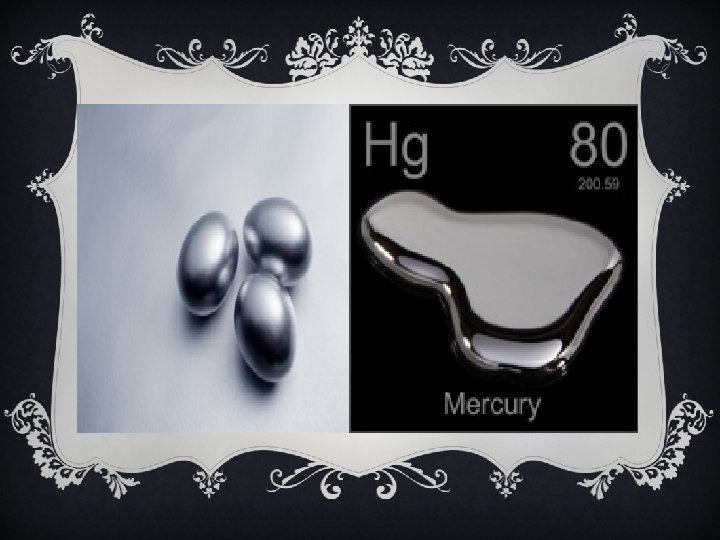
INTRODUCTION An amalgam is an alloy of any metal with mercury. Dental amalgam is made by alloying pure mercury with silver-tin-copper

G. V. BLACK FATHER OF DENTAL AMALGAM G. V. BLACK Formulated the alloy in 1896
v. Dental amalgam is a combination of one part liquid mercury with one part of a metallic alloy which mainly contains silver and tin. It has been used for over 150 years to restore decayed teeth, and its use has stirred controversy from the earliest days. To make the amalgam, mercury is mixed with the other metals to form a paste that can be fitted to the tooth cavity. The mixture sets relatively fast to form a hard alloy.
• At the time of the introduction of amalgam into dentistry, gold could be used in some types of dental restorations, but its cost prohibited widespread use. In the 19 th Century, there were no other synthetic materials that had both the required mechanical properties and the ease of placement. As a metallic alloy, amalgam did not look particularly good, but the increasing prevalence of dental caries at the time meant that this was a minor consideration. The even more profound increase in caries throughout the twentieth century, through the widespread use of refined sugars in foodstuffs, resulted in the increased use of dental amalgam fillings.
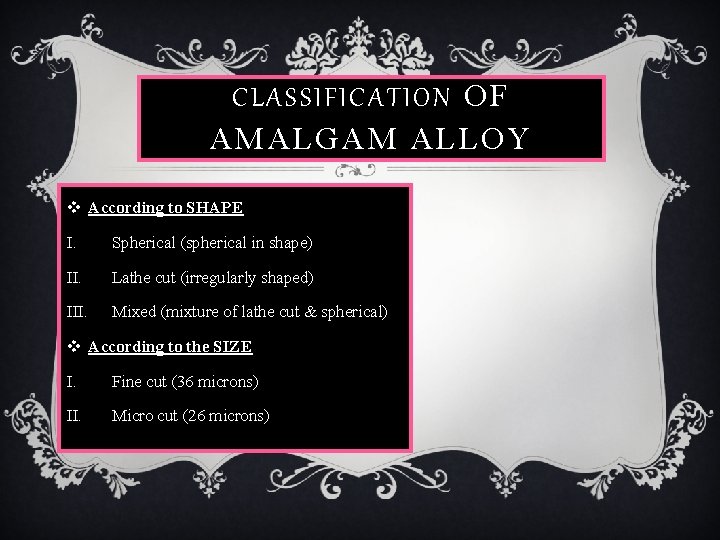
CLASSIFICATION OF AMALGAM ALLOY v According to SHAPE I. Spherical (spherical in shape) II. Lathe cut (irregularly shaped) III. Mixed (mixture of lathe cut & spherical) v According to the SIZE I. Fine cut (36 microns) II. Micro cut (26 microns)
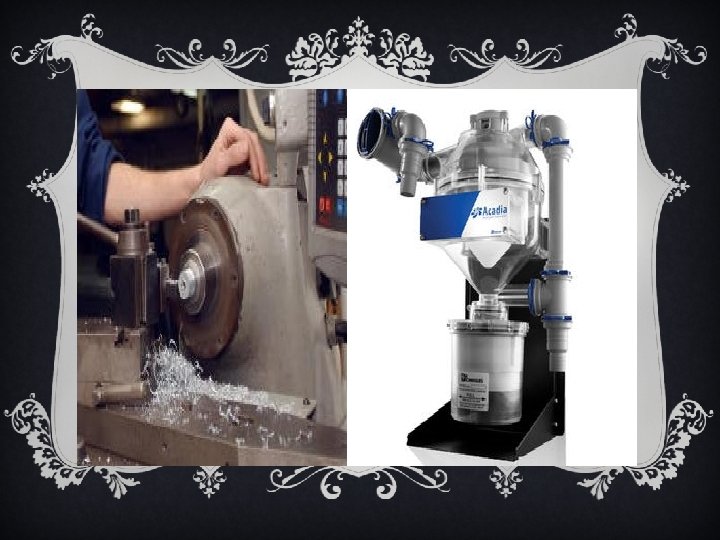
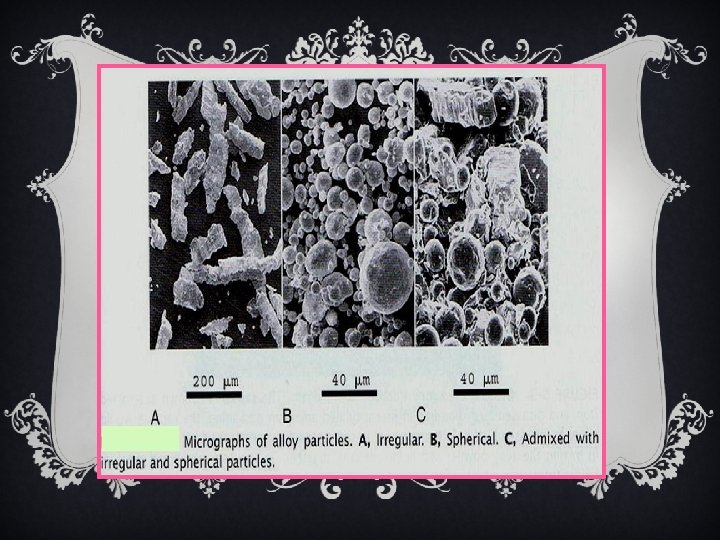
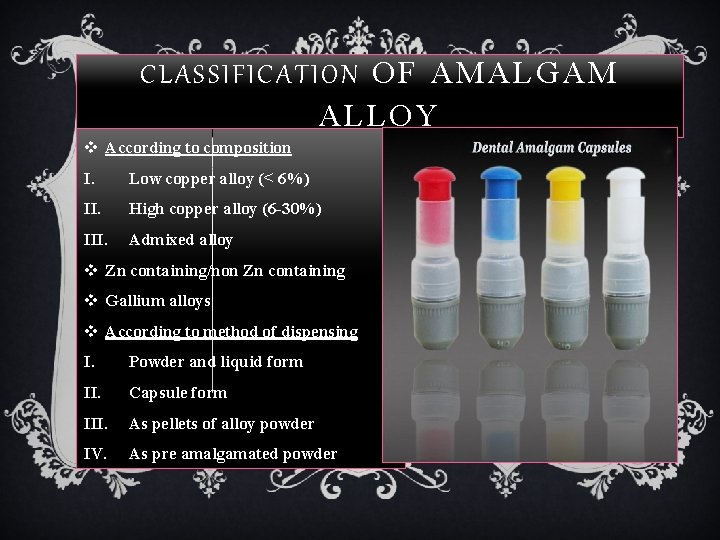
CLASSIFICATION OF AMALGAM ALLOY v According to composition I. Low copper alloy (< 6%) II. High copper alloy (6 -30%) III. Admixed alloy v Zn containing/non Zn containing v Gallium alloys v According to method of dispensing I. Powder and liquid form II. Capsule form III. As pellets of alloy powder IV. As pre amalgamated powder
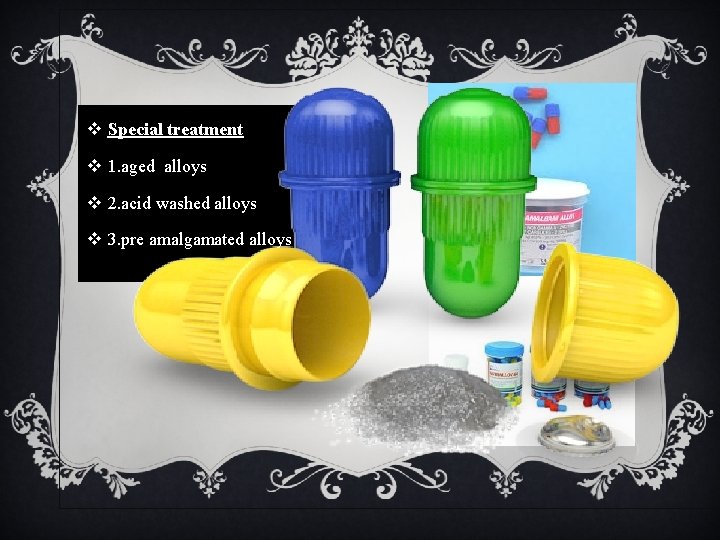
v Special treatment v 1. aged alloys v 2. acid washed alloys v 3. pre amalgamated alloys
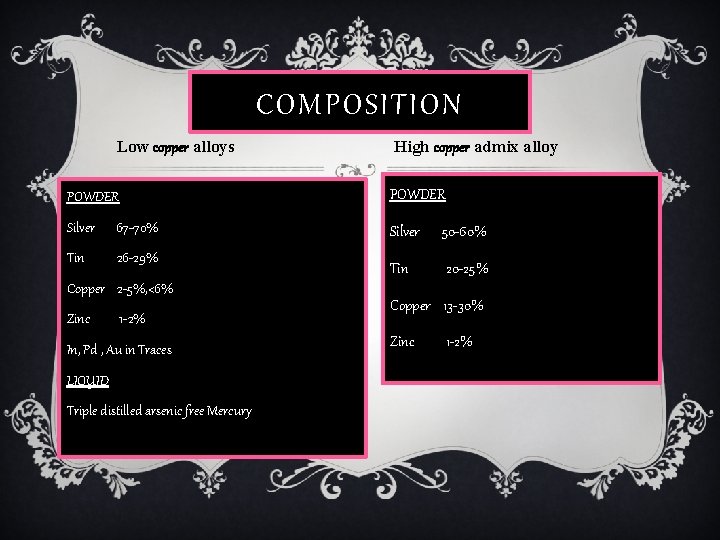
COMPOSITION Low copper alloys High copper admix alloy POWDER Silver 67 -70% Silver 50 -60% Tin 26 -29% Tin 20 -25% Copper 2 -5%, <6% Zinc 1 -2% In, Pd , Au in Traces LIQUID Triple distilled arsenic free Mercury Copper 13 -30% Zinc 1 -2%
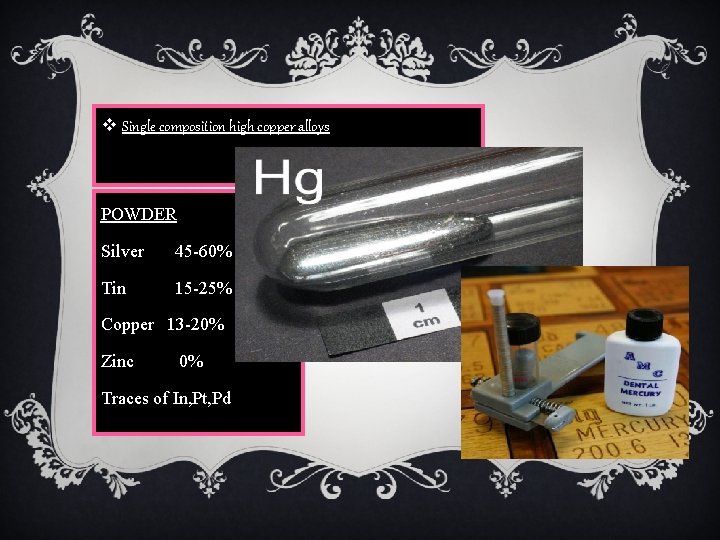
v Single composition high copper alloys POWDER Silver 45 -60% Tin 15 -25% Copper 13 -20% Zinc 0% Traces of In, Pt, Pd
PROPERTIES OF AMALGAM 1. Increased mercury leads to increased expansion , creep & corrosion 2. Compressive strength-Admixed is 430 Mpa after 7 days 3. Tensile strength-50 Mpa after 24 hours 4. Surface hardness-110 KHN 5. Working time 3 -8 mins 6. Setting time 5 -10 mins 7. Increased expansion is due to increased mercury , short trituration , low condensation pressure & water contamination 8. Creep is associated with : increased or decreased trituration , time lag between trituration & condensation, increased mercury, less condensation force
PHYSICAL PROPERTIES q Bio compatibility : it is biocompatibile q Strength : of amalgam takes 24 hrs to reach max q Corrosion : amalgam restoration shows corrosion & tarnish over a period of time q Thermal conductivity : it can transmit temp changes to the pulp q Micro leakage : occur when there is 2 -20 microns wide gap b/w the amalgam and the tooth structure
q Diamensional changes : small amount of contraction occurs in the first half an hour after trituration. q Delayed expansion : large setting expansion of about 4% sometimes takes place after few days in case of zinc containing amalgam , if there is moisture trapping or contamination during restoration q Mercuroscopic expansion : inhomogenous condensation pressure and wrong burnishing techniques can push mercury rich thin mix to the margins of the cavity. this excess mercury slowly react the alloy and powder more weaker points and large setting expansion at the margins. this can cause marginal breakdown or fracture.

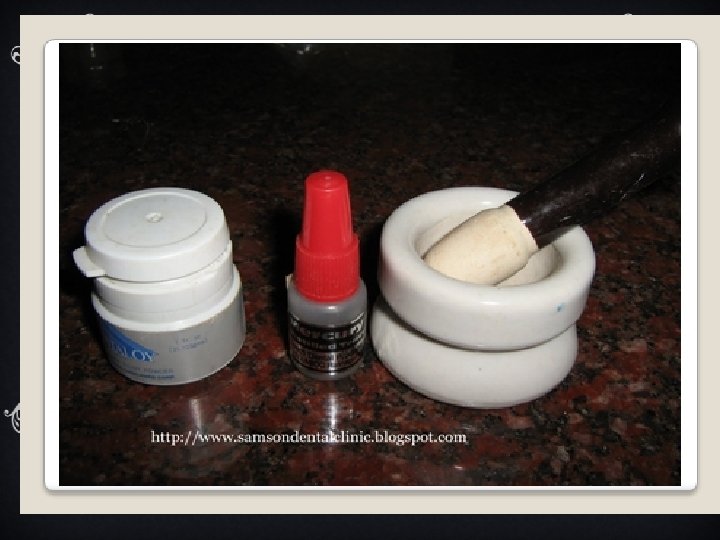
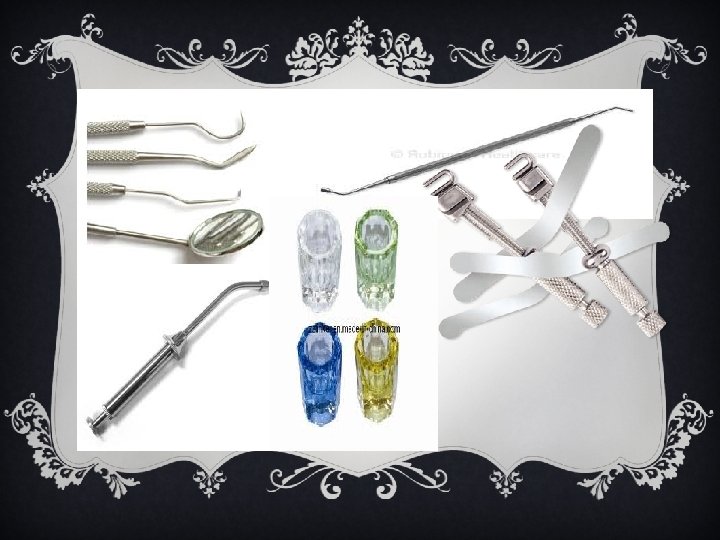
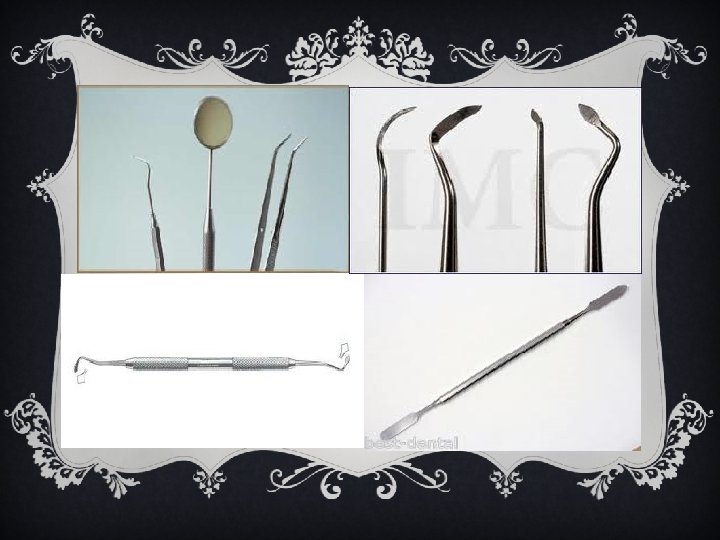
INSTRUMENTS
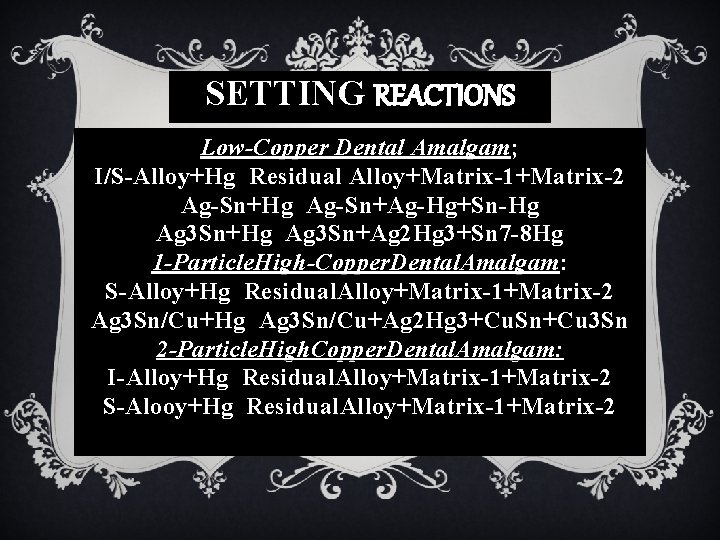
SETTING REACTIONS Low-Copper Dental Amalgam ; I/S-Alloy+Hg Residual Alloy+Matrix-1+Matrix-2 Ag-Sn+Hg Ag-Sn+Ag-Hg+Sn-Hg Ag 3 Sn+Ag 2 Hg 3+Sn 7 -8 Hg 1 -Particle. High-Copper. Dental. Amalgam : S-Alloy+Hg Residual. Alloy+Matrix-1+Matrix-2 Ag 3 Sn/Cu+Hg Ag 3 Sn/Cu+Ag 2 Hg 3+Cu. Sn+Cu 3 Sn 2 -Particle. High. Copper. Dental. Amalgam: I-Alloy+Hg Residual. Alloy+Matrix-1+Matrix-2 S-Alooy+Hg Residual. Alloy+Matrix-1+Matrix-2
MANIPULATION OF SILVER AMALGAM
SELECTION OF AMALGAM ALLOY v. In wider cavities alloy with low creep value is prefered v. Mercury alloy ratio Ø EAME’s has preferred 1: 1 ratio of alloy/mercury for best result
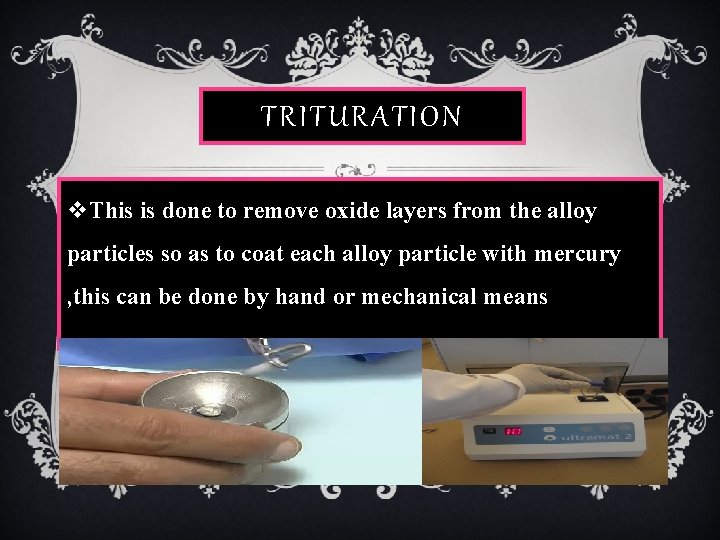
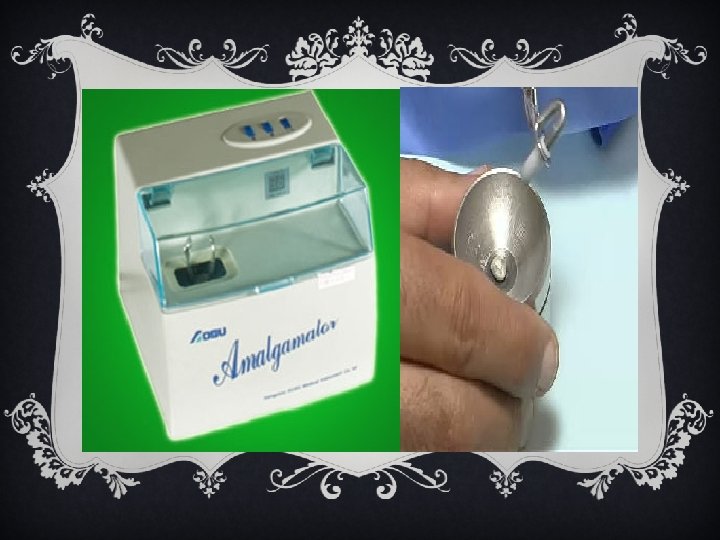
TRITURATION v. This is done to remove oxide layers from the alloy particles so as to coat each alloy particle with mercury , this can be done by hand or mechanical means
MULLING v. It is done so that alloy particles are coated with mercury. this can be done manually or mechanically
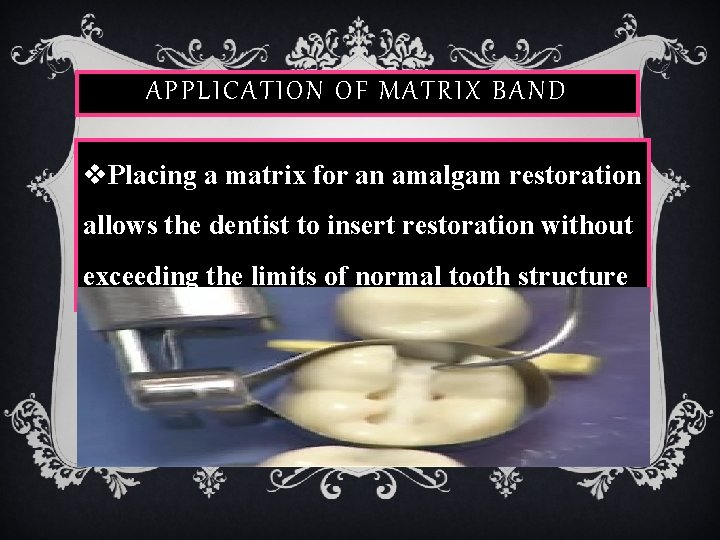
APPLICATION OF MATRIX BAND v. Placing a matrix for an amalgam restoration allows the dentist to insert restoration without exceeding the limits of normal tooth structure
INSERTION OF AMALGAM v. Pick a small amount of amalgam alloy with the help of amalgam carrier and transfer it to the preparation
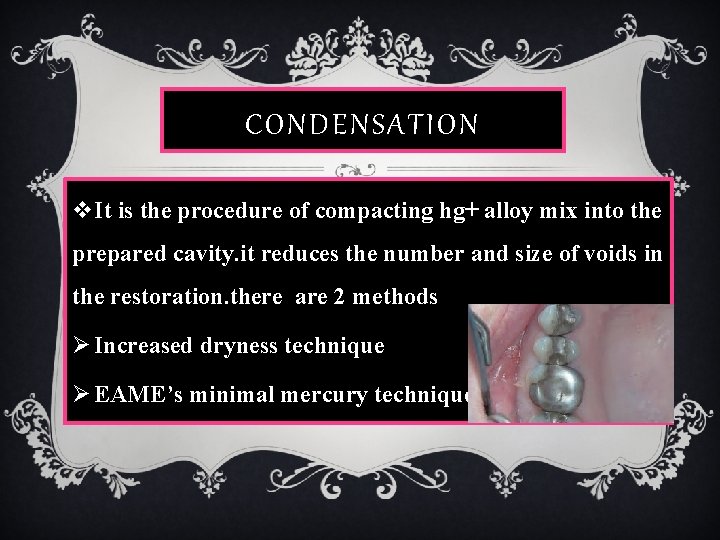
CONDENSATION v. It is the procedure of compacting hg+ alloy mix into the prepared cavity. it reduces the number and size of voids in the restoration. there are 2 methods Ø Increased dryness technique Ø EAME’s minimal mercury technique
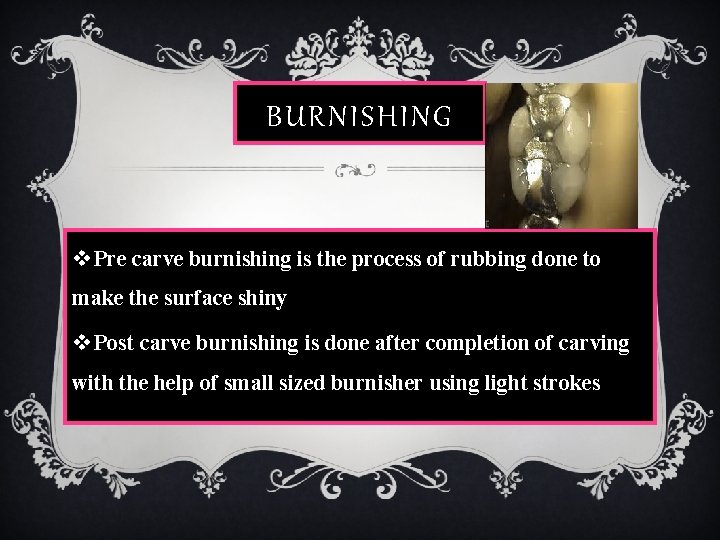
BURNISHING v Pre carve burnishing is the process of rubbing done to make the surface shiny v Post carve burnishing is done after completion of carving with the help of small sized burnisher using light strokes
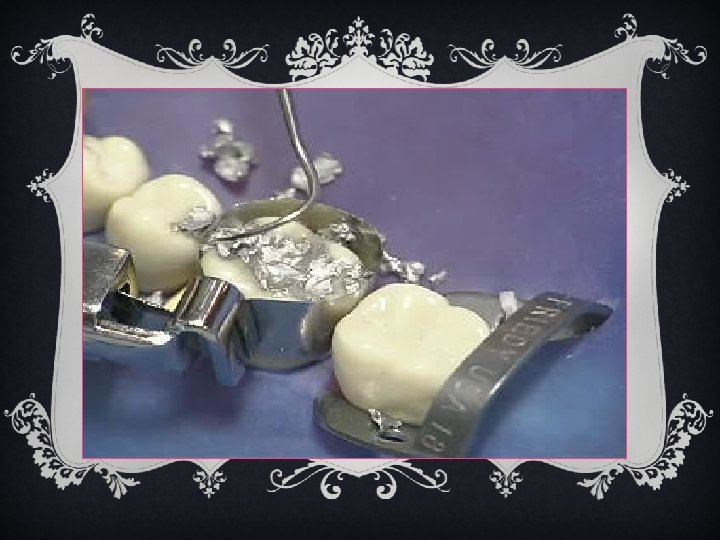
CARVING q Objectives of carving are v No over hanging and under hanging restoration v Proper size , location and good inter proximal contraction v Proper contour v Optimal occlusal anatomy
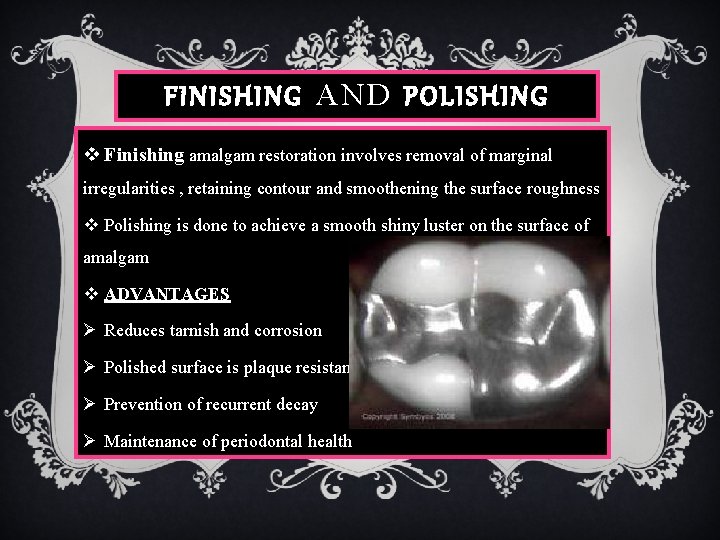
FINISHING AND POLISHING v Finishing amalgam restoration involves removal of marginal irregularities , retaining contour and smoothening the surface roughness v Polishing is done to achieve a smooth shiny luster on the surface of amalgam v ADVANTAGES Ø Reduces tarnish and corrosion Ø Polished surface is plaque resistant Ø Prevention of recurrent decay Ø Maintenance of periodontal health
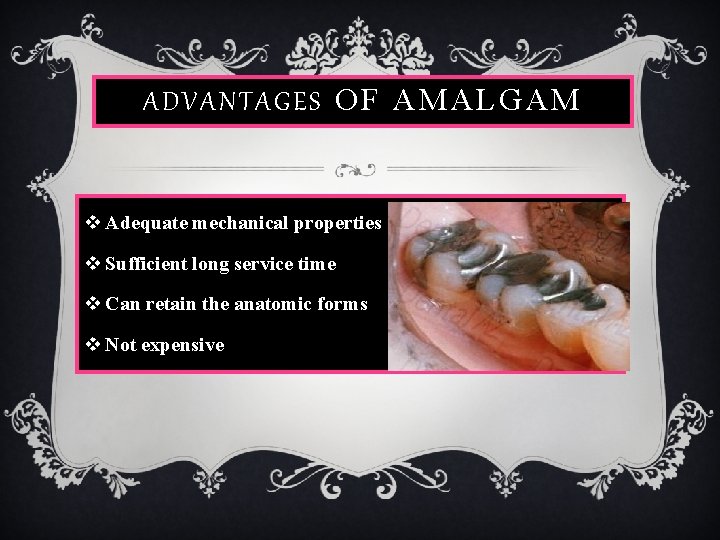
ADVANTAGES OF AMALGAM v Adequate mechanical properties v Sufficient long service time v Can retain the anatomic forms v Not expensive
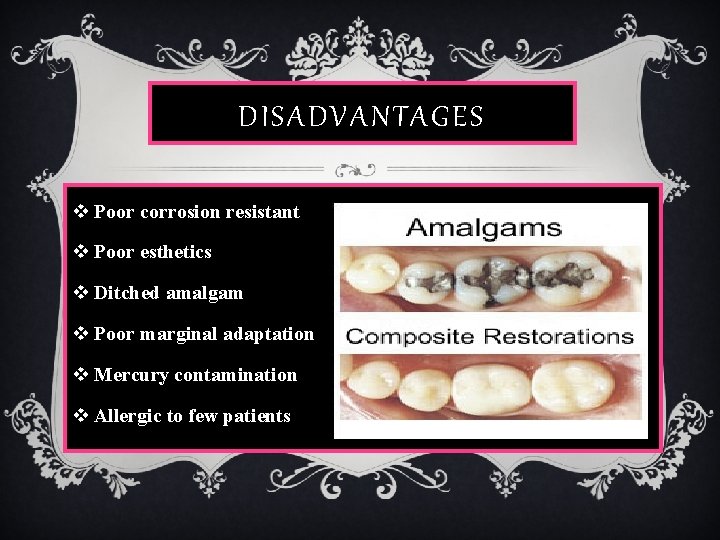
DISADVANTAGES v Poor corrosion resistant v Poor esthetics v Ditched amalgam v Poor marginal adaptation v Mercury contamination v Allergic to few patients
INDICATIONS v. Moderate to large class I preparation v. Class II preparation , in which there is heavy occlusion and problem of isolation v. Class IV preparation v. Used as post orthodontic restoration
CONTRAINDICATIONS v. Small to moderate class. I and class. II preparation should be restored with composite rather than amalgam is former results in more conservative tooth preparation v. Amalgam should avoid in area where aesthetic is of important
MERCURY TOXICITY Mercury can enter into the body respiratory and circulatory system by ingestion through skin or as vapors into the respiratory system and through food diet in circulatory system. In dentistry mercury is released during abrasion of amalgam restoration or trapped in the restoration which can migrate easily to body system In addition mercury vapors are inhaled during the time in dentistry, only very small amount of mercury is excreted but large amount is accumulated in the body.
§ Causes Damage to Brain in Children § Amalgam Fillings Linked to Neurological Problems, Gastrointestinal Problems § Mercury / Alzheimer's Disease Connection Found § Amalgam Fillings Release Highly Toxic Elemental Mercury § Gold Crowns, Gum, Bruxism, Computer Monitors Increase Release of Mercury Significantly § Cumulative Poison and Builds Up in Organs
§ Potential Contribuatory Factor in Other Diseases like allergy § Mercury Build Up in Brain, Organs and Breast Milk of Fetuses of Mothers With Amalgam Fillings § Proper Removal of Fillings Produces Eventual Health Improvement § World-reknowned Experts Agree About Potential Danger § Birth defect may be due to brief exposure during critical periods of featal development
PRECAUTIONS v Keep the mercury always in air tight bottles v Do not touch mercury directly without gloves v Do not spill the mercury on the floor or carpet v Do not open the capsules immediately after trituration v Do not use ultrasonic amalgamators v Collect all waste under water or sodium thiosulfate solution v Waste should be disposed by burying at larger depth v Keep the clinics well ventilated
Recent modification Bowen’s hybrid composite resin Modified visible light cure bowen’s hybrid composite resin have desirable property to Replace the silver amalgam
Gallium alloy(model) Gallium is a greyish metal of low density, and melting point 29. 8 degree Celsius, which can be used instead of mercury. Gallium alloy with indium and tin is a liquid at room temperature. Powder contains silver, tin, copper, and palladium. Liquid has gallium, tin, indium. When triturated, palladium alloys of Ag, Cu , In are formed with unreacted phases. Indium alloys Alloy containing higher percentage of indium has been tried. Powder has silver , copper and indium (4 to 30%). Indium replaces some amount of mercury and decreases health hazards by mercury vapour pollution. It has adequate mechanical properties strength at I hour 240 MPa , low creep-0. 8%Several composition, low and high Indium-alloys are under research-investigations.
COPPER AMALGAM Considering the antibacterial property of copper, copper amalgam was formulated with 30 -40% copper & 60 -70% of mercury & is supplied in pellet form the pellets are heated in a steel spatula, in a gas flame until mercury comes out of it. it is then triturated & condensed. it was suggested for rampent carious cases &deciduous tooth restoration. now it is not used since it has low corrosion resistance, poor mechanical property & greater mercury causing more health hazards
Be careful with silver amalgam Thank u Joyline dsouza Jisniya Jaseela. b. p Jahana Mariya davood nasrullah thomas Jamseera sidheeq
- Slides: 46