Community Health Worker CHWs Training for COVID19 Somalia










- Slides: 54
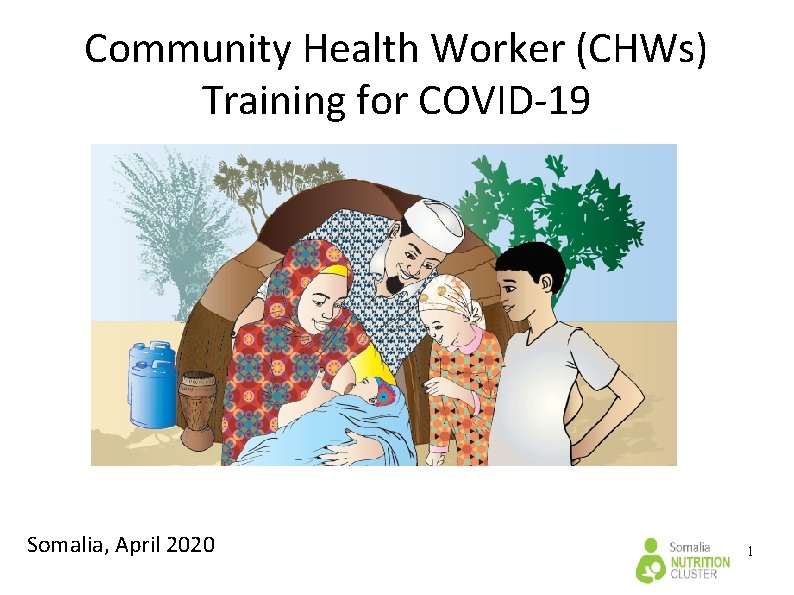
Community Health Worker (CHWs) Training for COVID-19 Somalia, April 2020 1
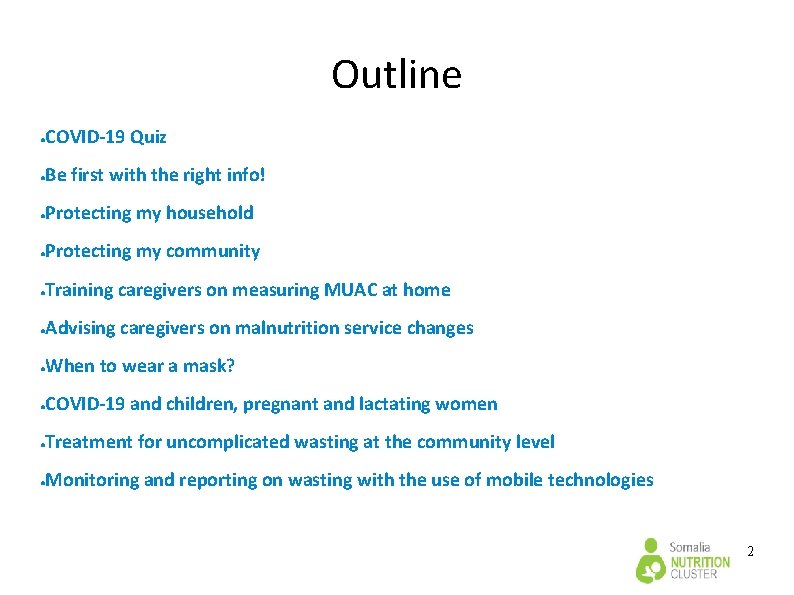
Outline ● COVID-19 Quiz ● Be first with the right info! ● Protecting my household ● Protecting my community ● Training caregivers on measuring MUAC at home ● Advising caregivers on malnutrition service changes ● When to wear a mask? ● COVID-19 and children, pregnant and lactating women ● Treatment for uncomplicated wasting at the community level ● Monitoring and reporting on wasting with the use of mobile technologies 2
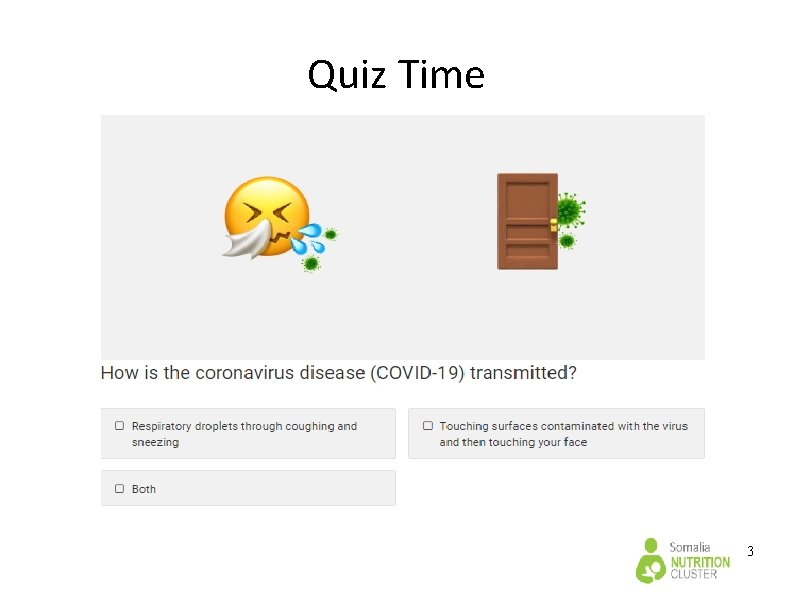
Quiz Time 3
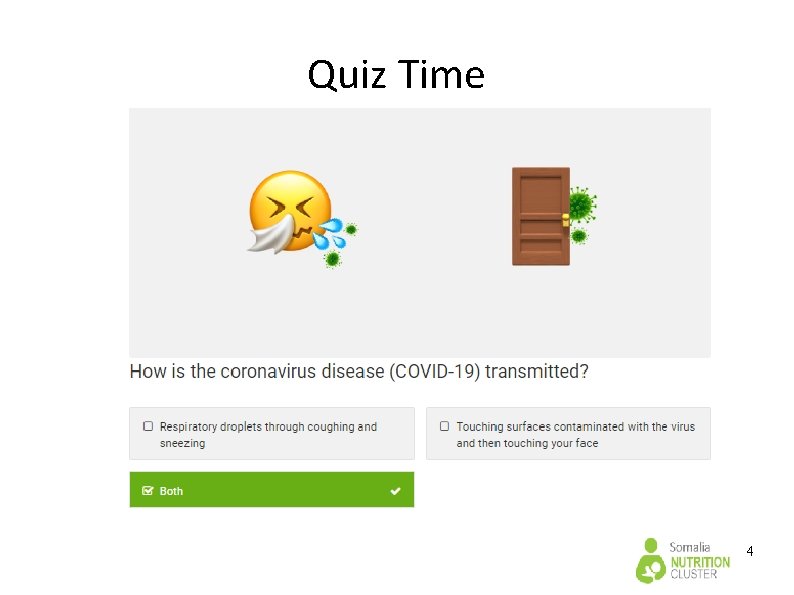
Quiz Time 4
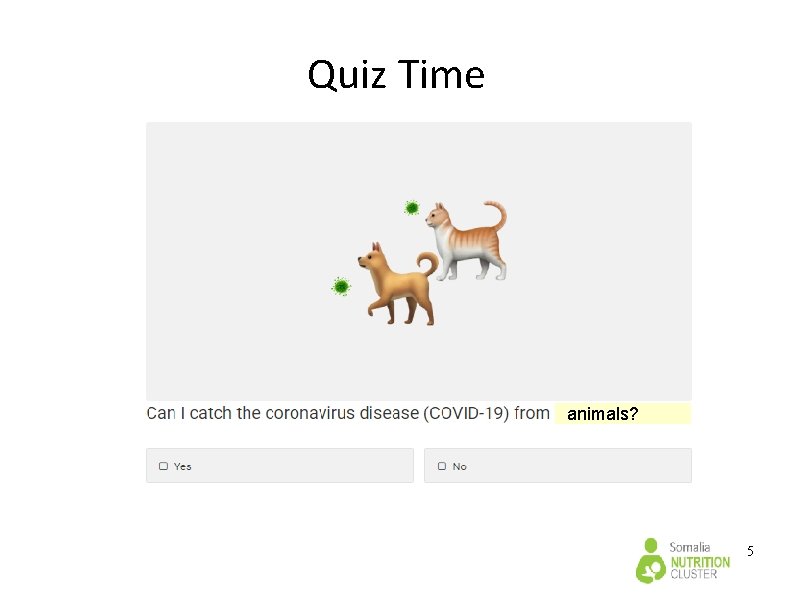
Quiz Time animals? 5
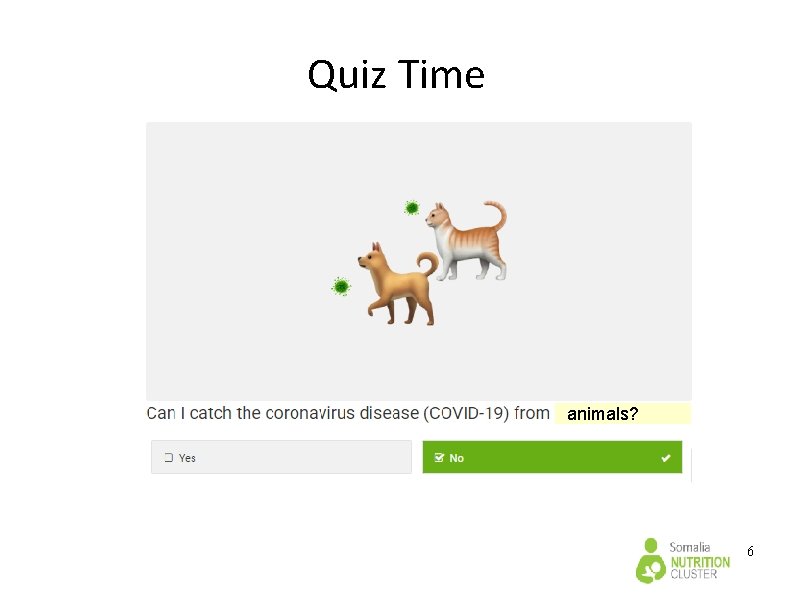
Quiz Time animals? 6
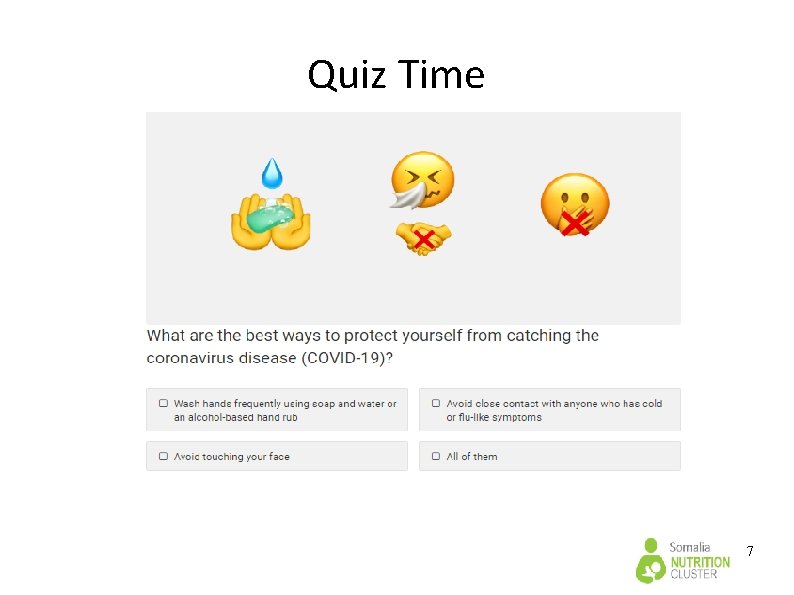
Quiz Time 7
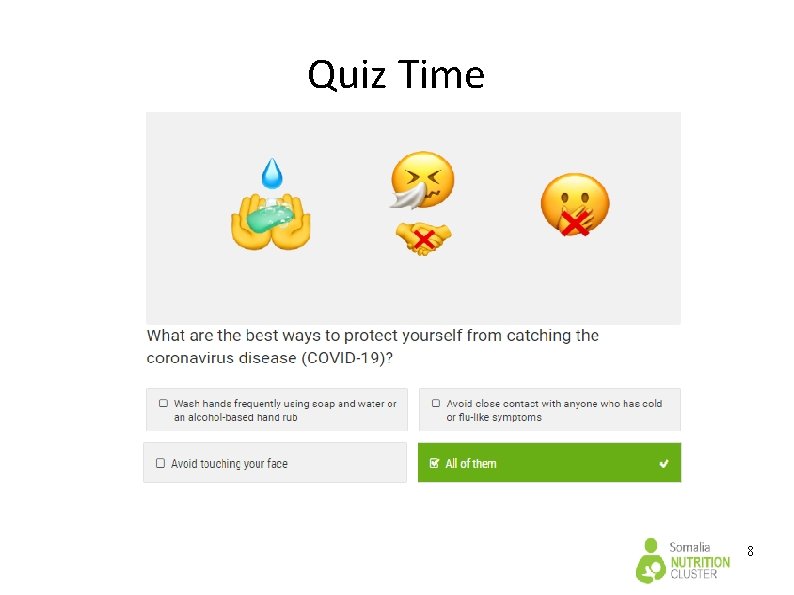
Quiz Time 8
Quiz Time 9
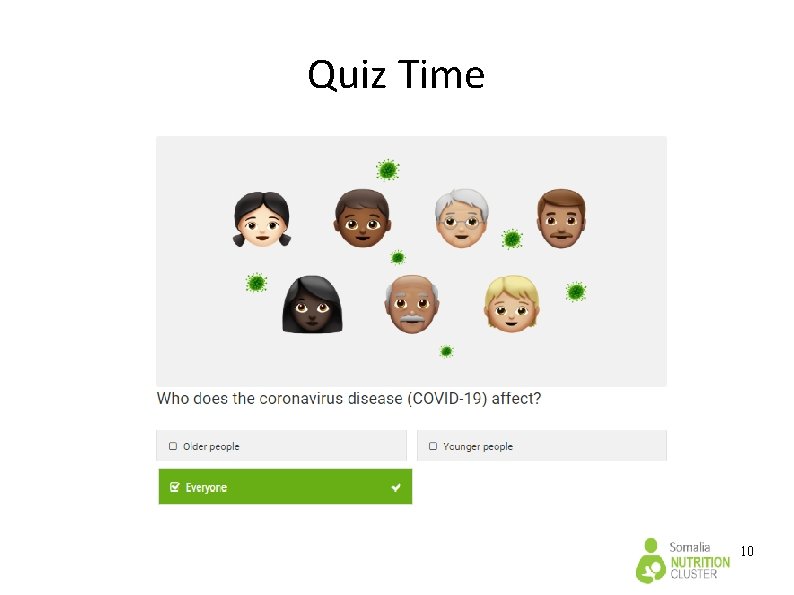
Quiz Time 10
Quiz Time 11
Quiz Time 12
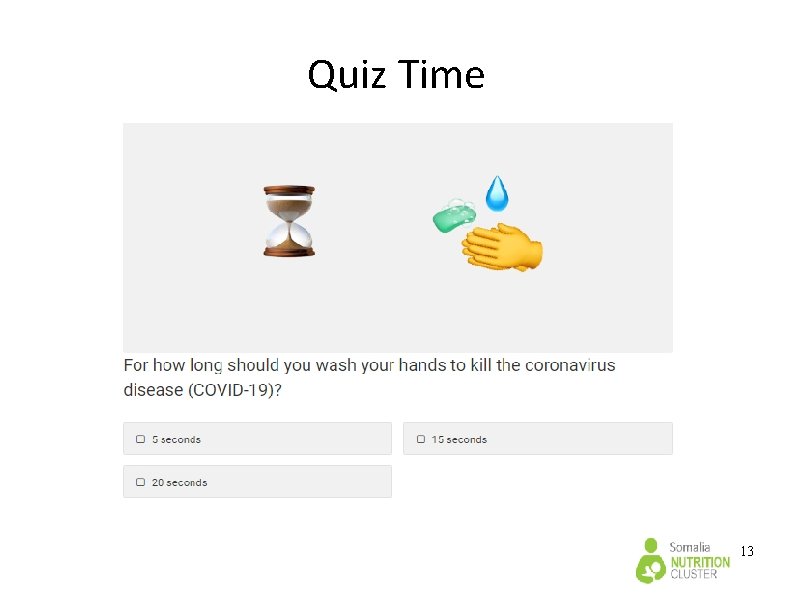
Quiz Time 13
Quiz Time 14
Quiz Time 15
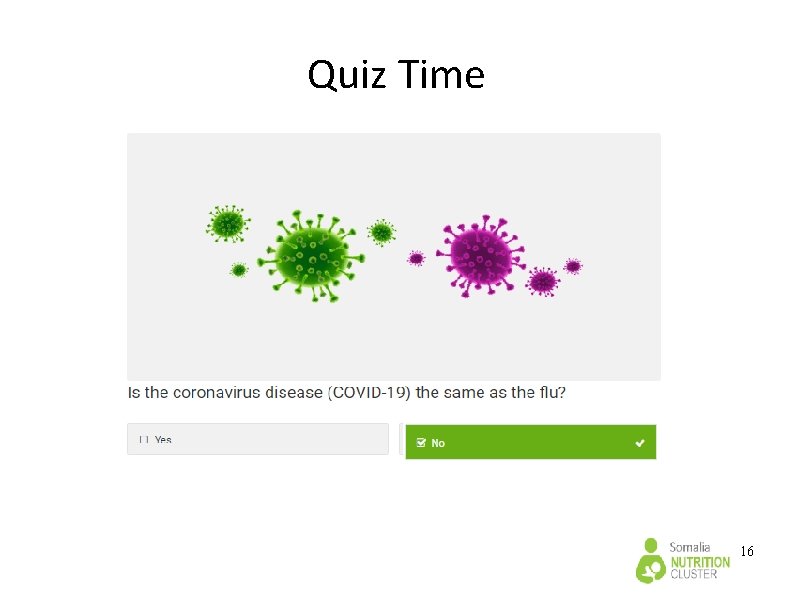
Quiz Time 16
Quiz Time 17
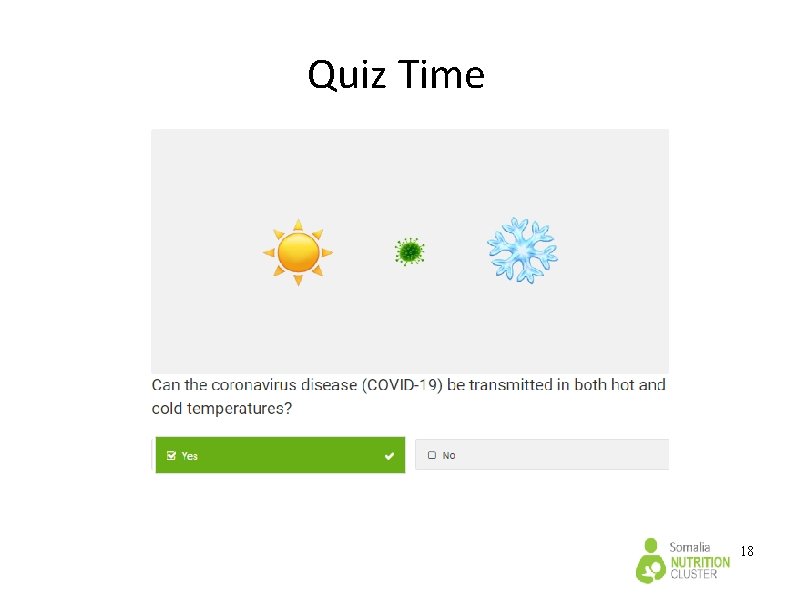
Quiz Time 18
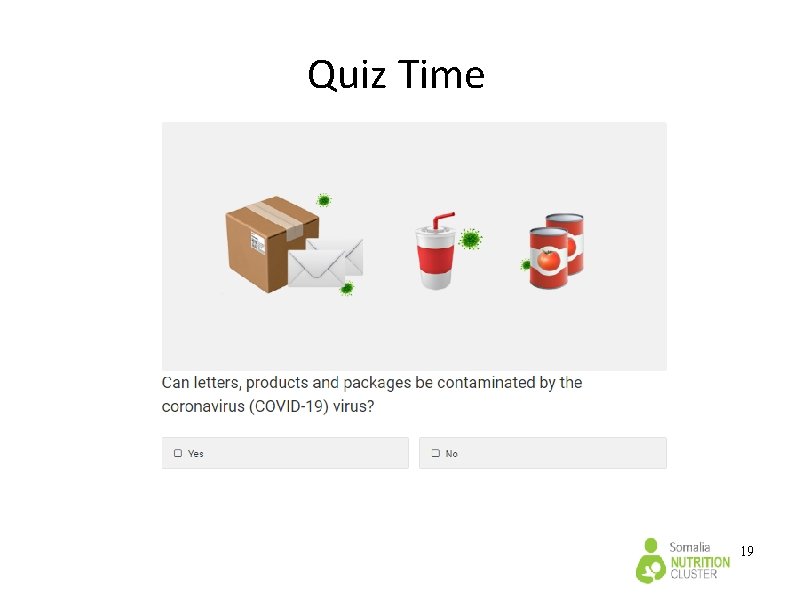
Quiz Time 19
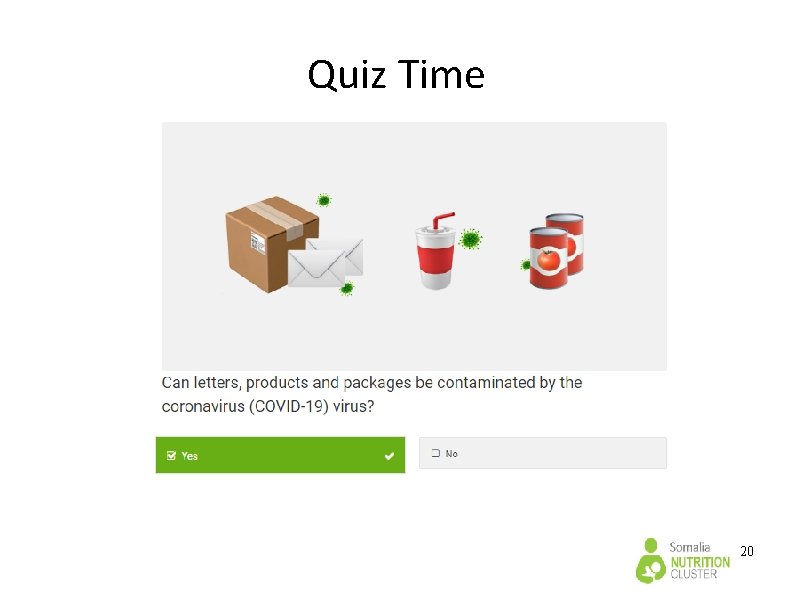
Quiz Time 20
Educated on COVID-19! 21
Be First with the Right Info! Check the facts with health facility workers. Know the facts. Share them with your community. If you know the facts, you can stop the myths! 22
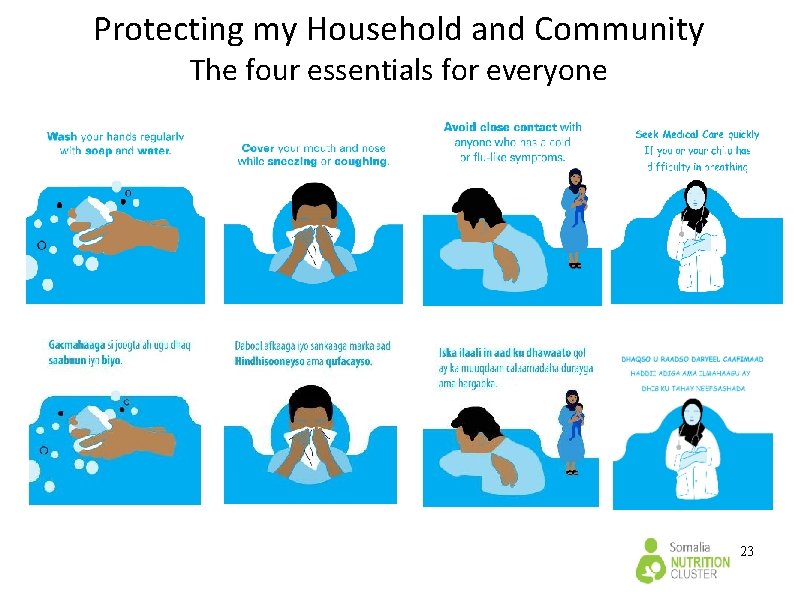
Protecting my Household and Community The four essentials for everyone 23
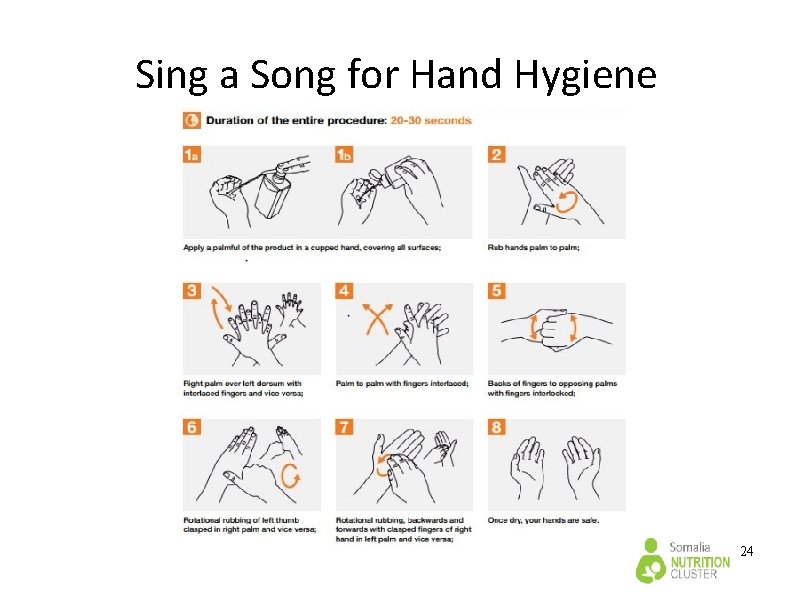
Sing a Song for Hand Hygiene 24
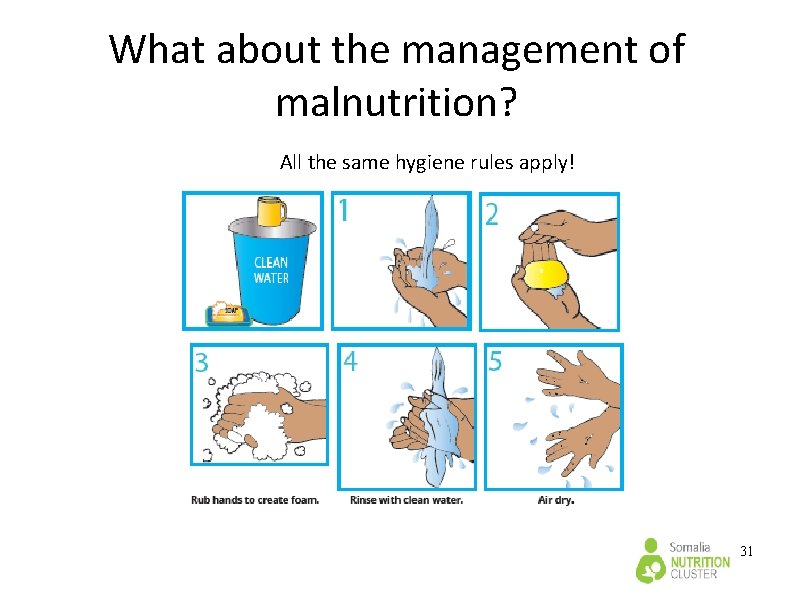
When to Wash Hands? • After visiting a public space, markets and places of worship • After touching surfaces outside of the home, including money • Before, during and after caring for a sick person • Before and after eating and feeding children • After using the toilet • After handling garbage • After touching animals • After helping children use the toilet • When your hands are visibly dirty 25
Coughing, Sneezing, Spitting, Touching your Face Sneeze and cough into your elbow, this helps to stop droplets from spreading longer distances. Try also to avoid spitting because this also spreads droplets that could transfer the virus. Try to avoid touching your face. Wash your hands after noticing you’ve touched your face to help keep your hands and face clean. 26
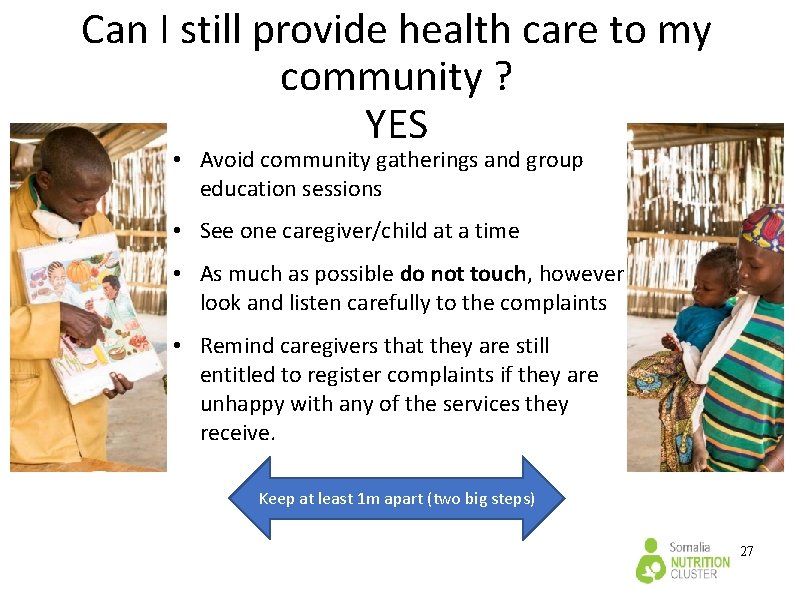
Can I still provide health care to my community ? YES • Avoid community gatherings and group education sessions • See one caregiver/child at a time • As much as possible do not touch, however look and listen carefully to the complaints • Remind caregivers that they are still entitled to register complaints if they are unhappy with any of the services they receive. Keep at least 1 m apart (two big steps) 27
Protecting my Community • Set a good example in your household. • Show empathy and respect. • Listen and build trust with your community. • Encourage families to keep their home well ventilated. • Reassure families who might be worried that there is a lot they can do to protect themselves and their loved ones. 28
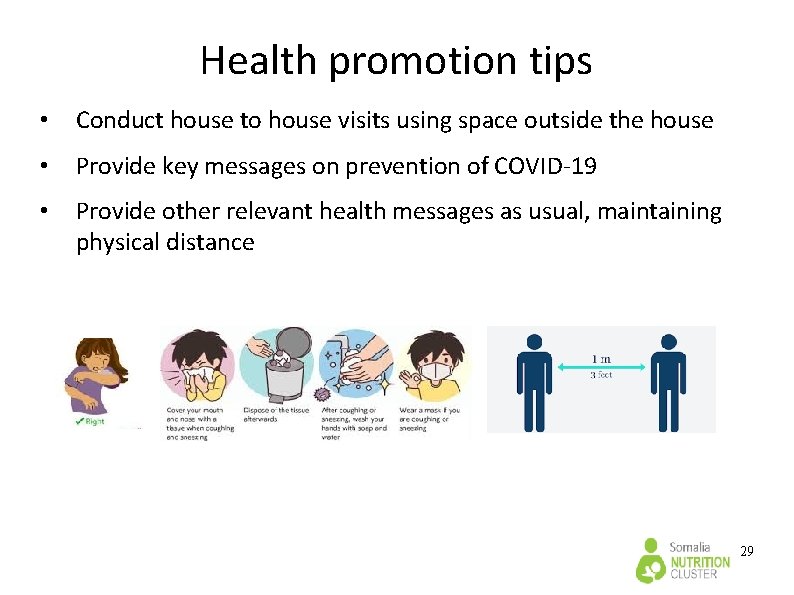
Health promotion tips • Conduct house to house visits using space outside the house • Provide key messages on prevention of COVID-19 • Provide other relevant health messages as usual, maintaining physical distance 29
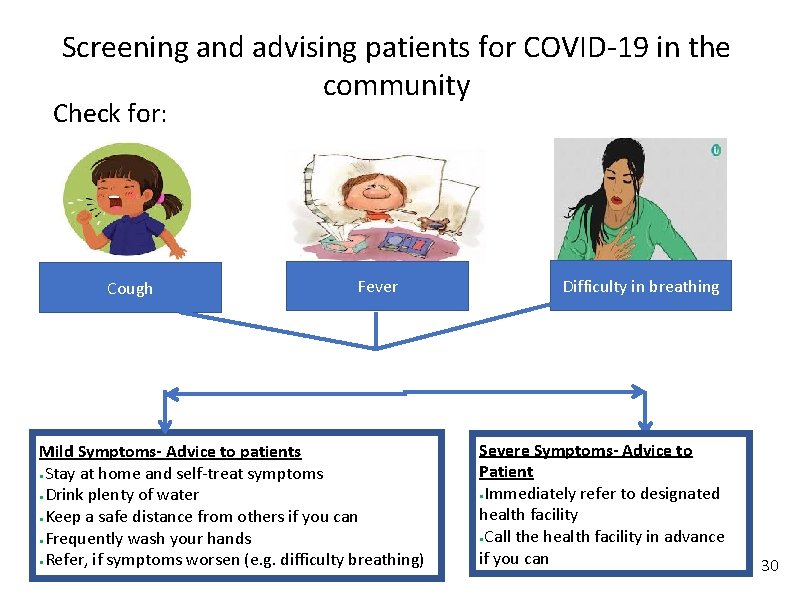
Screening and advising patients for COVID-19 in the community Check for: Cough Fever Mild Symptoms- Advice to patients ●Stay at home and self-treat symptoms ●Drink plenty of water ●Keep a safe distance from others if you can ●Frequently wash your hands ●Refer, if symptoms worsen (e. g. difficulty breathing) Difficulty in breathing Severe Symptoms- Advice to Patient ●Immediately refer to designated health facility ●Call the health facility in advance if you can 30
What about the management of malnutrition? All the same hygiene rules apply! 31
Keeping active in my community safely Use the 'low/no touch' approach. Train mothers to monitor their child's health and nutrition status with MUAC and oedema. Continue 1 -to-1 counselling, just keep at least 1 meter distance and make your visit shorter (15 minutes max). Communicate hygiene messages and COVID-19 awareness at every opportunity. 32
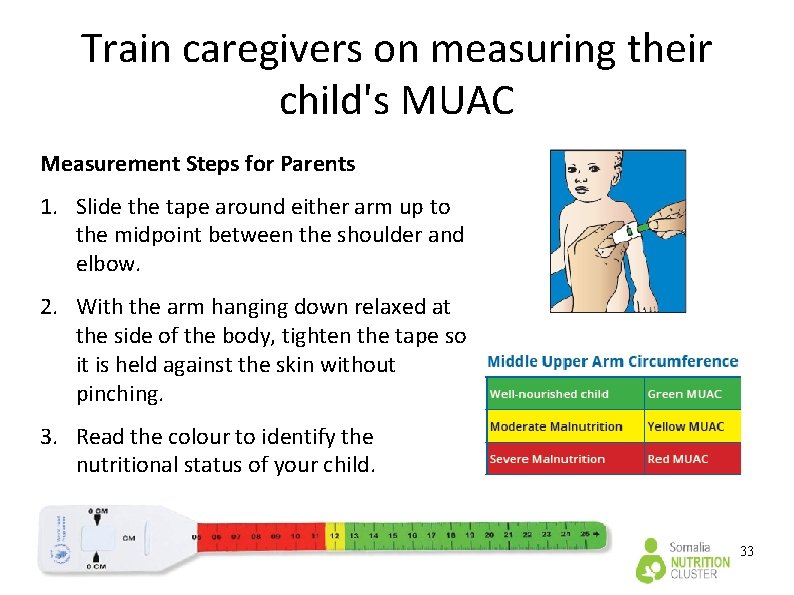
Train caregivers on measuring their child's MUAC Measurement Steps for Parents 1. Slide the tape around either arm up to the midpoint between the shoulder and elbow. 2. With the arm hanging down relaxed at the side of the body, tighten the tape so it is held against the skin without pinching. 3. Read the colour to identify the nutritional status of your child. 33
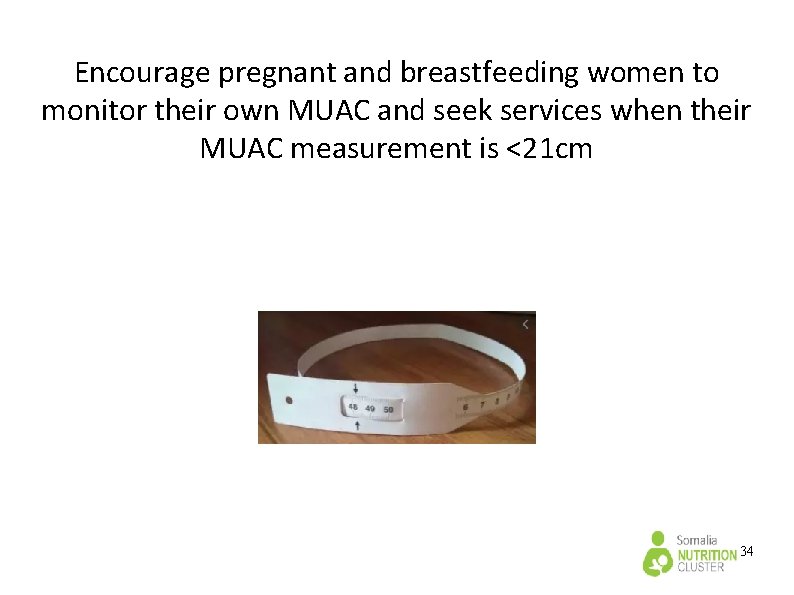
Encourage pregnant and breastfeeding women to monitor their own MUAC and seek services when their MUAC measurement is <21 cm 34
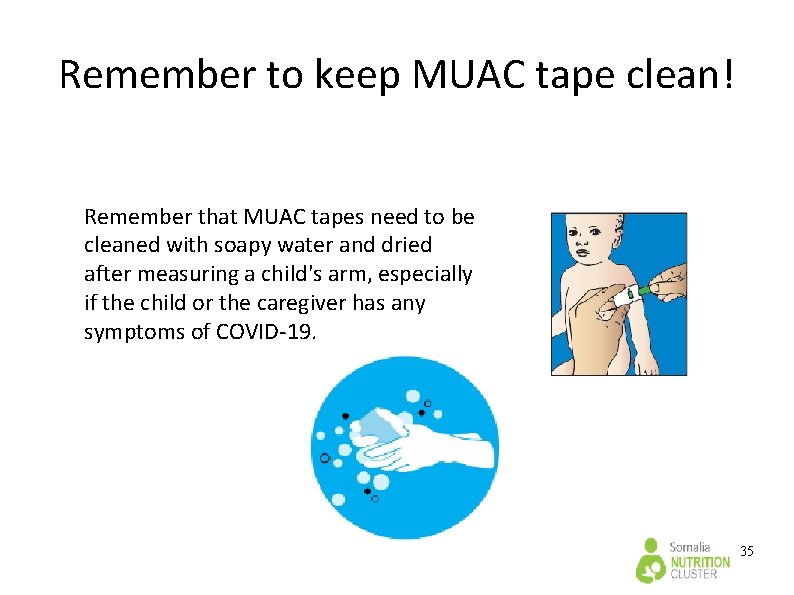
Remember to keep MUAC tape clean! Remember that MUAC tapes need to be cleaned with soapy water and dried after measuring a child's arm, especially if the child or the caregiver has any symptoms of COVID-19. 35
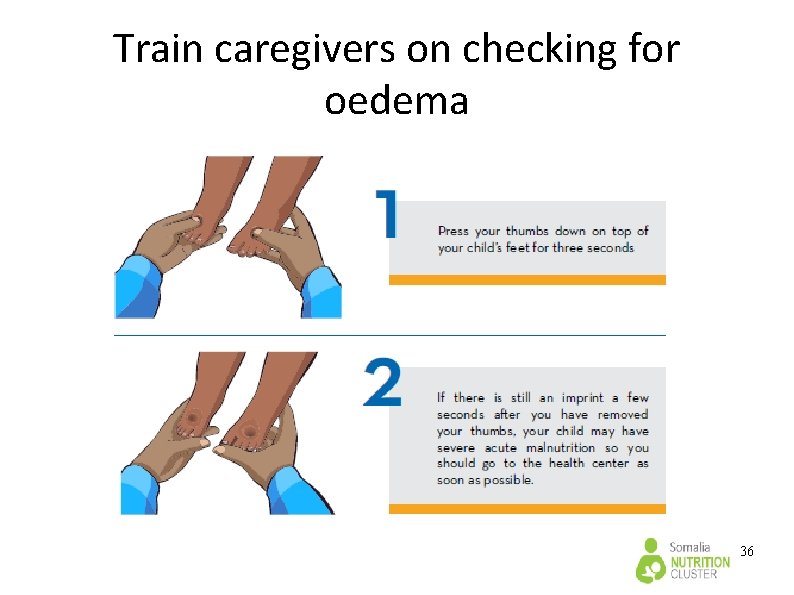
Train caregivers on checking for oedema 36
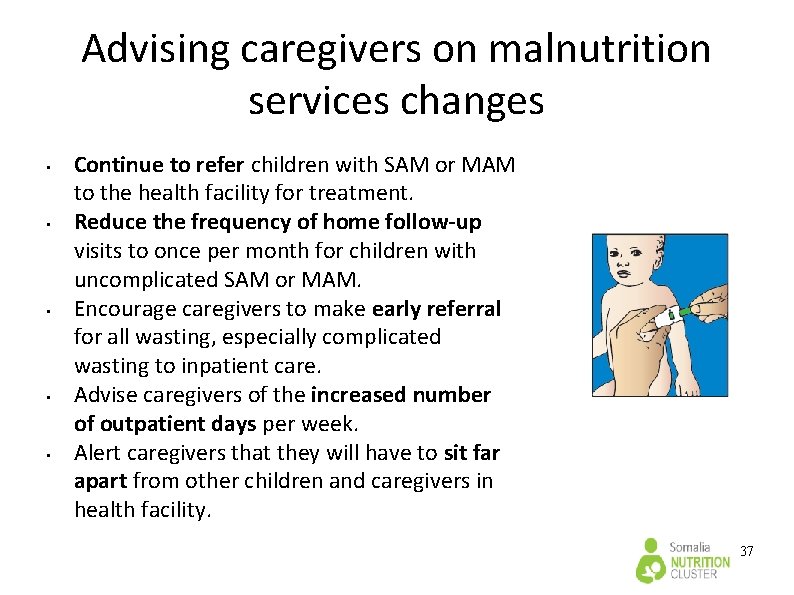
Advising caregivers on malnutrition services changes • • • Continue to refer children with SAM or MAM to the health facility for treatment. Reduce the frequency of home follow-up visits to once per month for children with uncomplicated SAM or MAM. Encourage caregivers to make early referral for all wasting, especially complicated wasting to inpatient care. Advise caregivers of the increased number of outpatient days per week. Alert caregivers that they will have to sit far apart from other children and caregivers in health facility. 37
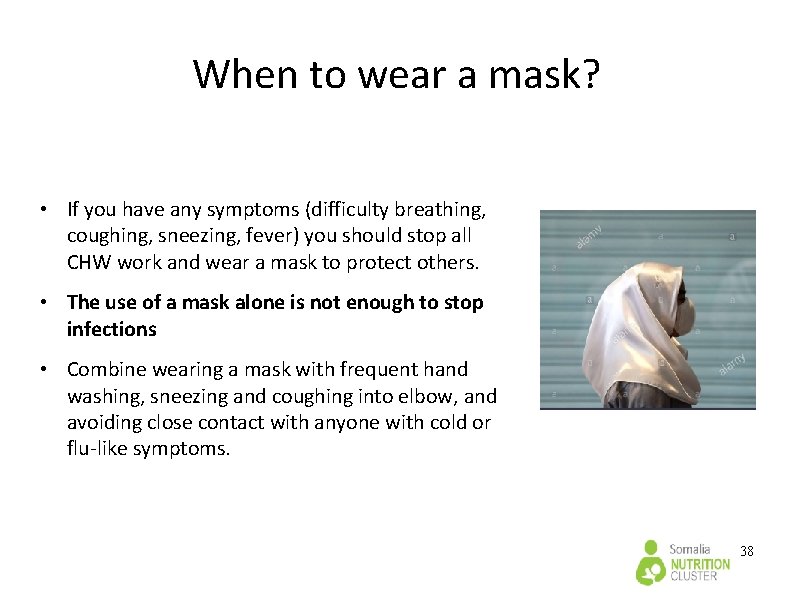
When to wear a mask? • If you have any symptoms (difficulty breathing, coughing, sneezing, fever) you should stop all CHW work and wear a mask to protect others. • The use of a mask alone is not enough to stop infections • Combine wearing a mask with frequent hand washing, sneezing and coughing into elbow, and avoiding close contact with anyone with cold or flu-like symptoms. 38
Making your own cloth face mask Medical masks are scarce and should be used by health care workers only Instead, cloth face masks can be worn to help slow virus spread: • In public settings where other social distancing measures are difficult to maintain (e. g. markets). • In homes, to help people who may have the virus to avoid transmitting it to others. Important: • Cloth face coverings should not be placed on young children under age 2, anyone who has trouble breathing, or is unconscious or otherwise unable to remove the cloth face covering without assistance. 39
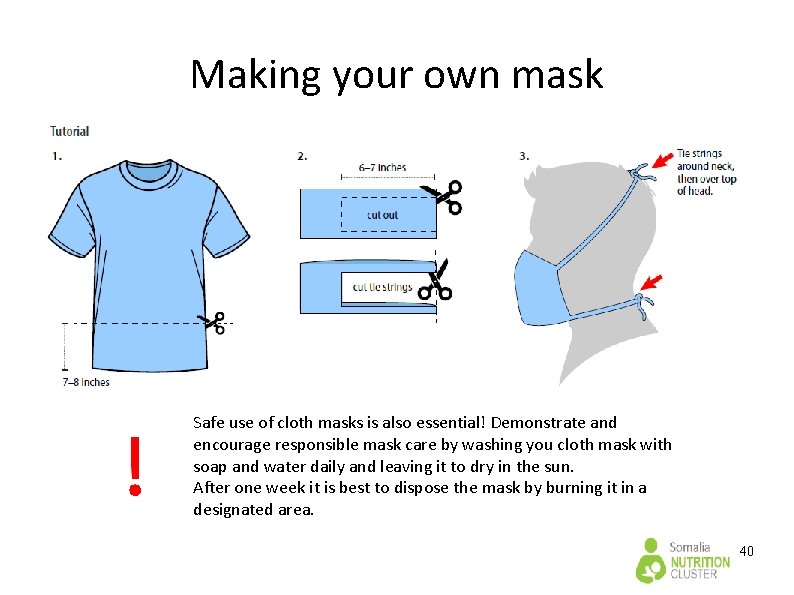
Making your own mask Safe use of cloth masks is also essential! Demonstrate and encourage responsible mask care by washing you cloth mask with soap and water daily and leaving it to dry in the sun. After one week it is best to dispose the mask by burning it in a designated area. 40
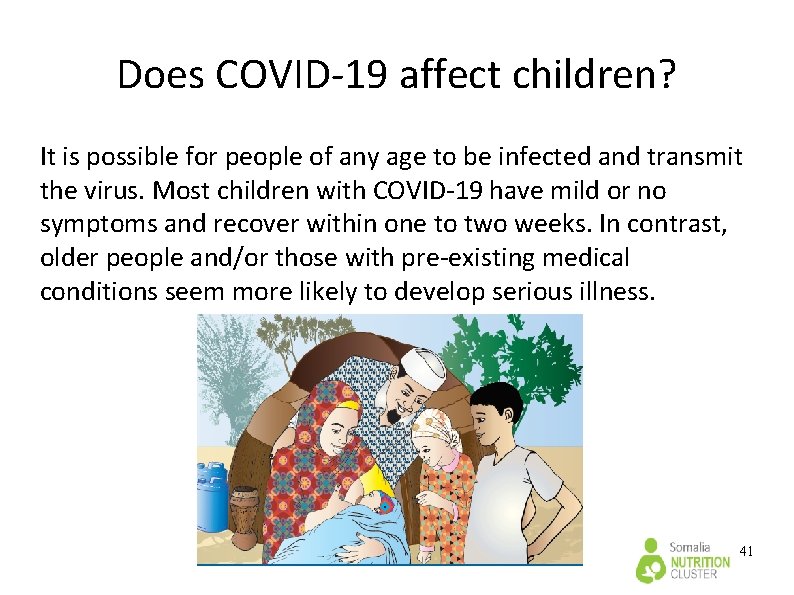
Does COVID-19 affect children? It is possible for people of any age to be infected and transmit the virus. Most children with COVID-19 have mild or no symptoms and recover within one to two weeks. In contrast, older people and/or those with pre-existing medical conditions seem more likely to develop serious illness. 41
What should I do if a child has symptoms of COVID-19? Advise the caregiver to: • Use soap, detergent or chlorinated water when handwashing • Try to avoid public places to prevent it passing to others • • Try and keep the child away from close contact with other family members, especially older people Keep a separate bowl and cup for the child and wash it carefully with soap and leave to dry in the sun 42
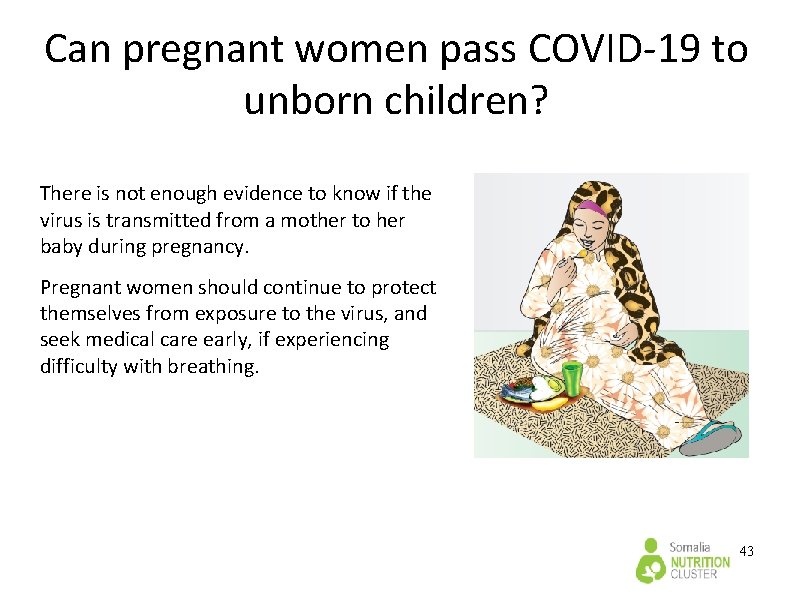
Can pregnant women pass COVID-19 to unborn children? There is not enough evidence to know if the virus is transmitted from a mother to her baby during pregnancy. Pregnant women should continue to protect themselves from exposure to the virus, and seek medical care early, if experiencing difficulty with breathing. 43
Is it safe for a mother to breastfeed if she is infected with COVID-19? YES! Breastfeeding is still best for babies. Mothers with symptoms who are well enough to breastfeed, should wear a mask when near her child (including during feeding), wash her hands before and after contact with the child, and clean/disinfect contaminated surfaces. Mothers should also continue breastfeeding if the child becomes sick with COVID-19 or any other illness. 44
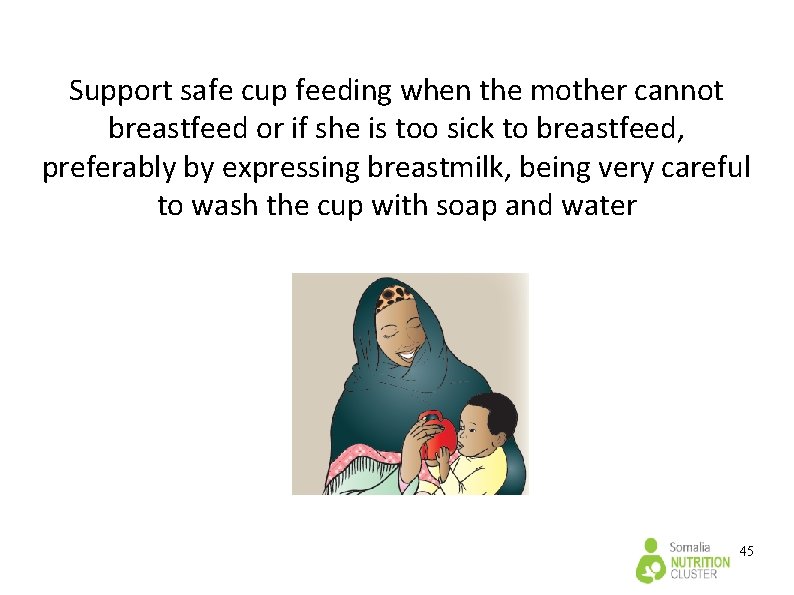
Support safe cup feeding when the mother cannot breastfeed or if she is too sick to breastfeed, preferably by expressing breastmilk, being very careful to wash the cup with soap and water 45
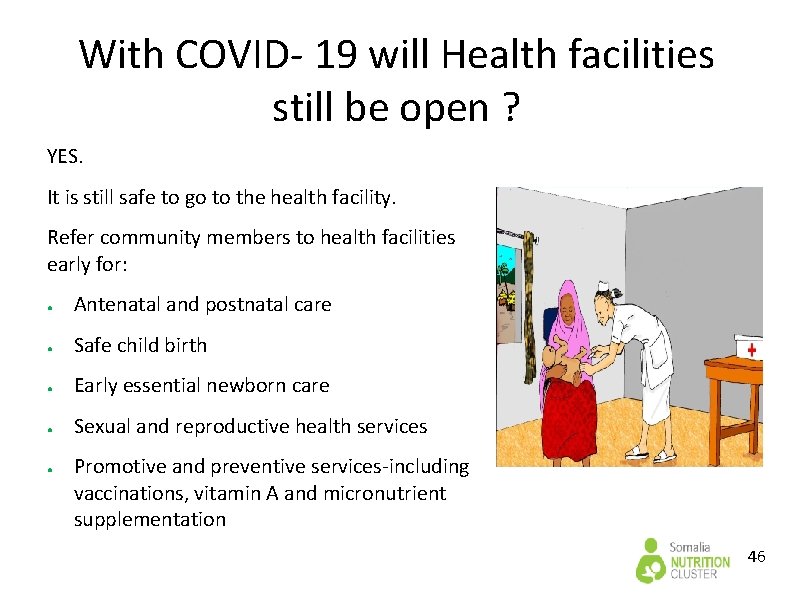
With COVID- 19 will Health facilities still be open ? YES. It is still safe to go to the health facility. Refer community members to health facilities early for: ● Antenatal and postnatal care ● Safe child birth ● Early essential newborn care ● Sexual and reproductive health services ● Promotive and preventive services-including vaccinations, vitamin A and micronutrient supplementation 46
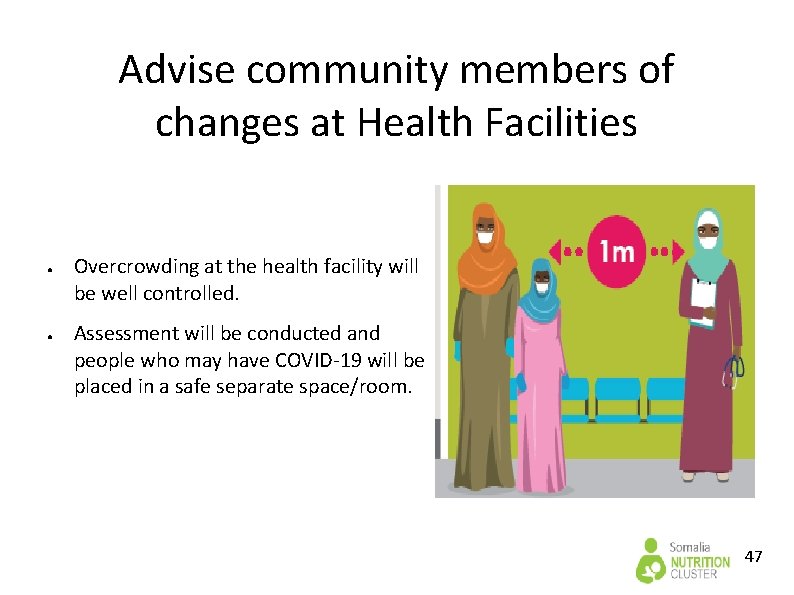
Advise community members of changes at Health Facilities ● ● Overcrowding at the health facility will be well controlled. Assessment will be conducted and people who may have COVID-19 will be placed in a safe separate space/room. 47
Home follow-up visits • Follow-up and support people who may have COVID-19 on a weekly basis • Check on people who are mildly unwell for danger signs or other livelihood needs and report this information to your supervisors • Wear a face masks and gloves, if available, and wash your hands with soap and water before and after each home visit 48
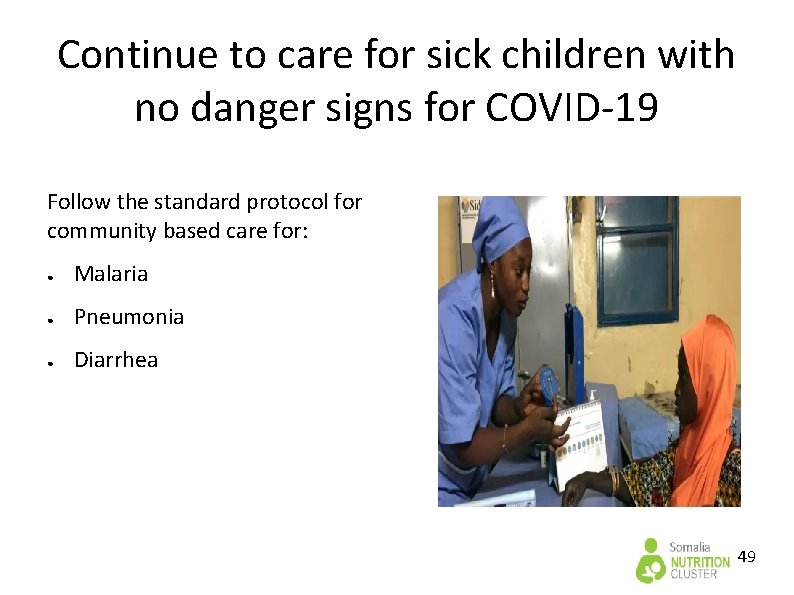
Continue to care for sick children with no danger signs for COVID-19 Follow the standard protocol for community based care for: ● Malaria ● Pneumonia ● Diarrhea 49
Care for the Newborn ● ● ● Promote Safe Motherhood and Newborn care at home, encourage mothers to visit the health facility for ANC, delivery and for an examination of their newborn. Promote early and exclusive breastfeeding for the first six months. Promote routine immunization, encouraging caregivers to attend services provided through outreach or their nearest health facility. 50
Ways to continue care when movement is restricted ● Share your phone number with your community ● Use mobile calls, texts and Whatsapp for: – client history, identification of danger signs, and provide referrals – Sending reports to your Supervisor – Following up on people who have returned home ● Collect enough supplies/medicines to last you for about two months 51
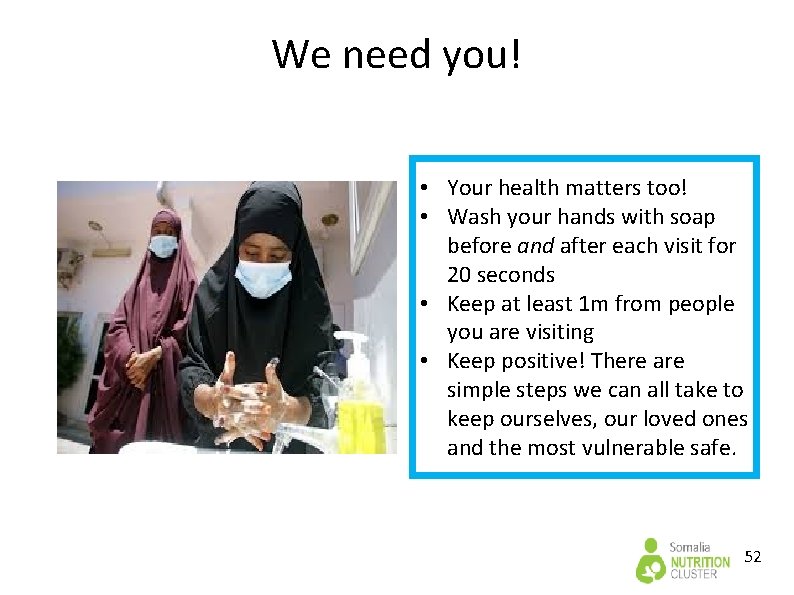
We need you! • Your health matters too! • Wash your hands with soap before and after each visit for 20 seconds • Keep at least 1 m from people you are visiting • Keep positive! There are simple steps we can all take to keep ourselves, our loved ones and the most vulnerable safe. 52
References and Resources • • • • UNICEF Coronavirus Quiz Tech RRT Webinar “Child wasting programming in response and preparation to the COVID-19 pandemic: experiences from the field” and “ Protecting, promoting and supporting IYCF during the COVID-19 pandemic: reflections and recommendations. ” Irish Global Health Network COVID-1 Weekly Webinar LSHTM Future Learn Online COVID-19 Course UNICEF COVID 19 Community guidance for social mobilizers volunteers (UNICEF Share. Point) MANAGEMENT OF CHILD WASTING IN THE CONTEXT OF COVID-19 Adaptation to Somali context Brief No. 1 (March 27 th 2020, GTAM) INFANT & YOUNG CHILD FEEDING IN THE CONTEXT OF COVID-1, Brief No. 2 (v 1) (30 March 2020, GTAM) Nutrition in emergencies checklist for the nutrition cluster, Infant and Young Child Feeding in Emergencies (IYCF-E) (March 2020, GTAM) Joint Statement on Infant and Young Child Feeding in the Context of COVID-19 Pandemic, ( March 2020, IFE Core Group) CORONAVIRUS DISEASE (COVID-19) Summary of Guidance for Nutrition in Emergencies Practitioners, VERSION 1. 1 – (13 March 2020, GTAM) Nutrition Cluster Contingency Response plan Somalia- COVID 19 (31 March 2020, Nutrition Cluster) Priorities for the Global COVID-19 Response: the Role of Community Health (Ballard et al, 2020) The COVID-19 Risk Communication Package For Healthcare Facilities (March 2020, WHO) COVID‑ 19: Strategic planning and operational guidance for maintaining essential health services during an outbreak (March 2020, WHO) WHO Mask Guidance (April 2020) 53
Any Questions? Contact chogan@unicef. org maabdirahman@unicef. org pramila. ghimire@wfp. org naema. hirad@wfp. org Presentation Last Updated: April 20 th 2020 54