CHEMISTRY MATTER AND STATES OF MATTER Hold on


- Slides: 54
CHEMISTRY MATTER AND STATES OF MATTER
Hold on to your hats! It’s going to be an exciting ride!
CHEMISTRY • The study of the composition, structure, and properties of matter and the changes that matter undergoes • Includes: chemical and physical properties, how things interact, and what they are made of.
WHAT IS MATTER • Matter – Anything that has mass and takes up space • Composition of Matter: – Atoms – Elements – Molecules – Compounds
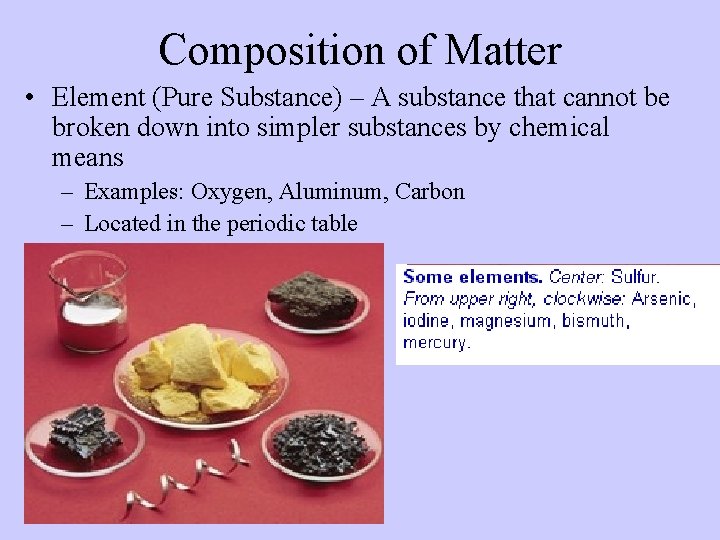
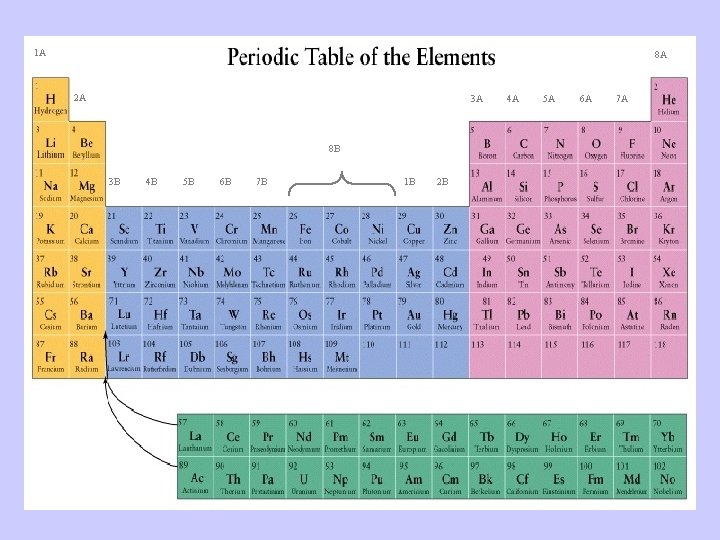
Composition of Matter • Element (Pure Substance) – A substance that cannot be broken down into simpler substances by chemical means – Examples: Oxygen, Aluminum, Carbon – Located in the periodic table
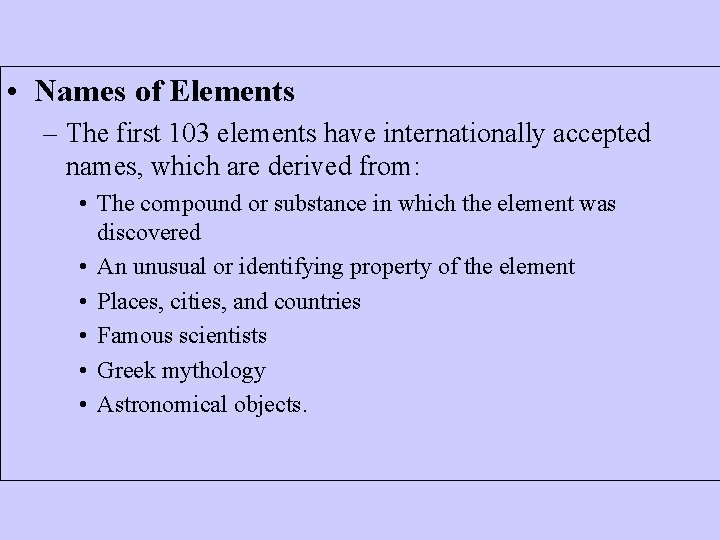
• Names of Elements – The first 103 elements have internationally accepted names, which are derived from: • The compound or substance in which the element was discovered • An unusual or identifying property of the element • Places, cities, and countries • Famous scientists • Greek mythology • Astronomical objects.
1 A 8 A 2 A 3 A 8 B 3 B 4 B 5 B 6 B 7 B 1 B 2 B 4 A 5 A 6 A 7 A
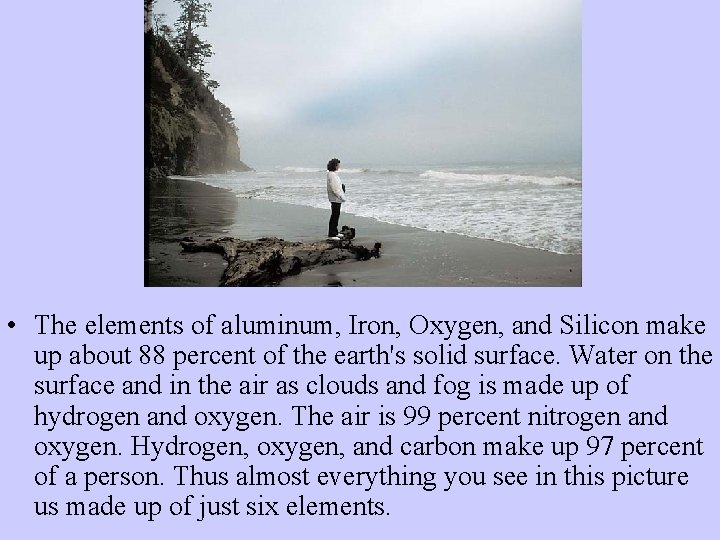
• The elements of aluminum, Iron, Oxygen, and Silicon make up about 88 percent of the earth's solid surface. Water on the surface and in the air as clouds and fog is made up of hydrogen and oxygen. The air is 99 percent nitrogen and oxygen. Hydrogen, oxygen, and carbon make up 97 percent of a person. Thus almost everything you see in this picture us made up of just six elements.
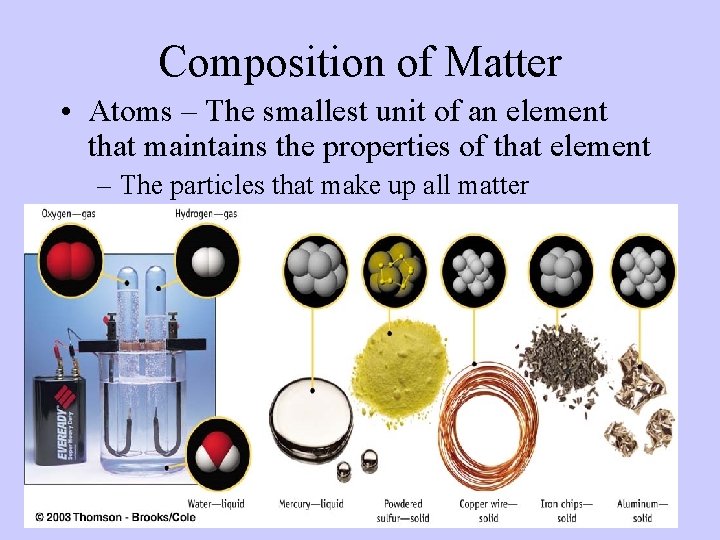
Composition of Matter • Atoms – The smallest unit of an element that maintains the properties of that element – The particles that make up all matter
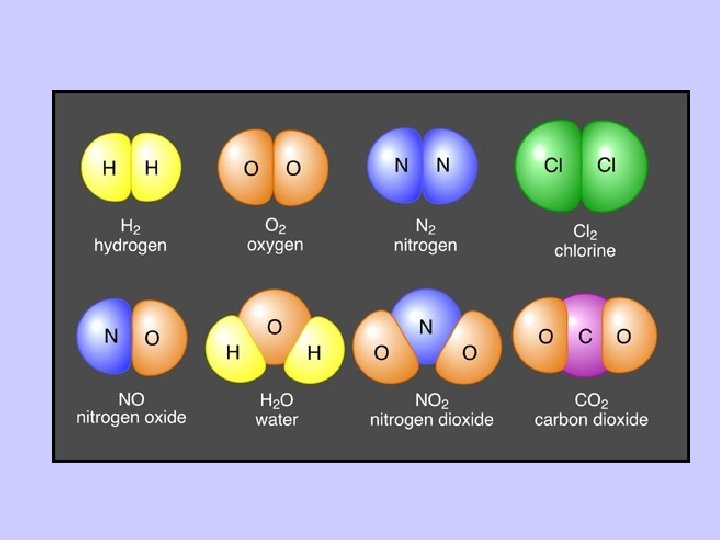
Composition of Matter • Compounds – A substance made of two or more different elements that are chemically combined – Example: Nylon is a combination of carbon, hydrogen, nitrogen, and oxygen atoms – Example: Composition of air
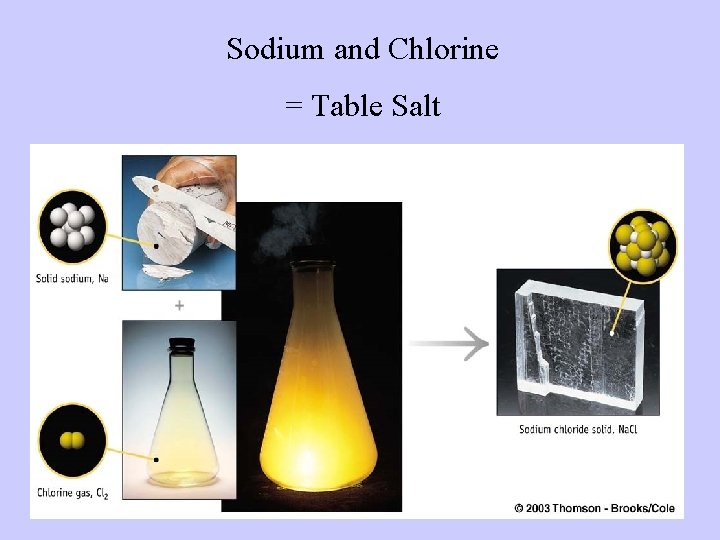
• Compounds have unique properties different from the elements themselves – Example: Sodium is very reactive (reacts with water violently) – Example: Chlorine is a very toxic gas (has been used as chemical warfare gas) – Sodium and Chlorine combined make TABLE SALT…the properties change when elements become compounds.
Sodium and Chlorine = Table Salt
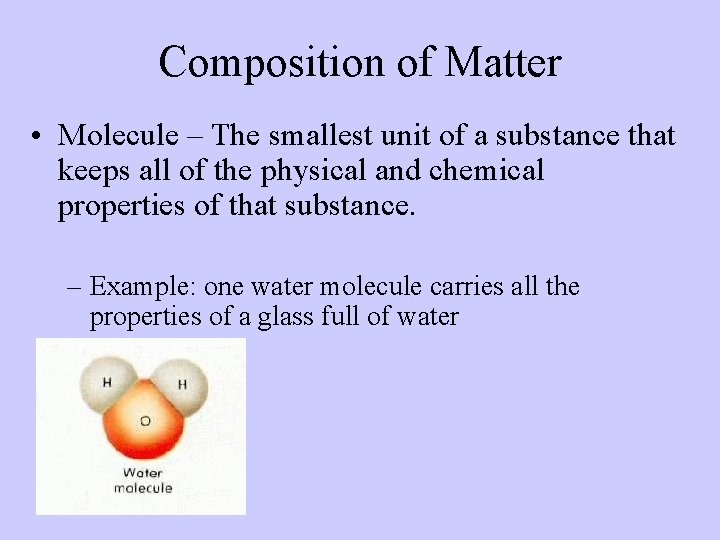
Composition of Matter • Molecule – The smallest unit of a substance that keeps all of the physical and chemical properties of that substance. – Example: one water molecule carries all the properties of a glass full of water
Chemical Formula • A combination of chemical symbols and numbers to represent a substance – Shows the number of atoms of each element in a compound – Ex: Table Sugar C 12 H 22 O 11 – 12 Carbon atoms, 22 Hydrogen atoms, 11 Oxygen atoms
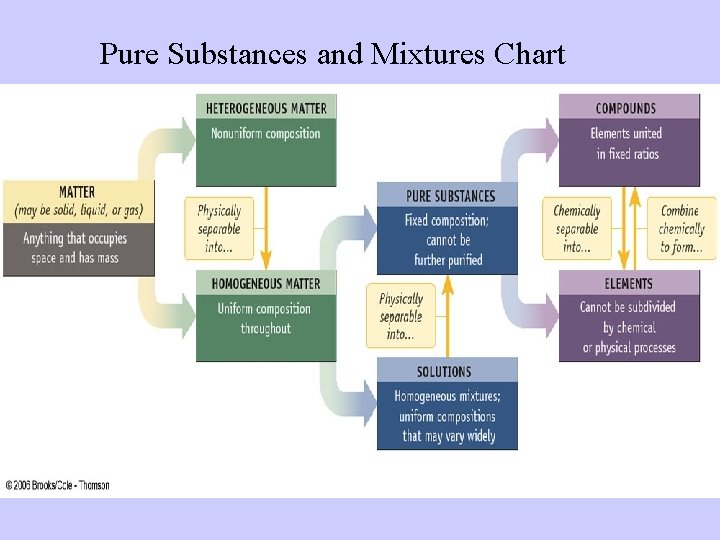
Substances and Mixtures • A pure substance is a kind of matter that cannot be separated into other kinds of matter by any physical process. – Pure Substances are Elements or compounds • A mixture is a material that can be separated by physical means into two or more substances. – Homogeneous or Heterogeneous
Pure Substances and Mixtures Chart
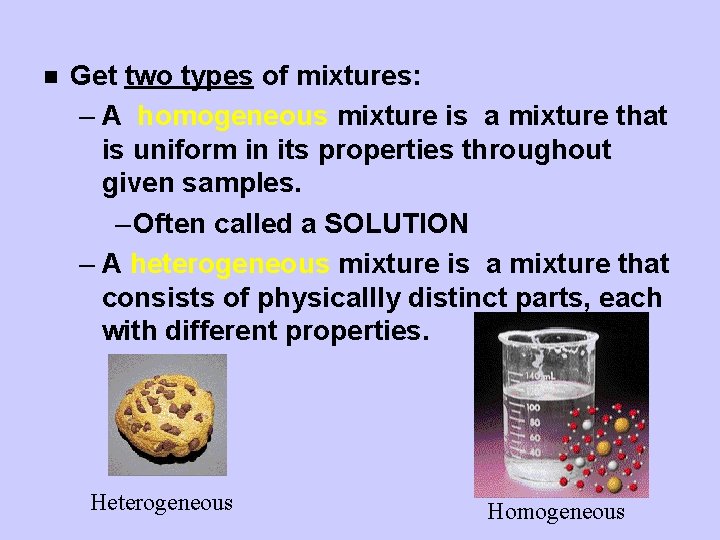
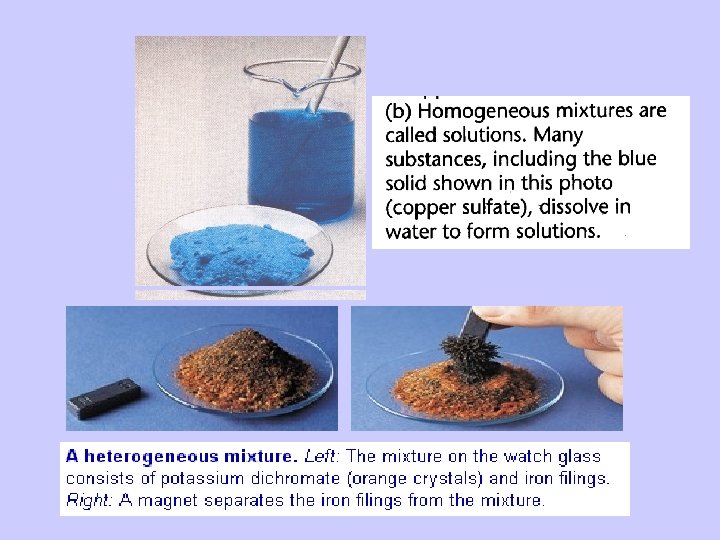
n Get two types of mixtures: – A homogeneous mixture is a mixture that is uniform in its properties throughout given samples. – Often called a SOLUTION – A heterogeneous mixture is a mixture that consists of physicallly distinct parts, each with different properties. Heterogeneous Homogeneous
2 Types Heterogeneous Mixtures • 1. Suspension – particles can separate out – EX: Orange juice with pulp • 2. Colloid – particles are able to separate light and cannot be separated by ordinary filters. – EX: milk, Jello, fog
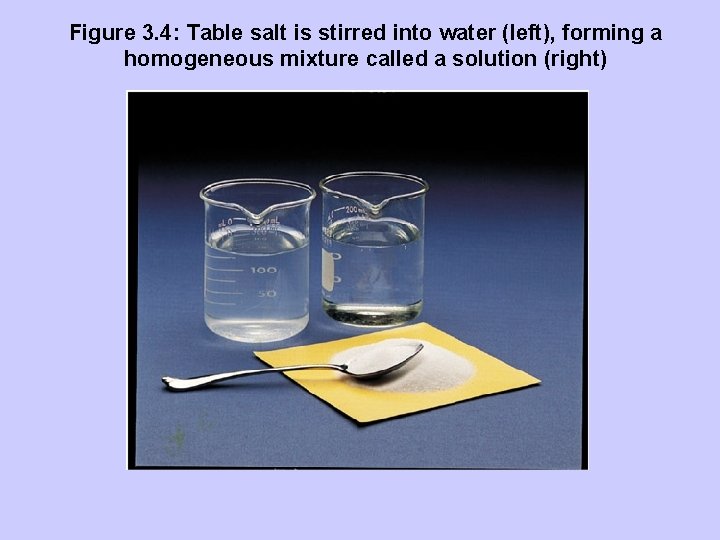
Figure 3. 4: Table salt is stirred into water (left), forming a homogeneous mixture called a solution (right)
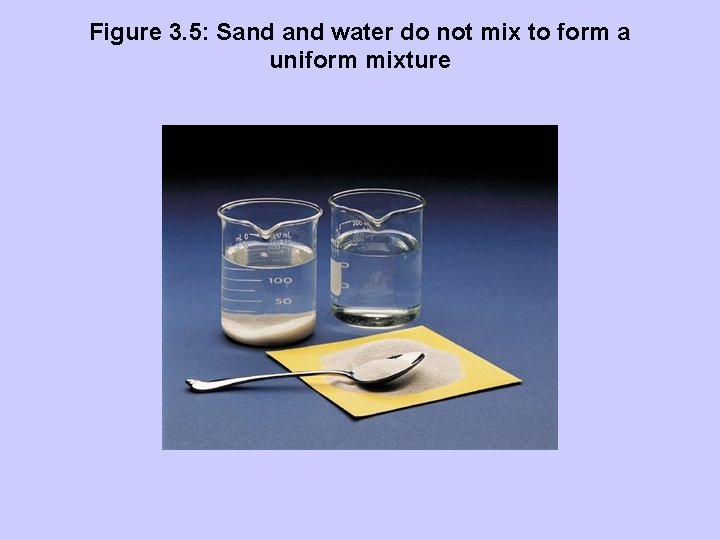
Figure 3. 5: Sand water do not mix to form a uniform mixture
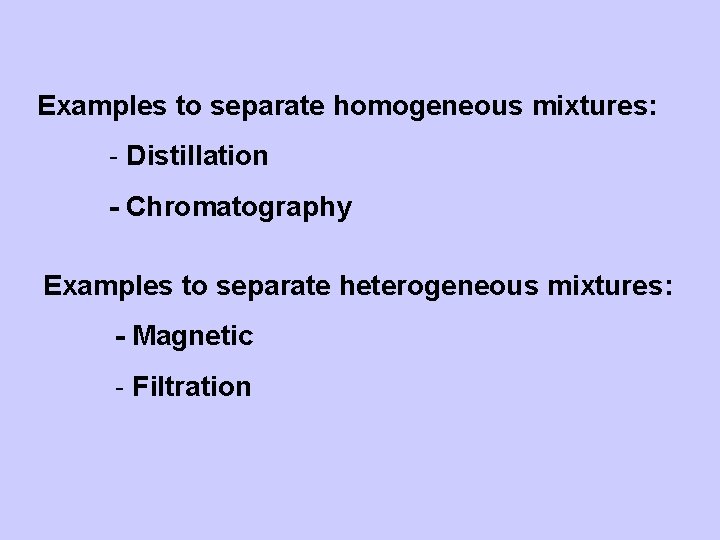
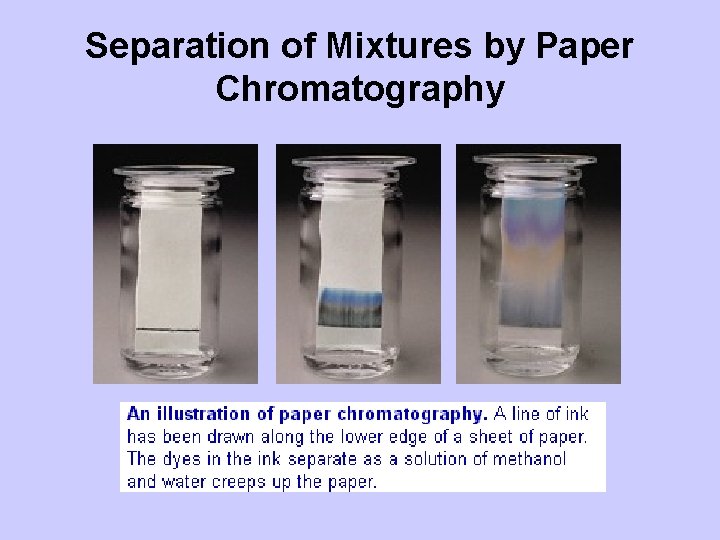
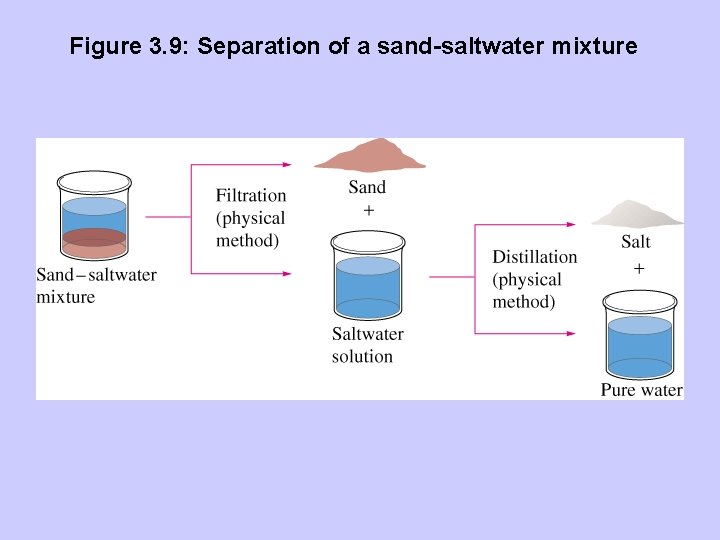
Separation of Mixtures Examples to separate homogeneous mixtures: - Distillation - Chromatography Examples to separate heterogeneous mixtures: - Magnetic - Filtration
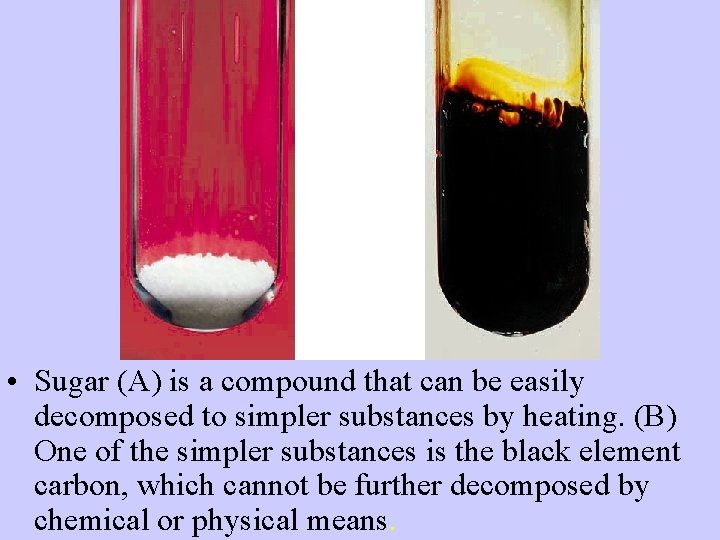
• Sugar (A) is a compound that can be easily decomposed to simpler substances by heating. (B) One of the simpler substances is the black element carbon, which cannot be further decomposed by chemical or physical means.
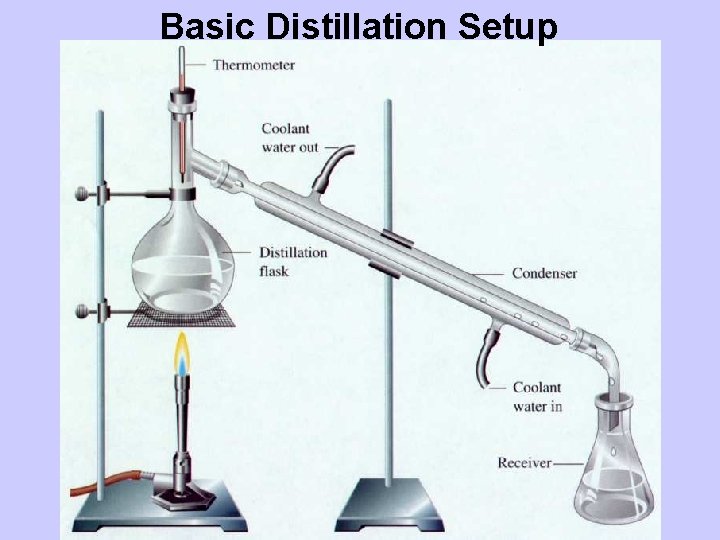
Basic Distillation Setup
Separation of Mixtures by Paper Chromatography
Figure 3. 9: Separation of a sand-saltwater mixture
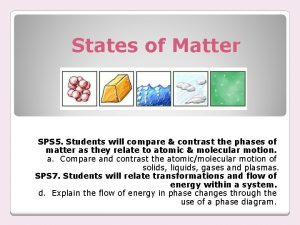
States of Matter
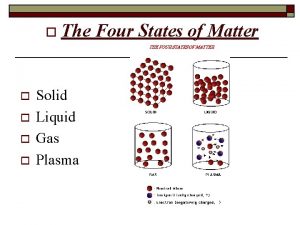
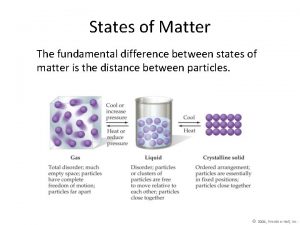
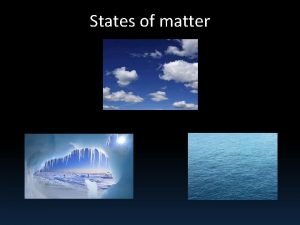
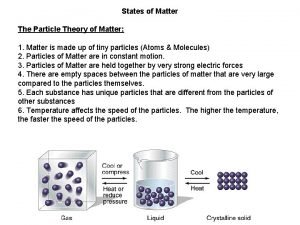
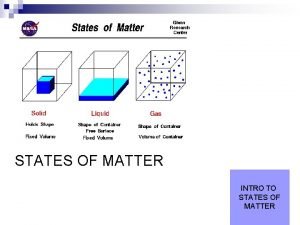
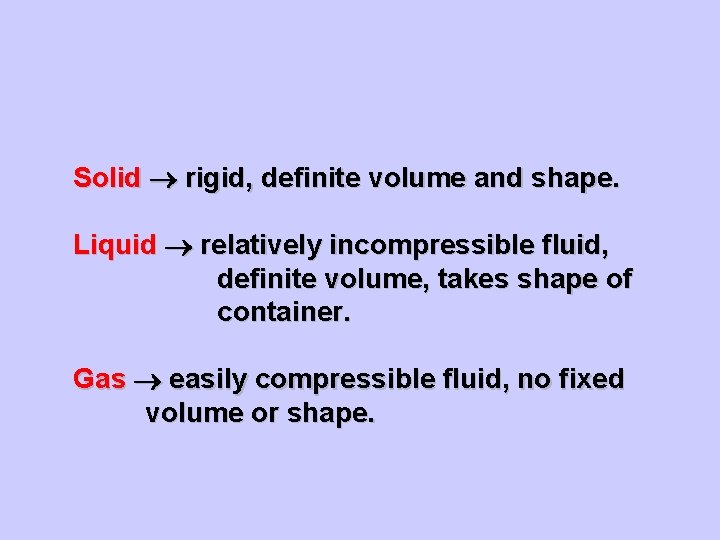
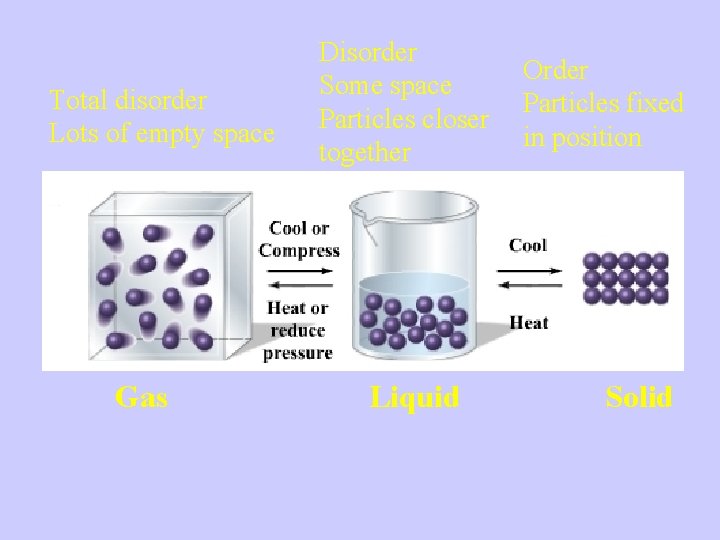
Classifications of Matter Solid rigid, definite volume and shape. Liquid relatively incompressible fluid, definite volume, takes shape of container. Gas easily compressible fluid, no fixed volume or shape.
Total disorder Lots of empty space Gas Disorder Some space Particles closer together Liquid Order Particles fixed in position Solid
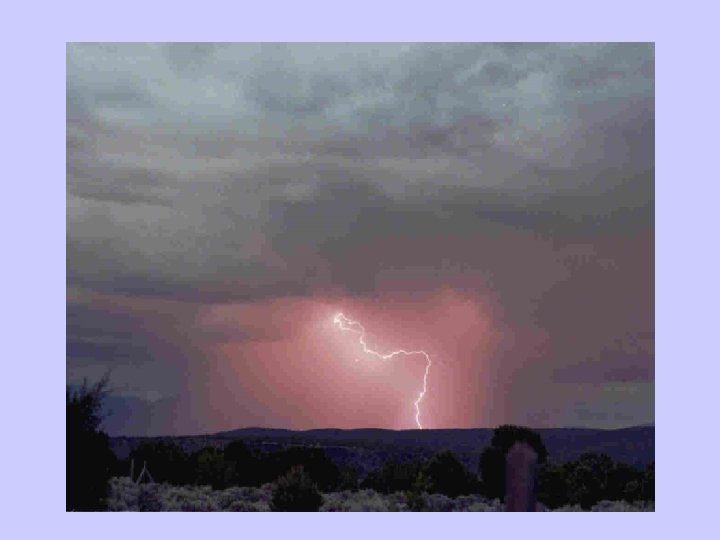
Plasma • • • Fourth state of matter Most common in the universe Does not have a definite shape Particles can conduct electric current Electric and magnetic fields affect plasma Natural plasma is found in lightning, fire, and aurora borealis
Energy and Changes in State An introduction through music…
Kinetic Theory of Matter • All matter is made of atoms and molecules that act like tiny particles • All of these tiny particles are in MOTION. • The higher the temperature, the faster the particles move. • Heavy particles move slower than light particles at the same temperature.
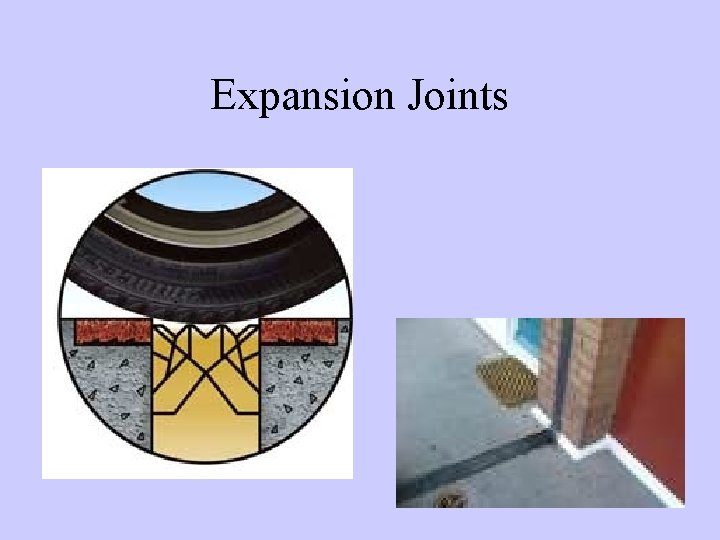
Thermal Energy and Expansion • Most matter expands when it gets hot and contracts when it cools (exception: water) • Thermal Energy – The total kinetic energy of the particles that make up the object. – Objects with a lot of kinetic energy have more thermal energy • Temperature is a measure of average kinetic energy. – Objects with more motion in their particles will have a higher temperature
Expansion Joints
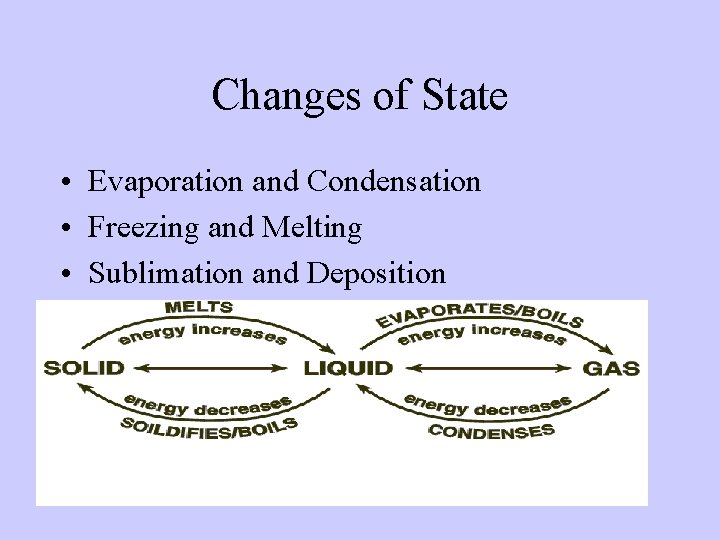
Changes of State • Evaporation and Condensation • Freezing and Melting • Sublimation and Deposition
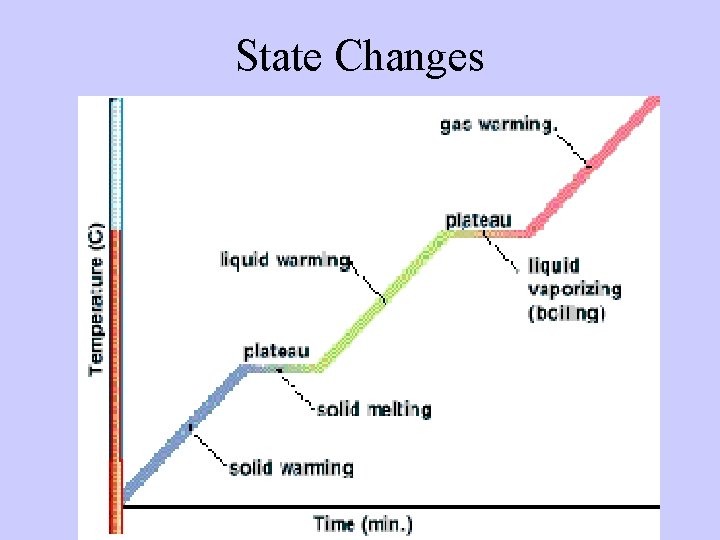
State Changes
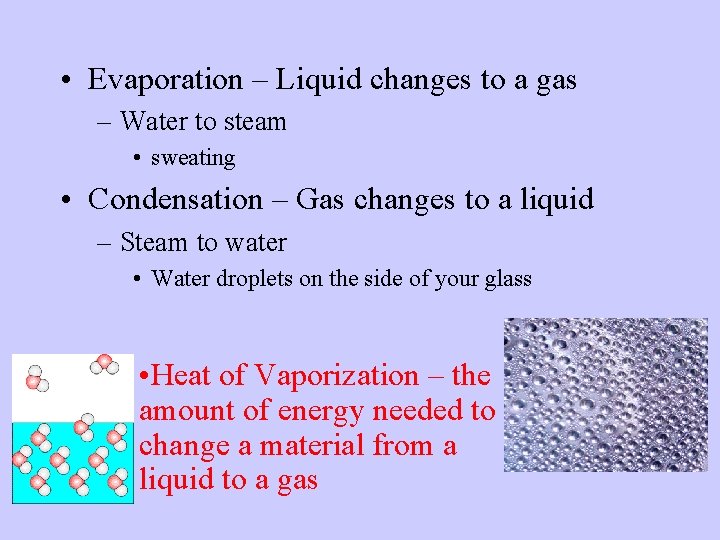
• Evaporation – Liquid changes to a gas – Water to steam • sweating • Condensation – Gas changes to a liquid – Steam to water • Water droplets on the side of your glass • Heat of Vaporization – the amount of energy needed to change a material from a liquid to a gas
• Melting – Solid changes to a liquid – Ice to water • Heat of Fusion – the amount of energy needed to change a material from the solid state to the liquid state • Freezing – Liquid changes to a solid – Water to ice
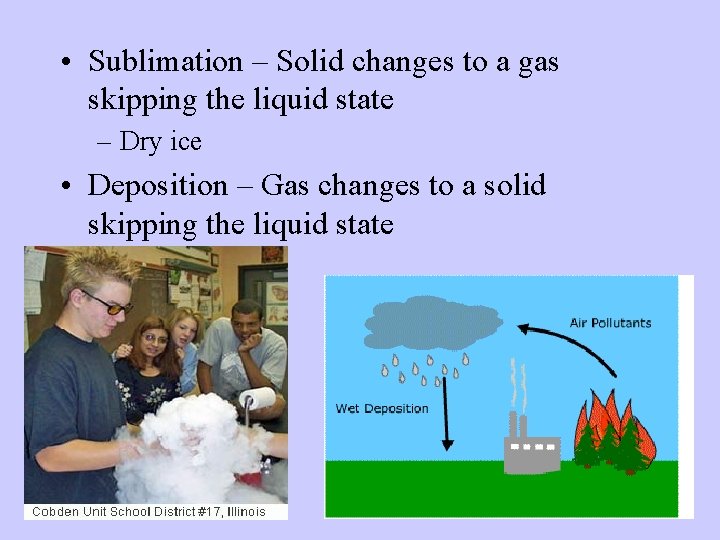
• Sublimation – Solid changes to a gas skipping the liquid state – Dry ice • Deposition – Gas changes to a solid skipping the liquid state
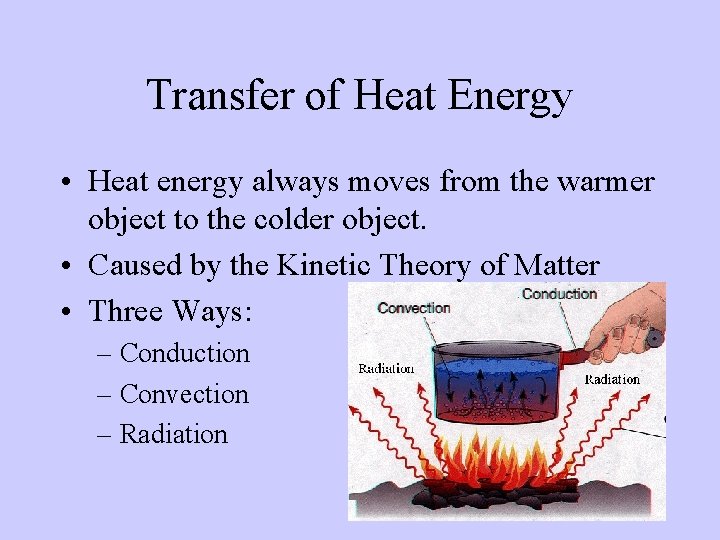
Transfer of Heat Energy • Heat energy always moves from the warmer object to the colder object. • Caused by the Kinetic Theory of Matter • Three Ways: – Conduction – Convection – Radiation
Conduction • The transfer of heat energy by touch – Ex: touching the desk will transfer heat energy from your hand to the desk.
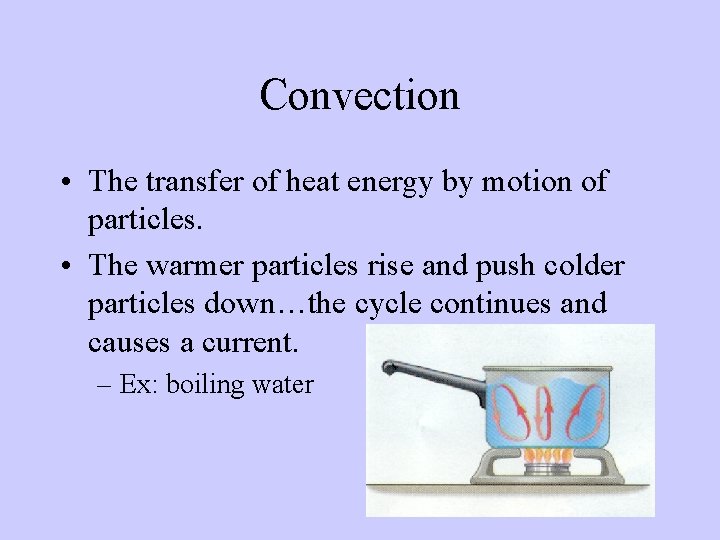
Convection • The transfer of heat energy by motion of particles. • The warmer particles rise and push colder particles down…the cycle continues and causes a current. – Ex: boiling water
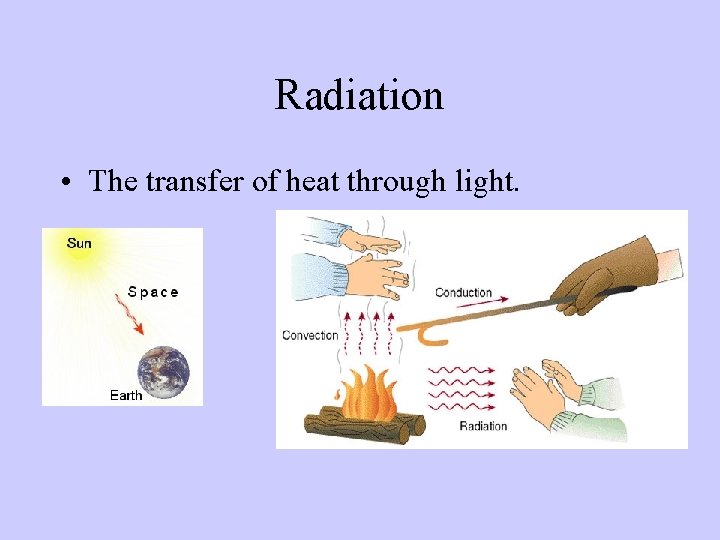
Radiation • The transfer of heat through light.
Properties of Matter Physical and Chemical
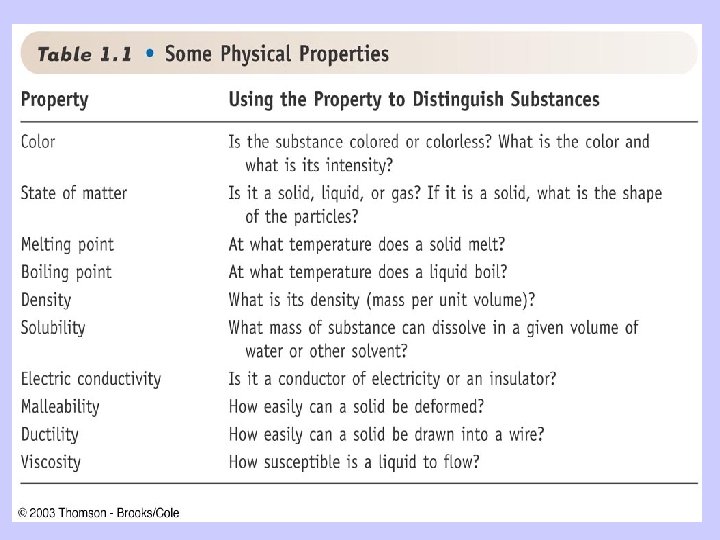
Physical Properties • Physical Property – any characteristic of a material that you can observe without changing the substances that make up the material – Easily observed and measurable – Includes: Shape, size, color, mass, volume, density, temperature, melting point, boiling point, state of matter
Chemical Property • A characteristic of a substance that indicates it can change chemically – Not as easy to observe – Includes: flammability, reactivity – Example: Steel combined with oxygen can lead to rust
Physical Changes n A physical change is a change in the form of matter but not in its chemical identity. Example: - Dissolution of salt. - Distillation - Breaking pencil in two - Cutting hair • Physical changes help to separate mixtures.
Chemical Changes n n A chemical change or chemical reaction is a change in which one or more kinds of matter are transformed into a new kind of matter or several new kinds of matter. Cannot be reversed by physical changes Example: - The rusting of iron. - Digesting food - Rotting fruit - Rusting steel - Burning gasoline
Chemical Changes (cont) • Chemical changes can be detected by such things as odor or color • Chemical changes form new substances that have new properties – Example: baking a cake
Law of Conservation of Mass • Matter is not created or destroyed during a chemical change • The mass of all substances before a chemical change equals the mass of all substances after the chemical change