C hapter 10 The Graph ADT Chapter 10
- Slides: 39
C hapter 10 The Graph ADT
Chapter 10: The Graph ADT 10. 1 – Introduction to Graphs 10. 2 – The Graph Interface 10. 3 – Implementations of Graphs 10. 4 – Application: Graph Traversals 10. 5 – Application: The Single-Source Shortest-Paths Problem
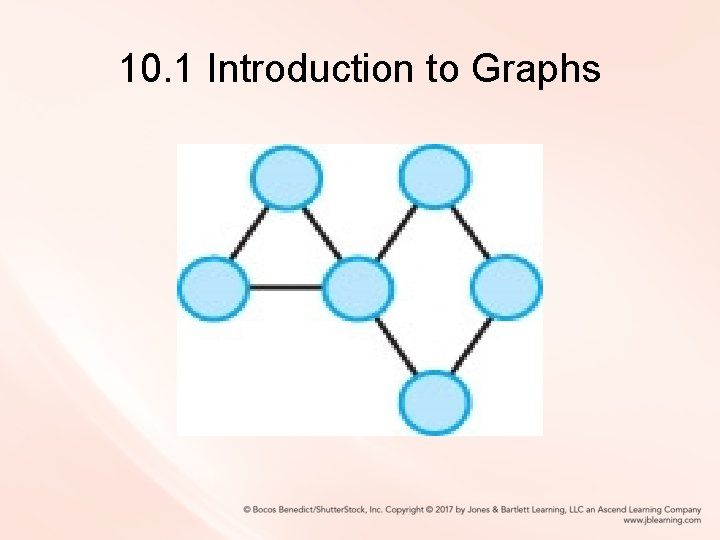
10. 1 Introduction to Graphs
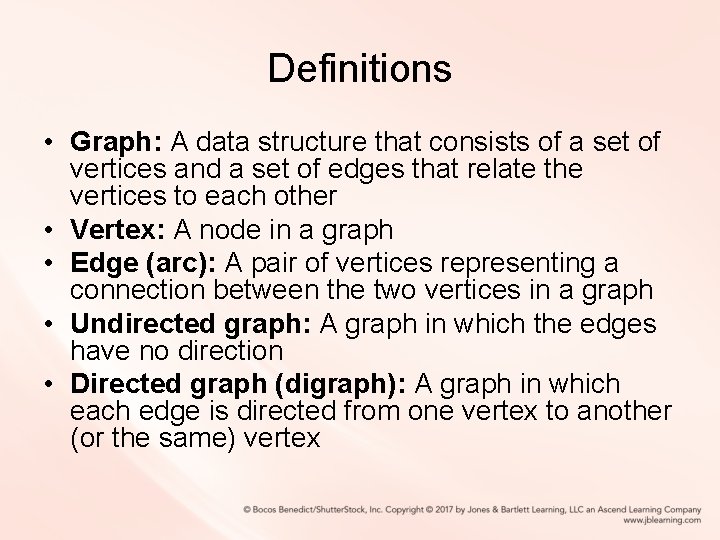
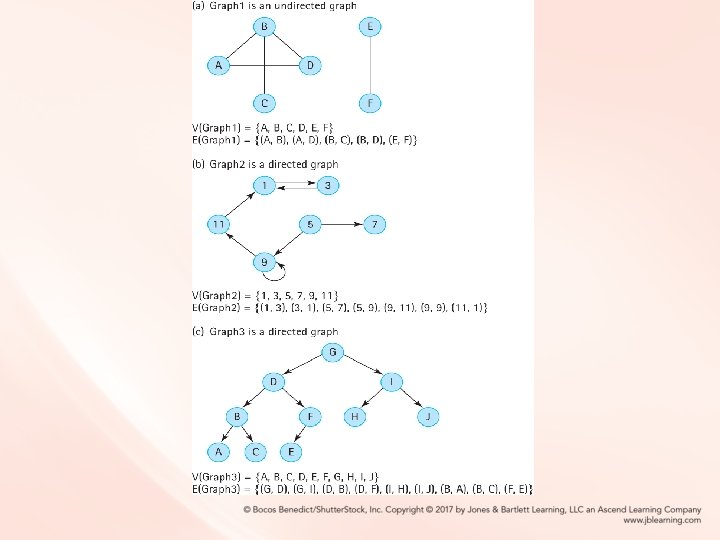
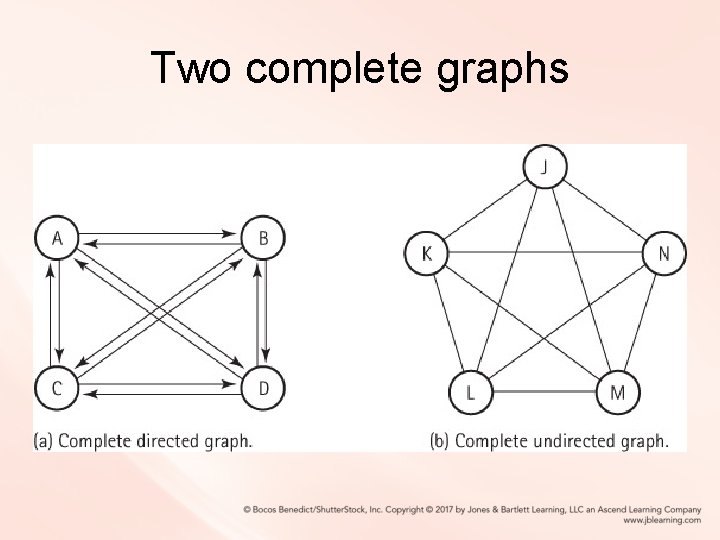
Definitions • Graph: A data structure that consists of a set of vertices and a set of edges that relate the vertices to each other • Vertex: A node in a graph • Edge (arc): A pair of vertices representing a connection between the two vertices in a graph • Undirected graph: A graph in which the edges have no direction • Directed graph (digraph): A graph in which each edge is directed from one vertex to another (or the same) vertex
Formally • a graph G is defined as follows: G = (V, E) where V(G) is a finite, nonempty set of vertices E(G) is a set of edges (written as pairs of vertices)
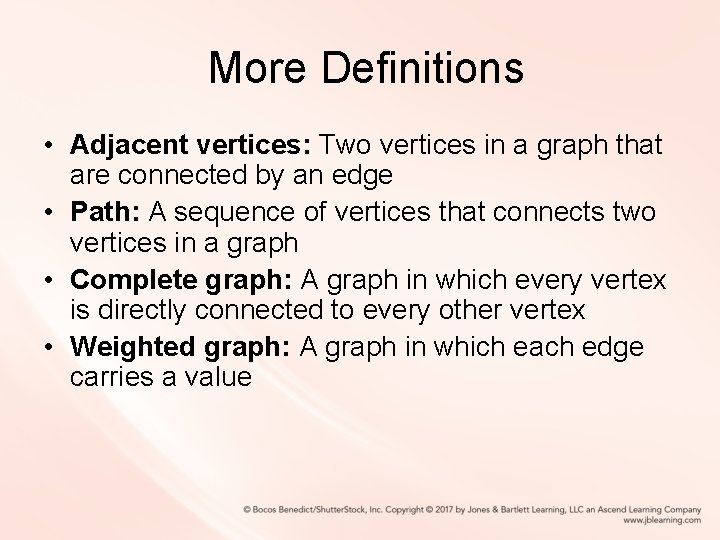
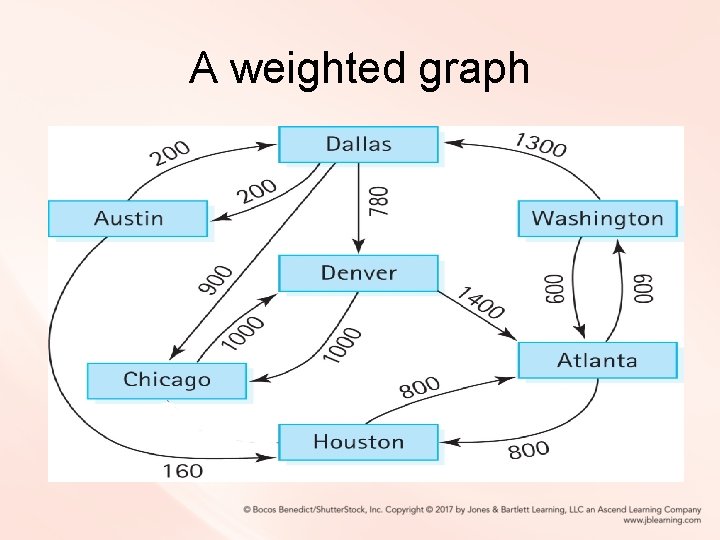
More Definitions • Adjacent vertices: Two vertices in a graph that are connected by an edge • Path: A sequence of vertices that connects two vertices in a graph • Complete graph: A graph in which every vertex is directly connected to every other vertex • Weighted graph: A graph in which each edge carries a value
Two complete graphs
A weighted graph
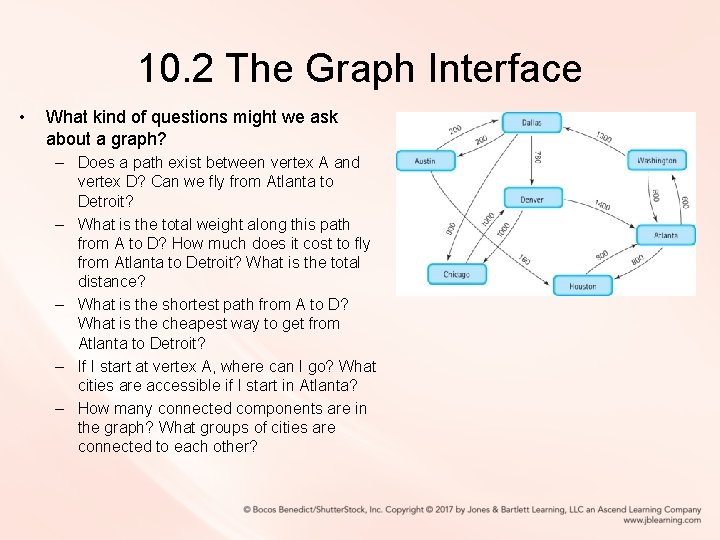
10. 2 The Graph Interface • What kind of questions might we ask about a graph? – Does a path exist between vertex A and vertex D? Can we fly from Atlanta to Detroit? – What is the total weight along this path from A to D? How much does it cost to fly from Atlanta to Detroit? What is the total distance? – What is the shortest path from A to D? What is the cheapest way to get from Atlanta to Detroit? – If I start at vertex A, where can I go? What cities are accessible if I start in Atlanta? – How many connected components are in the graph? What groups of cities are connected to each other?
Graph Operations • What kind of operations are defined on a graph? – We specify and implement a small set of useful graph operations – Many other operations on graphs can be defined; we have chosen operations that are useful when building applications to answer typical questions, such as those found on the previous slide
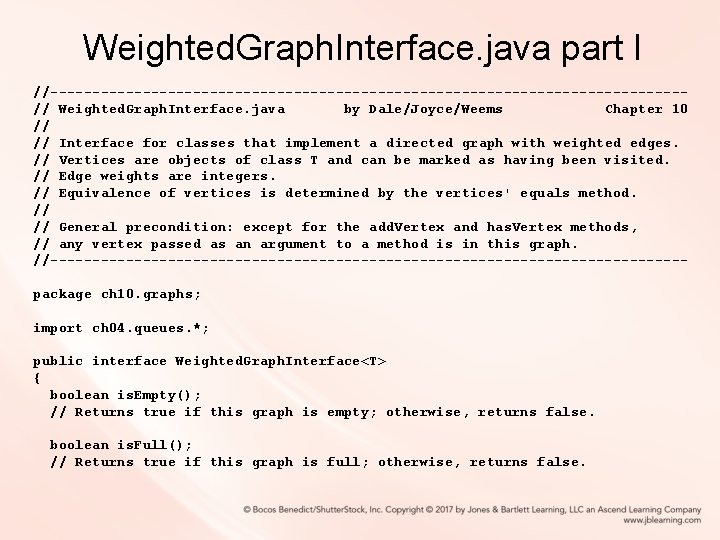
Weighted. Graph. Interface. java part I //--------------------------------------// Weighted. Graph. Interface. java by Dale/Joyce/Weems Chapter 10 // // Interface for classes that implement a directed graph with weighted edges. // Vertices are objects of class T and can be marked as having been visited. // Edge weights are integers. // Equivalence of vertices is determined by the vertices' equals method. // // General precondition: except for the add. Vertex and has. Vertex methods, // any vertex passed as an argument to a method is in this graph. //--------------------------------------package ch 10. graphs; import ch 04. queues. *; public interface Weighted. Graph. Interface<T> { boolean is. Empty(); // Returns true if this graph is empty; otherwise, returns false. boolean is. Full(); // Returns true if this graph is full; otherwise, returns false.
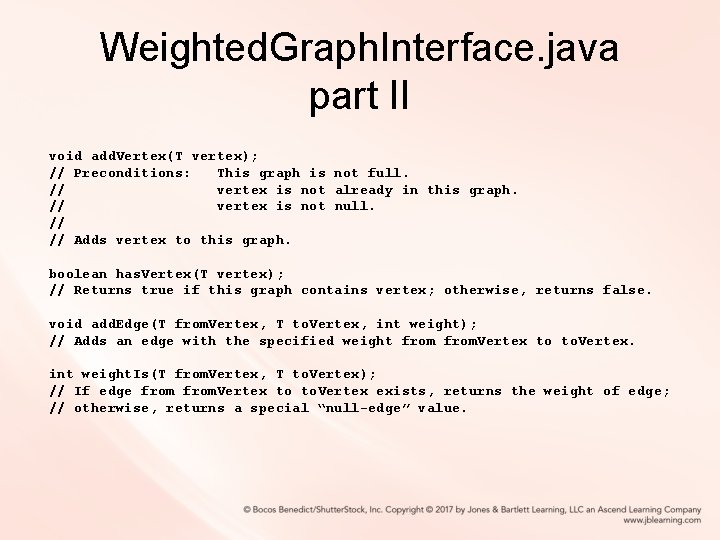
Weighted. Graph. Interface. java part II void add. Vertex(T vertex); // Preconditions: This graph is not full. // vertex is not already in this graph. // vertex is not null. // // Adds vertex to this graph. boolean has. Vertex(T vertex); // Returns true if this graph contains vertex; otherwise, returns false. void add. Edge(T from. Vertex, T to. Vertex, int weight); // Adds an edge with the specified weight from. Vertex to to. Vertex. int weight. Is(T from. Vertex, T to. Vertex); // If edge from. Vertex to to. Vertex exists, returns the weight of edge; // otherwise, returns a special “null-edge” value.
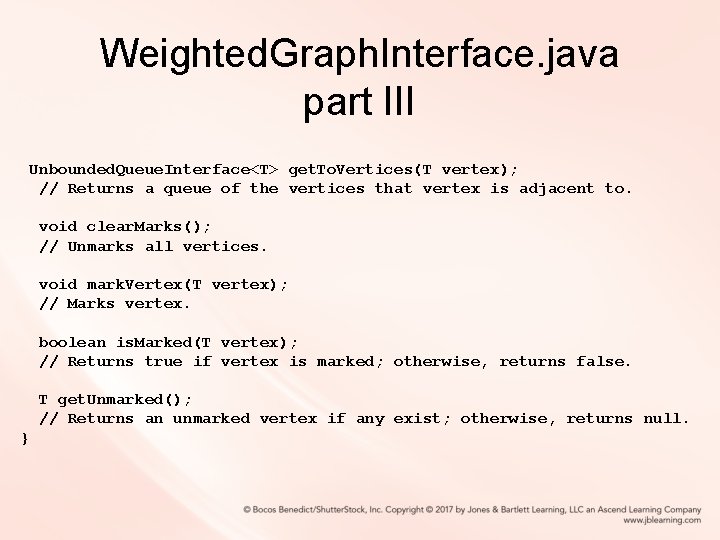
Weighted. Graph. Interface. java part III Unbounded. Queue. Interface<T> get. To. Vertices(T vertex); // Returns a queue of the vertices that vertex is adjacent to. void clear. Marks(); // Unmarks all vertices. void mark. Vertex(T vertex); // Marks vertex. boolean is. Marked(T vertex); // Returns true if vertex is marked; otherwise, returns false. T get. Unmarked(); // Returns an unmarked vertex if any exist; otherwise, returns null. }
10. 3 Implementations of Graphs • In this section we introduce two graph implementation approaches – an array based approach – a linked approach
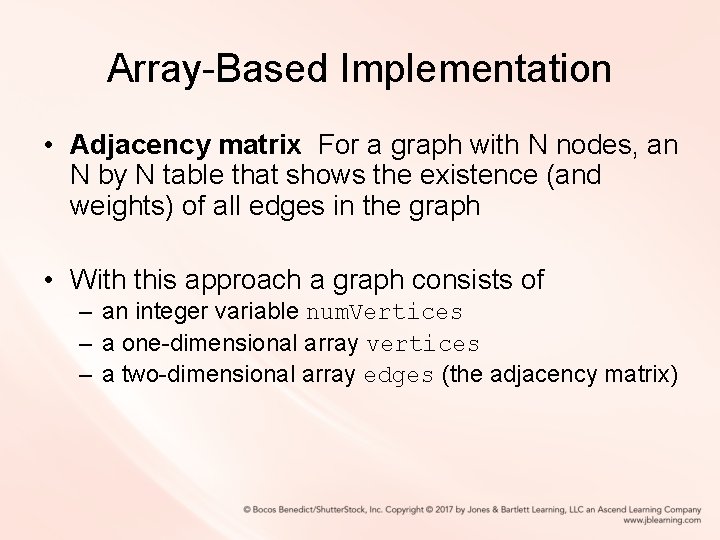
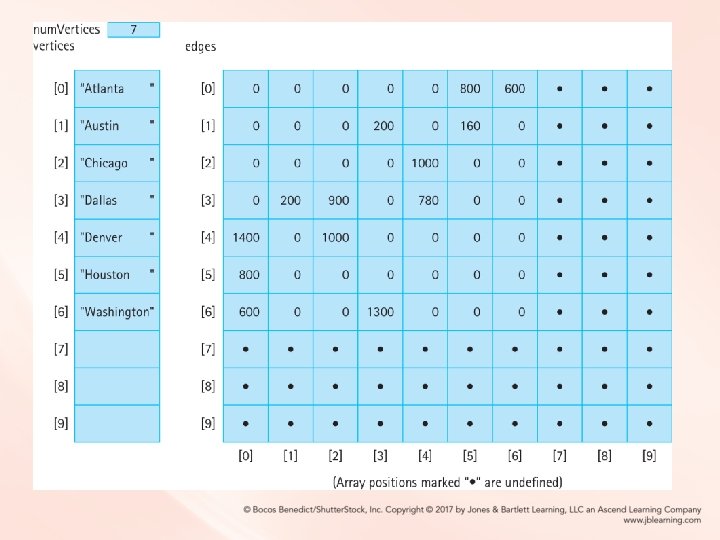
Array-Based Implementation • Adjacency matrix For a graph with N nodes, an N by N table that shows the existence (and weights) of all edges in the graph • With this approach a graph consists of – an integer variable num. Vertices – a one-dimensional array vertices – a two-dimensional array edges (the adjacency matrix)
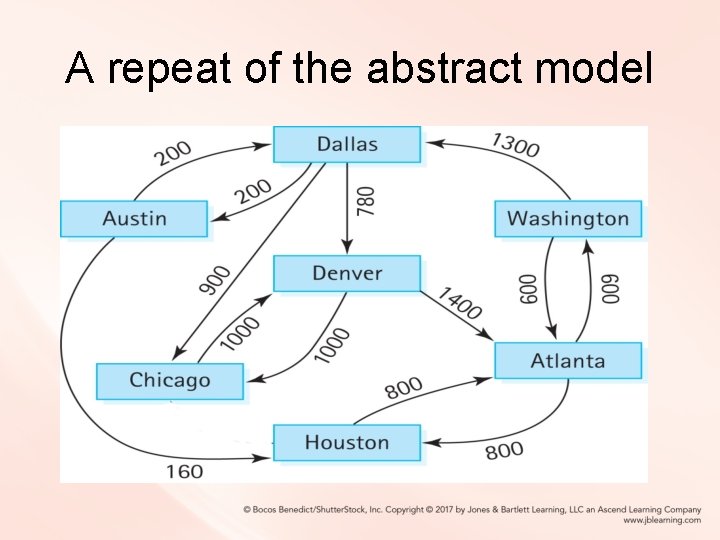
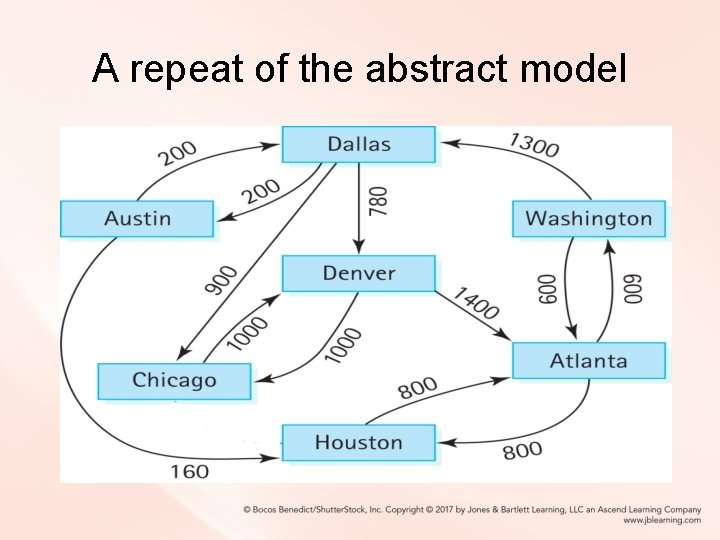
A repeat of the abstract model
The array-based implementation
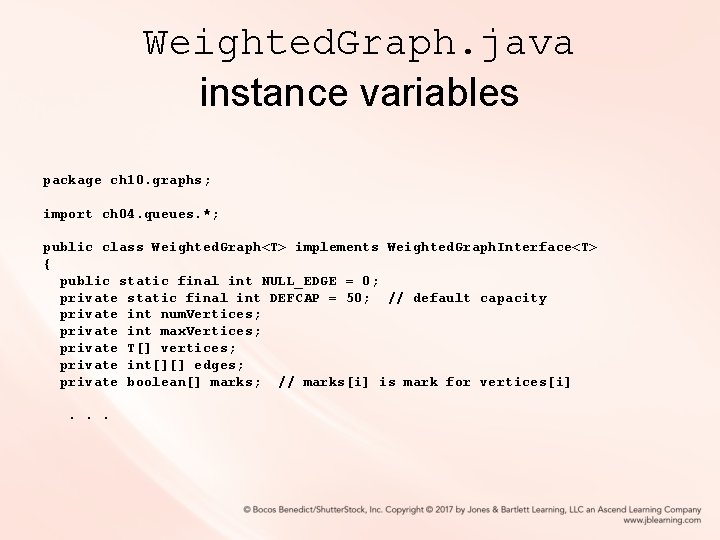
Weighted. Graph. java instance variables package ch 10. graphs; import ch 04. queues. *; public class Weighted. Graph<T> implements Weighted. Graph. Interface<T> { public static final int NULL_EDGE = 0; private static final int DEFCAP = 50; // default capacity private int num. Vertices; private int max. Vertices; private T[] vertices; private int[][] edges; private boolean[] marks; // marks[i] is mark for vertices[i]. . .
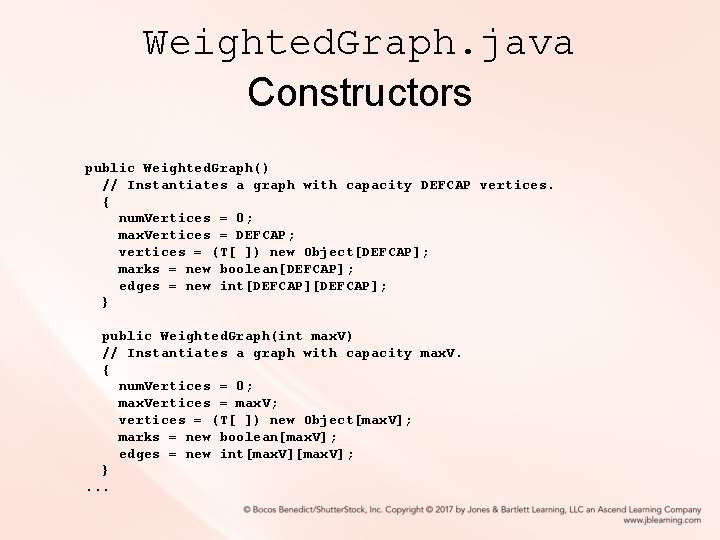
Weighted. Graph. java Constructors public Weighted. Graph() // Instantiates a graph with capacity DEFCAP vertices. { num. Vertices = 0; max. Vertices = DEFCAP; vertices = (T[ ]) new Object[DEFCAP]; marks = new boolean[DEFCAP]; edges = new int[DEFCAP]; } public Weighted. Graph(int max. V) // Instantiates a graph with capacity max. V. { num. Vertices = 0; max. Vertices = max. V; vertices = (T[ ]) new Object[max. V]; marks = new boolean[max. V]; edges = new int[max. V]; }. . .
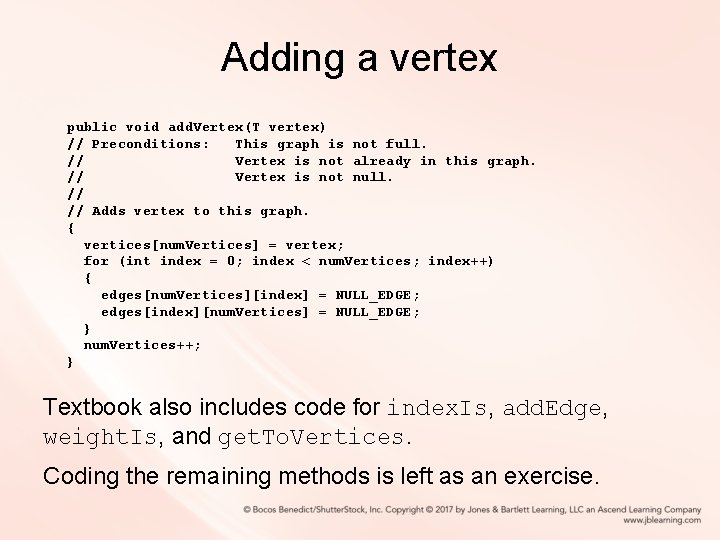
Adding a vertex public void add. Vertex(T vertex) // Preconditions: This graph is not full. // Vertex is not already in this graph. // Vertex is not null. // // Adds vertex to this graph. { vertices[num. Vertices] = vertex; for (int index = 0; index < num. Vertices; index++) { edges[num. Vertices][index] = NULL_EDGE; edges[index][num. Vertices] = NULL_EDGE; } num. Vertices++; } Textbook also includes code for index. Is, add. Edge, weight. Is, and get. To. Vertices. Coding the remaining methods is left as an exercise.
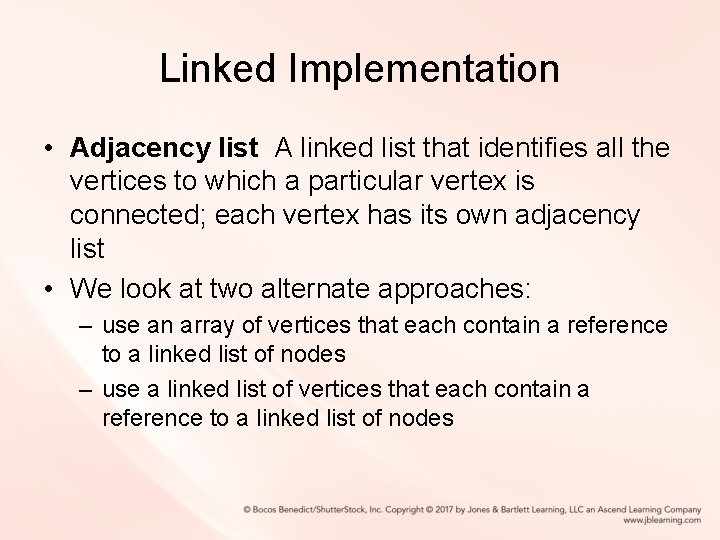
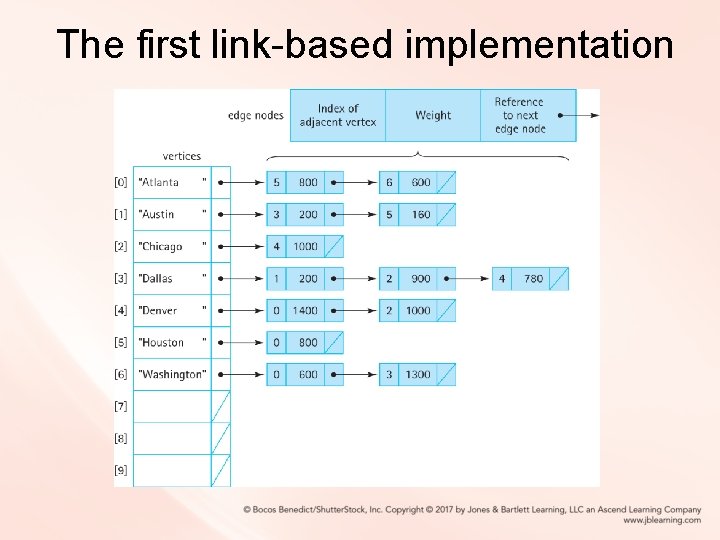
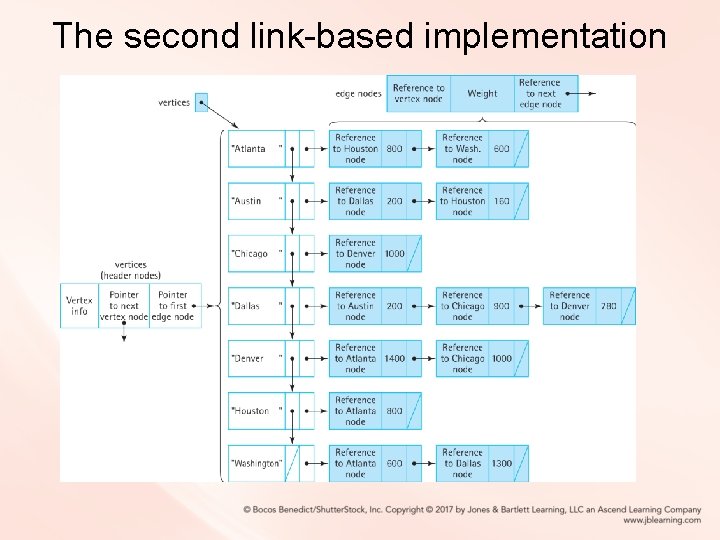
Linked Implementation • Adjacency list A linked list that identifies all the vertices to which a particular vertex is connected; each vertex has its own adjacency list • We look at two alternate approaches: – use an array of vertices that each contain a reference to a linked list of nodes – use a linked list of vertices that each contain a reference to a linked list of nodes
A repeat of the abstract model
The first link-based implementation
The second link-based implementation
10. 4 Application: Graph Traversals • Our graph specification does not include traversal operations. • We treat traversal as a graph application rather than an innate operation. • The basic operations given in our specification allow us to implement different traversals independent of how the graph itself is actually implemented. • The application Use. Graph in the ch 10. apps package contains the code for all the algorithms presented in Sections 10. 4 and 10. 5
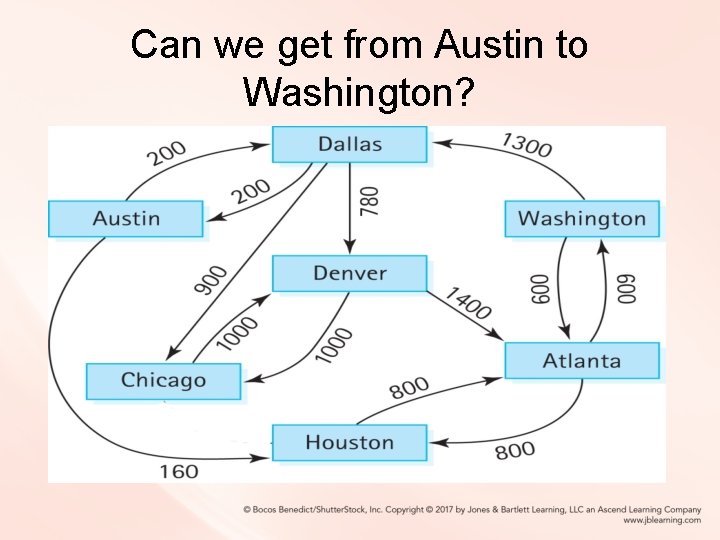
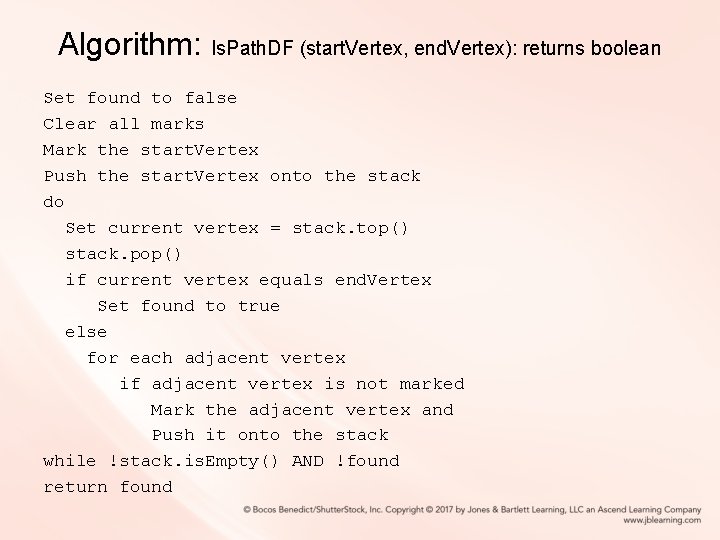
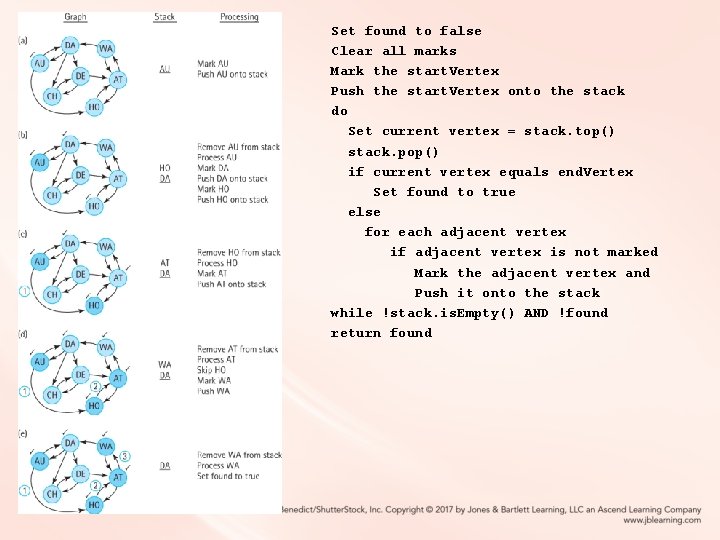
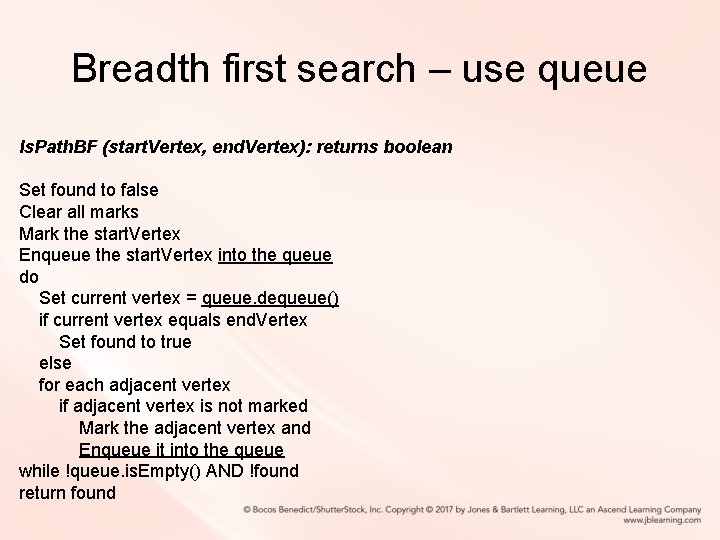
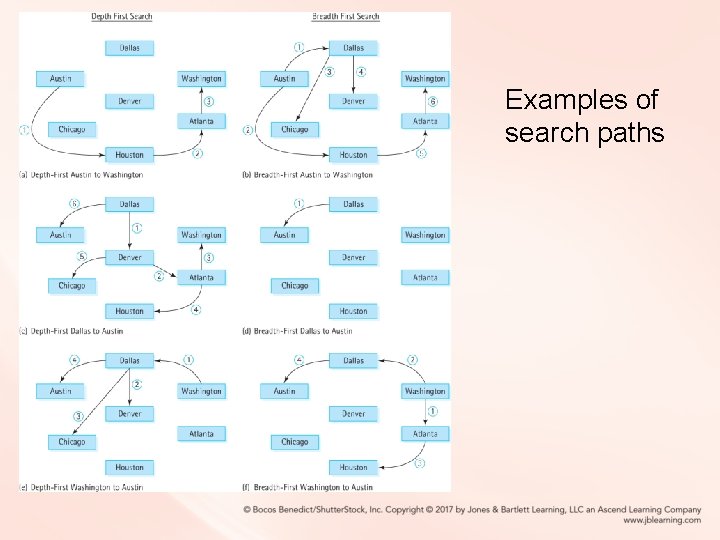
Graph Traversal • As we did for general trees, we look at two types of graph traversal: – The strategy of going as far as we can and then backtracking is called a depth-first strategy. – The strategy of fanning out “level by level” is called a breadth-first strategy. • We discuss algorithms for employing both strategies within the context of determining if two cities are connected in our airline example.
Can we get from Austin to Washington?
Algorithm: Is. Path. DF (start. Vertex, end. Vertex): returns boolean Set found to false Clear all marks Mark the start. Vertex Push the start. Vertex onto the stack do Set current vertex = stack. top() stack. pop() if current vertex equals end. Vertex Set found to true else for each adjacent vertex if adjacent vertex is not marked Mark the adjacent vertex and Push it onto the stack while !stack. is. Empty() AND !found return found
Set found to false Clear all marks Mark the start. Vertex Push the start. Vertex onto the stack do Set current vertex = stack. top() stack. pop() if current vertex equals end. Vertex Set found to true else for each adjacent vertex if adjacent vertex is not marked Mark the adjacent vertex and Push it onto the stack while !stack. is. Empty() AND !found return found
Breadth first search – use queue Is. Path. BF (start. Vertex, end. Vertex): returns boolean Set found to false Clear all marks Mark the start. Vertex Enqueue the start. Vertex into the queue do Set current vertex = queue. dequeue() if current vertex equals end. Vertex Set found to true else for each adjacent vertex if adjacent vertex is not marked Mark the adjacent vertex and Enqueue it into the queue while !queue. is. Empty() AND !found return found
Examples of search paths
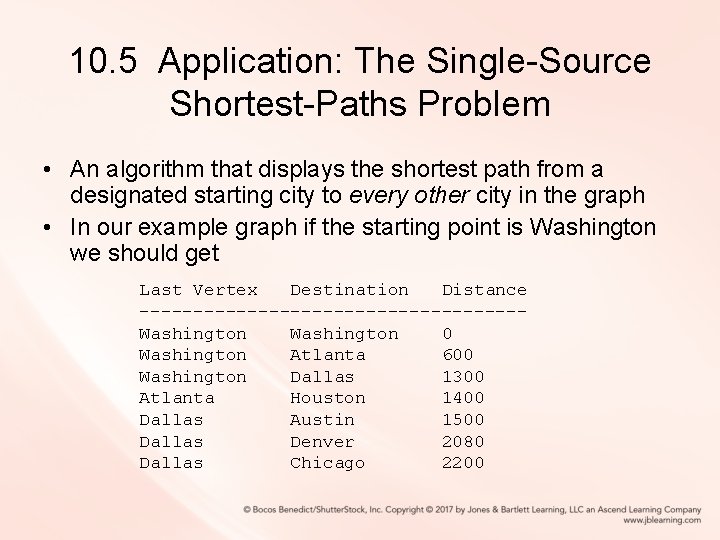
10. 5 Application: The Single-Source Shortest-Paths Problem • An algorithm that displays the shortest path from a designated starting city to every other city in the graph • In our example graph if the starting point is Washington we should get Last Vertex Destination Distance ------------------Washington 0 Washington Atlanta 600 Washington Dallas 1300 Atlanta Houston 1400 Dallas Austin 1500 Dallas Denver 2080 Dallas Chicago 2200
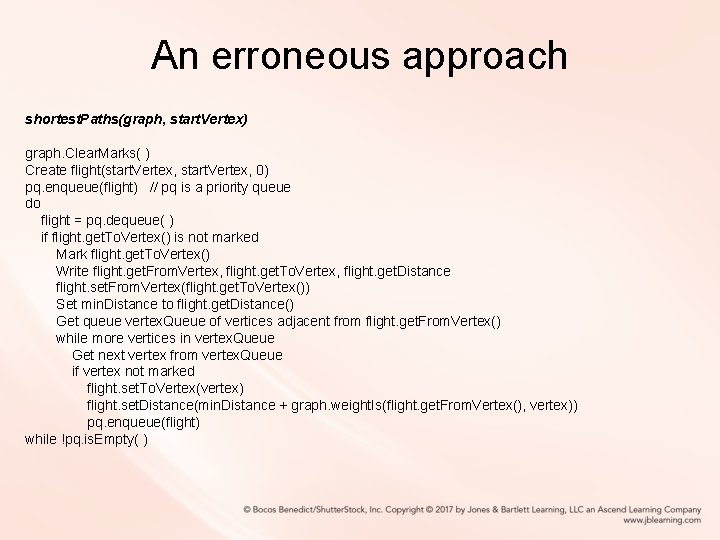
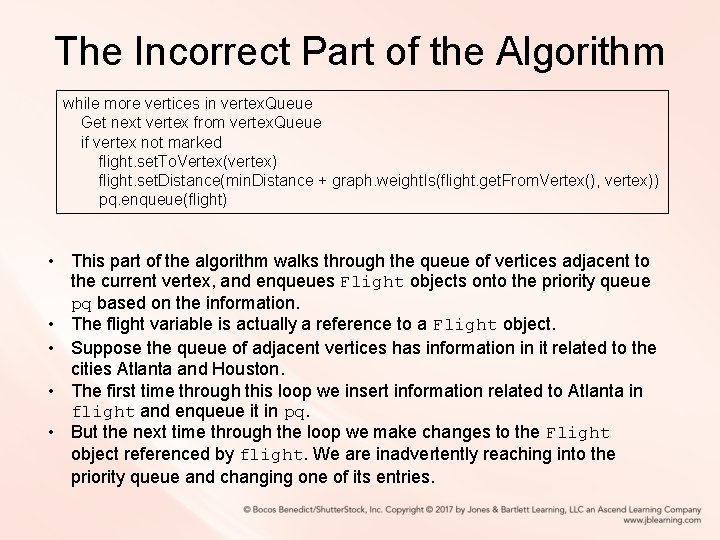
An erroneous approach shortest. Paths(graph, start. Vertex) graph. Clear. Marks( ) Create flight(start. Vertex, 0) pq. enqueue(flight) // pq is a priority queue do flight = pq. dequeue( ) if flight. get. To. Vertex() is not marked Mark flight. get. To. Vertex() Write flight. get. From. Vertex, flight. get. To. Vertex, flight. get. Distance flight. set. From. Vertex(flight. get. To. Vertex()) Set min. Distance to flight. get. Distance() Get queue vertex. Queue of vertices adjacent from flight. get. From. Vertex() while more vertices in vertex. Queue Get next vertex from vertex. Queue if vertex not marked flight. set. To. Vertex(vertex) flight. set. Distance(min. Distance + graph. weight. Is(flight. get. From. Vertex(), vertex)) pq. enqueue(flight) while !pq. is. Empty( )
Notes • The algorithm for the shortest-path traversal is similar to those we used for the depth-first and breadth-first searches, but there are three major differences: – We use a priority queue rather than a FIFO queue or stack – We stop only when there are no more cities to process; there is no destination – It is incorrect if we use a reference-based priority queue improperly!
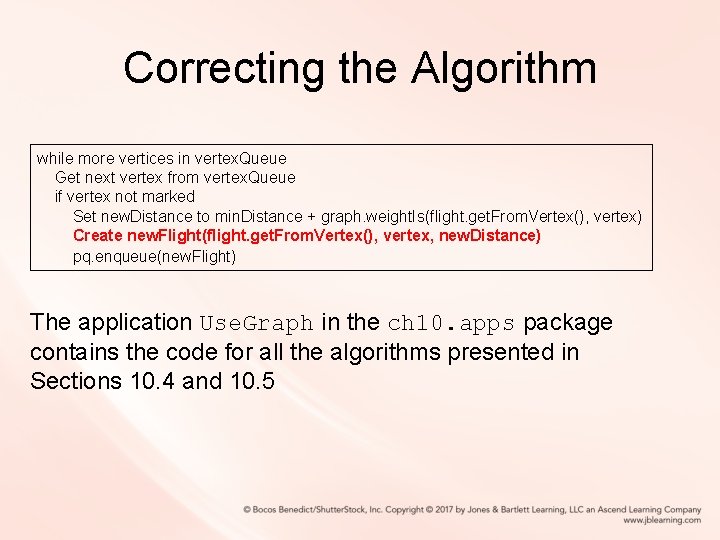
The Incorrect Part of the Algorithm while more vertices in vertex. Queue Get next vertex from vertex. Queue if vertex not marked flight. set. To. Vertex(vertex) flight. set. Distance(min. Distance + graph. weight. Is(flight. get. From. Vertex(), vertex)) pq. enqueue(flight) • This part of the algorithm walks through the queue of vertices adjacent to the current vertex, and enqueues Flight objects onto the priority queue pq based on the information. • The flight variable is actually a reference to a Flight object. • Suppose the queue of adjacent vertices has information in it related to the cities Atlanta and Houston. • The first time through this loop we insert information related to Atlanta in flight and enqueue it in pq. • But the next time through the loop we make changes to the Flight object referenced by flight. We are inadvertently reaching into the priority queue and changing one of its entries.
Correcting the Algorithm while more vertices in vertex. Queue Get next vertex from vertex. Queue if vertex not marked Set new. Distance to min. Distance + graph. weight. Is(flight. get. From. Vertex(), vertex) Create new. Flight(flight. get. From. Vertex(), vertex, new. Distance) pq. enqueue(new. Flight) The application Use. Graph in the ch 10. apps package contains the code for all the algorithms presented in Sections 10. 4 and 10. 5
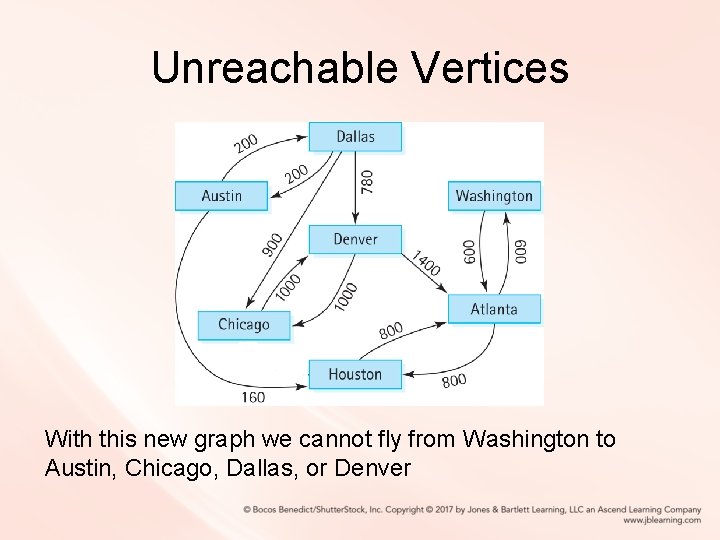
Unreachable Vertices With this new graph we cannot fly from Washington to Austin, Chicago, Dallas, or Denver
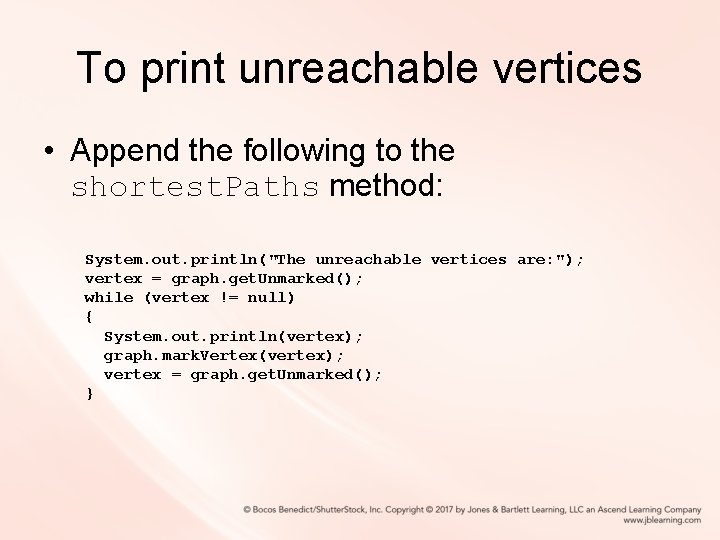
To print unreachable vertices • Append the following to the shortest. Paths method: System. out. println("The unreachable vertices are: "); vertex = graph. get. Unmarked(); while (vertex != null) { System. out. println(vertex); graph. mark. Vertex(vertex); vertex = graph. get. Unmarked(); }