5 2 Electron Arrangement in Atoms Chapter 5

- Slides: 47
5. 2 Electron Arrangement in Atoms > Chapter 5 Electrons In Atoms 5. 1 Revising the Atomic Model 5. 2 Electron Arrangement in Atoms 5. 3 Atomic Emission Spectra and the Quantum Mechanical Model 1 Copyright © Pearson Education, Inc. , or its affiliates. All Rights Reserved.
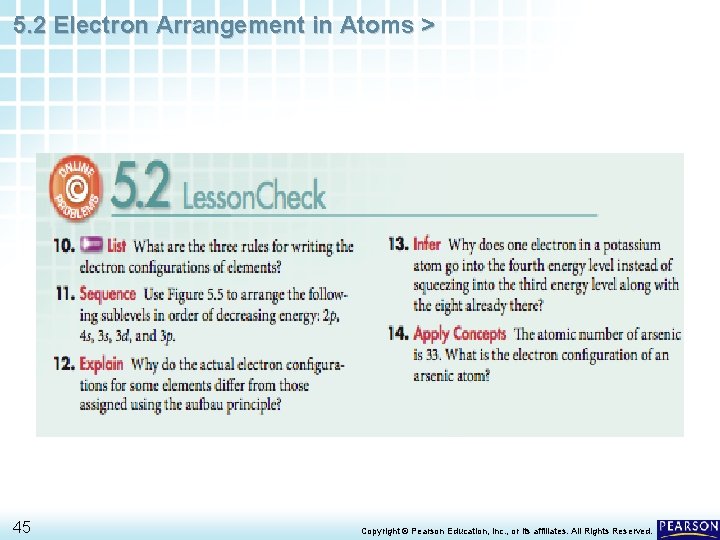
5. 2 Electron Arrangement in Atoms > Electron Configurations What are three rules for writing the electron configurations of elements? 2 Copyright © Pearson Education, Inc. , or its affiliates. All Rights Reserved.
5. 2 Electron Arrangement in Atoms > Electron Configurations The ways in which electrons are arranged in various orbitals around the nuclei of atoms are called electron configurations. 3 Copyright © Pearson Education, Inc. , or its affiliates. All Rights Reserved.
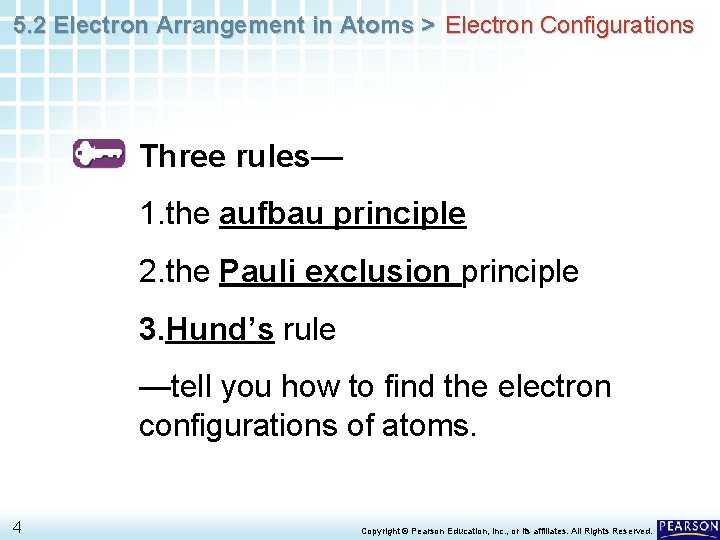
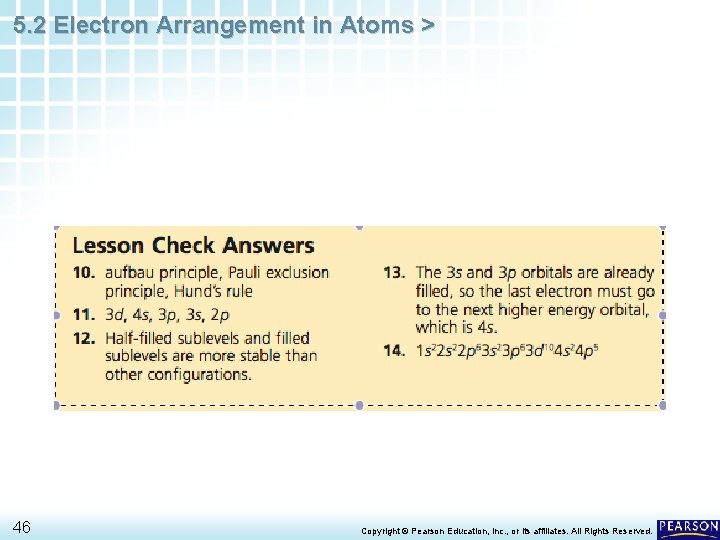
5. 2 Electron Arrangement in Atoms > Electron Configurations Three rules— 1. the aufbau principle 2. the Pauli exclusion principle 3. Hund’s rule —tell you how to find the electron configurations of atoms. 4 Copyright © Pearson Education, Inc. , or its affiliates. All Rights Reserved.
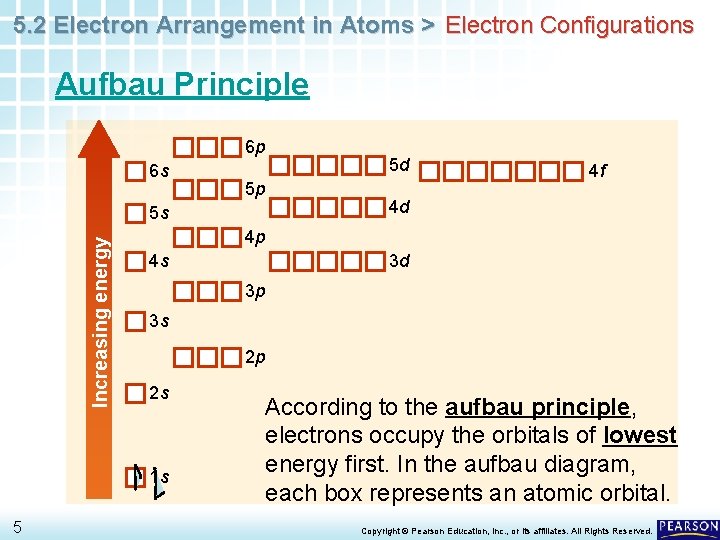
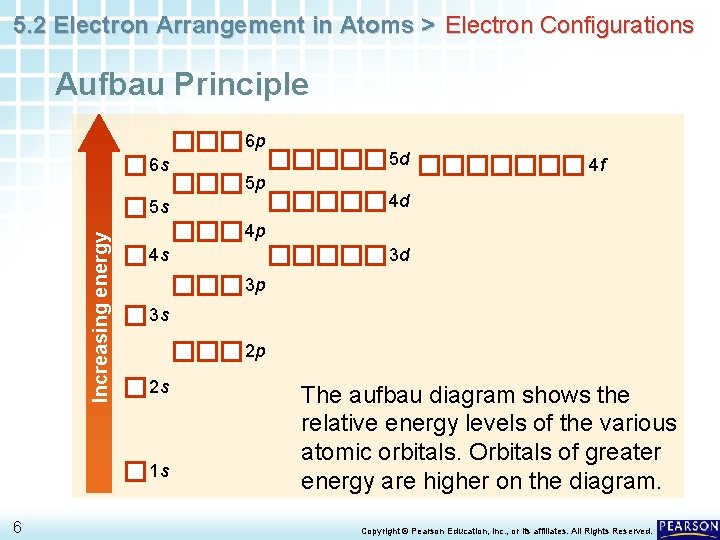
5. 2 Electron Arrangement in Atoms > Electron Configurations Aufbau Principle 6 p 6 s 5 p Increasing energy 5 s 4 f 4 d 4 p 4 s 3 d 3 p 3 s 2 p 2 s 1 s 5 5 d According to the aufbau principle, electrons occupy the orbitals of lowest energy first. In the aufbau diagram, each box represents an atomic orbital. Copyright © Pearson Education, Inc. , or its affiliates. All Rights Reserved.
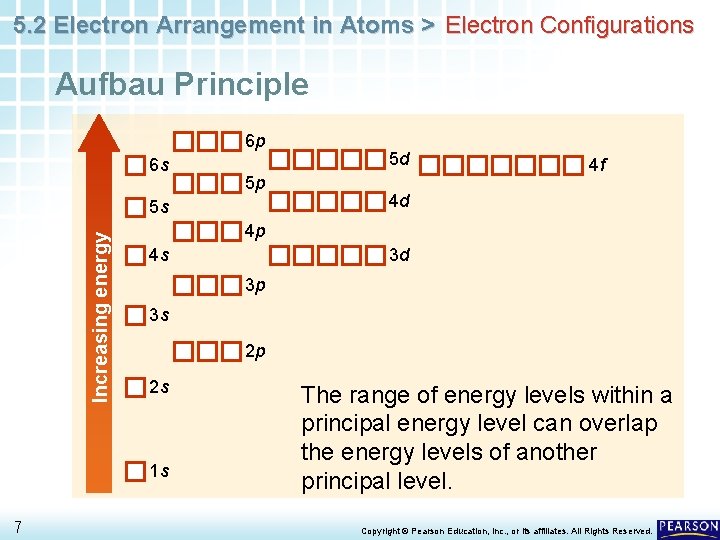
5. 2 Electron Arrangement in Atoms > Electron Configurations Aufbau Principle 6 p 6 s 5 p Increasing energy 5 s 4 f 4 d 4 p 4 s 3 d 3 p 3 s 2 p 2 s 1 s 6 5 d The aufbau diagram shows the relative energy levels of the various atomic orbitals. Orbitals of greater energy are higher on the diagram. Copyright © Pearson Education, Inc. , or its affiliates. All Rights Reserved.
5. 2 Electron Arrangement in Atoms > Electron Configurations Aufbau Principle 6 p 6 s 5 p Increasing energy 5 s 4 f 4 d 4 p 4 s 3 d 3 p 3 s 2 p 2 s 1 s 7 5 d The range of energy levels within a principal energy level can overlap the energy levels of another principal level. Copyright © Pearson Education, Inc. , or its affiliates. All Rights Reserved.
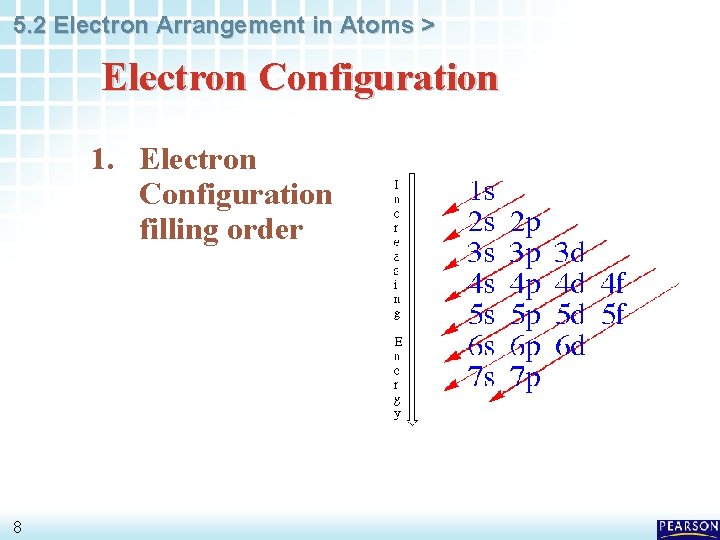
5. 2 Electron Arrangement in Atoms > Electron Configuration 1. Electron Configuration filling order 8
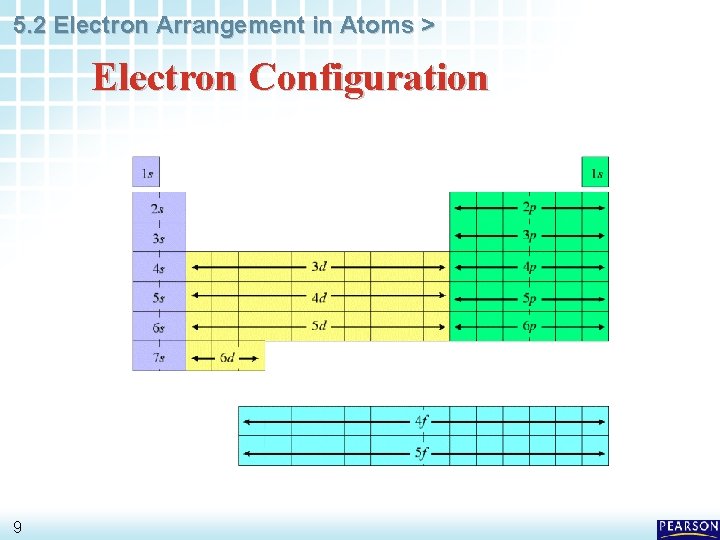
5. 2 Electron Arrangement in Atoms > Electron Configuration 9
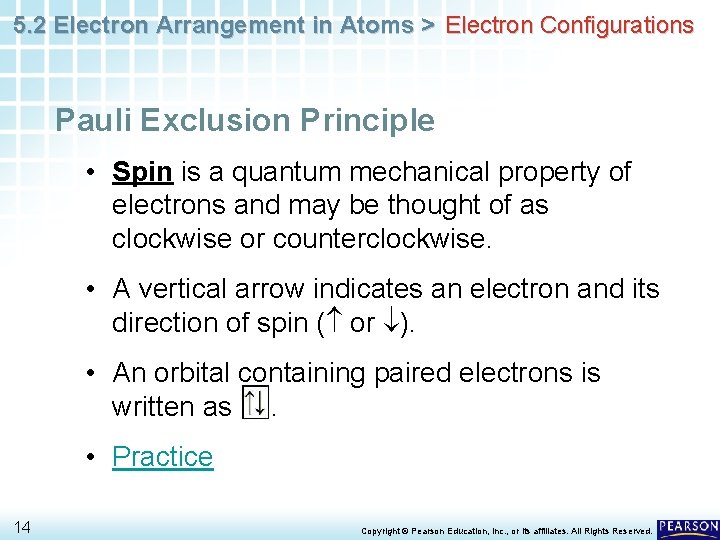
5. 2 Electron Arrangement in Atoms > Electron Configurations Pauli Exclusion Principle • According to the Pauli exclusion principle, an atomic orbital may describe at most two electrons. 10 Copyright © Pearson Education, Inc. , or its affiliates. All Rights Reserved.
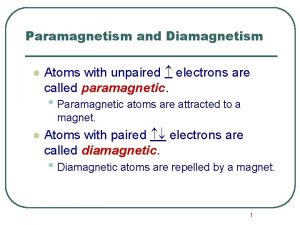
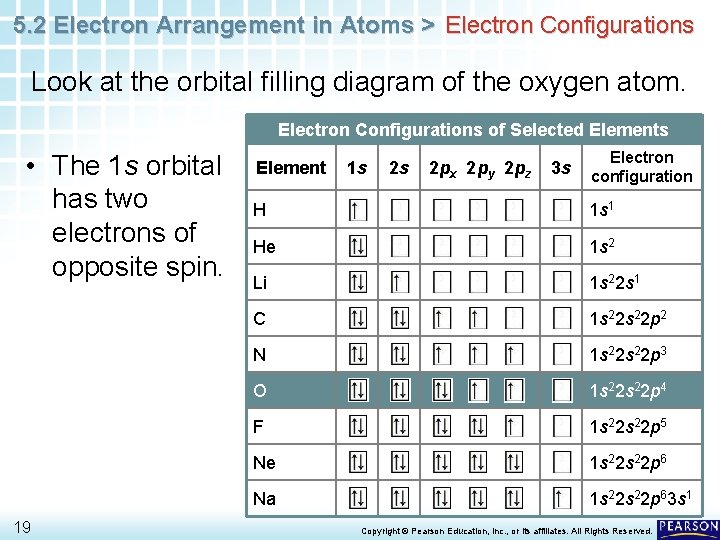
5. 2 Electron Arrangement in Atoms > Electron Configurations Pauli Exclusion Principle • According to the Pauli exclusion principle, an atomic orbital may describe at most two electrons. • To occupy the same orbital, two electrons must have opposite spins; that is, the electron spins must be paired. 11 Copyright © Pearson Education, Inc. , or its affiliates. All Rights Reserved.
5. 2 Electron Arrangement in Atoms > Electron Configurations Pauli Exclusion Principle • Spin is a quantum mechanical property of electrons and may be thought of as clockwise or counterclockwise. 12 Copyright © Pearson Education, Inc. , or its affiliates. All Rights Reserved.
5. 2 Electron Arrangement in Atoms > Electron Configurations Pauli Exclusion Principle • Spin is a quantum mechanical property of electrons and may be thought of as clockwise or counterclockwise. • A vertical arrow indicates an electron and its direction of spin ( or ). 13 Copyright © Pearson Education, Inc. , or its affiliates. All Rights Reserved.
5. 2 Electron Arrangement in Atoms > Electron Configurations Pauli Exclusion Principle • Spin is a quantum mechanical property of electrons and may be thought of as clockwise or counterclockwise. • A vertical arrow indicates an electron and its direction of spin ( or ). • An orbital containing paired electrons is written as. • Practice 14 Copyright © Pearson Education, Inc. , or its affiliates. All Rights Reserved.
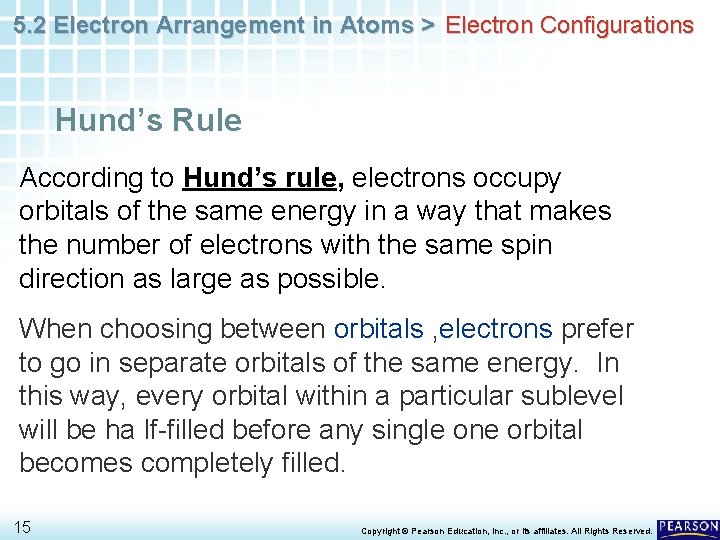
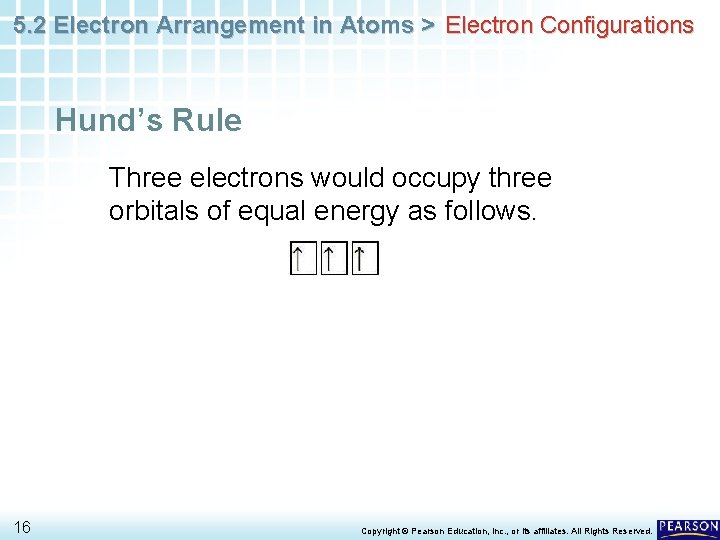
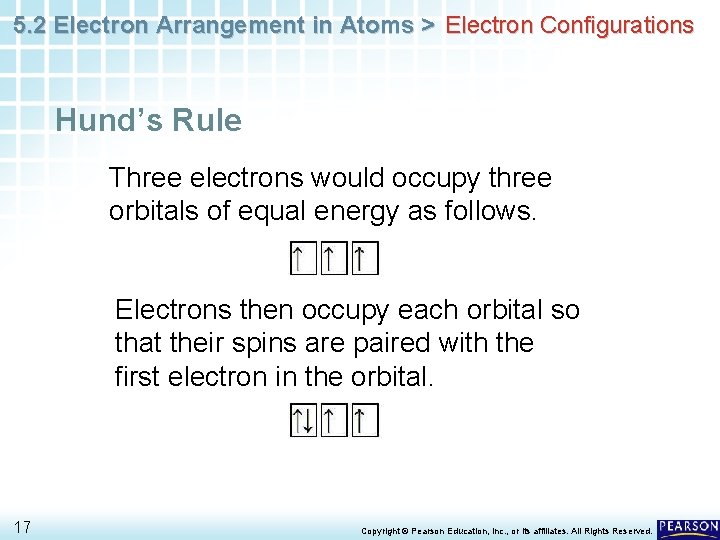
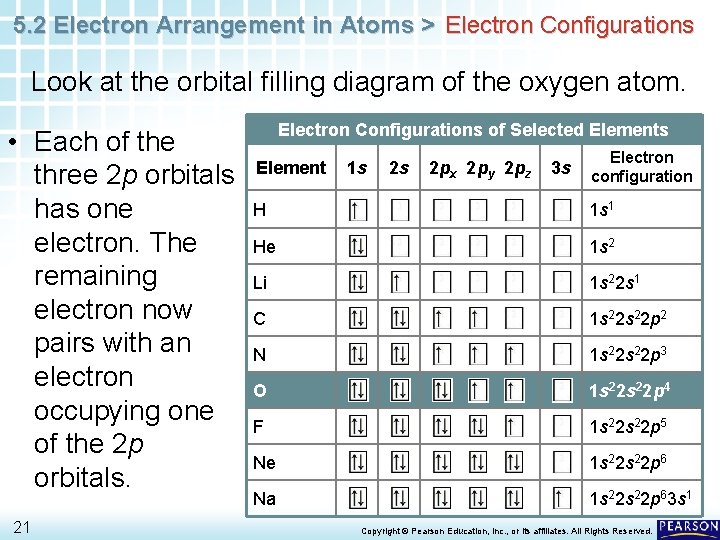
5. 2 Electron Arrangement in Atoms > Electron Configurations Hund’s Rule According to Hund’s rule, electrons occupy orbitals of the same energy in a way that makes the number of electrons with the same spin direction as large as possible. When choosing between orbitals , electrons prefer to go in separate orbitals of the same energy. In this way, every orbital within a particular sublevel will be ha lf-filled before any single one orbital becomes completely filled. 15 Copyright © Pearson Education, Inc. , or its affiliates. All Rights Reserved.
5. 2 Electron Arrangement in Atoms > Electron Configurations Hund’s Rule Three electrons would occupy three orbitals of equal energy as follows. 16 Copyright © Pearson Education, Inc. , or its affiliates. All Rights Reserved.
5. 2 Electron Arrangement in Atoms > Electron Configurations Hund’s Rule Three electrons would occupy three orbitals of equal energy as follows. Electrons then occupy each orbital so that their spins are paired with the first electron in the orbital. 17 Copyright © Pearson Education, Inc. , or its affiliates. All Rights Reserved.
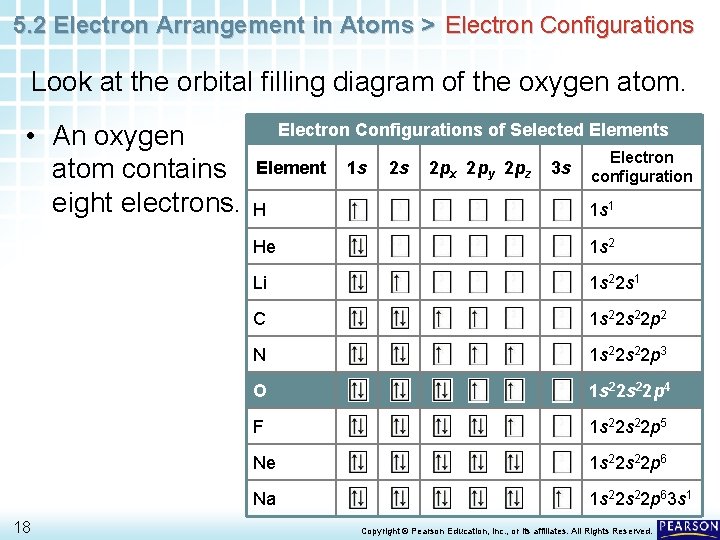
5. 2 Electron Arrangement in Atoms > Electron Configurations Look at the orbital filling diagram of the oxygen atom. • An oxygen atom contains eight electrons. 18 Electron Configurations of Selected Elements Element 1 s 2 s 2 px 2 py 2 pz 3 s Electron configuration H 1 s 1 He 1 s 2 Li 1 s 22 s 1 C 1 s 22 p 2 N 1 s 22 p 3 O 1 s 22 p 4 F 1 s 22 p 5 Ne 1 s 22 p 6 Na 1 s 22 p 63 s 1 Copyright © Pearson Education, Inc. , or its affiliates. All Rights Reserved.
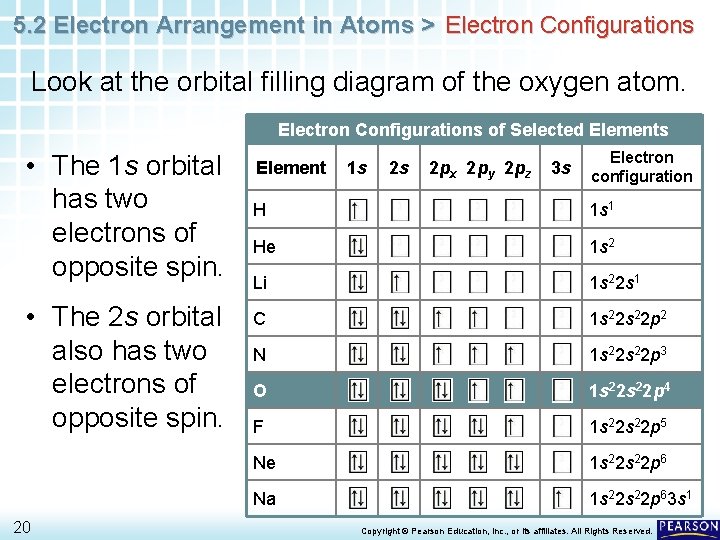
5. 2 Electron Arrangement in Atoms > Electron Configurations Look at the orbital filling diagram of the oxygen atom. Electron Configurations of Selected Elements • The 1 s orbital has two electrons of opposite spin. 19 Element 1 s 2 s 2 px 2 py 2 pz 3 s Electron configuration H 1 s 1 He 1 s 2 Li 1 s 22 s 1 C 1 s 22 p 2 N 1 s 22 p 3 O 1 s 22 p 4 F 1 s 22 p 5 Ne 1 s 22 p 6 Na 1 s 22 p 63 s 1 Copyright © Pearson Education, Inc. , or its affiliates. All Rights Reserved.
5. 2 Electron Arrangement in Atoms > Electron Configurations Look at the orbital filling diagram of the oxygen atom. Electron Configurations of Selected Elements • The 1 s orbital has two electrons of opposite spin. • The 2 s orbital also has two electrons of opposite spin. 20 Element 1 s 2 s 2 px 2 py 2 pz 3 s Electron configuration H 1 s 1 He 1 s 2 Li 1 s 22 s 1 C 1 s 22 p 2 N 1 s 22 p 3 O 1 s 22 p 4 F 1 s 22 p 5 Ne 1 s 22 p 6 Na 1 s 22 p 63 s 1 Copyright © Pearson Education, Inc. , or its affiliates. All Rights Reserved.
5. 2 Electron Arrangement in Atoms > Electron Configurations Look at the orbital filling diagram of the oxygen atom. • Each of the three 2 p orbitals has one electron. The remaining electron now pairs with an electron occupying one of the 2 p orbitals. 21 Electron Configurations of Selected Elements Element 1 s 2 s 2 px 2 py 2 pz 3 s Electron configuration H 1 s 1 He 1 s 2 Li 1 s 22 s 1 C 1 s 22 p 2 N 1 s 22 p 3 O 1 s 22 p 4 F 1 s 22 p 5 Ne 1 s 22 p 6 Na 1 s 22 p 63 s 1 Copyright © Pearson Education, Inc. , or its affiliates. All Rights Reserved.
5. 2 Electron Arrangement in Atoms > Electron Configurations • A convenient shorthand method for showing the electron configuration of an atom involves writing the energy level and the symbol for every sublevel occupied by an electron. 22 Copyright © Pearson Education, Inc. , or its affiliates. All Rights Reserved.
5. 2 Electron Arrangement in Atoms > Electron Configurations • A convenient shorthand method for showing the electron configuration of an atom involves writing the energy level and the symbol for every sublevel occupied by an electron. • You indicate the number of electrons occupying that sublevel with a superscript. 23 Copyright © Pearson Education, Inc. , or its affiliates. All Rights Reserved.
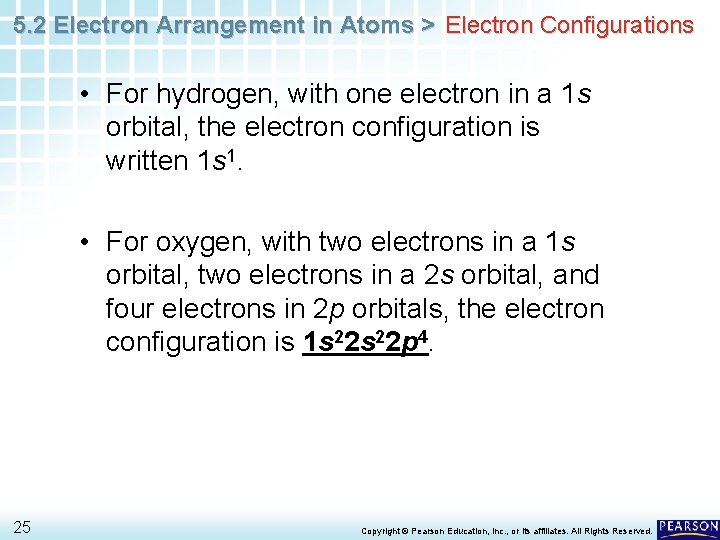
5. 2 Electron Arrangement in Atoms > Electron Configurations • For hydrogen, with one electron in a 1 s orbital, the electron configuration is written 1 s 1. 24 Copyright © Pearson Education, Inc. , or its affiliates. All Rights Reserved.
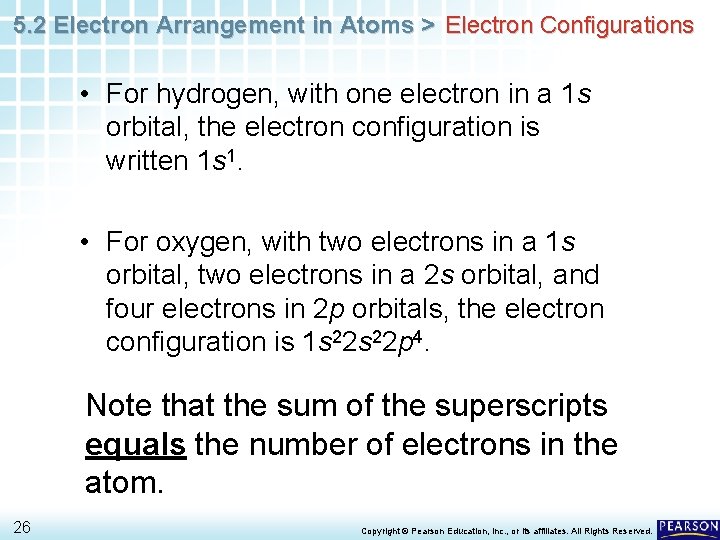
5. 2 Electron Arrangement in Atoms > Electron Configurations • For hydrogen, with one electron in a 1 s orbital, the electron configuration is written 1 s 1. • For oxygen, with two electrons in a 1 s orbital, two electrons in a 2 s orbital, and four electrons in 2 p orbitals, the electron configuration is 1 s 22 p 4. 25 Copyright © Pearson Education, Inc. , or its affiliates. All Rights Reserved.
5. 2 Electron Arrangement in Atoms > Electron Configurations • For hydrogen, with one electron in a 1 s orbital, the electron configuration is written 1 s 1. • For oxygen, with two electrons in a 1 s orbital, two electrons in a 2 s orbital, and four electrons in 2 p orbitals, the electron configuration is 1 s 22 p 4. Note that the sum of the superscripts equals the number of electrons in the atom. 26 Copyright © Pearson Education, Inc. , or its affiliates. All Rights Reserved.
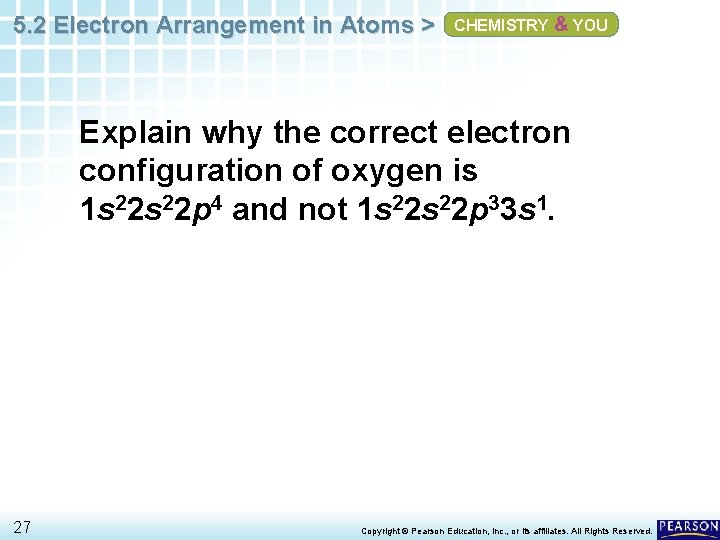
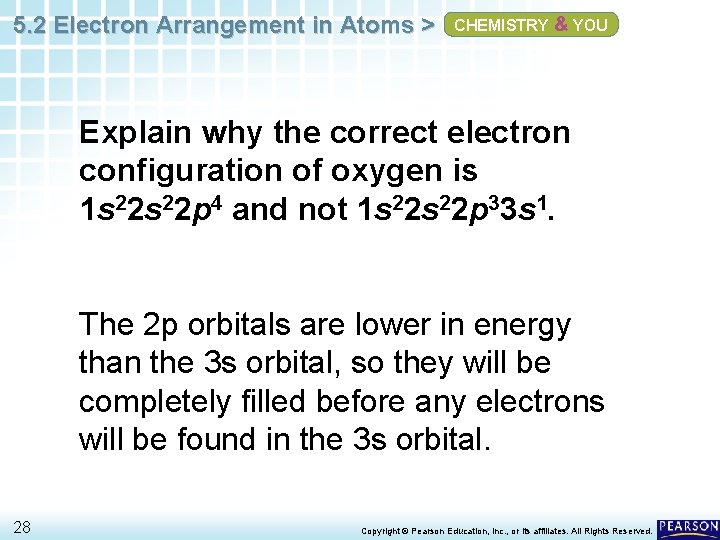
5. 2 Electron Arrangement in Atoms > CHEMISTRY & YOU Explain why the correct electron configuration of oxygen is 1 s 22 p 4 and not 1 s 22 p 33 s 1. 27 Copyright © Pearson Education, Inc. , or its affiliates. All Rights Reserved.
5. 2 Electron Arrangement in Atoms > CHEMISTRY & YOU Explain why the correct electron configuration of oxygen is 1 s 22 p 4 and not 1 s 22 p 33 s 1. The 2 p orbitals are lower in energy than the 3 s orbital, so they will be completely filled before any electrons will be found in the 3 s orbital. 28 Copyright © Pearson Education, Inc. , or its affiliates. All Rights Reserved.
5. 2 Electron Arrangement in Atoms > Sample Problem 5. 1 Writing Electron Configurations The atomic number of phosphorus is 15. Write the electron configuration of a phosphorus atom. 29 Copyright © Pearson Education, Inc. , or its affiliates. All Rights Reserved.
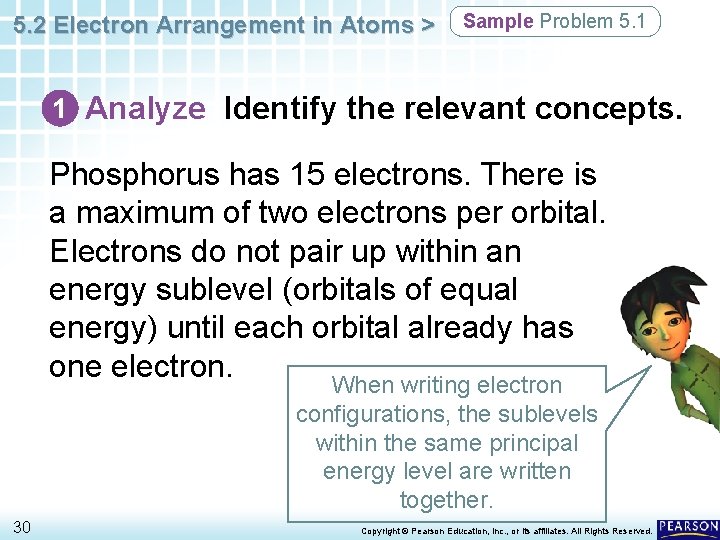
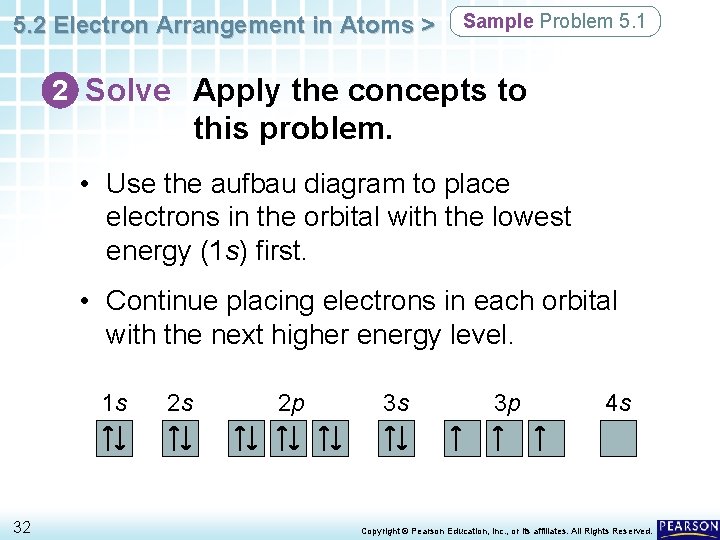
5. 2 Electron Arrangement in Atoms > Sample Problem 5. 1 1 Analyze Identify the relevant concepts. Phosphorus has 15 electrons. There is a maximum of two electrons per orbital. Electrons do not pair up within an energy sublevel (orbitals of equal energy) until each orbital already has one electron. When writing electron configurations, the sublevels within the same principal energy level are written together. 30 Copyright © Pearson Education, Inc. , or its affiliates. All Rights Reserved.
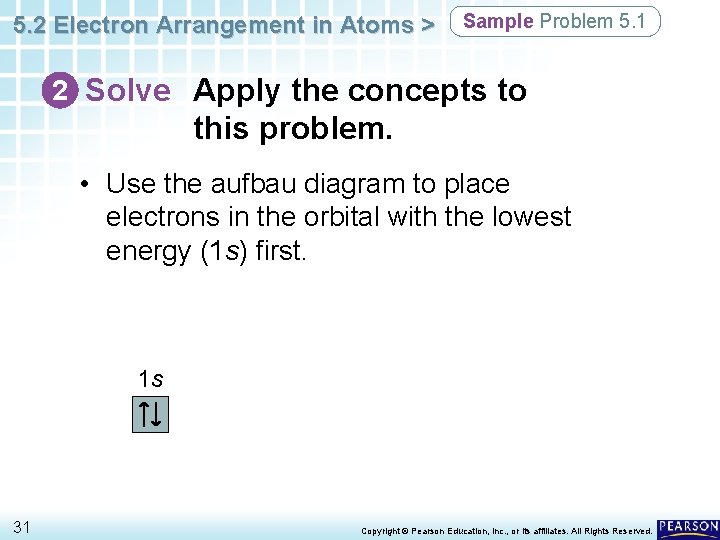
5. 2 Electron Arrangement in Atoms > Sample Problem 5. 1 2 Solve Apply the concepts to this problem. • Use the aufbau diagram to place electrons in the orbital with the lowest energy (1 s) first. 1 s 31 Copyright © Pearson Education, Inc. , or its affiliates. All Rights Reserved.
5. 2 Electron Arrangement in Atoms > Sample Problem 5. 1 2 Solve Apply the concepts to this problem. • Use the aufbau diagram to place electrons in the orbital with the lowest energy (1 s) first. • Continue placing electrons in each orbital with the next higher energy level. 1 s 32 2 s 2 p 3 s 3 p 4 s Copyright © Pearson Education, Inc. , or its affiliates. All Rights Reserved.
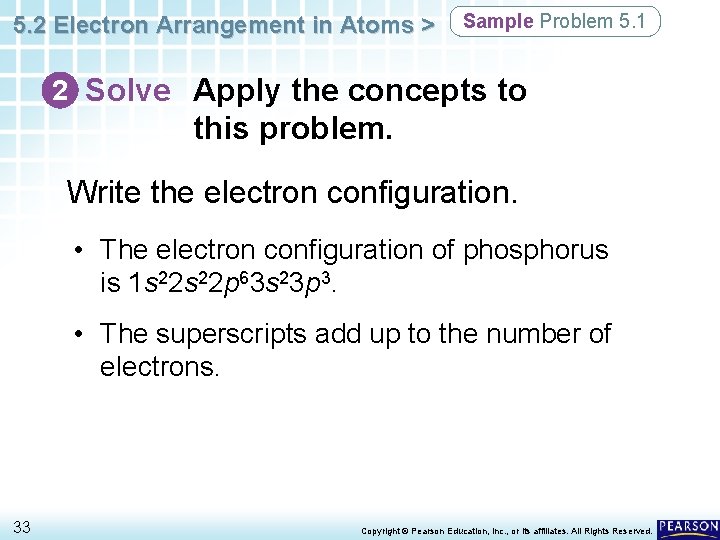
5. 2 Electron Arrangement in Atoms > Sample Problem 5. 1 2 Solve Apply the concepts to this problem. Write the electron configuration. • The electron configuration of phosphorus is 1 s 22 p 63 s 23 p 3. • The superscripts add up to the number of electrons. 33 Copyright © Pearson Education, Inc. , or its affiliates. All Rights Reserved.
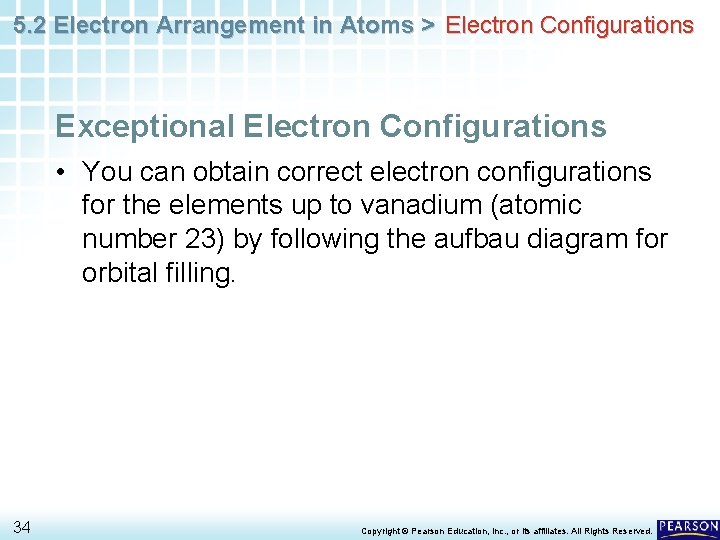
5. 2 Electron Arrangement in Atoms > Electron Configurations Exceptional Electron Configurations • You can obtain correct electron configurations for the elements up to vanadium (atomic number 23) by following the aufbau diagram for orbital filling. 34 Copyright © Pearson Education, Inc. , or its affiliates. All Rights Reserved.
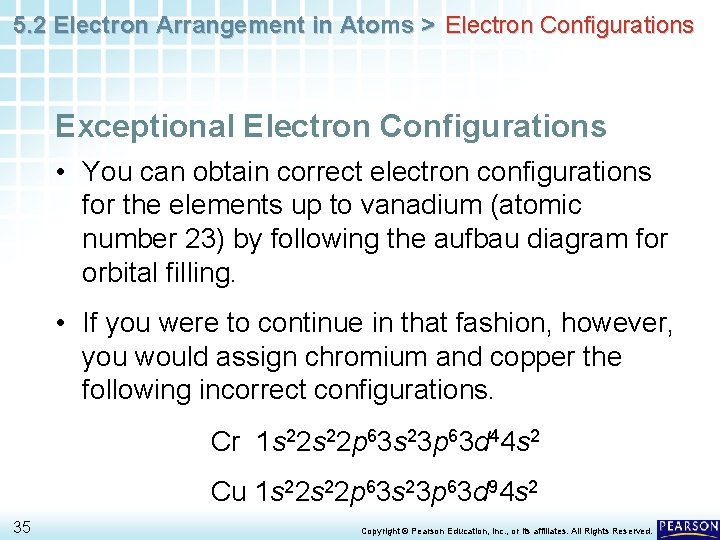
5. 2 Electron Arrangement in Atoms > Electron Configurations Exceptional Electron Configurations • You can obtain correct electron configurations for the elements up to vanadium (atomic number 23) by following the aufbau diagram for orbital filling. • If you were to continue in that fashion, however, you would assign chromium and copper the following incorrect configurations. Cr 1 s 22 p 63 s 23 p 63 d 44 s 2 Cu 1 s 22 p 63 s 23 p 63 d 94 s 2 35 Copyright © Pearson Education, Inc. , or its affiliates. All Rights Reserved.
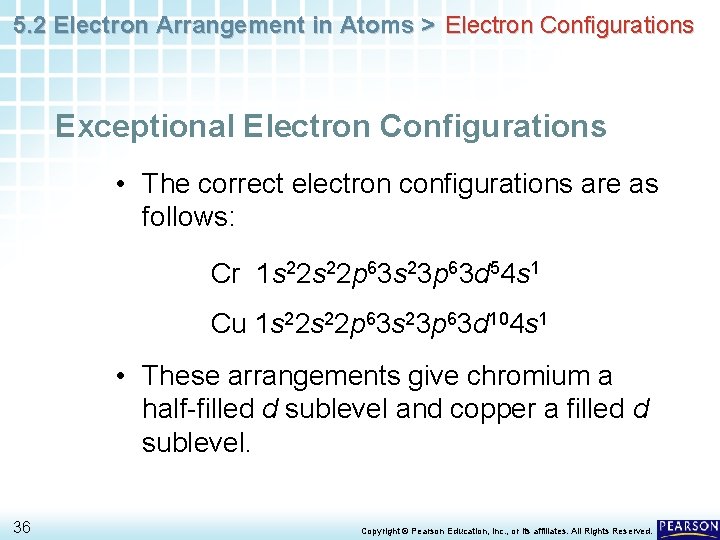
5. 2 Electron Arrangement in Atoms > Electron Configurations Exceptional Electron Configurations • The correct electron configurations are as follows: Cr 1 s 22 p 63 s 23 p 63 d 54 s 1 Cu 1 s 22 p 63 s 23 p 63 d 104 s 1 • These arrangements give chromium a half-filled d sublevel and copper a filled d sublevel. 36 Copyright © Pearson Education, Inc. , or its affiliates. All Rights Reserved.
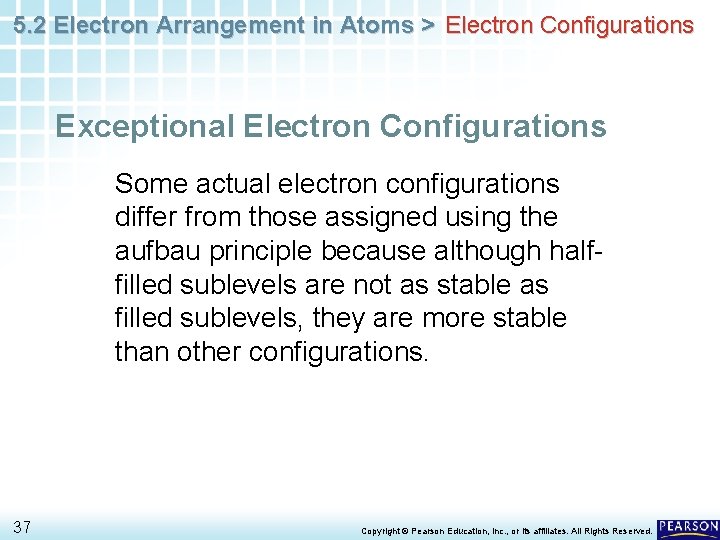
5. 2 Electron Arrangement in Atoms > Electron Configurations Exceptional Electron Configurations Some actual electron configurations differ from those assigned using the aufbau principle because although halffilled sublevels are not as stable as filled sublevels, they are more stable than other configurations. 37 Copyright © Pearson Education, Inc. , or its affiliates. All Rights Reserved.
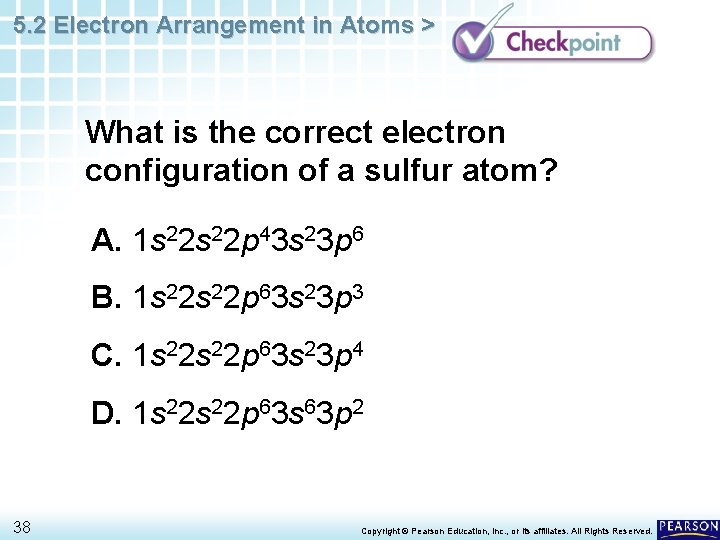
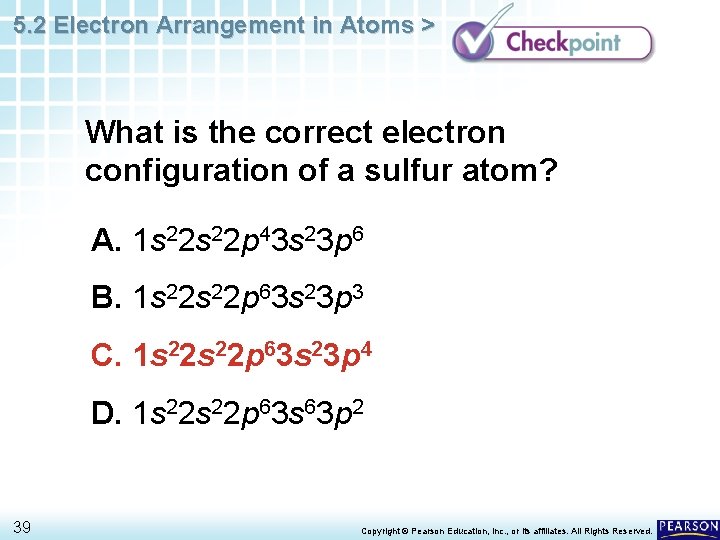
5. 2 Electron Arrangement in Atoms > What is the correct electron configuration of a sulfur atom? A. 1 s 22 p 43 s 23 p 6 B. 1 s 22 p 63 s 23 p 3 C. 1 s 22 p 63 s 23 p 4 D. 1 s 22 p 63 s 63 p 2 38 Copyright © Pearson Education, Inc. , or its affiliates. All Rights Reserved.
5. 2 Electron Arrangement in Atoms > What is the correct electron configuration of a sulfur atom? A. 1 s 22 p 43 s 23 p 6 B. 1 s 22 p 63 s 23 p 3 C. 1 s 22 p 63 s 23 p 4 D. 1 s 22 p 63 s 63 p 2 39 Copyright © Pearson Education, Inc. , or its affiliates. All Rights Reserved.
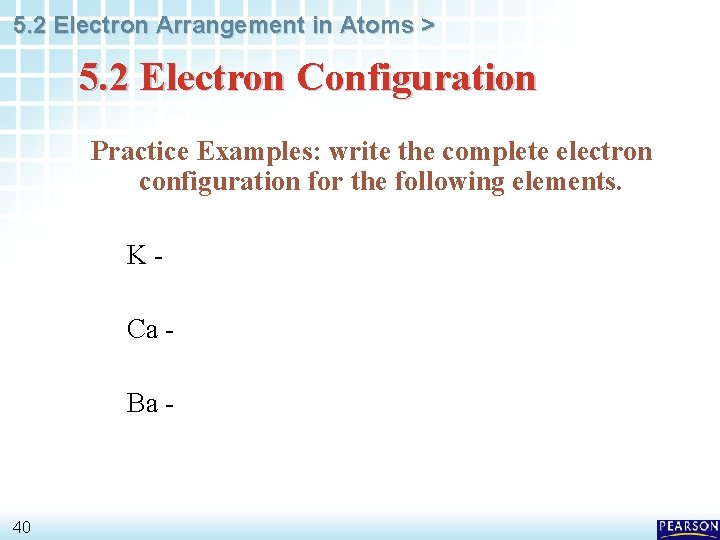
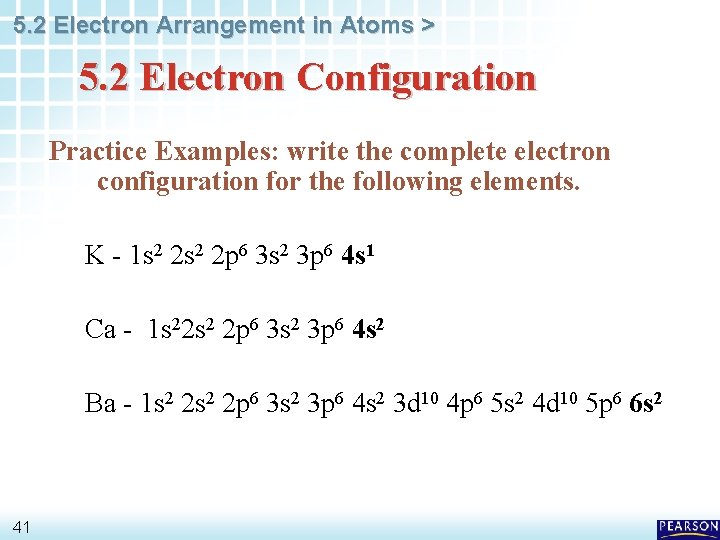
5. 2 Electron Arrangement in Atoms > 5. 2 Electron Configuration Practice Examples: write the complete electron configuration for the following elements. KCa Ba - 40
5. 2 Electron Arrangement in Atoms > 5. 2 Electron Configuration Practice Examples: write the complete electron configuration for the following elements. K - 1 s 2 2 p 6 3 s 2 3 p 6 4 s 1 Ca - 1 s 22 s 2 2 p 6 3 s 2 3 p 6 4 s 2 Ba - 1 s 2 2 p 6 3 s 2 3 p 6 4 s 2 3 d 10 4 p 6 5 s 2 4 d 10 5 p 6 6 s 2 41
5. 2 Electron Arrangement in Atoms > Key Concept Three rules—the aufbau principle, the Pauli exclusion principle, and Hund’s rule—tell you how to find the electron configurations of atoms. 42 Copyright © Pearson Education, Inc. , or its affiliates. All Rights Reserved.
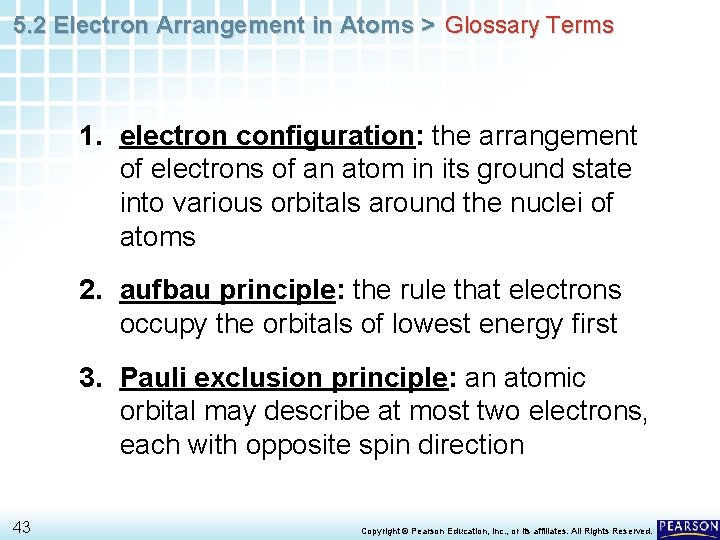
5. 2 Electron Arrangement in Atoms > Glossary Terms 1. electron configuration: the arrangement of electrons of an atom in its ground state into various orbitals around the nuclei of atoms 2. aufbau principle: the rule that electrons occupy the orbitals of lowest energy first 3. Pauli exclusion principle: an atomic orbital may describe at most two electrons, each with opposite spin direction 43 Copyright © Pearson Education, Inc. , or its affiliates. All Rights Reserved.
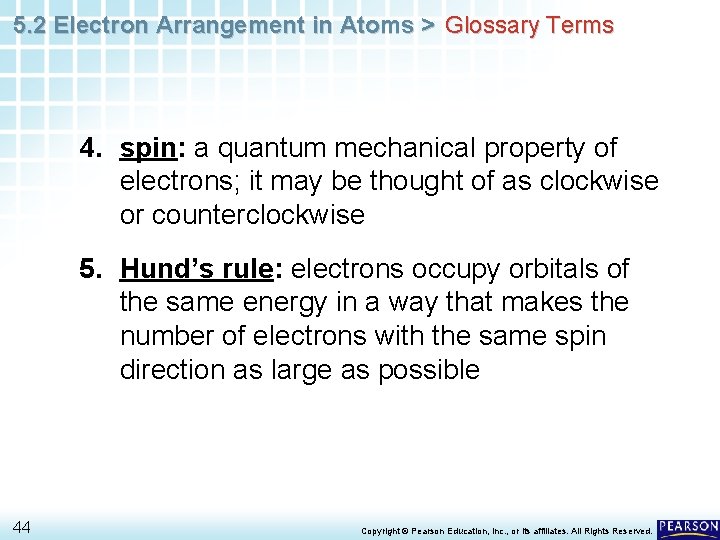
5. 2 Electron Arrangement in Atoms > Glossary Terms 4. spin: a quantum mechanical property of electrons; it may be thought of as clockwise or counterclockwise 5. Hund’s rule: electrons occupy orbitals of the same energy in a way that makes the number of electrons with the same spin direction as large as possible 44 Copyright © Pearson Education, Inc. , or its affiliates. All Rights Reserved.
5. 2 Electron Arrangement in Atoms > 45 Copyright © Pearson Education, Inc. , or its affiliates. All Rights Reserved.
5. 2 Electron Arrangement in Atoms > 46 Copyright © Pearson Education, Inc. , or its affiliates. All Rights Reserved.
5. 2 Electron Arrangement in Atoms > END OF 5. 2 47 Copyright © Pearson Education, Inc. , or its affiliates. All Rights Reserved.