
Electron Configuration Chapter 4 Light Today scientists believe
Electron Configuration Chapter 4
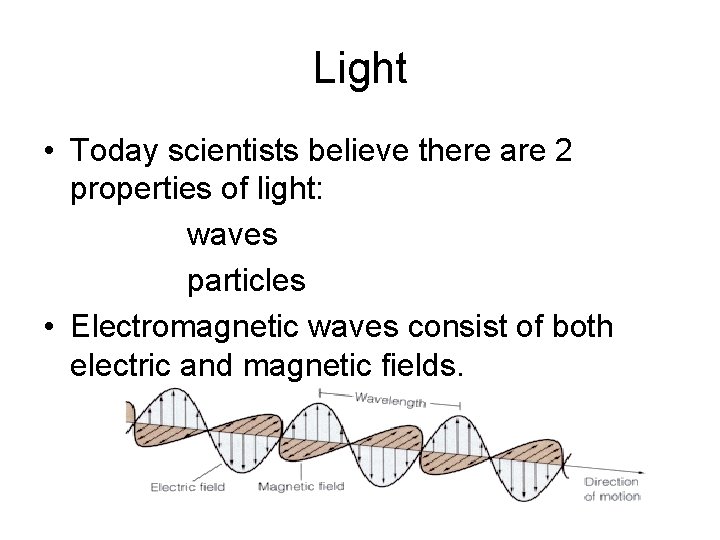
Light • Today scientists believe there are 2 properties of light: waves particles • Electromagnetic waves consist of both electric and magnetic fields.
Electromagnetic Waves • http: //www. phys. hawaii. edu/~teb/java/ntnuj ava/em. Wave. html
Wave Activity • Use the rope to devise an explanation of the following to be given to a person without sight: – Amplitude – Wavelength – Frequency – Crest – Trough – Relate wavelength and frequency
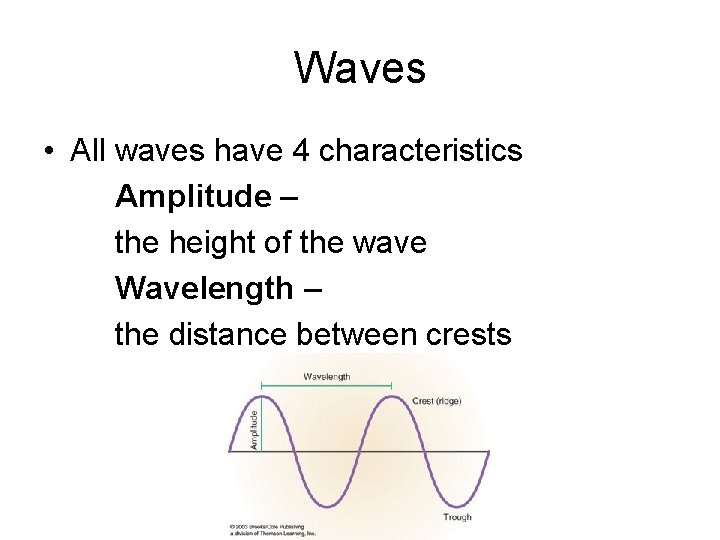
Waves • All waves have 4 characteristics Amplitude – the height of the wave Wavelength – the distance between crests
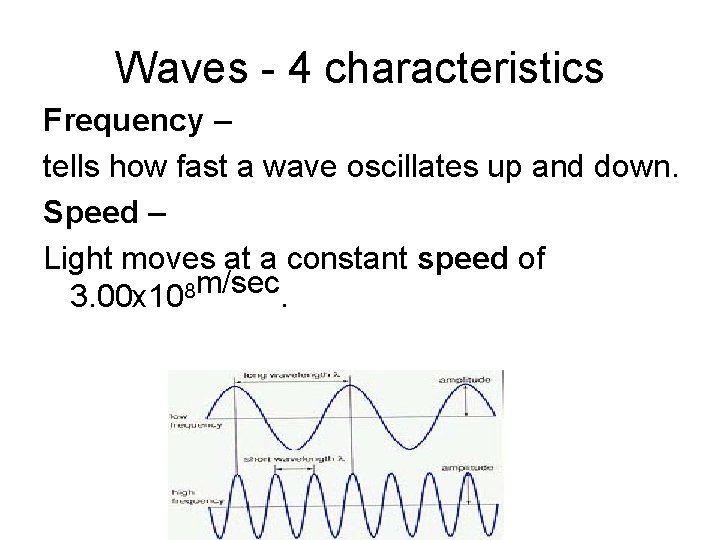
Waves - 4 characteristics Frequency – tells how fast a wave oscillates up and down. Speed – Light moves at a constant speed of 3. 00 x 108 m/sec.
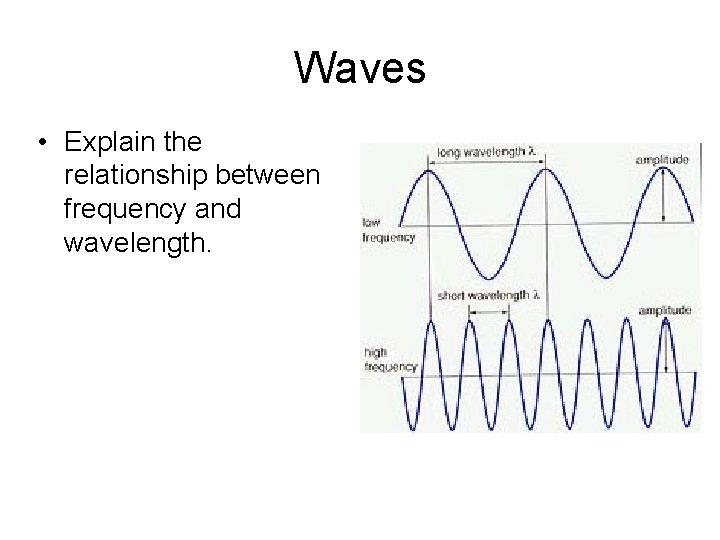
Waves • Explain the relationship between frequency and wavelength.
Electromagnetic Spectrum • Visible Light – each color has a different wavelength and therefore a different color. • Roy G. Biv – Violet has the shortest wavelength (highest frequency) – Red has the longest wavelength (lowest frequency)

Wavelengths
Quantum Theory • http: //www. youtube. com/watch? v=x_t. Nzeo u. HC 4
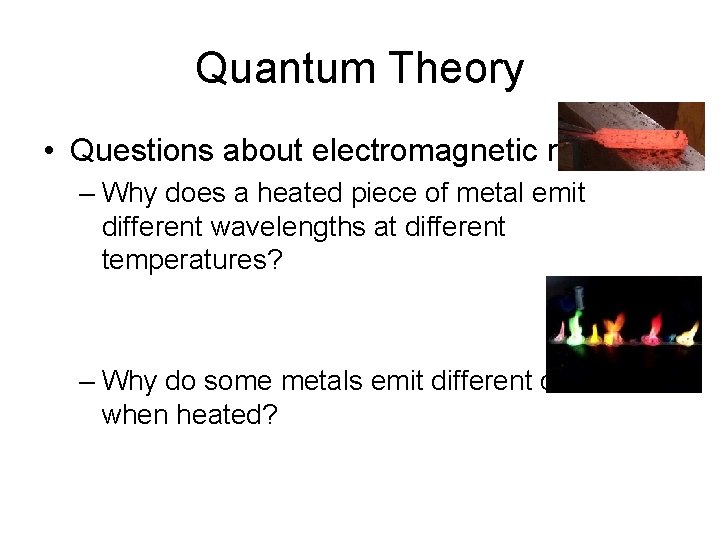
Quantum Theory • Questions about electromagnetic radiation: – Why does a heated piece of metal emit different wavelengths at different temperatures? – Why do some metals emit different colors when heated?
Planck • http: //www. youtube. com/playlist? list=PL 64 2 F 73306 F 273 E 49&feature=view_all
Planck’s Theory • Energy emitted or absorbed by an object is restricted to certain quantities. – Each “piece” of this energy is a quantum. – Energy absorbed or emitted by atoms are quantized. Their values are restricted to certain quantities. http: //www. youtube. com/watch? v=i 1 TVZIBj 7 UA &feature=plcp
Photoelectric Effect • http: //www. youtube. com/watch? v=v 5 h 3 h 2 E 4 z 2 Q&feature=related
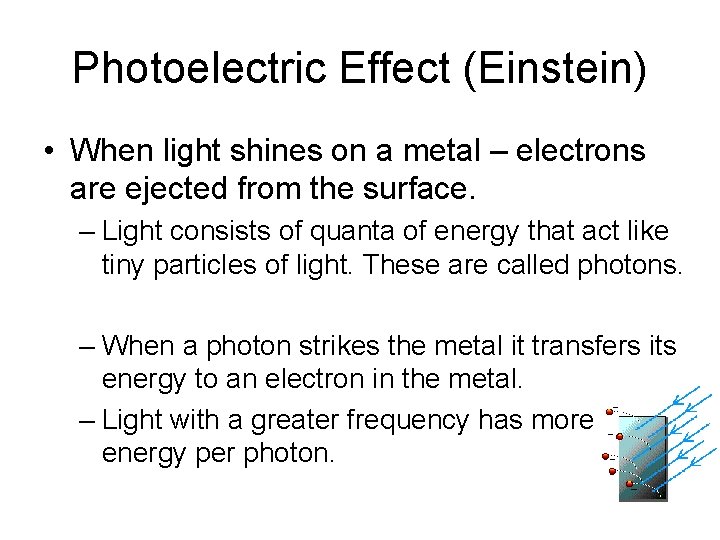
Photoelectric Effect (Einstein) • When light shines on a metal – electrons are ejected from the surface. – Light consists of quanta of energy that act like tiny particles of light. These are called photons. – When a photon strikes the metal it transfers its energy to an electron in the metal. – Light with a greater frequency has more energy per photon.
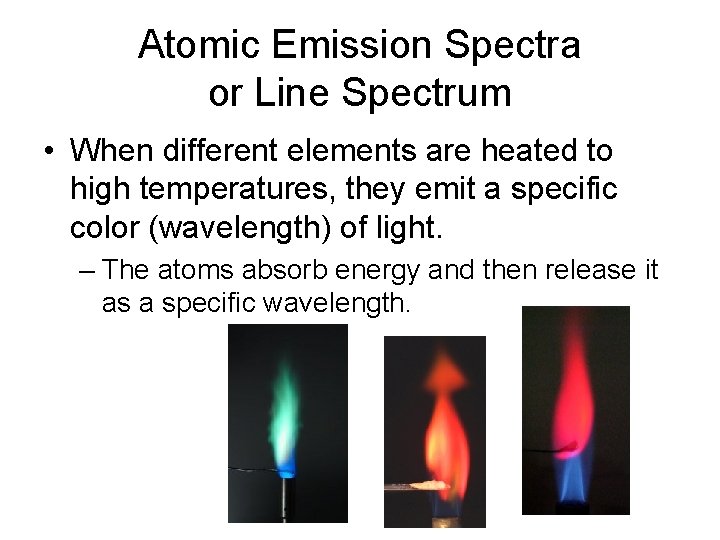
Atomic Emission Spectra or Line Spectrum • When different elements are heated to high temperatures, they emit a specific color (wavelength) of light. – The atoms absorb energy and then release it as a specific wavelength.
Line Spectra • http: //people. westminstercollege. edu/facult y/ccline/elements 1. html
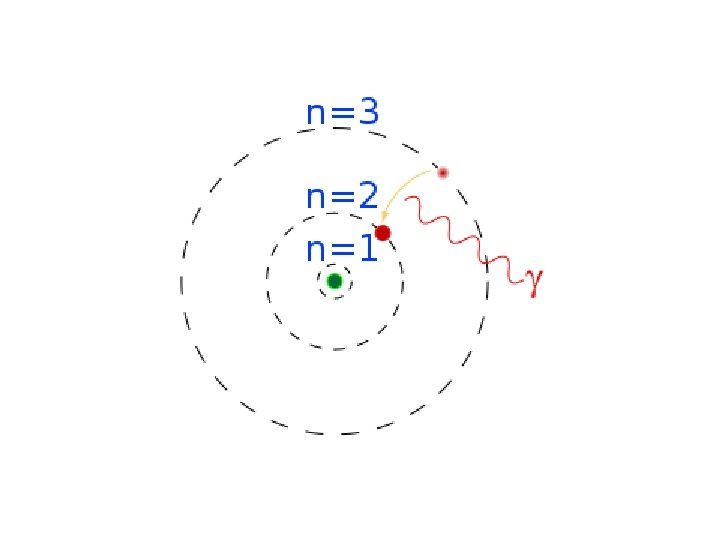
The Bohr Model • Bohr proposed that each electron has a certain quantum of energy called the ground state of energy. – The electrons at ground state are in the lowest energy level. – When electrons absorb radiant energy they are excited and move to a higher energy level. – When they move back to the ground state level they emit radiation (color)
Lab • Flame Tests and Emissions
Heisenberg’s Uncertainty Principle • The position and the momentum of a moving object cannot simultaneously be measured and known exactly. – You can’t know where a particle is and how it is moving at any one moment. • So, you can’t really predict where a particle will be in the future.
Lab • Quantum Leap Lab
Electron Density • Electron Density = the density of the electron cloud – where electrons are most likely to be found • Atomic Orbital (“electron cloud”) – Region around the nucleus of an atom where an electron of given energy is likely to be found
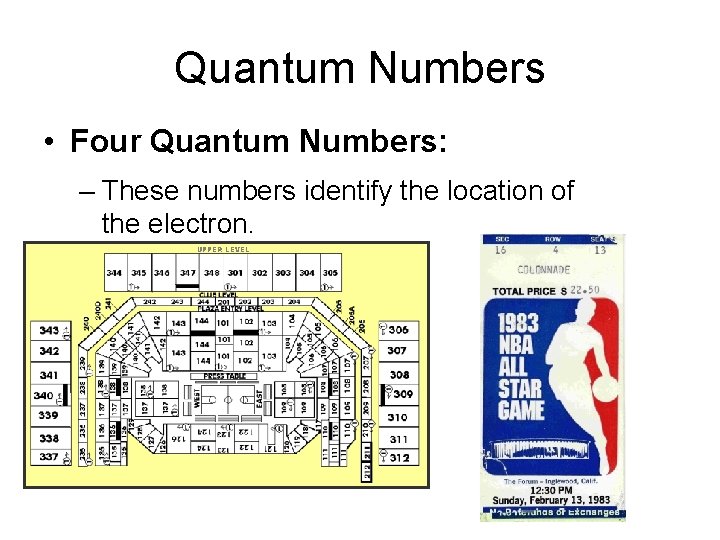
Quantum Numbers • Four Quantum Numbers: – These numbers identify the location of the electron. UPPER LEVEL
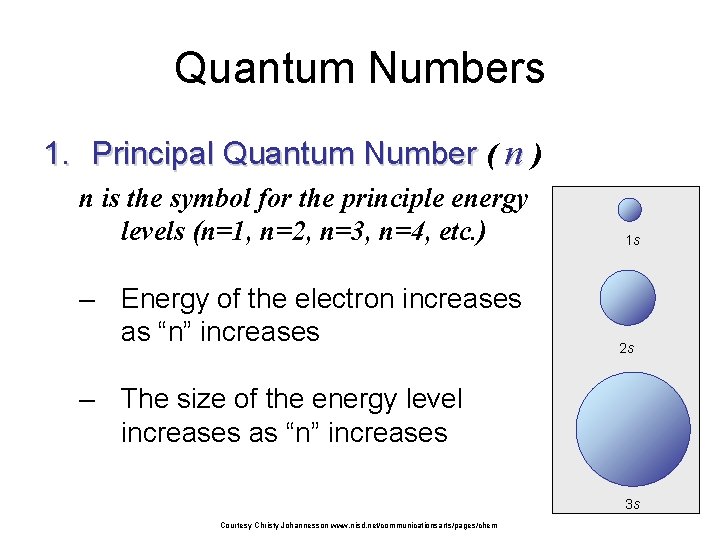
Quantum Numbers 1. Principal Quantum Number ( n ) n is the symbol for the principle energy levels (n=1, n=2, n=3, n=4, etc. ) – Energy of the electron increases as “n” increases 1 s 2 s – The size of the energy level increases as “n” increases 3 s Courtesy Christy Johannesson www. nisd. net/communicationsarts/pages/chem
Quantum Numbers 2. Each principle energy level is divided into Sublevels – The number of sublevels that a principal energy level has is the number of that principal energy level. – So, energy level 1 has one sublevel, level 2 has two sublevels, etc. – – – Sublevels are labeled: s, p, d, f Principal energy level 1 = s sublevel Principal energy level 2 = s and p sublevels Principal energy level 3 = s, p and d sublevels Principal energy level 4 = s, p, d and f sublevels
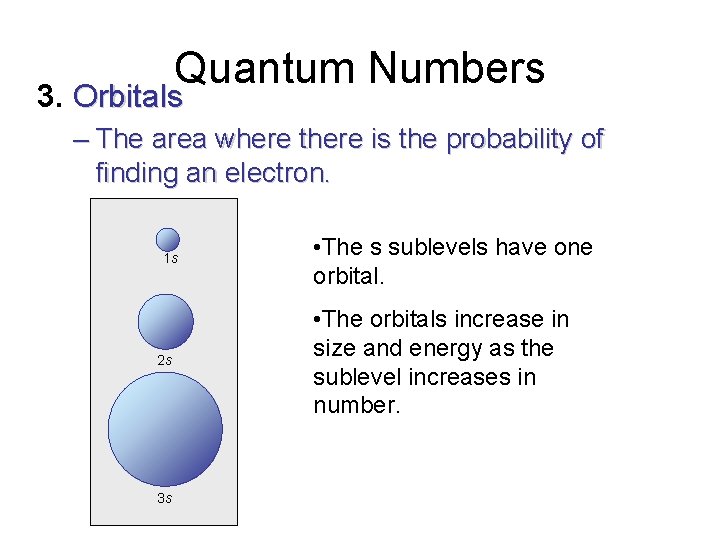
Quantum Numbers 3. Orbitals – The area where there is the probability of finding an electron. 1 s 2 s 3 s • The s sublevels have one orbital. • The orbitals increase in size and energy as the sublevel increases in number.
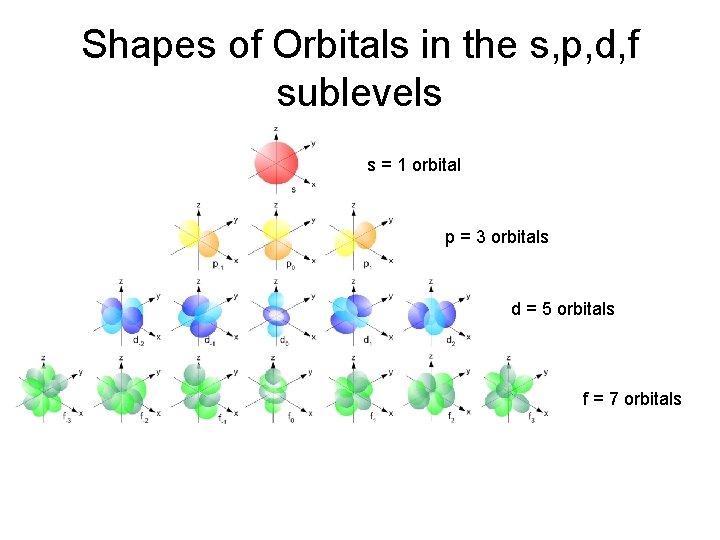
Shapes of Orbitals in the s, p, d, f sublevels s = 1 orbital p = 3 orbitals d = 5 orbitals f = 7 orbitals
Energy Levels • http: //www. youtube. com/watch? v=Vf. Bcf. Y R 1 VQo&feature=related • As the value of n increases – the electron energy increases. – electrons also spend more time farther from the nucleus making the orbital larger
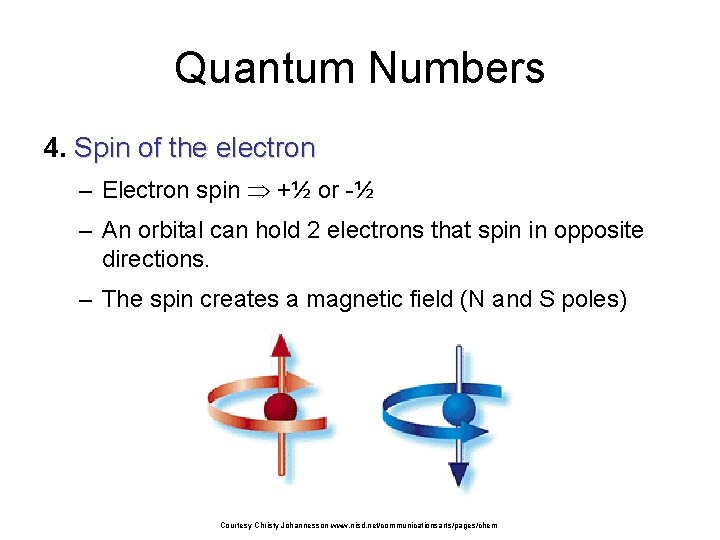
Quantum Numbers 4. Spin of the electron – Electron spin +½ or -½ – An orbital can hold 2 electrons that spin in opposite directions. – The spin creates a magnetic field (N and S poles) Courtesy Christy Johannesson www. nisd. net/communicationsarts/pages/chem
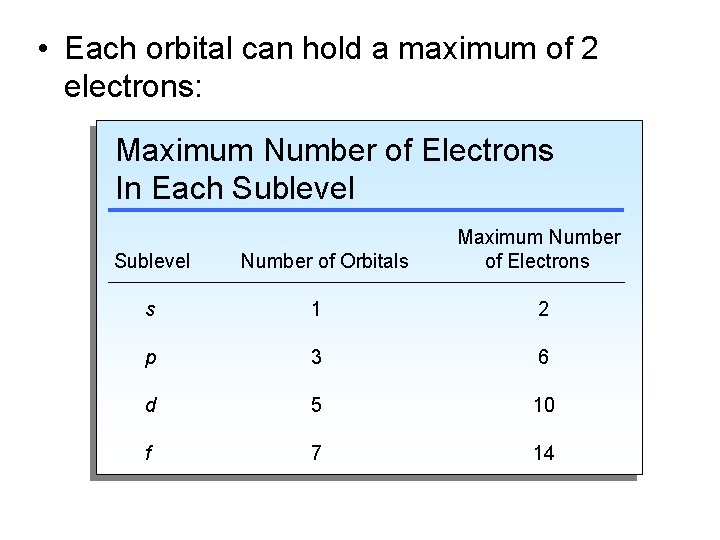
• Each orbital can hold a maximum of 2 electrons: Maximum Number of Electrons In Each Sublevel Number of Orbitals Maximum Number of Electrons s 1 2 p 3 6 d 5 10 f 7 14
Electron Configuration • Electron configuration is the distribution of the electrons among the orbitals of an atom. – Describes: • Where the electrons are found • What energies the electrons possess • When electrons are in the lowest energy orbitals possible they are at ground state • Ground state is the most stable state of the atom. • The electron configuration is determined by a set of principles.
Principles for Determining Electron Configuration Aufbau Principle: Electrons are added one at a time to the lowest energy orbitals available until all the electrons of the atom have been accounted for. Pauli Exclusion Principle: An orbital can hold a maximum of two electrons. To occupy the same orbital, two electrons must spin in opposite directions. Hund’s Rule: Electrons occupy equal-energy orbitals so that a maximum number of unpaired electrons results. Each orbital in a sub-level gets electron first and then they each get a second electron. *Aufbau is German for “building up”
Determining Electron Configuration • Orbital Diagrams • http: //intro. chem. okstate. edu/Workshop. Fol der/Electronconfnew. html
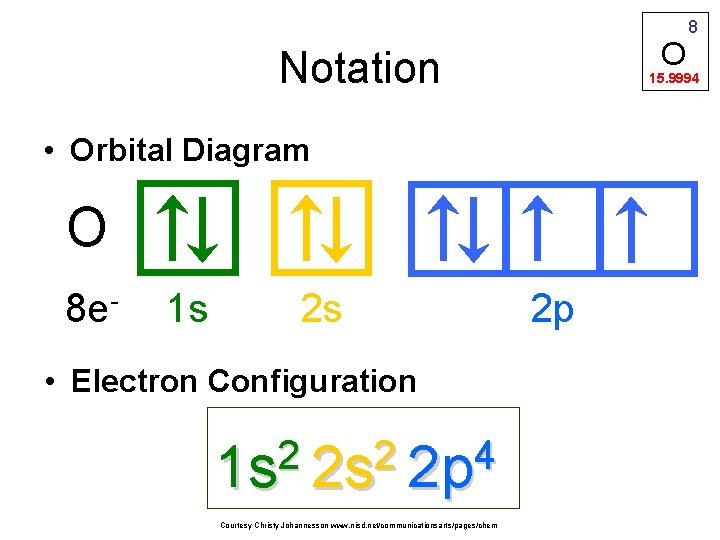
O Notation 15. 9994 • Orbital Diagram O 8 e- 1 s 2 s • Electron Configuration 2 2 4 1 s 2 s 2 p Courtesy Christy Johannesson www. nisd. net/communicationsarts/pages/chem 8 2 p
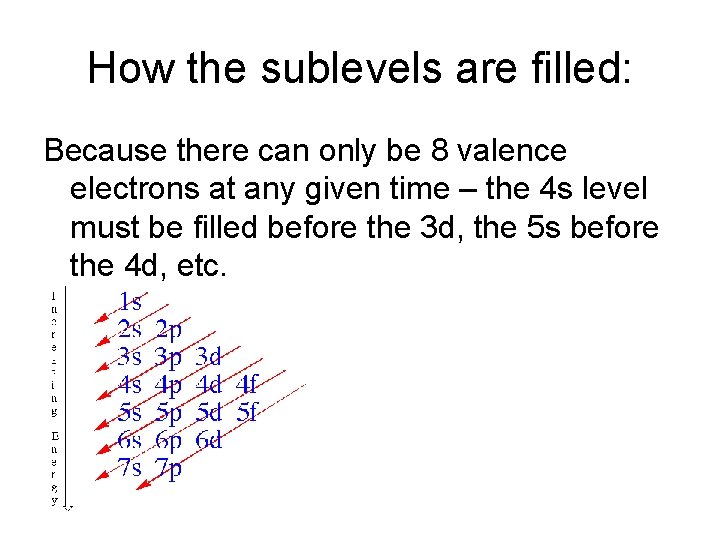
How the sublevels are filled: Because there can only be 8 valence electrons at any given time – the 4 s level must be filled before the 3 d, the 5 s before the 4 d, etc.
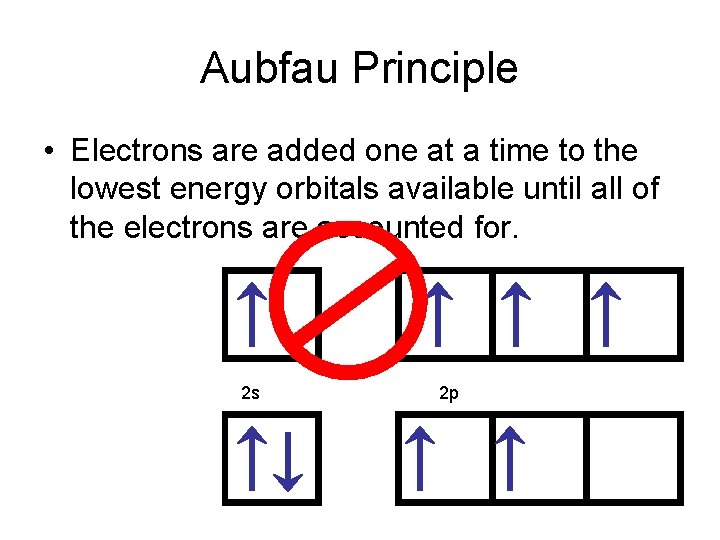
Aubfau Principle • Electrons are added one at a time to the lowest energy orbitals available until all of the electrons are accounted for. 2 s 2 p
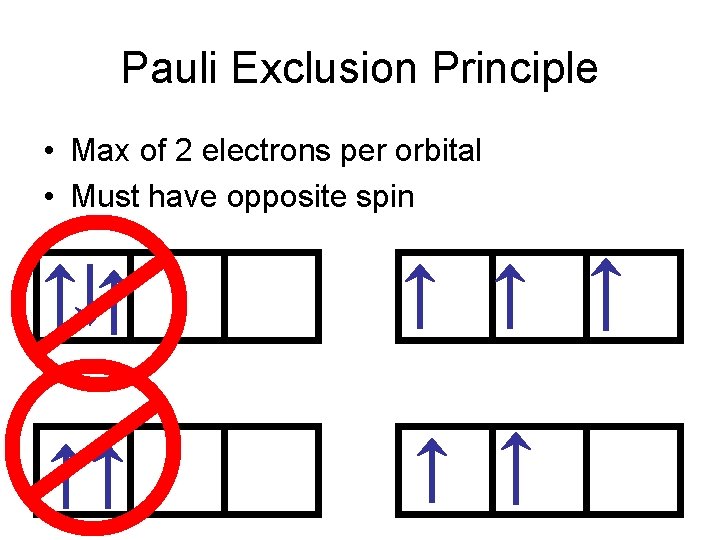
Pauli Exclusion Principle • Max of 2 electrons per orbital • Must have opposite spin
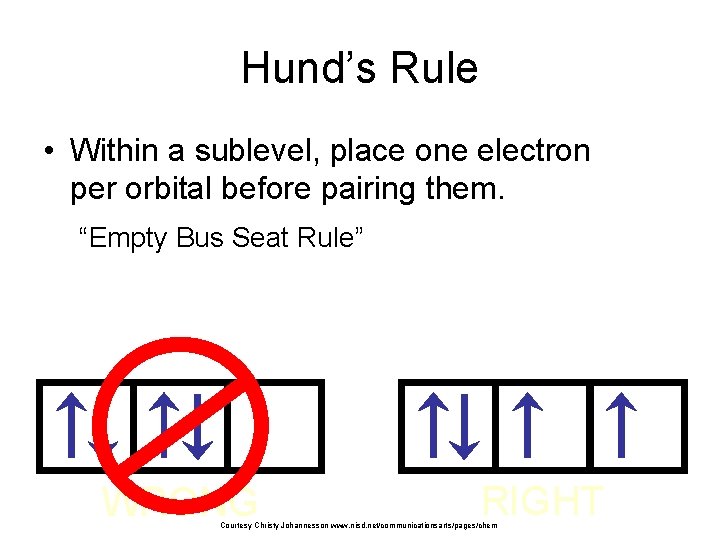
Hund’s Rule • Within a sublevel, place one electron per orbital before pairing them. “Empty Bus Seat Rule” WRONG RIGHT Courtesy Christy Johannesson www. nisd. net/communicationsarts/pages/chem
Practice Problems Al P Cl
- Slides: 40