Who Owns That Federal Land Grants in Aid
- Slides: 73
Who Owns That? Federal Land Grants in Aid of Railroads After the Railroad Leaves: An Update SC Johnson 1988 Trust v. Bayfield County 649 F. 3 d 799, C. A. 7 (Wis. 2011) Reversing 634 F. Supp. 2 d 956 (W. D. Wis. , June 26, 2009) NOTE: This presentation was updated on November 1, 2011. 1
Introduction & Summary 2
Samuel C. Johnson 1988 Trust, et al v. Bayfield County – a Big Deal? The American Land Title Association named Samuel C. Johnson 1988 Trust, et al v. Bayfield County as one of the six lawsuits in the US with “significant ramifications on the title insurance industry” in 2009. 3
Samuel C. Johnson 1988 Trust, et al v. Bayfield County – a Big Deal? The case was significant largely because the District Court decision created uncertainty about titles on potentially thousands of parcels – many of which would never show railroad ownership in the chain of title. 4
Samuel C. Johnson 1988 Trust, et al v. Bayfield County – 7 th Circuit In June 2011, the 7 th Circuit Court of Appeals reversed the District Court in a resounding victory for private landowners. 5
New Bottom Line “So the County has no right to build a snowmobile trail across the plaintiffs' lots without obtaining that right by purchase or condemnation. . . ” – Court of Appeals Judge Richard Posner in S. C. Johnson 1988 Trust v. Bayfield County, 649 F. 3 d 799, C. A. 7 (Wis. 2011) 6
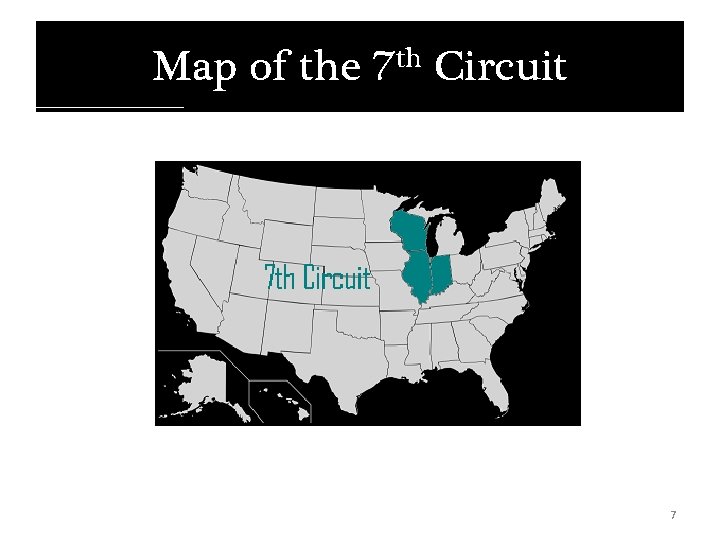
Map of the 7 th Circuit 7
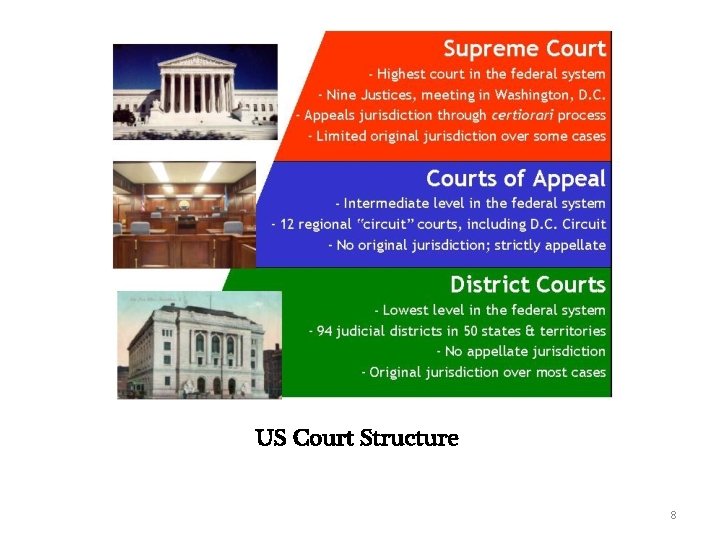
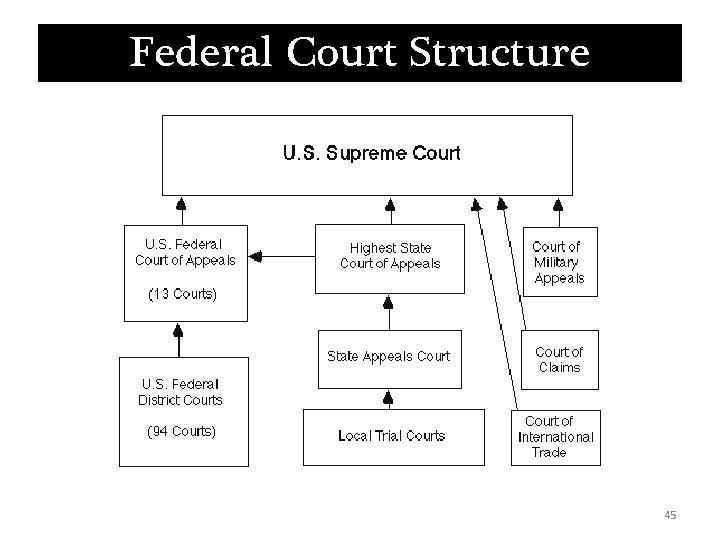
US Court Structure 8
Land Grants in Aid of Railroad Construction • In the 19 th century, Congress granted substantial amounts of land in aid of railroad construction and sometimes just provided a right-of-way across public lands. • Who owns lands within the “right-of-way” after the railroad has left? 9
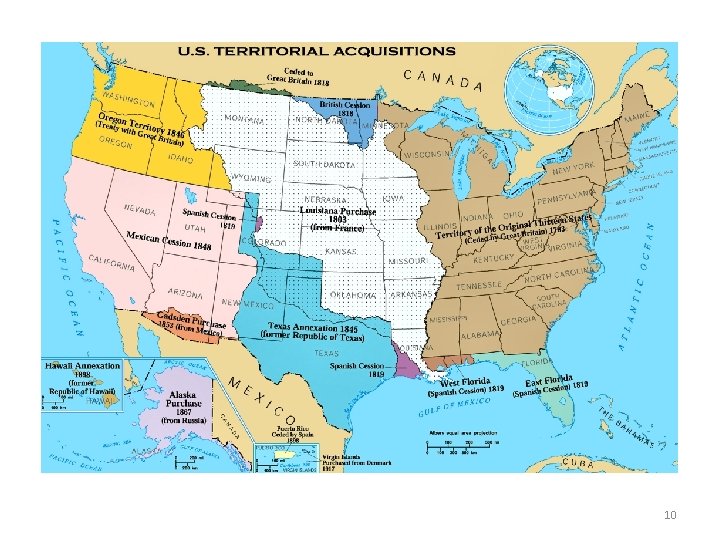
10
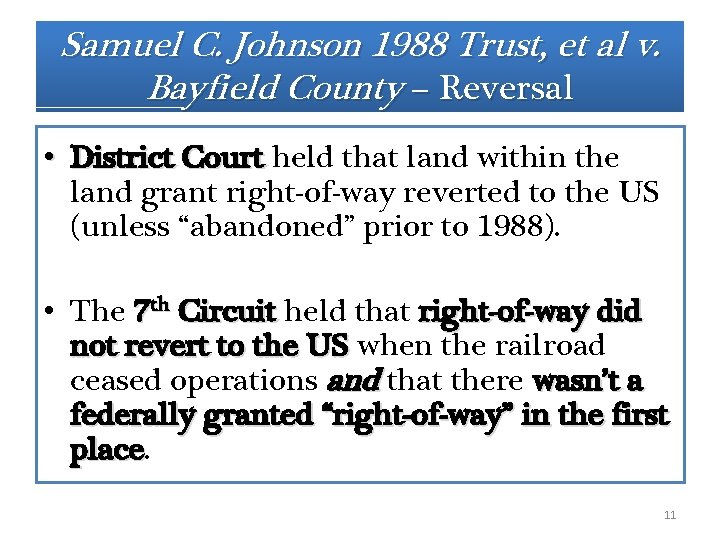
Samuel C. Johnson 1988 Trust, et al v. Bayfield County – Reversal • District Court held that land within the Court land grant right-of-way reverted to the US (unless “abandoned” prior to 1988). • The 7 th Circuit held that right-of-way did Circuit not revert to the US when the railroad US ceased operations and that there wasn’t a federally granted “right-of-way” in the first place 11
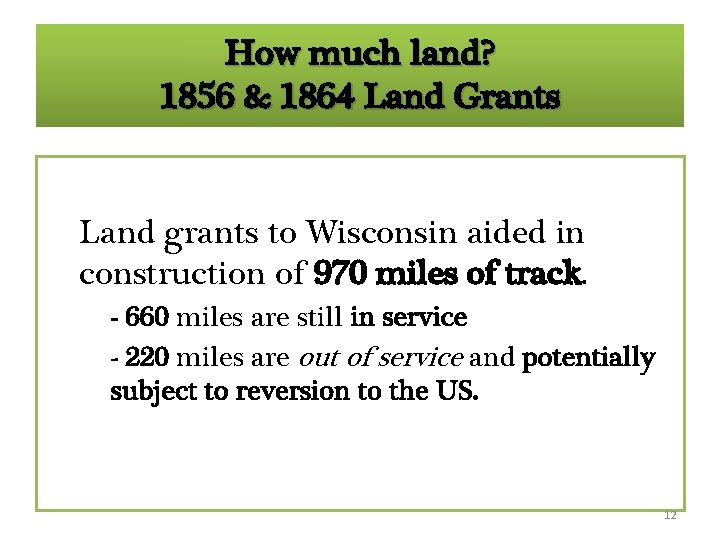
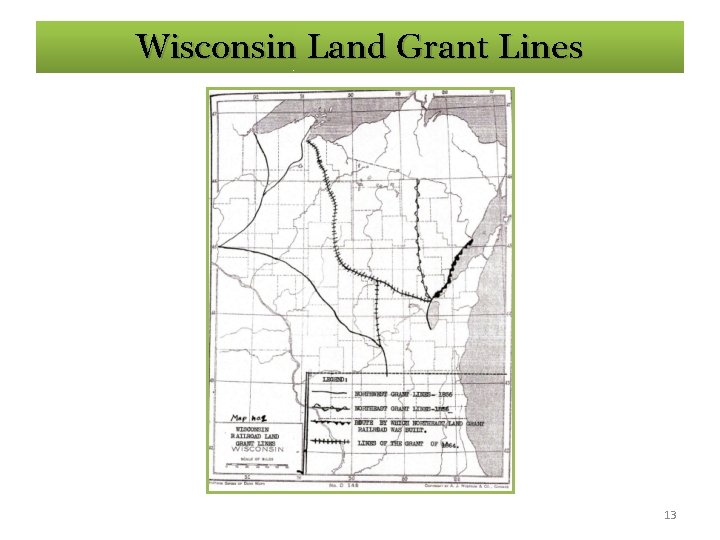
How much land? 1856 & 1864 Land Grants Land grants to Wisconsin aided in construction of 970 miles of track. - 660 miles are still in service - 220 miles are out of service and potentially subject to reversion to the US. 12
Wisconsin Land Grant Lines 13
1871 - End of the Grants • Public land grants for railroads had always been controversial. • Congress issued no new land grants after 1871. • Congress continued to provide public lands for railroad rights-of-way, most notably in the General Railroad Right-of-way Act of 1875. 14
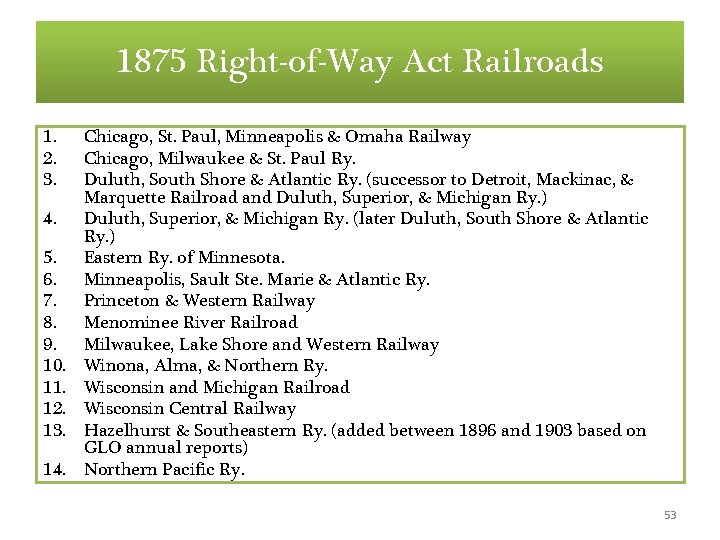
How much land? 1875 Right-of-Way Act Fourteen Wisconsin railroads obtained at least some of their rightsof-way under the 1875 General Railroad Right-of-way Act. 15
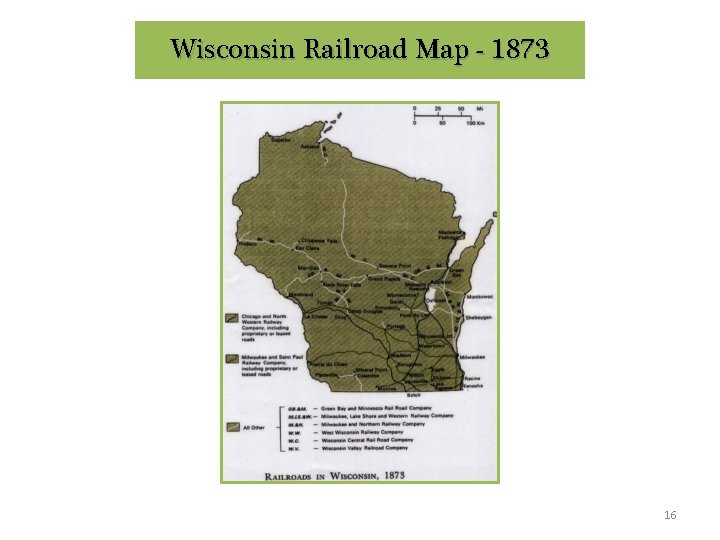
Wisconsin Railroad Map - 1873 16
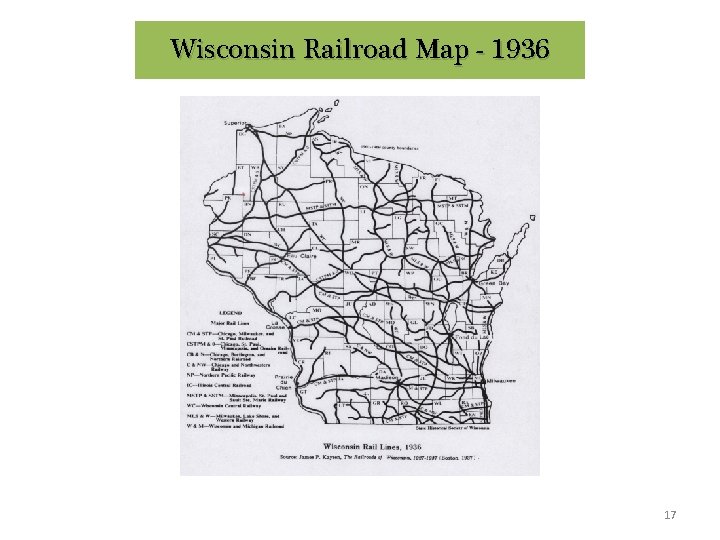
Wisconsin Railroad Map - 1936 17
Congressional Policy toward Disused Rail Corridors As rail lines on federally-provided rights-ofway fell into disuse, Congress looked for ways to dispose of these rights-of-way. 18
Congressional Policy toward Disused Rail Corridors Adopted in 1922, the Abandoned Railroad Right of Way Act allowed adjacent landowners to Act acquire title to the right-of-way when the railroad was “abandoned”. (43 U. S. C. § 912) 19
National Trails System Act (Rails-to-Trails) 16 U. S. C. § 1248 The Rails-to-Trails law preserves the United States' interest in the rights-of-ways for use as recreational trails unless the right-of-way was abandoned prior to October 4, 1988. 20
Samuel C. Johnson 1988 Trust, et al v. Bayfield County • The railroad, completed to Bayfield in 1883, ran across lands in Bayfield County now owned by the SC Johnson 1988 Trust and other plaintiffs. • The railroad was built with the aid of land grants from the US. 21
Samuel C. Johnson 1988 Trust, et al v. Bayfield County • The tracks were long gone in 1989 when Bayfield County began acquiring the rightof-way to build a snowmobile trail. • Bayfield County asserted it didn’t have to buy these lands because the right-of-way lands had reverted to the US. 22
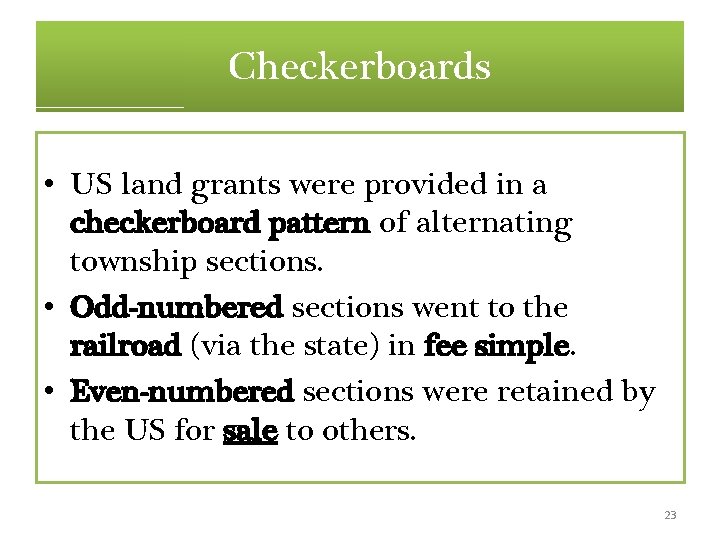
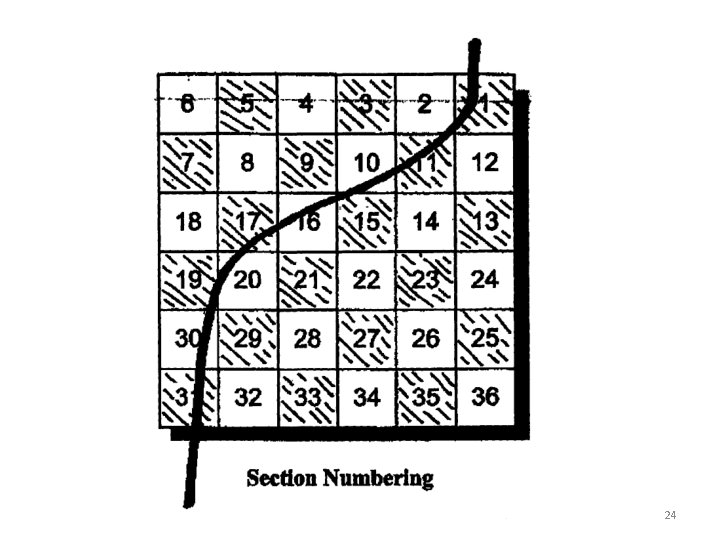
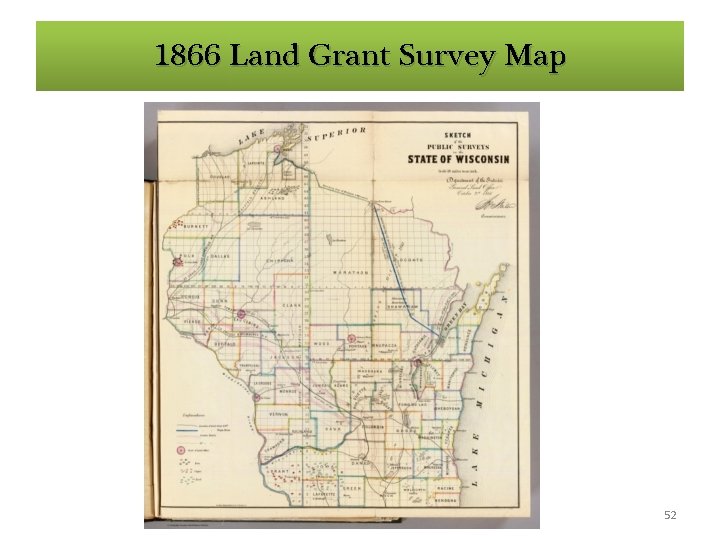
Checkerboards • US land grants were provided in a checkerboard pattern of alternating township sections. • Odd-numbered sections went to the railroad (via the state) in fee simple. • Even-numbered sections were retained by the US for sale to others. 23
24
US District Court’s Ruling District Court Judge Crabb found that: – The 1856 land grant included implied rights 1856 land grant of-way for the actual route of the line or that of-way the railroad obtained its right-of-way under the 1852 Right-of-way Act. 25
US District Court’s Ruling District Court Judge Crabb found that: – These rights-of-way reverted to the US because the line had not been “abandoned” prior to October 4, 1988. 26
Samuel C. Johnson 1988 Trust, et al v. Bayfield County – 7 th Circuit The 7 th Circuit Court of Appeals reversed the District Court holding: – Lands did not revert to the US. not 27
No Federal Right-of-way (7 th Circuit) The 7 th Circuit held: – Land grant did not include a federal grant of a right-of-way. 28
No Federal Right-of-way (7 th Circuit) 7 th Circuit said the railroad either: Circuit – acquired fee simple title (from the US) and thus didn’t need a right-of-way (Oddnumbered sections). Or Or – acquired as an easement from a private landowner that reverted to the private landowner when railroad operations ceased. (Even-numbered sections). 29
No Federal Right-of-way (7 th Circuit) “The statutes under which the federal lands statutes in this case passed into private hands did not create railroad rights of way… way There was no federal grant of a railroad right of way on which to base an inference of a federal reversion. ” • SC Johnson 1988 Trust v. Bayfield County, 649 F. 3 d 799, 804 -805, C. A. 7 (Wis. ) 30
When is a Railroad “Abandoned”? • Abandoned Railroad Right-of-way Act states that abandonment must have been decreed by a court abandonment of competent jurisdiction or Congress. (43 U. S. C. § 912). • Judge Crabb ruled that abandonment certificate from the Interstate Commerce Commission did not satisfy this requirement 31
Abandonment – 7 th Circuit The 7 th Circuit disagreed: An ICC (now STB) certificate of abandonment does satisfy the abandonment requirement in the Abandoned Railroad Right-of-way Act. 43 USC 934 32
1852 Right-of-way Act 33
Reversion to US Still Possible 1852 Right-of-way Act provided a 100’ -wide right-of-way across US lands for railroads, plank roads, and Macadamized roads. 34
1852 Right-of-way Act – Reversion 1852 Right-of-way Act – Act contained an express reversion clause. When railroad operations cease, the right-of-way reverts to US ownership. 35
1852 Right-of-way Act – Reversion Thus, a railroad built on a right-ofway obtained under the 1852 Right-ofway Act could still revert to public Act ownership. 36
1852 Right-of-way Act – Reversion The 1852 Right-of-way Act expired in 1852 Right-of-way Act 1867. To take advantage of the Act, the railroad had to be chartered before the expiration. 37
1852 Right-of-way Act– 7 th Circuit In SC Johnson, the railroad that obtained the land grant and built the railroad was not chartered before the 1852 Right-of-way Act expired in 1867. 1852 Right-of-way Act 38
1875 Right-of-Way Act 39
How much land? 1875 Right-of-Way Act The 7 th Circuit held that these 1875 Act rights-of-way were mere easements and easements did not revert to the US, which is the revert majority view among the federal appellate courts. 40
How much land? 1875 Right-of-Way Act “The [1875] Act does not hint at a reversionary interest, and who searching the chain of title of a lot never owned by a railroad would suspect a lurking governmental right so unsettling to the security of private property rights? …Countless tracts of private land would be encumbered with a federal easement even though no conferral of such an interest appeared in a statute or a chain of title. ” title Samuel C. Johnson 1988 Trust v. Bayfield County, Wis. , 649 F. 3 d 799, * (7 th CA 2011) 41
Old Bottom Line “If a former right-of-way was not declared abandoned before 1988, it is no longer possible for adjacent landowners to claim a right to the property. ” – District Judge Crabb in S. C. Johnson 1988 Trust v. Bayfield County, 634 F. Supp. 2 d 956, 974 (W. D. Wis. , Jun 26, 2009) 42
New Bottom Line “So the County has no right to build a snowmobile trail across the plaintiffs' lots without obtaining that right by purchase or condemnation. . . ” – Court of Appeals Judge Posner in S. C. Johnson 1988 Trust v. Bayfield County, 649 F. 3 d 799, C. A. 7 (Wis) 43
Appendices 44
Federal Court Structure 45
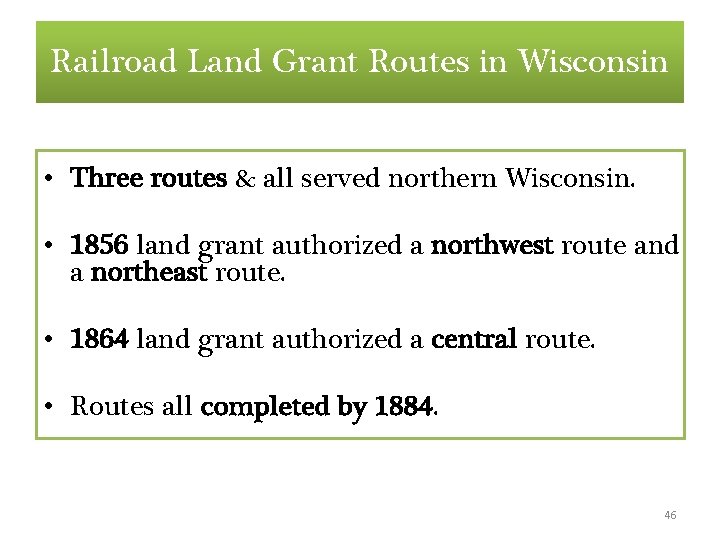
Railroad Land Grant Routes in Wisconsin • Three routes & all served northern Wisconsin. • 1856 land grant authorized a northwest route and a northeast route. • 1864 land grant authorized a central route. • Routes all completed by 1884. 46
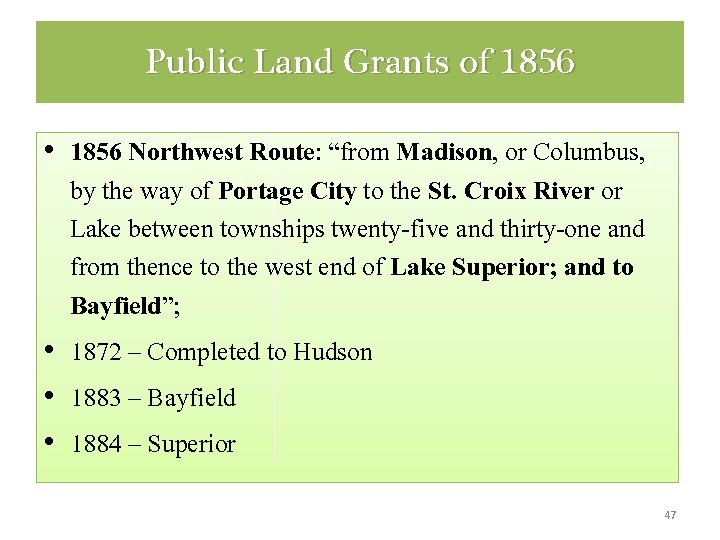
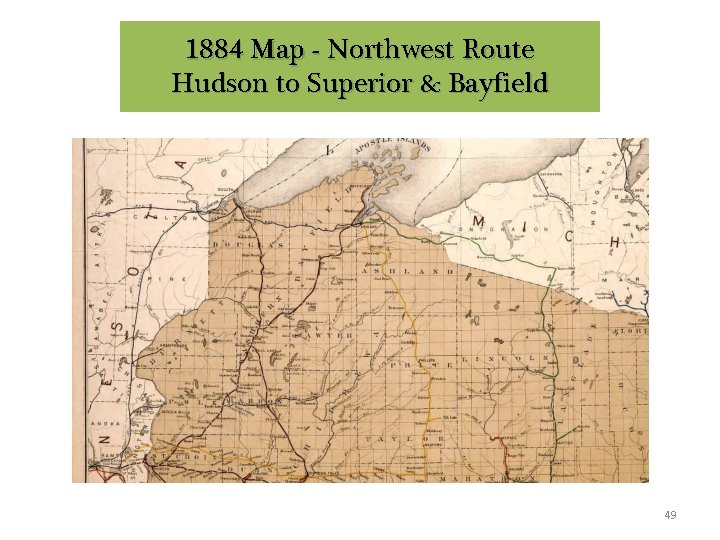
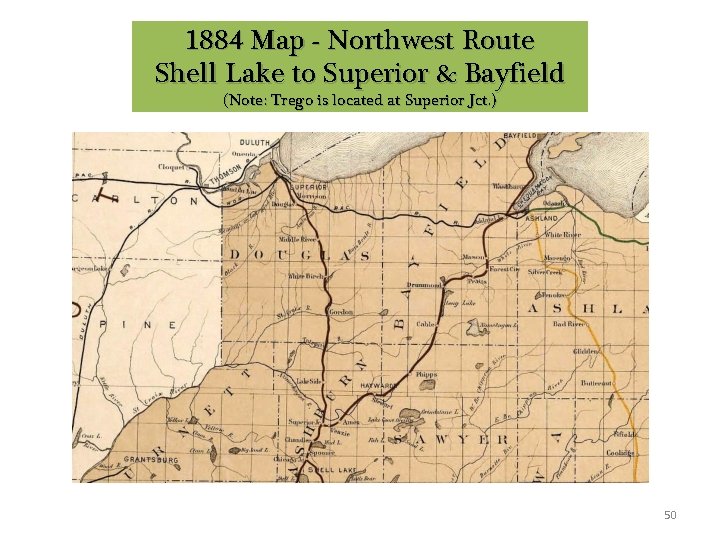
Public Land Grants of 1856 • 1856 Northwest Route: “from Madison, or Columbus, by the way of Portage City to the St. Croix River or Lake between townships twenty-five and thirty-one and from thence to the west end of Lake Superior; and to Bayfield”; • 1872 – Completed to Hudson • 1883 – Bayfield • 1884 – Superior 47
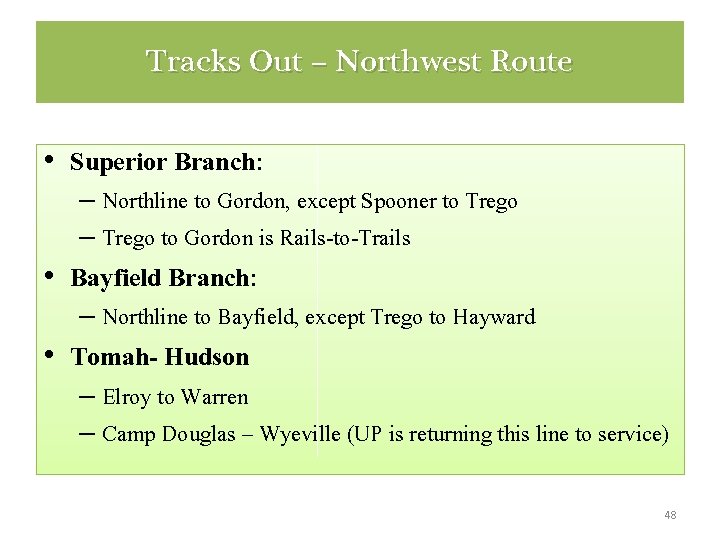
Tracks Out – Northwest Route • Superior Branch: – Northline to Gordon, except Spooner to Trego – Trego to Gordon is Rails-to-Trails • Bayfield Branch: – Northline to Bayfield, except Trego to Hayward • Tomah- Hudson – Elroy to Warren – Camp Douglas – Wyeville (UP is returning this line to service) 48
1884 Map - Northwest Route Hudson to Superior & Bayfield 49
1884 Map - Northwest Route Shell Lake to Superior & Bayfield (Note: Trego is located at Superior Jct. ) 50
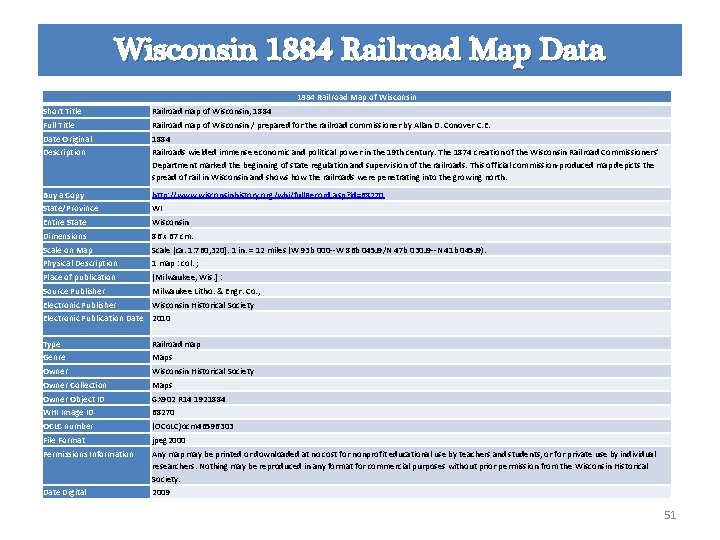
Wisconsin 1884 Railroad Map Data 1884 Railroad Map of Wisconsin Short Title Railroad map of Wisconsin, 1884 Full Title Railroad map of Wisconsin / prepared for the railroad commissioner by Allan D. Conover C. E. Date Original 1884 Description Railroads wielded immense economic and political power in the 19 th century. The 1874 creation of the Wisconsin Railroad Commissioners' Department marked the beginning of state regulation and supervision of the railroads. This official commission-produced map depicts the spread of rail in Wisconsin and shows how the railroads were penetrating into the growing north. Buy a Copy http: //www. wisconsinhistory. org/whi/full. Record. asp? id=68270 State/Province WI Entire State Wisconsin Dimensions 86 x 67 cm. Scale on Map Scale [ca. 1: 760, 320]. 1 in. = 12 miles (W 93 b 000 --W 86 b 045 J 9/N 47 b 030 J 9 --N 41 b 045 J 9). Physical Description 1 map : col. ; Place of publication [Milwaukee, Wis. ] : Source Publisher Milwaukee Litho. & Engr. Co. , Electronic Publisher Wisconsin Historical Society Electronic Publication Date 2010 Type Railroad map Genre Maps Owner Wisconsin Historical Society Owner Collection Maps Owner Object ID GX 902 R 14 1921884 WHI Image ID 68270 OCLC number (OCo. LC)ocm 46596303 File Format jpeg 2000 Permissions Information Any map may be printed or downloaded at no cost for nonprofit educational use by teachers and students, or for private use by individual researchers. Nothing may be reproduced in any format for commercial purposes without prior permission from the Wisconsin Historical Society. Date Digital 2009 51
1866 Land Grant Survey Map 52
1875 Right-of-Way Act Railroads 1. 2. 3. 4. 5. 6. 7. 8. 9. 10. 11. 12. 13. 14. Chicago, St. Paul, Minneapolis & Omaha Railway Chicago, Milwaukee & St. Paul Ry. Duluth, South Shore & Atlantic Ry. (successor to Detroit, Mackinac, & Marquette Railroad and Duluth, Superior, & Michigan Ry. ) Duluth, Superior, & Michigan Ry. (later Duluth, South Shore & Atlantic Ry. ) Eastern Ry. of Minnesota. Minneapolis, Sault Ste. Marie & Atlantic Ry. Princeton & Western Railway Menominee River Railroad Milwaukee, Lake Shore and Western Railway Winona, Alma, & Northern Ry. Wisconsin and Michigan Railroad Wisconsin Central Railway Hazelhurst & Southeastern Ry. (added between 1896 and 1903 based on GLO annual reports) Northern Pacific Ry. 53
State Law History of the Federal Land Grants 54
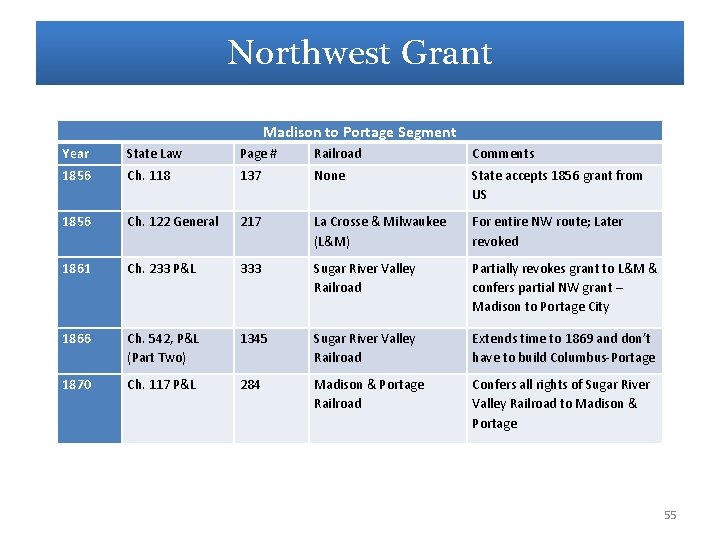
Northwest Grant Madison to Portage Segment Year State Law Page # Railroad Comments 1856 Ch. 118 137 None State accepts 1856 grant from US 1856 Ch. 122 General 217 La Crosse & Milwaukee (L&M) For entire NW route; Later revoked 1861 Ch. 233 P&L 333 Sugar River Valley Railroad Partially revokes grant to L&M & confers partial NW grant – Madison to Portage City 1866 Ch. 542, P&L (Part Two) 1345 Sugar River Valley Railroad Extends time to 1869 and don’t have to build Columbus-Portage 1870 Ch. 117 P&L 284 Madison & Portage Railroad Confers all rights of Sugar River Valley Railroad to Madison & Portage 55
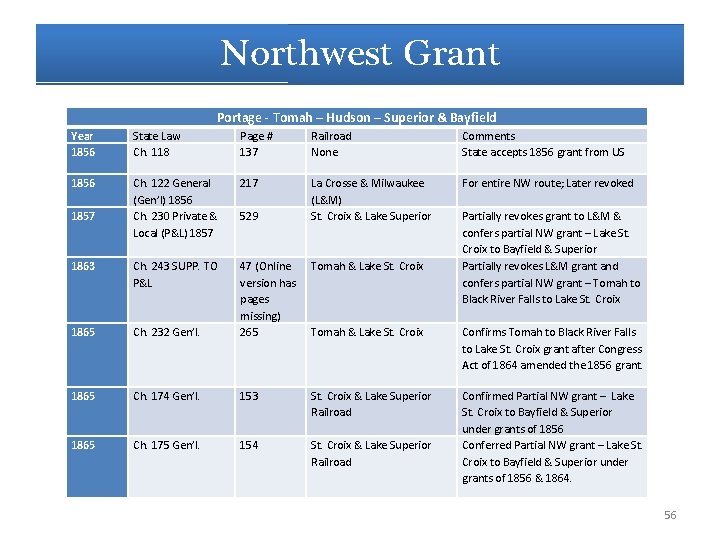
Northwest Grant Portage - Tomah – Hudson – Superior & Bayfield Year 1856 State Law Ch. 118 Page # 137 Railroad None Comments State accepts 1856 grant from US 1856 Ch. 122 General (Gen’l) 1856 Ch. 230 Private & Local (P&L) 1857 217 La Crosse & Milwaukee (L&M) St. Croix & Lake Superior For entire NW route; Later revoked 1863 Ch. 243 SUPP. TO P&L Tomah & Lake St. Croix 1865 Ch. 232 Gen’l. 47 (Online version has pages missing) 265 Tomah & Lake St. Croix Confirms Tomah to Black River Falls to Lake St. Croix grant after Congress Act of 1864 amended the 1856 grant. 1865 Ch. 174 Gen’l. 153 St. Croix & Lake Superior Railroad 1865 Ch. 175 Gen’l. 154 St. Croix & Lake Superior Railroad Confirmed Partial NW grant – Lake St. Croix to Bayfield & Superior under grants of 1856 Conferred Partial NW grant – Lake St. Croix to Bayfield & Superior under grants of 1856 & 1864. 1857 529 Partially revokes grant to L&M & confers partial NW grant – Lake St. Croix to Bayfield & Superior Partially revokes L&M grant and confers partial NW grant – Tomah to Black River Falls to Lake St. Croix 56
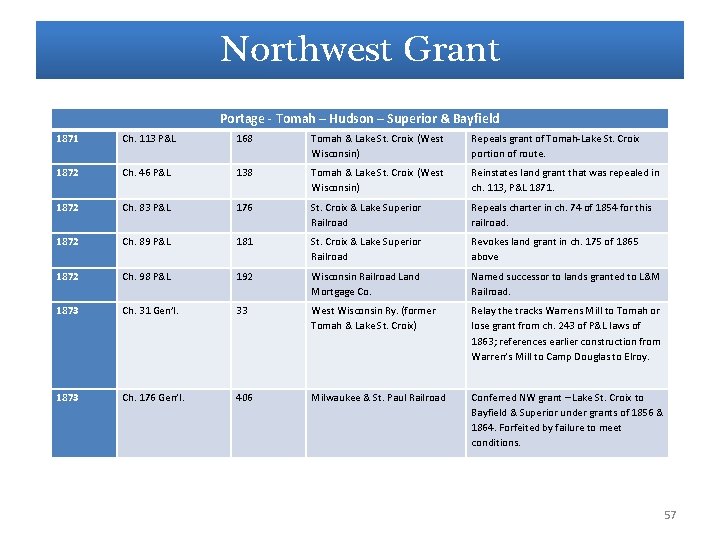
Northwest Grant Portage - Tomah – Hudson – Superior & Bayfield 1871 Ch. 113 P&L 168 Tomah & Lake St. Croix (West Wisconsin) Repeals grant of Tomah-Lake St. Croix portion of route. 1872 Ch. 46 P&L 138 Tomah & Lake St. Croix (West Wisconsin) Reinstates land grant that was repealed in ch. 113, P&L 1871. 1872 Ch. 83 P&L 176 St. Croix & Lake Superior Railroad Repeals charter in ch. 74 of 1854 for this railroad. 1872 Ch. 89 P&L 181 St. Croix & Lake Superior Railroad Revokes land grant in ch. 175 of 1865 above 1872 Ch. 98 P&L 192 Wisconsin Railroad Land Mortgage Co. Named successor to lands granted to L&M Railroad. 1873 Ch. 31 Gen’l. 33 West Wisconsin Ry. (former Tomah & Lake St. Croix) Relay the tracks Warrens Mill to Tomah or lose grant from ch. 243 of P&L laws of 1863; references earlier construction from Warren’s Mill to Camp Douglas to Elroy. 1873 Ch. 176 Gen’l. 406 Milwaukee & St. Paul Railroad Conferred NW grant – Lake St. Croix to Bayfield & Superior under grants of 1856 & 1864. Forfeited by failure to meet conditions. 57
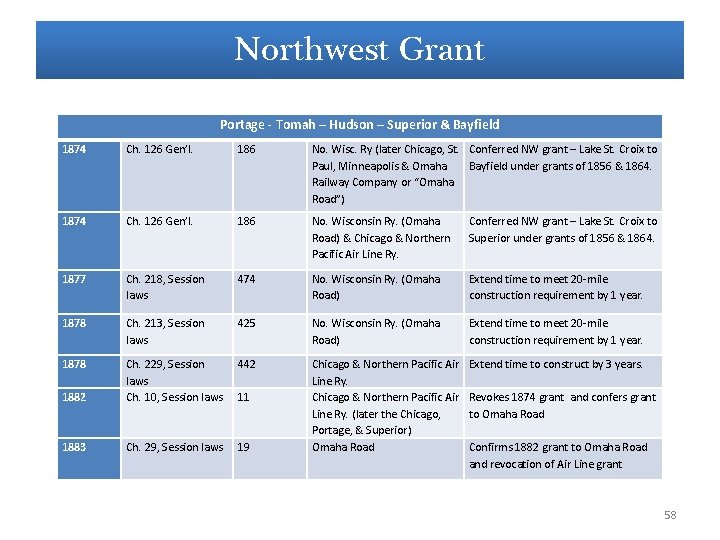
Northwest Grant Portage - Tomah – Hudson – Superior & Bayfield 1874 Ch. 126 Gen’l. 186 No. Wisc. Ry (later Chicago, St. Conferred NW grant – Lake St. Croix to Paul, Minneapolis & Omaha Bayfield under grants of 1856 & 1864. Railway Company or “Omaha Road”) 1874 Ch. 126 Gen’l. 186 No. Wisconsin Ry. (Omaha Road) & Chicago & Northern Pacific Air Line Ry. Conferred NW grant – Lake St. Croix to Superior under grants of 1856 & 1864. 1877 Ch. 218, Session laws 474 No. Wisconsin Ry. (Omaha Road) Extend time to meet 20 -mile construction requirement by 1 year. 1878 Ch. 213, Session laws 425 No. Wisconsin Ry. (Omaha Road) Extend time to meet 20 -mile construction requirement by 1 year. 1878 442 1883 Ch. 29, Session laws 19 Chicago & Northern Pacific Air Line Ry. (later the Chicago, Portage, & Superior) Omaha Road Extend time to construct by 3 years. 1882 Ch. 229, Session laws Ch. 10, Session laws 11 Revokes 1874 grant and confers grant to Omaha Road Confirms 1882 grant to Omaha Road and revocation of Air Line grant 58
Cases & Statutes 59
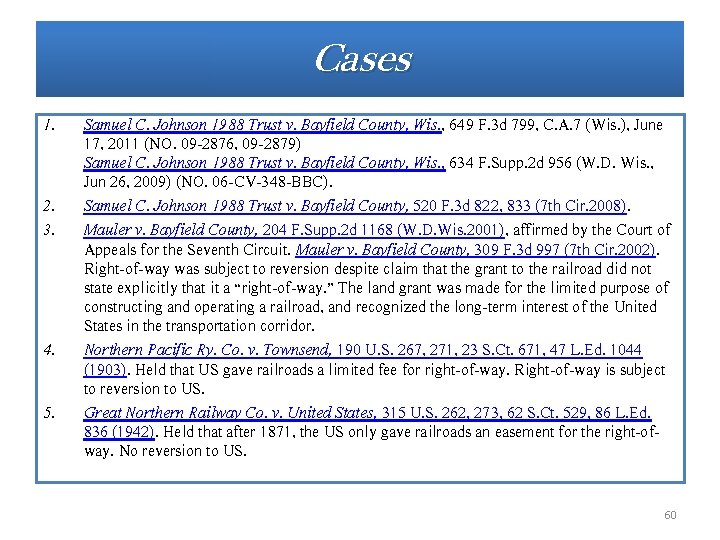
Cases 1. 2. 3. 4. 5. Samuel C. Johnson 1988 Trust v. Bayfield County, Wis. , 649 F. 3 d 799, C. A. 7 (Wis. ), June 17, 2011 (NO. 09 -2876, 09 -2879) Samuel C. Johnson 1988 Trust v. Bayfield County, Wis. , 634 F. Supp. 2 d 956 (W. D. Wis. , Jun 26, 2009) (NO. 06 -CV-348 -BBC). Samuel C. Johnson 1988 Trust v. Bayfield County, 520 F. 3 d 822, 833 (7 th Cir. 2008). Mauler v. Bayfield County, 204 F. Supp. 2 d 1168 (W. D. Wis. 2001), affirmed by the Court of Appeals for the Seventh Circuit. Mauler v. Bayfield County, 309 F. 3 d 997 (7 th Cir. 2002). Right-of-way was subject to reversion despite claim that the grant to the railroad did not state explicitly that it a “right-of-way. ” The land grant was made for the limited purpose of constructing and operating a railroad, and recognized the long-term interest of the United States in the transportation corridor. Northern Pacific Ry. Co. v. Townsend, 190 U. S. 267, 271, 23 S. Ct. 671, 47 L. Ed. 1044 (1903). Held that US gave railroads a limited fee for right-of-way. Right-of-way is subject to reversion to US. Great Northern Railway Co. v. United States, 315 U. S. 262, 273, 62 S. Ct. 529, 86 L. Ed. 836 (1942). Held that after 1871, the US only gave railroads an easement for the right-ofway. No reversion to US. 60
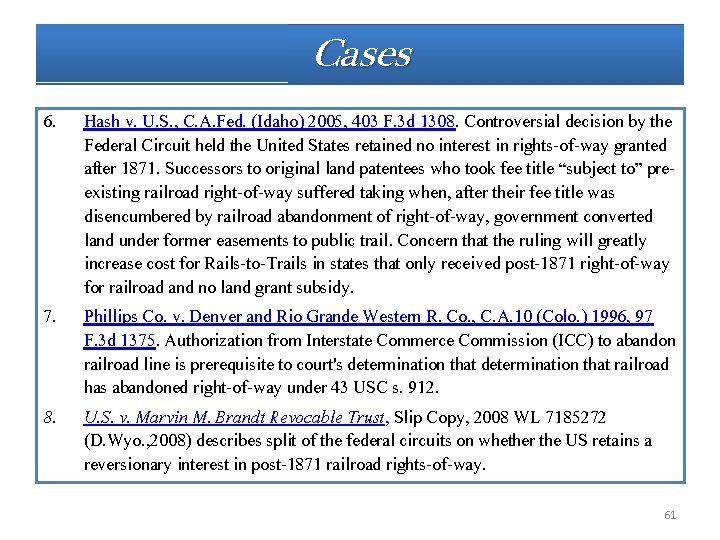
Cases 6. 7. 8. Hash v. U. S. , C. A. Fed. (Idaho) 2005, 403 F. 3 d 1308. Controversial decision by the Federal Circuit held the United States retained no interest in rights-of-way granted after 1871. Successors to original land patentees who took fee title “subject to” preexisting railroad right-of-way suffered taking when, after their fee title was disencumbered by railroad abandonment of right-of-way, government converted land under former easements to public trail. Concern that the ruling will greatly increase cost for Rails-to-Trails in states that only received post-1871 right-of-way for railroad and no land grant subsidy. Phillips Co. v. Denver and Rio Grande Western R. Co. , C. A. 10 (Colo. ) 1996, 97 F. 3 d 1375. Authorization from Interstate Commerce Commission (ICC) to abandon railroad line is prerequisite to court's determination that railroad has abandoned right-of-way under 43 USC s. 912. U. S. v. Marvin M. Brandt Revocable Trust, Slip Copy, 2008 WL 7185272 (D. Wyo. , 2008) describes split of the federal circuits on whether the US retains a reversionary interest in post-1871 railroad rights-of-way. 61
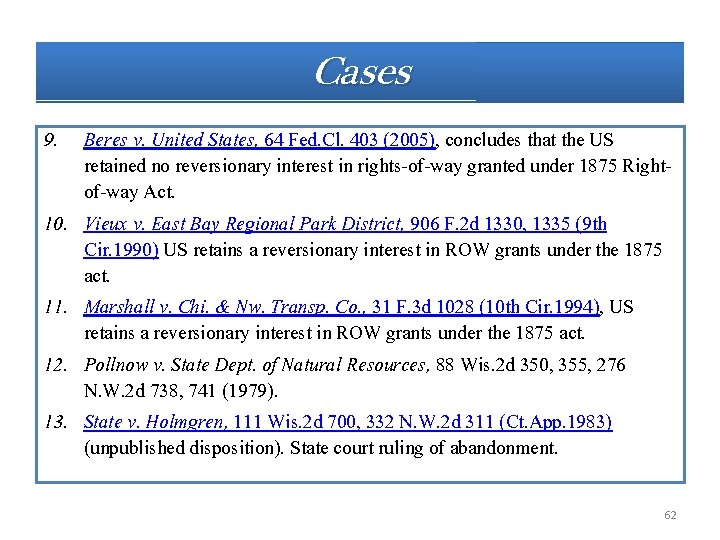
Cases 9. 10. 11. 12. 13. Beres v. United States, 64 Fed. Cl. 403 (2005), concludes that the US retained no reversionary interest in rights-of-way granted under 1875 Rightof-way Act. Vieux v. East Bay Regional Park District, 906 F. 2 d 1330, 1335 (9 th Cir. 1990) US retains a reversionary interest in ROW grants under the 1875 act. Marshall v. Chi. & Nw. Transp. Co. , 31 F. 3 d 1028 (10 th Cir. 1994), US retains a reversionary interest in ROW grants under the 1875 act. Pollnow v. State Dept. of Natural Resources, 88 Wis. 2 d 350, 355, 276 N. W. 2 d 738, 741 (1979). State v. Holmgren, 111 Wis. 2 d 700, 332 N. W. 2 d 311 (Ct. App. 1983) (unpublished disposition). State court ruling of abandonment. 62
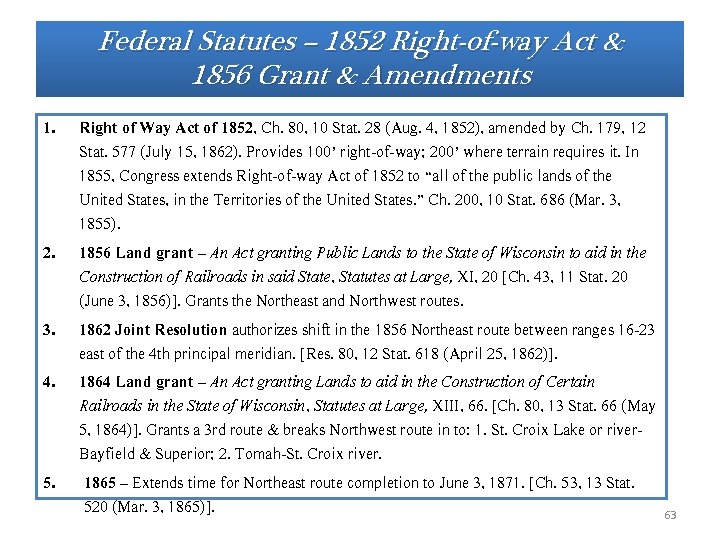
Federal Statutes – 1852 Right-of-way Act & 1856 Grant & Amendments 1. 2. 3. 4. 5. Right of Way Act of 1852, Ch. 80, 10 Stat. 28 (Aug. 4, 1852), amended by Ch. 179, 12 Stat. 577 (July 15, 1862). Provides 100’ right-of-way; 200’ where terrain requires it. In 1855, Congress extends Right-of-way Act of 1852 to “all of the public lands of the United States, in the Territories of the United States. ” Ch. 200, 10 Stat. 686 (Mar. 3, 1855). 1856 Land grant – An Act granting Public Lands to the State of Wisconsin to aid in the Construction of Railroads in said State, Statutes at Large, XI, 20 [Ch. 43, 11 Stat. 20 (June 3, 1856)]. Grants the Northeast and Northwest routes. 1862 Joint Resolution authorizes shift in the 1856 Northeast route between ranges 16 -23 east of the 4 th principal meridian. [Res. 80, 12 Stat. 618 (April 25, 1862)]. 1864 Land grant – An Act granting Lands to aid in the Construction of Certain Railroads in the State of Wisconsin, Statutes at Large, XIII, 66. [Ch. 80, 13 Stat. 66 (May 5, 1864)]. Grants a 3 rd route & breaks Northwest route in to: 1. St. Croix Lake or river. Bayfield & Superior; 2. Tomah-St. Croix river. 1865 – Extends time for Northeast route completion to June 3, 1871. [Ch. 53, 13 Stat. 520 (Mar. 3, 1865)]. 63
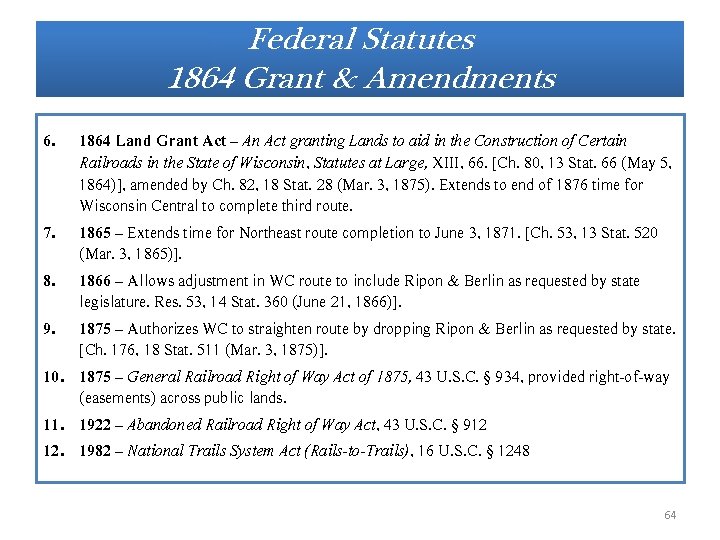
Federal Statutes 1864 Grant & Amendments 6. 1864 Land Grant Act – An Act granting Lands to aid in the Construction of Certain Railroads in the State of Wisconsin, Statutes at Large, XIII, 66. [Ch. 80, 13 Stat. 66 (May 5, 1864)], amended by Ch. 82, 18 Stat. 28 (Mar. 3, 1875). Extends to end of 1876 time for Wisconsin Central to complete third route. 7. 1865 – Extends time for Northeast route completion to June 3, 1871. [Ch. 53, 13 Stat. 520 (Mar. 3, 1865)]. 8. 1866 – Allows adjustment in WC route to include Ripon & Berlin as requested by state legislature. Res. 53, 14 Stat. 360 (June 21, 1866)]. 9. 1875 – Authorizes WC to straighten route by dropping Ripon & Berlin as requested by state. [Ch. 176, 18 Stat. 511 (Mar. 3, 1875)]. 10. 1875 – General Railroad Right of Way Act of 1875, 43 U. S. C. § 934, provided right-of-way (easements) across public lands. 11. 1922 – Abandoned Railroad Right of Way Act, 43 U. S. C. § 912 12. 1982 – National Trails System Act (Rails-to-Trails), 16 U. S. C. § 1248 64
Railroad conveyances Section 190. 11 Wis. Stats. 190. 11 Railroad conveyances, how executed and filed. (1) Every conveyance or lease, deed of trust, mortgage or satisfaction thereof made by any railroad corporation shall be executed and acknowledged in the manner in which conveyances of real estate by corporations are required to be to entitle the same to be recorded, and shall be filed with the department of financial institutions, which shall endorse thereon “filed” and the date of filing. (2) A record of filing under sub. (1) shall from the time of reception of the instrument have the same effect as to any property in this state described therein as the record of any similar instrument in the office of a register of deeds has as to property in his or her county, and shall be notice of the rights and interest of the grantee, lessee or mortgagee by such instrument to the same extent as if it were recorded in all of the counties in which any property therein described may be situated. (3) The department of financial institutions shall collect a fee of $1 per page filed under sub. (1). (4) The department of financial institutions shall collect a fee at the rate under s. 77. 22 and, on or before the 15 th day of the month after the fee is collected, shall remit that fee to the department of administration for deposit in the general fund. Sections 77. 21, 77. 22 and 77. 25 to 77. 27 apply to the fee under this subsection. History: 1981 c. 20; 1985 a. 29; 1991 a. 39; 1993 a. 412; 1995 a. 27. 65
Key Resources & Suggested Reading 1. Sanborn, John Bell. Congressional grants of land in aid of railways, Bulletin of the University of Wisconsin, (Economies, Political Science, and History Series, vol. 2, no. 3, pp. 263 -392. ) August 1899. 2. Greiner, Gordon Oswald. , Wisconsin national railroad land grants, Thesis (M. S. )--University of Wisconsin--Madison, 1935. 3. Railroad maps at State Historical Society: http: //www. wisconsinhistory. org/libraryarchives/maps/search. asp (Click on “Type of Map”, choose “railroad map”. 4. Wisconsin Railroad Timeline at http: //riptrack. net/wisconsin created by Sean Lamb, a Wisconsin-based railroad fan. 66
Key Resources & Suggested Reading 4. Kaysen, James P. The Railroads of Wisconsin, 1827 -1937. (Boston: The Railway and Locomotive Historical Society, 1937). Online facsimile at http: //www. wisconsinhistory. org/turningpoints/search. asp? id=63 5. First Annual Report of the Railroad Commissioners of Wisconsin, 1874, Madison, Wisconsin http: //books. google. com/books? id=AGga. AQAAIAAJ&pg=PP 4#v=onepage &q&f=false 6. Haney, Lewis Henry, A Congressional History of Railways in the United States, 1850 -1887, Bulletin of the University of Wisconsin, , (Economies, Political Science, and History Series, vol. 6, no. 1, pp. 1 -336. ) January 1910. 7. Hunt, Robert S. , Law and Locomotives: The Impact of the Railroad in Wisconsin Law in the Nineteenth Century (June 1958) 67
Key Resources & Suggested Reading 8. Gates, Paul W. History of Public Land Law Development, United States. Public Land Law Review Commission (1968). 9. Donaldson, Thomas. The public domain: its history, with statistics, United States. Public Lands Commission (1903 -1905). Excellent statistical compilation, but be careful to note which edition. 10. Ranney, Joseph A. , Imperia in Imperiis: Law and Railroads in Wisconsin, 1847 -1910, Wisconsin Lawyer Magazine. 11. Merk, Frederick Economic history of Wisconsin during the Civil War decade, Madison, The Society, 1916. Publications of the State Historical Society of Wisconsin. 68
Key Resources & Suggested Reading 12. Bernd, John Muth, The La Crosse and Milwaukee railroad land grant, 1856, Wisconsin Magazine Of History. Volume: 30 /Issue: 2 (1946 -1947) 13. Cronon, William, Nature's Metropolis: Chicago and the Great West, W. W. Norton & Company (1992) 14. Railroad maps at Library of Congress: http: //memory. loc. gov/ammem/gmdhtml/rrhome. html 69
Contemporary Commentary 1. Top Lawsuits Impacting the Title Industry, by ALTA Title Counsel Committee, Title. News, May 2010 - Volume 89, Number 5 at page 10. 2. Roberts, Darwin P. The legal history of federally granted railroad rights-of-way and the myth of congress's “ 1871 shift”, University of Colorado Law Review, Winter 2011 3. Wright, Danaya C. The Shifting Sands of Property Rights, Federal Railroad Grants, and Economic History, 38 Envtl. L. 711, 716 70
Disclaimer The views expressed are solely my own and not the official position of the Office of the Commissioner of Railroads or the state of Wisconsin generally. NOTE: This presentation was updated on November 1, 2011. 71
Acknowledgement I want to thank the Wisconsin Historical Society for granting me permission to use some of the map images included in my presentation. 72
Douglas S. Wood Legal Counsel Office of the Commissioner of Railroads 608 -266 -9536 doug. wood@wisconsin. gov 73