Federalism AP Government Politics Unit 2 Types of
- Slides: 60
Federalism AP Government & Politics Unit 2
Types of Governments Today, typically, the term "aristocracy" is 1. Democracy The word "democracy" used negatively to accuse a republic of literally means "rule by the people. " In being dominated by rich people, such as a democracy, the people govern. saying, "The United States has become 2. Republic A literal democracy is an aristocracy. “ impossible in a political system containing more than a few people. All 5. Dictatorship A dictatorship consists of rule by one person or a group of people. "democracies" are really republics. In Very few dictators admit they are a republic, the people elect dictators; they almost always claim to be representatives to make and enforce leaders of democracies. The dictator may laws. be one person, such as Castro in Cuba or 3. Monarchy A monarchy consists of Hitler in Germany, or a group of people, rule by a king or queen. Sometimes a such as the Communist Party in China. king is called an "emperor, " especially 6. Democratic Republic Usually, a if there is a large empire, such as "democratic republic" is not democratic China before 1911. There are no large and is not a republic. A government that monarchies today. The United officially calls itself a "democratic republic" Kingdom, which has a queen, is really is usually a dictatorship. Communist a republic because the queen has dictatorships have been especially prone virtually no political power. to use this term. For example, the official 4. Aristocracy An aristocracy is rule by name of North Vietnam was "The the aristocrats. Aristocrats are Democratic Republic of Vietnam. " China typically wealthy, educated people. uses a variant, "The People's Republic of Many monarchies have really been China. " ruled by aristocrats.
Types of Governments Democracy The word "democracy" literally means "rule by the people. " In a democracy, the people govern. Republic A literal democracy is impossible in a political system containing more than a few people. All "democracies" are really republics. In a republic, the people elect representatives to make and enforce laws.
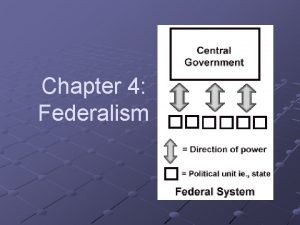
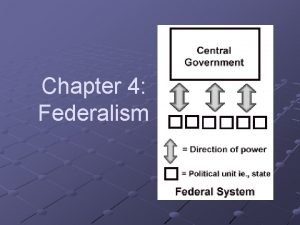
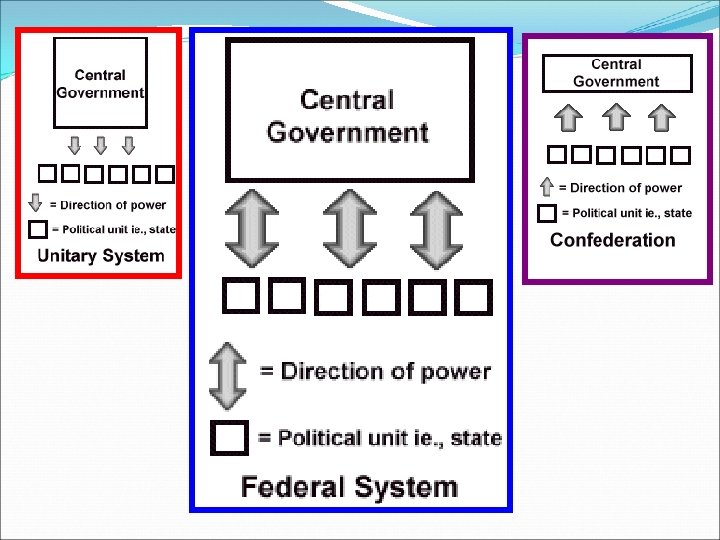
Three Ways Power is Shared Between a National Government and States/Sub-Units Unitary One strong national government Example: Great Britain Most of the world uses this type Confederal Strong states or regions with a weak national government Example: The Articles of Confederation, the Confederacy Federal* A strong central government that shares power with states or regions Example: The United States
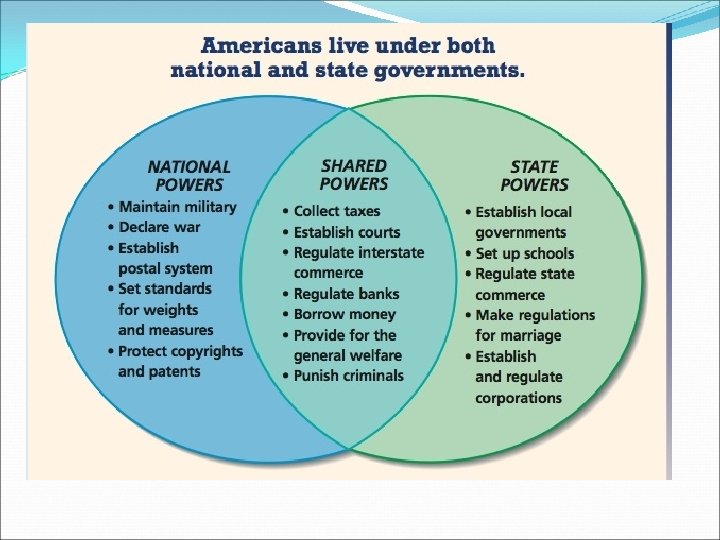
Federalism is theory or advocacy of federal political orders, where final authority is divided between sub-units and a center. Federalism refers to the apportioning of power between the federal government and the states. In a federal system, the national government holds significant power, but the smaller political subdivisions also hold significant power. The United States, Canada, Australia, and Brazil are examples of federal systems.
True or False? ? Most governments in the world have both state and national governments, as in the U. S. .
True or False? ? The powers of the state and national governments were clearly established in the Constitution.
True or False? ? Under federalism, states surrender their power to the national government.
True or False? ? The Framers themselves had a hard time agreeing on what was meant by federalism.
True or False? ? The nature of federalism has remained consistent throughout U. S. History.
True or False? ? The complexity of federalism tends to discourage citizen participation in government.
Discuss What reasons exist for the states to continue exercising independent power?
Discuss The speed limits vary across the nation’s roads and highways. Could the national government legally intervene to rectify these conflicting state laws ? Should it?
Discuss Gay marriage is allowed in six states (Massachusetts, Connecticut, Iowa, New Hampshire, Vermont, New York) and Washington, D. C. The Coquille Indian Tribe in Oregon also grants samesex marriage. Should the national government legally intervene to rectify the conflicting state laws ? Should it?
Discuss Certain areas in Nevada permit prostitution. Could the national government legally intervene to forbid such practices? Should it?
Discuss Alaska and Colorado have held referendums concerning the private possession of small amounts of marijuana. Could the national government legally intervene to forbid such practices? Should it?
Discuss California has laws allowing for the distribution and use concerning the medical marijuana. Could the national government legally intervene to forbid such practices? Should it?
Discuss Georgia, Texas, and other states have laws that allow the death penalty. Massachusetts and others have laws forbidding it. Could the national government legally intervene to rectify these conflicting state laws ? Should it?
Federalism Terms to Know Dual Federalism Cooperative Federalism AKA Creative Federalism New Federalism
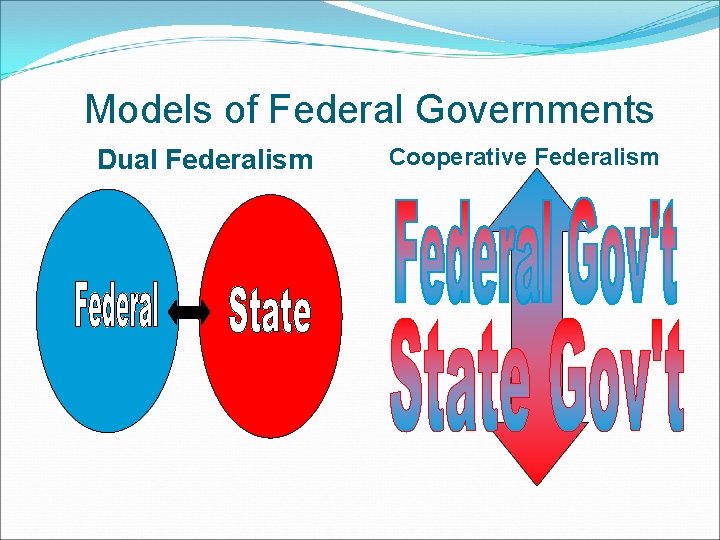
Models of Federal Governments Dual Federalism Cooperative Federalism
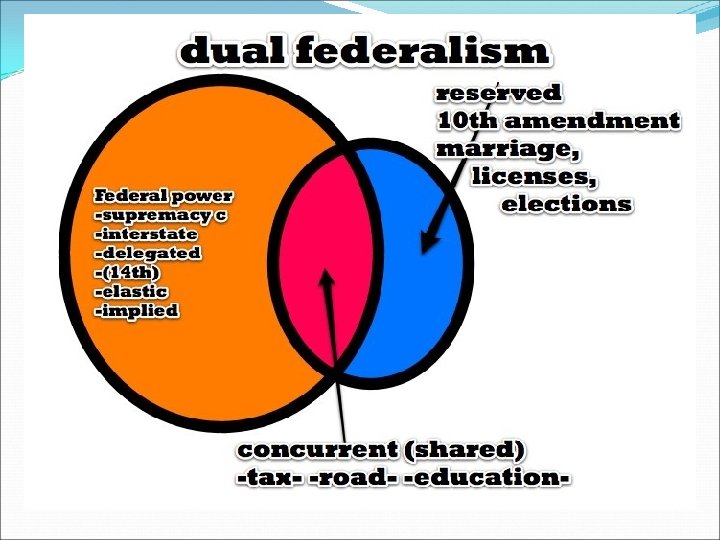
Dual Federalism, holds that the federal government and the state governments are coequals, and each are sovereign. In this theory, parts of the Constitution are interpreted very narrowly. In this case, there is a very large group of powers belonging to the states, and the federal government is limited to only those powers explicitly listed in the Constitution. In this narrow interpretation, the federal government has jurisdiction only if the Constitution clearly grants such. Examples: 10 th Amendment, the Supremacy Clause, the Necessary and Proper Clause, and the Commerce Clause.
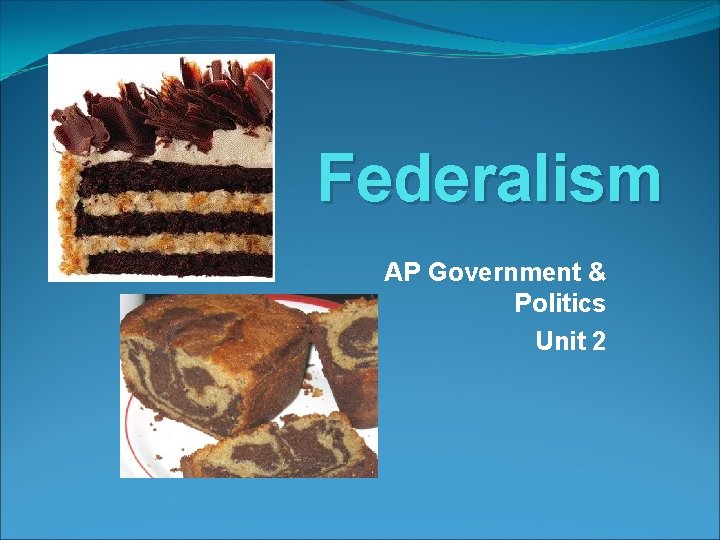
AKA… “Layer Cake Federalism"
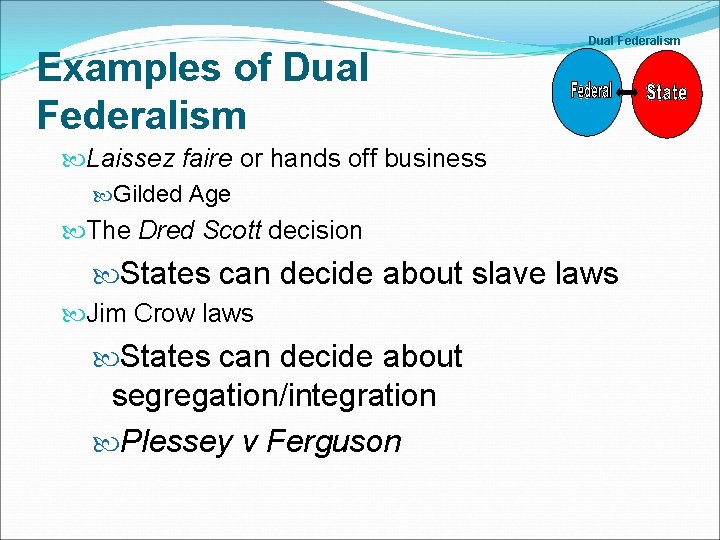
Examples of Dual Federalism Laissez faire or hands off business Gilded Age The Dred Scott decision States can decide about slave laws Jim Crow laws States can decide about segregation/integration Plessey v Ferguson
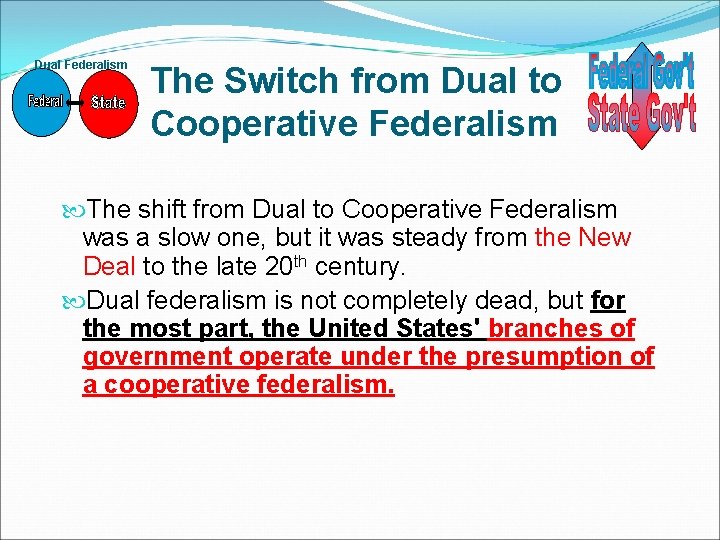
Dual Federalism The Switch from Dual to Cooperative Federalism The shift from Dual to Cooperative Federalism was a slow one, but it was steady from the New Deal to the late 20 th century. Dual federalism is not completely dead, but for the most part, the United States' branches of government operate under the presumption of a cooperative federalism.
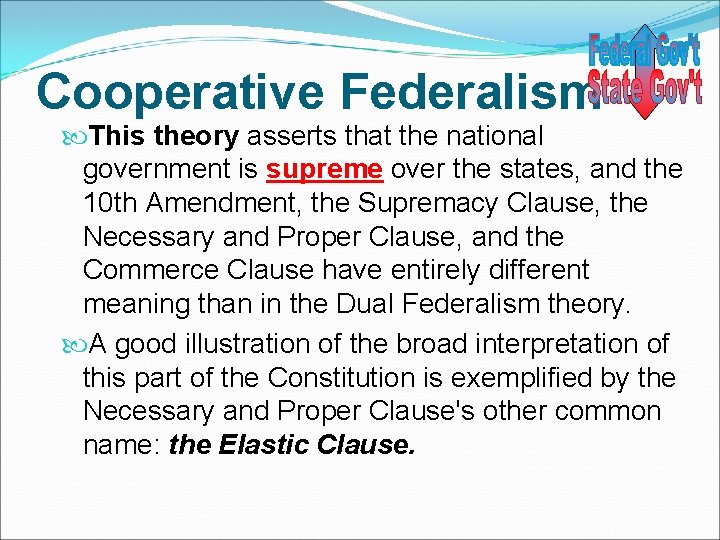
Cooperative Federalism This theory asserts that the national government is supreme over the states, and the 10 th Amendment, the Supremacy Clause, the Necessary and Proper Clause, and the Commerce Clause have entirely different meaning than in the Dual Federalism theory. A good illustration of the broad interpretation of this part of the Constitution is exemplified by the Necessary and Proper Clause's other common name: the Elastic Clause.
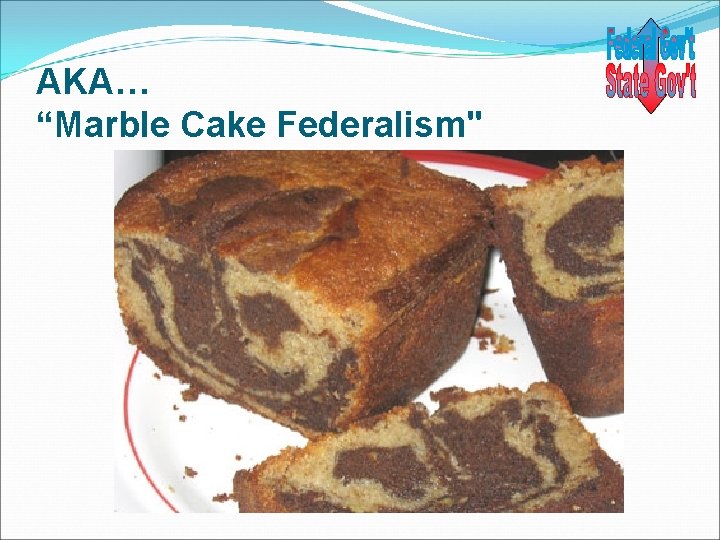
AKA… “Marble Cake Federalism"
Examples of Cooperative Federalism The New Deal Government programs to end the Great Depression The Great Society Government programs to end discrimination AND to provide for those less fortunate NCLB and Race to the top Federal government regulation and grants concerning K-12 education
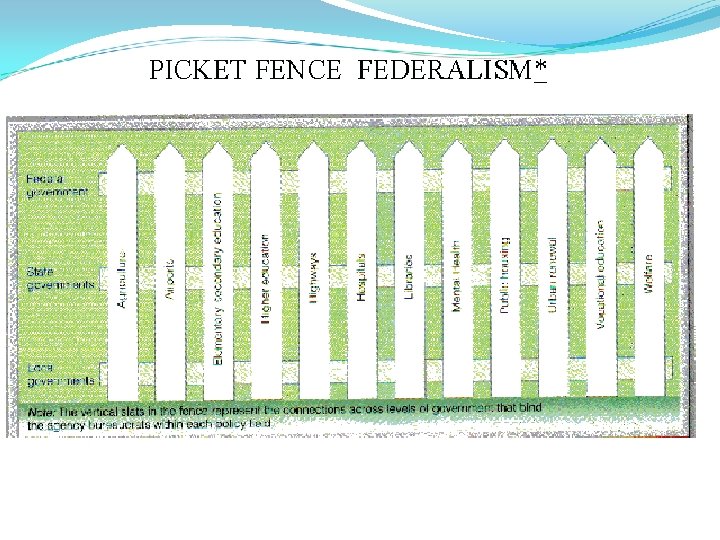
Cooperative Federalism & Grants “Cooperative Federalism" included an explosion of grants that reached beyond the states to establish intergovernmental links at all levels, often bypassing states entirely. AKA as “picket fence federalism" AKA as Creative Federalism Started with the Morrill Land Grant of 1862 federal government gave each state 30, 000 of public land for each representative in Congress the money from the sale of the lands was to establish and support agricultural and mechanical arts colleges (UGA, Texas A & M, Michigan State…)
New Federalism is the arrangement of administrative reforms with a devolutionary objective. This idea began during modern presidential administrations starting with Richard Nixon. Ronald Reagan’s campaigns centered around devolution It included decentralization of national programs to regions, streamlining of federal services, and the redirection of funds towards other levels of government. It also included efforts to reduce national control over the grants-in-aid programs and revise the character of federal involvement in general welfare spending.
Federal Mandates (the stick) Federal laws that direct state and local governments to comply with federal standards, rules, or regulations Federal Clean Air Act Sometimes the federal government will impose a mandate on state or local governments to implement a costly policy in return for funds that may not make up the full costs of the program. This is called an Unfunded Mandate Example: Endangered Species Act Passed by Congress in 1973, which imposes federal mandates on states to protect animal species that are deemed in danger of becoming extinct. States have NO CHOICE but to follow this Act whether or not money is supplied by the feds
Unfunded Mandates Reform Act of 1995 Prevented Congress from passing costly federal programs along to the states with at least a debate on how to fund them With its origins in the ‘Devolution Revolution’ (Republican- Contract with America), UMRA was designed to make it more difficult for the federal government to make state and local governments pay for programs and projects that it refuses to pay for itself. Unfortunately, UMRA largely has proven to be a case of promises unfulfilled
Federal Grants (the carrot) The federal government transfers payments or shares its revenues with lower levels of government via federal grants. It’s all about the money!!!! Who has it (the national government) Who wants it (the states) And who gets it (the states who jump through the right hoops) Federal governments use this power to enforce national rules and standards by opening and closing its “purse strings” for the states
Revenue Sharing The transfer of tax revenue to the states Congress gave an annual amount of federal tax revenue to the states and their cities, counties and townships. Revenue sharing was extremely popular with state officials, but it lost federal support during the Reagan Administration. In 1987, revenue sharing was replaced with block grants in smaller amounts to reduce the federal deficit
Two Types of Grants-in Aid Block grants Grants provided to the states from the federal government with few strings attached For example, a grant for transportation but the state can decide which roads will be built or where they will be located Categorical grants Grants provided to the states from the federal government with many strings attached For example, a grant for roads but the federal government decides where the road will go or which road can be widened can decide which road
Welfare Act of 1996 AKA…The Personal Responsibility and Work Opportunity Reconciliation Act Was signed in to law on August 22, 1996, by President Bill Clinton. It was a bipartisan effort with the Republican Congress It dramatically changed the nation's welfare system into one that required work in exchange for time-limited assistance. The law contained strong work requirements a performance bonus to reward states for moving welfare recipients into jobs state maintenance of effort requirements comprehensive child support enforcement and supports for families moving from welfare to work -- including increased funding for child care and guaranteed medical coverage. "
Important Supreme Court Cases Concerning Federalism South Dakota v Dole U. S. v Lopez Printz v U. S. District of Columbia v. Heller Mac. Donald v Chicago Boumediene v. Bush v Gore
South Dakota vs. Dole (1987) The withholding of federal highway funds followed a study of teenage driving and alcohol-related accidents The federal government required states to raise their drinking age to 21 in order to receive highway funds South Dakota claimed that the law is unconstitutional because the 21 st amendment gave power to the states for regulating alcoholic beverages. The state filed suit against Secretary of Transportation Elizabeth Dole Can Congress withhold federal funding in order to force a state to pass legislation it deems useful?
Decision and Importance Decision: “Yes!” Why important? The provision was designed to serve the general welfare AND it was held that even if Congress lacks the power to impose a national minimum drinking age directly, the “nonrequirement” aspect of the regulation was a valid exercise of Congress' spending power and upheld states rights
United States vs. Lopez (1995) Was the first modern Supreme Court case to set limits to Congress's lawmaking power. Alfonso Lopez, Jr. carried a handgun and bullets into his high school. He was charged with violating Section 922(q) of the Gun -Free School Zones Act of 1990. The government believed that the possession of a firearm at a school falls under jurisdiction of the Commerce Clause.
Decision and Importance The Court said, “NO!” to Commerce Clause in Lopez Too much of a stretch to connect guns in school to commerce Federal government had overstretched it’s boundaries Forced states to create the gun laws themselves. Why important? Interstate commerce, gun-free school zones can not be federally mandated (states rights) Was this a change in the direction of the Court?
Printz vs. United States (1997) Reagan’s press secretary, James Brady was seriously injured during the assassination attempt He later lobbied for stricter gun controls and background checks - these passed and became known as the “Brady Bill” Printz was a sheriff who challenged the Brady Bill charging that it violated the 10 th Amendment Did the federal mandated law take it too far? ?
Importance The Court said “YES!’ The Court ruled in favor of Printz, ruling that Congress may not require the States to administer a federal regulatory program and that the Act violated the Tenth Amendment to the U. S. Constitution The decision overturned requirements for local enforcement of the background checks Why important? The states are no longer subordinates in all power disputes involving unfunded mandates
Amendment II A well regulated militia, being necessary to the security of a free state, the right of the people to keep and bear arms, shall not be infringed. What exactly does that mean? ? ?
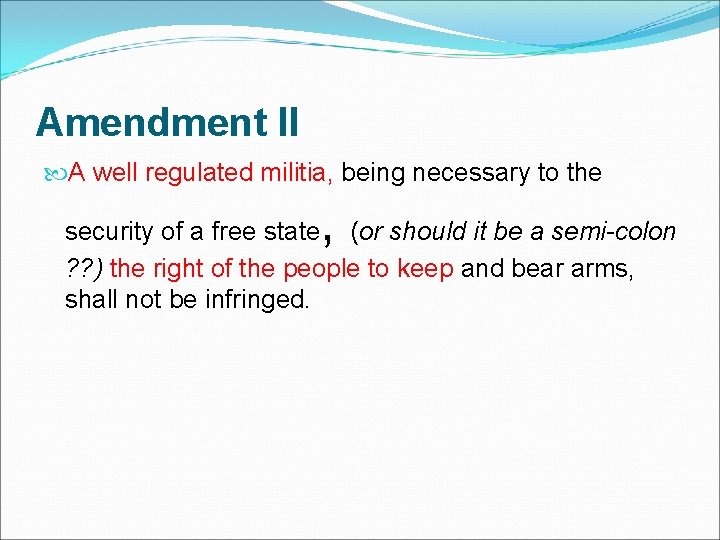
Amendment II A well regulated militia, being necessary to the , security of a free state (or should it be a semi-colon ? ? ) the right of the people to keep and bear arms, shall not be infringed.
District of Columbia v. Heller (2008) For the first time in seventy years, the Court heard a case regarding the central meaning of the Second Amendment and its relation to gun control laws. After the District of Columbia passed legislation barring the registration of handguns, requiring licenses for all pistols, and mandating that all legal firearms must be kept unloaded and disassembled or trigger locked, a group of private gun-owners brought suit claiming the laws violated their Second Amendment right to bear arms. Do local government have the right to impose such strict laws concerning guns?
District of Columbia v. Heller (2008) Decision No! In a 5 -4 decision, the Court held that the Second Amendment protects an individual right to possess a firearm unconnected with service in a militia, and to use that firearm for traditionally lawful purposes, such as self-defense within the home.
Mc. Donald v. Chicago, 2010 Facts of the case Several suits were filed against Chicago and Oak Park in Illinois challenging their gun bans after the Supreme Court issued its opinion in District of Columbia v. Heller. Here, plaintiffs argued that the Second Amendment should also apply to the states.
Mc. Donald v. Chicago, 2010 Ruling and Importance (5 -4) The Supreme Court ruled that the Fourteenth Amendment makes the Second Amendment right to keep and bear arms for the purpose of self-defense applicable to the states The Court reasoned that rights that are "fundamental to the Nation's scheme of ordered liberty" or that are "deeply rooted in this Nation's history and tradition" are appropriately applied to the states through the Fourteenth Amendment.
Habeas Corpus “You have the Body” A writ of habeas corpus is a judicial mandate to a prison official ordering that an inmate be brought to the court so it can be determined whether or not that person is imprisoned lawfully and whether or not he should be released from custody. Prisoners often seek release by filing a petition for a writ of habeas corpus. A habeas corpus petition is a petition filed with a court by a person who objects to his own or another's detention or imprisonment. The petition must show that the court ordering the detention or imprisonment made a legal or factual error.
Boumediene v. Bush (2008): Facts of the Case: In 2002 Lakhdar Boumediene and five other Algerian natives were seized by Bosnian police when U. S. intelligence officers suspected their involvement in a plot to attack the U. S. embassy there. The U. S. government classified the men as enemy combatants in the war on terror and detained them at the Guantanamo Bay Naval Base (GITMO), which is located on land that the U. S. leases from Cuba.
Boumediene v. Bush (2008): Questions of Law 1. Should the Military Commissions Act of 2006 be interpreted to strip federal courts of jurisdiction over habeas petitions filed by foreign citizens detained at the U. S. Naval Base at Guantanamo Bay, Cuba? 2. If so, is the Military Commissions Act of 2006 a violation of the Suspension Clause of the Constitution? 3. Are the detainees at Guantanamo Bay entitled to the protection of the Fifth Amendment right not to be deprived of liberty without due process of law and of the Geneva Conventions? 4. Can the detainees challenge the adequacy of judicial review provisions of the Military Commissions Act?
Importance No and Yes to the questions (5 -4 split decision) The Court ruled in favor of the detainees in each question. The procedures laid out in the Detainee Treatment Act are not adequate substitutes for the habeas writ. The detainees were not barred from seeking habeas or invoking the Suspension Clause merely because they had been designated as enemy combatants or held at Guantanamo Bay.
Bush v. Gore (2000) Facts of the Case: Following the closely contested 2000 presidential election, the Florida Supreme Court ordered that the Circuit Court in Leon County tabulate by hand 9000 contested ballots from Miami-Dade County. It also ordered that every county in Florida must immediately begin manually recounting all "undervotes" (ballots which did not indicate a vote for president) because there were enough contested ballots to place the outcome of the election in doubt. Governor George Bush and his running mate, Richard Cheney, filed a request for review in the U. S. Supreme Court and sought an emergency petition to reverse the Florida Supreme Court's decision.
Bush v. Gore (2000) Questions of Law: 1. Did the Florida Supreme Court violate Article II Section 1 Clause 2 of the U. S. Constitution by making new election law? 2. Do standardless manual recounts violate the Equal Protection and Due Process Clauses of the Constitution?
Importance In a hotly contested, 5 -4 decision the Supreme Court ruled for presidential candidate George W. Bush, vice pres. Candidate Dick Cheney (and Florida Governor Jeb Bush) 1. Yes , the Florida Supreme Ct. acted incorrectly Noting that the Equal Protection clause guarantees individuals that their ballots cannot be devalued by "later arbitrary and disparate treatment, " the opinion held 7 -2 that the Florida Supreme Court's scheme for recounting ballots was unconstitutional. 2. Yes, the manual recounts were unconstitutional Even if the recount was fair in theory, it was unfair in practice. The record suggested that different standards were applied from ballot to ballot, precinct to precinct, and county to county.
Read Your Chapters!! (Many) More Supreme Court cases to come…