Whether the Premier Points Card activity at 7
- Slides: 40
Whether the “Premier Points Card” activity at 7 - ELEVEN is successful than that at Family-Mart. • • • Open-John team 9654016 陳顗伃 Kelly 9631018 江美儀 Mei-Mei 9631022 莊晴晴 Jenny 9631039 林怡汝 Karen 9631006 段思宇 Rachel
I. Introduction • With intense competition of convenient store recently, the two biggest store, 7 -ELEVEN and Family-Mart, have their own special way to market merchandise. In these marketing activities, we have noticed that the “Premier Points Card” activity at 7 - ELEVEN seems to get more attention to the public. Thus, we want to talk about : whether the “Premier Points Card” activity at 7 - ELEVEN is successful than that at Family-Mart.
II. Literature Review A. Background of premier point card activity - “Premier point card activity” is structured marketing efforts that reward and therefore encourage, loyal buying behavior. - The first premier point card activity appear to have been the “trading stamp programs”. -They encourage repeat buying and thereby improve both retention rates and “share of wallet” from regular customers.
II. Literature Review B. Premier point card activities among convenience stores - In 2004, 7 -ELEVEN had promoted premium program first. - 7 months later, Family-Mart followed 7 ELEVEN’s step. - Since then, the business battles among convenience stores were begun.
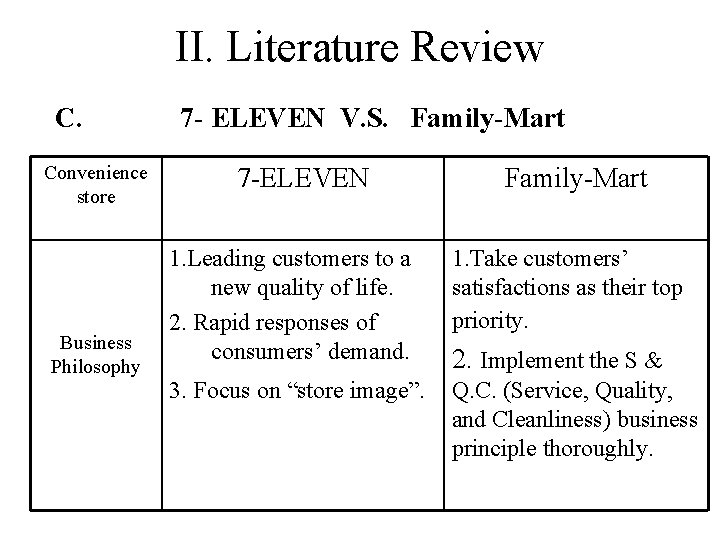
II. Literature Review C. Convenience store Business Philosophy 7 - ELEVEN V. S. Family-Mart 7 -ELEVEN 1. Leading customers to a new quality of life. 2. Rapid responses of consumers’ demand. Family-Mart 1. Take customers’ satisfactions as their top priority. 2. Implement the S & 3. Focus on “store image”. Q. C. (Service, Quality, and Cleanliness) business principle thoroughly.
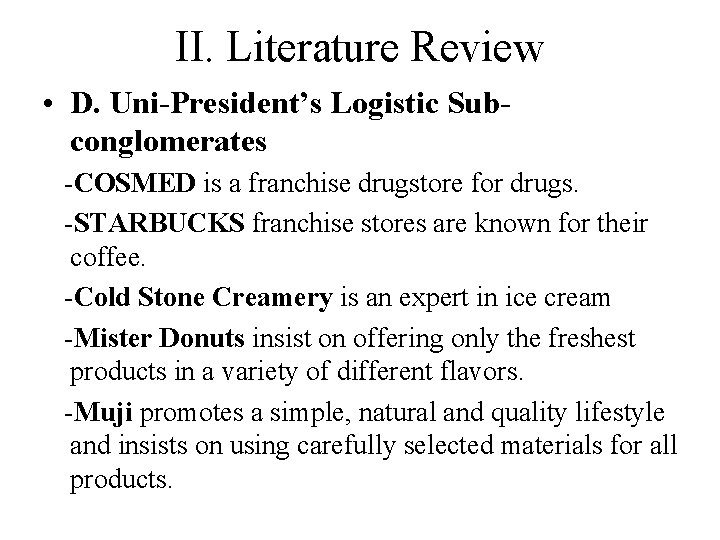
II. Literature Review • D. Uni-President’s Logistic Subconglomerates -COSMED is a franchise drugstore for drugs. -STARBUCKS franchise stores are known for their coffee. -Cold Stone Creamery is an expert in ice cream -Mister Donuts insist on offering only the freshest products in a variety of different flavors. -Muji promotes a simple, natural and quality lifestyle and insists on using carefully selected materials for all products.
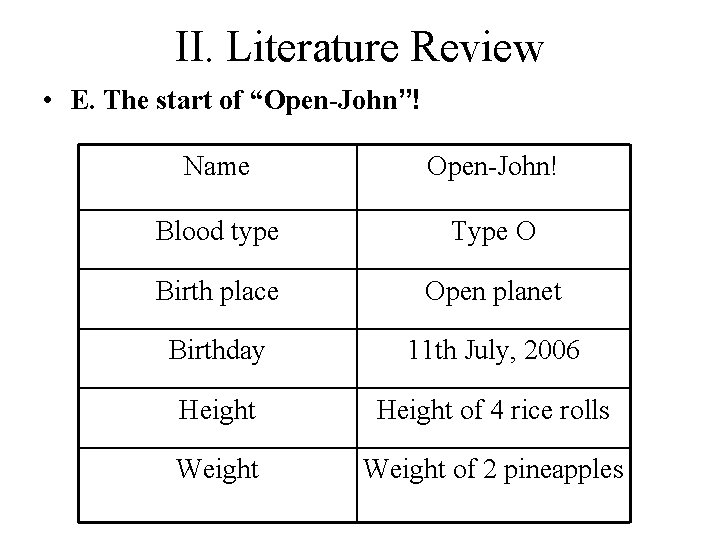
II. Literature Review • E. The start of “Open-John”! Name Open-John! Blood type Type O Birth place Open planet Birthday 11 th July, 2006 Height of 4 rice rolls Weight of 2 pineapples
III. Problems • “Premier Points Card” activity at 7 -ELEVEN seems to be more attractive, and we wonder why “Premier Points Card” activity at 7 ELEVEN catch more attention of customers than activity at Family-Mart.
IV. Hypothesis • Hypothesis 1: “Premier Points Card” activity at 7 ELEVEN is more attractive to consumers than that at Family-Mart. • Hypothesis 2: The premium of Uni- Presidents’ subsidiaries, which Family-Mart doesn’t have, is the most important reason that attracts customers to collect the points of 7 -ELEVEN. • Hypothesis 3: As to cartoon figures, consumers may prefer to exchange 7 -ELEVEN’s Open-John’s figure to Family-Mart’s cartoon figures. • Hypothesis 4: Those who seldom go to 7 -ELEVEN to consume will go to 7 -ELEVEN to consume specially for its “Premier Points Card” activity.
V. Methodologies • We will give customers of 7 -ELEVEN in NCTU the questionnaires. We made the questionnaire on the net http: //www. my 3 q. com/ • Use the pie chart and statistic to analysis. • There are total 48 people who done this questionnaires on the internet.
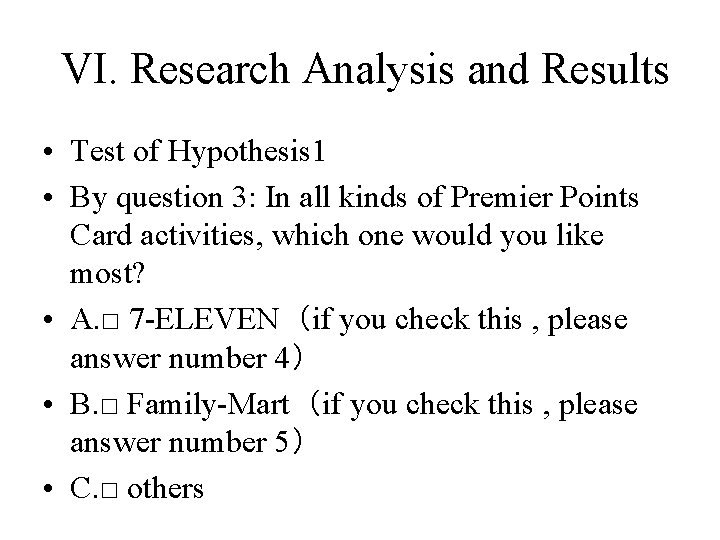
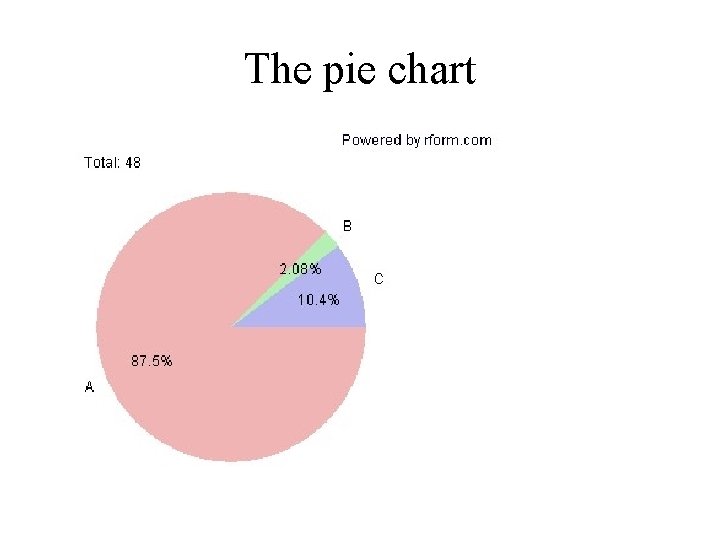
VI. Research Analysis and Results • Test of Hypothesis 1 • By question 3: In all kinds of Premier Points Card activities, which one would you like most? • A. □ 7 -ELEVEN(if you check this , please answer number 4) • B. □ Family-Mart(if you check this , please answer number 5) • C. □ others
The pie chart
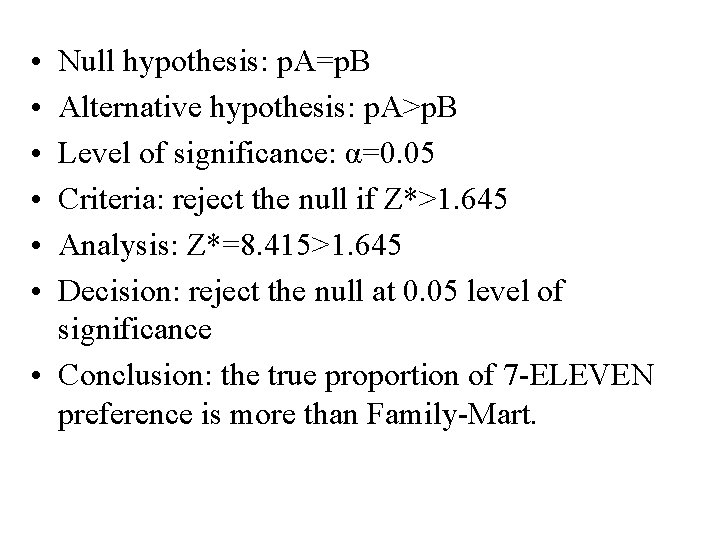
• • • Null hypothesis: p. A=p. B Alternative hypothesis: p. A>p. B Level of significance: α=0. 05 Criteria: reject the null if Z*>1. 645 Analysis: Z*=8. 415>1. 645 Decision: reject the null at 0. 05 level of significance • Conclusion: the true proportion of 7 -ELEVEN preference is more than Family-Mart.
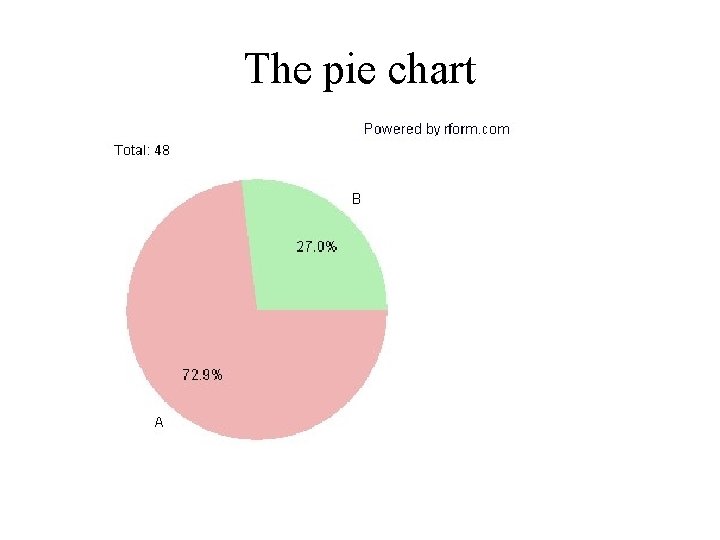
• Test of Hypothesis 2 • By question 4: Is the main reason attracts you to join this Premier Points Card activity of 7 ELEVEN that you can get discount at the store cooperated with Uni-Presidents enterprise? • A. □ yes • B. □ no
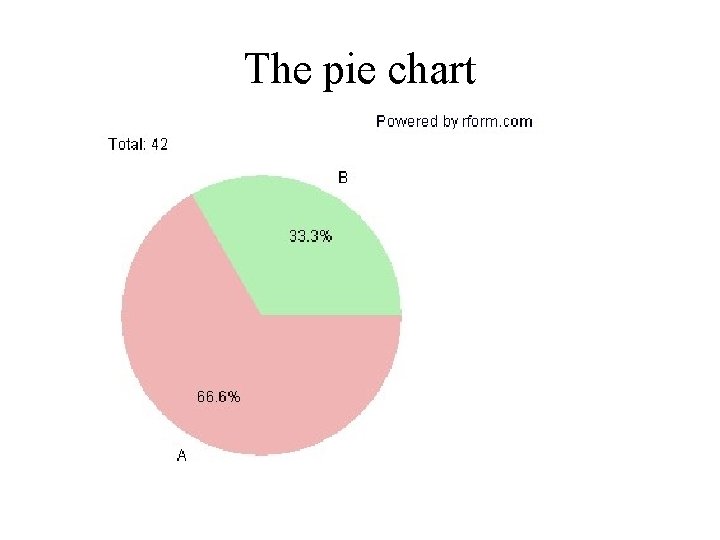
The pie chart
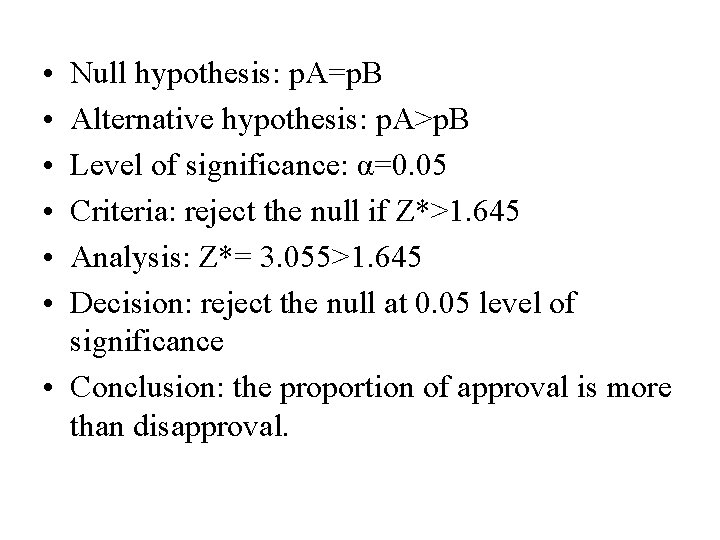
• • • Null hypothesis: p. A=p. B Alternative hypothesis: p. A>p. B Level of significance: α=0. 05 Criteria: reject the null if Z*>1. 645 Analysis: Z*= 3. 055>1. 645 Decision: reject the null at 0. 05 level of significance • Conclusion: the proportion of approval is more than disapproval.
• Test of Hypothesis 3 • By question 5: Comparing with Family-Mart’s cartoon figure, you prefer redeeming 7 ELEVEN’s Open-John figure? • A. □ yes • B. □ no
The pie chart
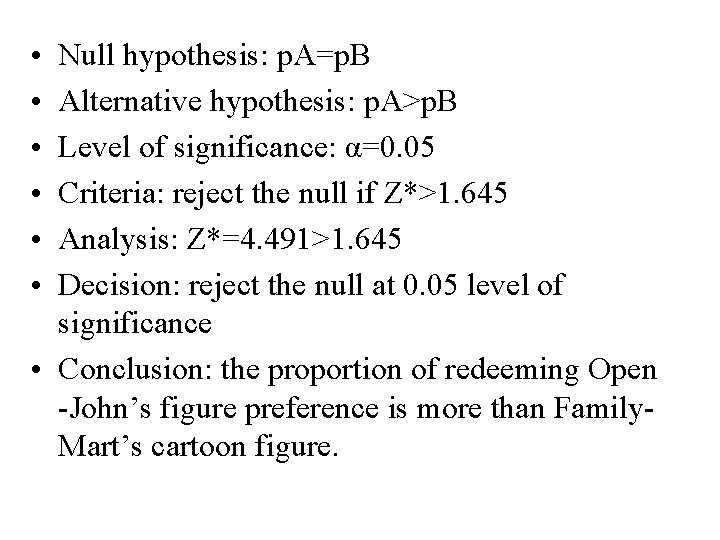
• • • Null hypothesis: p. A=p. B Alternative hypothesis: p. A>p. B Level of significance: α=0. 05 Criteria: reject the null if Z*>1. 645 Analysis: Z*=4. 491>1. 645 Decision: reject the null at 0. 05 level of significance • Conclusion: the proportion of redeeming Open -John’s figure preference is more than Family. Mart’s cartoon figure.
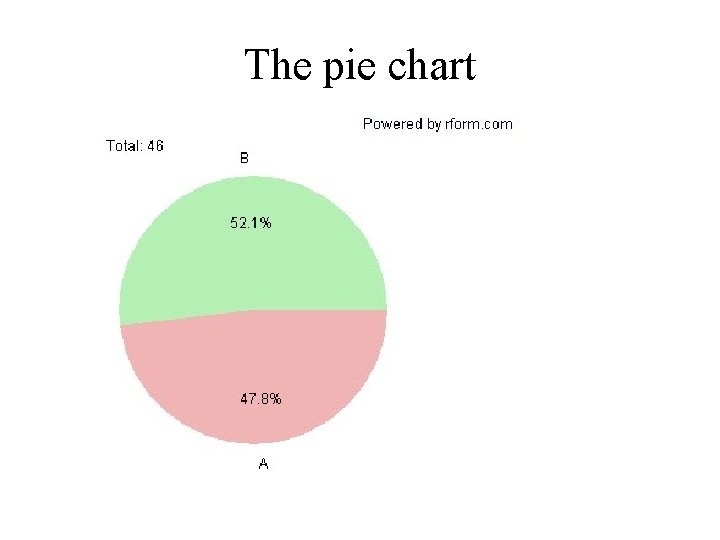
• Test of Hypothesis 4 • By question 6: If you are more convenient to consume at Family-Mart, would you increase the consuming amount and frequency of 7 ELEVEN because of its Premier Points Card activity? • A. □ yes • B. □ no
The pie chart
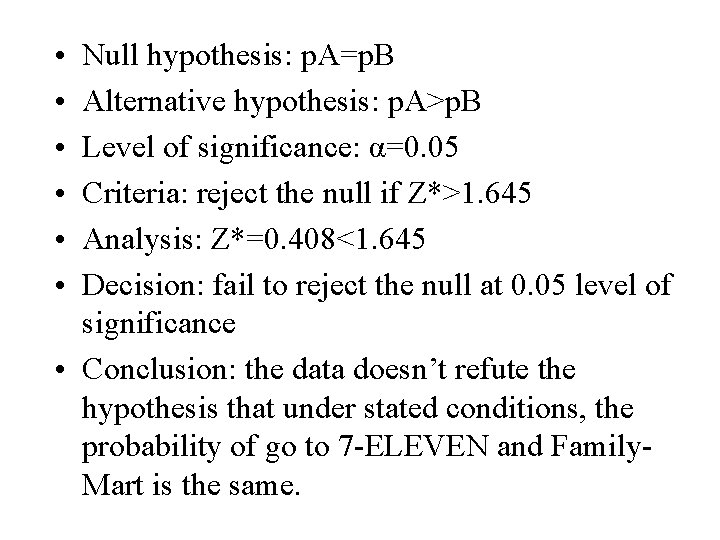
• • • Null hypothesis: p. A=p. B Alternative hypothesis: p. A>p. B Level of significance: α=0. 05 Criteria: reject the null if Z*>1. 645 Analysis: Z*=0. 408<1. 645 Decision: fail to reject the null at 0. 05 level of significance • Conclusion: the data doesn’t refute the hypothesis that under stated conditions, the probability of go to 7 -ELEVEN and Family. Mart is the same.
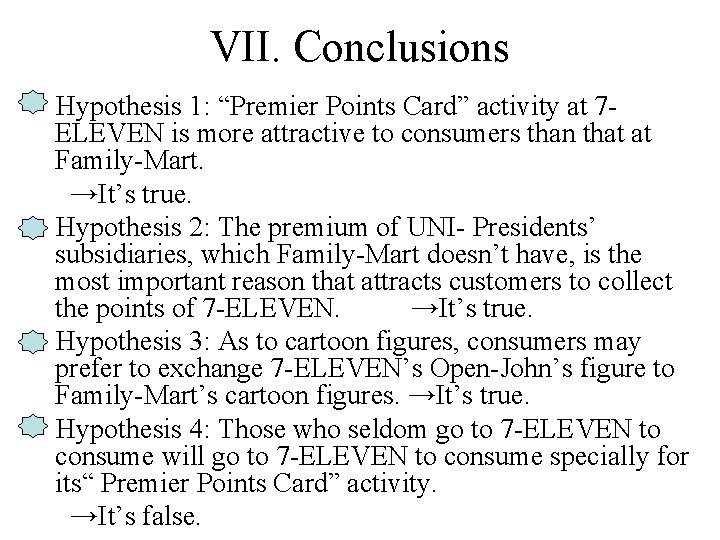
VII. Conclusions Hypothesis 1: “Premier Points Card” activity at 7 ELEVEN is more attractive to consumers than that at Family-Mart. →It’s true. Hypothesis 2: The premium of UNI- Presidents’ subsidiaries, which Family-Mart doesn’t have, is the most important reason that attracts customers to collect the points of 7 -ELEVEN. →It’s true. Hypothesis 3: As to cartoon figures, consumers may prefer to exchange 7 -ELEVEN’s Open-John’s figure to Family-Mart’s cartoon figures. →It’s true. Hypothesis 4: Those who seldom go to 7 -ELEVEN to consume will go to 7 -ELEVEN to consume specially for its“ Premier Points Card” activity. →It’s false.
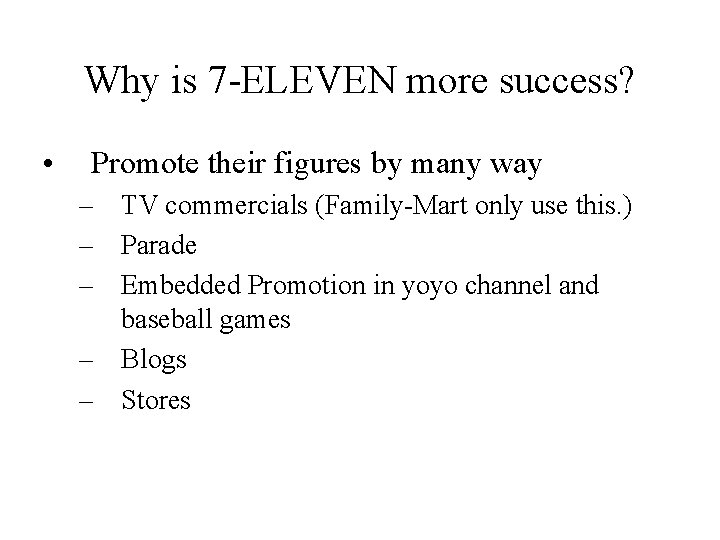
Why is 7 -ELEVEN more success? • Promote their figures by many way – TV commercials (Family-Mart only use this. ) – Parade – Embedded Promotion in yoyo channel and baseball games – Blogs – Stores
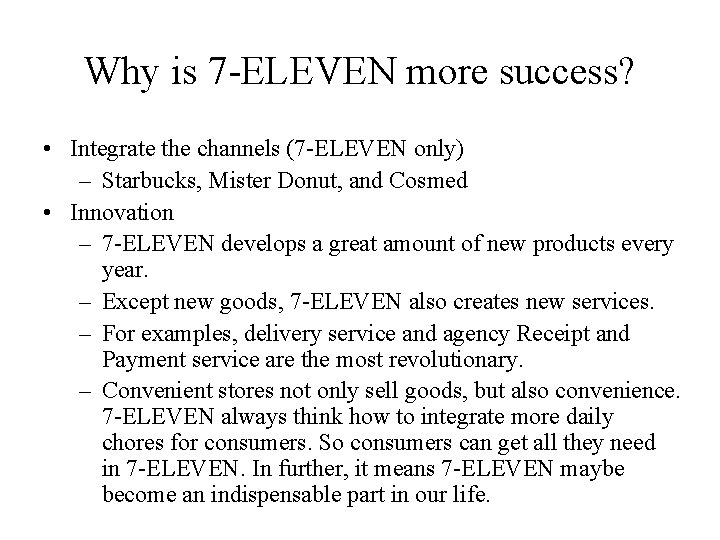
Why is 7 -ELEVEN more success? • Integrate the channels (7 -ELEVEN only) – Starbucks, Mister Donut, and Cosmed • Innovation – 7 -ELEVEN develops a great amount of new products every year. – Except new goods, 7 -ELEVEN also creates new services. – For examples, delivery service and agency Receipt and Payment service are the most revolutionary. – Convenient stores not only sell goods, but also convenience. 7 -ELEVEN always think how to integrate more daily chores for consumers. So consumers can get all they need in 7 -ELEVEN. In further, it means 7 -ELEVEN maybe become an indispensable part in our life.
Why is 7 -ELEVEN more success? – Family-Mart is a follower. While 7 -ELEVEN makes promotions, Family-Mart always copies them. – In 2005, 7 -ELEVEN made the promotion that consumers could collect points to exchange with something free. – Because portrait rights of popular roles of cartoons had been occupied, Family-Mart could not copy the promotion in this time. – Collection points for exchanging gifts have been taken by other industries for a long time; for instance, credit card industry. But it was first time in the convenient store industry. Thanks to the promotion, the monthly revenue of 7 -ELEVEN rose to an all-time high. It was 101 billion NTD.
Integrate the channels • Uni-President will have unmatchable competitive edge since they include Starbucks, Mister Donut, and Cosmed into collecting point promotion. • Points collected at 7 -ELEVEN not only can exchange goods in 7 -ELEVEN, but also in Starbucks, Mister Donut, and Cosmed. • This will attract consumers.
Innovation • Family-Mart always copy promotion programs of 7 -ELEVEN. • In 2005, 7 -ELEVEN made the promotion that consumers could collect points to exchange with gifts. • Family-Mart could not copy the promotion in this time. Because portrait rights of popular roles of cartoons had been occupied.
Innovation • Collection points for exchanging gifts have been taken by other industries for a long time. However, it was first time in the convenient store industry. • Thanks to the promotion, the monthly revenue of 7 -ELEVEN rose to an all-time high. It was 101 billion NTD.
Commends • For 7 -ELEVEN – the quality of gifts is important to customers. – Make strategic alliance with other industries which does not belong to Uni-President.
Commends • For Family-Mart: – Family-Mart should create some new idea for marking. – Family-Mart should make strategic alliance with other companies for increasing attractive power. – Family-Mart could offer free door-to-door delivery service to make customers more convenient.
References • • Balasubramanian, S. K. , Karrh, J. A. , & Patwardhan, H. (2006), “Audience response to product placements: An integrative framework and future research agenda. ” Journal of Advertising, 35, 115– 141. Auty, S. , & Lewis, C. (2004), “Exploring children’s choice: The reminder effect of product placement. ” Psychology & Marketing, 21, 699– 716. Brennan, S. , Rosenberger III, P. J. , & Hementera, V. (2004), “Product placement in movies: An Australian consumer perspective on their ethicality and acceptability. ” Marketing Bulletin, 15, 1– 16. Arjun, C. & Morris, B. H. (2001), “The chain of effects from brand trust and brand affect to brand performances: the role of brand loyalty. ” Journal of Marketing, 65, 2, 81 -93. Chaudhuri, A. & Morris, B. H. (2001), “The Chain of Effects from Brand Trust and Brand Affect to Brand Perormance: The Role of Brand Loyalty. ” Journal of Marketing, 65, 81 -93. Gould, S. J. , Gupta, P. B. , & Grabner-Krauter, S. G. (2000), “Product placement in movies: A cross-cultural analysis of Austrian, French and American consumers’ attitudes toward this emerging, international promotional medium. ” Journal of Advertising, 26 (4), 41– 58. Kotler, P. (2000), “Marketing Management, ” 10 th ed, New Jersey, Prentice Hall. d’Astous, A. , & Séguin, N. (1999), “Consumer reactions to product placement strategies in television sponsorship. ” European Journal of Marketing, 33, 896– 910.
References • • • Afuah (1998), “Innovation Management: Strategies, Implementation, and Profits, ” New York: Oxford University Press. Gardener, E. and Trivedi, M. (1998), “A communications framework to evaluate sales promotion strategies, ” Journal of Advertising Research, May-June, p 67 -71. Baldinger, A. L. , Rubinson, A. K. , & Joel, M. (1996), “Brand loyalty: the link between attitude and behavior. ” Journal of Advertising Research, 22 -33 Bhote, K. R. (1996), “Beyond Customer Satisfaction to Customer Loyalty- The Key to Greater Profitability. ” American Management Association, New York, 31 Higgins, J. M. (1995), “Innovation: The Core Competence. ” Planning Review 23, no. 6: 32 -25. Hall, R. (1992), “The Strategic Analysis of Intangible Resources. ” Strategic Management Journal 14, no. 2: 135 -144. Barney, J. B. (1991), “Firm Resources and Sustained Competitive Advantage. ” Journal of Management Science 17, no. 1: 99 -120 Drucker, P. F. (1985), “Innovation and Entrepreurship: Practice and Principles. ” London: William Heinemann. Student:Shu Chiung-Fang Advisor:Wang Chao-Ming(2005) “The Study of Selling Private Brand Products of Convenience Chain Stores for Consumer Behavior Effect --Example by 7 - ELEVEN Convenience Store’s OPEN-Chan Toy Figurine”. Student: Huang Cing-Yu Advisor:Huang Jen-Hung(2006) “The Study of Effects of Symbolic Meaning and Customer Value on Collecting Behavior of Collectable Premium”.
References • • Liu, Matthew Tingchi; Brock, James L. “Redemption behavior for credit card reward programs in China” Liao Yin-Ru & Wang Qiao-Ting & Li Yun-An “Marketing Research of “ 7 ELEVEN”and “Family-Mart” convenience stores in Hualien area”. Journal of Uni- President, Taipei, 2005 Tain-Xia Magazine, Taipei, 2005
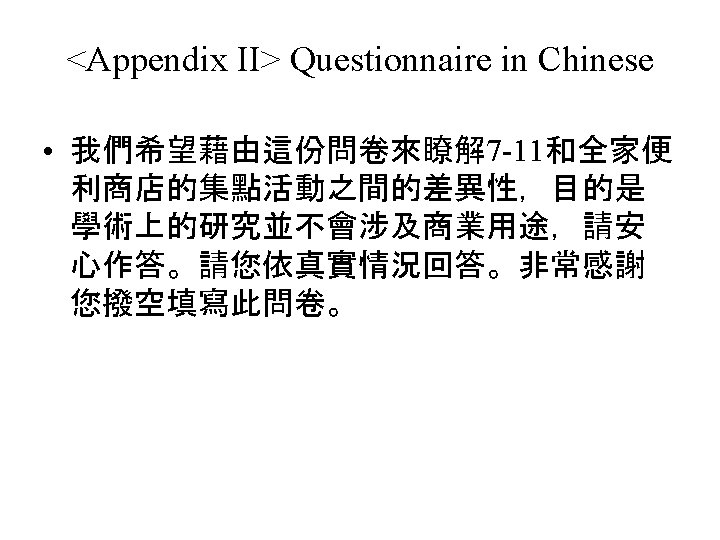
<Appendix I> Questionnaire in English • Dear all: This is an academic research questionnaire, the purpose is to understand "the difference of Premier Points Card activity between 7 - ELEVEN and Family -Mart. " I would like to conduct a survey and please provide your valuable information. Your answers will be important to the success of our research, and I hope you to answer truly. As the survey is confidential, please feel safe to answer. I truly appreciate your assistance.
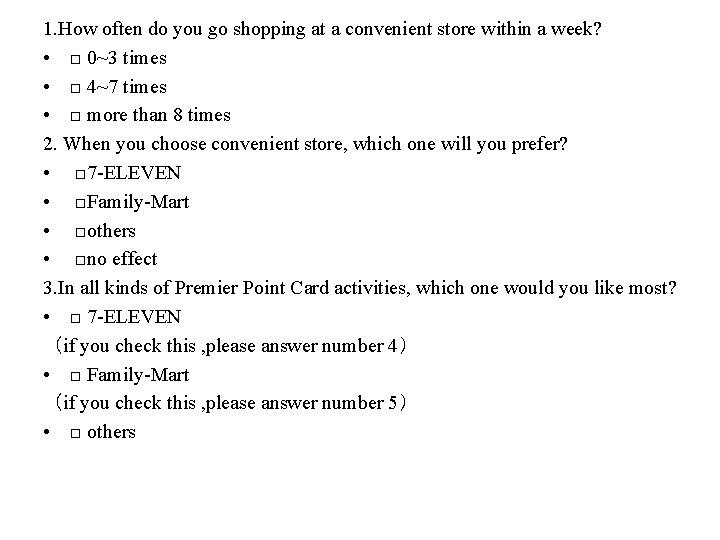
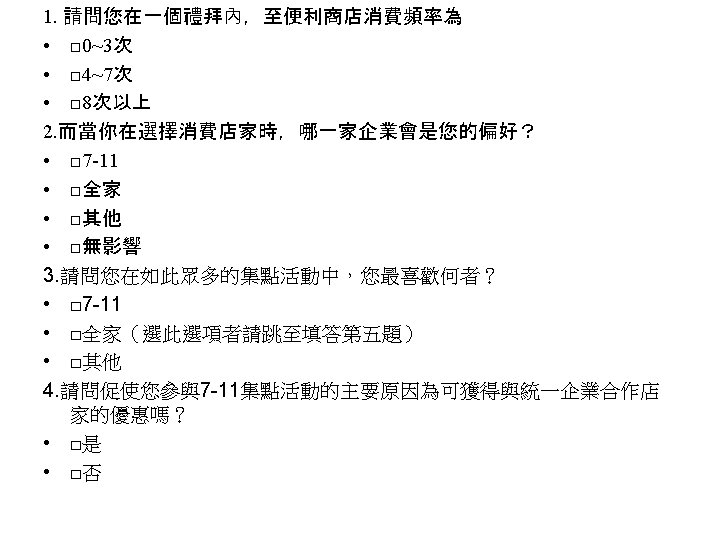
1. How often do you go shopping at a convenient store within a week? • □ 0~3 times • □ 4~7 times • □ more than 8 times 2. When you choose convenient store, which one will you prefer? • □ 7 -ELEVEN • □Family-Mart • □others • □no effect 3. In all kinds of Premier Point Card activities, which one would you like most? • □ 7 -ELEVEN (if you check this , please answer number 4) • □ Family-Mart (if you check this , please answer number 5) • □ others
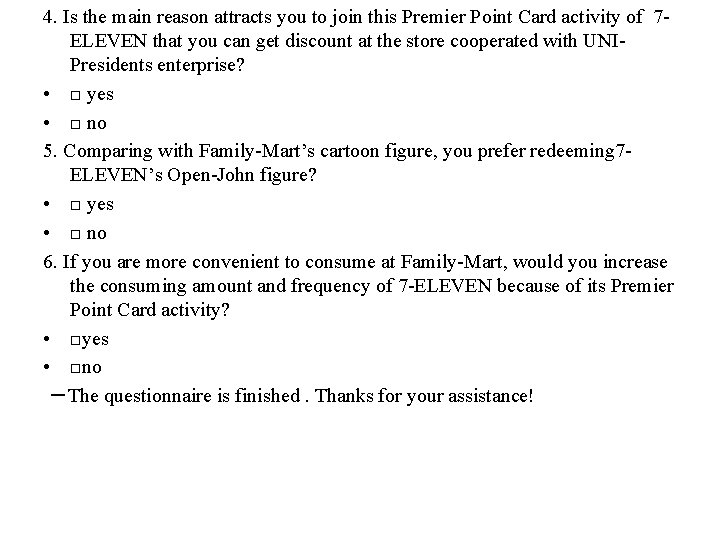
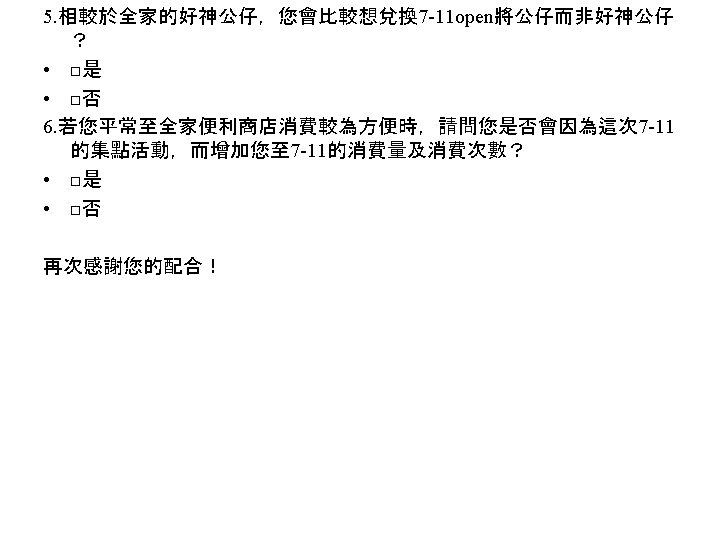
4. Is the main reason attracts you to join this Premier Point Card activity of 7 ELEVEN that you can get discount at the store cooperated with UNI- Presidents enterprise? • □ yes • □ no 5. Comparing with Family-Mart’s cartoon figure, you prefer redeeming 7 ELEVEN’s Open-John figure? • □ yes • □ no 6. If you are more convenient to consume at Family-Mart, would you increase the consuming amount and frequency of 7 -ELEVEN because of its Premier Point Card activity? • □yes • □no -The questionnaire is finished. Thanks for your assistance!