Activity Card Sort United Kingdom Alison LaverFawcett Ph

- Slides: 102
Activity Card Sort -United Kingdom Alison Laver-Fawcett Ph. D, OT(C), Dip. COT, PCAP, December 2016 a. laverfawcett@yorksj. ac. uk
A standardised assessment is ‘A published measurement tool, designed for a specific purpose in a given population, with detailed instructions provided as to when and how it is to be administered and scored, interpretation of the scores, and results of investigations of reliability and validity’ (Cole et al, 1995, p. 22)
How can you tell if an assessment is standardised? �Is there a test manual? � Does the test manual describe: ◦ the test development process? ◦ the purpose of the test ◦ client group for whom the test has been developed? ◦ details of psychometric studies undertaken to establish reliability and validity? ◦ the materials needed for test administration or are these included as part of the test package? ◦ the environment that should be used for testing?
How can you tell if an assessment is standardised? �Is there a protocol for test administration that provides all the instructions required to administer the test? �Is there guidance on how to score each test item? �Is there a scoring form for recording scores? �Is there guidance for interpreting
Activity Card Sort -United Kingdom A Q-sort assessment Underpinning evidence base Underpinning
Key reference �Laver-Fawcett AJ, Mallinson S (2013) �The Development of the Activity Card Sort – United Kingdom version (ACSUK). �OTJR: Occupation, Participation, and Health, 33 (3), 134 -145. �DOI: 10. 3928/15394492 -20130614 -02
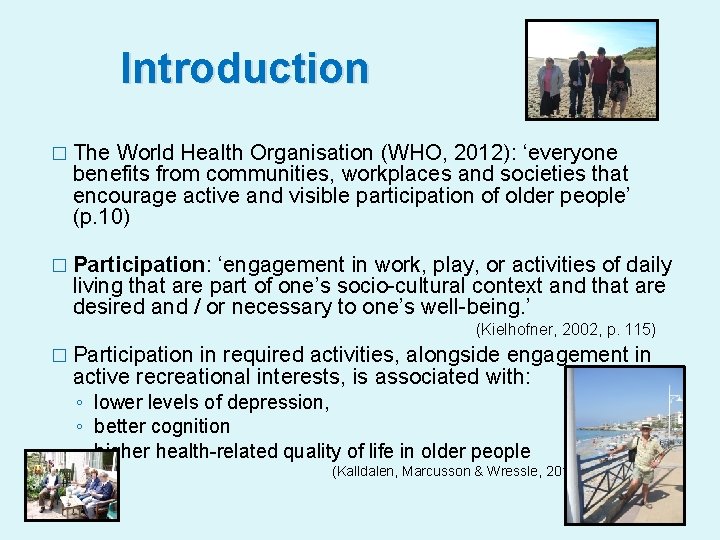
Introduction � The World Health Organisation (WHO, 2012): ‘everyone benefits from communities, workplaces and societies that encourage active and visible participation of older people’ (p. 10) � Participation: ‘engagement in work, play, or activities of daily living that are part of one’s socio-cultural context and that are desired and / or necessary to one’s well-being. ’ (Kielhofner, 2002, p. 115) � Participation in required activities, alongside engagement in active recreational interests, is associated with: ◦ lower levels of depression, ◦ better cognition ◦ higher health-related quality of life in older people (Kalldalen, Marcusson & Wressle, 2013)
Occupational therapy and participation � Occupational therapists can make important contributions to both prevention and remediation services for older people through enabling participation in meaningful occupations (Clark et al. , 2011) Further research is required to increase understanding of the factors that facilitate participation and evaluate occupational therapy interventions that are directed at increasing participation (Law, 2013) � This is a particular issue for: older populations with stroke (Spitzer, Tse, Baum & Carey, 2011) and mental health problems � (Bannigan & Laver-Fawcett, 2011) Reliable and valid measures of older people’s activity participation are essential for such research � The Activity Card Sort (ACS; Baum & Edwards, 2008) is recognised internationally as a useful self-report measure of participation for clinical practice and research (e. g. , Eriksson, et �
Activity Card Sort (ACS) � Well established measure of activity engagement for older people (2 nd edition, Baum and Edwards, 2008) Originally developed by Dr Carolyn Baum for use with people with dementia in the USA in early 1990 s (Baum, 1993) � Photograph cards for activities grouped in 4 categories: � ◦ ◦ Instrumental Low Demand leisure High Demand Leisure Social 3 ACS versions: Recovery, Institutional and Community Living � Each version uses the same 89 activity cards �
Descriptive Assessments �Provide information which describes the current functional status of the client �Focuses on the identification of the clients functional abilities and limitations �Functional status data is important for clinical decision making and for setting functionally oriented treatment goals �Need to be detailed and sensitive to determine factors which are limiting the client’s ability (Laver-Fawcett, 2012)
Evaluative Assessments �are used to detect change in the client’s occupational performance and / or performance component functioning over time �can be used to monitor the client’s progress during rehabilitation and determine the effectiveness of a specific treatment intervention �need to be sensitive and have established test-retest reliability (Laver-Fawcett, 2012)
Uses of the ACS � The Activity Card Sort (ACS) measures an individual's occupational performance (descriptive assessment) � Used to monitor changes in activity participation over time due to a chronic health condition, a stroke or aging (evaluative assessment) � Comparing premorbid engagement in activities with current activity participation (Baum, Perlmutter & Edwards, 2000; Hartman-Maeir, Soroker, Ring, Avni & Katz, 2007) � Useful for initial assessment, goal setting and intervention planning (descriptive assessment) � To monitor changes in activity participation following onset of illness (Albert, Bear-Lehman & Burkhardt, 2009; Chan, Chung & Packer, 2006; Packer, Boshoff & De. Jonge, 2008) (evaluative assessment) � To evaluate the effects of an intervention designed to impact on a person’s activity participation (evaluative assessment) � Creating an occupational history (descriptive assessment) (Canadian Stroke Network – Stroke Engine Assess, n. d. )
The ACS as a research measure The ACS has been used to research participation for: �Older people living in the community (Everard et al. , 2000) �Older people facing disability transitions (Albert, Bear-Lehman & Burkhardt, 2009) �People experiencing cognitive deficits (Baum, 1995) �People with stroke (Edwards, Hahn, Dromerick, & Baum, 2005) �People with vision problems (Packer, Girdler, Boldy, Dhaliwal, & Crowley, 2009)
Relevance to culture and environment Cross-cultural research has demonstrated that the ACS has improved validity and utility when the activities depicted are relevant to people’s culture and environment (Chan, Chung & Packer, 2006; Doney & Packer, 2008; Eriksson et al. , 2011; Katz, Karpin, Lak, Furman, & Hartman-Maeir, 2003)
Cultural sensitivity issues � 2009 & 2010 Dissertation projects when students used the ACS as a measure with people with dementia and carers identified cultural sensitivity issues (Laver-Fawcett, 2012) � Kessler and Egan (2012) undertook a review of measures to evaluate participation outcomes post-stroke and identified the ACS as a potentially useful measure. However, they noted limitations for use in the UK as the ACS depicts some activities that appear culturally specific to the US
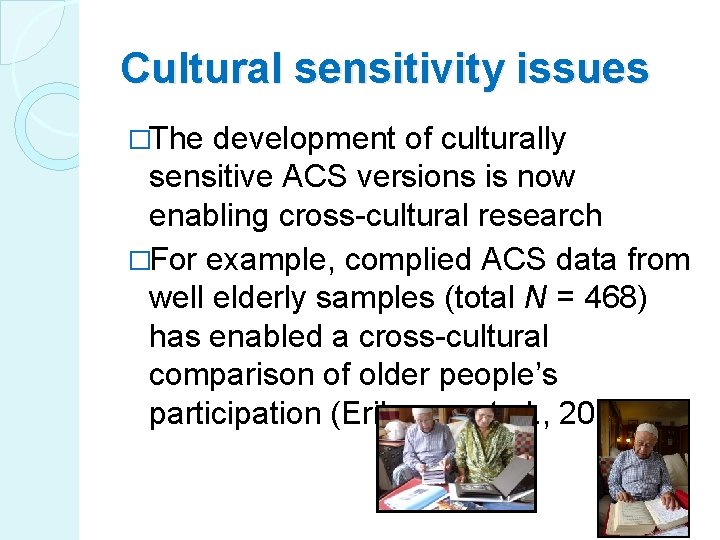
Cultural sensitivity issues �The development of culturally sensitive ACS versions is now enabling cross-cultural research �For example, complied ACS data from well elderly samples (total N = 468) has enabled a cross-cultural comparison of older people’s participation (Eriksson et al. , 2011)
Other versions of the ACS Researchers have adapted the ACS to develop eight culturally sensitive and valid versions for use in: �Arab countries (A-ACS; Hamed et al. , 2011; Hamed & Holm, 2013) �Australia (ACS-Australia; Packer, et al. , 2008) �Hong-Kong (ACS-HK; Chan et al. , 2006) �Israel (Katz et al. , 2003; Sachs & Josman, 2003) �Korea (Lee, 2009, as cited in Eriksson et al. , 2011) �Puerto Rico (Orellano, 2008) �Netherlands (Jong, van Nes, Lindeboom, 2012) �Singapore (as reported by Eriksson et al, 2011)
ACS review A useful overview of the ACS is available at: �Canadian Stroke Network – Stroke Engine Assess (n. d. ) In Depth Review of the Activity Card Sort (ACS). [Internet] Available from: �http: //strokengine. ca/assess/module_a cs_indepth-en. html [accessed 26 February 2016]
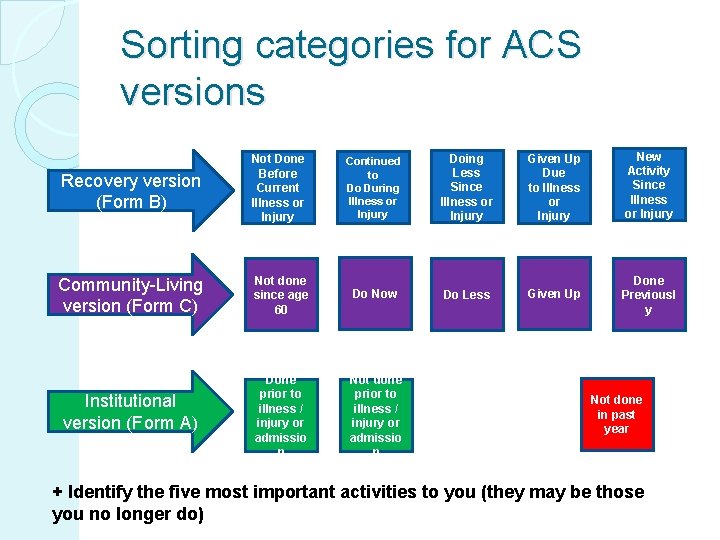
Background: Activity Card Sort (ACS) � The Activity Card Sort (ACS; Baum & Edwards, 2008) is recognised internationally as a useful self-report measure of participation for clinical practice and research (e. g. , Eriksson, et al. , 2011) � ACS-UK (Laver-Fawcett & Mallinson, 2013) has 93 Photograph cards for activities grouped in 4 categories: ◦ Instrumental, Low Demand Leisure, High Demand Leisure, Social/Cultural � 3 ACS-UK versions: Recovery, Institutional and Community Living (using the same 93 photo activity cards) � Different sorting categories of participation levels used for each of the three versions
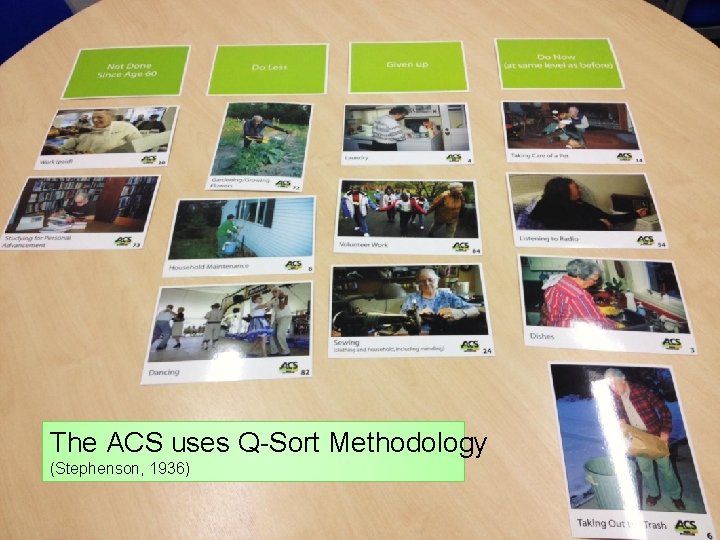
The ACS uses Q-Sort Methodology (Stephenson, 1936)
Q-Sort methodology � The Q-Sort methodology was originally described by Stephenson (1936 as cited in Block, 1961, p. 12) for collecting subjective data and involved the sorting of statements which were printed separately on cards to allow for ordering by subjects depending on their individual perspective. � Sorting photographs is desirable because it enables individuals with lower literacy levels to conduct the sort and prompts recall of activity engagement to help build a client’s occupational profile (Baum and Edwards, 2001; Law, Baum, Dunn, 2001)
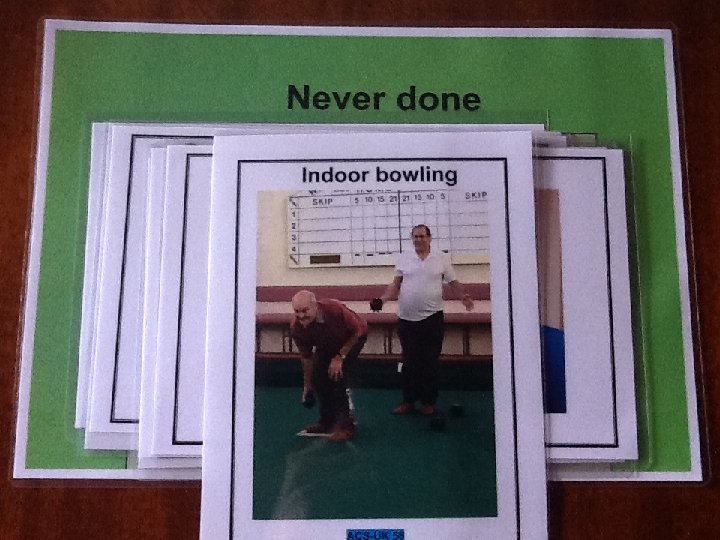
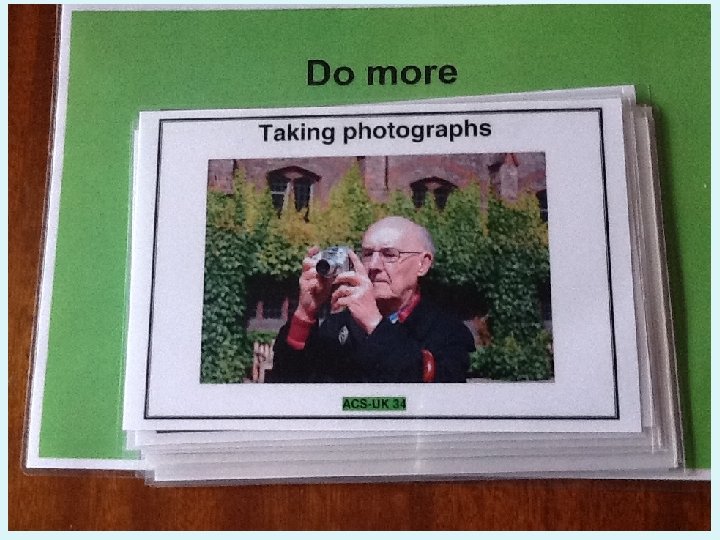
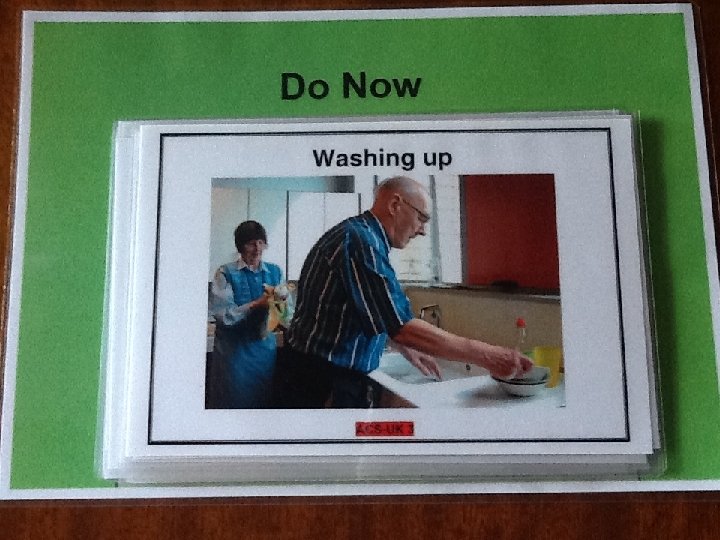
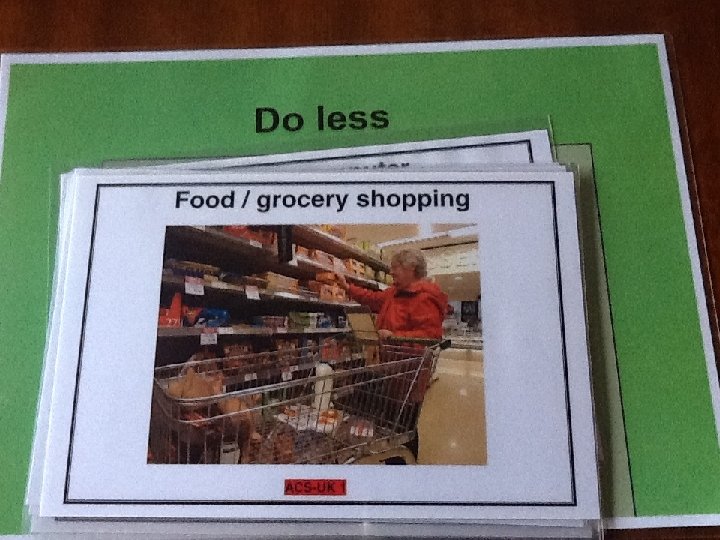
Sorting categories for ACS versions Continued to Do During Illness or Injury Doing Less Since Illness or Injury Given Up Due to Illness or Injury New Activity Since Illness or Injury Do Less Given Up Done Previousl y Recovery version (Form B) Not Done Before Current Illness or Injury Community-Living version (Form C) Not done since age 60 Do Now Institutional version (Form A) Done prior to illness / injury or admissio n Not done in past year + Identify the five most important activities to you (they may be those you no longer do)
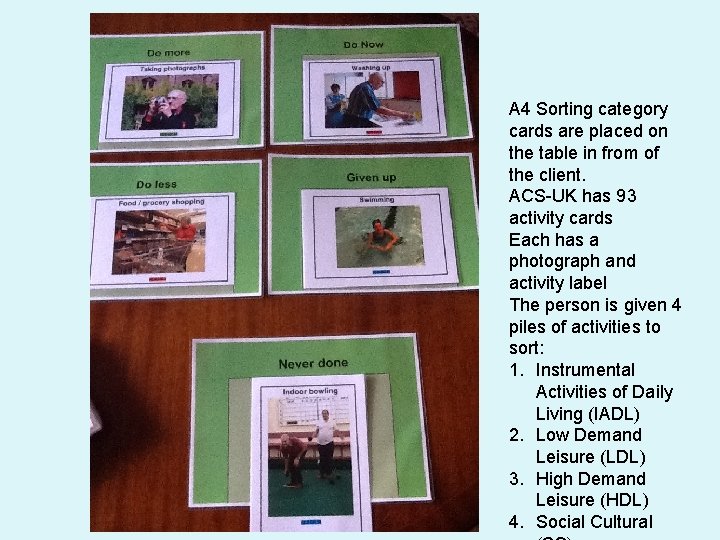
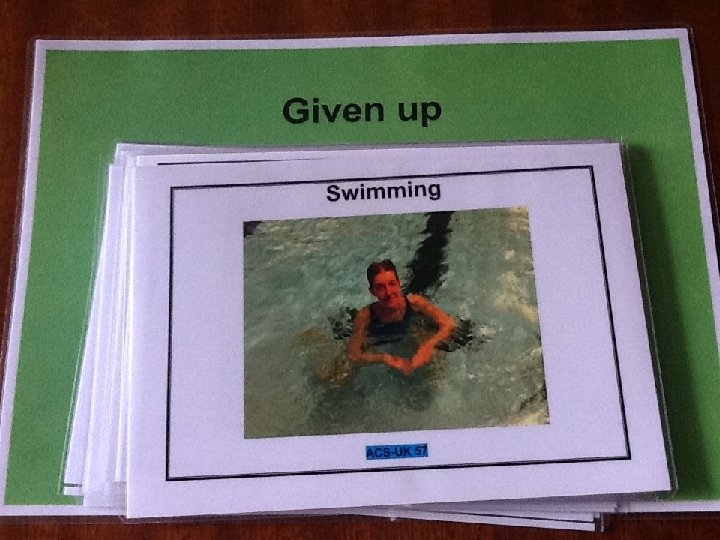
A 4 Sorting category cards are placed on the table in from of the client. ACS-UK has 93 activity cards Each has a photograph and activity label The person is given 4 piles of activities to sort: 1. Instrumental Activities of Daily Living (IADL) 2. Low Demand Leisure (LDL) 3. High Demand Leisure (HDL) 4. Social Cultural
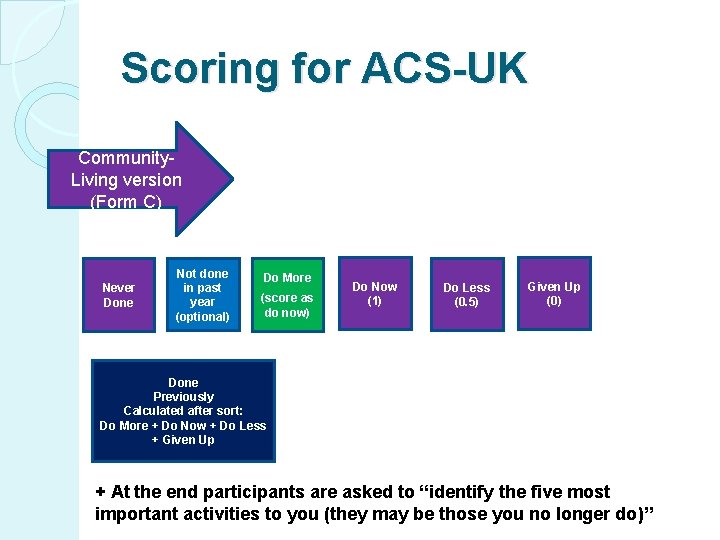
Scoring for ACS-UK Community. Living version (Form C) Never Done Not done in past year (optional) Do More (score as do now) Do Now (1) Do Less (0. 5) Given Up (0) Done Previously Calculated after sort: Do More + Do Now + Do Less + Given Up + At the end participants are asked to “identify the five most important activities to you (they may be those you no longer do)”
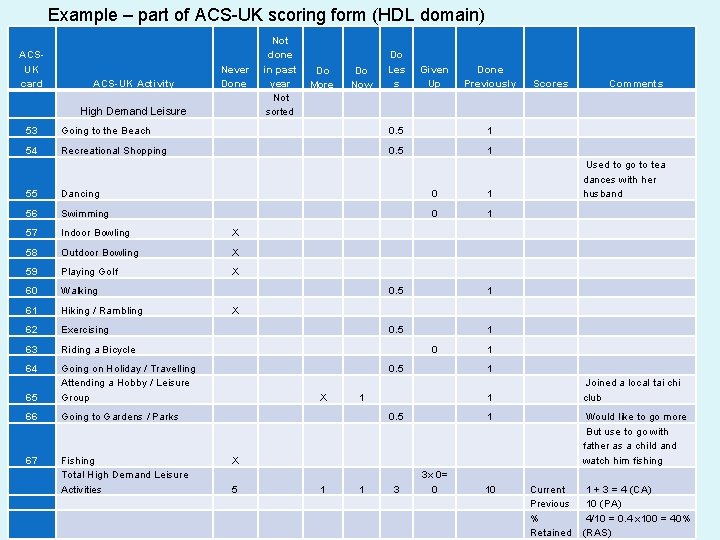
Example – part of ACS-UK scoring form (HDL domain) ACSUK card ACS-UK Activity Never Done High Demand Leisure Not done in past Do year More Not sorted Do Now Do Les s Given Up Done Previously Scores Comments 53 Going to the Beach 0. 5 1 54 Recreational Shopping 0. 5 1 55 Dancing 0 1 Used to go to tea dances with her husband 56 Swimming 0 1 57 Indoor Bowling X 58 Outdoor Bowling X 59 Playing Golf X 60 Walking 1 61 Hiking / Rambling 62 Exercising 1 63 Riding a Bicycle 1 64 1 65 Going on Holiday / Travelling Attending a Hobby / Leisure Group 1 Joined a local tai chi club 66 Going to Gardens / Parks 1 67 Fishing Total High Demand Leisure Activities Would like to go more But use to go with father as a child and watch him fishing Current Previous % Retained 1 + 3 = 4 (CA) 10 (PA) 4/10 = 0. 4 x 100 = 40% (RAS) 0. 5 X 0. 5 0 0. 5 X 1 0. 5 X 5 1 1 3 x 0= 0 3 10
What is Validity? Does it DO what it says on the tin �Validity: is the ‘extent to which a measurement method measures what it is intended to’ (Mc. Dowell and Newell, 1987, p. 330) �Validity relates to the appropriateness and justifiability of the things supposed about the person’s scores on a test and the rationale therapists have for making inferences from such scores to wider areas of functioning (Bartram, 1990)
Why is validity important? �The things OTs measure are not always directly observable �Test items are developed to elicit selfreported descriptions (e. g. of feelings) �People are provided with test items that link to hypothesised behaviours
Validity Three types of validation studies, known as: �content validation �construct validation �criterion related validation are traditionally performed during test development (Crocker and Algina, 1986)
Content validity � The degree to which an assessment measures what it is supposed to measure judged on the appropriateness of its content as judged by ‘the comprehensiveness of an assessment and its inclusion of items that fully represent the attribute being measured’ (Law, 1997, p. 431) � content analysis of literature and / or � expert panel review � Have the domains to be measured been weighted to reflect their relative importance to the overall content area?
ACS-UK study: Purpose To conduct a content validity study to generate and select culturally relevant activity items for inclusion in the ACS-UK. � The challenge for test developers is ‘striking a balance between the emic perspective (seeking equivalence within the culture) and the etic perspective (maintaining comparability)’ � 2004) (Alegria et al. , The methods used to develop other ACS culturally relevant versions were reviewed to inform this study’s methodology. � We aimed to produce a measure that included activities culturally relevant to UK older people and that replicated the ACS’ Q-sort, sorting categories and scoring method. � This study was undertaken with permission and advice on the methodology from the authors of the ACS (Baum & Edwards, 2008). �
Ethics �Ethical approval for all ACS-UK studies have been obtained from the York St John Ethics Committee or the YSJU Health Subjects Ethics Committee Acknowledgments: �Professor Carolyn Baum for permission to develop a UK version of the Activity Card Sort. �Faculty of Health and Life Sciences for funding for research assistant, Sarah Mallinson 1 day per week for one academic year,
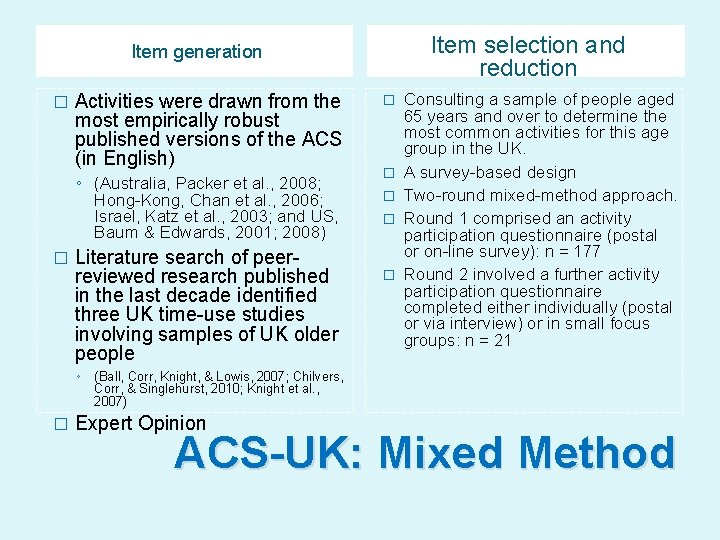
Item selection and reduction Item generation � Activities were drawn from the most empirically robust published versions of the ACS (in English) ◦ (Australia, Packer et al. , 2008; Hong-Kong, Chan et al. , 2006; Israel, Katz et al. , 2003; and US, Baum & Edwards, 2001; 2008) � Literature search of peerreviewed research published in the last decade identified three UK time-use studies involving samples of UK older people ◦ � � � Consulting a sample of people aged 65 years and over to determine the most common activities for this age group in the UK. A survey-based design Two-round mixed-method approach. Round 1 comprised an activity participation questionnaire (postal or on-line survey): n = 177 Round 2 involved a further activity participation questionnaire completed either individually (postal or via interview) or in small focus groups: n = 21 (Ball, Corr, Knight, & Lowis, 2007; Chilvers, Corr, & Singlehurst, 2010; Knight et al. , 2007) Expert Opinion ACS-UK: Mixed Method
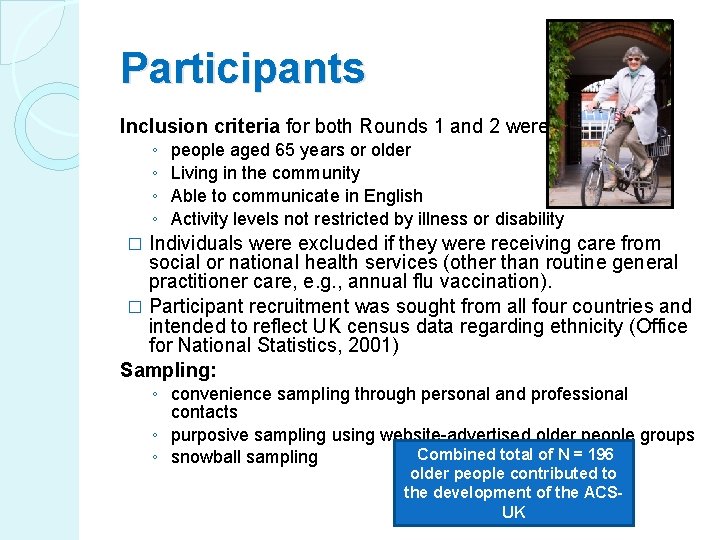
Participants Inclusion criteria for both Rounds 1 and 2 were: ◦ ◦ people aged 65 years or older Living in the community Able to communicate in English Activity levels not restricted by illness or disability Individuals were excluded if they were receiving care from social or national health services (other than routine general practitioner care, e. g. , annual flu vaccination). � Participant recruitment was sought from all four countries and intended to reflect UK census data regarding ethnicity (Office for National Statistics, 2001) Sampling: � ◦ convenience sampling through personal and professional contacts ◦ purposive sampling using website-advertised older people groups Combined total of N = 196 ◦ snowball sampling older people contributed to the development of the ACSUK
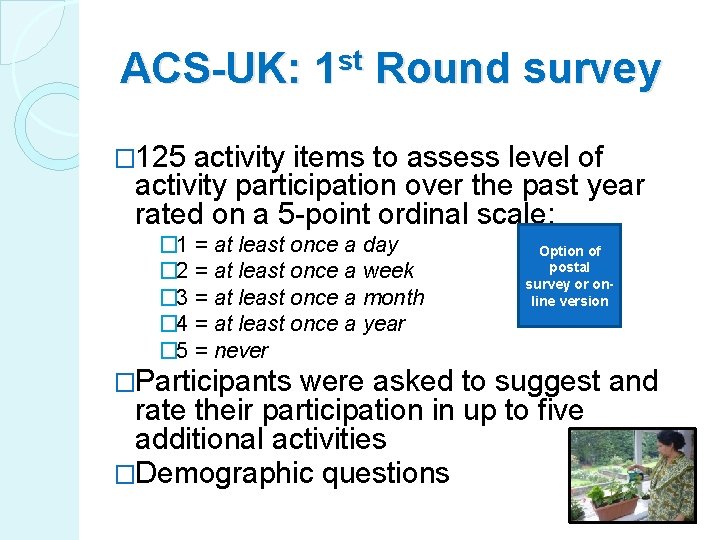
ACS-UK: 1 st Round survey � 125 activity items to assess level of activity participation over the past year rated on a 5 -point ordinal scale: � 1 = at least once a day � 2 = at least once a week � 3 = at least once a month � 4 = at least once a year � 5 = never Option of postal survey or online version �Participants were asked to suggest and rate their participation in up to five additional activities �Demographic questions
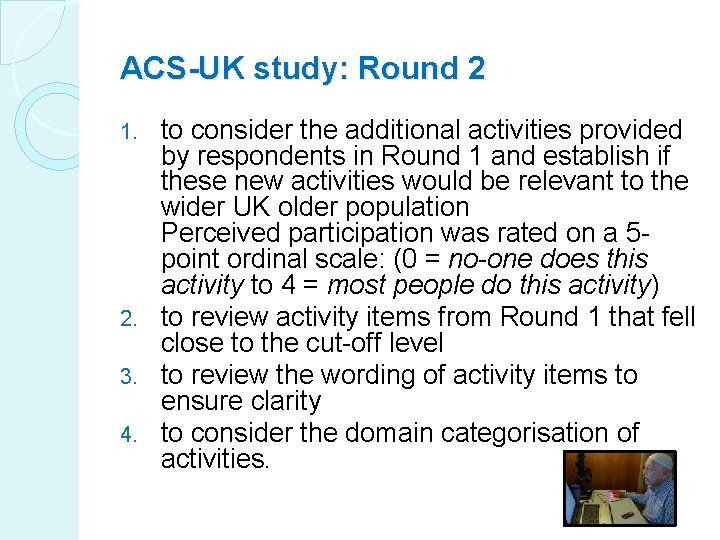
ACS-UK study: Round 2 to consider the additional activities provided by respondents in Round 1 and establish if these new activities would be relevant to the wider UK older population Perceived participation was rated on a 5 point ordinal scale: (0 = no-one does this activity to 4 = most people do this activity) 2. to review activity items from Round 1 that fell close to the cut-off level 3. to review the wording of activity items to ensure clarity 4. to consider the domain categorisation of activities. 1.
ACS-UK: Data analysis & Findings � Means and standard deviations were calculated for all items: � The most common activities that UK older people had participated in over the past year (Round 1) � The most common activities perceived for UK older people (Round 2) � Activity items with mean values of < 2. 0 (the equivalent of participating ‘less than once a year or never’ in Round 1 or ‘Rare or no participation’ in Round 2) were considered for removal. � Tables drawn up: activities ranked above this cutoff point at the end of Rounds 1 and 2
ACS-UK: Data analysis & Findings Eight of the 20 activities identified as additional potential activity items in Round 1 obtained means above 2 in Round 2. These were: � voting � travelling � cultural visits (which encompassed visits to National Trust or English Heritage sites, castles and country houses) � attending a hobby / leisure activity group � attending a social group � researching local history � performing charitable acts � and attending a night class / adult education group
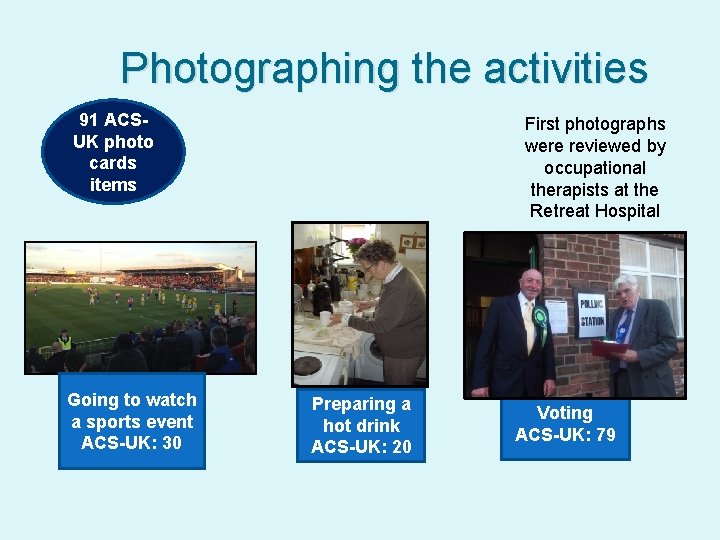
Activity Card Sort – United Kingdom (ACS-UK) � 91 Activity items were grouped under four categories: ◦ ◦ instrumental activities of daily living (n = 27) high demand leisure activities (n = 15) low demand leisure activities (n = 25) and social / cultural activities (n = 24)
ACS-UK study: Findings �The ACS-UK has seven items not included in other ACS versions 1. being on a committee 2. voting 3. keeping a diary / calendar of events 4. relaxing / meditating 5. attending a leisure / hobby group 6. going for drinks at pubs / social clubs 7. attending a night class / adult education group
ACS-UK study: Findings � Unlikely that these activities are unique to older people in the UK; voting, for example, should be applicable to older people in other democratic countries. � Literature on other ACS versions does not comprehensively detail activities that have not met the cut-off criteria for inclusion it is not possible to establish whether these seven ACS-UK items have been considered for inclusion in any other ACS versions. � ACS versions do not attempt to include an exhaustive number of activities, but rather activities that are the most common within a specific culture.
Findings �ACS (Baum & Edwards, 2008) item ‘Reading magazines / books’ was separated into two items for the ACS-UK following feedback from people with dementia (Laver-Fawcett, 2012) who found this combined activity item difficult to categorize �They explained that owing to short term memory problems they were unable to remember the plot or characters required to read books, but were still able to read magazines.
ACS-UK study: Findings �In both the ACS (Baum & Edwards, 2008) and A-ACS (Hamed et al, 2011) there is a ‘Dating / spending time with friends’ item �Results from the ACS-UK study led to ‘spending time with friends’ being grouped with ‘spending time with family’ (ACS-UK item ‘Spending time with Family / Friends’) �Dating or seeking a companion was seen by UK participants as a different activity and forms a separate ACS-UK item:
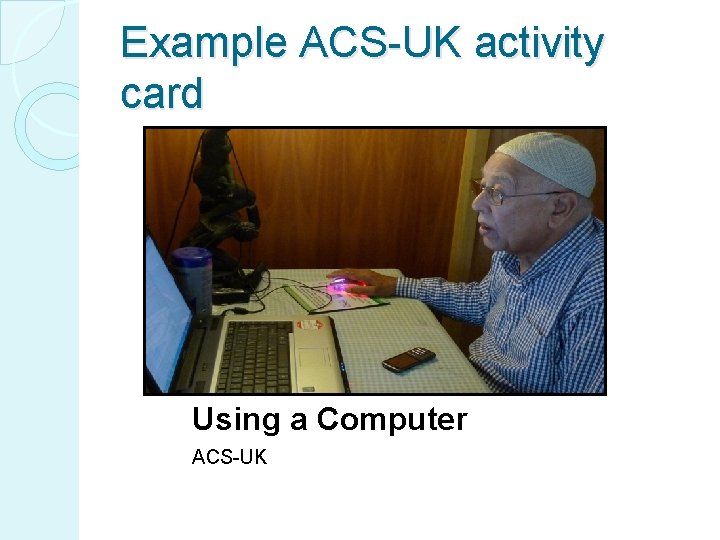
Example ACS-UK activity card Using a Computer ACS-UK
Photographing the activities 91 ACSUK photo cards items Going to watch a sports event ACS-UK: 30 First photographs were reviewed by occupational therapists at the Retreat Hospital Preparing a hot drink ACS-UK: 20 Voting ACS-UK: 79
So what is Reliability? �Reliability refers to the stability of test scores overtime and across different examiners (de Clive-Lowe, 1996) �Repeatability: how consistently an assessment can repeat results over time.
Reliability �There are several types of reliability. The relevance of a particular reliability study depends on the purpose of the assessment. �Inter-rater and test-retest reliability studies are quantitative, correlation design �Non-experimental, with data collected on two or more variables and the relationship explored (Grady and Wallston as cited in Sim and Wright, 2000 p 70) �Seek to establish the relationship between different test administrators or the time between assessments.
Why is reliability important to occupational therapists? �The implications of false positive and false negative results �The implications of not detecting clinically important change �How much error is acceptable? �Error owing to practice effects �Error owing to rater (therapist) variation in test administration and scoring
Reliability study: Students as Co. Researchers (SCo. Re) � 12 x 3 rd year BHSc(Hons) Occupational Therapy students � Collaborated in this study for their final year project � Focus is on students and tutors collaborating in a research team � Provides students with an experience of gaining ethical approval, participant recruitment and consent procedures, administering and scoring the ACS-UK, conducting a semi-structured interview, transcribing and data analysis. � Pedagogic drivers = Research informed Teaching (Ri. T) and Enquiry Based Learning (EBL). � Professional drivers = evidence based practice � Level 3 module in our new curriculum ‘Contributing to the Evidence Base’ � Assignment 5000 word written assignment in the format of a BJOT article
Acknowledgements for the Reliability study With thanks to: � The 34 participants who gave up their time to participate in this study � Maria Pickard (Occupational Therapist at Age UK) who gave her full supported and acted as gate keeper � The staff and volunteers at Age UK who assisted with participant recruitment � The students 2014/15 who collected the data from sample 1: Kris Barker, Oliver Black, Claire Buckley, Jonathan Jackson, Alice Lloyd-Jones, Kari Milsom and Lucy Thomas. � The students 2015/16 who collected the data from sample 2: Dritero Kastrati, Christine Mueller, Philippa Price and Sophie Storr support
Sample and method �A convenience sample was recruited through local community organisations. Sample 1 and 2 comprised 17 participants in each sample (total N = 34) �Participants completed the ACS-UK three times. �To establish inter-rater reliability ACS-UK was administered twice on the first day, by two different student researchers. �To establish test-retest reliability, it was administered the third time, by the first student, approximately two weeks later.
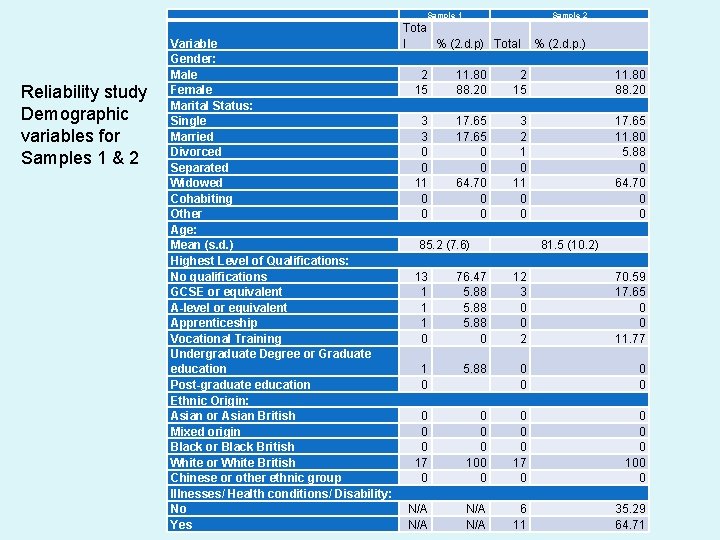
Reliability study Demographic variables for Samples 1 & 2 Sample 1 Sample 2 Tota Variable l % (2. d. p) Total % (2. d. p. ) Gender: Male 2 11. 80 2 Female 15 88. 20 15 Marital Status: Single 3 17. 65 3 Married 3 17. 65 2 Divorced 0 0 1 Separated 0 0 0 Widowed 11 64. 70 11 Cohabiting 0 0 0 Other 0 0 0 Age: Mean (s. d. ) 85. 2 (7. 6) 81. 5 (10. 2) Highest Level of Qualifications: No qualifications 13 76. 47 12 GCSE or equivalent 1 5. 88 3 A-level or equivalent 1 5. 88 0 Apprenticeship 1 5. 88 0 Vocational Training 0 0 2 Undergraduate Degree or Graduate education 1 5. 88 0 Post-graduate education 0 0 Ethnic Origin: Asian or Asian British 0 0 0 Mixed origin 0 0 0 Black or Black British 0 0 0 White or White British 17 100 17 Chinese or other ethnic group 0 0 0 Illnesses/ Health conditions/ Disability: No N/A 6 Yes N/A 11 11. 80 88. 20 17. 65 11. 80 5. 88 0 64. 70 0 0 70. 59 17. 65 0 0 11. 77 0 0 0 100 0 35. 29 64. 71
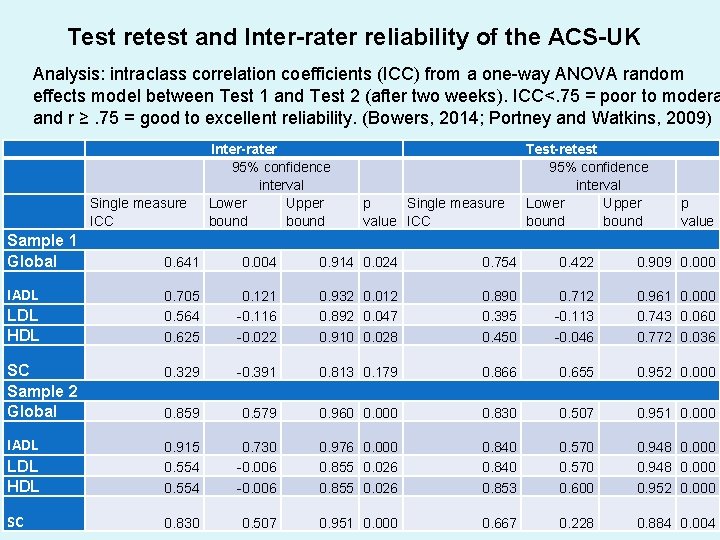
Test retest and Inter-rater reliability of the ACS-UK Analysis: intraclass correlation coefficients (ICC) from a one-way ANOVA random effects model between Test 1 and Test 2 (after two weeks). ICC<. 75 = poor to modera and r ≥. 75 = good to excellent reliability. (Bowers, 2014; Portney and Watkins, 2009) Single measure ICC Inter-rater 95% confidence interval Lower Upper bound p Single measure value ICC Test-retest 95% confidence interval Lower Upper bound p value Sample 1 Global 0. 641 0. 004 0. 914 0. 024 0. 754 0. 422 0. 909 0. 000 IADL LDL HDL 0. 705 0. 564 0. 625 0. 121 -0. 116 -0. 022 0. 932 0. 012 0. 892 0. 047 0. 910 0. 028 0. 890 0. 395 0. 450 0. 712 -0. 113 -0. 046 0. 961 0. 000 0. 743 0. 060 0. 772 0. 036 SC Sample 2 Global 0. 329 -0. 391 0. 813 0. 179 0. 866 0. 655 0. 952 0. 000 0. 859 0. 579 0. 960 0. 000 0. 830 0. 507 0. 951 0. 000 IADL LDL HDL 0. 915 0. 554 0. 730 -0. 006 0. 976 0. 000 0. 855 0. 026 0. 840 0. 853 0. 570 0. 600 0. 948 0. 000 0. 952 0. 000 SC 0. 830 0. 507 0. 951 0. 000 0. 667 0. 228 0. 884 0. 004
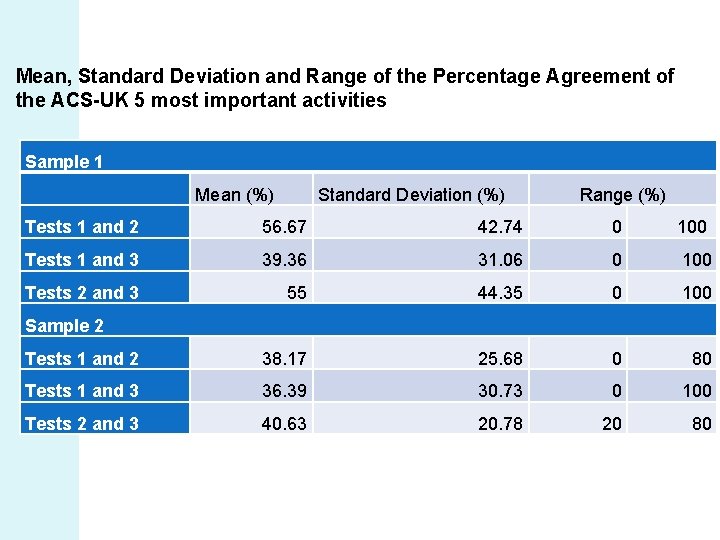
Mean, Standard Deviation and Range of the Percentage Agreement of the ACS-UK 5 most important activities Sample 1 Mean (%) Standard Deviation (%) Range (%) Tests 1 and 2 56. 67 42. 74 0 100 Tests 1 and 3 39. 36 31. 06 0 100 Tests 2 and 3 55 44. 35 0 100 Tests 1 and 2 38. 17 25. 68 0 80 Tests 1 and 3 36. 39 30. 73 0 100 Tests 2 and 3 40. 63 20. 78 20 80 Sample 2
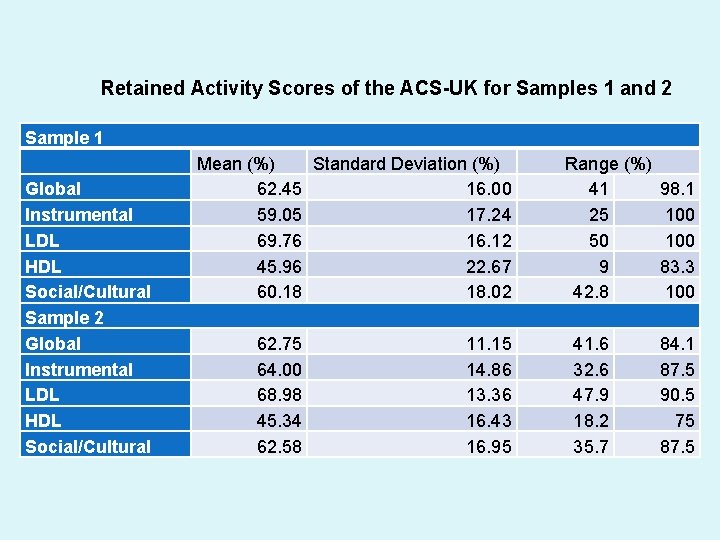
Retained Activity Scores of the ACS-UK for Samples 1 and 2 Sample 1 Global Instrumental LDL HDL Social/Cultural Sample 2 Global Instrumental LDL HDL Social/Cultural Mean (%) Standard Deviation (%) 62. 45 16. 00 59. 05 17. 24 69. 76 16. 12 45. 96 22. 67 60. 18 18. 02 62. 75 64. 00 68. 98 45. 34 62. 58 11. 15 14. 86 13. 36 16. 43 16. 95 Range (%) 41 25 50 9 42. 8 41. 6 32. 6 47. 9 18. 2 35. 7 98. 1 100 83. 3 100 84. 1 87. 5 90. 5 75 87. 5
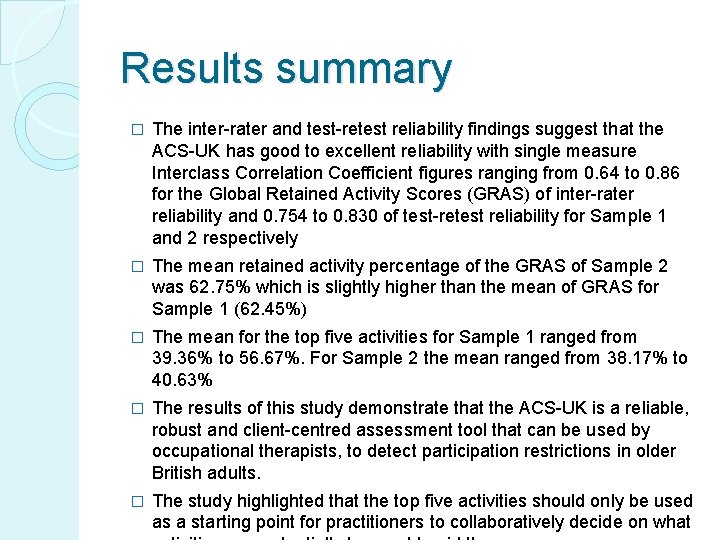
Results summary � The inter-rater and test-retest reliability findings suggest that the ACS-UK has good to excellent reliability with single measure Interclass Correlation Coefficient figures ranging from 0. 64 to 0. 86 for the Global Retained Activity Scores (GRAS) of inter-rater reliability and 0. 754 to 0. 830 of test-retest reliability for Sample 1 and 2 respectively � The mean retained activity percentage of the GRAS of Sample 2 was 62. 75% which is slightly higher than the mean of GRAS for Sample 1 (62. 45%) � The mean for the top five activities for Sample 1 ranged from 39. 36% to 56. 67%. For Sample 2 the mean ranged from 38. 17% to 40. 63% � The results of this study demonstrate that the ACS-UK is a reliable, robust and client-centred assessment tool that can be used by occupational therapists, to detect participation restrictions in older British adults. � The study highlighted that the top five activities should only be used as a starting point for practitioners to collaboratively decide on what
Limitations and future research � Convenience sample was homogeneous in terms of participants of varying ethnicities, as all participants were white British which consequently is not a full representation of the diversity of the UK’s older population (Office for National Statistics, 2011). � Sampling strategy may have led to a biased sample because the majority of people who attend AGE-UK groups may be more engaged in some activities than people who do not, within this age group. � Future ACS-UK studies should recruit participants from the wider community (e. g. from community centres, religious groups, coffee mornings, libraries and individuals’ homes) � Only the community living version (Form C) of the ACS-UK was investigated � Evaluation of the reliability of the ACS-UK Institutional version (Form A) and Recovery version (Form B) is required
Face validity and clinical utility study: Students as Co-Researchers (SCo. Re) � 8 x 3 rd year BHSc(Hons) Occupational Therapy students collaborated in this study for their final year project �Laver-Fawcett A, Brain L, Brodie C, Cardy L and Manaton L. (in press) The Face Validity and Clinical Utility of the Activity Card Sort – United Kingdom (ACS-UK). British Journal of Occupational Therapy
Acknowledgments � Data was collected through two dissertation projects undertaken by undergraduate occupational therapy students in the academic years 2011 -12 and 2012 -13. � Grateful thanks to the 27 participants who gave up their time to participate in the data collection and the people who supported the recruitment of participants. � The four occupational therapy undergraduate students who collected data during the 2 nd study: Leanne Brain, Courtney Brody, Lauren Cardy and Lisa Manaton � The four occupational therapy undergraduate students who collected data during the 1 st face validity and clinical utility study: Jessica Harrison, Hannah Lewis, Lucy Shaw and Debbie Agar (nee Smith).
Objectives � Determine the time required to administer and score the ACS-UK (duration - clinical utility) � Explore the ease of use of the ACS-UK for the people administering the assessment - occupational therapy students considering their future practice (clinical utility) � Explore the acceptability of the ACS-UK to community dwelling older people (face validity and clinical utility) � Measure the ACS-UK Global Activity Retention Scores among community dwelling older people.
Clinical Utility �Ease of use �Cost �Portability �Interpretability of results �Time taken to complete administration and scoring �Equipment/ items needed to complete it �Level of skill required to complete it (do you need additional training) �The amount of participation required by the client �Acceptability to the practice setting and the client group (language and culture)
Face validity � whether a test seems to measure what it is intended to measure (Asher, 1996) � in particular face validity concerns the acceptability of a test to the test-taker (Anastasi, 1988). Test is acceptable to: � the test-taker (service user) � Clinicians and managers who decide on its use � people who look at the results Usually evaluated through a survey method, e. g. interviews or questionnaires
Method - interview � Mixed methods approach (Creswell and Plano Clark, 2011) � ACS-UK was administered, scores obtained for: Current Activity (CA), Previous Activity (PA) and Retained Activity (RA) � Time taken to administer and score the ACS-UK (in seconds) � A semi-structured interview was developed to explore aspects of face validity, content validity and clinical utility � Open ended questions were used to allow participants to state opinions and explore ideas further � Students carried out interviews in pairs for consistency � Interviews were audio recorded and transcribed verb
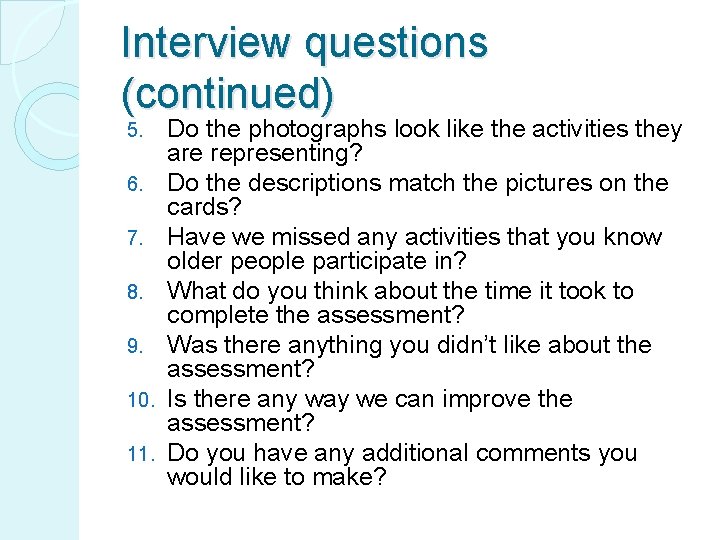
Interview questions What are your first impressions of the Activity Card Sort? 2. Did you find the assessment straightforward to carry out? 3. How easy were the instructions to follow, in relation to: 1. � Categories make sense � Sorting the cards � Choosing 5 most important / favourite activities 4. What do you think the purpose of this assessment is?
Interview questions (continued) 5. 6. 7. 8. 9. 10. 11. Do the photographs look like the activities they are representing? Do the descriptions match the pictures on the cards? Have we missed any activities that you know older people participate in? What do you think about the time it took to complete the assessment? Was there anything you didn’t like about the assessment? Is there any way we can improve the assessment? Do you have any additional comments you would like to make?
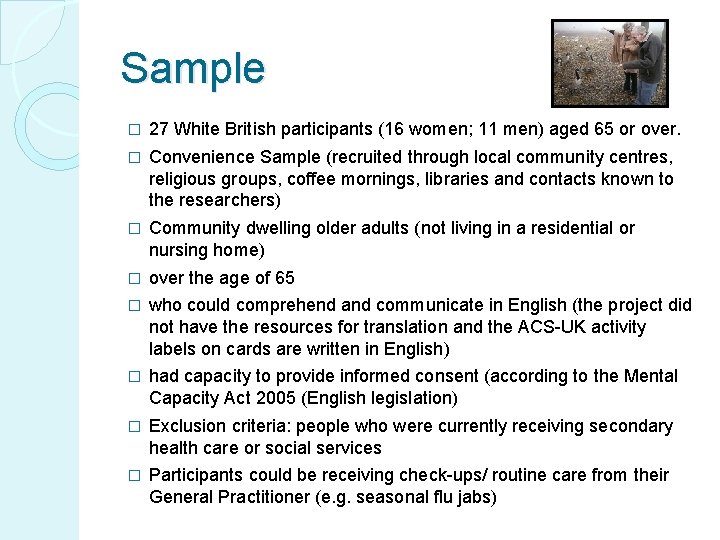
Sample � 27 White British participants (16 women; 11 men) aged 65 or over. � Convenience Sample (recruited through local community centres, religious groups, coffee mornings, libraries and contacts known to the researchers) � Community dwelling older adults (not living in a residential or nursing home) � over the age of 65 � who could comprehend and communicate in English (the project did not have the resources for translation and the ACS-UK activity labels on cards are written in English) � had capacity to provide informed consent (according to the Mental Capacity Act 2005 (English legislation) � Exclusion criteria: people who were currently receiving secondary health care or social services � Participants could be receiving check-ups/ routine care from their General Practitioner (e. g. seasonal flu jabs)
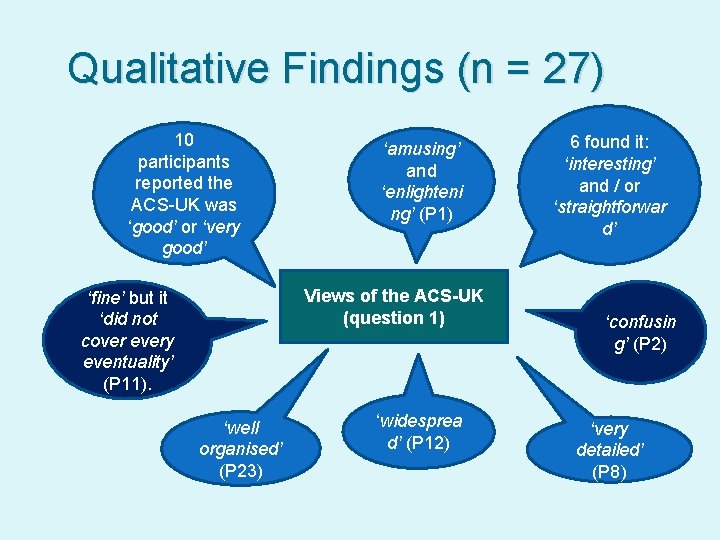
Qualitative Findings (n = 27) 10 participants reported the ACS-UK was ‘good’ or ‘very good’ ‘amusing’ and ‘enlighteni ng’ (P 1) Views of the ACS-UK (question 1) ‘fine’ but it ‘did not cover every eventuality’ (P 11). ‘well organised’ (P 23) ‘widesprea d’ (P 12) 6 found it: ‘interesting’ and / or ‘straightforwar d’ ‘confusin g’ (P 2) ‘very detailed’ (P 8)
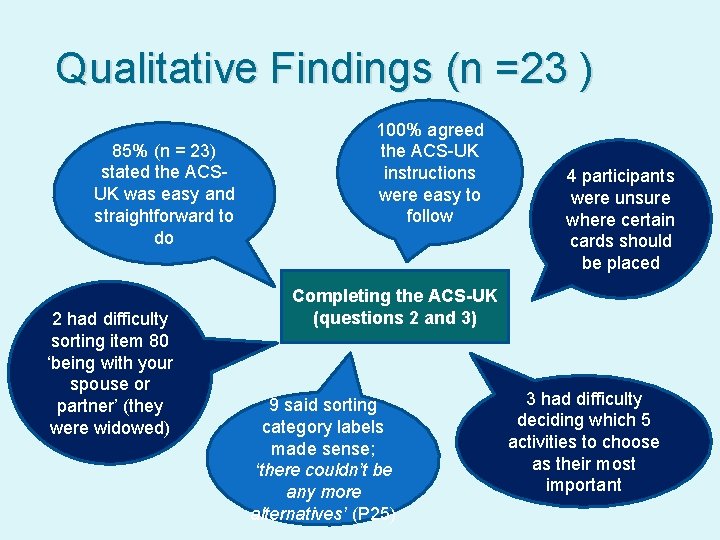
Qualitative Findings (n =23 ) 85% (n = 23) stated the ACSUK was easy and straightforward to do 2 had difficulty sorting item 80 ‘being with your spouse or partner’ (they were widowed) 100% agreed the ACS-UK instructions were easy to follow 4 participants were unsure where certain cards should be placed Completing the ACS-UK (questions 2 and 3) 9 said sorting category labels made sense; ‘there couldn’t be any more alternatives’ (P 25) 3 had difficulty deciding which 5 activities to choose as their most important
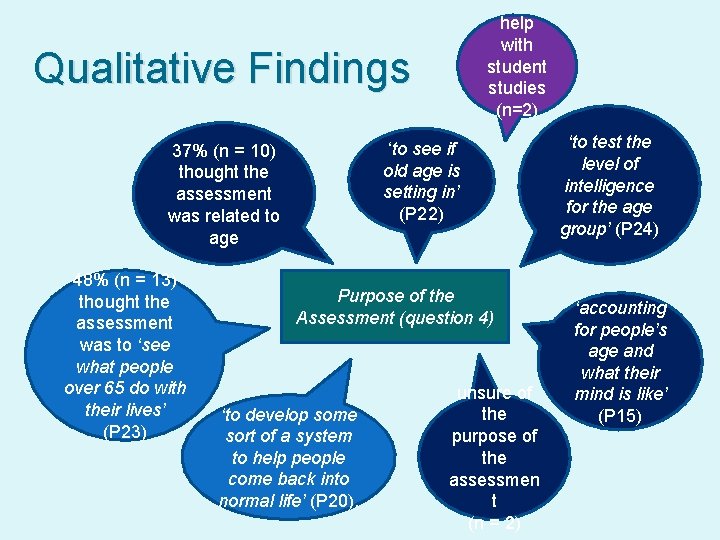
help with student studies (n=2) Qualitative Findings ‘to see if old age is setting in’ (P 22) 37% (n = 10) thought the assessment was related to age 48% (n = 13) thought the assessment was to ‘see what people over 65 do with their lives’ (P 23) Purpose of the Assessment (question 4) ‘to develop some sort of a system to help people come back into normal life’ (P 20). unsure of the purpose of the assessmen t (n = 2) ‘to test the level of intelligence for the age group’ (P 24) ‘accounting for people’s age and what their mind is like’ (P 15)
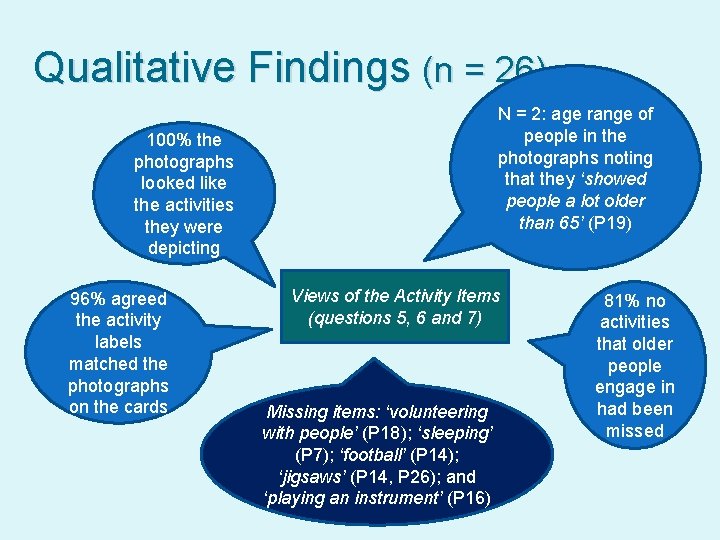
Qualitative Findings (n = 26) N = 2: age range of people in the photographs noting that they ‘showed people a lot older than 65’ (P 19) 100% the photographs looked like the activities they were depicting 96% agreed the activity labels matched the photographs on the cards Views of the Activity Items (questions 5, 6 and 7) Missing items: ‘volunteering with people’ (P 18); ‘sleeping’ (P 7); ‘football’ (P 14); ‘jigsaws’ (P 14, P 26); and ‘playing an instrument’ (P 16) 81% no activities that older people engage in had been missed
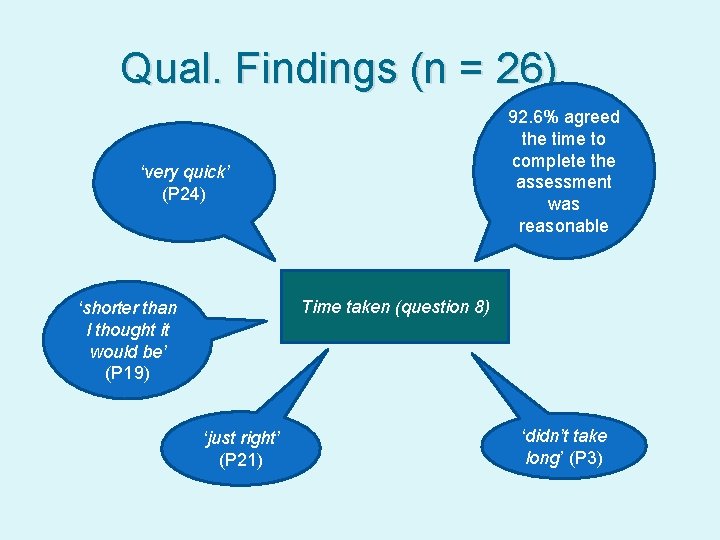
Qual. Findings (n = 26) 92. 6% agreed the time to complete the assessment was reasonable ‘very quick’ (P 24) Time taken (question 8) ‘shorter than I thought it would be’ (P 19) ‘just right’ (P 21) ‘didn’t take long’ (P 3)
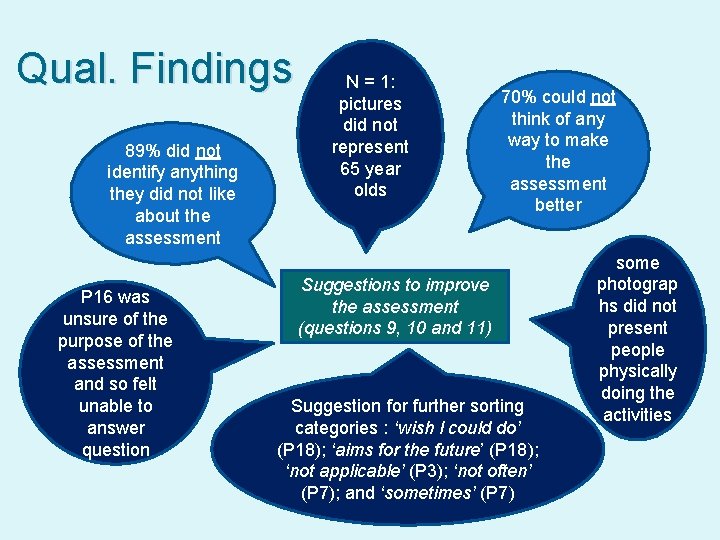
Qual. Findings 89% did not identify anything they did not like about the assessment P 16 was unsure of the purpose of the assessment and so felt unable to answer question N = 1: pictures did not represent 65 year olds 70% could not think of any way to make the assessment better Suggestions to improve the assessment (questions 9, 10 and 11) Suggestion for further sorting categories : ‘wish I could do’ (P 18); ‘aims for the future’ (P 18); ‘not applicable’ (P 3); ‘not often’ (P 7); and ‘sometimes’ (P 7) some photograp hs did not present people physically doing the activities
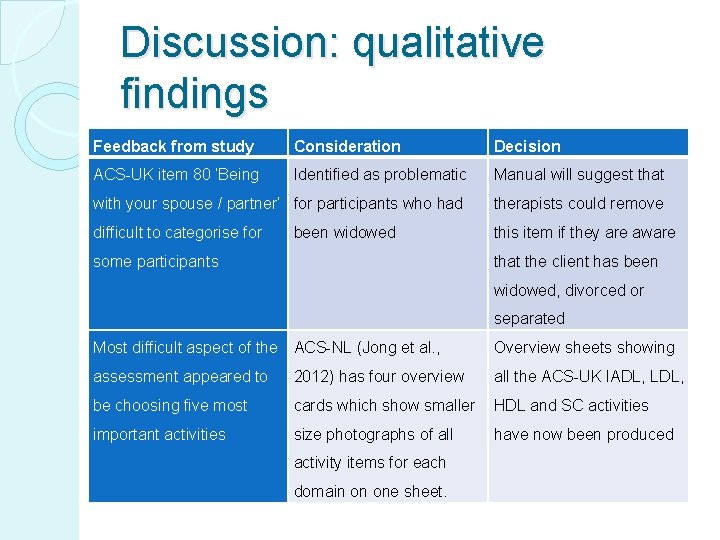
Discussion: qualitative findings Feedback from study Consideration Decision ACS-UK item 80 ‘Being Identified as problematic Manual will suggest that with your spouse / partner’ for participants who had therapists could remove difficult to categorise for this item if they are aware been widowed some participants that the client has been widowed, divorced or separated Most difficult aspect of the ACS-NL (Jong et al. , Overview sheets showing assessment appeared to 2012) has four overview all the ACS-UK IADL, LDL, be choosing five most cards which show smaller HDL and SC activities important activities size photographs of all activity items for each domain on one sheet. have now been produced
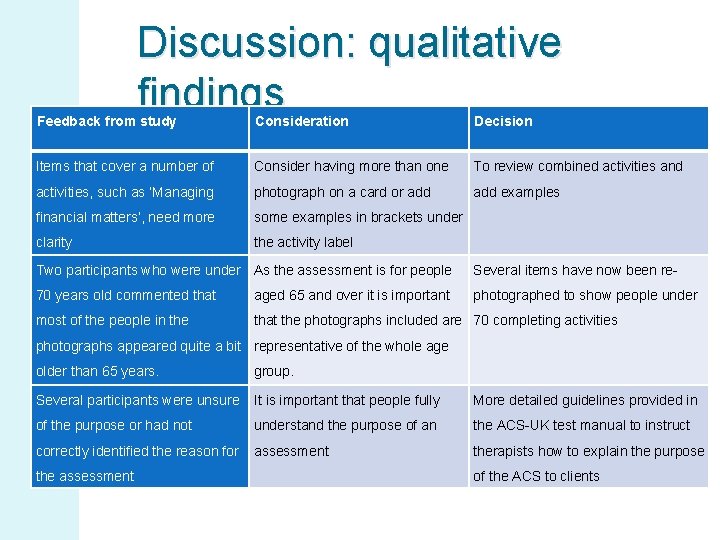
Discussion: qualitative findings Feedback from study Consideration Decision Items that cover a number of Consider having more than one To review combined activities and activities, such as ‘Managing photograph on a card or add examples financial matters’, need more some examples in brackets under clarity the activity label Two participants who were under As the assessment is for people Several items have now been re- 70 years old commented that aged 65 and over it is important photographed to show people under most of the people in the that the photographs included are 70 completing activities photographs appeared quite a bit representative of the whole age older than 65 years. group. Several participants were unsure It is important that people fully More detailed guidelines provided in of the purpose or had not the ACS-UK test manual to instruct understand the purpose of an correctly identified the reason for assessment therapists how to explain the purpose the assessment of the ACS to clients
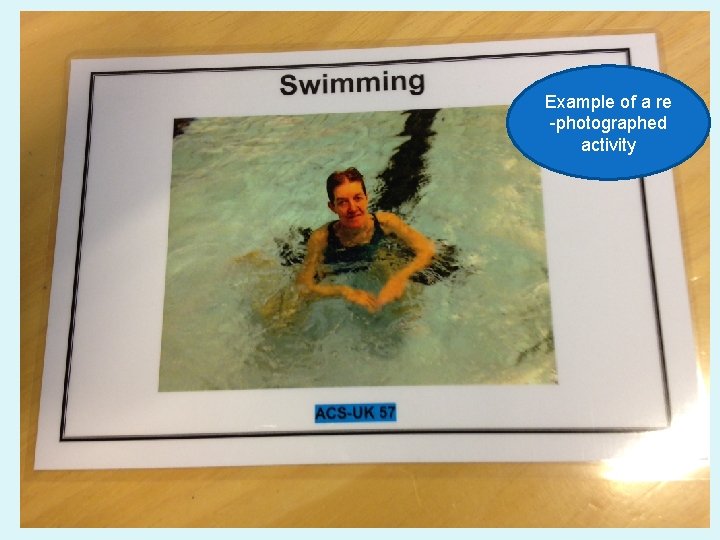
Example of a re -photographed activity
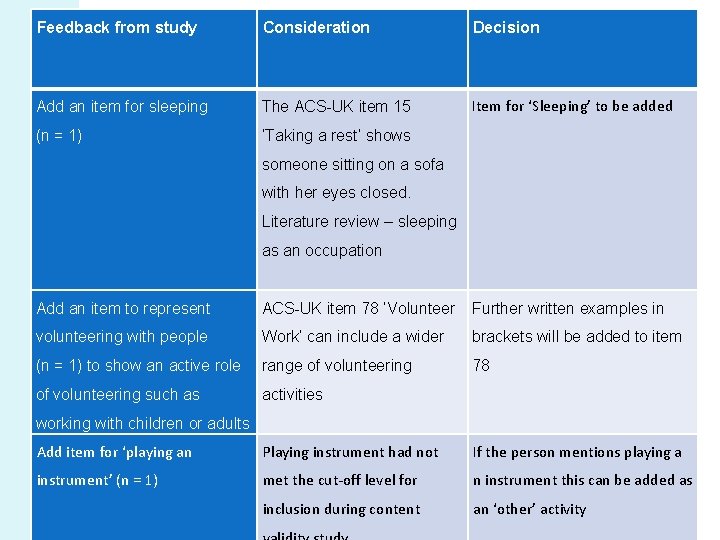
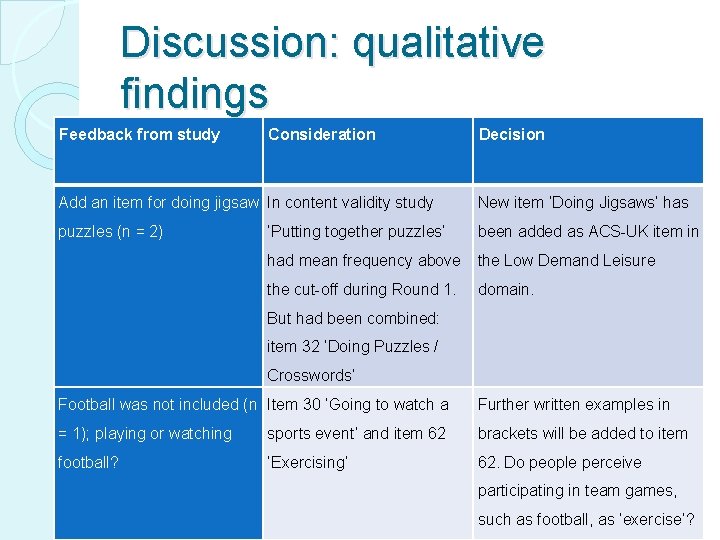
Feedback from study Consideration Decision Add an item for sleeping The ACS-UK item 15 Item for ‘Sleeping’ to be added (n = 1) ‘Taking a rest’ shows someone sitting on a sofa with her eyes closed. Literature review – sleeping as an occupation Add an item to represent ACS-UK item 78 ‘Volunteer Further written examples in volunteering with people Work’ can include a wider brackets will be added to item (n = 1) to show an active role range of volunteering 78 of volunteering such as activities Add item for ‘playing an Playing instrument had not If the person mentions playing a instrument’ (n = 1) met the cut-off level for n instrument this can be added as inclusion during content an ‘other’ activity working with children or adults
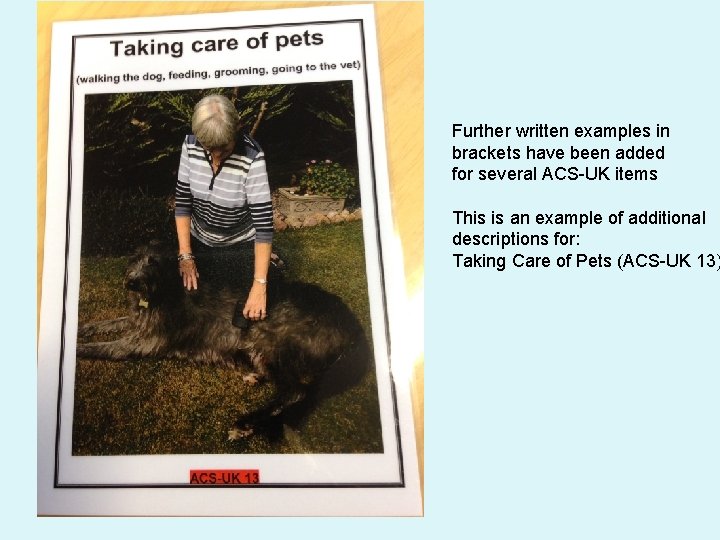
Further written examples in brackets have been added for several ACS-UK items This is an example of additional descriptions for: Taking Care of Pets (ACS-UK 13)
Discussion: qualitative findings Feedback from study Consideration Decision Add an item for doing jigsaw In content validity study New item ‘Doing Jigsaws’ has puzzles (n = 2) been added as ACS-UK item in ‘Putting together puzzles’ had mean frequency above the Low Demand Leisure the cut-off during Round 1. domain. But had been combined: item 32 ‘Doing Puzzles / Crosswords’ Football was not included (n Item 30 ‘Going to watch a Further written examples in = 1); playing or watching sports event’ and item 62 brackets will be added to item football? ‘Exercising’ 62. Do people perceive participating in team games, such as football, as ‘exercise’?
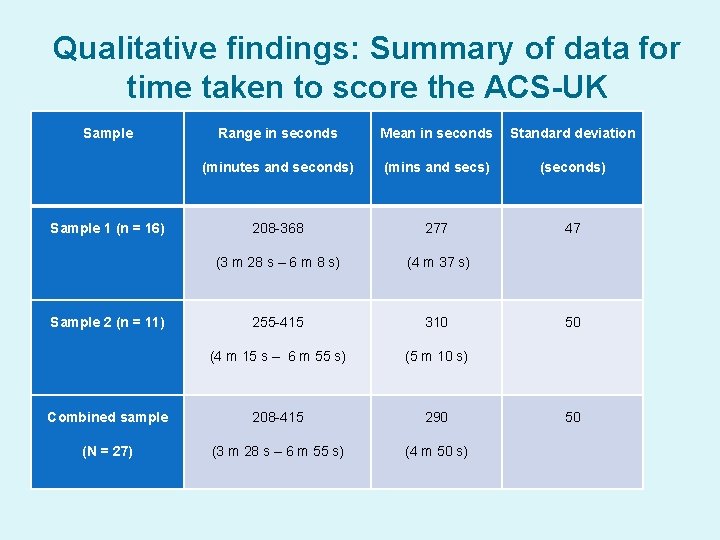
Qualitative findings: Summary of data for time taken to score the ACS-UK Sample Range in seconds Mean in seconds Standard deviation (minutes and seconds) (mins and secs) (seconds) 208 -368 277 47 (3 m 28 s – 6 m 8 s) (4 m 37 s) 255 -415 310 (4 m 15 s – 6 m 55 s) (5 m 10 s) Combined sample 208 -415 290 (N = 27) (3 m 28 s – 6 m 55 s) (4 m 50 s) Sample 1 (n = 16) Sample 2 (n = 11) 50 50
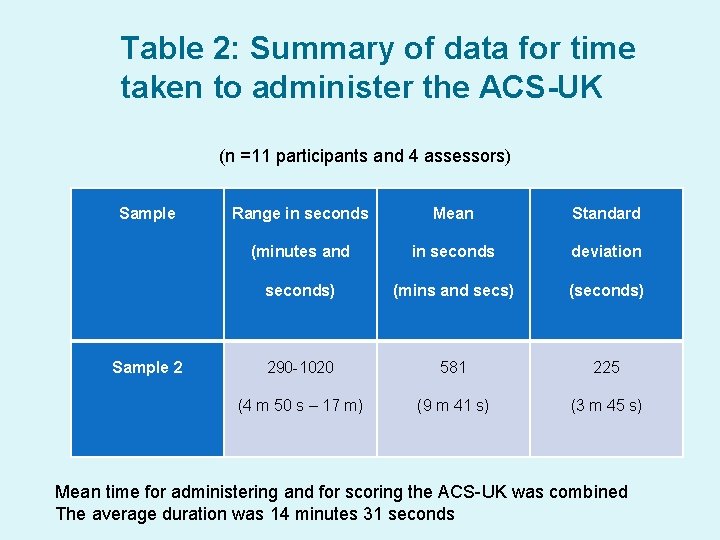
Table 2: Summary of data for time taken to administer the ACS-UK (n =11 participants and 4 assessors) Sample 2 Range in seconds Mean Standard (minutes and in seconds deviation seconds) (mins and secs) (seconds) 290 -1020 581 225 (4 m 50 s – 17 m) (9 m 41 s) (3 m 45 s) Mean time for administering and for scoring the ACS-UK was combined The average duration was 14 minutes 31 seconds
Discussion: duration �Despite having the most items of any ACS versions, the average time for administering and scoring the ACS-UK was approx. 14 ½ minutes �longest scoring time < 7 minutes �longest administration time was 17 minutes �total assessment time approx. 24 minutes �total ACS-UK time was 4 minutes longer than the 20 minutes reported for the ACS-HK (Chan et al. , 2006) and ACS (Baum and Edwards, 2008)
Discussion: duration �ACS-UK was less time consuming than the Israeli ACS �Katz et al. (2003) reported I-ACS took between 30 -60 minutes �However, Katz et al. undertook a discriminant validity study with healthy adults and older adults, caregivers and people with Alzheimer’s, stroke, or multiple sclerosis. �It may be that test administration will take longer with some client groups.
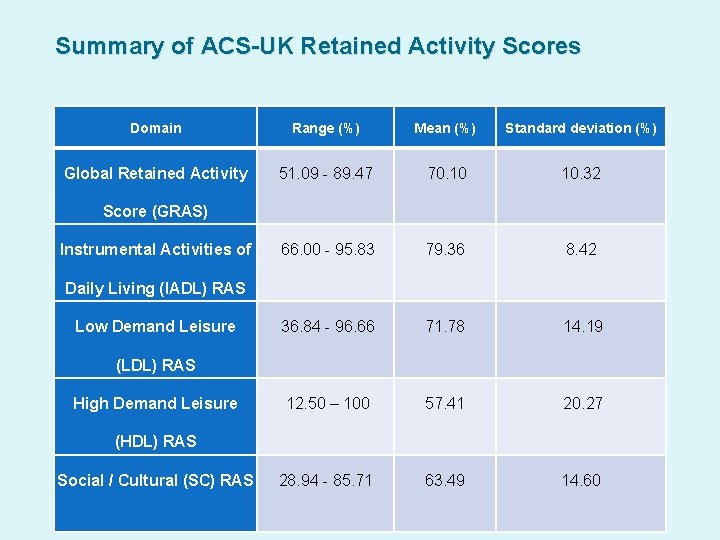
Summary of ACS-UK Retained Activity Scores Domain Range (%) Mean (%) Standard deviation (%) Global Retained Activity 51. 09 - 89. 47 70. 10 10. 32 Score (GRAS) Instrumental Activities of 66. 00 - 95. 83 79. 36 8. 42 Low Demand Leisure 36. 84 - 96. 66 71. 78 14. 19 (LDL) RAS High Demand Leisure 12. 50 – 100 57. 41 20. 27 (HDL) RAS Social / Cultural (SC) RAS 28. 94 - 85. 71 63. 49 14. 60 Daily Living (IADL) RAS
Limitations and future research �This study involved a small convenience sample of White British older adults. �It would be beneficial to conduct a further study with a more ethnically diverse sample that better represents the UK older adult population.
Limitations and future research �As a number of changes are being made to the ACS-UK in response to the results of this study, it would be useful to evaluate whether the changes lead to improved face validity with another sample. �Katz et al (2003) examined the differences in activity participation between men and women and a secondary analysis examining Retained Activity Scores and Global Retained Activity Scores by gender of the ACS-UK scores obtained by this sample would be useful.
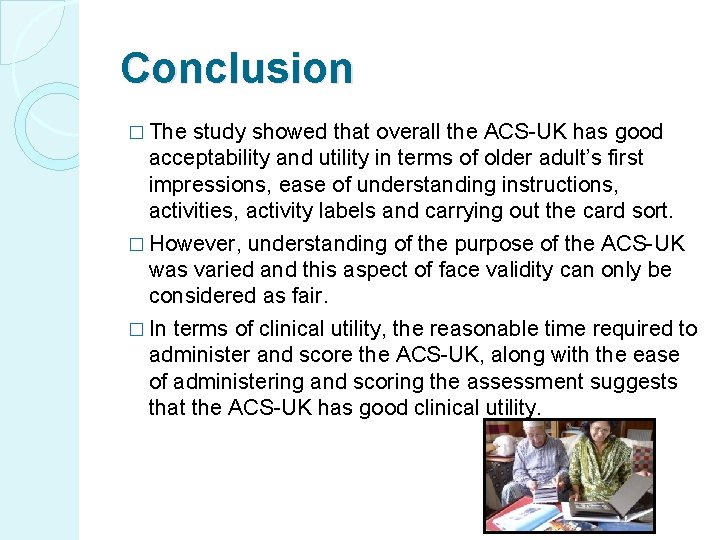
Conclusion � The study showed that overall the ACS-UK has good acceptability and utility in terms of older adult’s first impressions, ease of understanding instructions, activities, activity labels and carrying out the card sort. � However, understanding of the purpose of the ACS-UK was varied and this aspect of face validity can only be considered as fair. � In terms of clinical utility, the reasonable time required to administer and score the ACS-UK, along with the ease of administering and scoring the assessment suggests that the ACS-UK has good clinical utility.
Conclusion (continued) �The study also identified potential additional activities for consideration and shed new light on some activities which were previously removed during initial test development. �A sample of ACS-UK scores for community dwelling older adults was obtained for a future discriminative validity study.
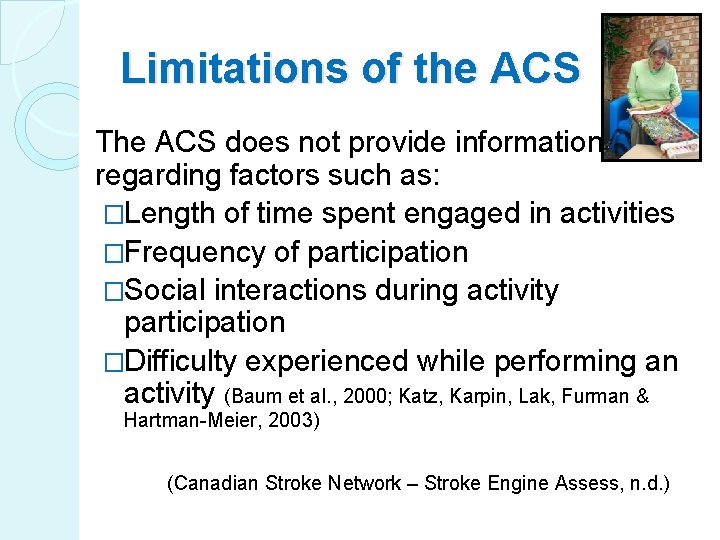
Limitations of the ACS The ACS does not provide information regarding factors such as: �Length of time spent engaged in activities �Frequency of participation �Social interactions during activity participation �Difficulty experienced while performing an activity (Baum et al. , 2000; Katz, Karpin, Lak, Furman & Hartman-Meier, 2003) (Canadian Stroke Network – Stroke Engine Assess, n. d. )
Questions and discussion
References � Albert, S. M. , Bear-Lehman, J. , & Burkhardt, A. (2009). Lifestyle-adjusted function: Variation beyond BADL and IADL competencies, Gerontologist, 49, 767 -777. � Alegria A. , Vila D. , Woo, M. , Canino G. , Takeuchi D. , Vera M. , Febo V. , Guarnaccia P. , Aguilar-Gaxiola S. , & Shrout P. (2004) Cultural Relevance and Equivalence in the NLAAS Instrument: Integrating Etic and Emic in the Development of Cross-Cultural Measures for a Psychiatric Epidemiology and Services Study of Latinos. International Journal of Methods in Psychiatric Research. 13(4) 270– 288. [Online] Available: http: //www. ncbi. nlm. nih. gov/pmc/articles/PMC 2771729/ [Accessed 13 March 2014] � Ball, V. , Corr, S. , Knight, J. , & Lowis, M. (2007). An investigation into the leisure occupations of older adults. British Journal of Occupational Therapy 70, 393 -400. � Bannigan, K. , & Laver-Fawcett, A. (2011) Aging, occupation and mental health: the contribution of the Research Centre for Occupation and Mental Health. WFOT Bulletin, 63, 55 -60. � Baum, C. M. (1993). The effects of occupation on behaviors of persons with senile dementia of the Alzheimer’s type and their careers. Dissertation, George Warren Brown School of Social Work, Washington University, St. Louis. � Baum, C. M. (1995). The contribution of occupation to function in persons with Alzheimer’s disease. Journal of Occupational Science, 2, 59– 67
References � Baum, C. M. , & Edwards, D. F. (2001). Activity Card Sort (ACS): Test manual. St Louis, MO: Penultima Press. � Baum, C. M. , & Edwards, D. F. (2008). Activity Card Sort (ACS): Test manual (2 nd Ed). Bethesda, MD: AOTA Press. � Baum, MC, Perlmutter, M & Edwards, D (Summer, 2000). Measuring function in Alzheimer’s Disease. Alzheimer’s Quarterly, 44 -61. � Block J (1961) The Q-Sort method in personality assessment and psychiatric research. Springfield: Charles C Thomas Publisher [On-line] Available: http: //abegs. org/sites/Research/Doc. Lib 1/ ﺃﺠﻨﺒﻴﺔ /The%20 QSort%20 Method%20 in%20 Personality%20 Assessment%20 and%20 Psychiatric%2 0 Research. pdf [28 th March 2014]. � Chan, W. K. , Chung, J. , & Packer, T. L. (2006). Validity and reliability of the Activity Card Sort – Hong Kong version. OTJR: Occupation, Participation, and Health, 26, 152– 158. � Chilvers, R. , Corr, S. , & Singlehurst, H. (2010). An Investigation into the Occupational Lives of Healthy Older People through their Use of Time. Australian Occupational Therapy Journal, 57, 24 -33. � Clark F, Jackson J, Carlson M, Chou C-P, Cherry BJ, Jordan-Marsh M, et al (2011) Effectiveness of a lifestyle intervention in promoting the well-being of independently living older people: results of the Well Elderly 2 Randomized Controlled Trial. Journal of Epidemiology and community Health 66(9) 782 -90.
References � Creswell JW and Plano Clark VL (2011) Designing and Conducting Mixed Methods Research. 2 nd ed. Thousand Oaks: Sage Publications. � Doney R. M. , & Packer T. L. (2008). Measuring changes in activity participation of older Australians: Validation of the Activity Card Sort –Australia. Australasian Journal on Ageing, 27, 33– 37. � Edwards, D. F. , Hahn, M. , Dromerick, A. W. , & Baum, M. C. (2005). Race differences in function and quality of life in mild stroke. Stroke, 36, 480. � Eriksson, G. M. , Chung, J. C. C. , Beng, L. H. , Hartman-Maeir, A. , Yoo, E. , Orellano, E. M. , van Nes, F. , De. Jonge, D. , & Baum, C. (2011). Occupations of older adults: A cross cultural description. OTJR: Occupation, Participation, and Health, 31(4) 182 -92. � Everard, K. M. , Lach, H. W. , Fisher, E. B. , & Baum, M. C. (2000). Relationship of activity and social support to the functional health of older adults. Journal of Gerontology: Social Sciences, 55 B, S 208 S 212. � Hamed R. , Al. Heresh R. , Abu Dahab S. , Collins B. , Fryer J. , & Holm
References � Hamed, R. , & Holm M. B. , (2013) Psychometric Properties of the Arab Heritage Activity Card Sort. Occupational Therapy International, 20, 23 -34. � Hartman-Maeir A, Soroker N, Ring H, Avni N, Katz N (2007) Activities, participation and satisfaction one-year post stroke. Disability Rehabilitation, 29(7): 559 -66 � Jong AM, van Nes FA, Lindeboom R. (2012) The Dutch Activity Card Sort institutional version was reproducible, but biased against women. Disabil Rehabil 34(18): 1550 -1555 � Kalldalen A, Marcusson J & Wressle E (2013) Interests among older people in relation to gender, function and health related quality of life. British Journal of Occupational Therapy, 76 (2), 87 -93. Katz, N. , Karpin, H. , Lak, A. , Furman, T. , & Hartman-Maeir, A. (2003). Participation in occupational performance: Reliability and validity of the Activity Card Sort. OTJR: Occupation, Participation, and Health, 23, 10– 17. � Laver-Fawcett AJ (2014) Procedure for Administering and Scoring ACS-UK Community Living version (Form C) (un-published test manual). York, York St John University (provided by author). � Laver-Fawcett A, Brain L, Brodie C, Cardy L and Manaton L. (in press) The Face Validity and Clinical Utility of the Activity Card Sort – United Kingdom (ACS-UK). British Journal of Occupational Therapy. , 79(8) 492– 504. � � Laver-Fawcett AJ, Mallinson S (2013) The Development of the Activity Card Sort – United Kingdom version (ACS-UK). OTJR: Occupation, Participation, and Health,
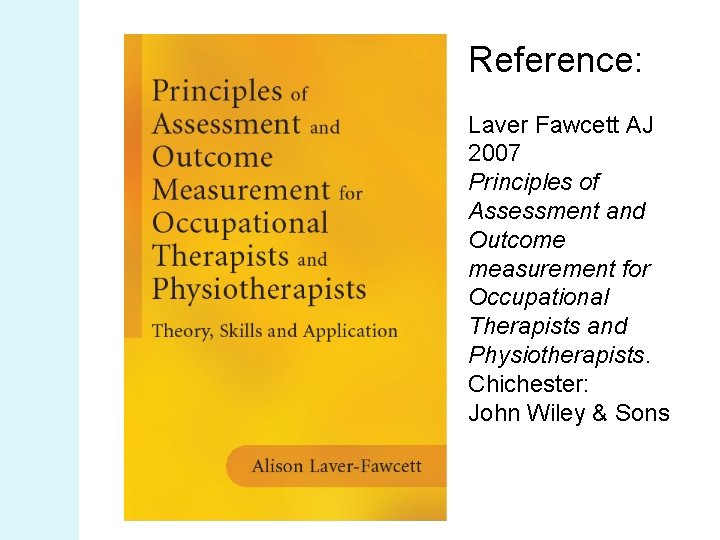
Reference: Laver Fawcett AJ 2007 Principles of Assessment and Outcome measurement for Occupational Therapists and Physiotherapists. Chichester: John Wiley & Sons
Further reading Book chapter �Laver-Fawcett (2012) �Psychosocial Occupational Therapy: An Evolving Practice (3 rd ed) �Chapter: Assessment, evaluation and outcome measurement Article Laver-Fawcett, A J (2014) Routine standardised outcome measurement to evaluate the effectiveness of occupational therapy interventions: essential or optional? Ergoterapeuten, 4, 28 -37
Declarations of interest: �The first author and YSJU maintains copyright of the Activity Card Sort. United Kingdom (ACS-UK). The ACSUK manual and cards may be published for-profit in future.
Further Acknowledgments �Dr Katrina Bannigan who co- supervised the first sample data collection and Sarah Mallinson who provided an introduction to this student research group on the administration of the ACS-UK for the face validity and clinical utility study 2011 -12.
Contact details Alison J. Laver-Fawcett, Ph. D, O. T. (C), Dip. COT, PCAP Faculty of Health and Life Sciences York St John University Lord Mayor’s Walk, York YO 31 7 EX +44(0)1904 -624624 a. laverfawcett@yorksj. ac. uk www. yorksj. ac. uk