
First Year Reports and Literature Reviews Alison TysonCapper



- Slides: 40
First Year Reports (and Literature Reviews) Alison Tyson-Capper Faculty Postgraduate Tutor Graduate School Faculty of Medical Sciences Newcastle University 3 rd March 2016
• Ph. D • MRes/Ph. D • Mphil * Full time/part time
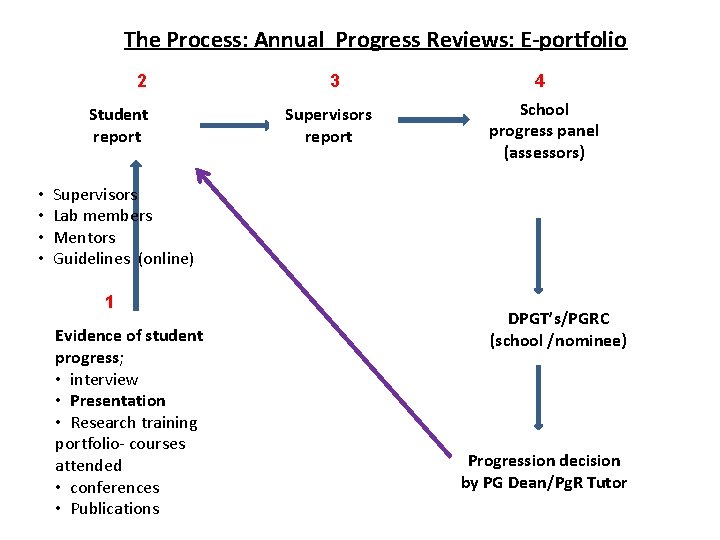
The Process: Annual Progress Reviews: E-portfolio 2 Student report • • 3 Supervisors report 4 School progress panel (assessors) Supervisors Lab members Mentors Guidelines (online) 1 Evidence of student progress; • interview • Presentation • Research training portfolio- courses attended • conferences • Publications DPGT’s/PGRC (school /nominee) Progression decision by PG Dean/Pg. R Tutor
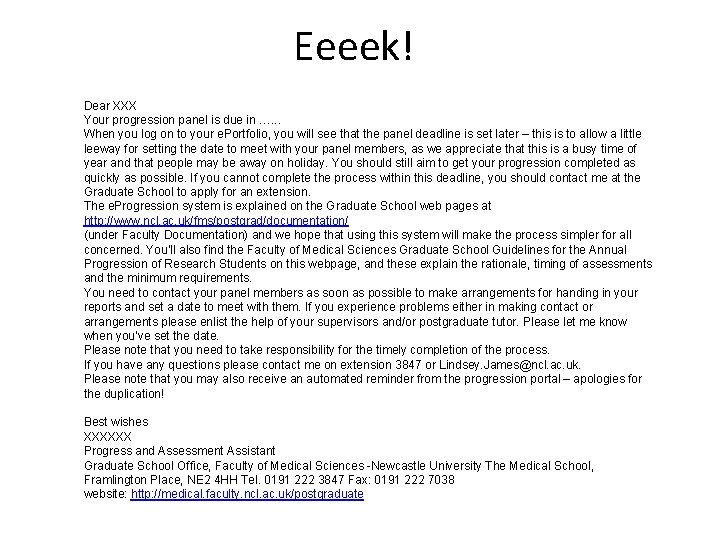
Eeeek! Dear XXX Your progression panel is due in …. . . When you log on to your e. Portfolio, you will see that the panel deadline is set later – this is to allow a little leeway for setting the date to meet with your panel members, as we appreciate that this is a busy time of year and that people may be away on holiday. You should still aim to get your progression completed as quickly as possible. If you cannot complete the process within this deadline, you should contact me at the Graduate School to apply for an extension. The e. Progression system is explained on the Graduate School web pages at http: //www. ncl. ac. uk/fms/postgrad/documentation/ (under Faculty Documentation) and we hope that using this system will make the process simpler for all concerned. You’ll also find the Faculty of Medical Sciences Graduate School Guidelines for the Annual Progression of Research Students on this webpage, and these explain the rationale, timing of assessments and the minimum requirements. You need to contact your panel members as soon as possible to make arrangements for handing in your reports and set a date to meet with them. If you experience problems either in making contact or arrangements please enlist the help of your supervisors and/or postgraduate tutor. Please let me know when you’ve set the date. Please note that you need to take responsibility for the timely completion of the process. If you have any questions please contact me on extension 3847 or Lindsey. James@ncl. ac. uk. Please note that you may also receive an automated reminder from the progression portal – apologies for the duplication! Best wishes XXXXXX Progress and Assessment Assistant Graduate School Office, Faculty of Medical Sciences -Newcastle University The Medical School, Framlington Place, NE 2 4 HH Tel. 0191 222 3847 Fax: 0191 222 7038 website: http: //medical. faculty. ncl. ac. uk/postgraduate
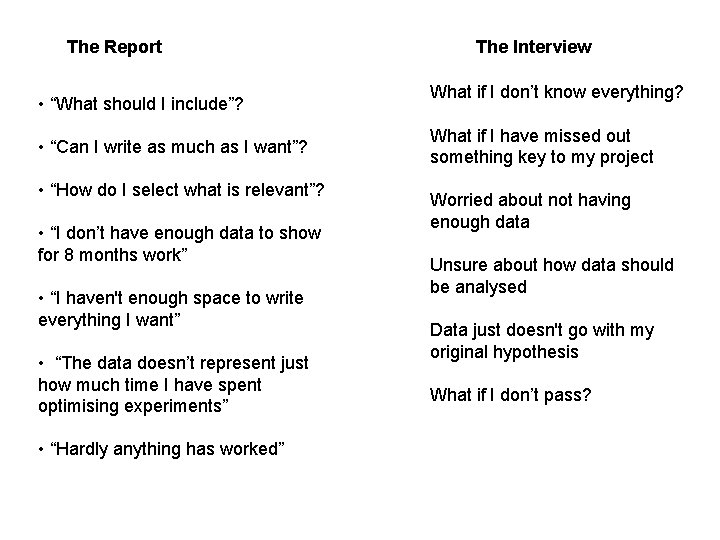
The Report • “What should I include”? • “Can I write as much as I want”? • “How do I select what is relevant”? • “I don’t have enough data to show for 8 months work” • “I haven't enough space to write everything I want” • “The data doesn’t represent just how much time I have spent optimising experiments” • “Hardly anything has worked” The Interview What if I don’t know everything? What if I have missed out something key to my project Worried about not having enough data Unsure about how data should be analysed Data just doesn't go with my original hypothesis What if I don’t pass?
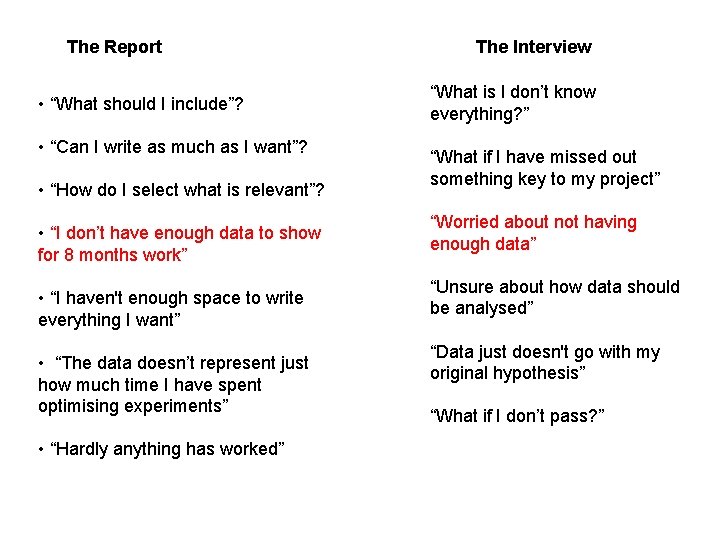
The Report • “What should I include”? • “Can I write as much as I want”? • “How do I select what is relevant”? • “I don’t have enough data to show for 8 months work” • “I haven't enough space to write everything I want” • “The data doesn’t represent just how much time I have spent optimising experiments” • “Hardly anything has worked” The Interview “What is I don’t know everything? ” “What if I have missed out something key to my project” “Worried about not having enough data” “Unsure about how data should be analysed” “Data just doesn't go with my original hypothesis” “What if I don’t pass? ”
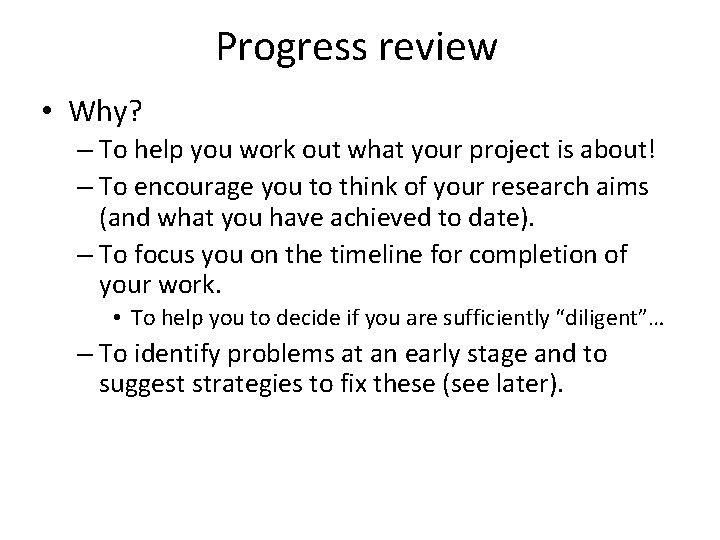
Progress review • Why? – To help you work out what your project is about! – To encourage you to think of your research aims (and what you have achieved to date). – To focus you on the timeline for completion of your work. • To help you to decide if you are sufficiently “diligent”… – To identify problems at an early stage and to suggest strategies to fix these (see later).
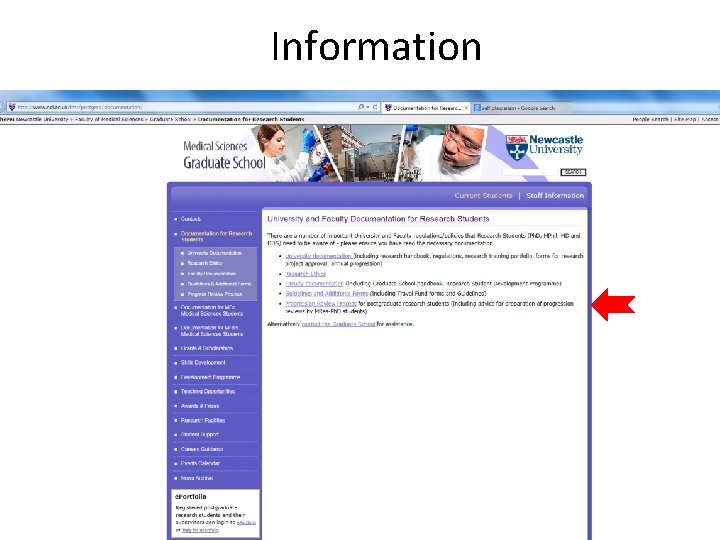
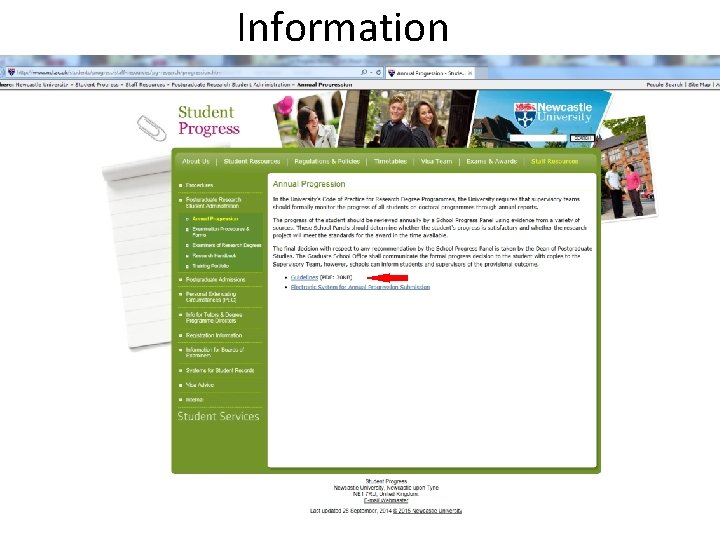
Information
Information
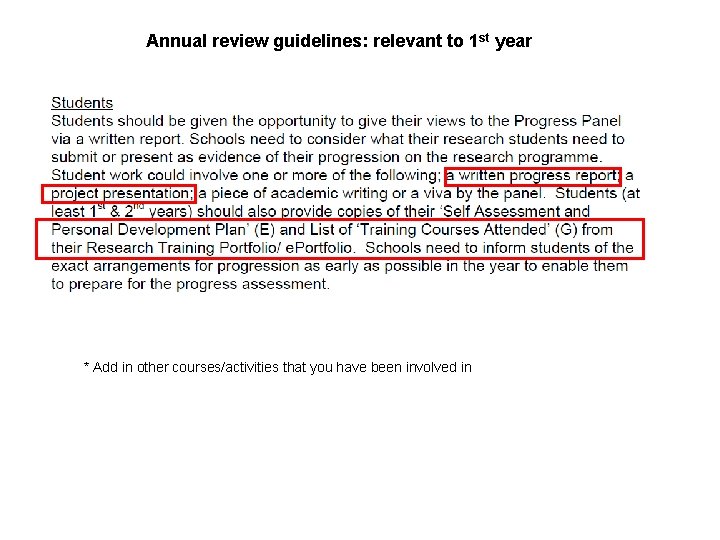
Annual review guidelines: relevant to 1 st year * Add in other courses/activities that you have been involved in
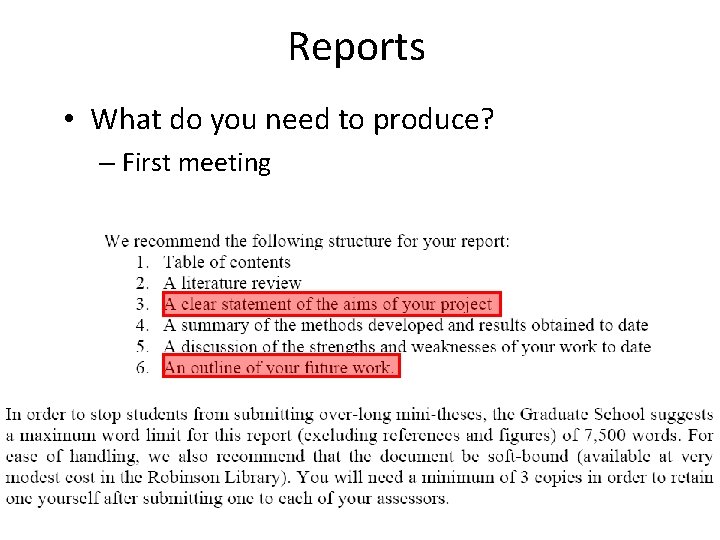
Reports • What do you need to produce? – First meeting
A journey of a thousand miles begins with a single step. Lao-tzu, The Way of Lao-tzu Chinese philosopher (604 BC - 531 BC)
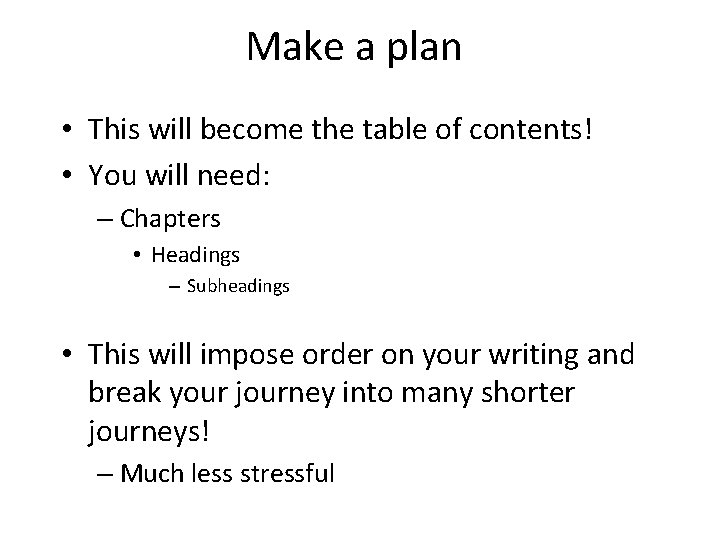
Make a plan • This will become the table of contents! • You will need: – Chapters • Headings – Subheadings • This will impose order on your writing and break your journey into many shorter journeys! – Much less stressful
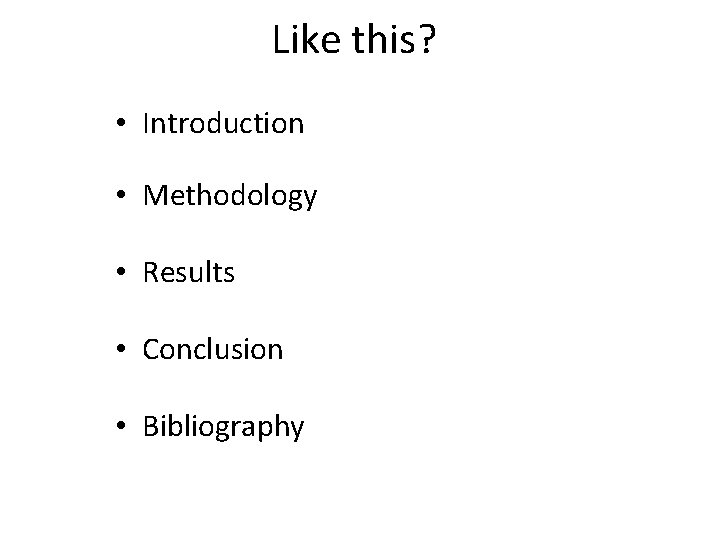
Like this? • Introduction • Methodology • Results • Conclusion • Bibliography
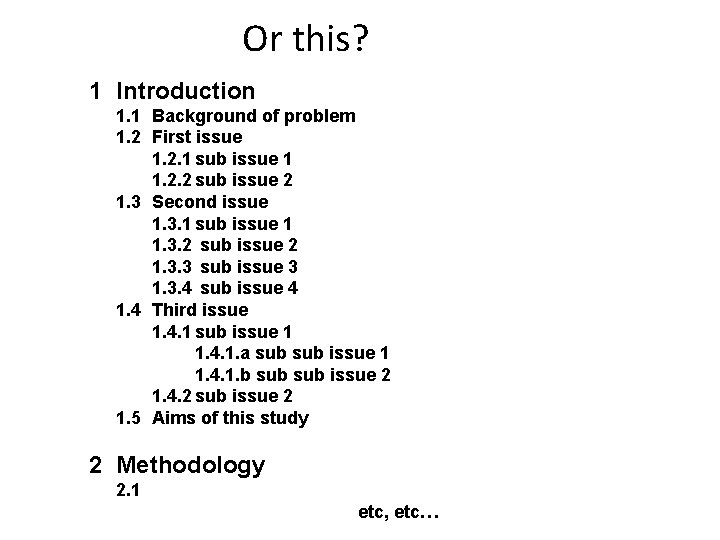
Or this? 1 Introduction 1. 1 Background of problem 1. 2 First issue 1. 2. 1 sub issue 1 1. 2. 2 sub issue 2 1. 3 Second issue 1. 3. 1 sub issue 1 1. 3. 2 sub issue 2 1. 3. 3 sub issue 3 1. 3. 4 sub issue 4 1. 4 Third issue 1. 4. 1 sub issue 1 1. 4. 1. a sub issue 1 1. 4. 1. b sub issue 2 1. 4. 2 sub issue 2 1. 5 Aims of this study 2 Methodology 2. 1 etc, etc…
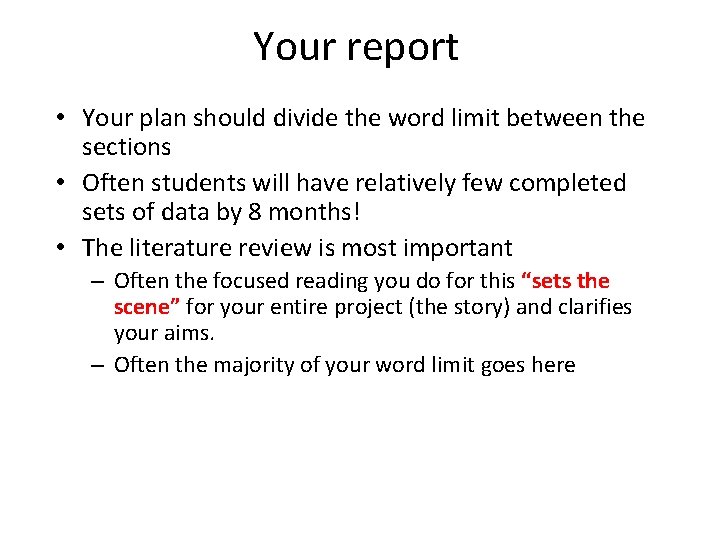
Your report • Your plan should divide the word limit between the sections • Often students will have relatively few completed sets of data by 8 months! • The literature review is most important – Often the focused reading you do for this “sets the scene” for your entire project (the story) and clarifies your aims. – Often the majority of your word limit goes here
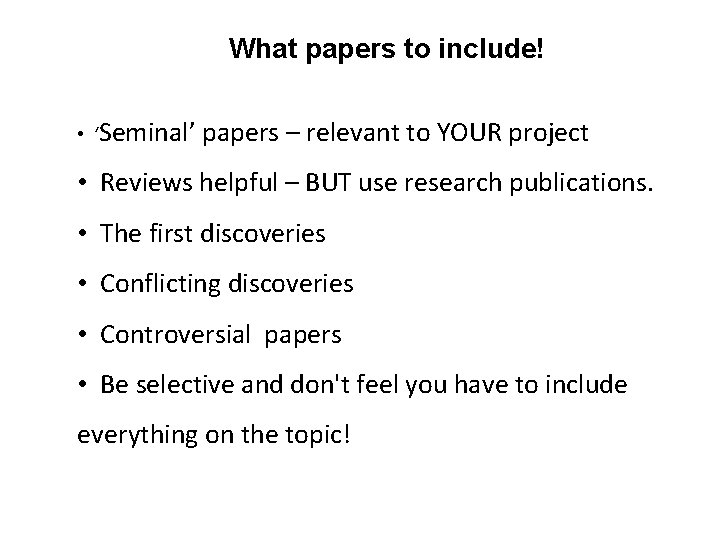
What papers to include! • ‘Seminal’ papers – relevant to YOUR project • Reviews helpful – BUT use research publications. • The first discoveries • Conflicting discoveries • Controversial papers • Be selective and don't feel you have to include everything on the topic!
MRes/Ph. D –First Year Report • Don’t get hung up on ‘I can’t replicate (self plagiarism) • Examined in MRes dissertation –can’t be included in Ph. D • Let’s clarify • Data = No (but can be used in Introduction –work leading to the Ph. D) • Literature Review –relevant – will be expanded and updated as you progress (cite MRes thesis for sections • Methods = Yes – in your MRes project you may have • developed assays • selected patient groups/samples • carried out a survey ** Examples at the end
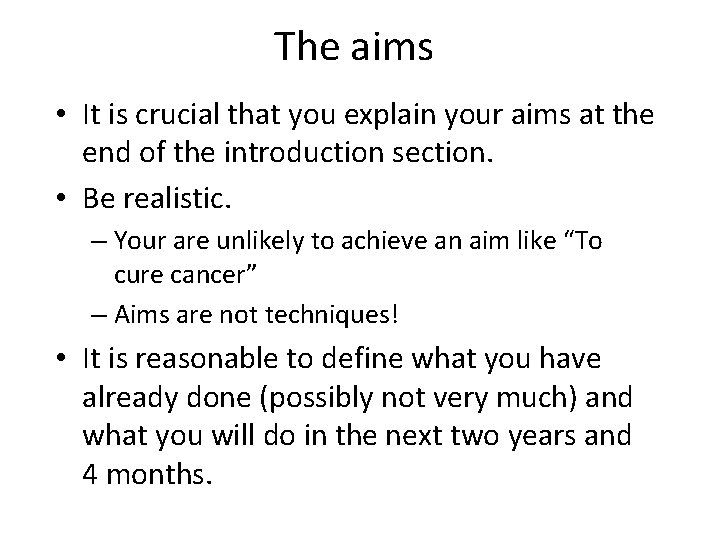
The aims • It is crucial that you explain your aims at the end of the introduction section. • Be realistic. – Your are unlikely to achieve an aim like “To cure cancer” – Aims are not techniques! • It is reasonable to define what you have already done (possibly not very much) and what you will do in the next two years and 4 months.
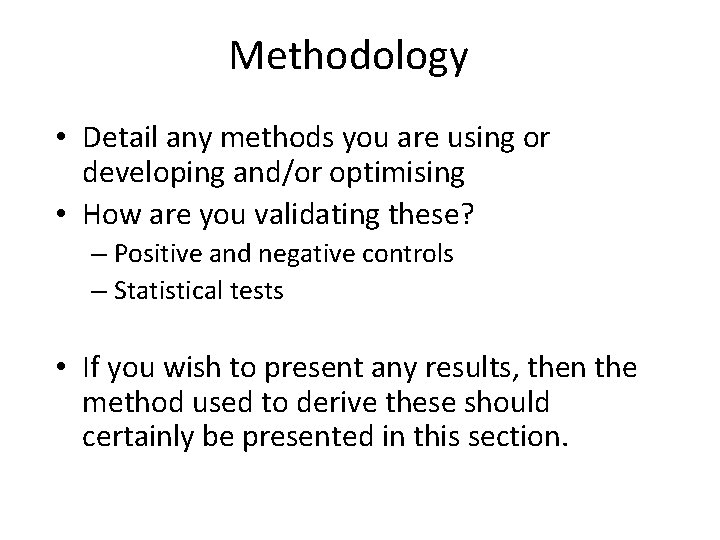
Methodology • Detail any methods you are using or developing and/or optimising • How are you validating these? – Positive and negative controls – Statistical tests • If you wish to present any results, then the method used to derive these should certainly be presented in this section.
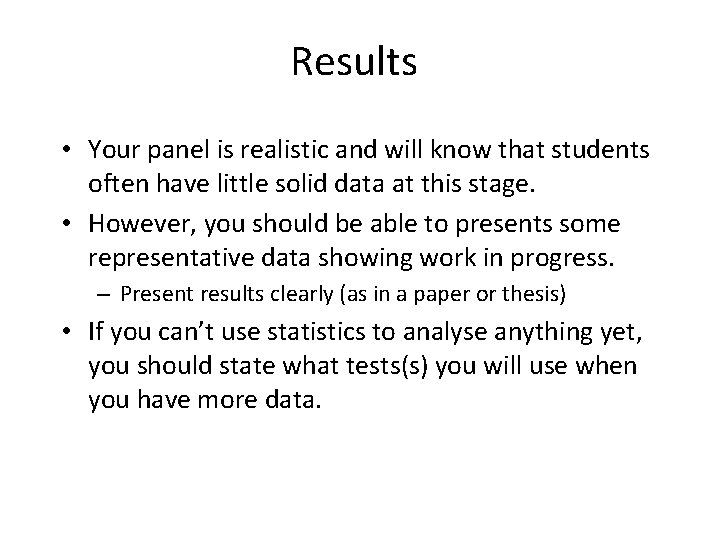
Results • Your panel is realistic and will know that students often have little solid data at this stage. • However, you should be able to presents some representative data showing work in progress. – Present results clearly (as in a paper or thesis) • If you can’t use statistics to analyse anything yet, you should state what tests(s) you will use when you have more data.
Discussion • This section should refer back to your aims. – Have you met any of your objectives yet? • If not, how long will it be before you do? • Are your findings consistent with the literature? • Detail any strengths and weaknesses of your protocols • Crucially, add a section on future work showing awareness of the timeline for completion of your thesis.
Tips • Write what you know/think and then reference a block of text • Try not to insert graphics within the text – Use separate pages – MUCH easier to format the final document • Minimise unnecessary use of colour – Cheaper and quicker to print Backup, Backup!
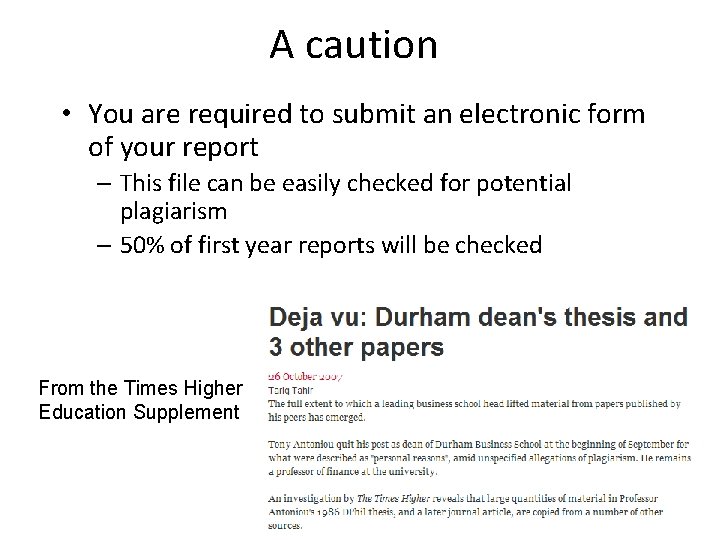
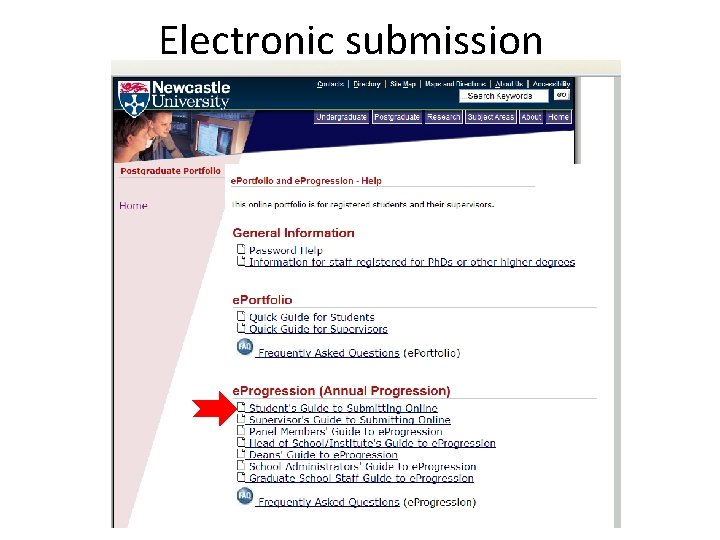
A caution • You are required to submit an electronic form of your report – This file can be easily checked for potential plagiarism – 50% of first year reports will be checked From the Times Higher Education Supplement
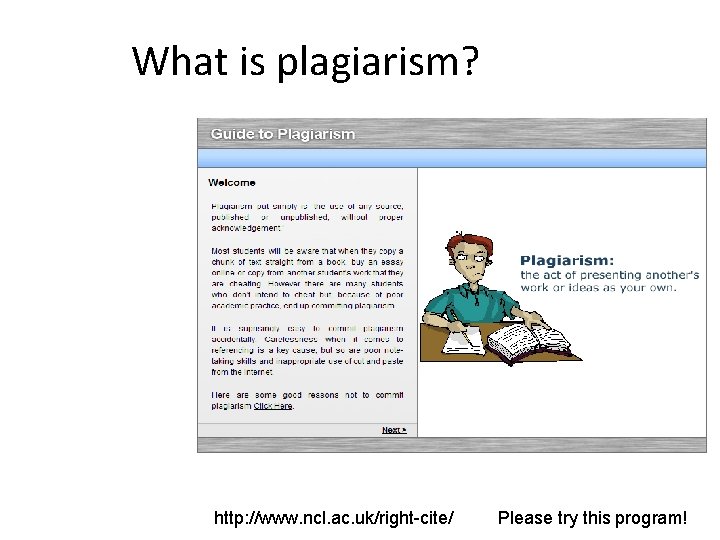
What is plagiarism? http: //www. ncl. ac. uk/right-cite/ Please try this program!
Finished? • Get fiends and family to prrofread • If English is not your first language, it can be helpful to use a proof-reader. – Lists are available in the Student’s Union. – The cost is quite reasonable – The proof-reader will (must!) only alter English and not the concept you are trying to express. • Remember – your supervisor will hope to focus mainly on your science rather than your English.
The role of your supervisors • It is your progress that is being reviewed • Do not expect your supervisor to spend ages helping you to make your report perfect • Most supervisors will be happy to comment (once or twice) on a completed draft document
Electronic submission
First panel meeting – what else is needed? • Power. Point Presentation (~15 -20 min) – Practice beforehand in front of your group- their questions are often tougher! • Annual report forms completed on-line by the: – Student – Supervisor(s) • Lab books • Record of PG skills training events you have attended (electronically recorded by Richy’s booking system).
The panel meeting • You should arrange this and provide documents to the assessors in good time • Ask them about a hard copy or electronic copy • There is no fixed duration for the interview – specific requirements -Power. Point presentation • The interview is based on the formal oral exam you will have on completion of your Ph. D/MD thesis (or may have on completion of your MPhil thesis).
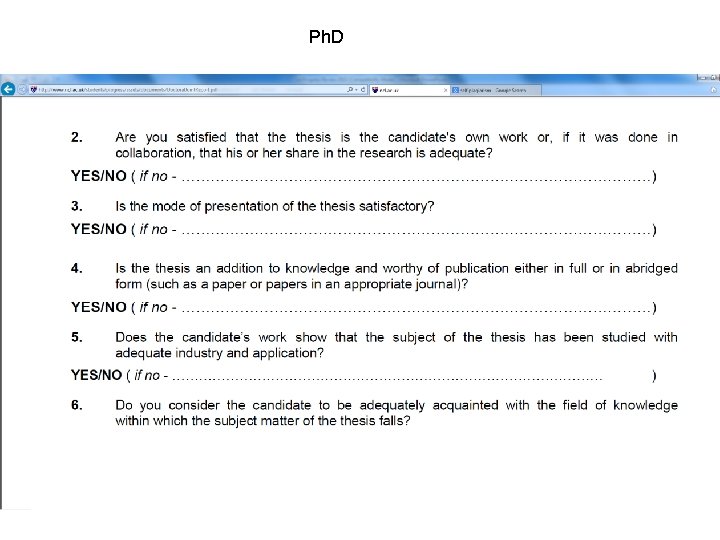
• Check out the instructions we give our Ph. D examiners. – Their report has set questions to address – This will give you an idea of what you can expect!
Ph. D
The Interview
• The reviewers will be hoping for a lively 2 way exchange of knowledge. – The more you say the less they can ask! • You may well find you know better than your reviewers the literature in your area. • Be prepared to highlight achievements you are particularly proud of • Don’t be worried if the reviewers suggest additional work – you still have time for this. – Make notes so any useful points you discuss are not forgotten
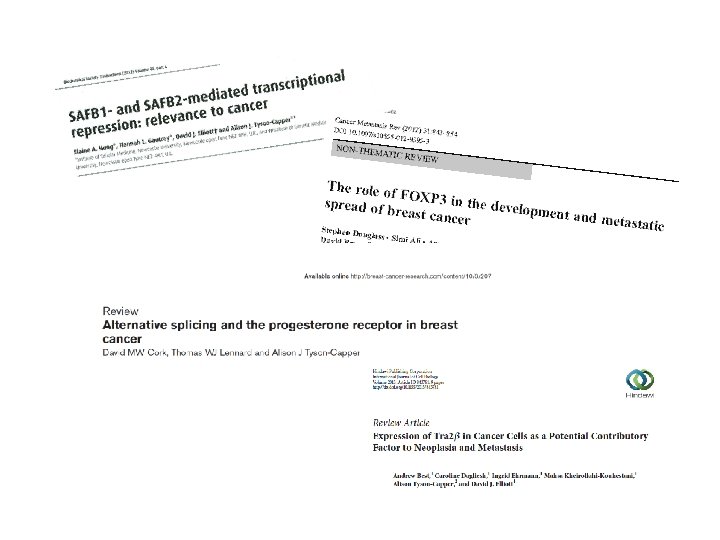
Phew – its all over • But, you have just written a wonderful literature review! – Will it now simply collect dust? • The review (and its bibliography) will be useful when you write your thesis • Maybe the literature review can also be converted (with a little extra effort) into a published review – Talk to your supervisors about this – Listen to Alicia’s advice – Attend our “Scientific Writing” session!
Progress review and your CV Investigating cancer-associated splicing in HER 2 in breast cancer Anna-Lena Dittrich Supervisor team: Dr Alison Tyson-Capper Dr Hannah Gautrey Dr David Browell Institute of Cellular Medicine Ph. D 1 st Year report “ it’s much more complex!” “Can’t include all I want to”!
Good luck! Any questions