
Welcome to the EIPN forum Alison Brabban Expert

Welcome to the EIPN forum Alison Brabban Expert Advisor to AMH Programme, Recovery Lead, Tees, Esk & Wear Valleys NHS Foundation Trust
Housekeeping • Audience have been muted so you won’t be able to ask questions verbally. • Please post any questions or comments using the “Q&A” function • Please use the ‘thumbs up’ feature to endorse questions • The conference will be run as two separate events: a. m. & p. m. • You will need to use the specific link for each session
An update from the Early Intervention in Psychosis Network (EIPN) Steven Wakeling Head of Quality and Accreditation
What is EIPN? • A quality improvement and accreditation network for EIP teams, run by the College Centre for Quality Improvement. • Uses a peer review model and the EIPN standards to review teams and identify areas for improvement, as well as areas of achievement. • Annual subscription based membership.
Membership options Developmental Accreditation If you want to improve your service and work towards accreditation, but would like some time & support to achieve this If your team wants support and a seal of approval from an independent body about the quality of your service
The Process 1. Self Review • 3 month period to self-assess against the standards using our online system • Data collection via surveys sent to staff, service users, friends, family and carers and partner agencies • The EIPN team receive all survey responses and a workbook is created
The Process 2. Peer Review • 1 day review • Peer review team – 1 EIPN staff member, 2 -3 professionals with expertise in EIP, 1 -2 service user or carer representatives • Structured day focussing on validating the self-review data, sharing good practice and identifying areas for improvement 3. Accreditation Committee (accreditation membership only)

For more information Get in touch Visit our website Steven Wakeling Head of Quality and Accreditation Steven. Wakeling@rcpsych. ac. uk www. rcpsych. ac. uk/EIPN Tahiyat Rashid Project Officer Tahiyat. Rashid@rcpsych. ac. uk Download the EIPN standards for free
Early Intervention in Psychosis National update Prof. Tim Kendall National Clinical Director for Mental Health Jay Nairn, Senior Programme Manager - Mental Health NHS England NHS Improvement
Contents Success and challenges for Early Intervention in Psychosis in England – Prof Tim Kendall • Long Term Plan commitments • Success and progress so far • Impact of covid-19 on mental health services National policy work in 2020/21 – Jay Nairn • Long-term plan implementation • Focus on contextual standards i. e. ARMS and over 35 s • Updating commissioning guidance • Improving data quality • Patient engagement and focus on BAME service users 10 |
Success and challenges for Early Intervention in Psychosis in England Prof Tim Kendall NHS England NHS Improvement
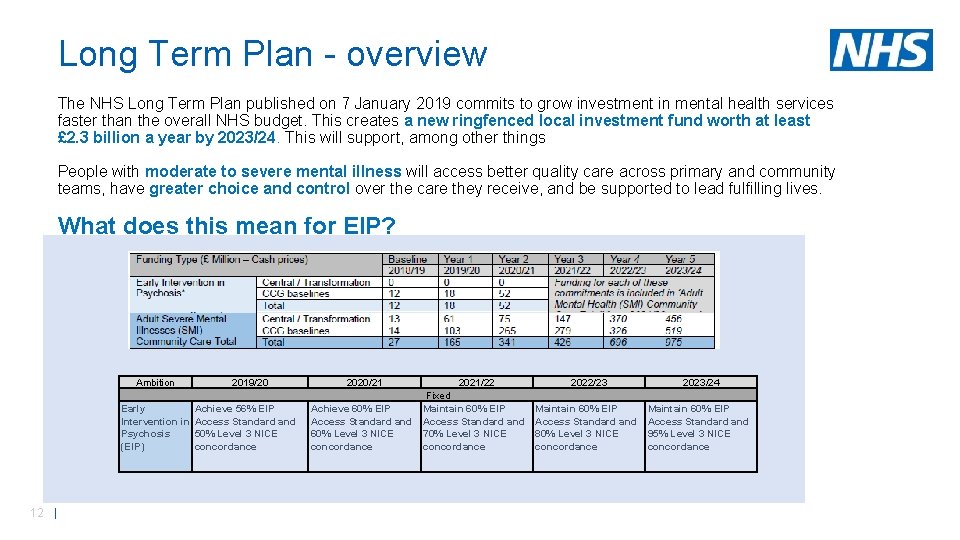
Long Term Plan - overview The NHS Long Term Plan published on 7 January 2019 commits to grow investment in mental health services faster than the overall NHS budget. This creates a new ringfenced local investment fund worth at least £ 2. 3 billion a year by 2023/24. This will support, among other things People with moderate to severe mental illness will access better quality care across primary and community teams, have greater choice and control over the care they receive, and be supported to lead fulfilling lives. What does this mean for EIP? Ambition Early Intervention in Psychosis (EIP) 12 | 2019/20 Achieve 56% EIP Access Standard and 50% Level 3 NICE concordance 2020/21 Achieve 60% EIP Access Standard and 60% Level 3 NICE concordance 2021/22 Fixed Maintain 60% EIP Access Standard and 70% Level 3 NICE concordance 2022/23 2023/24 Maintain 60% EIP Access Standard and 80% Level 3 NICE concordance Maintain 60% EIP Access Standard and 95% Level 3 NICE concordance
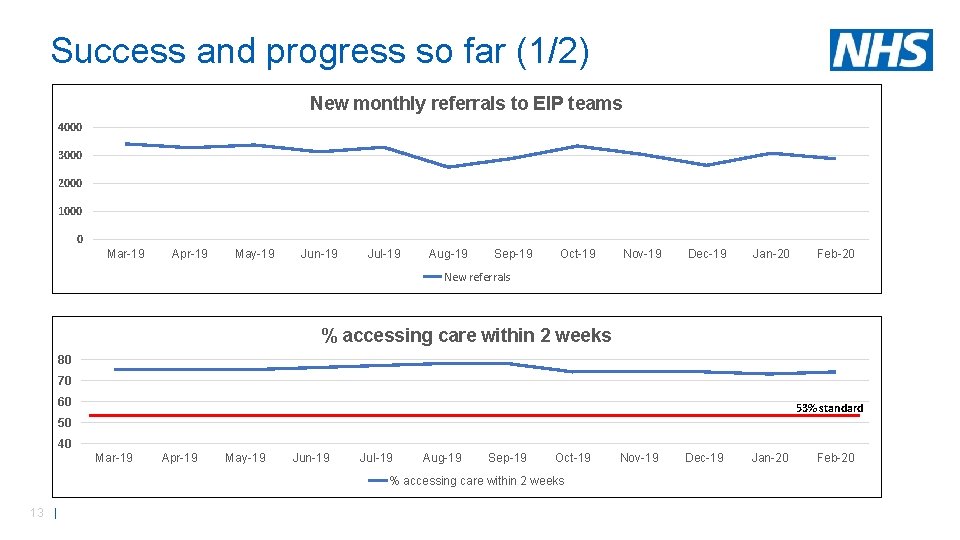
Success and progress so far (1/2) New monthly referrals to EIP teams 4000 3000 2000 1000 0 Mar-19 Apr-19 May-19 Jun-19 Jul-19 Aug-19 Sep-19 Oct-19 Nov-19 Dec-19 Jan-20 Feb-20 New referrals % accessing care within 2 weeks 80 70 60 53% standard 50 40 Mar-19 Apr-19 May-19 Jun-19 Jul-19 Aug-19 Sep-19 Oct-19 % accessing care within 2 weeks 13 | Nov-19 Dec-19 Jan-20 Feb-20
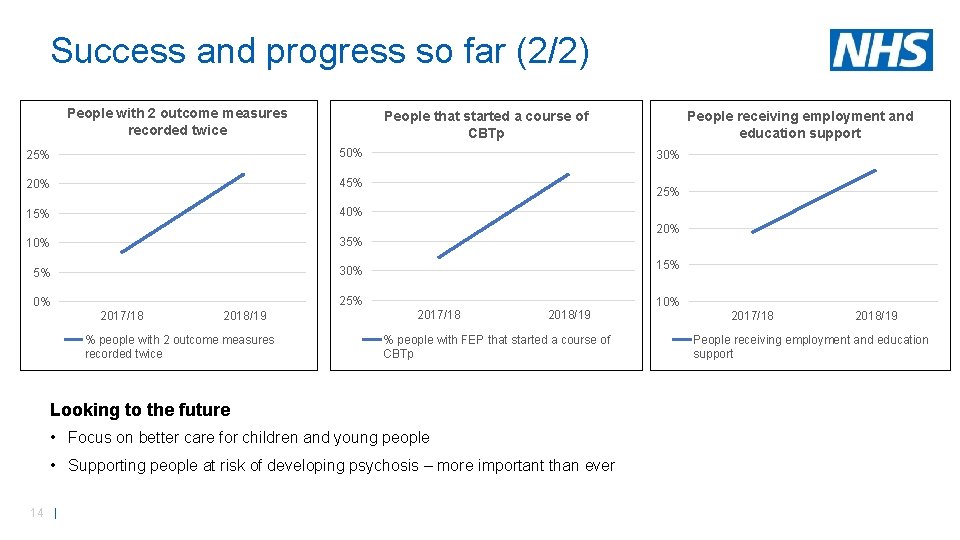
Success and progress so far (2/2) People with 2 outcome measures recorded twice People that started a course of CBTp 25% 50% 20% 45% 15% 40% 10% 35% 5% 30% 0% 25% 2017/18 2018/19 % people with 2 outcome measures recorded twice 30% 25% 20% 15% 2017/18 2018/19 % people with FEP that started a course of CBTp Looking to the future • Focus on better care for children and young people • Supporting people at risk of developing psychosis – more important than ever 14 | People receiving employment and education support 10% 2017/18 2018/19 People receiving employment and education support
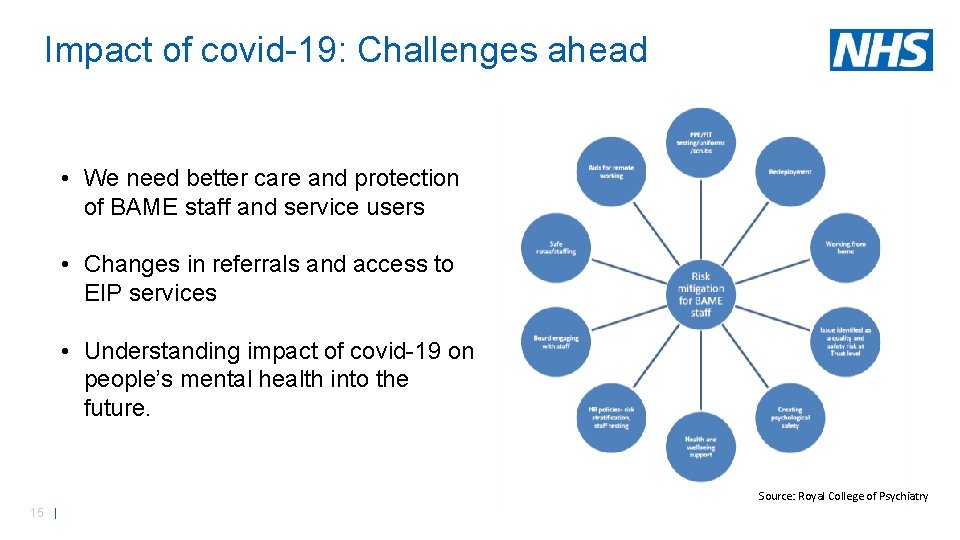
Impact of covid-19: Challenges ahead • We need better care and protection of BAME staff and service users • Changes in referrals and access to EIP services • Understanding impact of covid-19 on people’s mental health into the future. Source: Royal College of Psychiatry 15 |
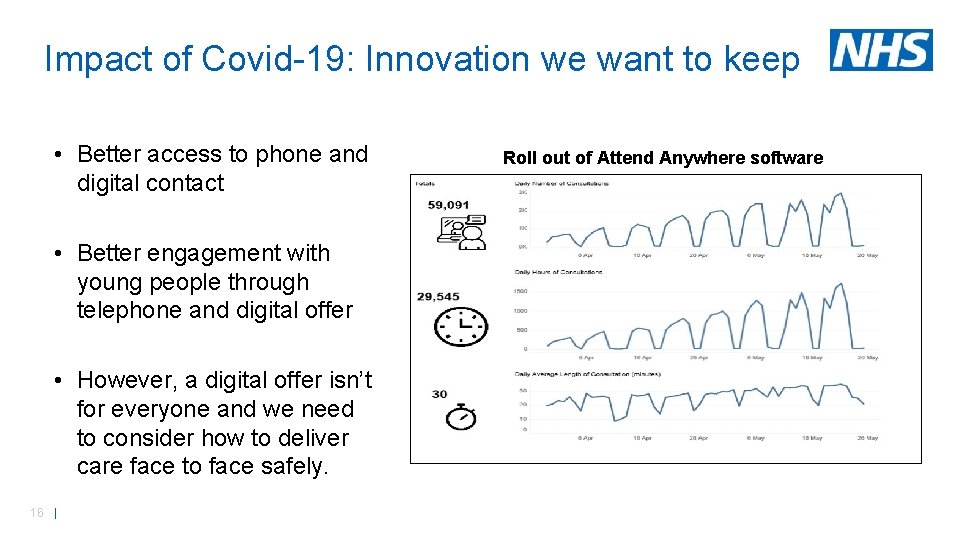
Impact of Covid-19: Innovation we want to keep • Better access to phone and digital contact • Better engagement with young people through telephone and digital offer • However, a digital offer isn’t for everyone and we need to consider how to deliver care face to face safely. 16 | Roll out of Attend Anywhere software
National policy work in 2020/21 Jay Nairn NHS England NHS Improvement
LTP implementation As set out in the Mental Health Implementation Plan 2019/20 – 2023/24, areas needs to ensure EIP services are commissioned in line NHS England guidance which includes: • Provision for all age groups (under 18 s and over 35 year olds) – areas should be aiming to deliver this now rather than planning for delivery in 2023/24 • Provision for people with an At Risk Mental State - areas should be aiming to deliver this now rather than planning for delivery in 2023/24 • Ensuring improvements are made in levels of NICE concordance of care so that 95% of services achieve level 3 of NICE concordance by 2023/24 • The referral to treatment element of the standard is met This is supported by significant new CCG baseline investment totalling £ 52 million nationally in 2020/21. 18 |
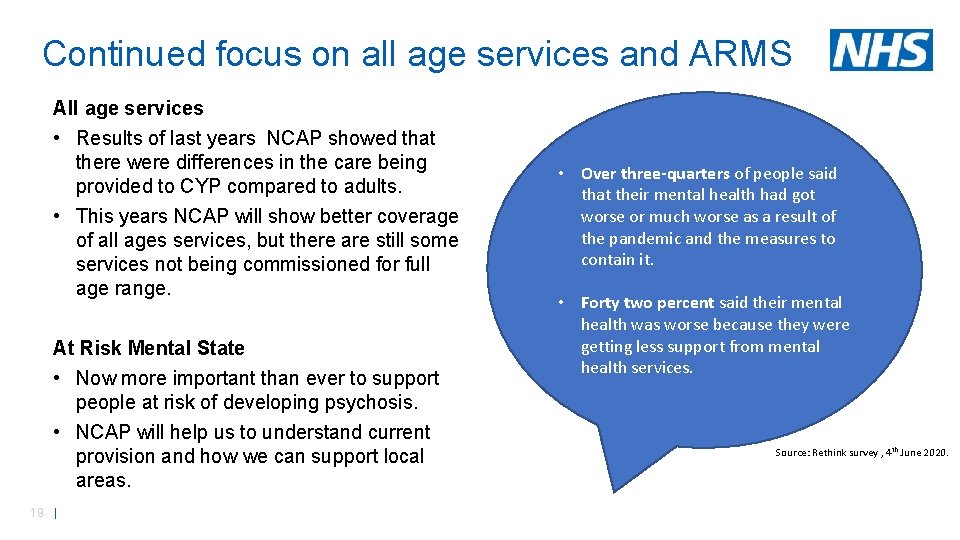
Continued focus on all age services and ARMS All age services • Results of last years NCAP showed that there were differences in the care being provided to CYP compared to adults. • This years NCAP will show better coverage of all ages services, but there are still some services not being commissioned for full age range. At Risk Mental State • Now more important than ever to support people at risk of developing psychosis. • NCAP will help us to understand current provision and how we can support local areas. 19 | • Over three-quarters of people said that their mental health had got worse or much worse as a result of the pandemic and the measures to contain it. • Forty two percent said their mental health was worse because they were getting less support from mental health services. Source: Rethink survey , 4 th June 2020.
Updating commissioning guidance We wanted to update the EIP commissioning guidance to include: • Our new LTP ambitions including community mental health transformation • Include an update on at risk mental state • Include an update on children and young people Steps taken so far: • Established a task and finish group • Reviewed and updated guidance • Looking to undertake some engagement post-covid to make sure we have got it right. 20 |
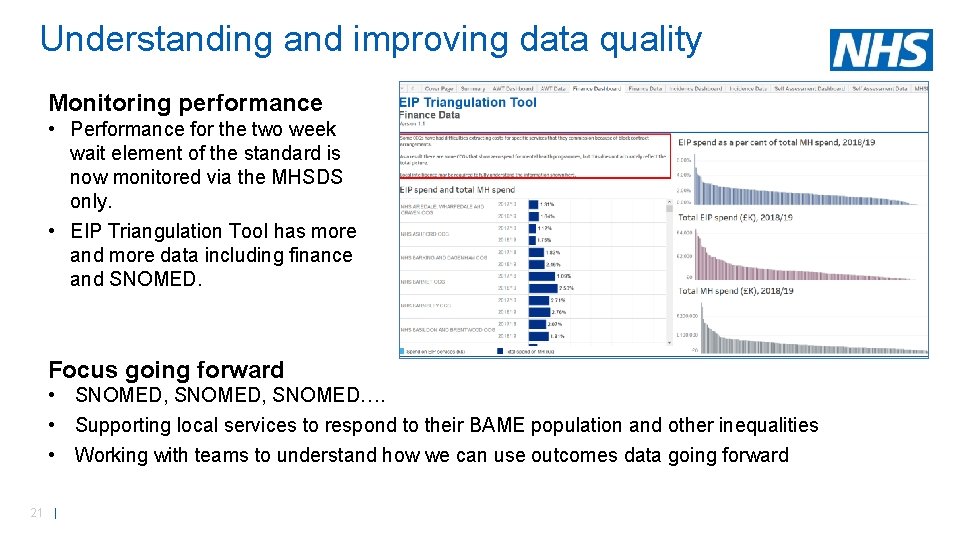
Understanding and improving data quality Monitoring performance • Performance for the two week wait element of the standard is now monitored via the MHSDS only. • EIP Triangulation Tool has more and more data including finance and SNOMED. Focus going forward • SNOMED, SNOMED…. • Supporting local services to respond to their BAME population and other inequalities • Working with teams to understand how we can use outcomes data going forward 21 |

Thank you Any questions? jaynairn@nhs. net 22 |
From short-term to long-term ‘recovery’: the next frontier of early intervention research and development Nev Jones Ph. D Department of Psychiatry Morsani College of Medicine University of South Florida
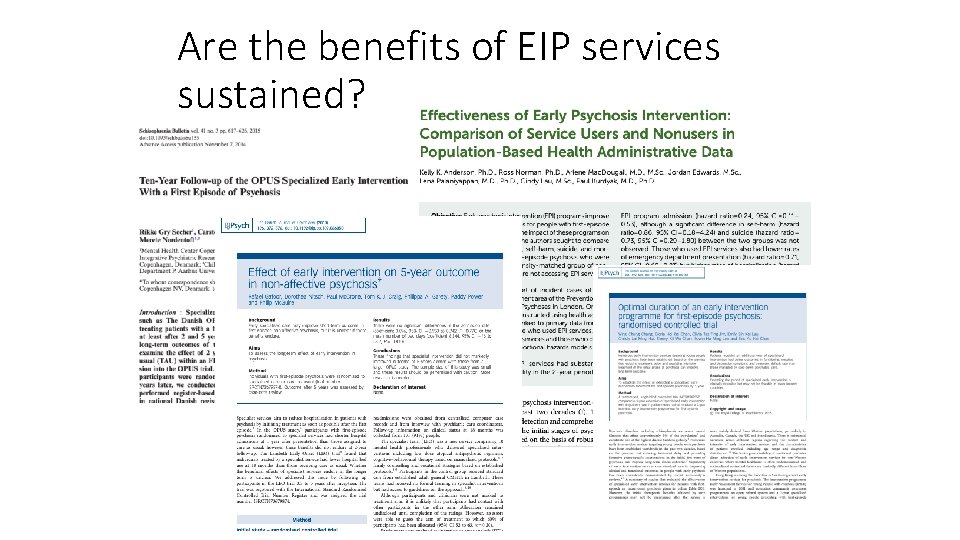
Are the benefits of EIP services sustained?
Where do we go from here? • • Reducing duration of untreated psychosis (TIPS) Extending EIP services (OPUS II, PEPP, EASY) Stronger transition/step-down practices Strengthening post-discharge mental health services across the board Medication discontinuation (Wunderink) Reduced initiation & use of antipsychotics (Open Dialogue, ODDESSI) Refining/augmenting core intervention components • E. g. cognitive remediation, e. Health, therapy, clozapine/LAIs
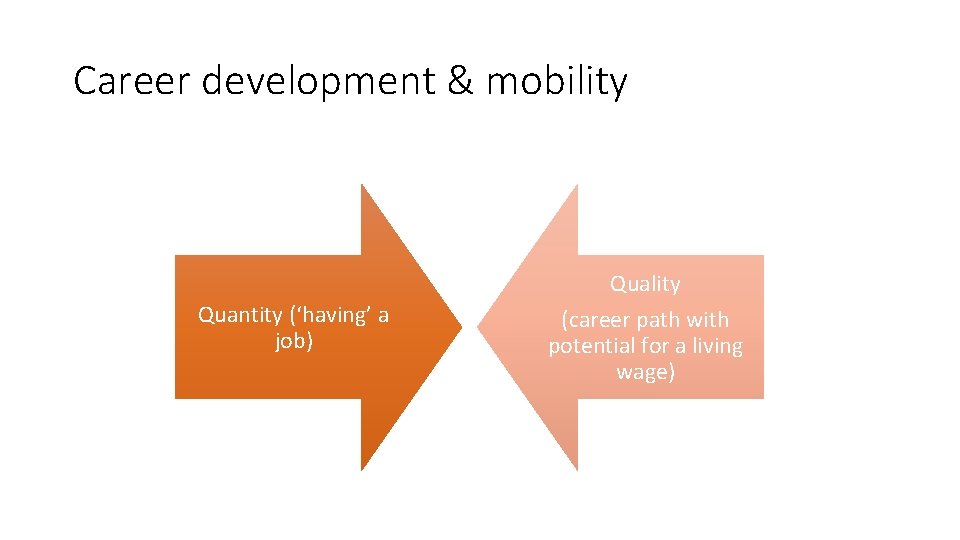
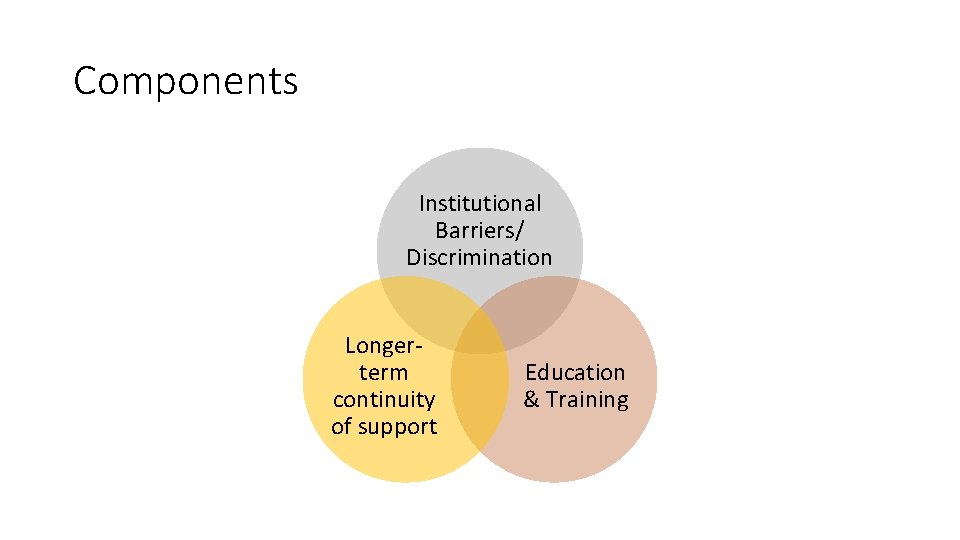
A different perspective • Autonomous motivation • Identifying & support ‘poor outcome’ sub-groups • Career development/mobility & community integration grounded in : trajectory interviews with 40 former service users, 80 current service users, 10 family members, 35 EIP clinicians + analysis of quantitative & administrative data
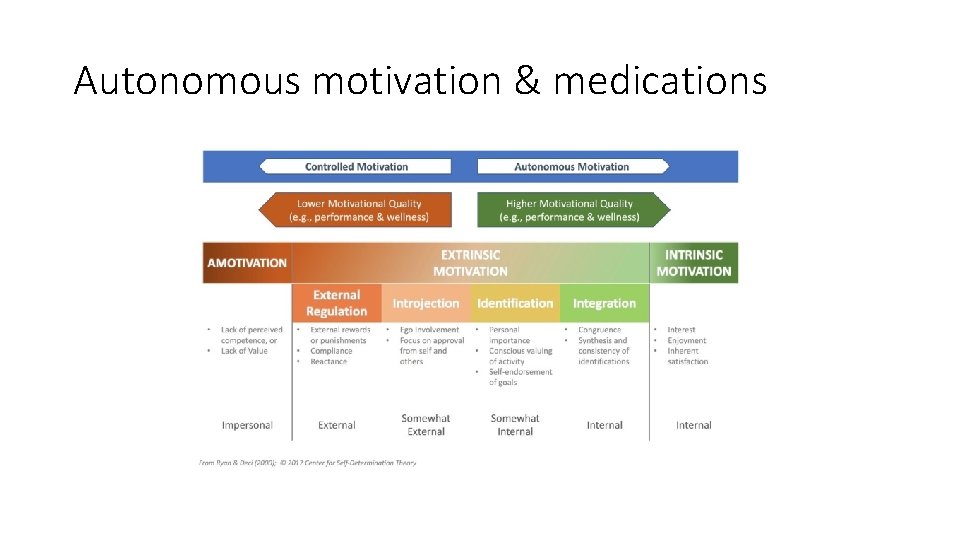
Autonomous motivation & medications
External motivations Two patterns of post-discharge medication discontinuation: • Explicit or implicit coercion/pressure • + benefits questioned • ~ individual effectiveness/underlying symptoms & course • ‘Adherence’ to please valued clinicians • + benefits questioned • ~ individual effectiveness/underlying symptoms & course
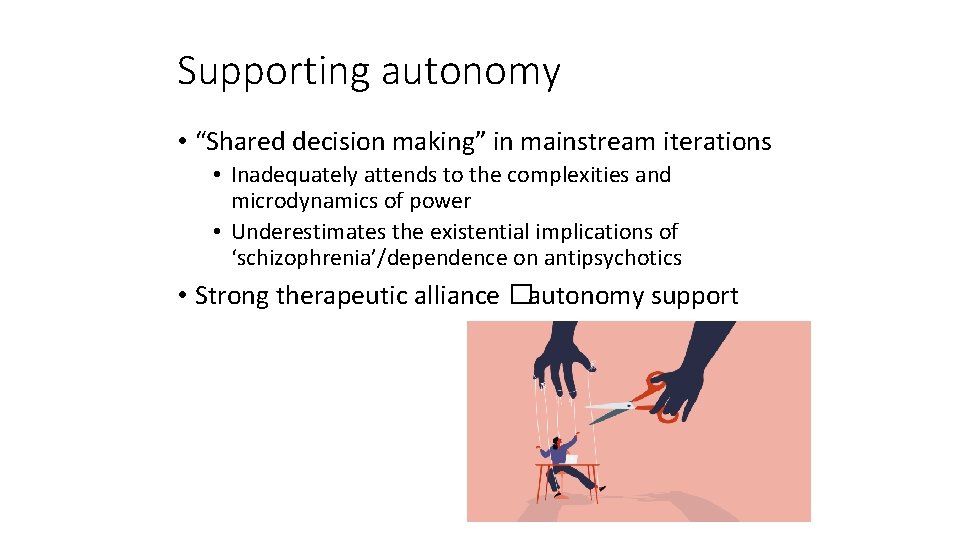
Supporting autonomy • “Shared decision making” in mainstream iterations • Inadequately attends to the complexities and microdynamics of power • Underestimates the existential implications of ‘schizophrenia’/dependence on antipsychotics • Strong therapeutic alliance �autonomy support
‘Poor Outcome’ Sub-Groups • Definition • Discharge to higher levels of care/incarceration • Unable to work or attend school • Ongoing distress and functional disability • Groups • Significant distress & disability in spite of resources, best available treatments • Structural and socioeconomic adversity as ‘overdeterminants’ • affordances to participate, benefit, reintegrate
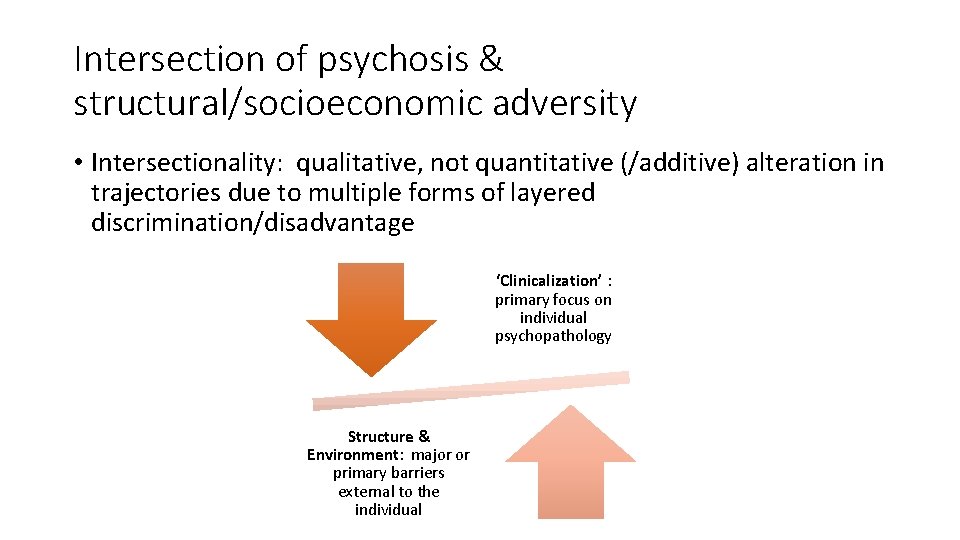
Intersection of psychosis & structural/socioeconomic adversity • Intersectionality: qualitative, not quantitative (/additive) alteration in trajectories due to multiple forms of layered discrimination/disadvantage ‘Clinicalization’ : primary focus on individual psychopathology Structure & Environment: major or primary barriers external to the individual
Career development & mobility Quantity (‘having’ a job) Quality (career path with potential for a living wage)
Components Institutional Barriers/ Discrimination Longerterm continuity of support Education & Training

Questions?
- Slides: 34