Title II Part A Updates Under the Every
- Slides: 50
Title II, Part A, Updates Under the Every Student Succeeds Act of 2015. Office of ESEA Programs 2019 Coordinators’ Technical Assistance Academy Blacksburg: June 17 -19, 2019 Norfolk: July 15 -17, 2019 Virginia Department of Education
Disclaimer The academy was planned under a grant from the U. S. Department of Education (USED). However, the content does not necessarily represent the policy of the USED, and you should not assume endorsement by the federal government. Virginia Department of Education
Session Overview • • Title II, Part A, Allocations Requirements Under ESSA Uses of Funds Application Updates Transferability Equitable Services Federal Program Monitoring Virginia Department of Education
ALLOCATIONS Virginia Department of Education
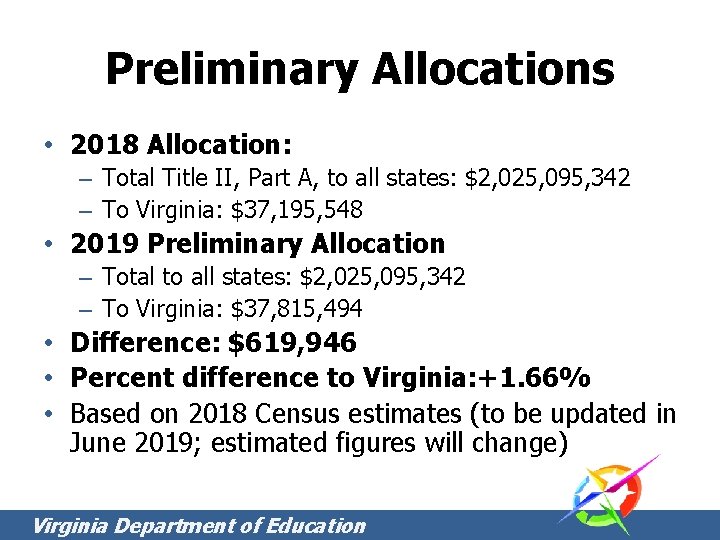
Preliminary Allocations • 2018 Allocation: – Total Title II, Part A, to all states: $2, 025, 095, 342 – To Virginia: $37, 195, 548 • 2019 Preliminary Allocation – Total to all states: $2, 025, 095, 342 – To Virginia: $37, 815, 494 • Difference: $619, 946 • Percent difference to Virginia: +1. 66% • Based on 2018 Census estimates (to be updated in June 2019; estimated figures will change) Virginia Department of Education
PROGRAM REQUIREMENTS AND USE OF FUNDS Virginia Department of Education
Transition to the Every Student Succeeds Act of 2015: Reminders • Full implementation in 2018 -2019 • Title II, Part A, changes – Elimination of “highly qualified” teachers and paraprofessionals. Teachers must be fully licensed and properly endorsed. – Paraprofessionals in Title I schools must have: • Secondary school diploma or equivalent; AND • Two years of study at institution of higher education; OR • Associate’s degree; OR • Successful passing of Parapro assessment. Virginia Department of Education
Every Student Succeeds Act of 2015, Title II, Part A • Focus on effectiveness and equity • Expanded uses of funds beginning in 2017 -2018 • Equitable services to private schools – Timeline changes – Value of services calculations – Additional consultation and planning requirements • Extensive stakeholder involvement required at state and local levels • Evidence-based requirements for class-size reduction and professional development • Prioritization of funding for schools identified for “Comprehensive” or “Targeted” support Virginia Department of Education
Stakeholder Consultations • Involve key stakeholders – Teachers (include Title I teachers, different grade levels and subject areas) • Recommend teacher advisory committee/teacher quality workgroup – Principals – Paraprofessionals – Central office staff (e. g. , human resources, professional development staff, instruction) – Parents – Private school officials – Business/Community Virginia Department of Education
Title II, Part A, Allowable Use of Funds (Slide 1 of 8) Allowable uses of funding include: • Personalized, evidence-based professional development for teachers, principals, and other school leaders to improve effectiveness, particularly in working with: – English learners – Disadvantaged students – Minority students – Students with disabilities – Gifted students Virginia Department of Education
Title II, Part A, Allowable Use of Funds, (Slide 2 of 8) • Teacher and principal leadership programs – Residency programs – Preparation academies • Teacher, principal, school leader evaluation systems • Activities to increase effectiveness of teachers/principals/school leaders • Activities to increase teacher equity and improve access to effective teachers Virginia Department of Education
Title II, Part A, Allowable Use of Funds, (Slide 3 of 8) • Differential pay for recruitment/retention • Recruiting/retaining effective teachers/principals, especially from underrepresented minority groups and teachers with disabilities • Screening/early hiring initiatives Virginia Department of Education
Title II, Part A, Allowable Use of Funds, (Slide 4 of 8) • Career opportunities – Career paths: coaching, mentoring, school leadership/school improvement teams • New teacher/principal/school leader induction/mentoring • Compensation to teachers for increased leadership roles and responsibilities including: collaborative planning, curriculum writing, peer observations, and leading trainings (which may involve using substitute teachers to cover classes during the school day) • Peer-led professional development activities • Professional learning community (PLC) activities Virginia Department of Education
Title II, Part A, Allowable Use of Funds (Slide 5 of 8) • STEM training, including computer science • Training/certifications for dual enrollment programs • Integrating CTE into academic instruction and workforce readiness/postsecondary programs • Early childhood transition program training Virginia Department of Education
Title II, Part A, Allowable Use of Funds (Slide 6 of 8) • School safety, trauma, mental health, alcohol/drug abuse prevention • Training to recognize/prevent child sexual abuse • Family engagement training Virginia Department of Education
Title II, Part A, Allowable Use of Funds (Slide 7 of 8) • Experiential learning training • PBIS and tiered systems of support training • Training on effective/appropriate use of data, including FERPA • Supporting effective library programs Virginia Department of Education
Title II, Part A, Allowable Use of Funds (Slide 8 of 8) • Working conditions surveys (data to be publicly posted) • Hiring of teachers to reduce class size, when evidence-based Virginia Department of Education
“Evidence-Based” Four tiers of evidence (likely to have a statistically significant effect on improving student outcomes): – Tier 1: Strong evidence available from at least one well-designed/well-implemented experimental study – Tier 2: Moderate evidence available from at least one well-designed/well-implemented quasiexperimental study – Tier 3: Promising evidence available from at least one well-designed and well-implemented correlational study with statistical controls for selection bias – Tier 4: Demonstrates a rationale based on highquality research findings and includes ongoing efforts to examine the effects of the activity, strategy, or intervention Virginia Department of Education
Evidence Based Resources – What Works Clearinghouse – Best Evidence Encyclopedia – Evidence for ESSA Virginia Department of Education
Evidence-Based Scenario Activity Virginia Department of Education
APPLICATION UPDATES Virginia Department of Education
Program Overview • NEW: The plan must describe: – Process for engaging stakeholders in application development process; – The school division’s system of professional growth and improvement, such as induction for teachers, principals, or other school leaders and opportunities for building the capacity of teachers and opportunities to develop meaningful teacher leadership; Virginia Department of Education
Program Overview (Slide 2 of 2) – Process for selecting activities that are evidence based; – How the school division will use data and ongoing consultation to update and improve activities; and – How the division will use funds to address the learning need of all students, including students with disabilities, English learners, and gifted students. Virginia Department of Education
General Education Provisions Act (GEPA) • The final ESSA state plan template released by USED on March 13, 2017, included a “Notice to All Applicants” about Section 427 of GEPA. • Each application must include a description of the steps the applicant will take to ensure equitable access to, and participation in, federally-assisted programs for students, teachers, and other program beneficiaries with special needs. • The statute highlights six types of barriers that can impede equitable access or participation: gender, race, national origin, color, disability, or age. Virginia Department of Education
GEPA • Based on local circumstances, the applicant should determine whether these or other barriers may prevent students, teachers, etc. , from such access or participation in the federally-funded project or activity. • The description in the application of steps to be taken to overcome these barriers need not be lengthy; the application may provide a clear and succinct description of how the applicant plans to address those barriers that are applicable to their circumstances. Virginia Department of Education
GEPA Application Tab • In the space provided on the GEPA tab, describe the steps the division will take to ensure equitable access. You may consider the following examples in your description: – Ensuring that events are held in accessible facilities; – Ensuring that materials are appropriate and accessible to all participants; – Translating documents into other languages as needed; – Conducting outreach or other activities to address gender and/or race inequities in mathematics, science, or other programs; or – Ensuring that diverse stakeholders are involved in program planning and implementation Virginia Department of Education
Teacher Quality • Qualified teachers and paraprofessionals • Equitable distribution of qualified, effective, and experienced teachers – Analyze teacher qualification, teacher experience, and teacher effectiveness data at each school. – Compare high poverty/high minority school data with low-poverty/low minority schools. Identify gaps. – Outline strategies used to ensure equitable distribution and support. Virginia Department of Education
Teacher Quality Tab: Teacher Equity Response Examples • General – Establishment of Equity Committees; hiring of equity directors • Qualifications – Early hiring – Hiring bonuses for high-need schools • Experience – High quality mentoring programs – Specialized support programs for new teachers • Effectiveness – Cultural competency professional development – Poverty simulations – ESL certification cohort – Microcredentials for specialized skills related to equity Virginia Department of Education
TRANSFERABILITY Virginia Department of Education
Transferring Funds under ESSA • Section 5103 (b)(2) of ESSA allows divisions to transfer up to 100 percent of funds awarded from two program areas: – Title II, Part A – Title IV, Part A Virginia Department of Education
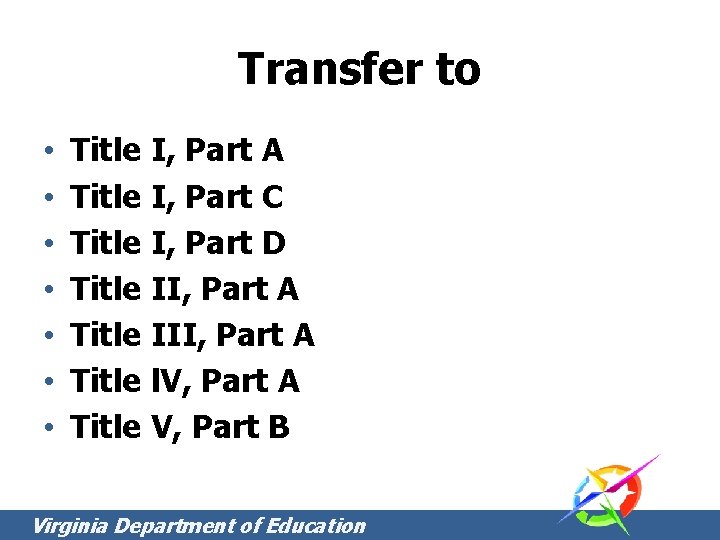
Transfer to • • Title I, Part A Title I, Part C Title I, Part D Title II, Part A Title III, Part A Title l. V, Part A Title V, Part B Virginia Department of Education
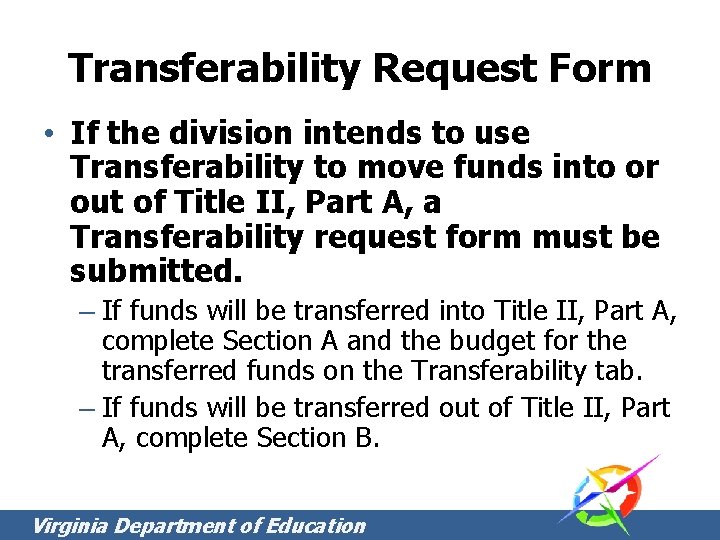
Transferability Request Form • If the division intends to use Transferability to move funds into or out of Title II, Part A, a Transferability request form must be submitted. – If funds will be transferred into Title II, Part A, complete Section A and the budget for the transferred funds on the Transferability tab. – If funds will be transferred out of Title II, Part A, complete Section B. Virginia Department of Education
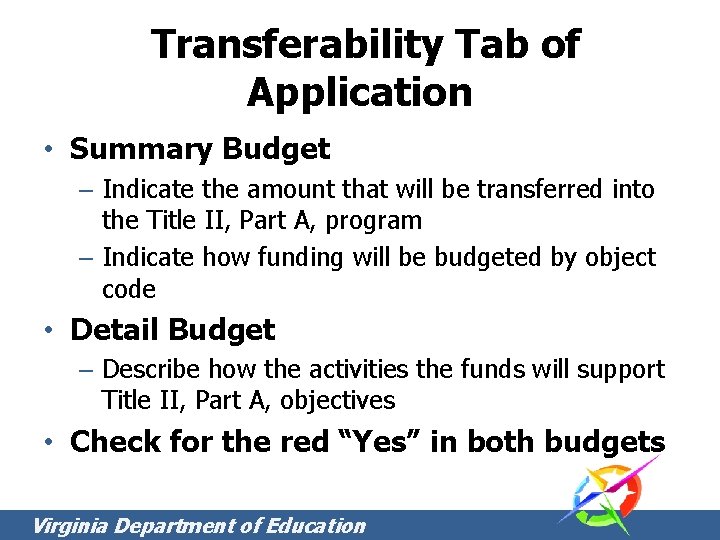
Transferability Tab of Application • Summary Budget – Indicate the amount that will be transferred into the Title II, Part A, program – Indicate how funding will be budgeted by object code • Detail Budget – Describe how the activities the funds will support Title II, Part A, objectives • Check for the red “Yes” in both budgets Virginia Department of Education
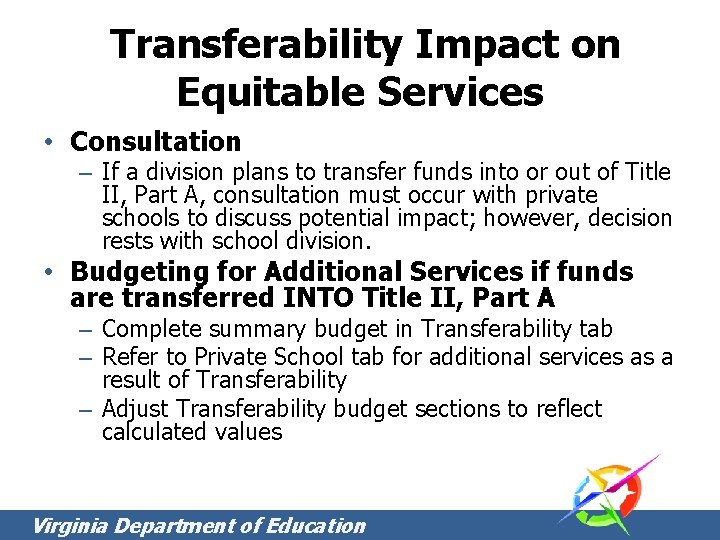
Transferability Impact on Equitable Services • Consultation – If a division plans to transfer funds into or out of Title II, Part A, consultation must occur with private schools to discuss potential impact; however, decision rests with school division. • Budgeting for Additional Services if funds are transferred INTO Title II, Part A – Complete summary budget in Transferability tab – Refer to Private School tab for additional services as a result of Transferability – Adjust Transferability budget sections to reflect calculated values Virginia Department of Education
Transferability Funds • Transferred funds will be made available in OMEGA under the program from which the funds are transferred. • These funds will essentially act as a separate award, under the award code of the original funding source, but with a new project code to reflect the new funding allowabilities under Title II, Part A, (receiving fund). • Budget transfer requests (BTR) for the transferred funds and subsequent reimbursement requests will be made under the indicated transferability award code. Virginia Department of Education 35
EQUITABLE SERVICES Virginia Department of Education
Consultation and Planning • Ombudsman responsible for collecting documentation on annual basis from school divisions: – Intent to Participate forms – Agreement of Services, to include Affirmation of Consultation (outlines plan of services and timeline) Virginia Department of Education
Formula Changes: Calculating Value of Services for Private Schools • The equitable services allocation for Title II, Part A, must be calculated on the basis of the LEA’s total Title II, Part A, allocation. • Administrative costs (e. g. , indirect costs; administration of Title II, Part A, program) are still taken “off the top. ” Virginia Department of Education
Method for Calculating Value of Services for Private Schools The LEA’s equitable services allocation is determined by first calculating the amount of Title II, Part A, funds available on a per-pupil basis, based on the total of all public and private school students (enrolled in participating private elementary and secondary schools), in schools located within the geographic boundaries of the school division - regardless of a student’s residency. – This amount is then multiplied by the number of students enrolled in participating private schools. Virginia Department of Education
FEDERAL PROGRAM MONITORING Virginia Department of Education
FPM Focus Areas • Prior Monitoring • Teacher Quality • Stakeholder Engagement and Plan Development • Use of Funds • Fiscal Processes • Parental Notifications • Equitable Services Virginia Department of Education
Stakeholder Engagement and Plan Development • Stakeholder Engagement for Title II, Part A, planning • Determining priorities • Evidence-based decision making • Use of data for determining impact of Title II, Part A, activities Virginia Department of Education
Fiscal Practices: Time and Effort Certifications • Semi-annual certifications must be kept on file for any positions paid with federal funds, including: – Class size reduction teachers – Title IIA coordinators – Professional development staff – Instructional coaches – Full-time mentors Virginia Department of Education
Fiscal Practices: Monthly Personnel Activity Reporting • For positions paid with combinations of federal funds and/or local funds, working on multiple cost objectives, a monthly Personnel Activity Report (PAR) must be completed. • Examples: – Federal coordinator, 75% from Title I and 25% from Title II – Instructional coach 75% from Title II, Part A; Classroom teacher, 25% from local funds Virginia Department of Education
Fiscal Practices: Timely Submission and Drawdown • Timely submission of initial application, revisions, and amendments • Timely drawdown of funds throughout award cycle Virginia Department of Education
Notice of Non-Qualified Teachers (4 Weeks Letter) • If a child is taught for four or more weeks by any teacher lacking proper qualifications (licensure/endorsement) in a Title I school, a letter of notification must be sent home to parents. • Examples: – Teachers with provisional licenses who have not passed Praxis II – Long-term substitutes who are not properly licensed or endorsed – Teachers of record teaching out of their area(s) of endorsement • Refer to IPAL report. Virginia Department of Education
Questions Virginia Department of Education
Contact Information Carol Sylvester Title II, Part A, Coordinator (804) 371 -0908 Carol. Sylvester@doe. virginia. gov TBD Title II/IV Specialist (804) xxx-xxxx @doe. virginia. gov Virginia Department of Education
References • Application Instructions, Guidelines, and Assurances • OMEGA Help Guide • State Travel Regulations • Non-Regulatory Guidance: Title II, Part A, Improving Teacher Quality Virginia Department of Education
Resources – Non-Regulatory Guidance: Using Evidence to Strengthen Educational Investments (September, 2016) – Criteria for High Quality Professional Development – Virginia Standards of Quality Virginia Department of Education