The NeuroOphthalmology of Headache Charles E Maxner MD






- Slides: 36
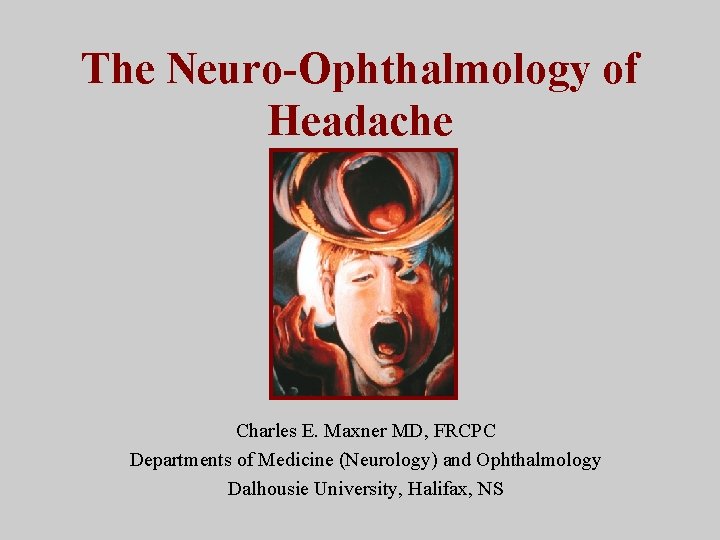
The Neuro-Ophthalmology of Headache Charles E. Maxner MD, FRCPC Departments of Medicine (Neurology) and Ophthalmology Dalhousie University, Halifax, NS
Objectives • Focus on the Primary Headache Disorders affecting the visual system • Review Migraine with Aura with emphasis on the aura • Review the concepts of Acephalgic Migraine and Retinal Migraine • Review the TAC disorders (Trigeminal Autonomic Cephalgias) • Briefly outline several interesting “headache” syndromes
Visual Disturbances of Migraine History “He seemed to see something shimmering before him like a light…a violent pain supervened in the right temple, then all in the head and neck…” Hippocrates
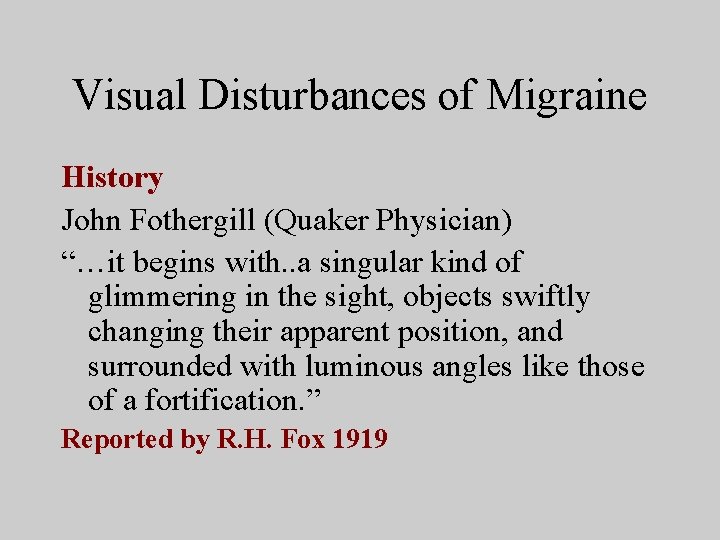
Visual Disturbances of Migraine History John Fothergill (Quaker Physician) “…it begins with. . a singular kind of glimmering in the sight, objects swiftly changing their apparent position, and surrounded with luminous angles like those of a fortification. ” Reported by R. H. Fox 1919
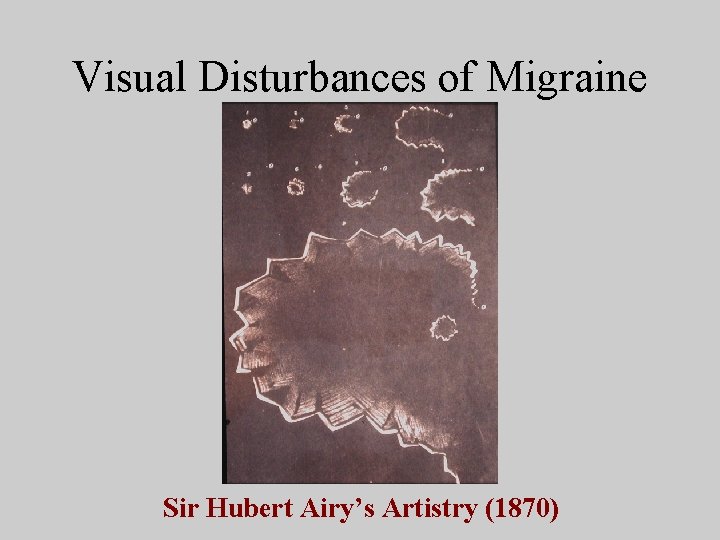
Visual Disturbances of Migraine • Sir Hubert Airy (1871): Published “On a distinct form of transient hemianopia” coining the term “teichopsia” (Greek: teichos=fortification and opsia=seeing) • X. Galezowski(1882): “ophthalmic megrim” in 3 migraineurs with CRAO • C. M. Fisher(1952): Migrainous amaurosis fugax
Visual Disturbances of Migraine Sir Hubert Airy’s Artistry (1870)
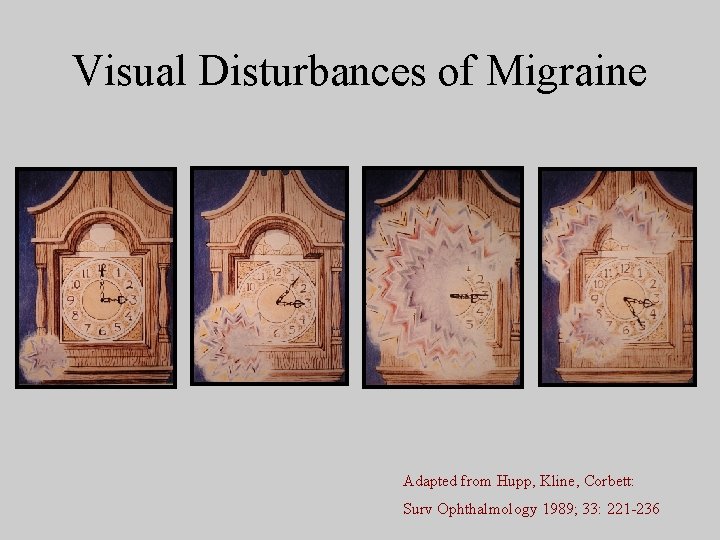
Visual Disturbances of Migraine v. IHS ICHD-2 Code 1. 2 v. Migraine with Aura • • • Positive >Negative Scotomata Often hemianopic Buildup and march 20 -30 minute duration Subsequent headache
Visual Disturbances of Migraine Adapted from Hupp, Kline, Corbett: Surv Ophthalmology 1989; 33: 221 -236
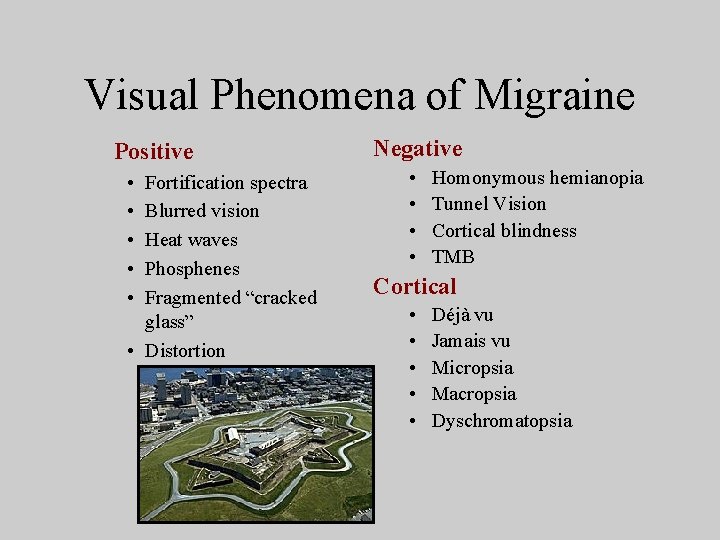
Visual Phenomena of Migraine Positive • • • Fortification spectra Blurred vision Heat waves Phosphenes Fragmented “cracked glass” • Distortion Negative • • Homonymous hemianopia Tunnel Vision Cortical blindness TMB Cortical • • • Déjà vu Jamais vu Micropsia Macropsia Dyschromatopsia
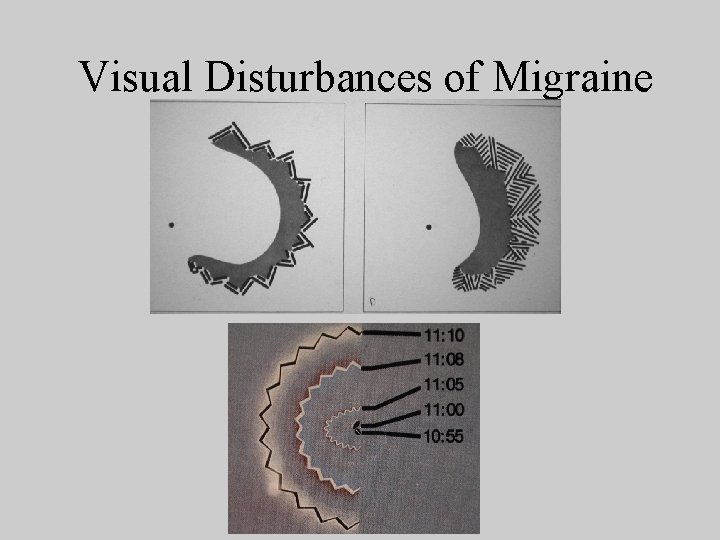
Visual Disturbances of Migraine Aura • K. Lashley calculated rate of progression of migraine scotoma as 3 mm/min over cortex (1941) • Spreading cortical depression (3 mm/min) of Leão (1944) • P. Milner(1958): “. . attention should be drawn to the striking similarity between the time courses of scintillating scotomas and Leão’s spreading depression. . ”
Visual Disturbances of Migraine
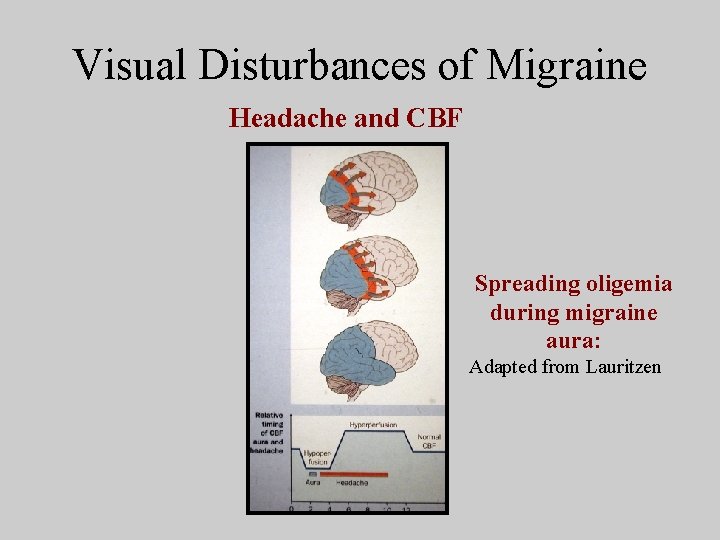
Visual Disturbances of Migraine Aura • Cerebral blood flow studies: Olesen and Lauritzen • Spreading hypoperfusion 2 mm/min • Appeared before migraine symptoms and continued into headache phase • Occasional preceding phase of hyperemia • CBF above ischemic range • Perfusion changes did not respect vascular territories Epiphenomenon?
Visual Disturbances of Migraine Headache and CBF Spreading oligemia during migraine aura: Adapted from Lauritzen
Visual Disturbances of Migraine Aura: f. MRI in Acute Attacks • Visual aura associated with decremental blood flow changes (30%) • Mean transit time increased (30%) • No DWI change observed with aura • Areas of occipital cortex contralateral to reported VF disturbance are non-responsive to standard visual stimuli during migraine visual aura • These areas correlate with area of decreased flow on PWI
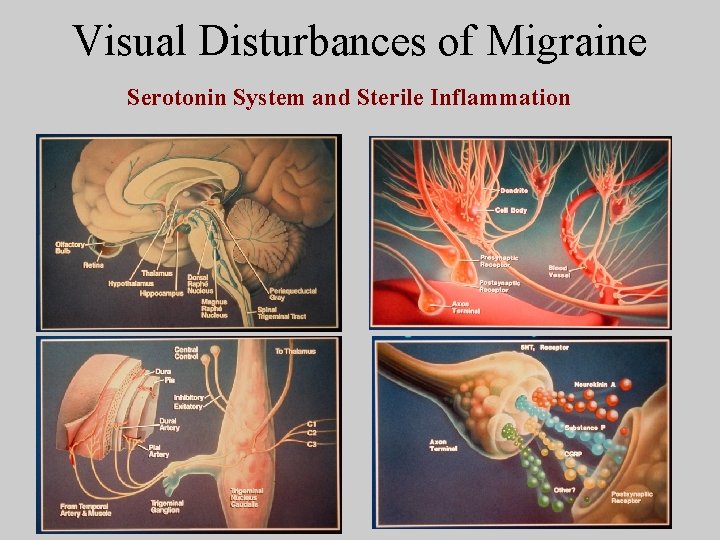
Visual Disturbances of Migraine Serotonin System and Sterile Inflammation
Visual Disturbances of Migraine Aura: Cause? • • Biochemical: Magnesium Neuro-transmitter: Serotonin Visual cortex: Aspects of Visual Input Electrical: “Migraine Generator”
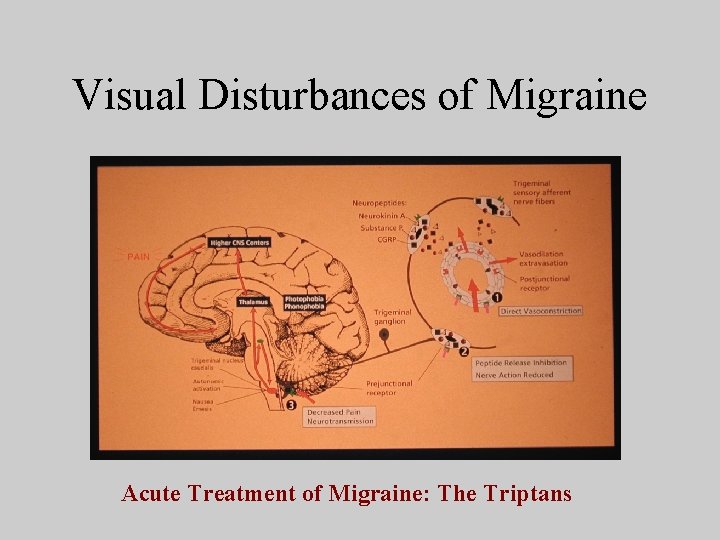
Visual Disturbances of Migraine Acute Treatment of Migraine: The Triptans
Visual Disturbances of Migraine Acephalgic Migraine • Typical aura without headache (IHS 1. 2. 3) • Episodic migrainous neurologic dysfunction of the type associated with the “classic” form of migraine but without headache • Personal or family history of migraine common • Normal examination
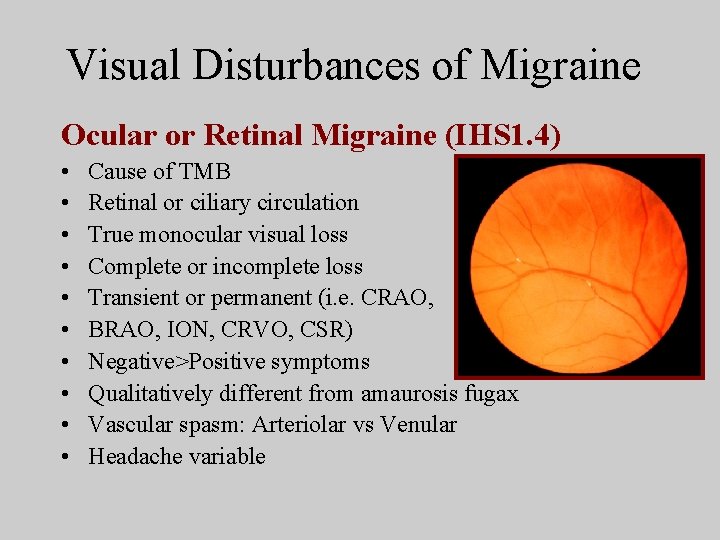
Visual Disturbances of Migraine Ocular or Retinal Migraine (IHS 1. 4) • • • Cause of TMB Retinal or ciliary circulation True monocular visual loss Complete or incomplete loss Transient or permanent (i. e. CRAO, BRAO, ION, CRVO, CSR) Negative>Positive symptoms Qualitatively different from amaurosis fugax Vascular spasm: Arteriolar vs Venular Headache variable
Visual Disturbances of Migraine • Carroll D. Retinal migraine. Headache 1970; 10: 9 -13. • Winterkorn J. et al Treatment of vasospastic amaurosis fugax with calcium channel blockers. NEJM 1993; 329: 396 -8. • Ammache Z. Idiopathic stabbing headache associated with monocular visual loss. Arch Neurol 2000; 57: 745 -6.
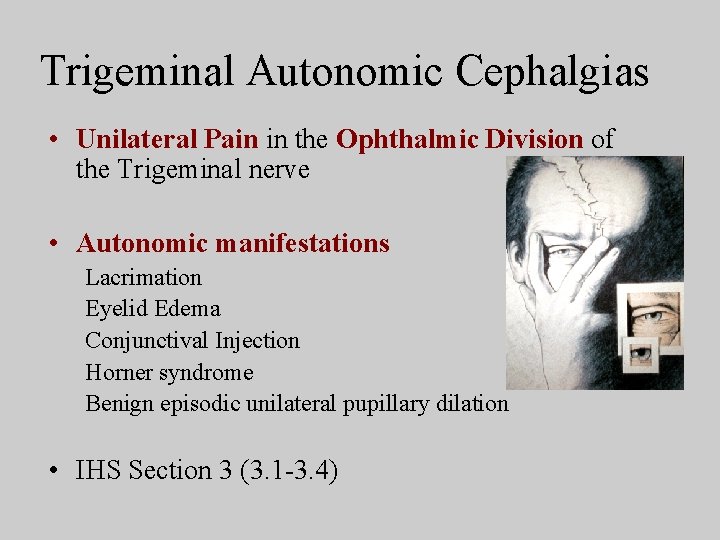
Trigeminal Autonomic Cephalgias • Unilateral Pain in the Ophthalmic Division of the Trigeminal nerve • Autonomic manifestations Lacrimation Eyelid Edema Conjunctival Injection Horner syndrome Benign episodic unilateral pupillary dilation • IHS Section 3 (3. 1 -3. 4)
Trigeminal Autonomic Cephalgias • 3. 1 Cluster Headache Episodic Chronic • 3. 2 Paroxysmal Hemicrania Episodic Chronic (CPH) • 3. 3 SUNCT Short-lasting Unilateral Neuralgiform headache attacks with Conjunctival injection and Tearing • 3. 4 Probable of 3. 1 to 3. 3
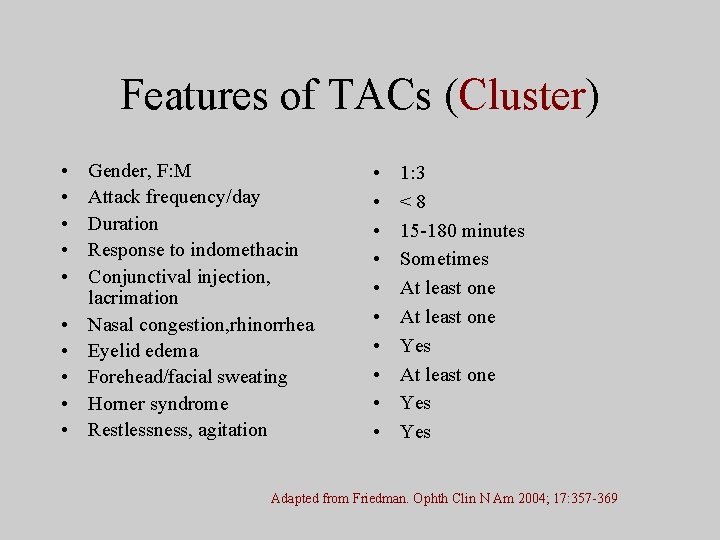
Features of TACs (Cluster) • • • Gender, F: M Attack frequency/day Duration Response to indomethacin Conjunctival injection, lacrimation Nasal congestion, rhinorrhea Eyelid edema Forehead/facial sweating Horner syndrome Restlessness, agitation • • • 1: 3 <8 15 -180 minutes Sometimes At least one Yes Adapted from Friedman. Ophth Clin N Am 2004; 17: 357 -369
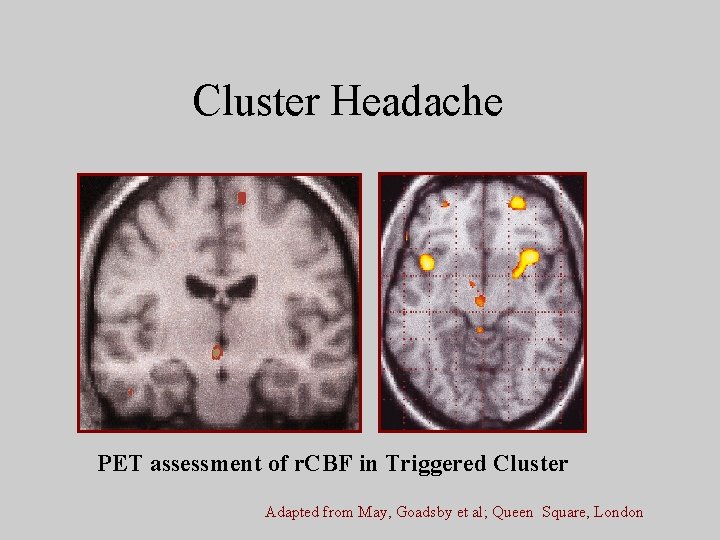
Cluster Headache PET assessment of r. CBF in Triggered Cluster Adapted from May, Goadsby et al; Queen Square, London
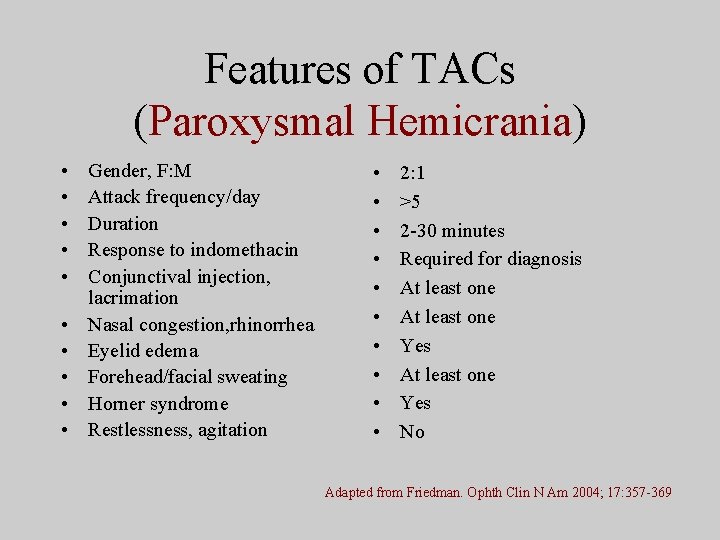
Features of TACs (Paroxysmal Hemicrania) • • • Gender, F: M Attack frequency/day Duration Response to indomethacin Conjunctival injection, lacrimation Nasal congestion, rhinorrhea Eyelid edema Forehead/facial sweating Horner syndrome Restlessness, agitation • • • 2: 1 >5 2 -30 minutes Required for diagnosis At least one Yes No Adapted from Friedman. Ophth Clin N Am 2004; 17: 357 -369
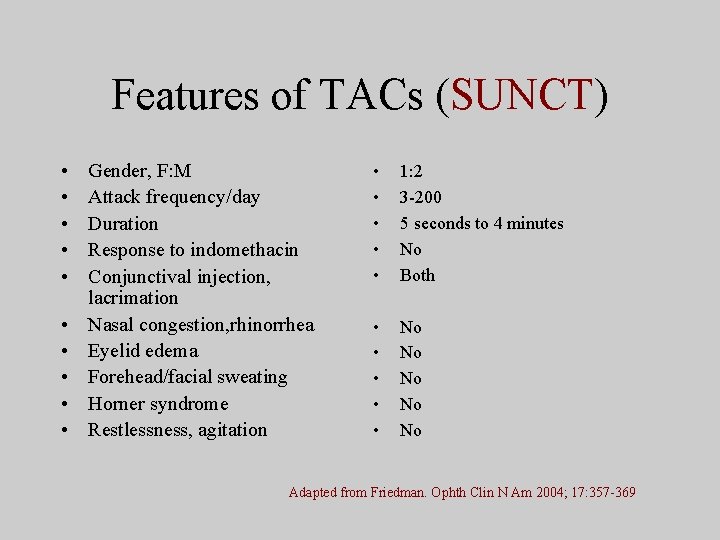
Features of TACs (SUNCT) • • • Gender, F: M Attack frequency/day Duration Response to indomethacin Conjunctival injection, lacrimation Nasal congestion, rhinorrhea Eyelid edema Forehead/facial sweating Horner syndrome Restlessness, agitation • • • 1: 2 3 -200 5 seconds to 4 minutes No Both • • • No No No Adapted from Friedman. Ophth Clin N Am 2004; 17: 357 -369
Ice-Pick-Like Headache • IHS 4. 1 Primary Stabbing Headache • “Needle-in-the-eye” syndrome • Sharp jabbing pain in orbit, temple, parietal and occasionally occipital area • Seconds duration, may have afterburn • Episodes: rare to multiple per day • Most often in migraineurs • Non-steroidal prophylaxis
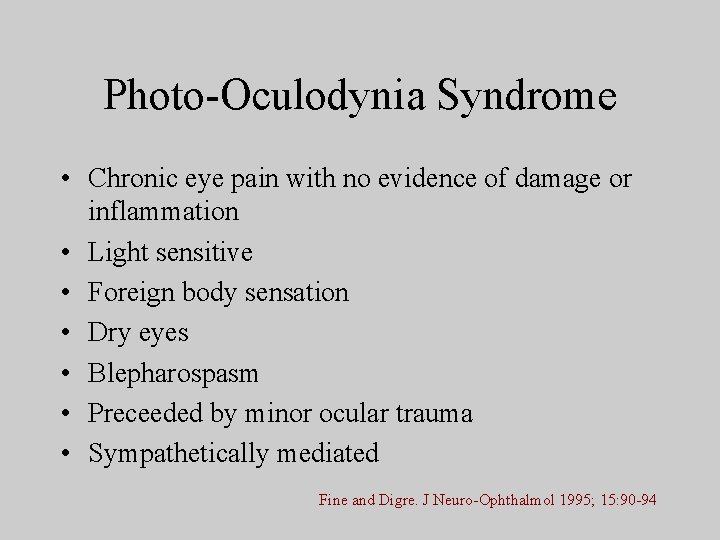
Photo-Oculodynia Syndrome • Chronic eye pain with no evidence of damage or inflammation • Light sensitive • Foreign body sensation • Dry eyes • Blepharospasm • Preceeded by minor ocular trauma • Sympathetically mediated Fine and Digre. J Neuro-Ophthalmol 1995; 15: 90 -94
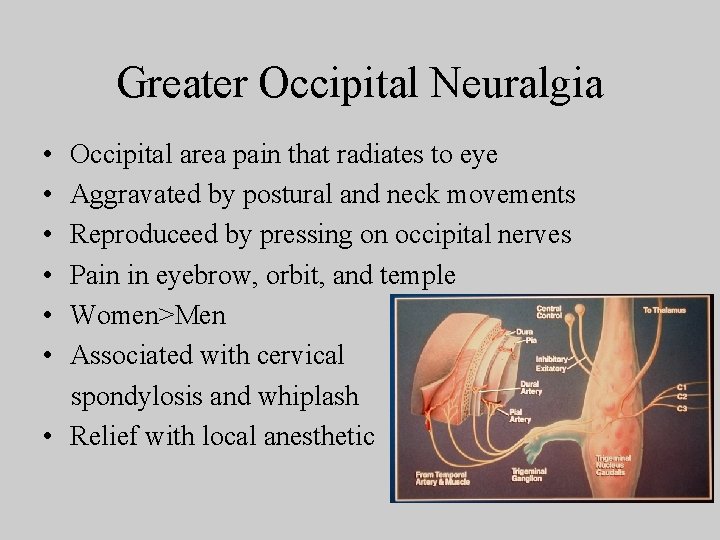
Greater Occipital Neuralgia • • • Occipital area pain that radiates to eye Aggravated by postural and neck movements Reproduceed by pressing on occipital nerves Pain in eyebrow, orbit, and temple Women>Men Associated with cervical spondylosis and whiplash • Relief with local anesthetic
Ophthalmoplegic “Migraine” • No longer a “migraine” disorder • Considered a Cranial Neuralgia (IHS 13. 17) • At least 2 attacks of migraine headache associated with paresis of one or more CN (CN III more frequent than IV or VI) • Pain ipsilateral to paresis • CN palsy accompanies headache or follows it within 4 days • No MRI lesions except within the nerve • Rare; Onset in childhood • Ophthalmoplegia may be permanent and aberrant regeneration is rare
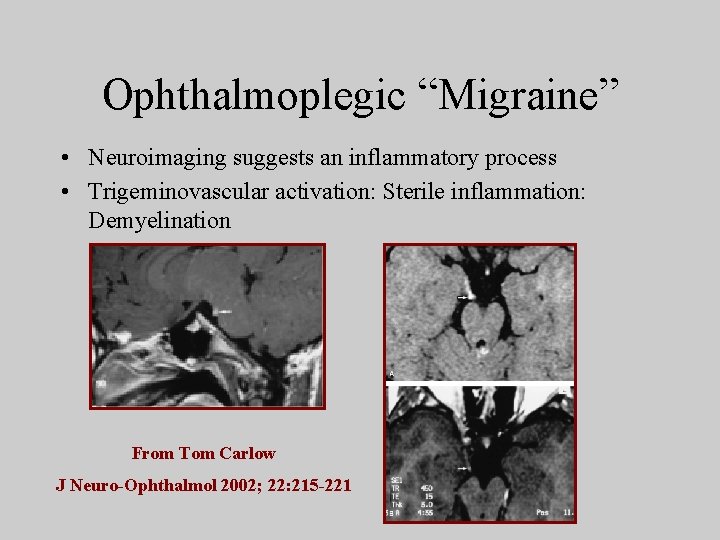
Ophthalmoplegic “Migraine” • Neuroimaging suggests an inflammatory process • Trigeminovascular activation: Sterile inflammation: Demyelination From Tom Carlow J Neuro-Ophthalmol 2002; 22: 215 -221
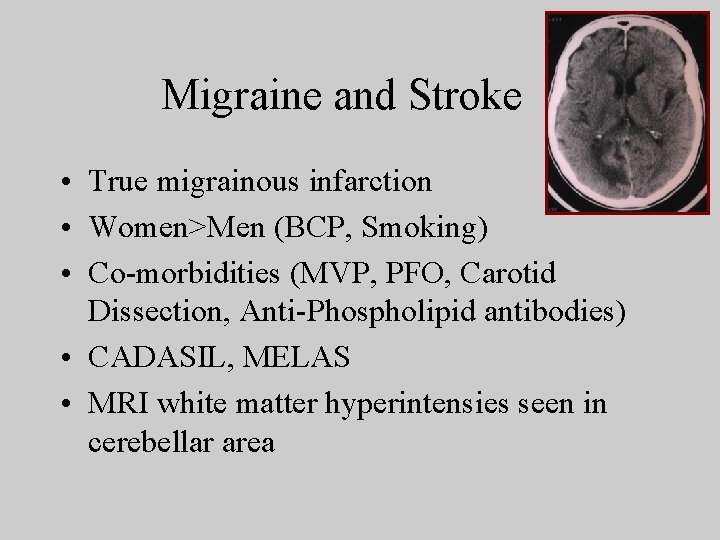
Migraine and Stroke • True migrainous infarction • Women>Men (BCP, Smoking) • Co-morbidities (MVP, PFO, Carotid Dissection, Anti-Phospholipid antibodies) • CADASIL, MELAS • MRI white matter hyperintensies seen in cerebellar area
Secondary Headache Disorders with Neuro-Ophthalmic Features • • • Carotid dissection PCA aneurysm Giant Cell Arteritis Pituitary Apoplexy IIH (Pseudotumor Cerebri) • H. Zoster (V 1) • Brain tumour • Tolosa-Hunt Syndrome • Inflammatory Orbital Pseudotumour • Optic Neuritis • Occipital lobe CVA
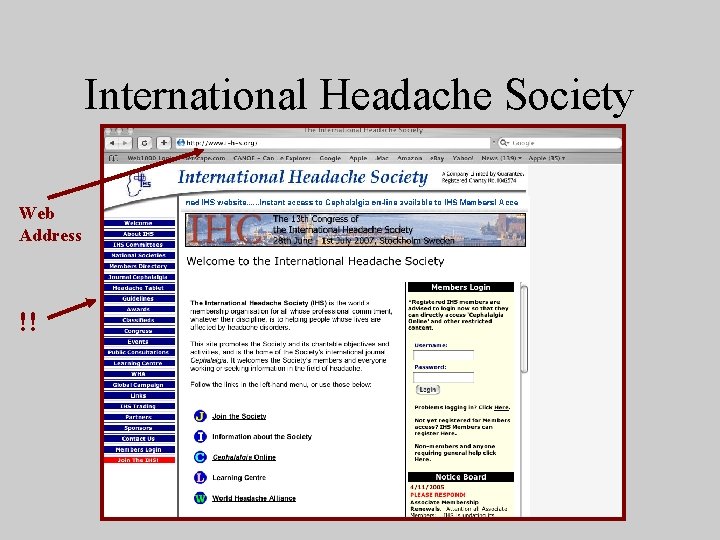
International Headache Society Web Address !!
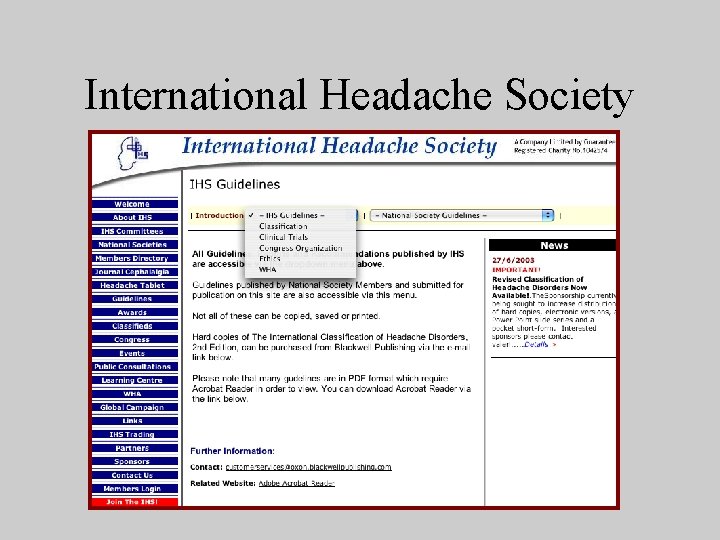
International Headache Society
Further Reading • • • Rapoport A, Edmeads J. Migraine: The Evolution of Our Knowledge. Arch Neurol 2000; 57: 1221 -1223. Corbett J. J. Neuro-Ophthalmic Complications of Migraine and Cluster Headaches. Neurologic Clinics 1983; 1: 973 -995. Hupp S. L. , Kline L. , Corbett J. J. Visual Disturbances of Migraine. Survey of Ophthalmology 1989; 33: 221 -236. Friedman D. I. The eye and headache. Ophthalmol Clin N Am 2004; 17: 357369. Lance J. W. , Goadsby P. J. Mechanism and Management of Headache. Seventh Edition. 2005; Elseveier-Butterworth-Heinemann Publishers Purdy R. A. , Rapoport A. M. , Sheftell F. , Tepper J. Advanced Therapy of Headache: 2 nd Edition. 2005; B. C. Decker Inc