Focus on Headache Relates to Chapter 59 Nursing
- Slides: 51
Focus on Headache (Relates to Chapter 59, “Nursing Management: Chronic Neurologic Problems, ” in the textbook) Copyright © 2011, 2007 by Mosby, Inc. , an affiliate of Elsevier Inc. Copyright © 2007, 2004, 2000, Mosby, Inc. , an affiliate of Elsevier Inc. All Rights Reserved.
Headache § Probably the most common type of pain experienced by humans § Majority of people have functional headaches § Migraine or tension-type headaches Copyright © 2011, 2007 by Mosby, Inc. , an affiliate of Elsevier Inc. 2
Headache § Not all cranium tissues are sensitive to pain. § Pain-sensitive structures include venous sinuses, dura, cranial blood vessels, divisions of the trigeminal nerve, facial nerve, glossopharyngeal nerve, vagus nerve, and the first three cervical nerves. Copyright © 2011, 2007 by Mosby, Inc. , an affiliate of Elsevier Inc. 3
Headache § Classification from the International Headache Society diagnostic criteria § Primary classifications § Tension-type § Migraine § Cluster Copyright © 2011, 2007 by Mosby, Inc. , an affiliate of Elsevier Inc. 4
Tension-Type Headache § Most common type § Bilateral, bandlike feeling of pressure around the head § Constant, squeezing tightness § Not aggravated by physical activity § Often subcategorized into § Episodic § Chronic Copyright © 2011, 2007 by Mosby, Inc. , an affiliate of Elsevier Inc. 5
Tension-Type Headache Etiology and Pathophysiology § Mechanism in all patients with tensiontype headaches has neurovascular factors similar to those involved in migraine headaches. Copyright © 2011, 2007 by Mosby, Inc. , an affiliate of Elsevier Inc. 6
Tension-Type Headache Clinical Manifestations § § No nausea or vomiting May involve sensitivity to light and sound May occur intermittently Can have combination of migraine and tension-type headaches Copyright © 2011, 2007 by Mosby, Inc. , an affiliate of Elsevier Inc. 7
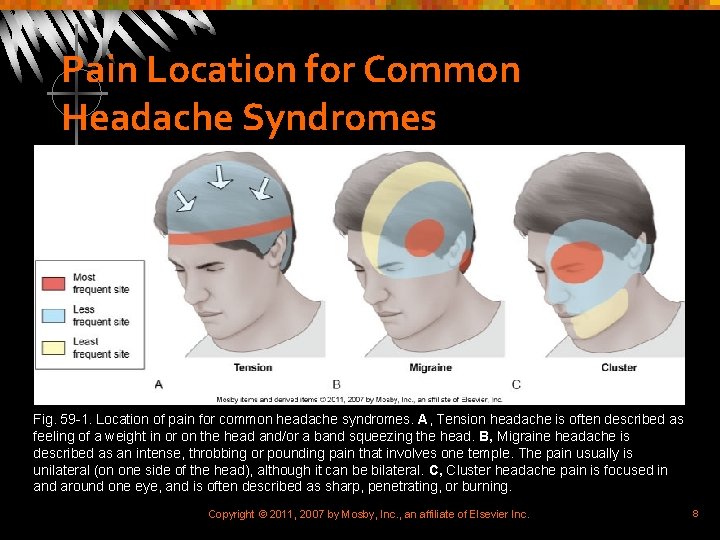
Pain Location for Common Headache Syndromes Fig. 59 -1. Location of pain for common headache syndromes. A, Tension headache is often described as feeling of a weight in or on the head and/or a band squeezing the head. B, Migraine headache is described as an intense, throbbing or pounding pain that involves one temple. The pain usually is unilateral (on one side of the head), although it can be bilateral. C, Cluster headache pain is focused in and around one eye, and is often described as sharp, penetrating, or burning. Copyright © 2011, 2007 by Mosby, Inc. , an affiliate of Elsevier Inc. 8
Tension-Type Headache Diagnostic Studies § Careful history taking § Electromyography may be performed. § May reveal sustained contraction of neck, scalp, or facial muscles § May not show increased tension even when test is done during headache Copyright © 2011, 2007 by Mosby, Inc. , an affiliate of Elsevier Inc. 9
Migraine Headache § Recurring § Characterized by unilateral or bilateral throbbing pain § Triggering event or factor § Strong family history Copyright © 2011, 2007 by Mosby, Inc. , an affiliate of Elsevier Inc. 10
Migraine Headache § Manifestations associated with neurologic and autoimmune nervous system function § More common in females than males § In United States, prevalence highest in those of lower socioeconomic status Copyright © 2011, 2007 by Mosby, Inc. , an affiliate of Elsevier Inc. 11
Migraine Headache Etiology and Pathophysiology § Evidence suggests vascular, muscular, and biochemical factors are involved. § Exact cause is unknown. Copyright © 2011, 2007 by Mosby, Inc. , an affiliate of Elsevier Inc. 12
Migraine Headache Etiology and Pathophysiology § Can be preceded by an aura and prodrome § May precede by days or hours § Aura associated with wave of oligemia, beginning at occipital lobe and spreading forward Copyright © 2011, 2007 by Mosby, Inc. , an affiliate of Elsevier Inc. 13
Migraine Headache Etiology and Pathophysiology § May be precipitated or triggered by § § § § Food Hormonal fluctuations Head trauma Physical exertion Fatigue Stress Pharmacologic agents Copyright © 2011, 2007 by Mosby, Inc. , an affiliate of Elsevier Inc. 14
Migraine Headache Clinical Manifestations § Subdivided into five categories § Two most important are § Migraine with aura § Migraine without aura is the most common. Copyright © 2011, 2007 by Mosby, Inc. , an affiliate of Elsevier Inc. 15
Migraine Headache Clinical Manifestations § Aura § May start 10 to 30 minutes before the start of headache § May include sensory dysfunction, motor dysfunction, dizziness, confusion, and even loss of consciousness Copyright © 2011, 2007 by Mosby, Inc. , an affiliate of Elsevier Inc. 16
Migraine Headache Clinical Manifestations § Clinical manifestations with migraines § § § Generalized edema Irritability Pallor Nausea, vomiting Sweating Copyright © 2011, 2007 by Mosby, Inc. , an affiliate of Elsevier Inc. 17
Migraine Headache Clinical Manifestations § During headache, some patients “hibernate. ” § Seek shelter from noise, light, odors, people, and problems § Headache is described as steady, throbbing pain that matches the pulse. Copyright © 2011, 2007 by Mosby, Inc. , an affiliate of Elsevier Inc. 18
Migraine Headache Clinical Manifestations § Pain is usually unilateral but may switch to other side in another episode. § Symptoms may worsen over time. § Severity is varied. § Not all migraines are disabling. Copyright © 2011, 2007 by Mosby, Inc. , an affiliate of Elsevier Inc. 19
Migraine Headache Diagnostic Studies § No specific laboratory or radiologic tests § Diagnosis is usually made from history. § Neurologic and diagnostic examinations are normal. Copyright © 2011, 2007 by Mosby, Inc. , an affiliate of Elsevier Inc. 20
Migraine Headache Diagnostic Studies § IHS criteria are used as clinical basis. § Neuroimaging techniques are not recommended unless abnormal findings are found on examination. Copyright © 2011, 2007 by Mosby, Inc. , an affiliate of Elsevier Inc. 21
Cluster Headache § Rare form of headache § Characterized by repeated headaches that occur for weeks or months at a time, followed by periods of remission § One of the most severe forms of head pain Copyright © 2011, 2007 by Mosby, Inc. , an affiliate of Elsevier Inc. 22
Cluster Headache Etiology and Pathophysiology § Neither cause nor pathophysiologic mechanism is known. § Extracranial vasodilation occurs in affected part of face. § Trigeminal nerve is implicated. Copyright © 2011, 2007 by Mosby, Inc. , an affiliate of Elsevier Inc. 23
Cluster Headache Clinical Manifestations § Sharp stabbing § Intense pain typically lasting from a few minutes to 3 hours § Pain is usually located around the eye, radiating to the temple, forehead, cheek, nose, or gums. Copyright © 2011, 2007 by Mosby, Inc. , an affiliate of Elsevier Inc. 24
Cluster Headache Clinical Manifestations § Other manifestations include § § § Swelling around the eye Lacrimation Facial flushing or pallor Rhinitis Constriction of the pupil Copyright © 2011, 2007 by Mosby, Inc. , an affiliate of Elsevier Inc. 25
Cluster Headache Clinical Manifestations § During the headache, patient is often agitated and restless. § Headaches occur with regularity. § Usually occur at same time of day § Typically last daily for 2 weeks to 3 months, then into remission for months or years Copyright © 2011, 2007 by Mosby, Inc. , an affiliate of Elsevier Inc. 26
Cluster Headache Diagnostic Studies § Diagnosis may be based primarily on history. § Headache diaries are helpful. § CT scan, MRI, or MRA may be performed to rule out aneurysm, tumor, or infection. Copyright © 2011, 2007 by Mosby, Inc. , an affiliate of Elsevier Inc. 27
Headache Other Types § Can be first symptom of a more serious illness § Can accompany subarachnoid hemorrhage; brain tumors; other intracranial masses; arteritis; vascular abnormalities; trigeminal neuralgia; diseases of the eyes, nose, and teeth; and systemic illness Copyright © 2011, 2007 by Mosby, Inc. , an affiliate of Elsevier Inc. 28
Headache Other Types § Symptoms may vary greatly. § Clinical evaluation must be thorough. § § Personality Life adjustment Environment Family situation Copyright © 2011, 2007 by Mosby, Inc. , an affiliate of Elsevier Inc. 29
Headache Collaborative Care § If no systemic underlying disease is found, therapy is directed toward functional type of headache. § Symptomatic and prophylactic therapies are used. § Including drugs, medications, yoga, biofeedback, cognitive-behavioral therapy, and relaxation training Copyright © 2011, 2007 by Mosby, Inc. , an affiliate of Elsevier Inc. 30
Headache Collaborative Care § Drug therapy § Tension-type headache § Nonopioid analgesic is used alone or in combination with a sedative, muscle relaxant, tranquilizer, or codeine. Copyright © 2011, 2007 by Mosby, Inc. , an affiliate of Elsevier Inc. 31
Headache Collaborative Care § Drug therapy § Migraine headache § Goal of acute migraine attack is to terminate or reduce symptoms. § Mild to moderate headache can obtain relief with aspirin or acetaminophen. Copyright © 2011, 2007 by Mosby, Inc. , an affiliate of Elsevier Inc. 32
Headache Collaborative Care § Drug therapy § Migraine headache § For moderate to severe, triptans have become first line of therapy. § Affect selected serotonin receptors § Reduce neurogenic inflammation of cerebral blood vessels § Produce vasoconstriction Copyright © 2011, 2007 by Mosby, Inc. , an affiliate of Elsevier Inc. 33
Headache Collaborative Care § Drug therapy § Migraine headache § Preventive treatment § Topiramate (Topamax) § Valproic acid (Depakote) § β-adrenergic blockers § Selective serotonin reuptake inhibitors § Calcium channel blockers § Divalproex, clonidine, and thiazides § Botox Copyright © 2011, 2007 by Mosby, Inc. , an affiliate of Elsevier Inc. 34
Headache Collaborative Care § Drug therapy § Cluster headache § Drug therapy not as useful as for other headaches § Prophylactic drugs may include verapamil, lithium, ergotamine, divalproex, or NSAIDs. Copyright © 2011, 2007 by Mosby, Inc. , an affiliate of Elsevier Inc. 35
Headache Collaborative Care § Drug therapy § Cluster headache § Acute treatment is inhalation of 100% oxygen delivered at a rate of 6 to 8 L per minute for 10 to 20 minutes. § Sumatriptan also effective for acute cluster headache § Invasive nerve blocks and ablative neurosurgical procedures have been used for refractory cluster headaches. Copyright © 2011, 2007 by Mosby, Inc. , an affiliate of Elsevier Inc. 36
Headache Nursing Management § Nursing assessment § Health history § Seizures, cancer, stroke, trauma, asthma or allergies, mental illness, stress, menstruation, exercise, food, bright lights, noxious stimuli § Medications § Surgery and other treatments Copyright © 2011, 2007 by Mosby, Inc. , an affiliate of Elsevier Inc. 37
Headache Nursing Management § Nursing assessment § Health history (cont’d) § Specific details about the headache § Location § Type of pain § Onset § Frequency § Duration, time of day § Relation to outside events Copyright © 2011, 2007 by Mosby, Inc. , an affiliate of Elsevier Inc. 38
Headache Nursing Management § Nursing assessment (cont’d) § Objective data § Anxiety or apprehension § Diaphoresis, pallor, unilateral flushing with cheek edema, conjunctivitis Copyright © 2011, 2007 by Mosby, Inc. , an affiliate of Elsevier Inc. 39
Headache Nursing Management § Nursing diagnoses § Acute pain § Anxiety § Hopelessness Copyright © 2011, 2007 by Mosby, Inc. , an affiliate of Elsevier Inc. 40
Headache Nursing Management § Planning § Have decreased or no pain § Experience increased comfort and reduced anxiety § Demonstrate understanding of triggering events and treatment strategies Copyright © 2011, 2007 by Mosby, Inc. , an affiliate of Elsevier Inc. 41
Headache Nursing Management § Planning § Use positive coping strategies to deal with chronic pain. § Experience ↑ quality of life Copyright © 2011, 2007 by Mosby, Inc. , an affiliate of Elsevier Inc. 42
Headache Nursing Management § Nursing implementation § Daily exercise, relaxation periods, and socializing help reduce recurrence and should be encouraged. § Suggest alternative pain management such as relaxation, meditation, yoga, and selfhypnosis. Copyright © 2011, 2007 by Mosby, Inc. , an affiliate of Elsevier Inc. 43
Headache Nursing Management § Nursing implementation (cont’d) § Massage and heat packs can help with tension-type. § Patient should make a written note of medications to prevent accidental overdose. Copyright © 2011, 2007 by Mosby, Inc. , an affiliate of Elsevier Inc. 44
Headache Nursing Management § Nursing implementation (cont’d) § Teach patient about prophylactic treatment. § Dietary counseling for food triggers § Avoid smoking and smoke exposure and other environmental triggers. Copyright © 2011, 2007 by Mosby, Inc. , an affiliate of Elsevier Inc. 45
Case Study Copyright © 2011, 2007 by Mosby, Inc. , an affiliate of Elsevier Inc. Copyright © 2007, 2004, 2000, Mosby, Inc. , an affiliate of Elsevier Inc. All Rights Reserved. 46
Case Study § 25 -year-old woman presents to clinic with throbbing headaches with photosensitivity. § Her headaches become so intense, they cause nausea and occasionally vomiting. Copyright © 2011, 2007 by Mosby, Inc. , an affiliate of Elsevier Inc. 47
Case Study § She states that the OTC pain medication has not provided much relief for her pain. § She began to develop the intermittent headaches about a year ago. Copyright © 2011, 2007 by Mosby, Inc. , an affiliate of Elsevier Inc. 48
Case Study § She believes her headaches have been getting worse over time. § To obtain relief, she usually shuts herself in a dark room. Copyright © 2011, 2007 by Mosby, Inc. , an affiliate of Elsevier Inc. 49
Case Study § She has a family history of headaches. § MRI and CT are negative for abnormalities. § She is diagnosed with migraine headaches. Copyright © 2011, 2007 by Mosby, Inc. , an affiliate of Elsevier Inc. 50
Discussion Questions 1. What can you tell her about treatment with medications? 2. What alternative therapies may help her? 3. What possible triggers should she avoid? Copyright © 2011, 2007 by Mosby, Inc. , an affiliate of Elsevier Inc. 51