
VAIDYANATHAN COMMITTEE REPORT ON REVIVAL OF CREDIT COOPERATIVE
- Slides: 28
VAIDYANATHAN COMMITTEE REPORT ON REVIVAL OF CREDIT COOPERATIVE INSTITUTIONS Vaidyanathan committee report
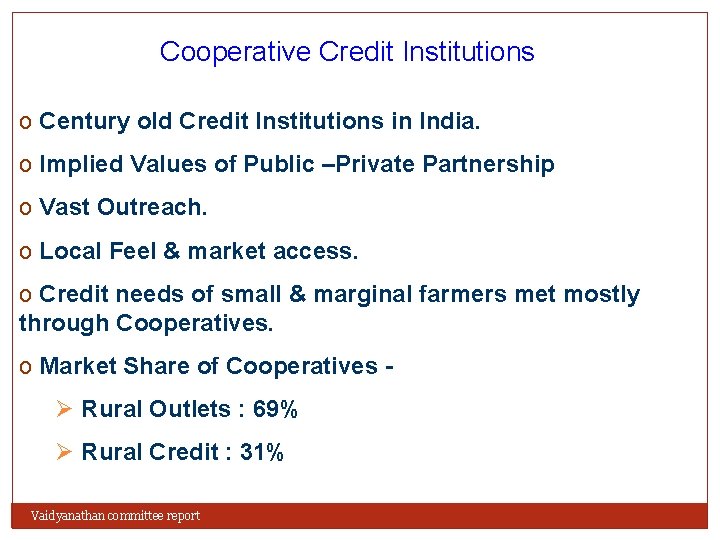
Cooperative Credit Institutions o Century old Credit Institutions in India. o Implied Values of Public –Private Partnership o Vast Outreach. o Local Feel & market access. o Credit needs of small & marginal farmers met mostly through Cooperatives. o Market Share of Cooperatives Ø Rural Outlets : 69% Ø Rural Credit : 31% Vaidyanathan committee report
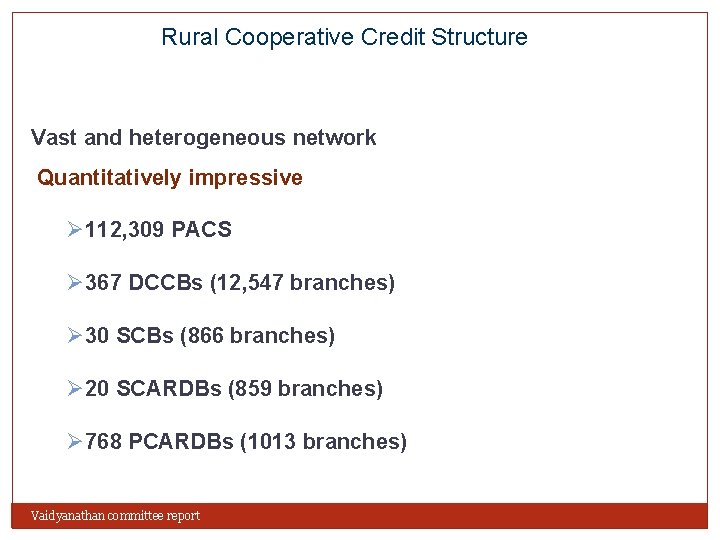
Rural Cooperative Credit Structure Vast and heterogeneous network Quantitatively impressive Ø 112, 309 PACS Ø 367 DCCBs (12, 547 branches) Ø 30 SCBs (866 branches) Ø 20 SCARDBs (859 branches) Ø 768 PCARDBs (1013 branches) Vaidyanathan committee report
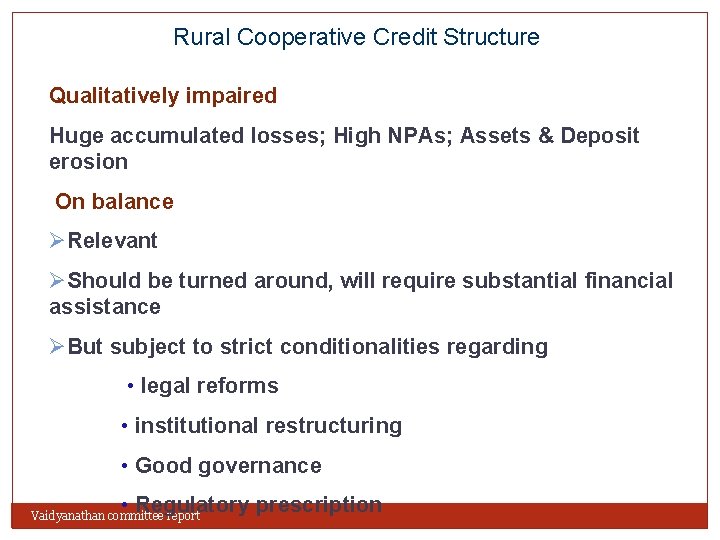
Rural Cooperative Credit Structure Qualitatively impaired Huge accumulated losses; High NPAs; Assets & Deposit erosion On balance ØRelevant ØShould be turned around, will require substantial financial assistance ØBut subject to strict conditionalities regarding • legal reforms • institutional restructuring • Good governance • Regulatory prescription Vaidyanathan committee report
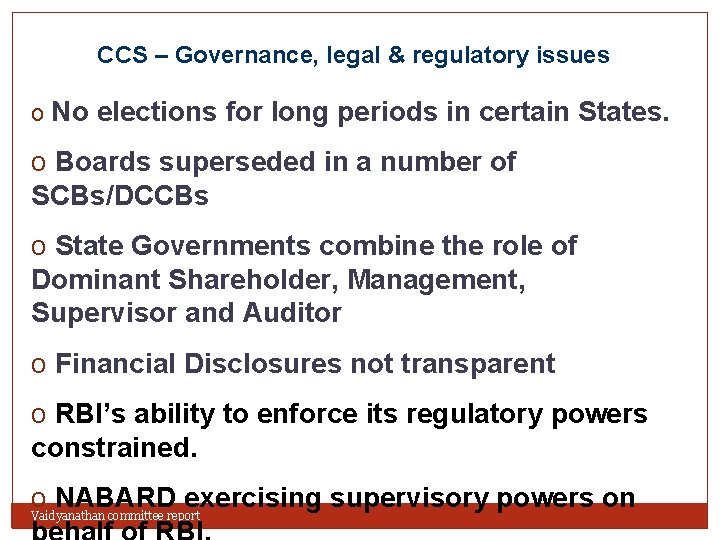
CCS – Governance, legal & regulatory issues o No elections for long periods in certain States. o Boards superseded in a number of SCBs/DCCBs o State Governments combine the role of Dominant Shareholder, Management, Supervisor and Auditor o Financial Disclosures not transparent o RBI’s ability to enforce its regulatory powers constrained. o NABARD exercising supervisory powers on Vaidyanathan committee report
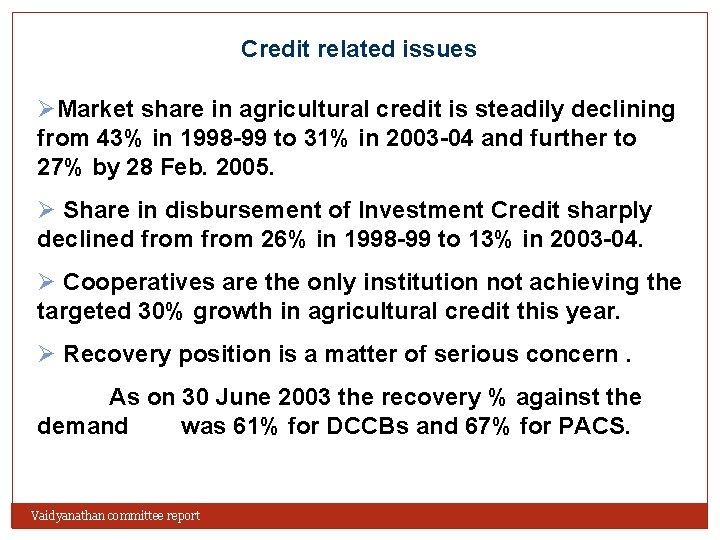
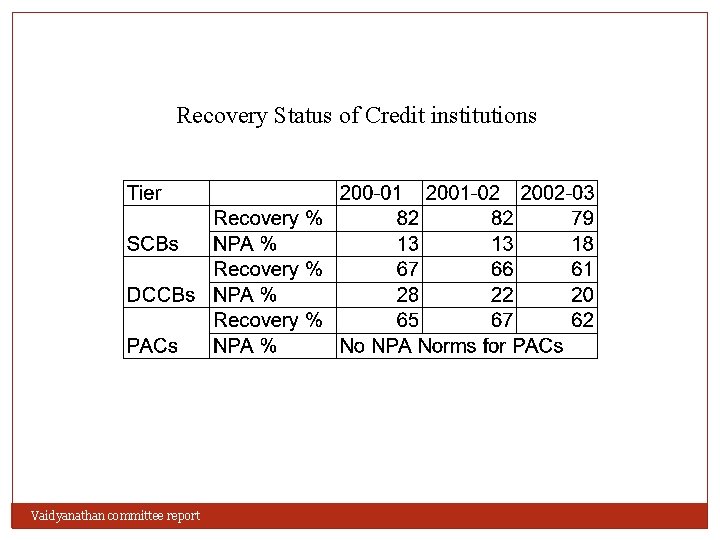
Credit related issues ØMarket share in agricultural credit is steadily declining from 43% in 1998 -99 to 31% in 2003 -04 and further to 27% by 28 Feb. 2005. Ø Share in disbursement of Investment Credit sharply declined from 26% in 1998 -99 to 13% in 2003 -04. Ø Cooperatives are the only institution not achieving the targeted 30% growth in agricultural credit this year. Ø Recovery position is a matter of serious concern. As on 30 June 2003 the recovery % against the demand was 61% for DCCBs and 67% for PACS. Vaidyanathan committee report
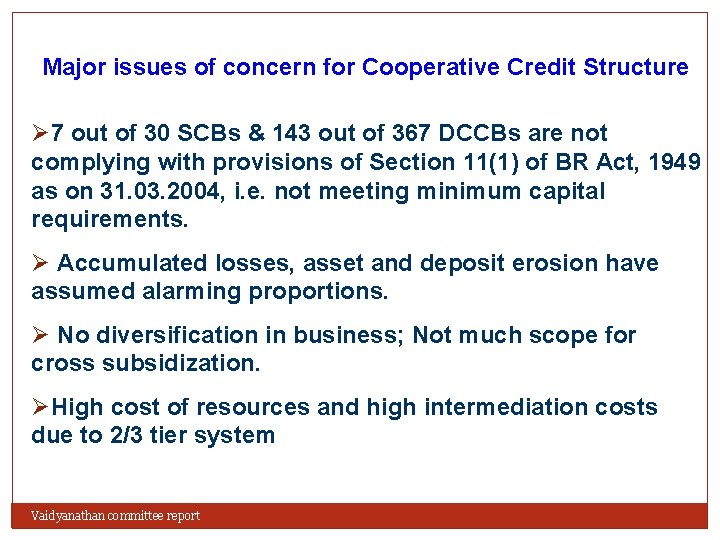
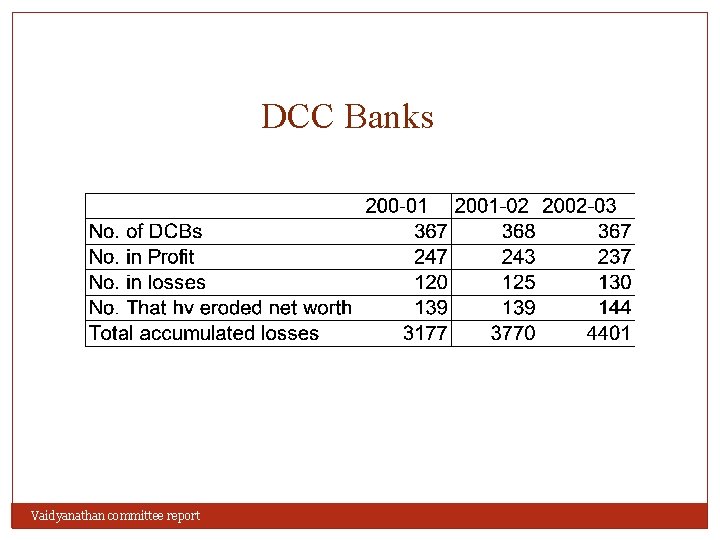
Major issues of concern for Cooperative Credit Structure Ø 7 out of 30 SCBs & 143 out of 367 DCCBs are not complying with provisions of Section 11(1) of BR Act, 1949 as on 31. 03. 2004, i. e. not meeting minimum capital requirements. Ø Accumulated losses, asset and deposit erosion have assumed alarming proportions. Ø No diversification in business; Not much scope for cross subsidization. ØHigh cost of resources and high intermediation costs due to 2/3 tier system Vaidyanathan committee report
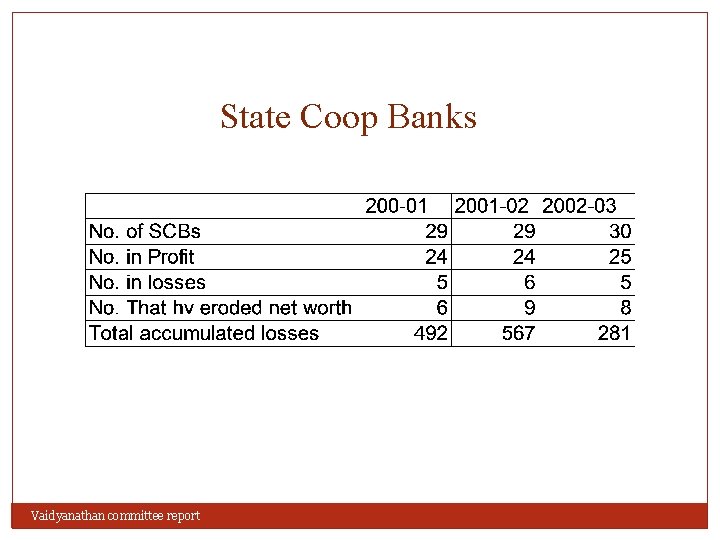
State Coop Banks Vaidyanathan committee report
DCC Banks Vaidyanathan committee report
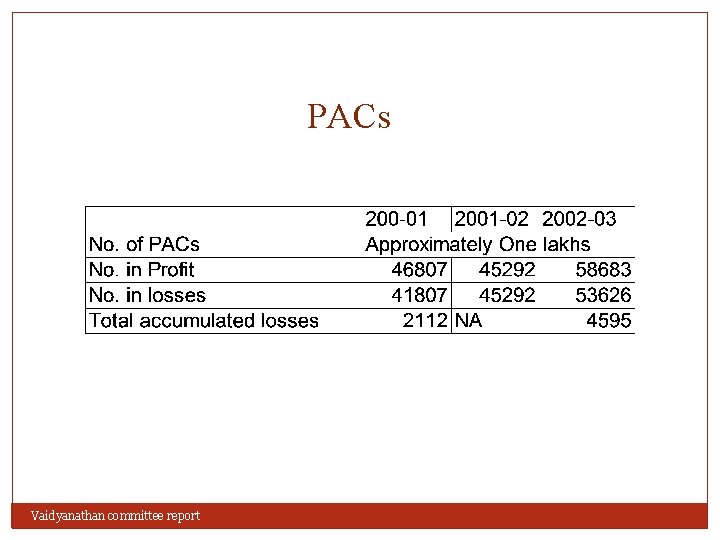
PACs Vaidyanathan committee report
Recovery Status of Credit institutions Vaidyanathan committee report
Major issues of concern for Cooperative Credit Structure …. . Contd. ØHigh NPAs ; high risk premium in lending ØLoan appraisal systems, monitoring very poor; Ø Poor internal checks and controls; Ø Financial disclosures not transparent. Ø Duality of control. Ø Poor HR practices; non-professional banking staff. Ø PACS very weak; nearly half of them incurring losses; need for reorganisation and modern business development models. Vaidyanathan committee report
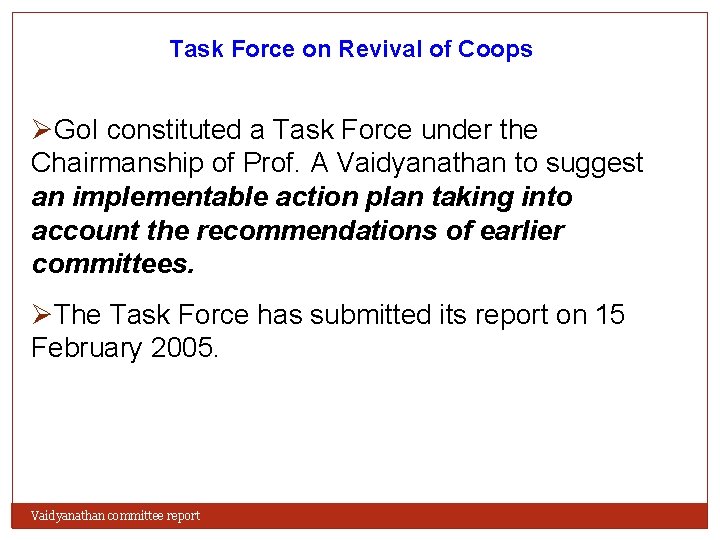
Task Force on Revival of Coops ØGo. I constituted a Task Force under the Chairmanship of Prof. A Vaidyanathan to suggest an implementable action plan taking into account the recommendations of earlier committees. ØThe Task Force has submitted its report on 15 February 2005. Vaidyanathan committee report
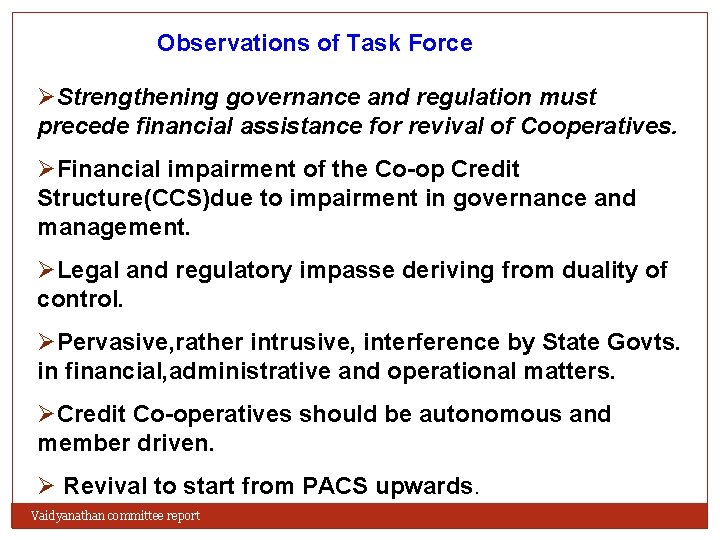
Observations of Task Force ØStrengthening governance and regulation must precede financial assistance for revival of Cooperatives. ØFinancial impairment of the Co-op Credit Structure(CCS)due to impairment in governance and management. ØLegal and regulatory impasse deriving from duality of control. ØPervasive, rather intrusive, interference by State Govts. in financial, administrative and operational matters. ØCredit Co-operatives should be autonomous and member driven. Ø Revival to start from PACS upwards. Vaidyanathan committee report
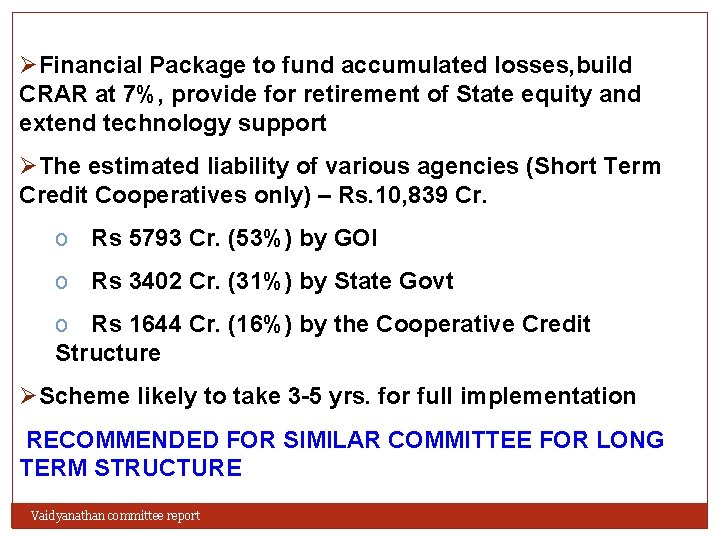
ØFinancial Package to fund accumulated losses, build CRAR at 7%, provide for retirement of State equity and extend technology support ØThe estimated liability of various agencies (Short Term Credit Cooperatives only) – Rs. 10, 839 Cr. o Rs 5793 Cr. (53%) by GOI o Rs 3402 Cr. (31%) by State Govt o Rs 1644 Cr. (16%) by the Cooperative Credit Structure ØScheme likely to take 3 -5 yrs. for full implementation RECOMMENDED FOR SIMILAR COMMITTEE FOR LONG TERM STRUCTURE Vaidyanathan committee report
Package of Revival of Credit Cooperative Institutions ØFinancial Package ØInstitutional reforms ØLegal and regulatory reforms Vaidyanathan committee report
Sharing Pattern For PACs: All losses arising of all activities ie. , agricultural and non agricultural. For DCCBs: o. Losses arising out of agricultural loses (Direct and indirect) o. Losses arising from loans to other coops Vaidyanathan committee report
Implementation ØState Govts should accept the package in toto including legal and regulatory changes, institutional reforms and their share of financial commitment ØRelease of funds will be linked to the progress in actually implementing the revival package Vaidyanathan committee report
Reforms suggested ØState Govts should retire from share capital ØNo nominees of the State Govt on the board of the institutions ØProfessionals on the board ØProfessionally qualified CEO for Banks and properly trained secretaries for PACs ØCEO appointed from the board Vaidyanathan committee report
Reforms suggested ØState Govts should retire from share capital ØNo nominees of the State Govt on the board of the institutions ØProfessionals on the board ØProfessionally qualified CEO for Banks and properly trained secretaries for PACs ØCEO appointed from the board Vaidyanathan committee report
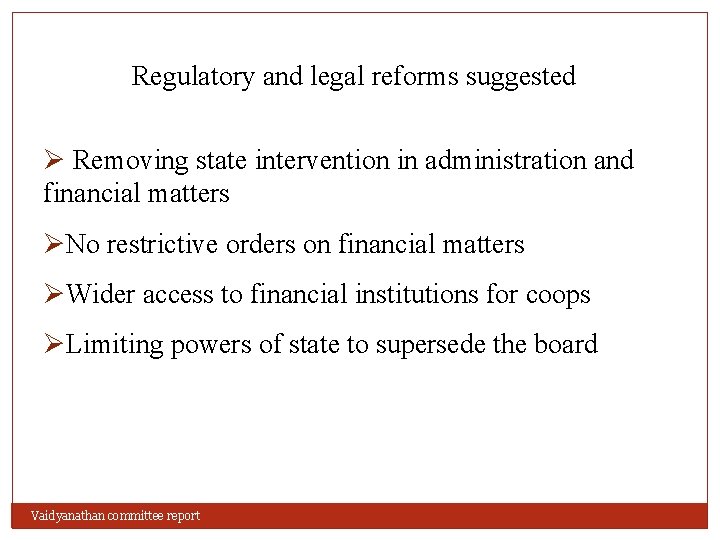
Regulatory and legal reforms suggested Ø Removing state intervention in administration and financial matters ØNo restrictive orders on financial matters ØWider access to financial institutions for coops ØLimiting powers of state to supersede the board Vaidyanathan committee report
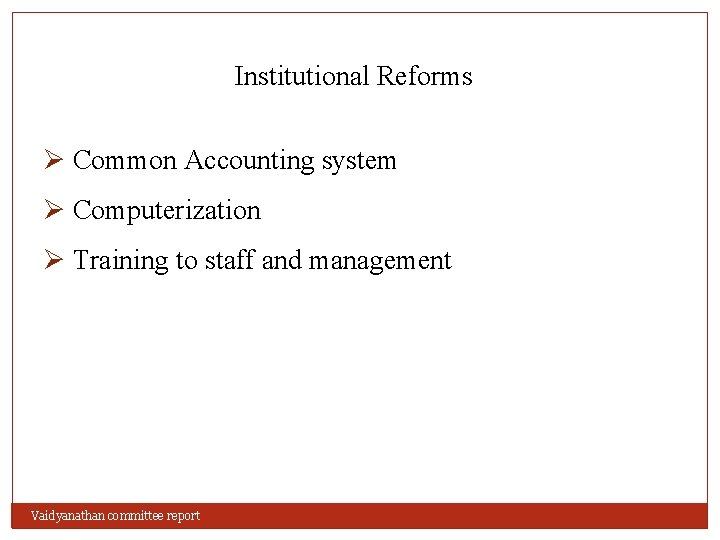
Institutional Reforms Ø Common Accounting system Ø Computerization Ø Training to staff and management Vaidyanathan committee report
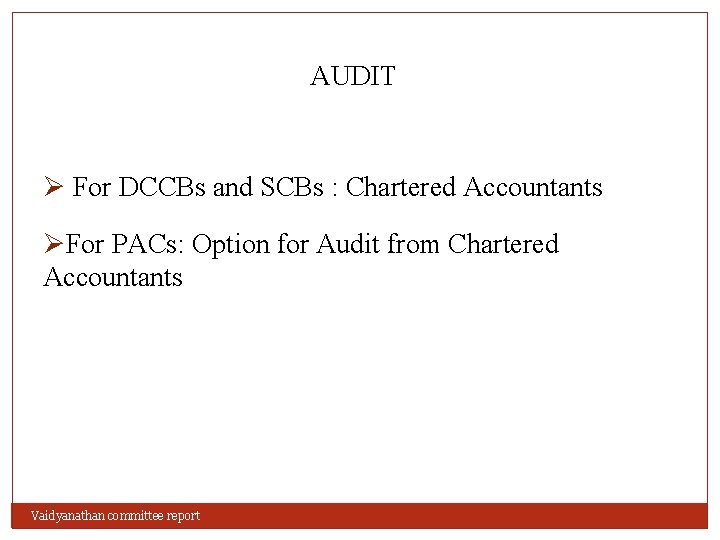
AUDIT Ø For DCCBs and SCBs : Chartered Accountants ØFor PACs: Option for Audit from Chartered Accountants Vaidyanathan committee report
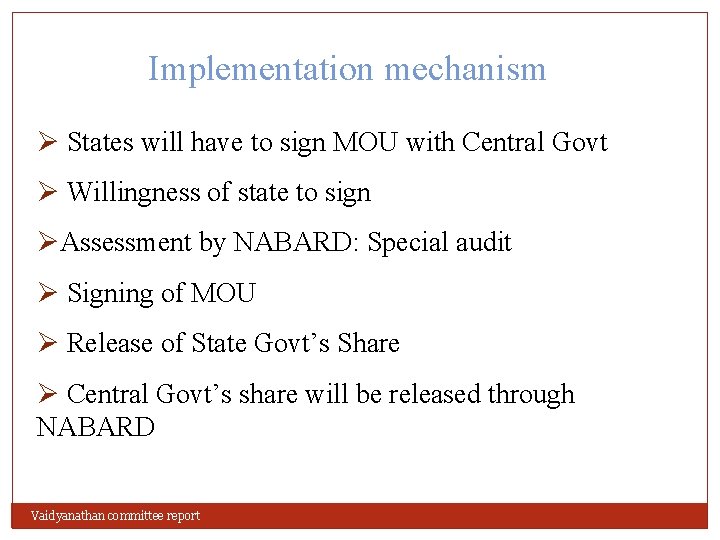
Implementation mechanism Ø States will have to sign MOU with Central Govt Ø Willingness of state to sign ØAssessment by NABARD: Special audit Ø Signing of MOU Ø Release of State Govt’s Share Ø Central Govt’s share will be released through NABARD Vaidyanathan committee report
Implementation mechanism Ø Capacity building programs from NABARD Ø 12 from each state master trainers: At lucknow Ø Trainers training at state leveles Ø 4 days for PACs secretaries and 2 days for Board Vaidyanathan committee report
Progress Ø States which have signed MOU ØMaharashtra ØOrissa ØMadhya Pradesh ØGujarat ØAndhra Pradesh Ø Uttar Pradesh Ø Bihar Ø Uttaranchal ØArunachal Pradesh ØHaryana Vaidyanathan committee report
Karnataka • Cabinet approves and again withheld • Finally state approves during the governors regime. Vaidyanathan committee report
THANK YOU Vaidyanathan committee report