
The Child in Pain Headache as an Example

- Slides: 74
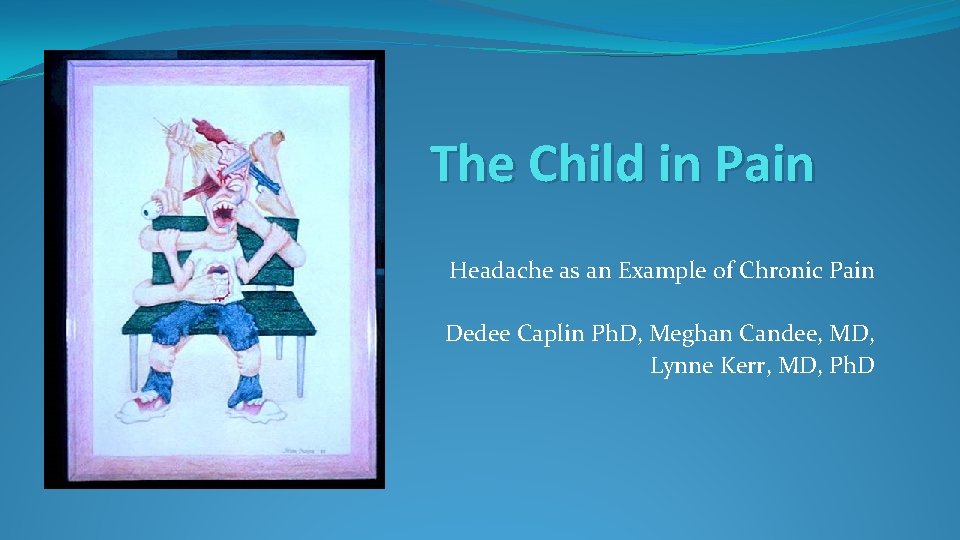
The Child in Pain Headache as an Example of Chronic Pain Dedee Caplin Ph. D, Meghan Candee, MD, Lynne Kerr, MD, Ph. D
Disclosure the speaker(s), planner(s), nor anyone in control of content for today's Pediatric Neurology Conference has any relevant financial relationship(s).
Learning Objectives • Identify elements of integrated health approach that is informed by medical and psychological factors • Identify methods of psychosocial assessment in a medical setting • Create a set of recommendations and interventions that improve functioning and reduce headache disability
THE MAGNITUDE OF THE PROBLEM • Migraine: 1% to 20% or more �Ages 4 7: boys>girls �Ages 7 11: boys=girls �Ages >11: girls>boys = 750, 000 to 7, 500, 000 US children! • Chronic Headaches: ~4% �girls>>boys = 3, 000 US children!
THE HEADACHE BURDEN • Tension-type headache and migraine are among the most prevalent disorders in the world. • 12 million provider visits/year in the US • $31 billion in medical costs and lost productivity annually in the US • 10% of adolescents with migraines miss 2 days of school per month • Average diagnostic cost of HA $8000
Case in Point: Joey � 6 year old boy, referred by his PCP presenting to headache clinic with a 6 month history of headaches. �Headaches occur 2 -3 times per week, often triggered by heat and sun or riding in the car. �Headaches are often associated with nausea and sensitivity to light and sound. �Headaches last between 2 and 4 hours, and often resolve after taking medication and falling asleep.
Additional Information: Joey �Parent is worried that headaches are symptom of something else �There is a family history of migraine in maternal aunt �General and neurologic exam are normal (normal abnormalities) �No prior imaging done �Tylenol has worked to relieve headache if he takes it early enough �No sleep problems noted, seldom drinks water, doesn’t skip meals �He has restricted video and screen use during school week and in the evenings
RED FLAGS IN HEADACHE - Psychological �Family history �Parent or child anxiety and worry �Lifestyle or family chaos �Comorbid psychological concerns
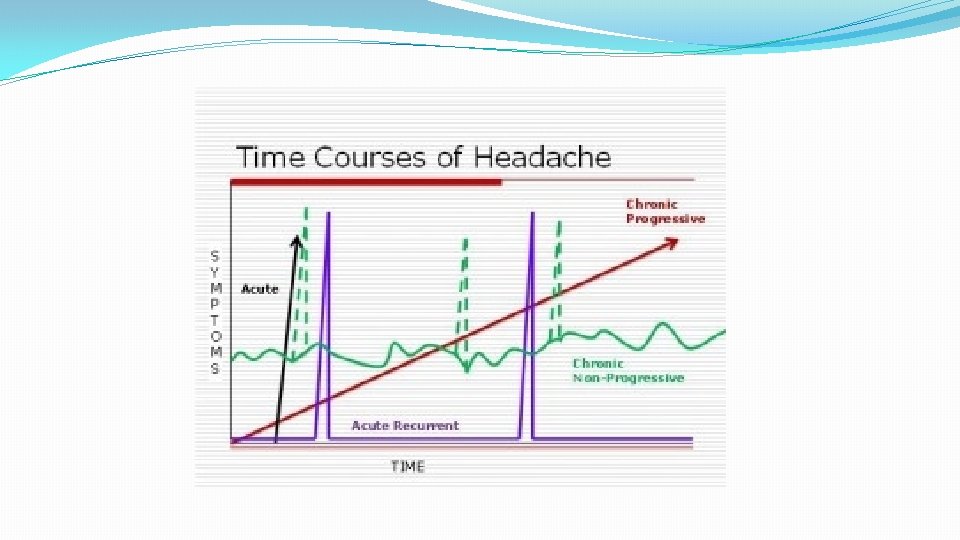
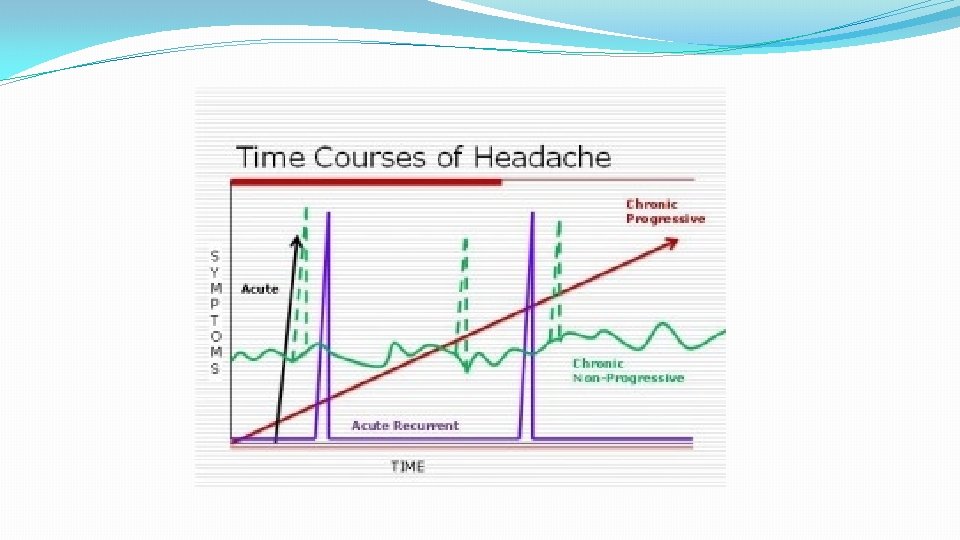
RED FLAGS IN HEADACHE - Neurological �Pattern of increasing headaches over a short time period �Abnormal exam – new clonus, papilledema, abnl visual fields, asymmetric tone, etc. �Weight loss, fever, other signs of systemic illness �“Worst headache of my life” �Positional component/Association with straining �Confusion �Swallowing difficulties/Occipital location/visual obscurations
Headache classification �Migraine: In children, 1 -72 hours, severe pain, nausea/vomiting OR photo/phono-sensitivity (family history) �Tension: not meeting criteria for migraine �Chronic daily headaches=chronic migraine: headaches 15 or more days a month. Some may meet criteria for migraines, others not. �Medication overuse headache: worry about this when patient takes ibuprofen/acetaminophen 3 times a week or more �Combined headaches �Others (stabbing or icepick, nummular, etc)
Evaluation: Joey �Diagnosis: migraine without aura �Severe, nausea, light sensitivity, family history of migraine �Possibilities of further evaluation: �MRI – but normal exam �Labs – but what would you be testing for
Treatment: Joey �Acute treatment �For headaches when they come or treatment “as needed”: � Distraction!!!!! � Ibuprofen or acetaminophen � Nausea/vomiting help (ondansetron) � Might also try a triptan – rizatriptan approved down to age 6, sumatriptan �Preventive treatment: Lifestyle: sleep, hydration, meals, ”busy-ness”, screen time (SMART) �Might try these and then have family come back to clinic 6 -8 weeks �Sunglasses may also be helpful �Family to keep a diary
SMART �Sleep: goal of 8 -10 hours �Meals: no skipping meals; drink enough to maintain clear urine �Activity: 30 -60 minutes of physical activity per day �Relaxation: reduce stress via biofeedback, mindfulness, and behavioral therapy �Triggers: Identify and avoid triggers Adapted from Dr. Heidi Blume, Seattle Children’s
The Role of the Psychologist �To assess overall functioning of parent and child in the context of chronic pain �Pain disability �Pain cognition �Mental health co-morbidities �Secondary to this: �Educate parent on pain, their impact, and their role in treatment �Create a plan for lifestyle changes that might be difficult to manage or integrate into daily plan �To assess need for psychological treatments designed to relieve pain, distress, and functional disability in headache. �CBT is evidence-based. “Both relaxation and CBT are effective in reducing severity and frequency of chronic headache… These treatment appear to have a lasting effect. ” (Palermo et al, 2009)
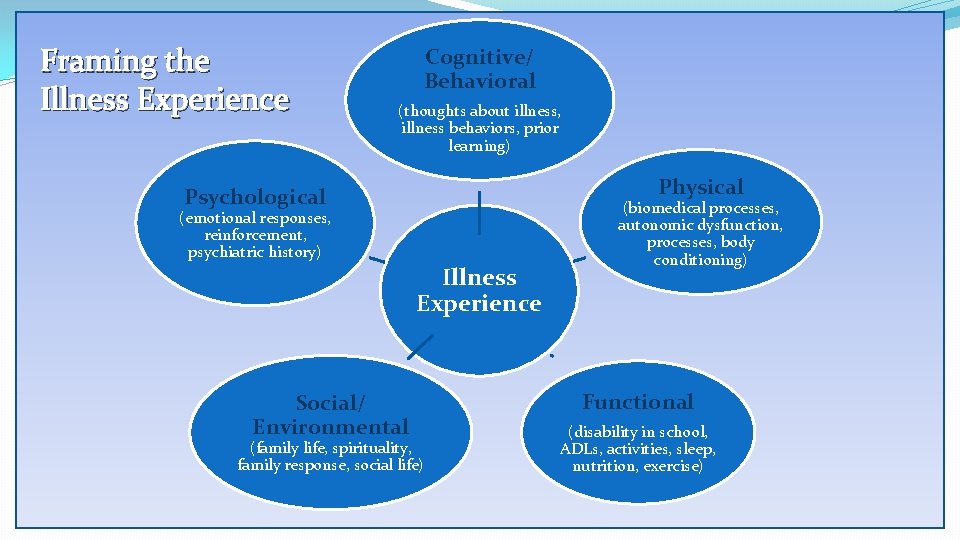
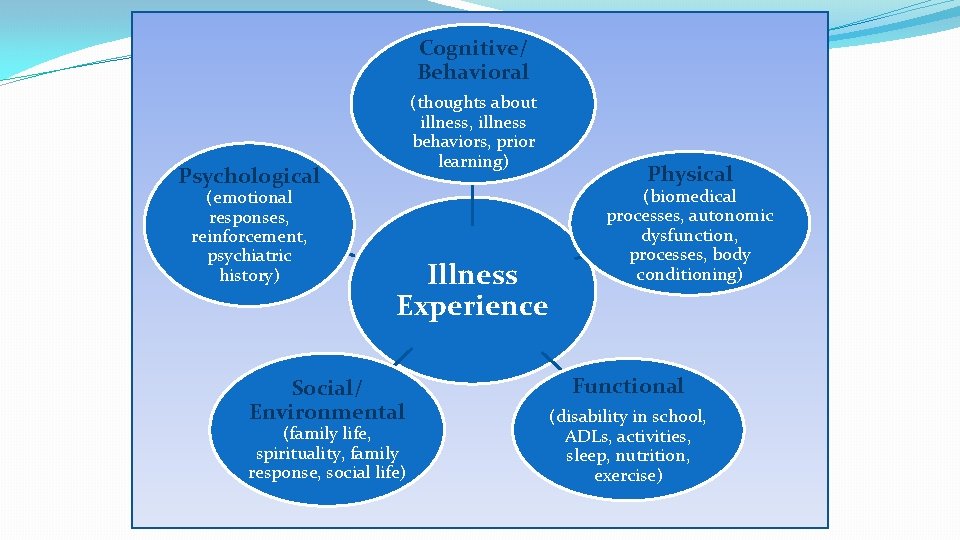
Framing the Illness Experience Cognitive/ Behavioral (thoughts about illness, illness behaviors, prior learning) Physical Psychological (emotional responses, reinforcement, psychiatric history) Illness Experience Social/ Environmental (family life, spirituality, family response, social life) (biomedical processes, autonomic dysfunction, processes, body conditioning) Functional (disability in school, ADLs, activities, sleep, nutrition, exercise)
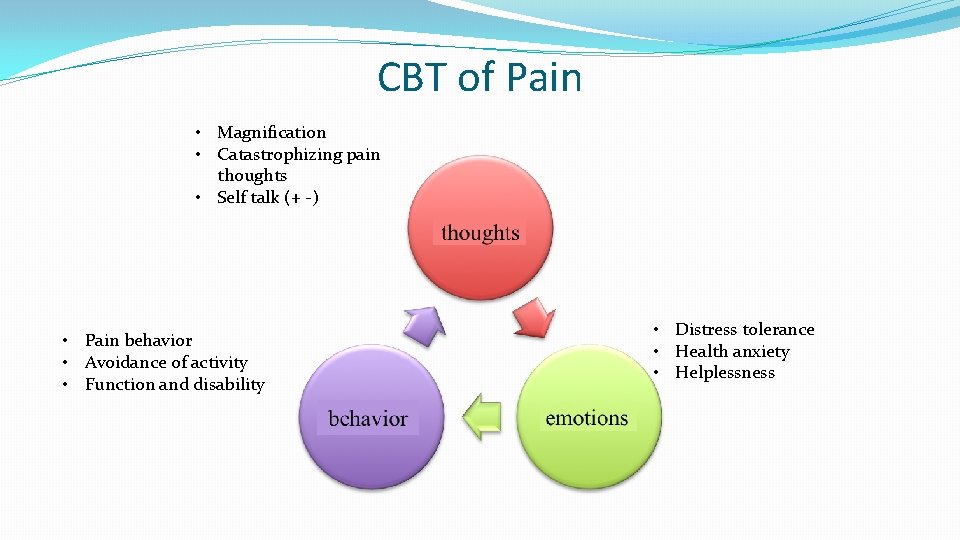
CBT of Pain • Magnification • Catastrophizing pain thoughts • Self talk (+ -) • Pain behavior • Avoidance of activity • Function and disability • Distress tolerance • Health anxiety • Helplessness
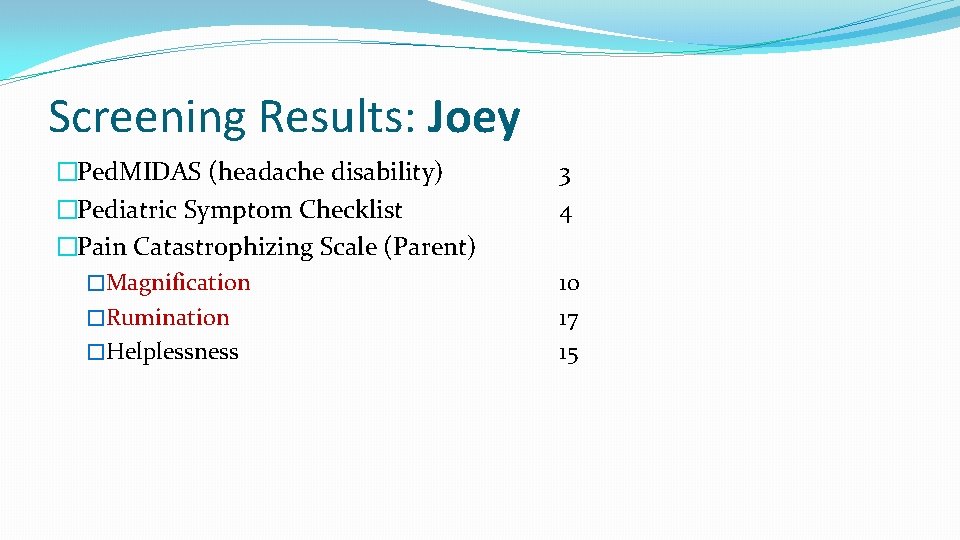
Screening Results: Joey �Ped. MIDAS (headache disability) �Pediatric Symptom Checklist �Pain Catastrophizing Scale (Parent) �Magnification �Rumination �Helplessness 3 4 10 17 15
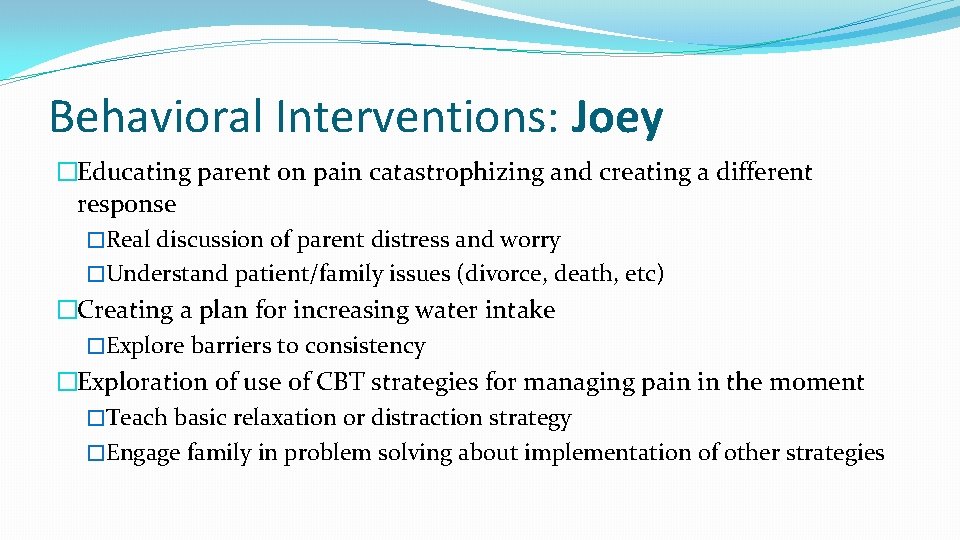
Behavioral Interventions: Joey �Educating parent on pain catastrophizing and creating a different response �Real discussion of parent distress and worry �Understand patient/family issues (divorce, death, etc) �Creating a plan for increasing water intake �Explore barriers to consistency �Exploration of use of CBT strategies for managing pain in the moment �Teach basic relaxation or distraction strategy �Engage family in problem solving about implementation of other strategies
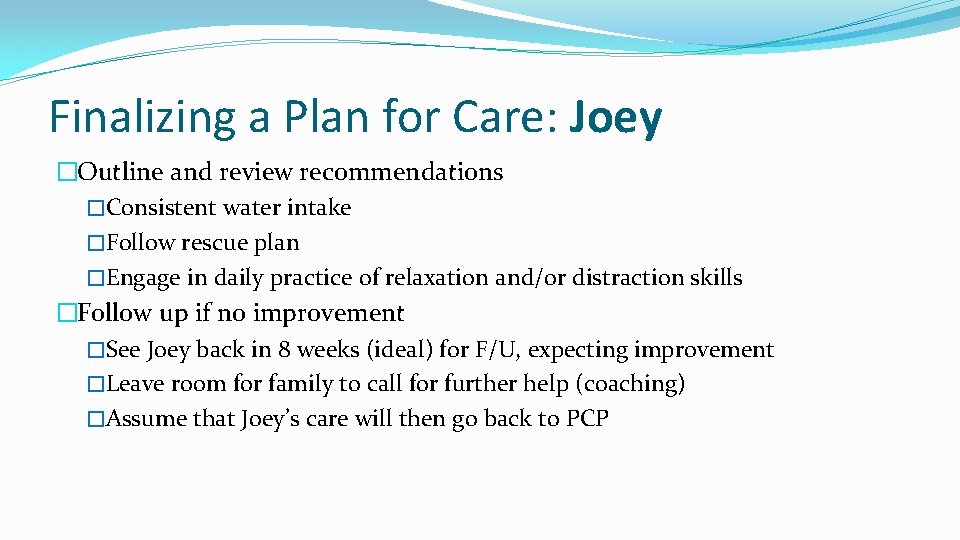
Finalizing a Plan for Care: Joey �Outline and review recommendations �Consistent water intake �Follow rescue plan �Engage in daily practice of relaxation and/or distraction skills �Follow up if no improvement �See Joey back in 8 weeks (ideal) for F/U, expecting improvement �Leave room for family to call for further help (coaching) �Assume that Joey’s care will then go back to PCP
Kali � 16 year old female, reporting headaches since age 6, worsening significantly since the start of high school. �Headaches currently occur daily, but are less frequent in summer months. �Patient reports fatigue, periods of dizziness, and difficulty concentrating, especially with mundane tasks �Patient reports that school, noise, and too much activity trigger worsening pain. �Sleep is the only thing that reportedly helps and she is sleeping a lot during day but having trouble at night.
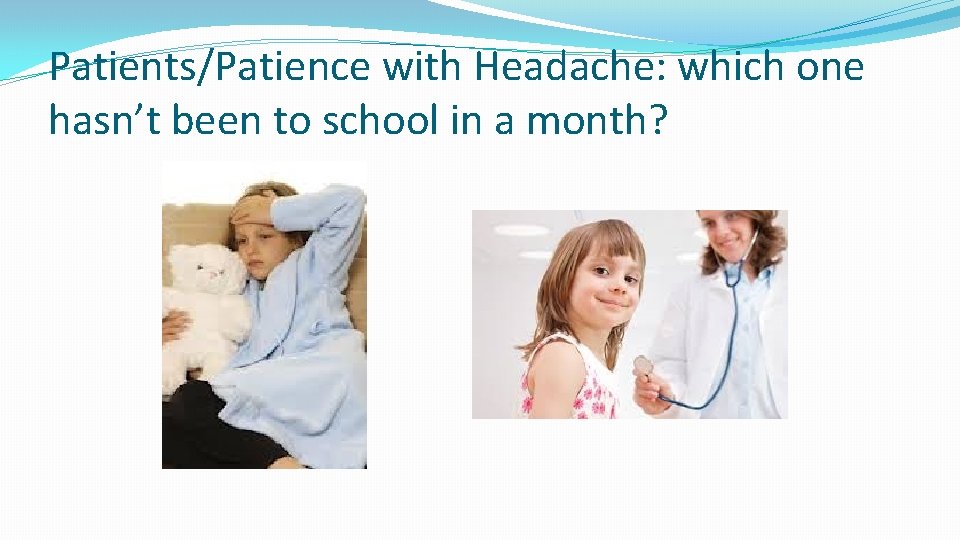
Patients/Patience with Headache: which one hasn’t been to school in a month?
Further medical workup and medical interventions: Kali �Consider MRI but likely normal �Consider lab testing �TSH, Mg, Vit D, Fe, folate, riboflavin, Co. Q 10, CBC, CMP, ESR
Why not image every HA patient? �Not necessary �Expensive �May find ”normal abnormalities” or incidental findings – warn parents �CT exposes child to radiation �Children may need to be sedated for MRI
Why do PCPs order headache imaging? �Most common reason for ordering imaging was for reassurance �Yield for clinically significant findings low, even if clinical suspicion for an abnormality is high
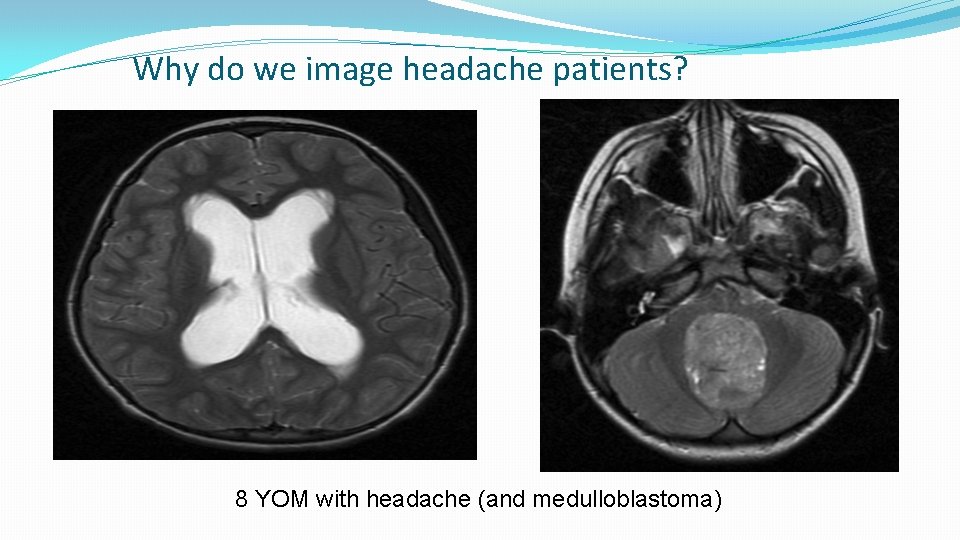
Why do we image headache patients? 8 YOM with headache (and medulloblastoma)
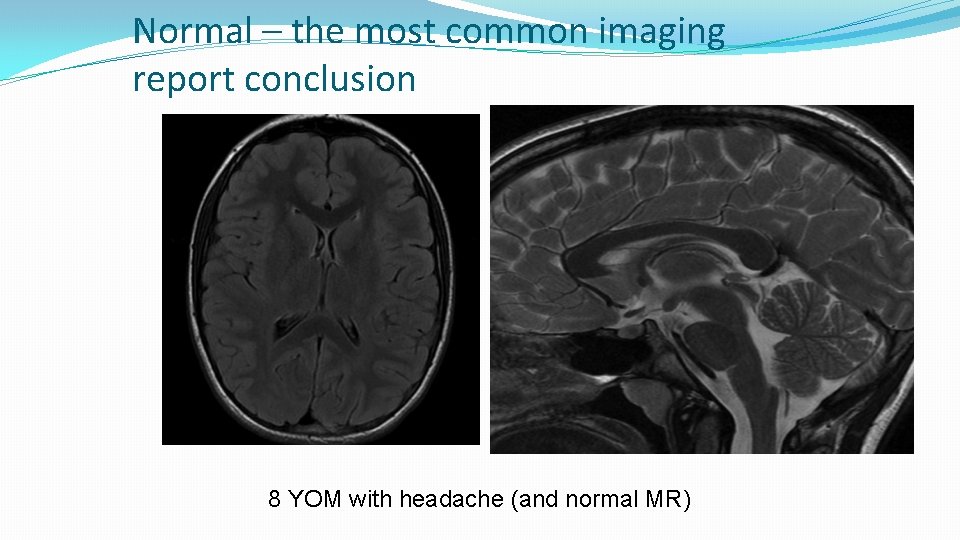
Normal – the most common imaging report conclusion 8 YOM with headache (and normal MR)
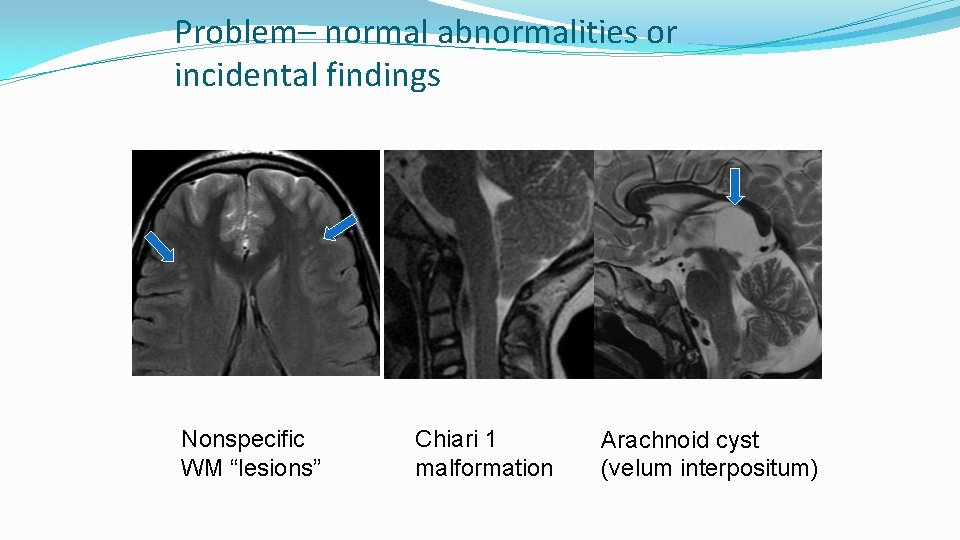
Problem– normal abnormalities or incidental findings Nonspecific WM “lesions” Chiari 1 malformation Arachnoid cyst (velum interpositum)
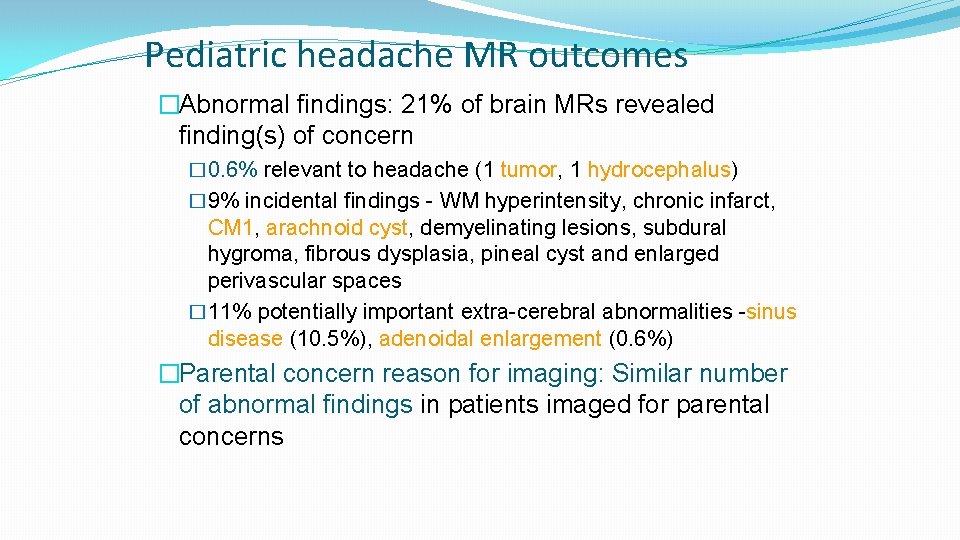
Pediatric headache MR outcomes �Abnormal findings: 21% of brain MRs revealed finding(s) of concern � 0. 6% relevant to headache (1 tumor, 1 hydrocephalus) � 9% incidental findings WM hyperintensity, chronic infarct, CM 1, arachnoid cyst, demyelinating lesions, subdural hygroma, fibrous dysplasia, pineal cyst and enlarged perivascular spaces � 11% potentially important extra cerebral abnormalities sinus disease (10. 5%), adenoidal enlargement (0. 6%) �Parental concern reason for imaging: Similar number of abnormal findings in patients imaged for parental concerns
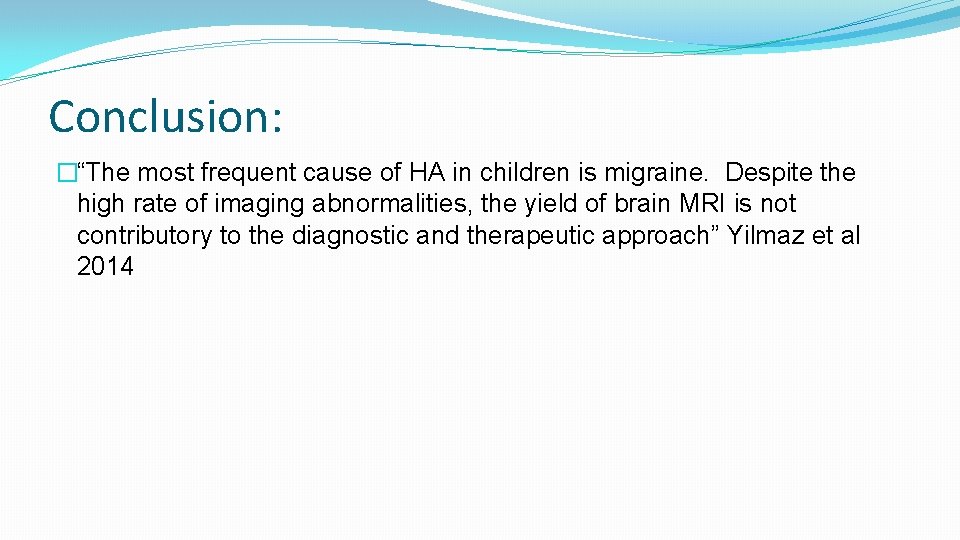
Conclusion: �“The most frequent cause of HA in children is migraine. Despite the high rate of imaging abnormalities, the yield of brain MRI is not contributory to the diagnostic and therapeutic approach” Yilmaz et al 2014
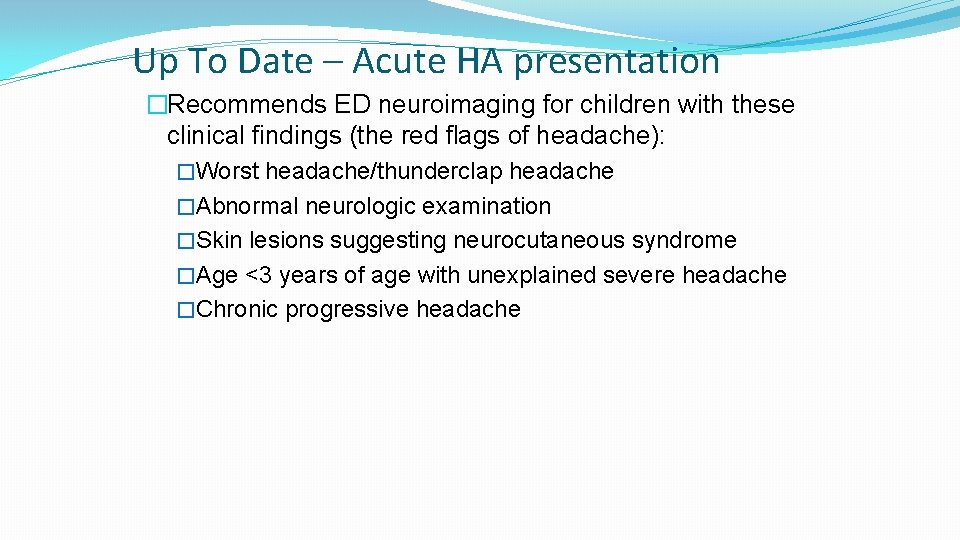
Up To Date – Acute HA presentation �Recommends ED neuroimaging for children with these clinical findings (the red flags of headache): �Worst headache/thunderclap headache �Abnormal neurologic examination �Skin lesions suggesting neurocutaneous syndrome �Age <3 years of age with unexplained severe headache �Chronic progressive headache
Choosing Wisely �Evidence-based recommendations on what providers and patients should question. �AHS: don’t perform neuroimaging studies in patients with stable headaches that meet criteria for migraine.
Sometimes you have to do testing to: �Move away from a diagnostic odyssey & toward. . . �developing a therapeutic alliance �breaking up a headache habit/cycle �focusing on prevention �getting back to life
Treatment of headaches �Any narcotics? Stop �Could she/he be overusing ibuprofen/acetaminophen for acute headache treatment which brings about medication overuse headache – if yes, need to stop these. May need to do this gradually. �If not using medication to acutely treat daily headaches, would not likely add an acute medication as can only use for 3 episodes a week.
Rescue – when nothing is working �Decrease panic (House of God “the first thing you should do in an emergency is take your own pulse”) �Home remedy – we all have our favorites, but consists of pain reliever, med for nausea/vomiting and med for sleep. Could use oral versions of the ED migraine cocktail in your materials. �IV migraine cocktail – ED/RTU/local ED (give families a copy), nonnarcotic
Preventives - medications �For children 10 and under, not overweight – periactin (cyproheptadine). Side effects weight gain, sleepiness – this is often a good side effect �For children over 10 – amitriptyline and topiramate �Amitriptyline SE weight gain, EKG first, sleepiness (again a good side effect) given nightly – only once a day �Topiramate SE weight loss, mental “fuzziness” tingling hands/feet – given nightly – only once a day �Treat comorbidities
Game changer N Engl J Med. 2016 Oct 27. [Epub] Trial of Amitriptyline, Topiramate, and Placebo for Pediatric Migraine. Powers SW 1, Coffey CS 1, Chamberlin LA 1, Ecklund DJ 1, Klingner EA 1, Yankey JW 1, Korbee LL 1, Porter LL 1, Hershey AD 1; CHAMP Investigators.
Results �Amitriptyline helped about 55% of kids �Topiramate helped about 57% of kids �No statistical difference between the two medications although ”pill taking behavior” may be important �Placebo helped about 60% of kids �Most kids did better coming to headache clinic and learning about headaches, getting BH interventions, and practicing lifestyle alterations and expectation that they would get better �Meds may be useful for co-morbidities such as problems sleeping.
Behavioral Health in Clinic � Difficult to get our population to access Behavioral Health � Evidence to show that medication plus CBT better than medication alone � Powers et al, Dec 2013 Cognitive behavioral therapy plus amitriptyline for chronic migraine in children: a randomized clinical trial. JAMA � Initially we envisioned this for Rx of comorbidities such as anxiety, but so much more � Single copay for comprehensive clinic
Bullying n o ati l u p o P n w o r G SAT ACT G E N E T I C S o r r Te m s ri
Cognitive/ Behavioral (thoughts about illness, illness behaviors, prior learning) Psychological (emotional responses, reinforcement, psychiatric history) Illness Experience Social/ Environmental (family life, spirituality, family response, social life) Physical (biomedical processes, autonomic dysfunction, processes, body conditioning) Functional (disability in school, ADLs, activities, sleep, nutrition, exercise)
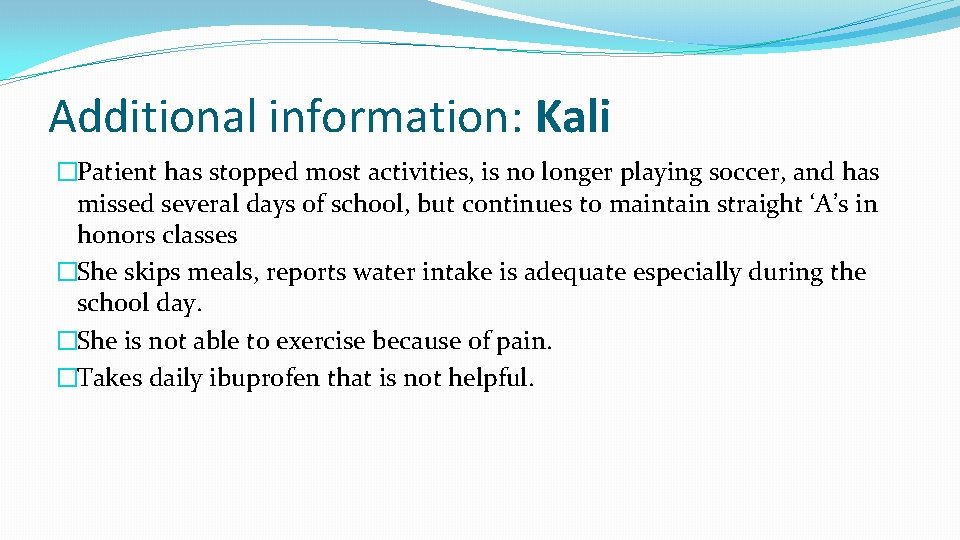
Additional information: Kali �Patient has stopped most activities, is no longer playing soccer, and has missed several days of school, but continues to maintain straight ‘A’s in honors classes �She skips meals, reports water intake is adequate especially during the school day. �She is not able to exercise because of pain. �Takes daily ibuprofen that is not helpful.
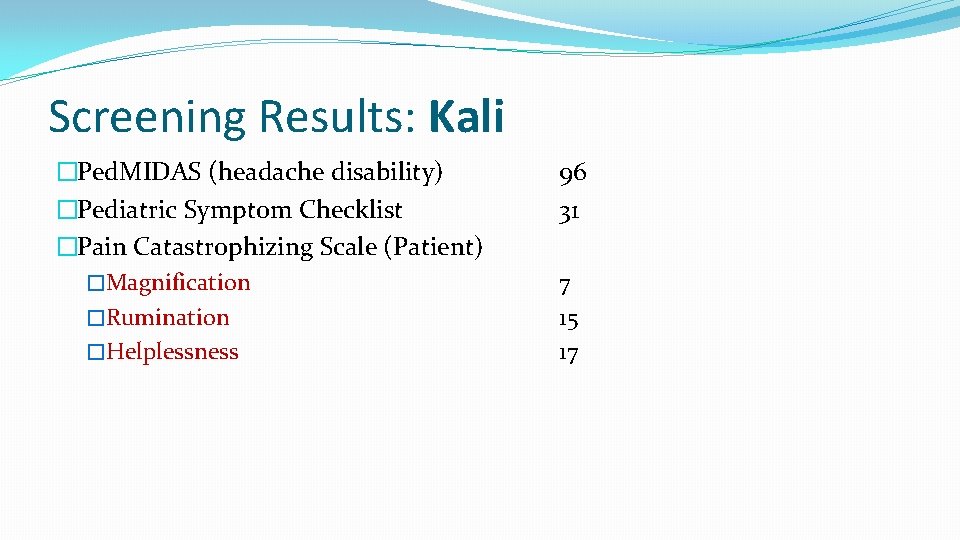
Screening Results: Kali �Ped. MIDAS (headache disability) �Pediatric Symptom Checklist �Pain Catastrophizing Scale (Patient) �Magnification �Rumination �Helplessness 96 31 7 15 17
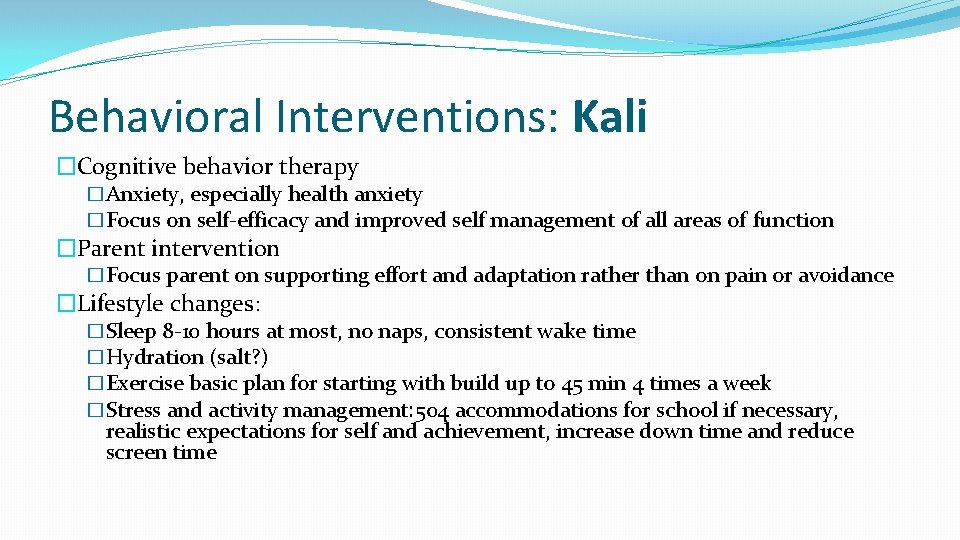
Behavioral Interventions: Kali �Cognitive behavior therapy �Anxiety, especially health anxiety �Focus on self-efficacy and improved self management of all areas of function �Parent intervention �Focus parent on supporting effort and adaptation rather than on pain or avoidance �Lifestyle changes: �Sleep 8 -10 hours at most, no naps, consistent wake time �Hydration (salt? ) �Exercise basic plan for starting with build up to 45 min 4 times a week �Stress and activity management: 504 accommodations for school if necessary, realistic expectations for self and achievement, increase down time and reduce screen time
Formulating a Plan for Care Neurological �See again in clinic soon after – approximately 8 weeks Behavioral Health �Don’t miss school! Work through it! Get to a therapist with self management and CBT plan – many pediatrics clinics now have BH �Increase activity in all areas incrementally and slowly �Emphasis on function, not headaches
Questions thus far?
The Role of Anxiety Kristi Kleinschmit, MD and Dedee Caplin, Ph. D
Learning Objectives • Identify elements of integrated health approach informed by medical and psychological factors • Identify methods of psychiatric assessment in a medical setting • Create a set of recommendations and interventions that improve anxiety management, even in the context of physical symptoms
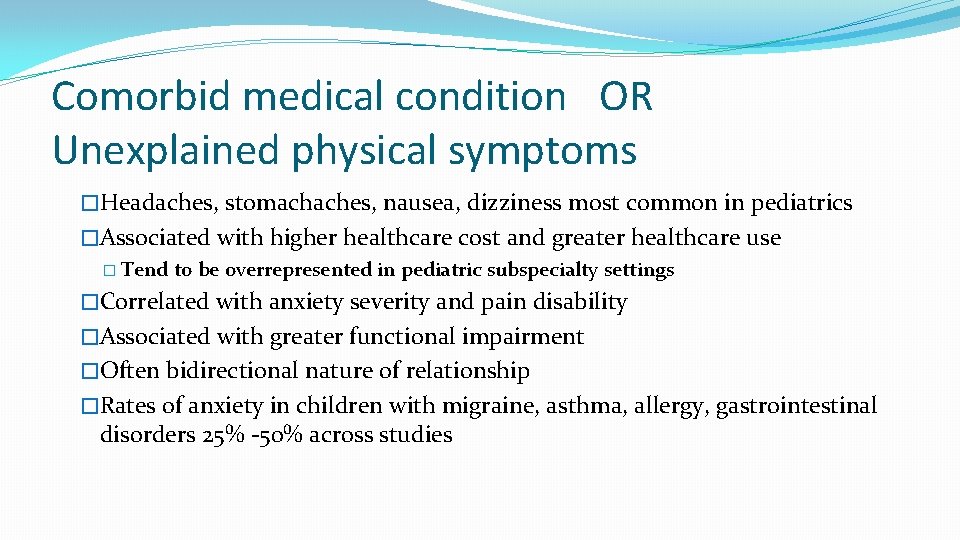
Comorbid medical condition OR Unexplained physical symptoms �Headaches, stomachaches, nausea, dizziness most common in pediatrics �Associated with higher healthcare cost and greater healthcare use � Tend to be overrepresented in pediatric subspecialty settings �Correlated with anxiety severity and pain disability �Associated with greater functional impairment �Often bidirectional nature of relationship �Rates of anxiety in children with migraine, asthma, allergy, gastrointestinal disorders 25% -50% across studies
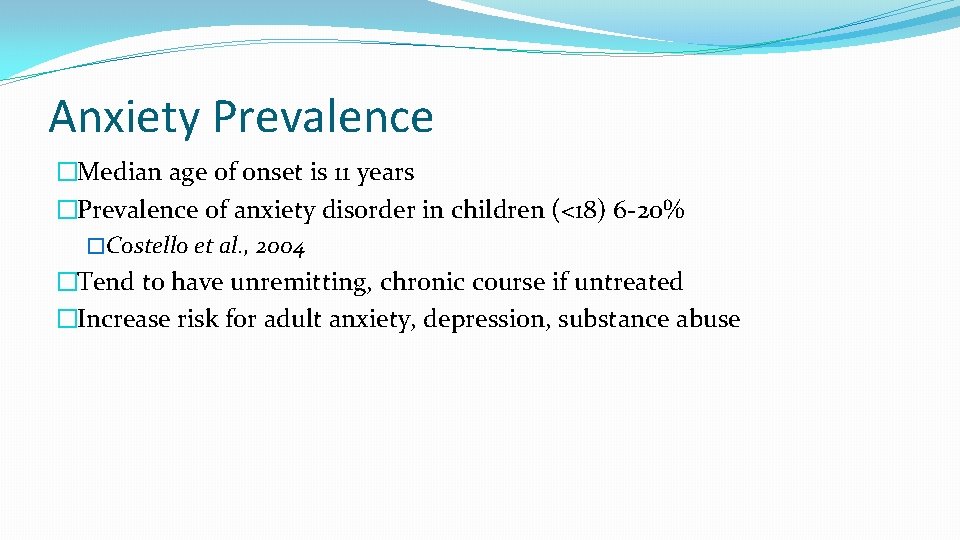
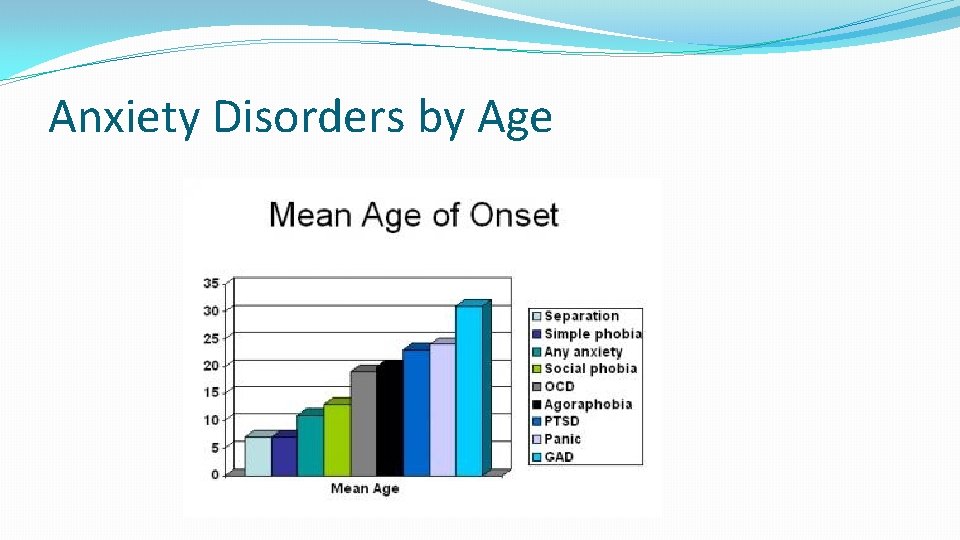
Anxiety Prevalence �Median age of onset is 11 years �Prevalence of anxiety disorder in children (<18) 6 -20% �Costello et al. , 2004 �Tend to have unremitting, chronic course if untreated �Increase risk for adult anxiety, depression, substance abuse
Anxiety Disorders by Age
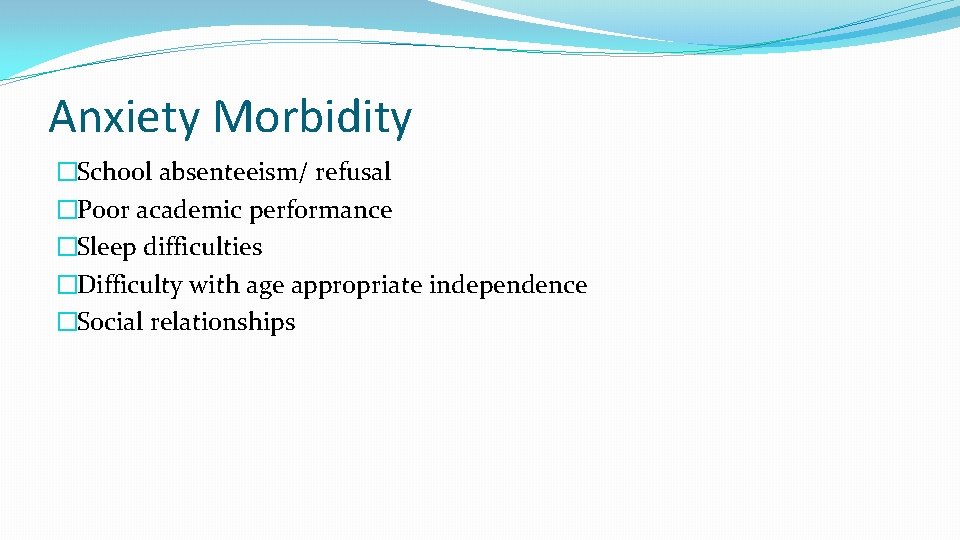
Anxiety Morbidity �School absenteeism/ refusal �Poor academic performance �Sleep difficulties �Difficulty with age appropriate independence �Social relationships
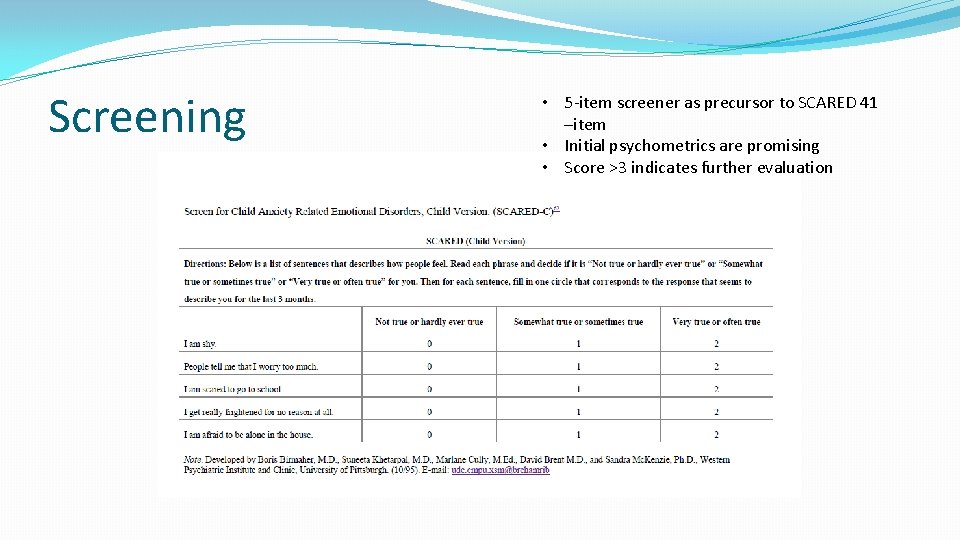
Screening • 5 -item screener as precursor to SCARED 41 –item • Initial psychometrics are promising • Score >3 indicates further evaluation
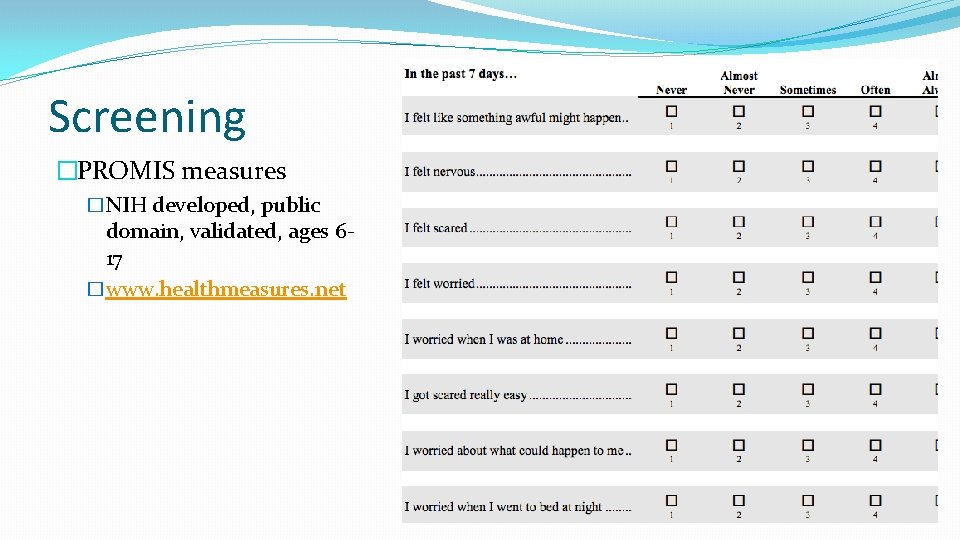
Screening �PROMIS measures �NIH developed, public domain, validated, ages 617 �www. healthmeasures. net
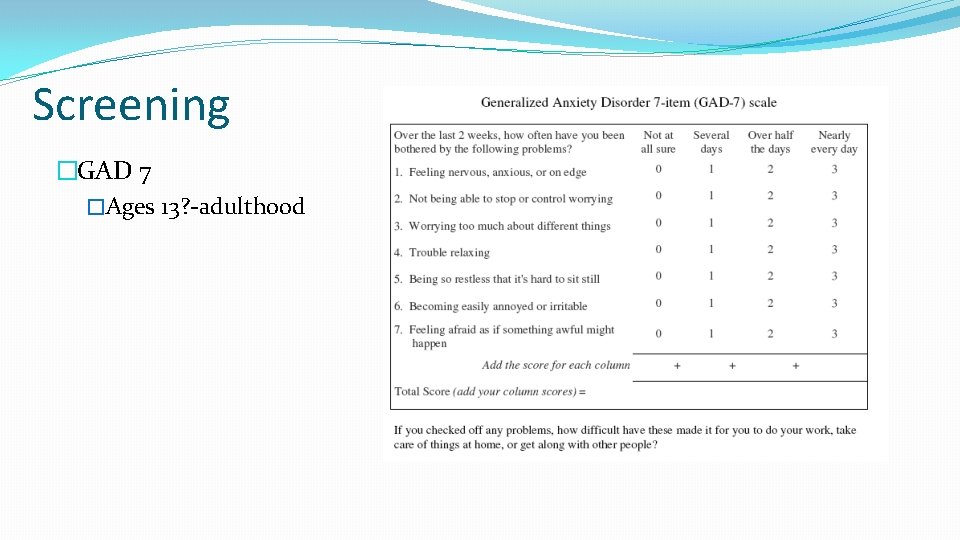
Screening �GAD 7 �Ages 13? -adulthood
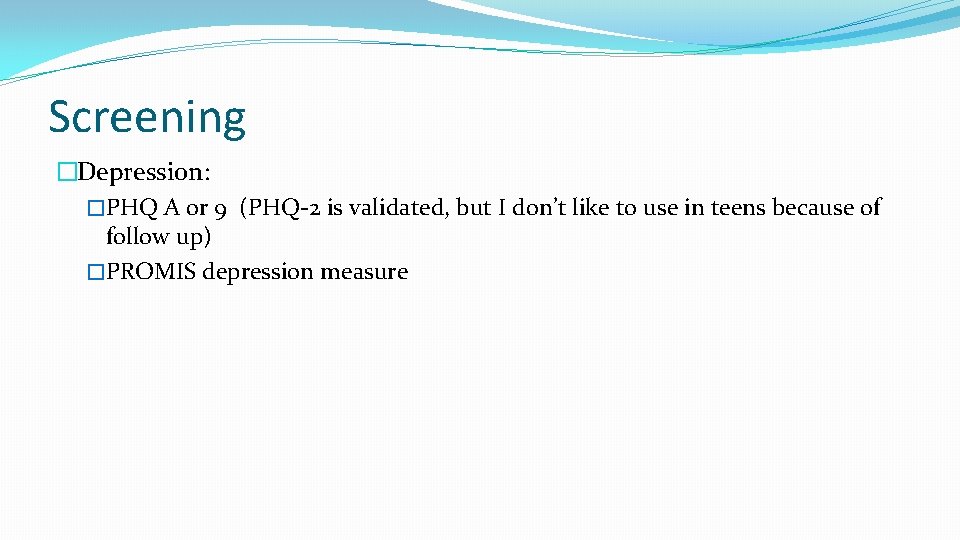
Screening �Depression: �PHQ A or 9 (PHQ-2 is validated, but I don’t like to use in teens because of follow up) �PROMIS depression measure
Further Evaluation �Solid family history �Solid HPI �Symptom history (onset, duration, settings, sequelae) �Recent psychosocial stressors �Impact of symptoms on child and family
Diagnosis �Anxiety versus Mood versus both �Although may be helpful for education, treatment very similar regardless of sub-type of anxiety disorder (except PTSD) �Use full SCARED screener for more help with clarification
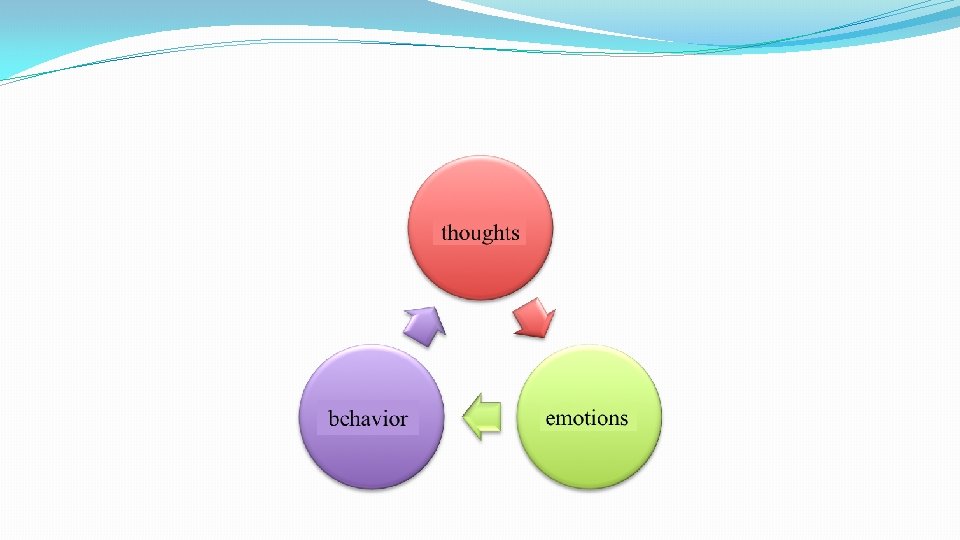
Treatment: First steps �Education and support �Explain the triangle of thoughts, emotions and behaviors �Distress tolerance skills �Parent encouragement �Gradual exposure to feared stimuli with use of pre-planned coping skills �Maintenance of regular habits and activities � Focus on sleep, exercise, eating and activity �Self-Help and Anxiety Apps
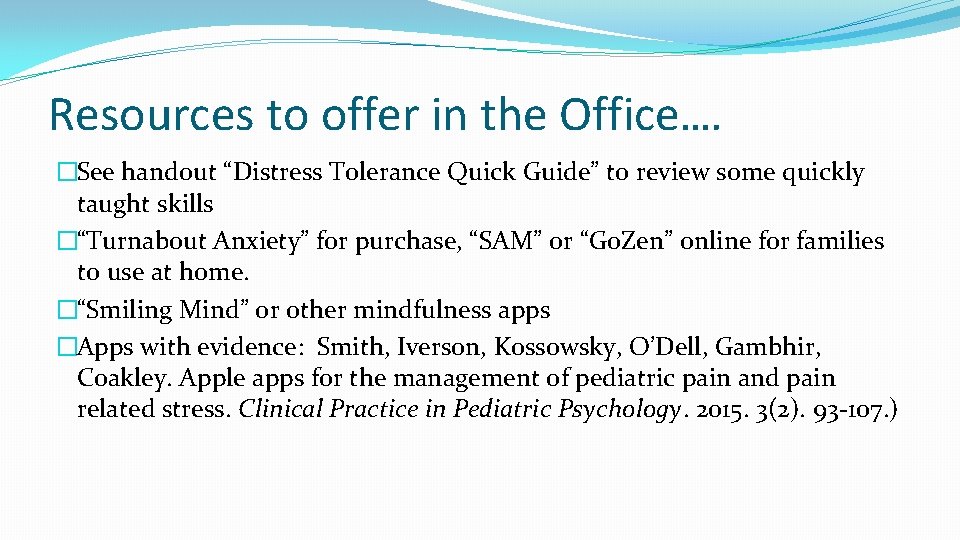
Resources to offer in the Office…. �See handout “Distress Tolerance Quick Guide” to review some quickly taught skills �“Turnabout Anxiety” for purchase, “SAM” or “Go. Zen” online for families to use at home. �“Smiling Mind” or other mindfulness apps �Apps with evidence: Smith, Iverson, Kossowsky, O’Dell, Gambhir, Coakley. Apple apps for the management of pediatric pain and pain related stress. Clinical Practice in Pediatric Psychology. 2015. 3(2). 93 -107. )
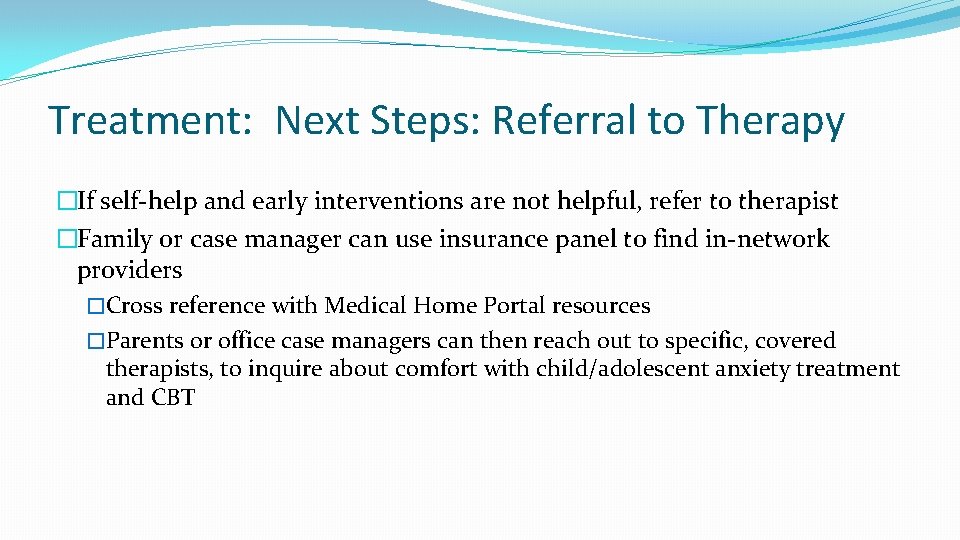
Treatment: Next Steps: Referral to Therapy �If self-help and early interventions are not helpful, refer to therapist �Family or case manager can use insurance panel to find in-network providers �Cross reference with Medical Home Portal resources �Parents or office case managers can then reach out to specific, covered therapists, to inquire about comfort with child/adolescent anxiety treatment and CBT
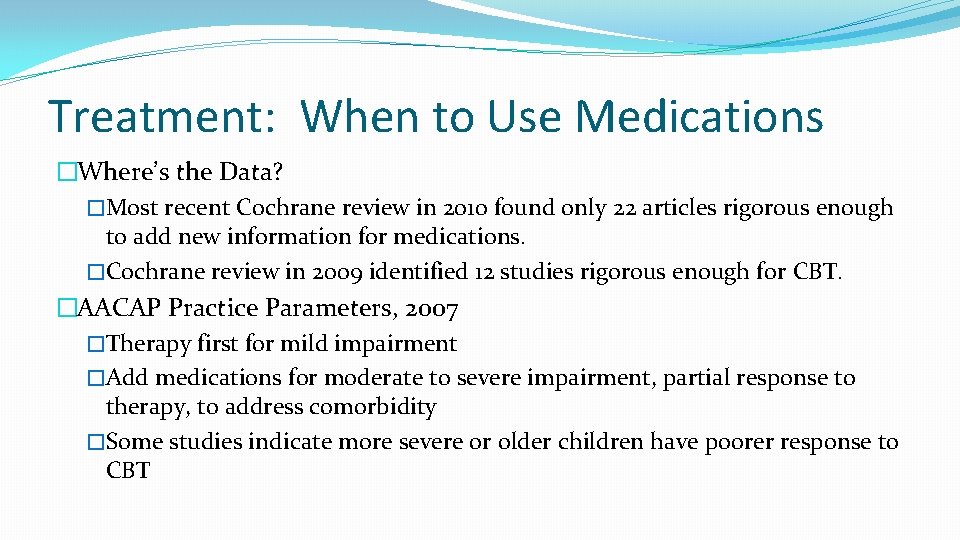
Treatment: When to Use Medications �Where’s the Data? �Most recent Cochrane review in 2010 found only 22 articles rigorous enough to add new information for medications. �Cochrane review in 2009 identified 12 studies rigorous enough for CBT. �AACAP Practice Parameters, 2007 �Therapy first for mild impairment �Add medications for moderate to severe impairment, partial response to therapy, to address comorbidity �Some studies indicate more severe or older children have poorer response to CBT
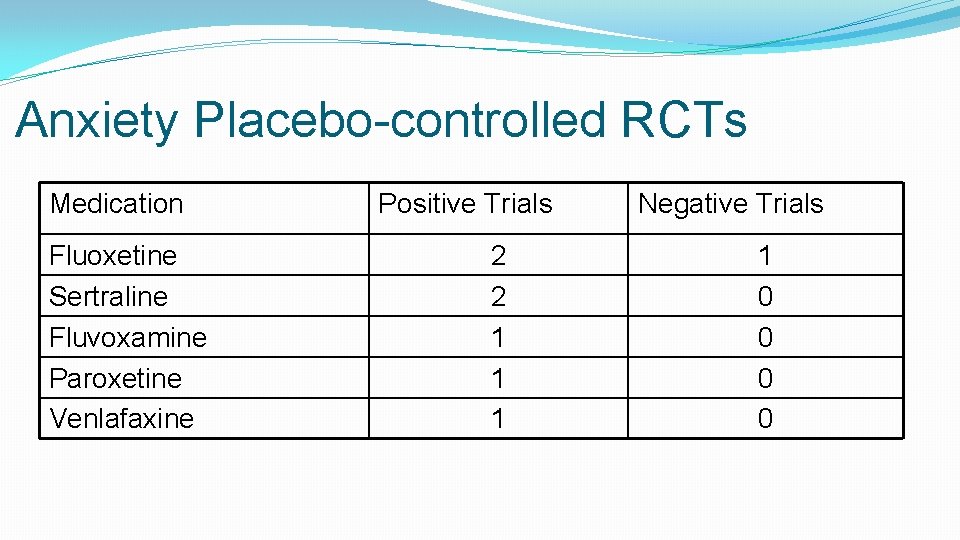
Anxiety Placebo controlled RCTs Medication Fluoxetine Sertraline Fluvoxamine Paroxetine Venlafaxine Positive Trials 2 2 1 1 1 Negative Trials 1 0 0
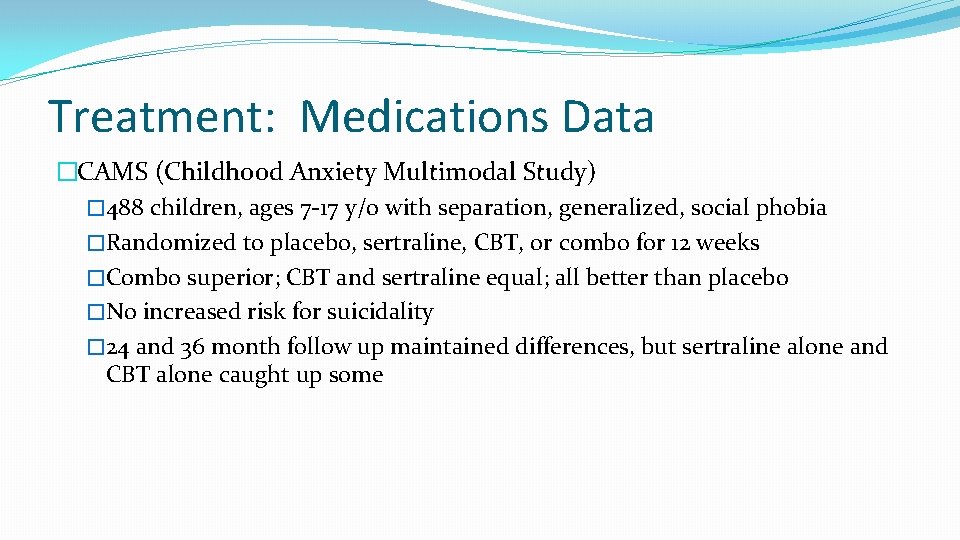
Treatment: Medications Data �CAMS (Childhood Anxiety Multimodal Study) � 488 children, ages 7 -17 y/o with separation, generalized, social phobia �Randomized to placebo, sertraline, CBT, or combo for 12 weeks �Combo superior; CBT and sertraline equal; all better than placebo �No increased risk for suicidality � 24 and 36 month follow up maintained differences, but sertraline alone and CBT alone caught up some
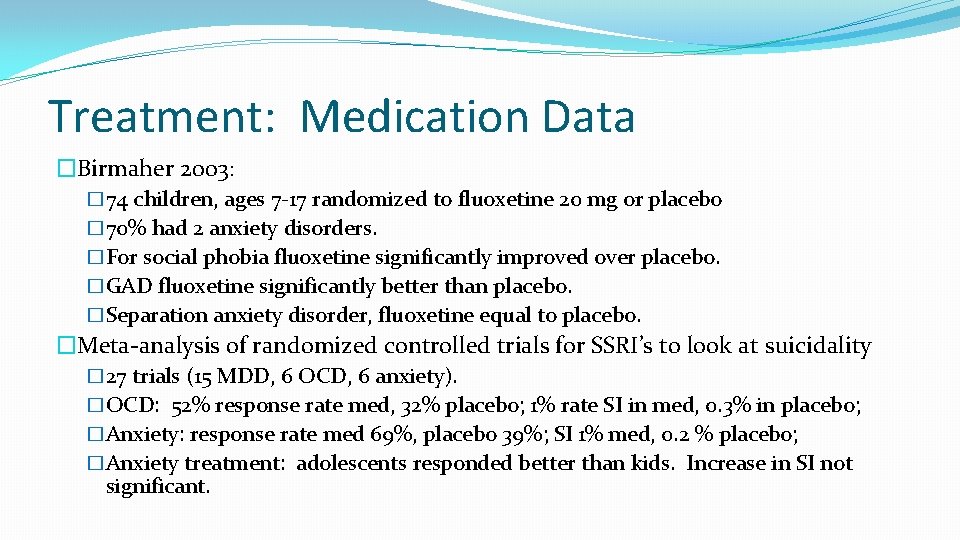
Treatment: Medication Data �Birmaher 2003: � 74 children, ages 7 -17 randomized to fluoxetine 20 mg or placebo � 70% had 2 anxiety disorders. �For social phobia fluoxetine significantly improved over placebo. �GAD fluoxetine significantly better than placebo. �Separation anxiety disorder, fluoxetine equal to placebo. �Meta-analysis of randomized controlled trials for SSRI’s to look at suicidality � 27 trials (15 MDD, 6 OCD, 6 anxiety). �OCD: 52% response rate med, 32% placebo; 1% rate SI in med, 0. 3% in placebo; �Anxiety: response rate med 69%, placebo 39%; SI 1% med, 0. 2 % placebo; �Anxiety treatment: adolescents responded better than kids. Increase in SI not significant.
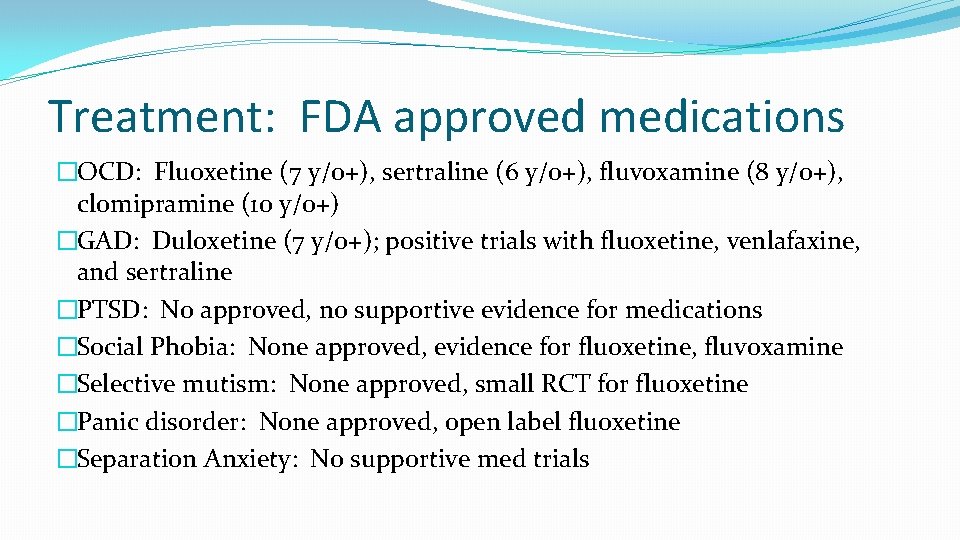
Treatment: FDA approved medications �OCD: Fluoxetine (7 y/o+), sertraline (6 y/o+), fluvoxamine (8 y/o+), clomipramine (10 y/o+) �GAD: Duloxetine (7 y/o+); positive trials with fluoxetine, venlafaxine, and sertraline �PTSD: No approved, no supportive evidence for medications �Social Phobia: None approved, evidence for fluoxetine, fluvoxamine �Selective mutism: None approved, small RCT for fluoxetine �Panic disorder: None approved, open label fluoxetine �Separation Anxiety: No supportive med trials
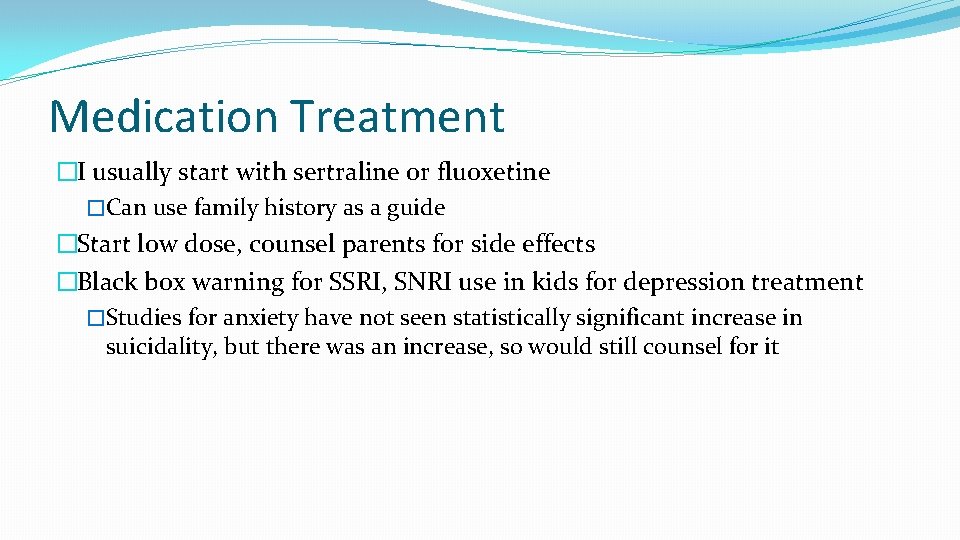
Medication Treatment �I usually start with sertraline or fluoxetine �Can use family history as a guide �Start low dose, counsel parents for side effects �Black box warning for SSRI, SNRI use in kids for depression treatment �Studies for anxiety have not seen statistically significant increase in suicidality, but there was an increase, so would still counsel for it
Next step: Not improving �Ensure adherence and adequate dosing �Verify diagnosis �Asses psychosocial stressors, opportunity to add more wrap-around interventions (school, parents, family) �Try another SSRI, or switch to SNRI �Adjunctive treatment
Adjunctive medications �Sleep (all off-label) �Lot of evidence for behavioral interventions �Break-through anxiety �No clear evidence for benzodiazepines in children (although lorazepam approved in kids for “anxiety”) �No supporting trials for buspirone (approved in adults) �Poor quality evidence for hydroxyzine in children (approved for “anxiety” in kids) �No solid evidence for gabapentin in children/adolescents/adults
Take Home Points about medications �Start low, go slow, but go! �Anxious kids have more somatic complaints in general, so may need validation for real or perceived side effects. �Most evidence for sertraline and fluoxetine �Best outcomes when combined with psychotherapy
Questions for any of us?
References: � Birmaher B et al. Fluoxetine for the treatment of childhood anxiety disorders. J. Am. Acad. Child Adoles. � � � Psychiatry. 2003. 42(4): 415 -423. Bridge et al. Clinical Response and Risk for Reported Suicidal Ideation and Suicide Attempts in Pediatric Antidepressant Treatment. JAMA. 2007; 297 (15): 1683 -1696. Cohen JA et al. A pilot randomized controlled trial of combined trauma-focused CBT and sertraline for childhood PTSD symptoms. J. Am. Acad. Child Psychiatry. 2007 July; 46 (7): 811 -819. Dummit ES III, et al. Fluoxetine treatment of children with selective mutism: an open trial. J. Am. Acad. Child Psychiatry. 1996, 35 (5): 615 -621. Ipser JC et al. Pharmacotherapy for anxiety disorders in children and adolescents. Cochrane Library. 2010. Issue 6. Placentini J, Bennett S, Compton S. 24 - and 36 -week outcomes for the child/adolescent anxiety multimodal study (CAMS). JAACAP, 2014 March; 53(3): 297 -310. The POTS Team. Cognitive-behavior therapy, sertraline, and their combination for children and adolescents with obsessive-compulsive disorder. JAMA. 2004 Oct; 292 (16) 1969 -1976. � Practice Parameters for the Assessment and Treatment of Children and Adolescents with Anxiety Disorders. J. Am. Acad. Child Adolesc. Psychiatry, 1997, 36(10 supplement): 69 S-84 S). � Walkup JT et al. Cognitive behavioral therapy, sertraline, or a combination in childhood anxiety. N. Engl J Med. 2008 December 25; 359(26): 2753 -2766.