The Addition Formulas in Trigonometry Scott Fallstrom Faculty
- Slides: 31
The Addition Formulas in Trigonometry Scott Fallstrom Faculty Director, Math Learning Center
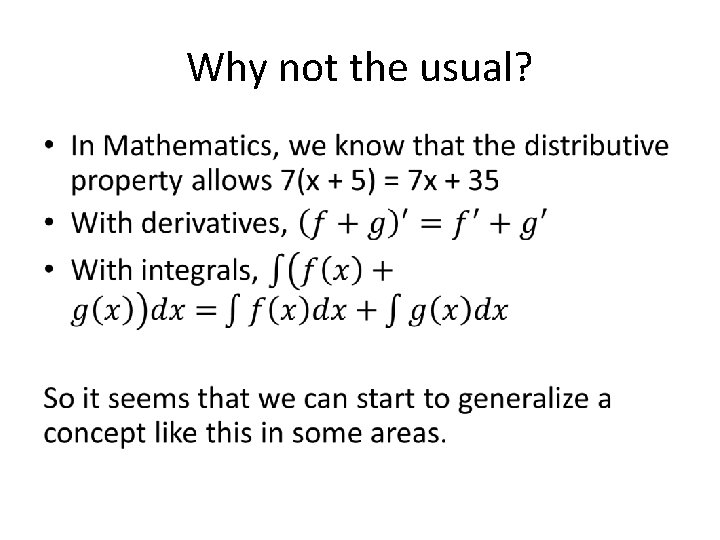
Why not the usual? •
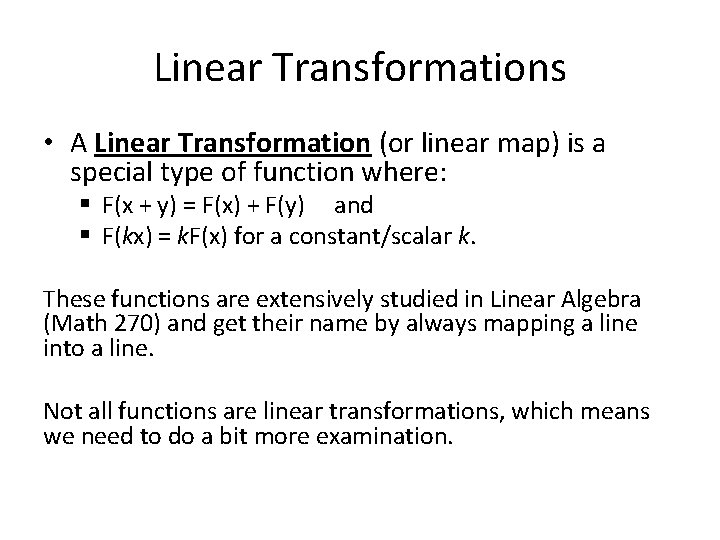
Linear Transformations • A Linear Transformation (or linear map) is a special type of function where: § F(x + y) = F(x) + F(y) and § F(kx) = k. F(x) for a constant/scalar k. These functions are extensively studied in Linear Algebra (Math 270) and get their name by always mapping a line into a line. Not all functions are linear transformations, which means we need to do a bit more examination.
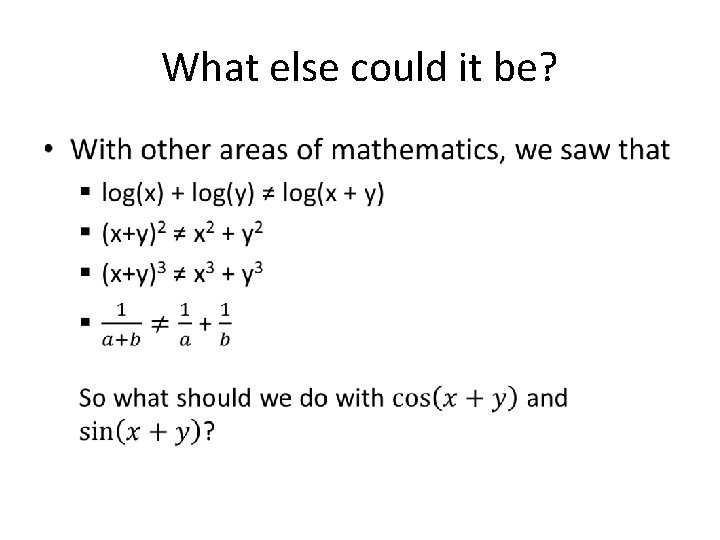
What else could it be? •
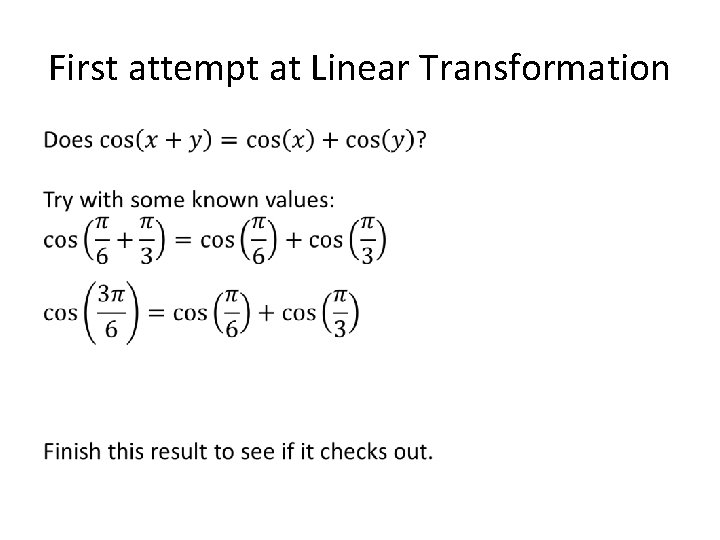
First attempt at Linear Transformation •
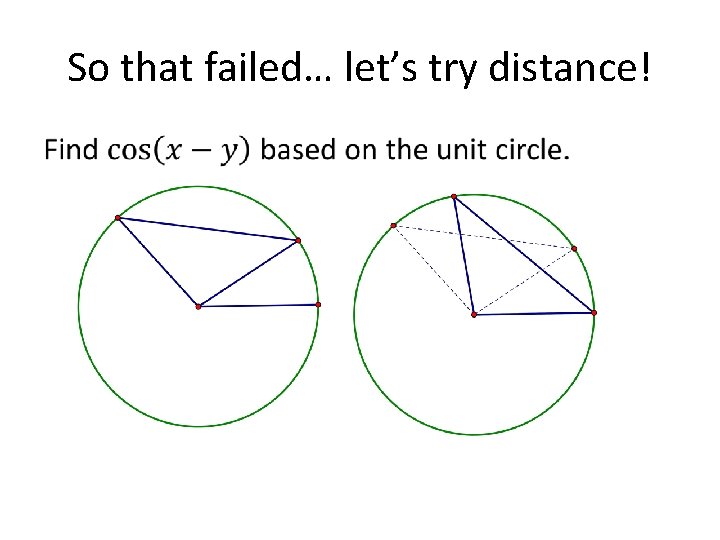
So that failed… let’s try distance! •
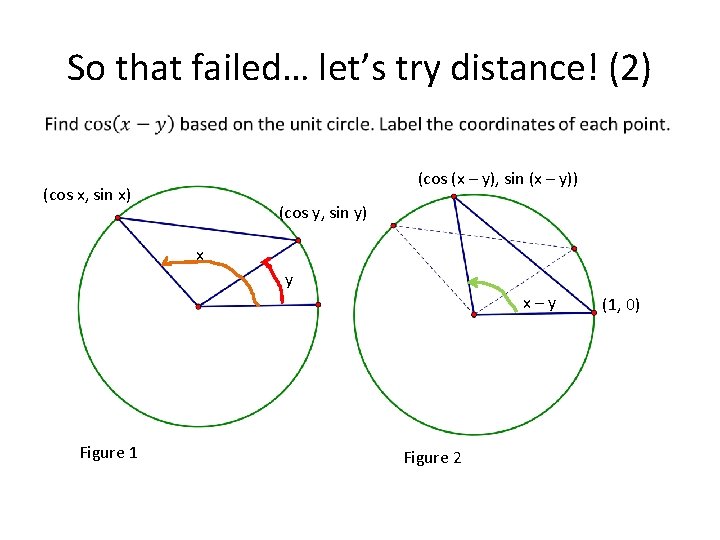
So that failed… let’s try distance! (2) • (cos (x – y), sin (x – y)) (cos x, sin x) (cos y, sin y) x y x – y Figure 1 Figure 2 (1, 0)
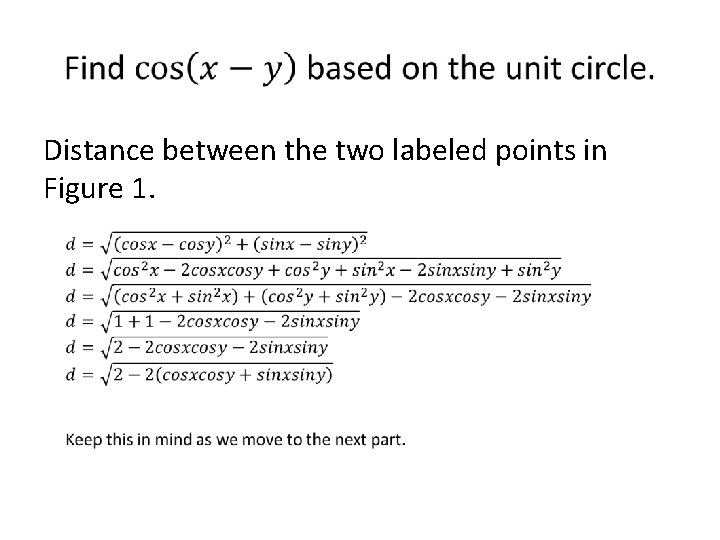
Distance between the two labeled points in Figure 1.
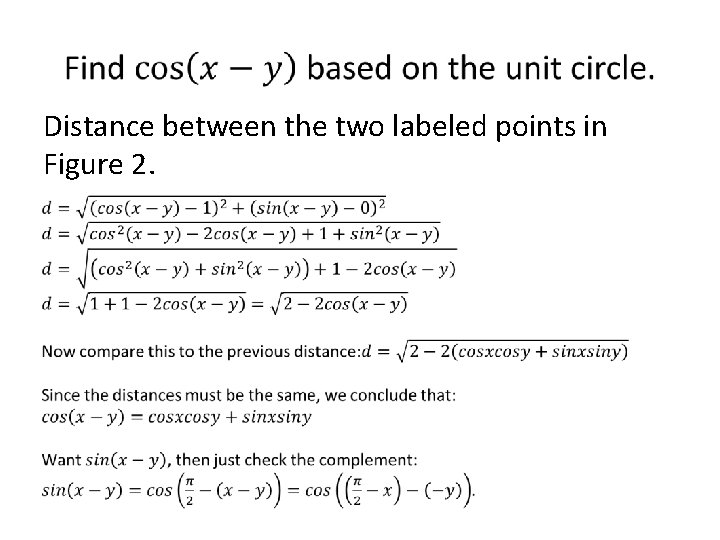
Distance between the two labeled points in Figure 2.
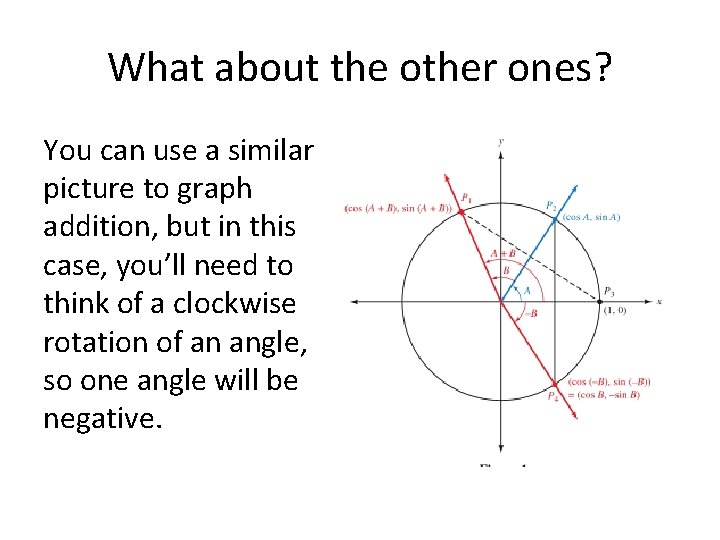
What about the other ones? You can use a similar picture to graph addition, but in this case, you’ll need to think of a clockwise rotation of an angle, so one angle will be negative.
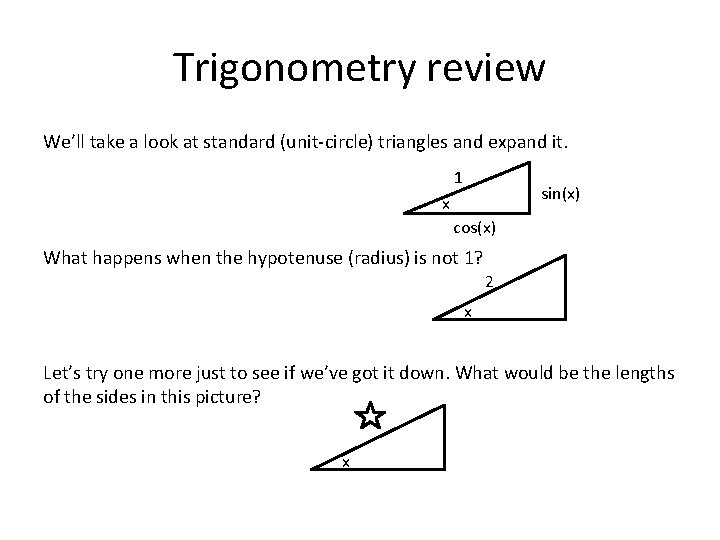
Trigonometry review We’ll take a look at standard (unit-circle) triangles and expand it. 1 sin(x) x cos(x) What happens when the hypotenuse (radius) is not 1? 2 x Let’s try one more just to see if we’ve got it down. What would be the lengths of the sides in this picture? x
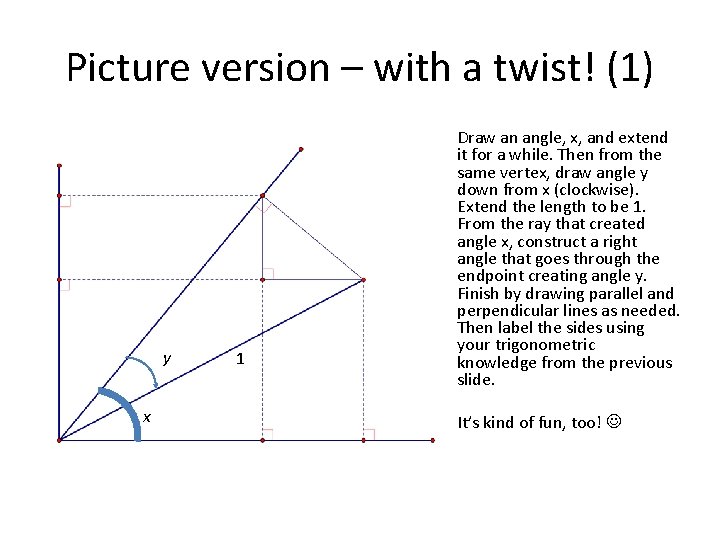
Picture version – with a twist! (1) y x 1 Draw an angle, x, and extend it for a while. Then from the same vertex, draw angle y down from x (clockwise). Extend the length to be 1. From the ray that created angle x, construct a right angle that goes through the endpoint creating angle y. Finish by drawing parallel and perpendicular lines as needed. Then label the sides using your trigonometric knowledge from the previous slide. It’s kind of fun, too!
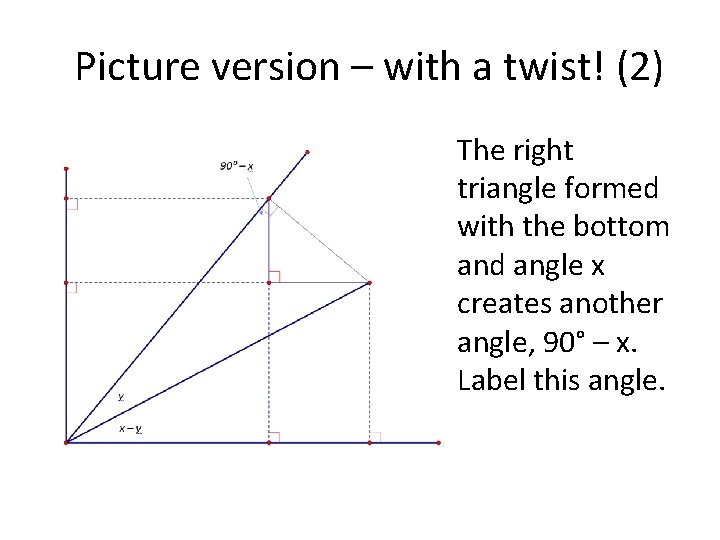
Picture version – with a twist! (2) The right triangle formed with the bottom and angle x creates another angle, 90° – x. Label this angle.
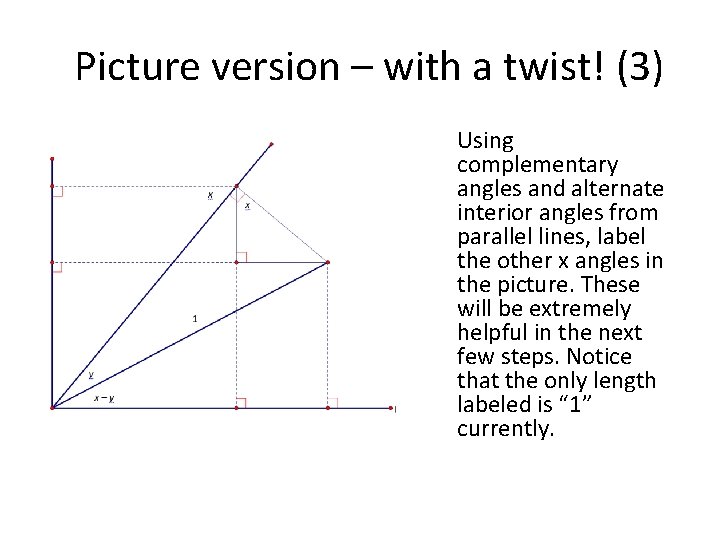
Picture version – with a twist! (3) Using complementary angles and alternate interior angles from parallel lines, label the other x angles in the picture. These will be extremely helpful in the next few steps. Notice that the only length labeled is “ 1” currently.
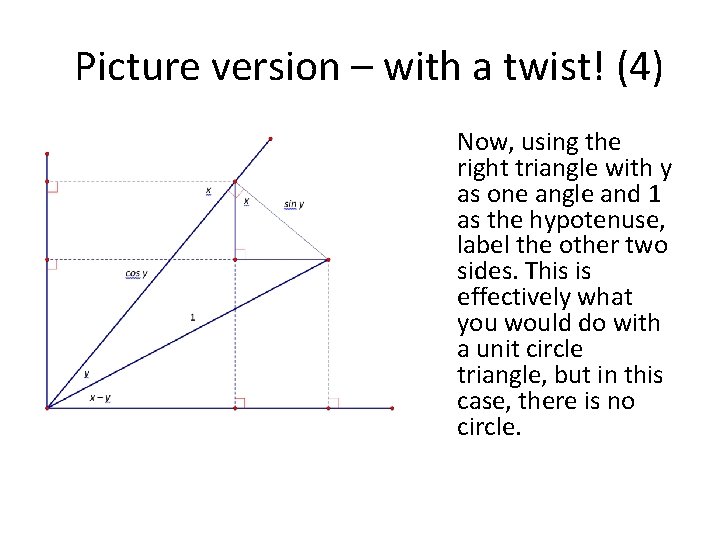
Picture version – with a twist! (4) Now, using the right triangle with y as one angle and 1 as the hypotenuse, label the other two sides. This is effectively what you would do with a unit circle triangle, but in this case, there is no circle.
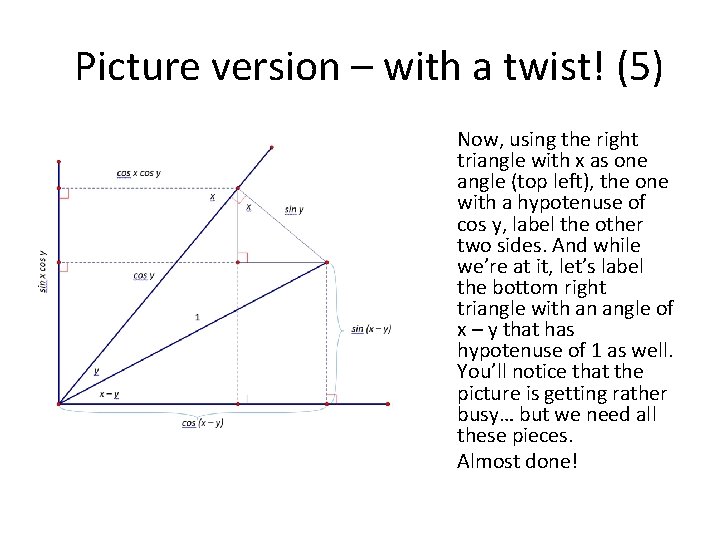
Picture version – with a twist! (5) Now, using the right triangle with x as one angle (top left), the one with a hypotenuse of cos y, label the other two sides. And while we’re at it, let’s label the bottom right triangle with an angle of x – y that has hypotenuse of 1 as well. You’ll notice that the picture is getting rather busy… but we need all these pieces. Almost done!
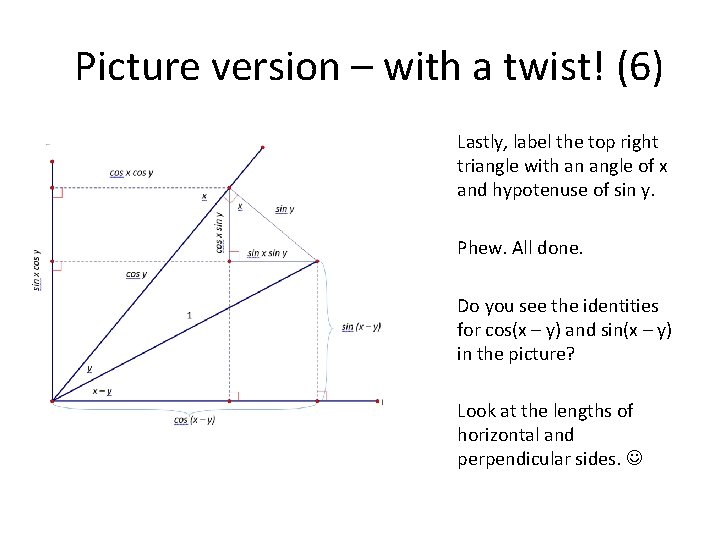
Picture version – with a twist! (6) Lastly, label the top right triangle with an angle of x and hypotenuse of sin y. Phew. All done. Do you see the identities for cos(x – y) and sin(x – y) in the picture? Look at the lengths of horizontal and perpendicular sides.
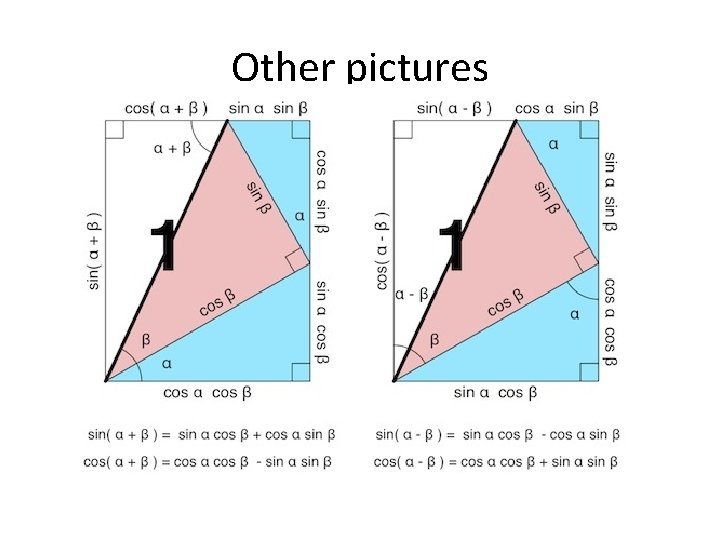
Other pictures
There are many other techniques Many of the other methods can involve distance or pictures, but rely on the law of cosines. But is there another way… a way that doesn’t require long arithmetic, memorizing or remembering some picture, or remembering some method to create a picture that would work?
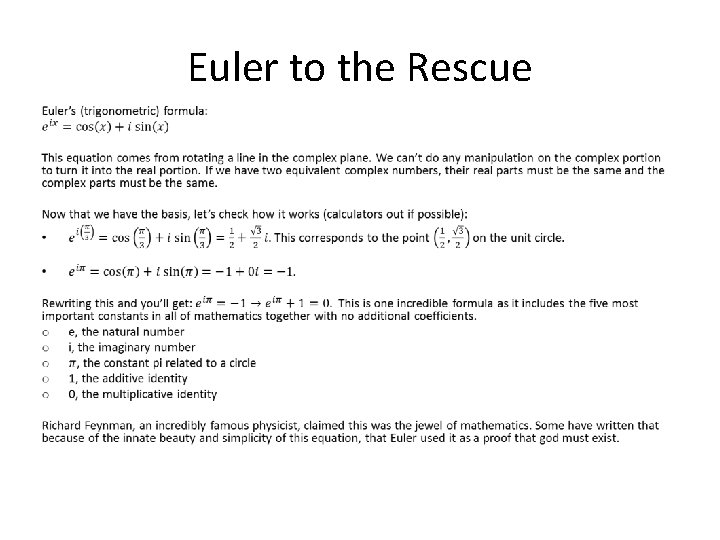
Euler to the Rescue •
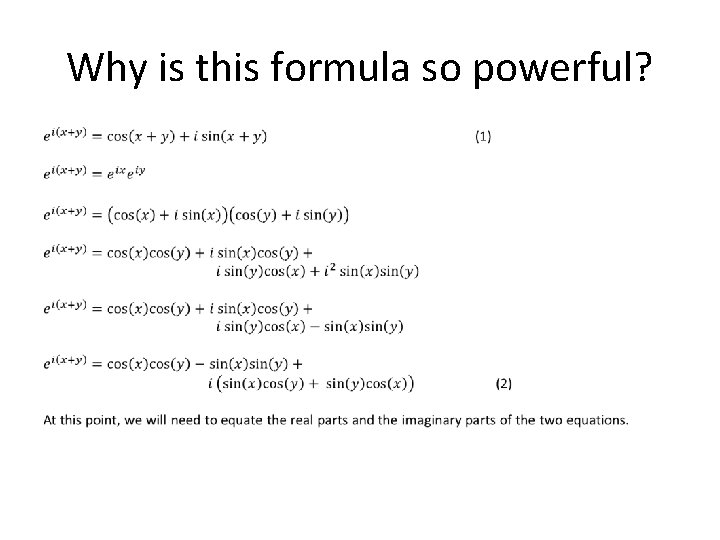
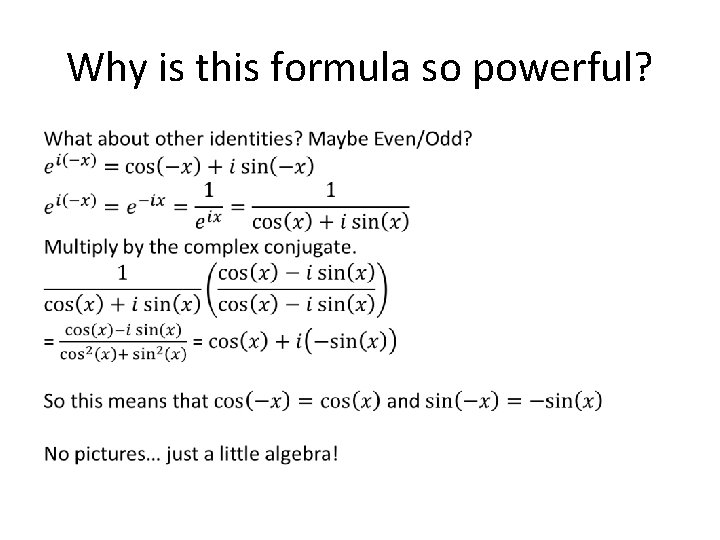
Why is this formula so powerful? •
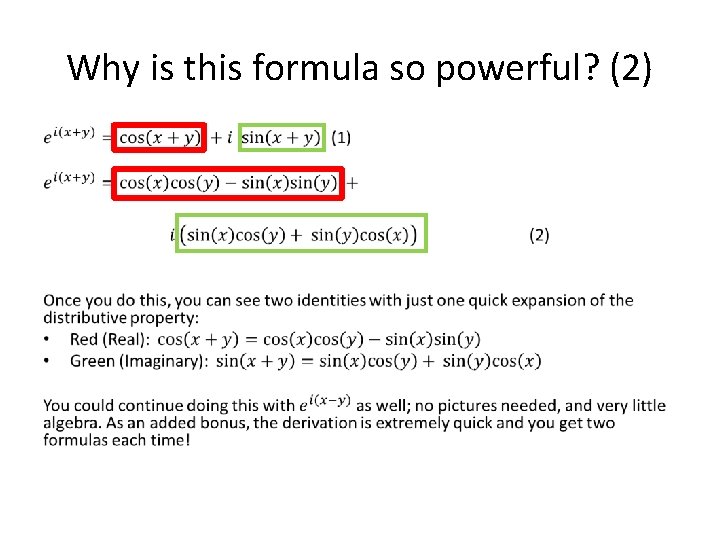
Why is this formula so powerful? (2) •
Why is this formula so powerful? •
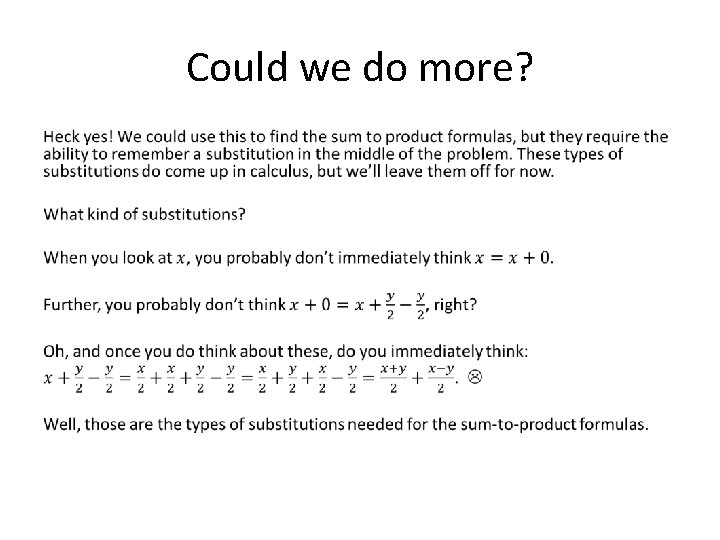
Could we do more? •
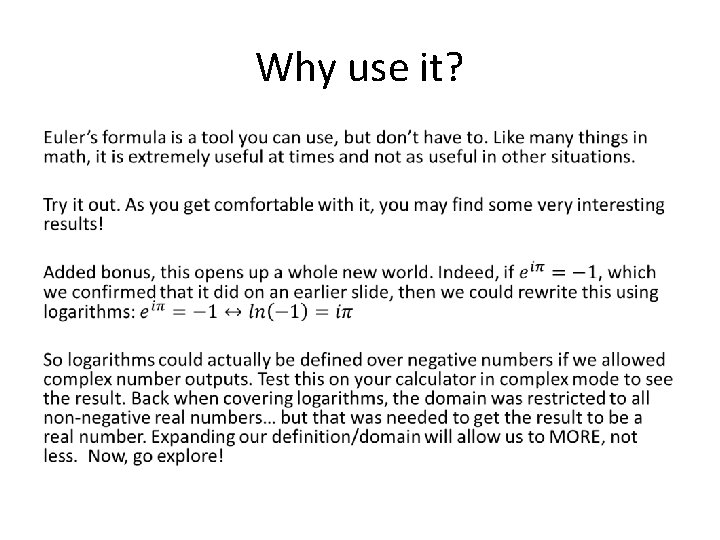
Why use it? •
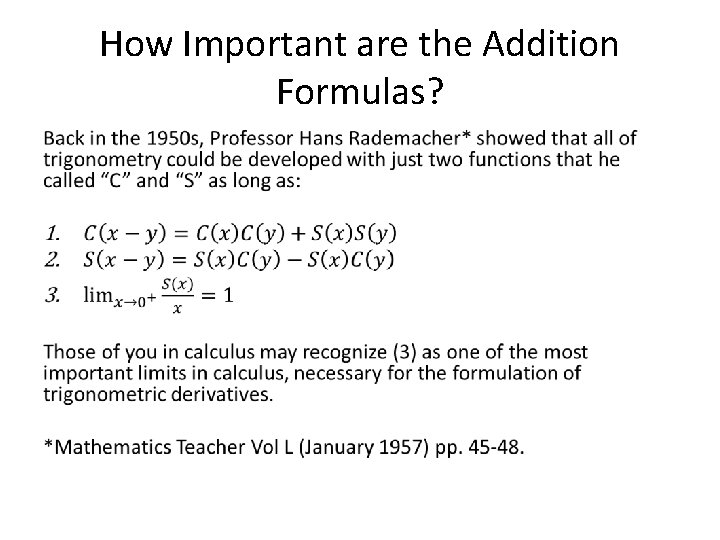
How Important are the Addition Formulas? •
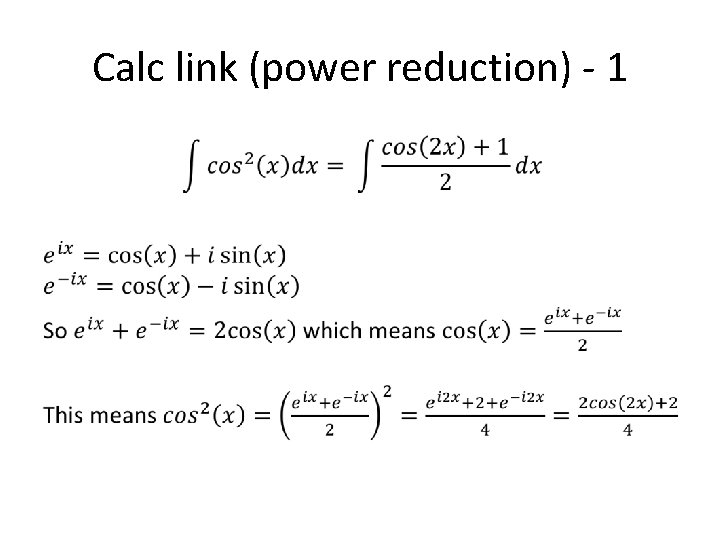
Calc link (power reduction) - 1 •
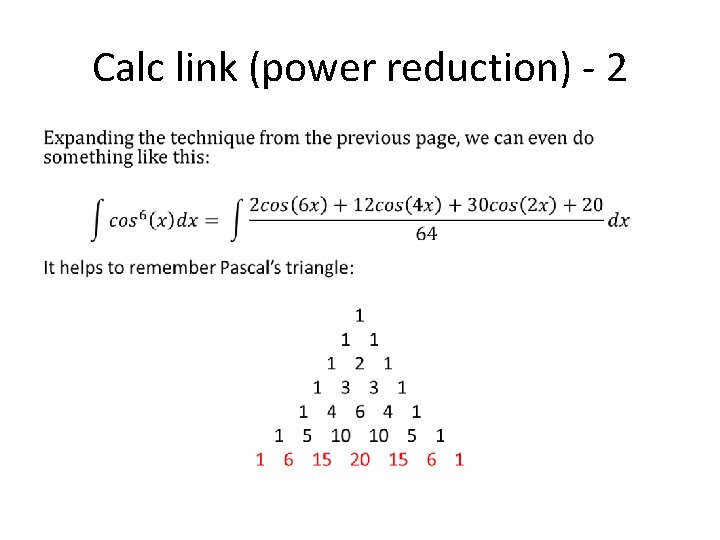
Calc link (power reduction) - 2 •
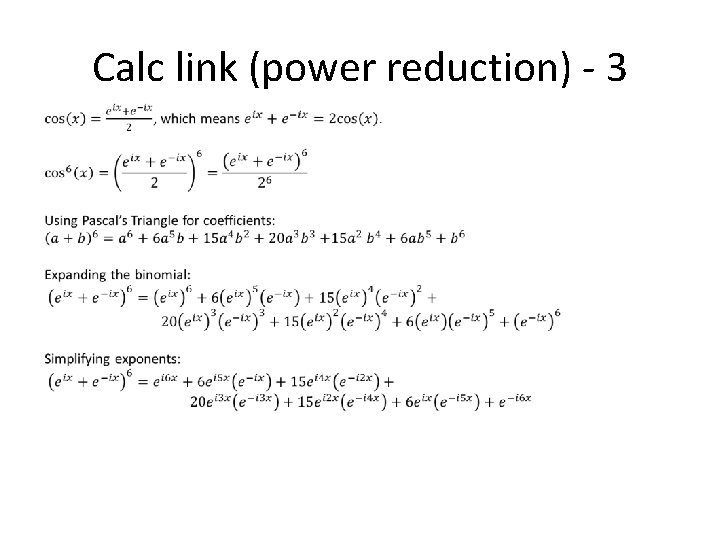
Calc link (power reduction) - 3 •
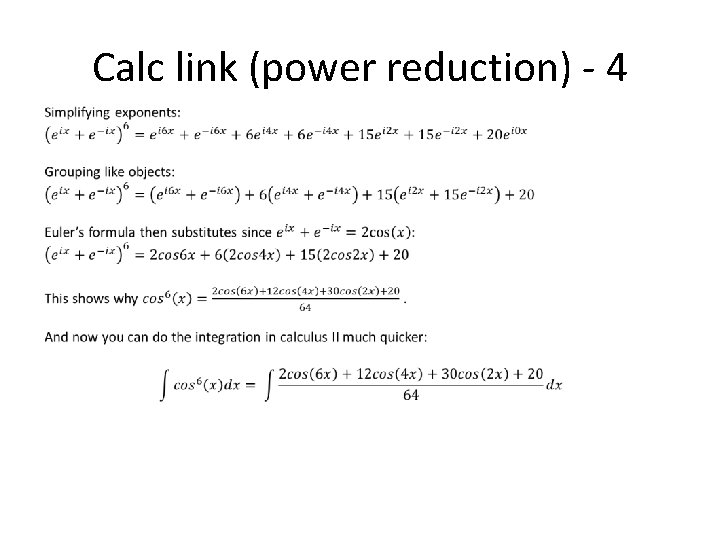
Calc link (power reduction) - 4 •
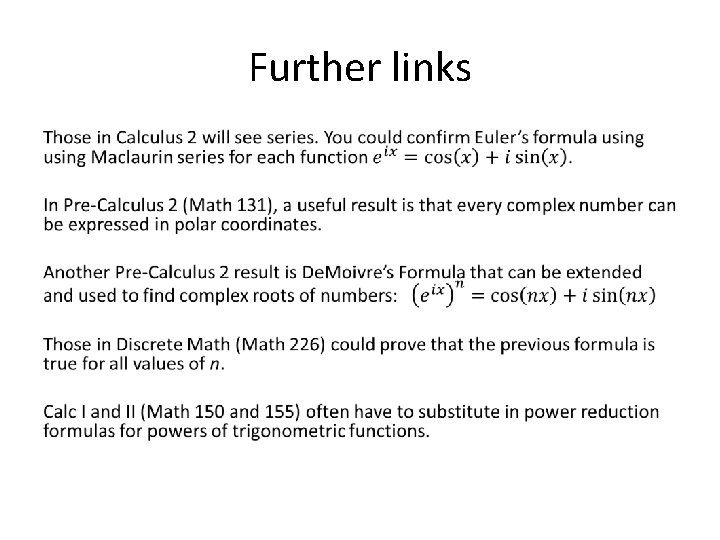
Further links •