Sharing for P 1 Parents ENGLISH LANGUAGE 3
- Slides: 45
Sharing for P 1 Parents ENGLISH LANGUAGE 3 January 2020 By HOD / English Language Mdm Lim Lay Chin 1
VISION All students to be proficient in English Language 2
MISSION The School EL programmes will help students : • Acquire good language skills • Develop thinking skills • Inculcate good values 3
Core Language Skills Listening Skills Speaking Skills Reading Skills Writing Skills 4
Classroom environment is: ☺focused on children’s interaction rather than on teacher talk ☺enriched with children’s written language ☺filled with various reading materials for children’s use 5
English Language learning is achieved through: ☺ vocabulary learned in books ☺ expression of thoughts in oral and written forms ☺ discussions with other children and the teacher ☺ informal peer interaction 6
English Language lessons includes… Development of social skills: oral interaction among peers in non-threatening situations working in partnership with other children turn taking & respect for others during class discussions 7
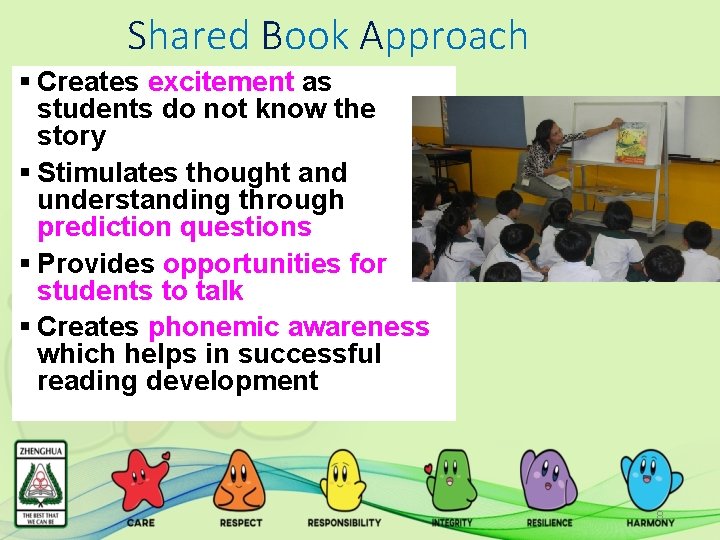
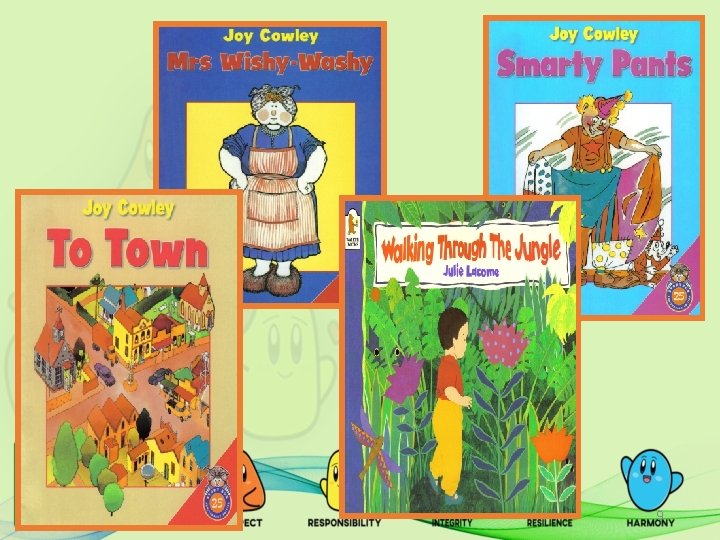
Shared Book Approach § Creates excitement as students do not know the story § Stimulates thought and understanding through prediction questions § Provides opportunities for students to talk § Creates phonemic awareness which helps in successful reading development 8
9
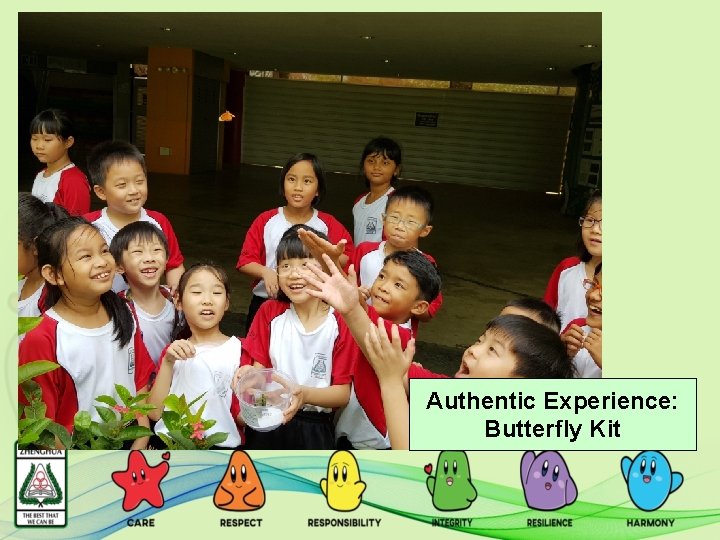
Authentic Experience: Butterfly Kit
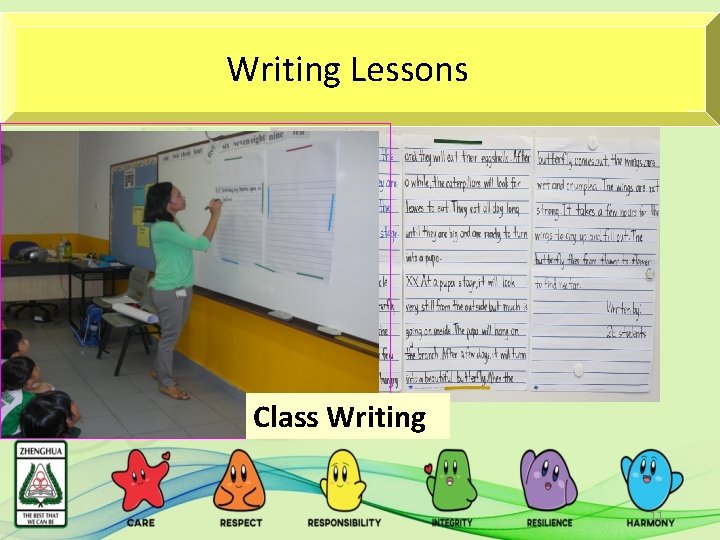
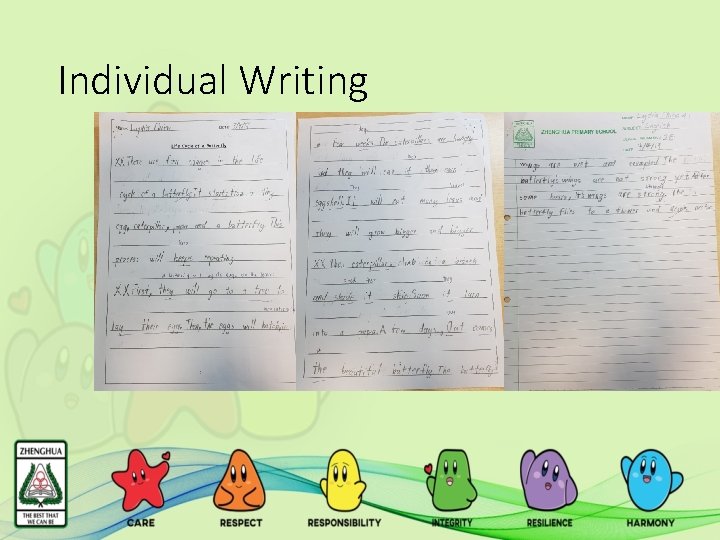
Writing Lessons Class Writing 11
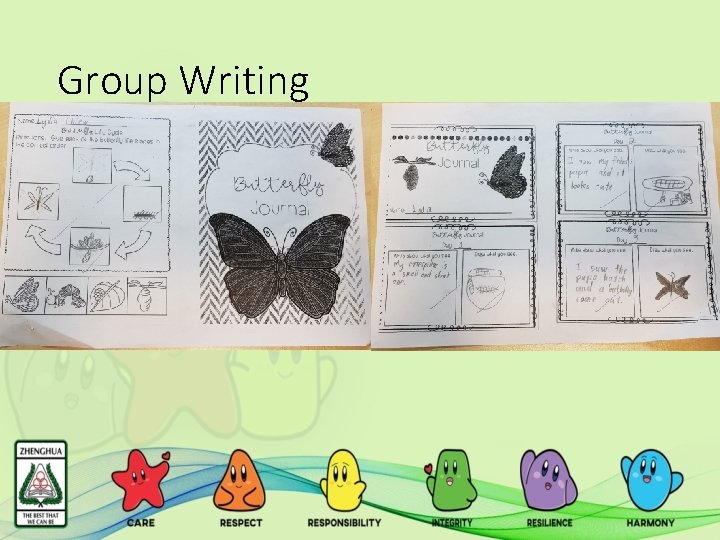
Group Writing
Individual Writing
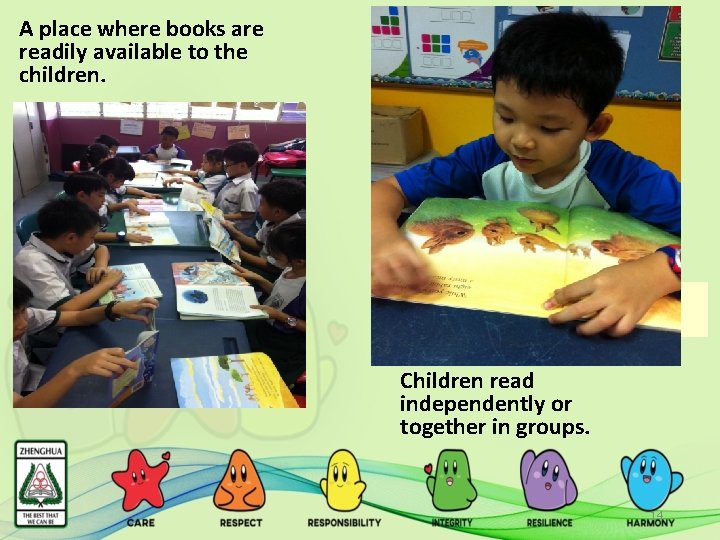
A place where books are readily available to the children. Reading Centre Children read independently or together in groups. 14
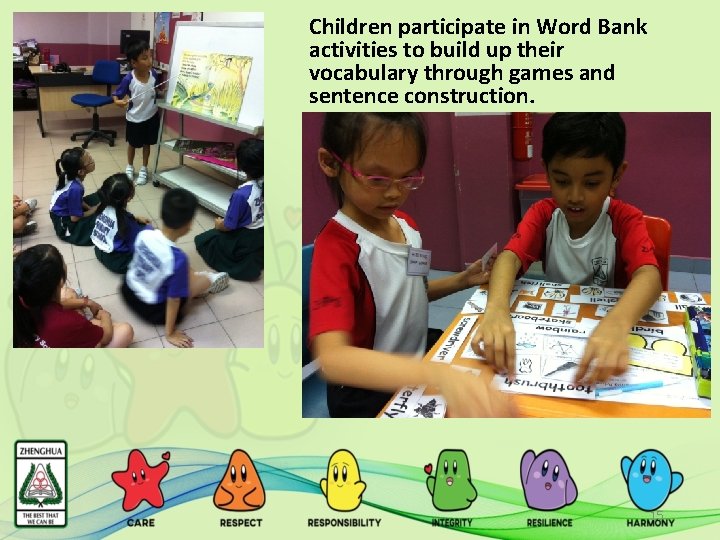
Children participate in Word Bank activities to build up their vocabulary through games and sentence construction. 15
WHAT PARENTS CAN DO TO HELP • Provide English Language reading materials at home • Role model by reading and encouraging your child to speak good English • Go to the library • Get your child to read books of their interest and talk about the characters or the plot • Stimulate your child’s thinking by discussing alternative story endings, inserting a twist in the story, etc 16
Thank you 17
Sharing for P 1 Parents Mathematics Mdm Chai Huel Leng, HOD Math
Department Vision and Mission Vision Every student a thinker and a resilient problem solver Mission • To build a strong mathematical foundation in students. • To foster the joy in the learning of Mathematics. • To engage students through various learning experiences. • To develop reasoning and communication skills in students. • To give students opportunities to appreciate and apply mathematics in real life context.
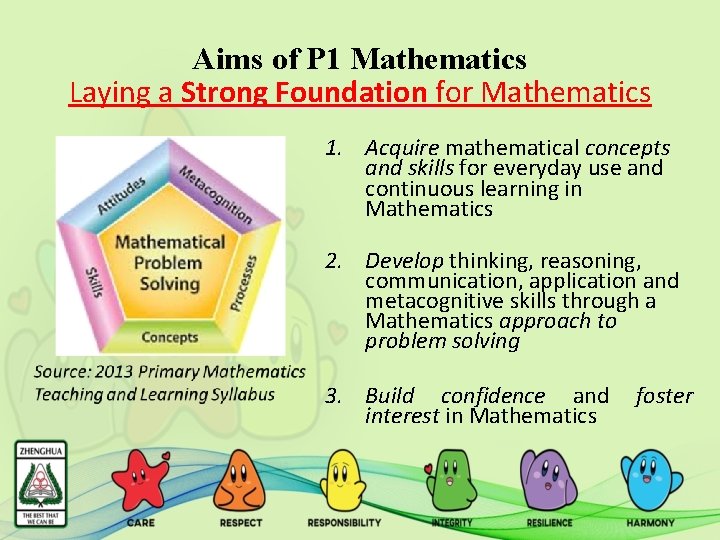
Aims of P 1 Mathematics Laying a Strong Foundation for Mathematics 1. Acquire mathematical concepts and skills for everyday use and continuous learning in Mathematics 2. Develop thinking, reasoning, communication, application and metacognitive skills through a Mathematics approach to problem solving 3. Build confidence and interest in Mathematics foster
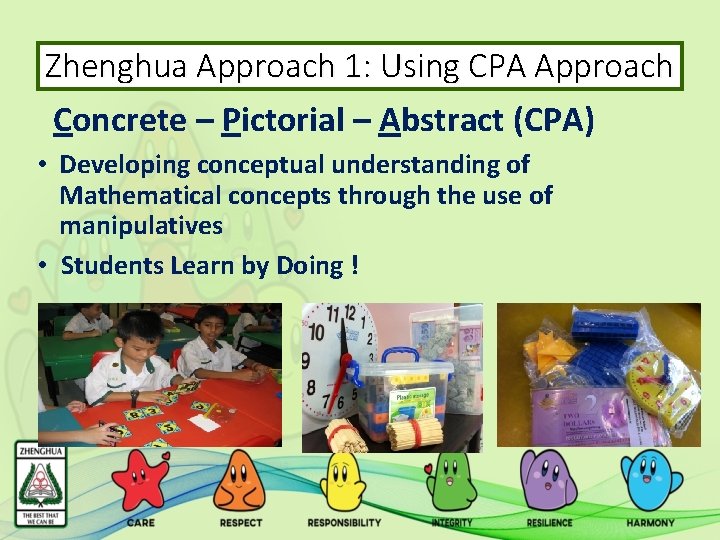
Zhenghua Approach 1: Using CPA Approach Concrete – Pictorial – Abstract (CPA) • Developing conceptual understanding of Mathematical concepts through the use of manipulatives • Students Learn by Doing !
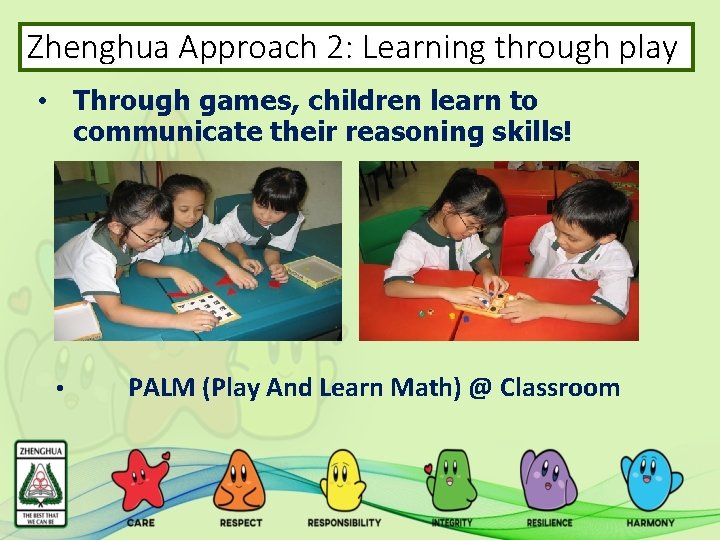
Zhenghua Approach 2: Learning through play • Through games, children learn to communicate their reasoning skills! • PALM (Play And Learn Math) @ Classroom
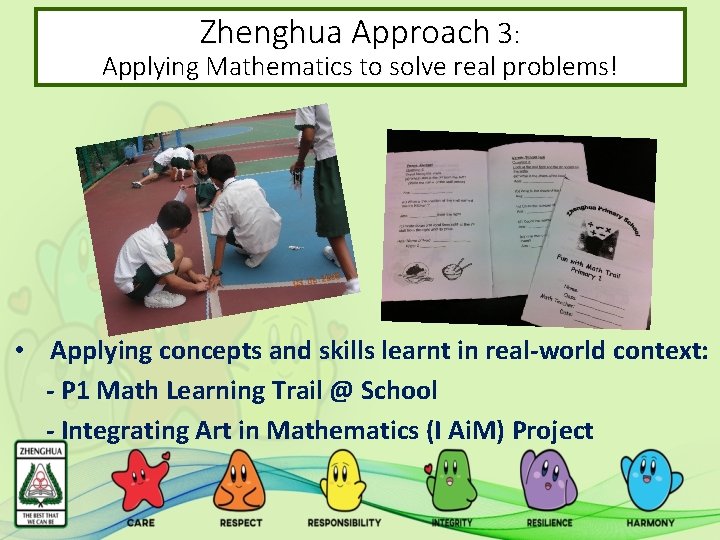
Zhenghua Approach 3: Applying Mathematics to solve real problems! • Applying concepts and skills learnt in real-world context: - P 1 Math Learning Trail @ School - Integrating Art in Mathematics (I Ai. M) Project
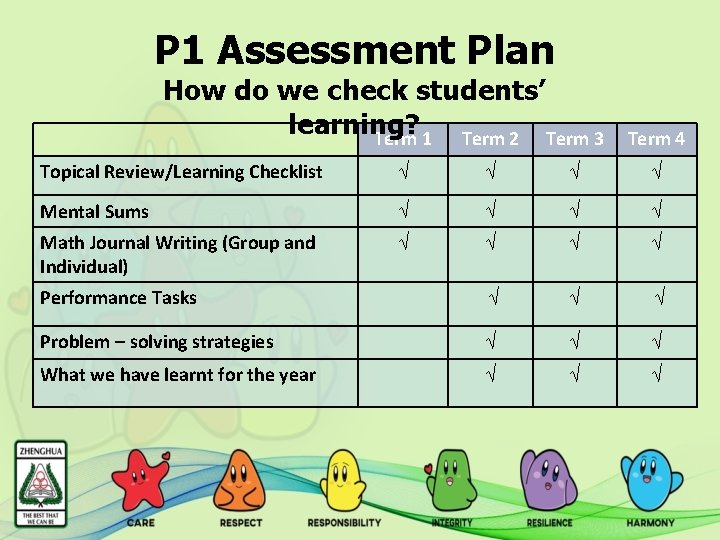
P 1 Assessment Plan How do we check students’ learning? Term 1 Term 2 Term 3 Term 4 Topical Review/Learning Checklist √ √ Mental Sums √ √ Math Journal Writing (Group and Individual) √ √ Performance Tasks √ √ √ Problem – solving strategies √ √ √ What we have learnt for the year √ √ √
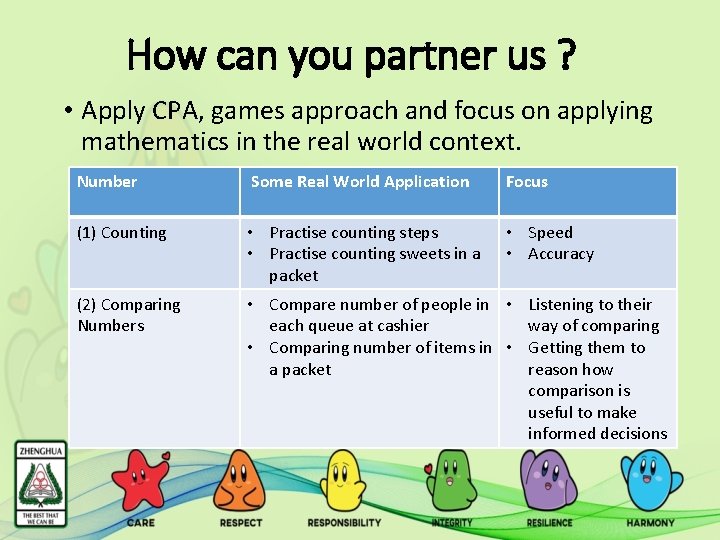
How can you partner us ? • Apply CPA, games approach and focus on applying mathematics in the real world context. Number Some Real World Application Focus (1) Counting • Practise counting steps • Practise counting sweets in a packet • Speed • Accuracy (2) Comparing Numbers • Compare number of people in • Listening to their each queue at cashier way of comparing • Comparing number of items in • Getting them to a packet reason how comparison is useful to make informed decisions
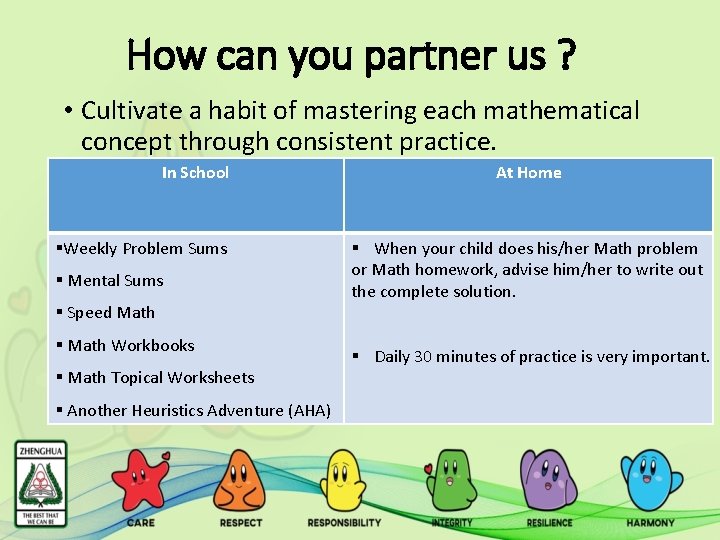
How can you partner us ? • Cultivate a habit of mastering each mathematical concept through consistent practice. In School §Weekly Problem Sums § Mental Sums § Speed Math § Math Workbooks § Math Topical Worksheets § Another Heuristics Adventure (AHA) At Home § When your child does his/her Math problem or Math homework, advise him/her to write out the complete solution. § Daily 30 minutes of practice is very important.
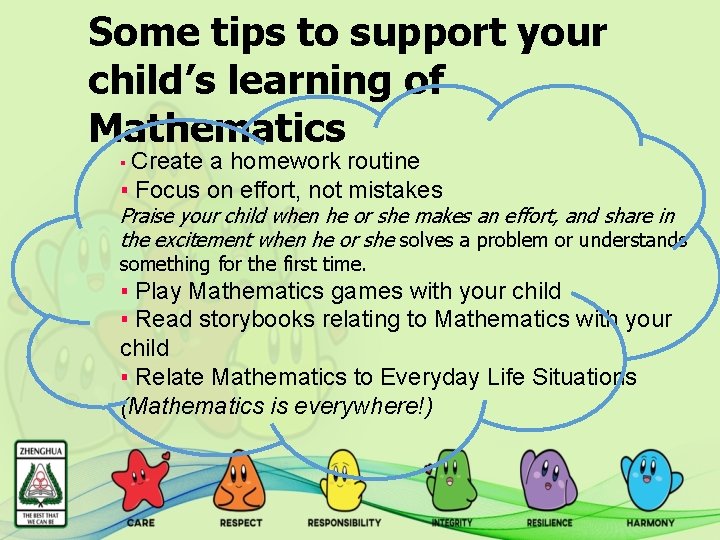
Some tips to support your child’s learning of Mathematics ▪ Create a homework routine ▪ Focus on effort, not mistakes Praise your child when he or she makes an effort, and share in the excitement when he or she solves a problem or understands something for the first time. ▪ Play Mathematics games with your child ▪ Read storybooks relating to Mathematics with your child ▪ Relate Mathematics to Everyday Life Situations (Mathematics is everywhere!)
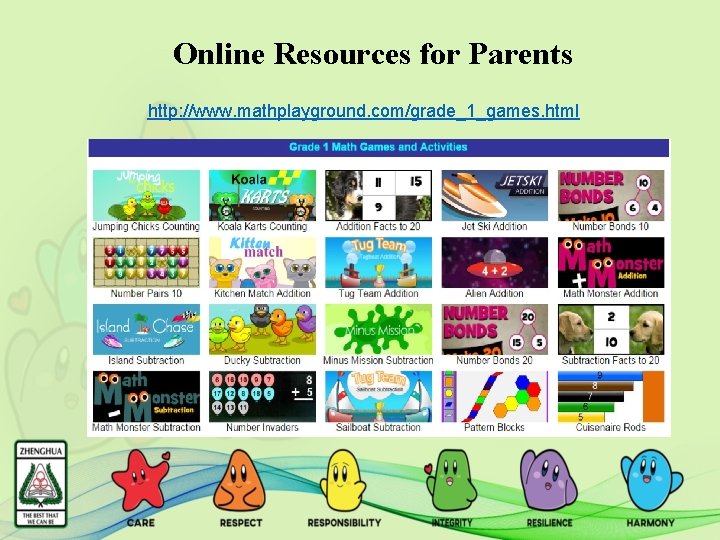
Online Resources for Parents http: //www. mathplayground. com/grade_1_games. html
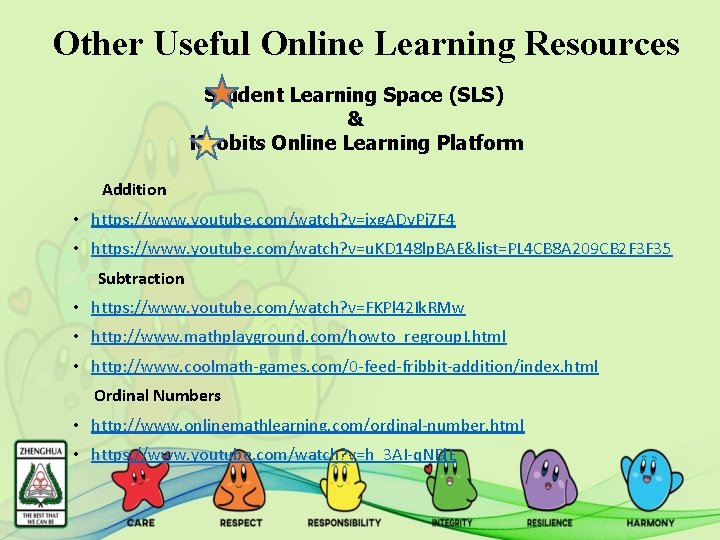
Other Useful Online Learning Resources Student Learning Space (SLS) & Koobits Online Learning Platform Addition • https: //www. youtube. com/watch? v=ixg. ADy. Pj 7 F 4 • https: //www. youtube. com/watch? v=u. KD 148 lp. BAE&list=PL 4 CB 8 A 209 CB 2 F 3 F 35 Subtraction • https: //www. youtube. com/watch? v=FKPl 42 Ik. RMw • http: //www. mathplayground. com/howto_regroup. I. html • http: //www. coolmath-games. com/0 -feed-fribbit-addition/index. html Ordinal Numbers • http: //www. onlinemathlearning. com/ordinal-number. html • https: //www. youtube. com/watch? v=h_3 AI-q. NBl. E
Sharing for P 1 Parents Mother Tongue Languages 3 January 2020 By HOD / MTL Mr Er Kim Hoe 31
VISION Every Zhenghua student is proficient in the use of Mother Tongue Languages 32
MISSION Provide a conducive environment through: Collaboration, Training, Basic languageskills, academic programmes, cultural appreciation & global exposure, to nurture students with morality and achievements 33
Core Language Skills Listening Skills Speaking Skills Reading Skills Writing Skills 34
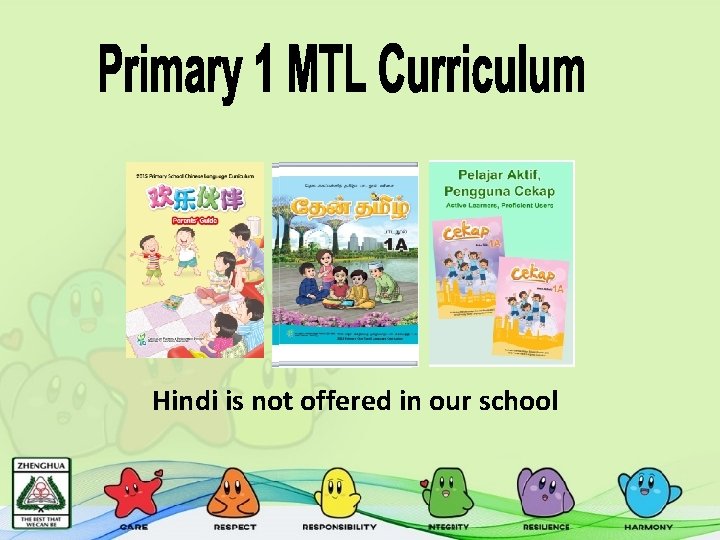
Hindi is not offered in our school
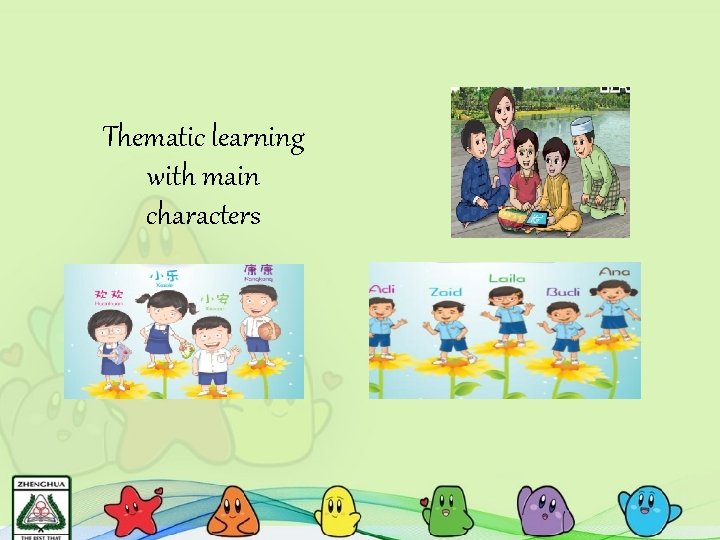
Thematic learning with main characters
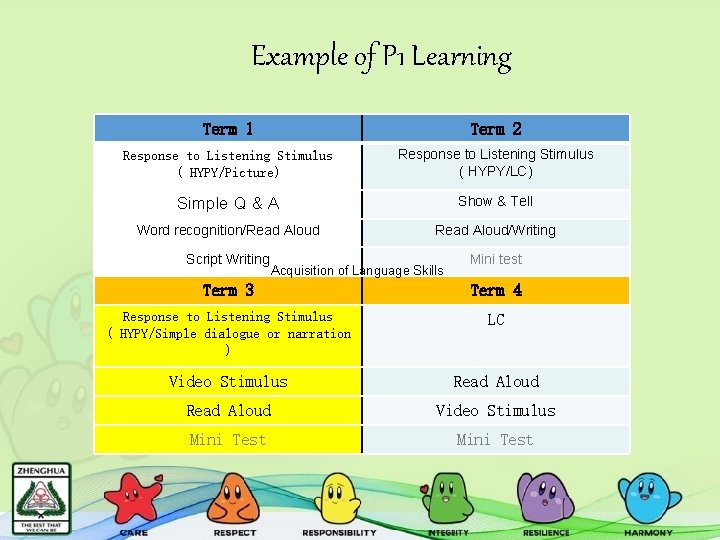
Example of P 1 Learning Term 1 Term 2 Response to Listening Stimulus ( HYPY/Picture) Response to Listening Stimulus ( HYPY/LC) Simple Q & A Show & Tell Word recognition/Read Aloud/Writing Script Writing Mini test Acquisition of Language Skills Term 3 Term 4 Response to Listening Stimulus ( HYPY/Simple dialogue or narration ) LC Video Stimulus Read Aloud Video Stimulus Mini Test Reading
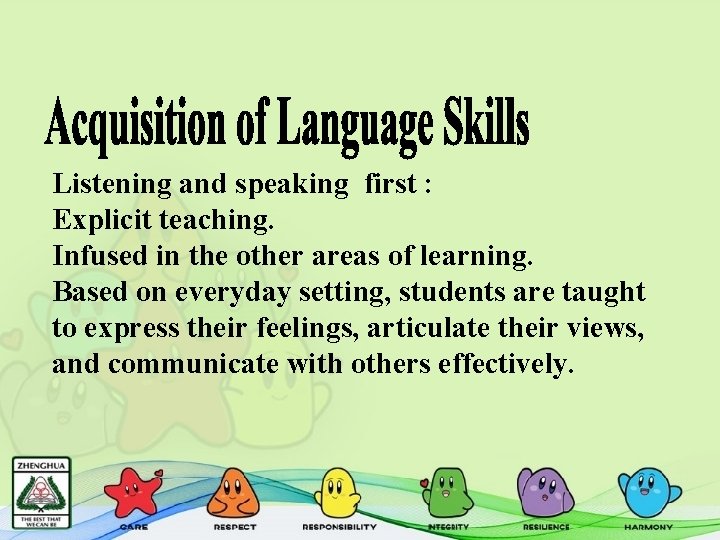
Listening and speaking first : Explicit teaching. Infused in the other areas of learning. Based on everyday setting, students are taught to express their feelings, articulate their views, and communicate with others effectively.
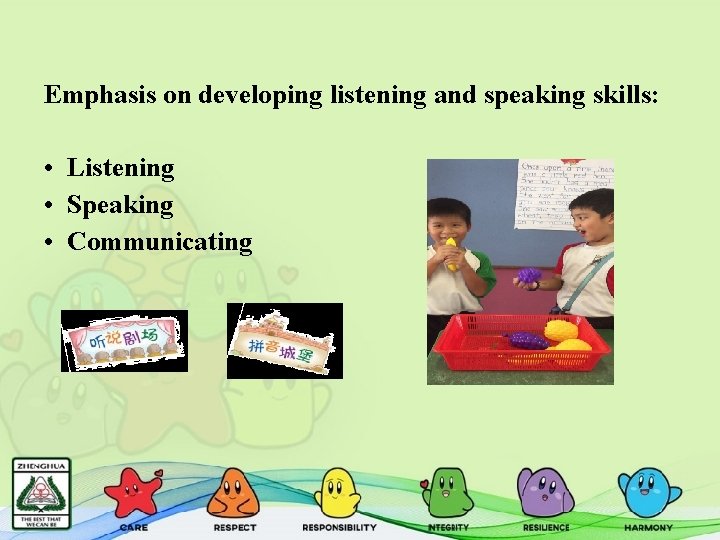
Emphasis on developing listening and speaking skills: • Listening • Speaking • Communicating
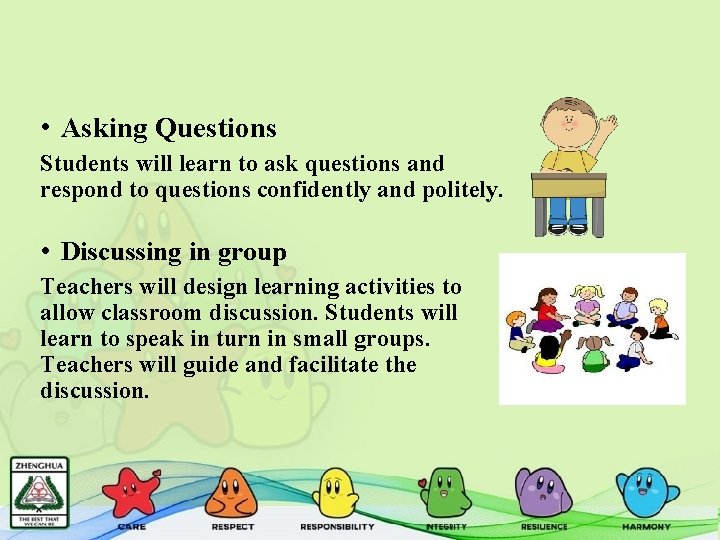
• Asking Questions Students will learn to ask questions and respond to questions confidently and politely. • Discussing in group Teachers will design learning activities to allow classroom discussion. Students will learn to speak in turn in small groups. Teachers will guide and facilitate the discussion.
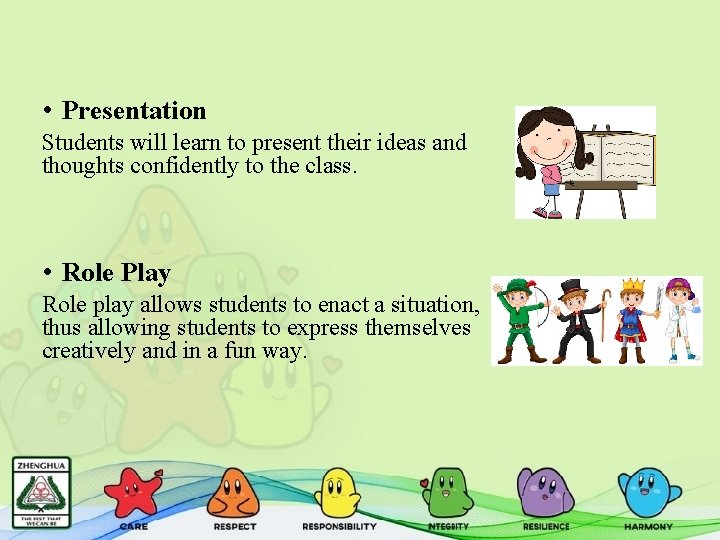
• Presentation Students will learn to present their ideas and thoughts confidently to the class. • Role Play Role play allows students to enact a situation, thus allowing students to express themselves creatively and in a fun way.
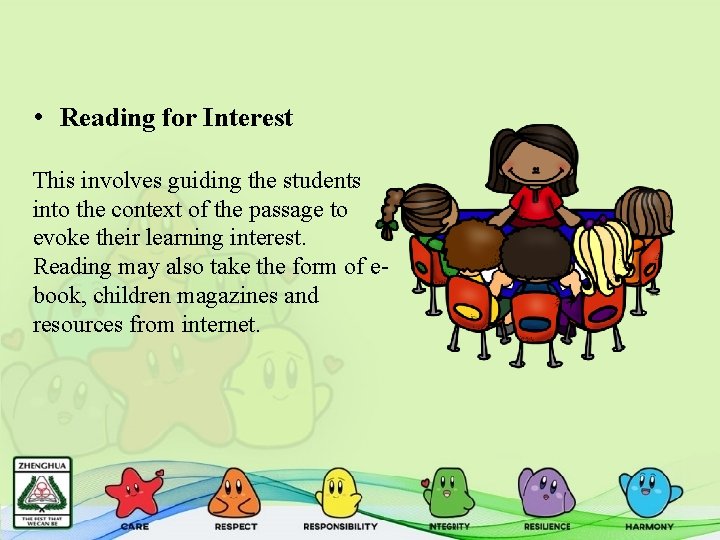
• Reading for Interest This involves guiding the students into the context of the passage to evoke their learning interest. Reading may also take the form of ebook, children magazines and resources from internet.
What You can Do To Help Your Child • Read good story books, newspaper articles & magazines in MTL with your child at home. • Role model by encouraging your child to speak good MT languages, using everyday experience e. g. when taking MRT train. • Go to the library and borrow MT books as well. Follow up by talking about the plot and characters in the books. • Listen to radio and watch relevant TV programmes in MTL. • Use the small whiteboard to co-write a few simple sentences with your child.
Useful Learning Resources 1. Parents in Education http: //parents-in-education. moe. gov. sg 2. Huan Le Huo Ban http: //xuele. moe. edu. sg/xuele/slot/u 107/index. html 3. Tinta Tunas http: //tinta. moe. gov. sg 4. Parents in Education http: //sangamam. moe. gov. sg
Thank you 45