Phi meson physics Marianna Testa University of Roma






- Slides: 56
Phi meson physics Marianna Testa University of Roma La Sapienza & INFN for the KLOE collaboration “e+e- Collisions from Phi to Psi”, Novosibirsk 27 February-2 March 2006
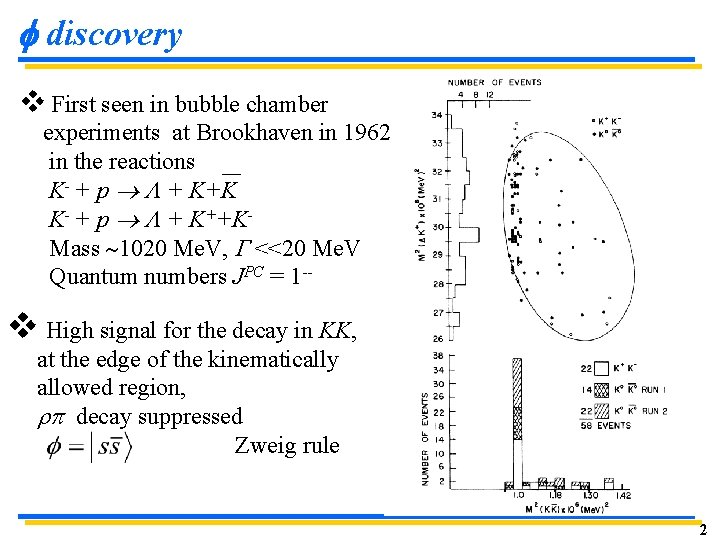
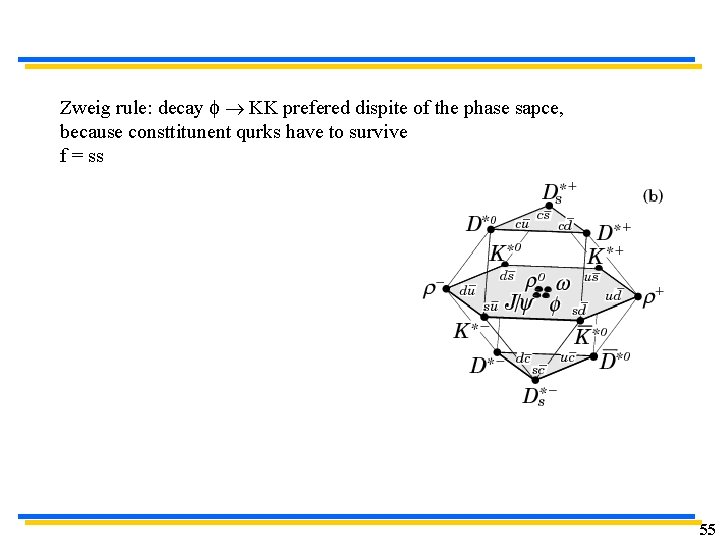
f discovery v First seen in bubble chamber experiments at Brookhaven in 1962 in the reactions K- + p L + K+K K- + p L + K++KMass 1020 Me. V, G <<20 Me. V Quantum numbers JPC = 1 -- v High signal for the decay in KK, at the edge of the kinematically allowed region, r decay suppressed Zweig rule 2
f at e+e- collider SND s(e+e- KSKL) PRD 63, 072002 (2001) Absolute BR can be determined using s (f f) and G(e+e-) (only) at a f factory mf = 1019. 42 0. 05 Me. V Gf = 4. 21 0. 04 Me. V Using • Gf /Gtot from SND & CMD-2 with f = K+K- , KK, p+p-p 0, , p 0 • G(e+e-) from KLOE 3
F factories DAFNE VEPP 2 M (1974 -2000) • Ebeam : 510 Me. V beam : 180 -700 Me. V • 2 separate rings for e+ e- to minimize beam- • • Escan step: D s = (1 – 10 )Me. V beam • 1 bunch • Lpeak 1. 3 1032 cm-2 s-1 • beam current 10 -50 m. A • up to 120 bunches 20 m. A per bunch • Lpeak 3 1030 cm-2 s-1 • Crossing angle at 12. 5 mrad • Circumference 18 m • KLOE experiment • Time collisiont 60 ns • 2 experiments CMD-2 & SND • 2. 4 fb-1 • 40 pb-1/detector 4
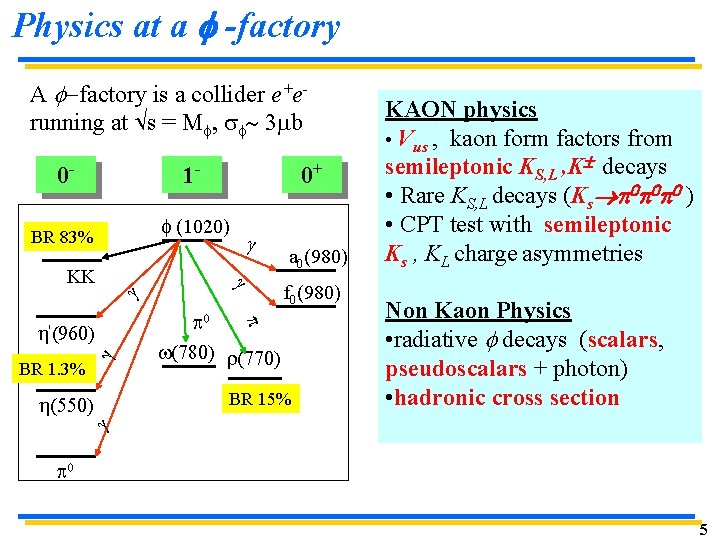
Physics at a f -factory A factory is a collider e+erunning at s = Mf, sf 3 mb 0 - 1 f (1020) BR 83% KK 0 g a 0(980) f 0(980) h(550) g g g h'(960) BR 1. 3% 0+ w(780) r(770) BR 15% KAON physics • Vus , kaon form factors from semileptonic KS, L , K decays • Rare KS, L decays (Ks p 0 p 0 p 0 ) • CPT test with semileptonic Ks , KL charge asymmetries Non Kaon Physics • radiative decays (scalars, pseudoscalars + photon) • hadronic cross section g 0 5
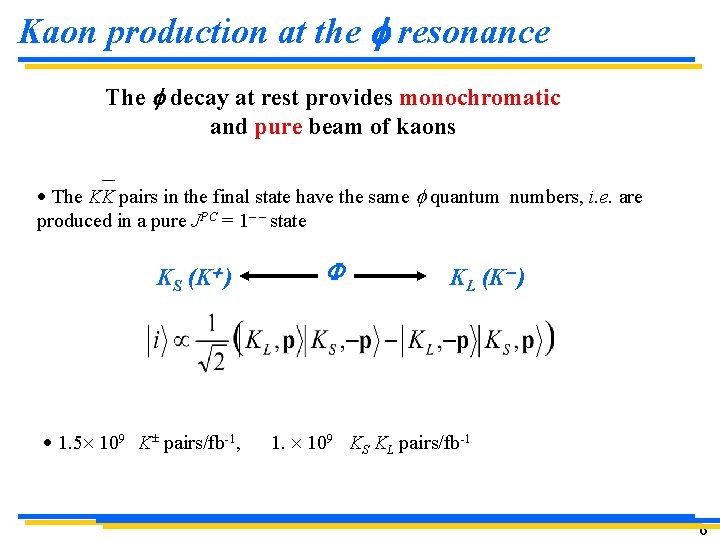
Kaon production at the f resonance The f decay at rest provides monochromatic and pure beam of kaons · The KK pairs in the final state have the same quantum numbers, i. e. are produced in a pure JPC = 1– – state KS (K+ ) · 1. 5 109 K± pairs/fb-1, F KL (K- ) 1. 109 KS KL pairs/fb-1 6
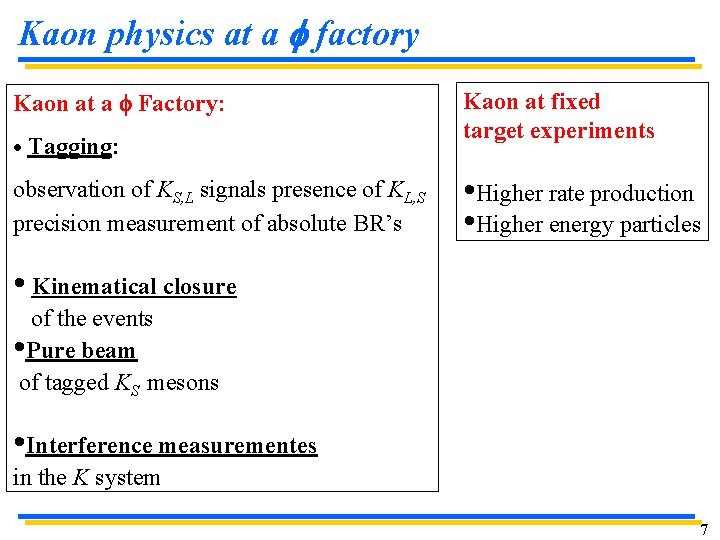
Kaon physics at a f factory Kaon at a f Factory: · Tagging: observation of KS, L signals presence of KL, S precision measurement of absolute BR’s Kaon at fixed target experiments • Higher rate production • Higher energy particles • Kinematical closure of the events • Pure beam of tagged KS mesons • Interference measurementes in the K system 7
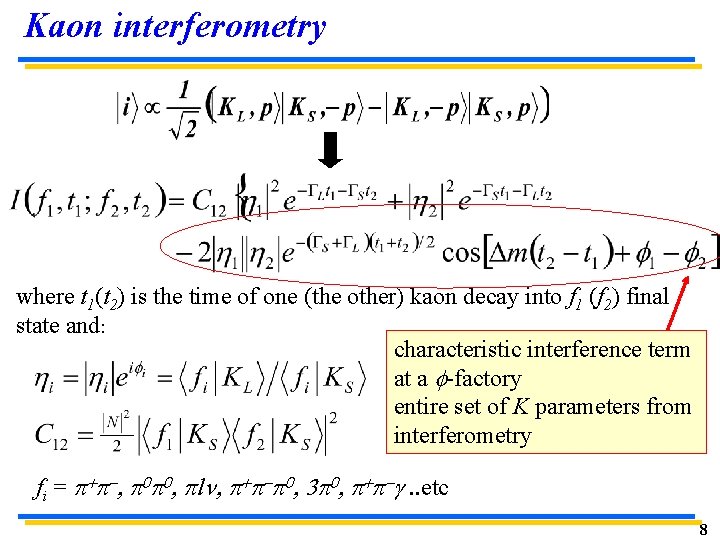
Kaon interferometry where t 1(t 2) is the time of one (the other) kaon decay into f 1 (f 2) final state and: characteristic interference term at a -factory entire set of K parameters from interferometry fi = + -, 0 0, l , + - 0, 3 0, + - . . etc 8
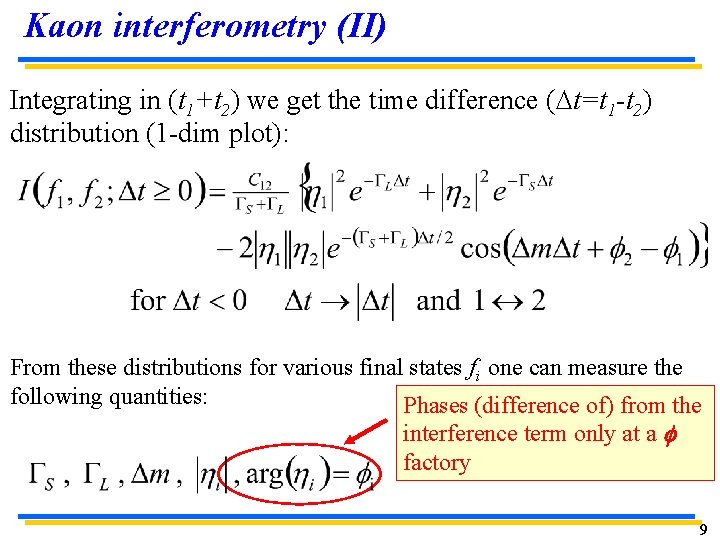
Kaon interferometry (II) Integrating in (t 1+t 2) we get the time difference (Dt=t 1 -t 2) distribution (1 -dim plot): From these distributions for various final states fi one can measure the following quantities: Phases (difference of) from the interference term only at a f factory 9
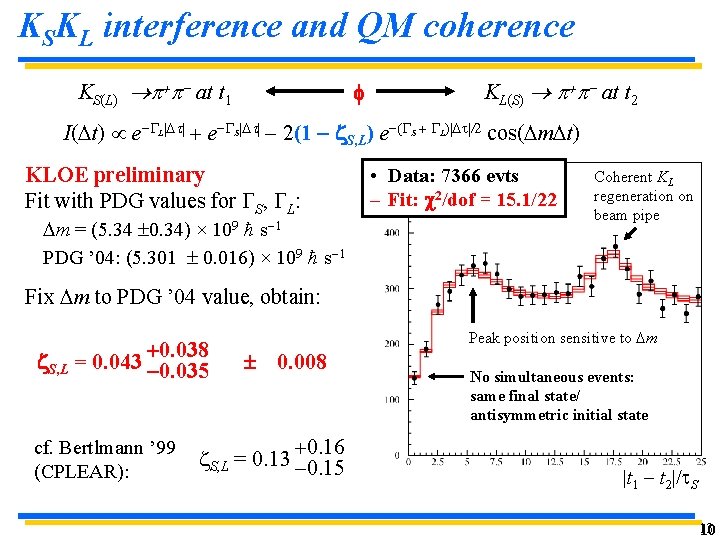
KSKL interference and QM coherence KS(L) + - at t 1 f KL(S) + - at t 2 I(Dt) e L|Dt| + e S|Dt| 2(1 z. S, L) e ( S + L)|Dt|/2 cos(Dm. Dt) KLOE preliminary Fit with PDG values for S, L: Dm = (5. 34 0. 34) × 109 ħ s 1 PDG ’ 04: (5. 301 0. 016) × 109 ħ s 1 • Data: 7366 evts – Fit: 2/dof = 15. 1/22 Coherent KL regeneration on beam pipe Fix Dm to PDG ’ 04 value, obtain: +0. 038 z. S, L = 0. 043 0. 035 cf. Bertlmann ’ 99 (CPLEAR): Peak position sensitive to Dm 0. 008 +0. 16 z. S, L = 0. 13 0. 15 No simultaneous events: same final state/ antisymmetric initial state |t 1 t 2|/t. S 13 10
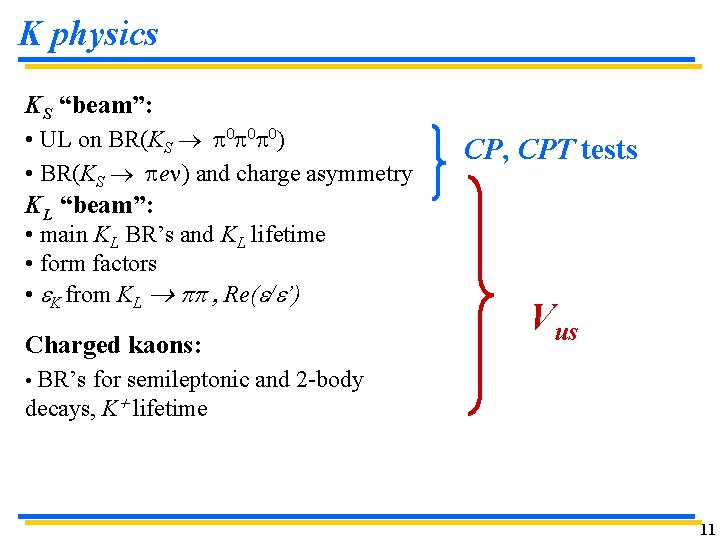
K physics KS “beam”: • UL on BR(KS 0 0 0) • BR(KS en) and charge asymmetry CP, CPT tests KL “beam”: • main KL BR’s and KL lifetime • form factors • e. K from KL , Re(e/e’) Charged kaons: Vus • BR’s for semileptonic and 2 -body decays, K+ lifetime 11
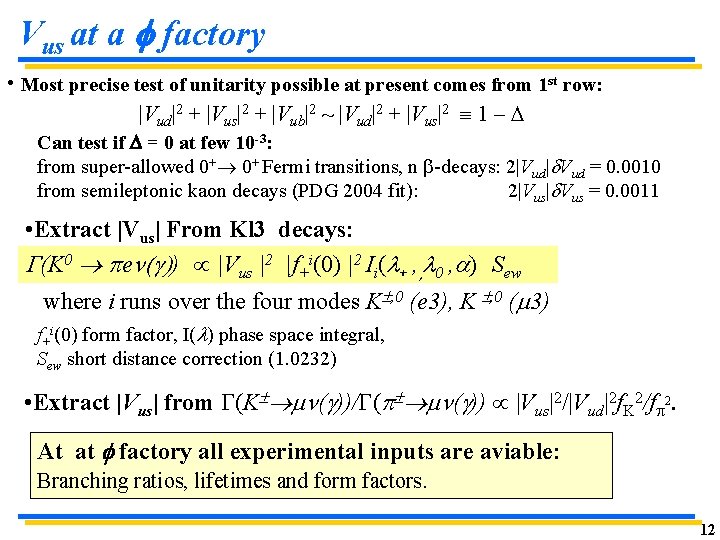
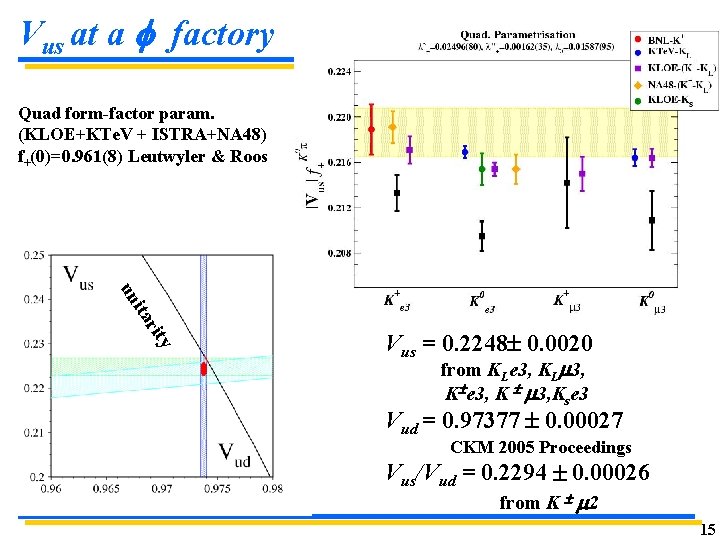
Vus at a f factory • Most precise test of unitarity possible at present comes from 1 st row: |Vud|2 + |Vus|2 + |Vub|2 ~ |Vud|2 + |Vus|2 1 – D Can test if D = 0 at few 10 -3: from super-allowed 0+ 0+ Fermi transitions, n b-decays: 2|Vud|d. Vud = 0. 0010 from semileptonic kaon decays (PDG 2004 fit): 2|Vus|d. Vus = 0. 0011 • Extract |Vus| From Kl 3 decays: G(K 0 e ( )) |Vus |2 |f+i(0) |2 Ii(l+ , , l 0 , a) Sew where i runs over the four modes K , 0 (e 3), K , 0 ( 3) f+i(0) form factor, I(l) phase space integral, Sew short distance correction (1. 0232) • Extract |Vus| from (K ( ))/ ( ( )) |Vus|2/|Vud|2 f. K 2/f 2. At at f factory all experimental inputs are aviable: Branching ratios, lifetimes and form factors. 12
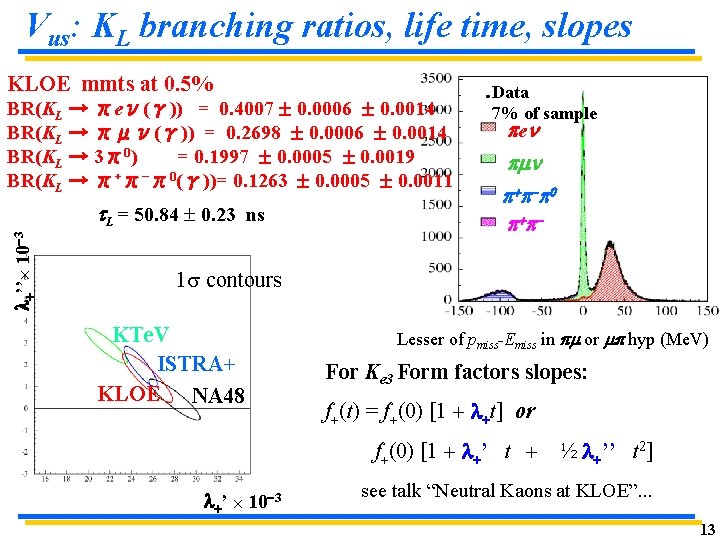
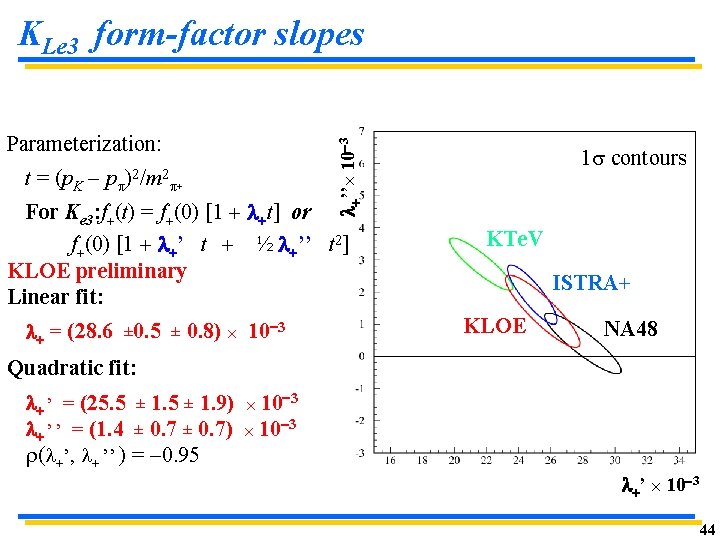
Vus: KL branching ratios, life time, slopes KLOE mmts at 0. 5% BR(KL → πeν(γ)) = 0. 4007 0. 0006 0. 0014 πμν(γ)) = 0. 2698 0. 0006 0. 0014 3π0) = 0. 1997 0. 0005 0. 0019 π+π−π0(γ))= 0. 1263 0. 0005 0. 0011 l+’’ 10 3 t. L = 50. 84 0. 23 ns Data 7% of sample pen pmn p+p-p 0 p+p- 1 s contours KTe. V ISTRA+ KLOE NA 48 Lesser of pmiss-Emiss in pm or mp hyp (Me. V) For Ke 3 Form factors slopes: f+(t) = f+(0) [1 + l+t] or f+(0) [1 + l+’ t + l+’ 10 3 ½ l+’’ t 2] see talk “Neutral Kaons at KLOE”. . . 13
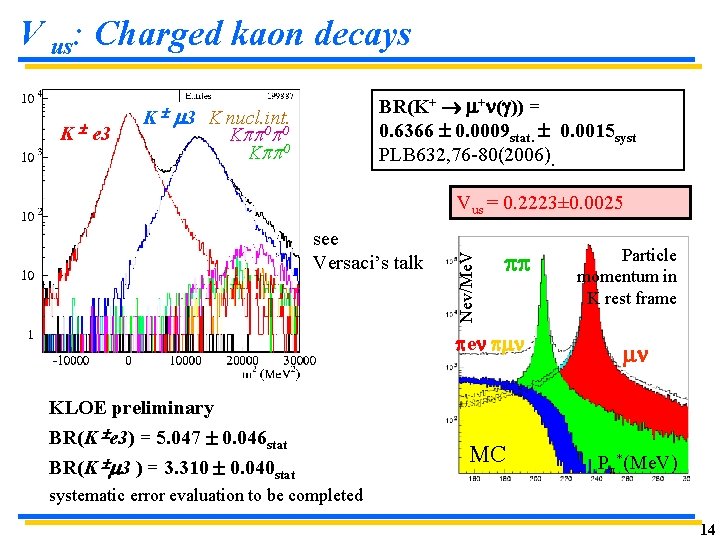
V us: Charged kaon decays K e 3 BR(K+ + ( )) = 0. 6366 0. 0009 stat. 0. 0015 syst PLB 632, 76 -80(2006). K m 3 K nucl. int. K 0 0 K 0 see Versaci’s talk Nev/Me. V Vus = 0. 2223± 0. 0025 e Particle momentum in K rest frame KLOE preliminary BR(K e 3) = 5. 047 0. 046 stat BR(K m 3 ) = 3. 310 0. 040 stat MC P *(Me. V) systematic error evaluation to be completed 14
Vus at a f factory Quad form-factor param. (KLOE+KTe. V + ISTRA+NA 48) f+(0)=0. 961(8) Leutwyler & Roos Vus un y rit ita Vus = 0. 2248 0. 0020 from KLe 3, KLm 3, K e 3, K m 3, Kse 3 Vud = 0. 97377 0. 00027 CKM 2005 Proceedings Vus/Vud = 0. 2294 0. 00026 from K m 2 15
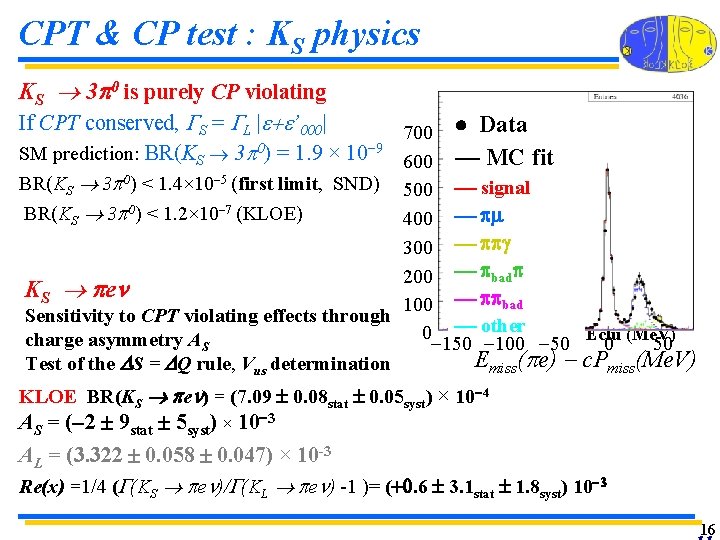
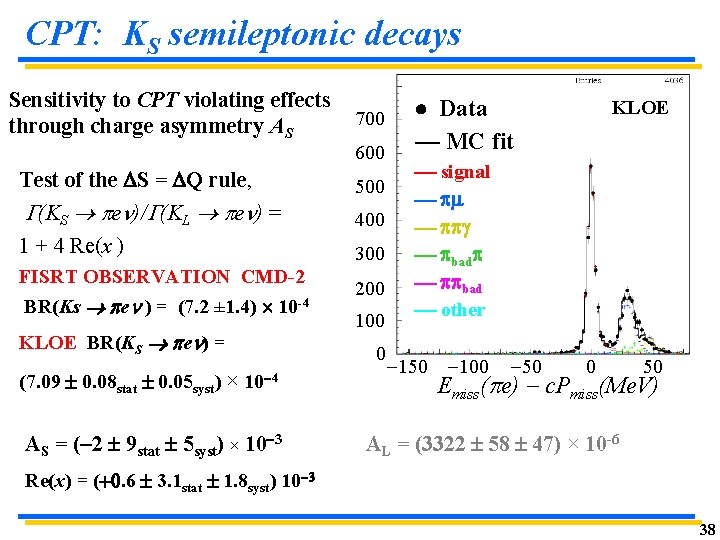
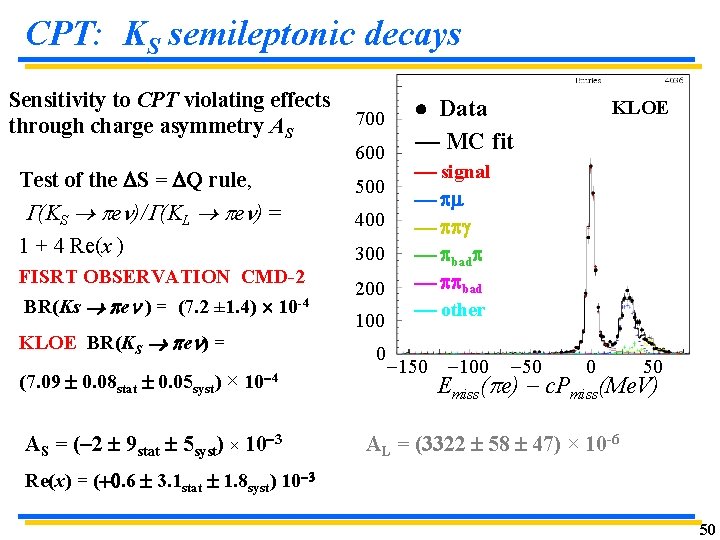
CPT & CP test : KS physics KS 3 p 0 is purely CP violating If CPT conserved, GS = GL |e+e’ 000| CMD 2’ 99 700 Data SM prediction: BR(KS 3 0) = 1. 9 × 10 9 600 — MC first observation fit BR(KS 3 0) < 1. 4× 10 5 (first limit, SND) 500 signal BR(KS 3 0) < 1. 2× 10 7 (KLOE) 400 300 200 bad KS pen 100 bad Sensitivity to CPT violating effects through other. P-Eloss-Eclu (Me. V) 0 charge asymmetry AS 150 100 50 Emiss( e) - c. Pmiss(Me. V) Test of the DS = DQ rule, Vus determination KLOE BR(KS pen) = (7. 09 0. 08 stat 0. 05 syst) × 10 4 AS = ( 2 9 stat 5 syst) × 10 3 AL = (3. 322 0. 058 0. 047) × 10 -3 Re(x) =1/4 (G(KS e )/G(KL e ) -1 )= (+0. 6 3. 1 stat 1. 8 syst) 10 3 16
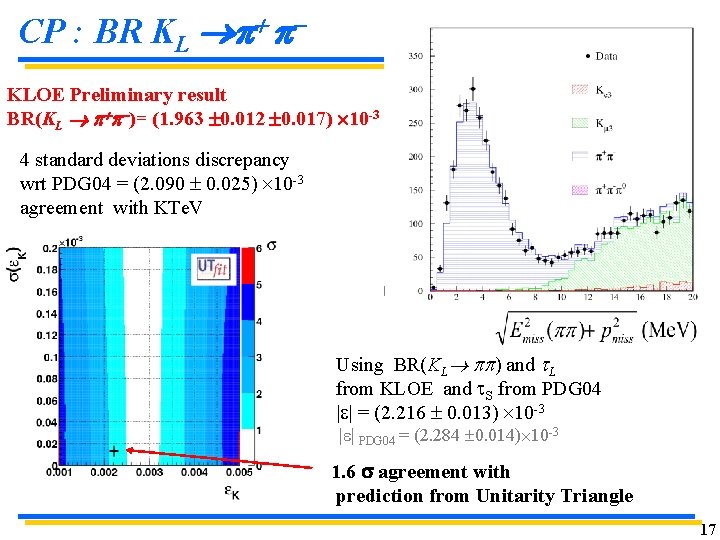
CP : BR KL p+ p- KLOE Preliminary result BR(KL p+p-)= (1. 963 0. 012 0. 017) 10 -3 4 standard deviations discrepancy wrt PDG 04 = (2. 090 0. 025) 10 -3 agreement with KTe. V Using BR(KL ) and t. L from KLOE and t. S from PDG 04 |e| = (2. 216 0. 013) 10 -3 |e| PDG 04 = (2. 284 0. 014) 10 -3 1. 6 s agreement with prediction from Unitarity Triangle 17
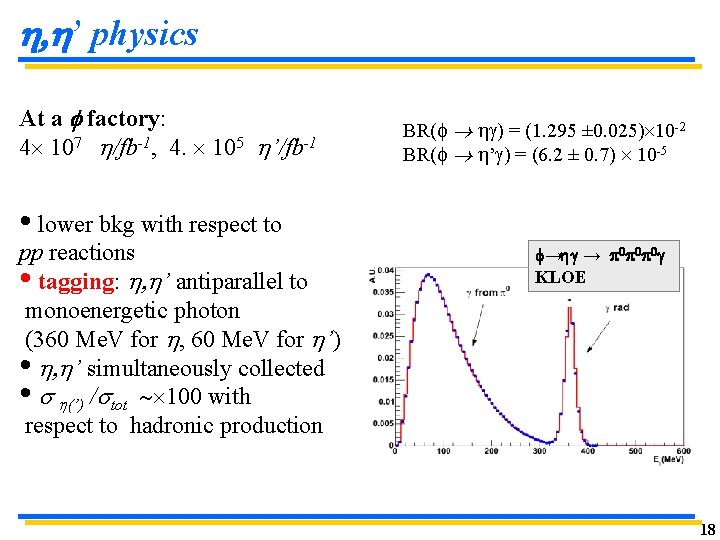
, ’ physics At a f factory: 4 107 /fb-1, 4. 105 ’/fb-1 BR(f hg) = (1. 295 ± 0. 025) 10 -2 BR(f h’g) = (6. 2 ± 0. 7) 10 -5 • lower bkg with respect to pp reactions • tagging: , ’ antiparallel to monoenergetic photon (360 Me. V for , 60 Me. V for ’) • , ’ simultaneously collected • s (’) /stot 100 with respect to hadronic production f→ → 0 0 0 KLOE 18
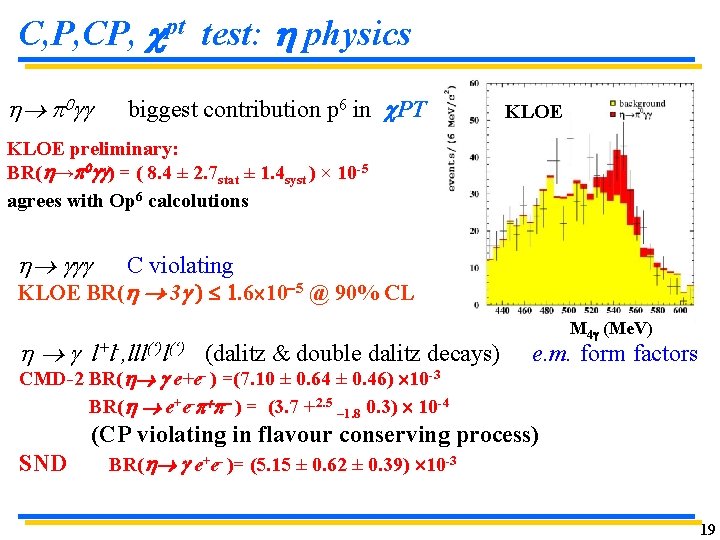
C, P, CP, pt test: physics 0 biggest contribution p 6 in PT KLOE preliminary: BR( →p 0 ) = ( 8. 4 ± 2. 7 stat ± 1. 4 syst ) × 10 -5 agrees with Op 6 calcolutions C violating KLOE BR( 3 1. 6 10 5 @ 90% CL l+l-, lll(‘) (dalitz & double dalitz decays) CMD-2 BR( e+e- ) =(7. 10 ± 0. 64 ± 0. 46) 10 -3 BR( e+e-p+p- ) = (3. 7 +2. 5 – 1. 8 0. 3) 10 -4 M 4 (Me. V) e. m. form factors (CP violating in flavour conserving process) SND BR( e+e- )= (5. 15 ± 0. 62 ± 0. 39) 10 -3 19
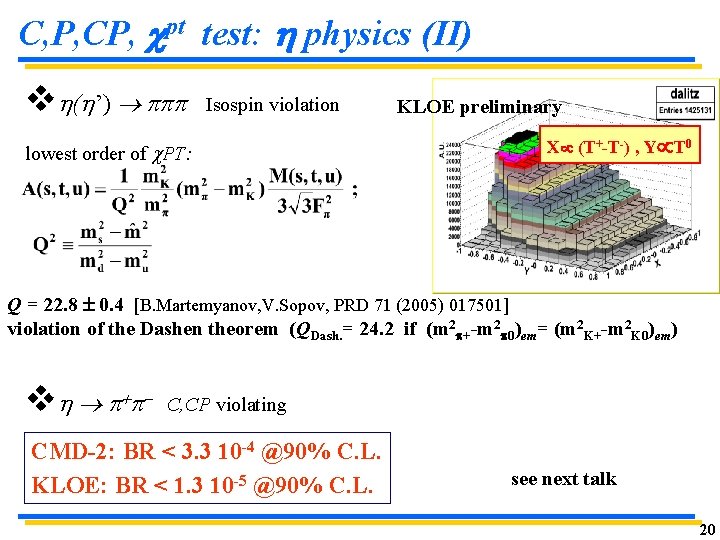
C, P, CP, pt test: physics (II) v ( ’) Isospin violation lowest order of PT: KLOE preliminary X (T+-T-) , Y T 0 Q = 22. 8 0. 4 [B. Martemyanov, V. Sopov, PRD 71 (2005) 017501] violation of the Dashen theorem (QDash. = 24. 2 if (m 2 +-m 2 0)em= (m 2 K+-m 2 K 0)em) v + - C, CP violating CMD-2: BR < 3. 3 10 -4 @90% C. L. KLOE: BR < 1. 3 10 -5 @90% C. L. see next talk 20
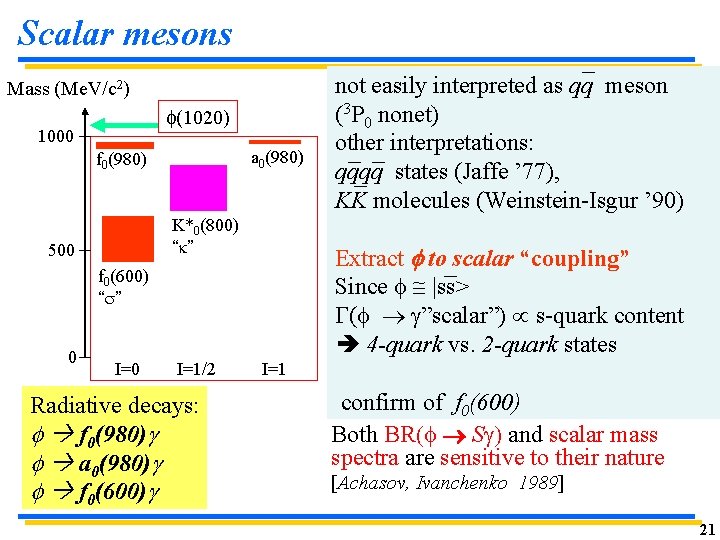
Scalar mesons Mass (Me. V/c 2) f(1020) 1000 a 0(980) f 0(980) K*0(800) “k” 500 Extract f to scalar “coupling” Since f |ss> (f g”scalar”) s-quark content 4 -quark vs. 2 -quark states f 0(600) “s” 0 I=1/2 Radiative decays: f 0(980) a 0(980) f 0(600) not easily interpreted as qq meson (3 P 0 nonet) other interpretations: qqqq states (Jaffe ’ 77), KK molecules (Weinstein-Isgur ’ 90) I=1 confirm of f 0(600) Both BR(f Sg) and scalar mass spectra are sensitive to their nature [Achasov, Ivanchenko 1989] 21
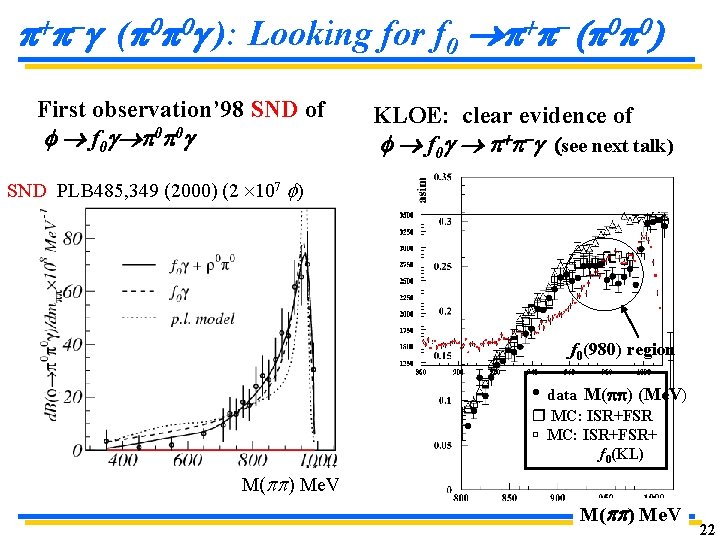
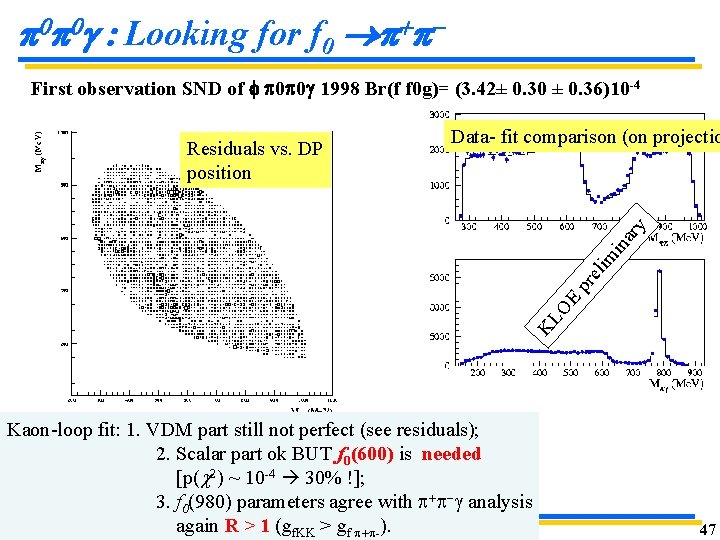
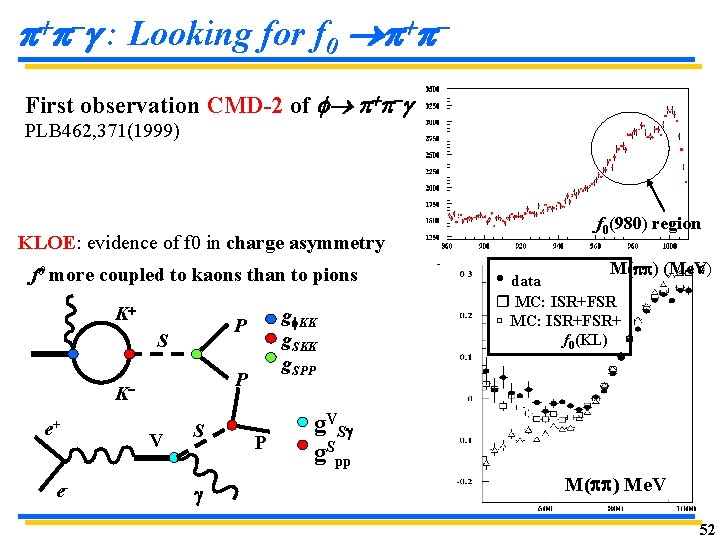
p+p- (p 0 p 0 ): Looking for f 0 p+p- (p 0 p 0) First observation’ 98 SND of f f 0 p 0 p 0 KLOE: clear evidence of f f 0 p+p- (see next talk) SND PLB 485, 349 (2000) (2 107 ) f 0(980) region • data M( ) (Me. V) r MC: ISR+FSR ú MC: ISR+FSR+ f 0(KL) M( ) Me. V M(pp) Me. V 22
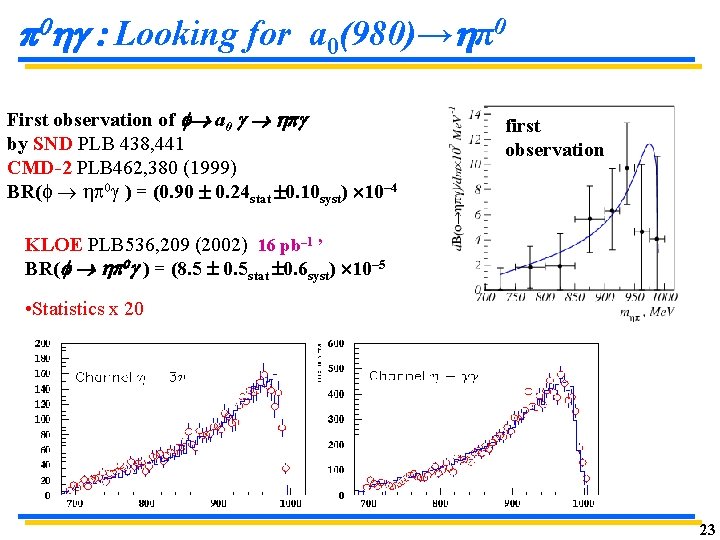
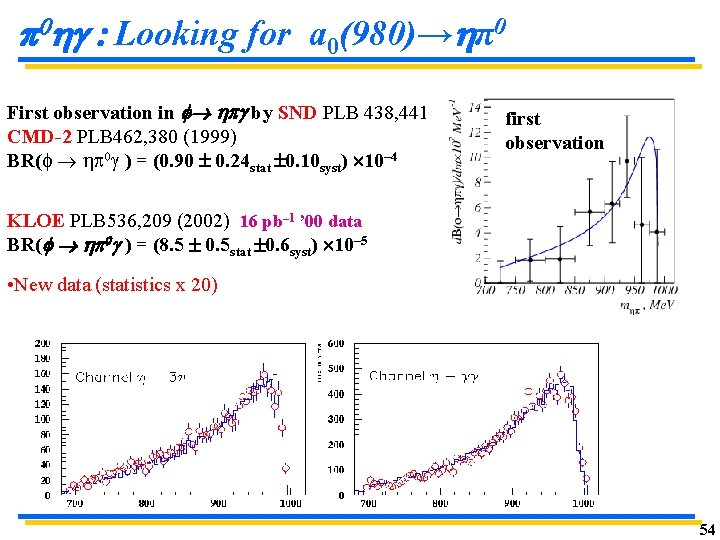
p 0 : Looking for a 0(980)→ π0 First observation of f a 0 p by SND PLB 438, 441 CMD-2 PLB 462, 380 (1999) BR(f h 0 g ) = (0. 90 0. 24 stat 0. 10 syst) 10– 4 first observation KLOE PLB 536, 209 (2002) 16 pb– 1 ’ BR(f p 0 ) = (8. 5 0. 5 stat 0. 6 syst) 10– 5 • Statistics x 20 23
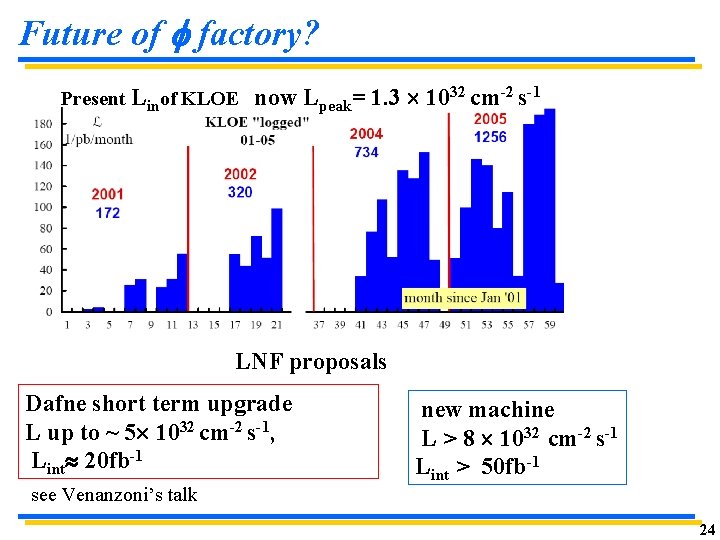
Future of f factory? Present Linof KLOE now Lpeak= 1. 3 1032 cm-2 s-1 LNF proposals Dafne short term upgrade L up to ~ 5 1032 cm-2 s-1, Lint 20 fb-1 see Venanzoni’s talk new machine L > 8 1032 cm-2 s-1 Lint > 50 fb-1 24
Prospectives for KS physics Lint= 20 -50 fb-1 CPT and DS= DQ violating parameters down to the per mill level Competitive on rare dacays, interesting for pt mostly Present measurement @20 fb-1 KS 0 0 0 CP, CPT < 1. 2 10 -7 KS e CPT, DS= DQ (7. 09 0. 10) 10 -4 As CPT (1. 5 11) 10 -3 KS + - 0 KS e+e- pt KS 0 e+e- KL KS pt (3 1) 10 -7 < 1. 4 10 -7 (6 3) 10 -9 (2. 78 0. 07) 10 -6 @50 fb-1 < 5 10 -9 0. 2 10 -5 2 10 -3 0. 4 10 -7 < 2 10 -8 seen 0. 03 10 -6 seen 0. 1 10 -5 1 10 -3 0. 3 10 -7 < 9 10 -9 2 10 -9 0. 02 10 -6 Assuming present efficiencies or e 5 -10% 25
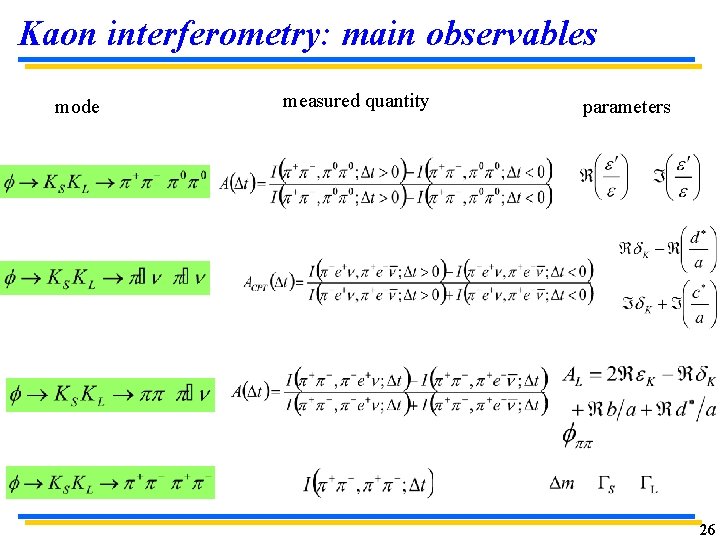
Kaon interferometry: main observables mode measured quantity parameters 26
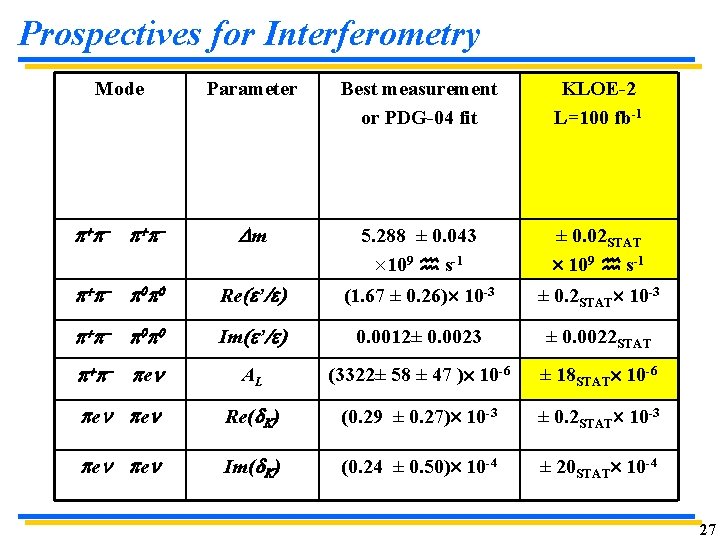
Prospectives for Interferometry Mode Parameter Best measurement or PDG-04 fit KLOE-2 L=100 fb-1 p+p- Dm 5. 288 ± 0. 043 109 s-1 ± 0. 02 STAT 109 s-1 p+p- p 0 p 0 Re(e’/e) (1. 67 ± 0. 26) 10 -3 ± 0. 2 STAT 10 -3 p+p- p 0 p 0 Im(e’/e) 0. 0012± 0. 0023 ± 0. 0022 STAT p+p- pen AL (3322± 58 ± 47 ) 10 -6 ± 18 STAT 10 -6 pen Re(d. K) (0. 29 ± 0. 27) 10 -3 ± 0. 2 STAT 10 -3 pen Im(d. K) (0. 24 ± 0. 50) 10 -4 ± 20 STAT 10 -4 27
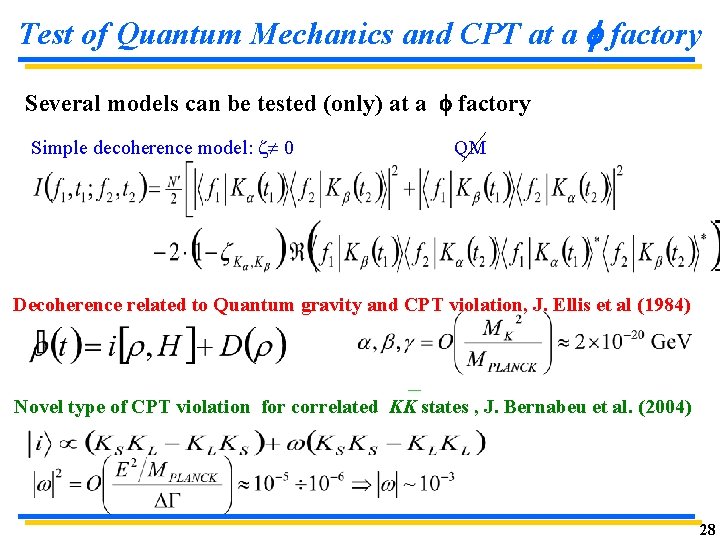
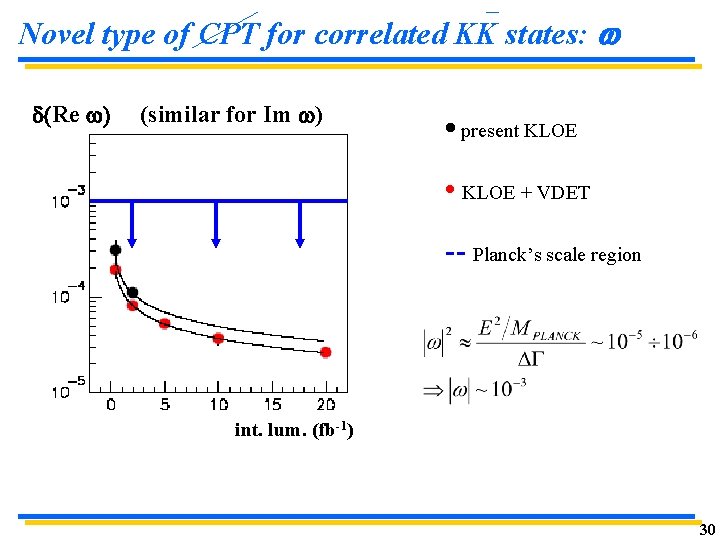
Test of Quantum Mechanics and CPT at a f factory Several models can be tested (only) at a f factory Simple decoherence model: z 0 QM Decoherence related to Quantum gravity and CPT violation, J. Ellis et al (1984) Novel type of CPT violation for correlated KK states , J. Bernabeu et al. (2004) 28
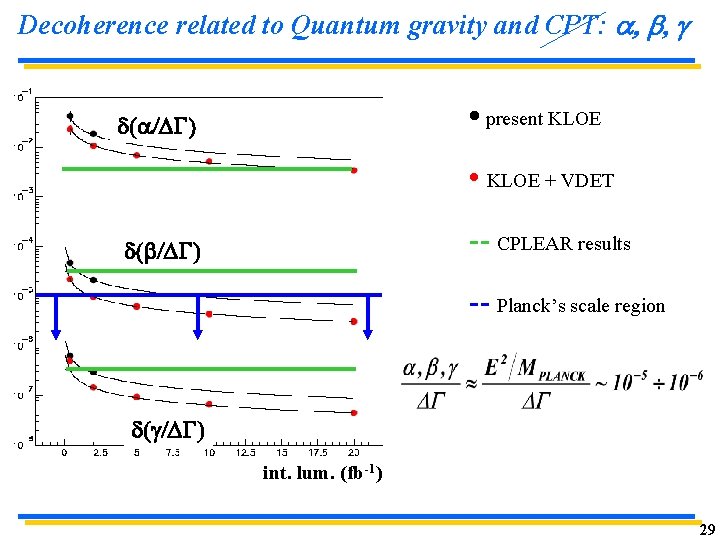
Decoherence related to Quantum gravity and CPT: a, b, • present KLOE d(a/DG • KLOE + VDET -- CPLEAR results d(b/DG -- Planck’s scale region d( /DG int. lum. (fb-1) 29
Novel type of CPT for correlated KK states: w d(Re w (similar for Im w) • present KLOE • KLOE + VDET -- Planck’s scale region int. lum. (fb-1) 30
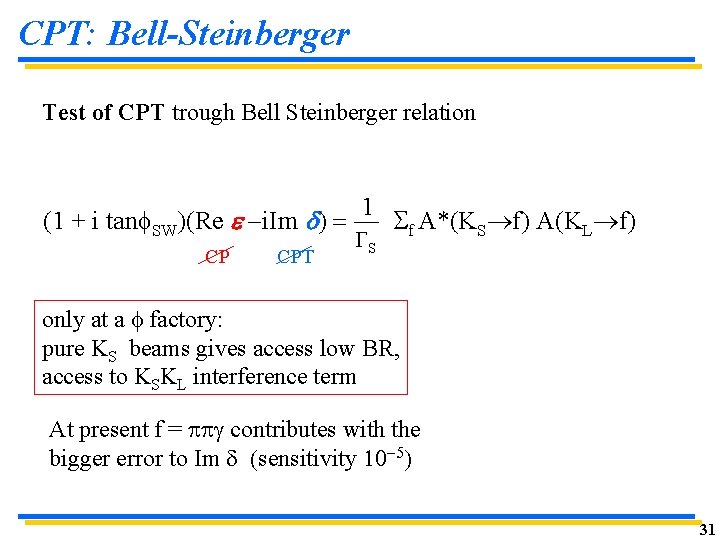
CPT: Bell-Steinberger Test of CPT trough Bell Steinberger relation (1 + i tanf. SW)(Re e i. Im d) = CP CPT 1 S Sf A*(KS f) A(KL f) only at a f factory: pure KS beams gives access low BR, access to KSKL interference term At present f = g contributes with the bigger error to Im d (sensitivity 10 5) 31
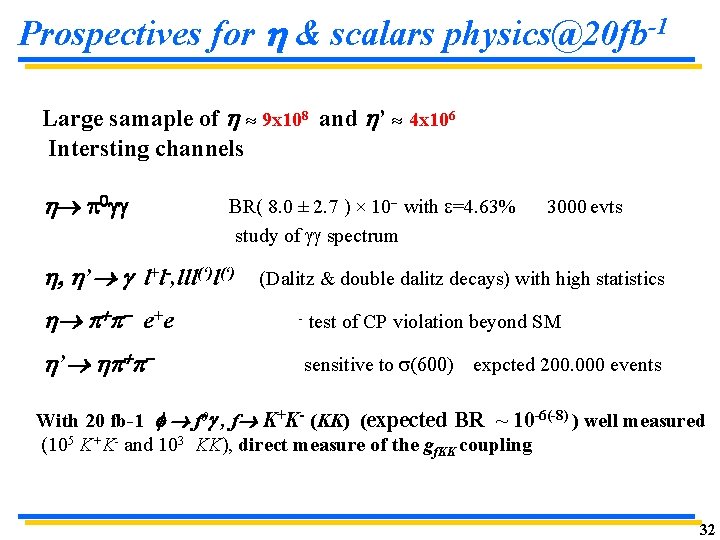
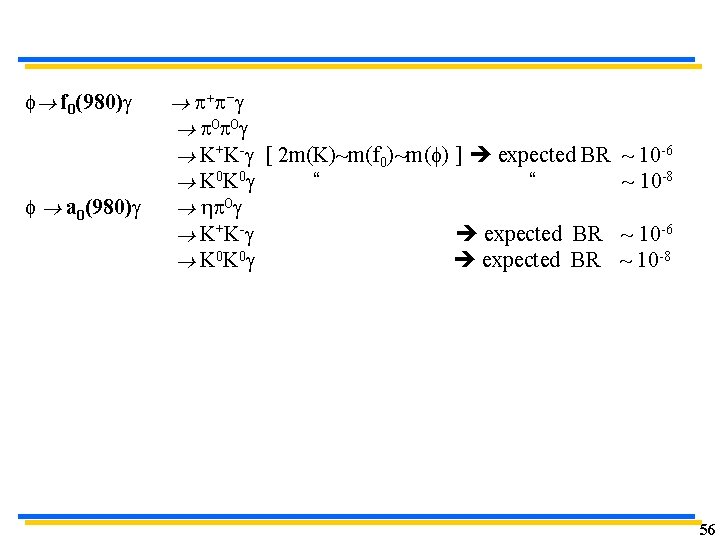
Prospectives for & scalars physics@20 fb-1 Large samaple of 9 x 10⁸ and ’ 4 x 10⁶ Intersting channels 0 BR( 8. 0 ± 2. 7 ) × 10 with e=4. 63% 3000 evts study of gg spectrum , ’ l+l-, lll(‘) p+p- e+e (Dalitz & double dalitz decays) with high statistics - test of CP violation beyond SM ’ p+p- sensitive to s(600) expcted 200. 000 events With 20 fb-1 f f 0 , f K+K- (KK) (expected BR ~ 10 -6(-8) ) well measured (105 K+K- and 103 KK), direct measure of the gf. KK coupling 32
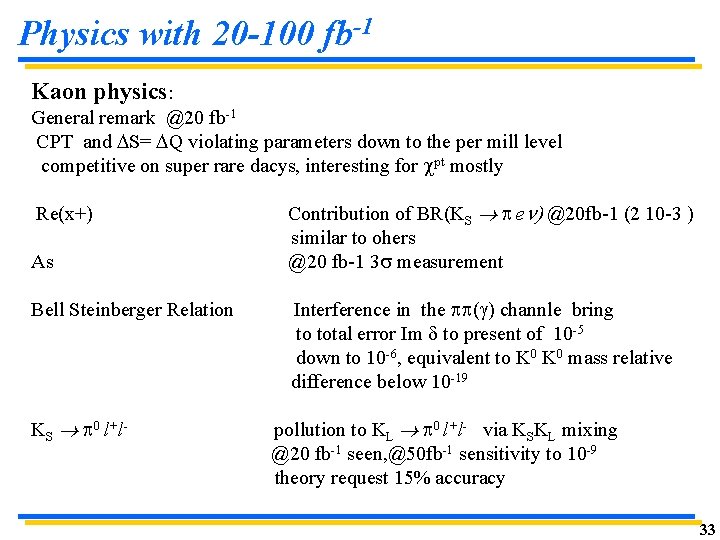
Physics with 20 -100 fb-1 Kaon physics: General remark @20 fb-1 CPT and DS= DQ violating parameters down to the per mill level competitive on super rare dacys, interesting for cpt mostly Re(x+) As Bell Steinberger Relation KS 0 l+l- Contribution of BR(KS e ) @20 fb-1 (2 10 -3 ) similar to ohers @20 fb-1 3 s measurement Interference in the (g) channle bring to total error Im d to present of 10 -5 down to 10 -6, equivalent to K 0 mass relative difference below 10 -19 pollution to KL 0 l+l- via KSKL mixing @20 fb-1 seen, @50 fb-1 sensitivity to 10 -9 theory request 15% accuracy 33
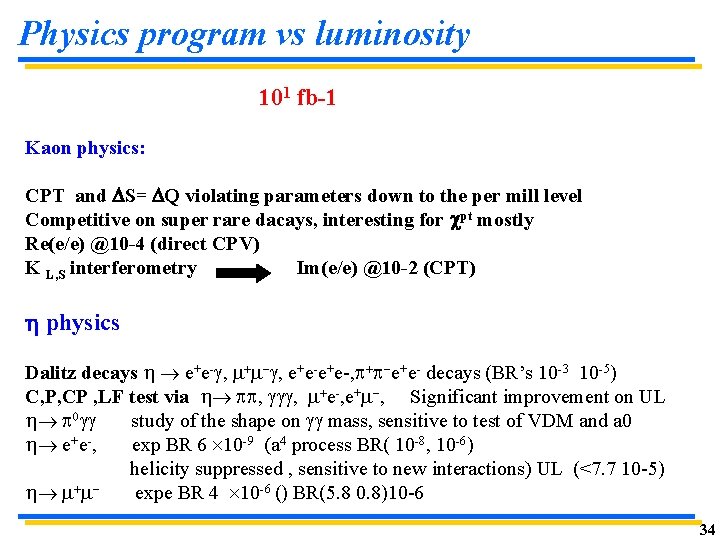
Physics program vs luminosity 101 fb-1 Kaon physics: CPT and DS= DQ violating parameters down to the per mill level Competitive on super rare dacays, interesting for pt mostly Re(e/e) @10 -4 (direct CPV) K L, S interferometry Im(e/e) @10 -2 (CPT) physics Dalitz decays h e+e-g, m+m g, e+e-, + e+e- decays (BR’s 10 -3 10 -5) C, P, CP , LF test via h , ggg, m+e-, e+m , Significant improvement on UL h 0 gg study of the shape on gg mass, sensitive to test of VDM and a 0 h e+e-, exp BR 6 10 -9 (a 4 process BR( 10 -8, 10 -6) helicity suppressed , sensitive to new interactions) UL (<7. 7 10 -5) h m + m expe BR 4 10 -6 () BR(5. 8 0. 8)10 -6 34
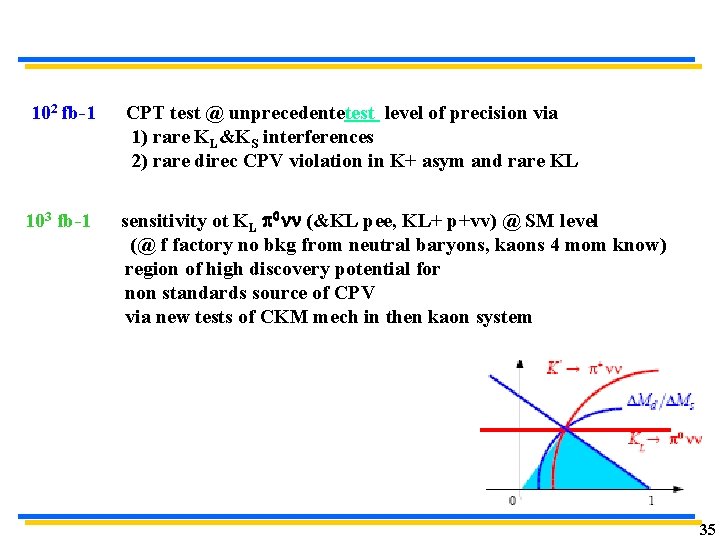
102 fb-1 CPT test @ unprecedentetest level of precision via 1) rare KL&KS interferences 2) rare direc CPV violation in K+ asym and rare KL 103 fb-1 sensitivity ot KL 0 (&KL pee, KL+ p+vv) @ SM level (@ f factory no bkg from neutral baryons, kaons 4 mom know) region of high discovery potential for non standards source of CPV via new tests of CKM mech in then kaon system 35
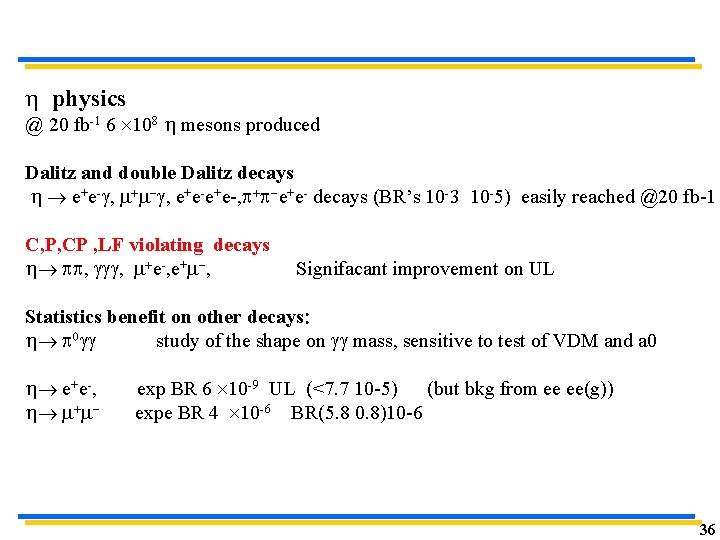
h physics @ 20 fb-1 6 108 h mesons produced Dalitz and double Dalitz decays h e+e-g, m+m g, e+e-, + e+e- decays (BR’s 10 -3 10 -5) easily reached @20 fb-1 C, P, CP , LF violating decays h , ggg, m+e-, e+m , Signifacant improvement on UL Statistics benefit on other decays: h 0 gg study of the shape on gg mass, sensitive to test of VDM and a 0 h e+e-, h m + m exp BR 6 10 -9 UL (<7. 7 10 -5) (but bkg from ee ee(g)) expe BR 4 10 -6 BR(5. 8 0. 8)10 -6 36
@20 f KKG well measured 104 K+k+ and 103 K 0 K) 37
CPT: KS semileptonic decays Sensitivity to CPT violating effects through charge asymmetry AS 700 600 Test of the DS = DQ rule, G(KS e )/G(KL e ) = 1 + 4 Re(x ) FISRT OBSERVATION CMD-2 BR(Ks pen ) = (7. 2 ± 1. 4) 10 -4 KLOE BR(KS pen) = (7. 09 0. 08 stat 0. 05 syst) × 500 400 300 200 100 0 10 4 AS = ( 2 9 stat 5 syst) × 10 3 Data — MC fit KLOE signal bad other 150 100 50 0 50 Emiss( e) - c. Pmiss(Me. V) AL = (3322 58 47) × 10 -6 Re(x) = (+0. 6 3. 1 stat 1. 8 syst) 10 3 38
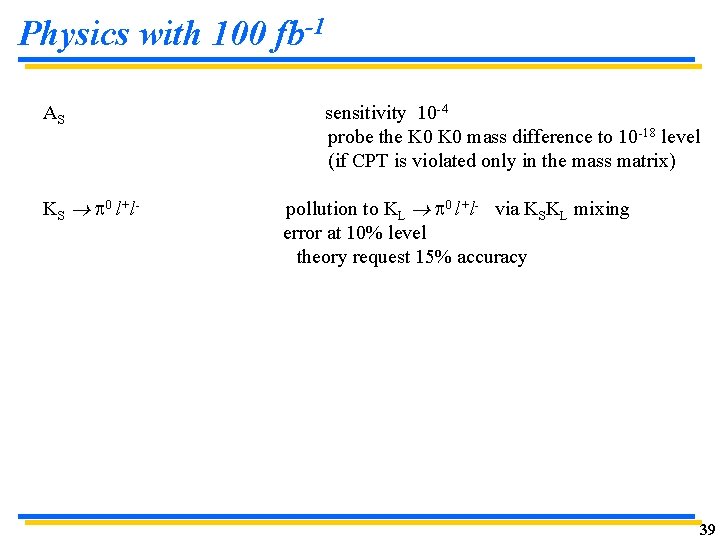
Physics with 100 fb-1 AS KS 0 l+l- sensitivity 10 -4 probe the K 0 mass difference to 10 -18 level (if CPT is violated only in the mass matrix) pollution to KL 0 l+l- via KSKL mixing error at 10% level theory request 15% accuracy 39
Conclusions A f favcotry provides the ideal place to perform almosto without competitors KS physics Quantum interferencem studies h/h physics High luminosity to access rare KS decays sensitivity to CPT test Neutral kaon Interferometry X pt studies Program complementary to LHC 40
Spare slides 41
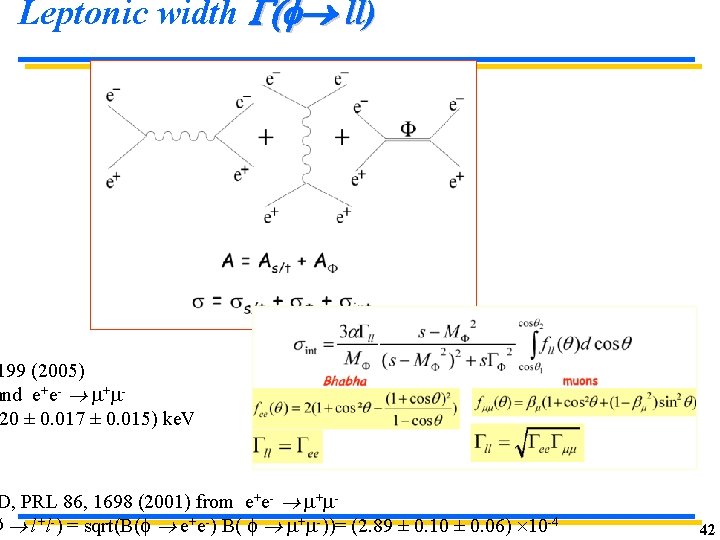
Leptonic width G(f ll) 199 (2005) and e+e- m+m 20 ± 0. 017 ± 0. 015) ke. V D, PRL 86, 1698 (2001) from e+e- m+m l+l-) = sqrt(B(f e+e-) B( f m+m-))= (2. 89 ± 0. 10 ± 0. 06) 10 -4 42
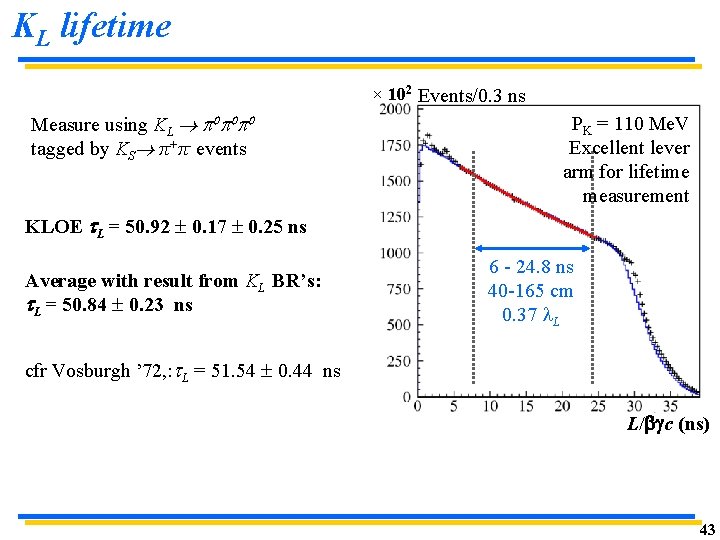
KL lifetime × 102 Events/0. 3 ns Measure using KL 0 0 0 tagged by KS π+π- events PK = 110 Me. V Excellent lever arm for lifetime measurement KLOE t. L = 50. 92 0. 17 0. 25 ns Average with result from KL BR’s: t. L = 50. 84 0. 23 ns 6 - 24. 8 ns 40 -165 cm 0. 37 l. L cfr Vosburgh ’ 72, : t. L = 51. 54 0. 44 ns L/b c (ns) 43
Parameterization: t = (p. K p )2/m 2 + l+’’ 10 3 KLe 3 form-factor slopes For Ke 3: f+(t) = f+(0) [1 + l+t] or f+(0) [1 + l+’ t + ½ l+’’ t 2] KLOE preliminary Linear fit: l+ = (28. 6 ± 0. 5 ± 0. 8) 10 3 1 s contours KTe. V ISTRA+ KLOE NA 48 Quadratic fit: l+ ’ = (25. 5 ± 1. 9) 10 3 l+ ’ ’ = (1. 4 ± 0. 7) 10 3 r(l+’, l+ ’’ ) = 0. 95 l+’ 10 3 44
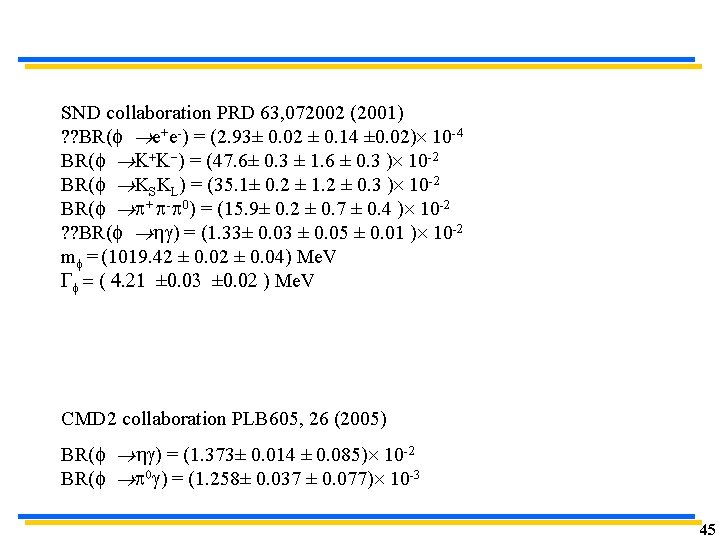
SND collaboration PRD 63, 072002 (2001) ? ? BR(f e+e-) = (2. 93± 0. 02 ± 0. 14 ± 0. 02) 10 -4 BR(f K+K ) = (47. 6± 0. 3 ± 1. 6 ± 0. 3 ) 10 -2 BR(f KSKL) = (35. 1± 0. 2 ± 1. 2 ± 0. 3 ) 10 -2 BR(f + - 0) = (15. 9± 0. 2 ± 0. 7 ± 0. 4 ) 10 -2 ? ? BR(f hg) = (1. 33± 0. 03 ± 0. 05 ± 0. 01 ) 10 -2 mf = (1019. 42 ± 0. 04) Me. V f = ( 4. 21 ± 0. 03 ± 0. 02 ) Me. V CMD 2 collaboration PLB 605, 26 (2005) BR(f hg) = (1. 373± 0. 014 ± 0. 085) 10 -2 BR(f 0 g) = (1. 258± 0. 037 ± 0. 077) 10 -3 45
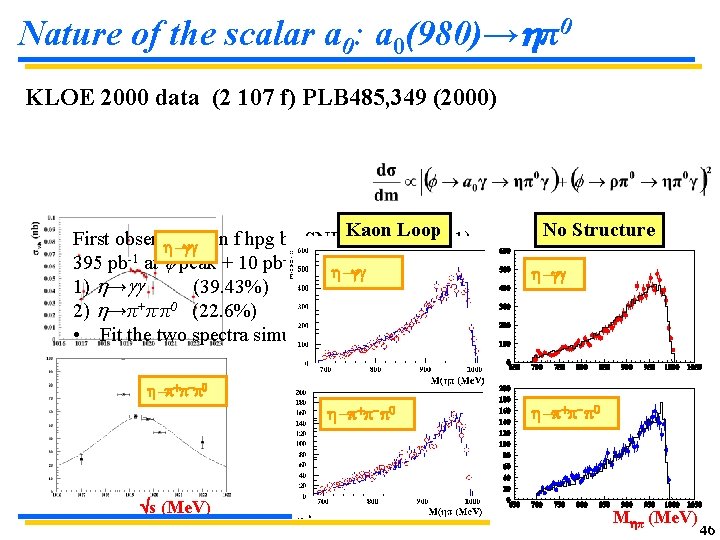
Nature of the scalar a 0: a 0(980)→ π0 KLOE 2000 data (2 107 f) PLB 485, 349 (2000) Kaon Loop No Structure First observation in f hpg by SND (PLB 438, 441) → -1 395 pb at peak + 10 pb-1 → → 4 1) → (39. 43%) 5 final state 2. 2 10 events 2) →π+π-π0 (22. 6%) π+π-+ 5 4180 events • Fit the two spectra simultaneously → + 0 s (Me. V) → + 0 M π (Me. V) 46
p 0 p 0 : Looking for f 0 p+p. First observation SND of f 0 0 1998 Br(f f 0 g)= (3. 42± 0. 30 ± 0. 36)10 -4 Data- fit comparison (on projectio KL OE pr e lim in ar y Residuals vs. DP position Kaon-loop fit: 1. VDM part still not perfect (see residuals); 2. Scalar part ok BUT f 0(600) is needed [p( 2) ~M(pp) 10 -4 MEV 30% !]; 3. f 0(980) parameters agree with + g analysis again R > 1 (gf. KK > gf + -). 47
CP Test in flavour conserving processes SM predictions small signature of New Physics beyond SM JPC= 0 -+ p+p- e + e - asymmetry between and ee planes (as KL) CP CMD-2 3. 8 +2. 5 – 1. 3 0. 3 h + - P, CP h 4 0 P, CP (large background in hadron production) 4 (background free) C Test not extensively studied in em and strong interactions h C h 0 e+e-, 0 + -, if * h. SM: via BR 3 10 -9 48
KS physics KS gg BR changed along the years Measurement of Na 48 (2. 78 0. 07) 10 6 (relevant bkg from KL gg) differs for c. PT O(p 4) by 30%, useful to fix O(p 6) counterterm v Ks + 0 Test of cpt 49
CPT: KS semileptonic decays Sensitivity to CPT violating effects through charge asymmetry AS 700 600 Test of the DS = DQ rule, G(KS e )/G(KL e ) = 1 + 4 Re(x ) FISRT OBSERVATION CMD-2 BR(Ks pen ) = (7. 2 ± 1. 4) 10 -4 KLOE BR(KS pen) = (7. 09 0. 08 stat 0. 05 syst) × 500 400 300 200 100 0 10 4 AS = ( 2 9 stat 5 syst) × 10 3 Data — MC fit KLOE signal bad other 150 100 50 0 50 Emiss( e) - c. Pmiss(Me. V) AL = (3322 58 47) × 10 -6 Re(x) = (+0. 6 3. 1 stat 1. 8 syst) 10 3 50
51
p+p- : Looking for f 0 p+p. First observation CMD-2 of f p+p- PLB 462, 371(1999) M( ) Me. V f 0(980) region KLOE: evidence of f 0 in charge asymmetry f 0 more coupled to kaons than to pions K+ S P K e+ e- gf. KK g. SPP P V S P • data M( ) (Me. V) r MC: ISR+FSR ú MC: ISR+FSR+ f 0(KL) g. VS g. Spp M( ) Me. V 52
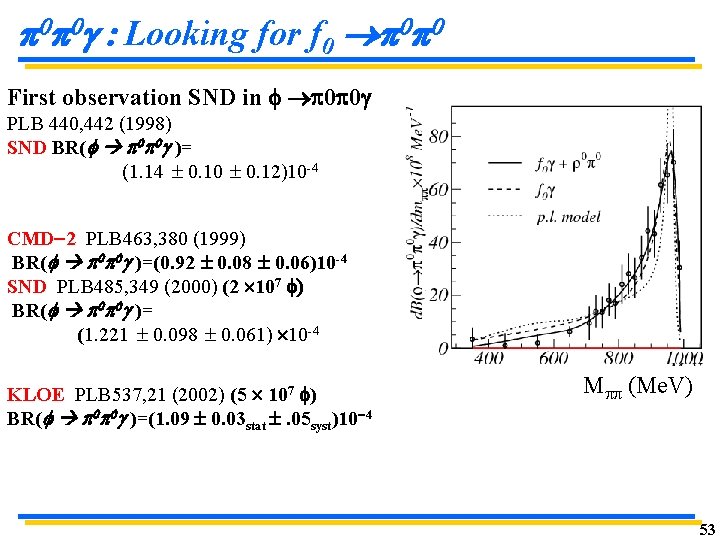
p 0 p 0 : Looking for f 0 p 0 p 0 First observation SND in f 0 0 PLB 440, 442 (1998) SND BR(f p 0 p 0 )= (1. 14 0. 10 0. 12)10 -4 CMD 2 PLB 463, 380 (1999) BR(f p 0 p 0 )=(0. 92 0. 08 0. 06)10 -4 SND PLB 485, 349 (2000) (2 107 f BR(f p 0 p 0 )= (1. 221 0. 098 0. 061) 10 -4 KLOE PLB 537, 21 (2002) (5 107 f) BR(f p 0 p 0 )=(1. 09 0. 03 stat . 05 syst)10 4 M (Me. V) 53
p 0 : Looking for a 0(980)→ π0 First observation in f p by SND PLB 438, 441 CMD-2 PLB 462, 380 (1999) BR(f h 0 g ) = (0. 90 0. 24 stat 0. 10 syst) 10– 4 first observation KLOE PLB 536, 209 (2002) 16 pb– 1 ’ 00 data BR(f p 0 ) = (8. 5 0. 5 stat 0. 6 syst) 10– 5 • New data (statistics x 20) 54
Zweig rule: decay f KK prefered dispite of the phase sapce, because consttitunent qurks have to survive f = ss 55
f f 0(980)g f a 0(980)g + g 0 0 g K+K-g [ 2 m(K)~m(f 0)~m(f) ] expected BR K 0 K 0 g “ “ h 0 g K + K -g expected BR K 0 K 0 g expected BR ~ 10 -6 ~ 10 -8 56