
Spectroscopy in the charm range from BESIII to
Spectroscopy in the charm range: from BESIII to PANDA Stefano Spataro on behalf the collaborations ISTITUTO NAZIONALE DI FISICA NUCLEARE Sezione di Torino
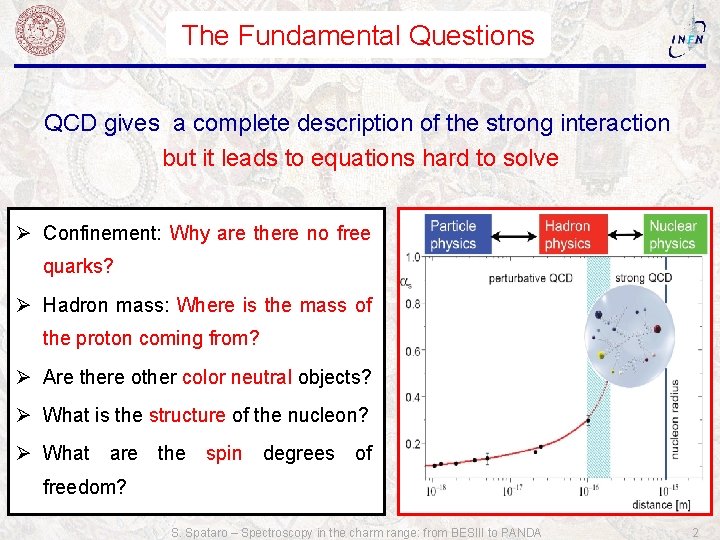
The Fundamental Questions QCD gives a complete description of the strong interaction but it leads to equations hard to solve Ø Confinement: Why are there no free quarks? Ø Hadron mass: Where is the mass of the proton coming from? Ø Are there other color neutral objects? Ø What is the structure of the nucleon? Ø What are the spin degrees of freedom? S. Spataro – Spectroscopy in the charm range: from BESIII to PANDA 2
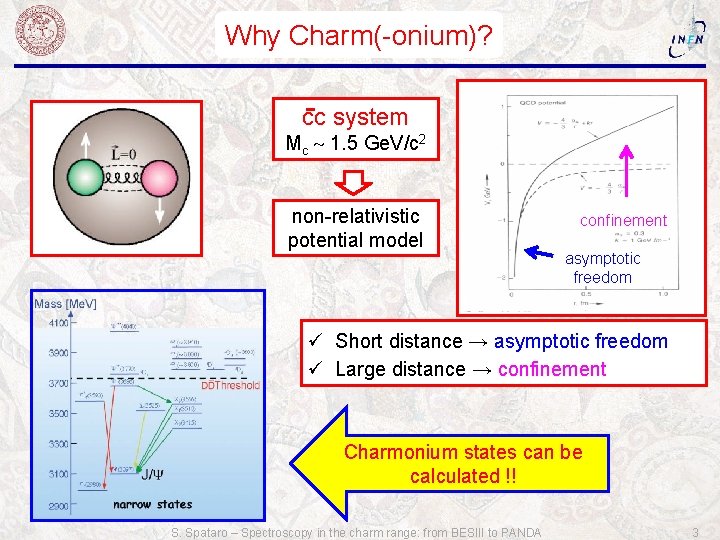
Why Charm(-onium)? cc system Mc 1. 5 Ge. V/c 2 non-relativistic potential model confinement asymptotic freedom ü Short distance → asymptotic freedom ü Large distance → confinement Charmonium states can be calculated !! S. Spataro – Spectroscopy in the charm range: from BESIII to PANDA 3
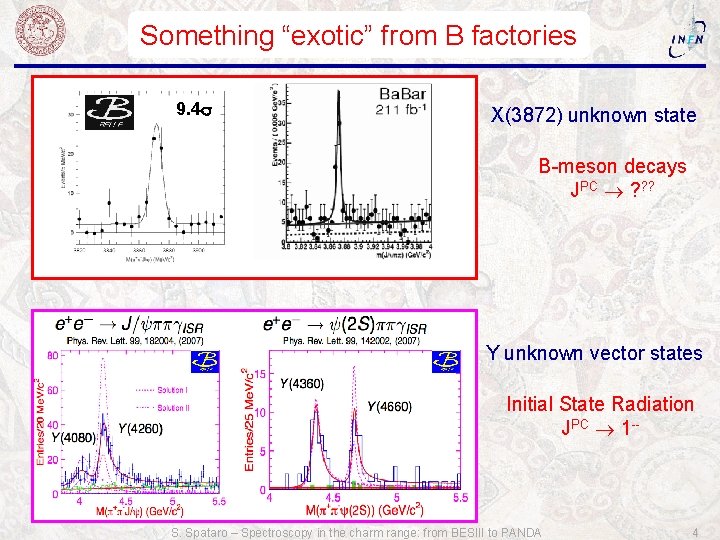
Something “exotic” from B factories 9. 4 s X(3872) unknown state B-meson decays JPC ? ? ? Y unknown vector states Initial State Radiation JPC 1 -- S. Spataro – Spectroscopy in the charm range: from BESIII to PANDA 4
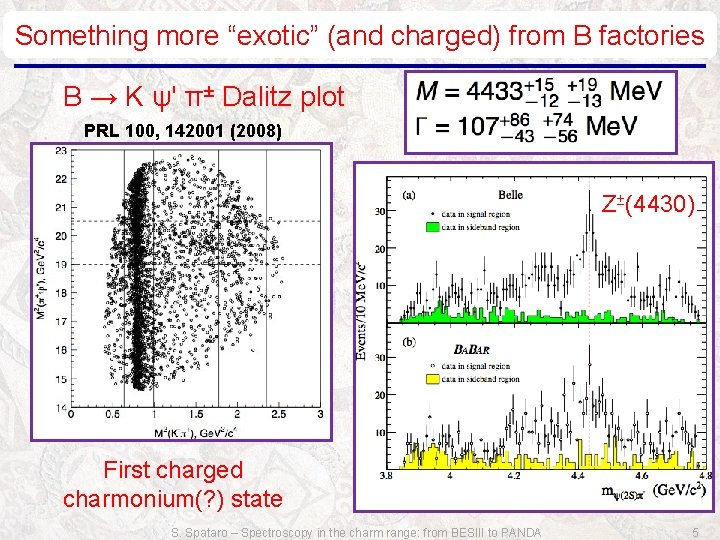
Something more “exotic” (and charged) from B factories B → K ψ' π± Dalitz plot PRL 100, 142001 (2008) Z±(4430) First charged charmonium(? ) state S. Spataro – Spectroscopy in the charm range: from BESIII to PANDA 5
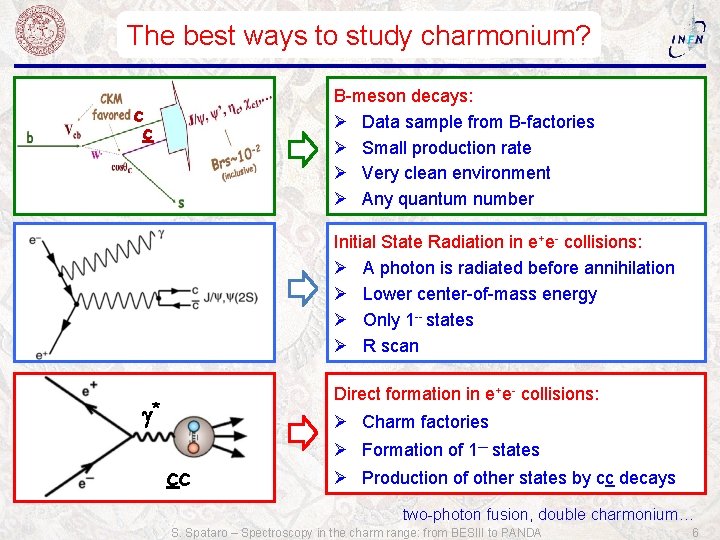
The best ways to study charmonium? B-meson decays: Ø Data sample from B-factories Ø Small production rate Ø Very clean environment Ø Any quantum number c c Initial State Radiation in e+e- collisions: Ø A photon is radiated before annihilation Ø Lower center-of-mass energy Ø Only 1 -- states Ø R scan Direct formation in e+e- collisions: * Ø Charm factories cc Ø Formation of 1–- states Ø Production of other states by cc decays two-photon fusion, double charmonium… S. Spataro – Spectroscopy in the charm range: from BESIII to PANDA 6
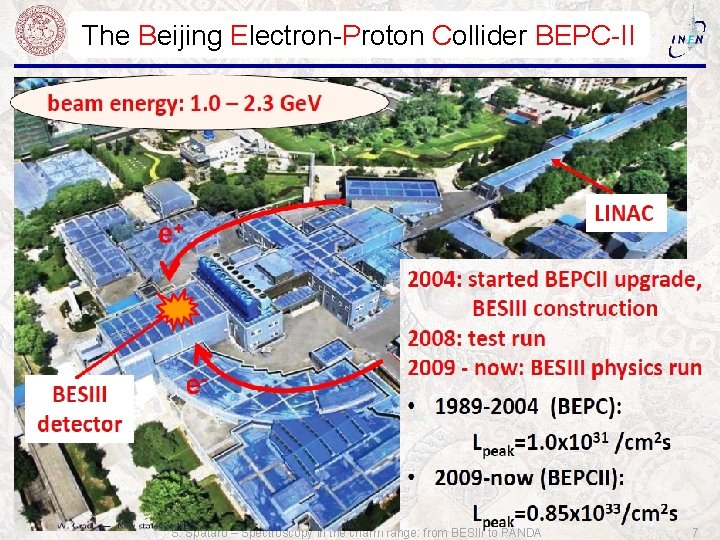
The Beijing Electron-Proton Collider BEPC-II S. Spataro – Spectroscopy in the charm range: from BESIII to PANDA 7

The Beijing Spectrometer S. Spataro – Spectroscopy in the charm range: from BESIII to PANDA 8

The Data Sample ü World largest data sample on J/ψ, ψ(2 S), ψ(3770), Y(4260)… in e+e- collisions ü From light mesons spectroscopy to ΛcΛc ü Also ISR, photon-photon physics, τ physics… S. Spataro – Spectroscopy in the charm range: from BESIII to PANDA 9
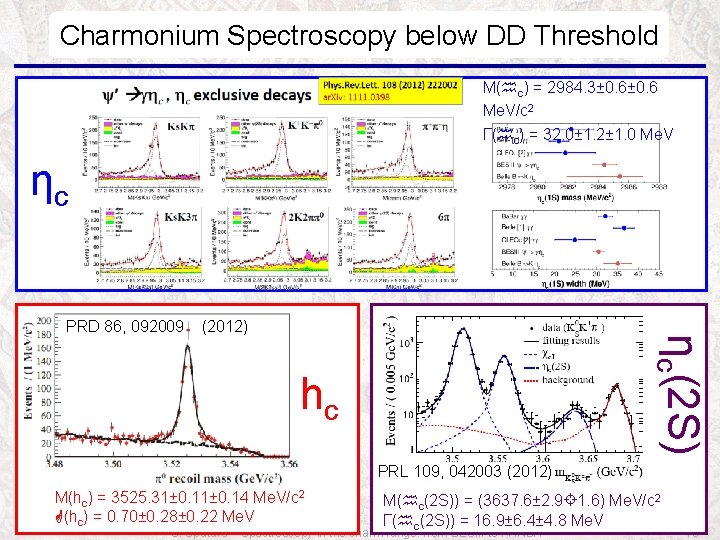
Charmonium Spectroscopy below DD Threshold M( c) = 2984. 3± 0. 6 Me. V/c 2 Γ( c) = 32. 0± 1. 2± 1. 0 Me. V ηc (2012) ηc(2 S) PRD 86, 092009 hc PRL 109, 042003 (2012) M(hc) = 3525. 31± 0. 14 Me. V/c 2 (hc) = 0. 70± 0. 28± 0. 22 Me. V M( c(2 S)) = (3637. 6± 2. 9 1. 6) Me. V/c 2 Γ( c(2 S)) = 16. 9± 6. 4± 4. 8 Me. V S. Spataro – Spectroscopy in the charm range: from BESIII to PANDA 10
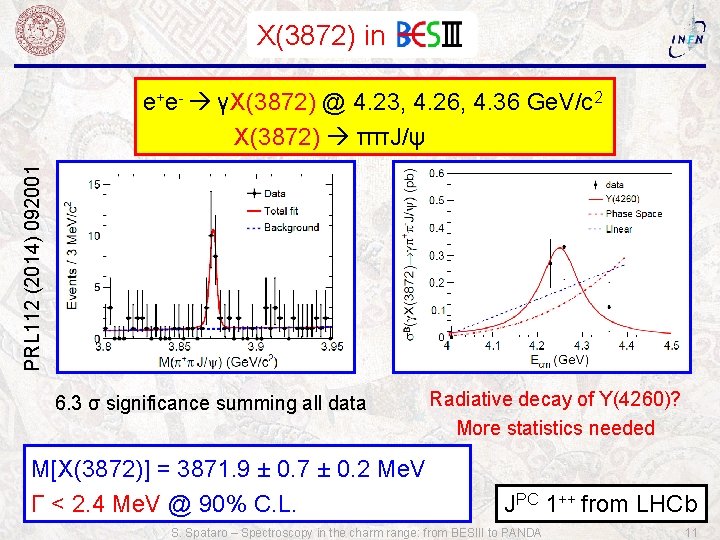
X(3872) in PRL 112 (2014) 092001 e+e- γX(3872) @ 4. 23, 4. 26, 4. 36 Ge. V/c 2 X(3872) ππJ/ψ 6. 3 σ significance summing all data M[X(3872)] = 3871. 9 ± 0. 7 ± 0. 2 Me. V Γ < 2. 4 Me. V @ 90% C. L. Radiative decay of Y(4260)? More statistics needed JPC 1++ from LHCb S. Spataro – Spectroscopy in the charm range: from BESIII to PANDA 11
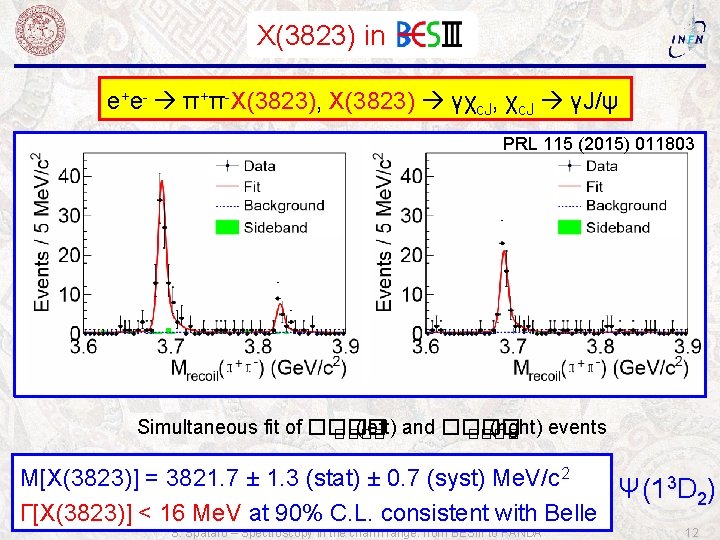
X(3823) in e+e- π+π-X(3823), X(3823) γχc. J, χc. J γJ/ψ PRL 115 (2015) 011803 Simultaneous fit of ���� (left) and ���� (right) events ���� M[X(3823)] = 3821. 7 ± 1. 3 (stat) ± 0. 7 (syst) Me. V/c 2 Ψ(13 D 2) Γ[X(3823)] < 16 Me. V at 90% C. L. consistent with Belle S. Spataro – Spectroscopy in the charm range: from BESIII to PANDA 12
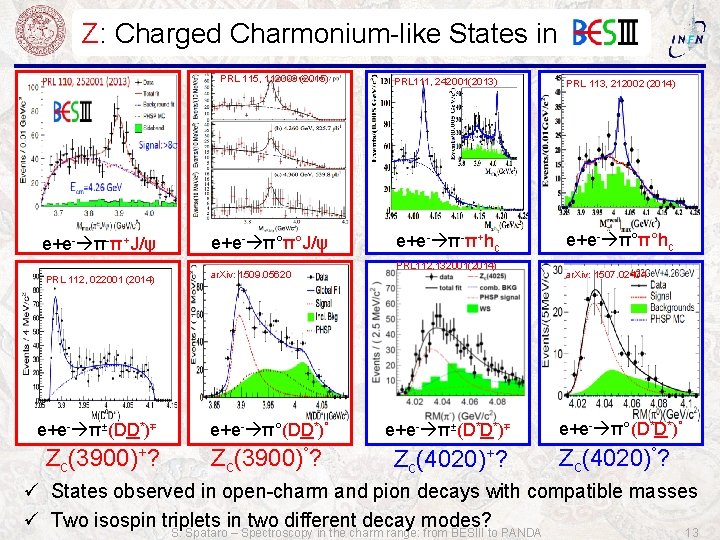
Z: Charged Charmonium-like States in e+e- π-π+J/ψ PRL 112, 022001 (2014) e+e- π±(DD*)∓ Zc(3900)+? PRL 115, 112003 (2015) PRL 111, 242001(2013) PRL 113, 212002 (2014) e+e- π°π°J/ψ e+e- π-π+hc e+e- π°π°hc ar. Xiv: 1509. 05620 PRL 112, 132001(2014) e+e- π°(DD*)° e+e- π±(D*D*)∓ Zc(3900)°? Zc(4020)+? ar. Xiv: 1507. 02404 e+e- π°(D*D*)° Zc(4020)°? ü States observed in open-charm and pion decays with compatible masses ü Two isospin triplets in two different decay modes? S. Spataro – Spectroscopy in the charm range: from BESIII to PANDA 13
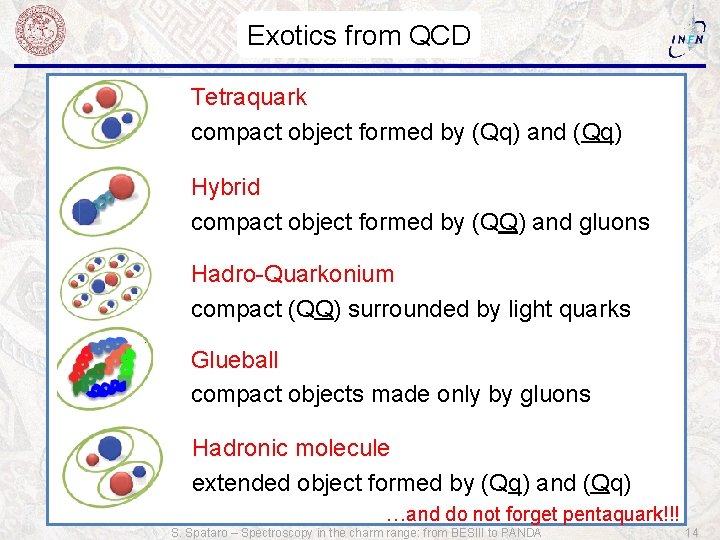
Exotics from QCD Tetraquark compact object formed by (Qq) and (Qq) Hybrid compact object formed by (QQ) and gluons Hadro-Quarkonium compact (QQ) surrounded by light quarks Glueball compact objects made only by gluons Hadronic molecule extended object formed by (Qq) and (Qq) …and do not forget pentaquark!!! S. Spataro – Spectroscopy in the charm range: from BESIII to PANDA 14
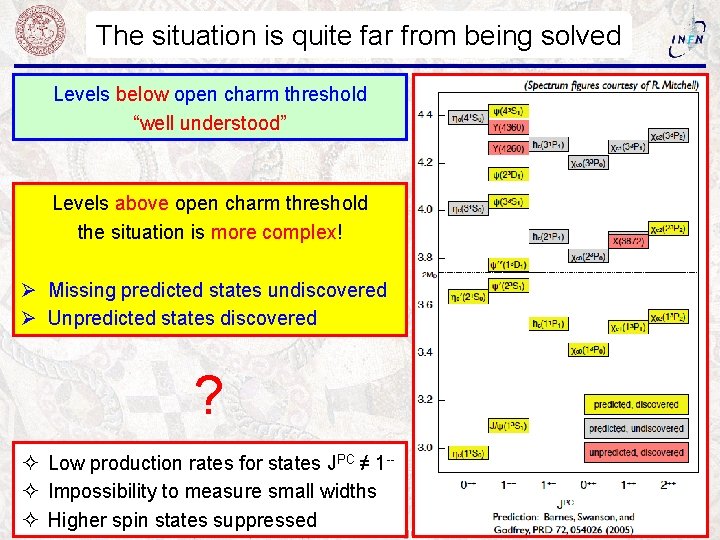
The situation is quite far from being solved Levels below open charm threshold “well understood” Levels above open charm threshold the situation is more complex! Ø Missing predicted states undiscovered Ø Unpredicted states discovered ? ² Low production rates for states JPC ≠ 1 -² Impossibility to measure small widths ² Higher spin states suppressed S. Spataro – Spectroscopy in the charm range: from BESIII to PANDA 15
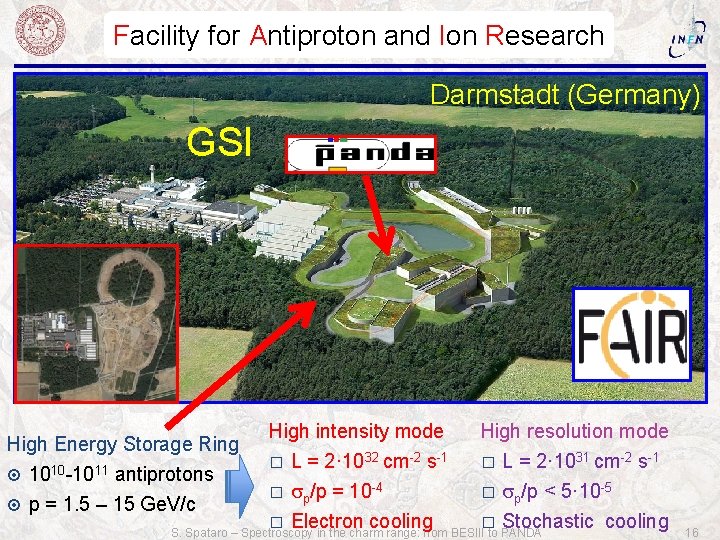
Facility for Antiproton and Ion Research Darmstadt (Germany) GSI High Energy Storage Ring 1010 -1011 antiprotons High intensity mode � L = 2· 1032 cm-2 s-1 High resolution mode � L = 2· 1031 cm-2 s-1 p/p = 10 -4 � p/p < 5· 10 -5 p = 1. 5 – 15 Ge. V/c � Electron cooling � Stochastic cooling S. Spataro – Spectroscopy in the charm range: from BESIII to PANDA � 16
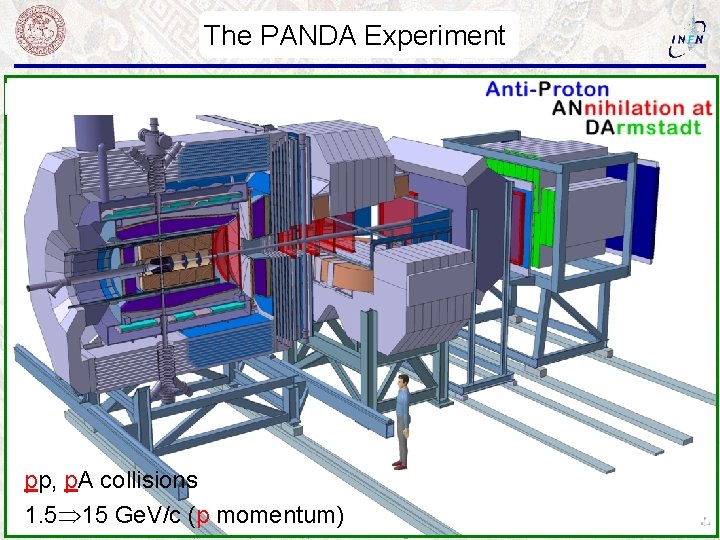
The PANDA Experiment pp, p. A collisions 1. 5 15 Ge. V/c (p momentum) S. Spataro – Spectroscopy in the charm range: from BESIII to PANDA 17
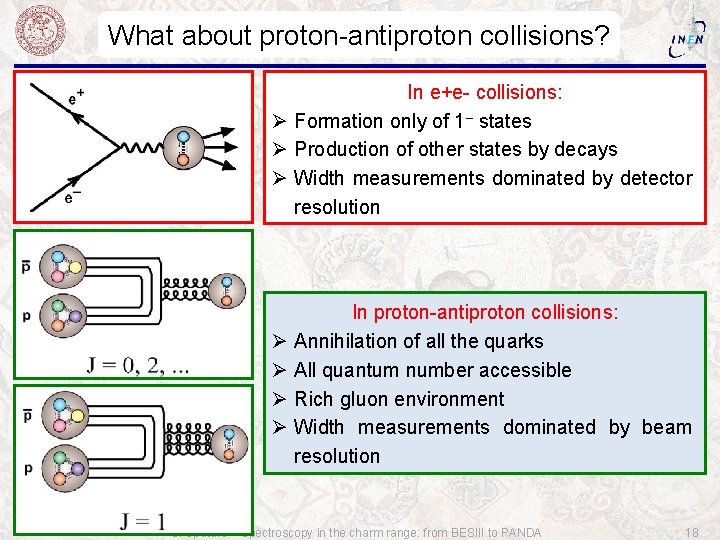
What about proton-antiproton collisions? In e+e- collisions: Ø Formation only of 1– states Ø Production of other states by decays Ø Width measurements dominated by detector resolution Ø Ø In proton-antiproton collisions: Annihilation of all the quarks All quantum number accessible Rich gluon environment Width measurements dominated by beam resolution S. Spataro – Spectroscopy in the charm range: from BESIII to PANDA 18
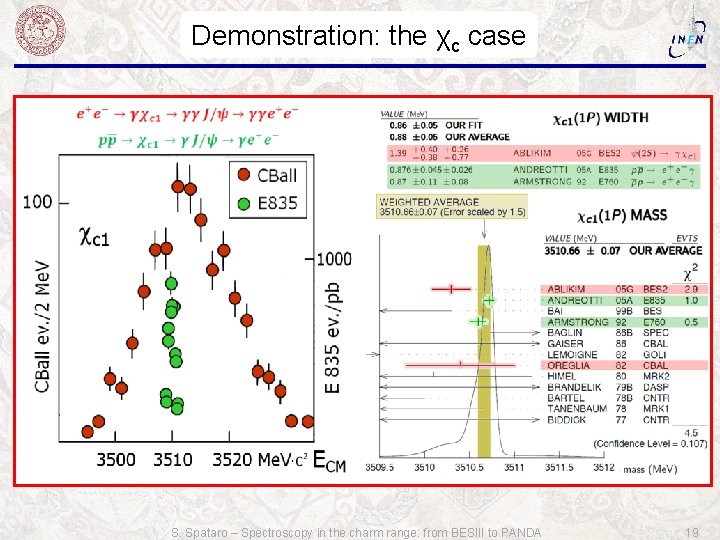
Demonstration: the χc case S. Spataro – Spectroscopy in the charm range: from BESIII to PANDA 19
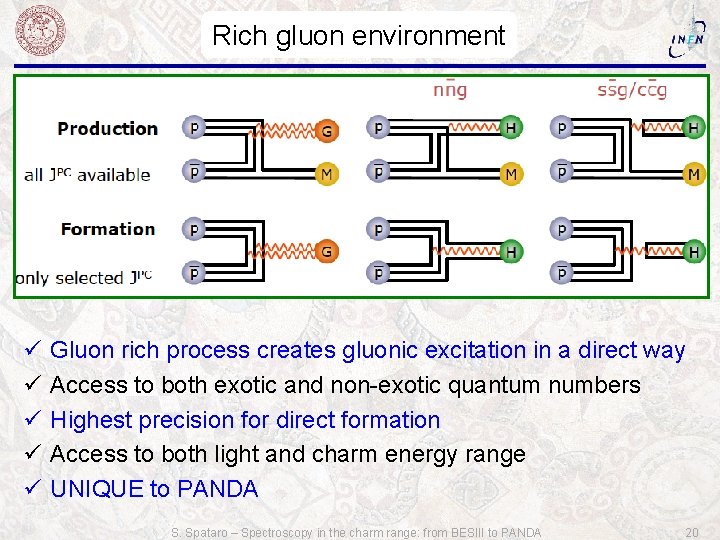
Rich gluon environment ü ü ü Gluon rich process creates gluonic excitation in a direct way Access to both exotic and non-exotic quantum numbers Highest precision for direct formation Access to both light and charm energy range UNIQUE to PANDA S. Spataro – Spectroscopy in the charm range: from BESIII to PANDA 20
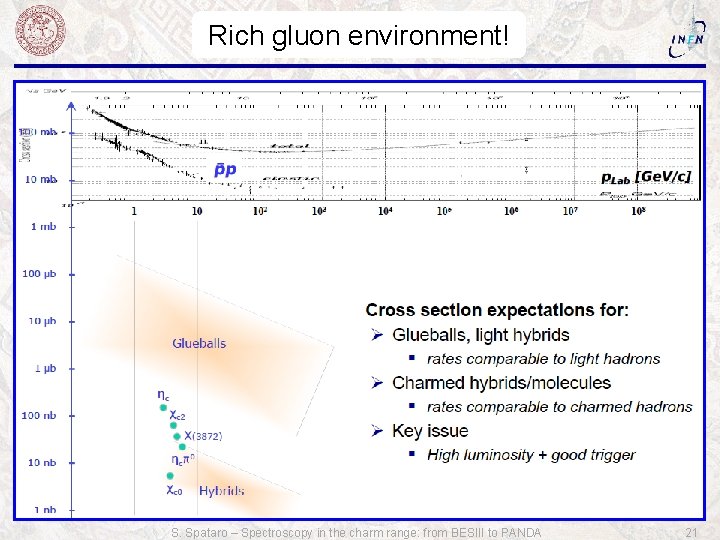
Rich gluon environment! S. Spataro – Spectroscopy in the charm range: from BESIII to PANDA 21
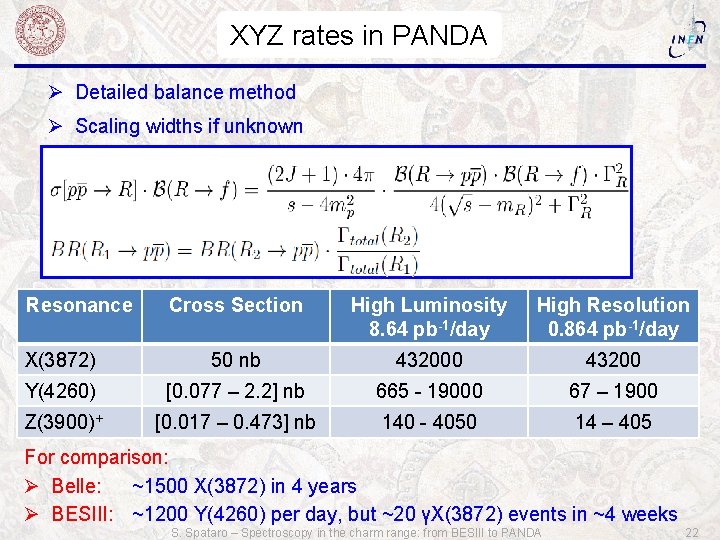
XYZ rates in PANDA Ø Detailed balance method Ø Scaling widths if unknown <<< Resonance Cross Section High Luminosity 8. 64 pb-1/day High Resolution 0. 864 pb-1/day X(3872) 50 nb 432000 43200 Y(4260) [0. 077 – 2. 2] nb 665 - 19000 67 – 1900 Z(3900)+ [0. 017 – 0. 473] nb 140 - 4050 14 – 405 For comparison: Ø Belle: ~1500 X(3872) in 4 years Ø BESIII: ~1200 Y(4260) per day, but ~20 γX(3872) events in ~4 weeks S. Spataro – Spectroscopy in the charm range: from BESIII to PANDA 22
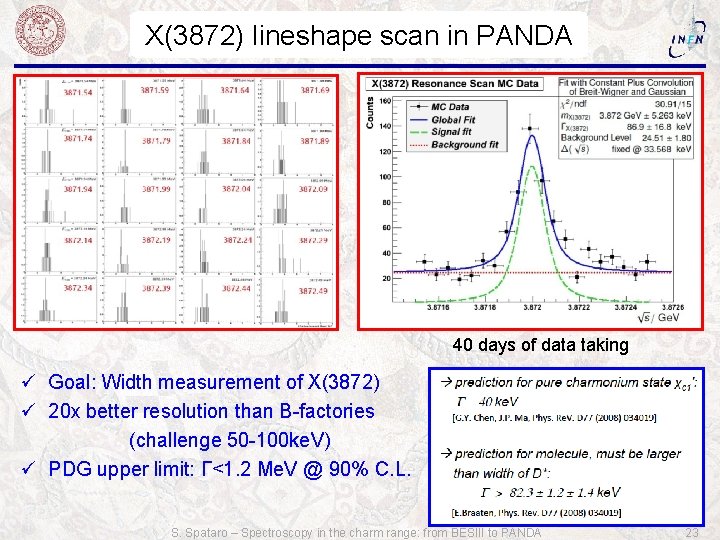
X(3872) lineshape scan in PANDA 40 days of data taking ü Goal: Width measurement of X(3872) ü 20 x better resolution than B-factories (challenge 50 -100 ke. V) ü PDG upper limit: Γ<1. 2 Me. V @ 90% C. L. S. Spataro – Spectroscopy in the charm range: from BESIII to PANDA 23
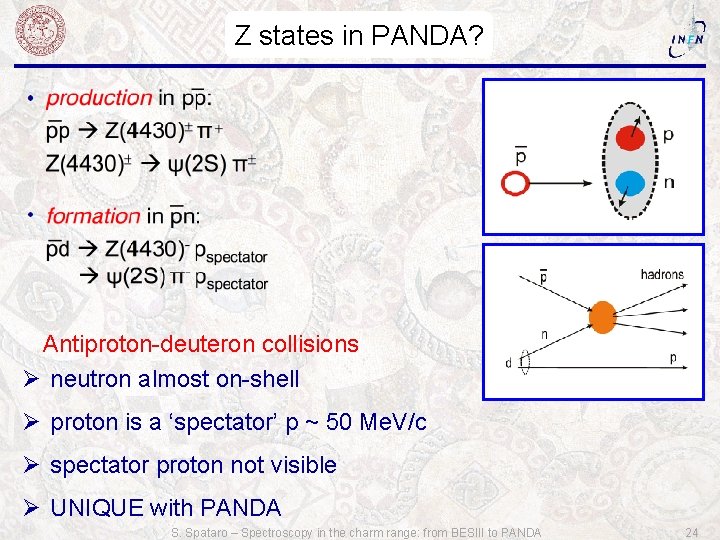
Z states in PANDA? Antiproton-deuteron collisions Ø neutron almost on-shell Ø proton is a ‘spectator’ p ~ 50 Me. V/c Ø spectator proton not visible Ø UNIQUE with PANDA S. Spataro – Spectroscopy in the charm range: from BESIII to PANDA 24
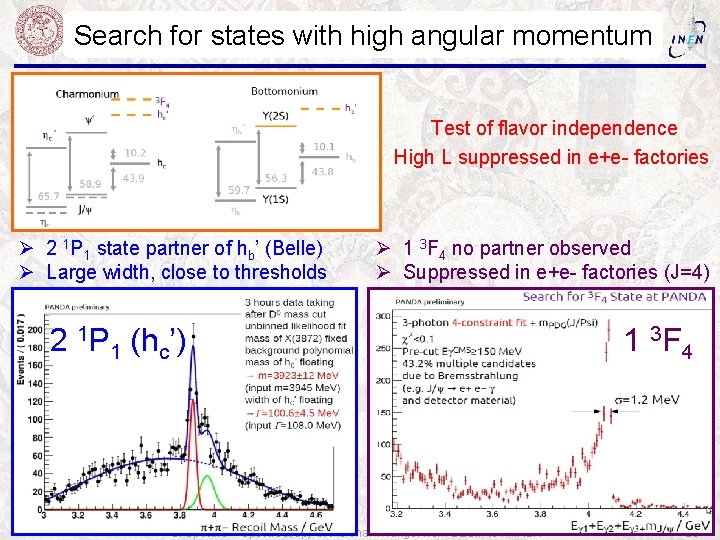
Search for states with high angular momentum Test of flavor independence High L suppressed in e+e- factories Ø 2 1 P 1 state partner of hb’ (Belle) Ø Large width, close to thresholds Ø 1 3 F 4 no partner observed Ø Suppressed in e+e- factories (J=4) 2 1 P 1 (hc’) S. Spataro – Spectroscopy in the charm range: from BESIII to PANDA 1 3 F 4 25
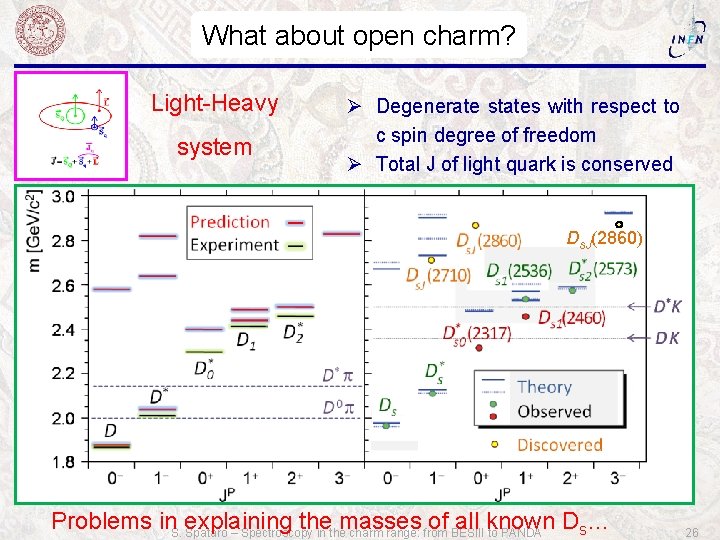
What about open charm? Light-Heavy system Ø Degenerate states with respect to c spin degree of freedom Ø Total J of light quark is conserved Ds. J(2860) Problems in. S. explaining the masses of all known Ds… Spataro – Spectroscopy in the charm range: from BESIII to PANDA 26
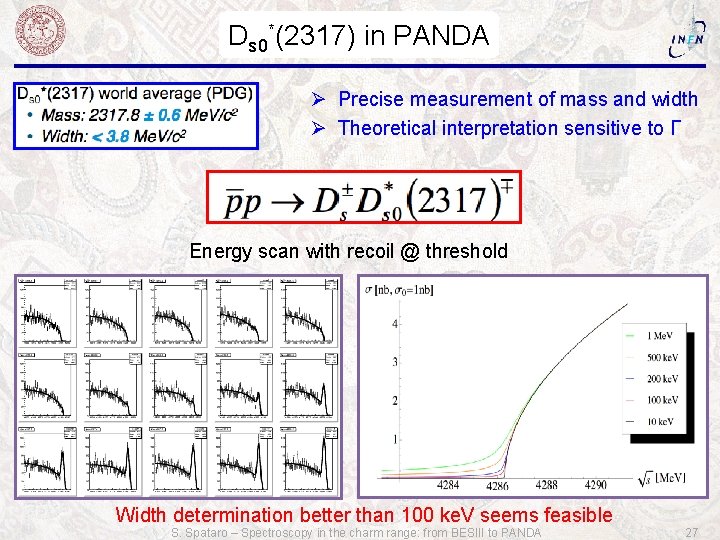
Ds 0*(2317) in PANDA Ø Precise measurement of mass and width Ø Theoretical interpretation sensitive to Γ Energy scan with recoil @ threshold Width determination better than 100 ke. V seems feasible S. Spataro – Spectroscopy in the charm range: from BESIII to PANDA 27
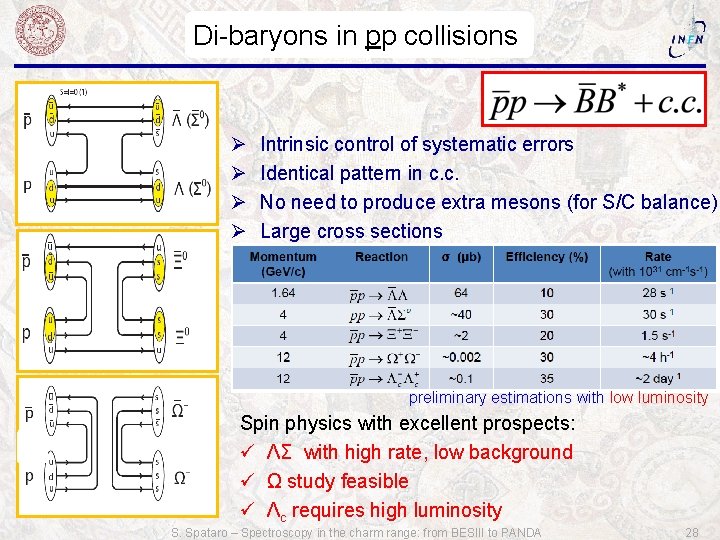
Di-baryons in pp collisions Ø Ø Intrinsic control of systematic errors Identical pattern in c. c. No need to produce extra mesons (for S/C balance) Large cross sections preliminary estimations with low luminosity Spin physics with excellent prospects: ü ΛΣ with high rate, low background ü Ω study feasible ü Λc requires high luminosity S. Spataro – Spectroscopy in the charm range: from BESIII to PANDA 28
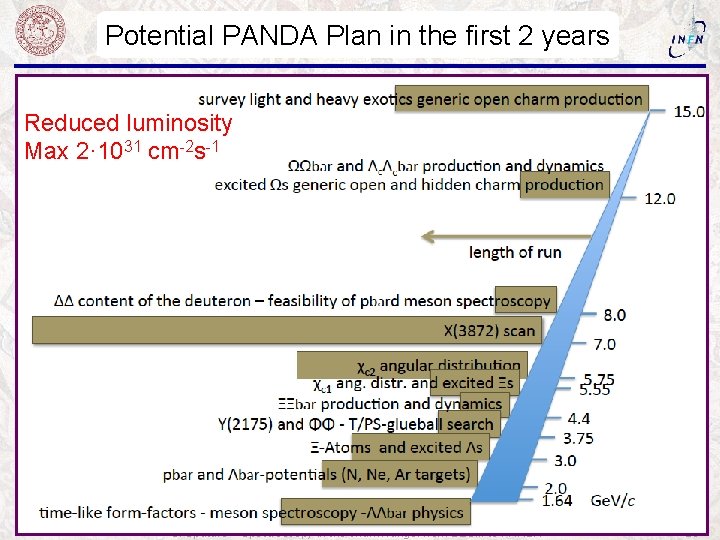
Potential PANDA Plan in the first 2 years Reduced luminosity Max 2· 1031 cm-2 s-1 S. Spataro – Spectroscopy in the charm range: from BESIII to PANDA 29
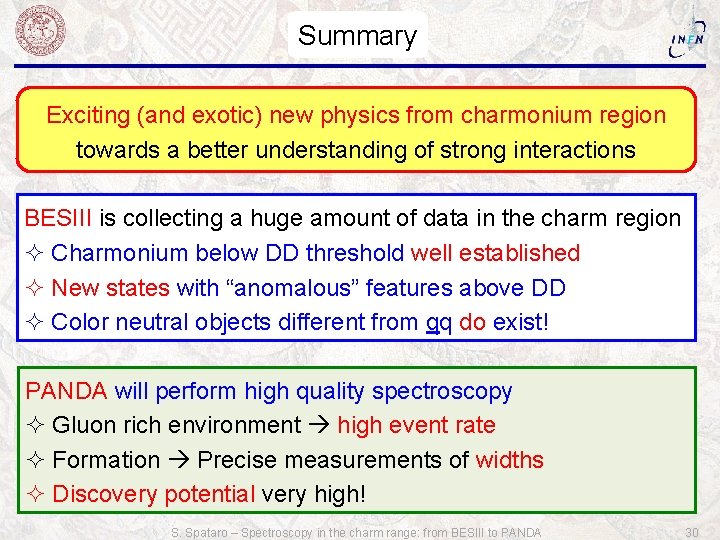
Summary Exciting (and exotic) new physics from charmonium region towards a better understanding of strong interactions BESIII is collecting a huge amount of data in the charm region ² Charmonium below DD threshold well established ² New states with “anomalous” features above DD ² Color neutral objects different from qq do exist! PANDA will perform high quality spectroscopy ² Gluon rich environment high event rate ² Formation Precise measurements of widths ² Discovery potential very high! S. Spataro – Spectroscopy in the charm range: from BESIII to PANDA 30
S. Spataro – Spectroscopy in the charm range: from BESIII to PANDA 31
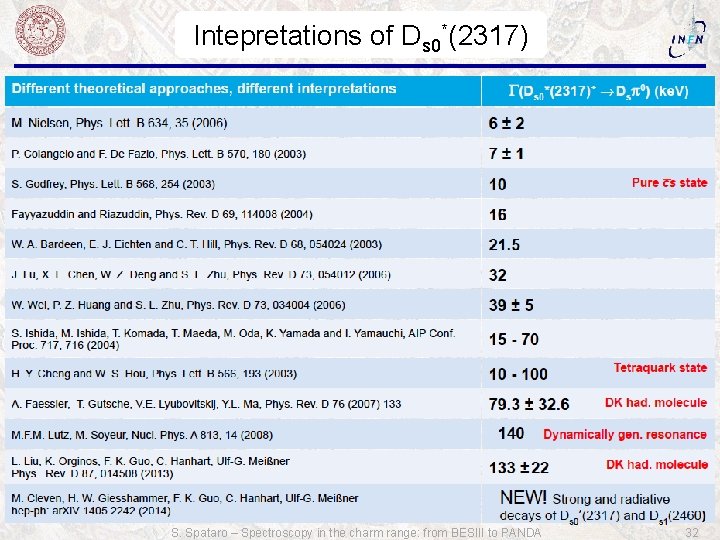
Intepretations of Ds 0*(2317) S. Spataro – Spectroscopy in the charm range: from BESIII to PANDA 32
- Slides: 32