
The phi meson in nuclear matter recent result

- Slides: 42
The phi meson in nuclear matter - recent result from theory P. Gubler and K. Ohtani, Phys. Rev. D 90, 094002 (2014). P. Gubler and W. Weise, Phys. Lett. B 751, 396 (2015). Talk at ECT* Workshop Collaborators: “New perspectives on Photons and Dileptons in Keisuke Ohtani (Tokyo Tech) Ultrarelativistic Heavy-Ion Collisions at RHIC and LHC” Wolfram Weise (ECT*, TUM) 4. December, 2015
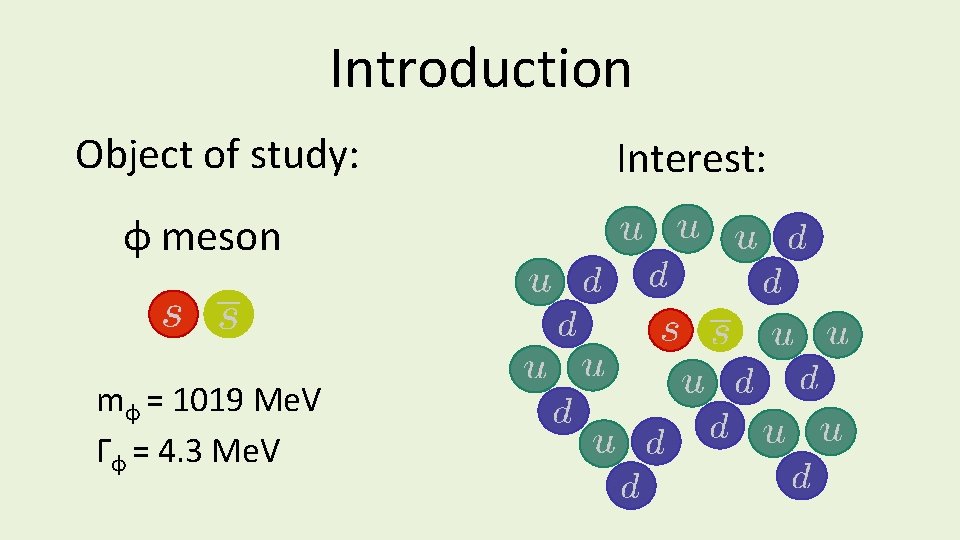
Introduction Object of study: φ meson mφ = 1019 Me. V Γφ = 4. 3 Me. V Interest:
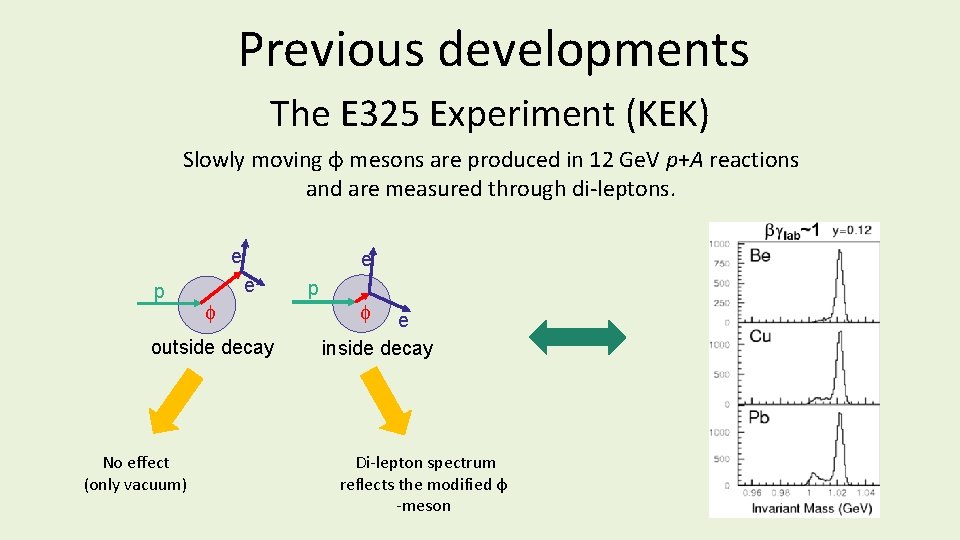
Previous developments The E 325 Experiment (KEK) Slowly moving φ mesons are produced in 12 Ge. V p+A reactions and are measured through di-leptons. e p e e f outside decay No effect (only vacuum) p f e inside decay Di-lepton spectrum reflects the modified φ -meson
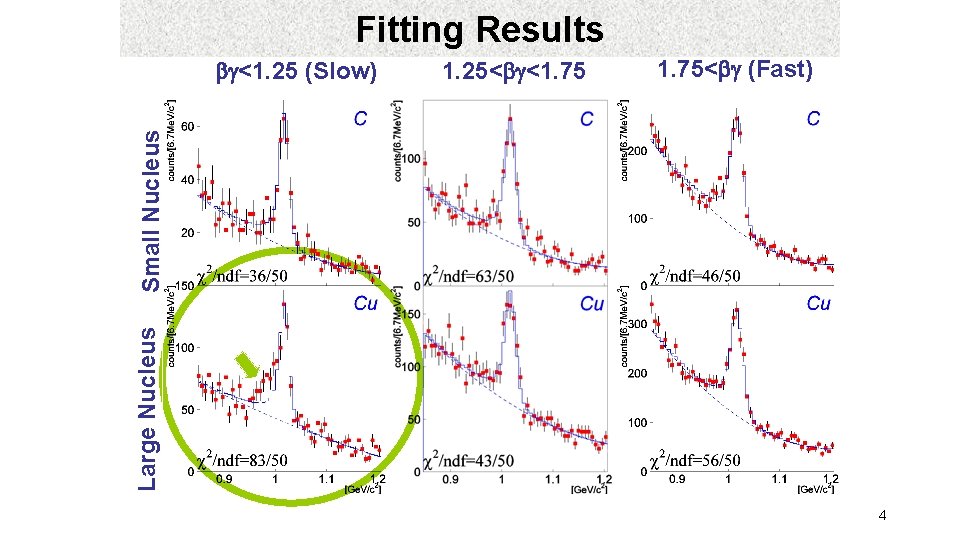
Fitting Results 1. 25<bg<1. 75<bg (Fast) Large Nucleus Small Nucleus bg<1. 25 (Slow) 4
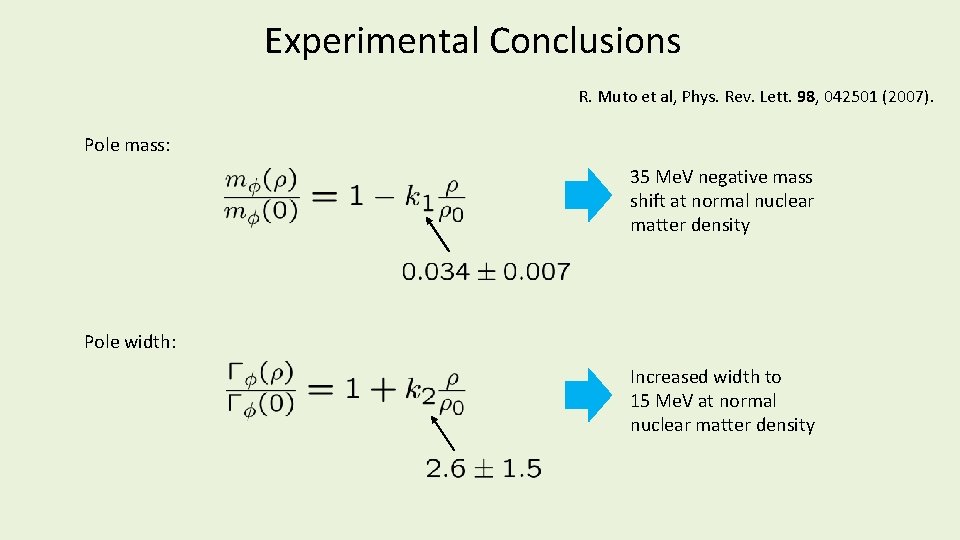
Experimental Conclusions R. Muto et al, Phys. Rev. Lett. 98, 042501 (2007). Pole mass: 35 Me. V negative mass shift at normal nuclear matter density Pole width: Increased width to 15 Me. V at normal nuclear matter density
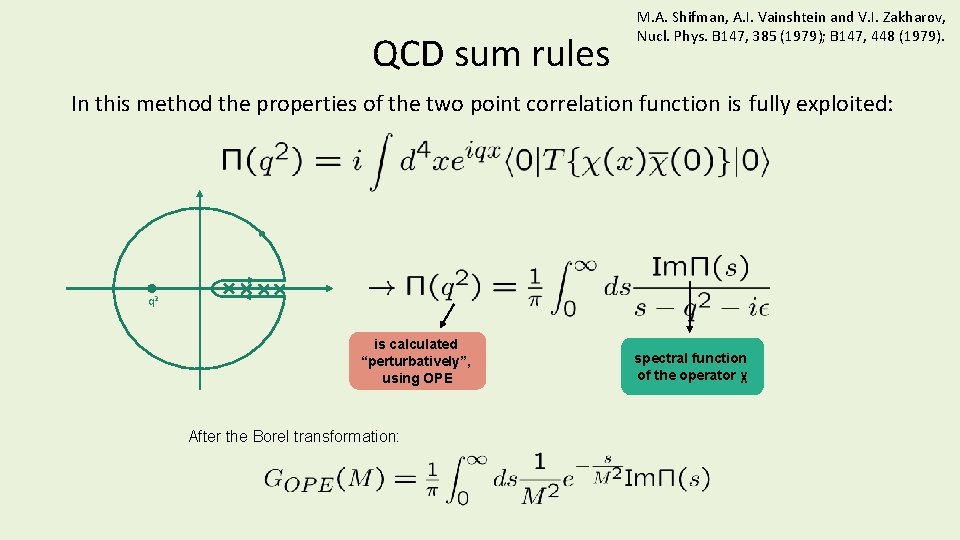
QCD sum rules M. A. Shifman, A. I. Vainshtein and V. I. Zakharov, Nucl. Phys. B 147, 385 (1979); B 147, 448 (1979). In this method the properties of the two point correlation function is fully exploited: q 2 is calculated “perturbatively”, using OPE After the Borel transformation: spectral function of the operator χ
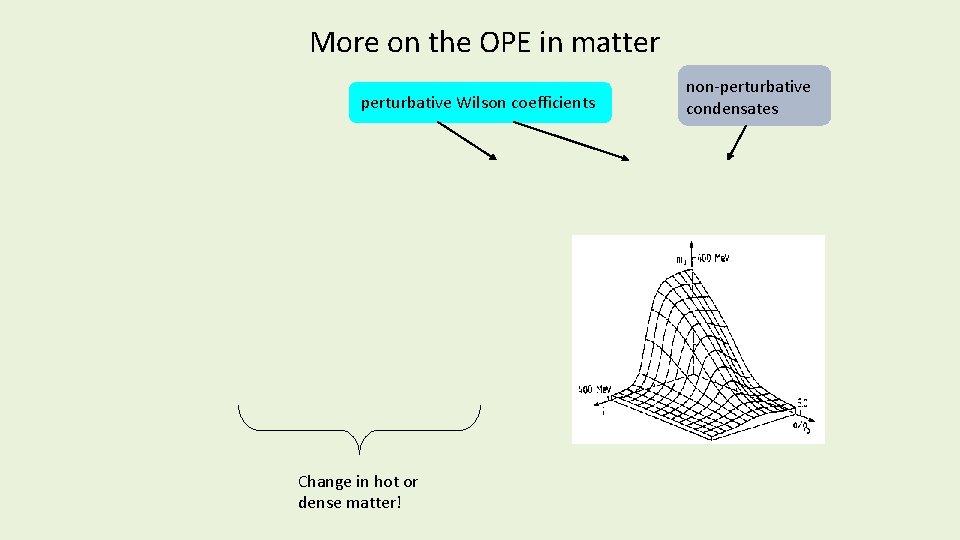
More on the OPE in matter perturbative Wilson coefficients Change in hot or dense matter! non-perturbative condensates
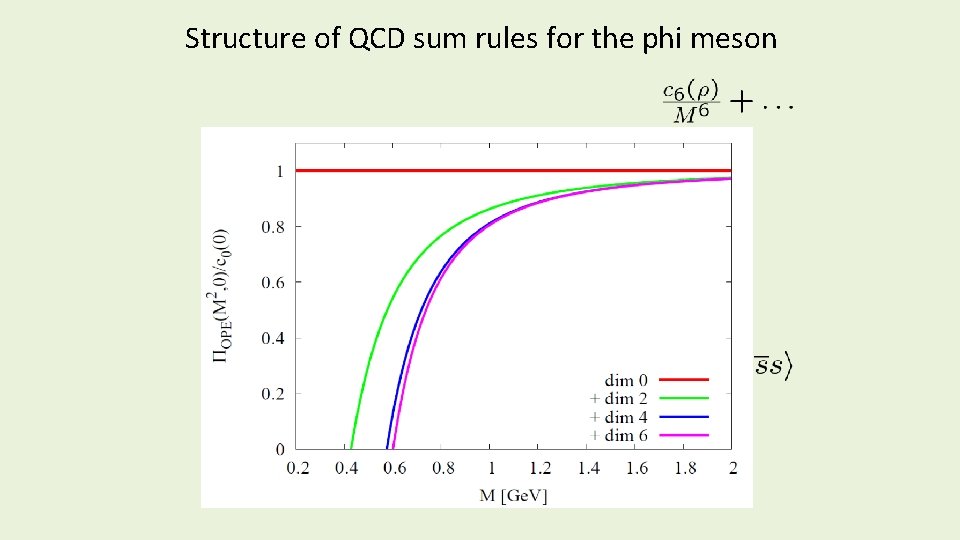
Structure of QCD sum rules for the phi meson In Vacuum Dim. 0: Dim. 2: Dim. 4: Dim. 6:
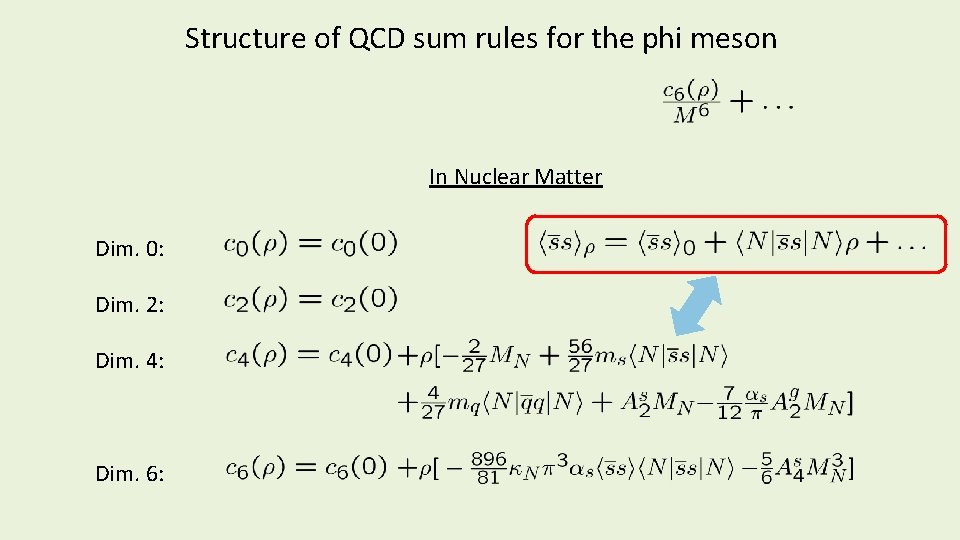
Structure of QCD sum rules for the phi meson In Nuclear Matter Dim. 0: Dim. 2: Dim. 4: Dim. 6:
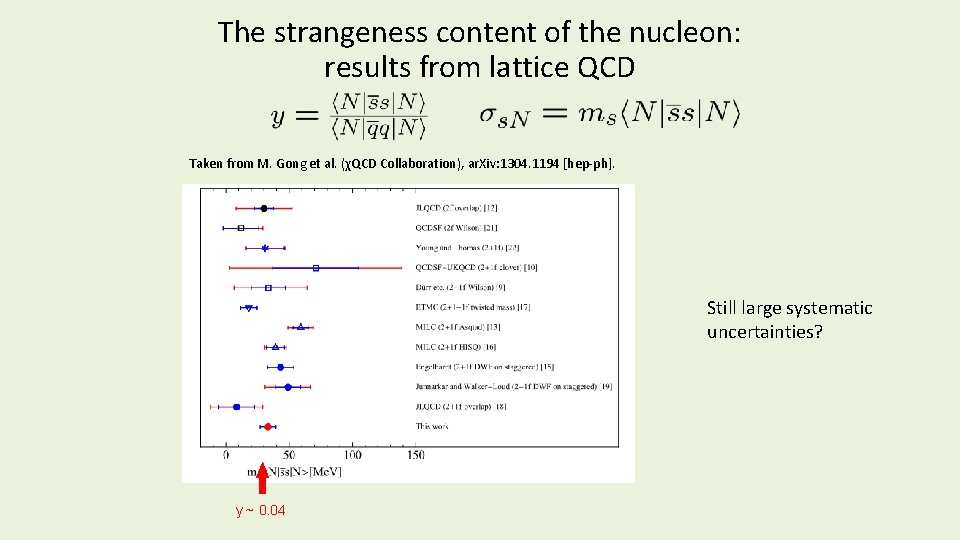
The strangeness content of the nucleon: results from lattice QCD Taken from M. Gong et al. (χQCD Collaboration), ar. Xiv: 1304. 1194 [hep-ph]. Still large systematic uncertainties? y ~ 0. 04
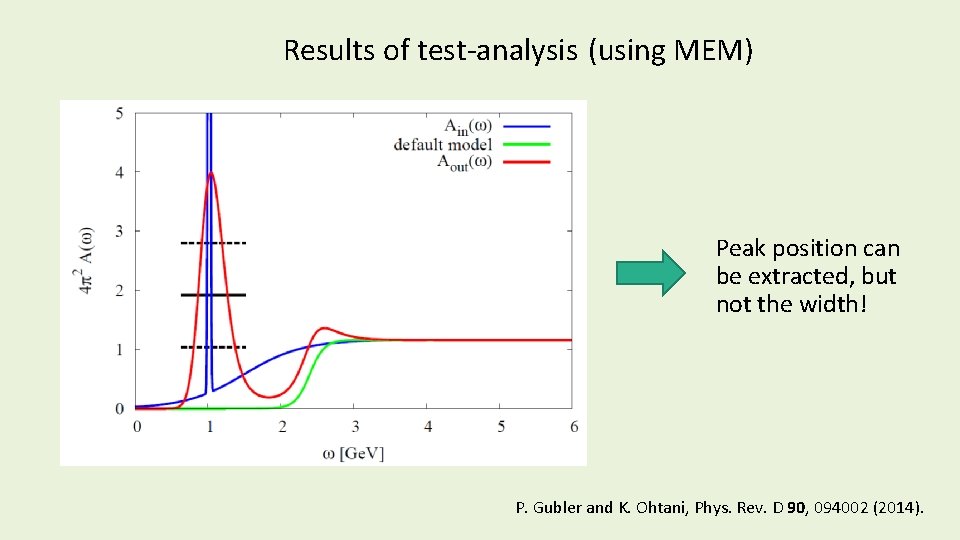
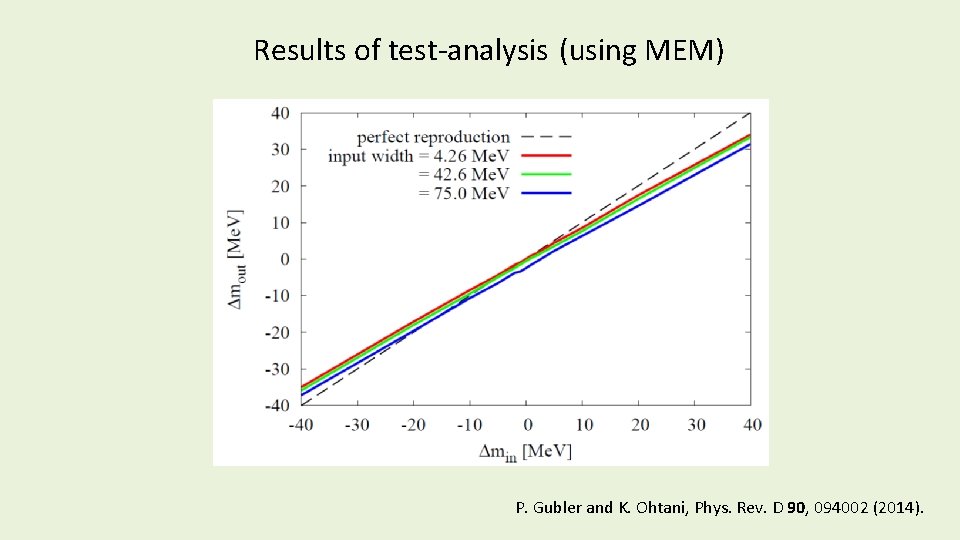
Results of test-analysis (using MEM) Peak position can be extracted, but not the width! P. Gubler and K. Ohtani, Phys. Rev. D 90, 094002 (2014).
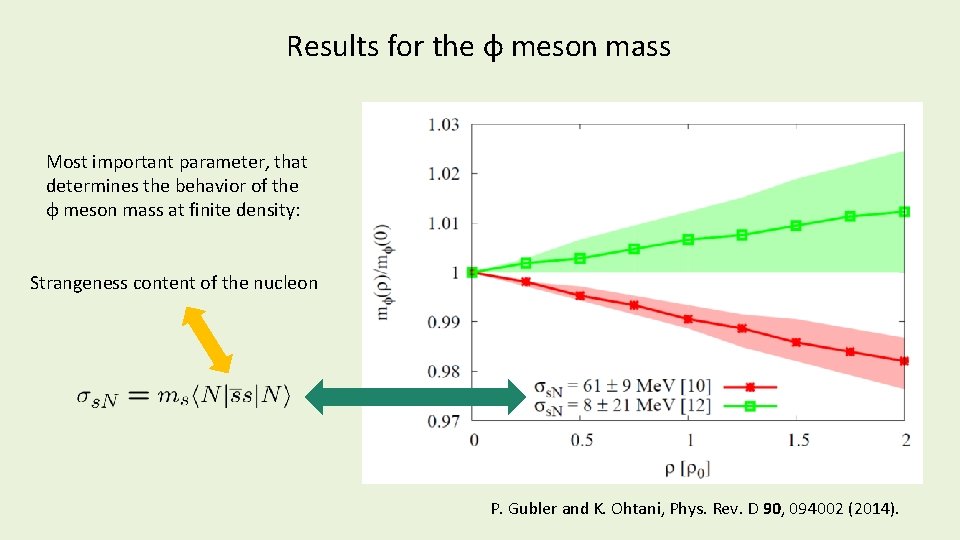
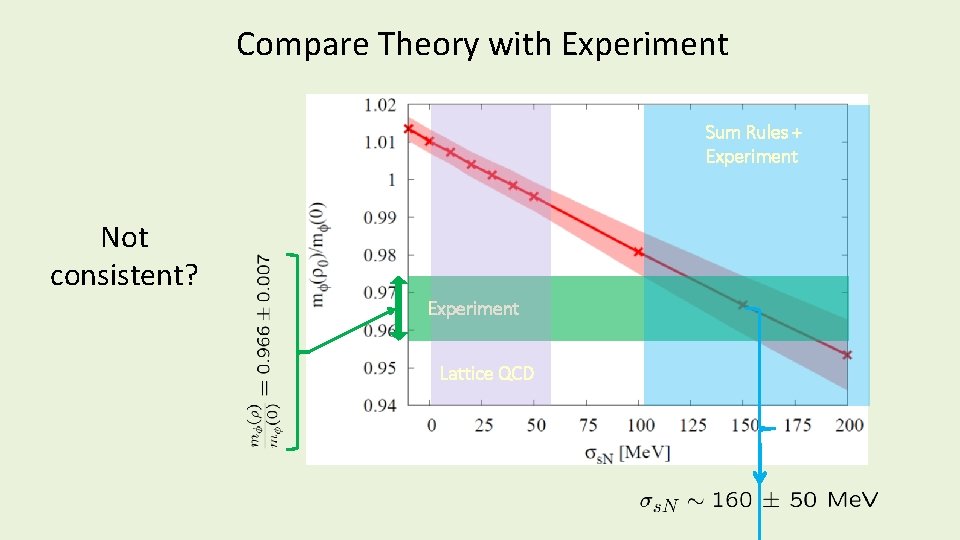
Results for the φ meson mass Most important parameter, that determines the behavior of the φ meson mass at finite density: Strangeness content of the nucleon P. Gubler and K. Ohtani, Phys. Rev. D 90, 094002 (2014).
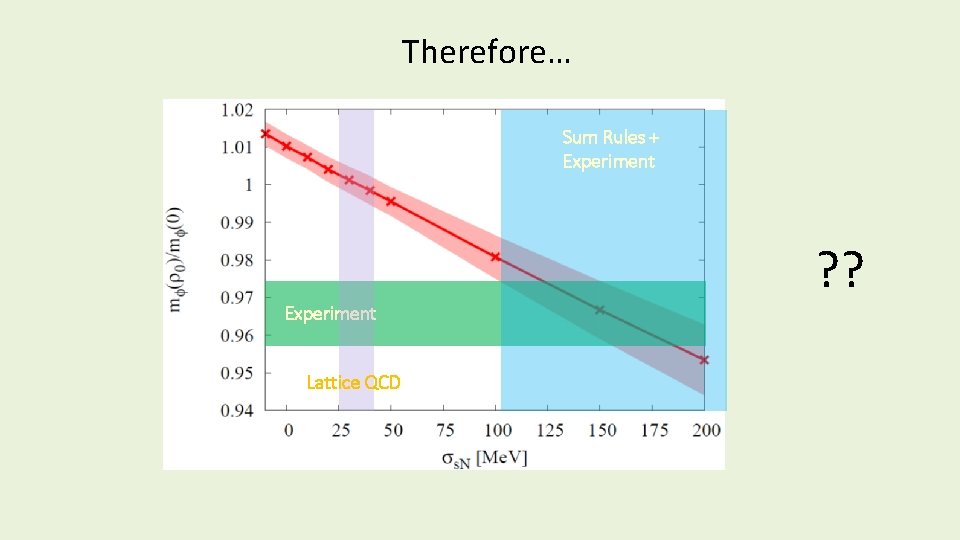
Compare Theory with Experiment Sum Rules + Experiment Not consistent? Experiment Lattice QCD
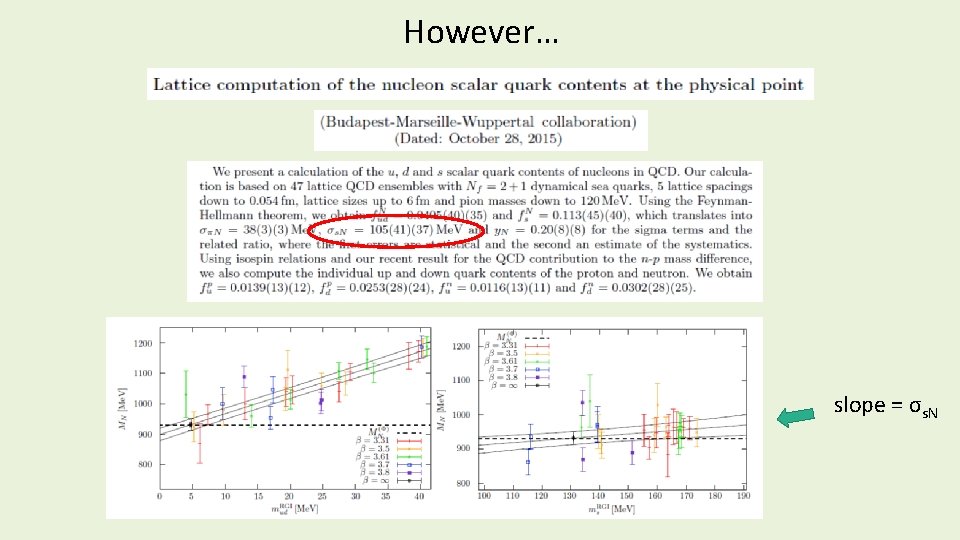
However… slope = σs. N
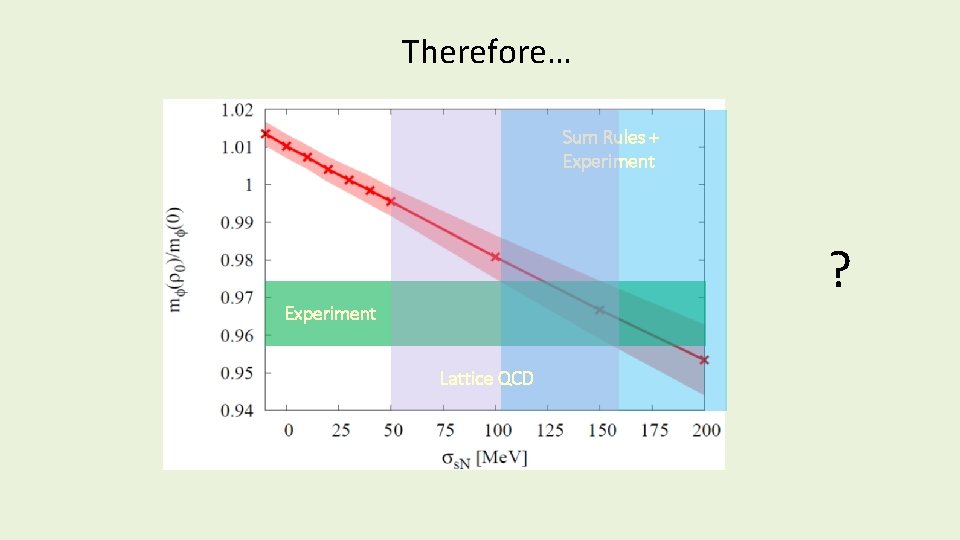
Therefore… Sum Rules + Experiment ? Experiment Lattice QCD
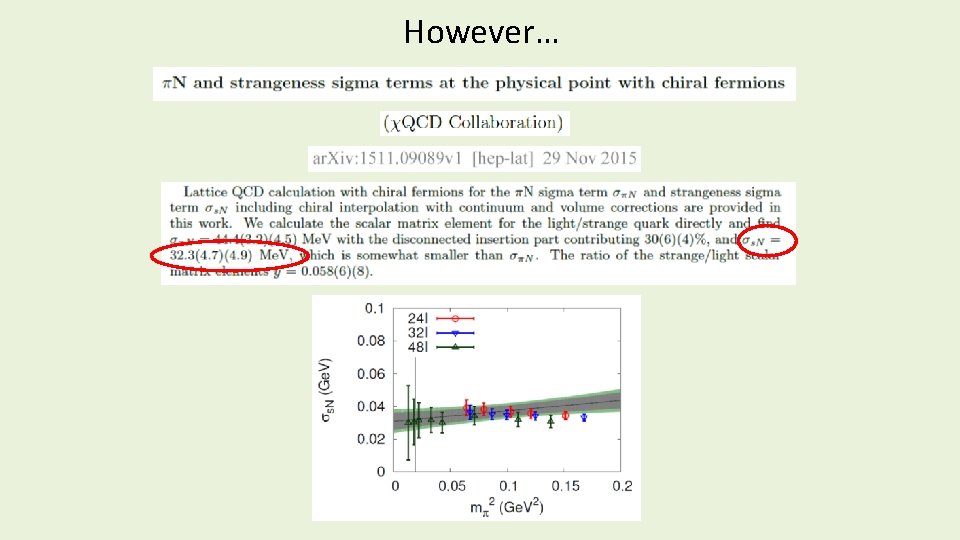
However…
Therefore… Sum Rules + Experiment Lattice QCD ? ?
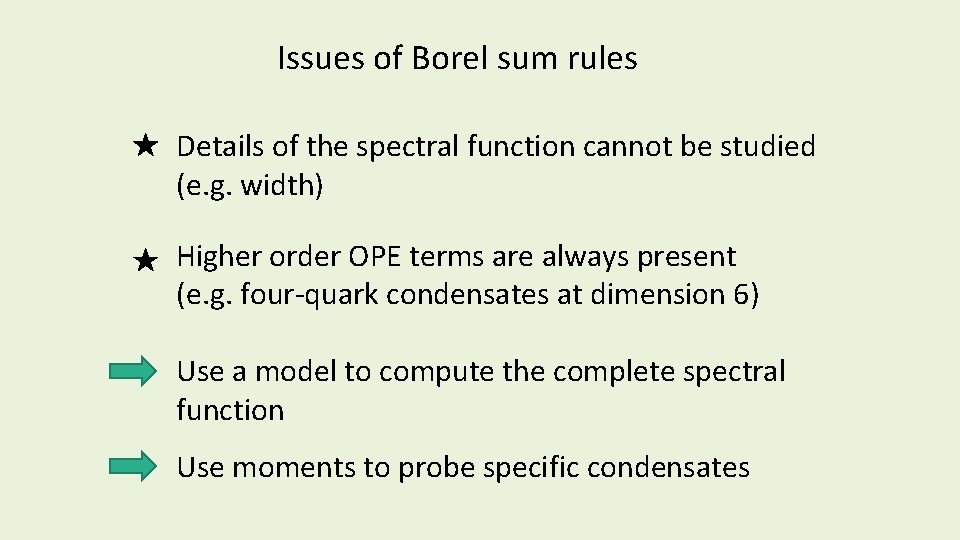
Issues of Borel sum rules Details of the spectral function cannot be studied (e. g. width) Higher order OPE terms are always present (e. g. four-quark condensates at dimension 6) Use a model to compute the complete spectral function Use moments to probe specific condensates
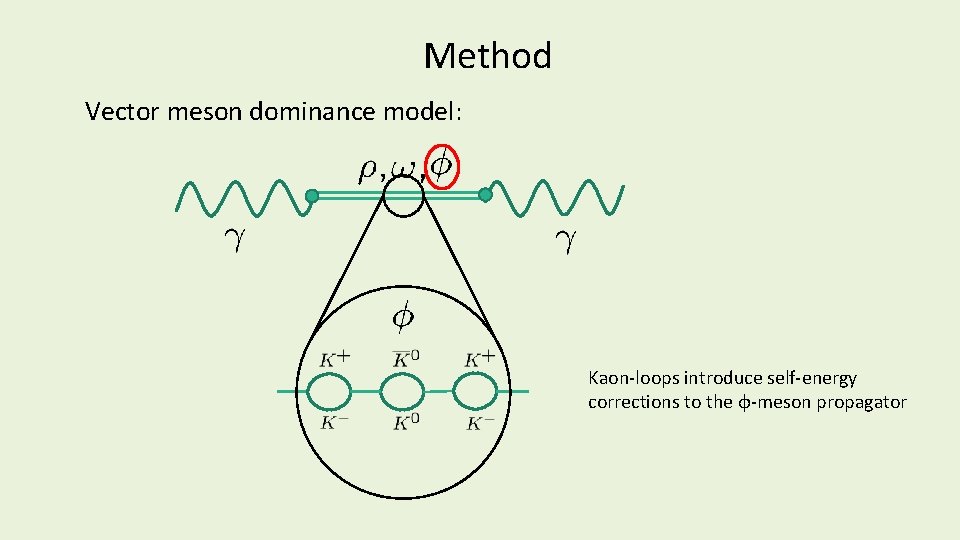
Method Vector meson dominance model: Kaon-loops introduce self-energy corrections to the φ-meson propagator
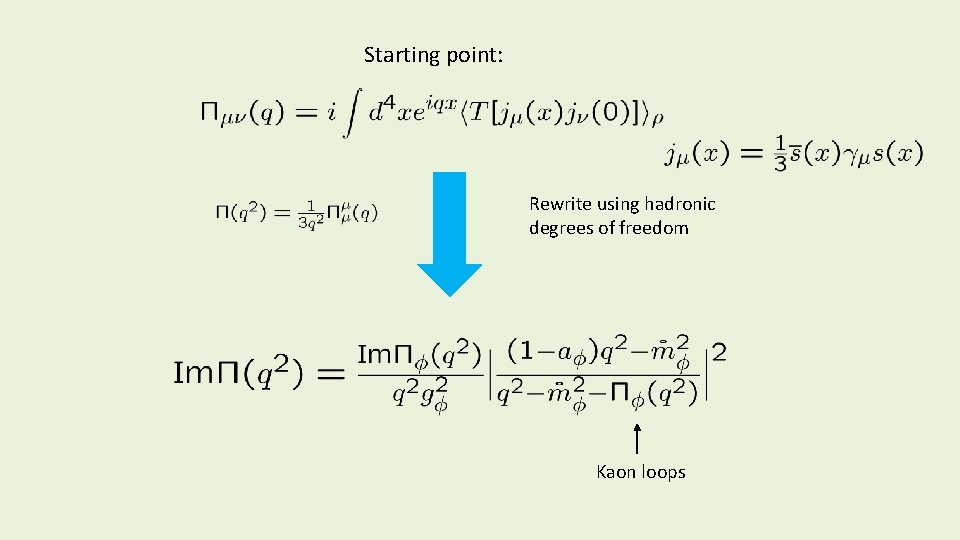
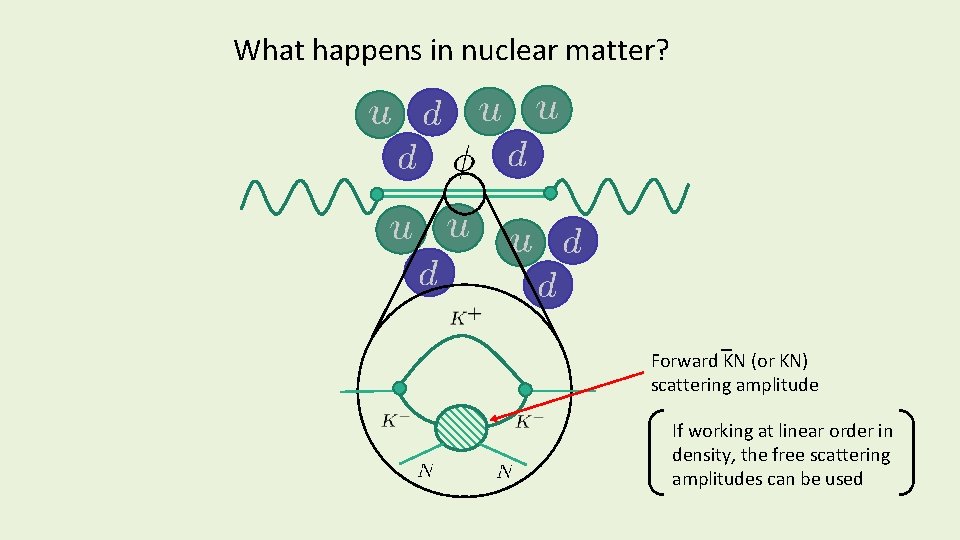
Starting point: Rewrite using hadronic degrees of freedom Kaon loops
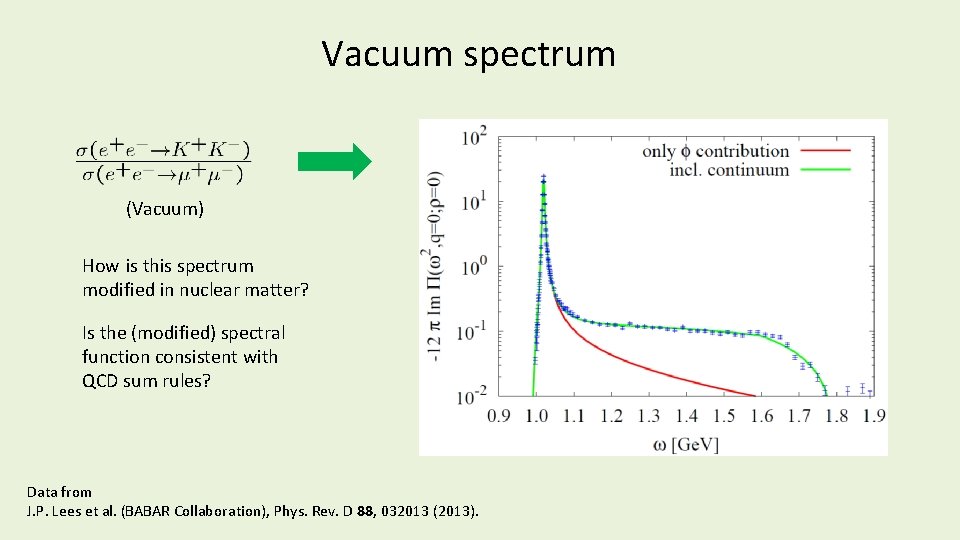
Vacuum spectrum (Vacuum) How is this spectrum modified in nuclear matter? Is the (modified) spectral function consistent with QCD sum rules? Data from J. P. Lees et al. (BABAR Collaboration), Phys. Rev. D 88, 032013 (2013).
What happens in nuclear matter? Forward KN (or KN) scattering amplitude If working at linear order in density, the free scattering amplitudes can be used
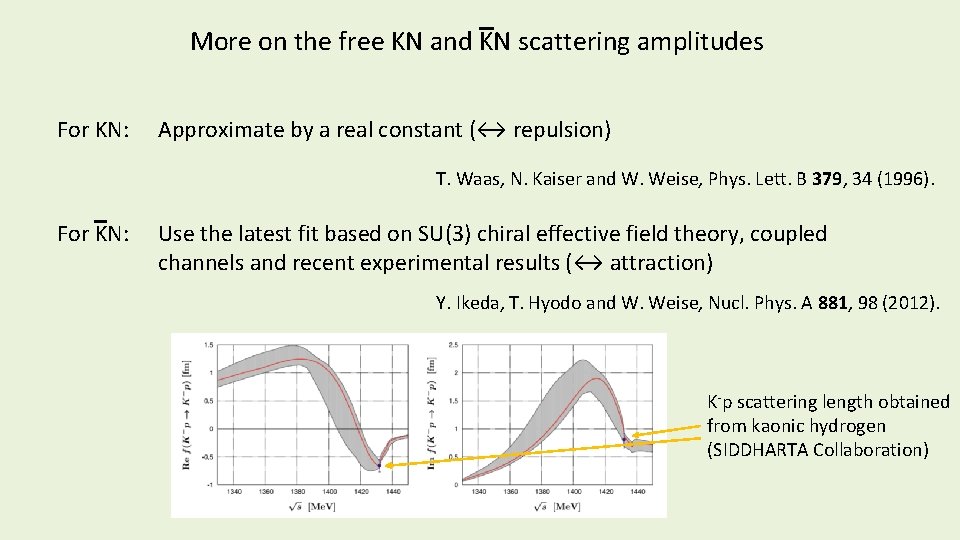
More on the free KN and KN scattering amplitudes For KN: Approximate by a real constant (↔ repulsion) T. Waas, N. Kaiser and W. Weise, Phys. Lett. B 379, 34 (1996). For KN: Use the latest fit based on SU(3) chiral effective field theory, coupled channels and recent experimental results (↔ attraction) Y. Ikeda, T. Hyodo and W. Weise, Nucl. Phys. A 881, 98 (2012). K-p scattering length obtained from kaonic hydrogen (SIDDHARTA Collaboration)
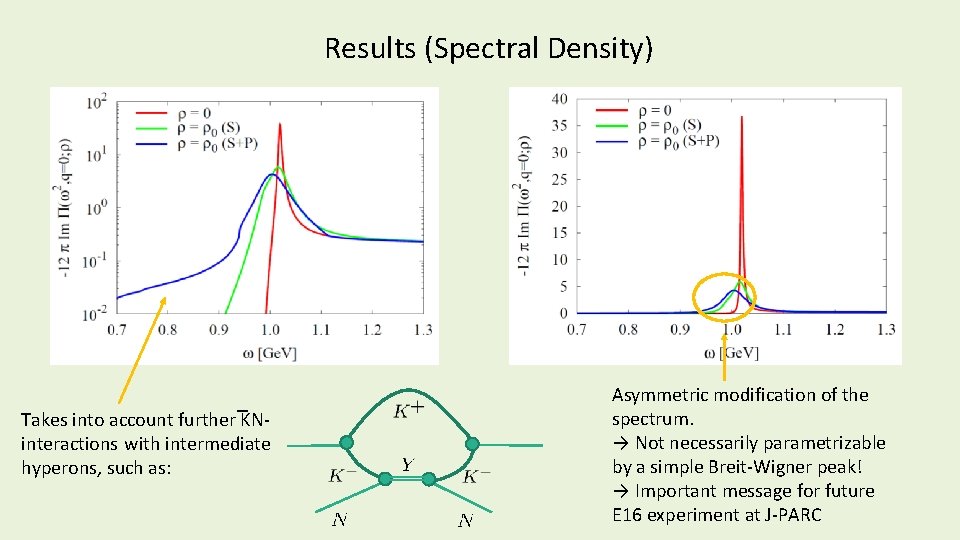
Results (Spectral Density) Takes into account further KNinteractions with intermediate hyperons, such as: Asymmetric modification of the spectrum. → Not necessarily parametrizable by a simple Breit-Wigner peak! → Important message for future E 16 experiment at J-PARC
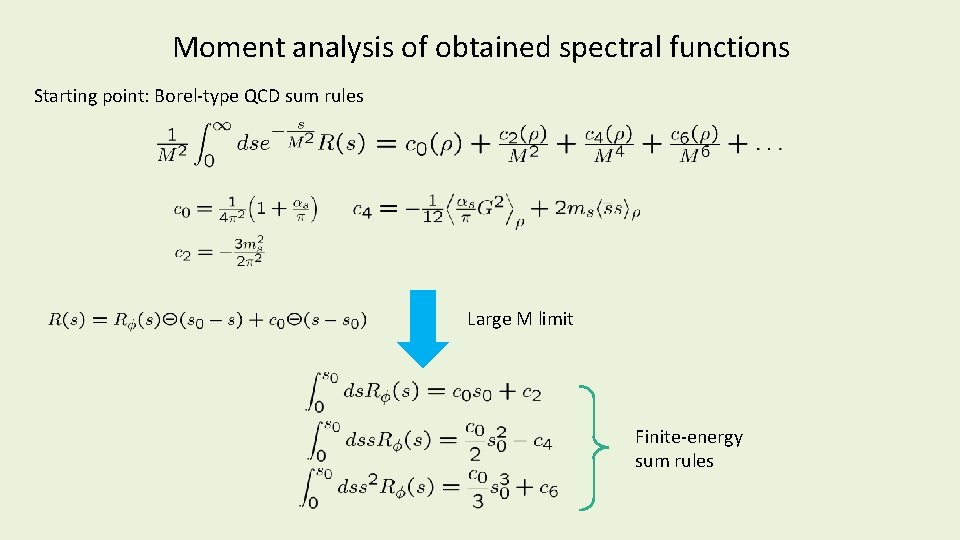
Moment analysis of obtained spectral functions Starting point: Borel-type QCD sum rules Large M limit Finite-energy sum rules
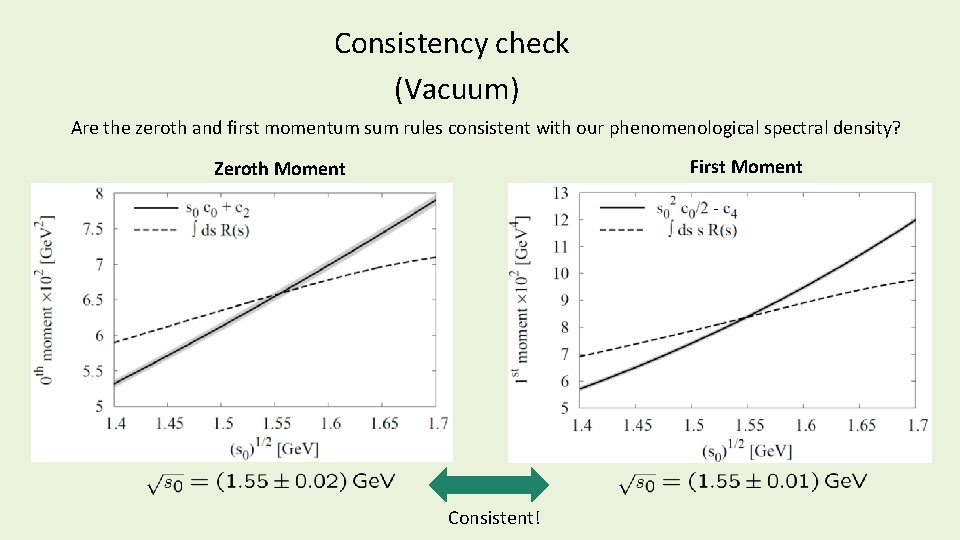
Consistency check (Vacuum) Are the zeroth and first momentum sum rules consistent with our phenomenological spectral density? First Moment Zeroth Moment Consistent!
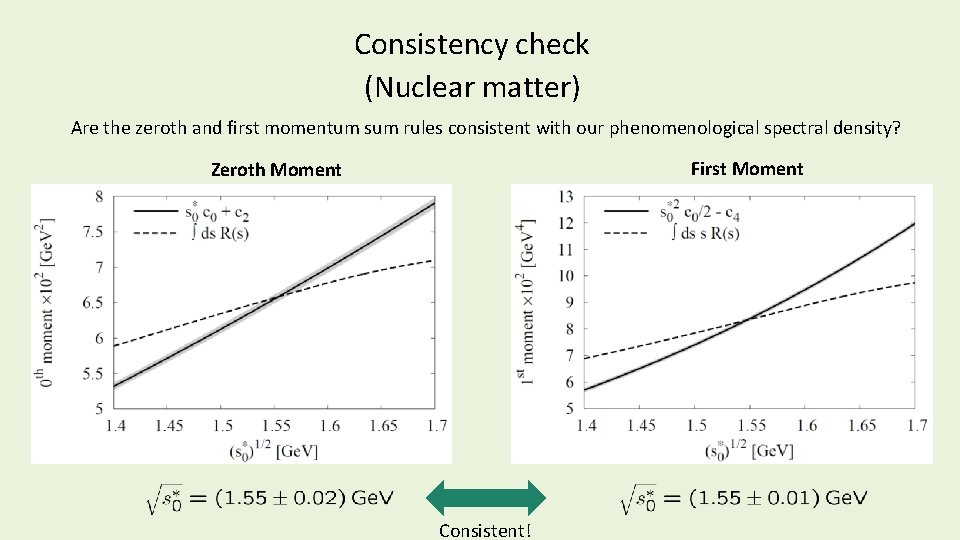
Consistency check (Nuclear matter) Are the zeroth and first momentum sum rules consistent with our phenomenological spectral density? First Moment Zeroth Moment Consistent!
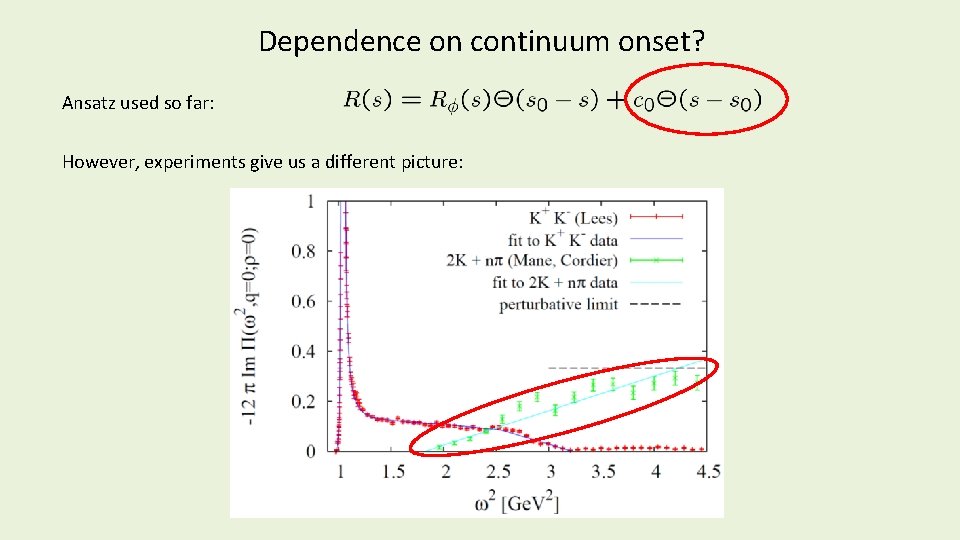
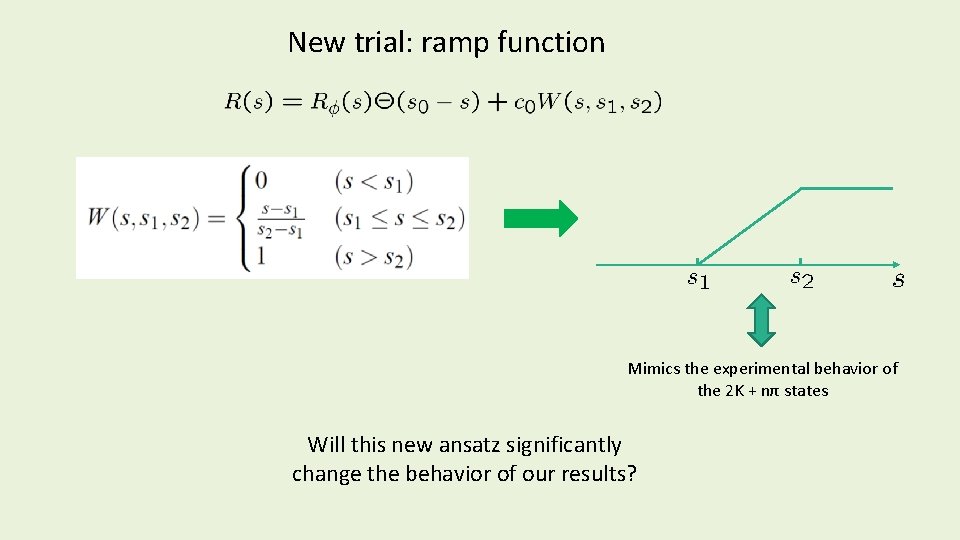
Dependence on continuum onset? Ansatz used so far: However, experiments give us a different picture:
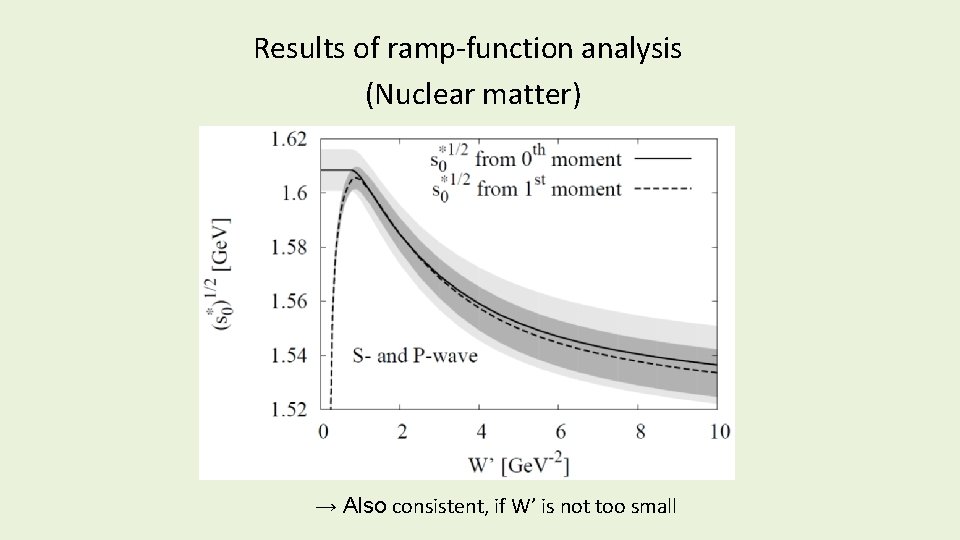
New trial: ramp function Mimics the experimental behavior of the 2 K + nπ states Will this new ansatz significantly change the behavior of our results?
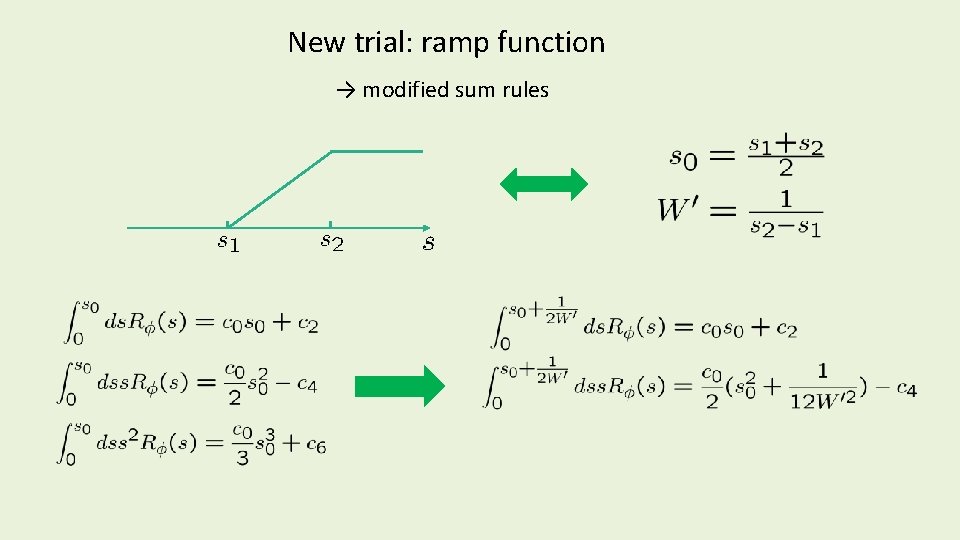
New trial: ramp function → modified sum rules
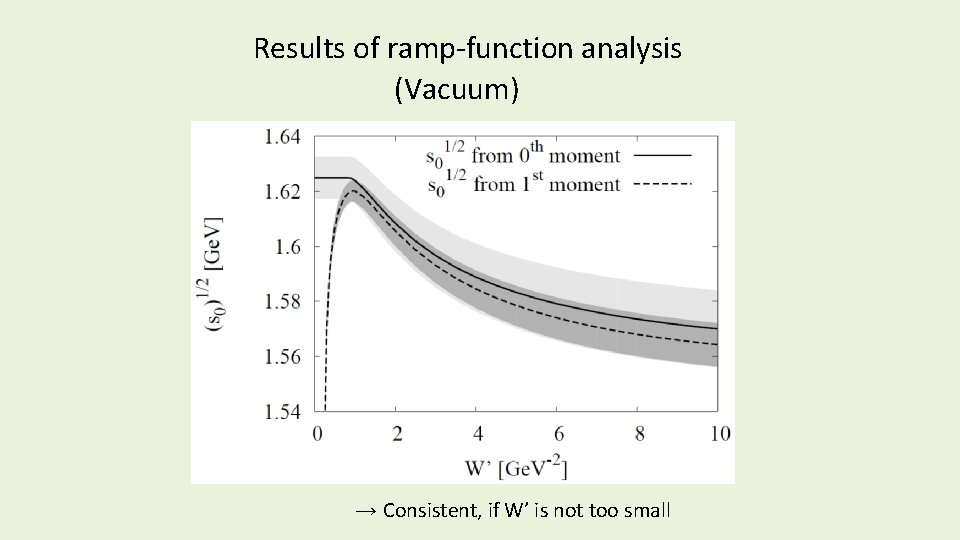
Results of ramp-function analysis (Vacuum) → Consistent, if W’ is not too small
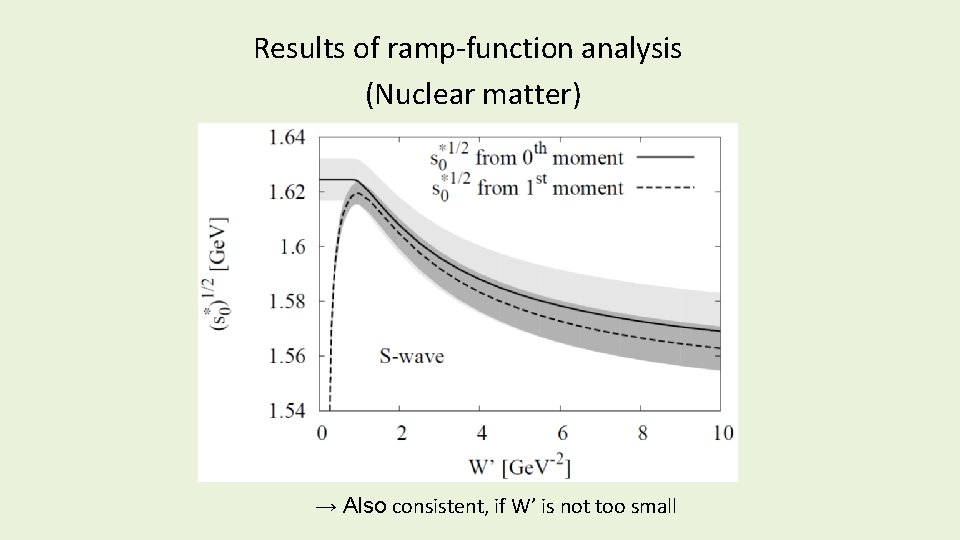
Results of ramp-function analysis (Nuclear matter) → Also consistent, if W’ is not too small
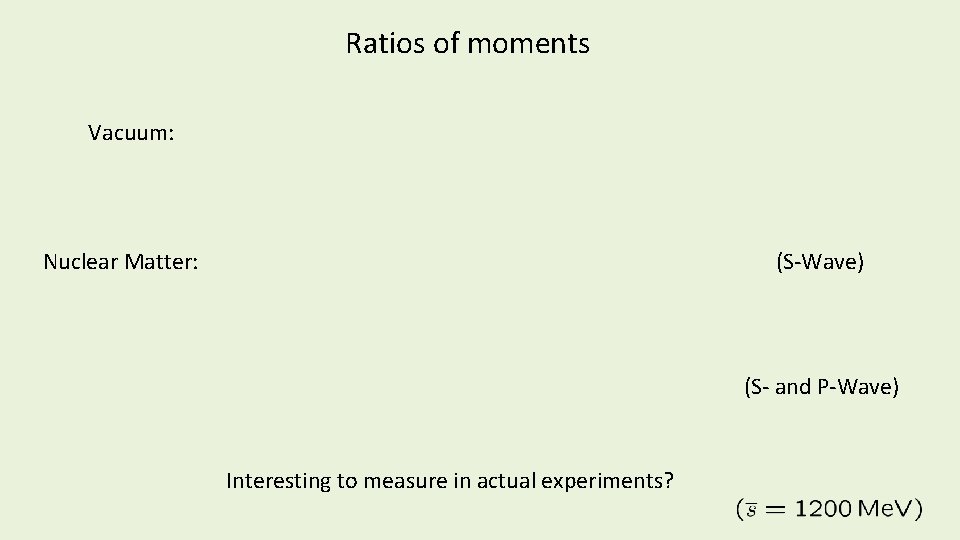
Ratios of moments Vacuum: Nuclear Matter: (S-Wave) (S- and P-Wave) Interesting to measure in actual experiments?
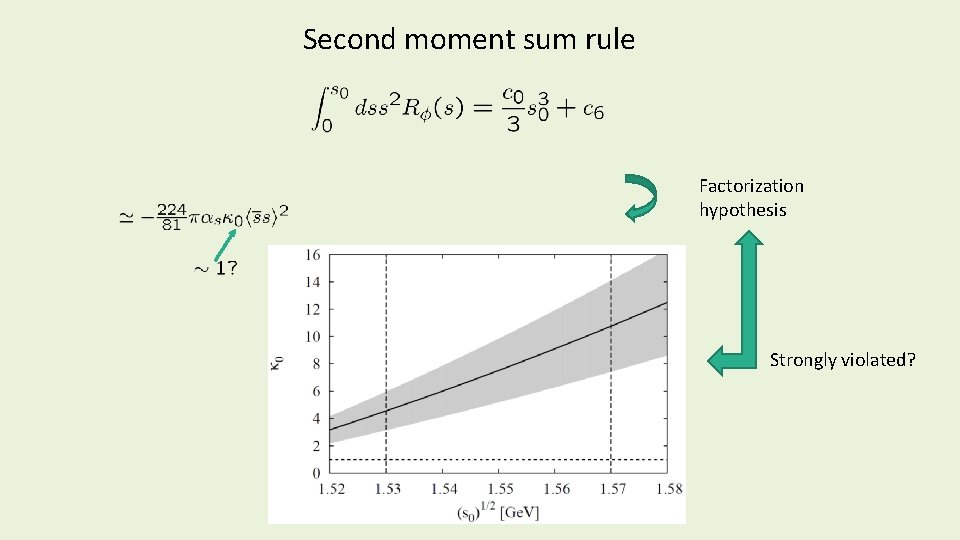
Second moment sum rule Factorization hypothesis Strongly violated?
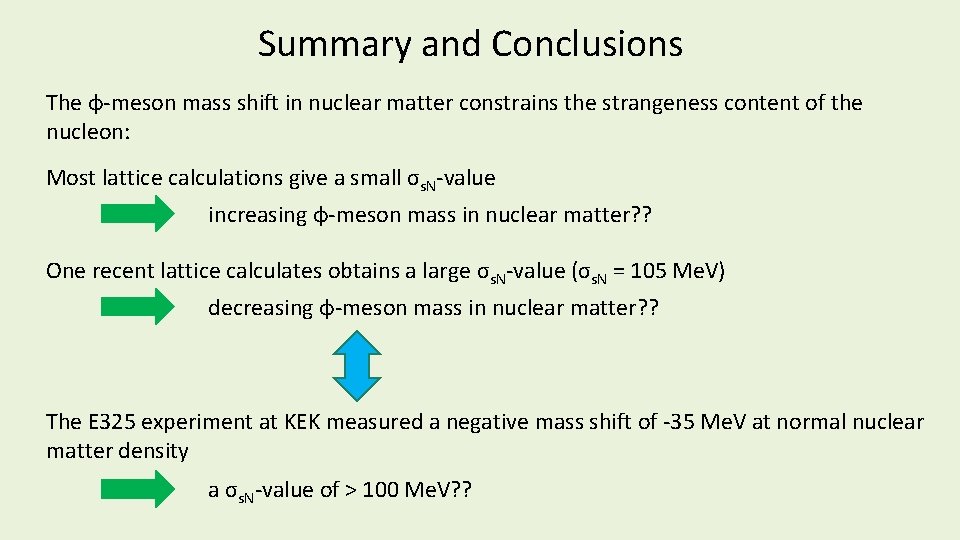
Summary and Conclusions The φ-meson mass shift in nuclear matter constrains the strangeness content of the nucleon: Most lattice calculations give a small σs. N-value increasing φ-meson mass in nuclear matter? ? One recent lattice calculates obtains a large σs. N-value (σs. N = 105 Me. V) decreasing φ-meson mass in nuclear matter? ? The E 325 experiment at KEK measured a negative mass shift of -35 Me. V at normal nuclear matter density a σs. N-value of > 100 Me. V? ?
Summary and Conclusions We have computed the φ meson spectral density in vacuum and nuclear matter based on an effective vector dominance model and the latest experimental constraints Accurate description of the spectral function in vacuum Non-symmetric behavior of peak in nuclear matter We have carried out a moment analysis of the obtained spectral functions Spectral functions are consistent with lowest two momentum sum rules Moments provide direct links between QCD condensates and experimentally measurable quantities
Outlook Further improve the sum rule computation Complete OPE up to operators of mass dimension 6 Accurate evaluation of four-quark condensates (on the lattice? ) Consider finite momentum Use both QCD sum rules and effective theory Make predictions for the E 16 experiment at J-PARC
Backup slides
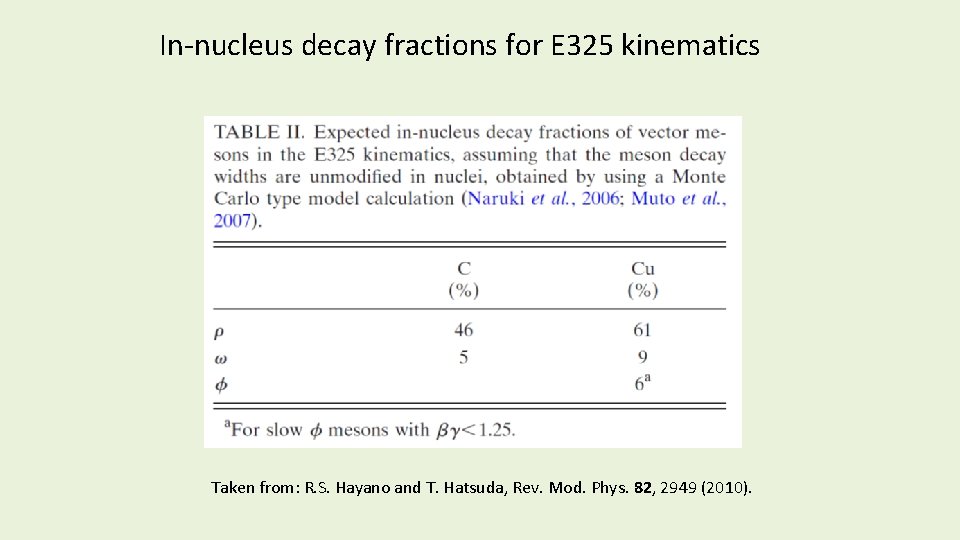
In-nucleus decay fractions for E 325 kinematics Taken from: R. S. Hayano and T. Hatsuda, Rev. Mod. Phys. 82, 2949 (2010).
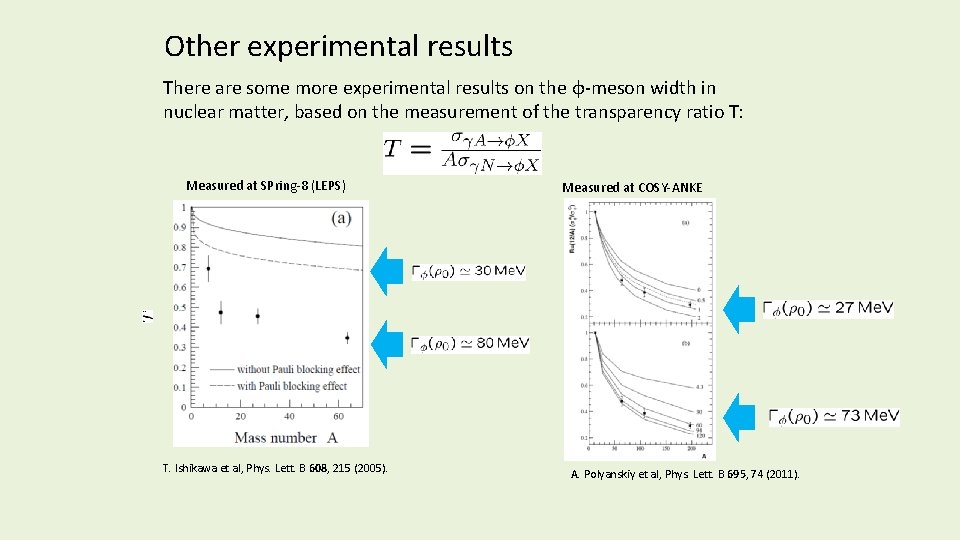
Other experimental results There are some more experimental results on the φ-meson width in nuclear matter, based on the measurement of the transparency ratio T: Measured at SPring-8 (LEPS) T. Ishikawa et al, Phys. Lett. B 608, 215 (2005). Measured at COSY-ANKE A. Polyanskiy et al, Phys. Lett. B 695, 74 (2011).
Results of test-analysis (using MEM) P. Gubler and K. Ohtani, Phys. Rev. D 90, 094002 (2014).
Results of ramp-function analysis (Nuclear matter) → Also consistent, if W’ is not too small