
New detectors for meson spectroscopy in Hall B
New detectors for meson spectroscopy in Hall B at JLab Baryons 2013, June 27 2013 Gabriel Charles

New detectors for meson spectroscopy in hall-B at Jefferson Lab 1) Meson spectroscopy at CLAS 12 2) Feasibility 3) Detector development and time schedule Gabriel. Charles@cea. fr CEA Saclay Baryons 2013, 06/27/2013 1
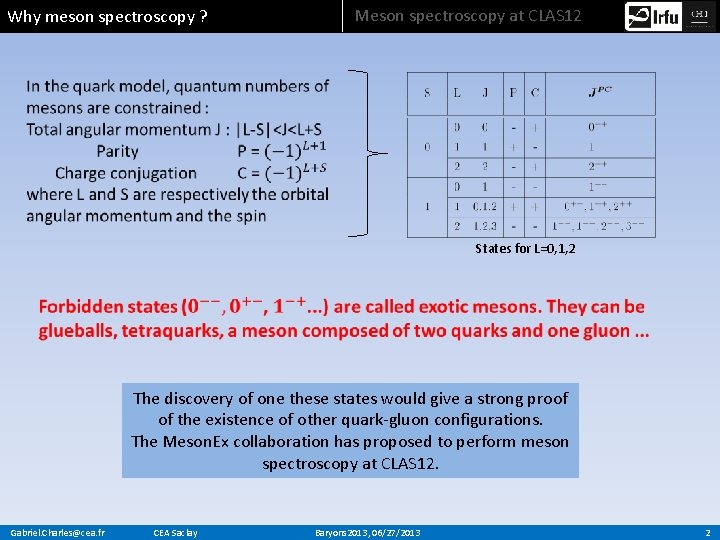
Why meson spectroscopy ? Meson spectroscopy at CLAS 12 States for L=0, 1, 2 The discovery of one these states would give a strong proof of the existence of other quark-gluon configurations. The Meson. Ex collaboration has proposed to perform meson spectroscopy at CLAS 12. Gabriel. Charles@cea. fr CEA Saclay Baryons 2013, 06/27/2013 2
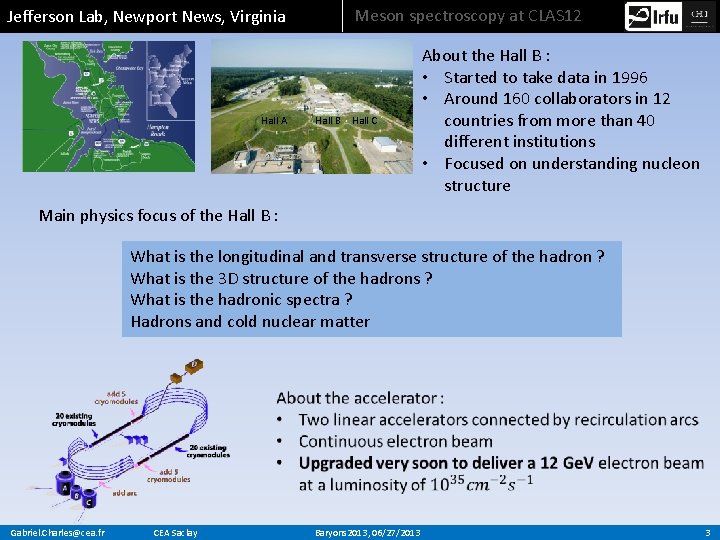
Jefferson Lab, Newport News, Virginia Hall A Meson spectroscopy at CLAS 12 Hall B Hall C About the Hall B : • Started to take data in 1996 • Around 160 collaborators in 12 countries from more than 40 different institutions • Focused on understanding nucleon structure Main physics focus of the Hall B : What is the longitudinal and transverse structure of the hadron ? What is the 3 D structure of the hadrons ? What is the hadronic spectra ? Hadrons and cold nuclear matter Gabriel. Charles@cea. fr CEA Saclay Baryons 2013, 06/27/2013 3
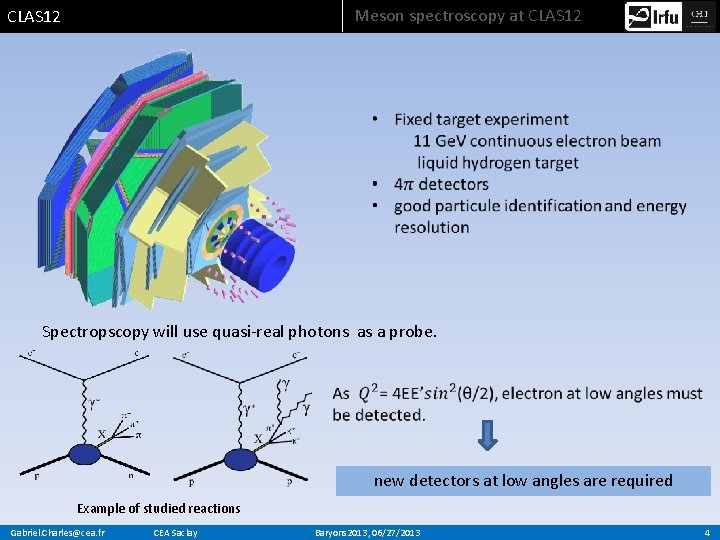
Meson spectroscopy at CLAS 12 Spectropscopy will use quasi-real photons as a probe. new detectors at low angles are required Example of studied reactions Gabriel. Charles@cea. fr CEA Saclay Baryons 2013, 06/27/2013 4
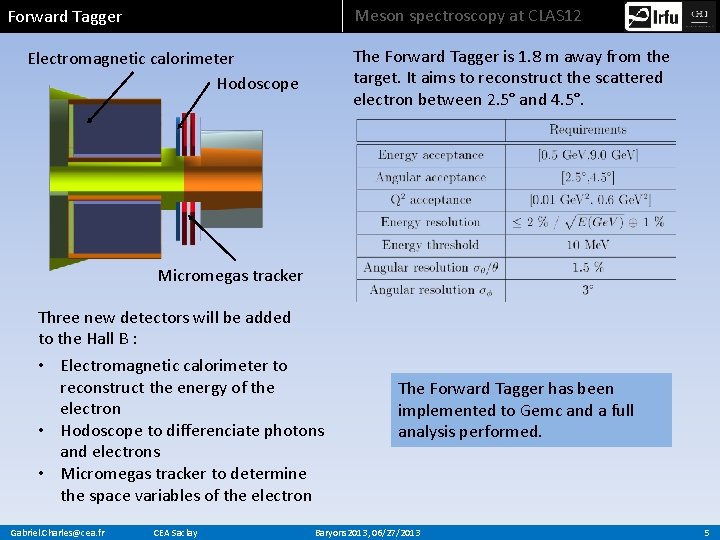
Meson spectroscopy at CLAS 12 Forward Tagger Electromagnetic calorimeter Hodoscope The Forward Tagger is 1. 8 m away from the target. It aims to reconstruct the scattered electron between 2. 5° and 4. 5°. Micromegas tracker Three new detectors will be added to the Hall B : • Electromagnetic calorimeter to reconstruct the energy of the electron • Hodoscope to differenciate photons and electrons • Micromegas tracker to determine the space variables of the electron The Forward Tagger has been implemented to Gemc and a full analysis performed. Gabriel. Charles@cea. fr CEA Saclay Baryons 2013, 06/27/2013 5
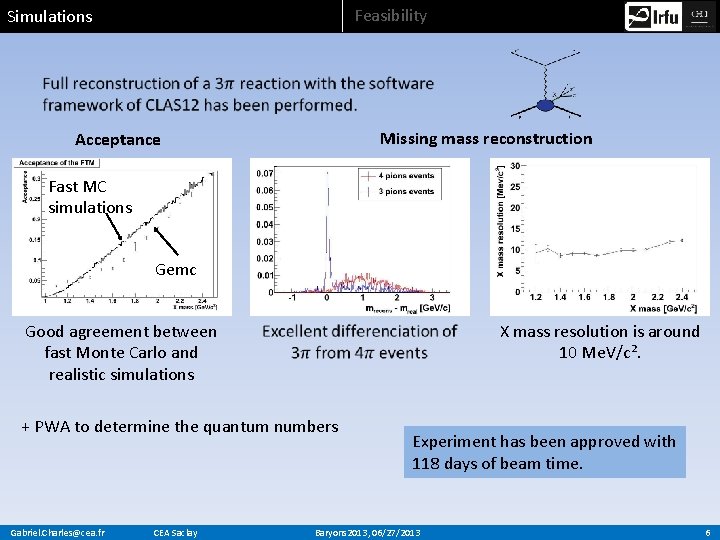
Feasibility Simulations Missing mass reconstruction Acceptance Fast MC simulations Gemc Good agreement between fast Monte Carlo and realistic simulations + PWA to determine the quantum numbers X mass resolution is around 10 Me. V/c². Experiment has been approved with 118 days of beam time. Gabriel. Charles@cea. fr CEA Saclay Baryons 2013, 06/27/2013 6
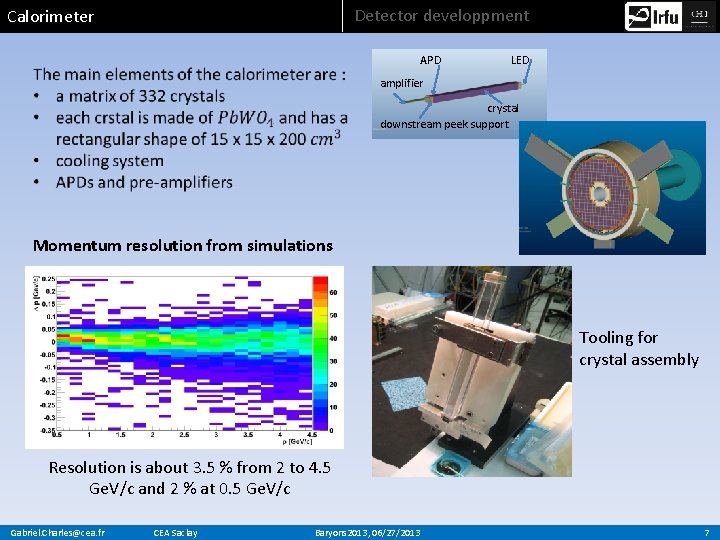
Detector developpment Calorimeter APD LED amplifier crystal downstream peek support Momentum resolution from simulations Tooling for crystal assembly Resolution is about 3. 5 % from 2 to 4. 5 Ge. V/c and 2 % at 0. 5 Ge. V/c Gabriel. Charles@cea. fr CEA Saclay Baryons 2013, 06/27/2013 7
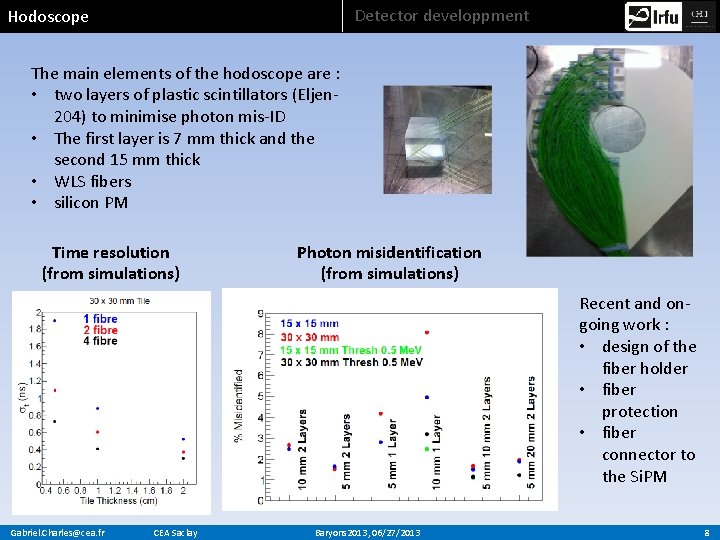
Detector developpment Hodoscope The main elements of the hodoscope are : • two layers of plastic scintillators (Eljen 204) to minimise photon mis-ID • The first layer is 7 mm thick and the second 15 mm thick • WLS fibers • silicon PM Time resolution (from simulations) Photon misidentification (from simulations) Recent and ongoing work : • design of the fiber holder • fiber protection • fiber connector to the Si. PM Gabriel. Charles@cea. fr CEA Saclay Baryons 2013, 06/27/2013 8
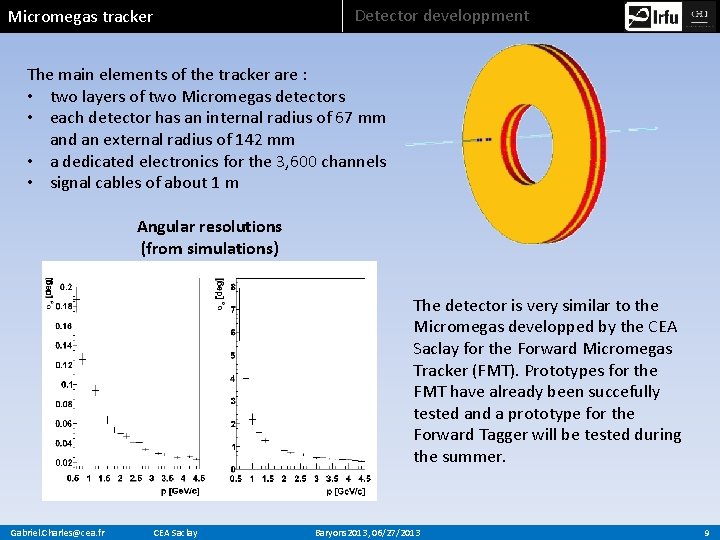
Micromegas tracker Detector developpment The main elements of the tracker are : • two layers of two Micromegas detectors • each detector has an internal radius of 67 mm and an external radius of 142 mm • a dedicated electronics for the 3, 600 channels • signal cables of about 1 m Angular resolutions (from simulations) The detector is very similar to the Micromegas developped by the CEA Saclay for the Forward Micromegas Tracker (FMT). Prototypes for the FMT have already been succefully tested and a prototype for the Forward Tagger will be tested during the summer. Gabriel. Charles@cea. fr CEA Saclay Baryons 2013, 06/27/2013 9
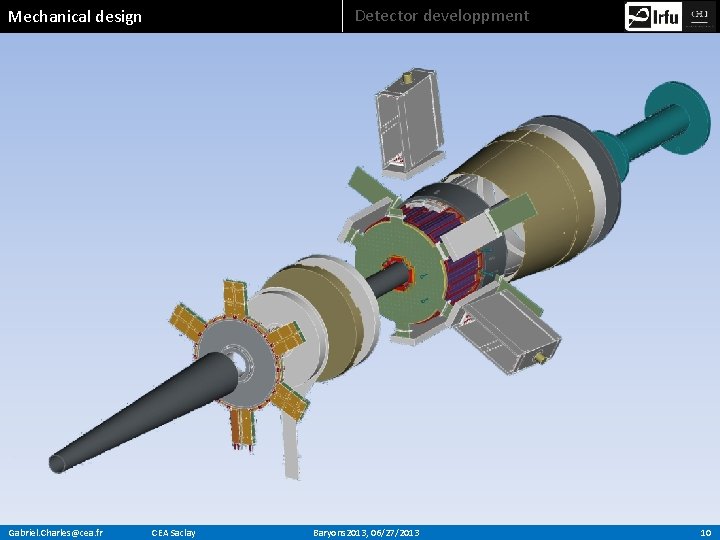
Detector developpment Mechanical design Gabriel. Charles@cea. fr CEA Saclay Baryons 2013, 06/27/2013 10
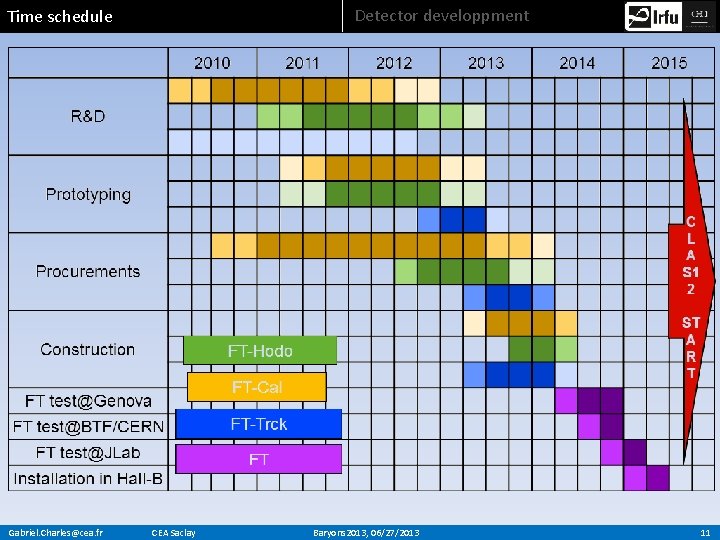
Detector developpment Time schedule Gabriel. Charles@cea. fr CEA Saclay Baryons 2013, 06/27/2013 11
- Slides: 12