National Standard Medication Chart NSMC Audit 2018 Train


- Slides: 81
National Standard Medication Chart (NSMC) Audit 2018 Train the Trainer Workshop
Introduction § In 2017, the Commission undertook a comprehensive review of the NIMC audit tool § The revised audit is called the National Standard Medication Chart (NSMC) Audit.
National Standard Medication Chart (NSMC) Audit § The Commission will coordinate an NSMC National Audit in October 2018. § All hospitals must complete the audit including all data entry between 1 October and 31 October § Using and auditing the NSMC are activities that can be used to demonstrate compliance with the NSQHS Standards for accreditation. (4. 2. 1, 4. 5. 2)
NSMC Audit Objectives § Provides a baseline for NSMC use and future QI initiatives § Improves the safety of medication charting in hospitals § Evaluate the effect of the NSMC safety features § Evaluate the implementation process on the safety and quality of prescribing and medication documentation § Identify further areas for improvement in medication management.
NSMC Audit § Frequency of auditing will depend on: § staff changes, § risk of medication errors § other local factors. § If significant non-compliance is identified: focus audits should occur more frequently within a quality improvement cycle (PDSA), until compliance improves. § Medication Chart Policy - Biennial national audit
NSMC Audit Data Collection Tools § Paper based form, available at: § https: //www. safetyandquality. gov. au/wpcontent/uploads/2018/06/National-Standard -Medication-Chart-audit-form. pdf § The NSMC Audit System is a web-based application which provides an electronic version of the Audit Form and into which audit data can be entered directly
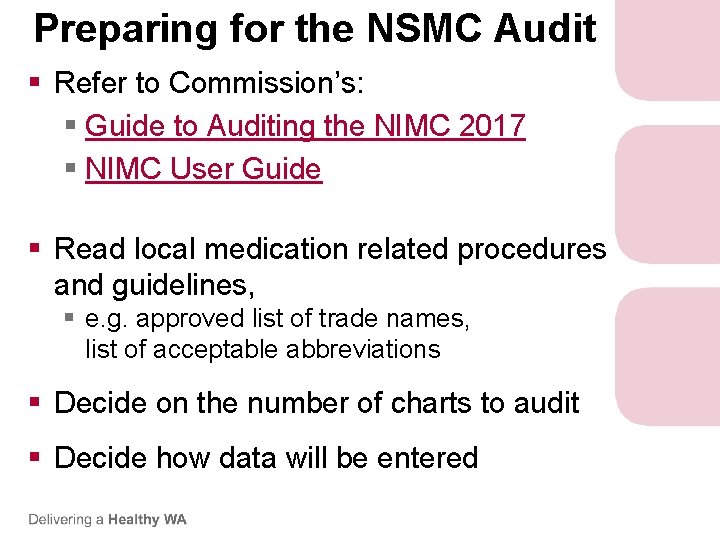
Preparing for the NSMC Audit § Refer to Commission’s: § Guide to Auditing the NIMC 2017 § NIMC User Guide § Read local medication related procedures and guidelines, § e. g. approved list of trade names, list of acceptable abbreviations § Decide on the number of charts to audit § Decide how data will be entered
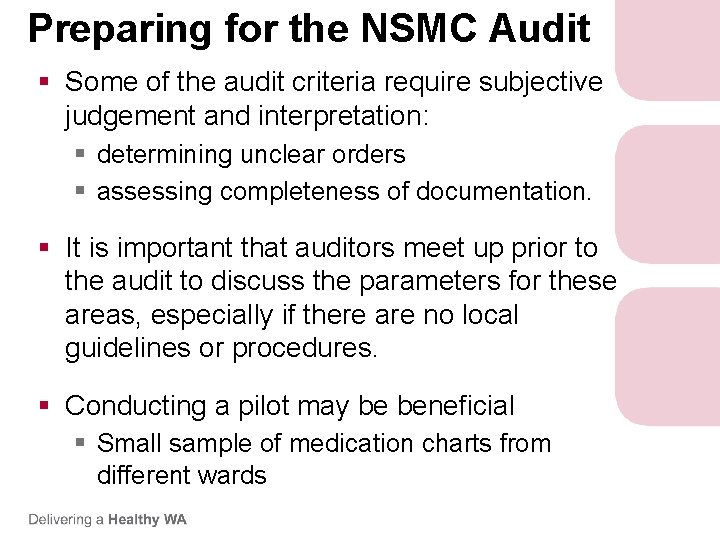
Preparing for the NSMC Audit § Some of the audit criteria require subjective judgement and interpretation: § determining unclear orders § assessing completeness of documentation. § It is important that auditors meet up prior to the audit to discuss the parameters for these areas, especially if there are no local guidelines or procedures. § Conducting a pilot may be beneficial § Small sample of medication charts from different wards
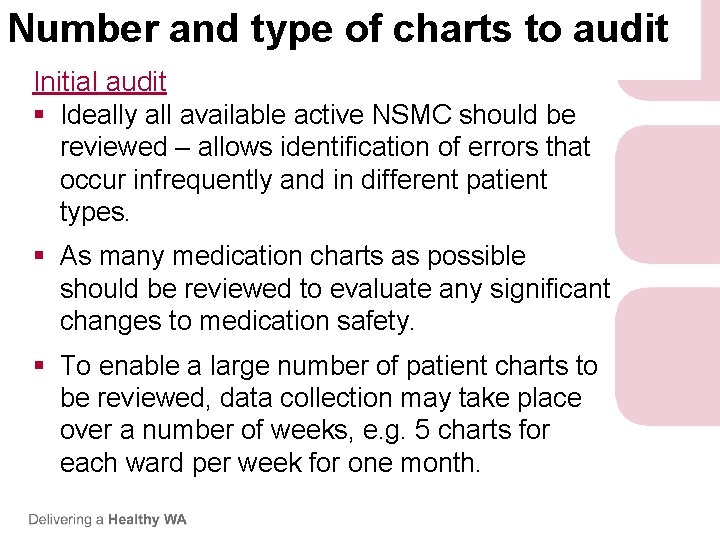
Number and type of charts to audit Initial audit § Ideally all available active NSMC should be reviewed – allows identification of errors that occur infrequently and in different patient types. § As many medication charts as possible should be reviewed to evaluate any significant changes to medication safety. § To enable a large number of patient charts to be reviewed, data collection may take place over a number of weeks, e. g. 5 charts for each ward per week for one month.
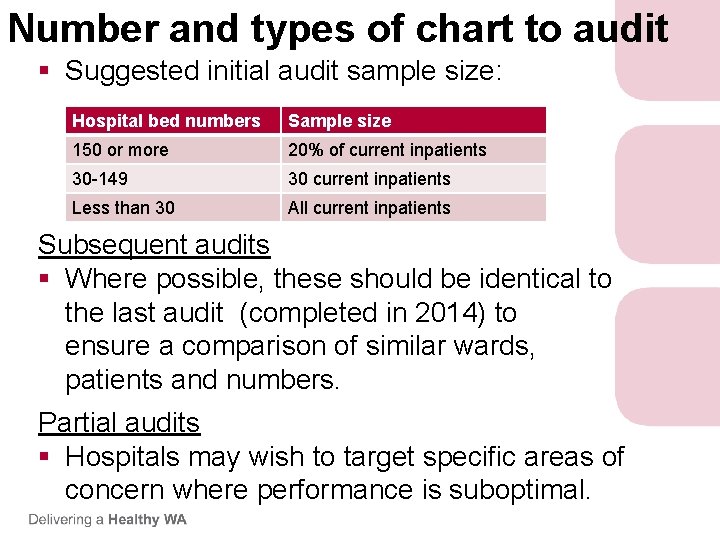
Number and types of chart to audit § Suggested initial audit sample size: Hospital bed numbers Sample size 150 or more 20% of current inpatients 30 -149 30 current inpatients Less than 30 All current inpatients Subsequent audits § Where possible, these should be identical to the last audit (completed in 2014) to ensure a comparison of similar wards, patients and numbers. Partial audits § Hospitals may wish to target specific areas of concern where performance is suboptimal.
Audit teams § Multidisciplinary to reflect the way in which clinicians use the NSMC § Ideally it should be conducted by 2 people together: § To minimise observer bias § A registered nurse – interpretation of the prescription and administration information. § A pharmacist (or medical officer, or another nurse) § The teams should be allocated and maintained for the audit period, to ensure consistency in the data collected.
Familiarisation with medication related policies and guidelines § Local medication related procedures and guidelines – e. g. hospital’s list of approved trade names for prescribing § If no local procedures or policies exist, auditors will need to agree on some audit parameters – e. g. acceptable abbreviations and trade names. § Establish consistency between auditors for current and subsequent audits.
Piloting data collection § Teams should consider testing their data collection methods, using the NSMC Audit Form. § NSMCs selected should include a variety of medicines which utilise different safety features of the chart. § Pilot testing and correlating data collection decisions will help to achieve consistency between audit team members. § Reflective discussion after pilot testing may also be helpful in situations where there is disparity between auditors.
Recommendations § It is recommended that sites collect data on the paper audit form, and then upload the information onto the database (NSMC Audit System). § Maintain a log of frequently occurring errors/issues § These can justify results for each site § e. g. “i-ii drops” – non-standard abbreviation, minimal impact § e. g. “U” (for units) – non-standard abbreviation, major impact § Can be used for education/improvement at each site
Recommendations § Take de-identified photos/photocopies of any major issues – present to site’s DTC or MSG with report § May be once-off event § May be part of a pattern § Obtain a list of acceptable trade names (may need to liaise with DTC or MSG) § Determine the paediatric dosing reference used, and have it ready when auditing. § Have a calculator handy – especially when auditing paediatric NIMCs
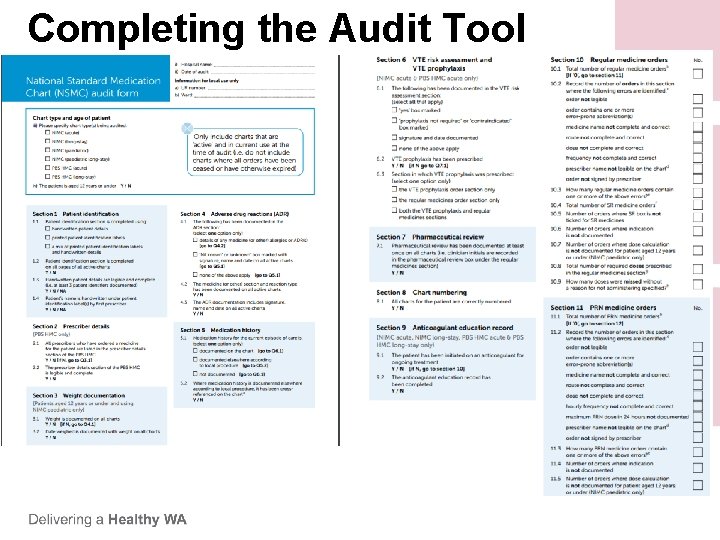
Completing the Audit Tool
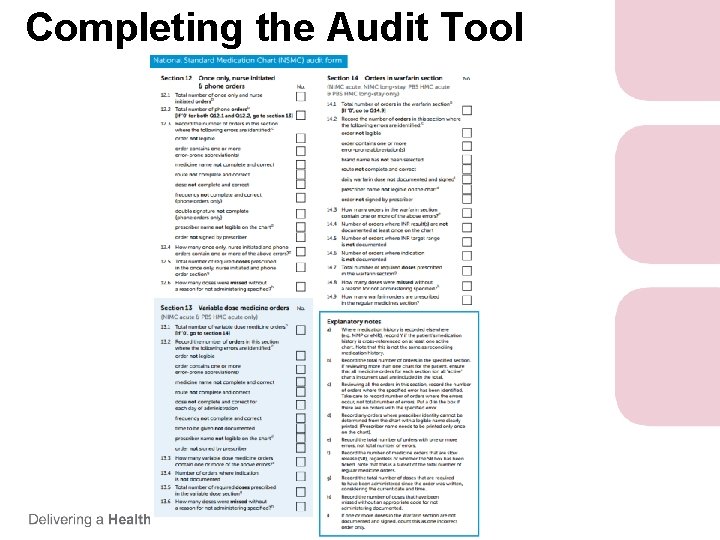
Completing the Audit Tool
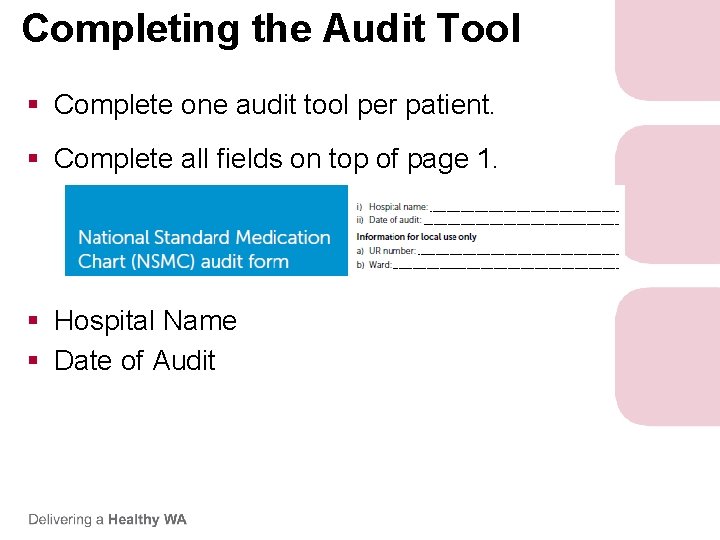
Completing the Audit Tool § Complete one audit tool per patient. § Complete all fields on top of page 1. § Hospital Name § Date of Audit
Patient Confidentiality § UR number and Ward – for local use only § To ensure confidentiality of patient information, these fields are not saved in the online audit system § The web-based NSMC audit system will automatically assign individual ID to each patient audited. § Hospitals can reference this identifier to individual patient details by recording it locally against the patient’s UR number
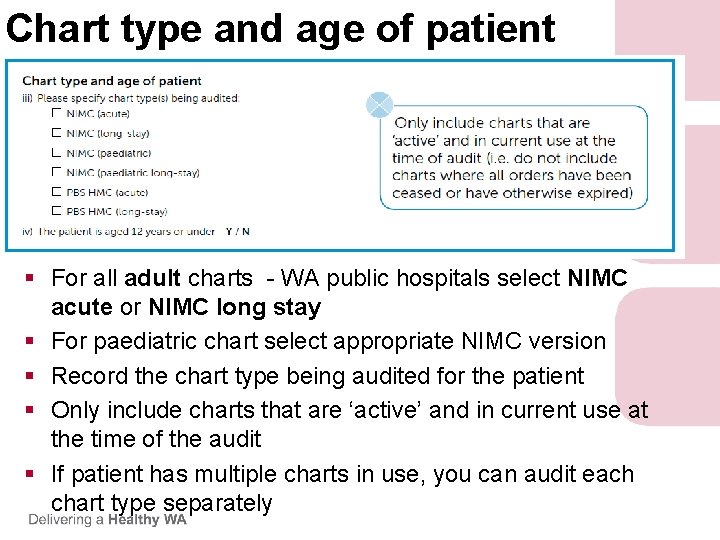
Chart type and age of patient § For all adult charts - WA public hospitals select NIMC acute or NIMC long stay § For paediatric chart select appropriate NIMC version § Record the chart type being audited for the patient § Only include charts that are ‘active’ and in current use at the time of the audit § If patient has multiple charts in use, you can audit each chart type separately
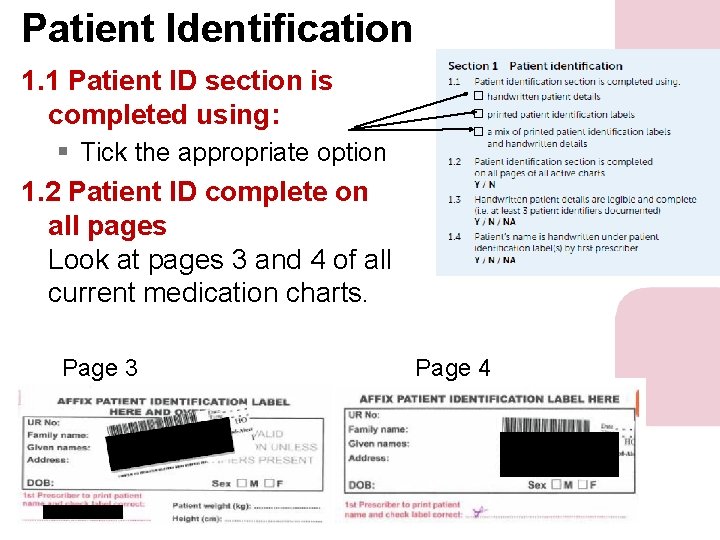
Patient Identification 1. 1 Patient ID section is completed using: § Tick the appropriate option 1. 2 Patient ID complete on all pages Look at pages 3 and 4 of all current medication charts. Page 3 Page 4
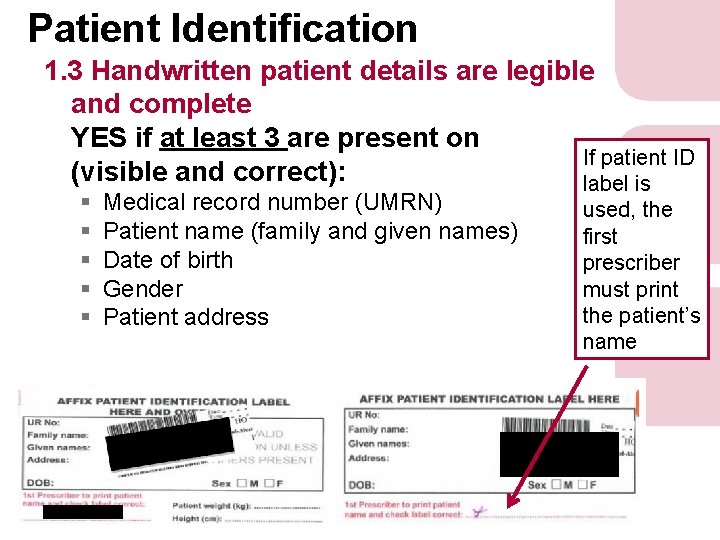
Patient Identification 1. 3 Handwritten patient details are legible and complete YES if at least 3 are present on If patient ID (visible and correct): label is § § § Medical record number (UMRN) Patient name (family and given names) Date of birth Gender Patient address used, the first prescriber must print the patient’s name
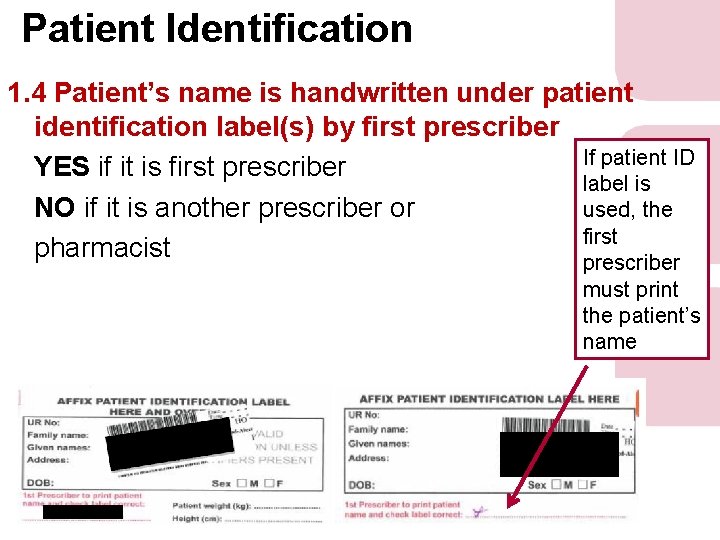
Patient Identification 1. 4 Patient’s name is handwritten under patient identification label(s) by first prescriber If patient ID YES if it is first prescriber label is NO if it is another prescriber or used, the first pharmacist prescriber must print the patient’s name
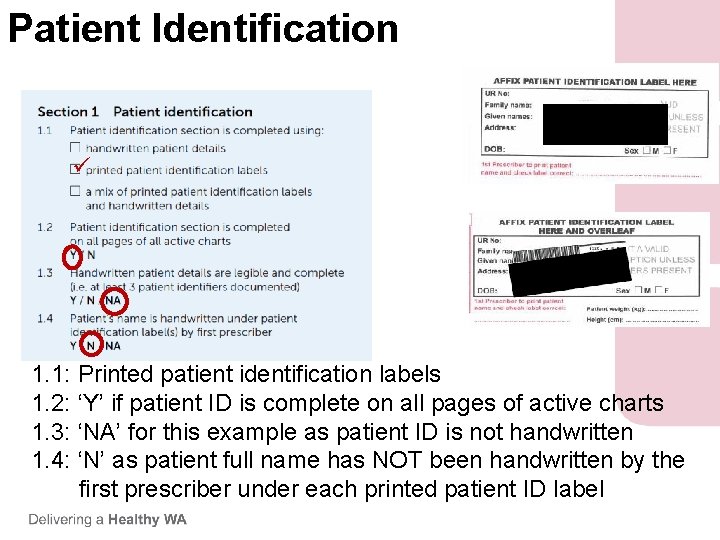
Patient Identification 1. 1: Printed patient identification labels 1. 2: ‘Y’ if patient ID is complete on all pages of active charts 1. 3: ‘NA’ for this example as patient ID is not handwritten 1. 4: ‘N’ as patient full name has NOT been handwritten by the first prescriber under each printed patient ID label
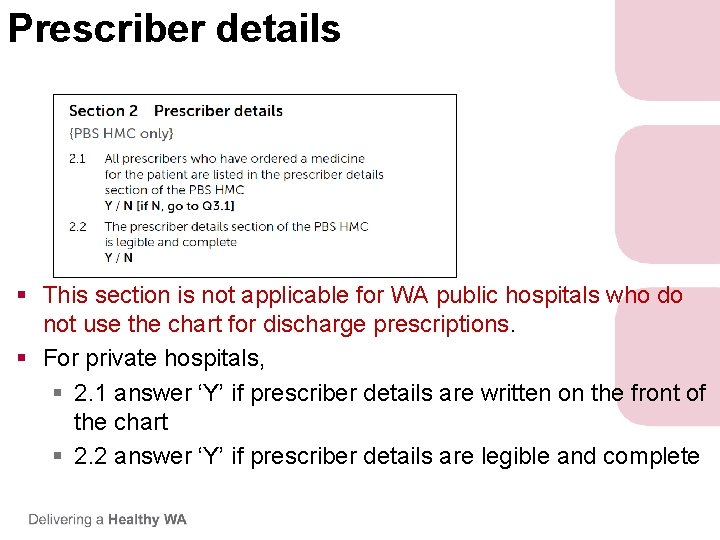
Prescriber details § This section is not applicable for WA public hospitals who do not use the chart for discharge prescriptions. § For private hospitals, § 2. 1 answer ‘Y’ if prescriber details are written on the front of the chart § 2. 2 answer ‘Y’ if prescriber details are legible and complete
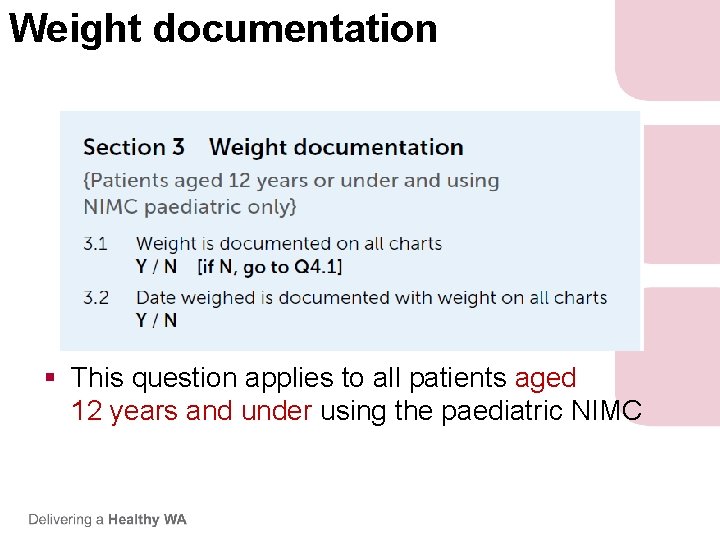
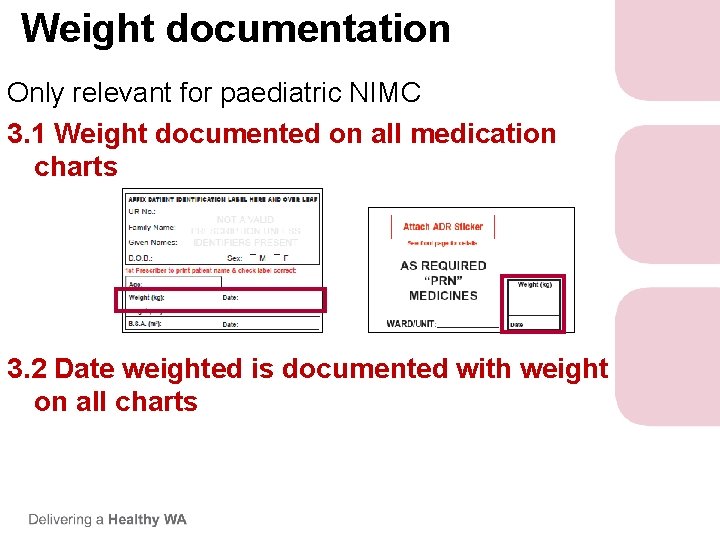
Weight documentation § This question applies to all patients aged 12 years and under using the paediatric NIMC
Weight documentation Only relevant for paediatric NIMC 3. 1 Weight documented on all medication charts 3. 2 Date weighted is documented with weight on all charts
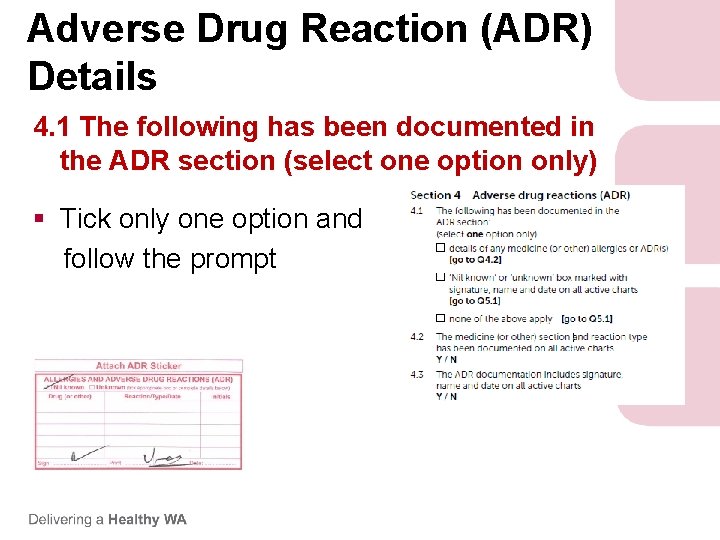
Adverse Drug Reaction (ADR) Details 4. 1 The following has been documented in the ADR section (select one option only) § Tick only one option and follow the prompt
ADR Details 4. 2 The medicine (or other) section and reaction type has been documented on all active charts • The key word here is ALL active charts 4. 3 The ADR documentation includes signature, name and date on all active charts
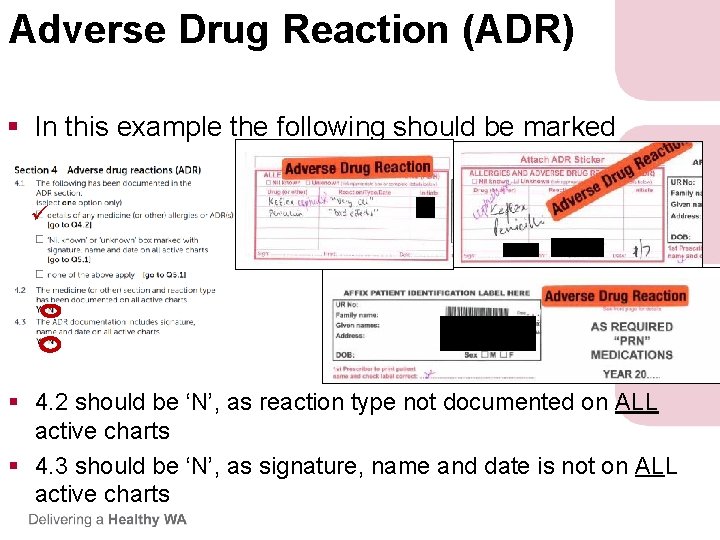
Adverse Drug Reaction (ADR) § In this example the following should be marked § 4. 2 should be ‘N’, as reaction type not documented on ALL active charts § 4. 3 should be ‘N’, as signature, name and date is not on ALL active charts
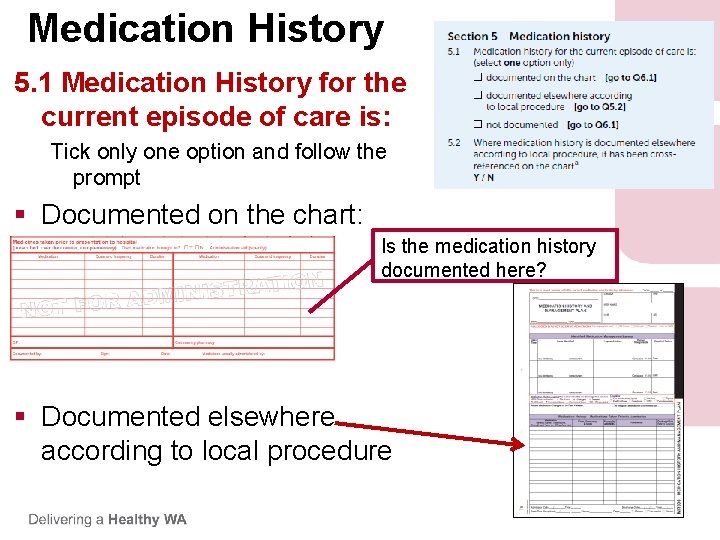
Medication History 5. 1 Medication History for the current episode of care is: Tick only one option and follow the prompt § Documented on the chart: Is the medication history documented here? § Documented elsewhere according to local procedure
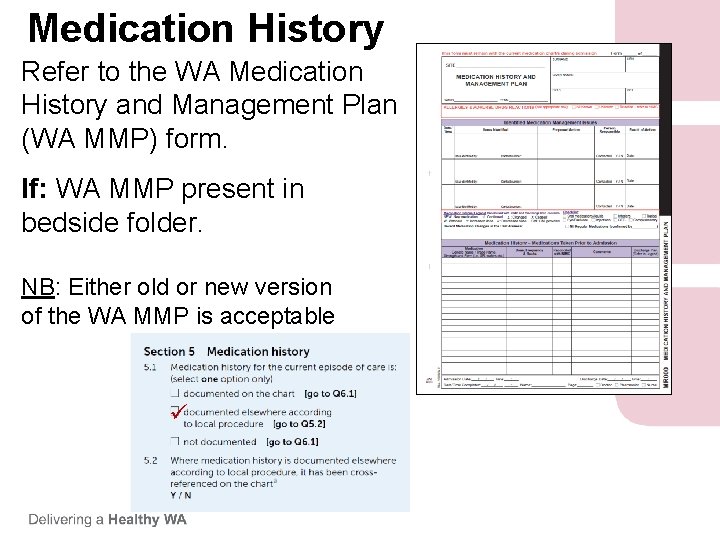
Medication History Refer to the WA Medication History and Management Plan (WA MMP) form. If: WA MMP present in bedside folder. NB: Either old or new version of the WA MMP is acceptable
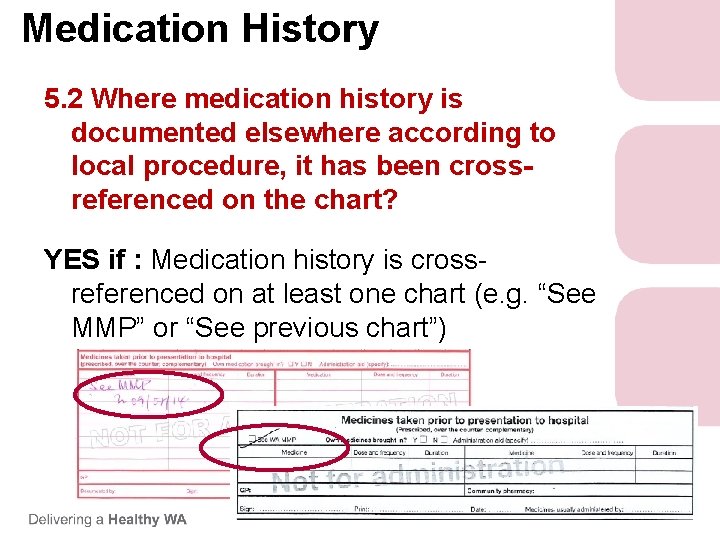
Medication History 5. 2 Where medication history is documented elsewhere according to local procedure, it has been crossreferenced on the chart? YES if : Medication history is crossreferenced on at least one chart (e. g. “See MMP” or “See previous chart”)
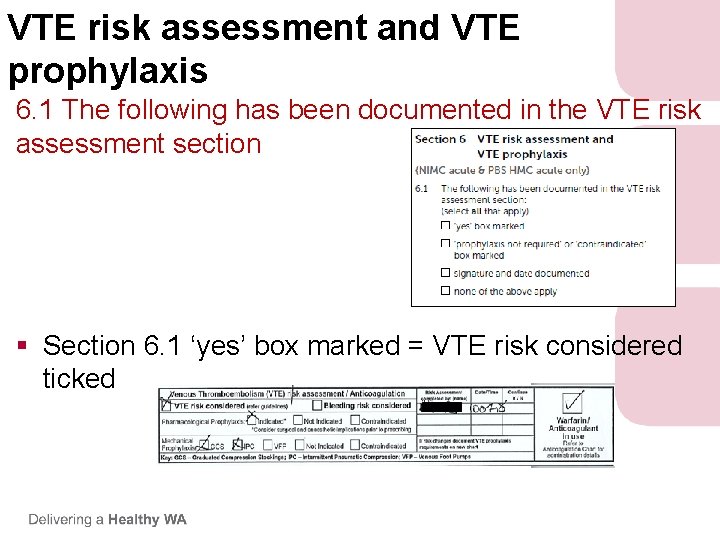
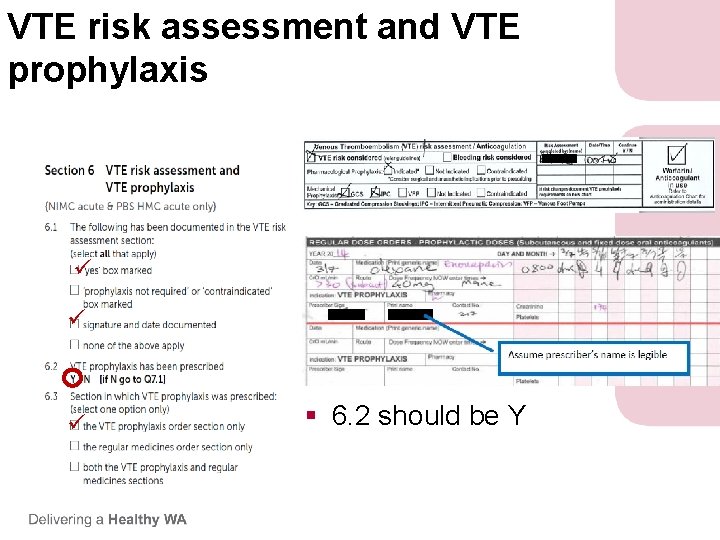
VTE risk assessment and VTE prophylaxis 6. 1 The following has been documented in the VTE risk assessment section § Section 6. 1 ‘yes’ box marked = VTE risk considered ticked
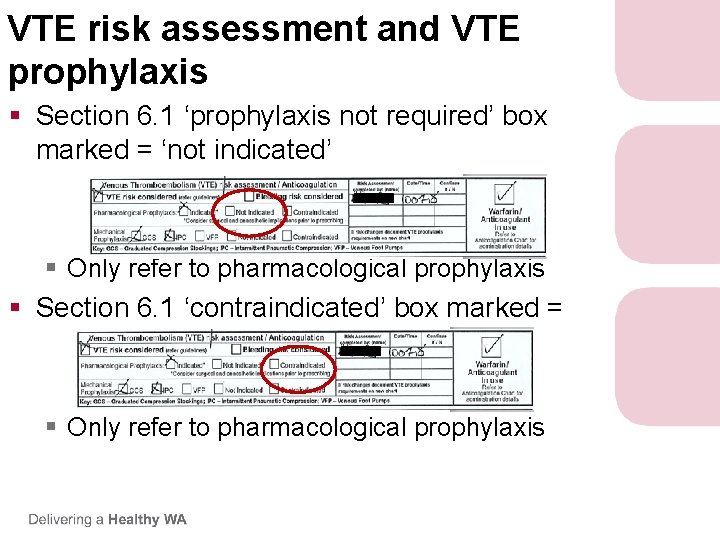
VTE risk assessment and VTE prophylaxis § Section 6. 1 ‘prophylaxis not required’ box marked = ‘not indicated’ § Only refer to pharmacological prophylaxis § Section 6. 1 ‘contraindicated’ box marked = § Only refer to pharmacological prophylaxis
VTE Prophylaxis 6. 2 VTE prophylaxis prescribed Refer to WA Anticoagulation chart. * YES if: Pharmacological VTE prophylaxis prescribed. § WA public hospitals will only be looking at pharmacological VTE prophylaxis and not mechanical
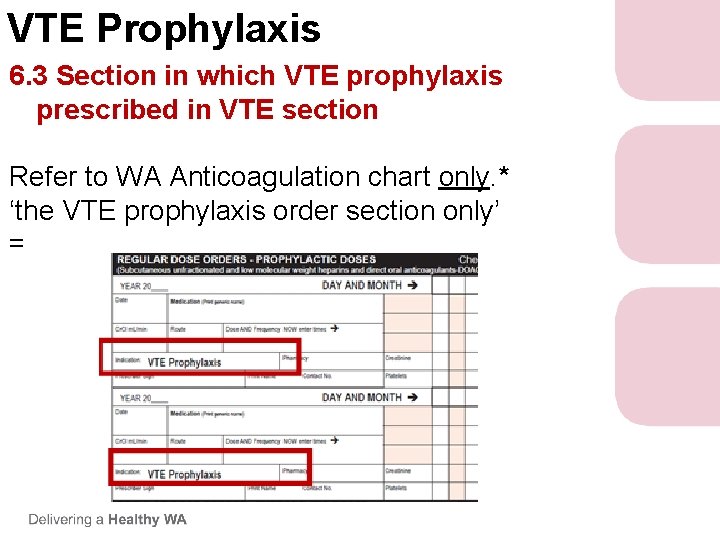
VTE Prophylaxis 6. 3 Section in which VTE prophylaxis prescribed in VTE section Refer to WA Anticoagulation chart only. * ‘the VTE prophylaxis order section only’ =
VTE risk assessment and VTE prophylaxis § 6. 2 should be Y
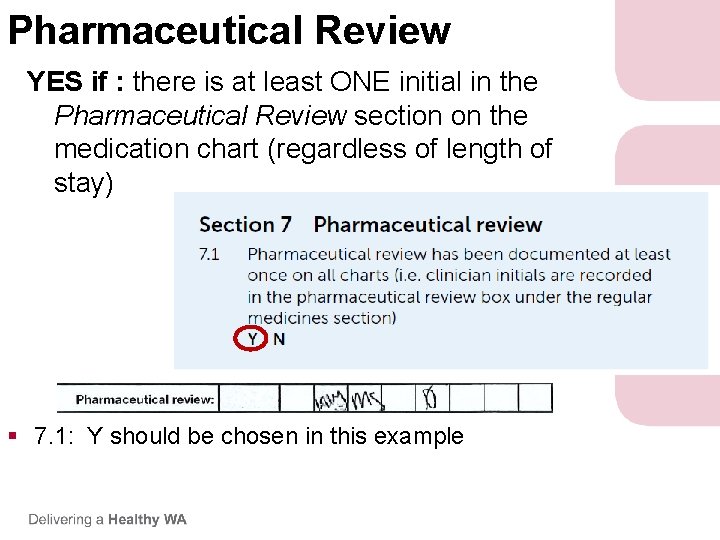
Pharmaceutical Review YES if : there is at least ONE initial in the Pharmaceutical Review section on the medication chart (regardless of length of stay) § 7. 1: Y should be chosen in this example
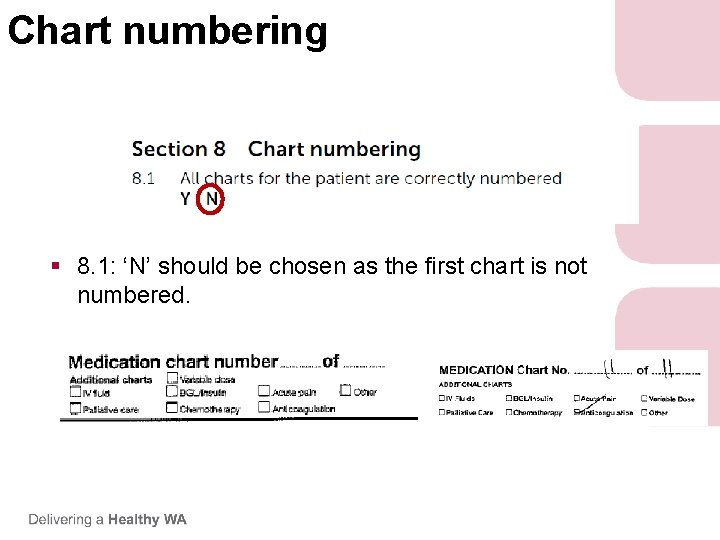
Chart numbering § 8. 1: ‘N’ should be chosen as the first chart is not numbered.
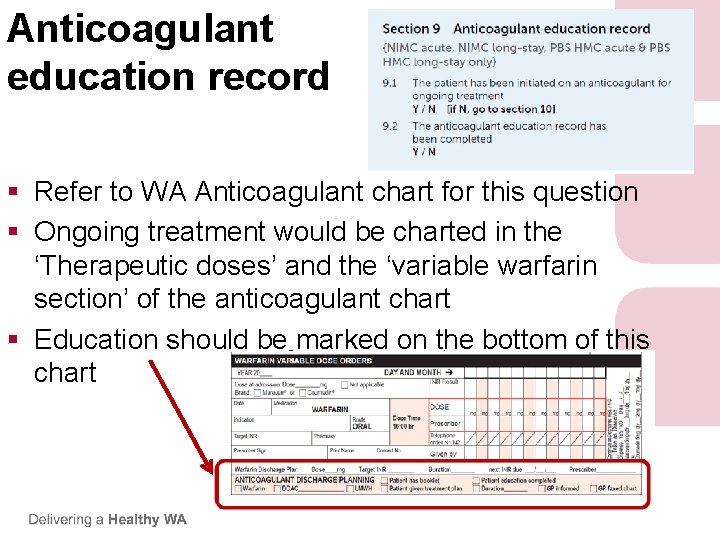
Anticoagulant education record § Refer to WA Anticoagulant chart for this question § Ongoing treatment would be charted in the ‘Therapeutic doses’ and the ‘variable warfarin section’ of the anticoagulant chart § Education should be marked on the bottom of this chart
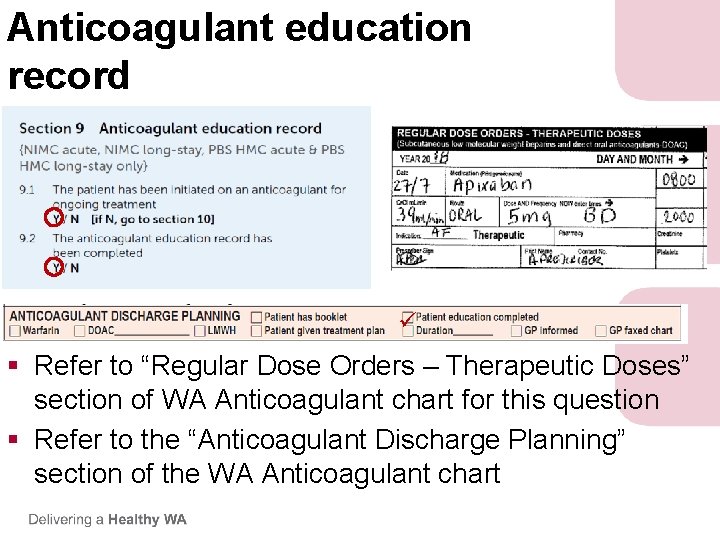
Anticoagulant education record § Refer to “Regular Dose Orders – Therapeutic Doses” section of WA Anticoagulant chart for this question § Refer to the “Anticoagulant Discharge Planning” section of the WA Anticoagulant chart
§ 5 -10 minute break before we look at the medicine order sections of the NSMC audit
Medicine Orders Section 10 - 14 § Orders should be considered complete and correct where there is no potential for misinterpretation or administration error, based on the documentation on the chart § Section 10 Regular medicine orders § Section 11 PRN medicine order § Section 12 Once-only, nurse initiated and phone orders § Section 13 Variable dose medicine orders § Section 14 Warfarin orders
Medicine order section Total number of medicines orders § The following relate to questions § 10. 1 § 11. 1 § 12. 2 § 13. 1 § 14. 1 § This relates to all the medicines orders in the specified section (regular, variable, prn etc. ) of all active charts § Includes only active orders § Exclude any ceased orders
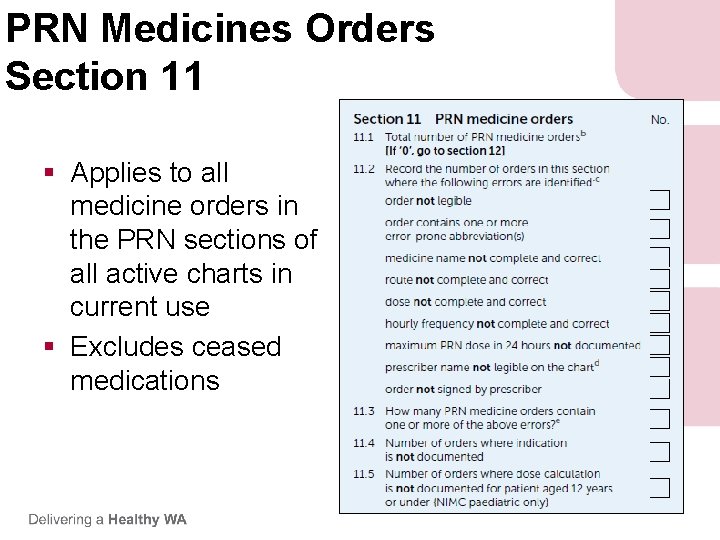
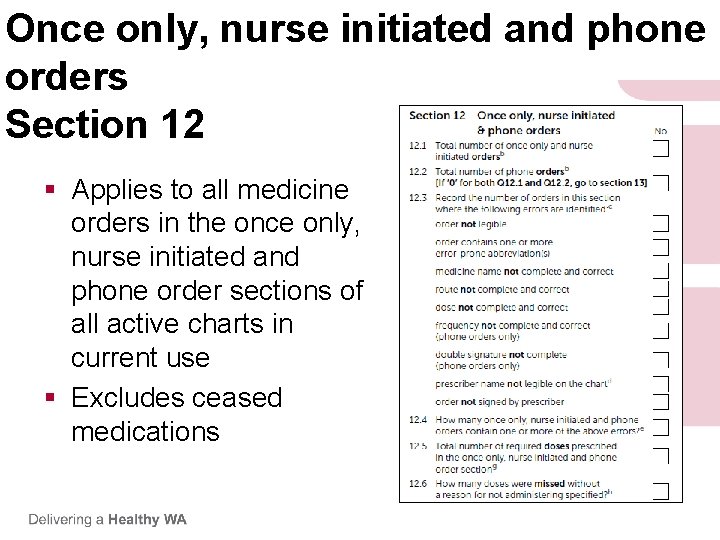
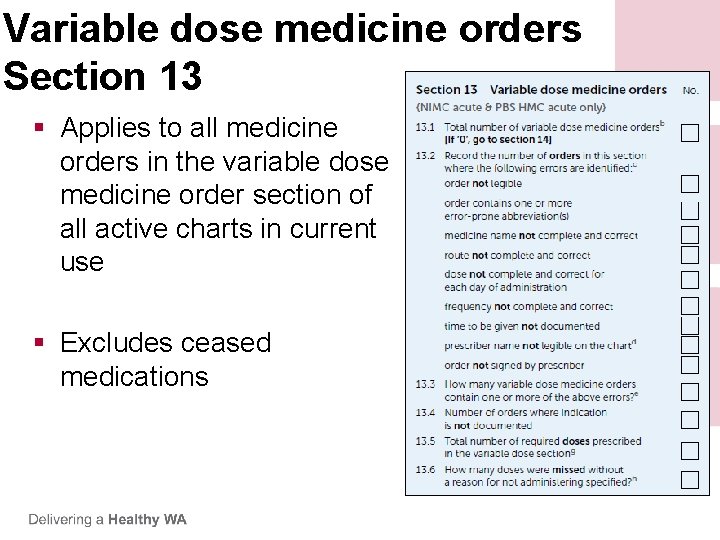
Medicine Order Section Record the number of orders in this section where the following errors are identified § The following relate to questions : § 10. 2 11. 2 12. 3 13. 2 14. 2 § Review all the orders in the specified medicines section § Record the number of orders where the specified error was identified § Record number of orders not the total number of errors § Put a ‘ 0’ in the box if there are no orders with the specified error
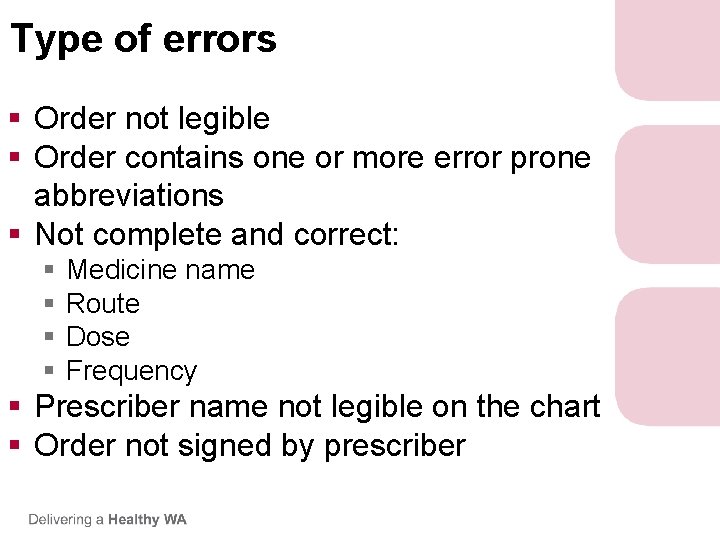
Type of errors § Order not legible § Order contains one or more error prone abbreviations § Not complete and correct: § § Medicine name Route Dose Frequency § Prescriber name not legible on the chart § Order not signed by prescriber
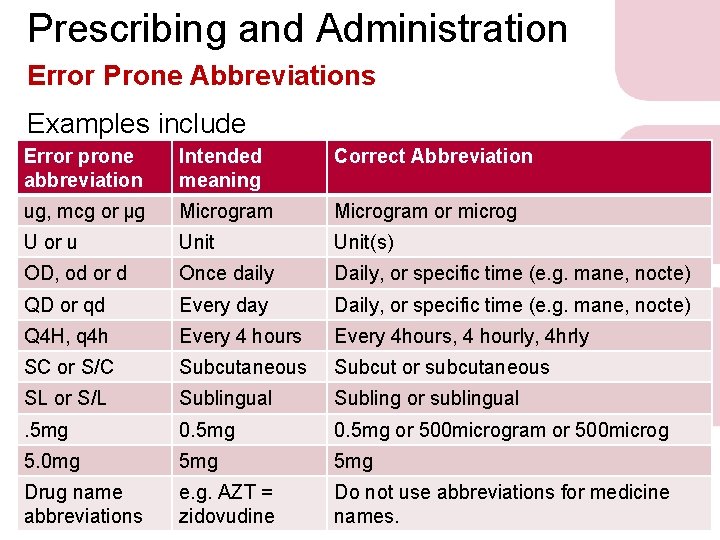
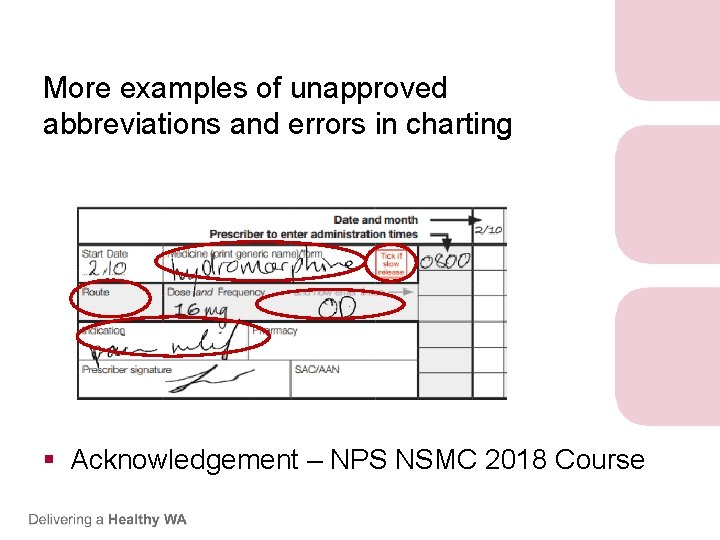
Prescribing and Administration Error Prone Abbreviations Examples include Error prone abbreviation Intended meaning Correct Abbreviation ug, mcg or μg Microgram or microg U or u Unit(s) OD, od or d Once daily Daily, or specific time (e. g. mane, nocte) QD or qd Every day Daily, or specific time (e. g. mane, nocte) Q 4 H, q 4 h Every 4 hours Every 4 hours, 4 hourly, 4 hrly SC or S/C Subcutaneous Subcut or subcutaneous SL or S/L Sublingual Subling or sublingual . 5 mg 0. 5 mg or 500 microgram or 500 microg 5. 0 mg 5 mg Drug name abbreviations e. g. AZT = zidovudine Do not use abbreviations for medicine names.
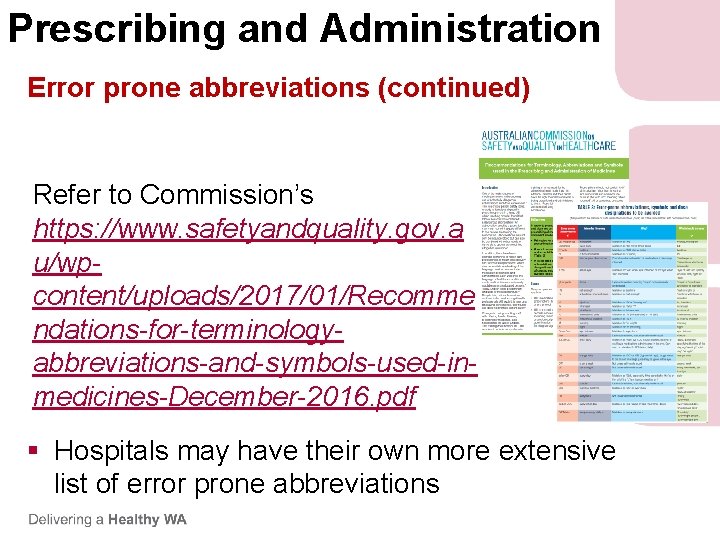
Prescribing and Administration Error prone abbreviations (continued) Refer to Commission’s https: //www. safetyandquality. gov. a u/wpcontent/uploads/2017/01/Recomme ndations-for-terminologyabbreviations-and-symbols-used-inmedicines-December-2016. pdf § Hospitals may have their own more extensive list of error prone abbreviations
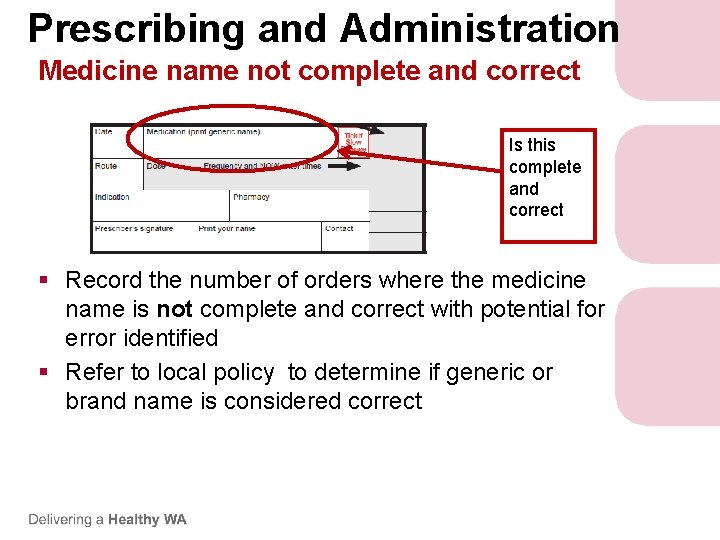
Prescribing and Administration Medicine name not complete and correct Is this complete and correct § Record the number of orders where the medicine name is not complete and correct with potential for error identified § Refer to local policy to determine if generic or brand name is considered correct
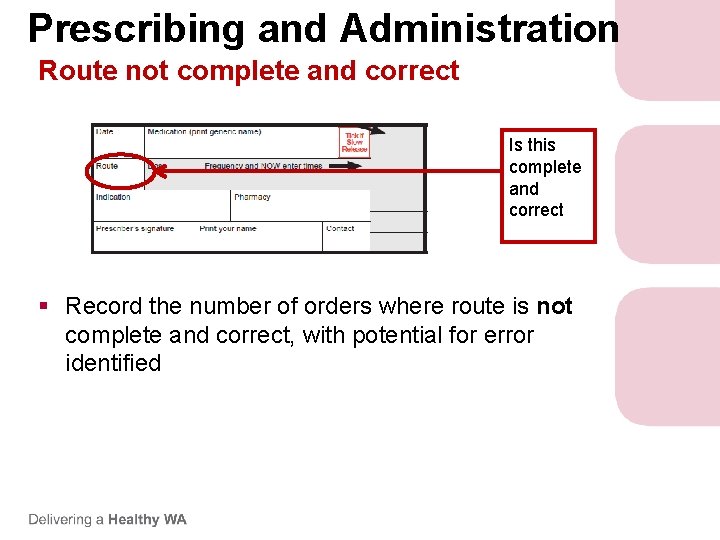
Prescribing and Administration Route not complete and correct Is this complete and correct § Record the number of orders where route is not complete and correct, with potential for error identified
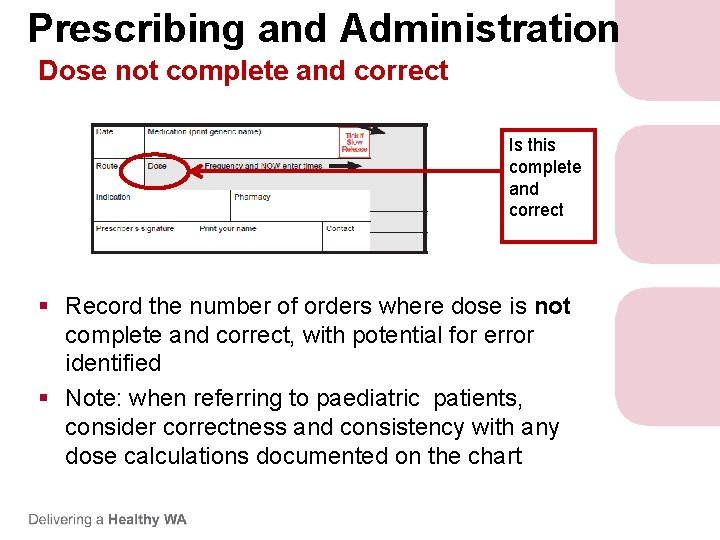
Prescribing and Administration Dose not complete and correct Is this complete and correct § Record the number of orders where dose is not complete and correct, with potential for error identified § Note: when referring to paediatric patients, consider correctness and consistency with any dose calculations documented on the chart
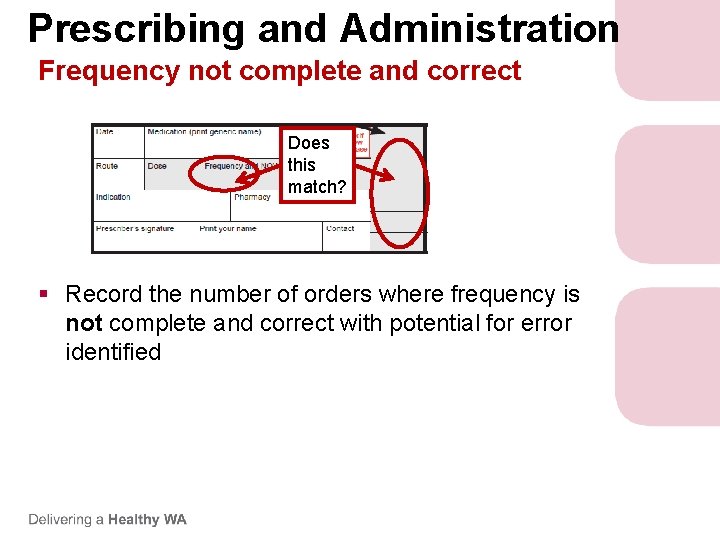
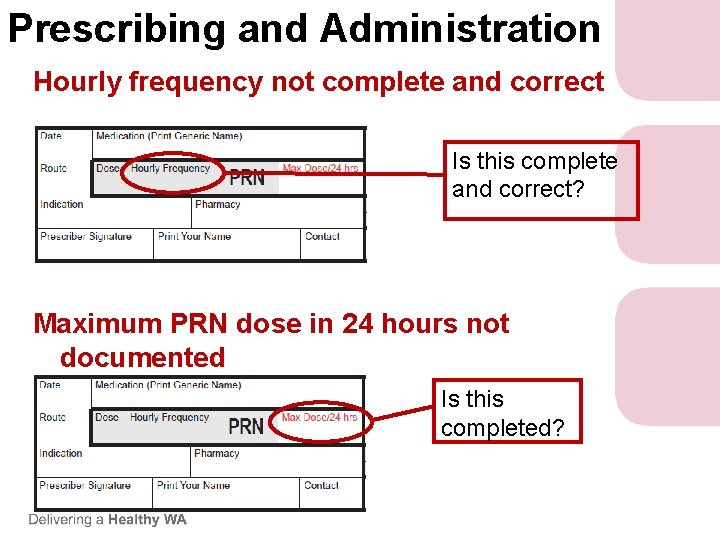
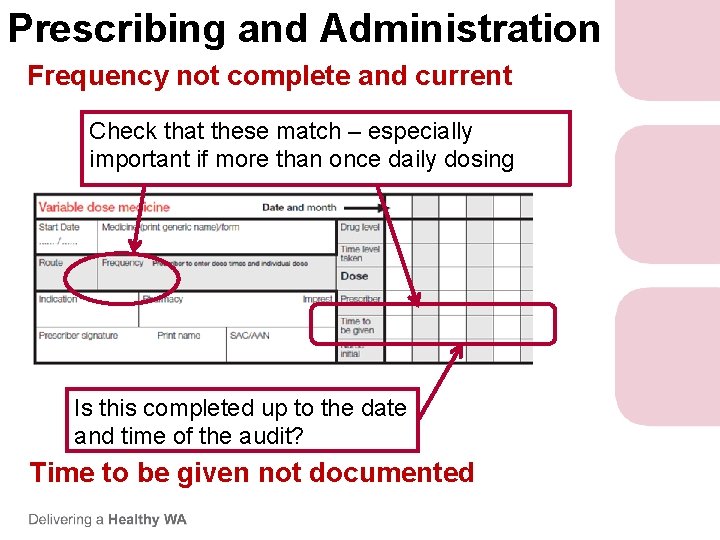
Prescribing and Administration Frequency not complete and correct Does this match? § Record the number of orders where frequency is not complete and correct with potential for error identified
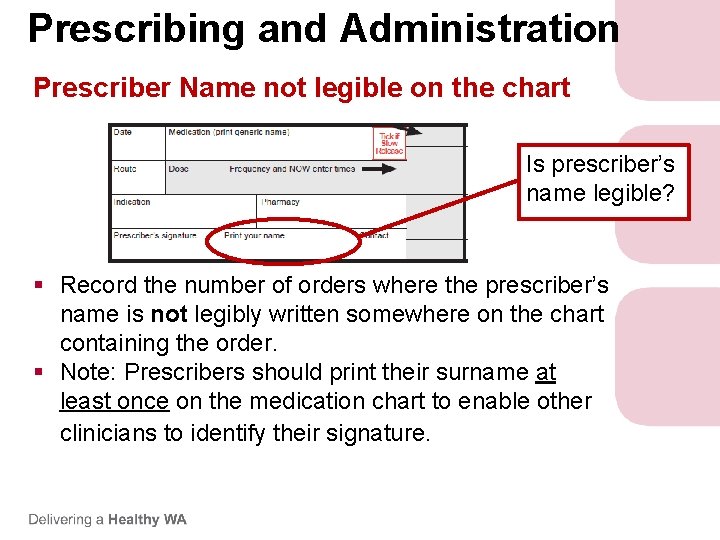
Prescribing and Administration Prescriber Name not legible on the chart Is prescriber’s name legible? § Record the number of orders where the prescriber’s name is not legibly written somewhere on the chart containing the order. § Note: Prescribers should print their surname at least once on the medication chart to enable other clinicians to identify their signature.
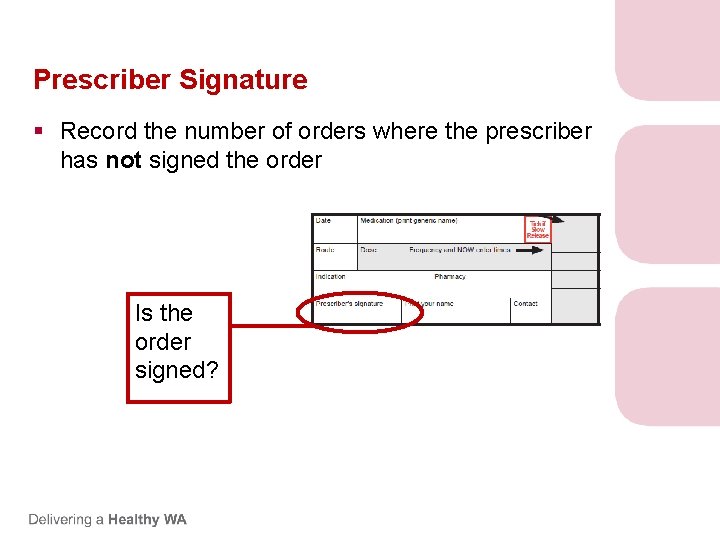
Prescriber Signature § Record the number of orders where the prescriber has not signed the order Is the order signed?
Medicine Order Section How many medicines orders contain one or more of the above errors § The following relate to questions § 10. 3 11. 3 12. 4 13. 3 14. 3 § Record the number of orders where one or more of the errors specified were identified § Do not record the total number of errors
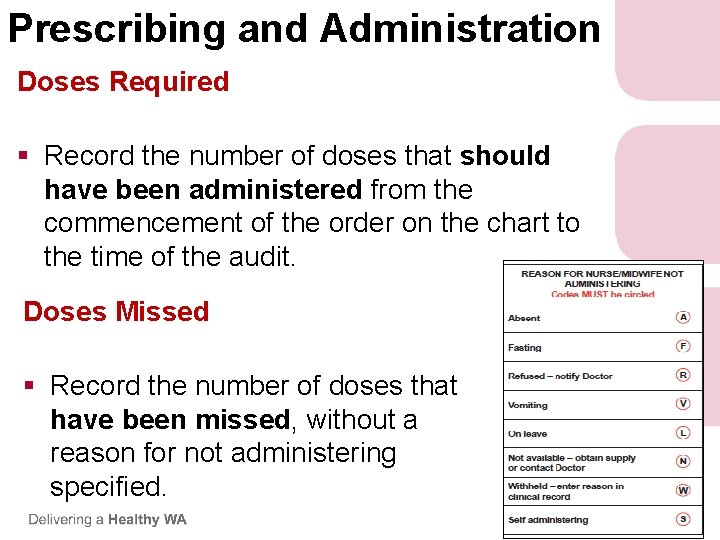
Prescribing and Administration Doses Required § Record the number of doses that should have been administered from the commencement of the order on the chart to the time of the audit. Doses Missed § Record the number of doses that have been missed, without a reason for not administering specified.
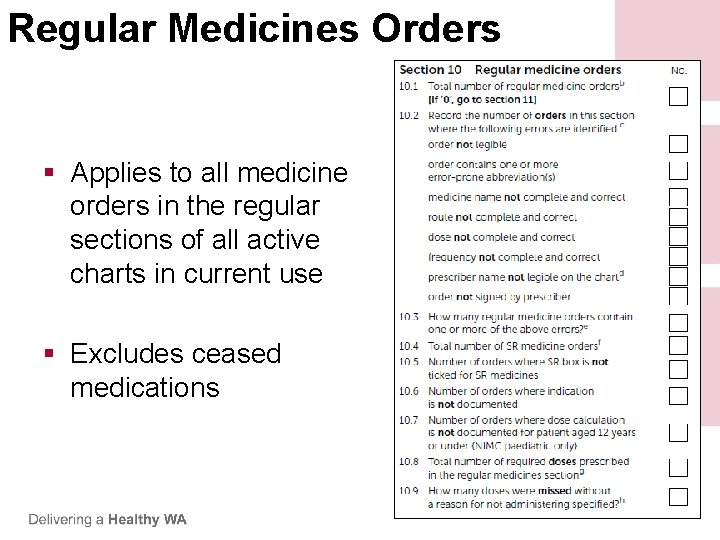
Regular Medicines Orders § Applies to all medicine orders in the regular sections of all active charts in current use § Excludes ceased medications
Sustained Release 10. 4 Number of SR medicines ordered Record the number of medicine orders that are slow release (SR) or modified release, regardless of whether the ‘SR’ box has been ticked 10. 5 Number of orders where SR box is not ticked for SR medicines
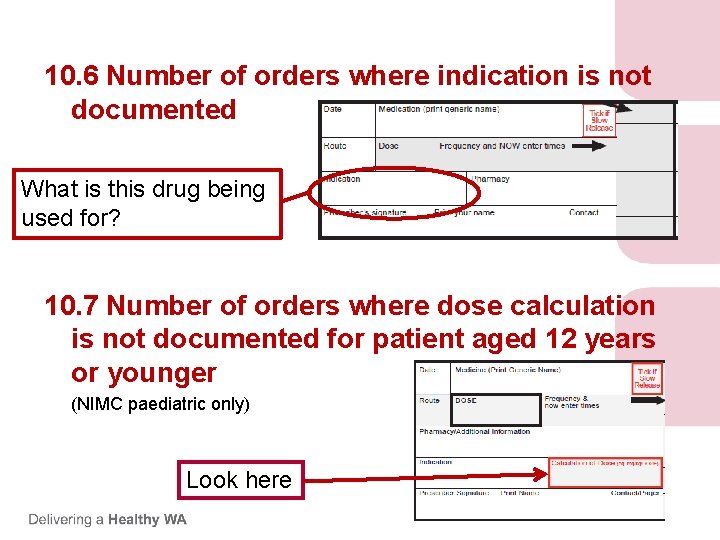
10. 6 Number of orders where indication is not documented What is this drug being used for? 10. 7 Number of orders where dose calculation is not documented for patient aged 12 years or younger (NIMC paediatric only) Look here
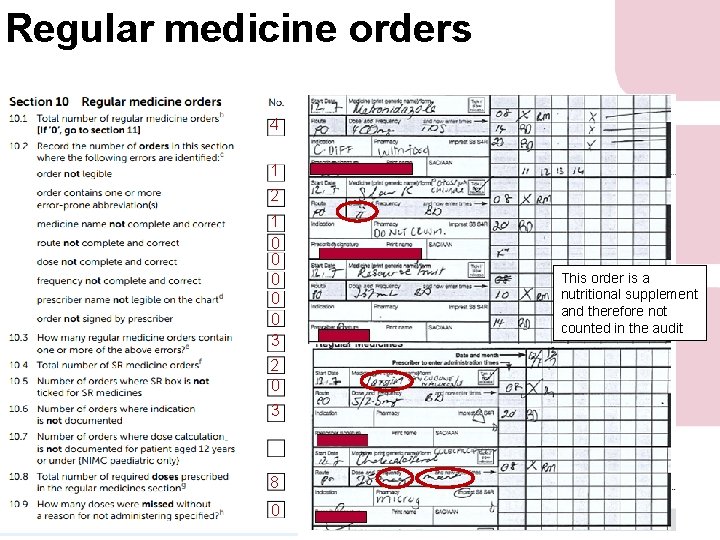
Regular medicine orders 4 1 2 1 0 0 0 3 2 0 3 8 0 This order is a nutritional supplement and therefore not counted in the audit
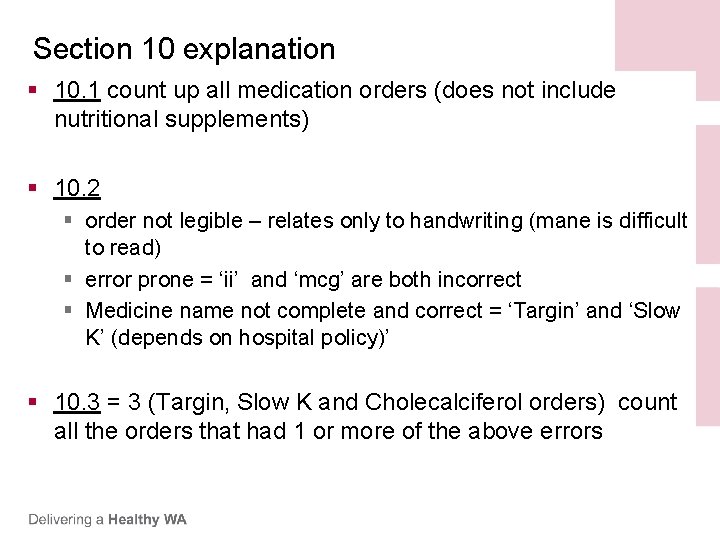
Section 10 explanation § 10. 1 count up all medication orders (does not include nutritional supplements) § 10. 2 § order not legible – relates only to handwriting (mane is difficult to read) § error prone = ‘ii’ and ‘mcg’ are both incorrect § Medicine name not complete and correct = ‘Targin’ and ‘Slow K’ (depends on hospital policy)’ § 10. 3 = 3 (Targin, Slow K and Cholecalciferol orders) count all the orders that had 1 or more of the above errors
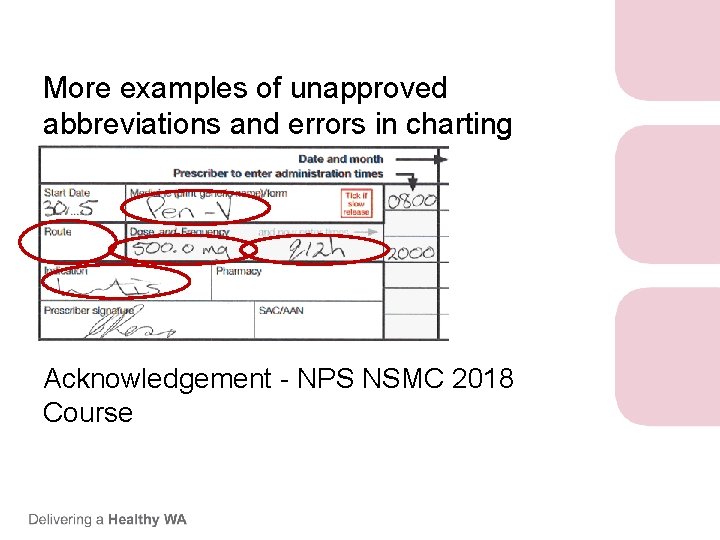
More examples of unapproved abbreviations and errors in charting Acknowledgement - NPS NSMC 2018 Course
More examples of unapproved abbreviations and errors in charting § Acknowledgement – NPS NSMC 2018 Course
PRN Medicines Orders Section 11 § Applies to all medicine orders in the PRN sections of all active charts in current use § Excludes ceased medications
Prescribing and Administration Hourly frequency not complete and correct Is this complete and correct? Maximum PRN dose in 24 hours not documented Is this completed?
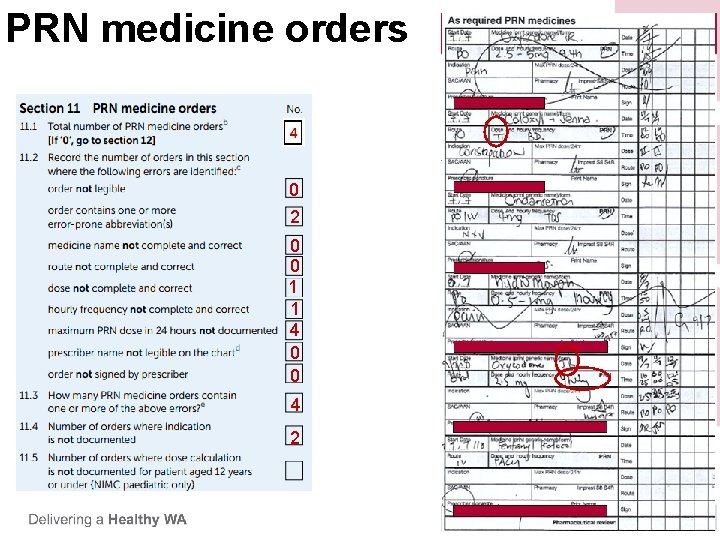
PRN medicine orders 0 2 0 0 1 1 4 0 0 4 2
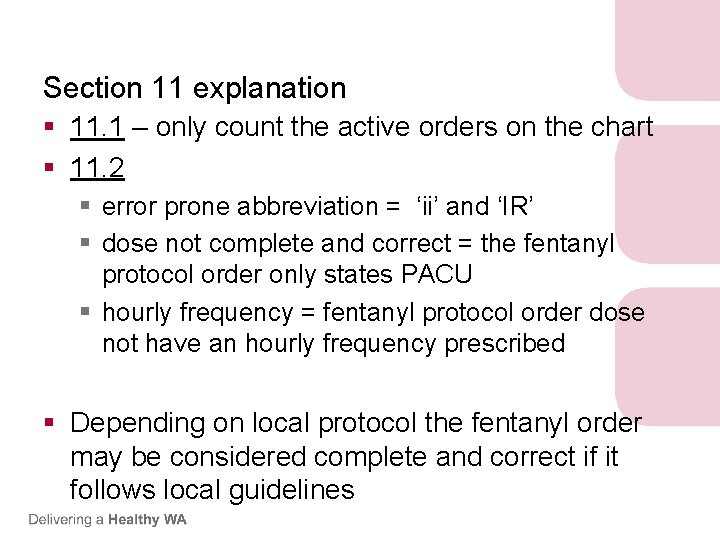
Section 11 explanation § 11. 1 – only count the active orders on the chart § 11. 2 § error prone abbreviation = ‘ii’ and ‘IR’ § dose not complete and correct = the fentanyl protocol order only states PACU § hourly frequency = fentanyl protocol order dose not have an hourly frequency prescribed § Depending on local protocol the fentanyl order may be considered complete and correct if it follows local guidelines
Once only, nurse initiated and phone orders Section 12 § Applies to all medicine orders in the once only, nurse initiated and phone order sections of all active charts in current use § Excludes ceased medications
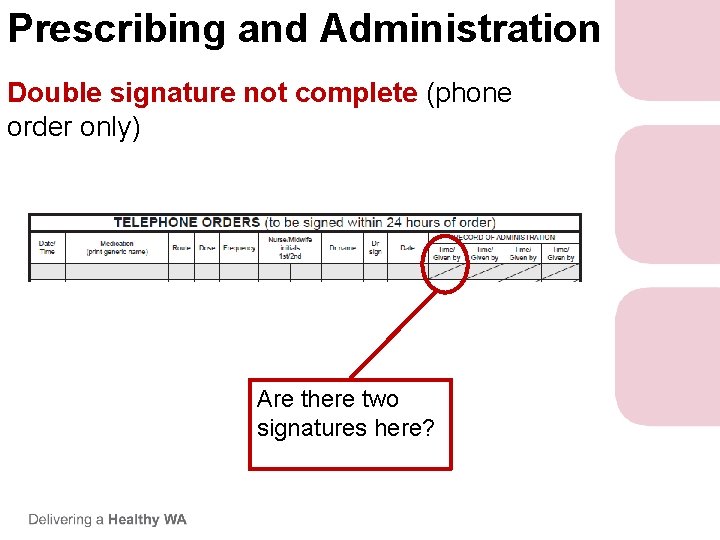
Prescribing and Administration Double signature not complete (phone order only) Are there two signatures here?
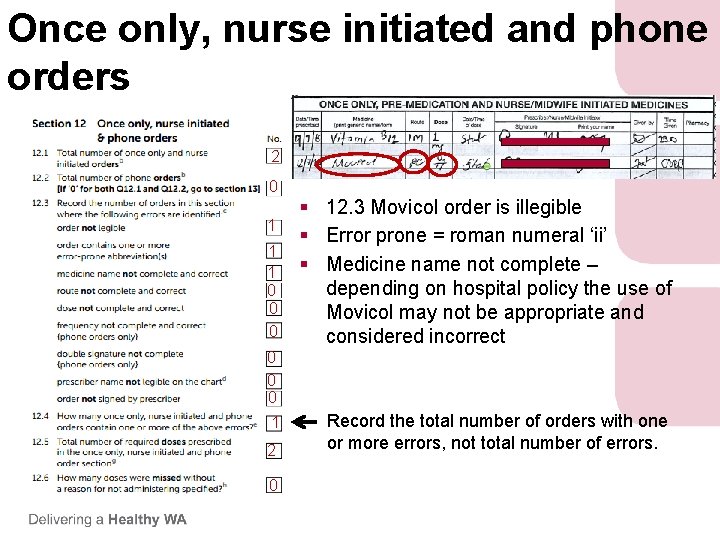
Once only, nurse initiated and phone orders 2 0 1 1 1 0 0 0 § 12. 3 Movicol order is illegible § Error prone = roman numeral ‘ii’ § Medicine name not complete – depending on hospital policy the use of Movicol may not be appropriate and considered incorrect 0 0 0 1 2 0 Record the total number of orders with one or more errors, not total number of errors.
Variable dose medicine orders Section 13 § Applies to all medicine orders in the variable dose medicine order section of all active charts in current use § Excludes ceased medications
Prescribing and Administration Frequency not complete and current Check that these match – especially important if more than once daily dosing Is this completed up to the date and time of the audit? Time to be given not documented
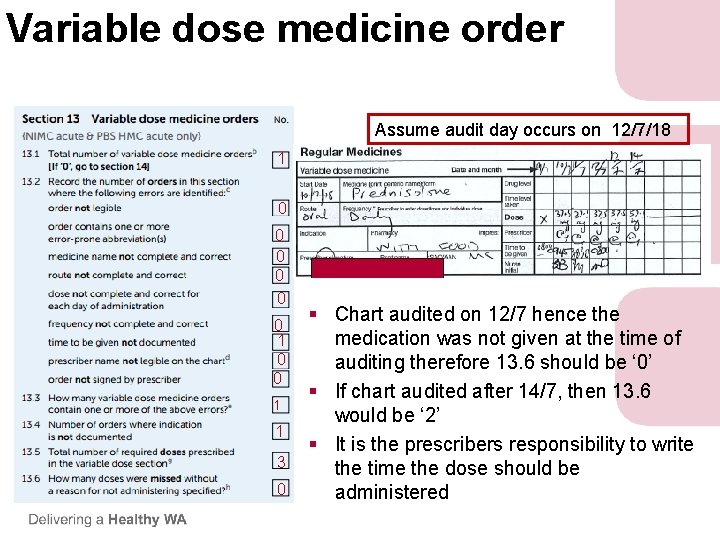
Variable dose medicine order Assume audit day occurs on 12/7/18 1 0 0 0 1 1 3 0 § Chart audited on 12/7 hence the medication was not given at the time of auditing therefore 13. 6 should be ‘ 0’ § If chart audited after 14/7, then 13. 6 would be ‘ 2’ § It is the prescribers responsibility to write the time the dose should be administered
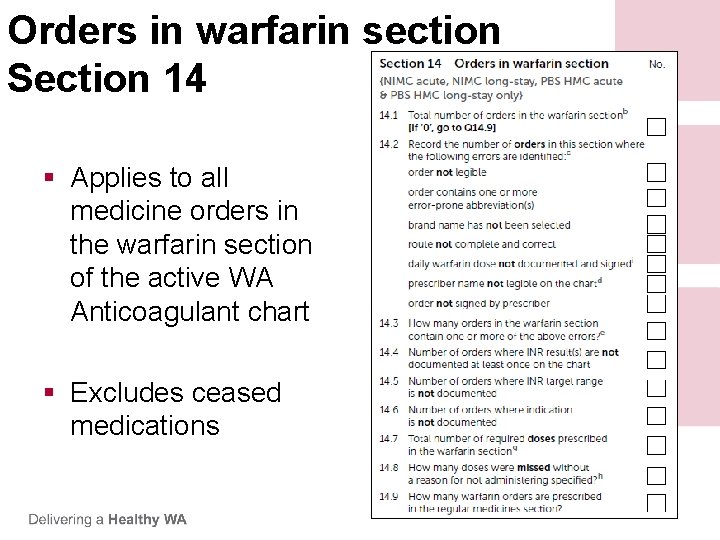
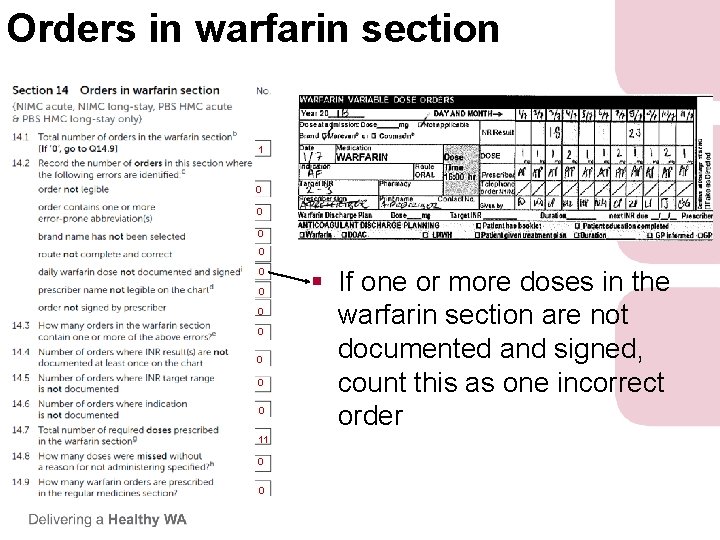
Orders in warfarin section Section 14 § Applies to all medicine orders in the warfarin section of the active WA Anticoagulant chart § Excludes ceased medications
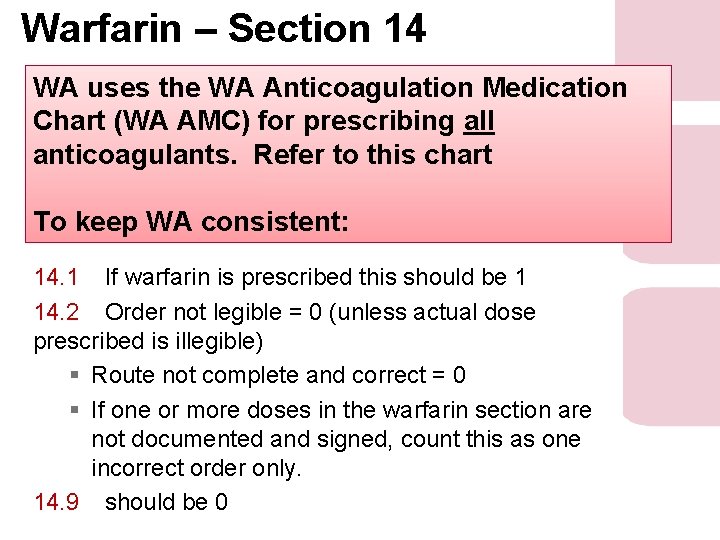
Warfarin – Section 14 WA uses the WA Anticoagulation Medication Chart (WA AMC) for prescribing all anticoagulants. Refer to this chart To keep WA consistent: 14. 1 If warfarin is prescribed this should be 1 14. 2 Order not legible = 0 (unless actual dose prescribed is illegible) § Route not complete and correct = 0 § If one or more doses in the warfarin section are not documented and signed, count this as one incorrect order only. 14. 9 should be 0
Orders in warfarin section 1 0 0 0 11 0 0 § If one or more doses in the warfarin section are not documented and signed, count this as one incorrect order
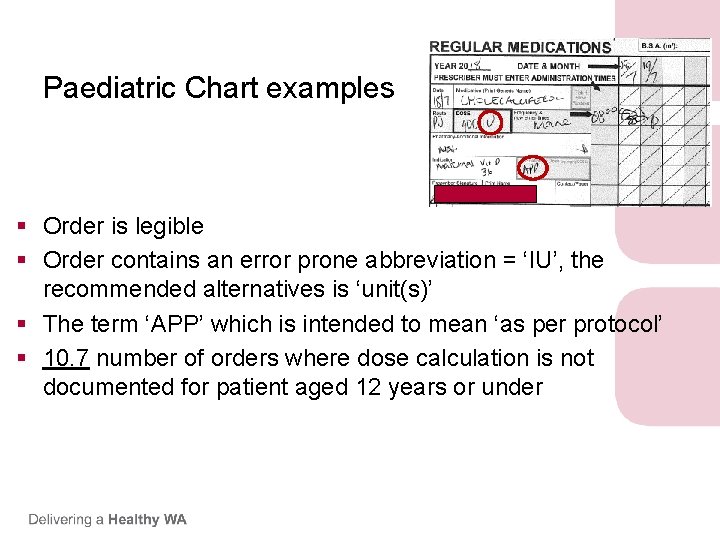
Paediatric Chart examples § Order is legible § Order contains an error prone abbreviation = ‘IU’, the recommended alternatives is ‘unit(s)’ § The term ‘APP’ which is intended to mean ‘as per protocol’ § 10. 7 number of orders where dose calculation is not documented for patient aged 12 years or under
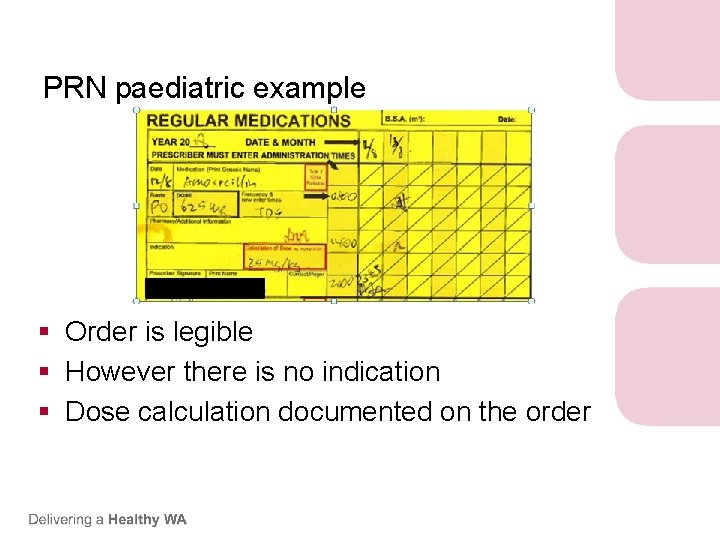
PRN paediatric example § Order is legible § However there is no indication § Dose calculation documented on the order
Acknowledgements § Australian Commission on Safety and Quality in Health Care Resources available at: https: //www. safetyandquality. gov. au/ourwork/medication-safety/nsmc-audit/ Audit system https: //www. safetyandquality. gov. au/ourwork/medication-safety/nsmc-audit/
Contact For more information: Medicines and Technology Unit – Medication Safety § Email: tat. jovanovska@health. wa. gov. au § Telephone: 9222 2172 (Tues/Wed only) § Kerry. Fitzsimons@health. wa. gov. au § Telephone 9222 4008 (Monday, Tuesday, Friday) Australian Commission on Safety and Quality in Health Care nsmc. audit@safetyandquality. gov. au