
PREANAESTHETIC MEDICATION IV ANAESTHETIC AGENTS Dr Shashi Bhushan
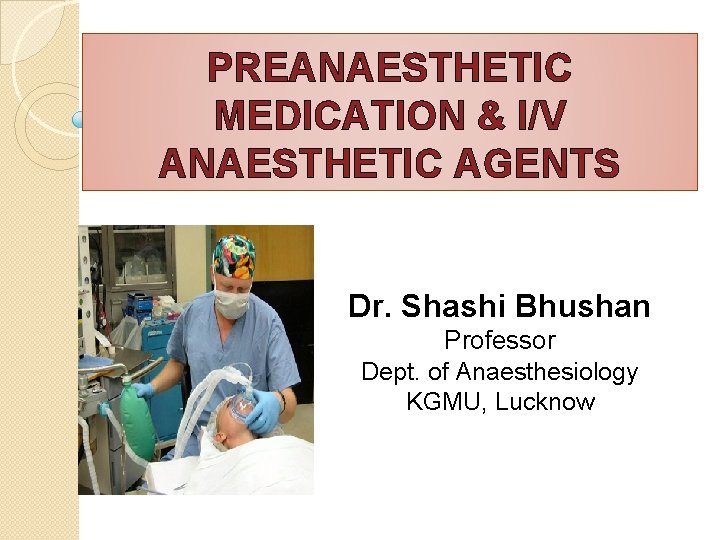
PREANAESTHETIC MEDICATION & I/V ANAESTHETIC AGENTS Dr. Shashi Bhushan Professor Dept. of Anaesthesiology KGMU, Lucknow
Overview v v v v v Pre-anaesthetic Medication Drugs used in pre-anaesthetic medication General Anaesthetics History Stages of anaesthesia Pharmacokinetics Mechanism of action Complications of general anaesthesia Summary
Preanaesthetic medication v“It is the term applied to the administration of drugs prior to general anaesthesia so as to make anaesthesia safer for the patient” v. Ensures comfort to the patient & to minimize adverse effects of anaesthesia
Aims �Relief of anxiety & apprehension preoperatively & facilitate smooth induction �Amnesia for pre- & post-operative events �Potentiate action of anaesthetics, so less dose is needed
Aims(contd. ) �Antiemetic effect extending to post-operative period �Decrease secretions & vagal stimulation caused by anaesthetics �Decrease acidity & volume of gastric juice to prevent reflux & aspiration pneumonia

Drugs used for preanesthetic medication �Anti-anxiety drugs- - Provide relief from apprehension & anxiety - Post-operative amnesia e. g. Diazepam (5 -10 mg oral), Lorazepam (2 mg i. m. ) (avoided co-administration with morphine, pethidine)
Sedatives-hypnoticse. g. Promethazine (25 mg i. m. ) has sedative, antiemetic & anticholinergic action � �Causes negligible respiratory depression & suitable for children
Opioid analgesics Morphine (8 -12 mg i. m. ) or Pethidine (50100 mg i. m. ) used one hour before surgery � �Provide sedation, pre-& post-operative analgesia, reduction in anaesthetic dose �Fentanyl (50 -100μg i. m. or i. v. ) preferred nowadays (just before induction of anaesthesia)
Anticholinergics�Atropine (0. 5 mg i. m. ) or Hyoscine (0. 5 mg i. m. ) or Glycopyrrolate (0. 1 -0. 3 mg i. m. ) one hour before surgery(not used nowadays) �Reduces salivary & bronchial secretions, vagal bradycardia, hypotension �Glycopyrrolate(selective peripheral action) acts rapidly, longer acting, potent antisecretory agent, prevents vagal bradycardia effectively
Antiemetics�Metoclopramide (10 mg i. m. ) used as antiemetic & as prokinetic gastric emptying agent prior to emergency surgery Domperidone (10 mg oral) more preferred (does not produce extrapyramidal side effects) � �Ondansetron (4 -8 mg i. v. ), a 5 HT 3 receptor antagonist, found effective in preventing post -anaesthetic nausea & vomiting
Drugs reducing acid secretion Ranitidine (150 -300 mg oral) or Famotidine (20 -40 mg oral) given night before & in morning along with Metoclopramide reduces risk of gastric regurgitation & aspiration pneumonia � �Proton pump inhibitors like Omeprazole (20 mg) with Domperidone (10 mg) is preferred nowadays
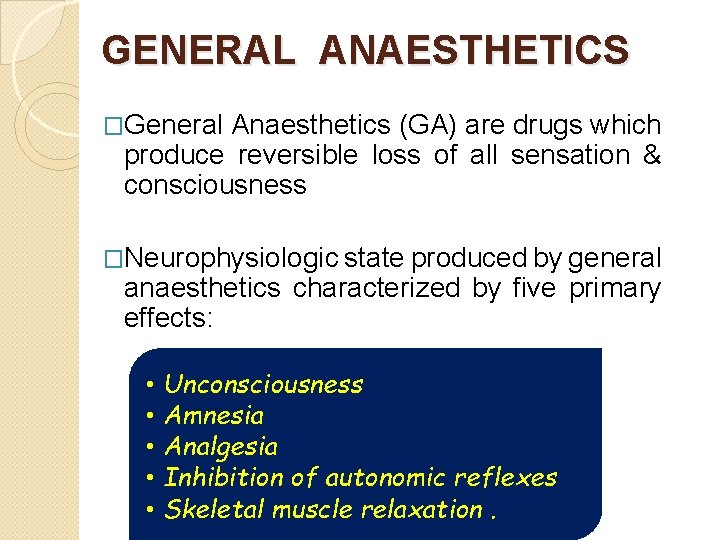
GENERAL ANAESTHETICS �General Anaesthetics (GA) are drugs which produce reversible loss of all sensation & consciousness �Neurophysiologic state produced by general anaesthetics characterized by five primary effects: • Unconsciousness • Amnesia • Analgesia • Inhibition of autonomic reflexes • Skeletal muscle relaxation.
Ideal anaesthetic- Rapid induction - Smooth loss of consciousness - Rapidly reversible upon discontinuation - Possess a wide margin of safety � The are: • • cardinal features of general anaesthesia Loss of all sensation, especially pain Sleep (unconsciousness) & amnesia Immobility & muscle relaxation Abolition of somatic & autonomic reflexes
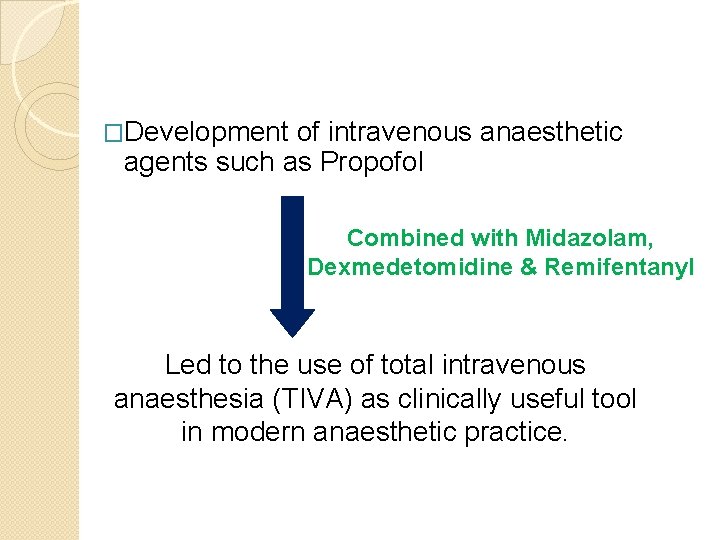
�Development of intravenous anaesthetic agents such as Propofol Combined with Midazolam, Dexmedetomidine & Remifentanyl Led to the use of total intravenous anaesthesia (TIVA) as clinically useful tool in modern anaesthetic practice.
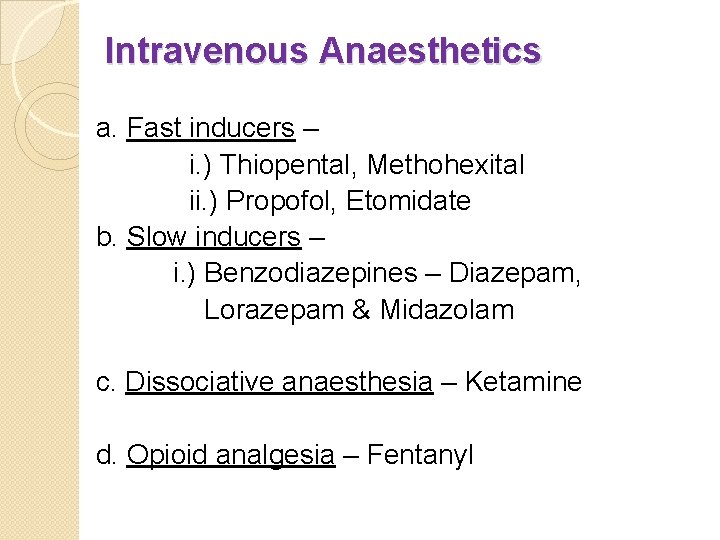
Intravenous Anaesthetics a. Fast inducers – i. ) Thiopental, Methohexital ii. ) Propofol, Etomidate b. Slow inducers – i. ) Benzodiazepines – Diazepam, Lorazepam & Midazolam c. Dissociative anaesthesia – Ketamine d. Opioid analgesia – Fentanyl
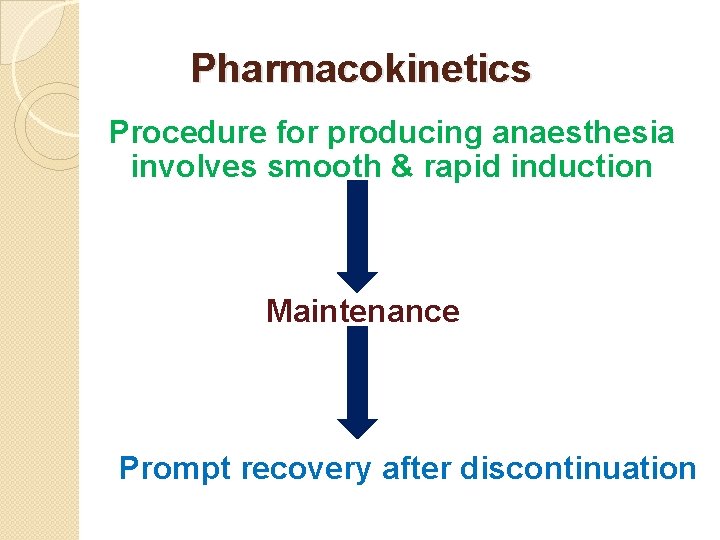
Pharmacokinetics Procedure for producing anaesthesia involves smooth & rapid induction Maintenance Prompt recovery after discontinuation
Induction – “Time interval between the administration of anaesthetic drug & development of stage of surgical anaesthesia” � �Fast & smooth induction desired to avoid dangerous excitatory phase
�Thiopental or Propofol often used for rapid induction � �Unconsciousness after injection results in few minutes �Muscle relaxants(Pancuronium or Atracurium) co-administered to facilitate intubation �Lipophilicity is key factor governing pharmacokinetics of inducing agents
Maintenance �Patient remains in sustained stage of surgical anaesthesia(stage 3 plane 2) �Depth of anaesthesia depends concentration of anaesthetic in CNS �Usually on maintained by administration of gases or volatile liquid anaesthetics (offer good control over depth of anaesthesia)
Recovery �Recovery phase starts as anaesthetic drug is discontinued (reverse of induction) �In this phase, nitrous oxide moves out of blood into alveoli at faster rate (causes diffusion hypoxia) �Oxygen given in last few minutes of anaesthesia & early post-anaesthetic period �More common with insoluble in blood gases relatively
Mechanism of Anaesthesia �Non-selective in action �At molecular level, anaesthetics interact with hydrophobic regions of neuronal membrane proteins �Inhaled anaesthetics, Barbiturates, Benzodiazepines, Etomidate & propofol facilitate GABA-mediated inhibition at GABAA receptor sites & increase Cl- flux �Ketamine blocks action of glutamate on NMDA receptor
�General anaesthetics disrupt neuronal firing & sensory processing in thalamus, by affecting neuronal membrane proteins �Motor activity also reduced – GA inhibit neuronal output from internal pyramidal layer of cerebral cortex
Intravenous anaesthetics Thiopentone sodium �Ultrashort acting thiobarbiturate, smooth induction within one circulation time �Crosses BBB rapidly �Diffuses rapidly out of brain, redistributed to body fats, muscles & other tissues �Typical induction dose is 3 -5 mg/kg �Metabolised in liver
�Cerebral vasoconstriction, reducing cerebral blood flow & intracranial pressure(suitable for patients with cerebral oedema & brain tumours) �Laryngospasm �No on intubation muscle relaxant action �Barbiturates in general may precipitate Acute intermittent porphyria (hepatic ALA synthetase) �Reduces respiratory rate & tidal volume
Propofol � Available as 1% or 2% emulsion in oil � Induction of anaesthesia with 1. 5 -2. 5 mg/kg within 30 sec & is smooth & pleasant � Low incidence movements of excitatory voluntary � Rapid recovery with low incidence of nausea & vomiting(antiemetic action) � Non-irritant � No to respiratory airways analgesic or muscle relaxant action
� Anticonvulsant � Preferred action agent for day care surgery � Apnoea & pain at site of injection are common after bolus injection � Produces marked decrease in systemic blood pressure during induction(decreases peripheral resistance) � Bradycardia is frequent
Ketamine � Phencyclidine derivative � Dissociative anaesthesia: a state characterized by immobility, amnesia and analgesia with light sleep and feeling of dissociation from surroundings � Primary site of action – cortex and limbic system – acts by blocking glutamate at NMDA receptors � Highly lipophilic drug � Dose: 1 -2 mg/kg i. v.
� Only i. v. anaesthetic possessing significant analgesic properties & produces CNS stimulation � Increases output � Markedly � Suitable heart rate, blood pressure & cardiac increases cerebral blood flow & ICP for patients of hypovolaemic shock � Recovery associated with “emergence delirium”, more in adults than children � Use of diazepam or midazolam i. v. prior to administration of ketamine, minimises this effect
Fentanyl �Potent, short acting (30 -50 min), opioid analgesic �Generally given i. v. �Reflex effects abolished �Respiratory predictable of painful stimuli are depression is marked but
�Decrease in heart rate, slight fall in BP �Nausea, vomiting & itching often occurs during recovery �Also employed as adjunct to spinal & nerve block anaesthesia & to relieve postoperative pain
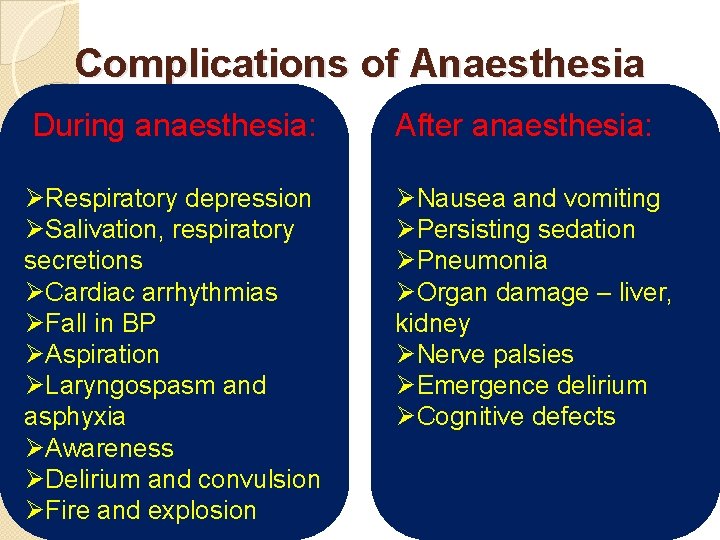
Complications of Anaesthesia During anaesthesia: After anaesthesia: ØRespiratory depression ØSalivation, respiratory secretions ØCardiac arrhythmias ØFall in BP ØAspiration ØLaryngospasm and asphyxia ØAwareness ØDelirium and convulsion ØFire and explosion ØNausea and vomiting ØPersisting sedation ØPneumonia ØOrgan damage – liver, kidney ØNerve palsies ØEmergence delirium ØCognitive defects
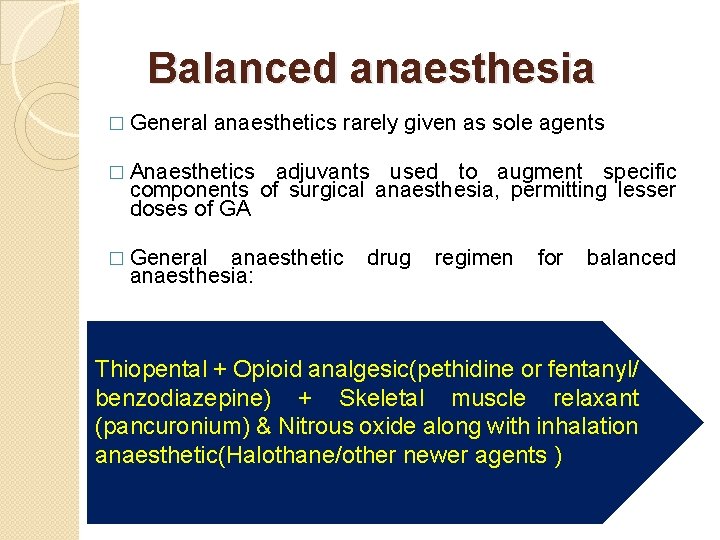
Balanced anaesthesia � General anaesthetics rarely given as sole agents � Anaesthetics adjuvants used to augment specific components of surgical anaesthesia, permitting lesser doses of GA � General anaesthetic anaesthesia: drug regimen for balanced Thiopental + Opioid analgesic(pethidine or fentanyl/ benzodiazepine) + Skeletal muscle relaxant (pancuronium) & Nitrous oxide along with inhalation anaesthetic(Halothane/other newer agents )
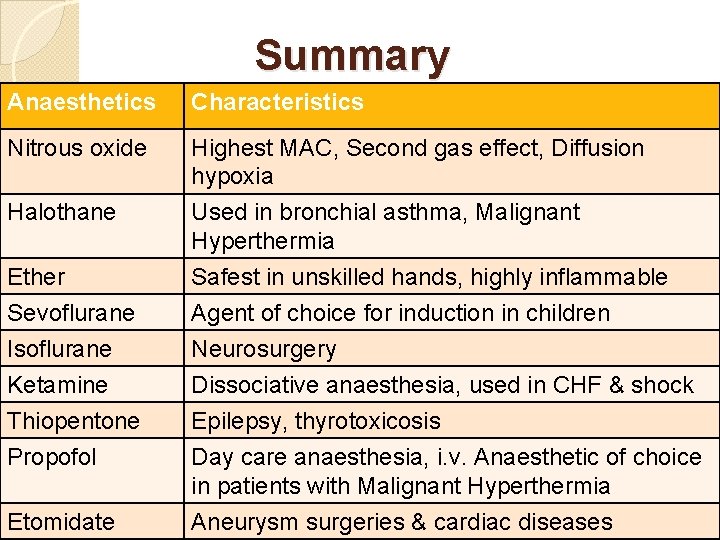
Summary Anaesthetics Characteristics Nitrous oxide Highest MAC, Second gas effect, Diffusion hypoxia Halothane Used in bronchial asthma, Malignant Hyperthermia Ether Sevoflurane Isoflurane Ketamine Thiopentone Propofol Safest in unskilled hands, highly inflammable Agent of choice for induction in children Neurosurgery Dissociative anaesthesia, used in CHF & shock Epilepsy, thyrotoxicosis Day care anaesthesia, i. v. Anaesthetic of choice in patients with Malignant Hyperthermia Aneurysm surgeries & cardiac diseases Etomidate
References � Pharmacological Basis of Therapeutics, Edition, Goodman & Gilman's � Medical Pharmacology, S. K. Srivastava � Principles � Review Garg 12 th of Pharmacology, 2 nd edition K. K. Sharma of Pharmacology, 8 th edition Gobind Rai

Thank You
- Slides: 35