Internet Infrastructure Switches and Routers Mounir Hamdi Head







- Slides: 147
Internet Infrastructure: Switches and Routers Mounir Hamdi Head & Chair Professor, Computer Science and Engineering Hong Kong University of Science and Technology CSIT 560 by M. Hamdi 1
Goals of the Course • Understand the architecture, operation, and evolution of the Internet – IP, Optical, Openflow • Understand how to design, implement and evaluate Internet routers and switches (Telecom Equipment) • Understand the implementation of network services (e. g. , Qo. S) on switches and routers • Introduction to Network-on-Chip (No. C), Communication Performance, Organizational Structure, Interconnection Topologies, Trade-offs in Network Topology, and Routing • Evaluate various Internet access methods (including wireless) • Build solid learning skills for investigating a good project – Task selection and aim – Survey & conclusion & research methodology – Presentation CSIT 560 by M. Hamdi 2
Outline of the Course • The focus of the course is on the design and analysis of highperformance electronic/optical switches/routers needed to support the development and delivery of advanced network services over high-speed Internet. • The switches and routers are the KEY building blocks of the Internet, and as a result, the capability of the Internet in all its aspects depends on the capability of its switches and routers (hardware and software) • Understand the evaluate the evolution of the Internet infrastructure (e. g. , No. C, Wireless, etc. ) • The goal of the course is to provide a basis for understanding, appreciating, and performing research/survey and development in networking with a special emphasis on switches and routers. CSIT 560 by M. Hamdi 3
Outline of the Course • Introduction – Evolution of the Internet (Architecture, Protocols and Applications) – Evolution of packet switches and routers, basic architectural components, and some example architectures – Network Processors and Packet Processing (IPv 4 and IPv 6) – Architecture and operation of “optical” circuit-switched switches/routers CSIT 560 by M. Hamdi 4
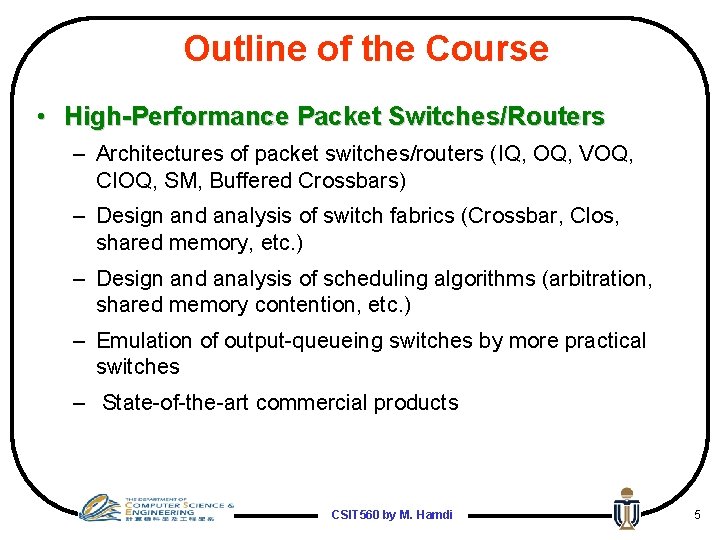
Outline of the Course • High-Performance Packet Switches/Routers – Architectures of packet switches/routers (IQ, OQ, VOQ, CIOQ, SM, Buffered Crossbars) – Design and analysis of switch fabrics (Crossbar, Clos, shared memory, etc. ) – Design and analysis of scheduling algorithms (arbitration, shared memory contention, etc. ) – Emulation of output-queueing switches by more practical switches – State-of-the-art commercial products CSIT 560 by M. Hamdi 5
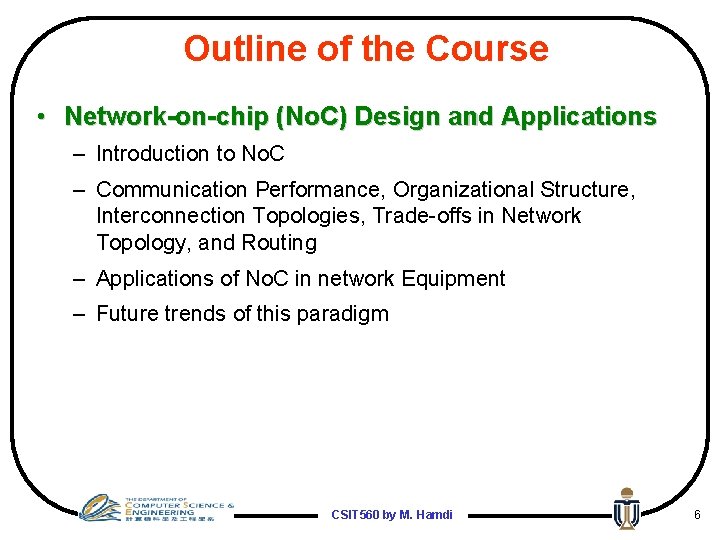
Outline of the Course • Network-on-chip (No. C) Design and Applications – Introduction to No. C – Communication Performance, Organizational Structure, Interconnection Topologies, Trade-offs in Network Topology, and Routing – Applications of No. C in network Equipment – Future trends of this paradigm CSIT 560 by M. Hamdi 6
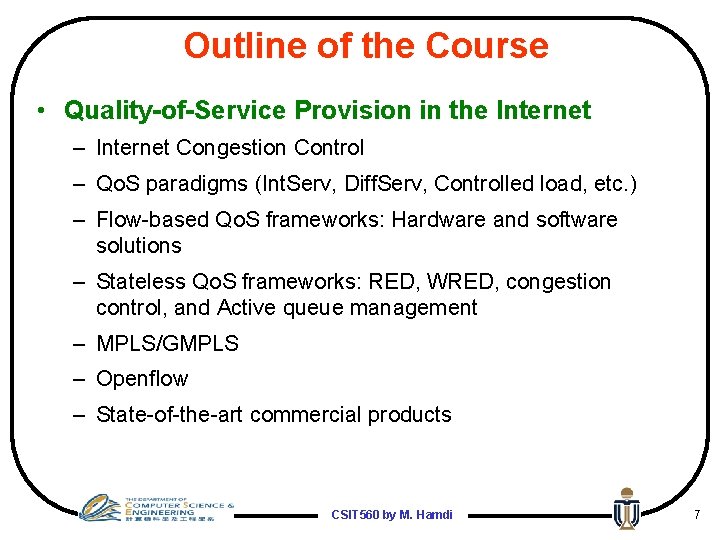
Outline of the Course • Quality-of-Service Provision in the Internet – Internet Congestion Control – Qo. S paradigms (Int. Serv, Diff. Serv, Controlled load, etc. ) – Flow-based Qo. S frameworks: Hardware and software solutions – Stateless Qo. S frameworks: RED, WRED, congestion control, and Active queue management – MPLS/GMPLS – Openflow – State-of-the-art commercial products CSIT 560 by M. Hamdi 7
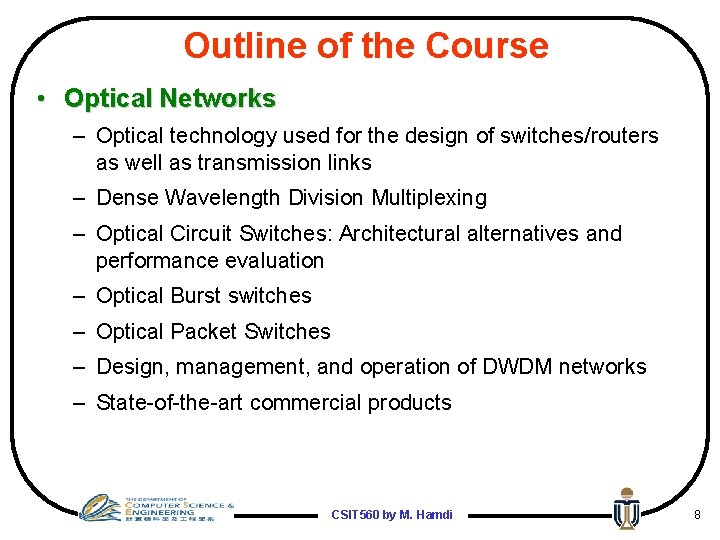
Outline of the Course • Optical Networks – Optical technology used for the design of switches/routers as well as transmission links – Dense Wavelength Division Multiplexing – Optical Circuit Switches: Architectural alternatives and performance evaluation – Optical Burst switches – Optical Packet Switches – Design, management, and operation of DWDM networks – State-of-the-art commercial products CSIT 560 by M. Hamdi 8
Outline of the Course • Internet Wireless Access – WLANs and 802. 11 – Wi. MAX and 802. 16 – Cellular mobile networks • Performance Evaluation – Simulations – Modeling CSIT 560 by M. Hamdi 9
Grading • Homework 20% • Midterm 40% • Project 40% CSIT 560 by M. Hamdi 10
Course project • Investigate and survey existing advances and/or new ideas and solutions – related to Internet Infrastrcuture - in a small scale project (To be given or chosen on your own) – Define the problem – Execute the survey and/or research – Work with your partner – Write up and present your finding CSIT 560 by M. Hamdi 11
Course Project • I’ll post on the class web page a list of projects – you can either choose one of these projects or come up with your own • Choose your project, partner (s), and submit a one page proposal describing: – The problem you are investigating – Your plan of project with milestones • Final project presentation (20 -25 minutes) • Submit project reports CSIT 560 by M. Hamdi 12
Independent Projects • If you want to go deeper in a topic related to Internet Infrastructures (e. g. , Wireless, Internet Routers, Data centers, Cloud Computing, Optical, Qo. S, No. C, Applications, etc. ), then you might want to opt for an Independent Project – You can come and talk to me CSIT 560 by M. Hamdi 13
Homework • Goals: 1. Synthesize main ideas and concepts from very important research or development work • I will post in the class web page a list of “well-known/seminal” papers to choose from • Report contains: 1. Description of the paper 2. Goals and problems solved in the paper 3. What did you like/dislike about the paper 4. How the paper affected the advances in networking (if any) 5. Recommendations for improvements or extension of the work CSIT 560 by M. Hamdi 14
How to Contact Me • Instructor: Mounir Hamdi, hamdi@cse. ust. hk • TA: Miss. Lu Wang, wanglu@cse. ust. hk • Office Hours – You can come any time – just email me ahead of time – I would like to work closely with each student CSIT 560 by M. Hamdi 15
Overview and History of the Internet CSIT 560 by M. Hamdi 16
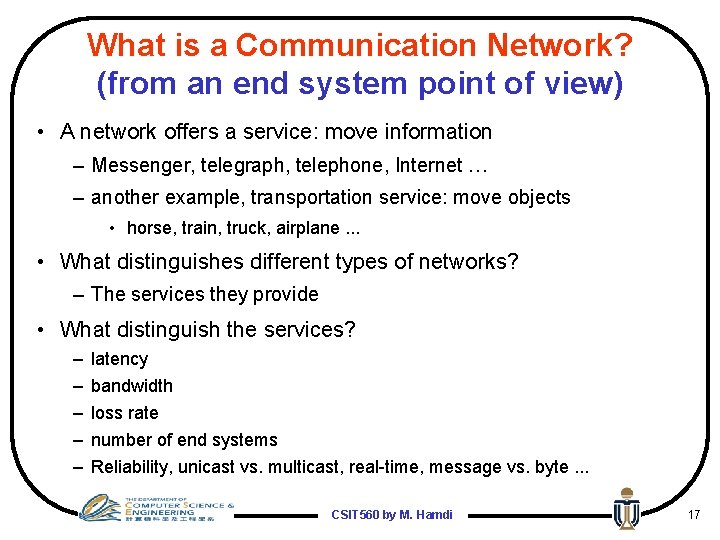
What is a Communication Network? (from an end system point of view) • A network offers a service: move information – Messenger, telegraph, telephone, Internet … – another example, transportation service: move objects • horse, train, truck, airplane. . . • What distinguishes different types of networks? – The services they provide • What distinguish the services? – – – latency bandwidth loss rate number of end systems Reliability, unicast vs. multicast, real-time, message vs. byte. . . CSIT 560 by M. Hamdi 17
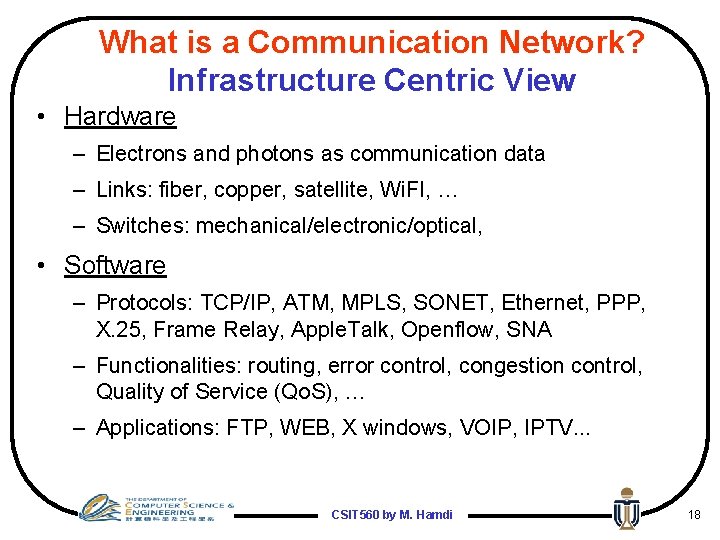
What is a Communication Network? Infrastructure Centric View • Hardware – Electrons and photons as communication data – Links: fiber, copper, satellite, Wi. FI, … – Switches: mechanical/electronic/optical, • Software – Protocols: TCP/IP, ATM, MPLS, SONET, Ethernet, PPP, X. 25, Frame Relay, Apple. Talk, Openflow, SNA – Functionalities: routing, error control, congestion control, Quality of Service (Qo. S), … – Applications: FTP, WEB, X windows, VOIP, IPTV. . . CSIT 560 by M. Hamdi 18
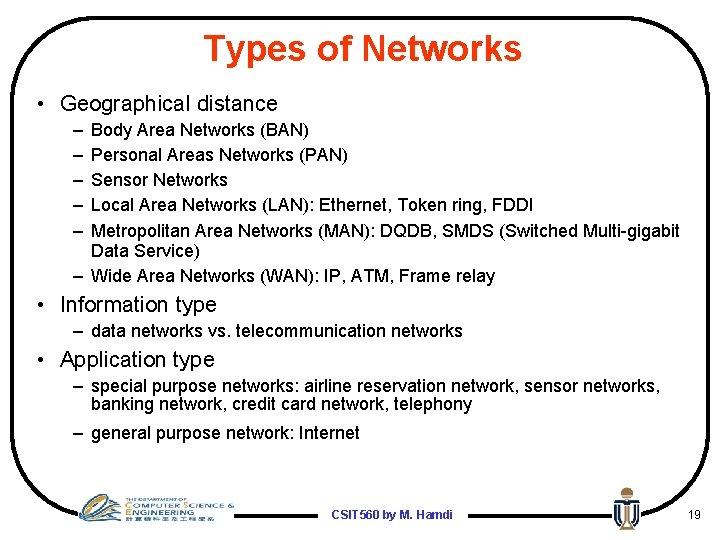
Types of Networks • Geographical distance – – – Body Area Networks (BAN) Personal Areas Networks (PAN) Sensor Networks Local Area Networks (LAN): Ethernet, Token ring, FDDI Metropolitan Area Networks (MAN): DQDB, SMDS (Switched Multi-gigabit Data Service) – Wide Area Networks (WAN): IP, ATM, Frame relay • Information type – data networks vs. telecommunication networks • Application type – special purpose networks: airline reservation network, sensor networks, banking network, credit card network, telephony – general purpose network: Internet CSIT 560 by M. Hamdi 19
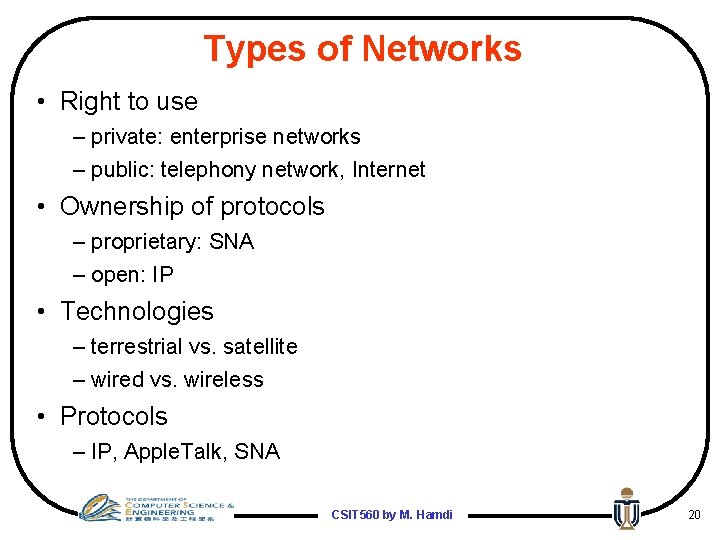
Types of Networks • Right to use – private: enterprise networks – public: telephony network, Internet • Ownership of protocols – proprietary: SNA – open: IP • Technologies – terrestrial vs. satellite – wired vs. wireless • Protocols – IP, Apple. Talk, SNA CSIT 560 by M. Hamdi 20
The Internet • Global scale, general purpose, heterogeneoustechnologies, public, computer network • Internet Protocol – Open standard: Internet Engineering Task Force (IETF) as standard body – Technical basis for other types of networks • Intranet: enterprise IP network • Developed by the research community CSIT 560 by M. Hamdi 21
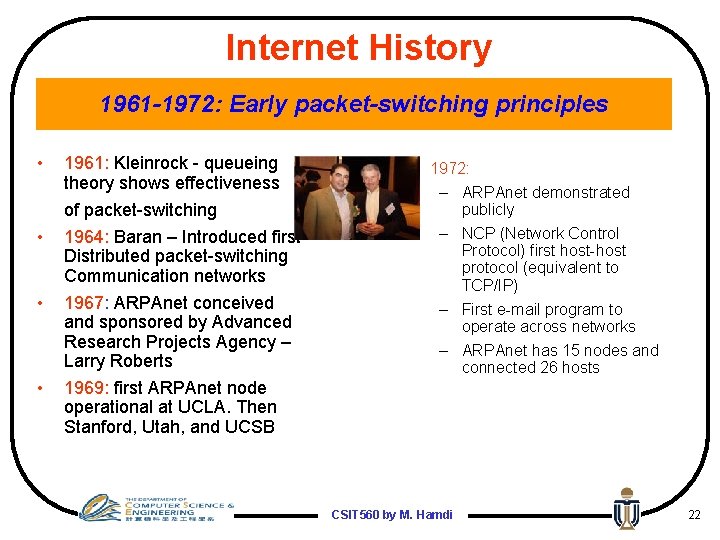
Internet History 1961 -1972: Early packet-switching principles • • 1961: Kleinrock - queueing theory shows effectiveness of packet-switching 1964: Baran – Introduced first Distributed packet-switching Communication networks 1967: ARPAnet conceived and sponsored by Advanced Research Projects Agency – Larry Roberts 1969: first ARPAnet node operational at UCLA. Then Stanford, Utah, and UCSB • 1972: – ARPAnet demonstrated publicly – NCP (Network Control Protocol) first host-host protocol (equivalent to TCP/IP) – First e-mail program to operate across networks – ARPAnet has 15 nodes and connected 26 hosts CSIT 560 by M. Hamdi 22
Internet History 1972 -1980: Internetworking, new and proprietary nets • 1970: ALOHAnet satellite network in Hawaii • 1973: Metcalfe’s Ph. D thesis proposes Ethernet • 1974: Cerf and Kahn architecture for interconnecting networks (TCP) • late 70’s: proprietary architectures: DECnet, SNA, XNA • late 70’s: switching fixed length packets (ATM precursor) • 1979: ARPAnet has 200 nodes Cerf and Kahn’s internetworking principles: – minimalism, autonomy - no internal changes is required to interconnect networks – best effort service model – stateless routers – decentralized control define today’s Internet architecture CSIT 560 by M. Hamdi 23
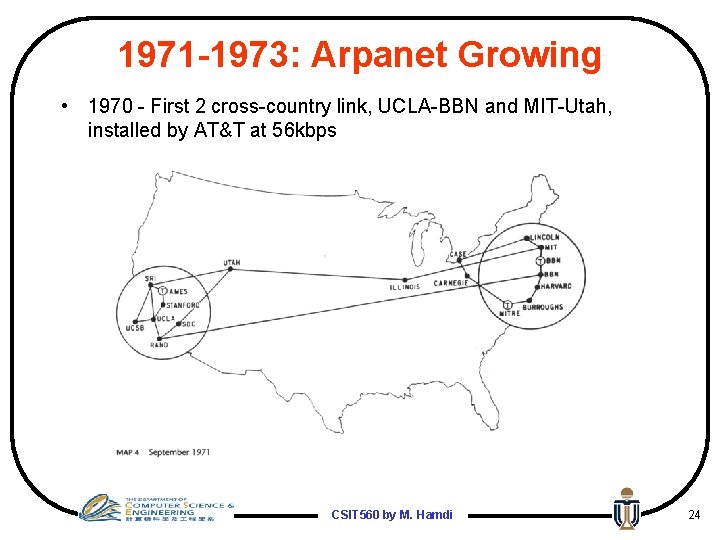
1971 -1973: Arpanet Growing • 1970 - First 2 cross-country link, UCLA-BBN and MIT-Utah, installed by AT&T at 56 kbps CSIT 560 by M. Hamdi 24
Internet History 1980 -1990: new protocols, a proliferation of networks • 1983: deployment of TCP/IP • 1982: SMTP e-mail protocol defined • New national networks: CSnet, BITnet, NSFnet, Minitel • 1983: DNS defined for nameto-IP-address translation • 100, 000 hosts connected to confederation of networks • 1985: ftp protocol defined (first version: 1972) • 1988: TCP congestion control CSIT 560 by M. Hamdi 25
Internet History 1990’s: commercialization, the WWW • Early 1990’s: ARPAnet decomissioned • 1991: NSF lifts restrictions on commercial use of NSFnet (decommissioned, 1995) • early 1990 s: WWW – hypertext [Bush 1945, Nelson 1960’s] – HTML, http: Berners-Lee – 1994: Mosaic, later Netscape – late 1990’s: commercialization of the WWW Late 1990’s: • est. 50 million computers on Internet • est. 100 million+ users in 160 countries • backbone links running at 1 Gbps+ 2000’s • Vo. IP, Video on demand, IPTV, Internet business • RSS, Web 2. 0 • Social networking CSIT 560 by M. Hamdi 26
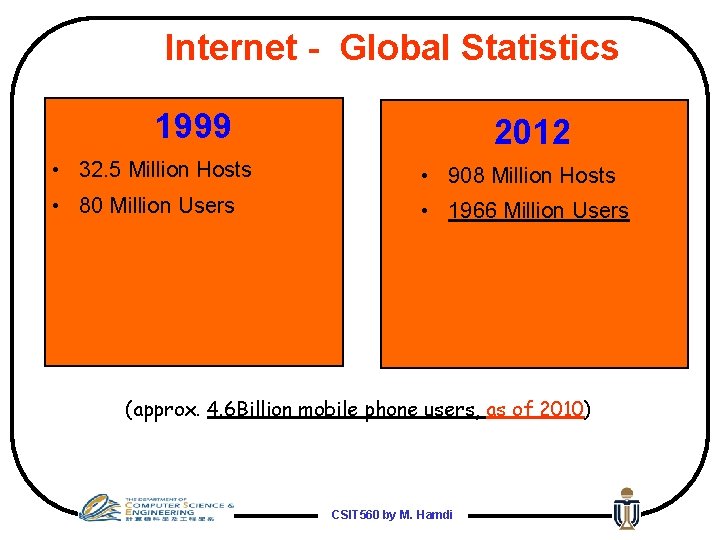
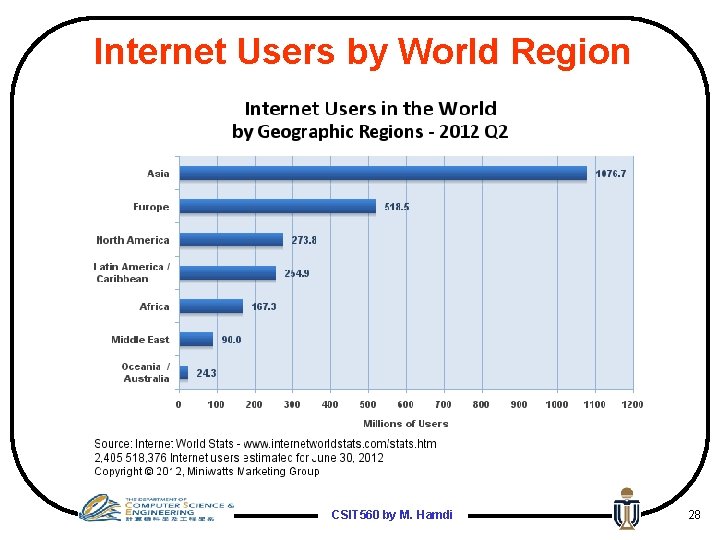
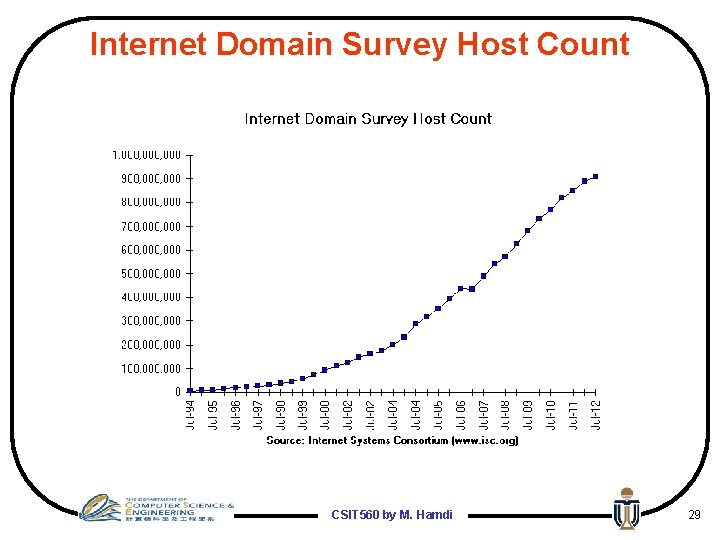
Internet - Global Statistics 1999 2012 • 32. 5 Million Hosts • 908 Million Hosts • 80 Million Users • 1966 Million Users (approx. 4. 6 Billion mobile phone users, as of 2010) CSIT 560 by M. Hamdi
Internet Users by World Region CSIT 560 by M. Hamdi 28
Internet Domain Survey Host Count CSIT 560 by M. Hamdi 29
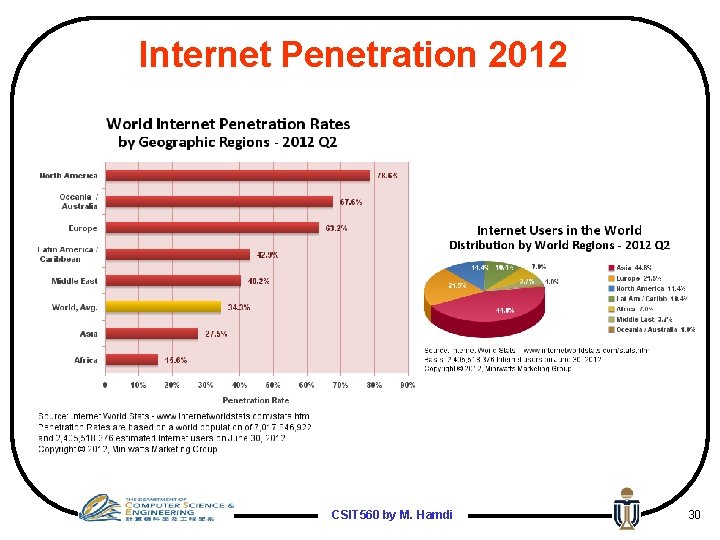
Internet Penetration 2012 CSIT 560 by M. Hamdi 30
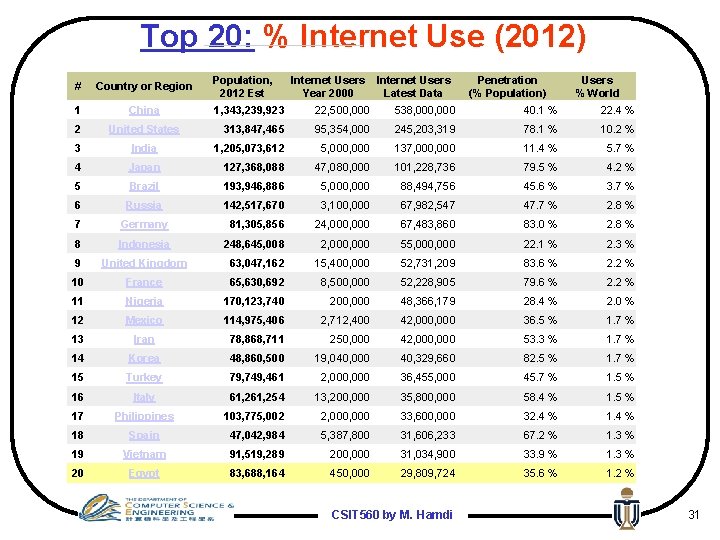
Top 20: % Internet Use (2012) # Country or Region 1 China 2 United States 3 Population, 2012 Est Internet Users Year 2000 Internet Users Latest Data Penetration (% Population) Users % World 1, 343, 239, 923 22, 500, 000 538, 000 40. 1 % 22. 4 % 313, 847, 465 95, 354, 000 245, 203, 319 78. 1 % 10. 2 % India 1, 205, 073, 612 5, 000 137, 000 11. 4 % 5. 7 % 4 Japan 127, 368, 088 47, 080, 000 101, 228, 736 79. 5 % 4. 2 % 5 Brazil 193, 946, 886 5, 000 88, 494, 756 45. 6 % 3. 7 % 6 Russia 142, 517, 670 3, 100, 000 67, 982, 547 47. 7 % 2. 8 % 7 Germany 81, 305, 856 24, 000 67, 483, 860 83. 0 % 2. 8 % 8 Indonesia 248, 645, 008 2, 000 55, 000 22. 1 % 2. 3 % 9 United Kingdom 63, 047, 162 15, 400, 000 52, 731, 209 83. 6 % 2. 2 % 10 France 65, 630, 692 8, 500, 000 52, 228, 905 79. 6 % 2. 2 % 11 Nigeria 170, 123, 740 200, 000 48, 366, 179 28. 4 % 2. 0 % 12 Mexico 114, 975, 406 2, 712, 400 42, 000 36. 5 % 1. 7 % 13 Iran 78, 868, 711 250, 000 42, 000 53. 3 % 1. 7 % 14 Korea 48, 860, 500 19, 040, 000 40, 329, 660 82. 5 % 1. 7 % 15 Turkey 79, 749, 461 2, 000 36, 455, 000 45. 7 % 1. 5 % 16 Italy 61, 254 13, 200, 000 35, 800, 000 58. 4 % 1. 5 % 17 Philippines 103, 775, 002 2, 000 33, 600, 000 32. 4 % 18 Spain 47, 042, 984 5, 387, 800 31, 606, 233 67. 2 % 1. 3 % 19 Vietnam 91, 519, 289 200, 000 31, 034, 900 33. 9 % 1. 3 % 20 Egypt 83, 688, 164 450, 000 29, 809, 724 35. 6 % 1. 2 % CSIT 560 by M. Hamdi 31
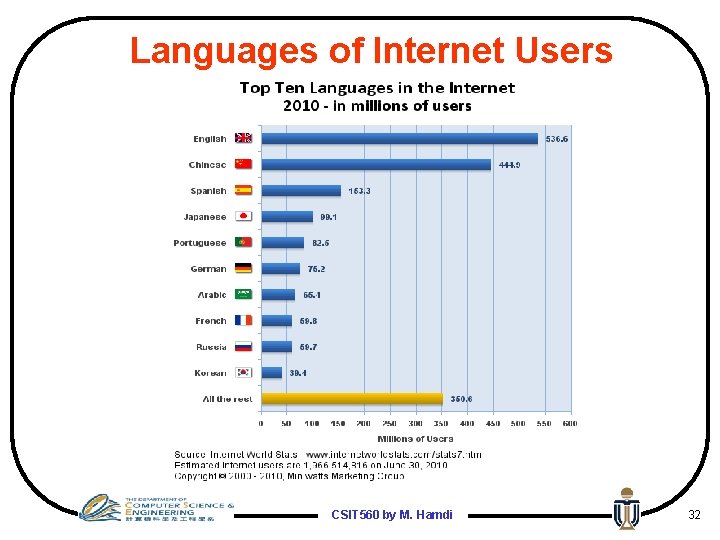
Languages of Internet Users CSIT 560 by M. Hamdi 32
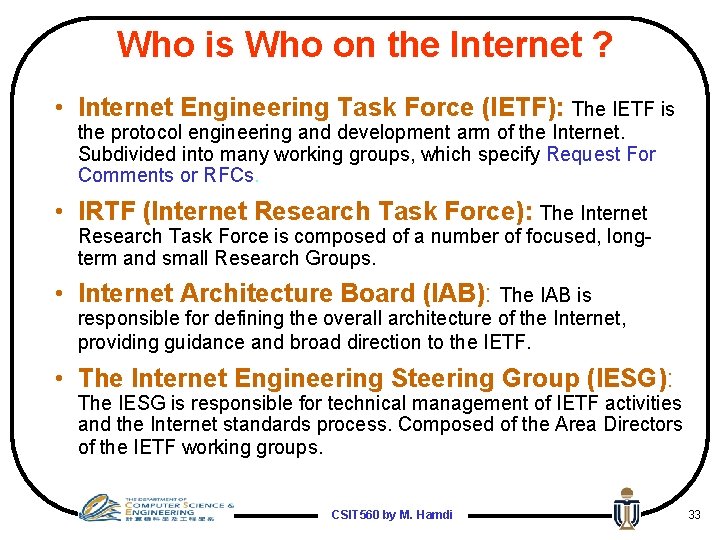
Who is Who on the Internet ? • Internet Engineering Task Force (IETF): The IETF is the protocol engineering and development arm of the Internet. Subdivided into many working groups, which specify Request For Comments or RFCs. • IRTF (Internet Research Task Force): The Internet Research Task Force is composed of a number of focused, longterm and small Research Groups. • Internet Architecture Board (IAB): The IAB is responsible for defining the overall architecture of the Internet, providing guidance and broad direction to the IETF. • The Internet Engineering Steering Group (IESG): The IESG is responsible for technical management of IETF activities and the Internet standards process. Composed of the Area Directors of the IETF working groups. CSIT 560 by M. Hamdi 33
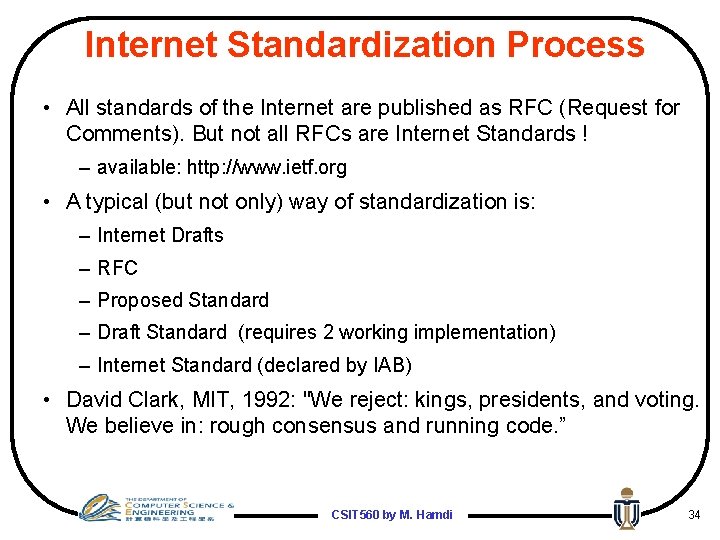
Internet Standardization Process • All standards of the Internet are published as RFC (Request for Comments). But not all RFCs are Internet Standards ! – available: http: //www. ietf. org • A typical (but not only) way of standardization is: – Internet Drafts – RFC – Proposed Standard – Draft Standard (requires 2 working implementation) – Internet Standard (declared by IAB) • David Clark, MIT, 1992: "We reject: kings, presidents, and voting. We believe in: rough consensus and running code. ” CSIT 560 by M. Hamdi 34
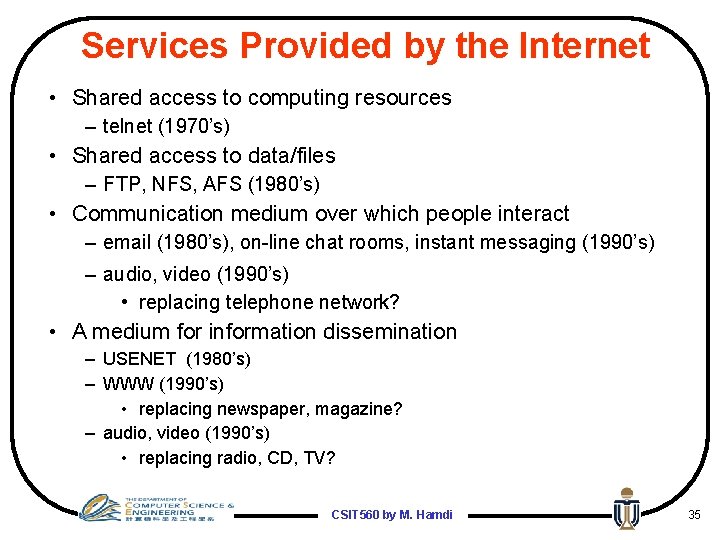
Services Provided by the Internet • Shared access to computing resources – telnet (1970’s) • Shared access to data/files – FTP, NFS, AFS (1980’s) • Communication medium over which people interact – email (1980’s), on-line chat rooms, instant messaging (1990’s) – audio, video (1990’s) • replacing telephone network? • A medium for information dissemination – USENET (1980’s) – WWW (1990’s) • replacing newspaper, magazine? – audio, video (1990’s) • replacing radio, CD, TV? CSIT 560 by M. Hamdi 35
Today’s Vision • Everything is digital: voice, video, music, pictures, live events, … • Everything is on-line: bank statement, medical record, books, airline schedule, weather, highway traffic, … • Everyone is connected: doctor, teacher, broker, mother, son, friends, enemies, voter CSIT 560 by M. Hamdi 36
What is Next? – many of it already here • E-Health, e-Govrnment, e-Banking, e-Business, …. • Internet of Things • Social Networking (Facebook, Twitter) – Already has huge impact (e. g. , Tunisia, Egypt, etc. ) • Electronic democracy – little people can voice their opinions to the whole world – Wiki. Leaks – bridge the gap between information haves and have no’s • Electronic Crimes – hacker can bring the whole world to its knee CSIT 560 by M. Hamdi 37
Industrial Players • Telephone companies – own long-haul and access communication links, customers • Cable companies – own access links • Wireless/Satellite companies – alternative communication links • Utility companies: power, water, railway – own right of way to lay down more wires • Medium companies – own content • Internet Service Providers • Equipment companies – switches/routers, chips, optics, computers • Software companies CSIT 560 by M. Hamdi 38
What is the Internet? • The collection of hosts and routers that are mutually reachable at any given instant • All run the Internet Protocol (IP) – Version 4 (IPv 4) is the dominant protocol – Version 6 (IPv 6) is the future protocol • Lots of protocols below and above IP, but only one IP – Common layer CSIT 560 by M. Hamdi 39
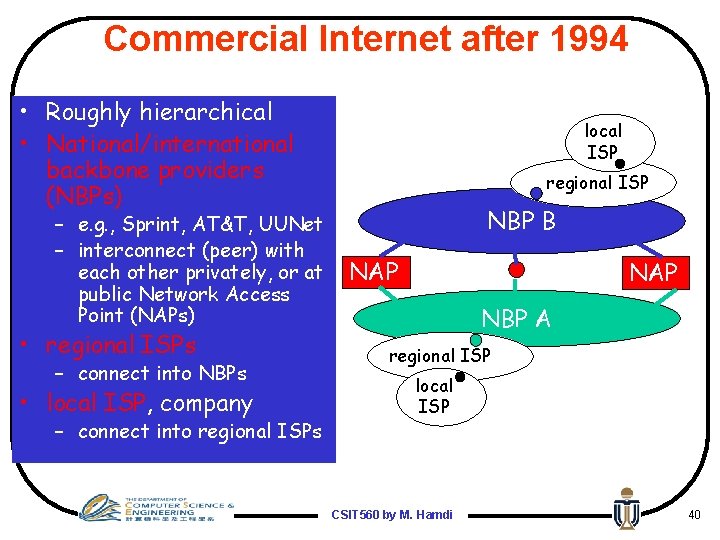
Commercial Internet after 1994 • Roughly hierarchical • National/international backbone providers (NBPs) – e. g. , Sprint, AT&T, UUNet – interconnect (peer) with each other privately, or at public Network Access Point (NAPs) • regional ISPs – connect into NBPs • local ISP, company – connect into regional ISPs local ISP regional ISP NBP B NAP NBP A regional ISP local ISP CSIT 560 by M. Hamdi 40
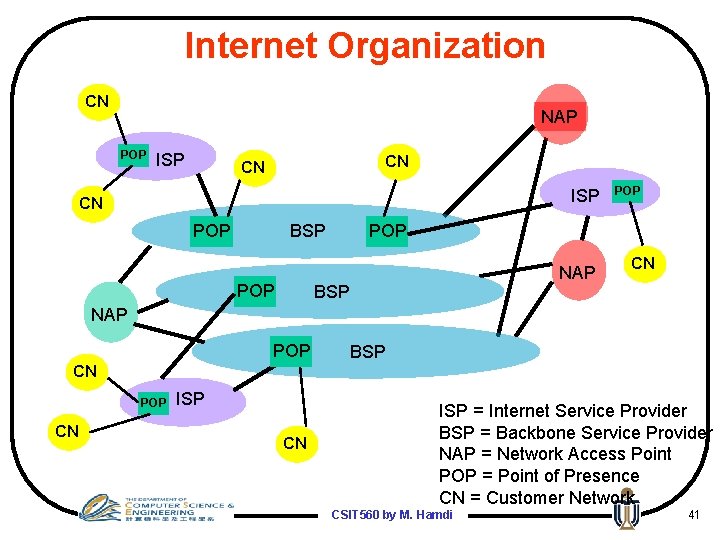
Internet Organization CN NAP POP ISP CN CN ISP CN BSP POP POP NAP BSP CN NAP POP BSP CN POP CN ISP = Internet Service Provider BSP = Backbone Service Provider NAP = Network Access Point POP = Point of Presence CN = Customer Network CSIT 560 by M. Hamdi 41
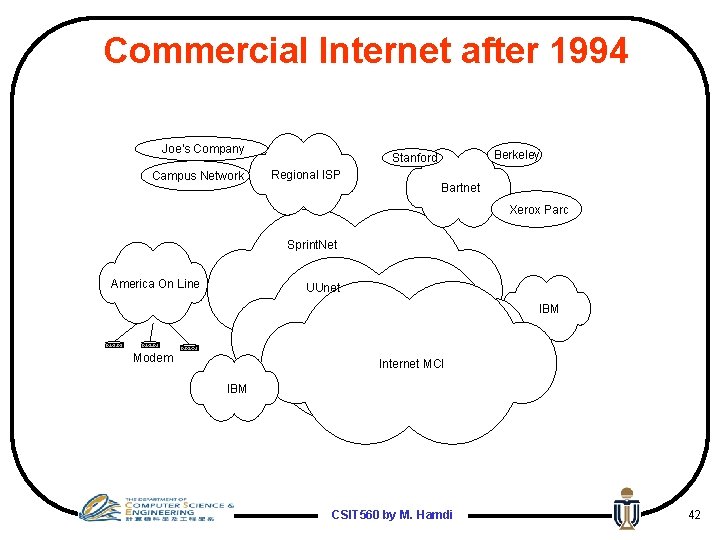
Commercial Internet after 1994 Joe's Company Campus Network Berkeley Stanford Regional ISP Bartnet Xerox Parc Sprint. Net America On Line UUnet NSF Network IBM NSF Network Modem Internet MCI IBM CSIT 560 by M. Hamdi 42
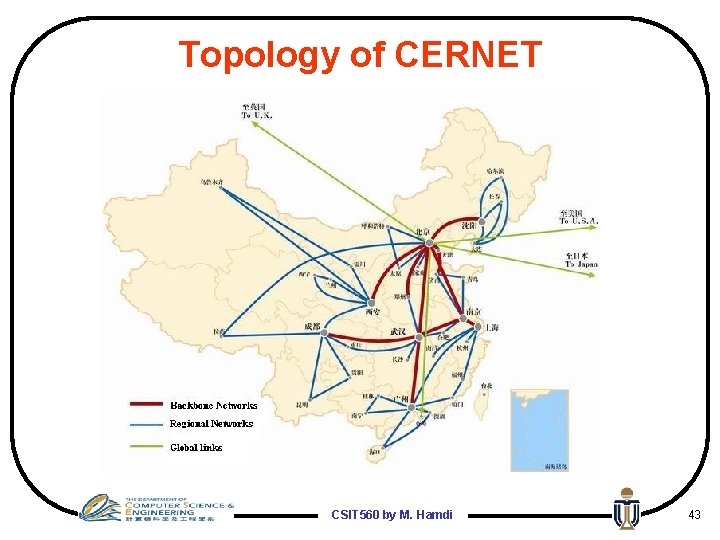
Topology of CERNET CSIT 560 by M. Hamdi 43
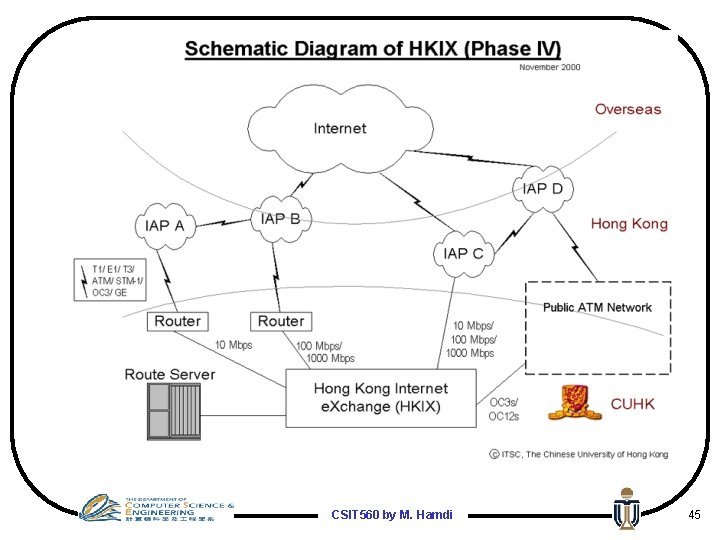
The Role of Hong Kong Internet Exchange Global Internet HK ISP-B HK ISP-A HKIX Downstream Customers CSIT 560 by M. Hamdi 44
CSIT 560 by M. Hamdi 45
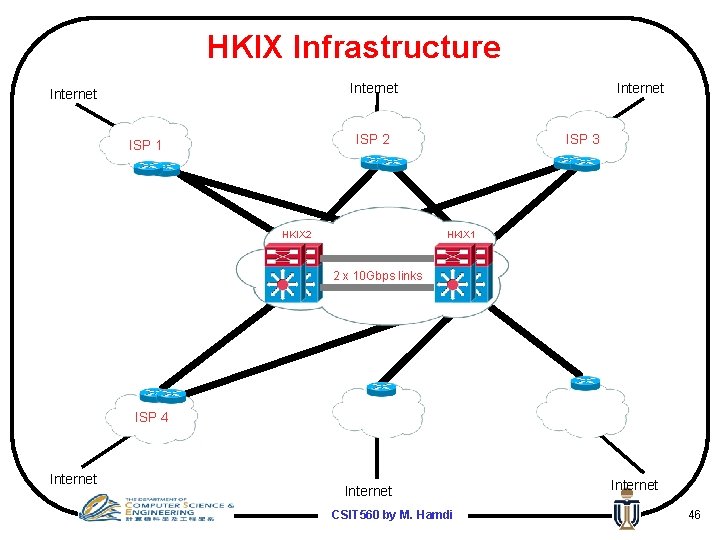
HKIX Infrastructure Internet ISP 2 ISP 1 HKIX 2 HKIX - AS 4635 ISP 3 HKIX 1 2 x 10 Gbps links ISP 4 Internet ISP 5 Internet CSIT 560 by M. Hamdi ISP 6 Internet 46
CSIT 560 by M. Hamdi 47
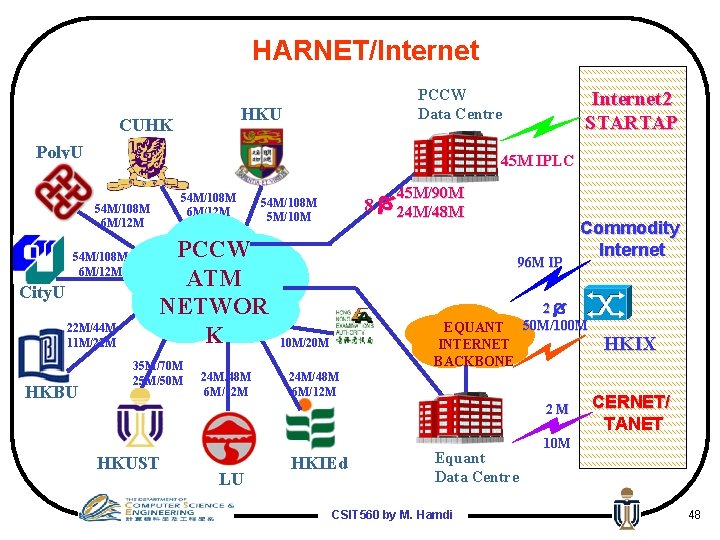
HARNET/Internet PCCW Data Centre HKU CUHK Poly. U 45 M IPLC 54 M/108 M 6 M/12 M City. U 22 M/44 M 11 M/22 M HKBU Internet 2 STARTAP PCCW ATM NETWOR K 35 M/70 M 25 M/50 M 24 M/48 M 6 M/12 M 45 M/90 M 8 24 M/48 M 54 M/108 M 5 M/10 M 96 M IP EQUANT INTERNET BACKBONE 10 M/20 M 2 50 M/100 M 24 M/48 M 6 M/12 M 2 M HKUST LU HKIEd Equant Data Centre CSIT 560 by M. Hamdi Commodity Internet HKIX CERNET/ TANET 10 M 48
Internet Architecture CSIT 560 by M. Hamdi 49
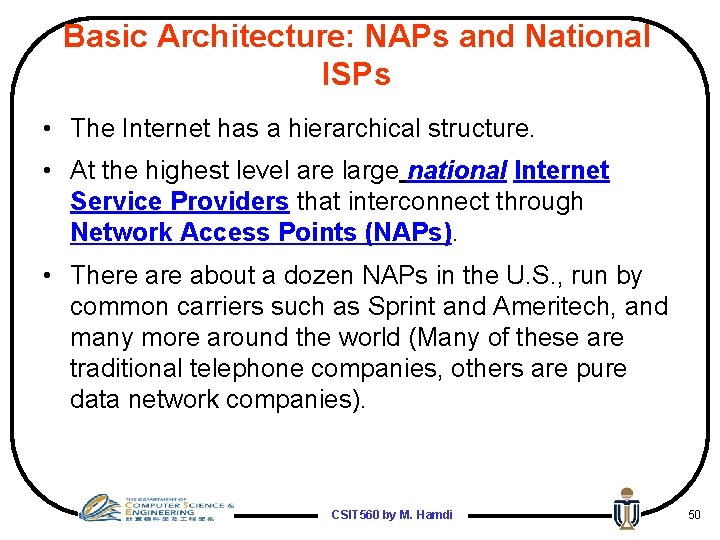
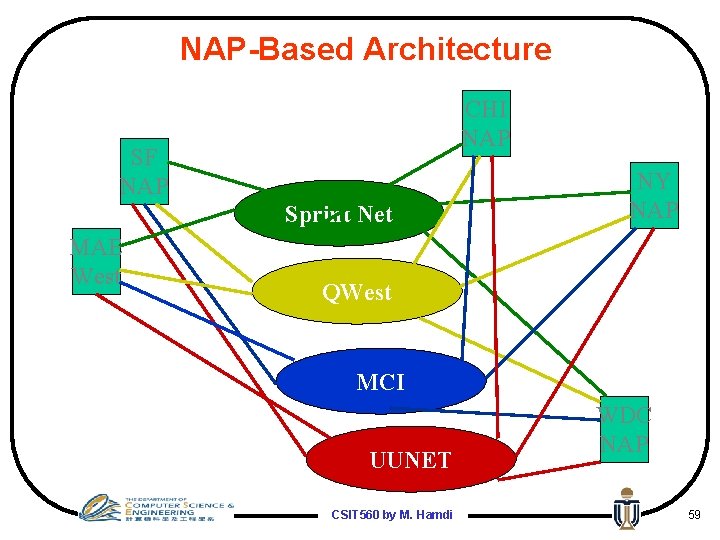
Basic Architecture: NAPs and National ISPs • The Internet has a hierarchical structure. • At the highest level are large national Internet Service Providers that interconnect through Network Access Points (NAPs). • There about a dozen NAPs in the U. S. , run by common carriers such as Sprint and Ameritech, and many more around the world (Many of these are traditional telephone companies, others are pure data network companies). CSIT 560 by M. Hamdi 50
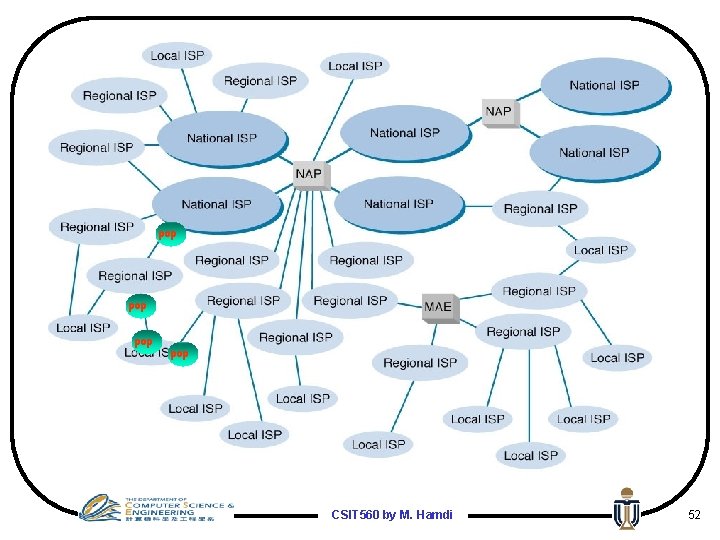
The real story… • Regional ISPs interconnect with national ISPs and provide services to their customers and sell access to local ISPs who, in turn, sell access to individuals and companies. CSIT 560 by M. Hamdi 51
pop pop CSIT 560 by M. Hamdi 52
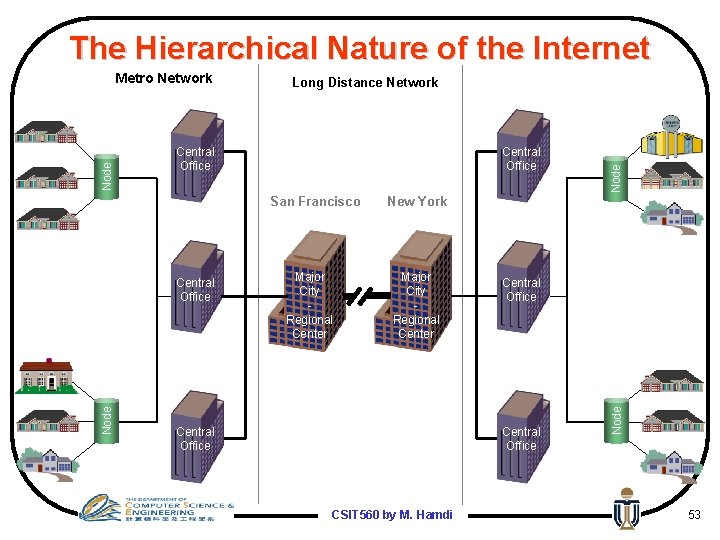
The Hierarchical Nature of the Internet Central Office San Francisco Node Central Office Major City Regional Center Node Long Distance Network New York Major City Regional Center Central Office CSIT 560 by M. Hamdi Node Metro Network 53
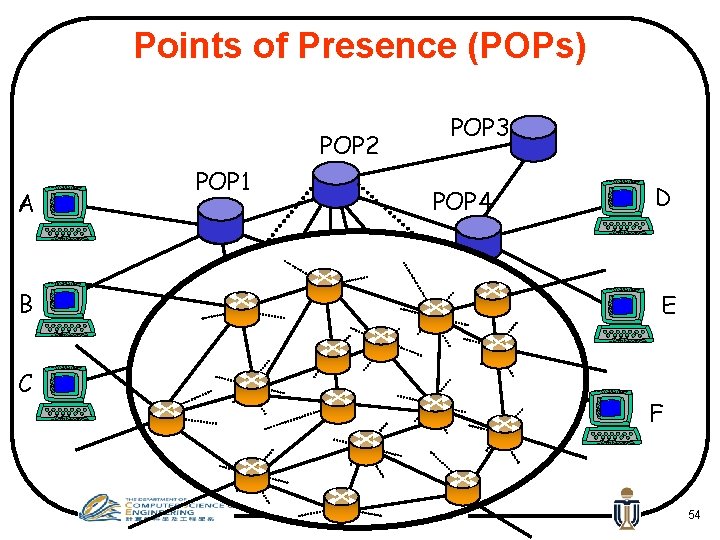
Points of Presence (POPs) POP 2 A POP 1 POP 4 B C POP 3 E POP 5 POP 6 POP 7 D POP 8 CSIT 560 by M. Hamdi F 54
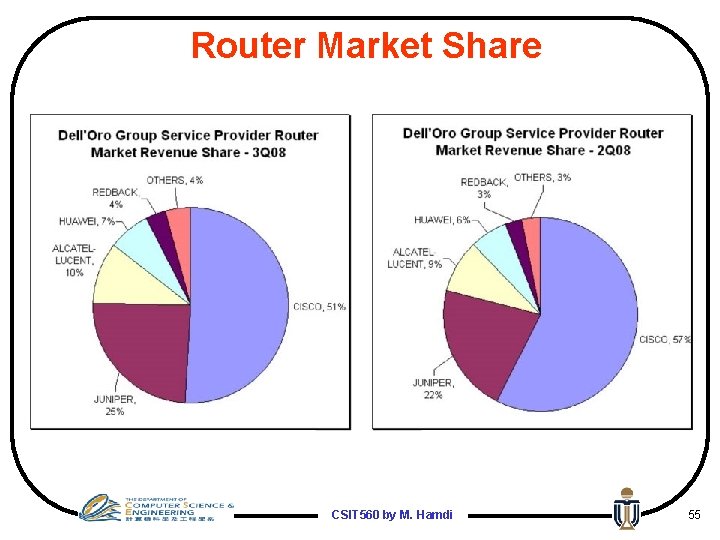
Router Market Share CSIT 560 by M. Hamdi 55
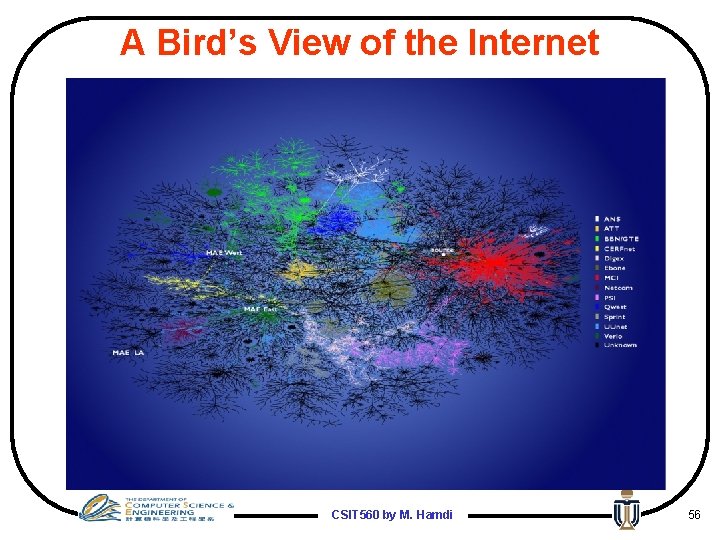
A Bird’s View of the Internet CSIT 560 by M. Hamdi 56
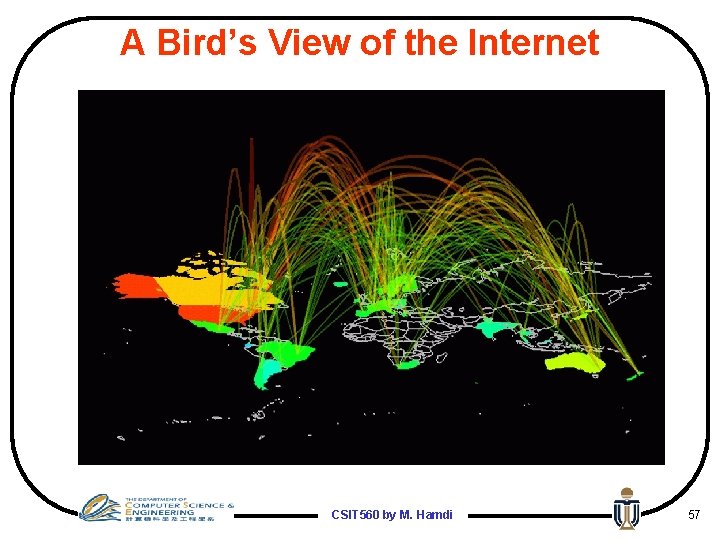
A Bird’s View of the Internet CSIT 560 by M. Hamdi 57
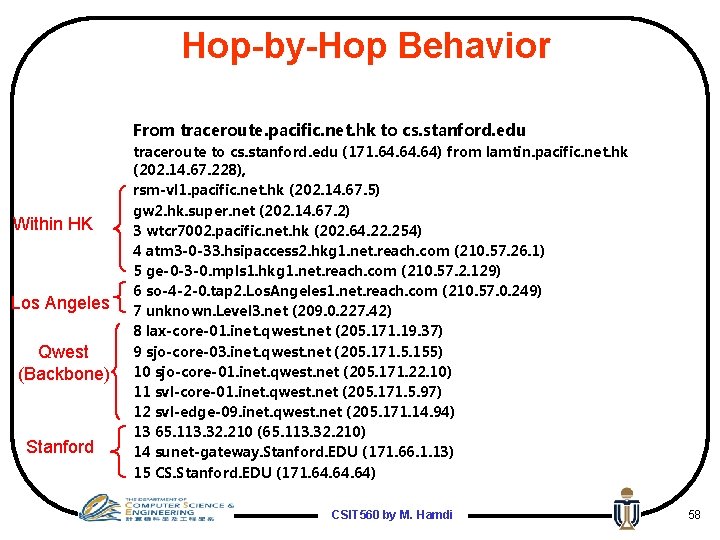
Hop-by-Hop Behavior From traceroute. pacific. net. hk to cs. stanford. edu Within HK Los Angeles Qwest (Backbone) Stanford traceroute to cs. stanford. edu (171. 64. 64) from lamtin. pacific. net. hk (202. 14. 67. 228), rsm-vl 1. pacific. net. hk (202. 14. 67. 5) gw 2. hk. super. net (202. 14. 67. 2) 3 wtcr 7002. pacific. net. hk (202. 64. 22. 254) 4 atm 3 -0 -33. hsipaccess 2. hkg 1. net. reach. com (210. 57. 26. 1) 5 ge-0 -3 -0. mpls 1. hkg 1. net. reach. com (210. 57. 2. 129) 6 so-4 -2 -0. tap 2. Los. Angeles 1. net. reach. com (210. 57. 0. 249) 7 unknown. Level 3. net (209. 0. 227. 42) 8 lax-core-01. inet. qwest. net (205. 171. 19. 37) 9 sjo-core-03. inet. qwest. net (205. 171. 5. 155) 10 sjo-core-01. inet. qwest. net (205. 171. 22. 10) 11 svl-core-01. inet. qwest. net (205. 171. 5. 97) 12 svl-edge-09. inet. qwest. net (205. 171. 14. 94) 13 65. 113. 32. 210 (65. 113. 32. 210) 14 sunet-gateway. Stanford. EDU (171. 66. 1. 13) 15 CS. Stanford. EDU (171. 64. 64) CSIT 560 by M. Hamdi 58
NAP-Based Architecture CHI NAP SF NAP Sprint Net MAE West NY NAP QWest MCI UUNET CSIT 560 by M. Hamdi WDC NAP 59
Basic Architecture: MAEs and local ISPs • As the number of ISPs has grown, a new type of network access point, called a metropolitan area exchange (MAE) has arisen. • There about 50 such MAEs around the U. S. today. • Sometimes large regional and local ISPs (AOL) also have access directly to NAPs. • It has to be approved by the other networks already connected to the NAPs – generally it is a business decision. CSIT 560 by M. Hamdi 60
Internet Packet Exchange Charges Peering • ISPs at the same level usually do not charge each other for exchanging messages. • They update their routing tables with each other customers or pop. • This is called peering. CSIT 560 by M. Hamdi 61
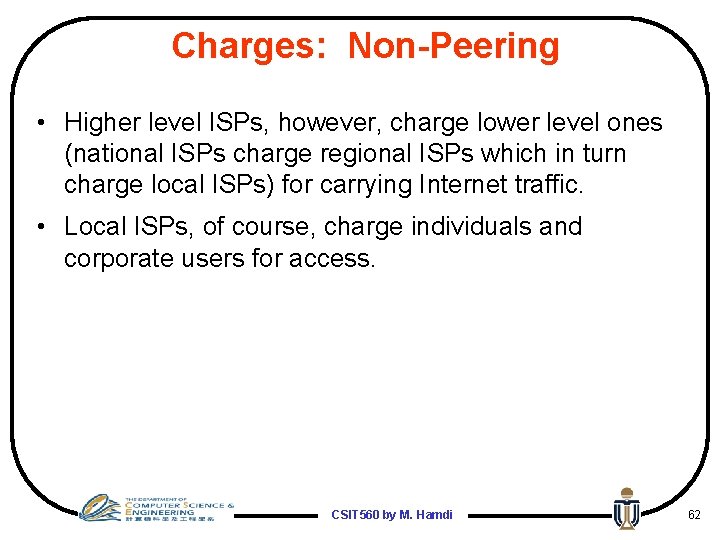
Charges: Non-Peering • Higher level ISPs, however, charge lower level ones (national ISPs charge regional ISPs which in turn charge local ISPs) for carrying Internet traffic. • Local ISPs, of course, charge individuals and corporate users for access. CSIT 560 by M. Hamdi 62
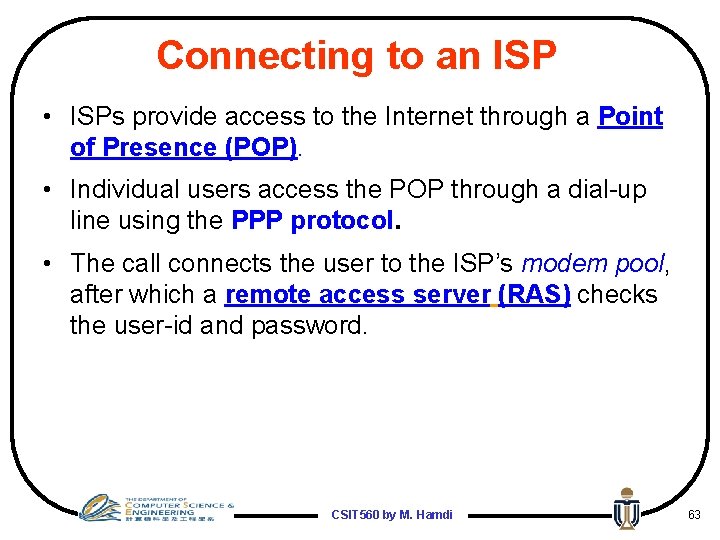
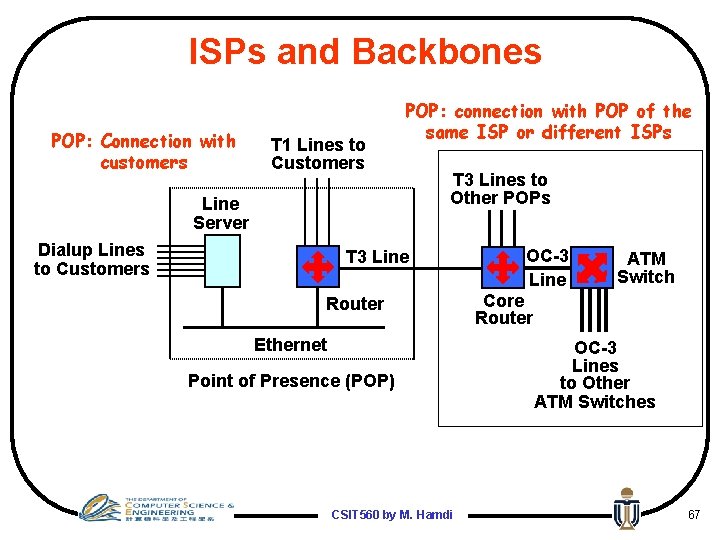
Connecting to an ISP • ISPs provide access to the Internet through a Point of Presence (POP). • Individual users access the POP through a dial-up line using the PPP protocol. • The call connects the user to the ISP’s modem pool, after which a remote access server (RAS) checks the user-id and password. CSIT 560 by M. Hamdi 63
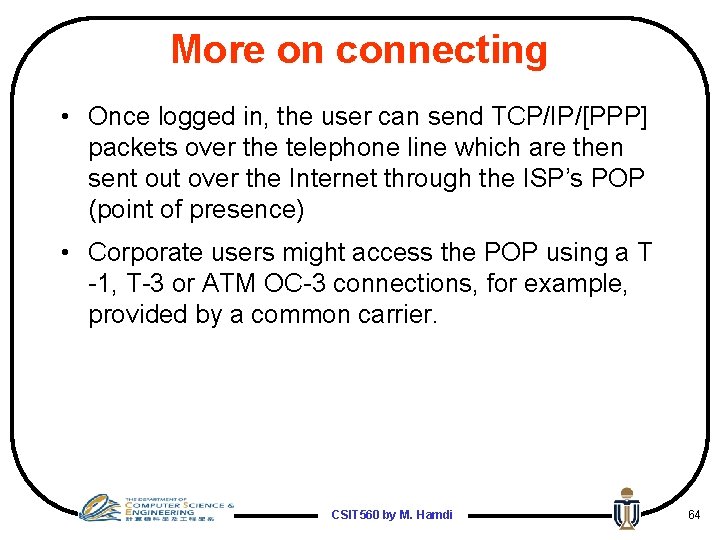
More on connecting • Once logged in, the user can send TCP/IP/[PPP] packets over the telephone line which are then sent out over the Internet through the ISP’s POP (point of presence) • Corporate users might access the POP using a T -1, T-3 or ATM OC-3 connections, for example, provided by a common carrier. CSIT 560 by M. Hamdi 64
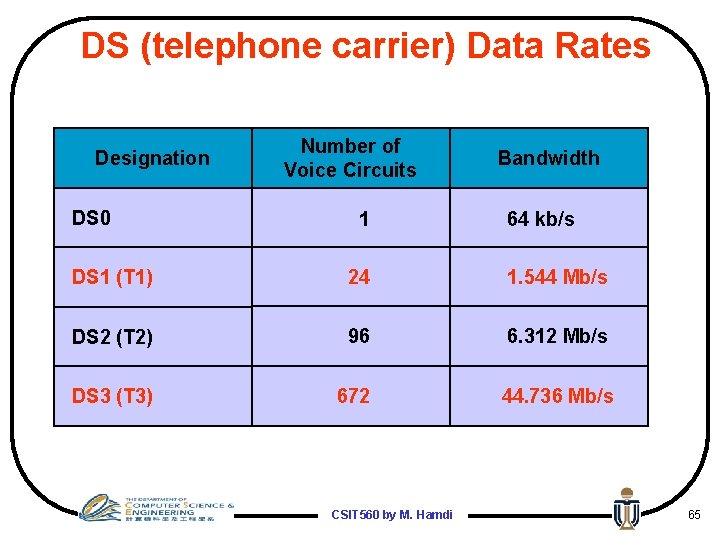
DS (telephone carrier) Data Rates Designation DS 0 Number of Voice Circuits 1 Bandwidth 64 kb/s DS 1 (T 1) 24 1. 544 Mb/s DS 2 (T 2) 96 6. 312 Mb/s DS 3 (T 3) 672 44. 736 Mb/s CSIT 560 by M. Hamdi 65
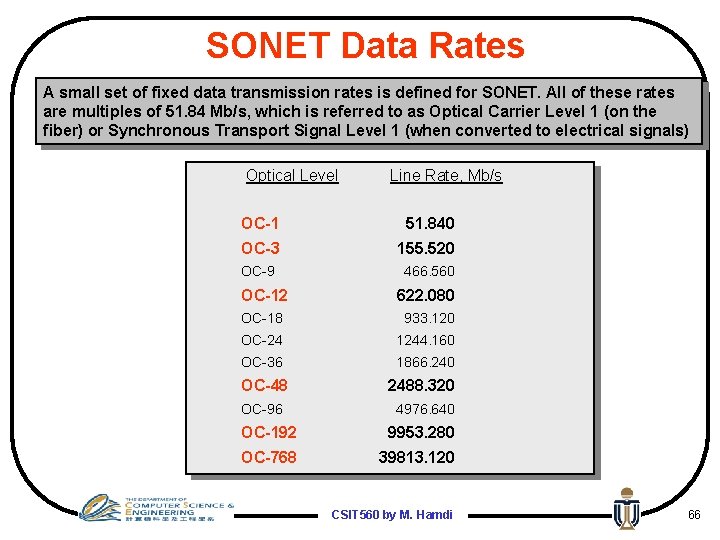
SONET Data Rates A small set of fixed data transmission rates is defined for SONET. All of these rates are multiples of 51. 84 Mb/s, which is referred to as Optical Carrier Level 1 (on the fiber) or Synchronous Transport Signal Level 1 (when converted to electrical signals) Optical Level Line Rate, Mb/s OC-1 51. 840 OC-3 155. 520 OC-9 466. 560 OC-12 622. 080 OC-18 933. 120 OC-24 1244. 160 OC-36 1866. 240 OC-48 2488. 320 OC-96 4976. 640 OC-192 9953. 280 OC-768 39813. 120 CSIT 560 by M. Hamdi 66
ISPs and Backbones POP: Connection with customers T 1 Lines to Customers POP: connection with POP of the same ISP or different ISPs Line Server Dialup Lines to Customers T 3 Lines to Other POPs T 3 Line Router Ethernet Point of Presence (POP) CSIT 560 by M. Hamdi OC-3 Line ATM Switch Core Router OC-3 Lines to Other ATM Switches 67
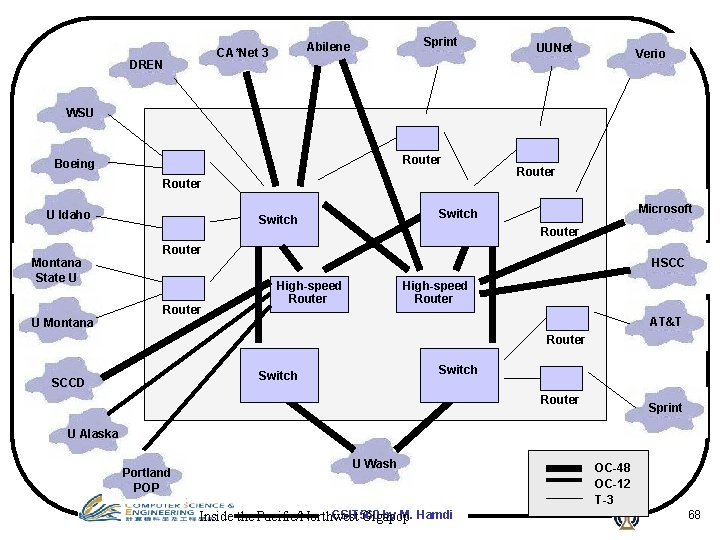
DREN Sprint Abilene CA*Net 3 UUNet Verio WSU Router Boeing Router U Idaho Montana State U U Montana Router Microsoft Switch Router HSCC High-speed Router AT&T Router Switch SCCD Router Sprint U Alaska Portland POP U Wash CSIT 560 by M. Hamdi Inside the Pacific/Northwest Gigapop OC-48 OC-12 T-3 68
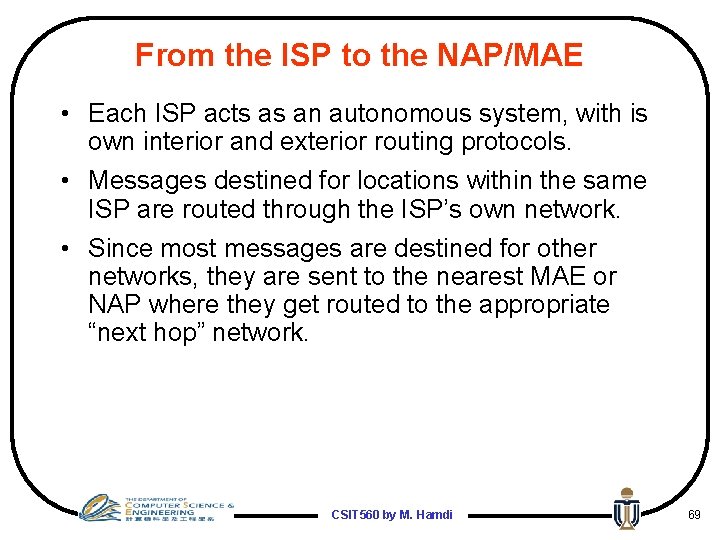
From the ISP to the NAP/MAE • Each ISP acts as an autonomous system, with is own interior and exterior routing protocols. • Messages destined for locations within the same ISP are routed through the ISP’s own network. • Since most messages are destined for other networks, they are sent to the nearest MAE or NAP where they get routed to the appropriate “next hop” network. CSIT 560 by M. Hamdi 69
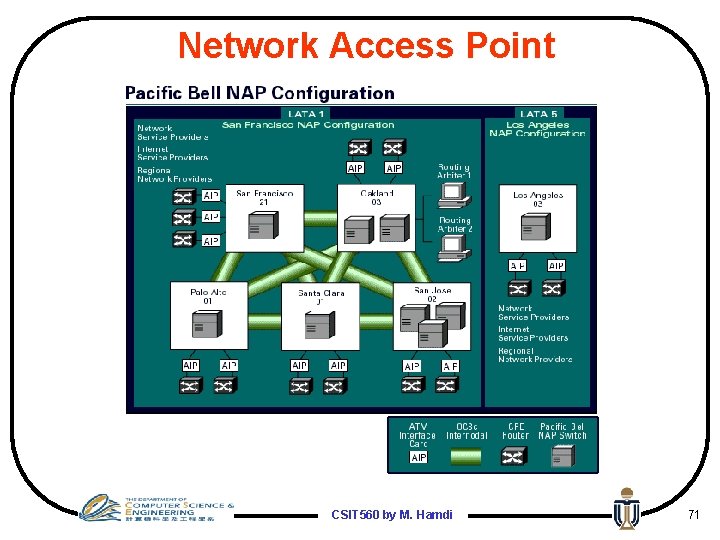
From the ISP to the NAP/MAE • Next is the connection from the local ISP to the NAP. From there packets are routed to the next higher level of ISP. • Actual connections can be complex and packets sometimes travel long distances. Each local ISP might connect a different regional ISP, causing packets to flow between cities, even though their destination is to another local ISP within the same city. CSIT 560 by M. Hamdi 70
Network Access Point CSIT 560 by M. Hamdi 71
ISPs and Backbones POP POP POP ATM/SONET Core POP POP Router Core POP POP Access Network CSIT 560 by M. Hamdi POP 72
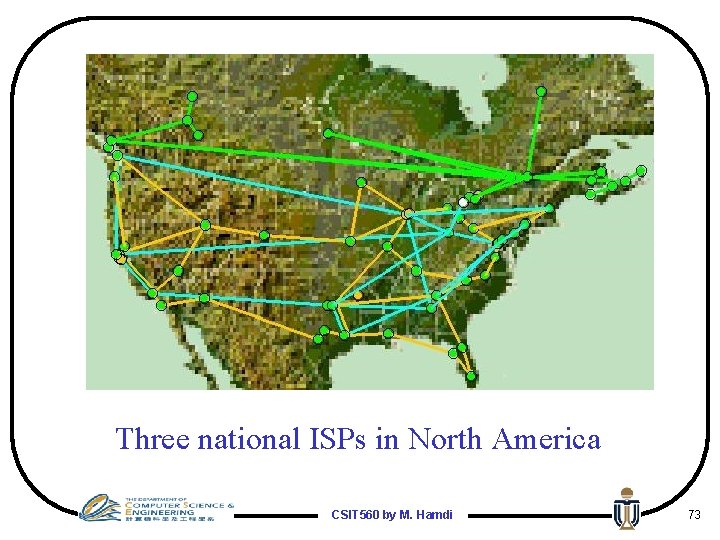
Three national ISPs in North America CSIT 560 by M. Hamdi 73
Backbone Map of UUNET - USA CSIT 560 by M. Hamdi 74
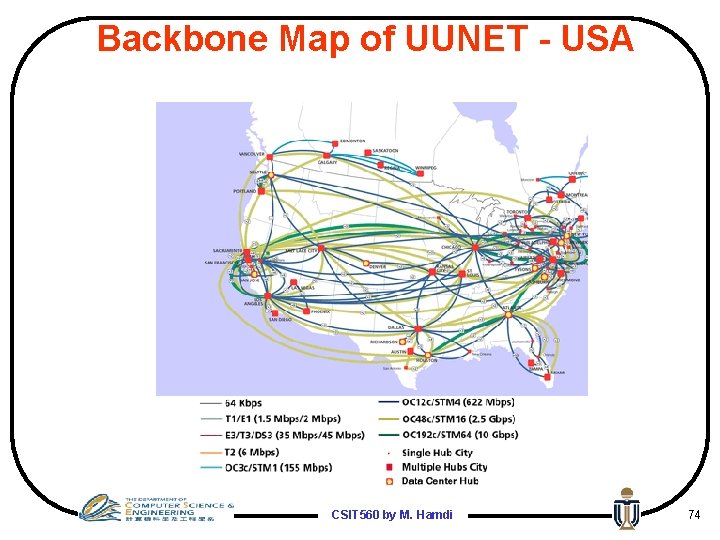
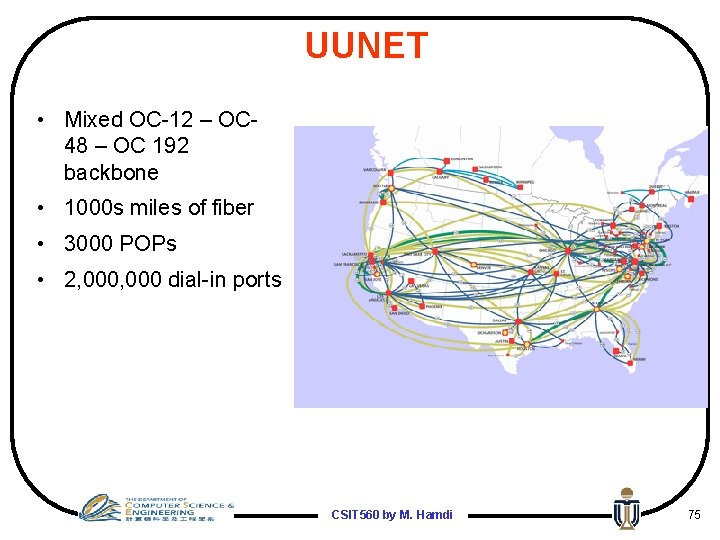
UUNET • Mixed OC-12 – OC 48 – OC 192 backbone • 1000 s miles of fiber • 3000 POPs • 2, 000 dial-in ports CSIT 560 by M. Hamdi 75
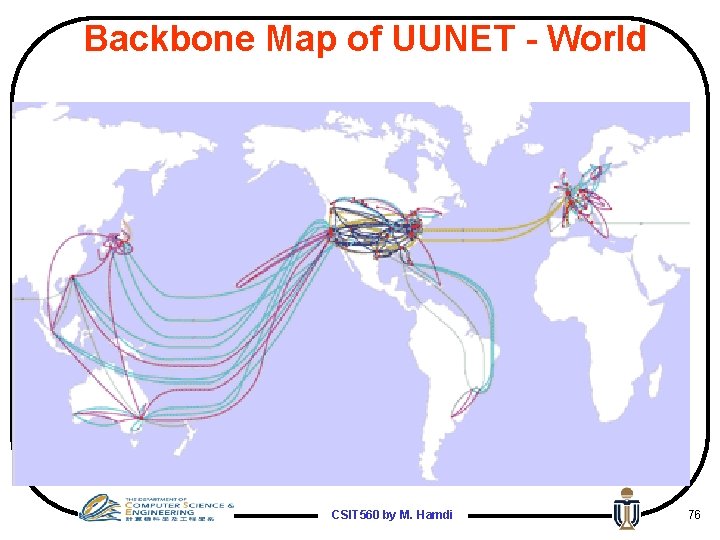
Backbone Map of UUNET - World CSIT 560 by M. Hamdi 76
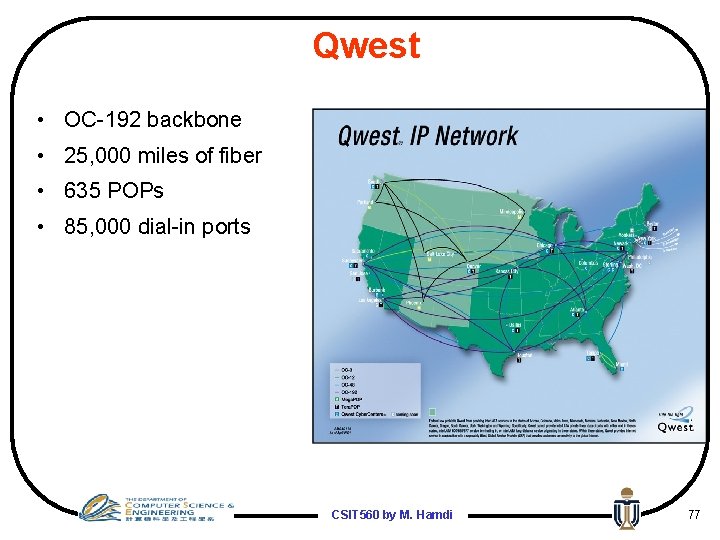
Qwest • OC-192 backbone • 25, 000 miles of fiber • 635 POPs • 85, 000 dial-in ports CSIT 560 by M. Hamdi 77
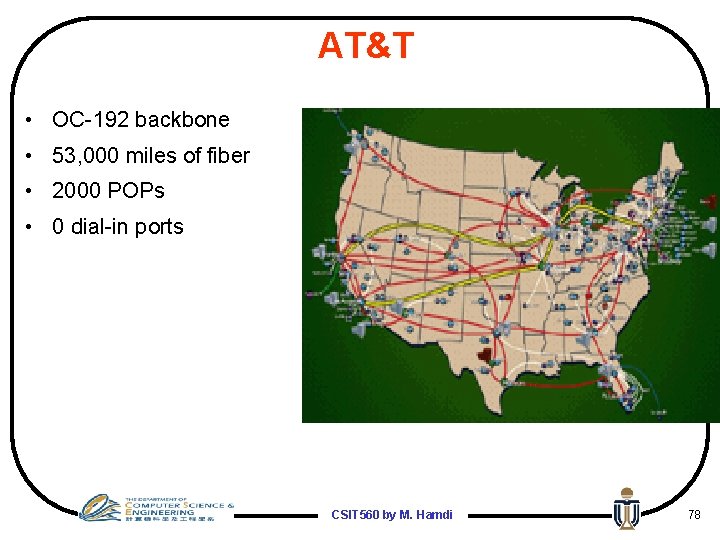
AT&T • OC-192 backbone • 53, 000 miles of fiber • 2000 POPs • 0 dial-in ports CSIT 560 by M. Hamdi 78
Internet Backbones after 2006 • As of mid-2001, most backbone circuits for national ISPs in the US are 622 Mbps ATM OC-12 lines. • The largest national ISPs converted to OC-192 (10 Gbps) by the end of 2005. • Many are now experimenting with OC-768 (40 Gbps) and some are planning to use OC-3072 (160 Gbps). • Aggregate Internet traffic reached 2. 5 Terabits per second (Tbps) by mid-2001. It is expected to reach 100 Tbps by 2011. CSIT 560 by M. Hamdi 79
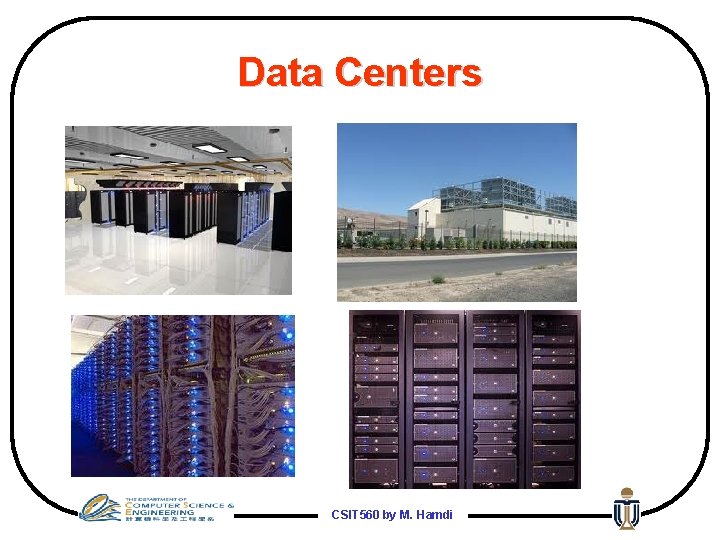
Data Centers CSIT 560 by M. Hamdi
Links for Long Haul Transmission • Possibilities – IP over SONET – IP over ATM – IP over Satellite – IP over WDM CSIT 560 by M. Hamdi 81
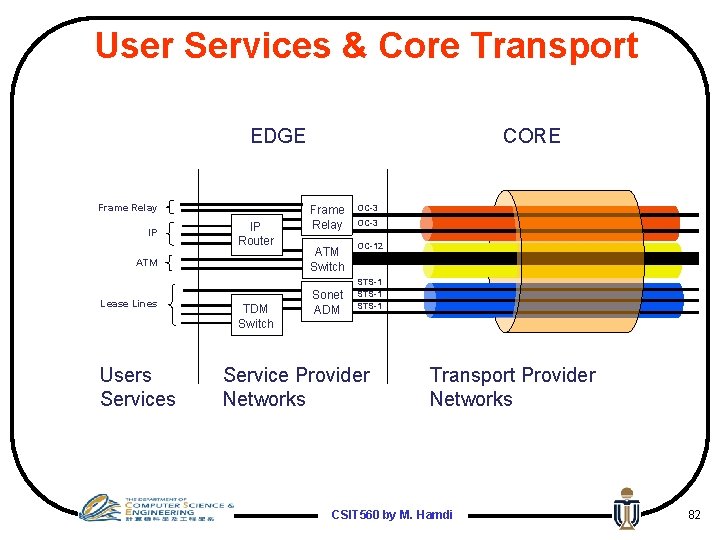
User Services & Core Transport EDGE Frame Relay IP IP Router CORE Frame Relay ATM Switch Lease Lines Sonet ADM Users Services TDM Switch OC-3 OC-12 STS-1 Service Provider Networks Transport Provider Networks CSIT 560 by M. Hamdi 82
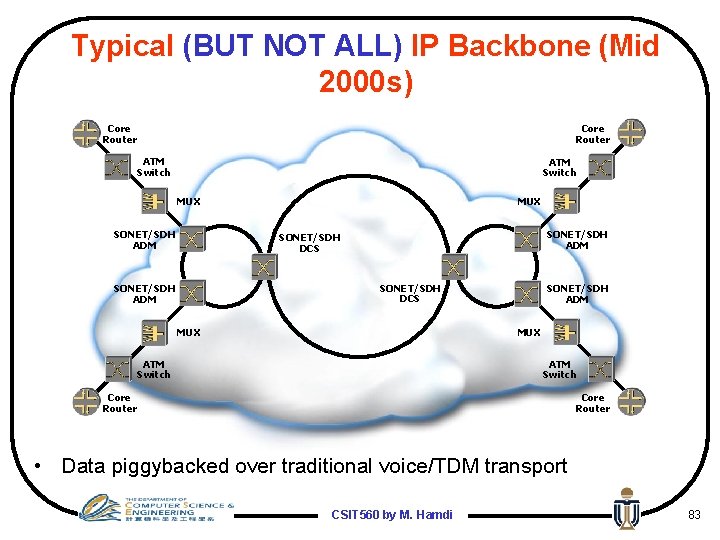
Typical (BUT NOT ALL) IP Backbone (Mid 2000 s) Core Router ATM Switch MUX SONET/SDH ADM SONET/SDH DCS SONET/SDH ADM MUX ATM Switch Core Router • Data piggybacked over traditional voice/TDM transport CSIT 560 by M. Hamdi 83
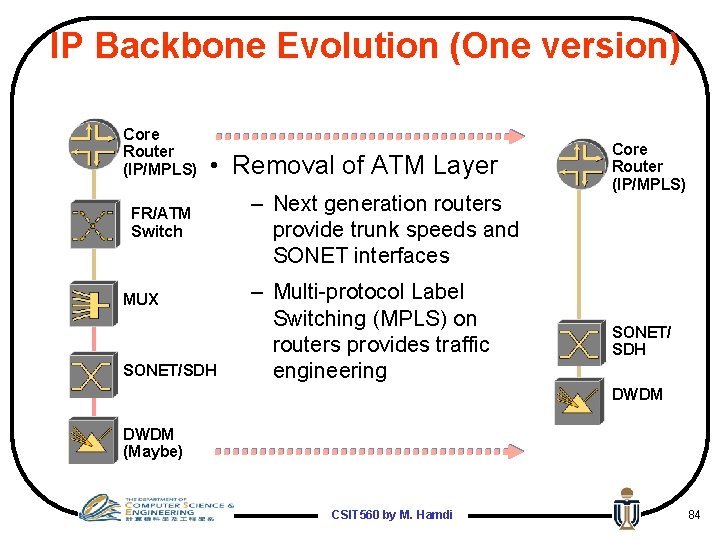
IP Backbone Evolution (One version) Core Router (IP/MPLS) • Removal of ATM Layer FR/ATM Switch MUX SONET/SDH – Next generation routers provide trunk speeds and SONET interfaces – Multi-protocol Label Switching (MPLS) on routers provides traffic engineering Core Router (IP/MPLS) SONET/ SDH DWDM (Maybe) CSIT 560 by M. Hamdi 84
Hierarchy of Routers and Switches Core IP Router FR/ATM Switch SONET/SDH • IP Router (datagram packet switching) • Deals directly with IP addresses; • Slow – typically no interface to SONET equipment • Expensive • Efficient (No header overhead and alternative routing) • ATM Switch (VC packet switching) • Label based switching • Fast (Hardware forwarding) • Header Tax • SONET OXC (Circuit switching) • Extremely fast – Optical technology • Inexpensive CSIT 560 by M. Hamdi 85
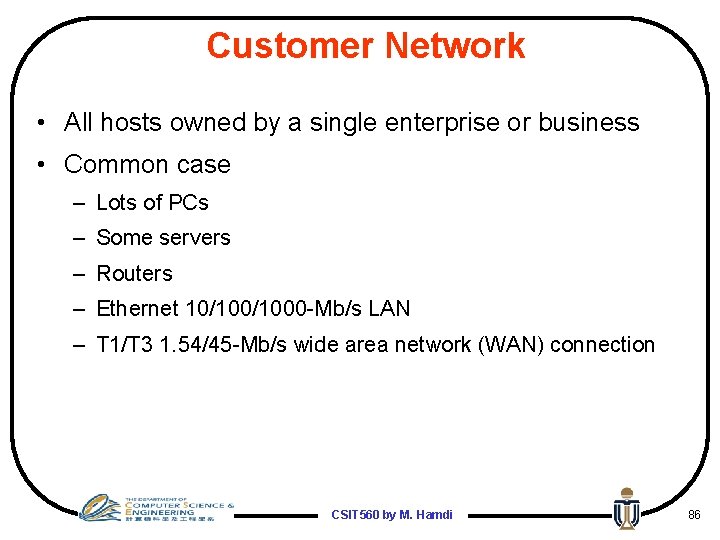
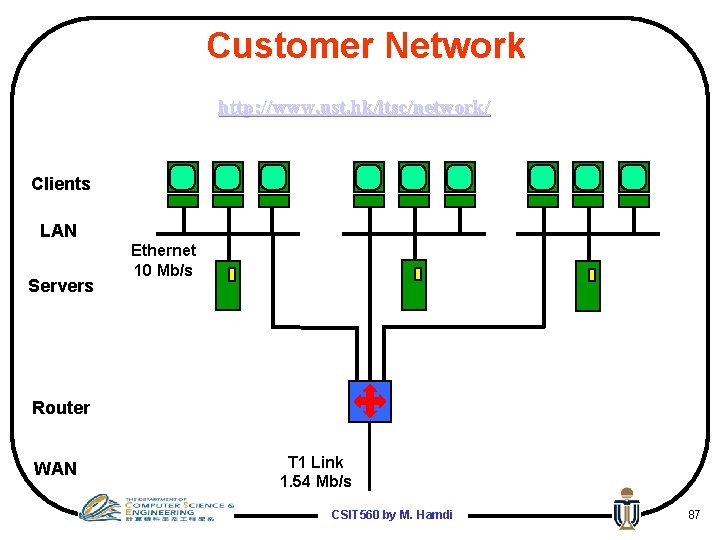
Customer Network • All hosts owned by a single enterprise or business • Common case – Lots of PCs – Some servers – Routers – Ethernet 10/1000 -Mb/s LAN – T 1/T 3 1. 54/45 -Mb/s wide area network (WAN) connection CSIT 560 by M. Hamdi 86
Customer Network http: //www. ust. hk/itsc/network/ Clients LAN Servers Ethernet 10 Mb/s Router WAN T 1 Link 1. 54 Mb/s CSIT 560 by M. Hamdi 87
Internet Access Technologies CSIT 560 by M. Hamdi 88
Internet Access Technologies • Previously, most people use 56 K dial-up lines to access the Internet, but a number of new access technologies are now being offered. • The main new access technologies are: – Digital Subscriber Line/ADSL – Cable Modems – Fixed Wireless (including satellite access) – Mobile Wireless (WAP) CSIT 560 by M. Hamdi 89
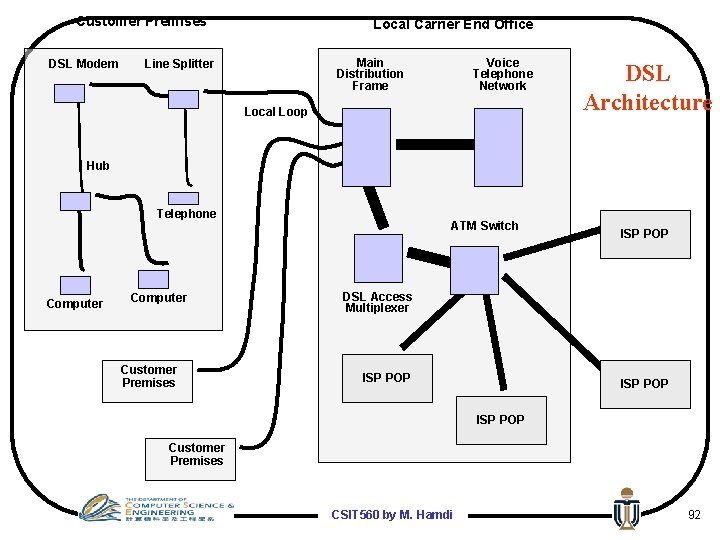
Digital Subscriber Line • Digital Subscriber Line (DSL) is one of the most used technologies now being implemented to significantly increase the data rates over traditional telephone lines. • Historically, voice telephone circuits have had only a limited capacity for data communications because they were constrained by the 4 k. Hz bandwidth voice channel. • Most local loop telephone lines actually have a much higher bandwidth and can therefore carry data at much higher rates. CSIT 560 by M. Hamdi 90
Digital Subscriber Line • DSL services are relatively new and not all common carriers offer them. • Two general categories of DSL services have emerged in the marketplace. – Symmetric DSL (SDSL) provides the same transmission rates (up to 128 Kbps) in both directions on the circuits. – Asymmetric DSL (ADSL) provides different data rates to (up to 640 Kbps) and from (up to 6. 144 Mbps) the carrier’s end office. It also includes an analog channel for voice transmissions. CSIT 560 by M. Hamdi 91
Customer Premises DSL Modem Local Carrier End Office Main Distribution Frame Line Splitter Voice Telephone Network Local Loop DSL Architecture Hub Telephone Computer Customer Premises ATM Switch ISP POP DSL Access Multiplexer ISP POP Customer Premises CSIT 560 by M. Hamdi 92
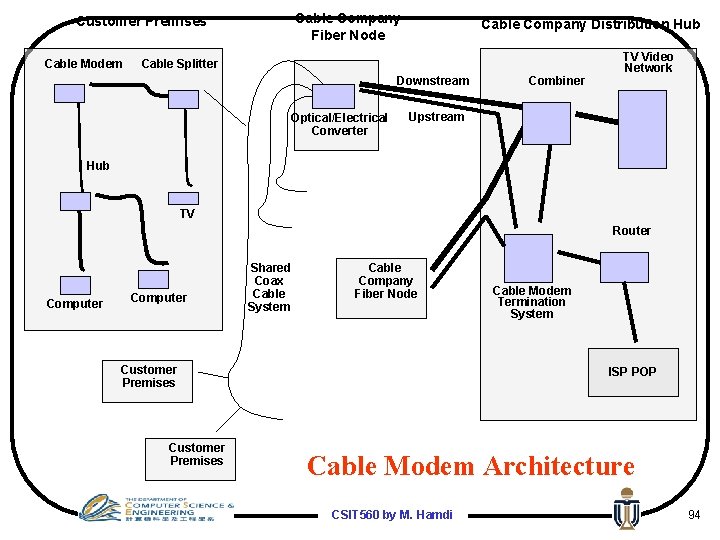
Cable Modems • One potential competitor to DSL is the “cable modem” a digital service offered by cable television companies which offers an upstream rate of 1. 5 -10 Mbps and a downstream rate of 2 -30 Mbps. • A few cable companies offer downstream services only, with upstream communications using regular telephone lines. CSIT 560 by M. Hamdi 93
Cable Company Fiber Node Customer Premises Cable Modem Cable Company Distribution Hub Cable Splitter Downstream Optical/Electrical Converter Combiner TV Video Network Upstream Hub TV Router Computer Shared Coax Cable System Cable Company Fiber Node Customer Premises Cable Modem Termination System ISP POP Cable Modem Architecture CSIT 560 by M. Hamdi 94
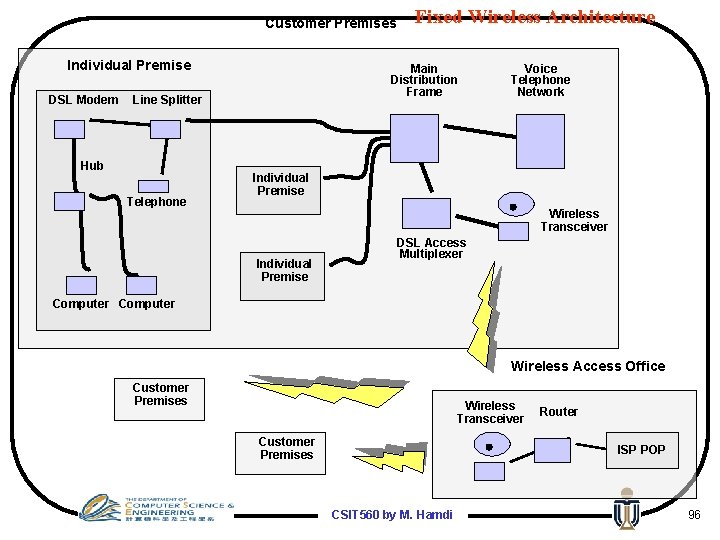
Fixed Wireless • Fixed Wireless is another “dish-based” microwave transmission technology. • It requires “line of sight” access between transmitters. • Data access speeds range from 1. 5 to 11 Mbps depending on the vendor. • Transmissions travel between transceivers at the customer premises and ISP’s wireless access office. CSIT 560 by M. Hamdi 95
Customer Premises Individual Premise DSL Modem Main Distribution Frame Line Splitter Hub Telephone Fixed Wireless Architecture Voice Telephone Network Individual Premise Wireless Transceiver Individual Premise DSL Access Multiplexer Computer Wireless Access Office Customer Premises Wireless Transceiver Customer Premises Router ISP POP CSIT 560 by M. Hamdi 96
Classifying Computer Networks CSIT 560 by M. Hamdi 97
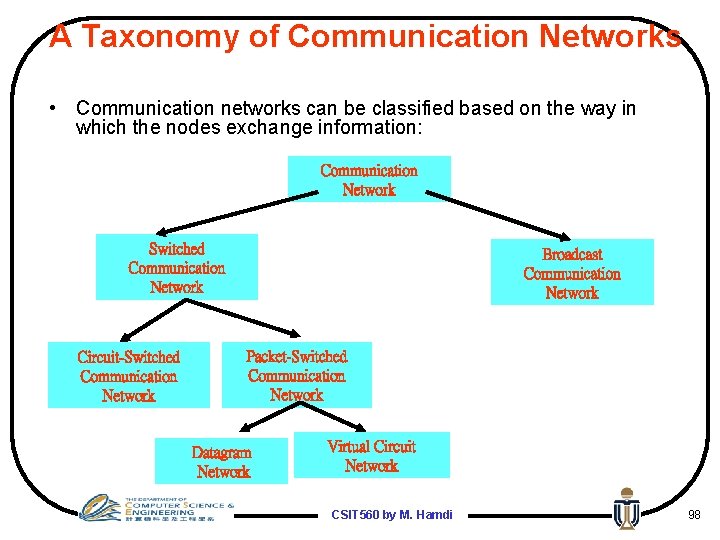
A Taxonomy of Communication Networks • Communication networks can be classified based on the way in which the nodes exchange information: Communication Network Switched Communication Network Circuit-Switched Communication Network Broadcast Communication Network Packet-Switched Communication Network Datagram Network Virtual Circuit Network CSIT 560 by M. Hamdi 98
Broadcast vs. Switched Communication Networks • Broadcast communication networks – information transmitted by any node is received by every other node in the network • examples: usually in LANs (Ethernet, Wavelan) – Problem: coordinate the access of all nodes to the shared communication medium (Multiple Access Problem) • Switched communication networks – information is transmitted to a sub-set of designated nodes • examples: WANs (Telephony Network, Internet) – Problem: how to forward information to intended node(s) • this is done by special nodes (e. g. , routers, switches) running routing protocols CSIT 560 by M. Hamdi 99
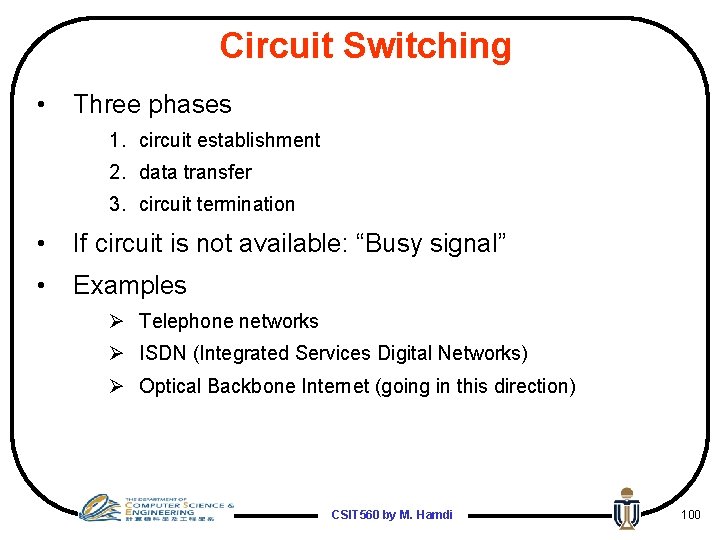
Circuit Switching • Three phases 1. circuit establishment 2. data transfer 3. circuit termination • If circuit is not available: “Busy signal” • Examples Ø Telephone networks Ø ISDN (Integrated Services Digital Networks) Ø Optical Backbone Internet (going in this direction) CSIT 560 by M. Hamdi 100
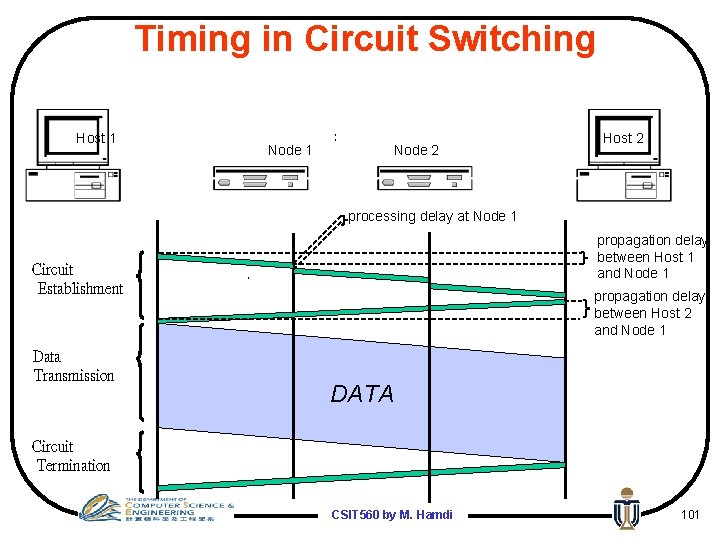
Timing in Circuit Switching Host 1 Node 2 Host 2 processing delay at Node 1 propagation delay between Host 1 and Node 1 Circuit Establishment Data Transmission propagation delay between Host 2 and Node 1 DATA Circuit Termination CSIT 560 by M. Hamdi 101
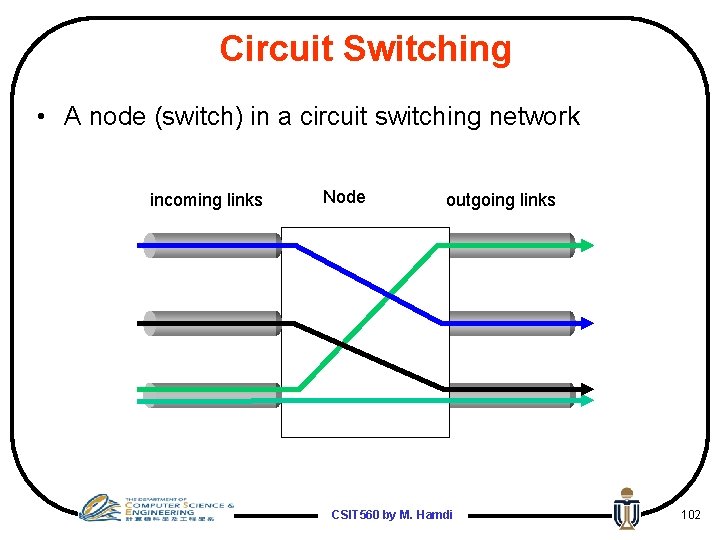
Circuit Switching • A node (switch) in a circuit switching network incoming links Node outgoing links CSIT 560 by M. Hamdi 102
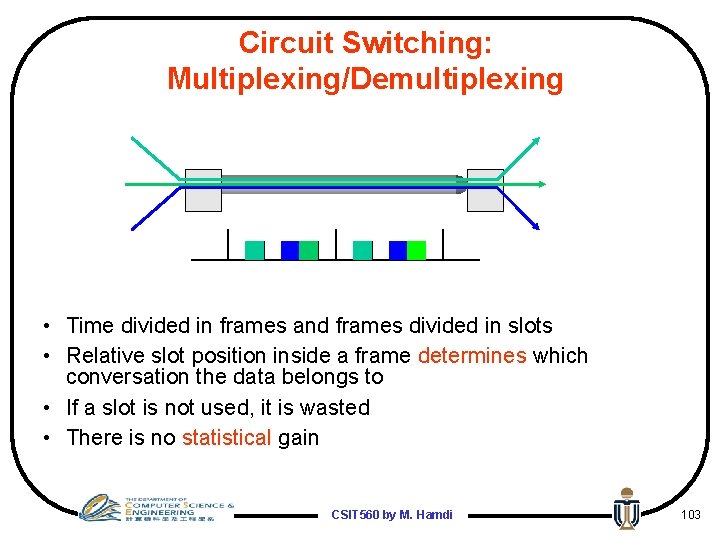
Circuit Switching: Multiplexing/Demultiplexing • Time divided in frames and frames divided in slots • Relative slot position inside a frame determines which conversation the data belongs to • If a slot is not used, it is wasted • There is no statistical gain CSIT 560 by M. Hamdi 103
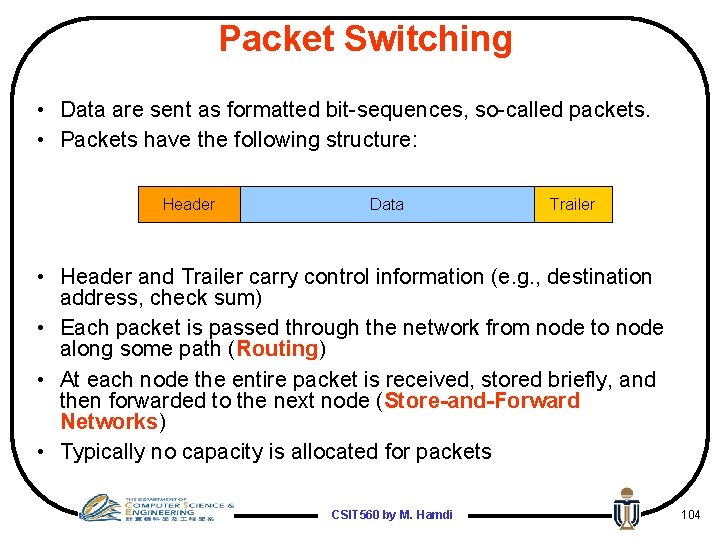
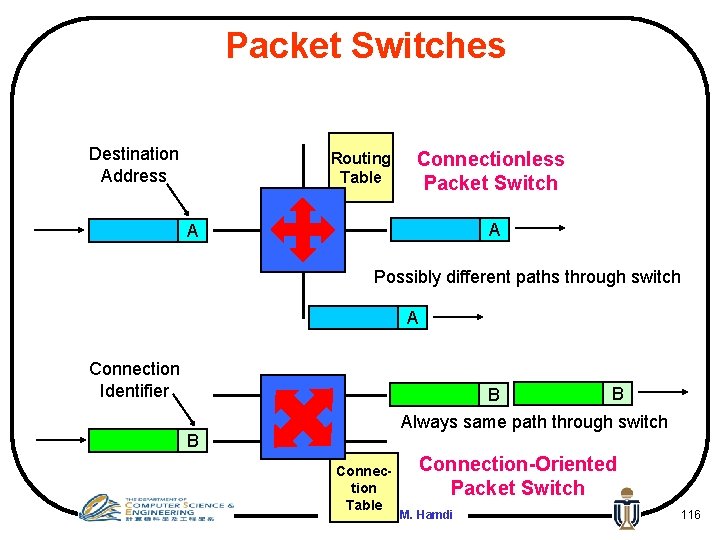
Packet Switching • Data are sent as formatted bit-sequences, so-called packets. • Packets have the following structure: Header Data Trailer • Header and Trailer carry control information (e. g. , destination address, check sum) • Each packet is passed through the network from node to node along some path (Routing) • At each node the entire packet is received, stored briefly, and then forwarded to the next node (Store-and-Forward Networks) • Typically no capacity is allocated for packets CSIT 560 by M. Hamdi 104
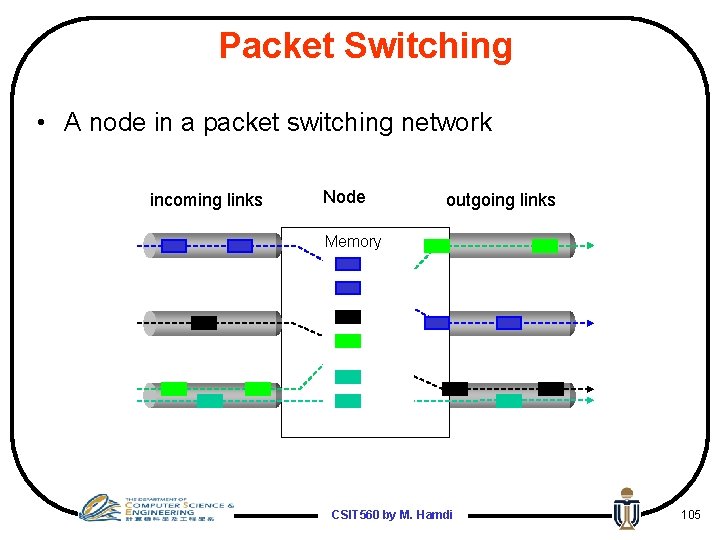
Packet Switching • A node in a packet switching network incoming links Node outgoing links Memory CSIT 560 by M. Hamdi 105
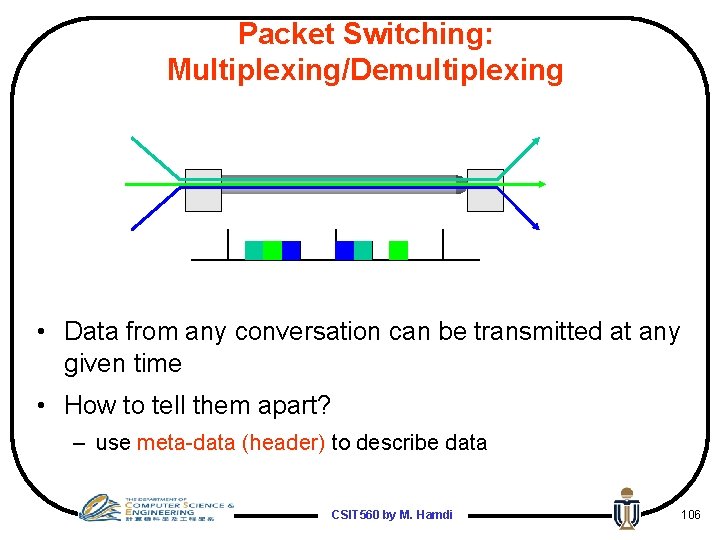
Packet Switching: Multiplexing/Demultiplexing • Data from any conversation can be transmitted at any given time • How to tell them apart? – use meta-data (header) to describe data CSIT 560 by M. Hamdi 106
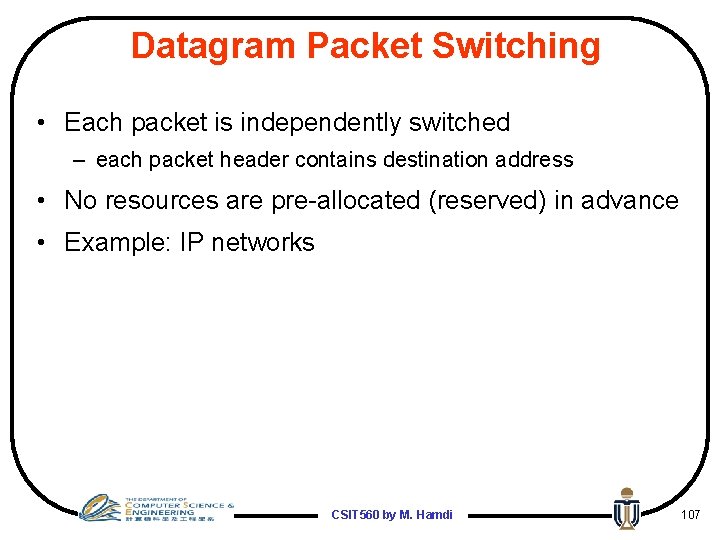
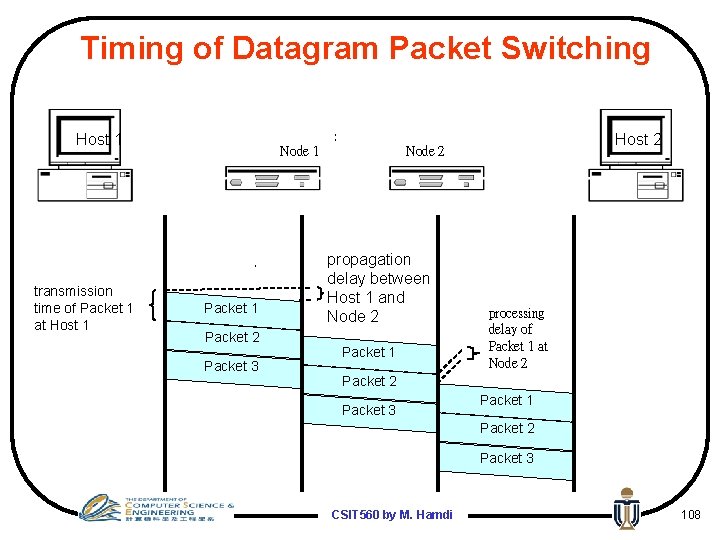
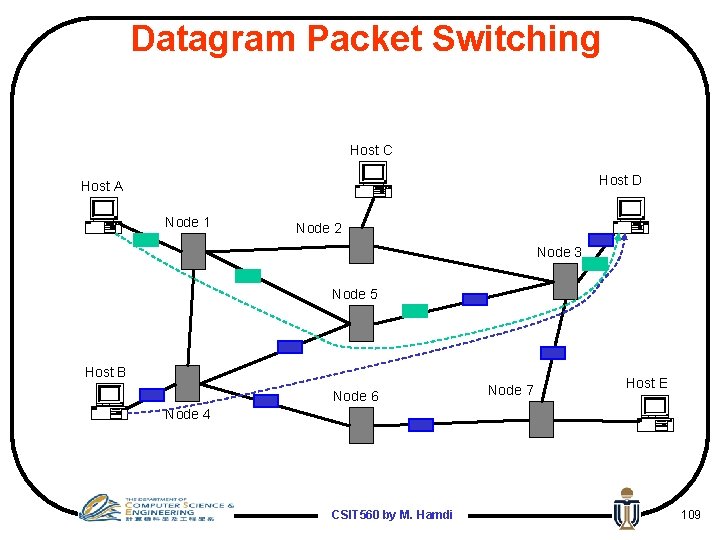
Datagram Packet Switching • Each packet is independently switched – each packet header contains destination address • No resources are pre-allocated (reserved) in advance • Example: IP networks CSIT 560 by M. Hamdi 107
Timing of Datagram Packet Switching Host 1 transmission time of Packet 1 at Host 1 Node 1 Packet 2 Packet 3 Host 2 Node 2 propagation delay between Host 1 and Node 2 Packet 1 processing delay of Packet 1 at Node 2 Packet 3 Packet 1 Packet 2 Packet 3 CSIT 560 by M. Hamdi 108
Datagram Packet Switching Host C Host D Host A Node 1 Node 2 Node 3 Node 5 Host B Node 6 Node 7 Host E Node 4 CSIT 560 by M. Hamdi 109
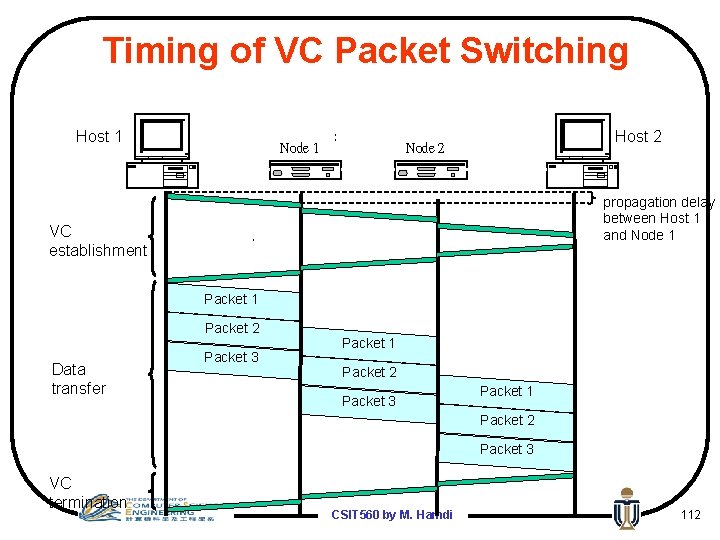
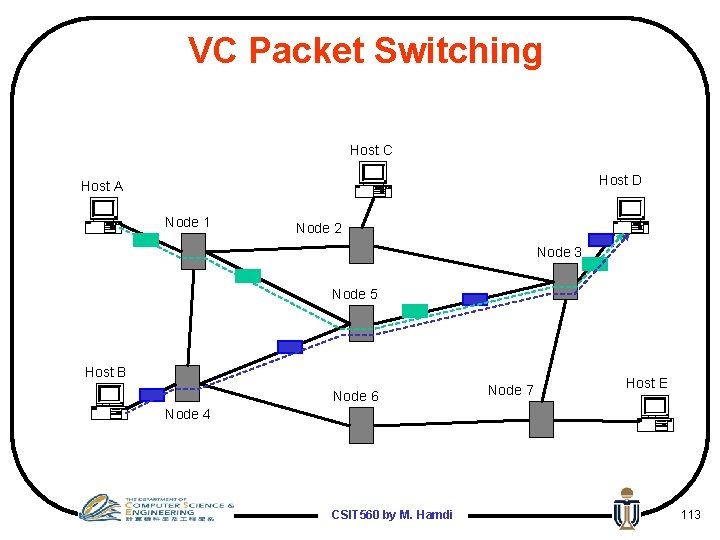
Virtual-Circuit Packet Switching • Hybrid of circuit switching and packet switching – data is transmitted as packets – all packets from one packet stream are sent along a preestablished path (=virtual circuit) • Guarantees in-sequence delivery of packets • However: Packets from different virtual circuits may be interleaved • Example: ATM networks CSIT 560 by M. Hamdi 110
Virtual-Circuit Packet Switching • Communication using virtual circuits takes place in three phases 1. VC establishment 2. data transfer 3. VC disconnect • Note: packet headers don’t need to contain the full destination address of the packet (One key to this idea) CSIT 560 by M. Hamdi 111
Timing of VC Packet Switching Host 1 Node 1 Host 2 Node 2 propagation delay between Host 1 and Node 1 VC establishment Packet 1 Packet 2 Data transfer Packet 3 Packet 1 Packet 2 Packet 3 VC termination CSIT 560 by M. Hamdi 112
VC Packet Switching Host C Host D Host A Node 1 Node 2 Node 3 Node 5 Host B Node 6 Node 7 Host E Node 4 CSIT 560 by M. Hamdi 113
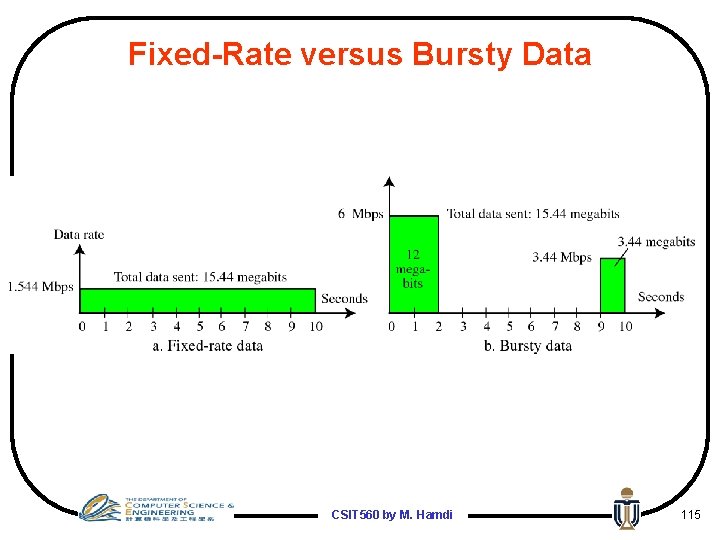
Packet-Switching vs. Circuit-Switching • Most important advantage of packet-switching over circuit switching: Ability to exploit statistical multiplexing: – efficient bandwidth usage; ratio between peek and average rate is 3: 1 for audio, and 15: 1 for data traffic • However, packet-switching needs to deal with congestion: – more complex routers – harder to provide good network services (e. g. , delay and bandwidth guarantees) • In practice they are combined – IP over SONET, IP over Frame Relay CSIT 560 by M. Hamdi 114
Fixed-Rate versus Bursty Data CSIT 560 by M. Hamdi 115
Packet Switches Destination Address Routing Table Connectionless Packet Switch A A Possibly different paths through switch A Connection Identifier B B Always same path through switch B Connection Table Connection-Oriented Packet Switch CSIT 560 by M. Hamdi 116
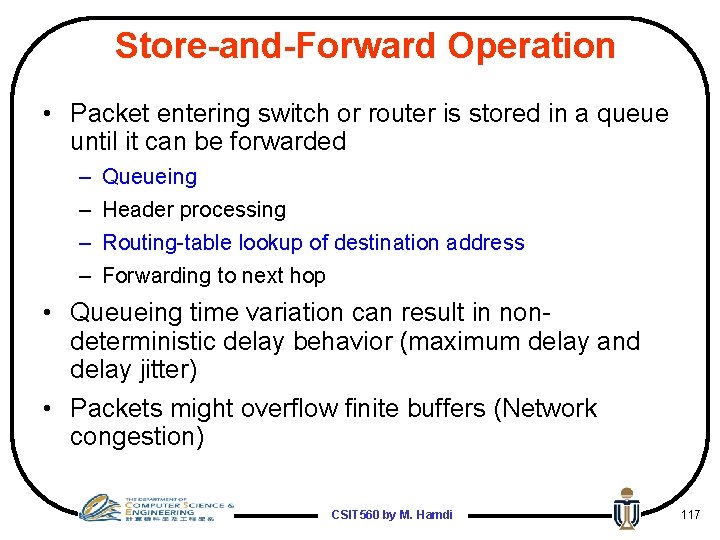
Store-and-Forward Operation • Packet entering switch or router is stored in a queue until it can be forwarded – – Queueing Header processing Routing-table lookup of destination address Forwarding to next hop • Queueing time variation can result in nondeterministic delay behavior (maximum delay and delay jitter) • Packets might overflow finite buffers (Network congestion) CSIT 560 by M. Hamdi 117
Link Diversity • Internet meant to accommodate many different link technologies – Ethernet – ATM – SONET – ISDN – Modem • The list continues to grow • “IP on Everything” CSIT 560 by M. Hamdi 118
Internet Protocols CSIT 560 by M. Hamdi 119
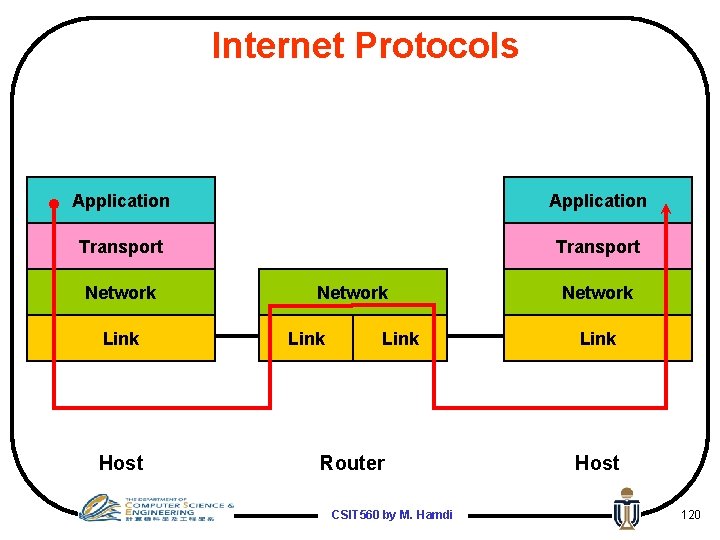
Internet Protocols Application Transport Network Link Host Network Link Router CSIT 560 by M. Hamdi Network Link Host 120
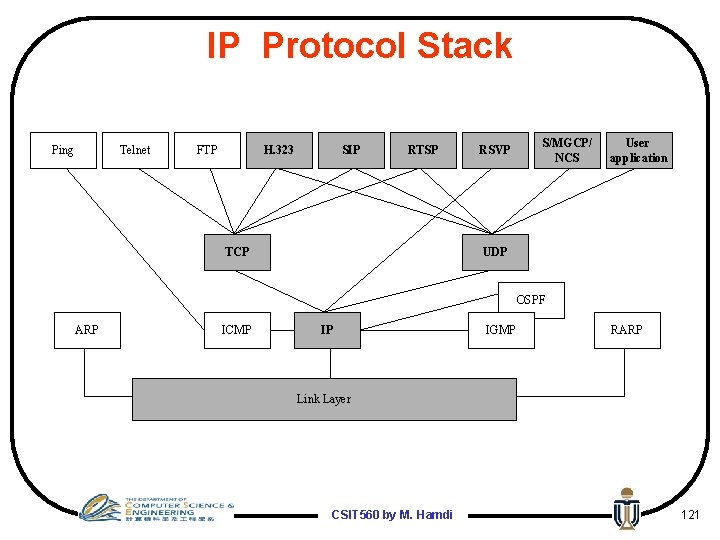
IP Protocol Stack Ping Telnet FTP H. 323 SIP RTSP TCP RSVP S/MGCP/ NCS User application UDP OSPF ARP ICMP IP IGMP RARP Link Layer CSIT 560 by M. Hamdi 121
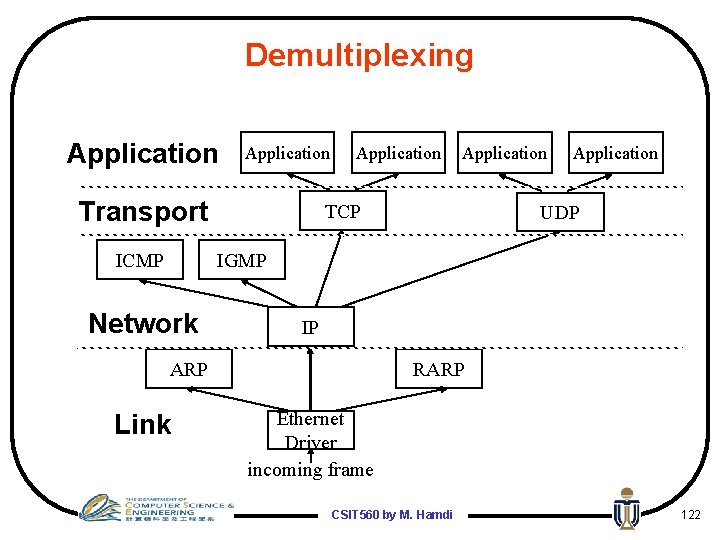
Demultiplexing Application Transport ICMP Application TCP Application UDP IGMP Network IP ARP Link RARP Ethernet Driver incoming frame CSIT 560 by M. Hamdi 122
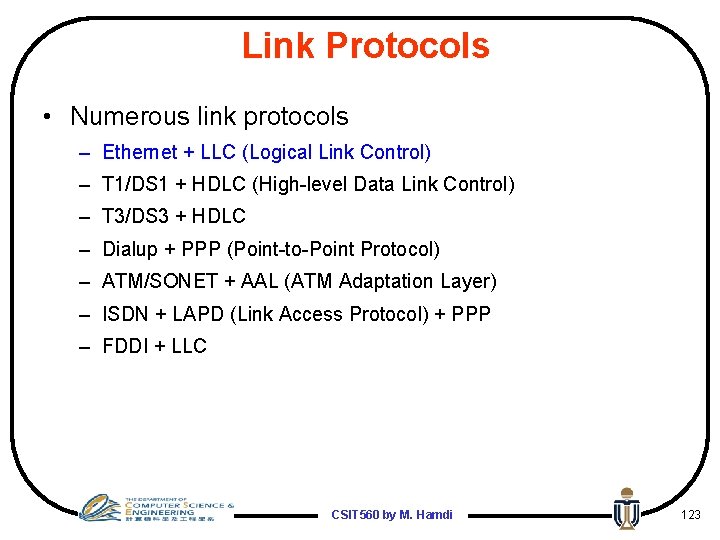
Link Protocols • Numerous link protocols – Ethernet + LLC (Logical Link Control) – T 1/DS 1 + HDLC (High-level Data Link Control) – T 3/DS 3 + HDLC – Dialup + PPP (Point-to-Point Protocol) – ATM/SONET + AAL (ATM Adaptation Layer) – ISDN + LAPD (Link Access Protocol) + PPP – FDDI + LLC CSIT 560 by M. Hamdi 123
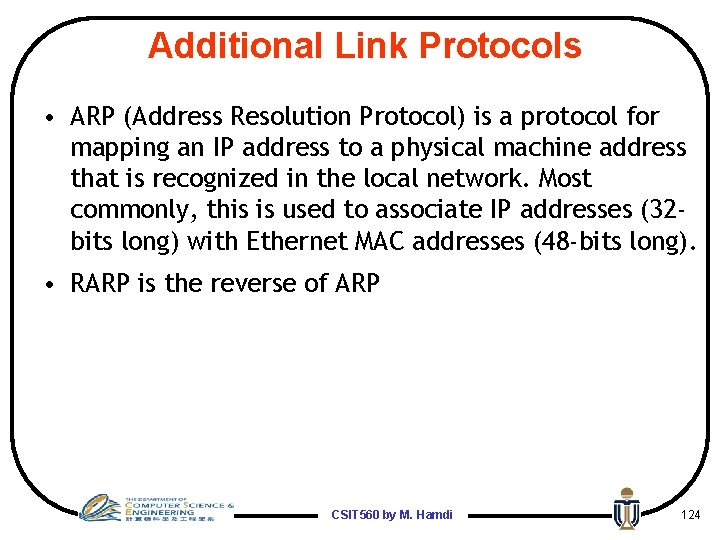
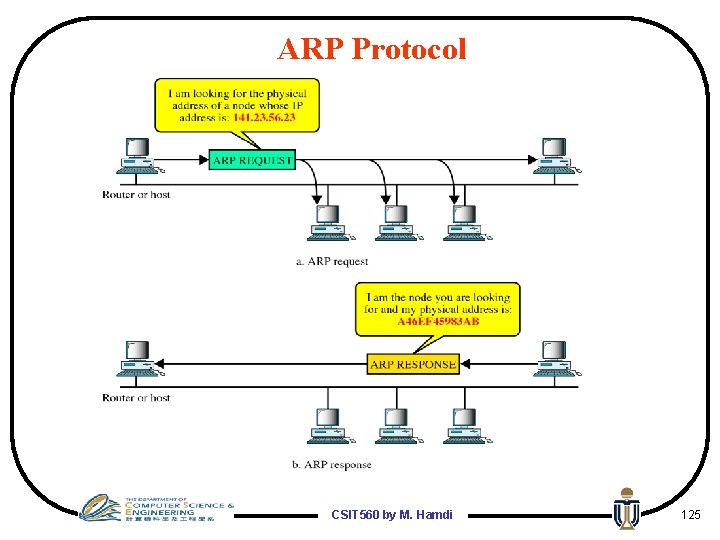
Additional Link Protocols • ARP (Address Resolution Protocol) is a protocol for mapping an IP address to a physical machine address that is recognized in the local network. Most commonly, this is used to associate IP addresses (32 bits long) with Ethernet MAC addresses (48 -bits long). • RARP is the reverse of ARP CSIT 560 by M. Hamdi 124
ARP Protocol CSIT 560 by M. Hamdi 125
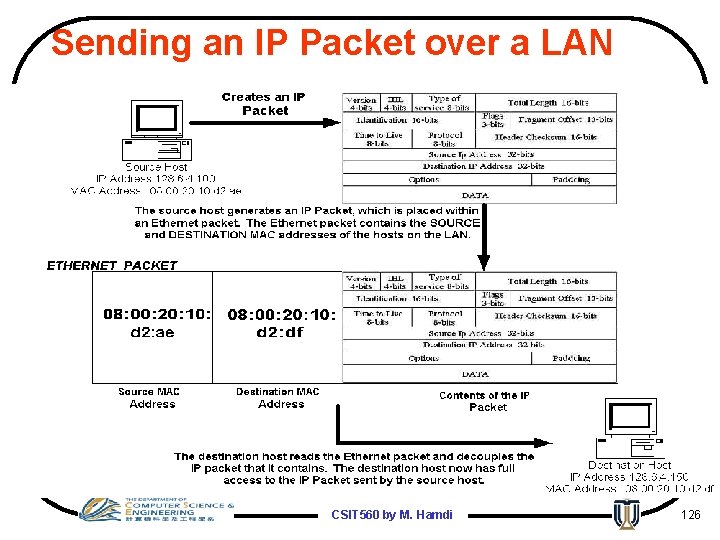
Sending an IP Packet over a LAN CSIT 560 by M. Hamdi 126
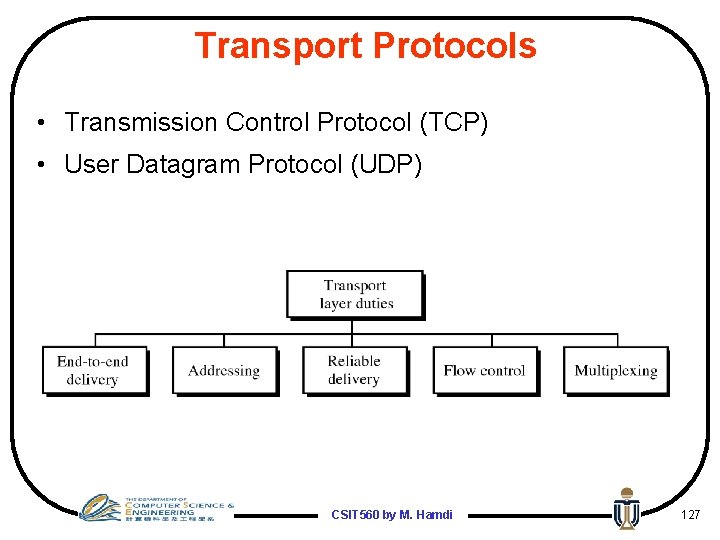
Transport Protocols • Transmission Control Protocol (TCP) • User Datagram Protocol (UDP) CSIT 560 by M. Hamdi 127
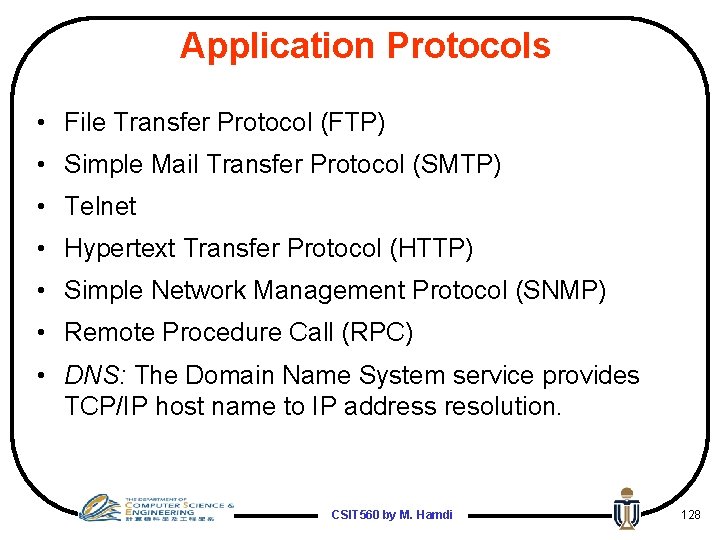
Application Protocols • File Transfer Protocol (FTP) • Simple Mail Transfer Protocol (SMTP) • Telnet • Hypertext Transfer Protocol (HTTP) • Simple Network Management Protocol (SNMP) • Remote Procedure Call (RPC) • DNS: The Domain Name System service provides TCP/IP host name to IP address resolution. CSIT 560 by M. Hamdi 128
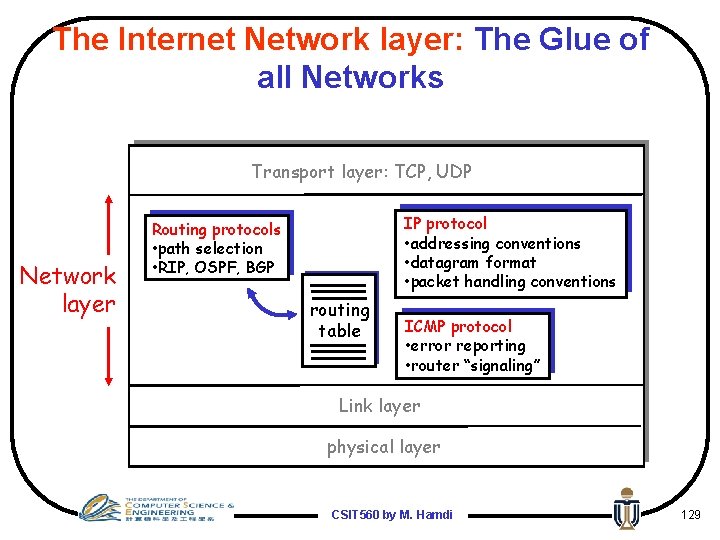
The Internet Network layer: The Glue of all Networks Transport layer: TCP, UDP Network layer IP protocol • addressing conventions • datagram format • packet handling conventions Routing protocols • path selection • RIP, OSPF, BGP routing table ICMP protocol • error reporting • router “signaling” Link layer physical layer CSIT 560 by M. Hamdi 129
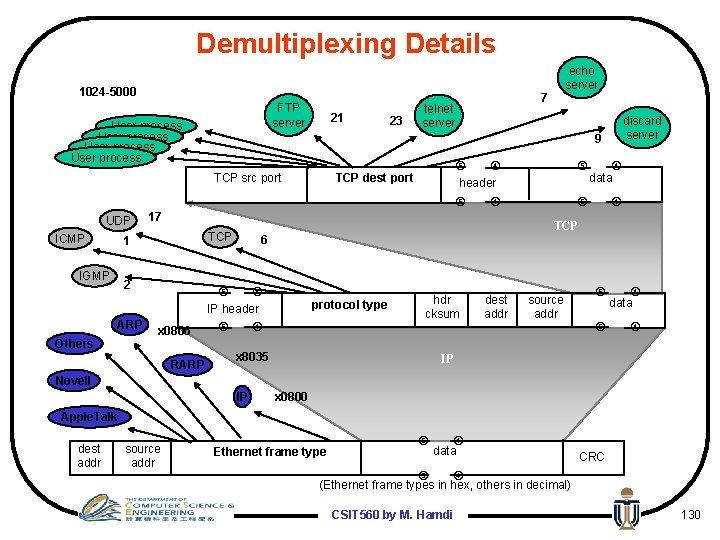
Demultiplexing Details 1024 -5000 FTP server User process 21 ICMP TCP 2 ARP Others TCP dest port header data 17 1 IGMP 7 telnet server 9 TCP src port UDP 23 RARP discard server TCP 6 IP header x 0806 echo server protocol type x 8035 hdr cksum dest addr source addr data IP Novell IP x 0800 Apple. Talk dest addr source addr Ethernet frame type data CRC (Ethernet frame types in hex, others in decimal) CSIT 560 by M. Hamdi 130
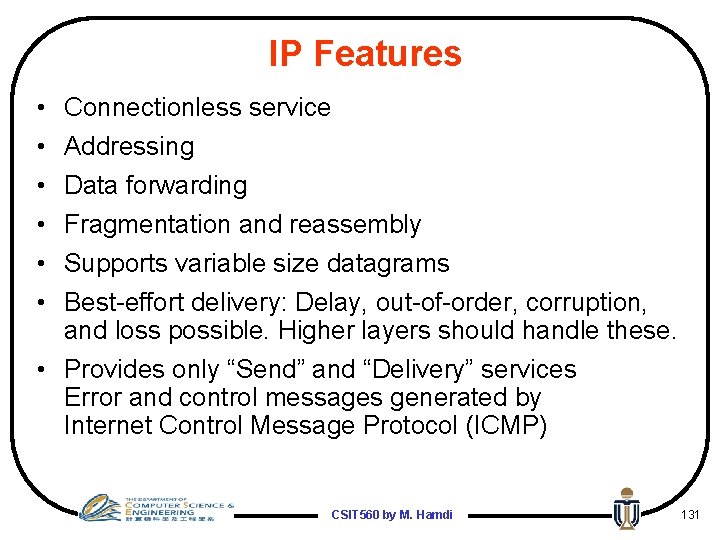
IP Features • • • Connectionless service Addressing Data forwarding Fragmentation and reassembly Supports variable size datagrams Best-effort delivery: Delay, out-of-order, corruption, and loss possible. Higher layers should handle these. • Provides only “Send” and “Delivery” services Error and control messages generated by Internet Control Message Protocol (ICMP) CSIT 560 by M. Hamdi 131
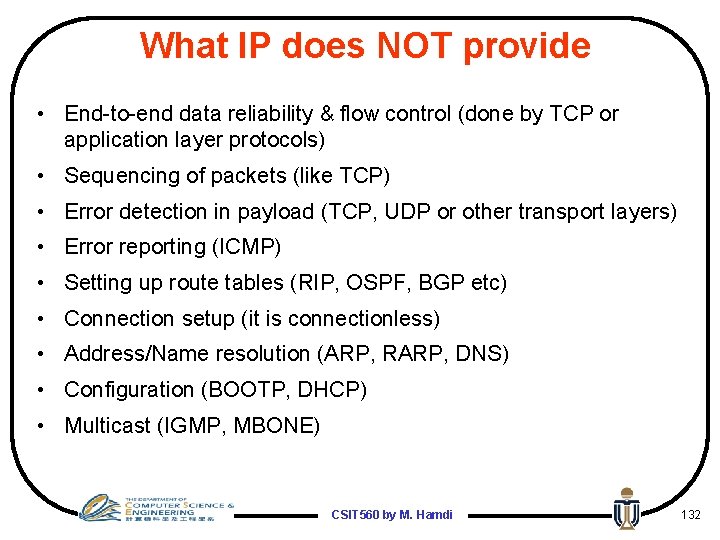
What IP does NOT provide • End-to-end data reliability & flow control (done by TCP or application layer protocols) • Sequencing of packets (like TCP) • Error detection in payload (TCP, UDP or other transport layers) • Error reporting (ICMP) • Setting up route tables (RIP, OSPF, BGP etc) • Connection setup (it is connectionless) • Address/Name resolution (ARP, RARP, DNS) • Configuration (BOOTP, DHCP) • Multicast (IGMP, MBONE) CSIT 560 by M. Hamdi 132
Internet Protocol (IP) • Two versions – IPv 4 – IPv 6 • IPv 4 dominates today’s Internet • IPv 6 is used sporadically – 6 Bone, Internet 2 CSIT 560 by M. Hamdi 133
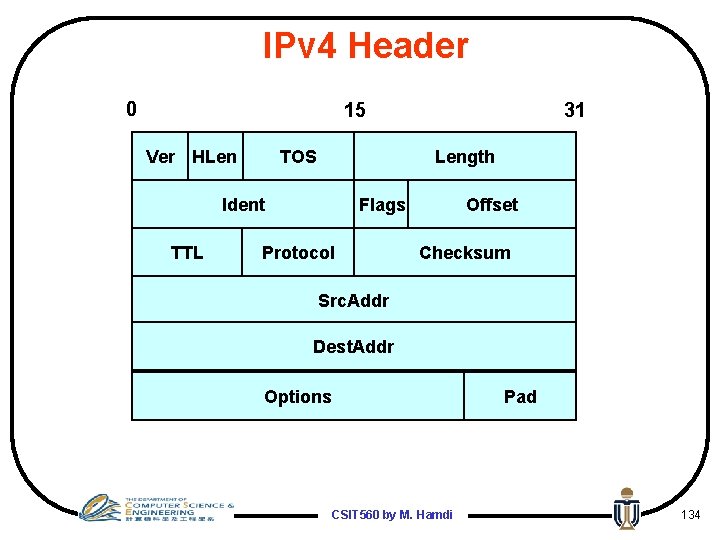
IPv 4 Header 0 15 Ver HLen TOS Length Ident TTL 31 Flags Protocol Offset Checksum Src. Addr Dest. Addr Options Pad CSIT 560 by M. Hamdi 134
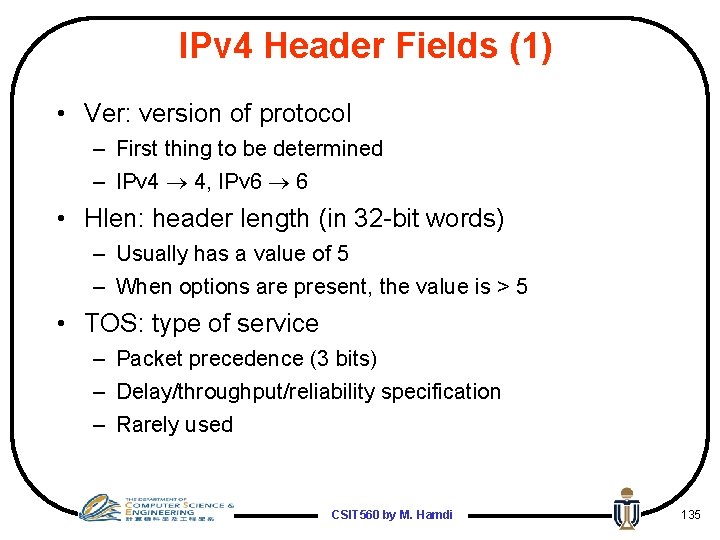
IPv 4 Header Fields (1) • Ver: version of protocol – First thing to be determined – IPv 4 4, IPv 6 6 • Hlen: header length (in 32 -bit words) – Usually has a value of 5 – When options are present, the value is > 5 • TOS: type of service – Packet precedence (3 bits) – Delay/throughput/reliability specification – Rarely used CSIT 560 by M. Hamdi 135
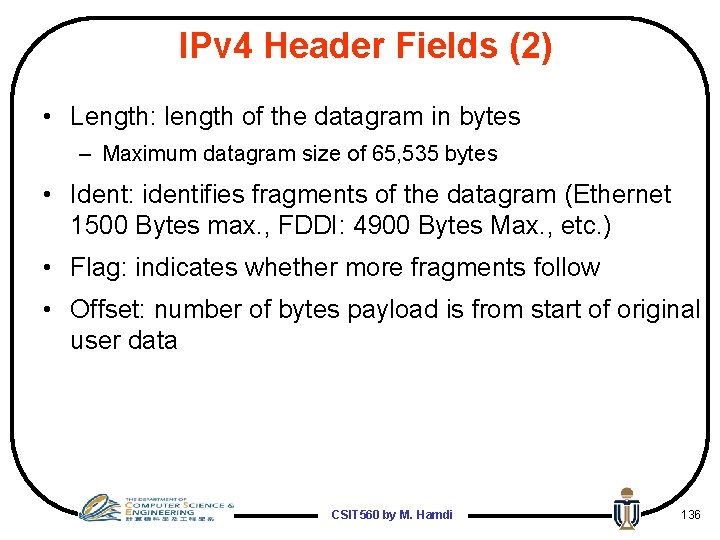
IPv 4 Header Fields (2) • Length: length of the datagram in bytes – Maximum datagram size of 65, 535 bytes • Ident: identifies fragments of the datagram (Ethernet 1500 Bytes max. , FDDI: 4900 Bytes Max. , etc. ) • Flag: indicates whether more fragments follow • Offset: number of bytes payload is from start of original user data CSIT 560 by M. Hamdi 136
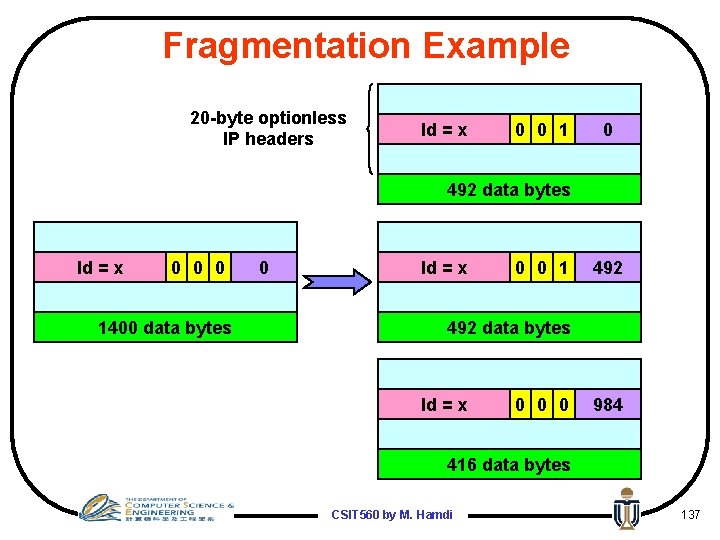
Fragmentation Example 20 -byte optionless IP headers Id = x 0 0 1 0 492 data bytes Id = x 0 0 0 1400 data bytes 0 Id = x 0 0 1 492 data bytes Id = x 0 0 0 984 416 data bytes CSIT 560 by M. Hamdi 137
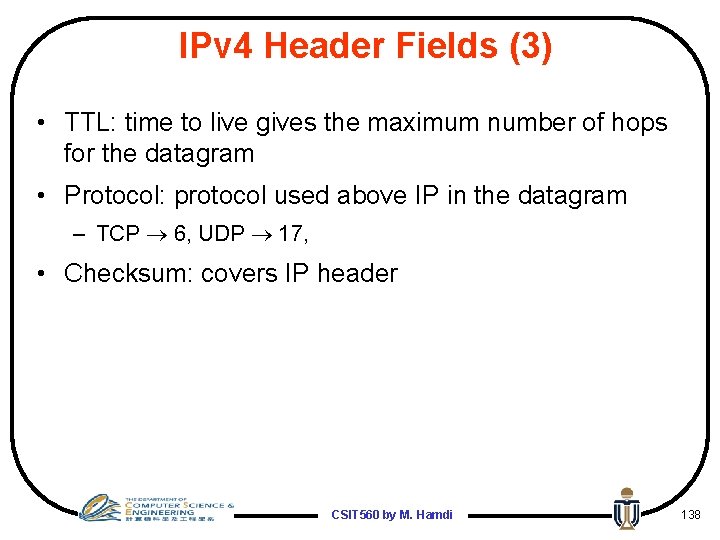
IPv 4 Header Fields (3) • TTL: time to live gives the maximum number of hops for the datagram • Protocol: protocol used above IP in the datagram – TCP 6, UDP 17, • Checksum: covers IP header CSIT 560 by M. Hamdi 138
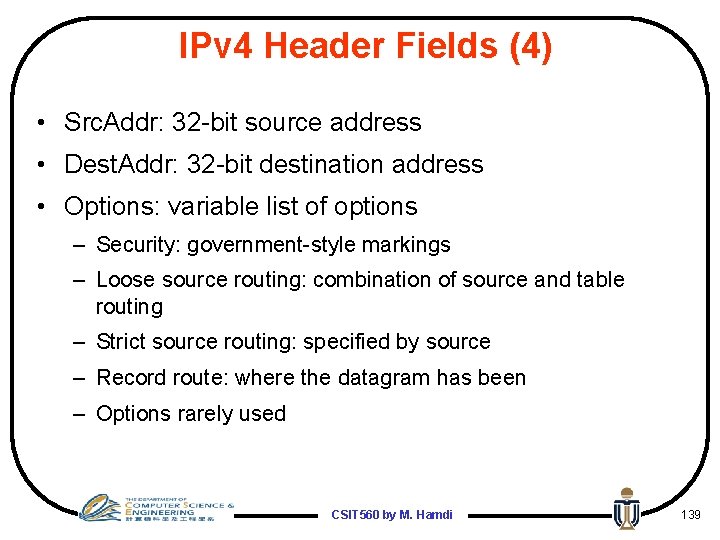
IPv 4 Header Fields (4) • Src. Addr: 32 -bit source address • Dest. Addr: 32 -bit destination address • Options: variable list of options – Security: government-style markings – Loose source routing: combination of source and table routing – Strict source routing: specified by source – Record route: where the datagram has been – Options rarely used CSIT 560 by M. Hamdi 139
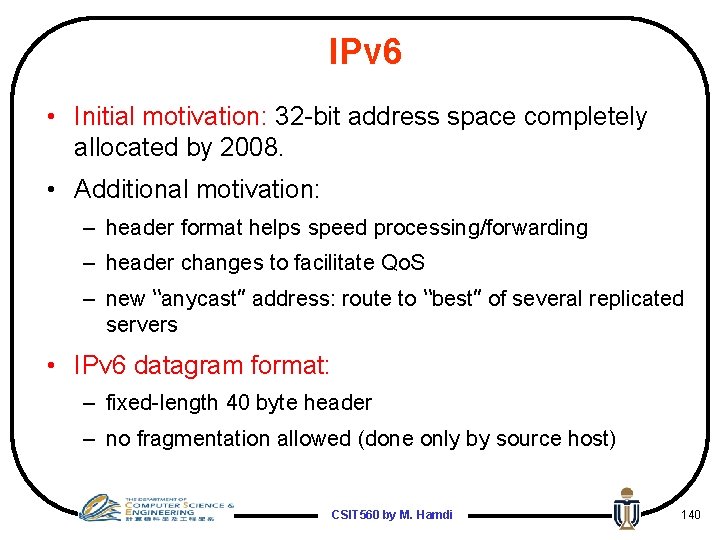
IPv 6 • Initial motivation: 32 -bit address space completely allocated by 2008. • Additional motivation: – header format helps speed processing/forwarding – header changes to facilitate Qo. S – new “anycast” address: route to “best” of several replicated servers • IPv 6 datagram format: – fixed-length 40 byte header – no fragmentation allowed (done only by source host) CSIT 560 by M. Hamdi 140
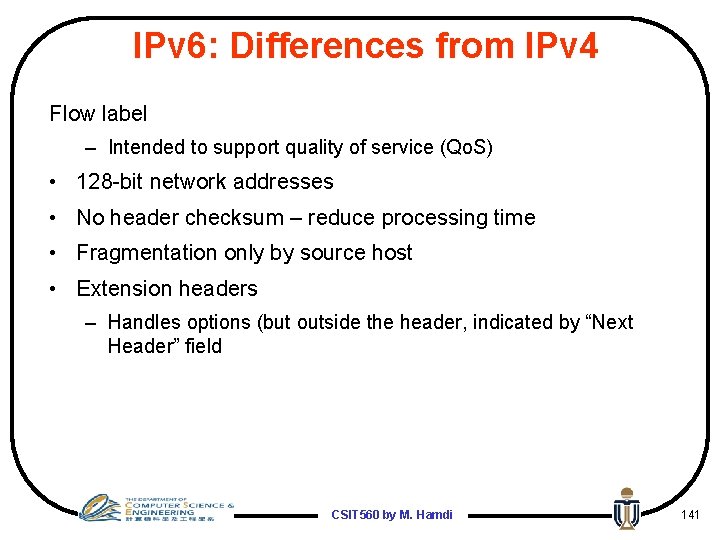
IPv 6: Differences from IPv 4 Flow label – Intended to support quality of service (Qo. S) • 128 -bit network addresses • No header checksum – reduce processing time • Fragmentation only by source host • Extension headers – Handles options (but outside the header, indicated by “Next Header” field CSIT 560 by M. Hamdi 141
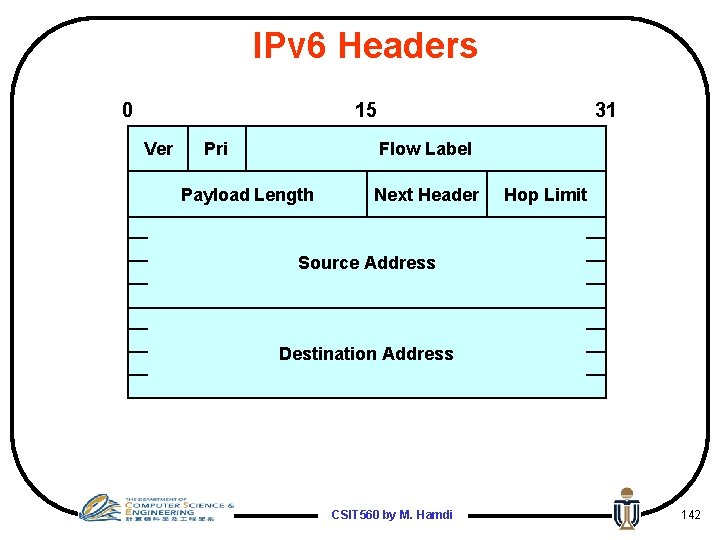
IPv 6 Headers 0 15 Ver Pri 31 Flow Label Payload Length Next Header Hop Limit Source Address Destination Address CSIT 560 by M. Hamdi 142
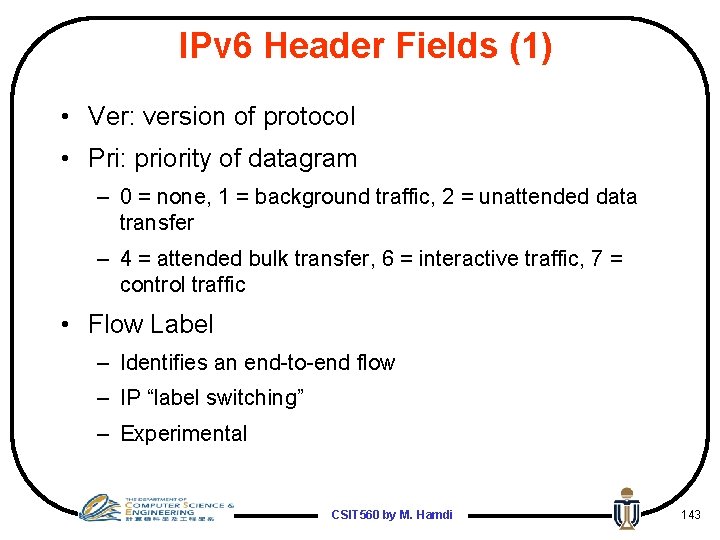
IPv 6 Header Fields (1) • Ver: version of protocol • Pri: priority of datagram – 0 = none, 1 = background traffic, 2 = unattended data transfer – 4 = attended bulk transfer, 6 = interactive traffic, 7 = control traffic • Flow Label – Identifies an end-to-end flow – IP “label switching” – Experimental CSIT 560 by M. Hamdi 143
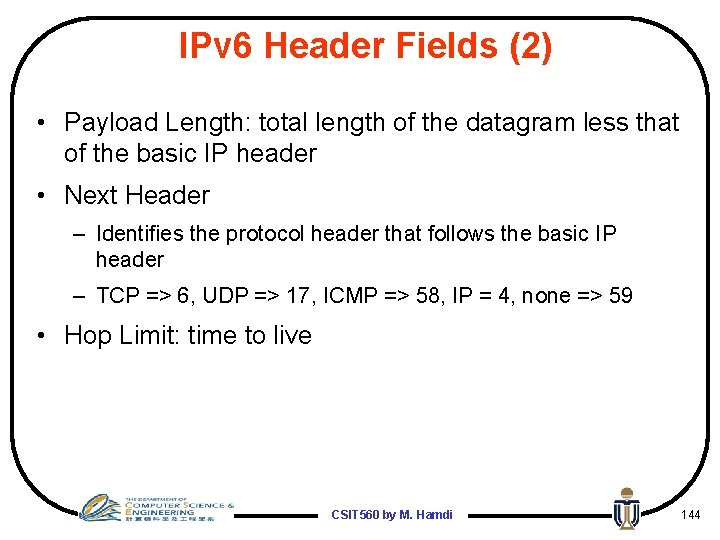
IPv 6 Header Fields (2) • Payload Length: total length of the datagram less that of the basic IP header • Next Header – Identifies the protocol header that follows the basic IP header – TCP => 6, UDP => 17, ICMP => 58, IP = 4, none => 59 • Hop Limit: time to live CSIT 560 by M. Hamdi 144
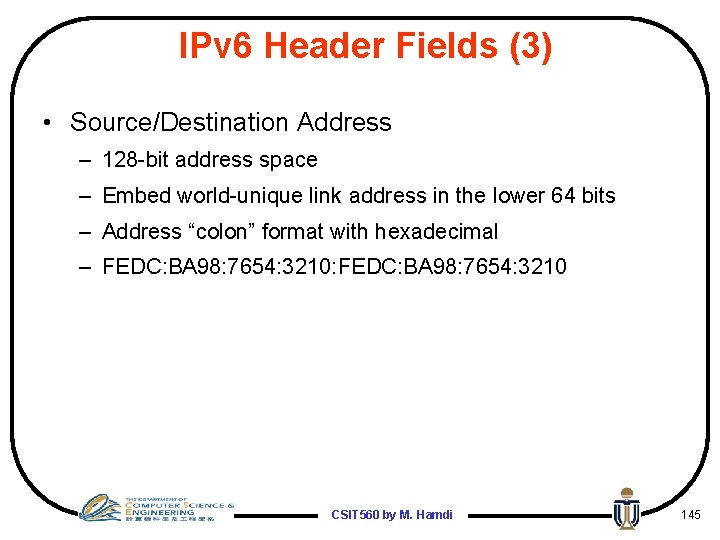
IPv 6 Header Fields (3) • Source/Destination Address – 128 -bit address space – Embed world-unique link address in the lower 64 bits – Address “colon” format with hexadecimal – FEDC: BA 98: 7654: 3210: FEDC: BA 98: 7654: 3210 CSIT 560 by M. Hamdi 145
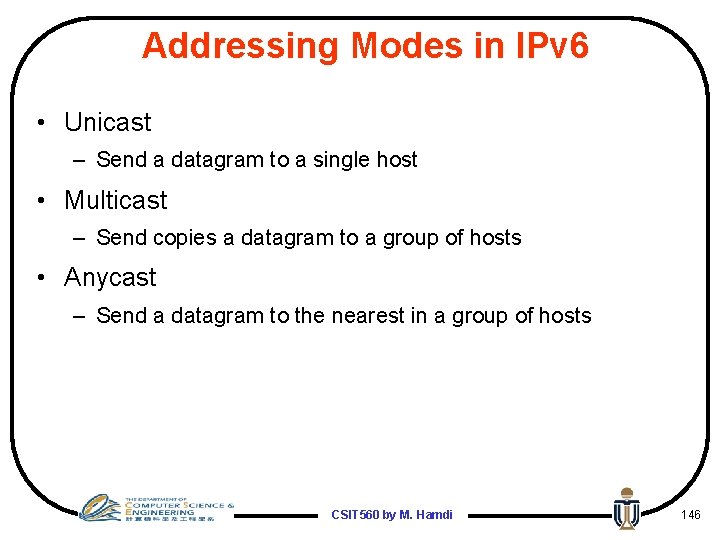
Addressing Modes in IPv 6 • Unicast – Send a datagram to a single host • Multicast – Send copies a datagram to a group of hosts • Anycast – Send a datagram to the nearest in a group of hosts CSIT 560 by M. Hamdi 146
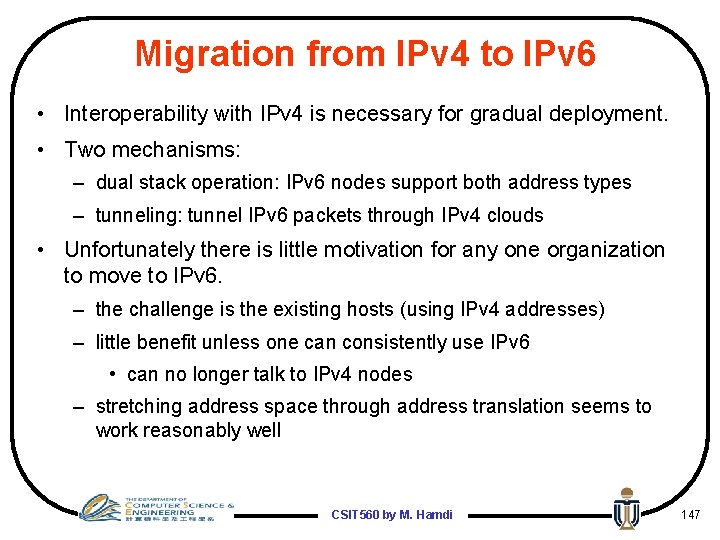
Migration from IPv 4 to IPv 6 • Interoperability with IPv 4 is necessary for gradual deployment. • Two mechanisms: – dual stack operation: IPv 6 nodes support both address types – tunneling: tunnel IPv 6 packets through IPv 4 clouds • Unfortunately there is little motivation for any one organization to move to IPv 6. – the challenge is the existing hosts (using IPv 4 addresses) – little benefit unless one can consistently use IPv 6 • can no longer talk to IPv 4 nodes – stretching address space through address translation seems to work reasonably well CSIT 560 by M. Hamdi 147