FOCUS ON 2014 GED TEST CONTENT REASONING THROUGH



- Slides: 92
FOCUS ON 2014 GED® TEST CONTENT: REASONING THROUGH LANGUAGE ARTS Presenters: Bonnie Goonen bv 73008@aol. com Susan Pittman skptvs@aol. com The IPDAE project is supported with funds provided through the Adult and Family Literacy Act, Division of Career and Adult Education, Florida Department of Education.
Session Objectives • Identify strategies for integrating reading and writing skills • Model and apply strategies for integrating reading and writing, including sentence combining and developing constructed responses • Review evidence-based scoring rubrics and sample anchor papers
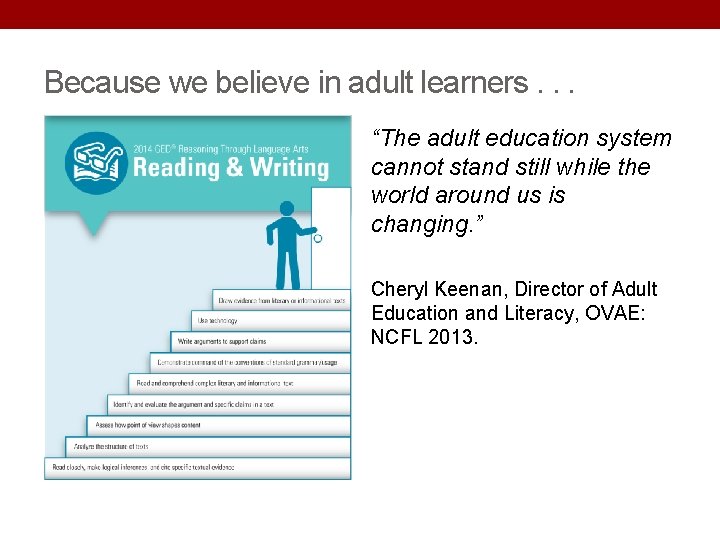
Because we believe in adult learners. . . “The adult education system cannot stand still while the world around us is changing. ” Cheryl Keenan, Director of Adult Education and Literacy, OVAE: NCFL 2013.
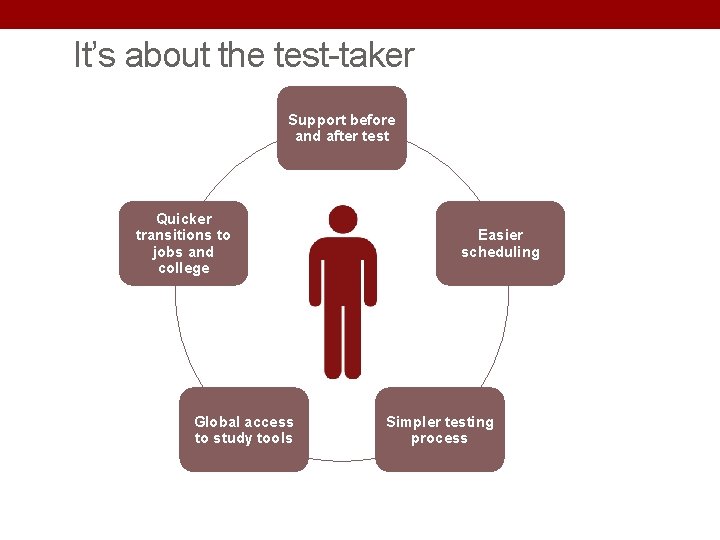
It’s about the test-taker Support before and after test Quicker transitions to jobs and college Global access to study tools Easier scheduling Simpler testing process 4
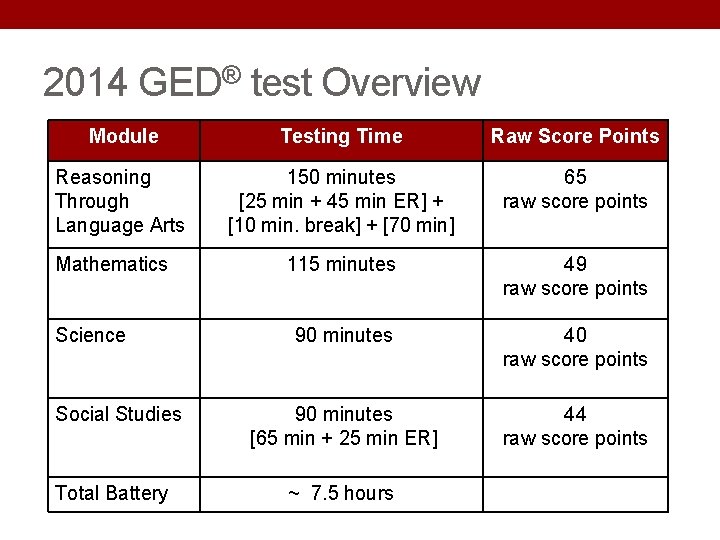
2014 GED® test Overview Module Testing Time Raw Score Points Reasoning Through Language Arts 150 minutes [25 min + 45 min ER] + [10 min. break] + [70 min] 65 raw score points Mathematics 115 minutes 49 raw score points Science 90 minutes 40 raw score points 90 minutes [65 min + 25 min ER] 44 raw score points Social Studies Total Battery ~ 7. 5 hours
GED® Tools for Students/Educators
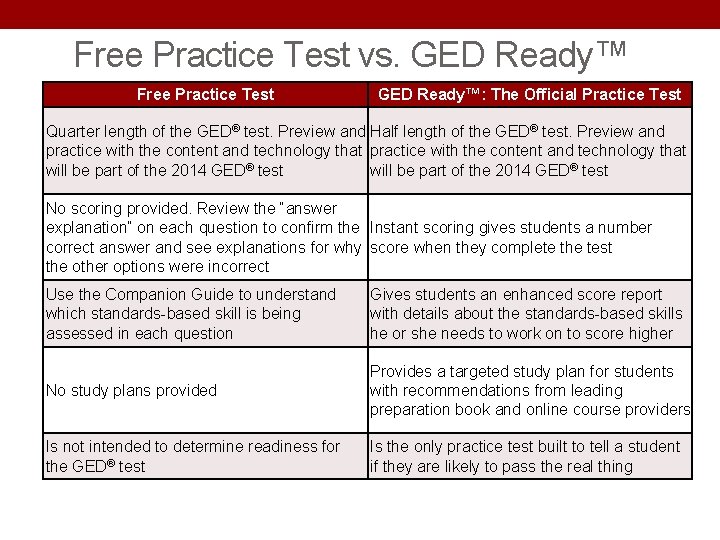
Free Practice Test vs. GED Ready™ Free Practice Test GED Ready™: The Official Practice Test Quarter length of the GED® test. Preview and Half length of the GED® test. Preview and practice with the content and technology that will be part of the 2014 GED® test No scoring provided. Review the “answer explanation” on each question to confirm the Instant scoring gives students a number correct answer and see explanations for why score when they complete the test the other options were incorrect Use the Companion Guide to understand which standards-based skill is being assessed in each question Gives students an enhanced score report with details about the standards-based skills he or she needs to work on to score higher No study plans provided Provides a targeted study plan for students with recommendations from leading preparation book and online course providers Is not intended to determine readiness for the GED® test Is the only practice test built to tell a student if they are likely to pass the real thing 7
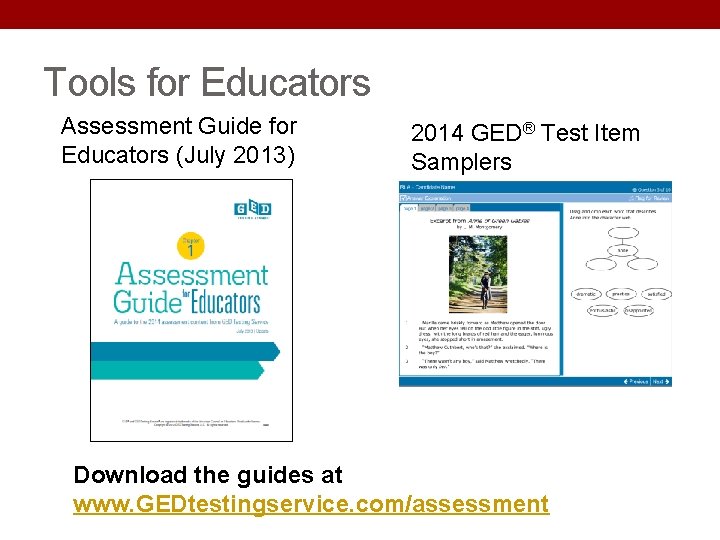
Tools for Educators Assessment Guide for Educators (July 2013) 2014 GED® Test Item Samplers Download the guides at www. GEDtestingservice. com/assessment
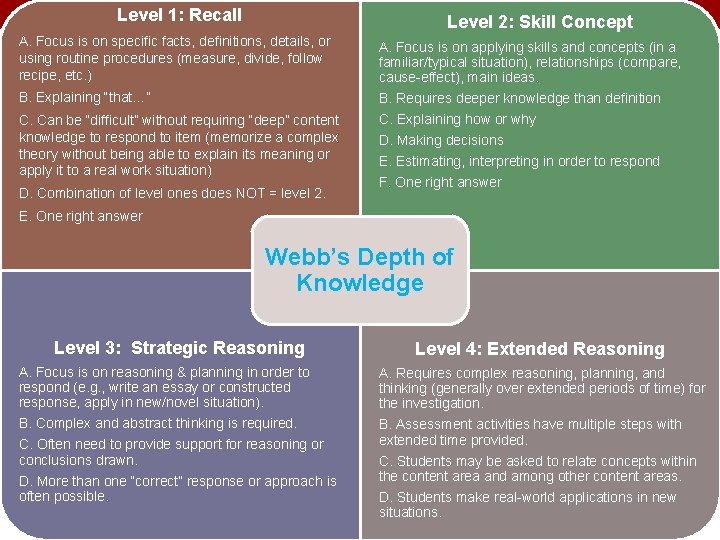
New Realities in Cognitive Complexity: Webb’s Depth of Knowledge (DOK)
Level 1: Recall Level 2: Skill Concept A. Focus is on specific facts, definitions, details, or using routine procedures (measure, divide, follow recipe, etc. ) B. Explaining “that…” C. Can be “difficult” without requiring “deep” content knowledge to respond to item (memorize a complex theory without being able to explain its meaning or apply it to a real work situation) D. Combination of level ones does NOT = level 2. A. Focus is on applying skills and concepts (in a familiar/typical situation), relationships (compare, cause-effect), main ideas. B. Requires deeper knowledge than definition C. Explaining how or why D. Making decisions E. Estimating, interpreting in order to respond F. One right answer E. One right answer Webb’s Depth of Knowledge Level 3: Strategic Reasoning A. Focus is on reasoning & planning in order to respond (e. g. , write an essay or constructed response, apply in new/novel situation). B. Complex and abstract thinking is required. C. Often need to provide support for reasoning or conclusions drawn. D. More than one “correct” response or approach is often possible. Level 4: Extended Reasoning A. Requires complex reasoning, planning, and thinking (generally over extended periods of time) for the investigation. B. Assessment activities have multiple steps with extended time provided. C. Students may be asked to relate concepts within the content area and among other content areas. D. Students make real-world applications in new situations.
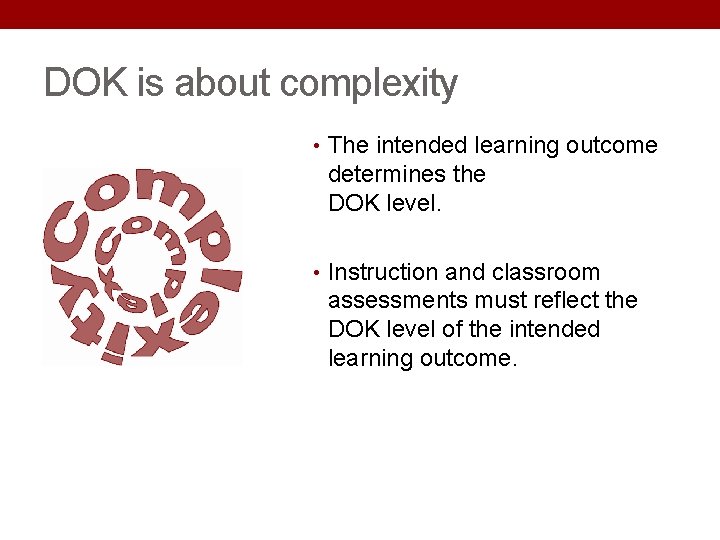
DOK is about complexity • The intended learning outcome determines the DOK level. • Instruction and classroom assessments must reflect the DOK level of the intended learning outcome.
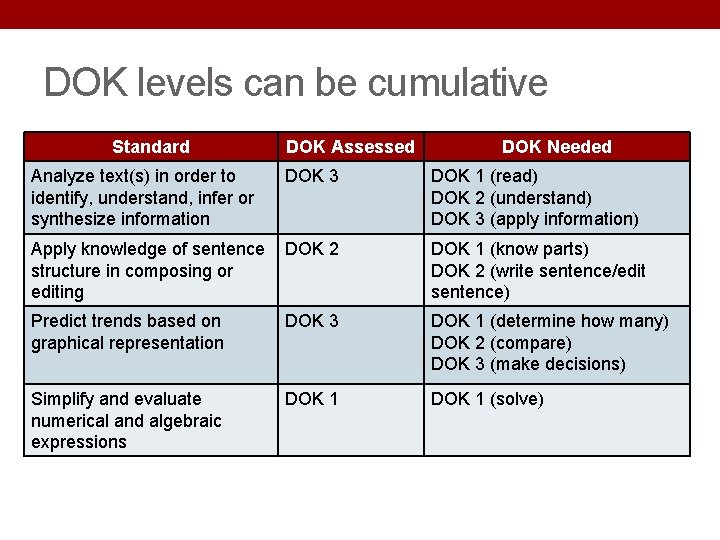
DOK levels can be cumulative Standard Analyze text(s) in order to identify, understand, infer or synthesize information DOK Assessed DOK 3 DOK Needed DOK 1 (read) DOK 2 (understand) DOK 3 (apply information) Apply knowledge of sentence DOK 2 structure in composing or editing DOK 1 (know parts) DOK 2 (write sentence/edit sentence) Predict trends based on graphical representation DOK 3 DOK 1 (determine how many) DOK 2 (compare) DOK 3 (make decisions) Simplify and evaluate numerical and algebraic expressions DOK 1 (solve)
Remember DOK is. . . …descriptive …focuses on how deeply a student has to know the content in order to respond …NOT the same as difficulty …NOT the same as Bloom’s Taxonomy
CONTENT AND CONTEXT OF REASONING THROUGH LANGUAGE ARTS MODULE
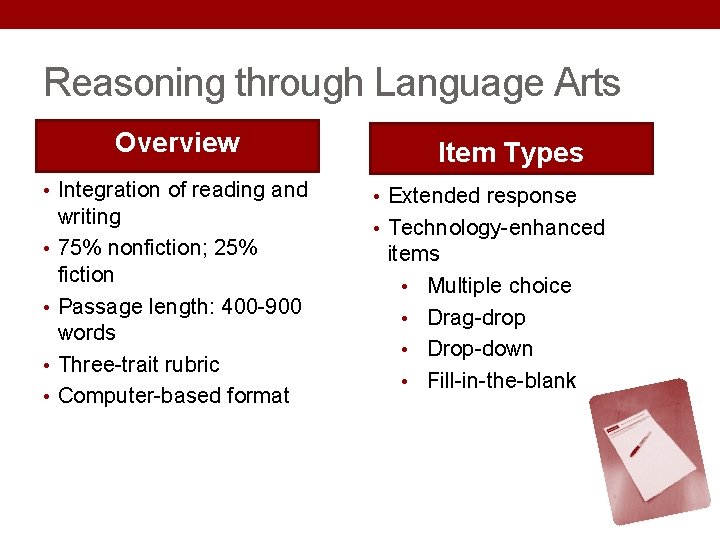
Reasoning through Language Arts Overview • Integration of reading and • • writing 75% nonfiction; 25% fiction Passage length: 400 -900 words Three-trait rubric Computer-based format Item Types • Extended response • Technology-enhanced items • Multiple choice • Drag-drop • Drop-down • Fill-in-the-blank
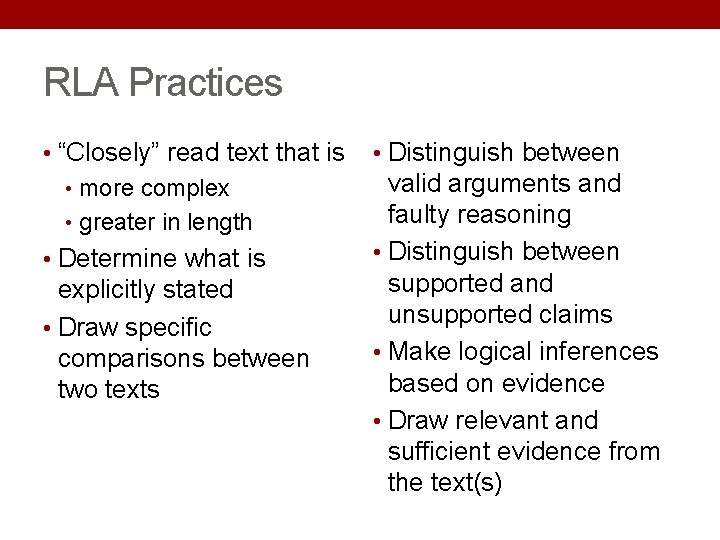
RLA Practices • “Closely” read text that is • more complex • greater in length • Determine what is explicitly stated • Draw specific comparisons between two texts • Distinguish between valid arguments and faulty reasoning • Distinguish between supported and unsupported claims • Make logical inferences based on evidence • Draw relevant and sufficient evidence from the text(s)
AN INTRODUCTION TO ANCHOR PAPERS
What is at stake? “My view is that good writing is a sign of good thinking. Writing that is persuasive, logical, and orderly is impressive. Writing that’s not careful can be a signal of unclear thinking. ” “Writing is integral in nearly every job. It’s really not a promotion issue since you’d never get to the point of promotion without good communications skills. You can’t move up without writing skills. ”
Brainstorm Time! Constructed response is. . .
Constructed responses. . . • Ask test takers to apply knowledge, skills, and critical thinking abilities • Require test takers to “construct” answers without the benefit of any suggestions or choices • Require test takers to generate and intertwine ideas into a response that is directly related to the text(s) • Can be short or extended
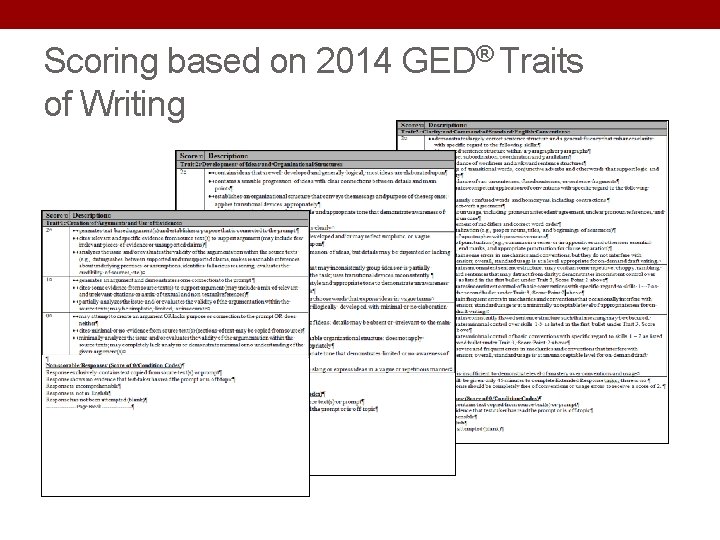
Scoring based on 2014 GED® Traits of Writing
Multi-dimensional Scoring Rubric Candidate responses will be scored based on three traits: • Trait 1: Creation of arguments and use of evidence • Trait 2: Development of ideas and structure • Trait 3: Clarity and command of standard English conventions
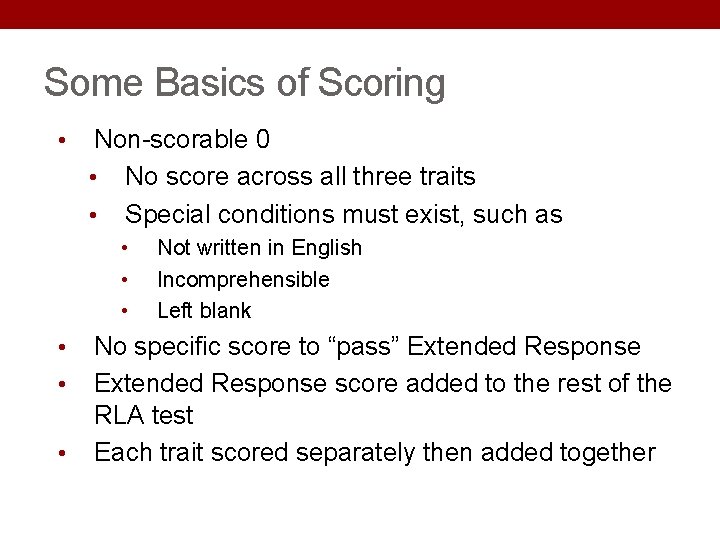
Some Basics of Scoring • Non-scorable 0 • No score across all three traits • Special conditions must exist, such as • • • Not written in English Incomprehensible Left blank No specific score to “pass” Extended Response score added to the rest of the RLA test Each trait scored separately then added together
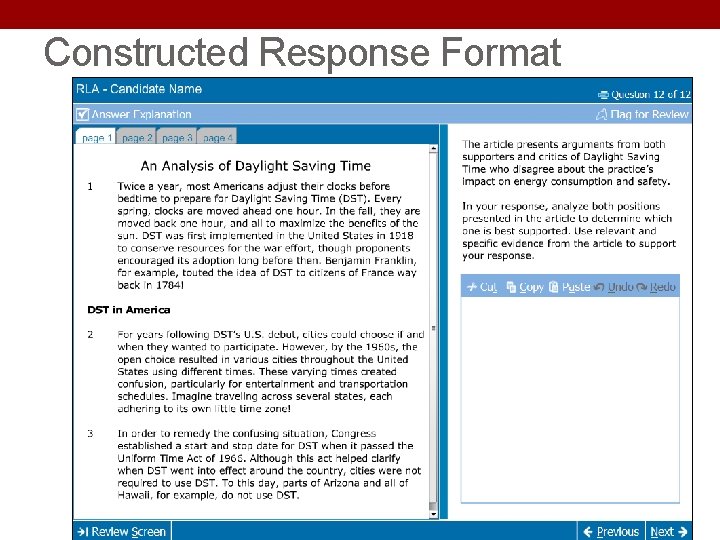
Constructed Response Format
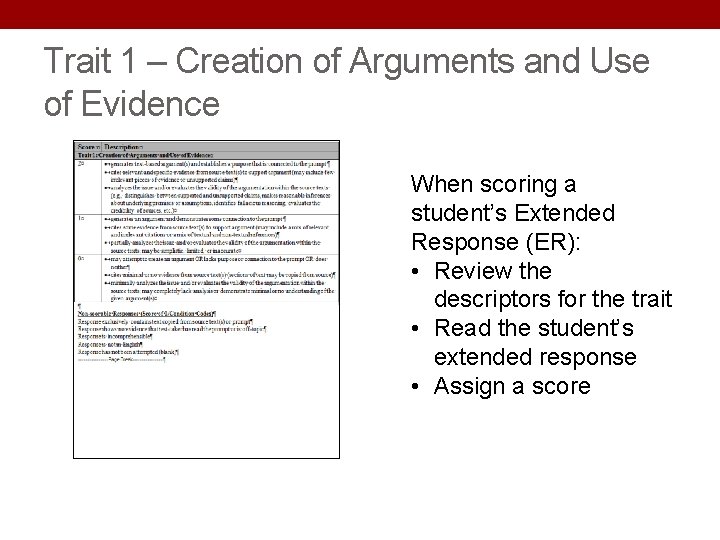
Trait 1 – Creation of Arguments and Use of Evidence When scoring a student’s Extended Response (ER): • Review the descriptors for the trait • Read the student’s extended response • Assign a score
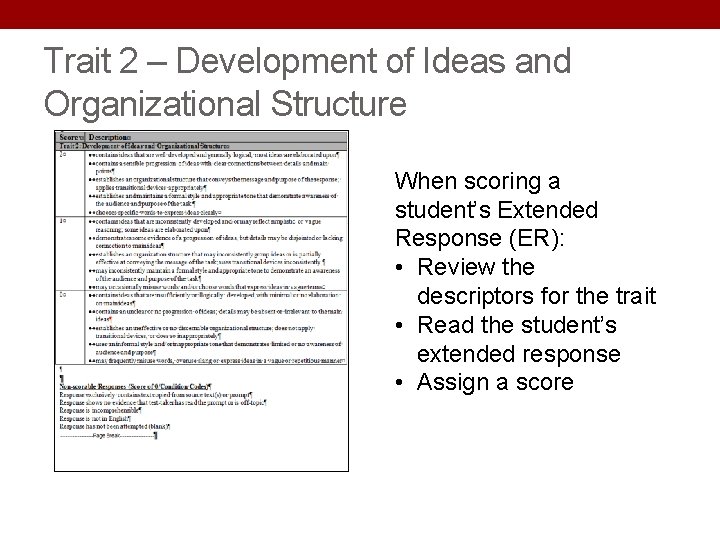
Trait 2 – Development of Ideas and Organizational Structure When scoring a student’s Extended Response (ER): • Review the descriptors for the trait • Read the student’s extended response • Assign a score
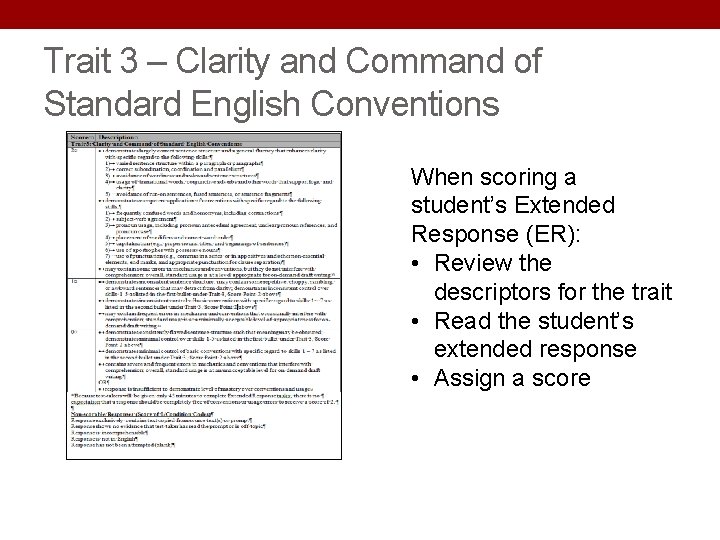
Trait 3 – Clarity and Command of Standard English Conventions When scoring a student’s Extended Response (ER): • Review the descriptors for the trait • Read the student’s extended response • Assign a score
Let’s Take a Closer Look An Analysis of Daylight Savings Time The article presents arguments from both supporters and critics of Daylight Saving Time who disagree about the practice’s impact on energy consumption and safety. In your response, analyze both positions presented in the article to determine which one is best supported. Use relevant and specific evidence from the article to support your response. Materials from GED Testing Service®
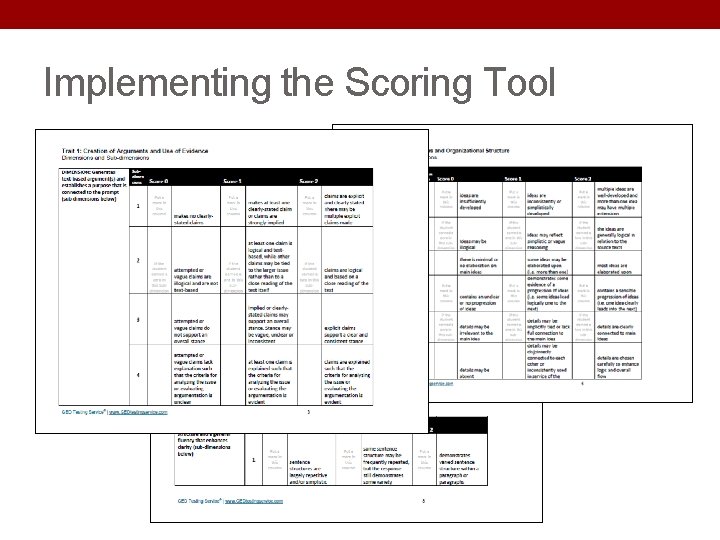
Implementing the Scoring Tool
Reviewing the Anchor Papers • Read the anchor paper • Identify the following: • Claim or stance • Evidence to support claim or stance • Strengths and weaknesses of the writing sample
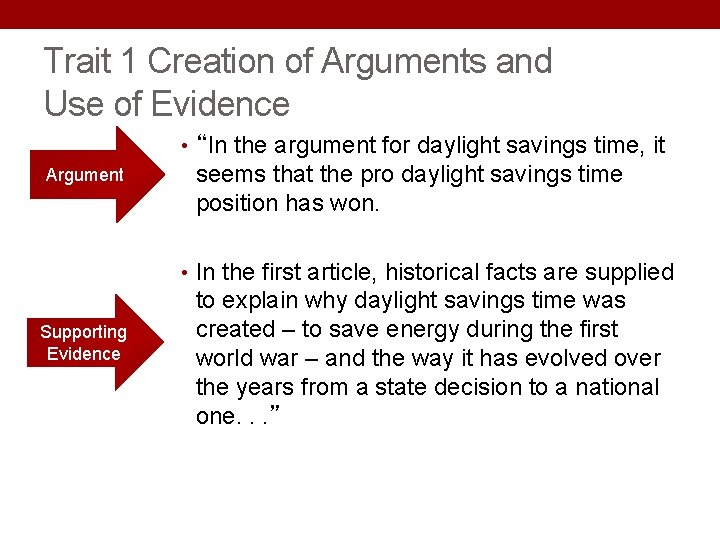
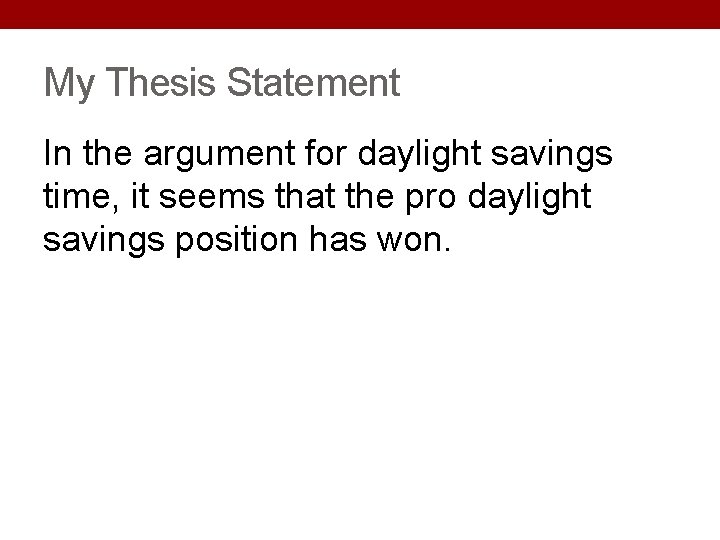
Trait 1 Creation of Arguments and Use of Evidence • “In the argument for daylight savings time, it Argument seems that the pro daylight savings time position has won. • In the first article, historical facts are supplied Supporting Evidence to explain why daylight savings time was created – to save energy during the first world war – and the way it has evolved over the years from a state decision to a national one. . . ”
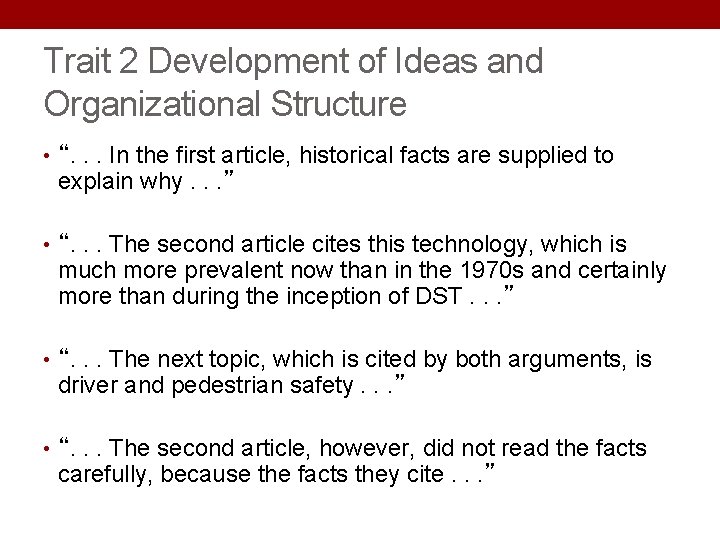
Trait 2 Development of Ideas and Organizational Structure • “. . . In the first article, historical facts are supplied to explain why. . . ” • “. . . The second article cites this technology, which is much more prevalent now than in the 1970 s and certainly more than during the inception of DST. . . ” • “. . . The next topic, which is cited by both arguments, is driver and pedestrian safety. . . ” • “. . . The second article, however, did not read the facts carefully, because the facts they cite. . . ”
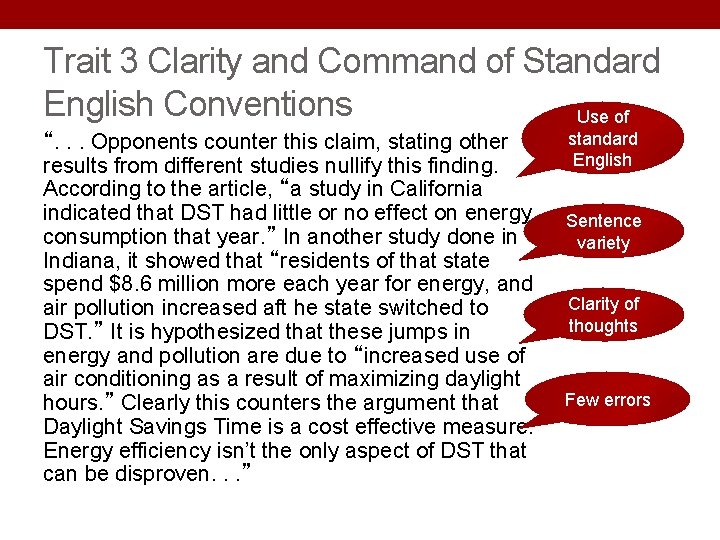
Trait 3 Clarity and Command of Standard English Conventions Use of “. . . Opponents counter this claim, stating other results from different studies nullify this finding. According to the article, “a study in California indicated that DST had little or no effect on energy consumption that year. ” In another study done in Indiana, it showed that “residents of that state spend $8. 6 million more each year for energy, and air pollution increased aft he state switched to DST. ” It is hypothesized that these jumps in energy and pollution are due to “increased use of air conditioning as a result of maximizing daylight hours. ” Clearly this counters the argument that Daylight Savings Time is a cost effective measure. Energy efficiency isn’t the only aspect of DST that can be disproven. . . ” standard English Sentence variety Clarity of thoughts Few errors
Let’s Try Another One • Read the anchor paper • Identify the following: • Claim or stance • Evidence to support claim or stance • Strengths and weaknesses of the writing sample
A Review of the Research Evidence-based practices for teaching integrated reading and writing include. . . Adapted from the research of Steve Graham and Amy Gillespie, Vanderbilt University (2011)
A Review of the Research • Strategy Instruction • Summarization • Peer Assistance/Collaboration • Setting Product Goals • Word Processing • Sentence Combining Adapted from the research of Steve Graham and Amy Gillespie, Vanderbilt University (2011)
A Review of the Research • Process Approach • Inquiry • Pre-Writing Activities • Writing as a Tool for Learning • Study of Models Adapted from the research of Steve Graham and Amy Gillespie, Vanderbilt University (2011)
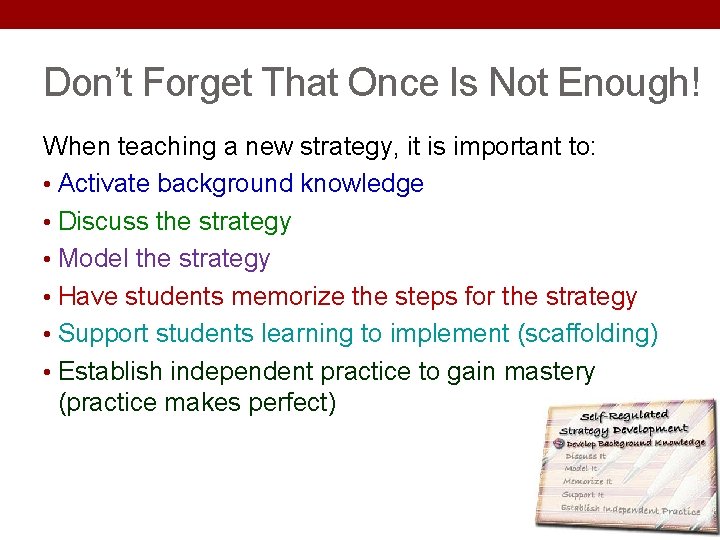
Don’t Forget That Once Is Not Enough! When teaching a new strategy, it is important to: • Activate background knowledge • Discuss the strategy • Model the strategy • Have students memorize the steps for the strategy • Support students learning to implement (scaffolding) • Establish independent practice to gain mastery (practice makes perfect)
Let’s Start with the Sentence! What is sentence combining? • It is the act of making one smoother, more detailed sentence out of two or more short, choppy sentences.
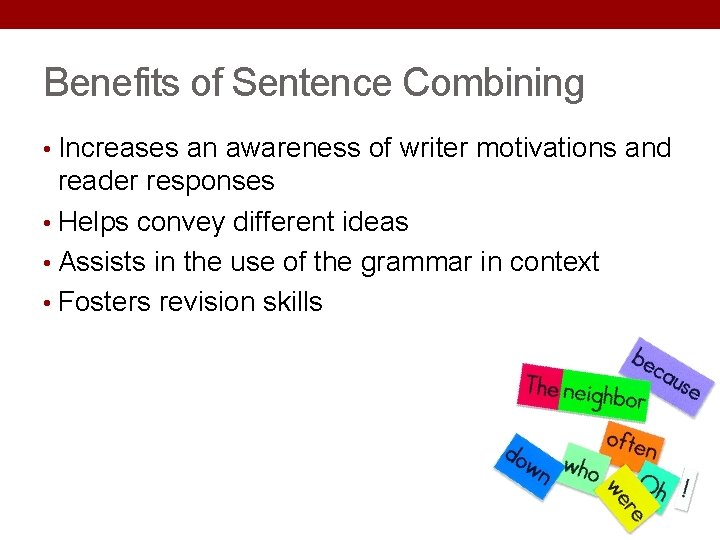
Benefits of Sentence Combining • Increases an awareness of writer motivations and reader responses • Helps convey different ideas • Assists in the use of the grammar in context • Fosters revision skills
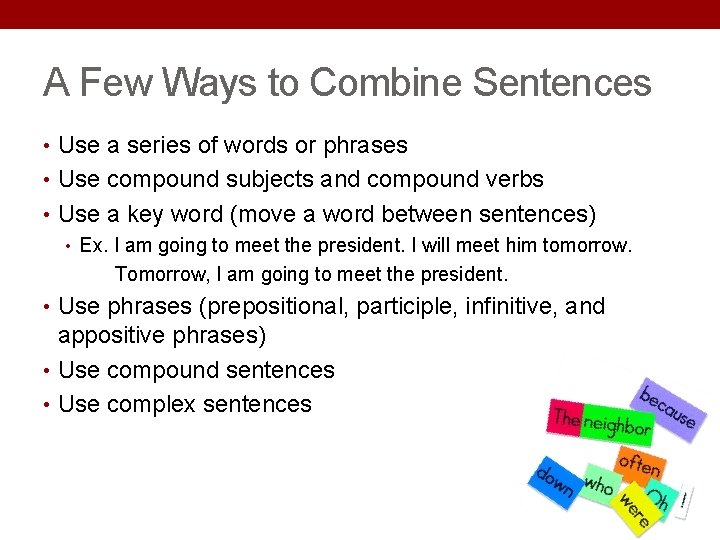
A Few Ways to Combine Sentences • Use a series of words or phrases • Use compound subjects and compound verbs • Use a key word (move a word between sentences) • Ex. I am going to meet the president. I will meet him tomorrow. Tomorrow, I am going to meet the president. • Use phrases (prepositional, participle, infinitive, and appositive phrases) • Use compound sentences • Use complex sentences
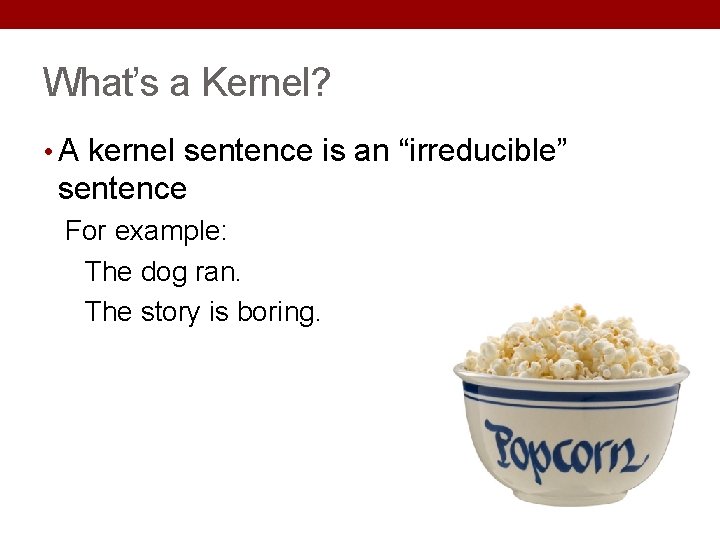
What’s a Kernel? • A kernel sentence is an “irreducible” sentence For example: The dog ran. The story is boring.
Let’s Combine! • Meditation can help you relax. • Meditation is a technique. • The technique can be learned.
Let’s Combine! How about. . . • Meditation can help you relax. • Meditation is a technique. • The technique can be learned. Meditation is a relaxation technique that can be learned.
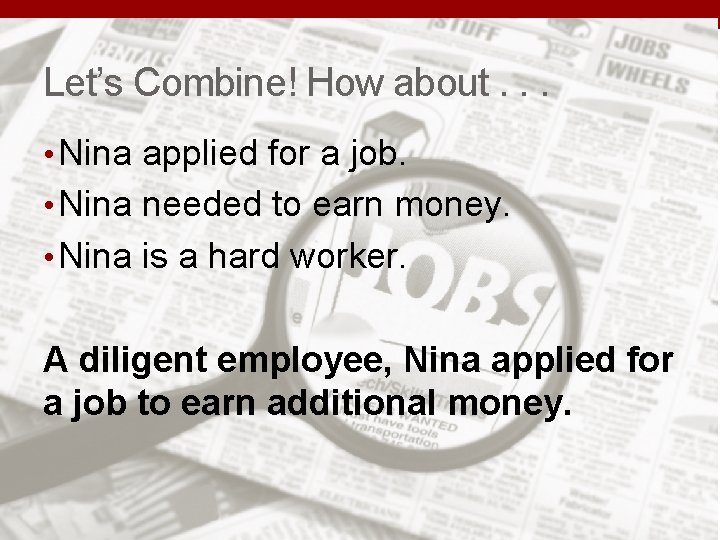
Let’s Combine! • Nina applied for a job. • Nina needed to earn money. • Nina is a hard worker.
Let’s Combine! How about. . . • Nina applied for a job. • Nina needed to earn money. • Nina is a hard worker. A diligent employee, Nina applied for a job to earn additional money.
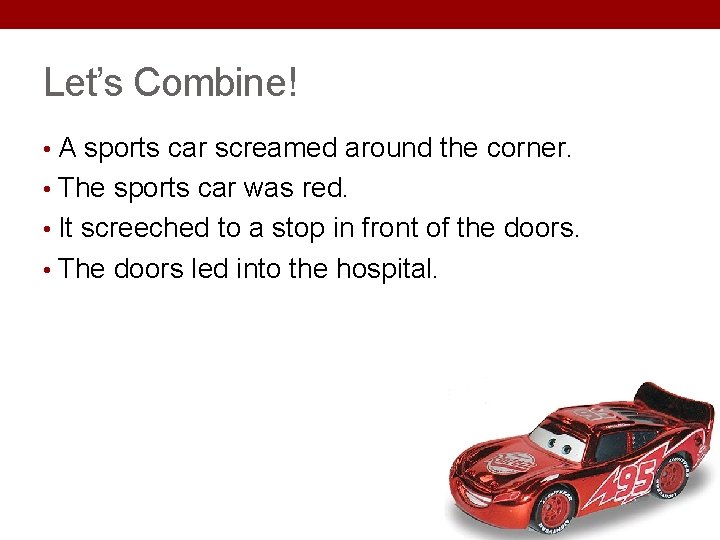
Let’s Combine! • A sports car screamed around the corner. • The sports car was red. • It screeched to a stop in front of the doors. • The doors led into the hospital.
Let’s Combine! How about. . . • A sports car screamed around the corner. • The sports car was red. • It screeched to a stop in front of the doors. • The doors led into the hospital. • The fire-red sports car screamed around the corner and screeched to a stop in front of the hospital emergency room. • Screaming around the corner, the fire-red sports car screeched to a stop in front of the hospital’s emergency room door.
How to Incorporate Sentence Combining • Introduce alongside the writing process. • Provide short, frequent sessions • Organize lessons into • Teacher modeling • Support/guided practice • Independent practice • Develop evaluative questions • Use content as exercises • Make it fun!
Double Duty Summarizing (a skill needed for both effective reading and writing)
Teach the 6 Rules of Summarization • Delete unnecessary material • Delete redundant material • Compose a word to replace a list of items • Compose a word to replace individual parts of an action • Select a topic sentence • Invent a topic sentence if needed
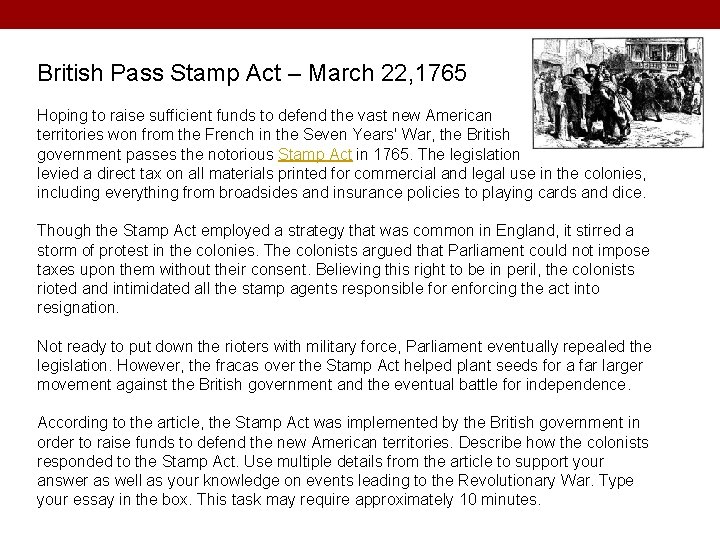
British Pass Stamp Act – March 22, 1765 Hoping to raise sufficient funds to defend the vast new American territories won from the French in the Seven Years' War, the British government passes the notorious Stamp Act in 1765. The legislation levied a direct tax on all materials printed for commercial and legal use in the colonies, including everything from broadsides and insurance policies to playing cards and dice. Though the Stamp Act employed a strategy that was common in England, it stirred a storm of protest in the colonies. The colonists argued that Parliament could not impose taxes upon them without their consent. Believing this right to be in peril, the colonists rioted and intimidated all the stamp agents responsible for enforcing the act into resignation. Not ready to put down the rioters with military force, Parliament eventually repealed the legislation. However, the fracas over the Stamp Act helped plant seeds for a far larger movement against the British government and the eventual battle for independence. According to the article, the Stamp Act was implemented by the British government in order to raise funds to defend the new American territories. Describe how the colonists responded to the Stamp Act. Use multiple details from the article to support your answer as well as your knowledge on events leading to the Revolutionary War. Type your essay in the box. This task may require approximately 10 minutes.
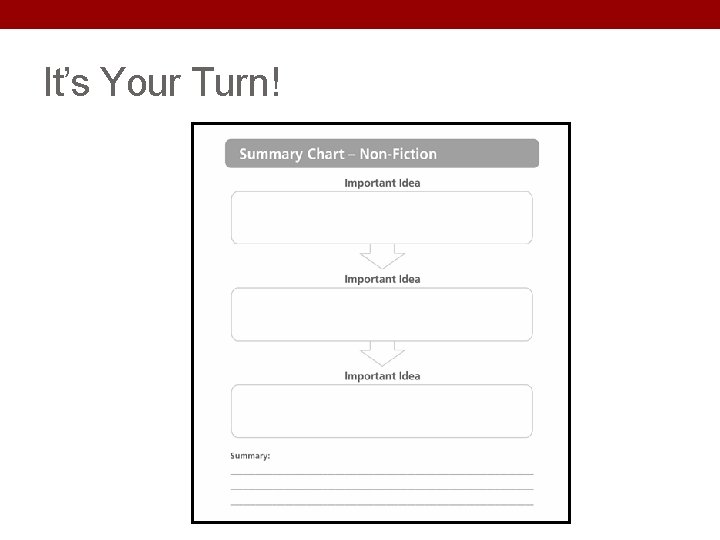
It’s Your Turn!
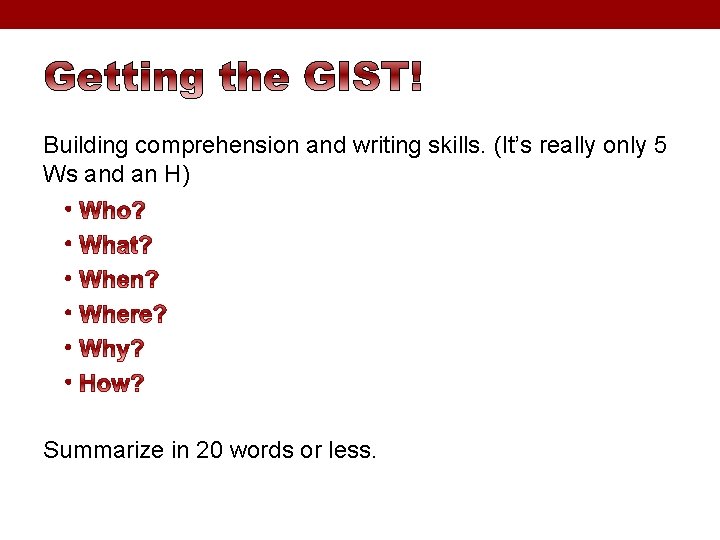
Building comprehension and writing skills. (It’s really only 5 Ws and an H) • • • Summarize in 20 words or less.
STEPS FOR DRAFTING CONSTRUCTED RESPONSES (Integrating Reading and Writing)
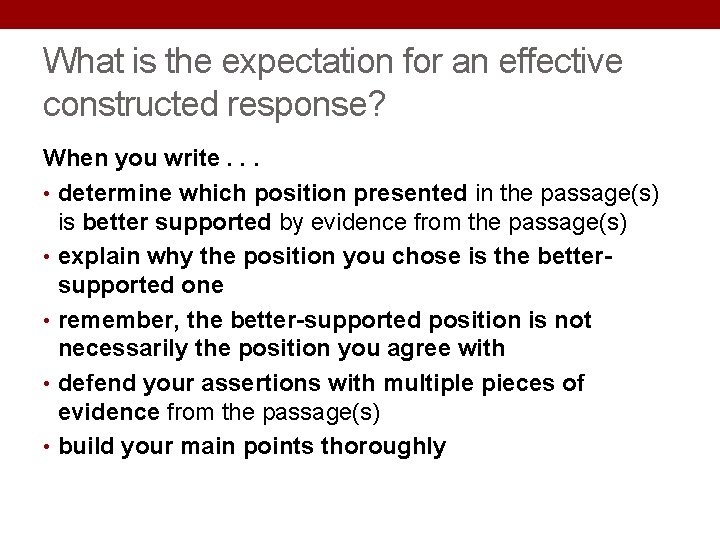
What is the expectation for an effective constructed response? When you write. . . • determine which position presented in the passage(s) is better supported by evidence from the passage(s) • explain why the position you chose is the bettersupported one • remember, the better-supported position is not necessarily the position you agree with • defend your assertions with multiple pieces of evidence from the passage(s) • build your main points thoroughly
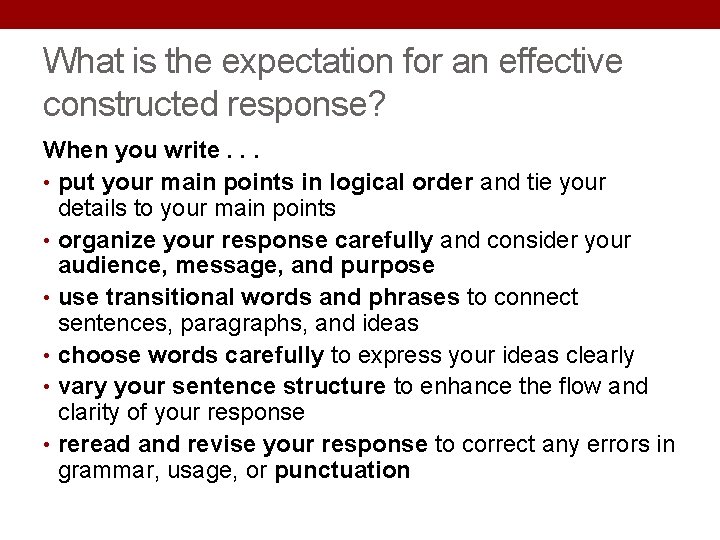
What is the expectation for an effective constructed response? When you write. . . • put your main points in logical order and tie your details to your main points • organize your response carefully and consider your audience, message, and purpose • use transitional words and phrases to connect sentences, paragraphs, and ideas • choose words carefully to express your ideas clearly • vary your sentence structure to enhance the flow and clarity of your response • reread and revise your response to correct any errors in grammar, usage, or punctuation
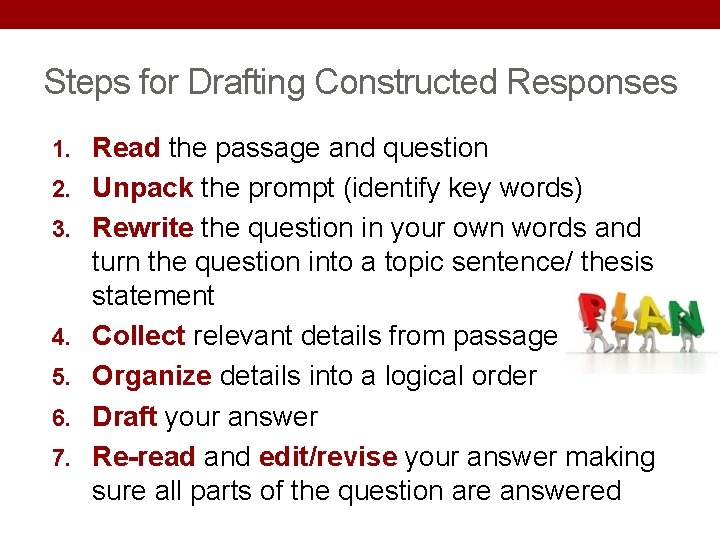
Steps for Drafting Constructed Responses 1. Read the passage and question 2. Unpack the prompt (identify key words) 3. Rewrite the question in your own words and 4. 5. 6. 7. turn the question into a topic sentence/ thesis statement Collect relevant details from passage Organize details into a logical order Draft your answer Re-read and edit/revise your answer making sure all parts of the question are answered
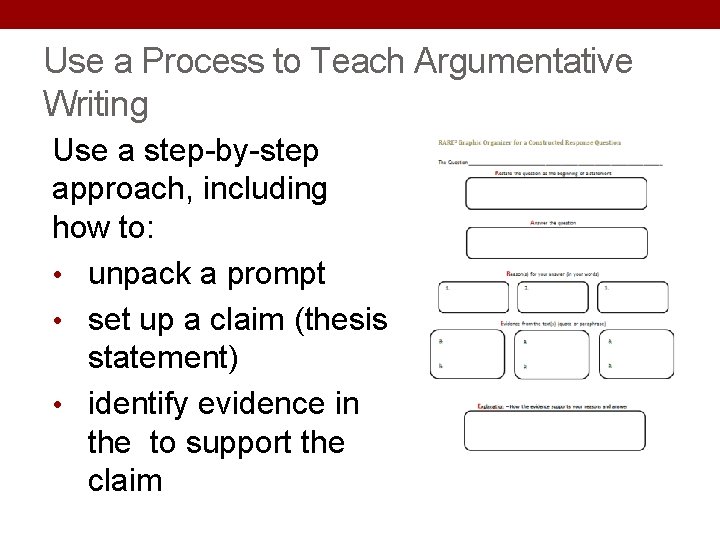
Use a Process to Teach Argumentative Writing Use a step-by-step approach, including how to: • unpack a prompt • set up a claim (thesis statement) • identify evidence in the to support the claim
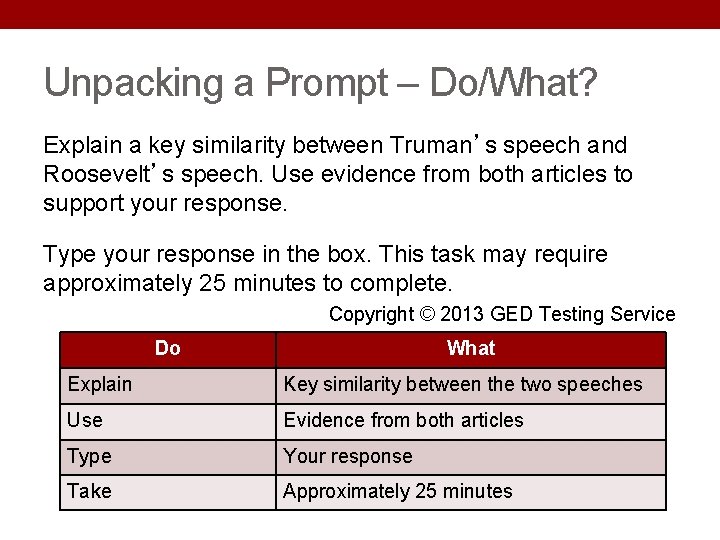
Unpacking a Prompt – Do/What? Explain a key similarity between Truman’s speech and Roosevelt’s speech. Use evidence from both articles to support your response. Type your response in the box. This task may require approximately 25 minutes to complete. Copyright © 2013 GED Testing Service Do What Explain Key similarity between the two speeches Use Evidence from both articles Type Your response Take Approximately 25 minutes
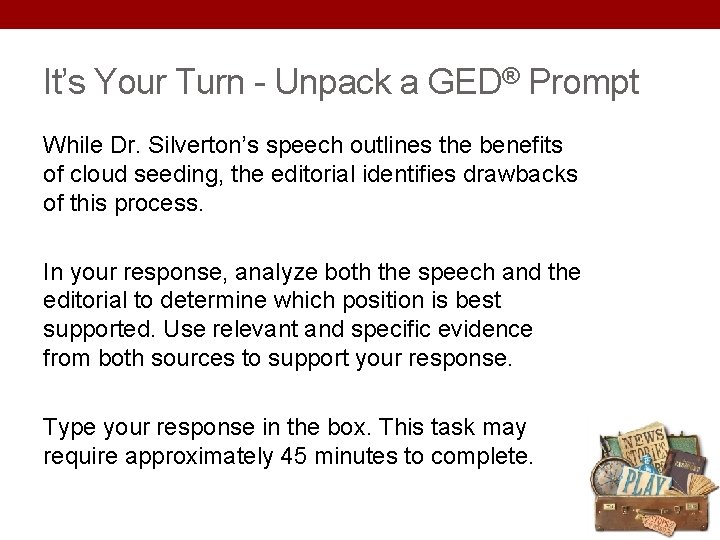
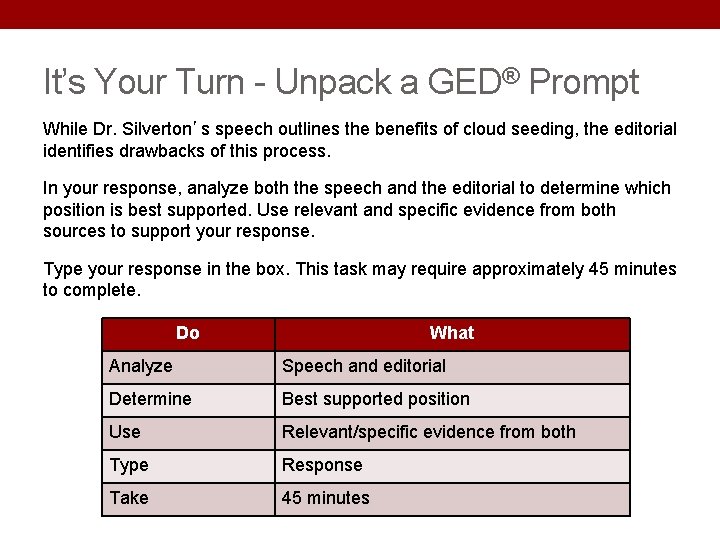
It’s Your Turn - Unpack a GED® Prompt While Dr. Silverton’s speech outlines the benefits of cloud seeding, the editorial identifies drawbacks of this process. In your response, analyze both the speech and the editorial to determine which position is best supported. Use relevant and specific evidence from both sources to support your response. Type your response in the box. This task may require approximately 45 minutes to complete.
It’s Your Turn - Unpack a GED® Prompt While Dr. Silverton’s speech outlines the benefits of cloud seeding, the editorial identifies drawbacks of this process. In your response, analyze both the speech and the editorial to determine which position is best supported. Use relevant and specific evidence from both sources to support your response. Type your response in the box. This task may require approximately 45 minutes to complete. Do What Analyze Speech and editorial Determine Best supported position Use Relevant/specific evidence from both Type Response Take 45 minutes
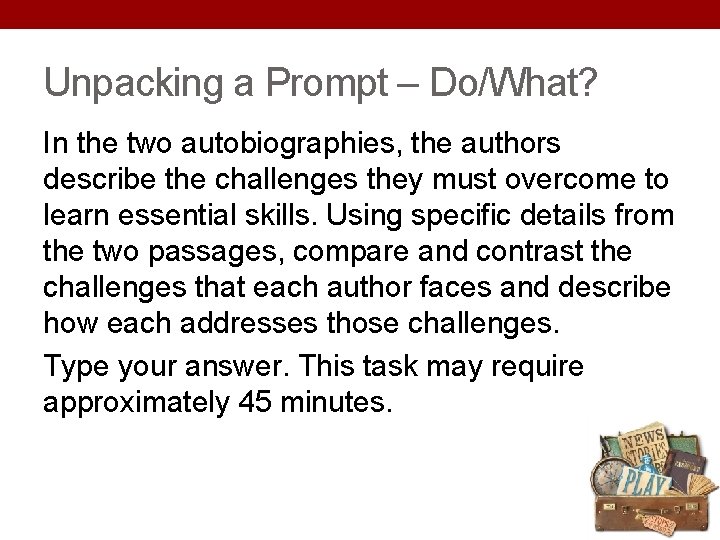
Unpacking a Prompt – Do/What? In the two autobiographies, the authors describe the challenges they must overcome to learn essential skills. Using specific details from the two passages, compare and contrast the challenges that each author faces and describe how each addresses those challenges. Type your answer. This task may require approximately 45 minutes.
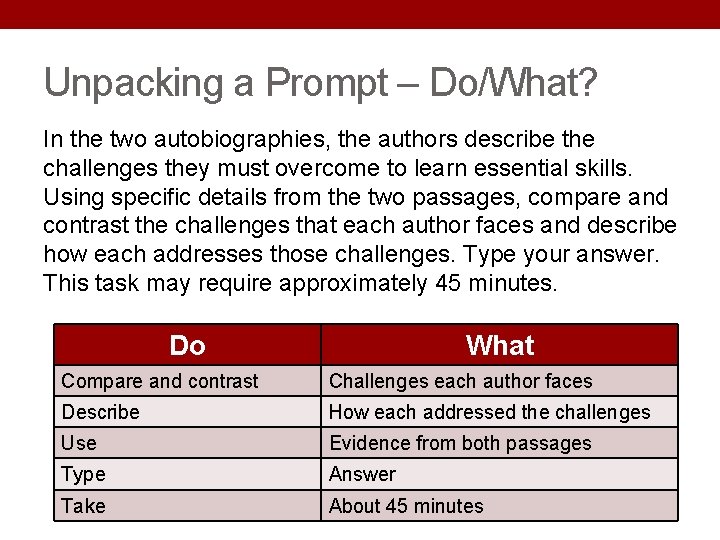
Unpacking a Prompt – Do/What? In the two autobiographies, the authors describe the challenges they must overcome to learn essential skills. Using specific details from the two passages, compare and contrast the challenges that each author faces and describe how each addresses those challenges. Type your answer. This task may require approximately 45 minutes. Do What Compare and contrast Challenges each author faces Describe How each addressed the challenges Use Evidence from both passages Type Answer Take About 45 minutes
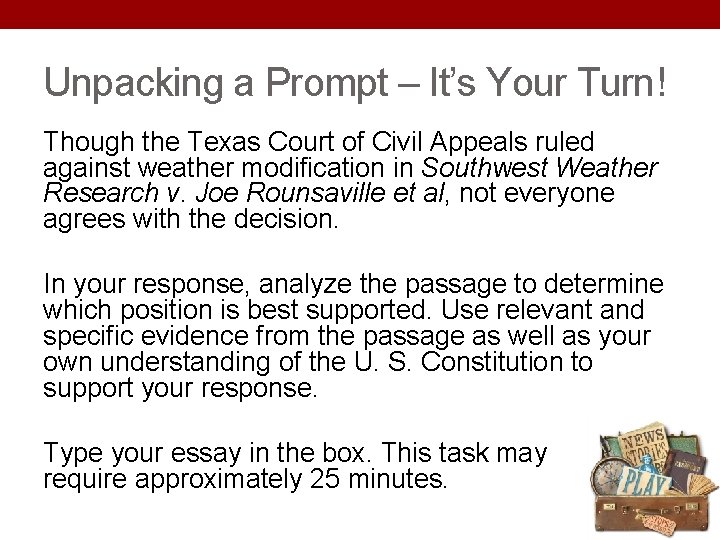
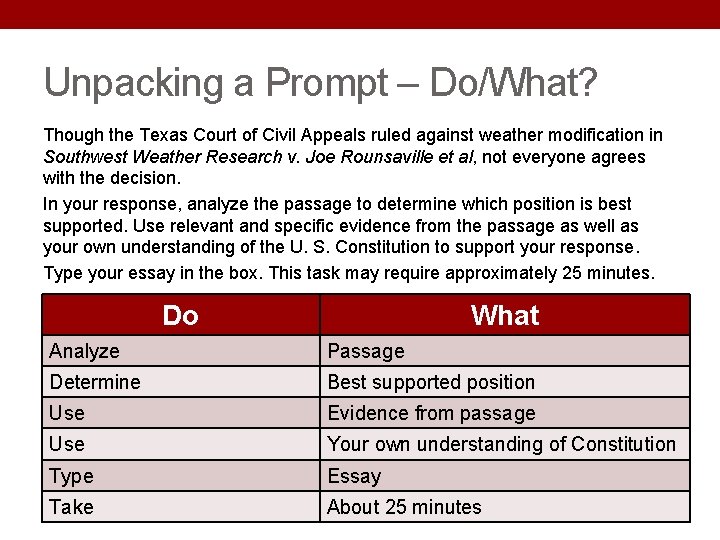
Unpacking a Prompt – It’s Your Turn! Though the Texas Court of Civil Appeals ruled against weather modification in Southwest Weather Research v. Joe Rounsaville et al, not everyone agrees with the decision. In your response, analyze the passage to determine which position is best supported. Use relevant and specific evidence from the passage as well as your own understanding of the U. S. Constitution to support your response. Type your essay in the box. This task may require approximately 25 minutes.
Unpacking a Prompt – Do/What? Though the Texas Court of Civil Appeals ruled against weather modification in Southwest Weather Research v. Joe Rounsaville et al, not everyone agrees with the decision. In your response, analyze the passage to determine which position is best supported. Use relevant and specific evidence from the passage as well as your own understanding of the U. S. Constitution to support your response. Type your essay in the box. This task may require approximately 25 minutes. Do What Analyze Passage Determine Best supported position Use Evidence from passage Use Your own understanding of Constitution Type Essay Take About 25 minutes
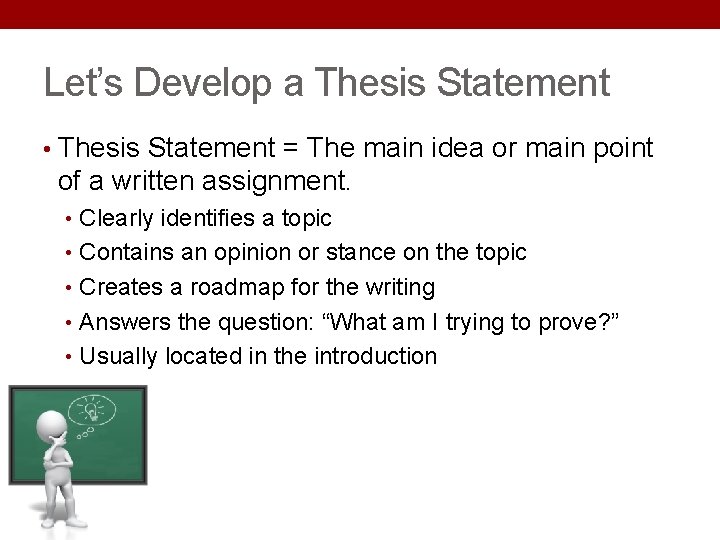
Let’s Develop a Thesis Statement • Thesis Statement = The main idea or main point of a written assignment. • Clearly identifies a topic • Contains an opinion or stance on the topic • Creates a roadmap for the writing • Answers the question: “What am I trying to prove? ” • Usually located in the introduction
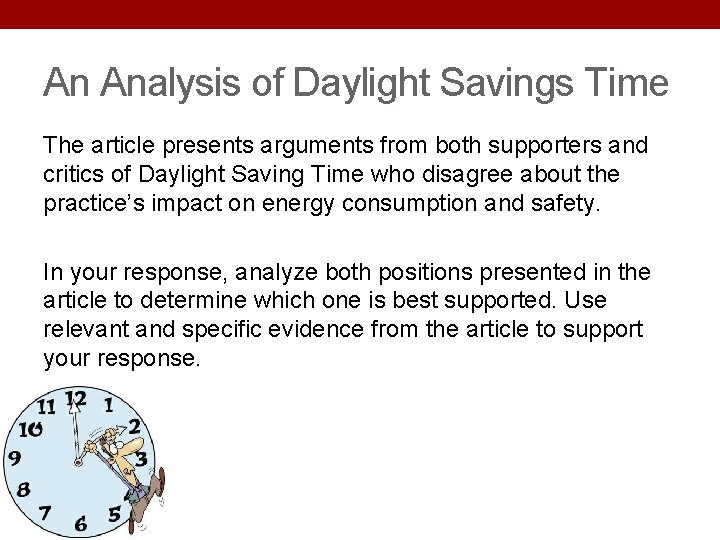
An Analysis of Daylight Savings Time The article presents arguments from both supporters and critics of Daylight Saving Time who disagree about the practice’s impact on energy consumption and safety. In your response, analyze both positions presented in the article to determine which one is best supported. Use relevant and specific evidence from the article to support your response.
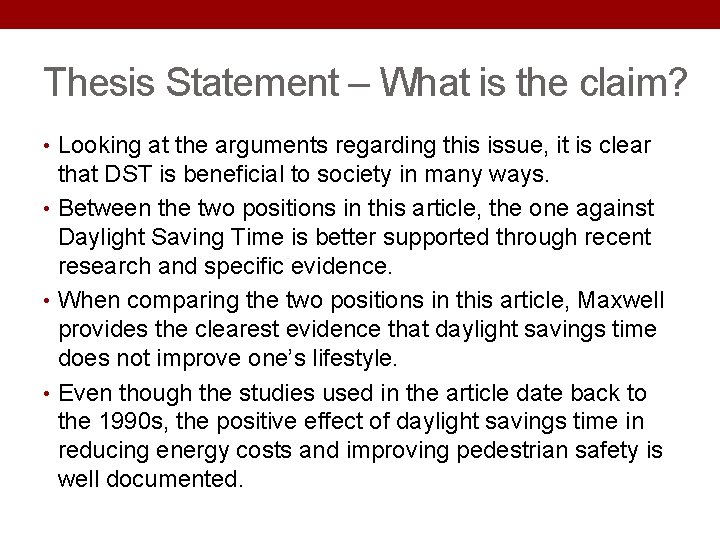
Thesis Statement – What is the claim? • Looking at the arguments regarding this issue, it is clear that DST is beneficial to society in many ways. • Between the two positions in this article, the one against Daylight Saving Time is better supported through recent research and specific evidence. • When comparing the two positions in this article, Maxwell provides the clearest evidence that daylight savings time does not improve one’s lifestyle. • Even though the studies used in the article date back to the 1990 s, the positive effect of daylight savings time in reducing energy costs and improving pedestrian safety is well documented.
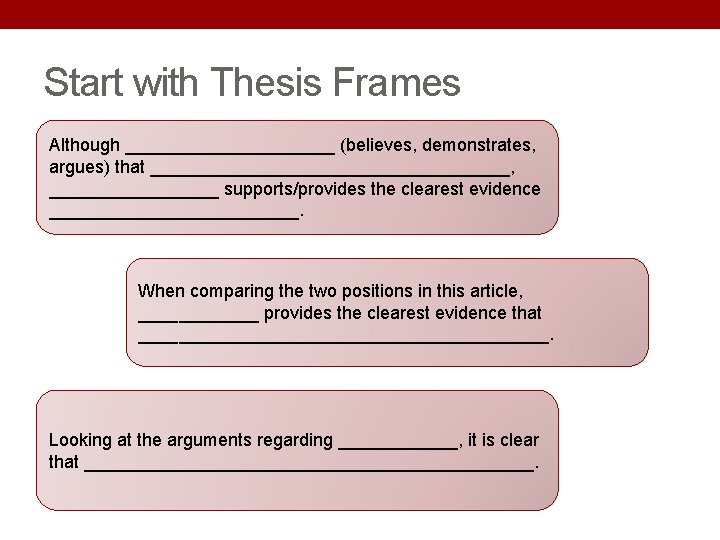
Start with Thesis Frames Although ___________ (believes, demonstrates, argues) that __________________, _________ supports/provides the clearest evidence _____________. When comparing the two positions in this article, ______ provides the clearest evidence that _____________________. Looking at the arguments regarding ______, it is clear that _______________________.
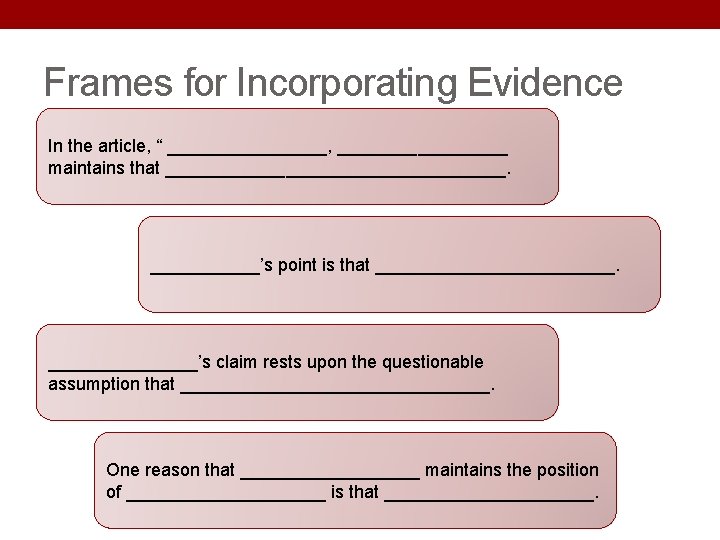
Frames for Incorporating Evidence In the article, “ ________, _________ maintains that _________________. ______’s point is that ____________. ________’s claim rests upon the questionable assumption that ________________. One reason that _________ maintains the position of __________ is that ___________.
My Thesis Statement In the argument for daylight savings time, it seems that the pro daylight savings position has won.
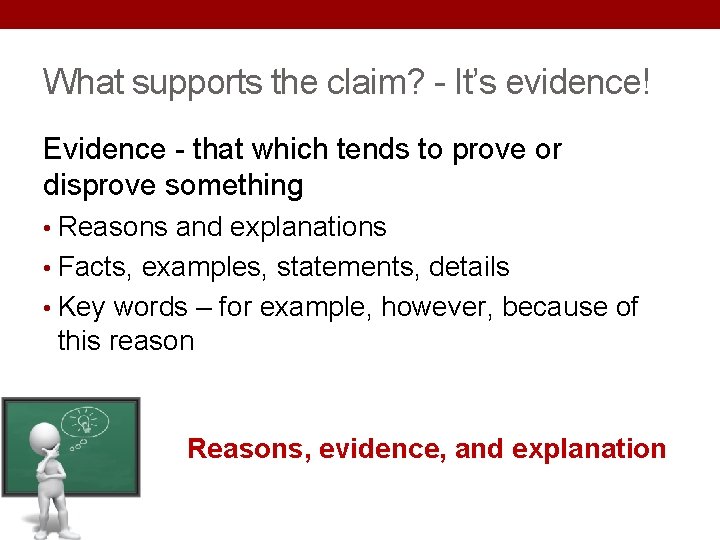
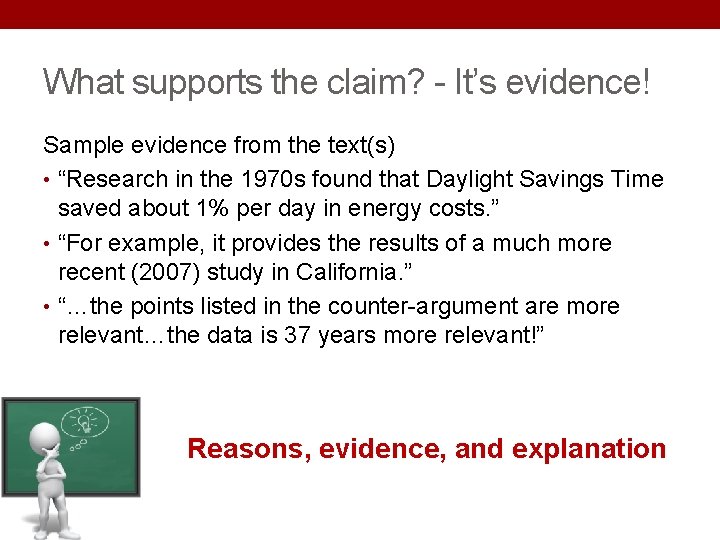
What supports the claim? - It’s evidence! Evidence - that which tends to prove or disprove something • Reasons and explanations • Facts, examples, statements, details • Key words – for example, however, because of this reason Reasons, evidence, and explanation
What supports the claim? - It’s evidence! Sample evidence from the text(s) • “Research in the 1970 s found that Daylight Savings Time saved about 1% per day in energy costs. ” • “For example, it provides the results of a much more recent (2007) study in California. ” • “…the points listed in the counter-argument are more relevant…the data is 37 years more relevant!” Reasons, evidence, and explanation
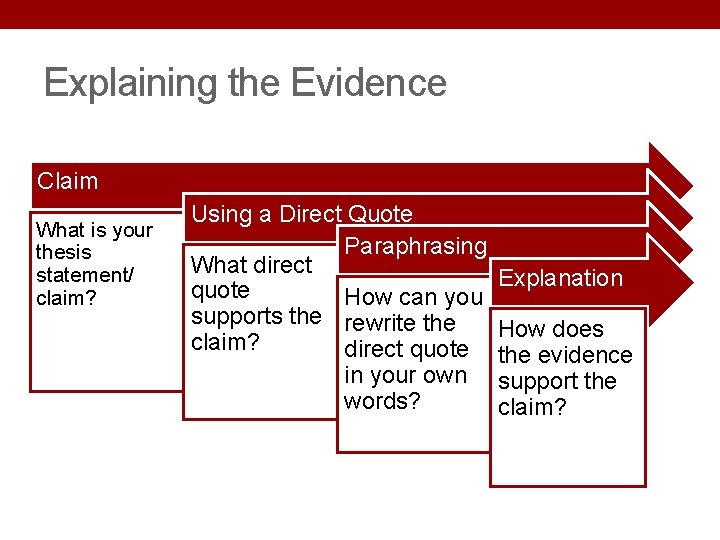
Explaining the Evidence Claim What is your thesis statement/ claim? Using a Direct Quote Paraphrasing What direct quote How can you supports the rewrite the claim? direct quote in your own words? Explanation How does the evidence support the claim?
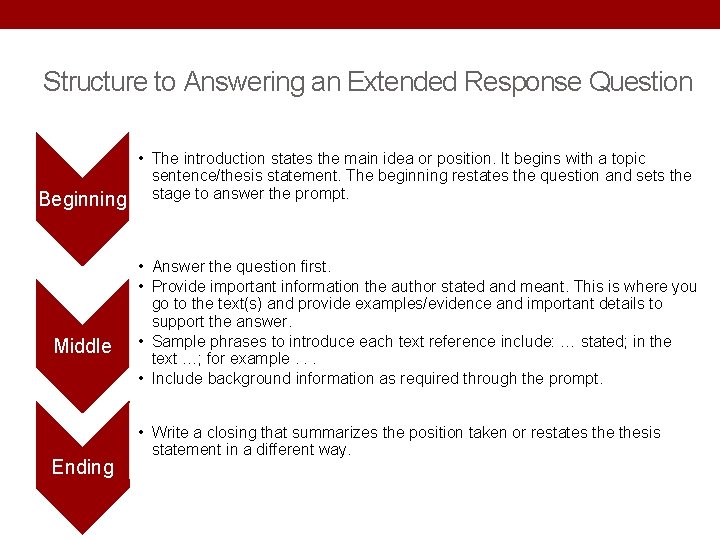
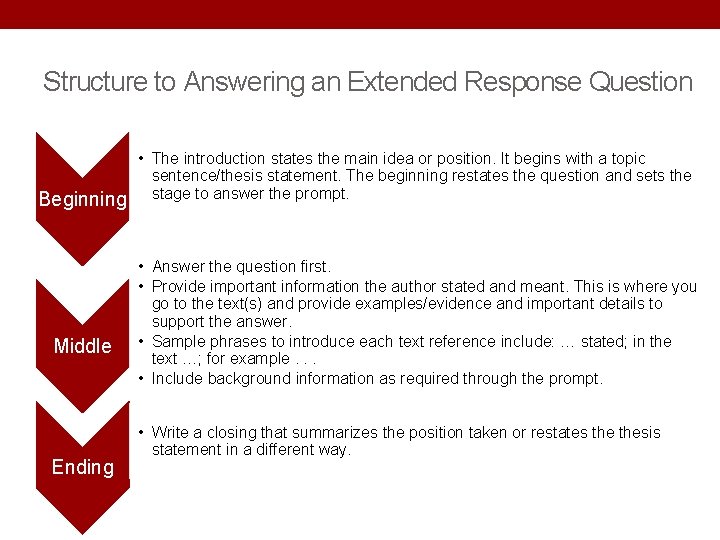
Structure to Answering an Extended Response Question Beginning Middle Ending • The introduction states the main idea or position. It begins with a topic sentence/thesis statement. The beginning restates the question and sets the stage to answer the prompt. • Answer the question first. • Provide important information the author stated and meant. This is where you go to the text(s) and provide examples/evidence and important details to support the answer. • Sample phrases to introduce each text reference include: … stated; in the text …; for example. . . • Include background information as required through the prompt. • Write a closing that summarizes the position taken or restates thesis statement in a different way.
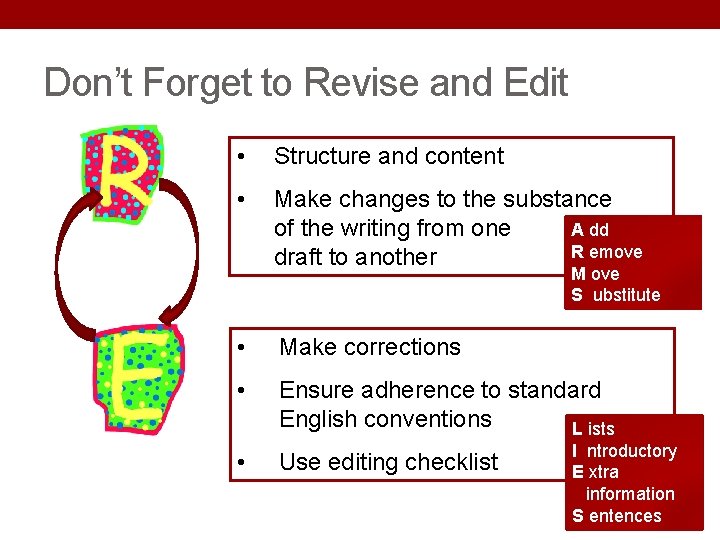
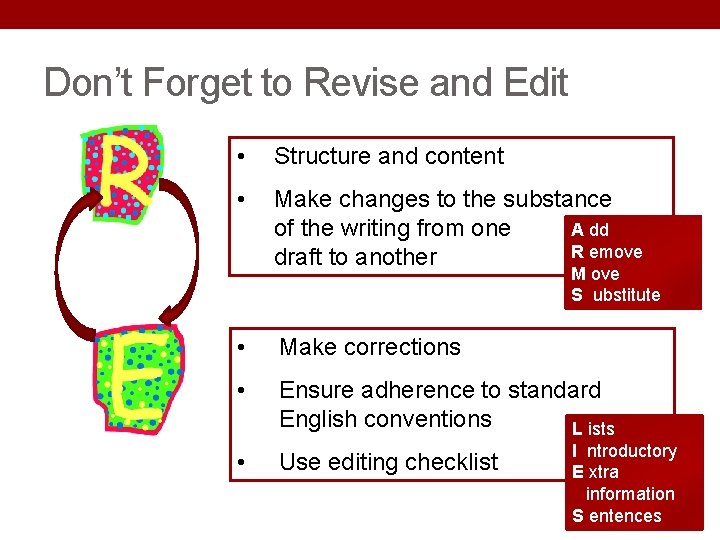
Don’t Forget to Revise and Edit • Structure and content • Make changes to the substance of the writing from one A dd R emove draft to another M ove S ubstitute • Make corrections • Ensure adherence to standard English conventions L ists • Use editing checklist I ntroductory E xtra information S entences
Let’s Try It! Hershey and Mars
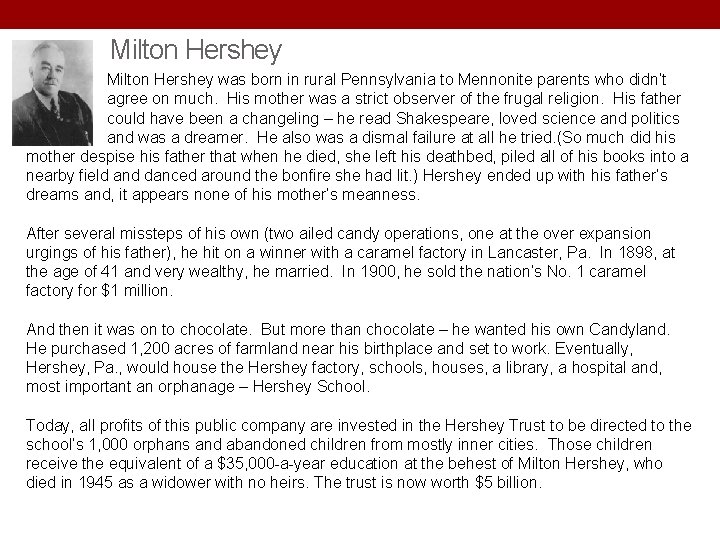
Milton Hershey was born in rural Pennsylvania to Mennonite parents who didn’t agree on much. His mother was a strict observer of the frugal religion. His father could have been a changeling – he read Shakespeare, loved science and politics and was a dreamer. He also was a dismal failure at all he tried. (So much did his mother despise his father that when he died, she left his deathbed, piled all of his books into a nearby field and danced around the bonfire she had lit. ) Hershey ended up with his father’s dreams and, it appears none of his mother’s meanness. After several missteps of his own (two ailed candy operations, one at the over expansion urgings of his father), he hit on a winner with a caramel factory in Lancaster, Pa. In 1898, at the age of 41 and very wealthy, he married. In 1900, he sold the nation’s No. 1 caramel factory for $1 million. And then it was on to chocolate. But more than chocolate – he wanted his own Candyland. He purchased 1, 200 acres of farmland near his birthplace and set to work. Eventually, Hershey, Pa. , would house the Hershey factory, schools, houses, a library, a hospital and, most important an orphanage – Hershey School. Today, all profits of this public company are invested in the Hershey Trust to be directed to the school’s 1, 000 orphans and abandoned children from mostly inner cities. Those children receive the equivalent of a $35, 000 -a-year education at the behest of Milton Hershey, who died in 1945 as a widower with no heirs. The trust is now worth $5 billion.
Unpack the Prompt – Do/What? Hershey and Mars were successful businessmen in the chocolate industry. Explain a key similarity between Hershey’s and Mars’ lives that assisted them in their success. Use evidence from both articles to support your answer. Type your response in the box. This task may require approximately 45 minutes to complete. Do What
Unpack the Prompt – Do/What? Hershey and Mars were successful businessmen in the chocolate industry. Explain a key similarity between Hershey’s and Mars’ lives that assisted them in their success. Use evidence from both articles to support your answer. Type your response in the box. This task may require approximately 45 minutes to complete. Do What Describe How colonists responded to the Stamp Act Use Multiple details from article Use Knowledge of Revolutionary War Type Short answer Take About 45 minutes
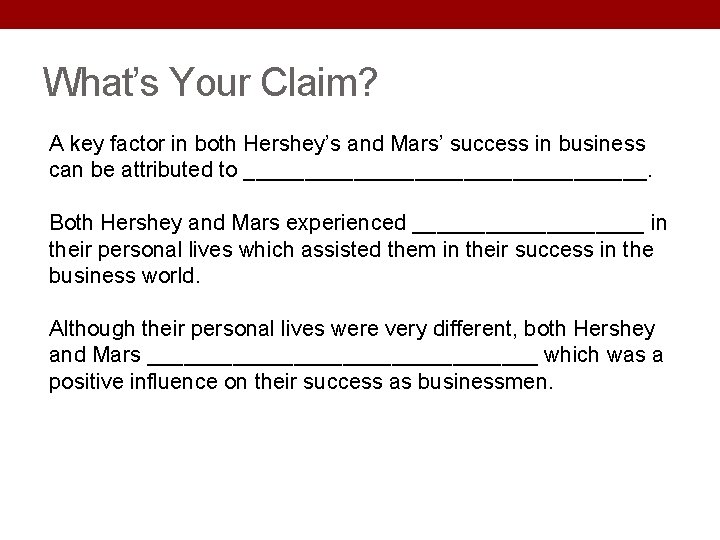
What’s Your Claim? A key factor in both Hershey’s and Mars’ success in business can be attributed to _________________. Both Hershey and Mars experienced __________ in their personal lives which assisted them in their success in the business world. Although their personal lives were very different, both Hershey and Mars ________________ which was a positive influence on their success as businessmen.
What’s the Evidence? What are key words, phrases, ideas that support the claim? Text 1 – Hershey Text 2 – Mars
Structure to Answering an Extended Response Question Beginning Middle Ending • The introduction states the main idea or position. It begins with a topic sentence/thesis statement. The beginning restates the question and sets the stage to answer the prompt. • Answer the question first. • Provide important information the author stated and meant. This is where you go to the text(s) and provide examples/evidence and important details to support the answer. • Sample phrases to introduce each text reference include: … stated; in the text …; for example. . . • Include background information as required through the prompt. • Write a closing that summarizes the position taken or restates thesis statement in a different way.
Don’t Forget to Revise and Edit • Structure and content • Make changes to the substance of the writing from one A dd R emove draft to another M ove S ubstitute • Make corrections • Ensure adherence to standard English conventions L ists • Use editing checklist I ntroductory E xtra information S entences
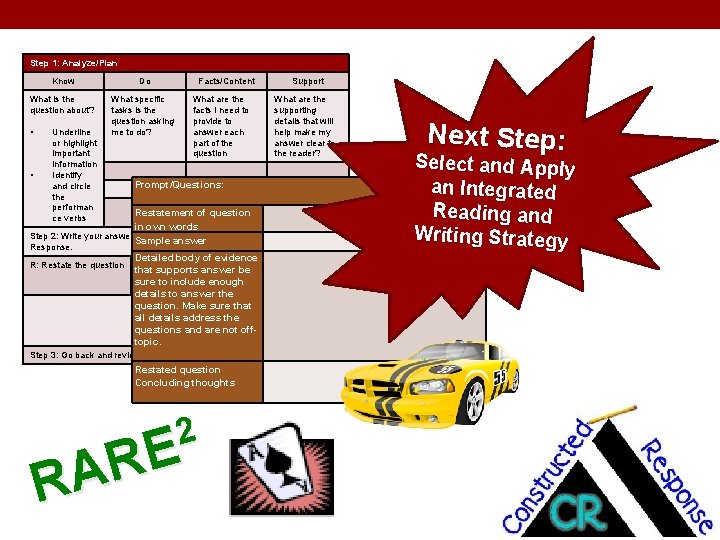
Step 1: Analyze/Plan Know Do What is the question about? What specific tasks is the question asking me to do? • • Underline or highlight important information Identify and circle the performan ce verbs Facts/Content What are the facts I need to provide to answer each part of the question Support What are the supporting details that will help make my answer clear to the reader? Prompt/Questions: Restatement of question in own words Step 2: Write your answer – Be sure to use the “RAS” Method for Written Sample answer Response. Detailed body of evidence A: Answer the question S: Support your answer that supports answer be using your notes with evidence sure to include enough (supporting details) details to answer the question. Make sure that all details address the questions and are not off- topic. Step 3: Go back and review, revise, and edit your answer. Restated question Concluding thoughts R: Restate the question 2 E R RA Next Step: Select and Apply an Integrated Reading and Writing Strategy
A Few Strategies to Get Started • Dedicate time to writing and writing instruction across the curriculum. • Involve students in various forms of writing. • Treat writing as a process. • Keep students engaged. • Be enthusiastic about writing.
A Few Strategies to Get Started • Teach often to the whole class, in small groups, and with individual students. • Model, explain, and provide guided assistance. • Provide support, but move towards self- regulation. • Adapt writing assignments and instruction to meet student needs. • Set high expectations.
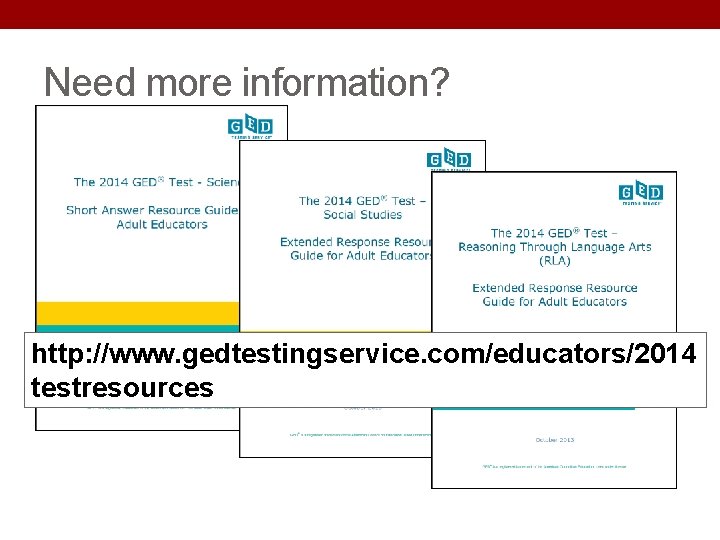
Need more information? http: //www. gedtestingservice. com/educators/2014 testresources
“High achievement always occurs in the framework of high expectation. ” Charles F. Kettering (1876 -1958)
Q & A
Bonnie Goonen bv 73008@aol. com Susan Pittman skptvs@aol. com Copyright© 2013 GED Testing Service LLC. All rights reserved. Used by permission. GED® and GED Testing Service® are registered trademarks of the American Council on Education (ACE). They may not be used or reproduced without the express written permission of ACE or GED Testing Service. The GED® and GED Testing Service® brands are administered by GED Testing Service LLC under license from the American Council on Education.