
Unit 4 Test Review FOCUS 1116 Please get

- Slides: 26
Unit 4 Test Review
FOCUS 11/16 • Please get a photosynthesis bellwork from the BLUE basket at the front of the classroom
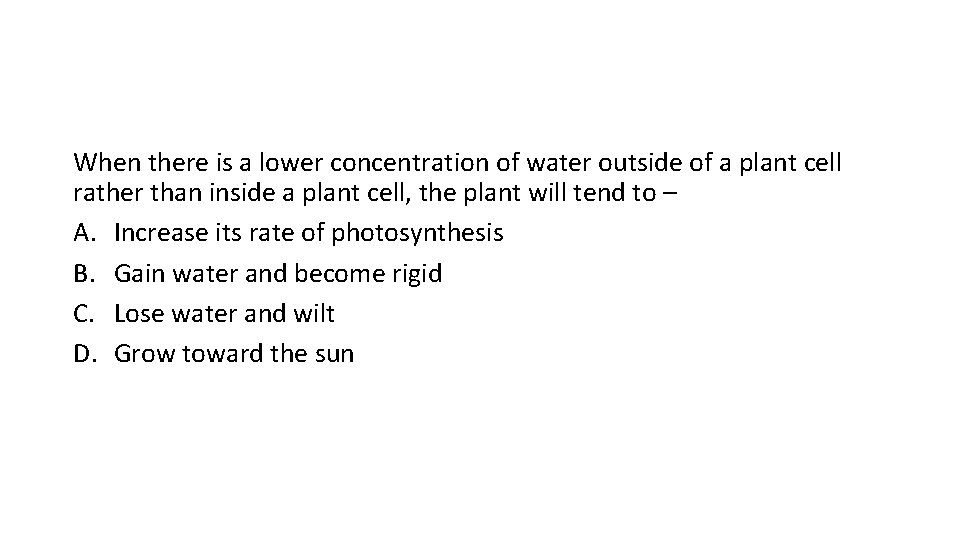
When there is a lower concentration of water outside of a plant cell rather than inside a plant cell, the plant will tend to – A. Increase its rate of photosynthesis B. Gain water and become rigid C. Lose water and wilt D. Grow toward the sun
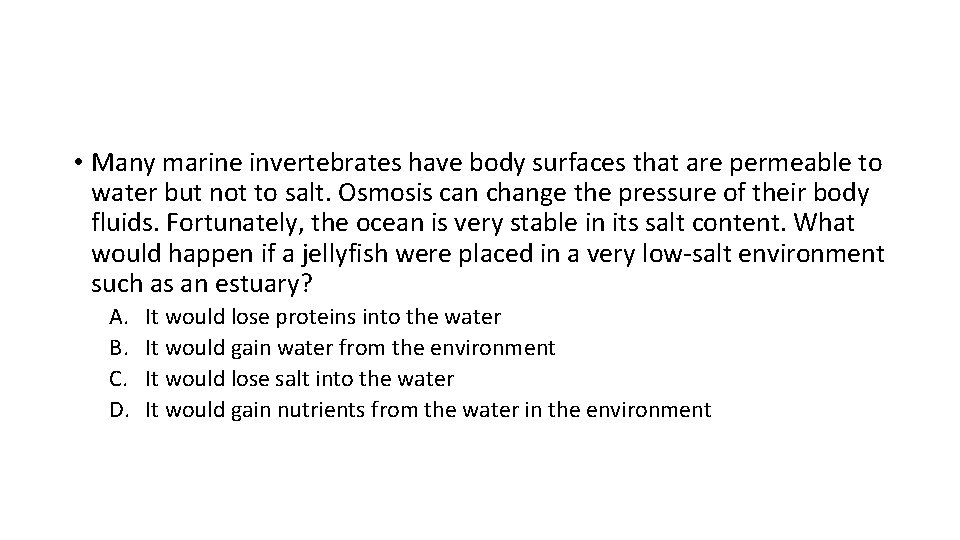
• Many marine invertebrates have body surfaces that are permeable to water but not to salt. Osmosis can change the pressure of their body fluids. Fortunately, the ocean is very stable in its salt content. What would happen if a jellyfish were placed in a very low-salt environment such as an estuary? A. B. C. D. It would lose proteins into the water It would gain water from the environment It would lose salt into the water It would gain nutrients from the water in the environment
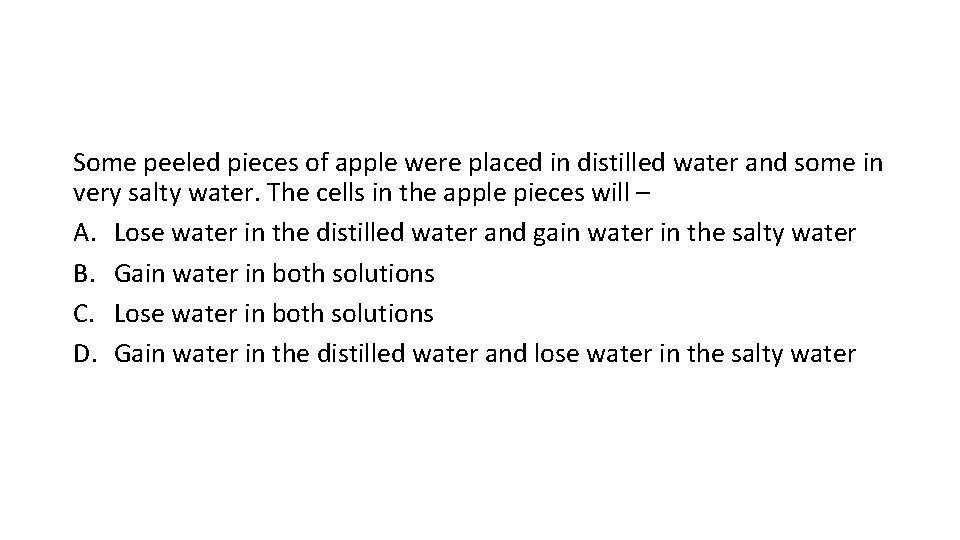
Some peeled pieces of apple were placed in distilled water and some in very salty water. The cells in the apple pieces will – A. Lose water in the distilled water and gain water in the salty water B. Gain water in both solutions C. Lose water in both solutions D. Gain water in the distilled water and lose water in the salty water
The main reason that eating salty foods makes a person thirsty is that additional fluid is needed to – A. Increase the salinity of blood B. Prevent damage to the lining of the throat C. Dissolve salt crystals in the stomach D. Maintain the fluid balance in cells
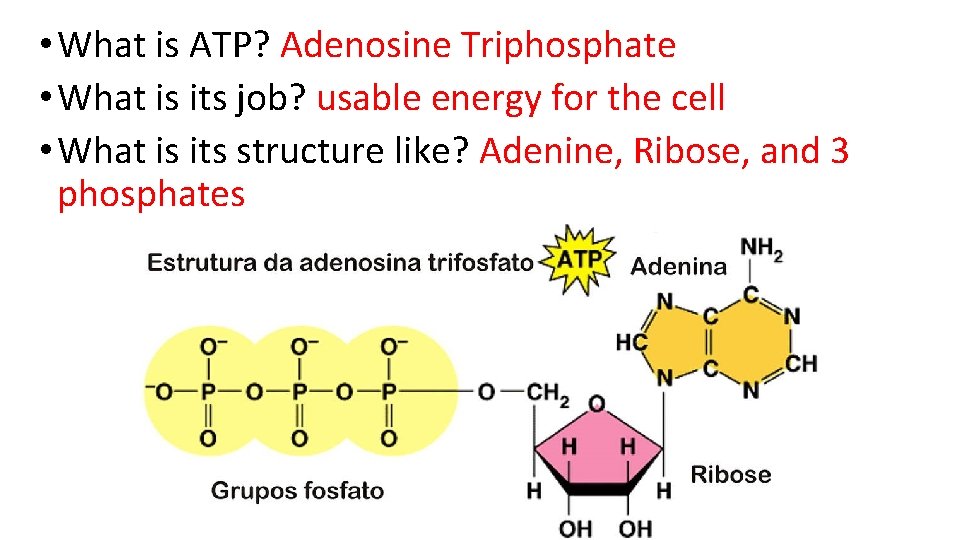
• What is ATP? Adenosine Triphosphate • What is its job? usable energy for the cell • What is its structure like? Adenine, Ribose, and 3 phosphates
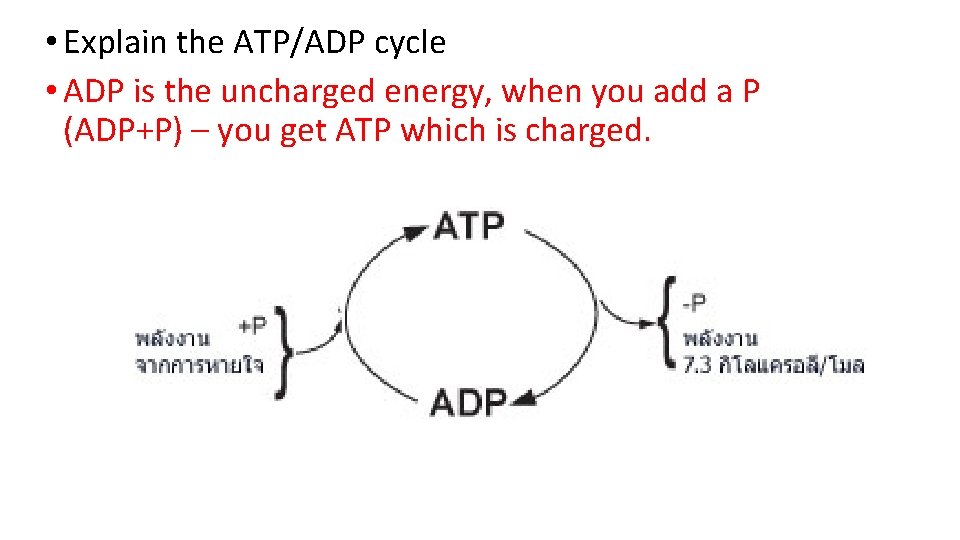
• Explain the ATP/ADP cycle • ADP is the uncharged energy, when you add a P (ADP+P) – you get ATP which is charged.
• What is the purpose of cellular respiration? To make usable energy for the cell from glucose (aka – food)
• What is the difference between aerobic and anaerobic respiration? • Aerobic: requires O 2 • Anaerobic: No O 2 required
• What is the purpose of glycolysis? Breaks down glucose • Where does it occur? Cytoplasm • What is produced? 2 ATP; 2 Pyruvate
• What is fermentation and why is it done? • Anaerobic Respiration; When there is no oxygen left, we have another way to make energy • What are the two types of fermentation? • Lactic acid • Ethyl Alcohol (alcoholic)
• What are the two main parts of aerobic respiration that follow glycolysis? • Krebs cycle • Electron Transport Chain (ETC)
• Where does respiration take place? Mitochondria
• What is the Krebs Cycle? Is the process of releasing CO 2 and generating some ATP from pyruvic acid • What is the purpose of it? Release CO 2, generate ATP • What is produced/obtained? 2 ATP produced, CO 2 is released • Where in the mito? MATRIX!!!
• Explain what happens in the Electron Transport Chain. • Inner-membrane of the mitochondria; creates a proton gradient so that it generate A TON OF ATP!!! =34 TOTAL ATP!!!
• About how much energy is produced from aerobic respiration? 36 -38 ATP!!
• What is the purpose of photosynthesis? To create glucose from sunlight! • Where does it take place? Chloroplasts
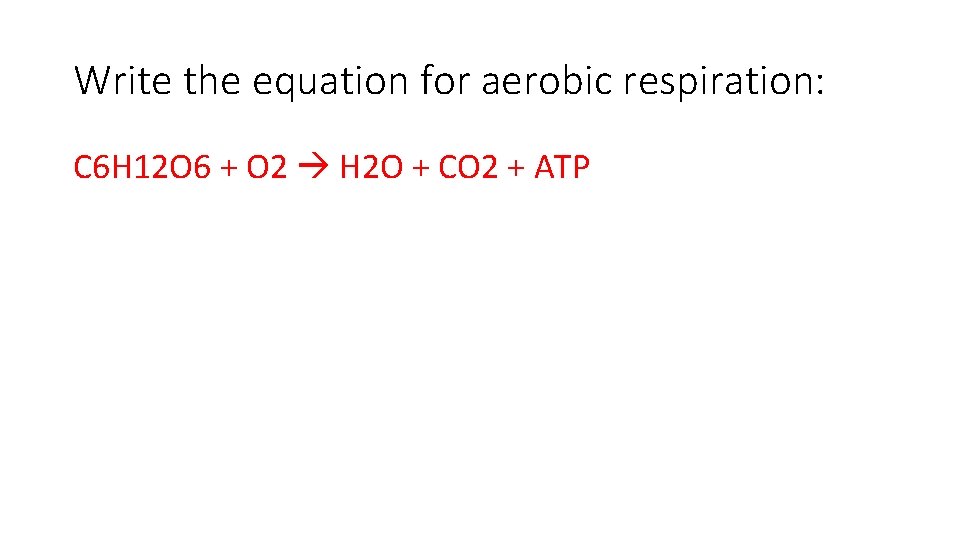
Write the equation for aerobic respiration: C 6 H 12 O 6 + O 2 H 2 O + CO 2 + ATP
• What is a pigment? Absorbs light to produce color • What is the purpose of chlorophyll? Absorbs sunlight in photosynthesis
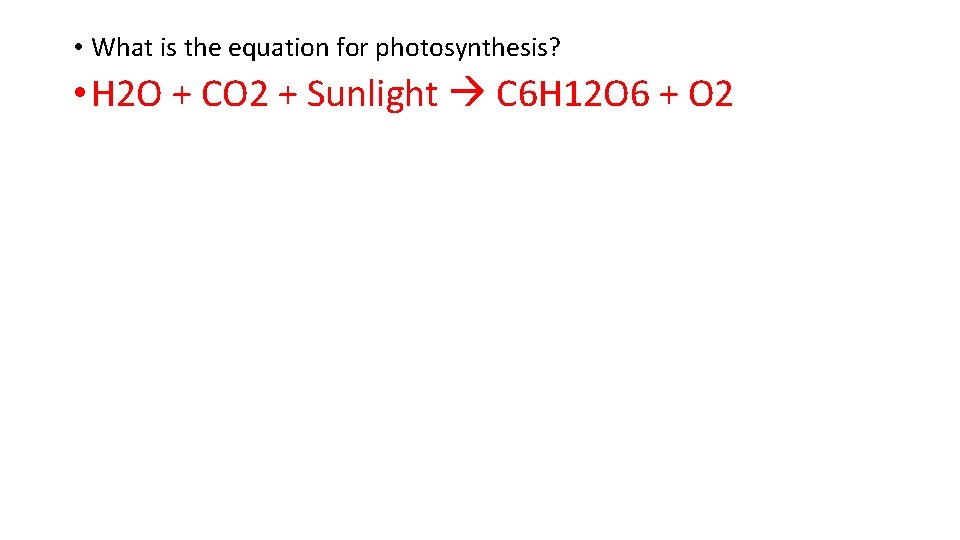
• What is the equation for photosynthesis? • H 2 O + CO 2 + Sunlight C 6 H 12 O 6 + O 2
• What are the main parts of the chloroplast? • Grana – stack of thylakoids/granum; which have chlorophyll and absorb light • Stroma – fluid surrounding the grana
• What happens during the light dependent reactions of photosynthesis? • Sunlight is absorbed • Water is split • ATP is charged • Where in the chloroplast do these occur? Grana
• What happens during the light independent (calvin cycle) reactions of photosynthesis? • Do not require light • H 2 O and CO 2 join to form glucose • O 2 is released • Where in the chloroplast do these occur? Stroma
• How are photosynthesis and aerobic respiration linked? • The formulas are flipped • Plants created glucose (food) from the sun, they also take in CO 2 and release O 2. Animals and humans, eat plants for food (glucose) to create ATP. Humans release CO 2 and take in O 2. • Plants generate food & O 2 for animals/humans • Animals/humans generate CO 2 for plants.
• Define and give an example of each – • Hypotonic – There is more salt in the cell, so water is brought in and the cell swells (Hypo = hippo = thick/fat cell) • Hypertonic – There is more salt in the environment, so the cell loses water and shrinks (hyper people are skinny) • Isotonic – There are equal amounts of water/salt in and outside of the cell. BALANCED! • Passive Transport – Moving from high to low concentration; no energy required • Active Transport – Moving from low to high concentration; energy is required.