
Social Services and Wellbeing Wales Act 2014 Better
Social Services and Well-being (Wales) Act 2014 ‘Better Conversations’ in Information, Advice and Assistance Services Skills based resource pack
Aim and objectives Aim • To support better conversations Objectives • Know why effective conversation skills are essential to this service • Explore the essential conversation skills • Discuss and try out the results you can get using effective conversations
Context for Information, Advice and Assistance • Responding to a wide range of requests • Increasing demand limited time • Having to identify what matters most to the individual within the context of the social care intervention • Giving the right response • Feeling safe • Feeling good about how well you do your job • Providing IAA face to face or via the phone
Social Services and Well-being (Wales) Act 2014 • • • Voice and Control Avoid creating unnecessary dependence Sustainability – with fewer services ‘What matters’ most support Prevention by earlier intervention Access to information about a range of options by signposting • Ending of the tick box culture • Outcome - maintain or regain as much independence as possible • It gives permission to do things differently
What are the hopes for the Act? “Essentially we want a system that will be simpler, where people will be asked about what matters to them and which captures what they can contribute to their own well-being” Mark Drakeford A short film to help us understand https: //www. youtube. com/watch? v=a 2 Ki. Tnsv 5 ZM&f eature=youtu. be
What is the vision for our Information, Advice and Assistance service?
Section 2 Our own experience
Think of a good example In your busy conversations, think of an example of a good conversation you have had with a caller. What pleased you most about it? What did you achieve?
Key elements What are the most important elements of effective communication from your experience?
Key elements of communication • Showing that you are listening • Expressing empathy and warmth • Asking the right questions so there is clarity about concerns • Showing support by recognition of individuals’ strengths • Showing patience • Appearing knowledgeable and effective
Section 3 Starting well
The importance of first contact • People are calling at a time of stress and challenge. • They may feel they are very clear about what they need and why. But • They may be confused, anxious, frightened, frustrated, angry. • They need time to reflect, hear themselves talk and hear themselves become clearer.
Examples of negative thinking What sort of comments do you hear each other making about some of the things you feel you have to put up with?
Focusing your skills • • • Listening and expressing empathy Exploring concerns and aspirations Expecting natural defensiveness Helping people understand value their strengths Avoiding arguments and confrontation Enables you to: • Notice people for the problems they face, not just the problems they cause • Notice peoples abilities to alter their own course and to offset their own risk and concerns • Focus on their hopes and aspirations • Notice the strengths of families / groups / units and support what's important to them, building on their resilience • Make better decisions (with the individual) based on the right information • Signpost if needs be to most appropriate services
Imagine Something you feel you need to tackle… • Work / life balance • Eating • Exercise • Parenting • Supporting elderly parents • Drink less wine Make a commitment to act now!
Experiencing behaviour change • Individuals NOT information make decisions and keep people safe. • If we do decide to act, unless we have made the decision and commitment ourselves we may be unlikely to keep it going.
Managing the conversation You • Make a commitment to listen • Stay calm and purposeful • Stay focussed on the most important issues • Acknowledge the challenge • Build on the strengths • Explore individual’s hopes and aspirations • Respect individual’s skills, knowledge and expertise And you try to avoid • Rescuing, advising, telling or ‘doing to’ rather than ‘with’
5 stages to a good conversation 1. 2. 3. 4. 5. Open engaging questions Active listening Open exploratory questions Information exchange Summary and actions
Section 4 Good conversations
5 stages to a good conversation 1. 2. 3. 4. 5. Open engaging questions Active listening Open exploratory questions Information exchange Summary and actions
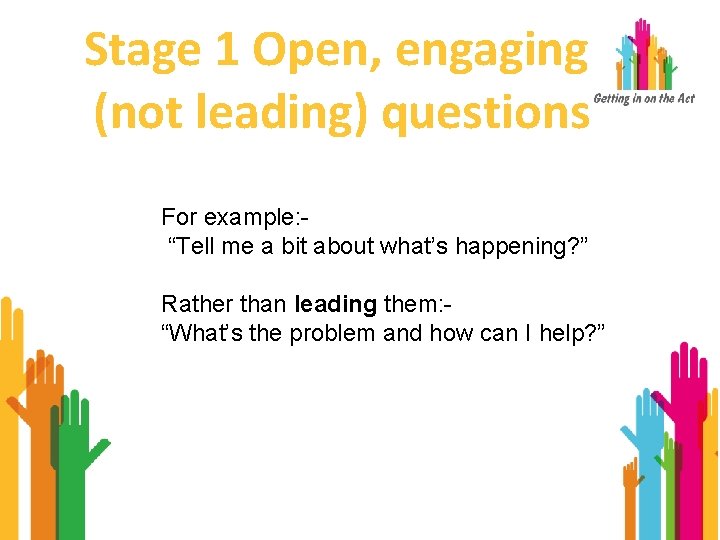
Stage 1 Open, engaging (not leading) questions For example: - “Tell me a bit about what’s happening? ” Rather than leading them: “What’s the problem and how can I help? ”
Stage 2 Active listening • Respond by letting people know that you are listening and understanding. • Respond with short reflective statements that get to the heart of the matter.
The power of reflection • If you are reflecting, you are focusing on an individual’s world, their thoughts, their dilemmas as opposed to… • Solely asking questions needed by the system which may or may not be relevant or meaningful or • Making suggestions or offering advice too soon Remember - reflective statements are your vehicle for your intuitive understanding
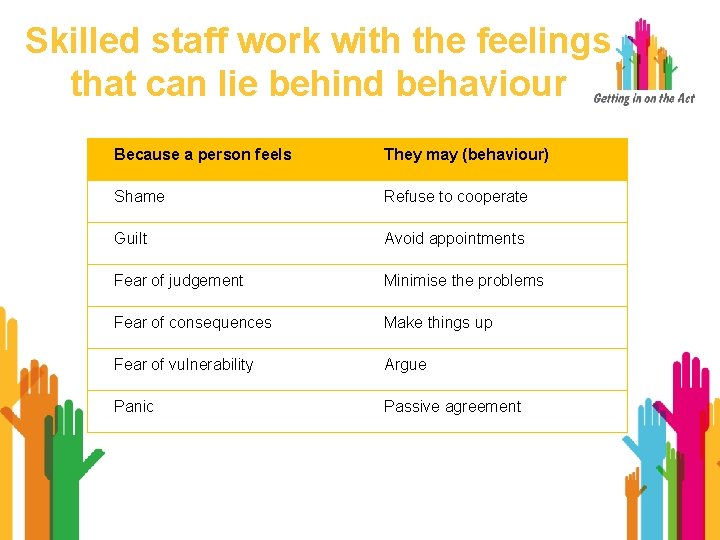
Skilled staff work with the feelings that can lie behind behaviour Because a person feels They may (behaviour) Shame Refuse to cooperate Guilt Avoid appointments Fear of judgement Minimise the problems Fear of consequences Make things up Fear of vulnerability Argue Panic Passive agreement
Practice reflective statements In 3’s • One person be the speaker talking about an issue that concerns you • Second person keep time and facilitate a shared discussion after 5 minutes • Third person listen and reflect on the speakers situation, wondering: - • What's important to her / him (e. g. you are trying to help your mum stay at home)
Practice reflective statements • What feelings may be behind the words? (E. g. you are really worried, this has never happened before) • What have I noticed about the challenge s / he faces? (It’s hard for you with so many conflicting responsibilities) • What have I noticed about her / his strengths / values? (You want the best for your mum and are going the extra mile)
Stage 3 Asking exploratory questions • • • Open, not closed Simple, not multiple Not leading Avoid ‘Why’ Key questions
Open exploratory questions (finding out what matters) • What concerns you most? • What would worry you if nothing changed? • What have you noticed when things are a bit better? • What do you hope for if things can improve? • What would be happening to make you a little less concerned?
Engaging with other professionals when they want to refer to you • Can I check a few things out with you so I’m clear about what you might need from us? • What is it specifically about their situation that concerns you? • What have you noticed about the family when things are going well? • What would be happening in 3 months’ time if things were improved? • What might you specifically want from us to help them achieve this? • What would your role continue to be and how shall we keep in touch?
Stage 4 The information exchange For example: • Would you like me to give you a bit more information? • Could I ask you for a little more information?
Stage 5 Summary and actions • A focus on key issues • What are the strengths / skills and motivators you have noticed? • What actions have they decided to take? • Empowering summaries
Summary example from a conversation with a concerned daughter “You are very concerned that your mum may be missing meals in the day as it is painful for her to prepare food. Her friends or a neighbour calls in 3 times a week and you call on the weekend but there are some times when she is alone. You would like to consider options with your mum about how she might cope on these days. This is a new and strange situation for you and your mum who is a strong and independent woman. ” Question for worker and daughter: “What are your thoughts about next steps? ”
Thinking about what action(s) you both might want from your discussion… What the person is going to do next and what the worker is going to do next - examples • Individual will discuss more with family members • Individual will gather more information and ring again • Individual will think about things a bit more before deciding on any action • Individual will contact a suggested service following signposting from frontline staff • Worker will offer further contact • Worker will offer / access more specialist advice • Worker will refer into the organisation or another service for specialist help
Strategies for lowering challenging conversations • What do you do when the individual is not having a good day? • What tactics do you use to try and stop yourself getting sucked into emotions such as anxiety or anger?
Case scenarios In 3’s • One person be the individual. • Second person follow the phases, always remembering to reflect and affirm throughout. • Third person keeps the time, observes and facilitates the debriefing. • Call time after 10 minutes and debrief.
Feedback from exercise
Next steps • Follow up in team meetings • Case discussions • Review your progress… What I will notice myself doing? What I will notice others doing?
- Slides: 37