ECE 150 Fundamentals of Programming The call stack
- Slides: 46
ECE 150 Fundamentals of Programming The call stack Douglas Wilhelm Harder, M. Math. Prof. Hiren Patel, Ph. D. hiren. patel@uwaterloo. ca dwharder@uwaterloo. ca © 2018 by Douglas Wilhelm Harder and Hiren Patel. Some rights reserved.
The call stack and recursion etc. Outline • In this lesson, we will: – – – Describe the call stack Step through an example Observe that we can assign to parameters Improve our fast_sin function Introduce the concept of recursion Look at how the call stack supports recursion 2
The call stack and recursion etc. Where are local variables stored? • Recall that: – Local variables are temporary storage – When you call a function, you do not return the current function until the function that is called completes execution and returns • Suppose you were solving a problem: – You could write details and data on a piece of paper – If you had to solve a sub-problem, you could • Get a new piece of paper, put it over the current one and work on the subproblem until you have solved it • You now return from solving the sub-problem by storing the solution and then returning the bottom piece of paper – If you had a sub-problem, you could go one step further by putting another piece of paper on top, and focusing on that problem until it is complete 3
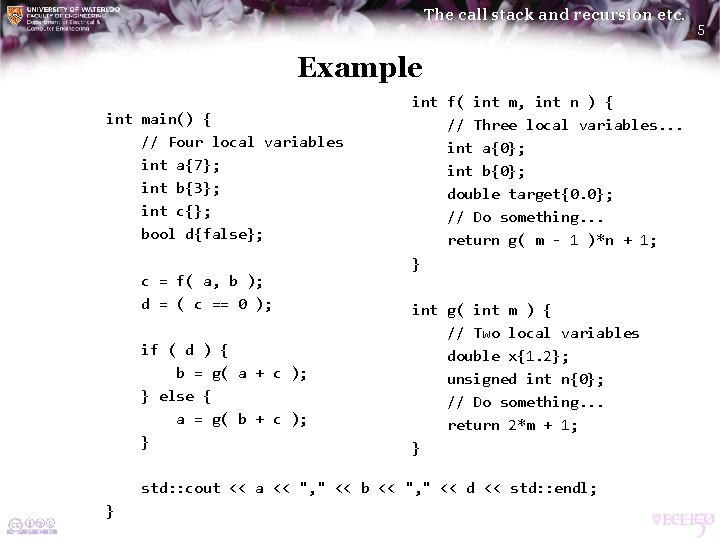
The call stack and recursion etc. Example • Like a stack of paper, local variables are stored on a virtual stack of memory • Suppose we have three functions: int main(); int f( int m, int n ); int g( int m ); 4
The call stack and recursion etc. Example int main() { // Four local variables int a{7}; int b{3}; int c{}; bool d{false}; c = f( a, b ); d = ( c == 0 ); if ( d ) { b = g( a + c ); } else { a = g( b + c ); } int f( int m, int n ) { // Three local variables. . . int a{0}; int b{0}; double target{0. 0}; // Do something. . . return g( m - 1 )*n + 1; } int g( int m ) { // Two local variables double x{1. 2}; unsigned int n{0}; // Do something. . . return 2*m + 1; } std: : cout << a << ", " << b << ", " << d << std: : endl; } 5
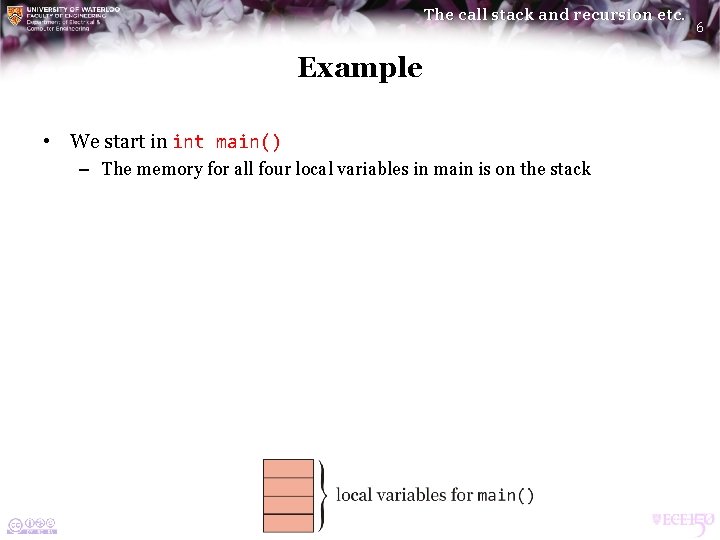
The call stack and recursion etc. Example • We start in int main() – The memory for all four local variables in main is on the stack 6
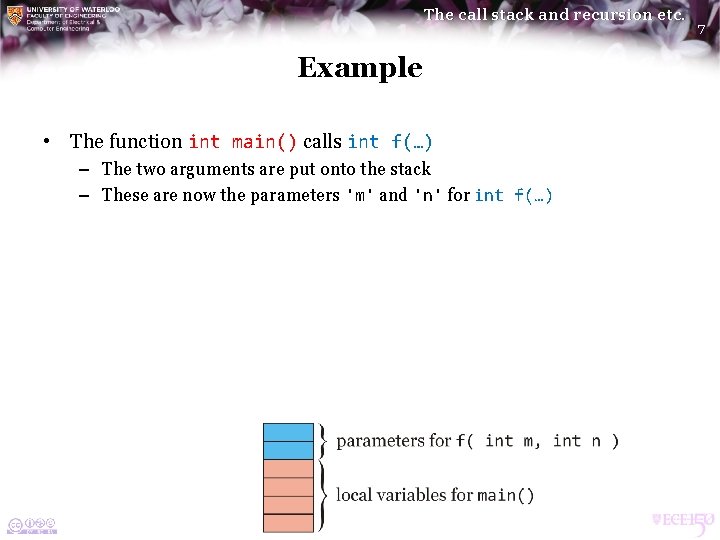
The call stack and recursion etc. Example • The function int main() calls int f(…) – The two arguments are put onto the stack – These are now the parameters 'm' and 'n' for int f(…) 7
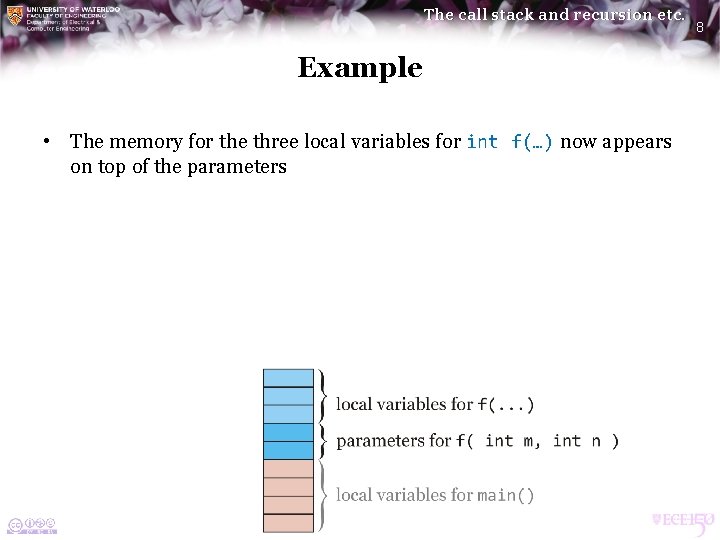
The call stack and recursion etc. Example • The memory for the three local variables for int f(…) now appears on top of the parameters 8
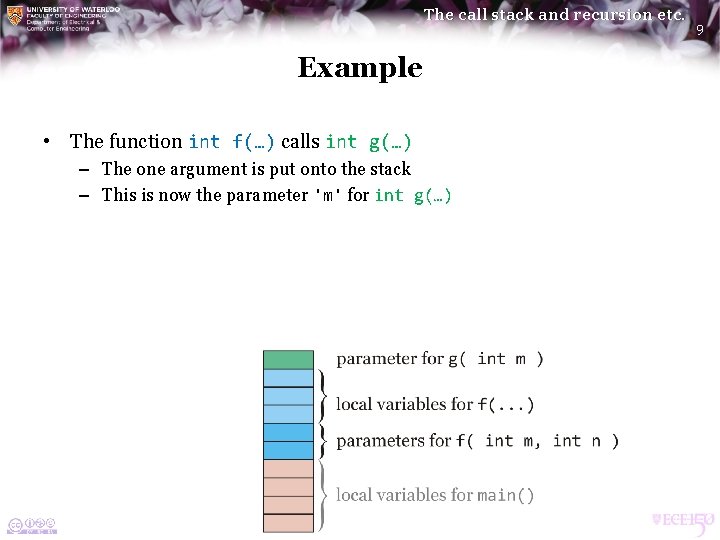
The call stack and recursion etc. Example • The function int f(…) calls int g(…) – The one argument is put onto the stack – This is now the parameter 'm' for int g(…) 9
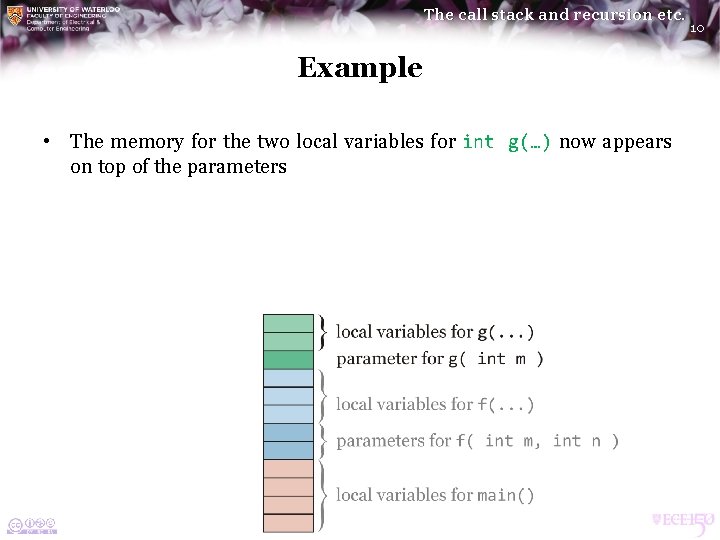
The call stack and recursion etc. Example • The memory for the two local variables for int g(…) now appears on top of the parameters 10
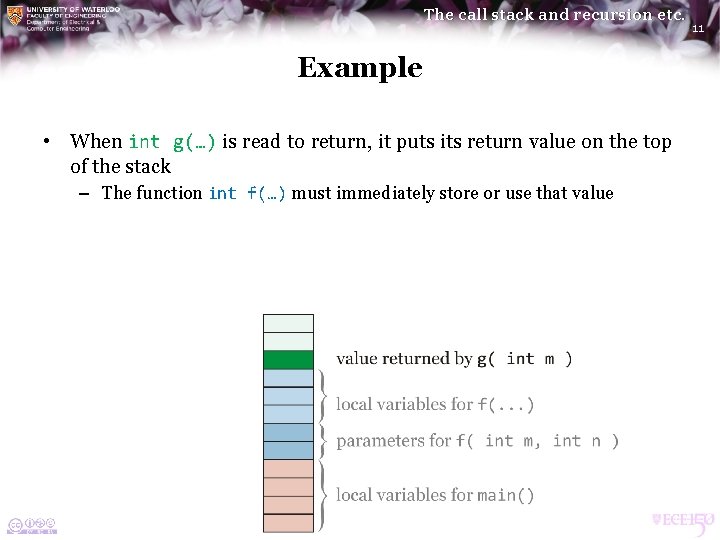
The call stack and recursion etc. Example • When int g(…) is read to return, it puts its return value on the top of the stack – The function int f(…) must immediately store or use that value 11
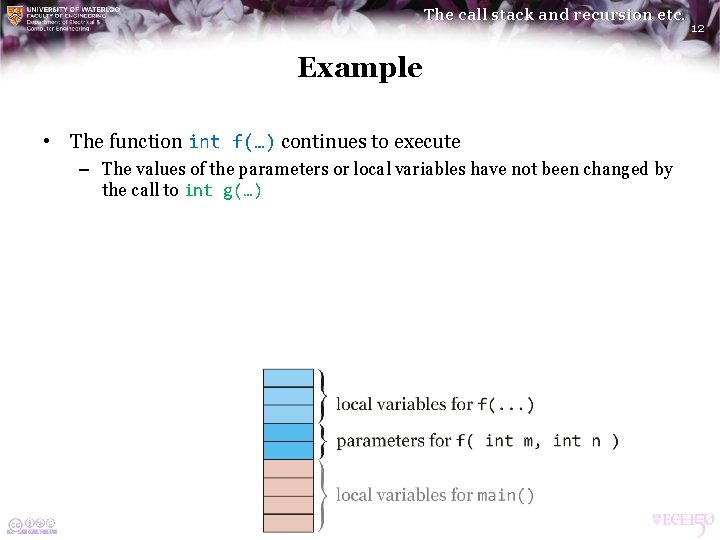
The call stack and recursion etc. Example • The function int f(…) continues to execute – The values of the parameters or local variables have not been changed by the call to int g(…) 12
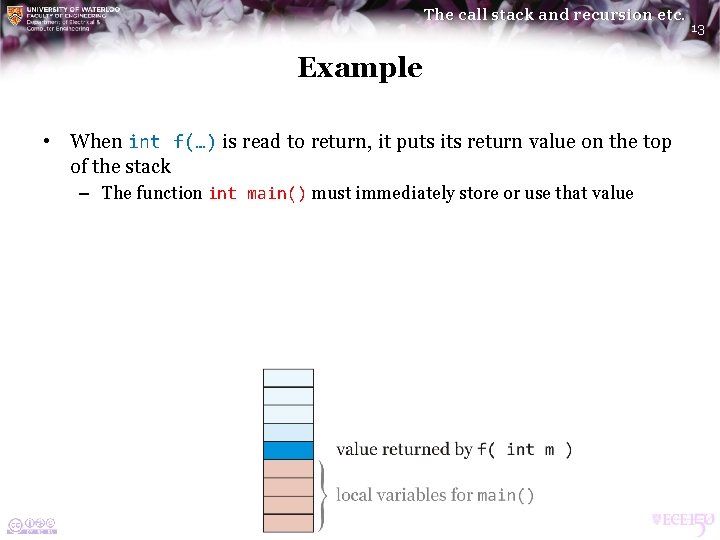
The call stack and recursion etc. Example • When int f(…) is read to return, it puts its return value on the top of the stack – The function int main() must immediately store or use that value 13
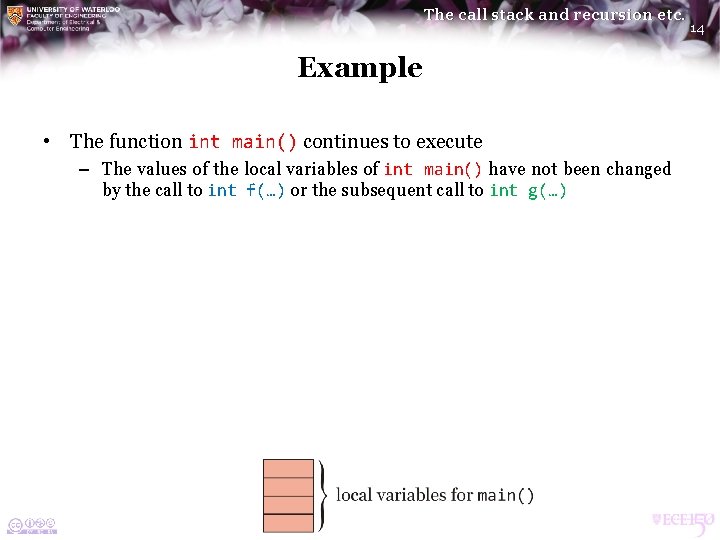
The call stack and recursion etc. Example • The function int main() continues to execute – The values of the local variables of int main() have not been changed by the call to int f(…) or the subsequent call to int g(…) 14
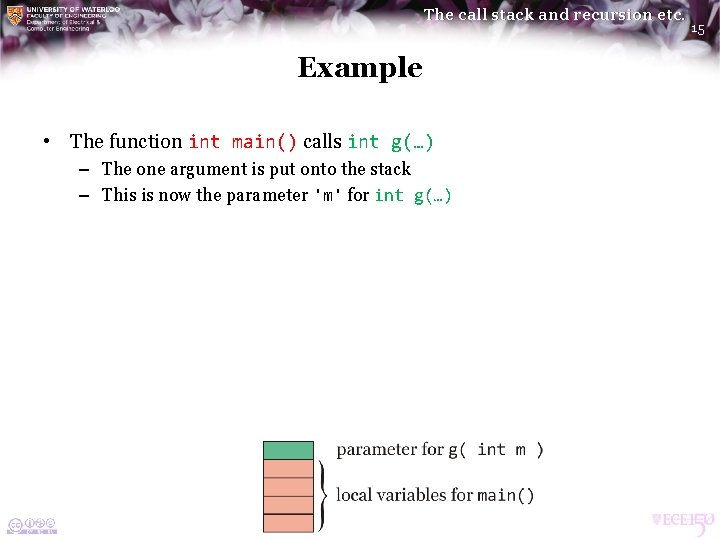
The call stack and recursion etc. Example • The function int main() calls int g(…) – The one argument is put onto the stack – This is now the parameter 'm' for int g(…) 15
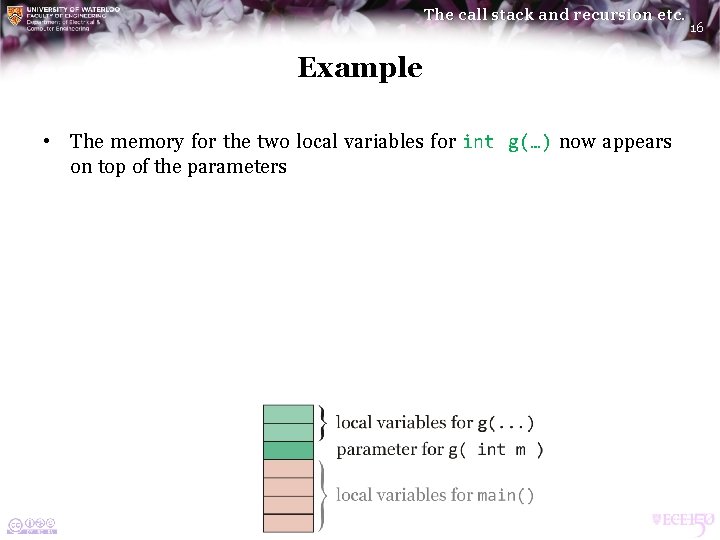
The call stack and recursion etc. Example • The memory for the two local variables for int g(…) now appears on top of the parameters 16
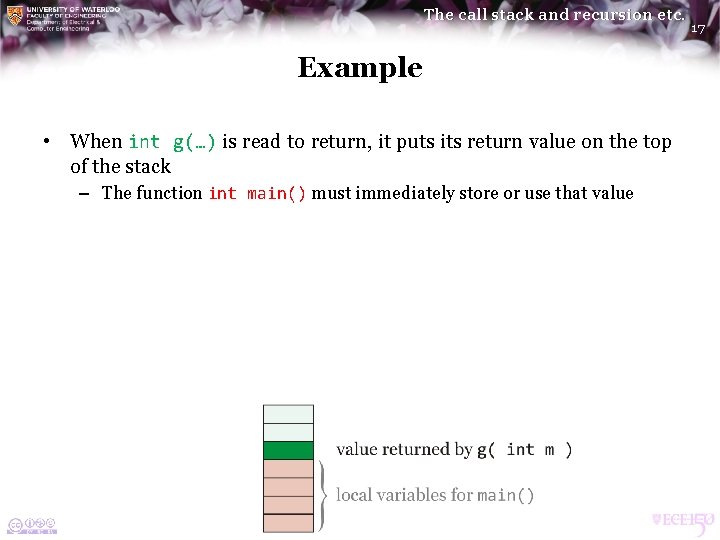
The call stack and recursion etc. Example • When int g(…) is read to return, it puts its return value on the top of the stack – The function int main() must immediately store or use that value 17
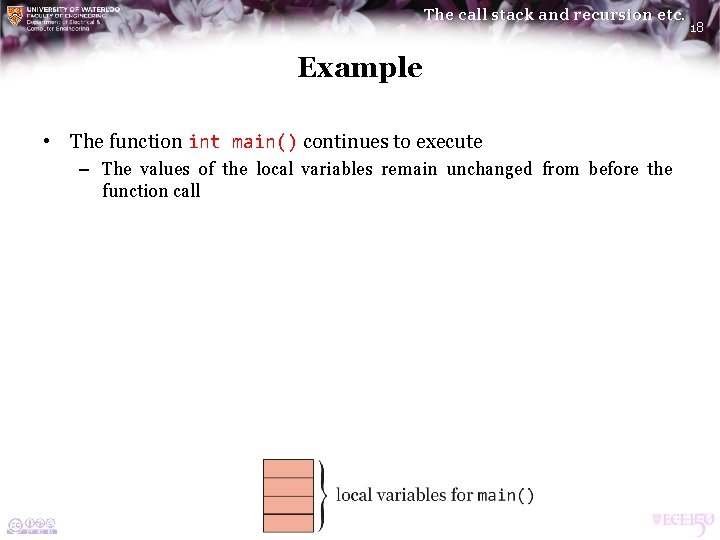
The call stack and recursion etc. Example • The function int main() continues to execute – The values of the local variables remain unchanged from before the function call 18
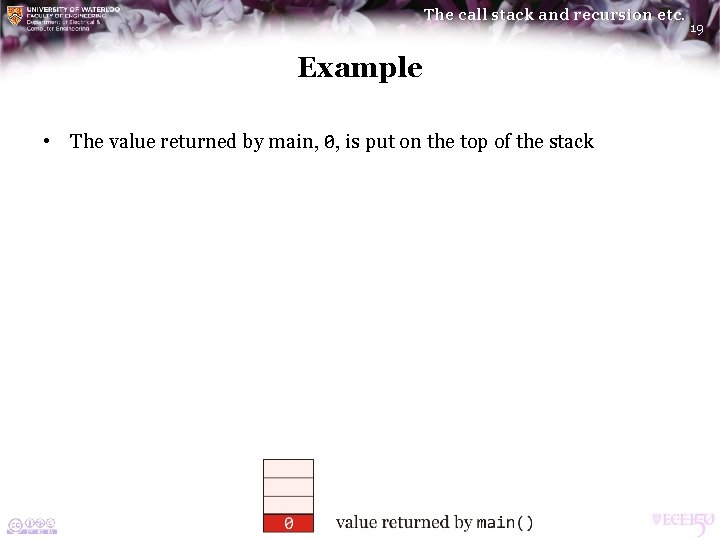
The call stack and recursion etc. Example • The value returned by main, 0, is put on the top of the stack 19
The call stack and recursion etc. The call stack • You will learn much more about the call stack in second-year courses – Many behaviors will make more sense if you understand this concept • Note: the call stack is much more complex: – How do we know where the parameters are, where to put the return value, and how functions know where to resume their execution after returning, etc. 20
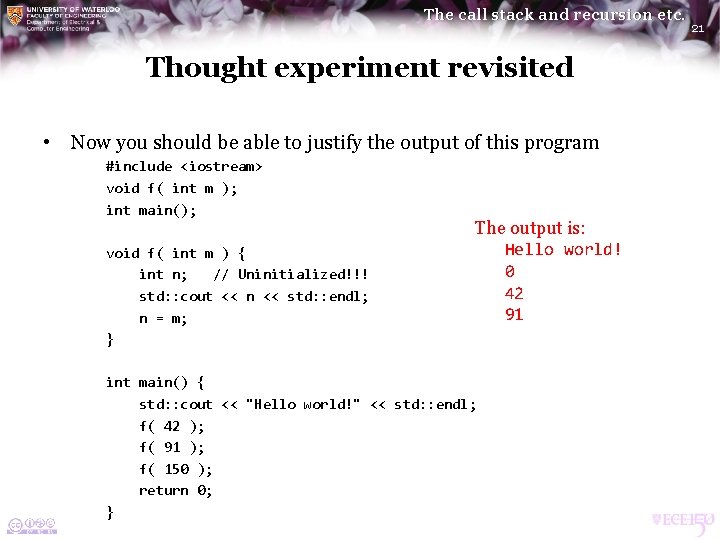
The call stack and recursion etc. Thought experiment revisited • Now you should be able to justify the output of this program #include <iostream> void f( int m ); int main(); void f( int m ) { int n; // Uninitialized!!! std: : cout << n << std: : endl; n = m; } The output is: Hello world! 0 42 91 int main() { std: : cout << "Hello world!" << std: : endl; f( 42 ); f( 91 ); f( 150 ); return 0; } 21
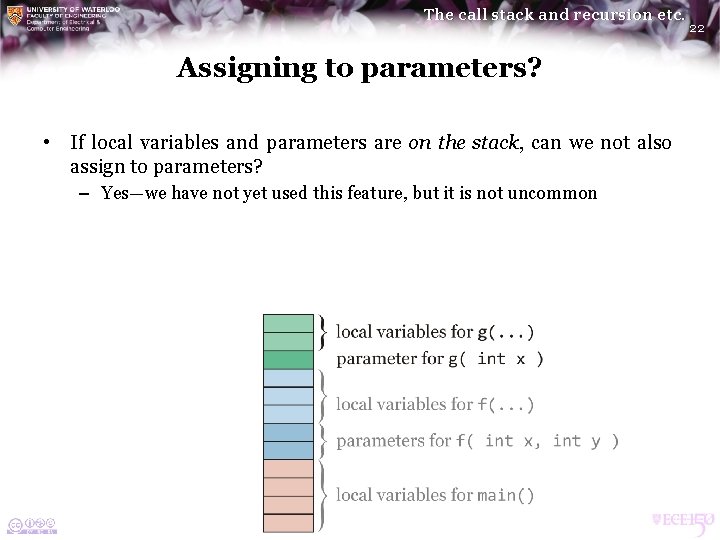
The call stack and recursion etc. Assigning to parameters? • If local variables and parameters are on the stack, can we not also assign to parameters? – Yes—we have not yet used this feature, but it is not uncommon 22
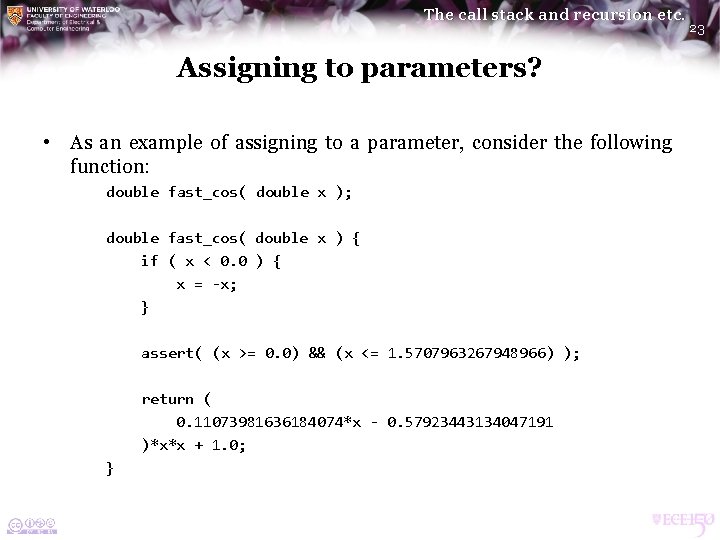
The call stack and recursion etc. Assigning to parameters? • As an example of assigning to a parameter, consider the following function: double fast_cos( double x ); double fast_cos( double x ) { if ( x < 0. 0 ) { x = -x; } assert( (x >= 0. 0) && (x <= 1. 5707963267948966) ); return ( 0. 11073981636184074*x - 0. 57923443134047191 )*x*x + 1. 0; } 23
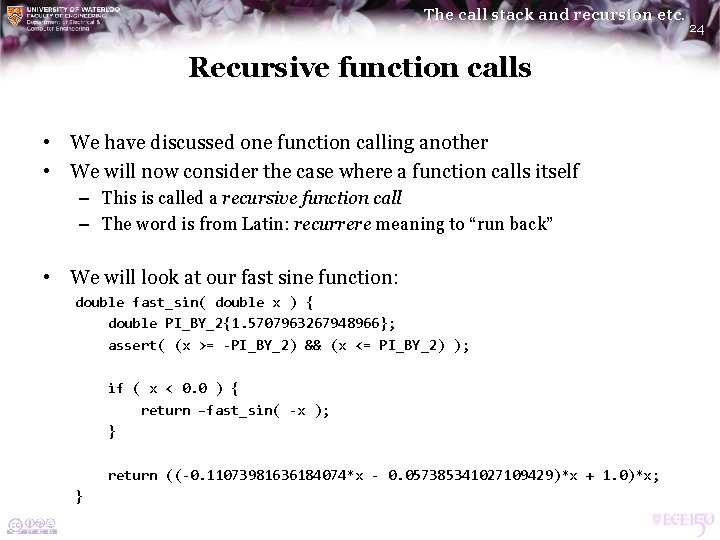
The call stack and recursion etc. Recursive function calls • We have discussed one function calling another • We will now consider the case where a function calls itself – This is called a recursive function call – The word is from Latin: recurrere meaning to “run back” • We will look at our fast sine function: double fast_sin( double x ) { double PI_BY_2{1. 5707963267948966}; assert( (x >= -PI_BY_2) && (x <= PI_BY_2) ); if ( x < 0. 0 ) { return –fast_sin( -x ); } return ((-0. 11073981636184074*x - 0. 057385341027109429)*x + 1. 0)*x; } 24
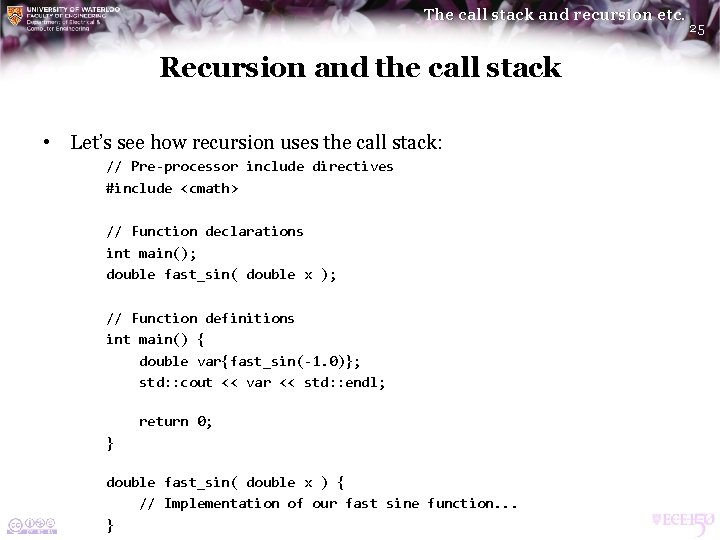
The call stack and recursion etc. Recursion and the call stack • Let’s see how recursion uses the call stack: // Pre-processor include directives #include <cmath> // Function declarations int main(); double fast_sin( double x ); // Function definitions int main() { double var{fast_sin(-1. 0)}; std: : cout << var << std: : endl; return 0; } double fast_sin( double x ) { // Implementation of our fast sine function. . . } 25
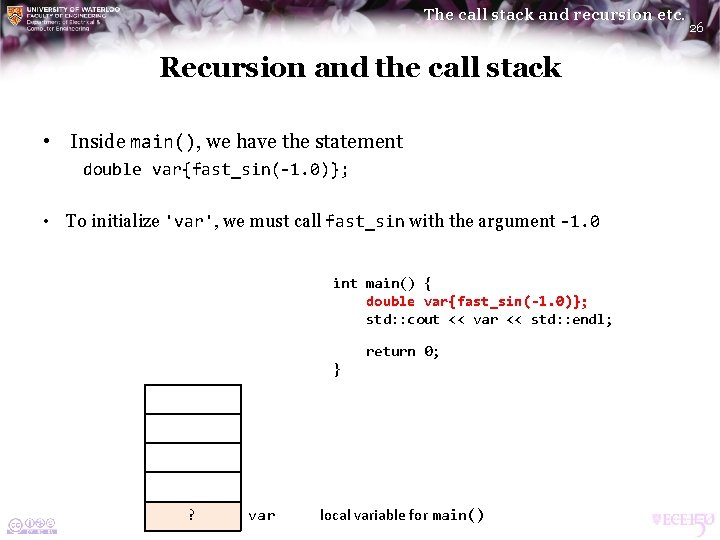
The call stack and recursion etc. Recursion and the call stack • Inside main(), we have the statement double var{fast_sin(-1. 0)}; • To initialize 'var', we must call fast_sin with the argument -1. 0 int main() { double var{fast_sin(-1. 0)}; std: : cout << var << std: : endl; return 0; } ? var local variable for main() 26
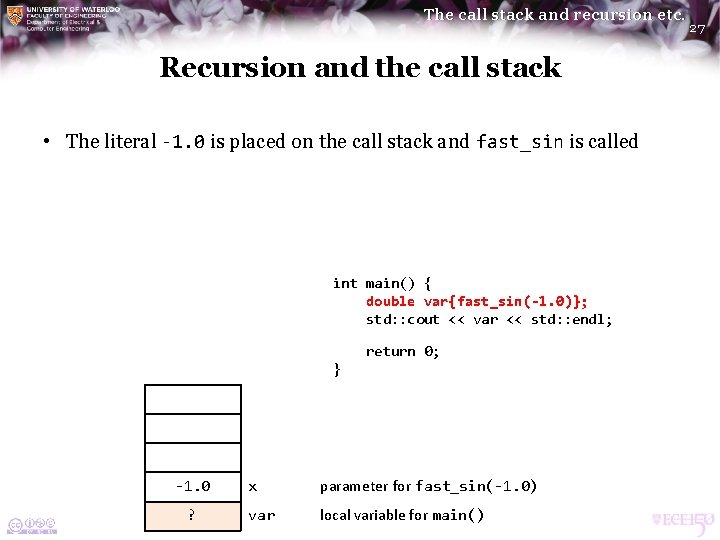
The call stack and recursion etc. Recursion and the call stack • The literal -1. 0 is placed on the call stack and fast_sin is called int main() { double var{fast_sin(-1. 0)}; std: : cout << var << std: : endl; return 0; } -1. 0 ? x parameter for fast_sin(-1. 0) var local variable for main() 27
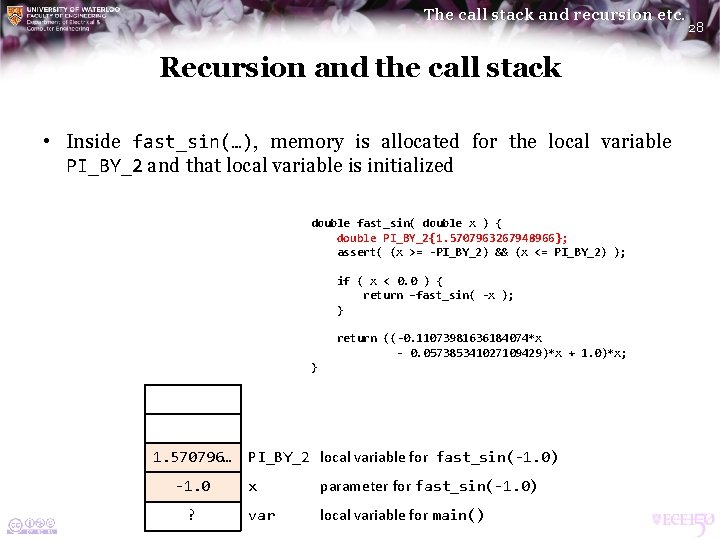
The call stack and recursion etc. Recursion and the call stack • Inside fast_sin(…), memory is allocated for the local variable PI_BY_2 and that local variable is initialized double fast_sin( double x ) { double PI_BY_2{1. 5707963267948966}; assert( (x >= -PI_BY_2) && (x <= PI_BY_2) ); if ( x < 0. 0 ) { return –fast_sin( -x ); } return ((-0. 11073981636184074*x - 0. 057385341027109429)*x + 1. 0)*x; } 1. 570796… PI_BY_2 local variable for fast_sin(-1. 0) -1. 0 ? x parameter for fast_sin(-1. 0) var local variable for main() 28
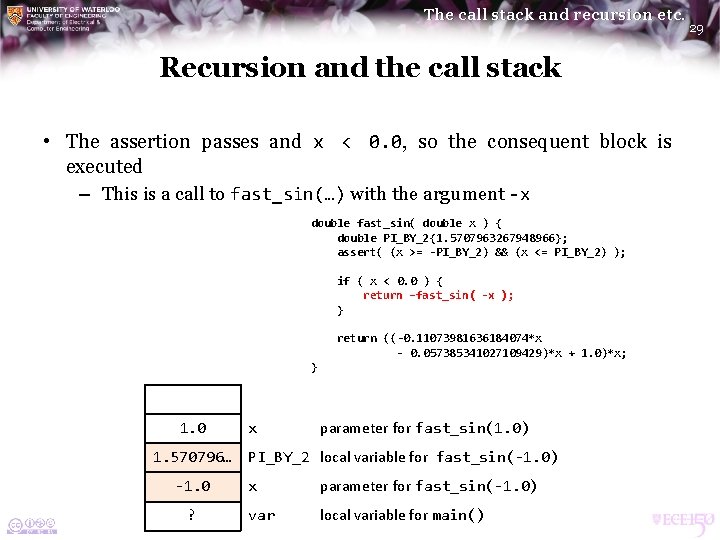
The call stack and recursion etc. Recursion and the call stack • The assertion passes and x < 0. 0, so the consequent block is executed – This is a call to fast_sin(…) with the argument -x double fast_sin( double x ) { double PI_BY_2{1. 5707963267948966}; assert( (x >= -PI_BY_2) && (x <= PI_BY_2) ); if ( x < 0. 0 ) { return –fast_sin( -x ); } return ((-0. 11073981636184074*x - 0. 057385341027109429)*x + 1. 0)*x; } 1. 0 x parameter for fast_sin(1. 0) 1. 570796… PI_BY_2 local variable for fast_sin(-1. 0) -1. 0 ? x parameter for fast_sin(-1. 0) var local variable for main() 29
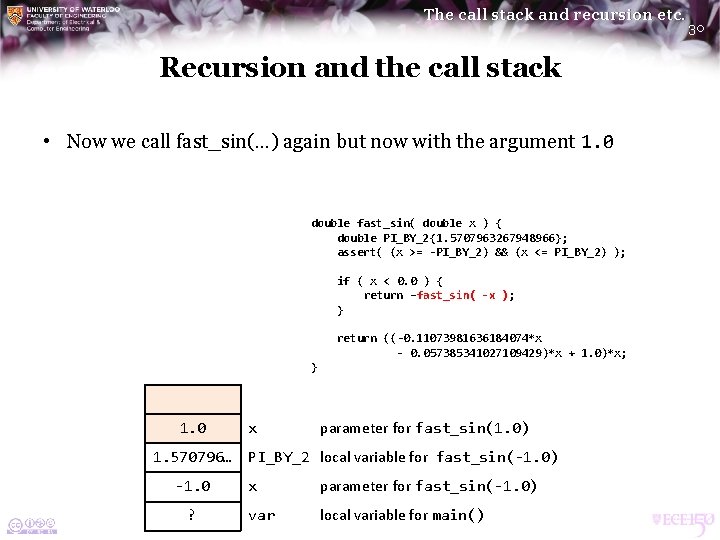
The call stack and recursion etc. Recursion and the call stack • Now we call fast_sin(…) again but now with the argument 1. 0 double fast_sin( double x ) { double PI_BY_2{1. 5707963267948966}; assert( (x >= -PI_BY_2) && (x <= PI_BY_2) ); if ( x < 0. 0 ) { return –fast_sin( -x ); } return ((-0. 11073981636184074*x - 0. 057385341027109429)*x + 1. 0)*x; } 1. 0 x parameter for fast_sin(1. 0) 1. 570796… PI_BY_2 local variable for fast_sin(-1. 0) -1. 0 ? x parameter for fast_sin(-1. 0) var local variable for main() 30
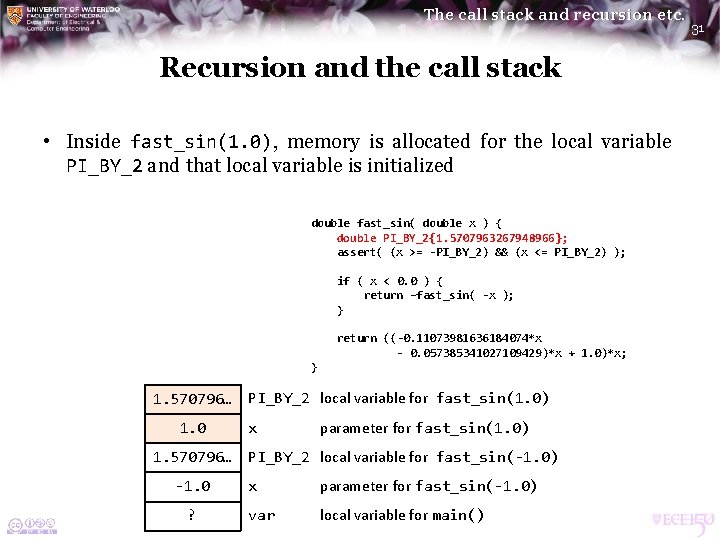
The call stack and recursion etc. Recursion and the call stack • Inside fast_sin(1. 0), memory is allocated for the local variable PI_BY_2 and that local variable is initialized double fast_sin( double x ) { double PI_BY_2{1. 5707963267948966}; assert( (x >= -PI_BY_2) && (x <= PI_BY_2) ); if ( x < 0. 0 ) { return –fast_sin( -x ); } return ((-0. 11073981636184074*x - 0. 057385341027109429)*x + 1. 0)*x; } 1. 570796… PI_BY_2 local variable for fast_sin(1. 0) 1. 0 x parameter for fast_sin(1. 0) 1. 570796… PI_BY_2 local variable for fast_sin(-1. 0) -1. 0 ? x parameter for fast_sin(-1. 0) var local variable for main() 31
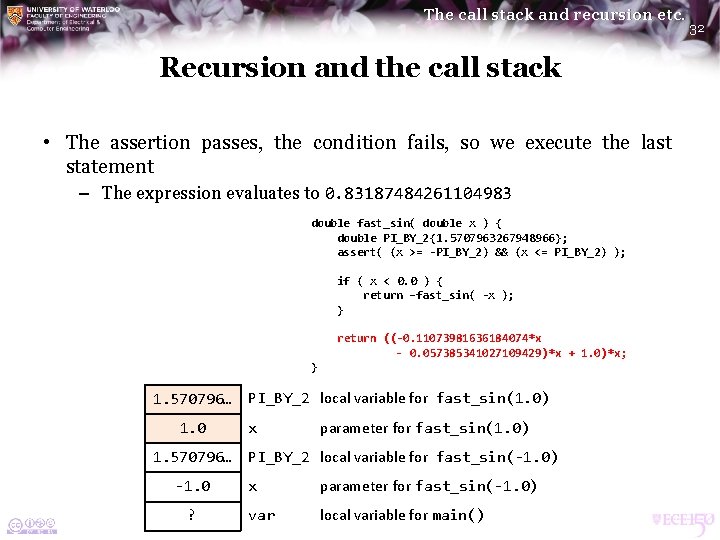
The call stack and recursion etc. Recursion and the call stack • The assertion passes, the condition fails, so we execute the last statement – The expression evaluates to 0. 83187484261104983 double fast_sin( double x ) { double PI_BY_2{1. 5707963267948966}; assert( (x >= -PI_BY_2) && (x <= PI_BY_2) ); if ( x < 0. 0 ) { return –fast_sin( -x ); } return ((-0. 11073981636184074*x - 0. 057385341027109429)*x + 1. 0)*x; } 1. 570796… PI_BY_2 local variable for fast_sin(1. 0) 1. 0 x parameter for fast_sin(1. 0) 1. 570796… PI_BY_2 local variable for fast_sin(-1. 0) -1. 0 ? x parameter for fast_sin(-1. 0) var local variable for main() 32
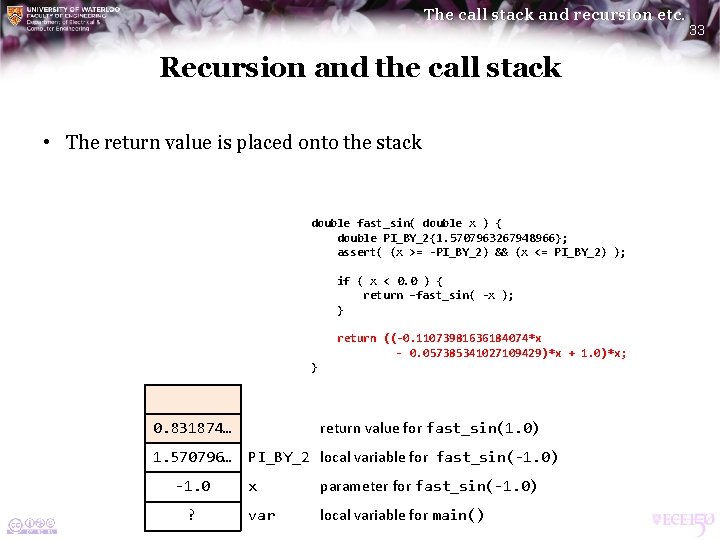
The call stack and recursion etc. Recursion and the call stack • The return value is placed onto the stack double fast_sin( double x ) { double PI_BY_2{1. 5707963267948966}; assert( (x >= -PI_BY_2) && (x <= PI_BY_2) ); if ( x < 0. 0 ) { return –fast_sin( -x ); } return ((-0. 11073981636184074*x - 0. 057385341027109429)*x + 1. 0)*x; } return value for fast_sin(1. 0) 0. 831874… 1. 570796… PI_BY_2 local variable for fast_sin(-1. 0) -1. 0 ? x parameter for fast_sin(-1. 0) var local variable for main() 33
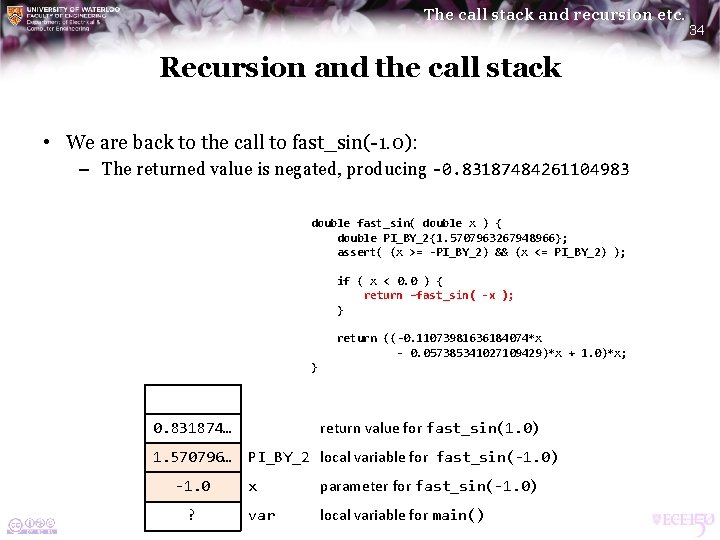
The call stack and recursion etc. Recursion and the call stack • We are back to the call to fast_sin(-1. 0): – The returned value is negated, producing -0. 83187484261104983 double fast_sin( double x ) { double PI_BY_2{1. 5707963267948966}; assert( (x >= -PI_BY_2) && (x <= PI_BY_2) ); if ( x < 0. 0 ) { return –fast_sin( -x ); } return ((-0. 11073981636184074*x - 0. 057385341027109429)*x + 1. 0)*x; } return value for fast_sin(1. 0) 0. 831874… 1. 570796… PI_BY_2 local variable for fast_sin(-1. 0) -1. 0 ? x parameter for fast_sin(-1. 0) var local variable for main() 34
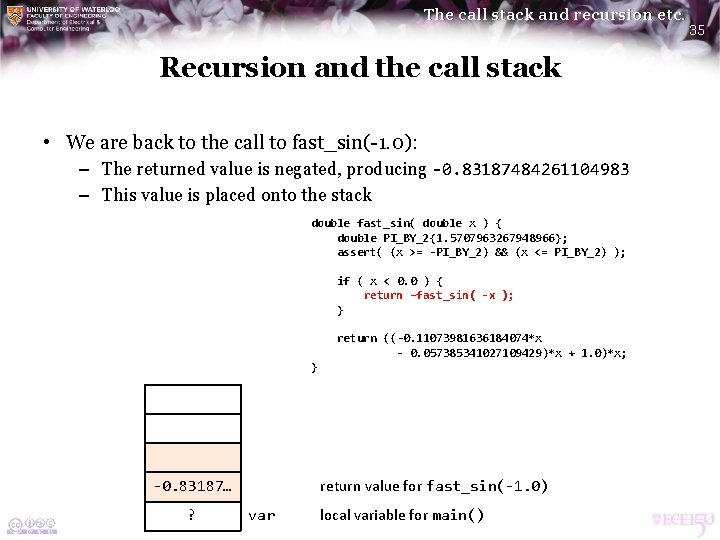
The call stack and recursion etc. Recursion and the call stack • We are back to the call to fast_sin(-1. 0): – The returned value is negated, producing -0. 83187484261104983 – This value is placed onto the stack double fast_sin( double x ) { double PI_BY_2{1. 5707963267948966}; assert( (x >= -PI_BY_2) && (x <= PI_BY_2) ); if ( x < 0. 0 ) { return –fast_sin( -x ); } return ((-0. 11073981636184074*x - 0. 057385341027109429)*x + 1. 0)*x; } return value for fast_sin(-1. 0) -0. 83187… ? var local variable for main() 35
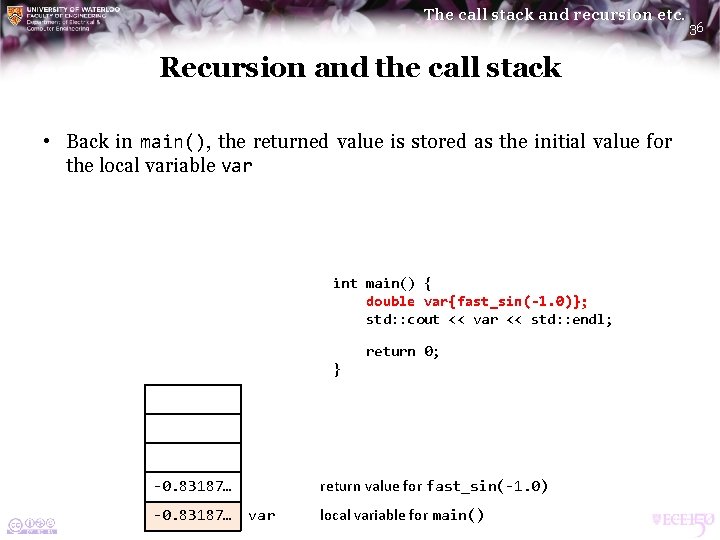
The call stack and recursion etc. Recursion and the call stack • Back in main(), the returned value is stored as the initial value for the local variable var int main() { double var{fast_sin(-1. 0)}; std: : cout << var << std: : endl; return 0; } -0. 83187… return value for fast_sin(-1. 0) -0. 83187… var local variable for main() 36
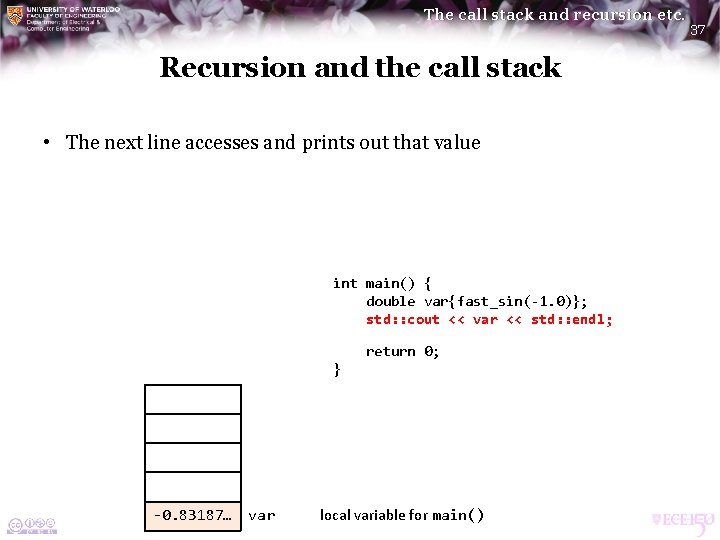
The call stack and recursion etc. Recursion and the call stack • The next line accesses and prints out that value int main() { double var{fast_sin(-1. 0)}; std: : cout << var << std: : endl; return 0; } -0. 83187… var local variable for main() 37
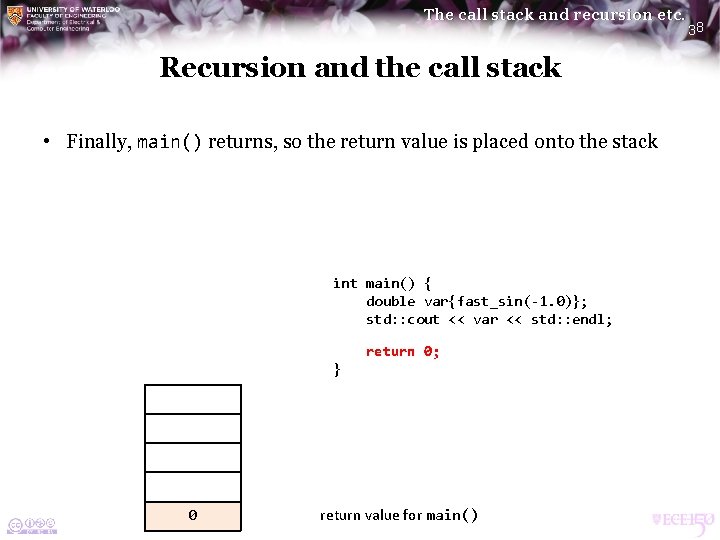
The call stack and recursion etc. Recursion and the call stack • Finally, main() returns, so the return value is placed onto the stack int main() { double var{fast_sin(-1. 0)}; std: : cout << var << std: : endl; return 0; } 0 return value for main() 38
The call stack and recursion etc. Recursion and the call stack • Thus, the call stack allows recursion – We will use recursion throughout this course – It will appear in subsequent courses, as well – Recursion allows us to solve a problem by reformulating the problem in simpler or alternate terms 39
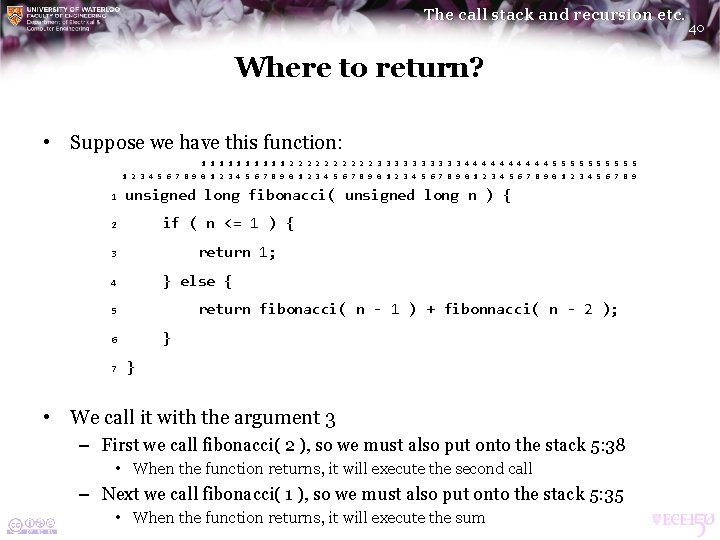
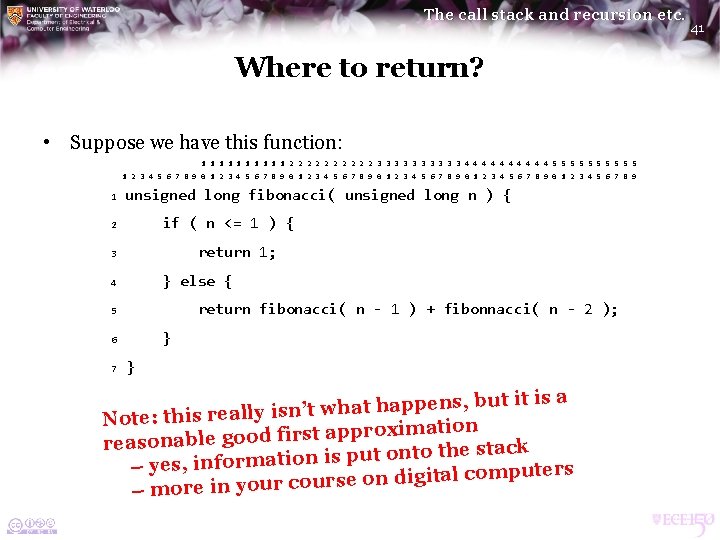
The call stack and recursion etc. Where to return? • Suppose we have this function: 1 1 1 1 1 2 2 2 2 2 3 3 3 3 3 4 4 4 4 4 5 5 5 5 5 1 2 3 4 5 6 7 8 9 0 1 2 3 4 5 6 7 8 9 0 1 2 3 4 5 6 7 8 9 1 unsigned long fibonacci( unsigned long n ) { if ( n <= 1 ) { 2 return 1; 3 } else { 4 return fibonacci( n - 1 ) + fibonnacci( n - 2 ); 5 } 6 7 } • We call it with the argument 3 – First we call fibonacci( 2 ), so we must also put onto the stack 5: 38 • When the function returns, it will execute the second call – Next we call fibonacci( 1 ), so we must also put onto the stack 5: 35 • When the function returns, it will execute the sum 40
The call stack and recursion etc. Where to return? • Suppose we have this function: 1 1 1 1 1 2 2 2 2 2 3 3 3 3 3 4 4 4 4 4 5 5 5 5 5 1 2 3 4 5 6 7 8 9 0 1 2 3 4 5 6 7 8 9 0 1 2 3 4 5 6 7 8 9 1 unsigned long fibonacci( unsigned long n ) { if ( n <= 1 ) { 2 return 1; 3 } else { 4 return fibonacci( n - 1 ) + fibonnacci( n - 2 ); 5 } 6 7 } t it is a u b , s n e p p a h t a h w ’t Note: this really isn ation im x o r p p a t s r fi d o o reasonable g to the stack n o t u p is n o ti a m r – yes, info puters m o c l a it ig d n o e s r u – more in your co 41
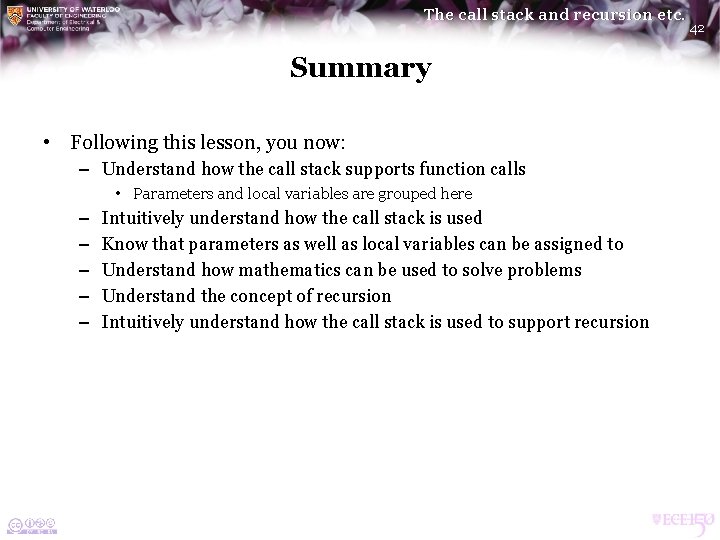
The call stack and recursion etc. Summary • Following this lesson, you now: – Understand how the call stack supports function calls • Parameters and local variables are grouped here – – – Intuitively understand how the call stack is used Know that parameters as well as local variables can be assigned to Understand how mathematics can be used to solve problems Understand the concept of recursion Intuitively understand how the call stack is used to support recursion 42
The call stack and recursion etc. References [1] No references? 43
The call stack and recursion etc. Acknowledgments Proof read by Dr. Thomas Mc. Conkey and Charlie Liu. 44
The call stack and recursion etc. Colophon These slides were prepared using the Georgia typeface. Mathematical equations use Times New Roman, and source code is presented using Consolas. The photographs of lilacs in bloom appearing on the title slide and accenting the top of each other slide were taken at the Royal Botanical Gardens on May 27, 2018 by Douglas Wilhelm Harder. Please see https: //www. rbg. ca/ for more information. 45
The call stack and recursion etc. Disclaimer These slides are provided for the ECE 150 Fundamentals of Programming course taught at the University of Waterloo. The material in it reflects the authors’ best judgment in light of the information available to them at the time of preparation. Any reliance on these course slides by any party for any other purpose are the responsibility of such parties. The authors accept no responsibility for damages, if any, suffered by any party as a result of decisions made or actions based on these course slides for any other purpose than that for which it was intended. 46