Dunn Loring Volunteer Fire Rescue Department Volunteer In

- Slides: 120
Dunn Loring Volunteer Fire & Rescue Department Volunteer In Station Introductory Training (VISIT) As of May 2013 V 7. 1
Agenda I – Introduction II – Fairfax County Fire & Rescue Department III – Our Department IV – Training V – Station and Facility Orientation VI – Apparatus Orientation Fire EMS
Agenda (continued) VII – Personal Protective Equipment VIII – Equipment IX – Riding Apparatus X – Review XI – Test
Fairfax County VISIT Section I Introduction
I – Introduction Objectives Overview Requirements to Ride Level 1 Orientation Program
I – VISIT Objectives To orient you to our fire department To understand your roles and responsibilities As a member As a first responder To familiarize you with apparatus and equipment To be able to perform basic supportive tasks
I – VISIT Overview Includes overview of our organization, equipment, apparatus, facilities, policies and procedures Lecture and practical evolutions Completion requires written test and practical evaluation Complements Level 1 A/B training provided at Fire & Rescue Academy
I – Requirements to Ride/Observe VISIT Level 1 A Physical scheduled HIPAA Privacy & Security Training Approval of Volunteer Chief
I – Requirements prior to EMT VISIT Level 1 Category A or B medical classification HIPAA Privacy & Security Training Incident Command System (ICS) Training (100, 200, 700, 800) Approval of Volunteer Chief
I – Level 1 Orientation Program Level 1 A Personal Safety / Incident Command System (ICS) CPR Haz. Mat Awareness Level 1 B History, Organization and Terminology (HOT) Fire Extinguishers Communications Cultural Diversity
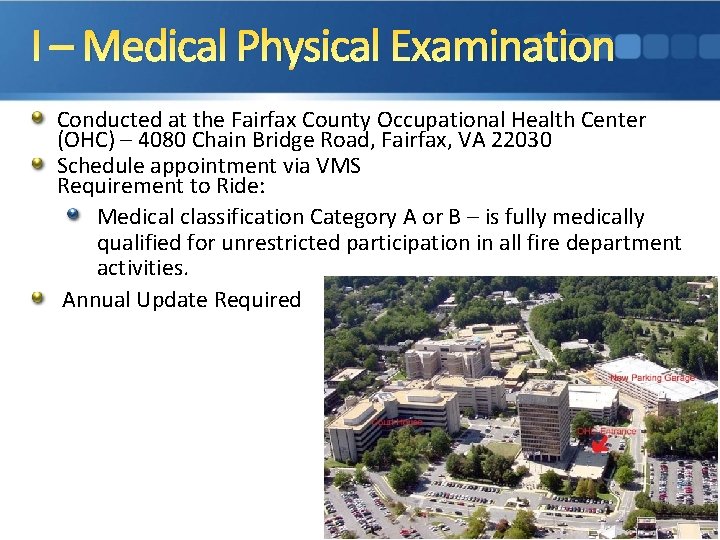
I – Medical Physical Examination Conducted at the Fairfax County Occupational Health Center (OHC) – 4080 Chain Bridge Road, Fairfax, VA 22030 Schedule appointment via VMS Requirement to Ride: Medical classification Category A or B – is fully medically qualified for unrestricted participation in all fire department activities. Annual Update Required
Fairfax County VISIT Section II Fairfax County Fire and Rescue Department
II – Fairfax County Fire & Rescue Overview Operations Rules and Policies Key County Staff Volunteer Organizations Volunteer Roles Benefits
II – Overview Combination system Career and volunteer Volunteers supplement career staff 37 fire stations Fire stations provide fire suppression and emergency medical services. 12 volunteer fire departments Over 1, 300 career staff Fairfax City (2 fire stations) Northern Virginia Mutual Aid (400 series)
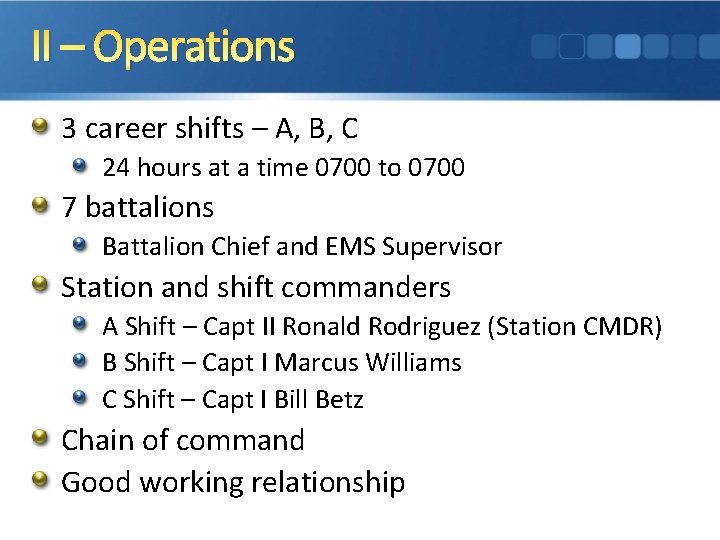
II – Operations 3 career shifts – A, B, C 24 hours at a time 0700 to 0700 7 battalions Battalion Chief and EMS Supervisor Station and shift commanders A Shift – Capt II Ronald Rodriguez (Station CMDR) B Shift – Capt I Marcus Williams C Shift – Capt I Bill Betz Chain of command Good working relationship
II – Rules and Policies Standard Operating Procedures (SOPs) Standing Orders (SOs) General Orders (GOs) Informational Bulletins (IBs) Volunteer Policies and Procedures Manual
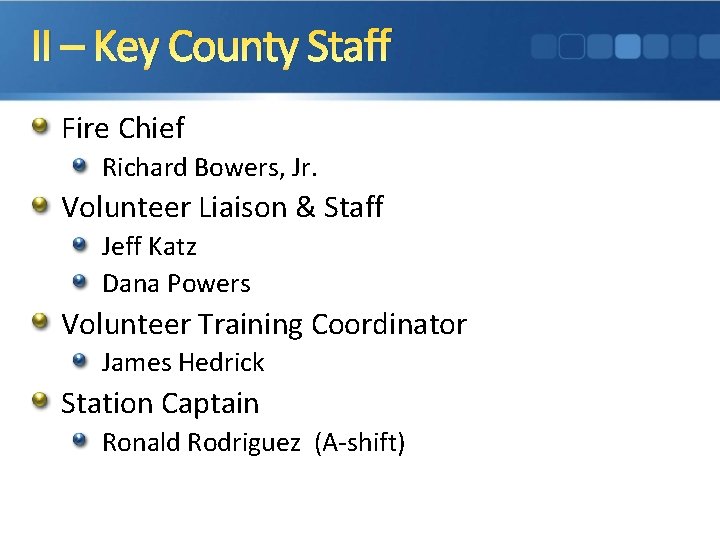
II – Key County Staff Fire Chief Richard Bowers, Jr. Volunteer Liaison & Staff Jeff Katz Dana Powers Volunteer Training Coordinator James Hedrick Station Captain Ronald Rodriguez (A-shift)
II – Volunteer Organizations Fairfax County Volunteer Fire Commission Fairfax County Volunteer Fire and Rescue Association http: //www. fcvfra. org
II – Volunteer Roles Suppression EMS Unit officers Command officers Training Fundraising Administration Public education Special operations
II – Benefits Injury, disability and death insurance Comprehensive medical examinations (OHC) Additional benefits from VFDs, State and Federal Government Personal property tax exemption 10 free visits to county Recreation Centers per month
Fire and Rescue Support Team (Fi. RST) Support program under sponsorship of Fire Chief Provides connection between family of member and the Fire and Rescue Department Network that enables members to obtain and utilize available resources and information in times of crisis “Taking care of our own” – career, volunteer, civilian Contacts: 703 -246 -7401 571 -238 -5160 Hot line / office Liaison cell phone
Fairfax County VISIT Section III Our Department
III – Our Department Station History Organization Fundraising Meetings Accountability Policies Communication
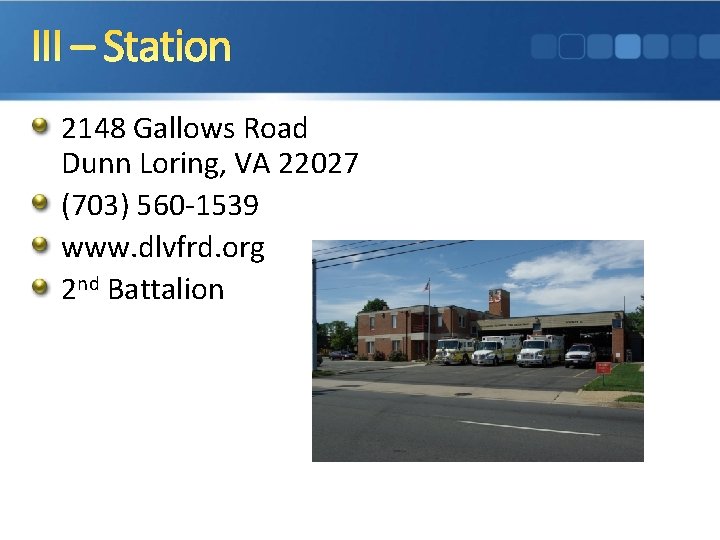
III – Station 2148 Gallows Road Dunn Loring, VA 22027 (703) 560 -1539 www. dlvfrd. org 2 nd Battalion
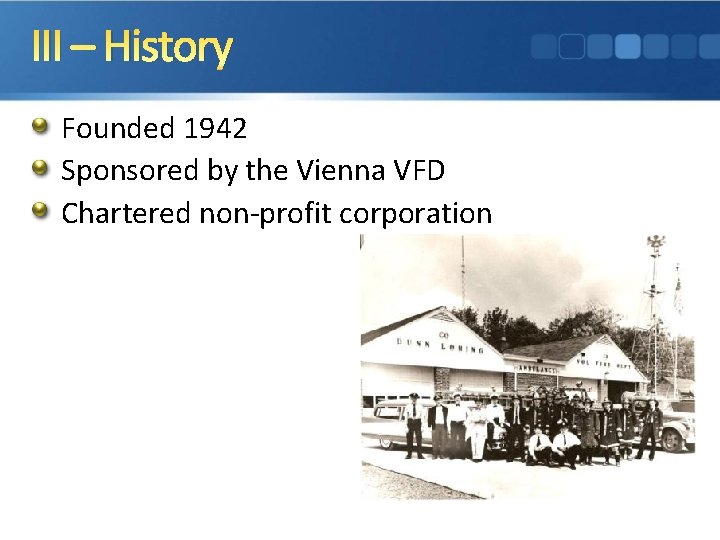
III – History Founded 1942 Sponsored by the Vienna VFD Chartered non-profit corporation
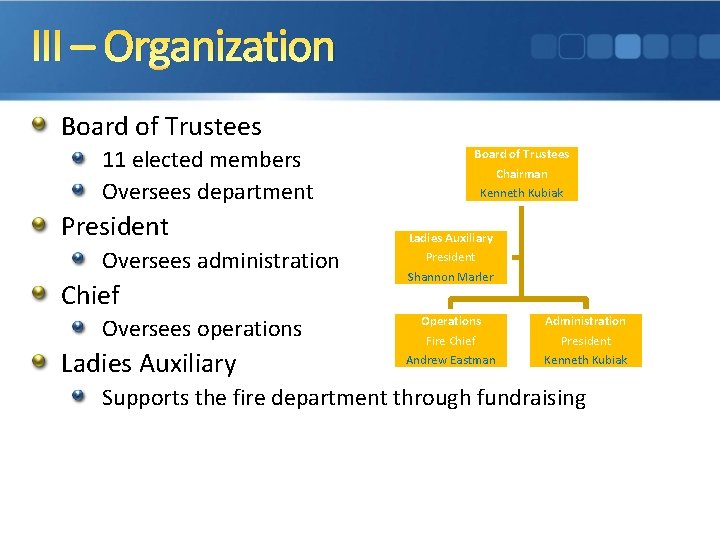
III – Organization Board of Trustees 11 elected members Oversees department President Oversees administration Chief Oversees operations Ladies Auxiliary Board of Trustees Chairman Kenneth Kubiak Ladies Auxiliary President Shannon Marler Operations Administration Fire Chief Andrew Eastman President Kenneth Kubiak Supports the fire department through fundraising
III – Fundraising Key to success of our department Bingo Every Wednesday and Saturday evening Fund drive Letter mailed twice a year Hall rental
III – Meetings Board meeting First Monday of month at 7: 30 pm (1930 hours) Membership meeting Second Monday of month at 7: 00 pm (1900 hours) Operations meeting and 30 -minute drill Follows immediately after the membership meeting Monthly drill Fourth Monday of month at 7: 00 pm (1900 hours)
III – Communication Website http: //www. dlvfrd. org Volunteer Management System (VMS) http: //vms. fcvfra. org Email Distribution List co 13@fcvfra. org
III – Accountability Chain of command Hours If you didn’t log it, it didn’t happen Use VMS for reporting hours Injury/accident reporting Must be immediate Report to the OIC and Volunteer Chief Must be documented in Station Log Book
III – Policies Uniform and personal appearance Uniform and Grooming policies Use of station facilities Minimum participation requirements Answering station telephones Business line (emergency/non-emergency) Fire phone If you see a problem, report it!
Fairfax County VISIT Section IV Training
IV – Training VISIT Level 1 EMT-B Emergency Vehicle Operator EMS Documentation Firefighter I/II Hydraulics Qualifications to Drive Instructor I/II/III Officer I/II/III Specialized Training Continuing Education
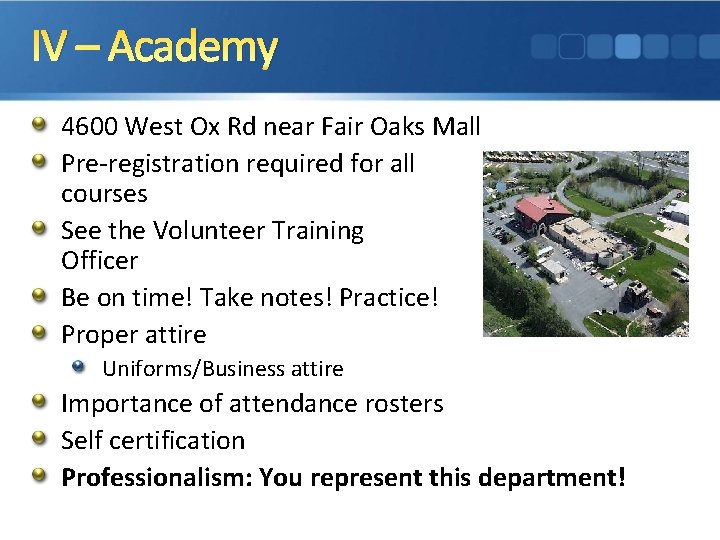
IV – Academy 4600 West Ox Rd near Fair Oaks Mall Pre-registration required for all courses See the Volunteer Training Officer Be on time! Take notes! Practice! Proper attire Uniforms/Business attire Importance of attendance rosters Self certification Professionalism: You represent this department!
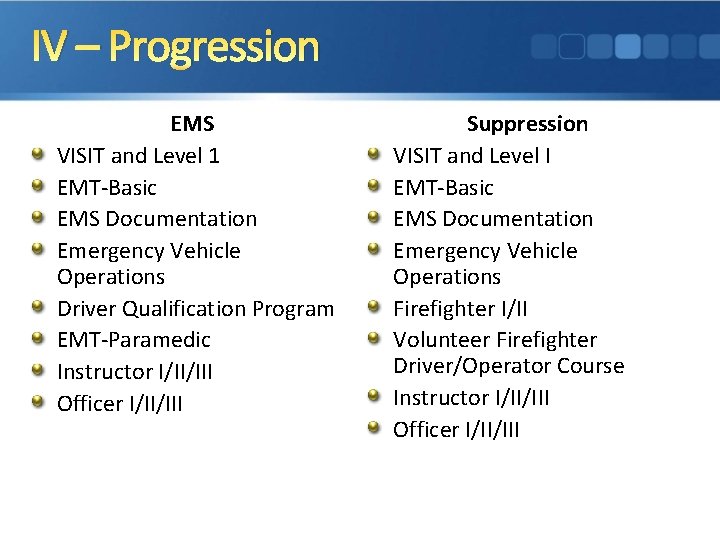
IV – Progression EMS VISIT and Level 1 EMT-Basic EMS Documentation Emergency Vehicle Operations Driver Qualification Program EMT-Paramedic Instructor I/II/III Officer I/II/III Suppression VISIT and Level I EMT-Basic EMS Documentation Emergency Vehicle Operations Firefighter I/II Volunteer Firefighter Driver/Operator Course Instructor I/II/III Officer I/II/III
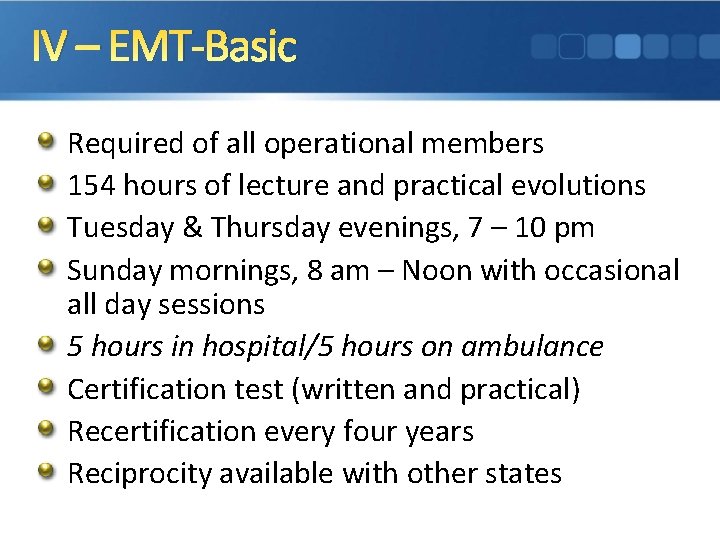
IV – EMT-Basic Required of all operational members 154 hours of lecture and practical evolutions Tuesday & Thursday evenings, 7 – 10 pm Sunday mornings, 8 am – Noon with occasional all day sessions 5 hours in hospital/5 hours on ambulance Certification test (written and practical) Recertification every four years Reciprocity available with other states
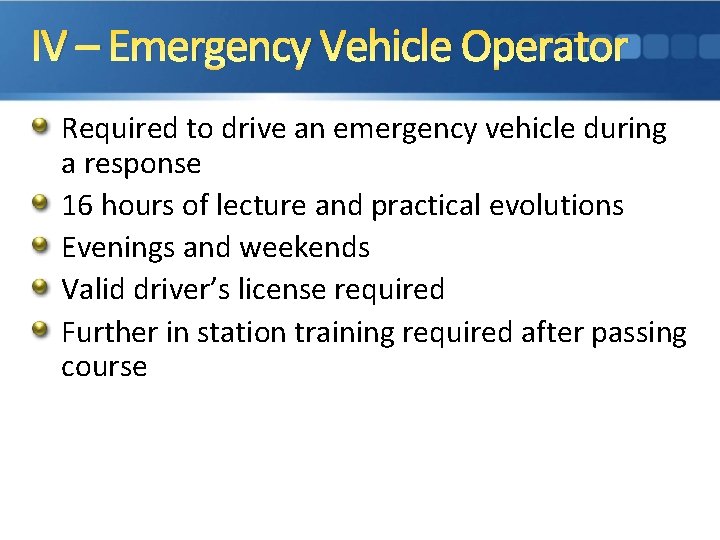
IV – Emergency Vehicle Operator Required to drive an emergency vehicle during a response 16 hours of lecture and practical evolutions Evenings and weekends Valid driver’s license required Further in station training required after passing course
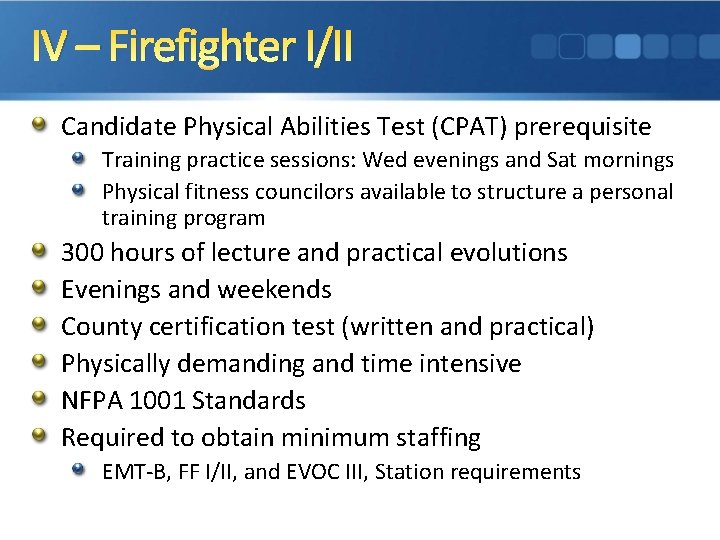
IV – Firefighter I/II Candidate Physical Abilities Test (CPAT) prerequisite Training practice sessions: Wed evenings and Sat mornings Physical fitness councilors available to structure a personal training program 300 hours of lecture and practical evolutions Evenings and weekends County certification test (written and practical) Physically demanding and time intensive NFPA 1001 Standards Required to obtain minimum staffing EMT-B, FF I/II, and EVOC III, Station requirements
IV –Firefighter Driver / Operator Course Required to be an engine driver/operator 28 hours of lecture and practical evolutions Evenings and weekends County certification test (written) Must have 6 months of minimum staffing
IV – Qualifications to Drive EMS Unit EMT-Basic EVOC II Station “Behind the Wheel” Non-emergency Emergency Refer to Emergency Vehicle Operator Quals Suppression Unit EMT-Basic Emergency Vehicle Operations III Firefighter I/II Hydraulics Station “Behind the Wheel” Non-emergency Emergency Refer to Emergency Vehicle Operator Qualifications and Engine Operators Qualifications Manuals
IV – Instructor I / III Each level is approximately 16 hours of lecture and practical evolutions Evenings and weekends Instructor I is required to serve as classroom instructor and progress to higher levels Instructor II required for academy or state certified training instructors Instructor III required to be an academy lead instructor
IV – Officer I / III Required for EMS, suppression, and command officers Full semester course Evenings Offered by NVCC
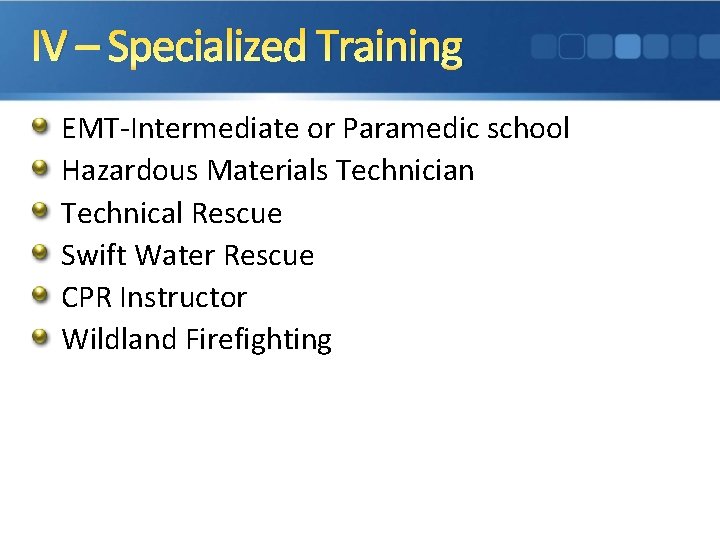
IV – Specialized Training EMT-Intermediate or Paramedic school Hazardous Materials Technician Technical Rescue Swift Water Rescue CPR Instructor Wildland Firefighting
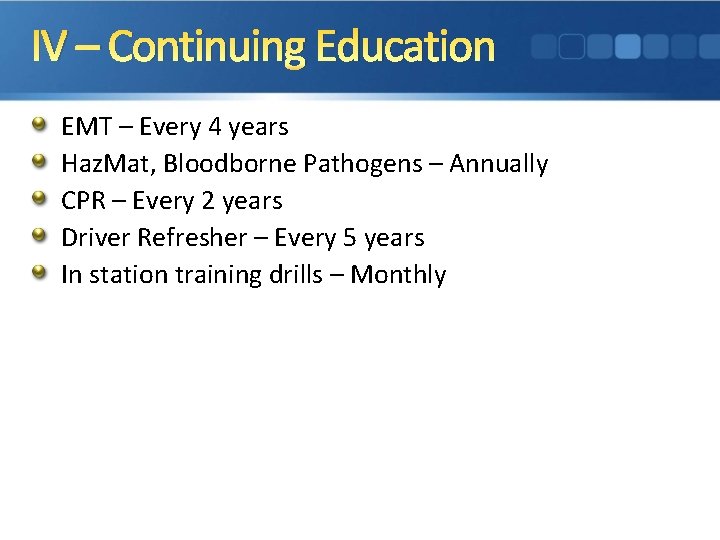
IV – Continuing Education EMT – Every 4 years Haz. Mat, Bloodborne Pathogens – Annually CPR – Every 2 years Driver Refresher – Every 5 years In station training drills – Monthly
Fairfax County VISIT Section V Station and Facility Organization
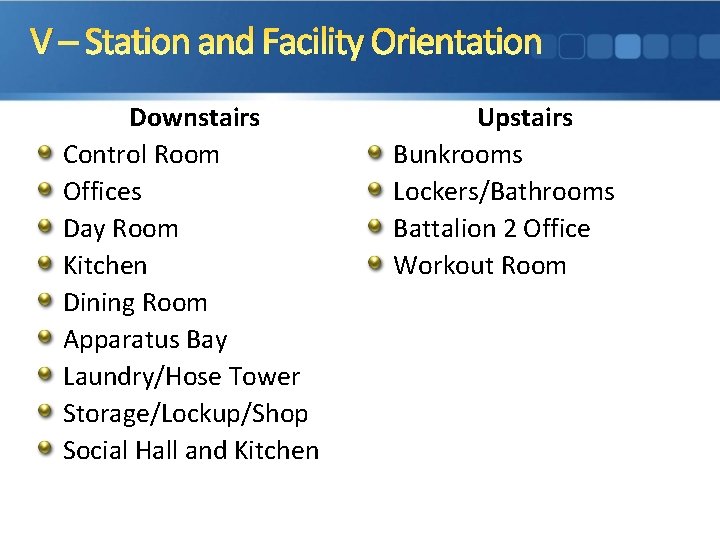
V – Station and Facility Orientation Downstairs Control Room Offices Day Room Kitchen Dining Room Apparatus Bay Laundry/Hose Tower Storage/Lockup/Shop Social Hall and Kitchen Upstairs Bunkrooms Lockers/Bathrooms Battalion 2 Office Workout Room
V – Station Notes Cipher Locks Station is a home. Please respect it and those that live and work here.
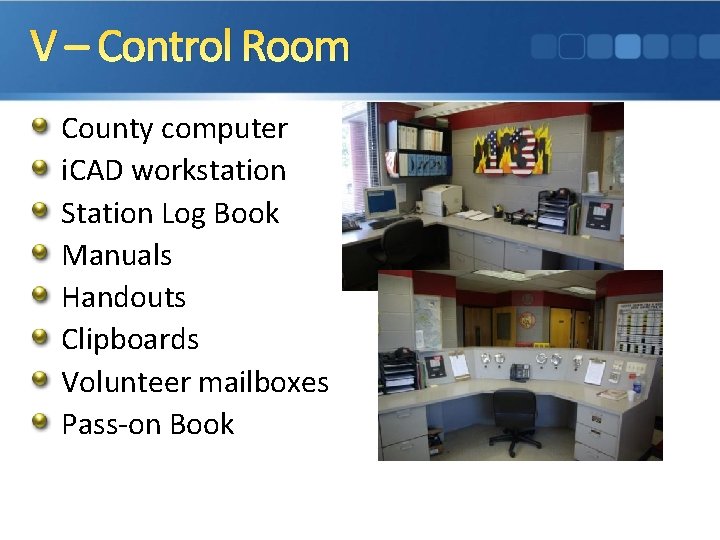
V – Control Room County computer i. CAD workstation Station Log Book Manuals Handouts Clipboards Volunteer mailboxes Pass-on Book
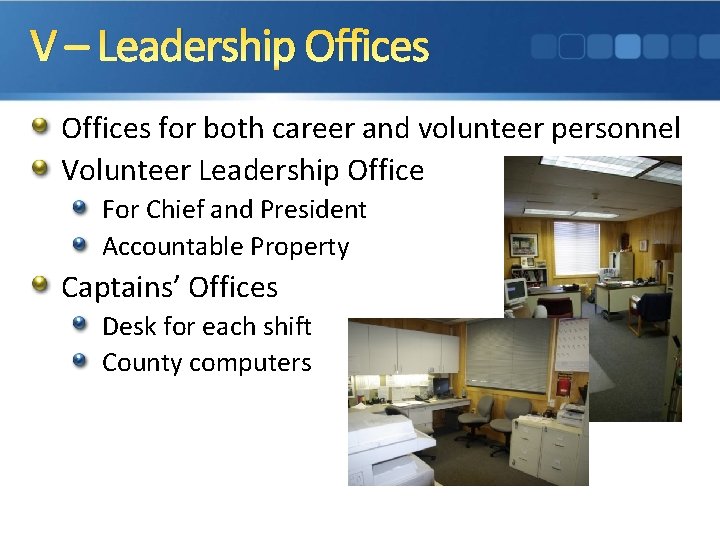
V – Leadership Offices for both career and volunteer personnel Volunteer Leadership Office For Chief and President Accountable Property Captains’ Offices Desk for each shift County computers
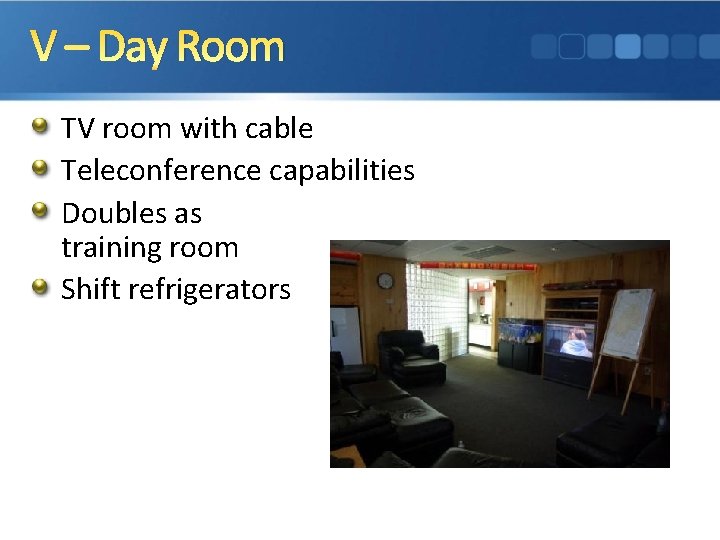
V – Day Room TV room with cable Teleconference capabilities Doubles as training room Shift refrigerators
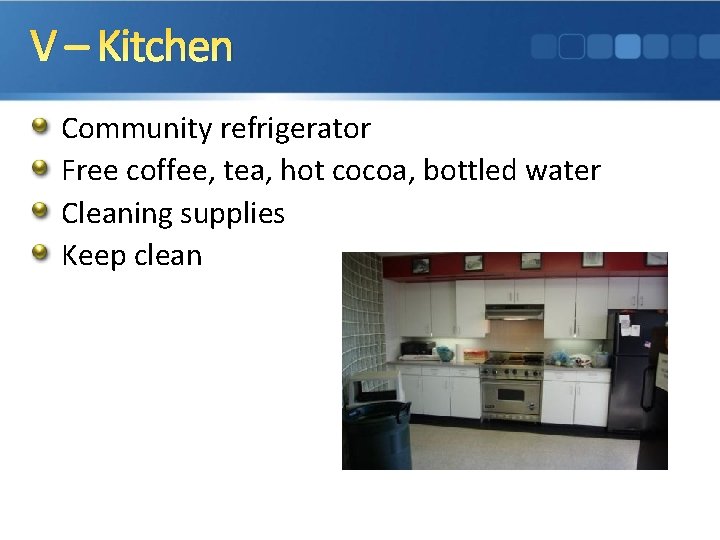
V – Kitchen Community refrigerator Free coffee, tea, hot cocoa, bottled water Cleaning supplies Keep clean
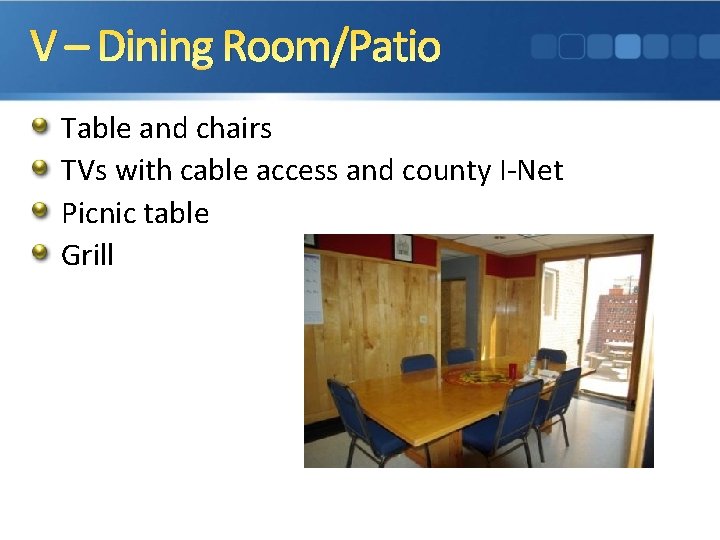
V – Dining Room/Patio Table and chairs TVs with cable access and county I-Net Picnic table Grill
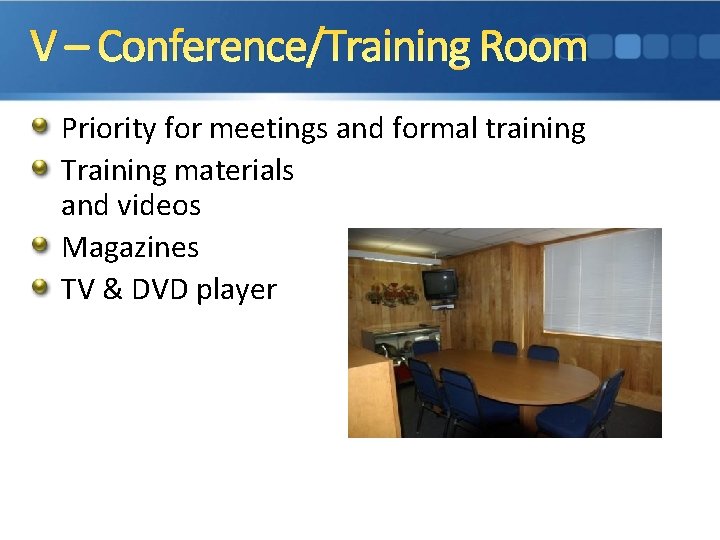
V – Conference/Training Room Priority for meetings and formal training Training materials and videos Magazines TV & DVD player
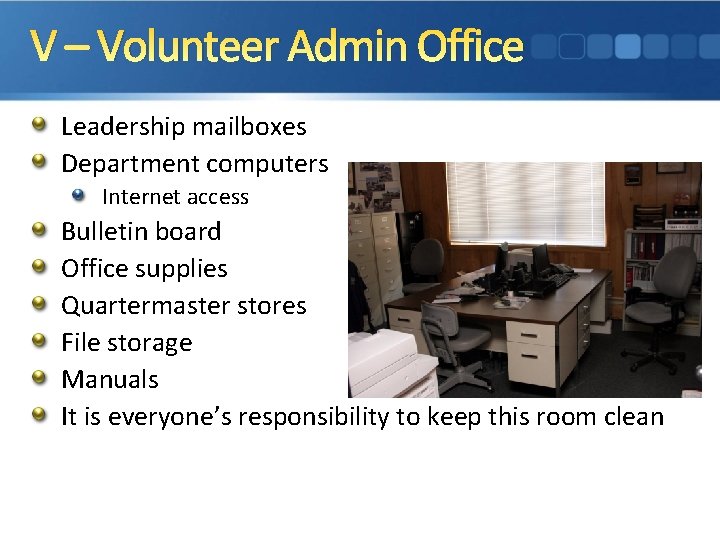
V – Volunteer Admin Office Leadership mailboxes Department computers Internet access Bulletin board Office supplies Quartermaster stores File storage Manuals It is everyone’s responsibility to keep this room clean
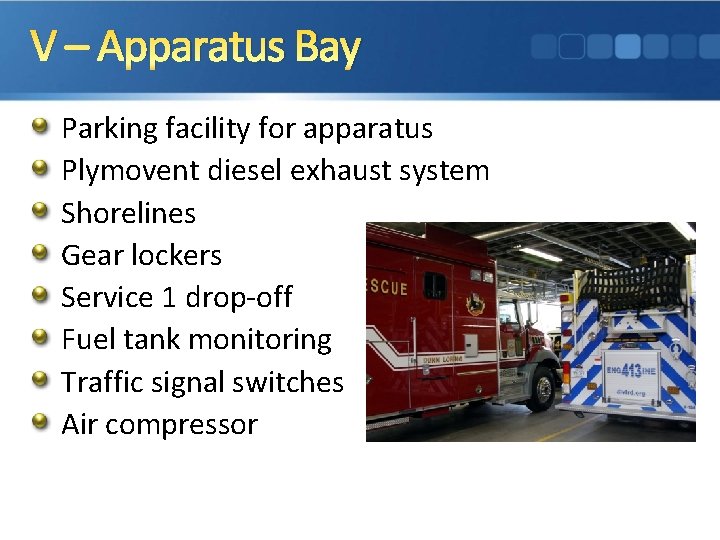
V – Apparatus Bay Parking facility for apparatus Plymovent diesel exhaust system Shorelines Gear lockers Service 1 drop-off Fuel tank monitoring Traffic signal switches Air compressor
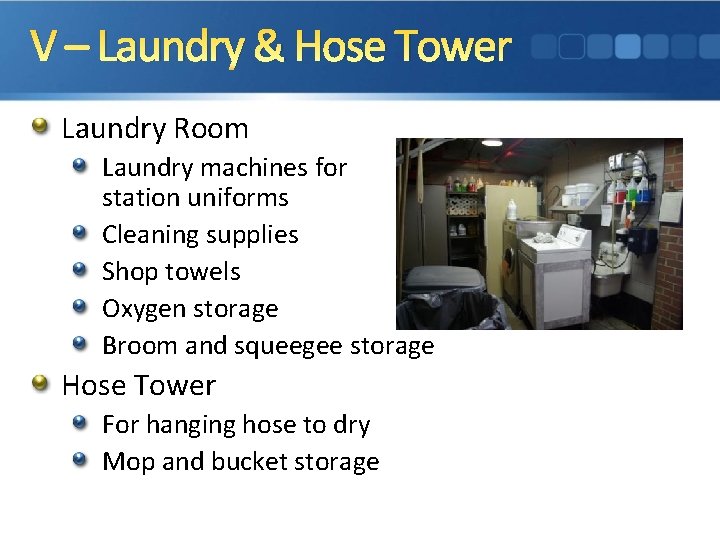
V – Laundry & Hose Tower Laundry Room Laundry machines for station uniforms Cleaning supplies Shop towels Oxygen storage Broom and squeegee storage Hose Tower For hanging hose to dry Mop and bucket storage
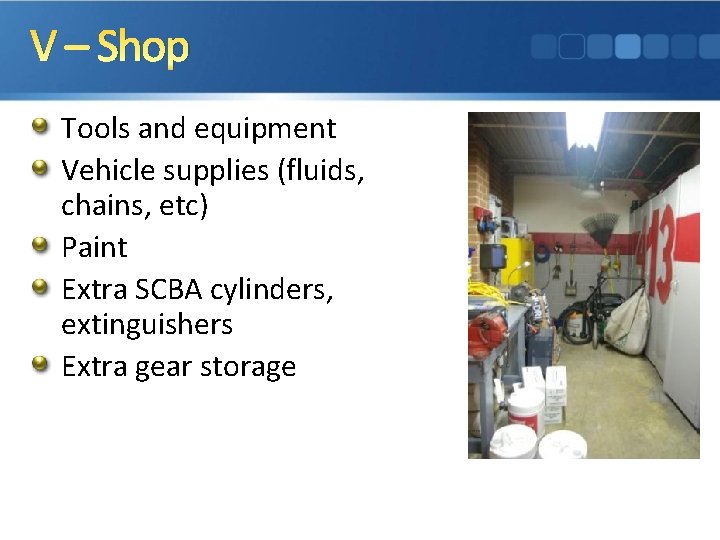
V – Shop Tools and equipment Vehicle supplies (fluids, chains, etc) Paint Extra SCBA cylinders, extinguishers Extra gear storage
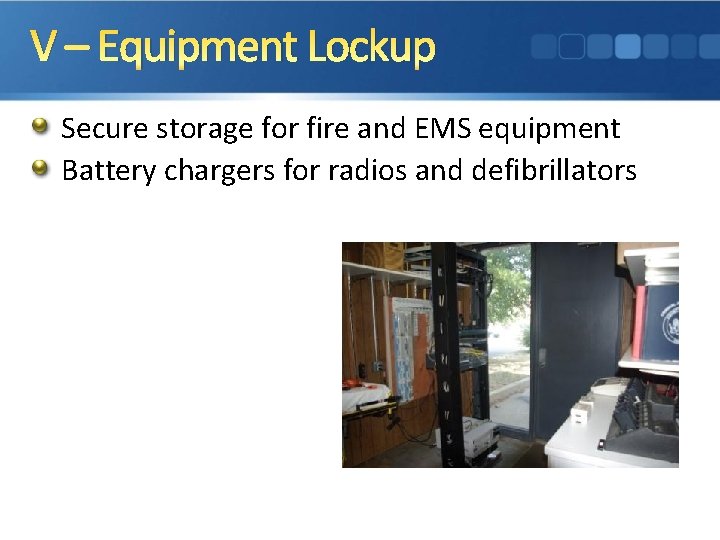
V – Equipment Lockup Secure storage for fire and EMS equipment Battery chargers for radios and defibrillators
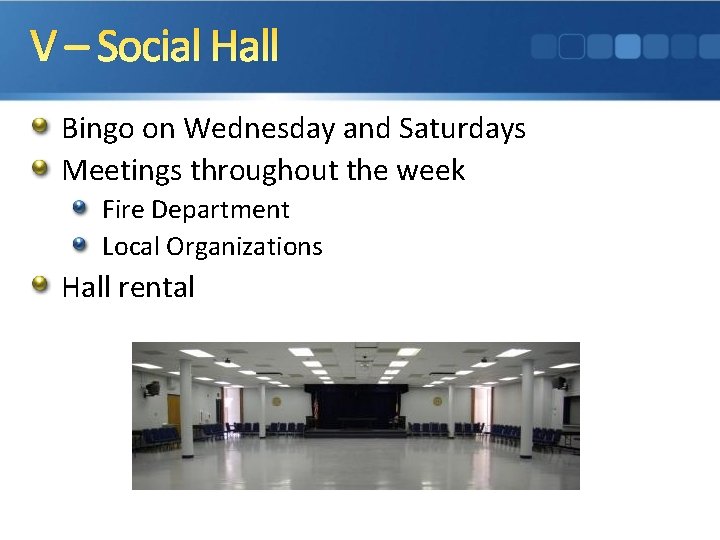
V – Social Hall Bingo on Wednesday and Saturdays Meetings throughout the week Fire Department Local Organizations Hall rental
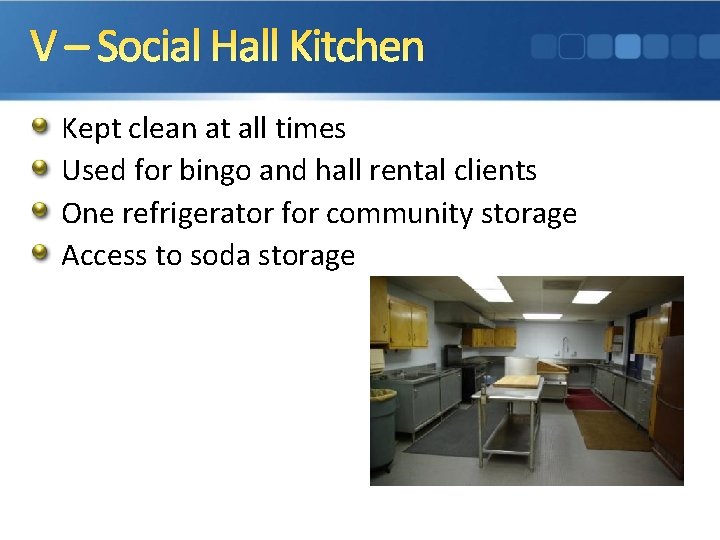
V – Social Hall Kitchen Kept clean at all times Used for bingo and hall rental clients One refrigerator for community storage Access to soda storage
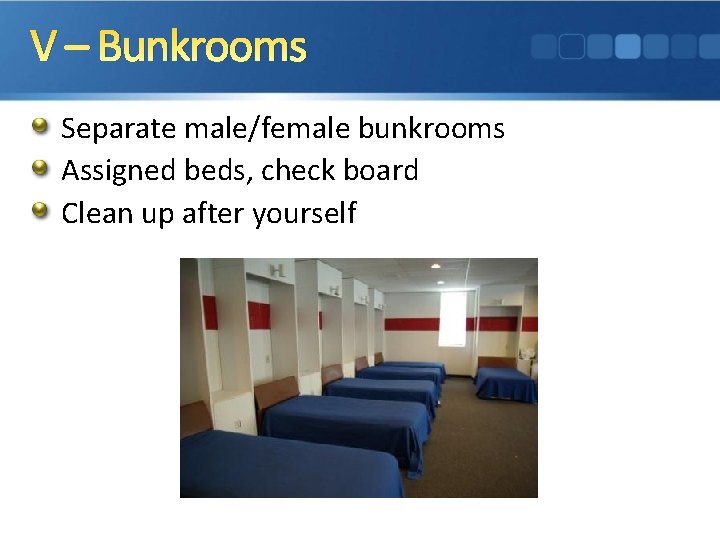
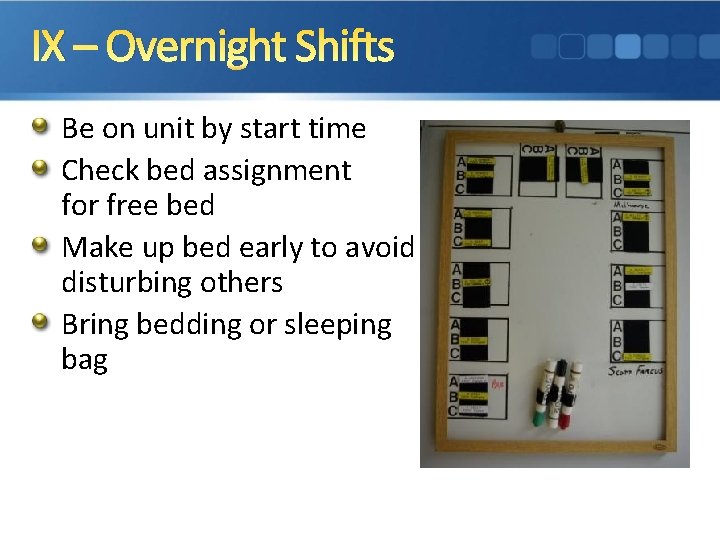
V – Bunkrooms Separate male/female bunkrooms Assigned beds, check board Clean up after yourself
V – Lockers/Bathrooms Separate male/female facilities Assigned lockers Clean up after yourself
V – Battalion 2 Office and bunk for battalion chief
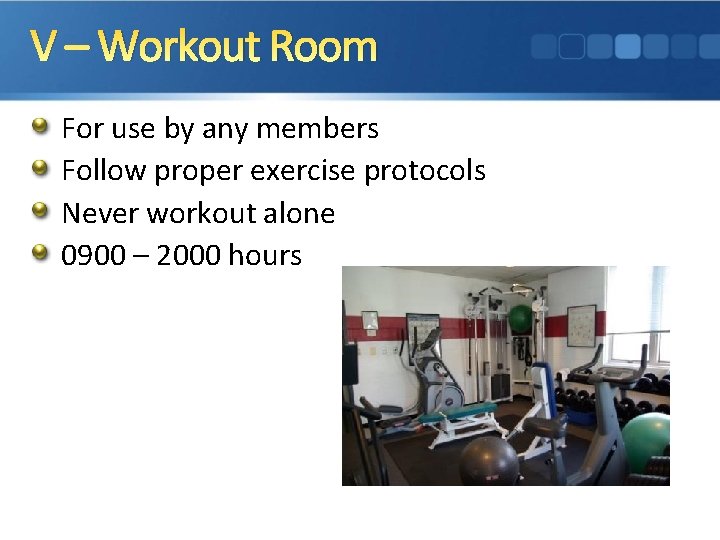
V – Workout Room For use by any members Follow proper exercise protocols Never workout alone 0900 – 2000 hours
Fairfax County VISIT Section VI Apparatus Organization
Fairfax County VISIT Section VI Apparatus Orientation
VI – Apparatus Orientation Engine (E 413, V-135) Reserve Engine (E 413 B, V-133) Medic (M 413, V-134) Ambulance (A 413/A 413 E, V-116) Rehabilitation Unit (REHAB 413, 7039) Battalion Chief’s Buggy (BC 402, 5861) Utility (UT 413, V-111)
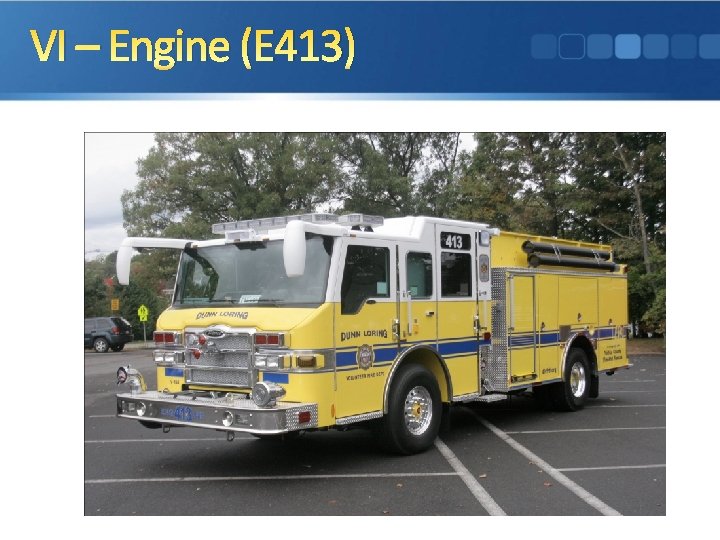
VI – Engine (E 413)
VI – Engine (E 413) 2009 Pierce Velocity PUC pumper 750 gallon water tank 1250 GPM pump Seating for 6 Cost $523, 000 in 2009 Staffed by Fairfax County Personnel: 1 Driver / Operator 1 Officer 1 ALS Firefighter 1 Firefighter Performs fire suppression and medical tasks Supplemental staffing by volunteers
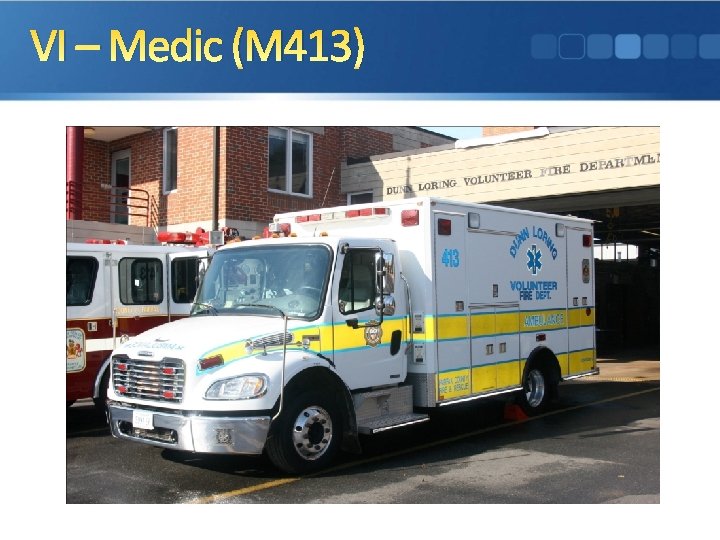
VI – Medic (M 413)
VI – Medic (M 413) 2005 Freightliner M 2 American La. France Medic Master Ambulance Seating for 3 Cost $135, 000 in 2005 Staffed by Fairfax County personnel: 1 Firefighter Driver 1 Fire. Medic Provides medical services and hospital transport Supplemental staffing by volunteers
VI – Reserve Engine (E 413 B)
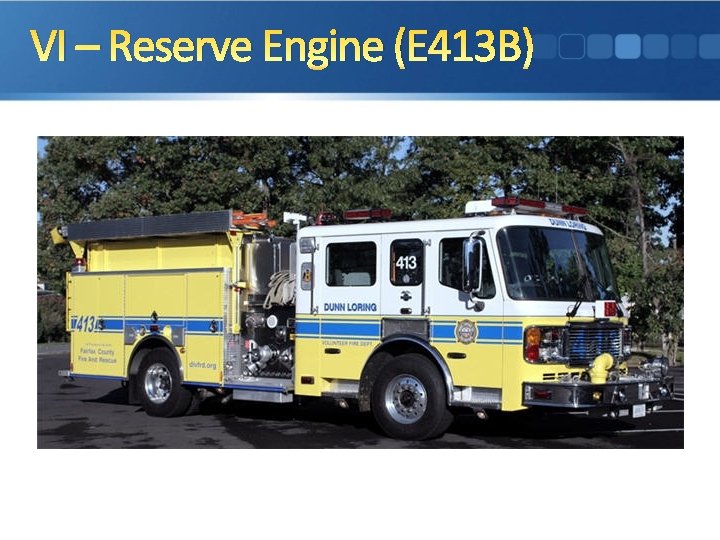
VI – Reserve Engine (E 413 B) 2003 American La. France Eagle pumper 750 gallon water tank 1500 GPM pump Seating for 6 Cost $368, 000 in 2004 Staffed by Dunn Loring Personnel: 1 Driver / Operator 1 Officer 2 Firefighters Performs fire suppression and medical tasks
VI – Ambulance (A 413/A 413 E)
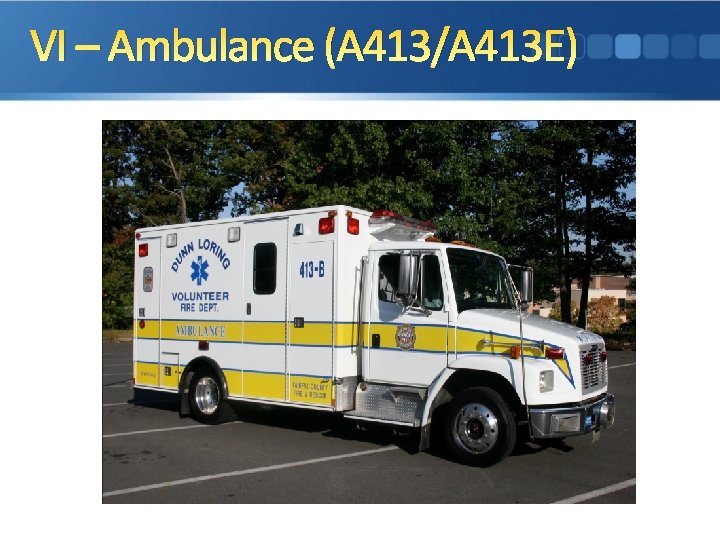
VI – Ambulance (A 413/A 413 E) 2001 Freightliner FL 60 American La. France Medic Master Ambulance Seating for 3 Cost $135, 000 in 2001 Staffed by Dunn Loring volunteers as needed: 1 Firefighter or EMT Driver 1 Firefighter or EMT Officer Provide medical services and hospital transport
VI – Battalion Chief 402 (BC 402)
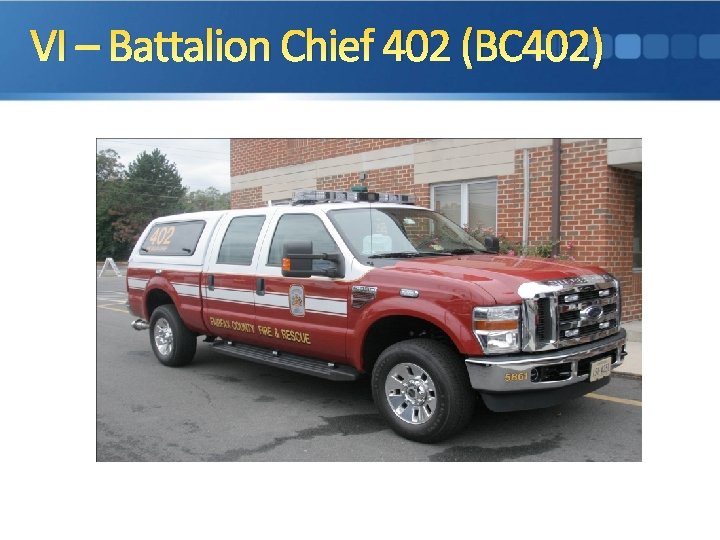
VI – Battalion Chief 402 (BC 402) 2009 Ford F 350 Super Duty 4 x 4 Seating for 2 Staff by Fairfax County personnel 1 Battalion Chief Equipped with: Command boards, manuals and equipment Basic EMS equipment Provides command functions Supplemental staffing by volunteers
VI – Rehab Unit (REHAB 413)
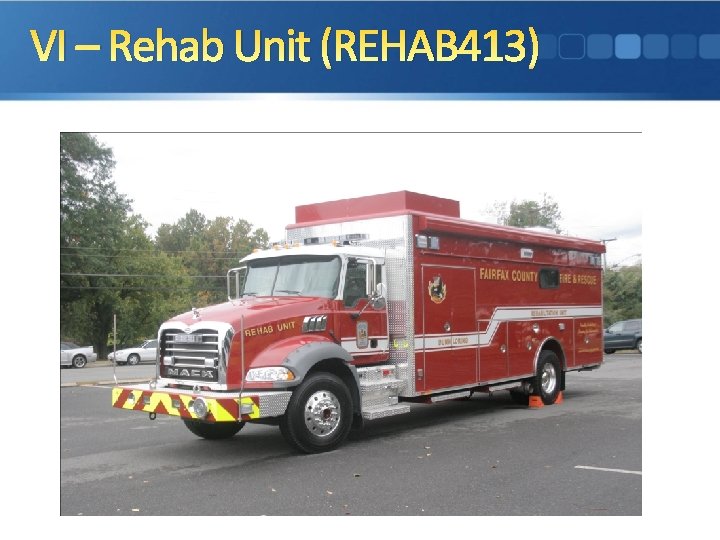
VI – Rehab (REHAB 413) 2009 Mack Pierce Rehabilitation Unit County Owned – Cost $453, 000 in 2009 Provides temperature controlled environment for fire department personnel to rehabilitate after operating at intense or long term incidents. Staffed on an as-needed basis by career or volunteer personnel on all greater alarm and as-called incidents.
VI – Utility (UT 413)
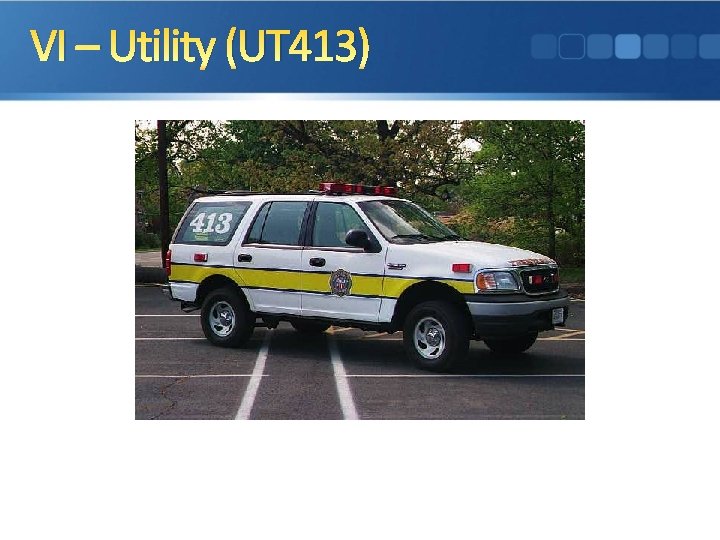
VI – Utility (UT 413) 2000 Ford Expedition Staffed by 2 Equipped with: Basic EMS equipment Backboard and straps Used to carry equipment, tools, personnel Acts as a reserve command unit
Fairfax County VISIT Section VII Personal Protective Equipment (PPE)
VII – Personal Protective Equipment Firefighter Suppression Gear Accountability Tags SCBA EMS Only Protective Gear Accountability Tags Personal Infection Control (PIC) Kit Station Uniform – Station Polo or T-Shirt, Blue pants, Black Belt, Black Safety-Shoes
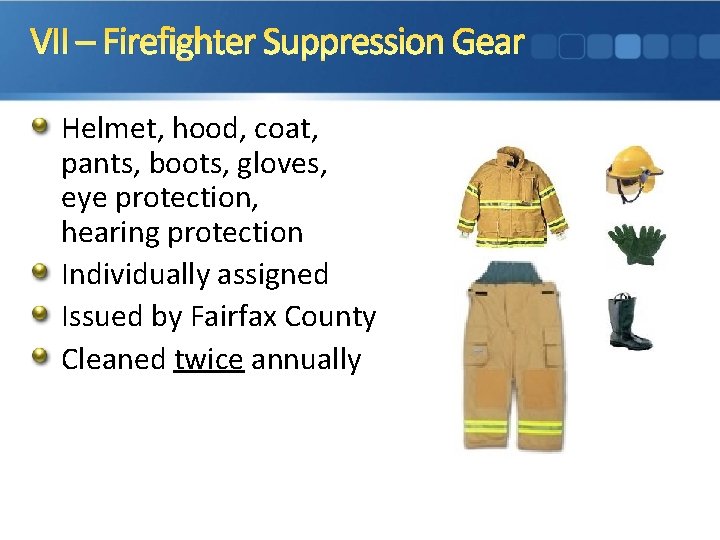
VII – Firefighter Suppression Gear Helmet, hood, coat, pants, boots, gloves, eye protection, hearing protection Individually assigned Issued by Fairfax County Cleaned twice annually
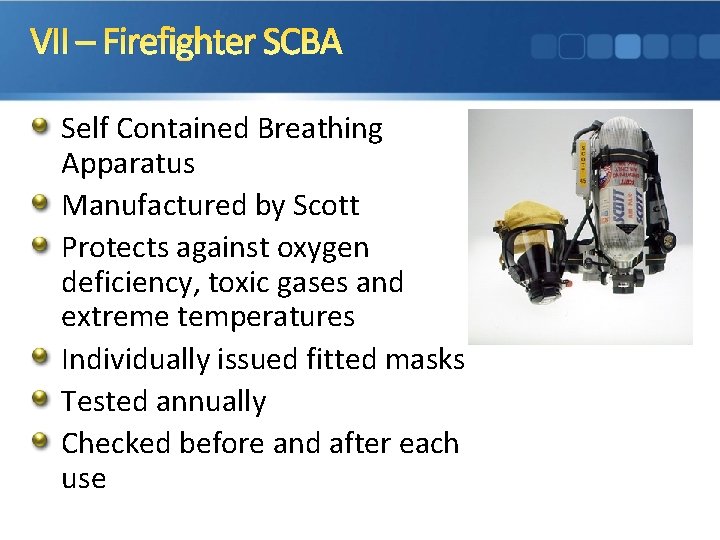
VII – Firefighter SCBA Self Contained Breathing Apparatus Manufactured by Scott Protects against oxygen deficiency, toxic gases and extreme temperatures Individually issued fitted masks Tested annually Checked before and after each use
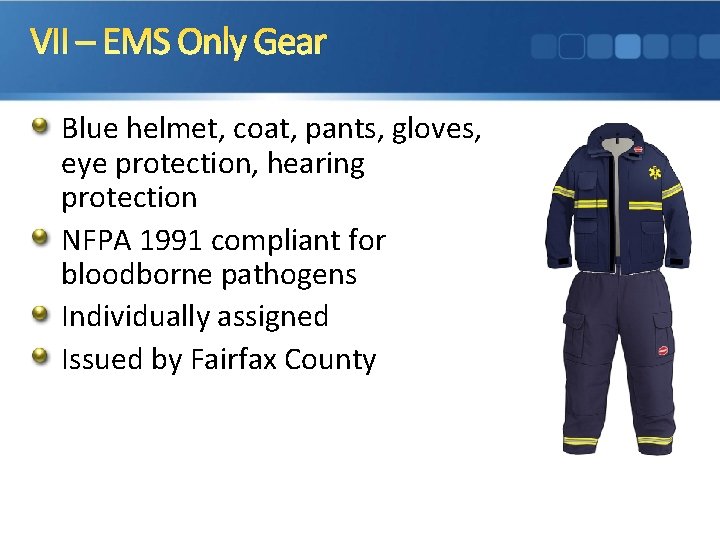
VII – EMS Only Gear Blue helmet, coat, pants, gloves, eye protection, hearing protection NFPA 1991 compliant for bloodborne pathogens Individually assigned Issued by Fairfax County
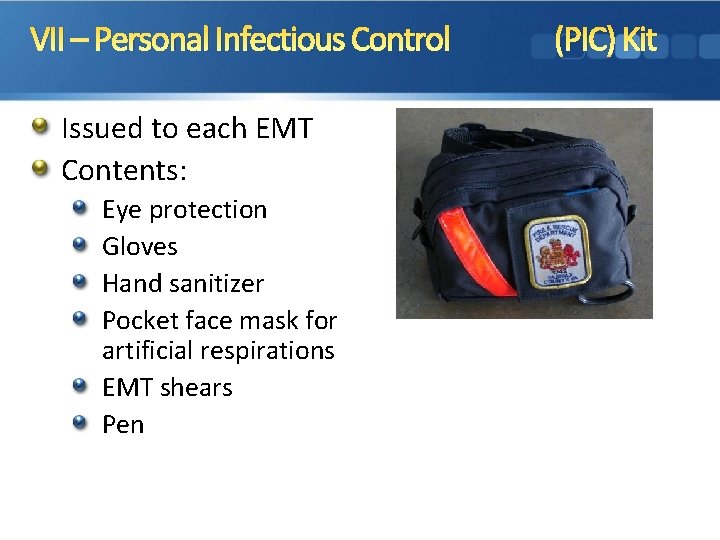
VII – Personal Infectious Control Issued to each EMT Contents: Eye protection Gloves Hand sanitizer Pocket face mask for artificial respirations EMT shears Pen (PIC) Kit
Fairfax County VISIT Section VIII Equipment
VIII – Equipment Common Hand Tools Hoses Ladders EMS Equipment
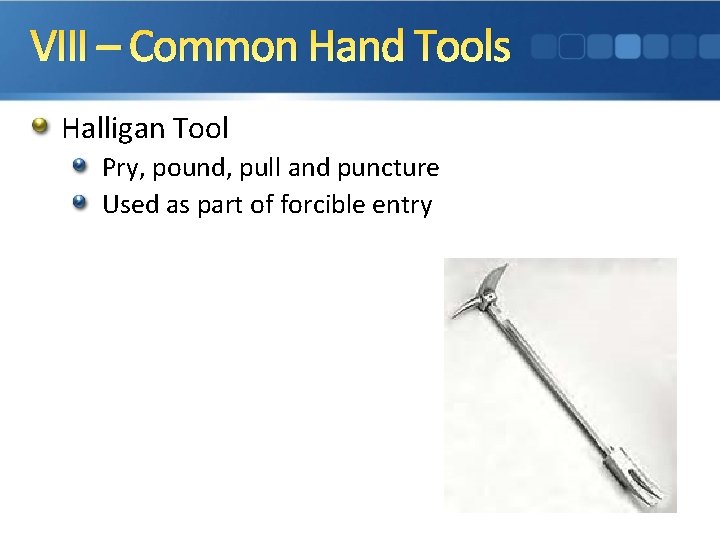
VIII – Common Hand Tools Halligan Tool Pry, pound, pull and puncture Used as part of forcible entry
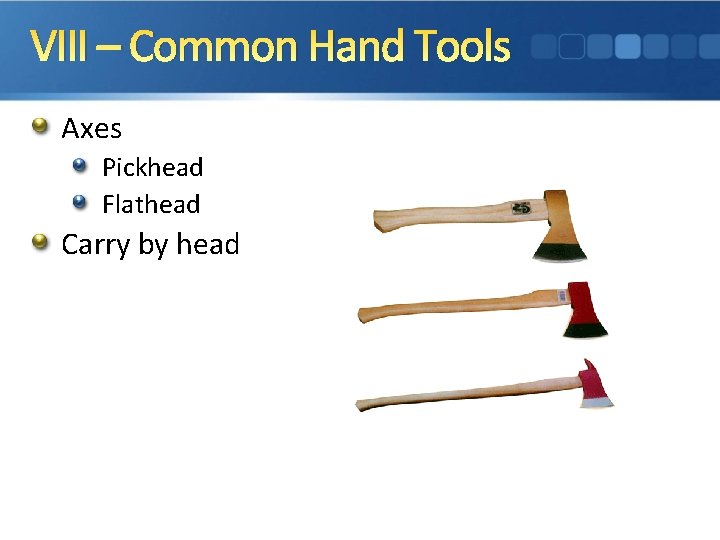
VIII – Common Hand Tools Axes Pickhead Flathead Carry by head
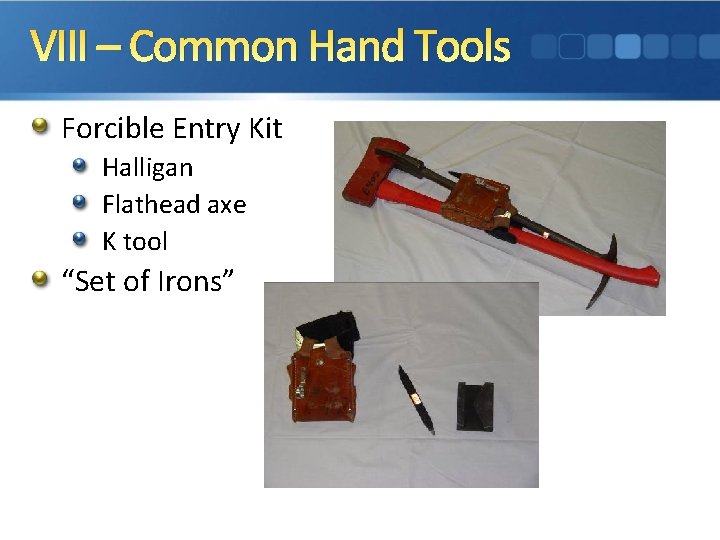
VIII – Common Hand Tools Forcible Entry Kit Halligan Flathead axe K tool “Set of Irons”
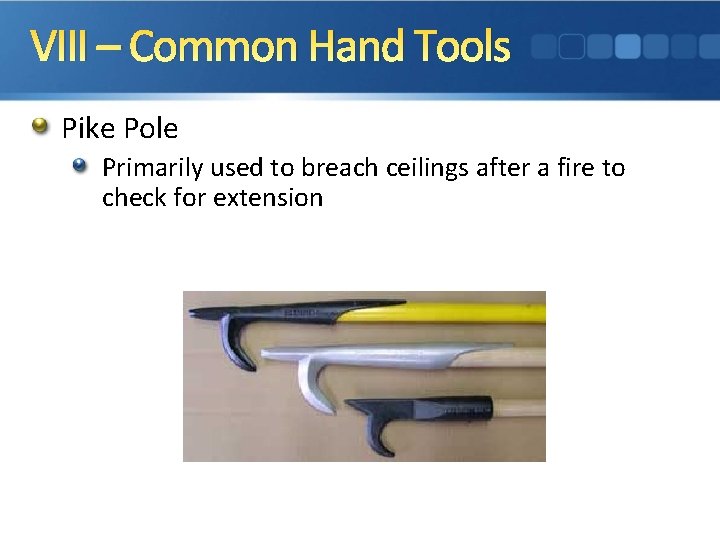
VIII – Common Hand Tools Pike Pole Primarily used to breach ceilings after a fire to check for extension
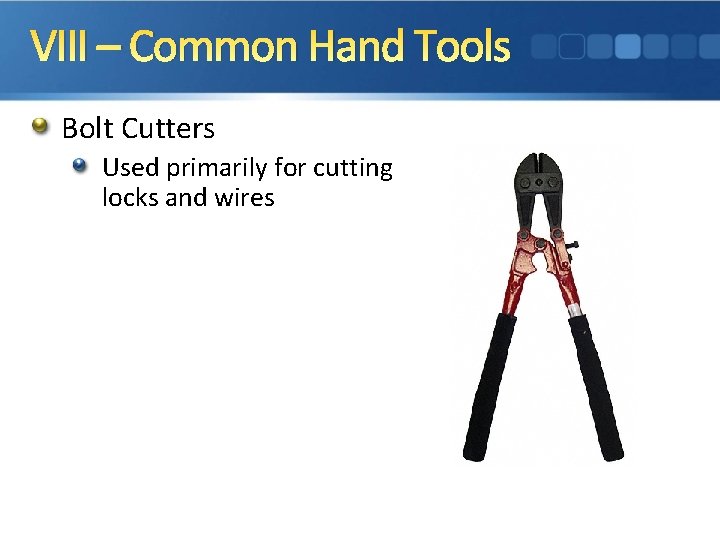
VIII – Common Hand Tools Bolt Cutters Used primarily for cutting locks and wires
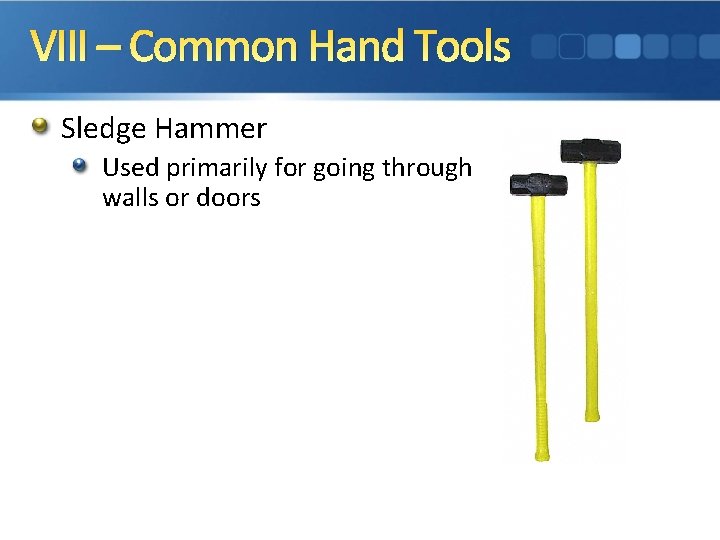
VIII – Common Hand Tools Sledge Hammer Used primarily for going through walls or doors
VIII – Hoses Different sizes and functions Range from 1” to 6” Typically 50’ sections
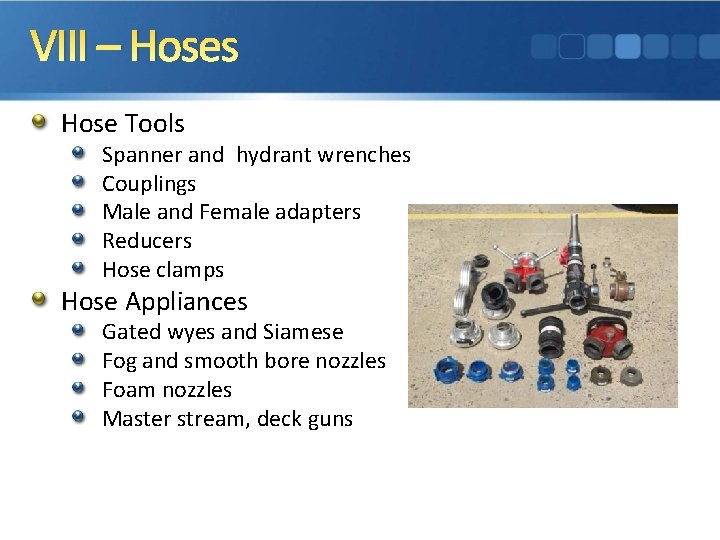
VIII – Hoses Hose Tools Spanner and hydrant wrenches Couplings Male and Female adapters Reducers Hose clamps Hose Appliances Gated wyes and Siamese Fog and smooth bore nozzles Foam nozzles Master stream, deck guns
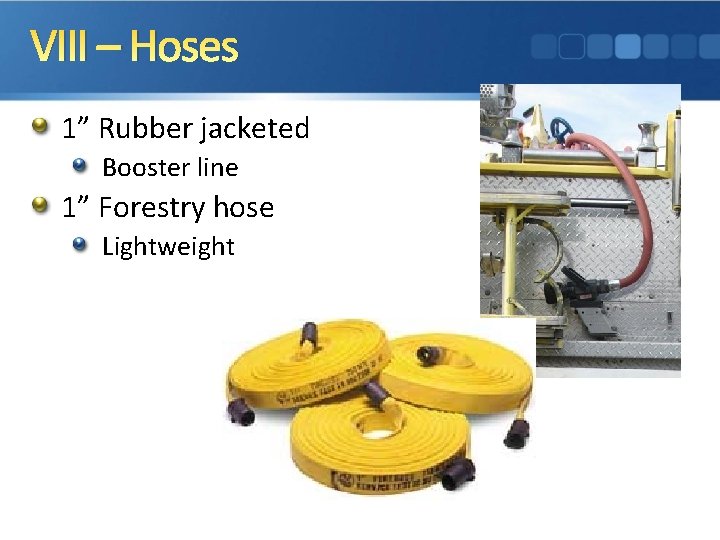
VIII – Hoses 1” Rubber jacketed Booster line 1” Forestry hose Lightweight
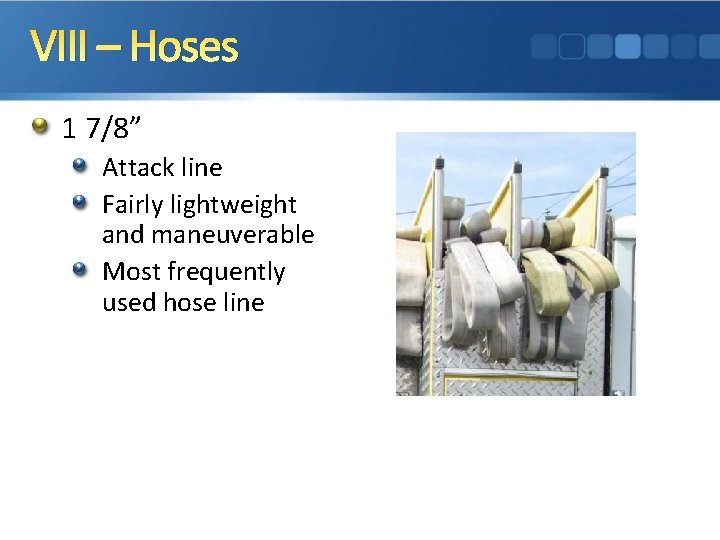
VIII – Hoses 1 7/8” Attack line Fairly lightweight and maneuverable Most frequently used hose line
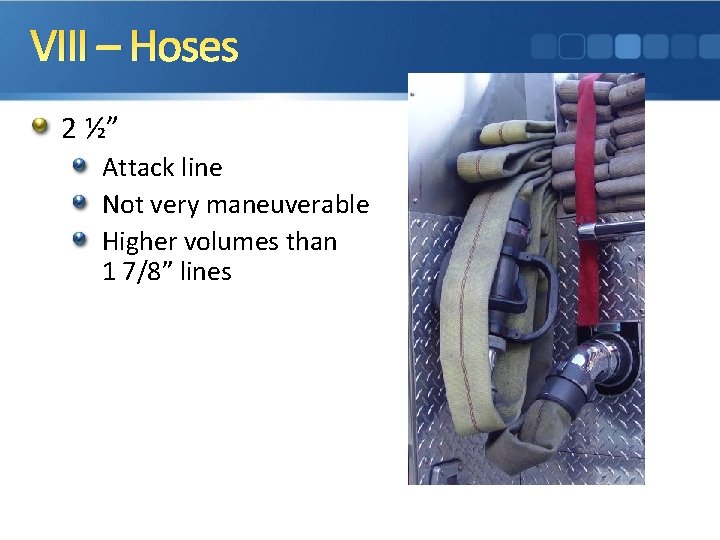
VIII – Hoses 2 ½” Attack line Not very maneuverable Higher volumes than 1 7/8” lines
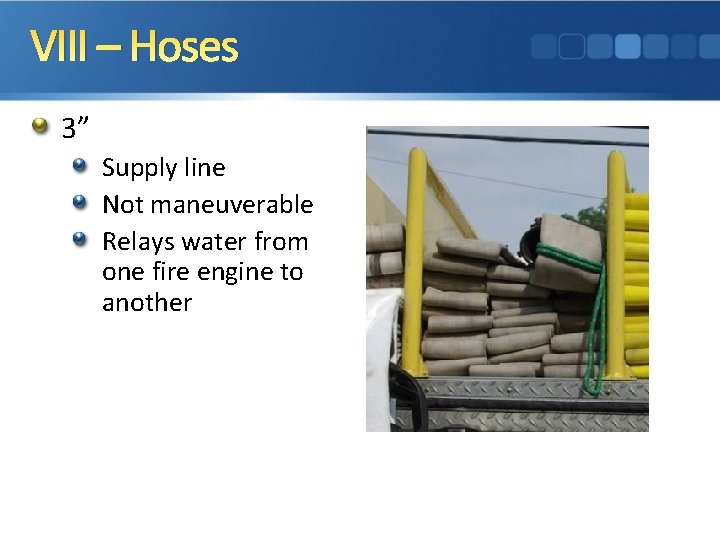
VIII – Hoses 3” Supply line Not maneuverable Relays water from one fire engine to another
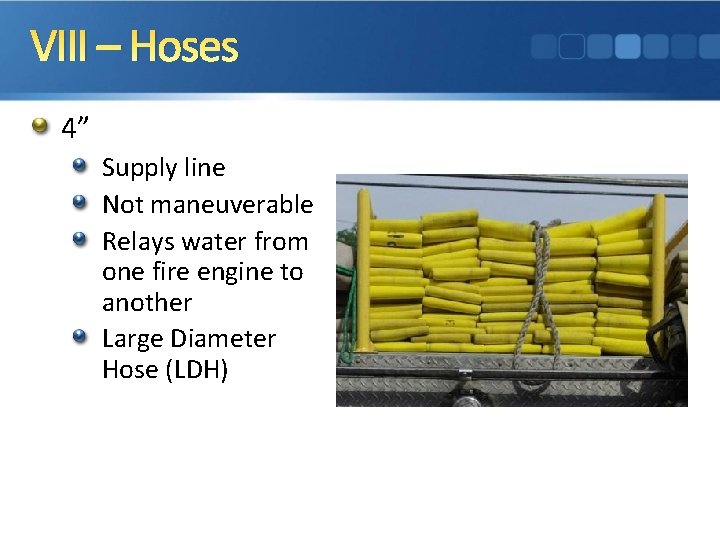
VIII – Hoses 4” Supply line Not maneuverable Relays water from one fire engine to another Large Diameter Hose (LDH)
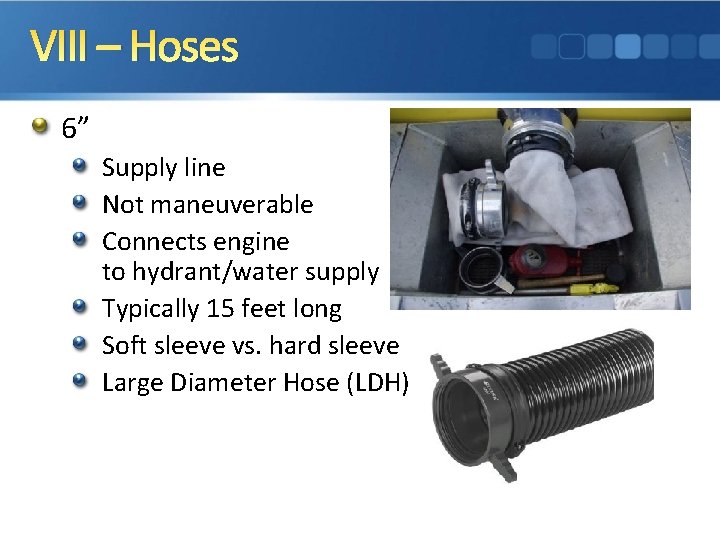
VIII – Hoses 6” Supply line Not maneuverable Connects engine to hydrant/water supply Typically 15 feet long Soft sleeve vs. hard sleeve Large Diameter Hose (LDH)
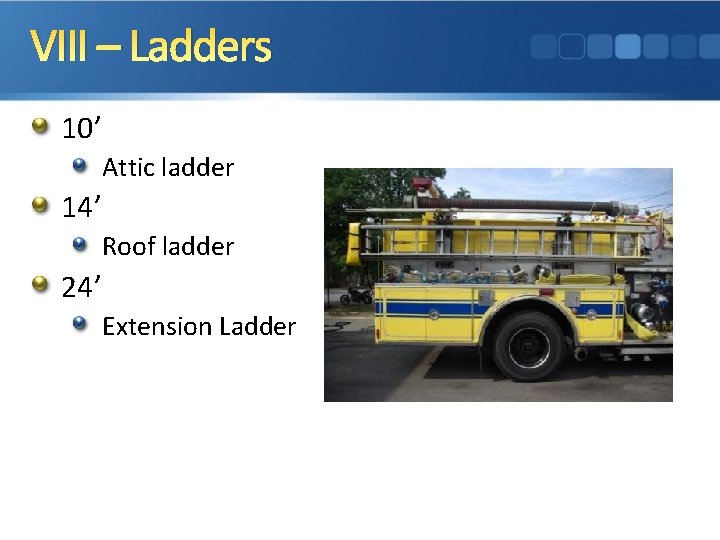
VIII – Ladders 10’ Attic ladder 14’ Roof ladder 24’ Extension Ladder
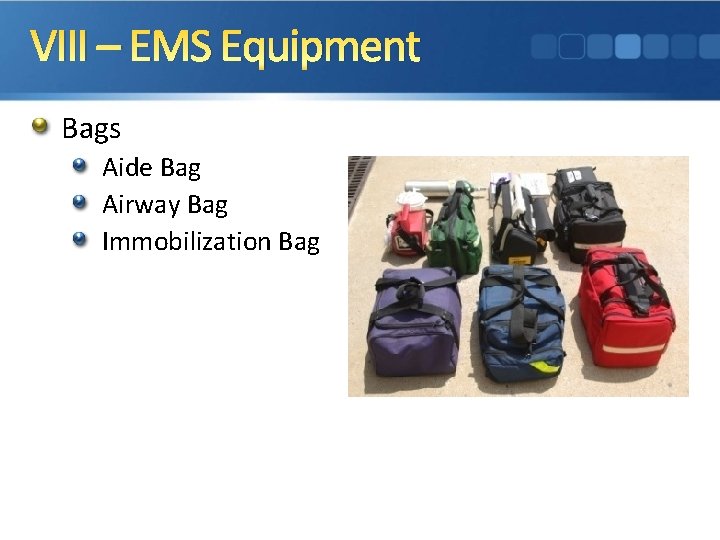
VIII – EMS Equipment Bags Aide Bag Airway Bag Immobilization Bag
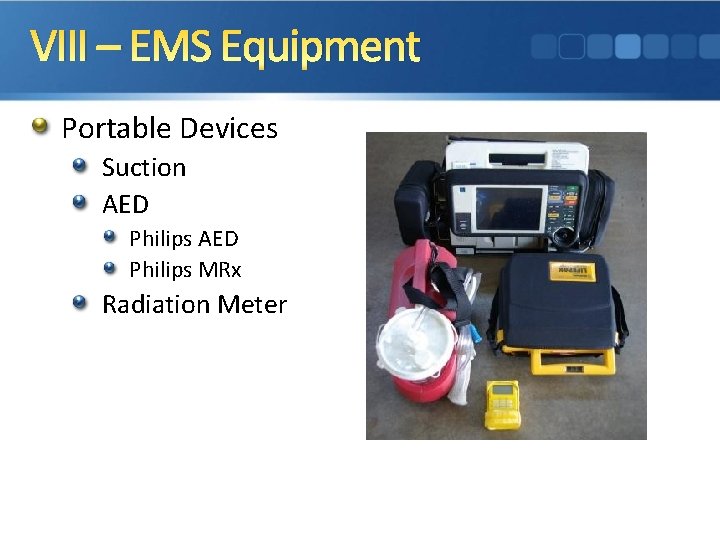
VIII – EMS Equipment Portable Devices Suction AED Philips MRx Radiation Meter
VIII – EMS Equipment Specialized Kits Intubation Kit OB Kit Burn Kit Triage Kit
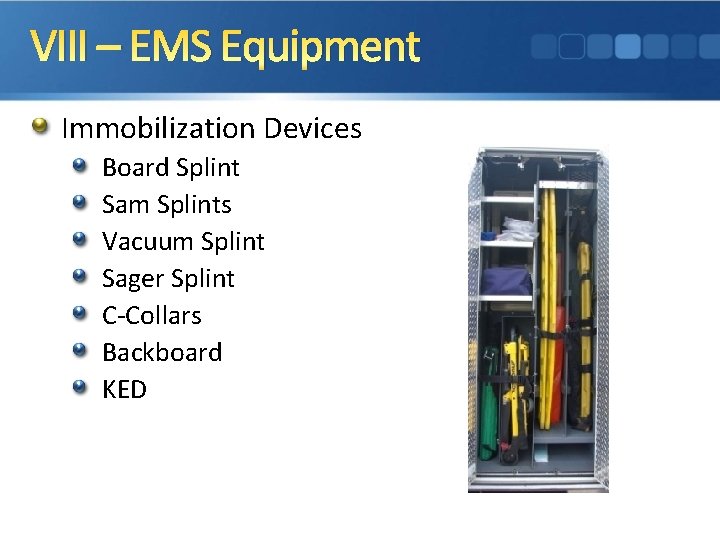
VIII – EMS Equipment Immobilization Devices Board Splint Sam Splints Vacuum Splint Sager Splint C-Collars Backboard KED
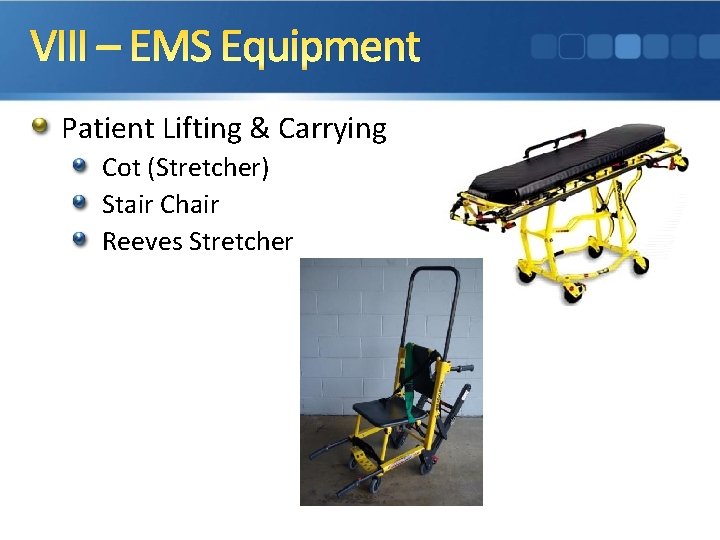
VIII – EMS Equipment Patient Lifting & Carrying Cot (Stretcher) Stair Chair Reeves Stretcher
VIII – EMS Equipment Other Equipment MAST Emesis Basins Linens Gloves Sharps Containers Oxygen Cylinders
Fairfax County VISIT Section IX Riding Apparatus
IX – Riding Apparatus Overview What apparatus to ride? Obtaining an assignment Overnight shifts Safety Skills for red hats
IX – Overview Safety is priority one Only perform skills you are trained in
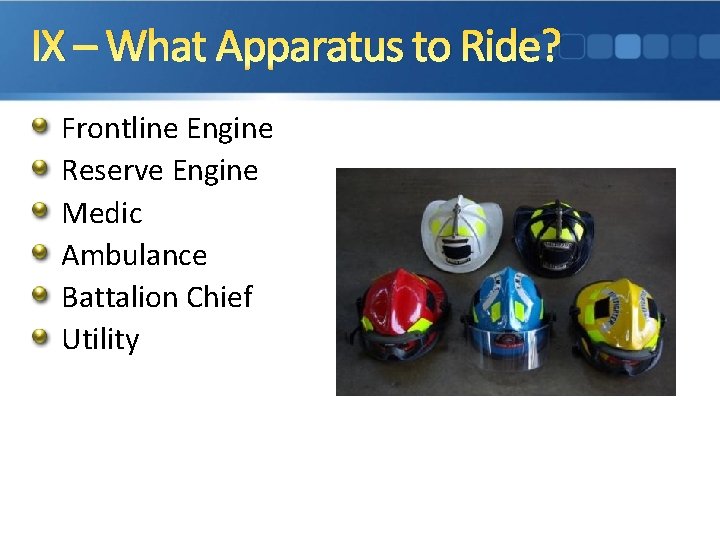
IX – What Apparatus to Ride? Frontline Engine Reserve Engine Medic Ambulance Battalion Chief Utility
IX – Obtaining an Assignment Career units VMS in the Operations, Supplemental section Notify officer of unit Previous shift work day and that morning Volunteer units VMS in the Operations, Duty Shift section Inform officer of your skill set Place gear/accountability tags on unit Roster function on MCT Re-familiarize with tool/equipment placement
IX – Overnight Shifts Be on unit by start time Check bed assignment for free bed Make up bed early to avoid disturbing others Bring bedding or sleeping bag
IX – Safety Be careful Safety is priority one Road vests/jackets and helmets on accidents Stay with either officer or driver as directed
IX – Skills for Riding Traffic control / Use of flares Fire hydrant usage CPR assistance Equipment retrieval Must know equipment location EMS operations Cleaning and decontamination Restocking Ambulance cot operation Observe all aspects of patient care Provide limited treatment under the supervision of a qualified patient care provider
Fairfax County VISIT Section X Review
Fairfax County VISIT Section XI TEST