
Chapter 26 First Aid for Colleges and Universities

- Slides: 29
Chapter 26 First Aid for Colleges and Universities 10 th Edition Water Emergencies Slide Presentation prepared by Randall Benner, M. Ed. , NREMT-P © 2012 Pearson Education, Inc.
Learning Objectives • Explain the difference between drowning and near-drowning. • Explain the difference between wet and dry drowning. • Explain why you should always try to resuscitate someone who has had an accident in cold water. • Explain how to safely reach someone in trouble in the water. © 2012 Pearson Education, Inc.
Learning Objectives • Describe and demonstrate how to protect a victim in the water if you suspect spinal injury. • Describe and demonstrate first aid care for a near-drowning victim. • Describe the various kinds of diving emergencies. © 2012 Pearson Education, Inc.
Learning Objectives • List the signs and symptoms of air embolism and decompression sickness • Describe and demonstrate first aid care for a victim of air embolism or decompression sickness. • Describe and demonstrate first aid care for a victim of barotrauma. © 2012 Pearson Education, Inc.
Introduction • Nearly 4, 000 deaths occur annually from water accidents. • The First Aider may find themself in a workrelated or recreation-related activity when a water emergency occurs. • Important to remember: never attempt a water rescue unless you are a specially trained and good swimmer who has donned a personal flotation device and has the help of others. © 2012 Pearson Education, Inc.
Drowning and Near-Drowning • Definitions – Drowning: death from suffocation due to submersion – Near-Drowning: at least temporary survival from near soffocation due to submersion • Most commonly happens to children under age 5, and people between 15 and 24 years of age • May not occur in large bodies of water © 2012 Pearson Education, Inc.
Drowning and Near-Drowning • Remain alert for signs of struggle. – – Sudden splashing Screams Calls for help Swimmer who is thrashing © 2012 Pearson Education, Inc.
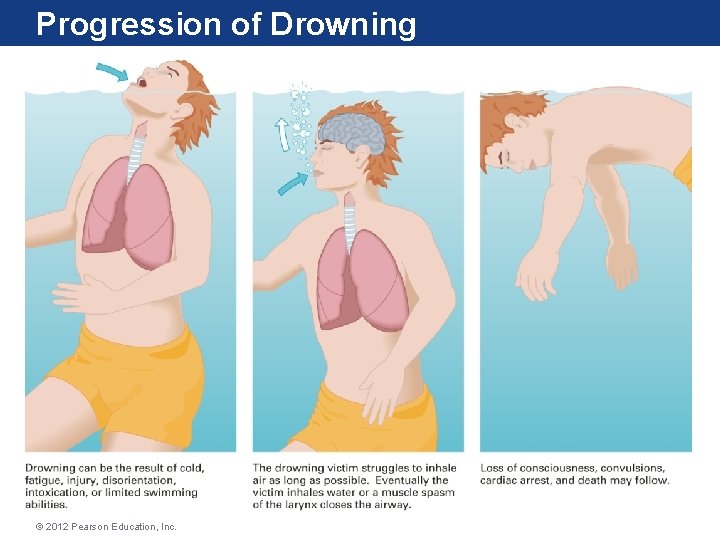
Drowning and Near-Drowning • Wet drowning occurs when the victim has aspirated fluid or a foreign body into the lungs. • Dry drowning occurs when laryngeal spasms prevent fluid from entering the lungs, but the person still suffocates. • Secondary drowning occurs when a resuscitated victim dies within 96 hours of the incident from aspiration pneumonia. © 2012 Pearson Education, Inc.
Progression of Drowning © 2012 Pearson Education, Inc.
Drowning and Near-Drowning • Types of drowning refer to the victim’s activities prior to unresponsiveness and death – Active drowning – victim is still trying to remain afloat and breathing with great energy expenditure – Passive drowning – victim is not moving, is usually face down or submerged; drowning results from total expenditure of energy © 2012 Pearson Education, Inc.
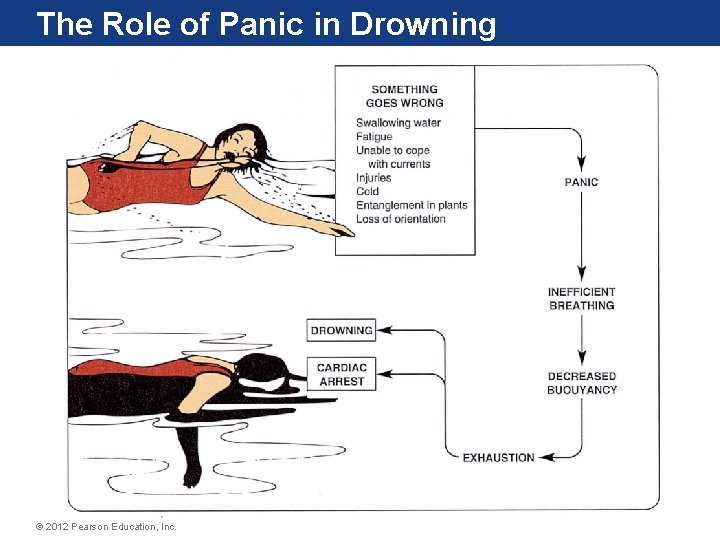
The Role of Panic in Drowning © 2012 Pearson Education, Inc.
Drowning and Near-Drowning • Resuscitating Cold Water Submersion Victims – Cold water emergencies have a higher chance of survival (below 68 degrees F) – Beneficial effects result from the mammalian diving reflex and the effects of cold water on the body’s metabolic rate – Any cold water submersion victims should be resuscitated, even if submersion has been lengthy (over 30 minutes) © 2012 Pearson Education, Inc.
Drowning and Near-Drowning • Ensuring your own safety – Always act with your personal safety first. – Never attempt a deep water rescue unless all of the criteria below apply: • • You’re a strong swimmer. You’ve had water rescue technique training. You’re wearing a personal flotation device. You’re accompanied by others to assist you. © 2012 Pearson Education, Inc.
Drowning and Near-Drowning • Water rescue close to shore or in shallow water for a conscious victim – Keep firm footing for yourself, don’t slip into the water. – Lean backwards as you pull the victim out. – Use an object (rope, oar, branch, etc. ) for the victim to grab so you can pull them in. – Use a shepherd's crook if available. © 2012 Pearson Education, Inc.
Drowning and Near-Drowning • Water rescue for a conscious victim out of your reach – Items to toss to victim: • • a ring buoy a heaving line a throw bag a heaving jug • Shout to victim to get their attention. • Stand on rope’s end before throwing. • Swing underhand with intent of throwing device just past the victim. © 2012 Pearson Education, Inc.
Drowning and Near-Drowning • Water rescue for an unconscious victim out of your reach – If possible, make rescue attempt from a boat (not from in the water) – Use a shepherd's crook if available. – If rescuing from a boat, do not allow yourself to fall into the water. – Follow standard techniques and safety criteria described previously. © 2012 Pearson Education, Inc.
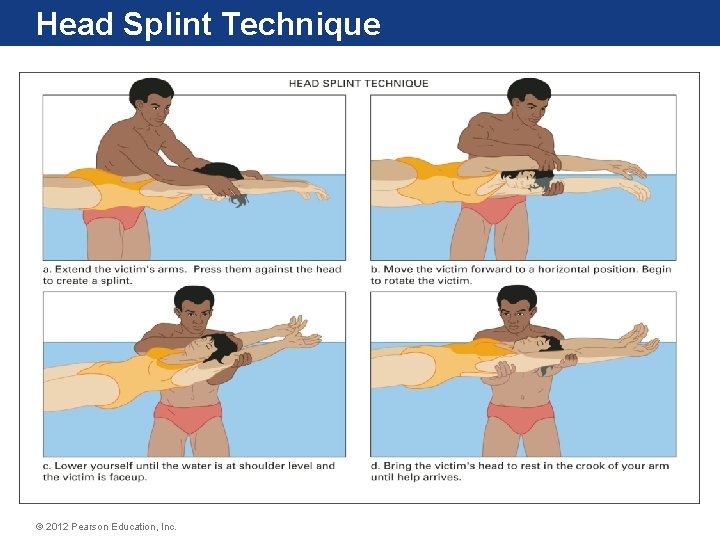
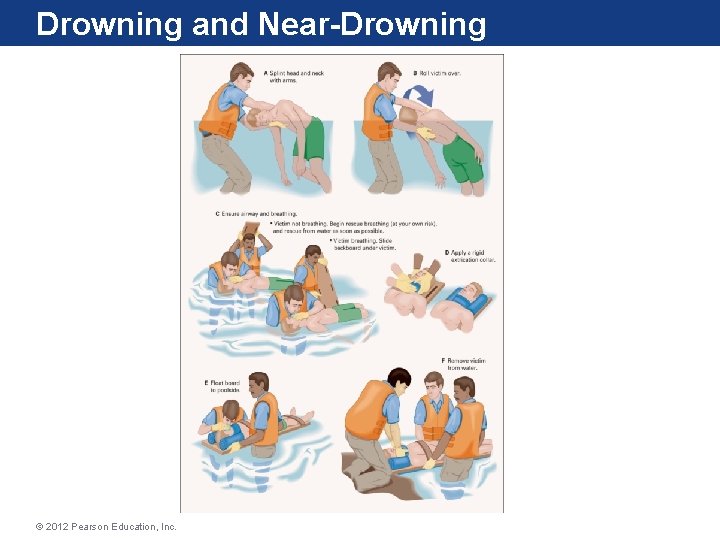
Drowning and Near-Drowning • Head or spinal injury concerns – Suspect head or spinal injury if the victim is unconscious, or if known trauma has occurred. – Goal is to support the back and stabilize the head in the water. – Use the head-splint or the hip/shoulder support techniques. © 2012 Pearson Education, Inc.
Head Splint Technique © 2012 Pearson Education, Inc.
Drowning and Near-Drowning • Head or spinal injury concerns – Use hip/shoulder support technique. – Position yourself aside the victim. – With your arms under the hips and shoulders, lift the victim’s body just high enough that their face is out of the water. – Remain in this position until medical help arrives. – Attempt to keep the victim’s body horizontal. © 2012 Pearson Education, Inc.
Drowning and Near-Drowning • Head or spinal injury concerns – If you are not trained in water rescue do the following: • Do not remove the victim from water. • Keep the victim afloat on his or her back. • Always support the head and neck, and keep them level with the back. • Maintain the airway and support ventilation as possible. • Maintain these maneuvers until medical help arrives. © 2012 Pearson Education, Inc.
Drowning and Near-Drowning • The First Aider should – Activate the EMS. – Safely remove the victim from the water. – Maintain immobilization in water, if possible, prior to removal of the unconscious victim. – Once out of the water, assess and manage the airway, breathing, and circulation functions. – Maintain care and support any lost functions until EMS arrives. © 2012 Pearson Education, Inc.
Drowning and Near-Drowning © 2012 Pearson Education, Inc.
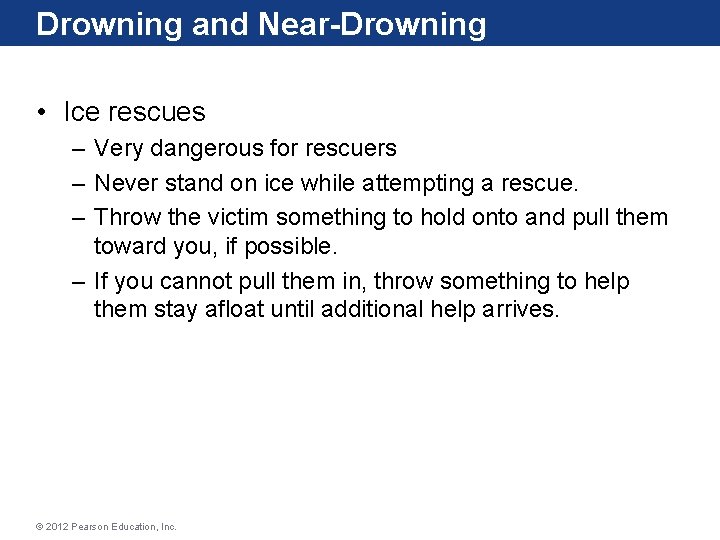
Drowning and Near-Drowning • Ice rescues – Very dangerous for rescuers – Never stand on ice while attempting a rescue. – Throw the victim something to hold onto and pull them toward you, if possible. – If you cannot pull them in, throw something to help them stay afloat until additional help arrives. © 2012 Pearson Education, Inc.
Diving Emergencies • Diving into shallow water – Injuries to the head, neck, back, extremities, or chest can occur. – Always assume spinal injuries have occurred and attempt rescue with immobilization techniques as described previously. – If victim has left the water, proceed with standard care as you would for any victim with suspected neck or spinal injuries. © 2012 Pearson Education, Inc.
Diving Emergencies • Deep-water diving – Most serious complication is coma, which can result from asphyxiation, head injury, heart attack, air tank contamination, intoxication, or aspiration. – Victim may be unconscious from air embolism or decompression sickness. – A hyperbaric chamber for recompression may be needed at the hospital. © 2012 Pearson Education, Inc.
Diving Emergencies • Air Embolism – Often occurs from holding one’s breath while diving (into a pool, using scuba gear, etc. ) • Damage to lungs causes air to enter the vascular system – Decompression sickness (the “bends”) • Occurs when a diver ascends too rapidly from deep water and nitrogen bubbles form in the body – Has gradual onset; symptoms can develop 12– 24 hours after a dive. © 2012 Pearson Education, Inc.
Diving Emergencies • First aid care for air embolism or decompression sickness – In absence of trauma, place the victim on their left side in a 15 degree-head down position. – Provide support to airway, breathing, and circulation functions as needed. – Continue to monitor and care for the victim until EMS arrives. © 2012 Pearson Education, Inc.
Diving Emergencies • Barotrauma (the “squeeze”) – Occurs with rapid ascent or descent when air in the body’s cavities cannot equalize – Can include mild or severe pain to affected areas with possible ear/nose discharge, dizziness, nausea, and disorientation – Victim requires immediate care and transportation to a medical facility to prevent worsening of the condition © 2012 Pearson Education, Inc.
Summary • Drowning and near-drowning victims have special rescue and treatment needs. • Never attempt a water rescue unless you are equipped and trained to do so safely. • Victims of water emergencies should still be seen by a physician, regardless of how they feel, for a complete evaluation. • Always suspect and treat for neck and/or spinal injury for any victims of shallow water diving. © 2012 Pearson Education, Inc.