
COMOX FIRE RESCUE S T A R T





- Slides: 66
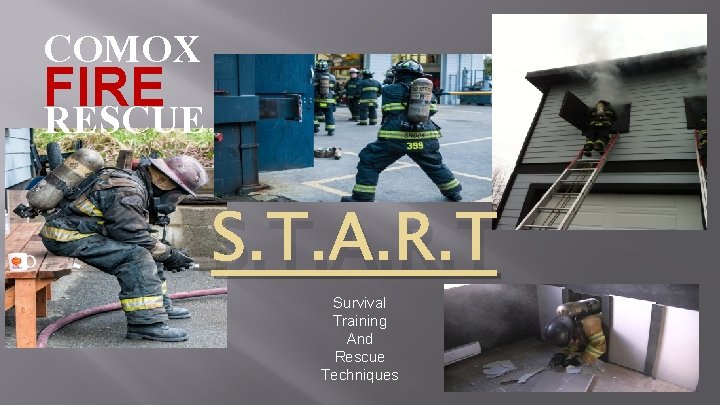
COMOX FIRE RESCUE S. T. A. R. T Survival Training And Rescue Techniques
S. T. A. R. T � Survival Training � How to rescue ourselves � And � Rescue Techniques � How to rescue our fellow firefighters
Course Layout � Session 1 � Classroom Discuss issues and ideology surrounding RIT: �Before the Tones �Normal Operations (After the Tone) �MAYDAY – Activation of the RIT Team �The Rescue �After the MAYDAY – Mission Accomplished
Course Layout � Session 2 � Working with the webbing How to stow the webbing ready for use �How to tie water knot �How to tie a handcuff knot How to create a harness with the webbing How to use it as a drag device
Course Layout � Session 3 � TOWER Escaping above grade room Rescuing firefighter who has fallen through the floor Carrying firefighters up and down stairs
� Session 4 � START Course Layout building Wire entanglement Rapid location of doors and windows Wall breach Rescuing firefighter through a window (Denver)
Course Layout � Session 5 � “End of Day Scenario” Cold smoke environment Working as a team � 50’ Firefighter Rescue
SAFETY FIRST! � These are realistic situations � Follow the directions of your instructors � If something looks unsafe – speak up! � Take time to recover / rehab yourself
ENGINEER LANGVARDT
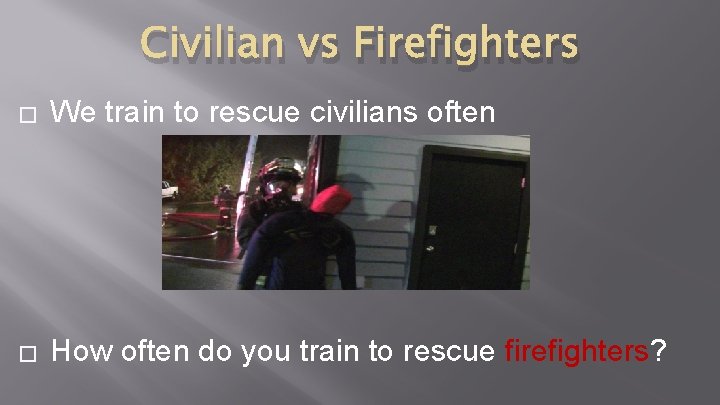
Civilian vs Firefighters � We train to rescue civilians often � How often do you train to rescue firefighters?
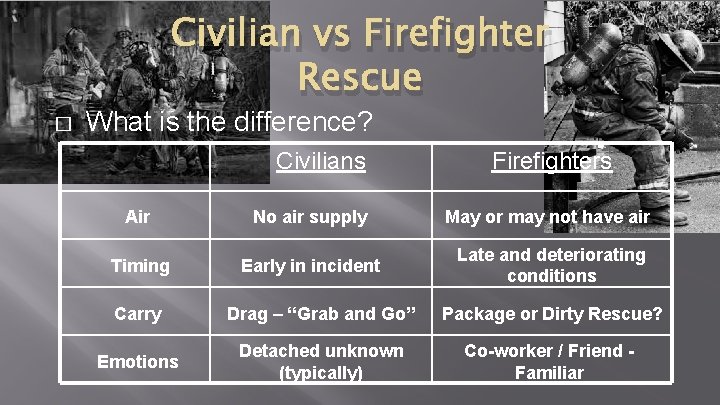
Civilian vs Firefighter Rescue � What is the difference? Civilians Firefighters Air No air supply May or may not have air Timing Early in incident Late and deteriorating conditions Carry Drag – “Grab and Go” Package or Dirty Rescue? Emotions Detached unknown (typically) Co-worker / Friend Familiar
Before the Tones � Maintain our heath � Exercise / Stay fit � Active lifestyle � Cardio is critical Team only operates until first member runs out of air!
Before the Tones � Be Prepared for the Call � Diet Food for physical and mental strength � Fluid intake Drink fluids consistently �Too Late once the pager tones
Before the Tones � Educate Yourself � Understand � Be strategies and tactics competent with your tools Understand their intended use / proper use Understand their limitations
Before the Tones � Do you know building construction? � Look at preplans � Check out buildings in your area Industrial / Commercial sites �FR 3 / Alarms call? �Take a tour before you leave the site (if appropriate)
Before the Tones � Mutual Aid Partners: � Familiarize with their equipment SCBA? Location of Universal Air Connection? Can you swap a cylinder / mask under hostile conditions?
Before the Tones � Have a Comms plan: � In the event of a “MAYDAY” call how are radio comms going to be managed? � Remember – regardless of the MAYDAY call, there’s still an incident to be managed.
Before the Tones � Take Training Seriously � Important for any call � CRITICAL for successful Firefighter rescue � Train with your equipment If it cuts – cut things with it Practice carrying it in realistic situations
Before the Tones � Consider Building a basic RIT kit � Should be easy to carry � Expand on the kit as each incident demands � Suggestions: A basic kit should include Air (for the down firefighter) Mask (in case of damage – again the down firefighter) Tarp (to stage equipment) Basic Irons set (Halligan, Sledge)
Before the Tones � Other RIT Kit considerations: � Rope (rescue and Utility) � Lighting (portable – set up at firefighter location) � Management board To keep track of incident before the MAYDAY � Extra Carabineers – great for instant hand-holds � Extra Webbing
Before the Tones � Train, Train � Practice MAYDAY calls � Experiment � Utilize � Take – try new ideas the internet as a wealth of information Patient Handling courses if they come available
Before the Tones � DO NOT IGNORE PASS or LOW AIR ALARMS ON THE TRAINING GROUND. � TRAIN YOURSELF TO REACT TO THEM – � IT COULD SAVE A FIREFIGHTER’S LIFE!
Normal Operations (After the Tone) � Who is assigned RIT? � How are RIT teams assigned in your department? Predetermined or chosen “on the fly”? � New guy w/ little experience or the veteran? Not a desired assignment so new guy often assigned to RIT – BAD IDEA!
Normal Operations (After the Tone) � RIT Leader � Need to assign a “RIT Leader” to manage the RIT team. � Should be highly experienced and highly trusted � Needs to be skilled in all aspects of firefighting and rescue
Normal Operations (After the Tone) � RIT Leader � Needs to be skilled in all aspects of firefighting and rescue Particularly skilled in forcible entry and strong building construction knowledge � RIT Leader needs to be a cheerleader for a POSITIVE outcome regardless of the situation.
Normal Operations (After the Tone) � Information gathering (as you would in any ff role) � Type of alarm � Time of day (Residential vs Commercial) � Reports from scene (dispatch or first arriving)
Normal Operations (After the tone) � Information that Matters � It all paints a picture, but these are important: � Mode of Operation (Offensive vs Defensive) � Tactics being used � Rescue operations? � Structure use (residential, industrial, commercial? )
Sooo…. You’re Assigned to RIT
You’re Assigned to RIT! � Initial Size-up � Where is the fire located? � Where is it going? � Where are the crews in relation to both? � Meet with command soon as possible
You’re Assigned to RIT � Initial Size-up � 360 Walk around Looking for access / egress points Soften these points now? Ladder Placement (on the ground or to the windows? )
You’re Assigned to RIT � Interior floor plan? � Pre-plans? � Building � Takes occupant / owner? away surprises: Unusual construction features Unusual layout Useable egresses / accesses
You’re Assigned to RIT � Monitor Comms and LISTEN � Radio traffic keeps us informed of progress / location of teams � Tone of voices (unusual stress) on radio may indicate problems before teams recognize or admit to them
You’re Assigned to RIT � Monitor Comms and LISTEN � Listen for PASS alarms Heavy radio traffic may inhibit team’s ability to call MAYDAY. � May hear a PASS over the incident noise � May hear a PASS on the radio in the background of radio comms
You’re Assigned to RIT � Constantly discuss among your team members the “What if” ‘s � What if: Partial collapse? MAYDAY is called right now? Attack crews do NOT get a handle on the fire quickly? � Start preparing for those “What if” ‘s
You’re Assigned to RIT � Keep your mental state on task � Conversations should be limited to: Current conditions: are things getting better or worse? Rescue plans / ideas Equipment needs Roles and responsibilities if RIT is activated Buddy checks – is our PPE ready to go?
You’re Assigned to RIT � RIT Staging � Work. Safe. BC section 31. 23 says: A suitably equipped rescue team of at least 2 firefighters must be established on the scene before sending in a second entry team and not more than 10 minutes after the initial attack. � Work. Safe. BC section 31. 23 goes on to say: The rescue team required by subsection (4<ed: above>) must not engage in any duties that limit their ability to make a prompt response to rescue an endangered firefighter while interior structural firefighting is being conducted.
You’re Assigned to RIT � Work. Safe. BC does NOT define what constitutes a “prompt rescue” � Unofficial industry standard – 60 seconds � Is this sufficient?
You’re Assigned to RIT � Where do we physically stage? � As per department O. G’s Some common sense guidelines: �Out of way of operations �In accordance to meeting Work. Safe BC mandate �(“Prompt Rescue”)
You’re Assigned to RIT � Staging Strategies: � Hi-Rise: Common strategy is to locate two floors below fire floor (Operations staged one floor below fire floor typically) � Large Commercial Buildings May need to consider multiple RIT teams staged at multiple accesses (manpower – mutual aid? )
You’re Assigned to RIT � Staging Equipment: � Once Location determined we need to set up our equipment. � Basic RIT Kit? (as previously discussed) Use your knowledge of the department’s tools and your understanding of the incident to put together an appropriate stockpile of tools for possible rescue.
You’re Assigned to RIT � Equipment Staging � Tools considerations: Remember – pneumatic tools Electric / battery tools Hydraulics (Pump stays outside of course!) Gas tools �(may not function well in oxygen deficient atmosphere) Hand tools � Pick tools appropriate to the situation.
You’re Assigned to RIT � A few other considerations: � Dedicated hose line? � Ventilation fan? � Ladders? Up , Down and Across � Back Boards?
You’re Assigned to RIT � REHAB: � Temperature Probably worse when non active Hard to maintain physical and mental strength � Time How long can we maintain “readiness” mentally and physically? � Hydration Keep drinking water �Too late once you’re dehydrated.
You’re Assigned to RIT � REHAB: � RIT Leader MUST monitor the team � Looking � Ask for their physical and mental readiness to be rotated out before it’s too late: Give command a heads up – don’t expect instant replacements!
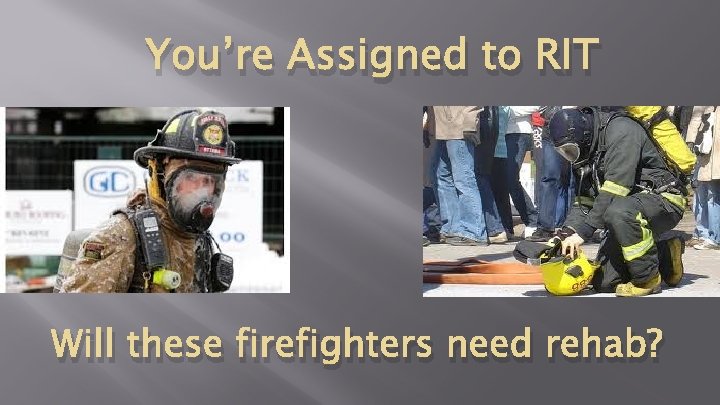
You’re Assigned to RIT Will these firefighters need rehab?
You’re Assigned to RIT � Remember: � Need to communicate regularly with Command This requires tact – Command is busy and in demand � Monitor � Know play your team and understand the strategies and tactics in
MAYDAY, MAYDAY � The most dreaded words on the fireground…
Activation of the RIT Team � Most important thing to remember: � COMMAND MUST REMAIN IN COMMAND � NO FREELANCING – REMAIN ON TASK
Activation of the RIT Team � If you are not on RIT and have been previously tasked (ie fire attack) remain on task until otherwise directed by command. � If you have relevant information, convey that information by radio and await further instructions.
Activation of the RIT Team � Down FF needs to convey 2 primary pieces of information: WHERE are you? WHAT is wrong?
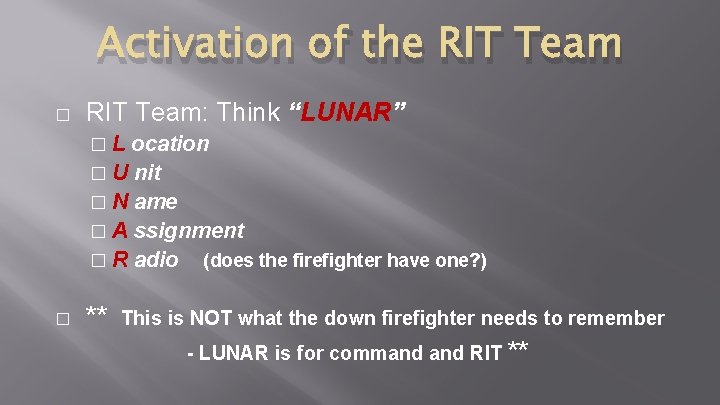
Activation of the RIT Team � RIT Team: Think “LUNAR” �L ocation � U nit � N ame � A ssignment � R adio (does the firefighter have one? ) � ** This is NOT what the down firefighter needs to remember - LUNAR is for command RIT **
Activation of the RIT Team � Remember – You’ve already been planning for this (“what if” ‘s) : Start calling for the resources you need ASAP! � More equipment? � More firefighters? � Back-up crews?
Activation of the RIT Team � Radio traffic will become intense: � Remember – we already planned for how to handle this! � Do not be offended by continual requests for status updates from command.
FOUND THEM! (…now for the hard part…)
The Rescue � 4 Questions to Answer � Is the firefighter breathing? � How much air does the firefighter have? (sufficient to execute the rescue? ) � What is your location? (I/C needs to know) � What additional resources do you need?
The Resue � Give command a clear accounting of the firefighter’s condition. � Turn off the pass alarm if it is activated � Ensure appropriate medical care is ready to receive the firefighter upon extrication from the structure.
The Rescue � Clean vs Dirty Rescue? � Will we take time to carefully package the firefighter to protect them from further injury OR � Is the situation immediately dangerous to life – we need to drag them out of here NOW.
The Rescue � Definition of Clean vs Dirty � Clean = Pay careful attention to packaging � We will take time to: Waist strap through the legs Chest strap backed off Shoulder straps tied into half hitch � Dirty = “Grab and Go”. No time to package.
The Rescue � Questions to consider: � Is the firefighter breathing? � Does the firefighter have sufficient air supply? � Is the firefighter free of entanglements? � Is our position safe from the fire? � Is the firefighter medically stable? � If “no” to any of these – DIRTY RESCUE
The Rescue � Nothing will be easy and everything will take great physical stamina � Monitor each other – physical and mental status � Ensure Command has a relief crew ready
The Rescue � Do not wait until it is too late to call for fresh teams. � Monitor air consumption closely. � Consider how long it will take for fresh members to reach your location. Plan accordingly. � Expect to switch out team members at least once – likely more.
The Rescue Techniques for maneuvering the firefighter will be covered in the practical sessions.
After the MAYDAY: Mission Accomplished
Mission Accomplished � Team Leader – Conduct a PAR � Personnel Accountability Review Ensure your team is out of harm’s way and intact Command will likely be calling a PAR soon
Summary � � � Train RIT operations regularly Do NOT take the RIT assignment lightly! Learn to react to PASS alarms Plan and prepare for the worst possible situation Keep your discipline at all times
QUESTIONS ?