Comparative governance in SOEs The Tennessee Valley Authority



- Slides: 40
Comparative governance in SOEs: The Tennessee Valley Authority (TVA) Pusan National University Public Enterprise Managers’ Course March 13, 2019 Robert J. Dickey 1
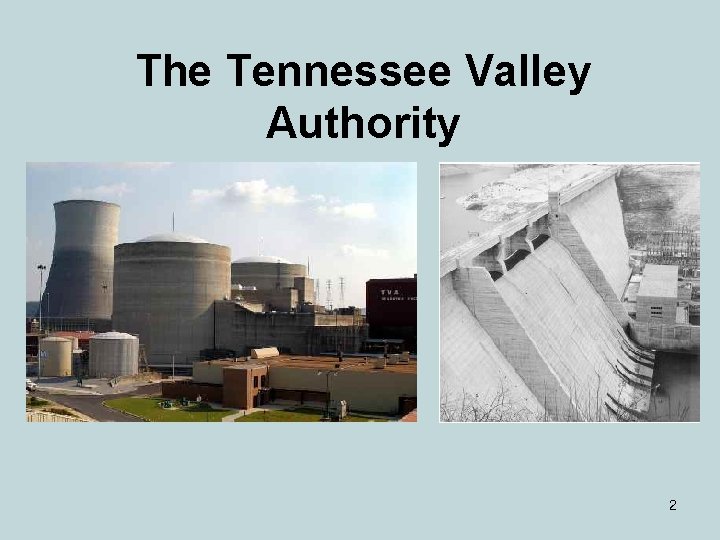
The Tennessee Valley Authority 2
The Tennessee Valley Authority • • a federal corporation (no profits) the nation’s largest public power company serves 9 million people across 7 states a regional development agency, stimulates sustainable economic development in the public interest • manages the nation’s 7 th-largest river system – to reduce flood damage, maintain navigation, provide recreational opportunities, and protect water quality in the 41, 000 sq. mi watershed (106, 189 km 2). 3
SOEs? • ‘What are “State-owned Enterprises? – It depends where you are – – Each country defines and labels things differently – Scholars have different perspectives 4
SOEs: possibilities • • ‘State-owned’ organizations … Enterprises ‘Government-owned’ organizations ‘Government-invested’ … ‘Public’ organizations ‘Hybrid’ organizations Privatized/Privatizing organizations & services 5
‘Government’-… • Various levels of government – National/Federal – State or Local/Municipal • Various ‘insideness’ of government – Connected to President/Prime Minister – Ministry or Agency – Controlled by Government-managed fund 6
‘Enterprise’ 1. a project or undertaking, especially one that requires boldness or effort 2. a business unit; a company or firm How different from ‘government’? 7
Types of SOEs • GOC, SOC, state enterprise, publiclyowned corporation, government business enterprise, or parastatal • legal entity created by a government • to undertake commercial activities on behalf of its owner, the government. – revenues are ‘inconvenient’ in government 8
Types of SOEs • Distinct legal form from ‘government’ • Established to operate in commercial affairs • May also have public policy objectives – national development/infrastructure – protectionism – provide basic materials 9
Types of SOEs • Legal status varies, – a part of government – stock companies with a state or statecontrolled fund as a regular stockholder – anything between • transitional (ultimate privatization) • nationalized private firms – national interest/policy, bankruptcy … 10
‘quasi-privatization’ • where continued state control in some form is intended – Parastatals in Africa – In many countries • Railroad • Post Office • Electric & Water/Sewer Utilities 11
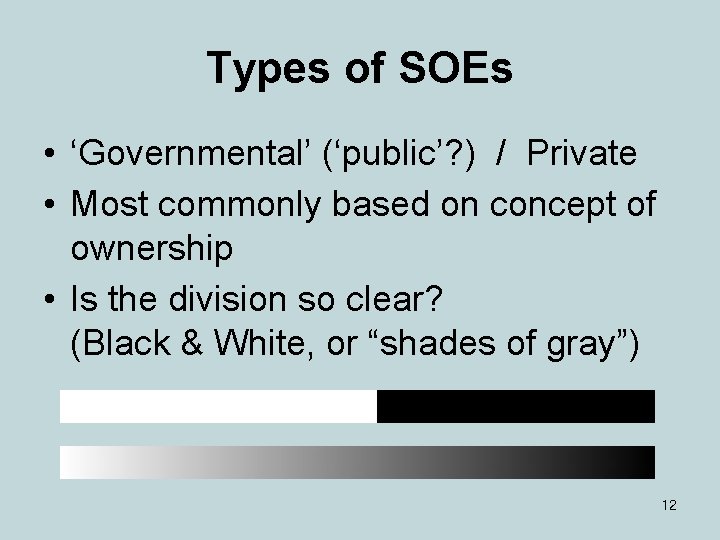
Types of SOEs • ‘Governmental’ (‘public’? ) / Private • Most commonly based on concept of ownership • Is the division so clear? (Black & White, or “shades of gray”) 12
Types of SOEs 1. pure government organization 2. quasi governmental organization (“quago”) 3. quasi nongovernmental organization (“quango”) 4. pure private organization 13
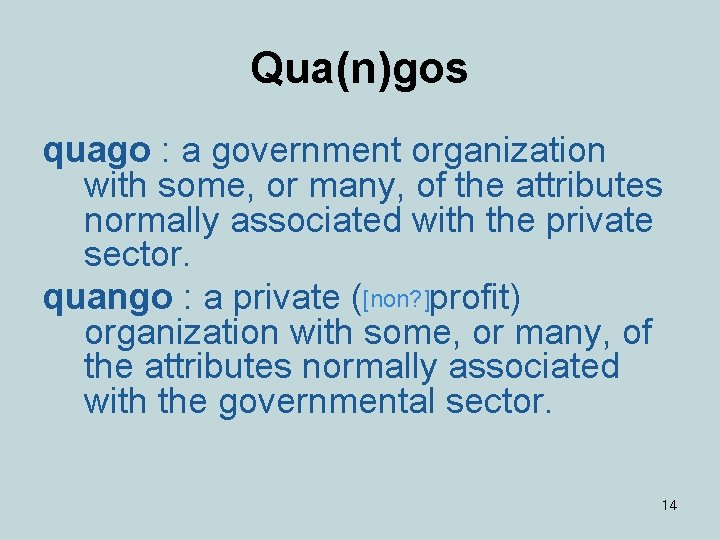
Qua(n)gos quago : a government organization with some, or many, of the attributes normally associated with the private sector. quango : a private ([non? ]profit) organization with some, or many, of the attributes normally associated with the governmental sector. 14
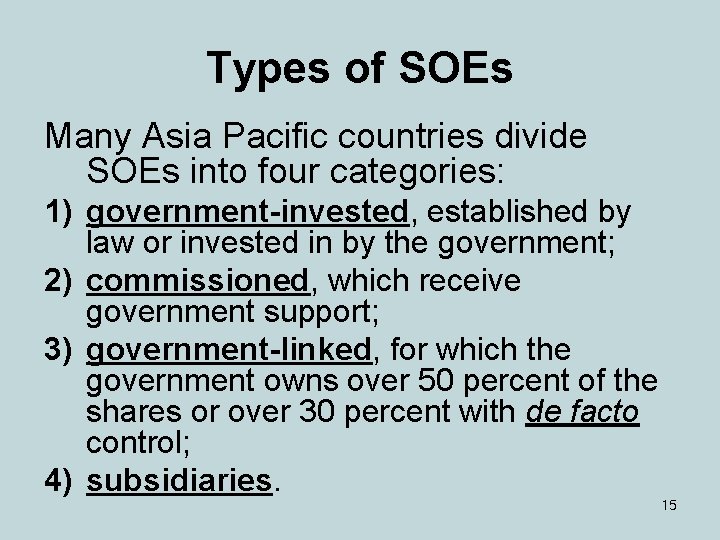
Types of SOEs Many Asia Pacific countries divide SOEs into four categories: 1) government-invested, established by law or invested in by the government; 2) commissioned, which receive government support; 3) government-linked, for which the government owns over 50 percent of the shares or over 30 percent with de facto control; 4) subsidiaries. 15
Title 5 of the U. S. Code. (Quasi-Governmental) 1. quasi-official agencies (AMTRAK) 2. government-sponsored enterprises (Federal Home Loan Mortgage Corporation (FHLMC), “Freddie Mac”) 3. federally funded R&D corporations (RAND) 4. Congressionally-chartered nonprofit organizations (American Red Cross) 5. agency-related nonprofit organizations 6. venture capital funds 7. indeterminate character 16
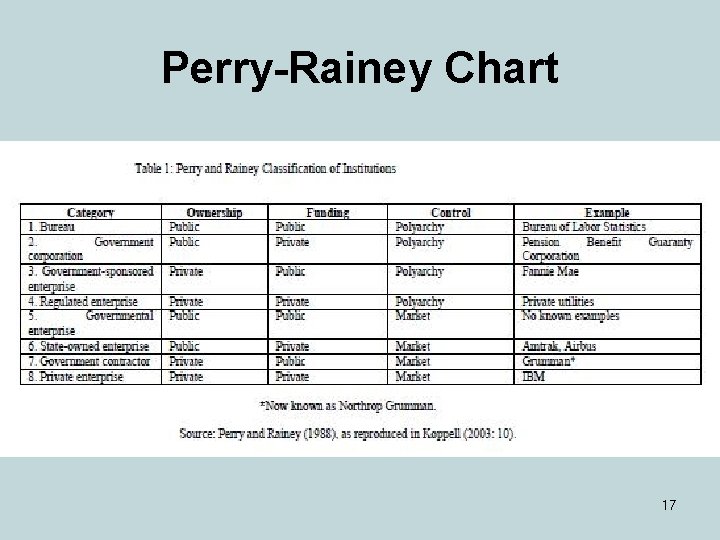
Perry-Rainey Chart 17
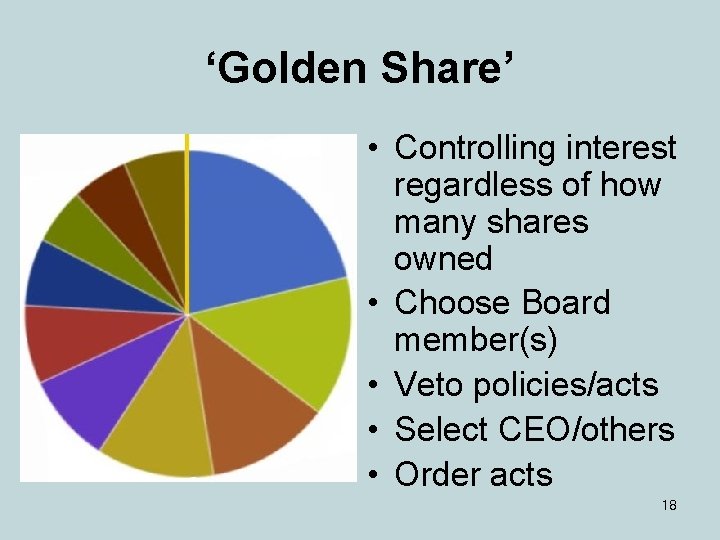
‘Golden Share’ • Controlling interest regardless of how many shares owned • Choose Board member(s) • Veto policies/acts • Select CEO/others • Order acts 18
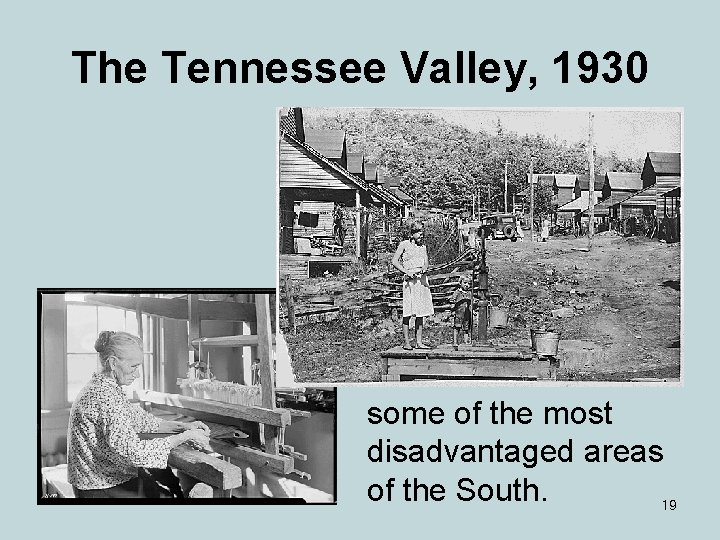
The Tennessee Valley, 1930 some of the most disadvantaged areas of the South. 19
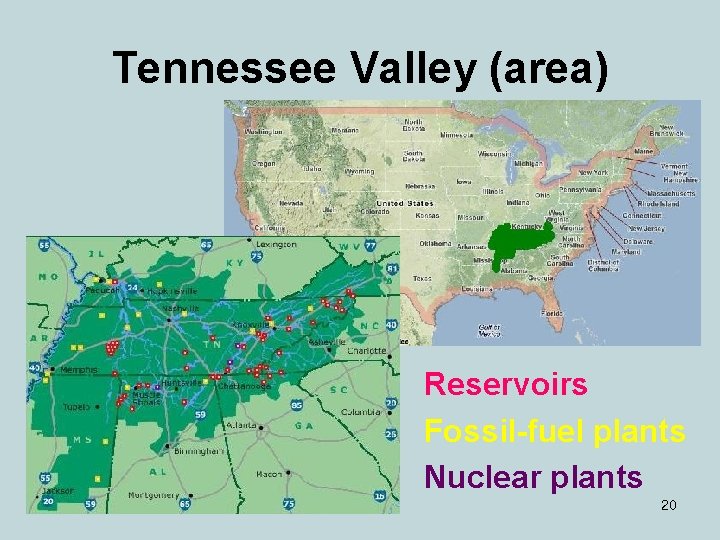
Tennessee Valley (area) Reservoirs Fossil-fuel plants Nuclear plants 20
TVA’s Operations • Over 12, 000 employees (not public servants) • Hydro-electric, fossil-fuel, and nuclear power plants • Dams – control floods – produce electricity – provide recreational and water resources 21
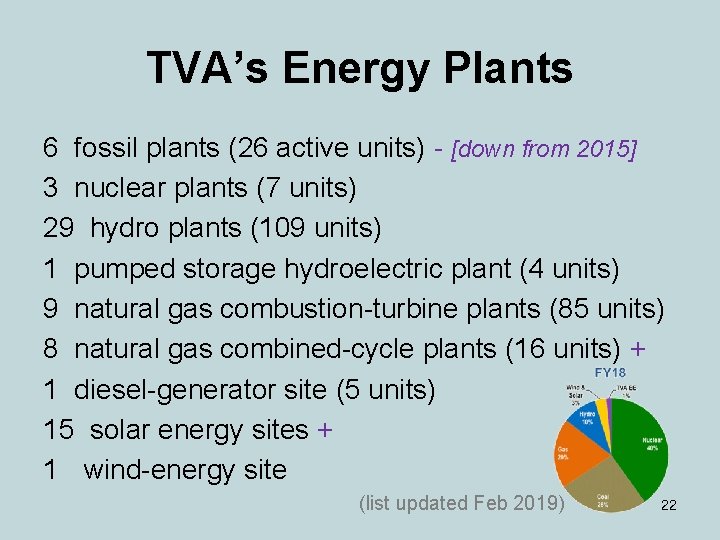
TVA’s Energy Plants 6 fossil plants (26 active units) - [down from 2015] 3 nuclear plants (7 units) 29 hydro plants (109 units) 1 pumped storage hydroelectric plant (4 units) 9 natural gas combustion-turbine plants (85 units) 8 natural gas combined-cycle plants (16 units) + 1 diesel-generator site (5 units) 15 solar energy sites + 1 wind-energy site (list updated Feb 2019) 22
TVA’s founding • by the U. S. Congress in 1933 • reduce flood damage • improve navigation on the Tennessee River • provide electric power • promote “agricultural and industrial development” in the region. 23
TVA Legislation "The full success of the Tennessee Valley development project will depend more upon the ability, vision, and executive capacity of the members of the board than upon legislative provisions. " 24
TVA Corporate Design • “a corporation • clothed with the power of government but • possessed of the flexibility and initiative of a private enterprise. ” • functions and duties defined by law 25
Challenges for Governance • Who does the Board report to? – Ratepayers? – Local Utilities (distributors? ) – Employee Unions? – Other “Stakeholders”? – Bureaucratic “Supervisors”? – Board Appointment Authorities? (president, congress, etc) 26
Challenges for Governance. 2 • Corporate Fiscal Aims? – repay government investment? – lower rates? • Corporate Social Aims? – Within the community? – Beyond the community? 27
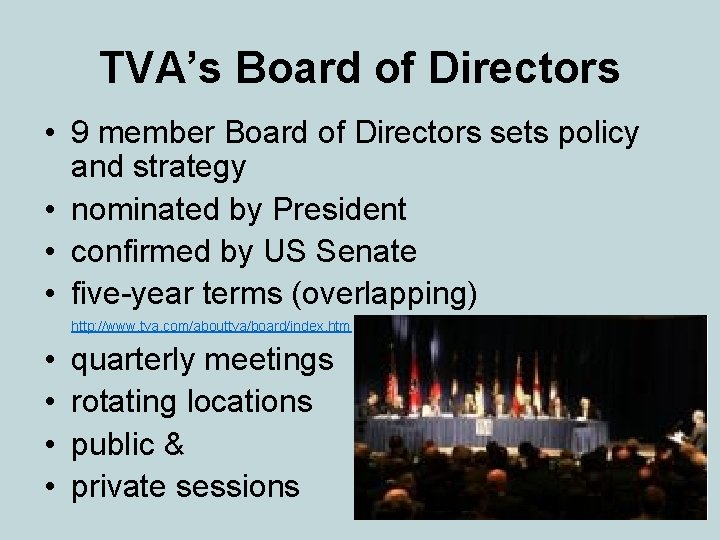
TVA’s Board of Directors • 9 member Board of Directors sets policy and strategy • nominated by President • confirmed by US Senate • five-year terms (overlapping) http: //www. tva. com/abouttva/board/index. htm • • quarterly meetings rotating locations public & private sessions 28
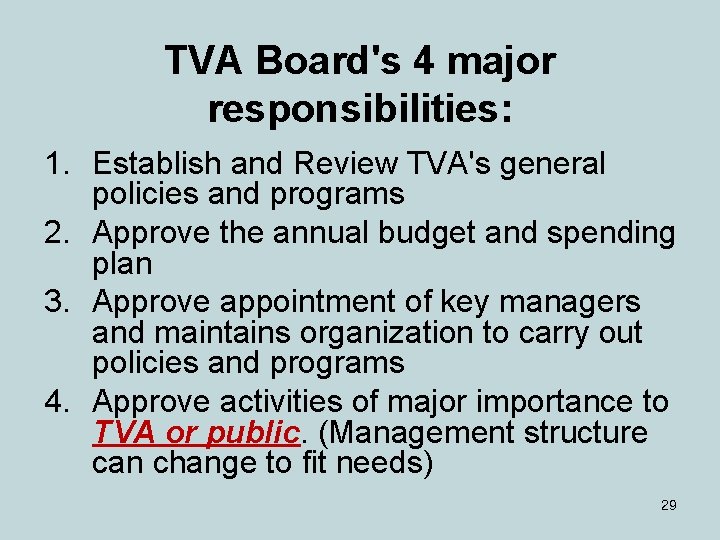
TVA Board's 4 major responsibilities: 1. Establish and Review TVA's general policies and programs 2. Approve the annual budget and spending plan 3. Approve appointment of key managers and maintains organization to carry out policies and programs 4. Approve activities of major importance to TVA or public. (Management structure can change to fit needs) 29
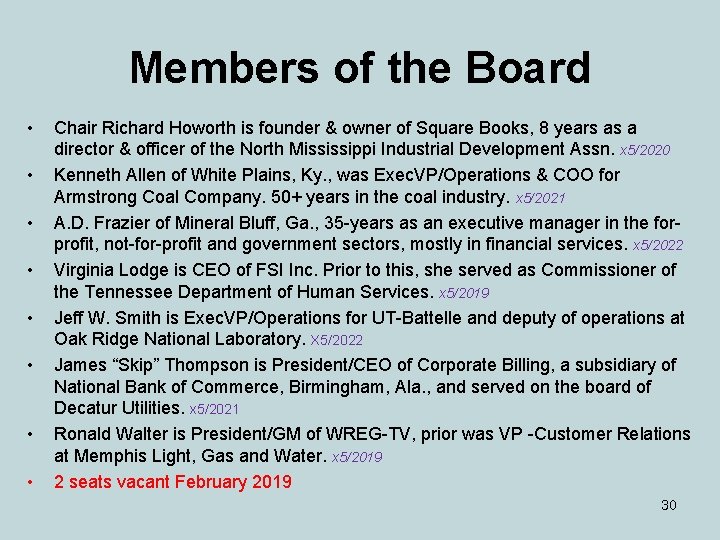
Members of the Board • • Chair Richard Howorth is founder & owner of Square Books, 8 years as a director & officer of the North Mississippi Industrial Development Assn. x 5/2020 Kenneth Allen of White Plains, Ky. , was Exec. VP/Operations & COO for Armstrong Coal Company. 50+ years in the coal industry. x 5/2021 A. D. Frazier of Mineral Bluff, Ga. , 35 -years as an executive manager in the forprofit, not-for-profit and government sectors, mostly in financial services. x 5/2022 Virginia Lodge is CEO of FSI Inc. Prior to this, she served as Commissioner of the Tennessee Department of Human Services. x 5/2019 Jeff W. Smith is Exec. VP/Operations for UT-Battelle and deputy of operations at Oak Ridge National Laboratory. X 5/2022 James “Skip” Thompson is President/CEO of Corporate Billing, a subsidiary of National Bank of Commerce, Birmingham, Ala. , and served on the board of Decatur Utilities. x 5/2021 Ronald Walter is President/GM of WREG-TV, prior was VP -Customer Relations at Memphis Light, Gas and Water. x 5/2019 2 seats vacant February 2019 30
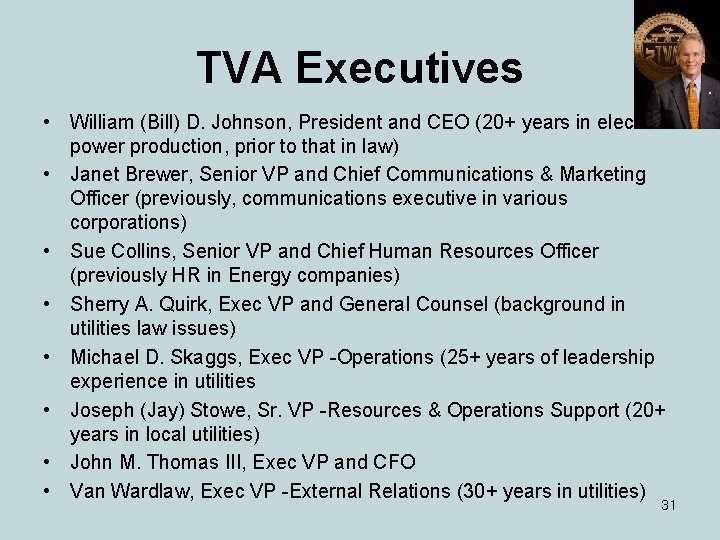
TVA Executives • William (Bill) D. Johnson, President and CEO (20+ years in electric power production, prior to that in law) • Janet Brewer, Senior VP and Chief Communications & Marketing Officer (previously, communications executive in various corporations) • Sue Collins, Senior VP and Chief Human Resources Officer (previously HR in Energy companies) • Sherry A. Quirk, Exec VP and General Counsel (background in utilities law issues) • Michael D. Skaggs, Exec VP -Operations (25+ years of leadership experience in utilities • Joseph (Jay) Stowe, Sr. VP -Resources & Operations Support (20+ years in local utilities) • John M. Thomas III, Exec VP and CFO • Van Wardlaw, Exec VP -External Relations (30+ years in utilities) 31
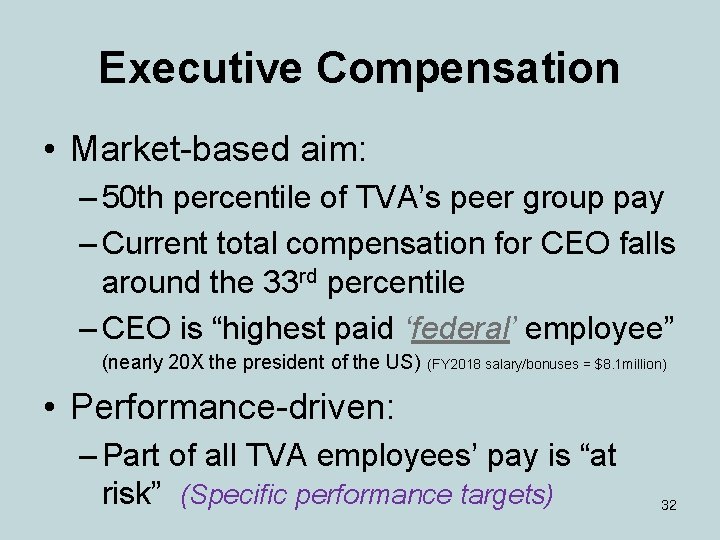
Executive Compensation • Market-based aim: – 50 th percentile of TVA’s peer group pay – Current total compensation for CEO falls around the 33 rd percentile – CEO is “highest paid ‘federal’ employee” (nearly 20 X the president of the US) (FY 2018 salary/bonuses = $8. 1 million) • Performance-driven: – Part of all TVA employees’ pay is “at risk” (Specific performance targets) 32
TVA Finance • Target: profit-neutral • Revenues (mostly) from electricity sales have paid back initial US investment • No stockholders, sells bonds • CRISIS 2016: pension shortfall – Underfunded for years, 2015 stock market fall – Pensions reduced 33
TVA’s funding (FY 2018) • operating revenue from electricity sales was ~ $11. 2 billion. (12, 500, 000, 000 KRW) • receives no public tax dollars • finances all programs, including 1. environmental protection 2. integrated river management, and 3. economic development through power sales and sale of bonds in the financial markets. • the total amount of outstanding bonds & banknotes represents TVA’s debt. Fiscal year ends Sept 30, 2018 34
TVA’s taxes? • tax-equivalent payments annually to state and local governments in eight states. • nearly ~$524 million in 2018. (~585, 500, 000 KRW) • based on power sales revenue and property owned by TVA in each state. • TVA one of the largest “taxpayers” in Tennessee and Alabama. 35
Producing Electricity • Most controversial aspect of TVA, resisted by private power companies • purchased their facilities • TVA contracts with municipalities and cooperatives to supply wholesale power, also direct to large industries • RESULT: an integrated power service area: TVA is the sole power supplier 36
Distribution of TVA electricity • electric power to 154 local power distributors • directly to 56 large industries and federal agencies • network of 16, 200 miles of transmission line (26, 071 km) • electric rates among the lowest in the nation 37
Public Interests • maintain a balance between competing demands for water and land resources. • 49 dams are public assets managed in the public interest. • integrated resource management ensures precious water resources not wasted. – As water flows downstream, it’s used over and over, for drinking, fish habitat, navigation, coolant for power plants, energy to spin turbines, and recreation. • by controlling the flow of water, averted over $5. 4 billion in property damage. • More than 9, 000 archaeological sites 38
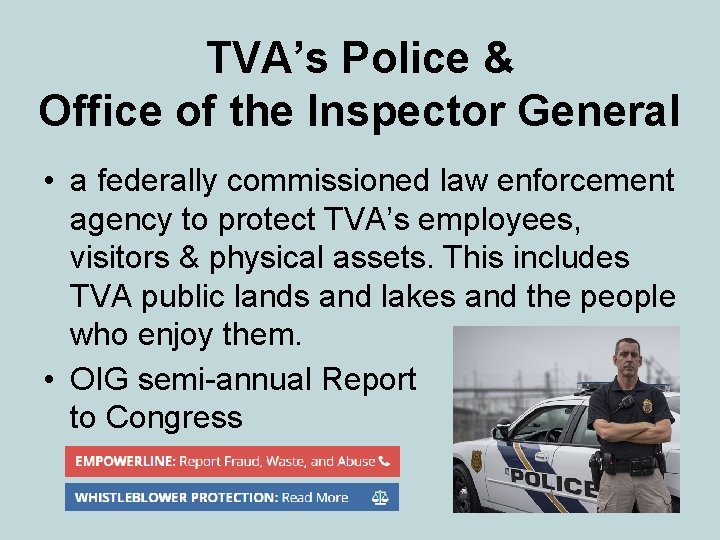
TVA’s Police & Office of the Inspector General • a federally commissioned law enforcement agency to protect TVA’s employees, visitors & physical assets. This includes TVA public lands and lakes and the people who enjoy them. • OIG semi-annual Report to Congress 39
Questions? Robert J. Dickey, MPA JD robertjdickey@yahoo. com 010 -2272 -0968 40