C HAPTER 10 The Revenue Cycle Sales and
- Slides: 60
C HAPTER 10 The Revenue Cycle: Sales and Cash Collections © 2006 Prentice Hall Business Publishing Accounting Information Systems, 10/e Romney/Steinbart 1 of 161
INTRODUCTION • Questions to be addressed in this chapter include: – What are the basic business activities and data processing operations that are performed in the revenue cycle? – What decisions need to be made in the revenue cycle, and what information is needed to make these decisions? – What are the major threats in the revenue cycle and the controls related to those threats? © 2006 Prentice Hall Business Publishing Accounting Information Systems, 10/e Romney/Steinbart 2 of 161
INTRODUCTION • The revenue cycle is a recurring set of business activities and related information processing operations associated with: – Providing goods and services to customers – Collecting their cash payments • The primary external exchange of information is with customers. © 2006 Prentice Hall Business Publishing Accounting Information Systems, 10/e Romney/Steinbart 3 of 161
INTRODUCTION • Information about revenue cycle activities flows to other accounting cycles, e. g. : – The expenditure and production cycles • Receive information about sales transactions so they’ll know when to initiate the purchase or production of more inventory. © 2006 Prentice Hall Business Publishing Accounting Information Systems, 10/e Romney/Steinbart 4 of 161
INTRODUCTION • Information about revenue cycle activities flows to other accounting cycles, e. g. : – The expenditure and production cycles – The human resources/payroll cycle • Uses information about sales to calculate commissions and bonuses. © 2006 Prentice Hall Business Publishing Accounting Information Systems, 10/e Romney/Steinbart 5 of 161
INTRODUCTION • Information about revenue cycle activities flows to other accounting cycles, e. g. : – The expenditure and production cycles – The human resources/payroll cycle – The general ledger and reporting function • Uses information produced by the revenue cycle in preparing financial statements and performance reports. © 2006 Prentice Hall Business Publishing Accounting Information Systems, 10/e Romney/Steinbart 6 of 161
INTRODUCTION • The primary objective of the revenue cycle: – Provide the right product in the right place at the right time for the right price. © 2006 Prentice Hall Business Publishing Accounting Information Systems, 10/e Romney/Steinbart 7 of 161
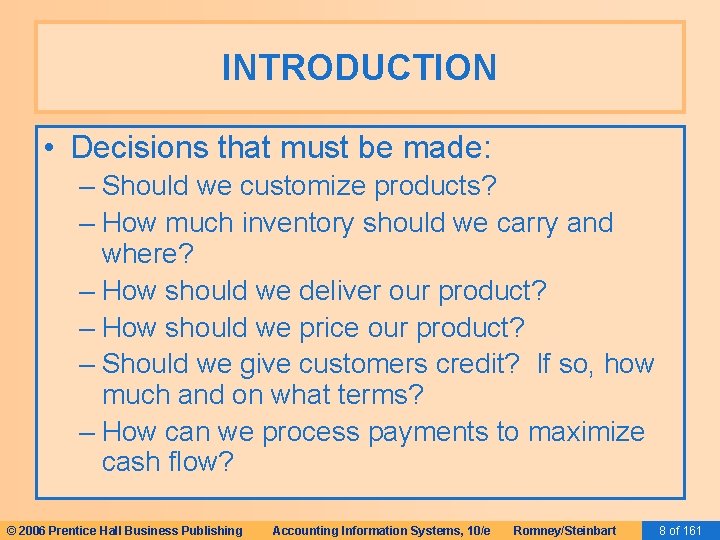
INTRODUCTION • Decisions that must be made: – Should we customize products? – How much inventory should we carry and where? – How should we deliver our product? – How should we price our product? – Should we give customers credit? If so, how much and on what terms? – How can we process payments to maximize cash flow? © 2006 Prentice Hall Business Publishing Accounting Information Systems, 10/e Romney/Steinbart 8 of 161
INTRODUCTION • Management also has to evaluate the efficiency and effectiveness of revenue cycle processes: – Requires data about: • Events that occur • Resources used • Agents who participate – The data needs to be accurate, reliable, and timely. © 2006 Prentice Hall Business Publishing Accounting Information Systems, 10/e Romney/Steinbart 9 of 161
INTRODUCTION • In this chapter, we’ll look at: – How the three basic AIS functions are carried out in the revenue cycle, i. e. : • Capturing and processing data • Storing and organizing the data for decisions • Providing controls to safeguard resources (including data) © 2006 Prentice Hall Business Publishing Accounting Information Systems, 10/e Romney/Steinbart 10 of 161
REVENUE CYCLE BUSINESS ACTIVITIES • Four basic business activities are performed in the revenue cycle: – Sales order entry – Shipping – Billing – Cash collection © 2006 Prentice Hall Business Publishing Accounting Information Systems, 10/e Romney/Steinbart 11 of 161
REVENUE CYCLE BUSINESS ACTIVITIES • Four basic business activities are performed in the revenue cycle: – Sales order entry – Shipping – Billing – Cash collection © 2006 Prentice Hall Business Publishing Accounting Information Systems, 10/e Romney/Steinbart 12 of 161
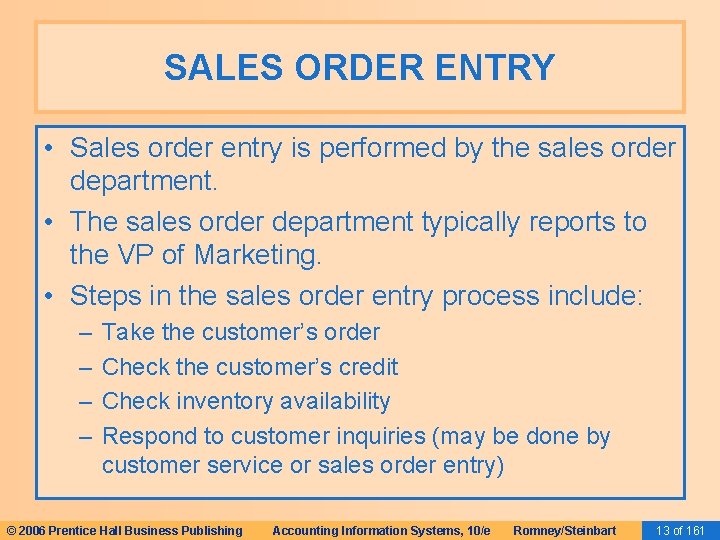
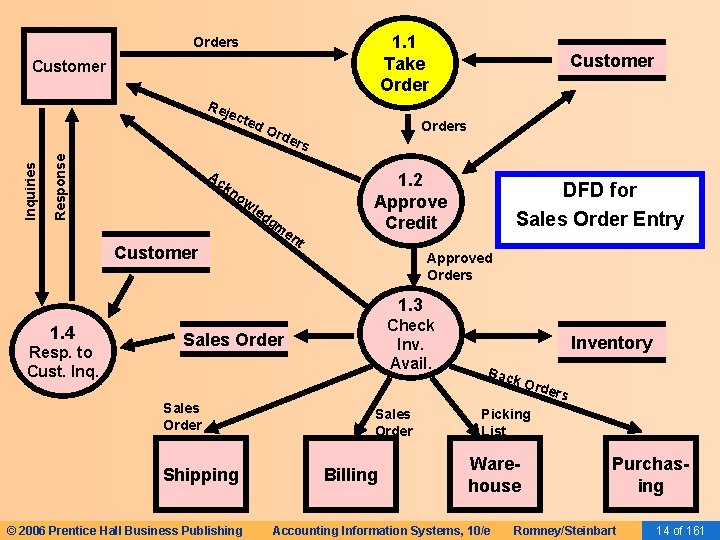
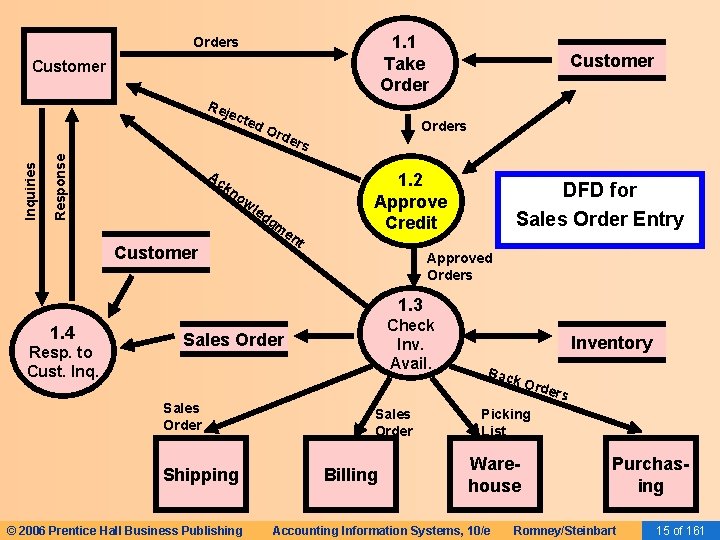
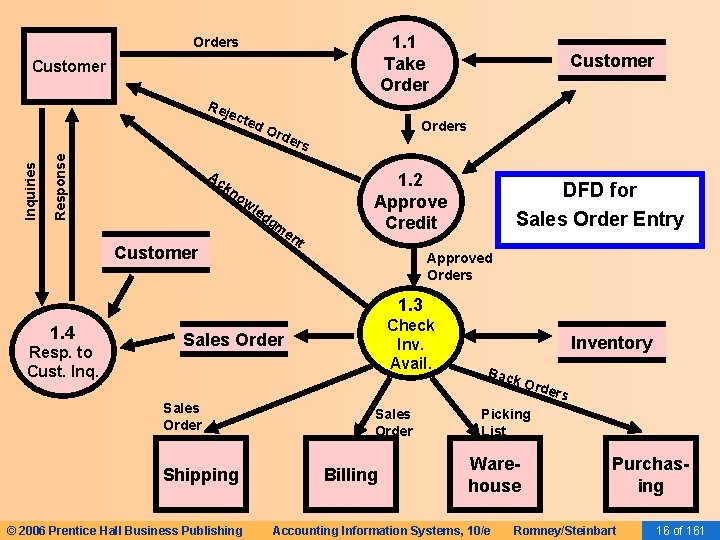
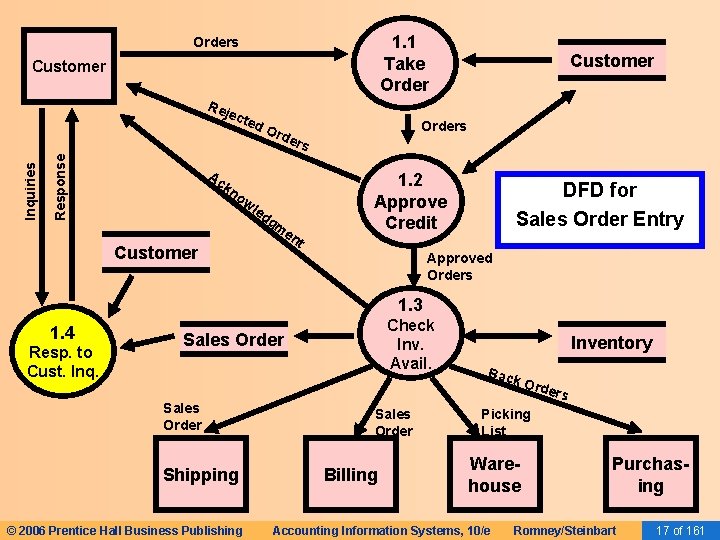
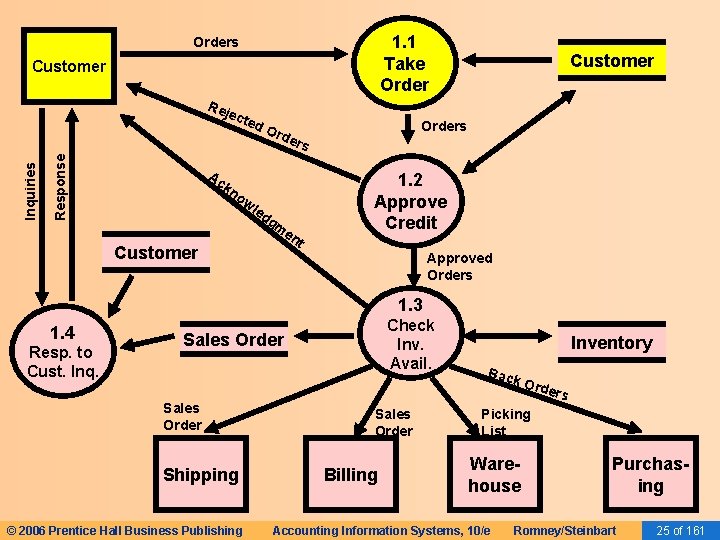
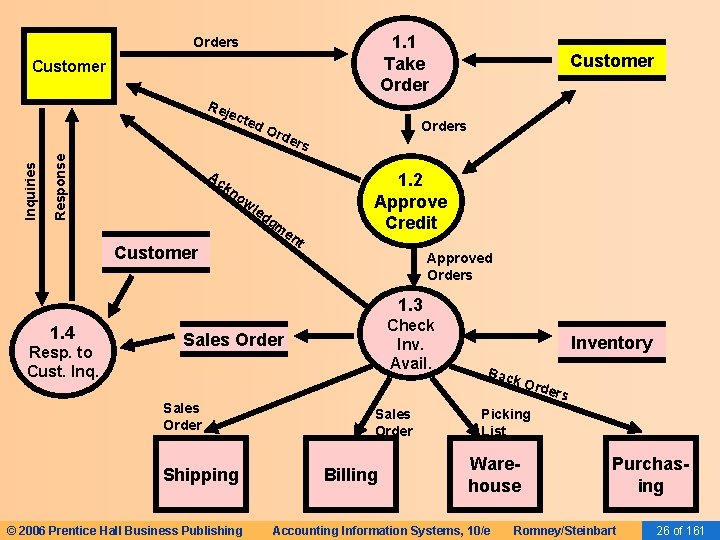
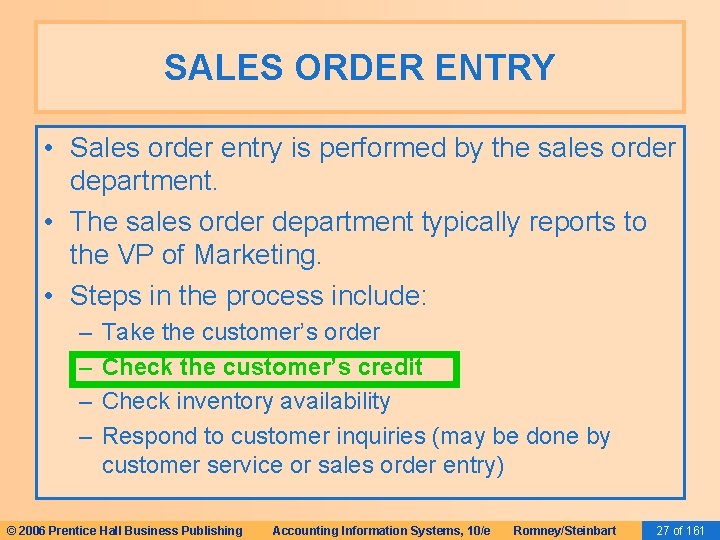
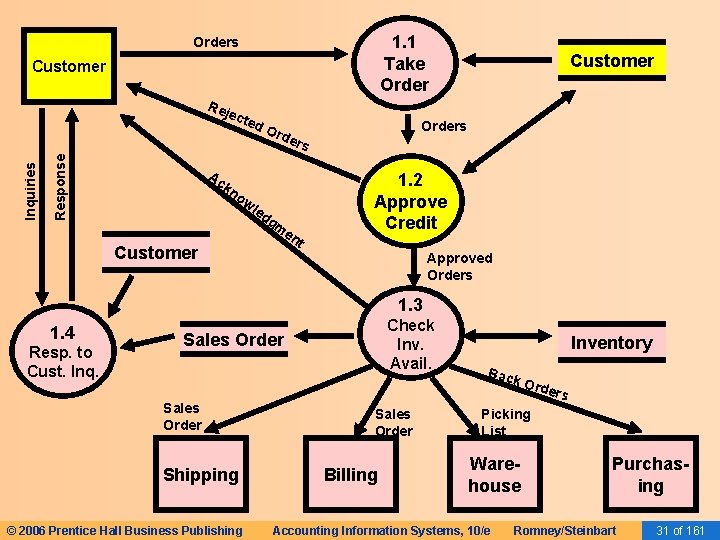
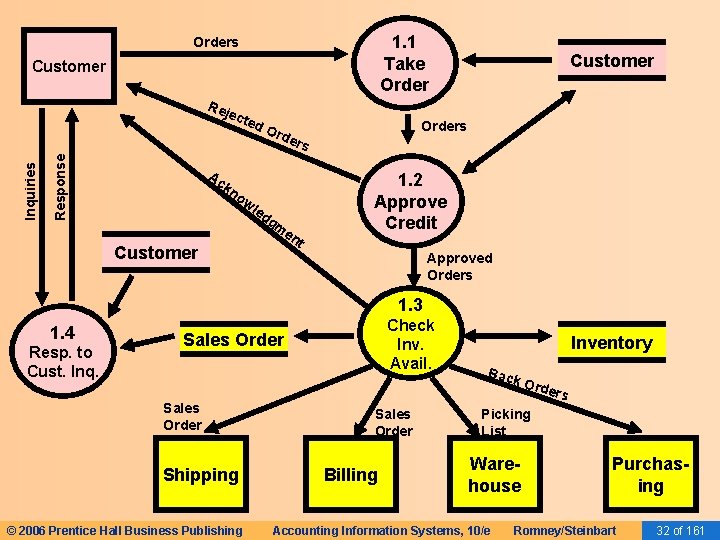
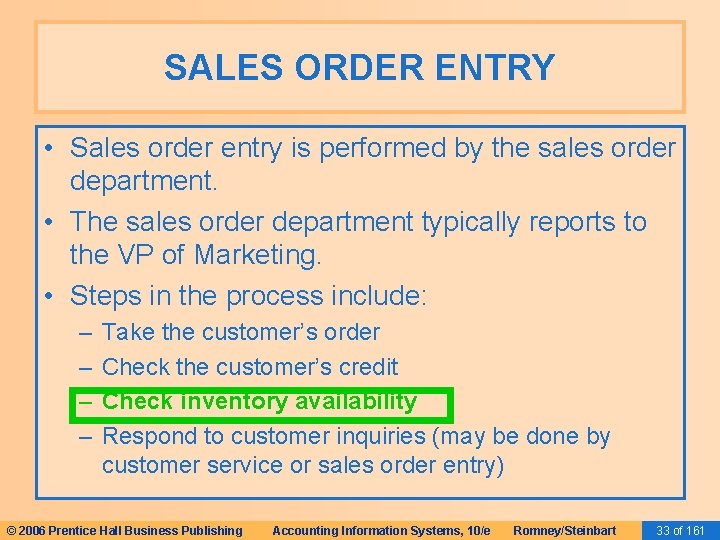
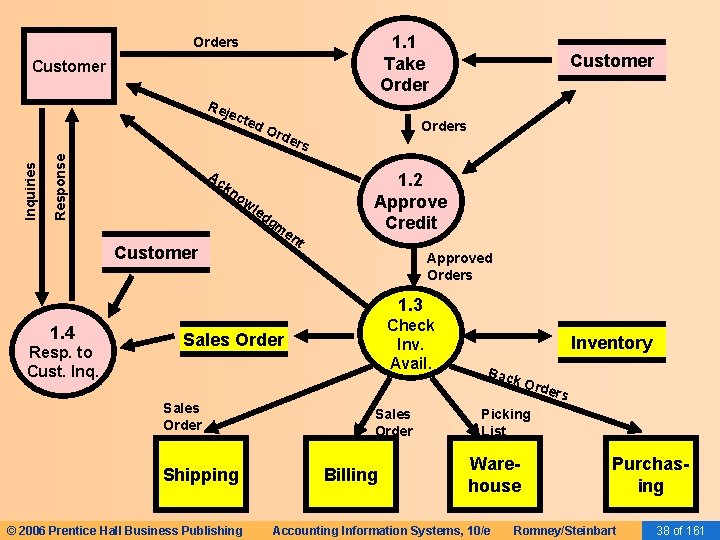
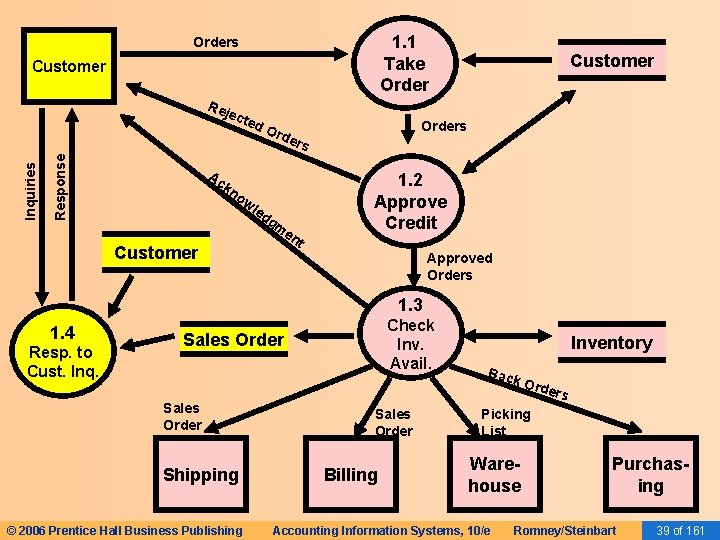
SALES ORDER ENTRY • Sales order entry is performed by the sales order department. • The sales order department typically reports to the VP of Marketing. • Steps in the sales order entry process include: – – Take the customer’s order Check the customer’s credit Check inventory availability Respond to customer inquiries (may be done by customer service or sales order entry) © 2006 Prentice Hall Business Publishing Accounting Information Systems, 10/e Romney/Steinbart 13 of 161
1. 1 Take Orders Customer Response Inquiries Rej ect ed Ac Ord Customer Orders 1. 2 Approve Credit kn ow le d Customer gm en DFD for Sales Order Entry t Approved Orders 1. 3 1. 4 Resp. to Cust. Inq. Check Inv. Avail. Sales Order Shipping © 2006 Prentice Hall Business Publishing Inventory Bac k Or ders Sales Order Billing Picking List Warehouse Accounting Information Systems, 10/e Purchasing Romney/Steinbart 14 of 161
1. 1 Take Orders Customer Response Inquiries Rej ect ed Ac Ord Customer Orders 1. 2 Approve Credit kn ow le d Customer gm en DFD for Sales Order Entry t Approved Orders 1. 3 1. 4 Resp. to Cust. Inq. Check Inv. Avail. Sales Order Shipping © 2006 Prentice Hall Business Publishing Inventory Bac k Or ders Sales Order Billing Picking List Warehouse Accounting Information Systems, 10/e Purchasing Romney/Steinbart 15 of 161
1. 1 Take Orders Customer Response Inquiries Rej ect ed Ac Ord Customer Orders 1. 2 Approve Credit kn ow le d Customer gm en DFD for Sales Order Entry t Approved Orders 1. 3 1. 4 Resp. to Cust. Inq. Check Inv. Avail. Sales Order Shipping © 2006 Prentice Hall Business Publishing Inventory Bac k Or ders Sales Order Billing Picking List Warehouse Accounting Information Systems, 10/e Purchasing Romney/Steinbart 16 of 161
1. 1 Take Orders Customer Response Inquiries Rej ect ed Ac Ord Customer Orders 1. 2 Approve Credit kn ow le d Customer gm en DFD for Sales Order Entry t Approved Orders 1. 3 1. 4 Resp. to Cust. Inq. Check Inv. Avail. Sales Order Shipping © 2006 Prentice Hall Business Publishing Inventory Bac k Or ders Sales Order Billing Picking List Warehouse Accounting Information Systems, 10/e Purchasing Romney/Steinbart 17 of 161
SALES ORDER ENTRY • Sales order entry is performed by the sales order department. • The sales order department typically reports to the VP of Marketing. • Steps in the process include: – – Take the customer’s order Check the customer’s credit Check inventory availability Respond to customer inquiries (may be done by customer service or sales order entry) © 2006 Prentice Hall Business Publishing Accounting Information Systems, 10/e Romney/Steinbart 18 of 161
SALES ORDER ENTRY • Take customer orders – Order data are received on a sales order document which may be completed and received: • • • In the store By mail By phone On a website By a salesperson in the field © 2006 Prentice Hall Business Publishing Accounting Information Systems, 10/e Romney/Steinbart 19 of 161
SALES ORDER ENTRY • The sales order (paper or electronic) indicates: – Item numbers ordered – Quantities – Prices – Salesperson © 2006 Prentice Hall Business Publishing Accounting Information Systems, 10/e Romney/Steinbart 20 of 161
SALES ORDER ENTRY • To reduce human error, customers should enter data themselves as much as possible: – On websites – On OCR forms – Via phone menus © 2006 Prentice Hall Business Publishing Accounting Information Systems, 10/e Romney/Steinbart 21 of 161
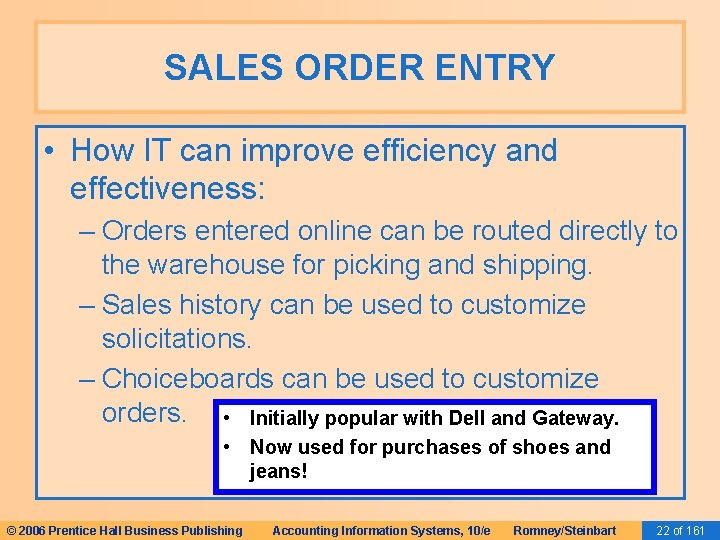
SALES ORDER ENTRY • How IT can improve efficiency and effectiveness: – Orders entered online can be routed directly to the warehouse for picking and shipping. – Sales history can be used to customize solicitations. – Choiceboards can be used to customize orders. • Initially popular with Dell and Gateway. • Now used for purchases of shoes and jeans! © 2006 Prentice Hall Business Publishing Accounting Information Systems, 10/e Romney/Steinbart 22 of 161
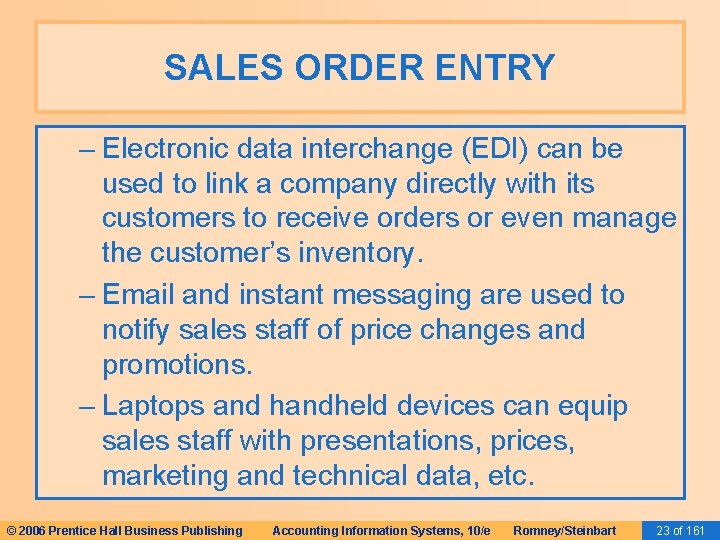
SALES ORDER ENTRY – Electronic data interchange (EDI) can be used to link a company directly with its customers to receive orders or even manage the customer’s inventory. – Email and instant messaging are used to notify sales staff of price changes and promotions. – Laptops and handheld devices can equip sales staff with presentations, prices, marketing and technical data, etc. © 2006 Prentice Hall Business Publishing Accounting Information Systems, 10/e Romney/Steinbart 23 of 161
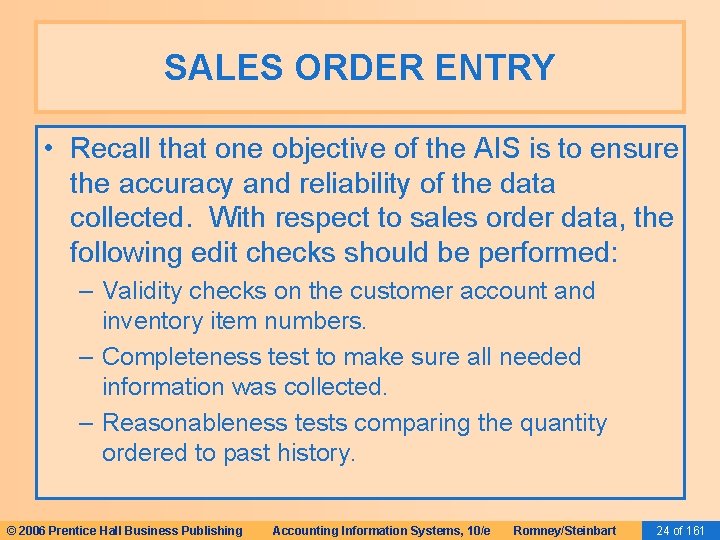
SALES ORDER ENTRY • Recall that one objective of the AIS is to ensure the accuracy and reliability of the data collected. With respect to sales order data, the following edit checks should be performed: – Validity checks on the customer account and inventory item numbers. – Completeness test to make sure all needed information was collected. – Reasonableness tests comparing the quantity ordered to past history. © 2006 Prentice Hall Business Publishing Accounting Information Systems, 10/e Romney/Steinbart 24 of 161
1. 1 Take Orders Customer Response Inquiries Rej ect ed Ac Ord Customer Orders 1. 2 Approve Credit kn ow le d Customer gm en t Approved Orders 1. 3 1. 4 Resp. to Cust. Inq. Check Inv. Avail. Sales Order Shipping © 2006 Prentice Hall Business Publishing Inventory Bac k Or ders Sales Order Billing Picking List Warehouse Accounting Information Systems, 10/e Purchasing Romney/Steinbart 25 of 161
1. 1 Take Orders Customer Response Inquiries Rej ect ed Ac Ord Customer Orders 1. 2 Approve Credit kn ow le d Customer gm en t Approved Orders 1. 3 1. 4 Resp. to Cust. Inq. Check Inv. Avail. Sales Order Shipping © 2006 Prentice Hall Business Publishing Inventory Bac k Or ders Sales Order Billing Picking List Warehouse Accounting Information Systems, 10/e Purchasing Romney/Steinbart 26 of 161
SALES ORDER ENTRY • Sales order entry is performed by the sales order department. • The sales order department typically reports to the VP of Marketing. • Steps in the process include: – – Take the customer’s order Check the customer’s credit Check inventory availability Respond to customer inquiries (may be done by customer service or sales order entry) © 2006 Prentice Hall Business Publishing Accounting Information Systems, 10/e Romney/Steinbart 27 of 161
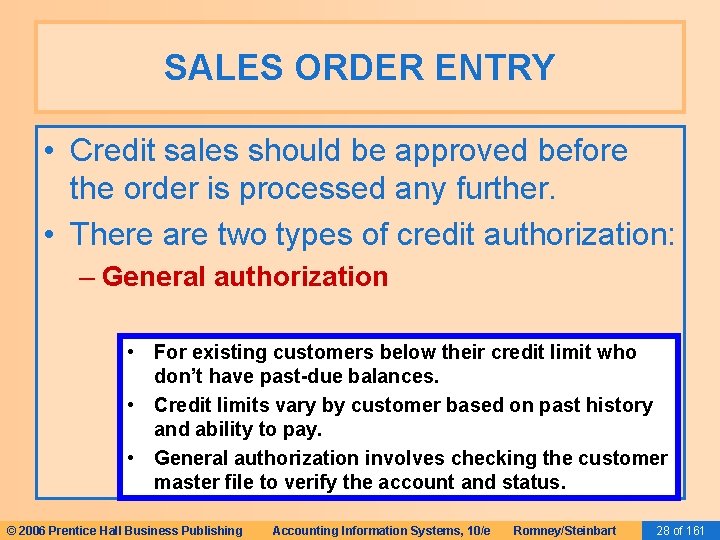
SALES ORDER ENTRY • Credit sales should be approved before the order is processed any further. • There are two types of credit authorization: – General authorization • For existing customers below their credit limit who don’t have past-due balances. • Credit limits vary by customer based on past history and ability to pay. • General authorization involves checking the customer master file to verify the account and status. © 2006 Prentice Hall Business Publishing Accounting Information Systems, 10/e Romney/Steinbart 28 of 161
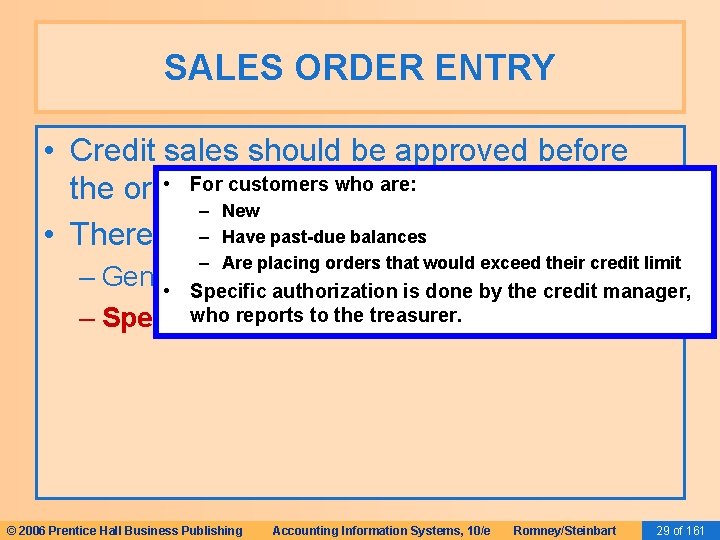
SALES ORDER ENTRY • Credit sales should be approved before • For who are: the order iscustomers processed any further. – New Have past-due • There are– two typesbalances of credit authorization: – Are placing orders that would exceed their credit limit – General authorization • Specific authorization is done by the credit manager, who reports to the treasurer. – Specific authorization © 2006 Prentice Hall Business Publishing Accounting Information Systems, 10/e Romney/Steinbart 29 of 161
SALES ORDER ENTRY • How can IT improve the process? – Automatic checking of credit limits and balances – Emails or IMs to the credit manager for accounts needing specific authorization © 2006 Prentice Hall Business Publishing Accounting Information Systems, 10/e Romney/Steinbart 30 of 161
1. 1 Take Orders Customer Response Inquiries Rej ect ed Ac Ord Customer Orders 1. 2 Approve Credit kn ow le d Customer gm en t Approved Orders 1. 3 1. 4 Resp. to Cust. Inq. Check Inv. Avail. Sales Order Shipping © 2006 Prentice Hall Business Publishing Inventory Bac k Or ders Sales Order Billing Picking List Warehouse Accounting Information Systems, 10/e Purchasing Romney/Steinbart 31 of 161
1. 1 Take Orders Customer Response Inquiries Rej ect ed Ac Ord Customer Orders 1. 2 Approve Credit kn ow le d Customer gm en t Approved Orders 1. 3 1. 4 Resp. to Cust. Inq. Check Inv. Avail. Sales Order Shipping © 2006 Prentice Hall Business Publishing Inventory Bac k Or ders Sales Order Billing Picking List Warehouse Accounting Information Systems, 10/e Purchasing Romney/Steinbart 32 of 161
SALES ORDER ENTRY • Sales order entry is performed by the sales order department. • The sales order department typically reports to the VP of Marketing. • Steps in the process include: – – Take the customer’s order Check the customer’s credit Check inventory availability Respond to customer inquiries (may be done by customer service or sales order entry) © 2006 Prentice Hall Business Publishing Accounting Information Systems, 10/e Romney/Steinbart 33 of 161
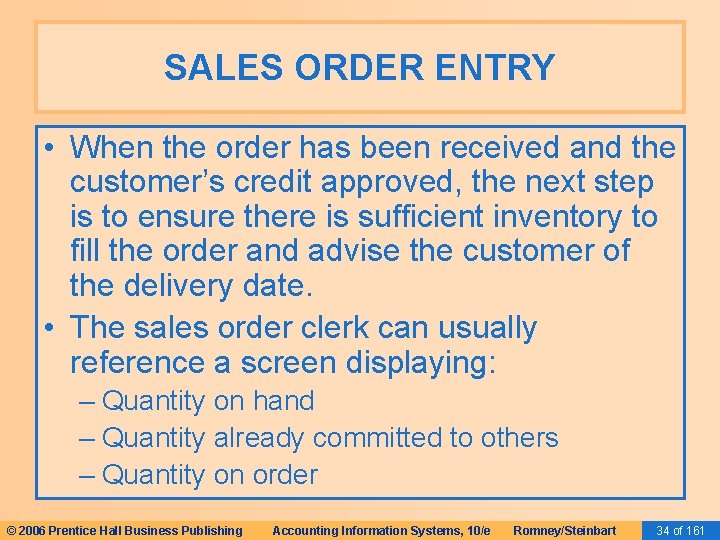
SALES ORDER ENTRY • When the order has been received and the customer’s credit approved, the next step is to ensure there is sufficient inventory to fill the order and advise the customer of the delivery date. • The sales order clerk can usually reference a screen displaying: – Quantity on hand – Quantity already committed to others – Quantity on order © 2006 Prentice Hall Business Publishing Accounting Information Systems, 10/e Romney/Steinbart 34 of 161
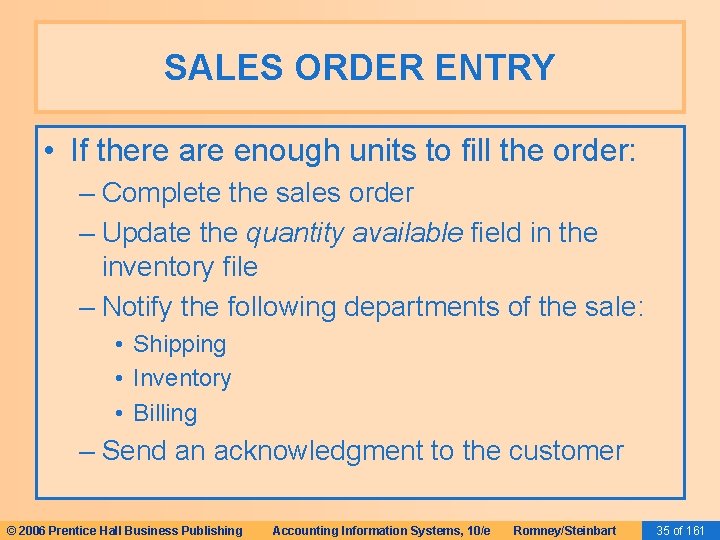
SALES ORDER ENTRY • If there are enough units to fill the order: – Complete the sales order – Update the quantity available field in the inventory file – Notify the following departments of the sale: • Shipping • Inventory • Billing – Send an acknowledgment to the customer © 2006 Prentice Hall Business Publishing Accounting Information Systems, 10/e Romney/Steinbart 35 of 161
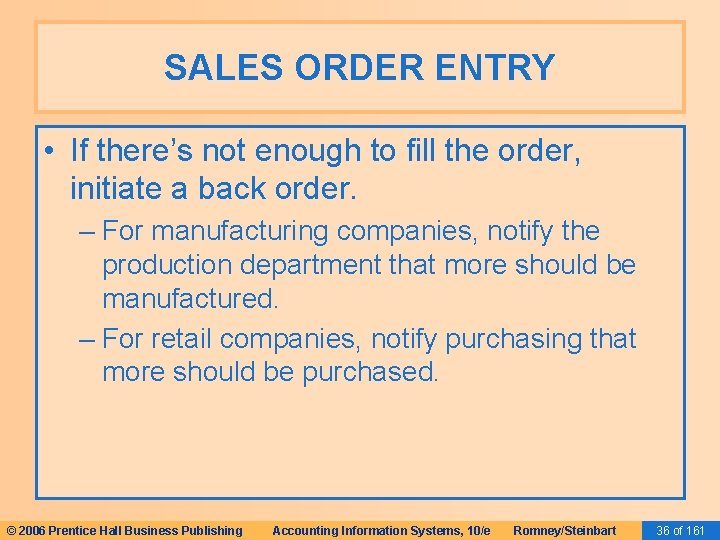
SALES ORDER ENTRY • If there’s not enough to fill the order, initiate a back order. – For manufacturing companies, notify the production department that more should be manufactured. – For retail companies, notify purchasing that more should be purchased. © 2006 Prentice Hall Business Publishing Accounting Information Systems, 10/e Romney/Steinbart 36 of 161
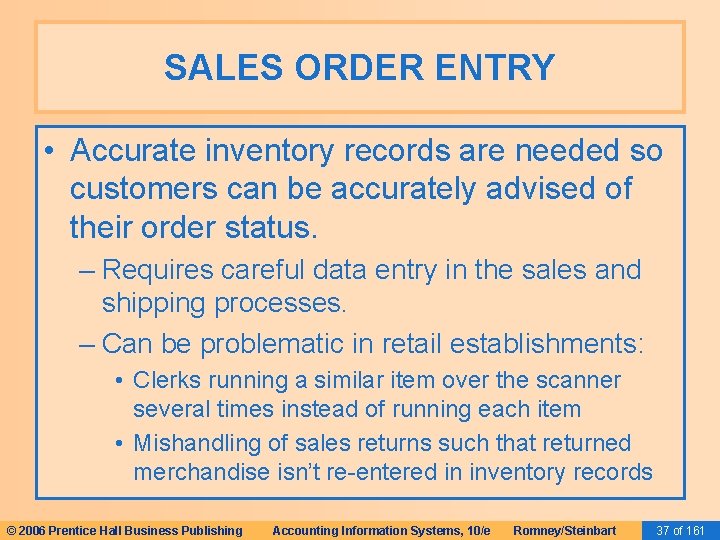
SALES ORDER ENTRY • Accurate inventory records are needed so customers can be accurately advised of their order status. – Requires careful data entry in the sales and shipping processes. – Can be problematic in retail establishments: • Clerks running a similar item over the scanner several times instead of running each item • Mishandling of sales returns such that returned merchandise isn’t re-entered in inventory records © 2006 Prentice Hall Business Publishing Accounting Information Systems, 10/e Romney/Steinbart 37 of 161
1. 1 Take Orders Customer Response Inquiries Rej ect ed Ac Ord Customer Orders 1. 2 Approve Credit kn ow le d Customer gm en t Approved Orders 1. 3 1. 4 Resp. to Cust. Inq. Check Inv. Avail. Sales Order Shipping © 2006 Prentice Hall Business Publishing Inventory Bac k Or ders Sales Order Billing Picking List Warehouse Accounting Information Systems, 10/e Purchasing Romney/Steinbart 38 of 161
1. 1 Take Orders Customer Response Inquiries Rej ect ed Ac Ord Customer Orders 1. 2 Approve Credit kn ow le d Customer gm en t Approved Orders 1. 3 1. 4 Resp. to Cust. Inq. Check Inv. Avail. Sales Order Shipping © 2006 Prentice Hall Business Publishing Inventory Bac k Or ders Sales Order Billing Picking List Warehouse Accounting Information Systems, 10/e Purchasing Romney/Steinbart 39 of 161
SALES ORDER ENTRY • Sales order entry is performed by the sales order department. • The sales order department typically reports to the VP of Marketing. • Steps in the process include: – – Take the customer’s order Check the customer’s credit Check inventory availability Respond to customer inquiries (may be done by customer service or sales order entry) © 2006 Prentice Hall Business Publishing Accounting Information Systems, 10/e Romney/Steinbart 40 of 161
SALES ORDER ENTRY • Another step in the sales order entry process is responding to customer inquiries: – May occur before or after the order is placed – The quality of this customer service can be critical to company success © 2006 Prentice Hall Business Publishing Accounting Information Systems, 10/e Romney/Steinbart 41 of 161
SALES ORDER ENTRY • Many companies use Customer Relationship Management (CRM) systems to support this process: – Organizes customer data to facilitate efficient and personalized service – Provides data about customer needs and business practices so they can be contacted proactively about the need to reorder © 2006 Prentice Hall Business Publishing Accounting Information Systems, 10/e Romney/Steinbart 42 of 161
SALES ORDER ENTRY • The goal of CRM is to retain customers: – Rule of thumb: It takes 5 times as much effort to attract a new customer as it does to retain an existing one. – CRMs should be seen as tools to improve the level of customer service and encourage loyalty—not as a way to keep them off your back. © 2006 Prentice Hall Business Publishing Accounting Information Systems, 10/e Romney/Steinbart 43 of 161
SALES ORDER ENTRY • Transaction processing technology can be used to improve customer relationships: – POS systems can link to the customer master file to: • Automatically update accounts receivable. • Print customized coupons (e. g. , if the customer just bought yogurt, print a yogurt coupon to encourage repeat sales). © 2006 Prentice Hall Business Publishing Accounting Information Systems, 10/e Romney/Steinbart 44 of 161
SALES ORDER ENTRY • IT should be used to automate responses to routine customer requests. • Examples: – Providing telephone menus or websites that lead customers to answers about • EXAMPLE: Timex includes their watch manuals • Account balances online, so a customer who’s missing his manual can • Order status find out how to reset his watch when Daylight Savings Timeasked rolls around. human intervention required. • Frequently questions. No (FAQs) – Online chat or instant messaging • These methods free up customer service reps to deal with less routine issues. © 2006 Prentice Hall Business Publishing Accounting Information Systems, 10/e Romney/Steinbart 45 of 161
SALES ORDER ENTRY • The effectiveness of a website depends on its design: – Review records of customer interactions to identify potential problems. – A poorly-designed, difficult-to-use website can create customer ill will. – A well-designed site can provide insights that lead to increased sales, e. g. , by analyzing website traffic to determine products of greatest interest. © 2006 Prentice Hall Business Publishing Accounting Information Systems, 10/e Romney/Steinbart 46 of 161
SALES ORDER ENTRY • Sales order entry involved the steps of: – Taking the customer’s order – Checking the customer’s credit – Checking inventory availability – Responding to customer inquiries • We have now completed sales order entry and are ready to move to the next step. © 2006 Prentice Hall Business Publishing Accounting Information Systems, 10/e Romney/Steinbart 47 of 161
REVENUE CYCLE BUSINESS ACTIVITIES • Four basic business activities are performed in the revenue cycle: – Sales order entry – Shipping – Billing – Cash collection © 2006 Prentice Hall Business Publishing Accounting Information Systems, 10/e Romney/Steinbart 48 of 161
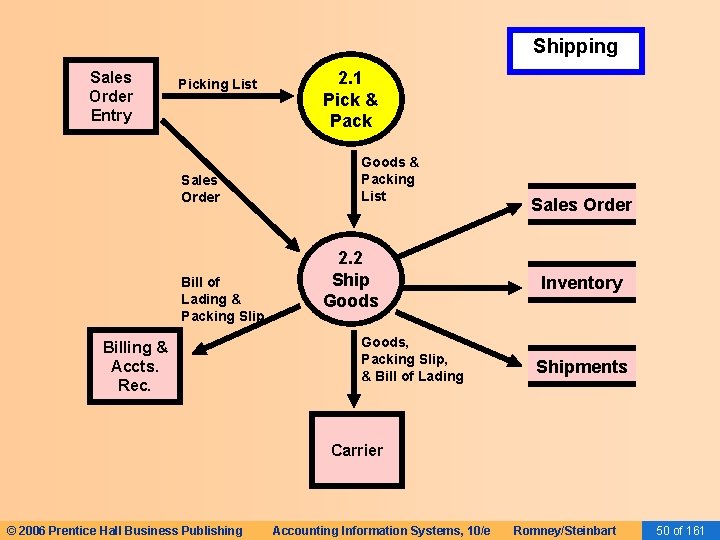
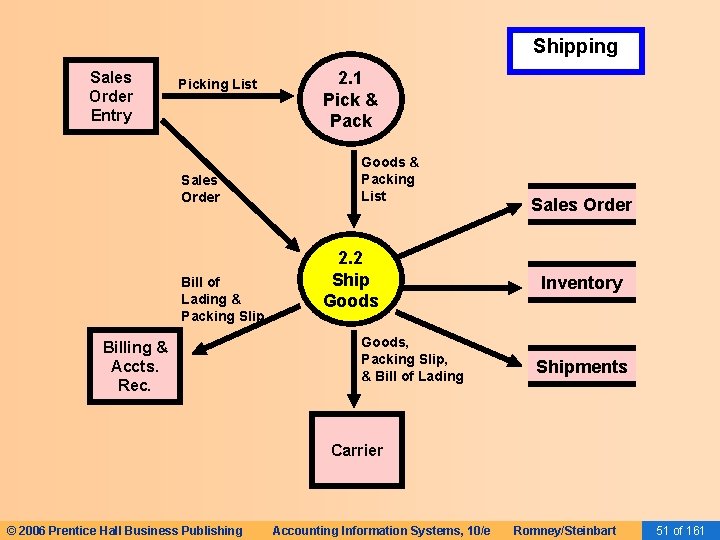
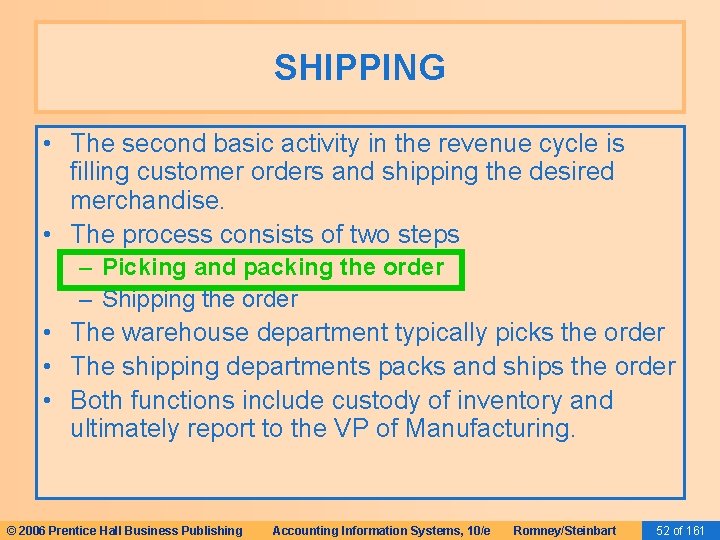
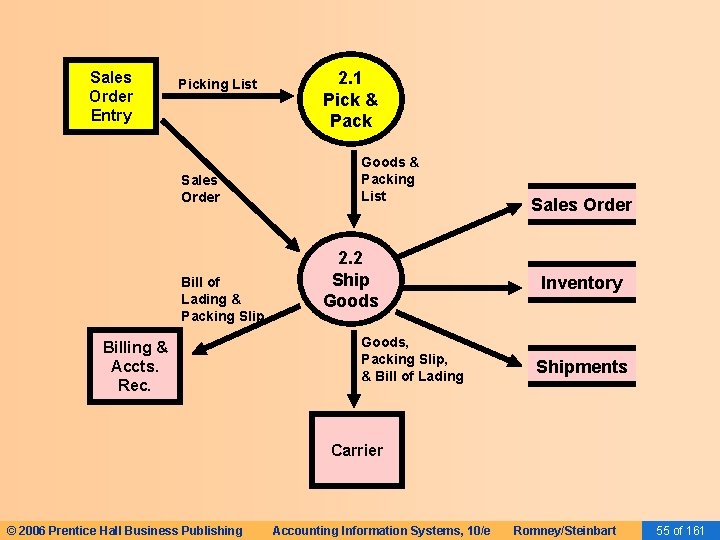
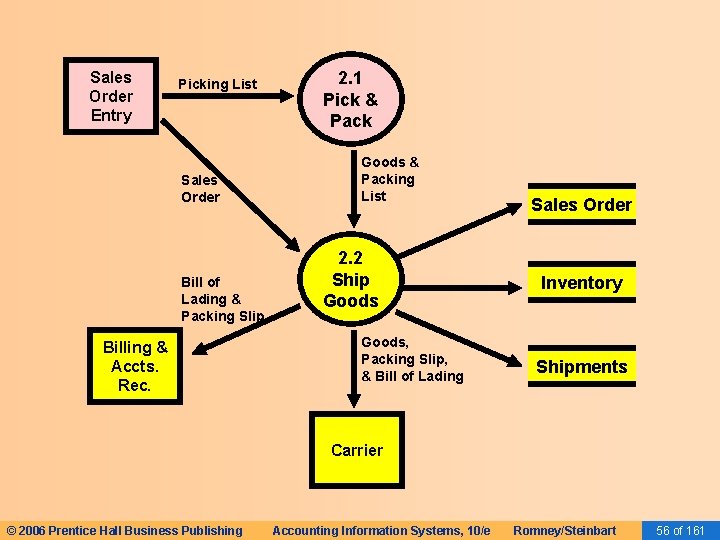
SHIPPING • The second basic activity in the revenue cycle is filling customer orders and shipping the desired merchandise. • The process consists of two steps – Picking and packing the order – Shipping the order • The warehouse department typically picks the order • The shipping departments packs and ships the order • Both functions include custody of inventory and ultimately report to the VP of Manufacturing. © 2006 Prentice Hall Business Publishing Accounting Information Systems, 10/e Romney/Steinbart 49 of 161
Shipping Sales Order Entry Picking List Sales Order Bill of Lading & Packing Slip Billing & Accts. Rec. 2. 1 Pick & Pack Goods & Packing List 2. 2 Ship Goods, Packing Slip, & Bill of Lading Sales Order Inventory Shipments Carrier © 2006 Prentice Hall Business Publishing Accounting Information Systems, 10/e Romney/Steinbart 50 of 161
Shipping Sales Order Entry Picking List Sales Order Bill of Lading & Packing Slip Billing & Accts. Rec. 2. 1 Pick & Pack Goods & Packing List 2. 2 Ship Goods, Packing Slip, & Bill of Lading Sales Order Inventory Shipments Carrier © 2006 Prentice Hall Business Publishing Accounting Information Systems, 10/e Romney/Steinbart 51 of 161
SHIPPING • The second basic activity in the revenue cycle is filling customer orders and shipping the desired merchandise. • The process consists of two steps – Picking and packing the order – Shipping the order • The warehouse department typically picks the order • The shipping departments packs and ships the order • Both functions include custody of inventory and ultimately report to the VP of Manufacturing. © 2006 Prentice Hall Business Publishing Accounting Information Systems, 10/e Romney/Steinbart 52 of 161
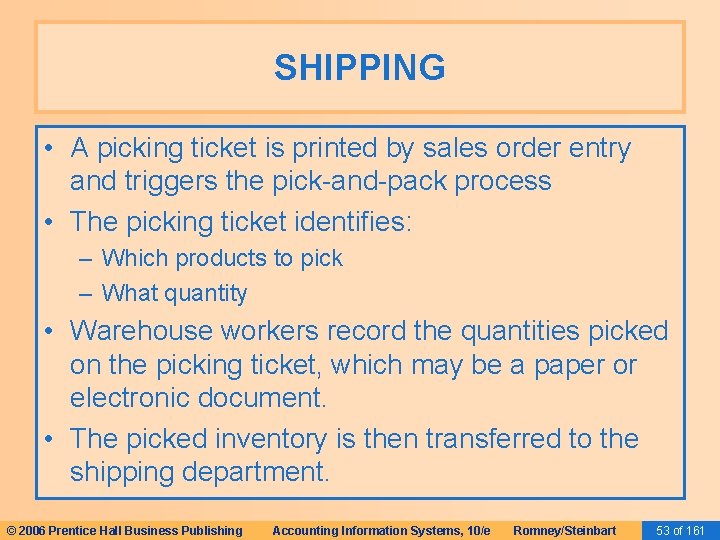
SHIPPING • A picking ticket is printed by sales order entry and triggers the pick-and-pack process • The picking ticket identifies: – Which products to pick – What quantity • Warehouse workers record the quantities picked on the picking ticket, which may be a paper or electronic document. • The picked inventory is then transferred to the shipping department. © 2006 Prentice Hall Business Publishing Accounting Information Systems, 10/e Romney/Steinbart 53 of 161
SHIPPING • Technology can speed the movement of inventory and improve the accuracy of perpetual inventory records: – Bar code scanners – Conveyer belts – Wireless technology so workers can receive instructions without returning to dispatch – Radio frequency identification (RFID) tags: • Eliminate the need to align goods with scanner • Allow inventory to be tracked as it moves through warehouse • Can store up to 128 bytes of data © 2006 Prentice Hall Business Publishing Accounting Information Systems, 10/e Romney/Steinbart 54 of 161
Sales Order Entry Picking List Sales Order Bill of Lading & Packing Slip Billing & Accts. Rec. 2. 1 Pick & Pack Goods & Packing List 2. 2 Ship Goods, Packing Slip, & Bill of Lading Sales Order Inventory Shipments Carrier © 2006 Prentice Hall Business Publishing Accounting Information Systems, 10/e Romney/Steinbart 55 of 161
Sales Order Entry Picking List Sales Order Bill of Lading & Packing Slip Billing & Accts. Rec. 2. 1 Pick & Pack Goods & Packing List 2. 2 Ship Goods, Packing Slip, & Bill of Lading Sales Order Inventory Shipments Carrier © 2006 Prentice Hall Business Publishing Accounting Information Systems, 10/e Romney/Steinbart 56 of 161
SHIPPING • The second basic activity in the revenue cycle is filling customer orders and shipping the desired merchandise. • The process consists of two steps – Picking and packing the order – Shipping the order • The warehouse department typically picks the order • The shipping departments packs and ships the order • Both functions include custody of inventory and ultimately report to the VP of Manufacturing. © 2006 Prentice Hall Business Publishing Accounting Information Systems, 10/e Romney/Steinbart 57 of 161
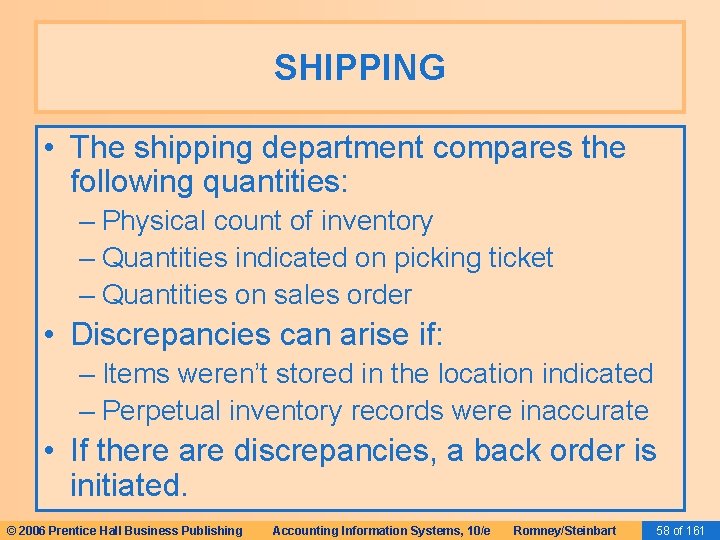
SHIPPING • The shipping department compares the following quantities: – Physical count of inventory – Quantities indicated on picking ticket – Quantities on sales order • Discrepancies can arise if: – Items weren’t stored in the location indicated – Perpetual inventory records were inaccurate • If there are discrepancies, a back order is initiated. © 2006 Prentice Hall Business Publishing Accounting Information Systems, 10/e Romney/Steinbart 58 of 161
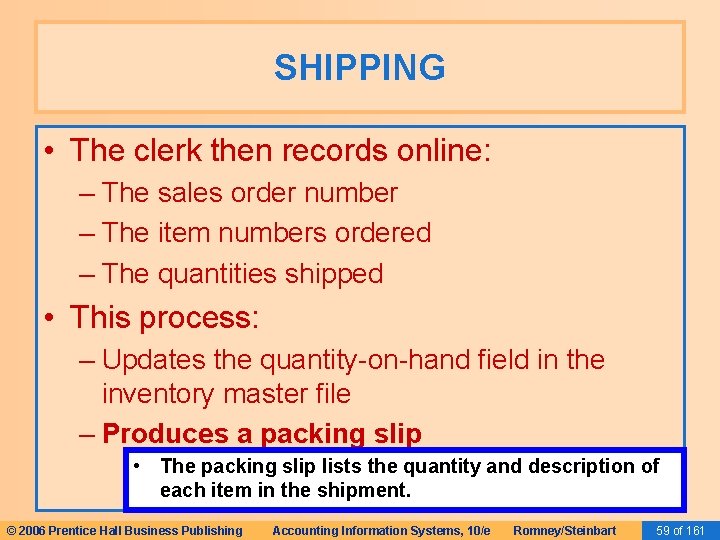
SHIPPING • The clerk then records online: – The sales order number – The item numbers ordered – The quantities shipped • This process: – Updates the quantity-on-hand field in the inventory master file – Produces a packing slip • The packing slip lists the quantity and description of each item in the shipment. © 2006 Prentice Hall Business Publishing Accounting Information Systems, 10/e Romney/Steinbart 59 of 161
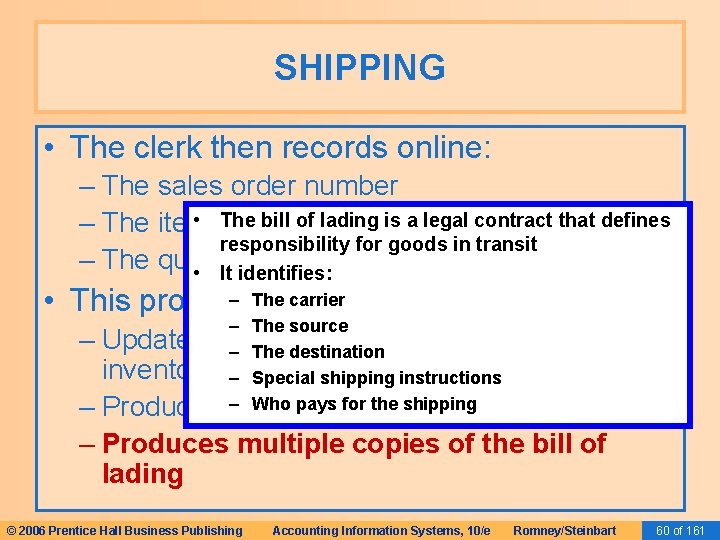
SHIPPING • The clerk then records online: – The sales order number • numbers The bill of lading is a legal contract that defines – The item ordered responsibility for goods in transit – The quantities shipped • It identifies: – The carrier • This produces – – The source Updates the quantity-on-hand field – The destination inventory master – Special file shipping instructions – packing Who pays for the shipping Produces a slip in the – – Produces multiple copies of the bill of lading © 2006 Prentice Hall Business Publishing Accounting Information Systems, 10/e Romney/Steinbart 60 of 161