How Cleveland Clinic Transformed Revenue Cycle Analytics and


- Slides: 16
How Cleveland Clinic Transformed Revenue Cycle Analytics and Saved Millions November 14, 2018 Bob Gross, MBA, CPHIMS Director, Revenue Cycle Analytics
Agenda • • • What is the “Revenue Cycle” Revenue Cycle as an analytical use case Buy Versus Build Analytics as a core competency The importance of cohesive teams
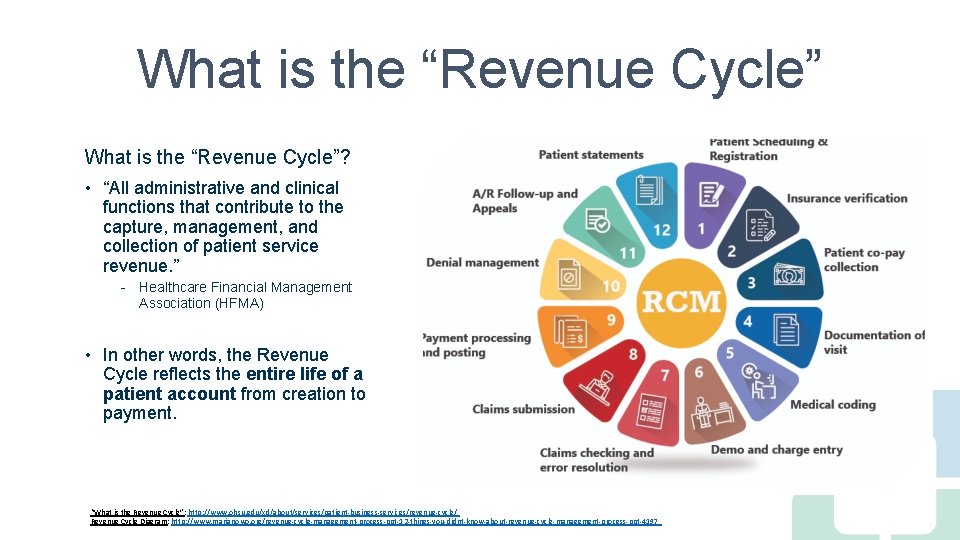
What is the “Revenue Cycle”? • “All administrative and clinical functions that contribute to the capture, management, and collection of patient service revenue. ” - Healthcare Financial Management Association (HFMA) • In other words, the Revenue Cycle reflects the entire life of a patient account from creation to payment. “What is the Revenue Cycle”: http: //www. ohsu. edu/xd/about/services/patient-business-services/revenue-cycle/ Revenue Cycle Diagram: http: //www. marianowo. org/revenue-cycle-management-process-ppt-12 -things-you-didnt-know-about-revenue-cycle-management-process-ppt-4197
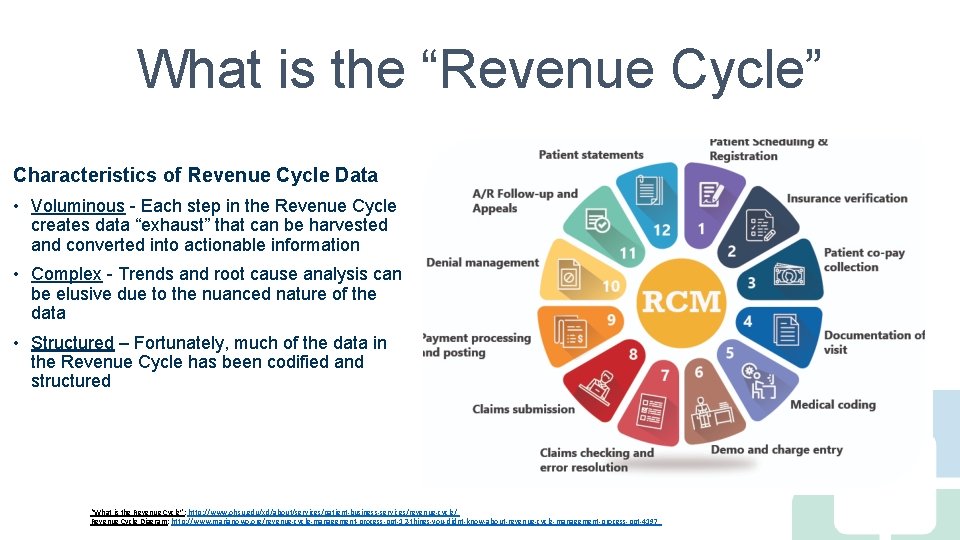
What is the “Revenue Cycle” Characteristics of Revenue Cycle Data • Voluminous - Each step in the Revenue Cycle creates data “exhaust” that can be harvested and converted into actionable information • Complex - Trends and root cause analysis can be elusive due to the nuanced nature of the data • Structured – Fortunately, much of the data in the Revenue Cycle has been codified and structured “What is the Revenue Cycle”: http: //www. ohsu. edu/xd/about/services/patient-business-services/revenue-cycle/ Revenue Cycle Diagram: http: //www. marianowo. org/revenue-cycle-management-process-ppt-12 -things-you-didnt-know-about-revenue-cycle-management-process-ppt-4197
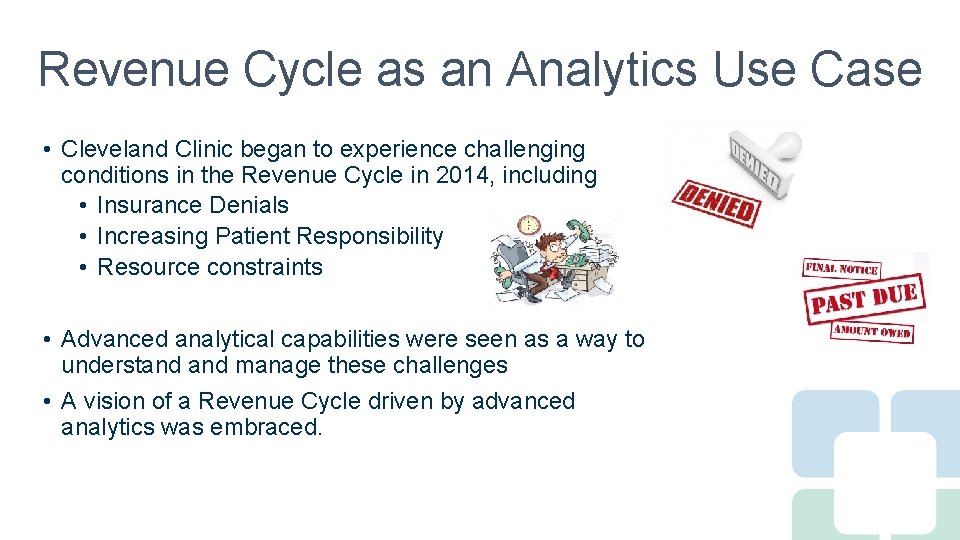
Revenue Cycle as an Analytics Use Case • Cleveland Clinic began to experience challenging conditions in the Revenue Cycle in 2014, including • Insurance Denials • Increasing Patient Responsibility • Resource constraints • Advanced analytical capabilities were seen as a way to understand manage these challenges • A vision of a Revenue Cycle driven by advanced analytics was embraced.
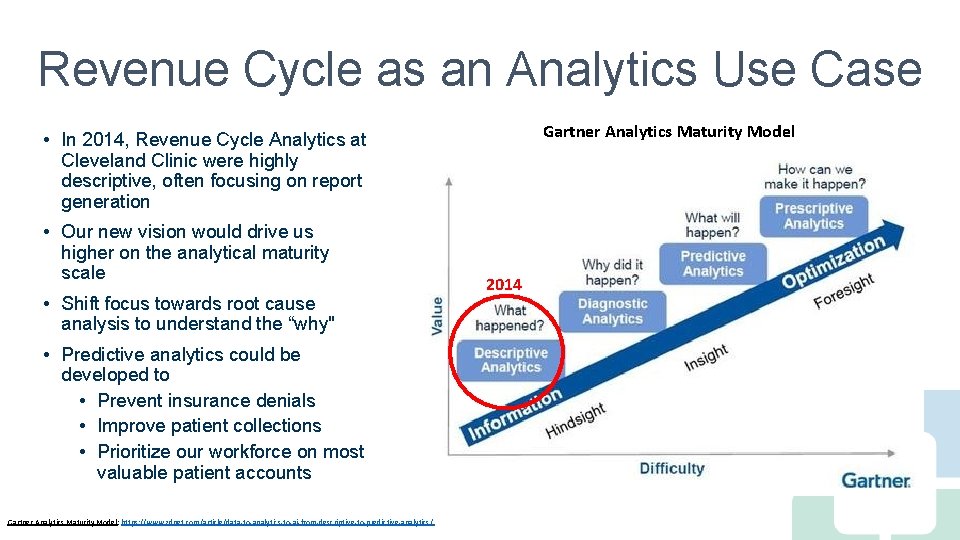
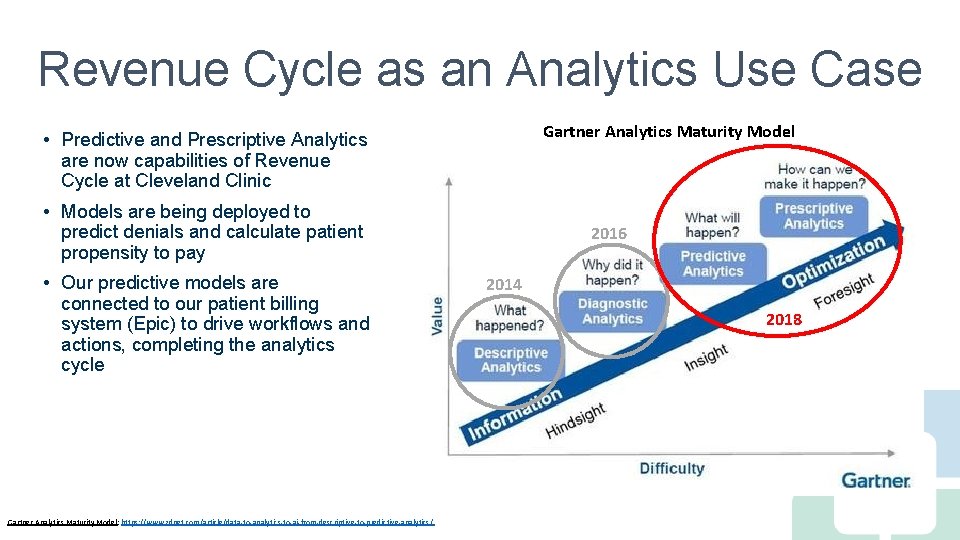
Revenue Cycle as an Analytics Use Case Gartner Analytics Maturity Model • In 2014, Revenue Cycle Analytics at Cleveland Clinic were highly descriptive, often focusing on report generation • Our new vision would drive us higher on the analytical maturity scale • Shift focus towards root cause analysis to understand the “why" • Predictive analytics could be developed to • Prevent insurance denials • Improve patient collections • Prioritize our workforce on most valuable patient accounts Gartner Analytics Maturity Model: https: //www. zdnet. com/article/data-to-analytics-to-ai-from-descriptive-to-predictive-analytics/ 2014
Buy Versus Build A Software as a Service provider was selected in mid 2014 to implement an analytics platform capable of achieving the vision Software as a Service (Saa. S) Experience • Some of the quick wins with the Saa. S analytics provider were - Ingesting and visualizing patient accounting data - Developing analytical views on insurance claims data • However, it became clear that in order to develop advanced analytical capabilities, the Saa. S arrangement would require much more investment and customization • As more investment in time and capital was made, we began to ask the question “Should we build this ourselves? ”
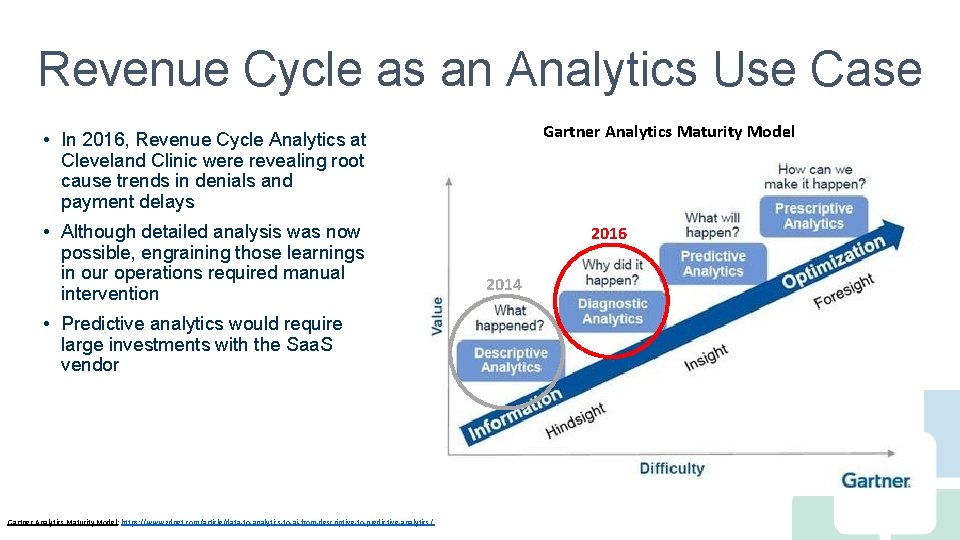
Revenue Cycle as an Analytics Use Case Gartner Analytics Maturity Model • In 2016, Revenue Cycle Analytics at Cleveland Clinic were revealing root cause trends in denials and payment delays • Although detailed analysis was now possible, engraining those learnings in our operations required manual intervention • Predictive analytics would require large investments with the Saa. S vendor Gartner Analytics Maturity Model: https: //www. zdnet. com/article/data-to-analytics-to-ai-from-descriptive-to-predictive-analytics/ 2016 2014
Buy Versus Build In 2016, Cleveland Clinic made a substantial investment in technologies that could enable the development of an in-house Revenue Cycle Analytics Platform. Making the “pitch” to leadership • An in-depth assessment of resource requirements and timing was conducted • Feasibility studies were also performed – “Can we actually accomplish this? ” • We proposed creating a partnership between our Enterprise Analytics and Revenue Cycle Management teams to build a replacement to the Saa. S platform over 18 months. • An investment in software developers, quantitative analysts, and business analysts was made to support the project. • Net of the personnel investment, the project would achieve a $1. 8 M annual ROI upon completion.
Buy Versus Build We successfully completed the implementation of our Revenue Cycle Analytics platform in June, 2018, enabling us to eliminate the need for Saa. S based analytics. Analytical Capabilities Achieved • With the implementation of the in-house developed solution, the following capabilities now exist • Data Modeling – New data sources can be ingested using an enterprise standard “data vault” methodology • Visualization –Dashboards and drill down analytics can be developed and published enterprise wide • Machine Learning – Predictive models are being developed to predict denials prior to billing claims, and scoring patients for propensity to pay. • All capabilities are unified with consistent tools and connectivity
Revenue Cycle as an Analytics Use Case Gartner Analytics Maturity Model • Predictive and Prescriptive Analytics are now capabilities of Revenue Cycle at Cleveland Clinic • Models are being deployed to predict denials and calculate patient propensity to pay • Our predictive models are connected to our patient billing system (Epic) to drive workflows and actions, completing the analytics cycle Gartner Analytics Maturity Model: https: //www. zdnet. com/article/data-to-analytics-to-ai-from-descriptive-to-predictive-analytics/ 2016 2014 2018
Analytics as a Core Competency • Advanced Analytics are now viewed as a core competency within Revenue Cycle Management at Cleveland Clinic • Building our platform in-house enabled us to transform our Revenue Cycle by creating and deploying predictive and prescriptive analytics • Advanced analytical capabilities give us a competitive advantage in managing insurance denials and facilitating patient payments • Using analytics is good, but competing on analytics is better - Thomas Davenport
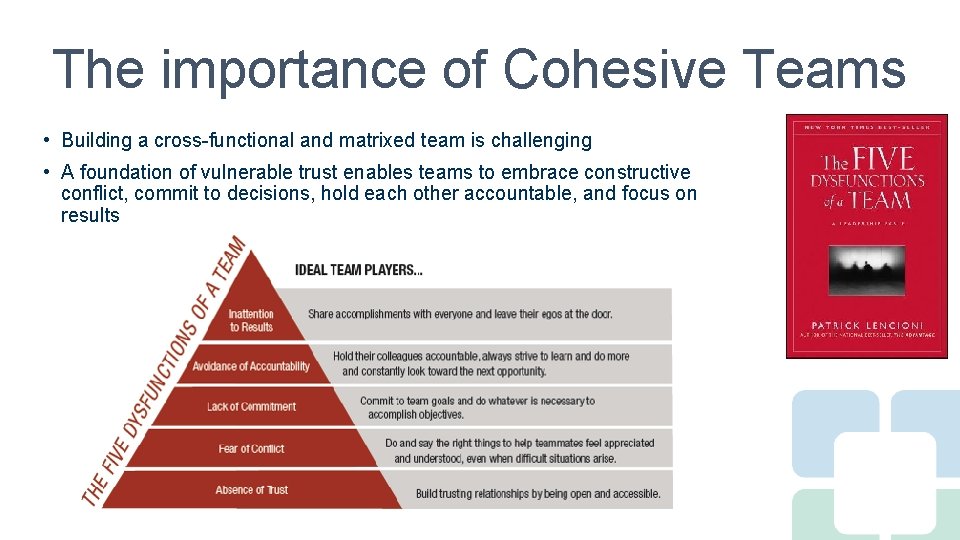
The importance of Cohesive Teams • Building a cross-functional and matrixed team is challenging • A foundation of vulnerable trust enables teams to embrace constructive conflict, commit to decisions, hold each other accountable, and focus on results
Summary • The Revenue Cycle covers the entire life of a patient account, providing rich data “exhaust” to harvest for analytics • Advanced analytics can play a major role in solving today’s Revenue Cycle challenges • Trade-offs exist between buying and building analytical solutions • Advanced analytics can provide a competitive advantage • Cohesive teams enable organizations to achieve results
Contact Information Bob Gross, MBA, CPHIMS Director, Revenue Cycle Analytics Cleveland Clinic https: //www. linkedin. com/in/bob-gross-46809486/ grossb@ccf. org