Atoms Molecules and Ions Chapter 2 Copyright The
- Slides: 42
Atoms, Molecules and Ions Chapter 2 Copyright © The Mc. Graw-Hill Companies, Inc. Permission required for reproduction or display.
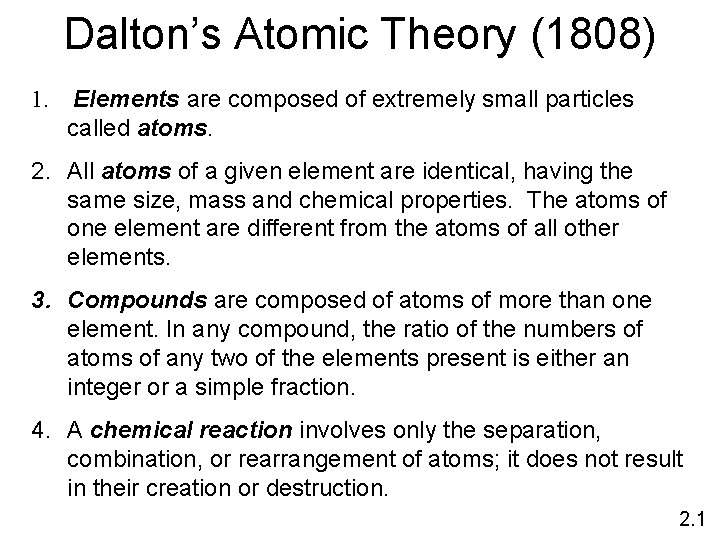
Dalton’s Atomic Theory (1808) 1. Elements are composed of extremely small particles called atoms. 2. All atoms of a given element are identical, having the same size, mass and chemical properties. The atoms of one element are different from the atoms of all other elements. 3. Compounds are composed of atoms of more than one element. In any compound, the ratio of the numbers of atoms of any two of the elements present is either an integer or a simple fraction. 4. A chemical reaction involves only the separation, combination, or rearrangement of atoms; it does not result in their creation or destruction. 2. 1
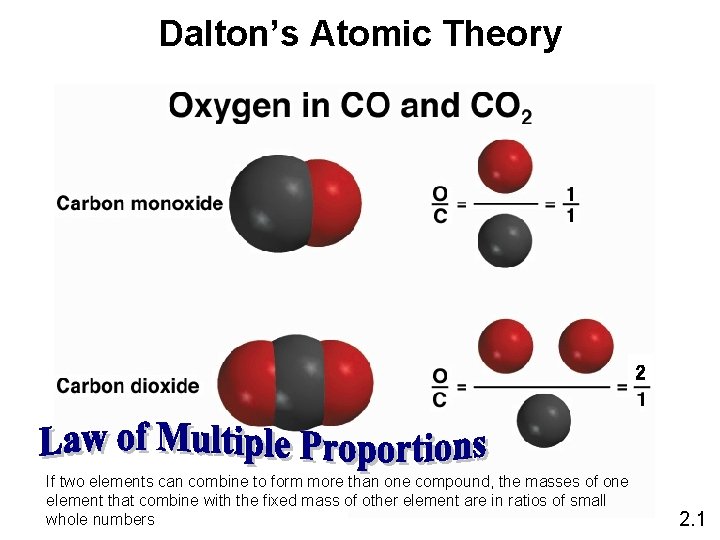
Dalton’s Atomic Theory 2 If two elements can combine to form more than one compound, the masses of one element that combine with the fixed mass of other element are in ratios of small whole numbers 2. 1
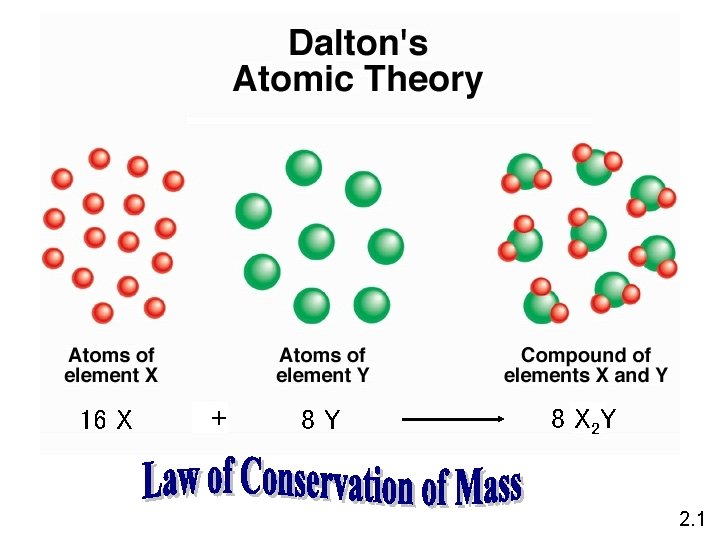
16 X + 8 Y 8 X 2 Y 2. 1
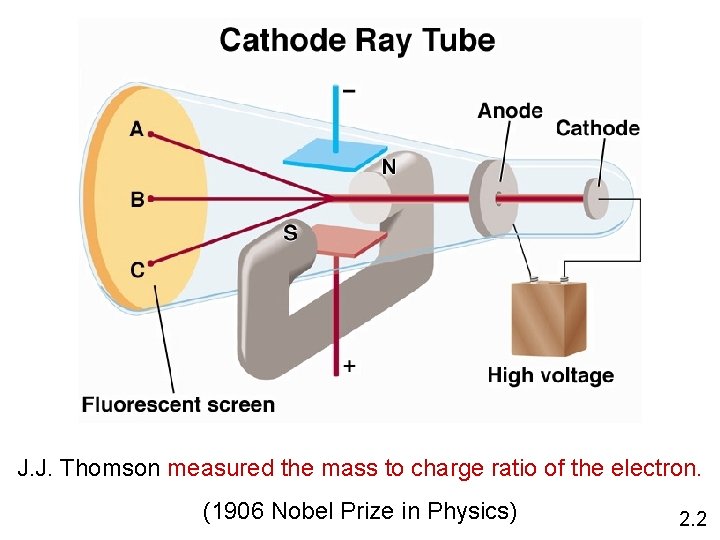
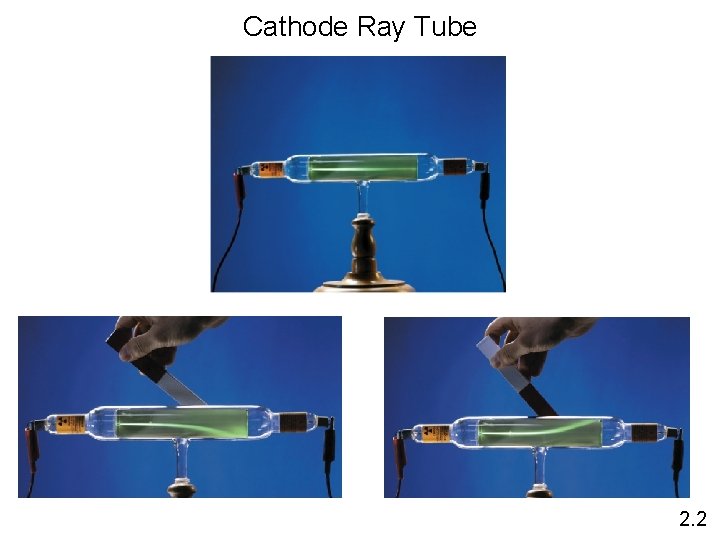
J. J. Thomson measured the mass to charge ratio of the electron. (1906 Nobel Prize in Physics) 2. 2
Cathode Ray Tube 2. 2
Cathode Ray Tube
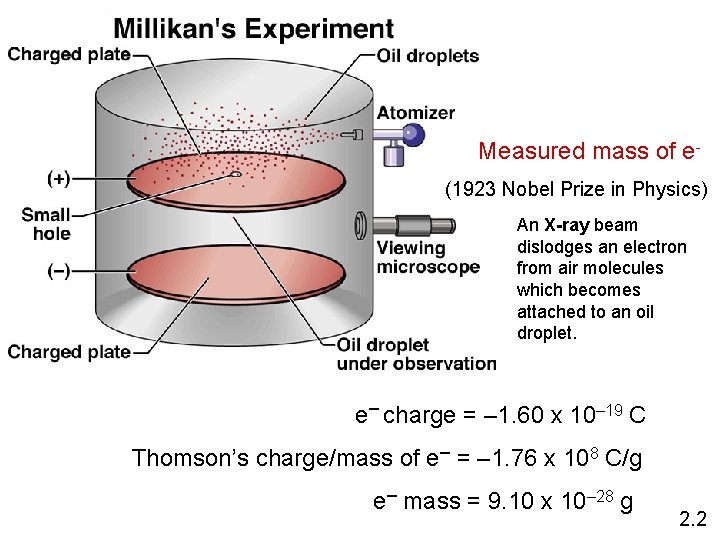
Measured mass of e- (1923 Nobel Prize in Physics) An X-ray beam dislodges an electron from air molecules which becomes attached to an oil droplet. e– charge = – 1. 60 x 10– 19 C Thomson’s charge/mass of e– = – 1. 76 x 108 C/g e– mass = 9. 10 x 10– 28 g 2. 2
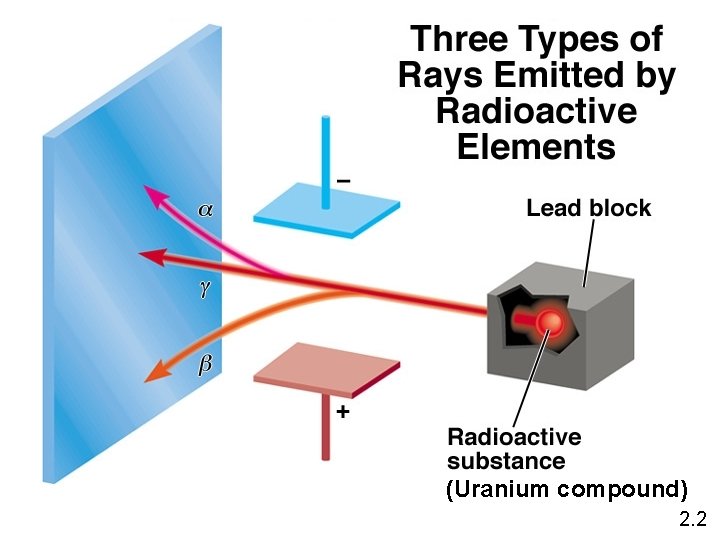
(Uranium compound) 2. 2
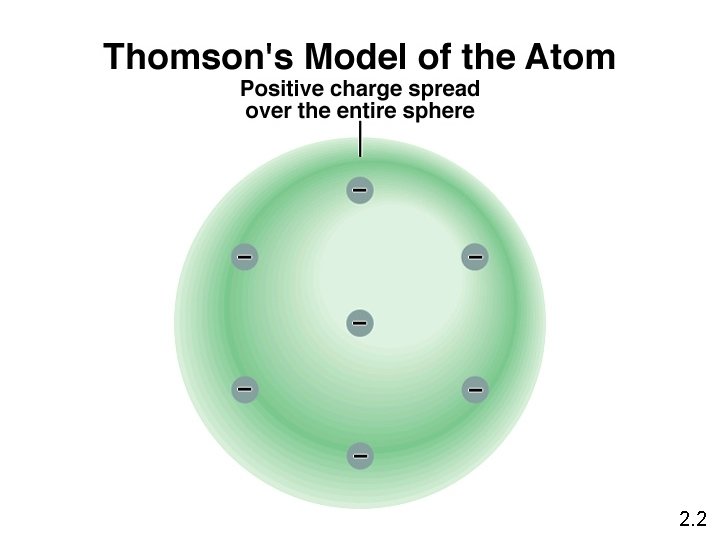
2. 2
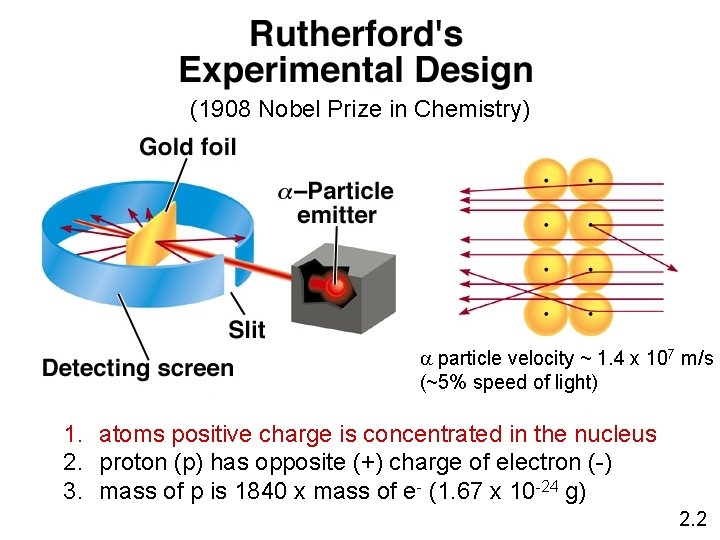
(1908 Nobel Prize in Chemistry) a particle velocity ~ 1. 4 x 10⁷ m/s (~5% speed of light) 1. atoms positive charge is concentrated in the nucleus 2. proton (p) has opposite (+) charge of electron (-) 3. mass of p is 1840 x mass of e- (1. 67 x 10 -24 g) 2. 2
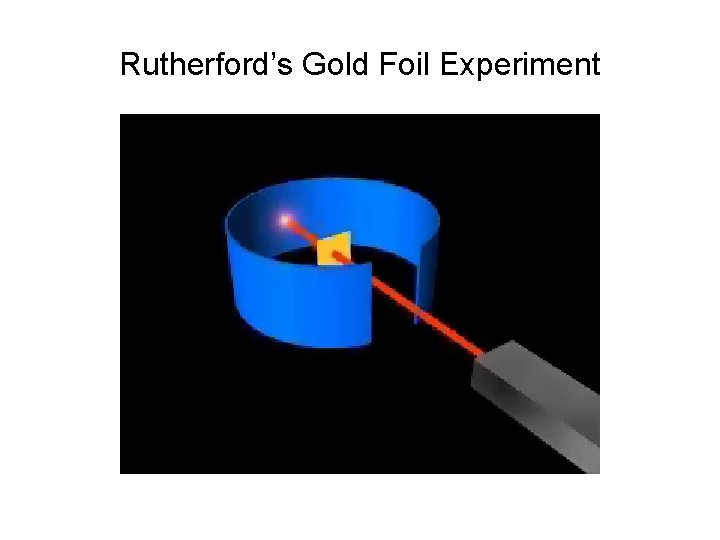
Rutherford’s Gold Foil Experiment
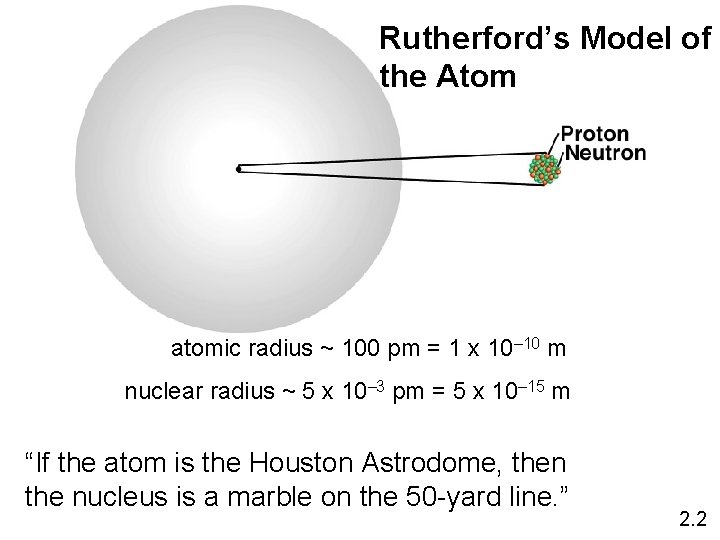
Rutherford’s Model of the Atom atomic radius ~ 100 pm = 1 x 10– 10 m nuclear radius ~ 5 x 10– 3 pm = 5 x 10– 15 m “If the atom is the Houston Astrodome, then the nucleus is a marble on the 50 -yard line. ” 2. 2
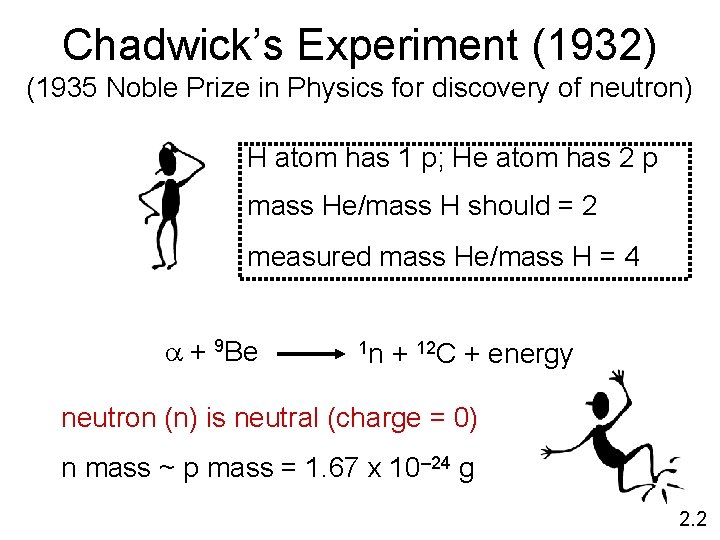
Chadwick’s Experiment (1932) (1935 Noble Prize in Physics for discovery of neutron) H atom has 1 p; He atom has 2 p mass He/mass H should = 2 measured mass He/mass H = 4 a + 9 Be 1 n + 12 C + energy neutron (n) is neutral (charge = 0) n mass ~ p mass = 1. 67 x 10– 24 g 2. 2
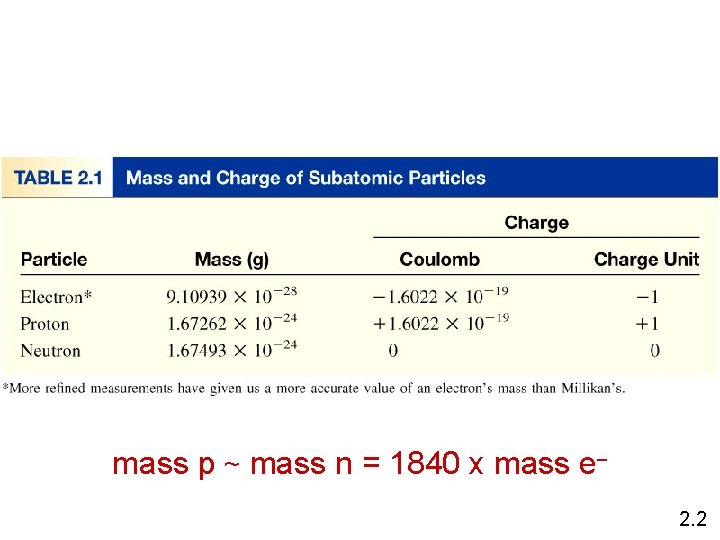
mass p ~ mass n = 1840 x mass e– 2. 2
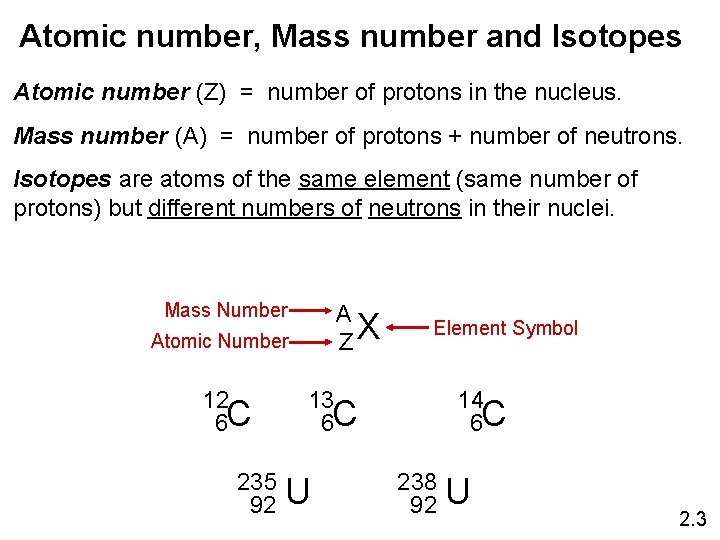
Atomic number, Mass number and Isotopes Atomic number (Z) = number of protons in the nucleus. Mass number (A) = number of protons + number of neutrons. Isotopes are atoms of the same element (same number of protons) but different numbers of neutrons in their nuclei. Mass Number A ZX Atomic Number 12 C 6 235 92 Element Symbol 13 C 6 U 14 C 6 238 92 U 2. 3
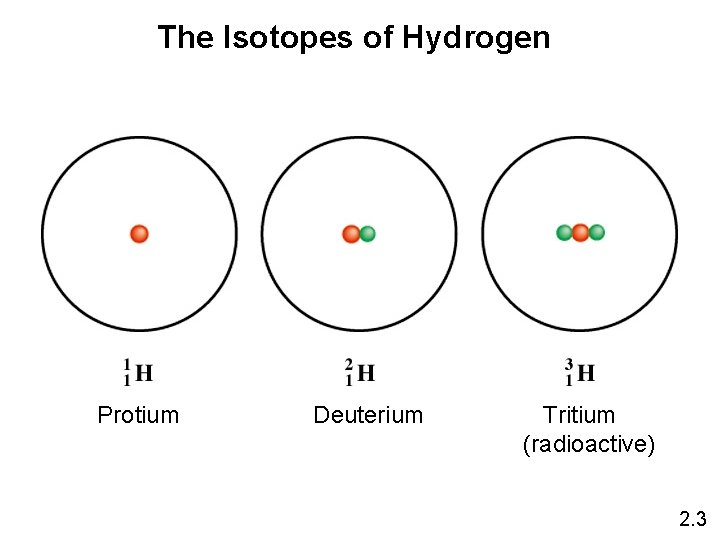
The Isotopes of Hydrogen Protium Deuterium Tritium (radioactive) 2. 3
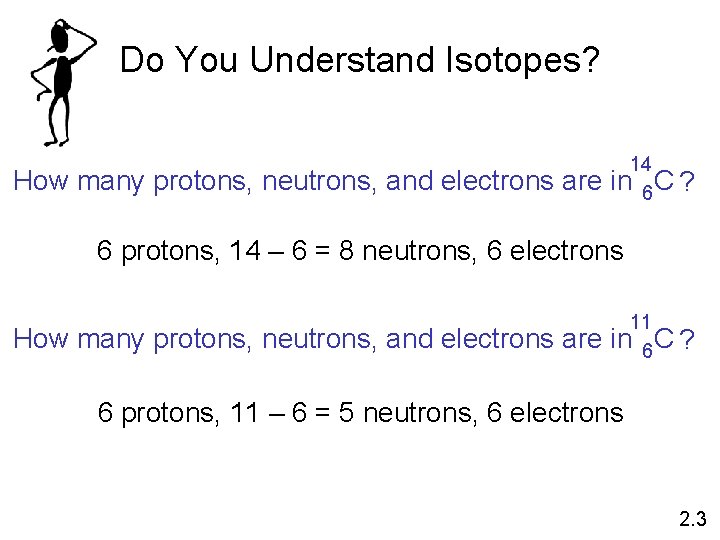
Do You Understand Isotopes? 14 How many protons, neutrons, and electrons are in 6 C ? 6 protons, 14 – 6 = 8 neutrons, 6 electrons 11 How many protons, neutrons, and electrons are in 6 C ? 6 protons, 11 – 6 = 5 neutrons, 6 electrons 2. 3
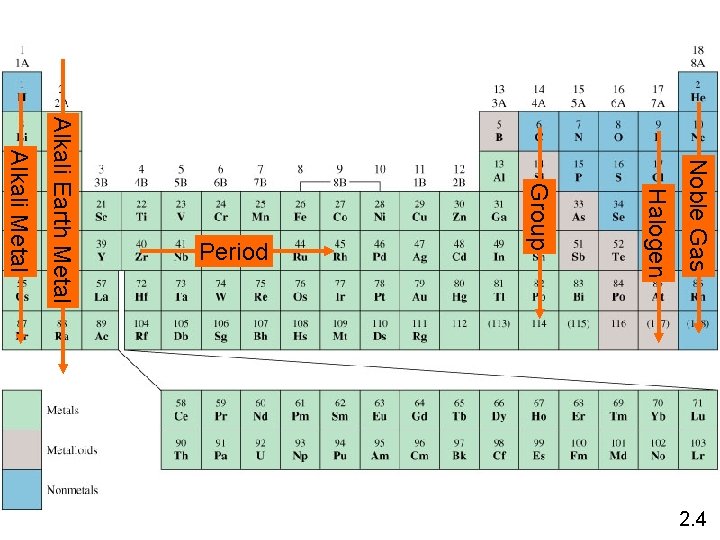
Noble Gas Halogen Group Alkali Metal Alkali Earth Metal Period 2. 4
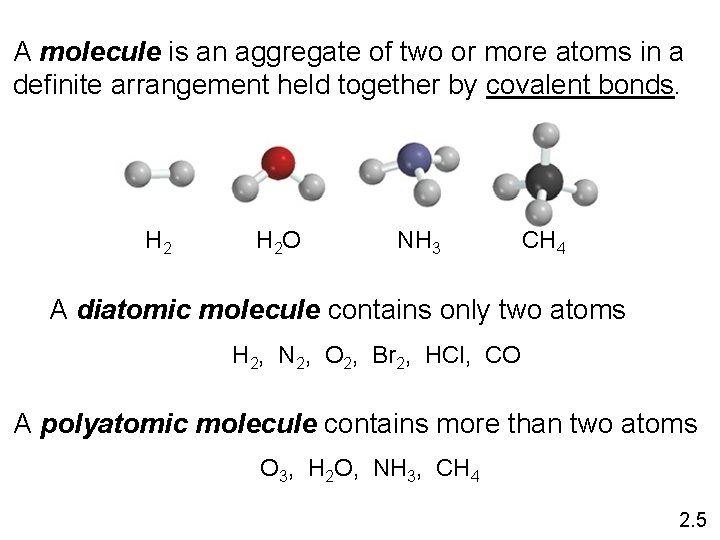
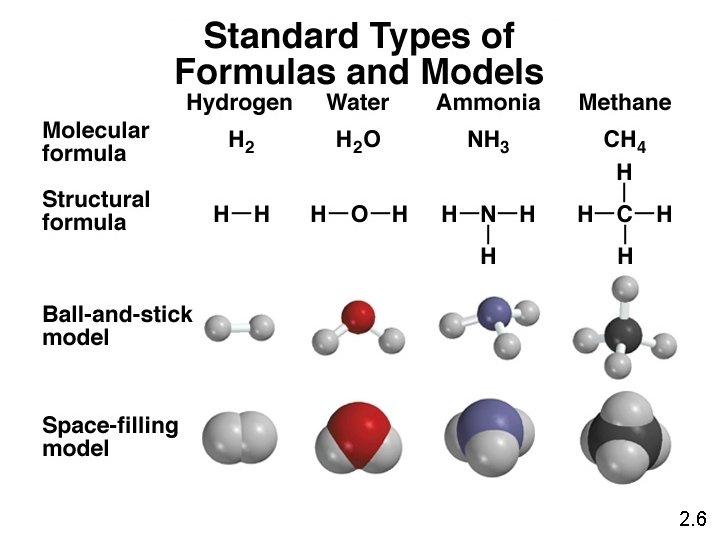
A molecule is an aggregate of two or more atoms in a definite arrangement held together by covalent bonds. H 2 O NH 3 CH 4 A diatomic molecule contains only two atoms H 2, N 2, O 2, Br 2, HCl, CO A polyatomic molecule contains more than two atoms O 3, H 2 O, NH 3, CH 4 2. 5
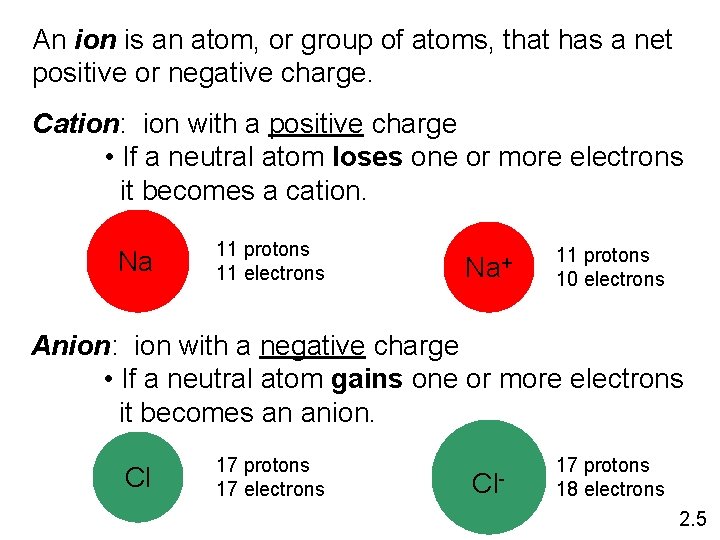
An ion is an atom, or group of atoms, that has a net positive or negative charge. Cation: ion with a positive charge • If a neutral atom loses one or more electrons it becomes a cation. Na 11 protons 11 electrons Na+ 11 protons 10 electrons Anion: ion with a negative charge • If a neutral atom gains one or more electrons it becomes an anion. Cl 17 protons 17 electrons Cl- 17 protons 18 electrons 2. 5
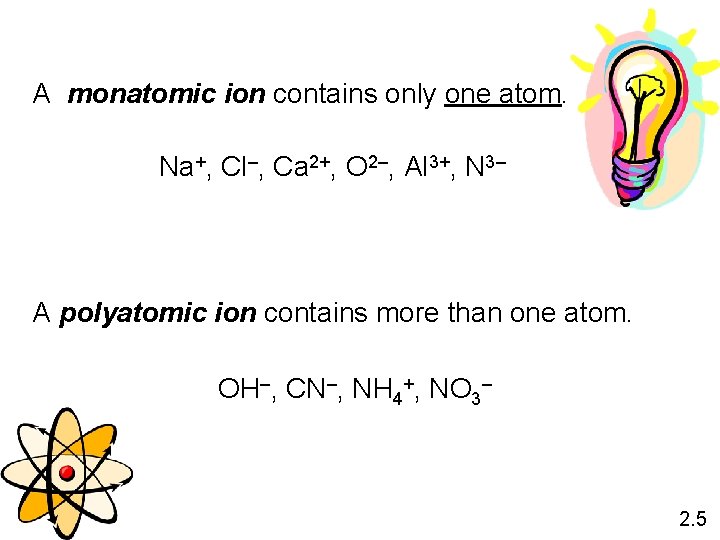
A monatomic ion contains only one atom. Na+, Cl–, Ca 2+, O 2–, Al 3+, N 3– A polyatomic ion contains more than one atom. OH–, CN–, NH 4+, NO 3– 2. 5
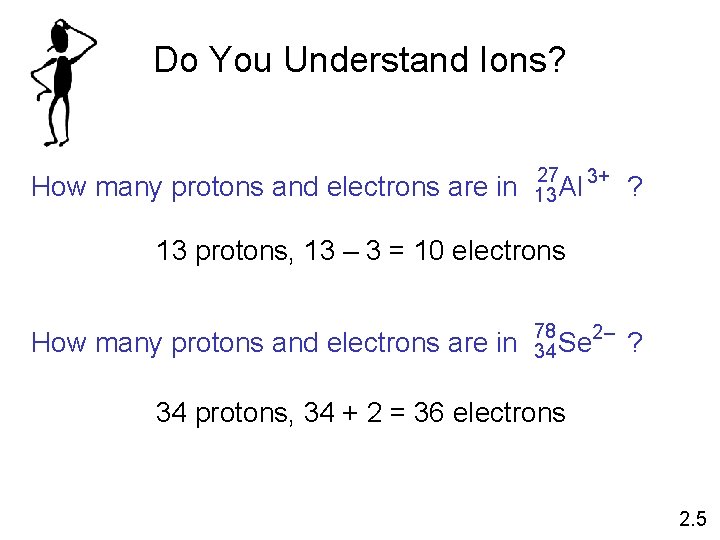
Do You Understand Ions? 27 3+ How many protons and electrons are in ? 13 Al 13 protons, 13 – 3 = 10 electrons 78 2– How many protons and electrons are in ? Se 34 34 protons, 34 + 2 = 36 electrons 2. 5
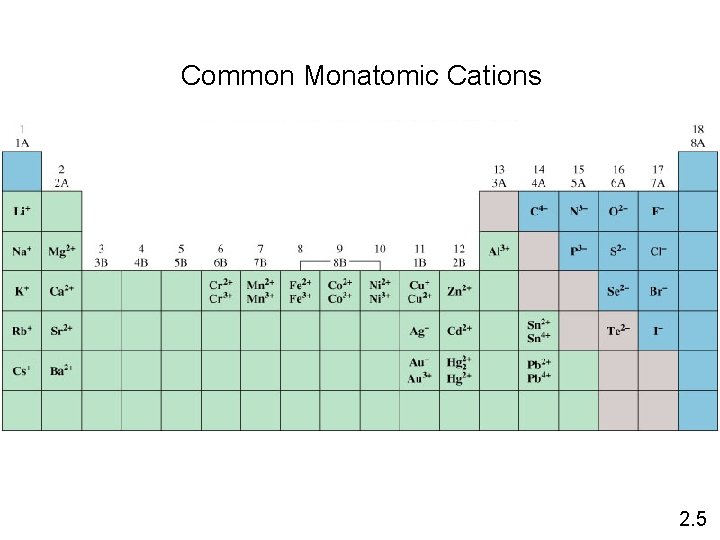
Common Monatomic Cations 2. 5
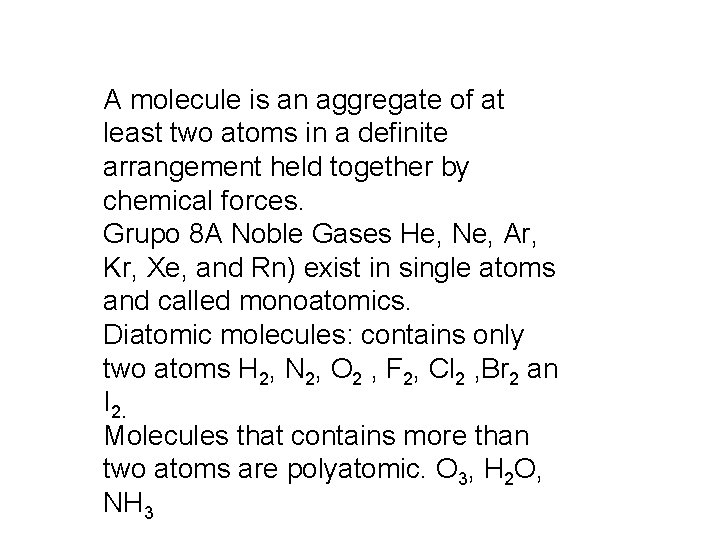
A molecule is an aggregate of at least two atoms in a definite arrangement held together by chemical forces. Grupo 8 A Noble Gases He, Ne, Ar, Kr, Xe, and Rn) exist in single atoms and called monoatomics. Diatomic molecules: contains only two atoms H 2, N 2, O 2 , F 2, Cl 2 , Br 2 an I 2. Molecules that contains more than two atoms are polyatomic. O 3, H 2 O, NH 3
2. 6
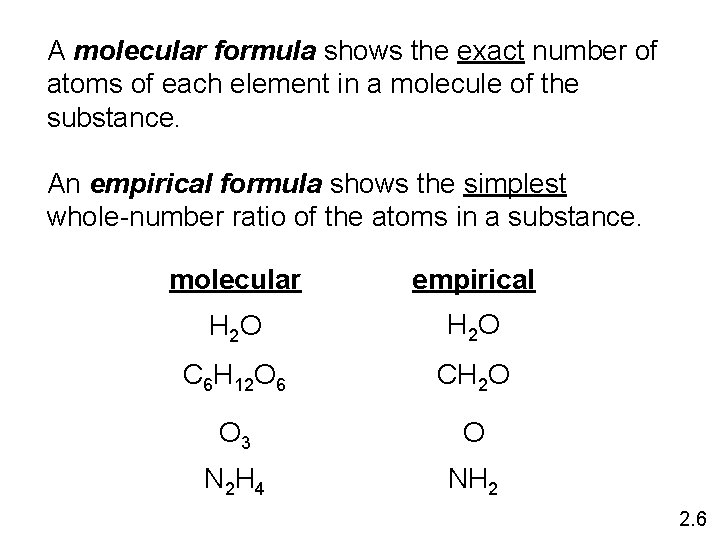
A molecular formula shows the exact number of atoms of each element in a molecule of the substance. An empirical formula shows the simplest whole-number ratio of the atoms in a substance. molecular empirical H 2 O C 6 H 12 O 6 CH 2 O O 3 O N 2 H 4 NH 2 2. 6
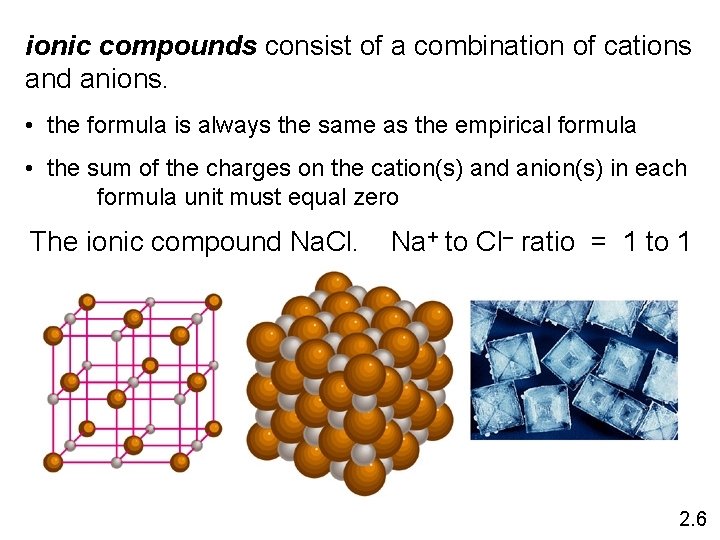
ionic compounds consist of a combination of cations and anions. • the formula is always the same as the empirical formula • the sum of the charges on the cation(s) and anion(s) in each formula unit must equal zero The ionic compound Na. Cl. Na+ to Cl– ratio = 1 to 1 2. 6
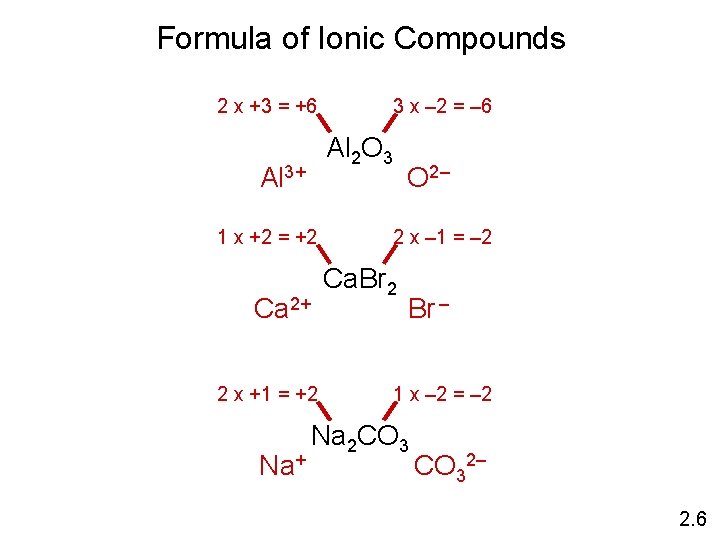
Formula of Ionic Compounds 2 x +3 = +6 Al 2 O 3 Al 3+ 1 x +2 = +2 Ca 2+ 2 x +1 = +2 Na+ 3 x – 2 = – 6 O 2– 2 x – 1 = – 2 Ca. Br 2 Br – 1 x – 2 = – 2 Na 2 CO 32– 2. 6
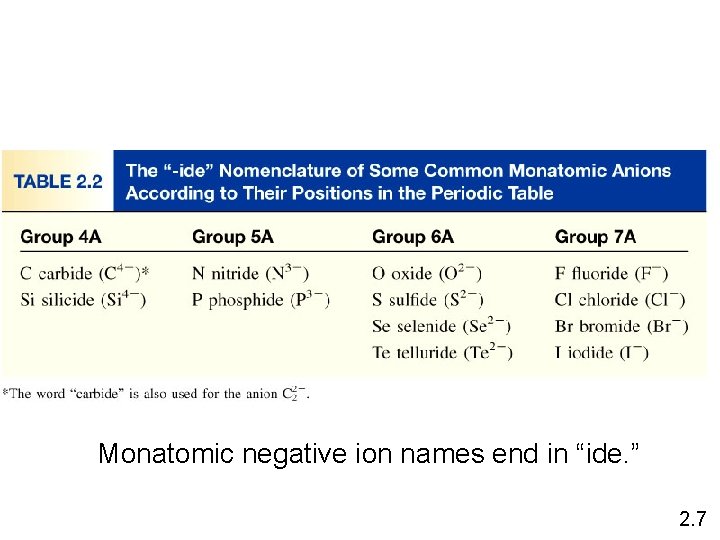
Monatomic negative ion names end in “ide. ” 2. 7
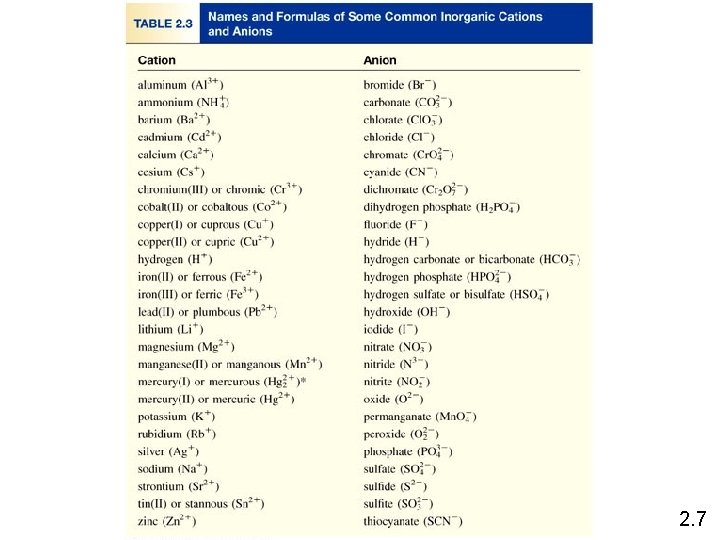
2. 7
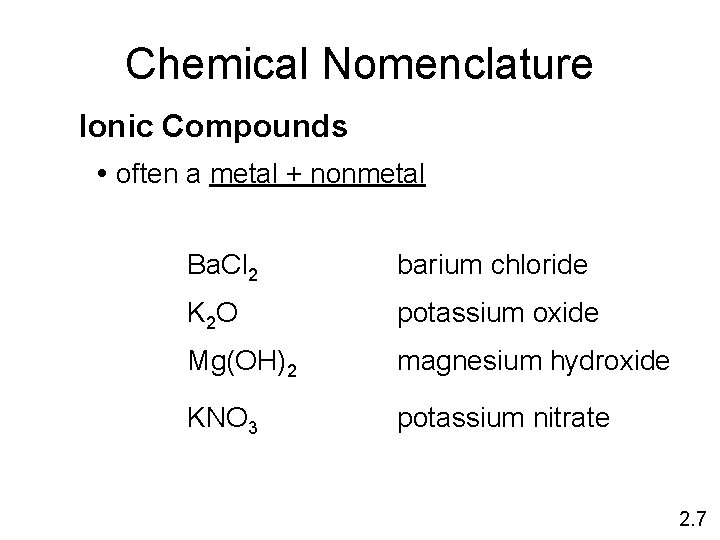
Chemical Nomenclature Ionic Compounds • often a metal + nonmetal Ba. Cl 2 barium chloride K 2 O potassium oxide Mg(OH)2 magnesium hydroxide KNO 3 potassium nitrate 2. 7
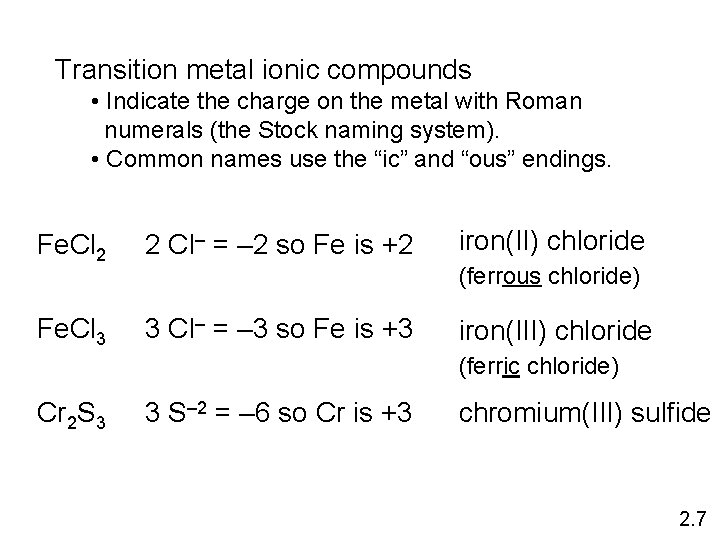
Transition metal ionic compounds • Indicate the charge on the metal with Roman numerals (the Stock naming system). • Common names use the “ic” and “ous” endings. iron(II) chloride Fe. Cl 2 2 Cl– = – 2 so Fe is +2 Fe. Cl 3 3 Cl– = – 3 so Fe is +3 iron(III) chloride (ferric chloride) Cr 2 S 3 3 S– 2 = – 6 so Cr is +3 chromium(III) sulfide (ferrous chloride) 2. 7
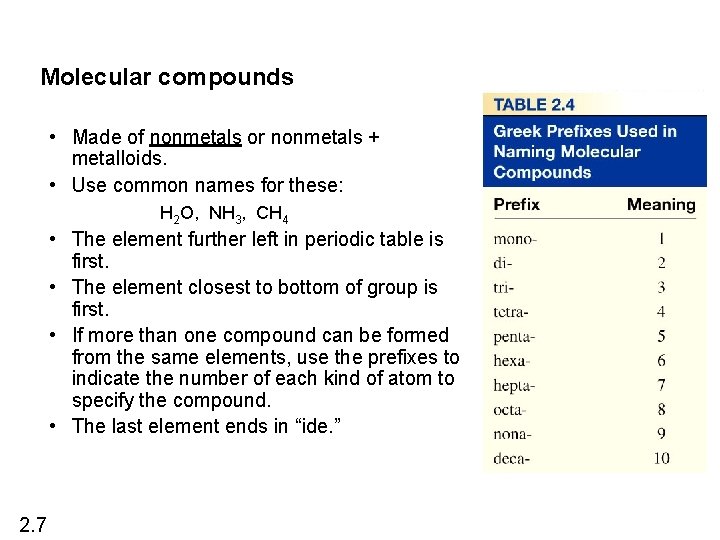
Molecular compounds • Made of nonmetals or nonmetals + metalloids. • Use common names for these: H 2 O, NH 3, CH 4 • The element further left in periodic table is first. • The element closest to bottom of group is first. • If more than one compound can be formed from the same elements, use the prefixes to indicate the number of each kind of atom to specify the compound. • The last element ends in “ide. ” 2. 7
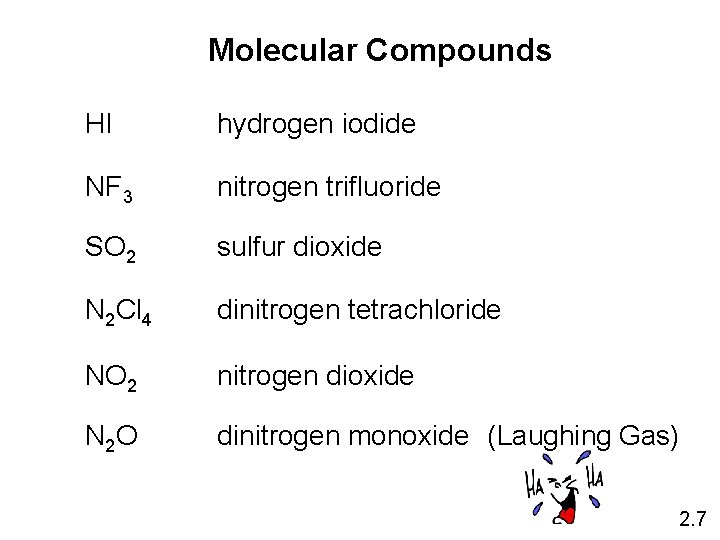
Molecular Compounds HI hydrogen iodide NF 3 nitrogen trifluoride SO 2 sulfur dioxide N 2 Cl 4 dinitrogen tetrachloride NO 2 nitrogen dioxide N 2 O dinitrogen monoxide (Laughing Gas) 2. 7
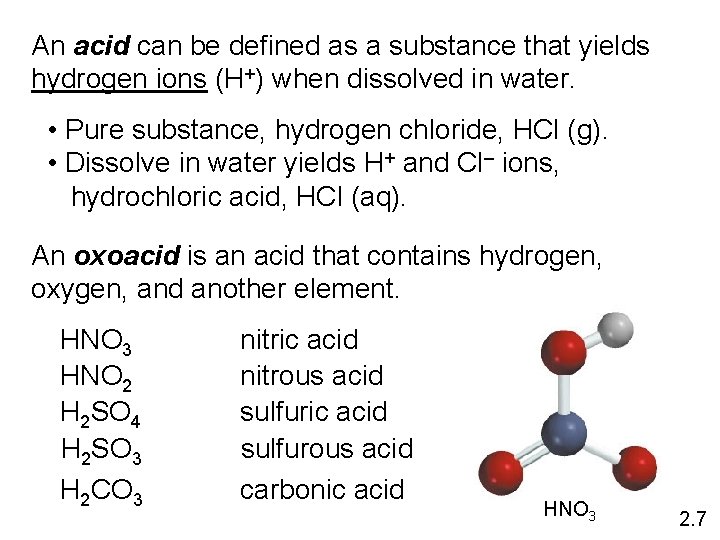
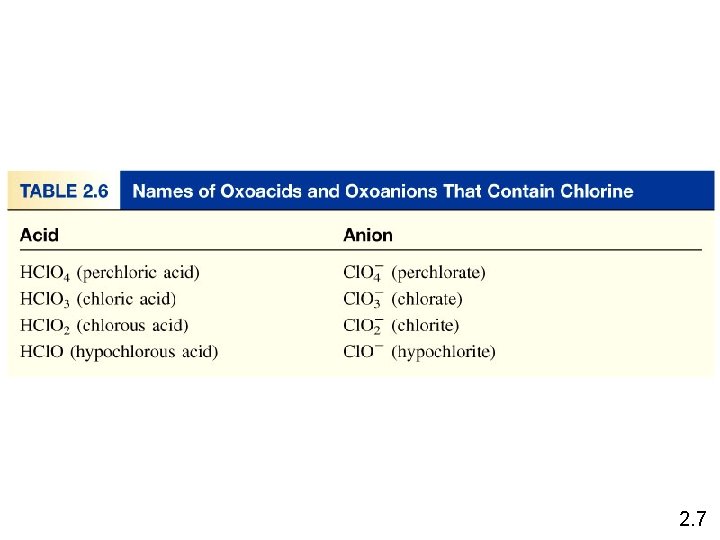
An acid can be defined as a substance that yields hydrogen ions (H+) when dissolved in water. • Pure substance, hydrogen chloride, HCl (g). • Dissolve in water yields H+ and Cl– ions, hydrochloric acid, HCl (aq). An oxoacid is an acid that contains hydrogen, oxygen, and another element. HNO 3 HNO 2 H 2 SO 4 H 2 SO 3 H 2 CO 3 nitric acid nitrous acid sulfuric acid sulfurous acid carbonic acid HNO 3 2. 7
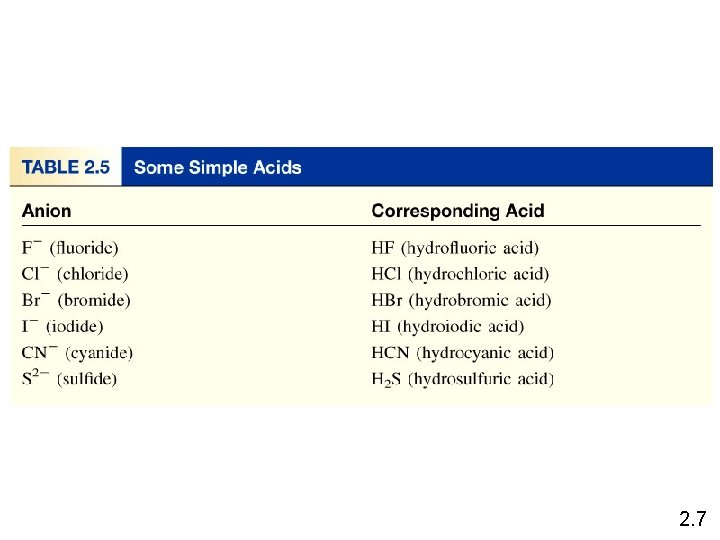
2. 7
2. 7
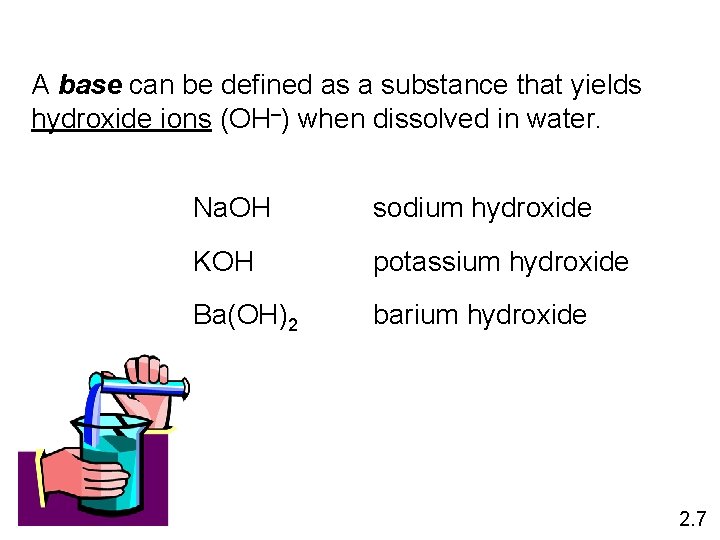
A base can be defined as a substance that yields hydroxide ions (OH–) when dissolved in water. Na. OH sodium hydroxide KOH potassium hydroxide Ba(OH)2 barium hydroxide 2. 7
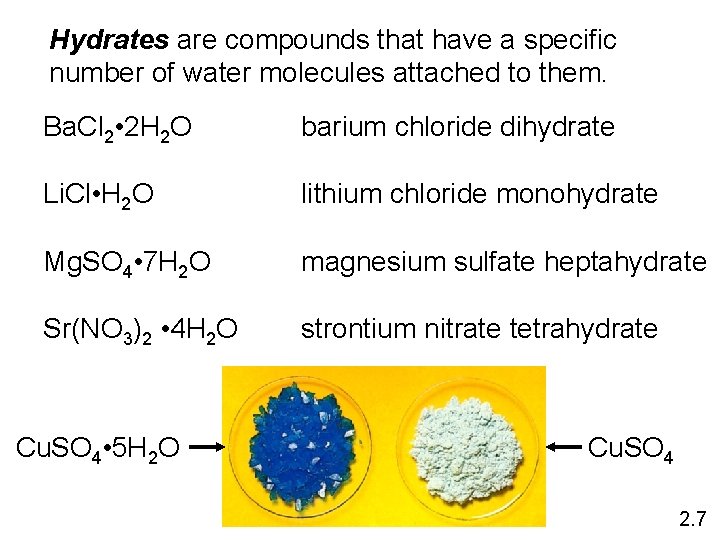
Hydrates are compounds that have a specific number of water molecules attached to them. Ba. Cl 2 • 2 H 2 O barium chloride dihydrate Li. Cl • H 2 O lithium chloride monohydrate Mg. SO 4 • 7 H 2 O magnesium sulfate heptahydrate Sr(NO 3)2 • 4 H 2 O strontium nitrate tetrahydrate Cu. SO 4 • 5 H 2 O Cu. SO 4 2. 7
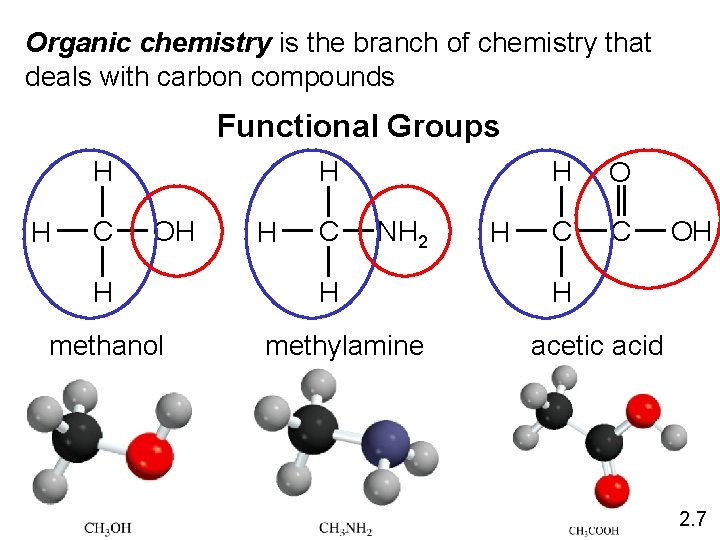
Organic chemistry is the branch of chemistry that deals with carbon compounds Functional Groups H H C H OH H methanol H C NH 2 H methylamine H H O C C OH H acetic acid 2. 7
Chapter 2 Homework/Classwork • Read p. 71 -75 • Do # 1, 2, 5, 7, 8, 14, 15, 16, 17, 20, 24, 26, 32, 34, 36, 38, 44, 46, 50, 51, 52, 56, 58, 60, 62, 66, 68, 69, 71, 78, 80