An Introduction to Agroecology wsoloedu 07126 com 2











- Slides: 161
《农业生态学》 (An Introduction to Agroecology) 王松良 博士 wsoloedu 07@126. com 2
Teaching group members Email : claude. caldwell@dal. ca
Ms Shannon Kilyanek Email: skilyanek@dal. ca
王松良 农学博士, 教授 E-mail: wsoloedu 07@126. com Tel: 87645506 (0)
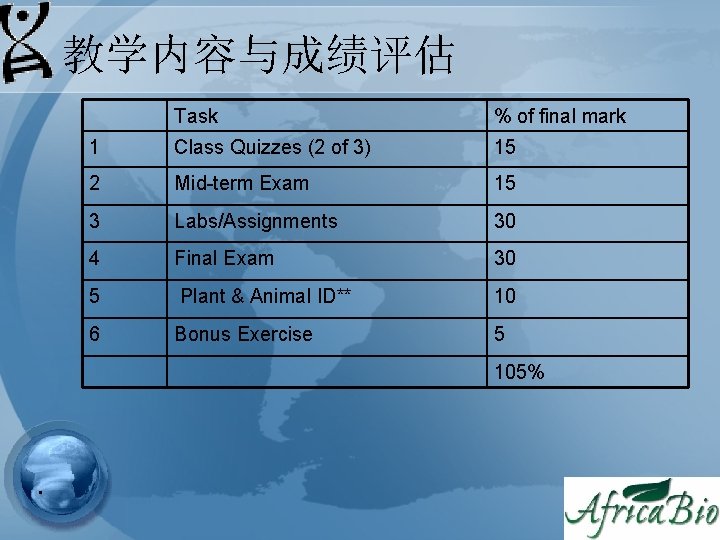
教学内容与成绩评估 Task % of final mark 1 Class Quizzes (2 of 3) 15 2 Mid-term Exam 15 3 Labs/Assignments 30 4 Final Exam 30 5 Plant & Animal ID** 10 6 Bonus Exercise 5 105% •
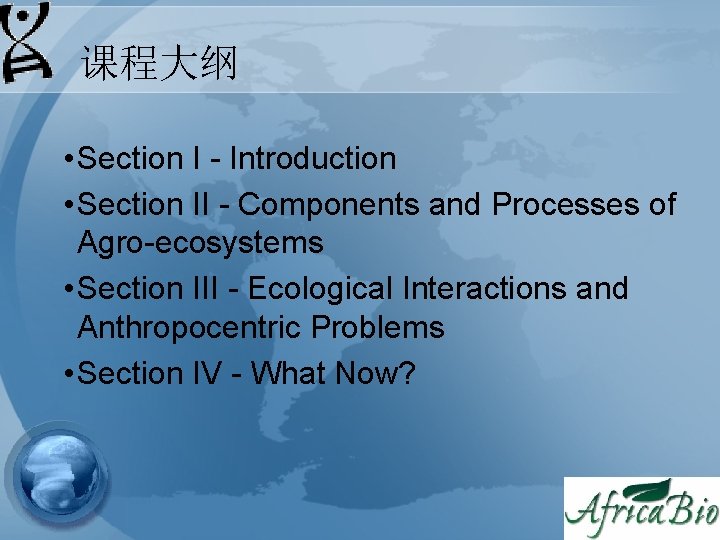
课程大纲 • Section I - Introduction • Section II - Components and Processes of Agro-ecosystems • Section III - Ecological Interactions and Anthropocentric Problems • Section IV - What Now?
Section I – Introduction • Scope and objectives of this course and evaluation methods • What is agriculture, ecology, ecosystems, agro-ecosystems? Natural ecosystems vs. People-centred ecosystems. "What is Agro-ecology? " • Agriculture: Is this a good idea? Making money and respecting the environment • Communication skills and library use
Section II - Components and Processes of Agro-ecosystems • Energy and matter in the agroecosystem Agroclimate, crop diversity and adaptation, accessing resources Cultivated soils and living organisms • • – – – Soils: Natural and managed Soil carbon cycle and the role of soil organisms in the carbon cycle Nutrient cycling in soil
Section III - Ecological Interactions and Anthropocentric Problems • • Land preparation Manures and composts – – • • Erosion and soil degradation: "Keep your soil covered" Sustainable Production systems – – – – • Manures: Green and brown Compost - Making and using it Domestic livestock systems Vegetable production systems: tropical and temperate Forages for dairy and beef Cereals for flour and meat Potato production Introduction to aquaculture systems Orientation to herbs, aromatic and medicinal crops Greenhouse and nursery production Environmental horticulture and the green industry
Section IV - What Now? • The efficiency of feeding animals for human food: Food versus feed • Energy flow in agro-ecosystems • Animal welfare: A good life for animals • Pesticides in agriculture and the environment • Genetically modified crops: Present and future • Integrated pest management • Agricultural ecosystems re-visited
Agro-ecology Schedule • Monday (8: 00 -9: 30) – Introduction to the course; goals, process and evaluation; use of web. Ct; assign supermarket exercise if it has not already happened. • Tuesday (8: 00 -9: 30) – What is agriculture, Ecology, ecosystems and agro-ecology? Communication skills, references and citations; assign paraphrase exercise • Wednesday (8: 00 -9: 30) – De-brief the supermarket survey; Making money and respecting the environment • Thursday (9: 55 -11: 25) – Debrief paraphrase exercise; Introduction to the NSAC library; library assignment;
• Friday (2: 00 -3: 30) – Economic plants on campus tour • Monday (8: 00 -9: 30) – De-brief tour; Energy and matter in the agro-ecosystem • Tuesday (8: 00 -9: 30) - Agro-climate and crop adaptation; Introduction to soils • Wednesday (8: 00 -9: 30) – Soils –types and texture exercise • Thursday (9: 55 -11: 25) – De-brief soils exercise; (listen to Miller soils lecture plus discuss); procedure for completing the course by distance on web. Ct.
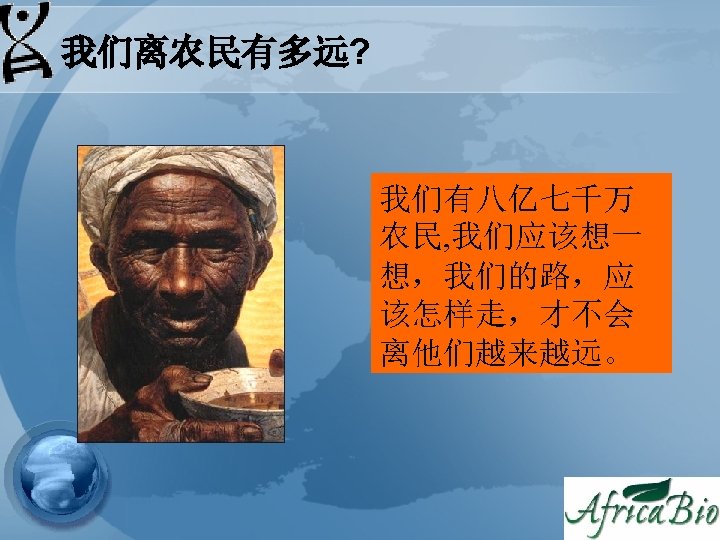
三农难题 • • • Rural economy: economic policy stemming from long term Rural-Urban Divide makes traditional theory of (agricultural) economics ineffective for Rural China Rural environment: the urgent contradict between rural population and land resource consolidates the ideology of Nature and Society Dualism Rural society : huge population burden and double Dualistic societies ecologically and economically leads to multi-pressures in food, economy and environment and education interwoven plight
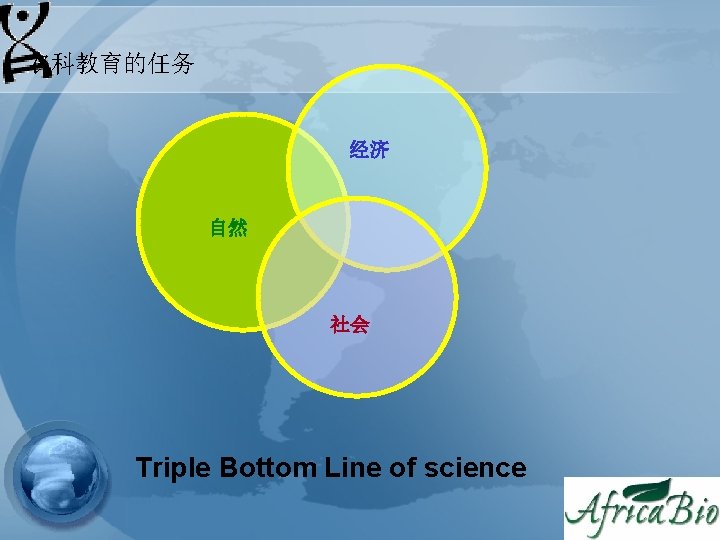
农科教育的任务 经济 自然 社会 Triple Bottom Line of science
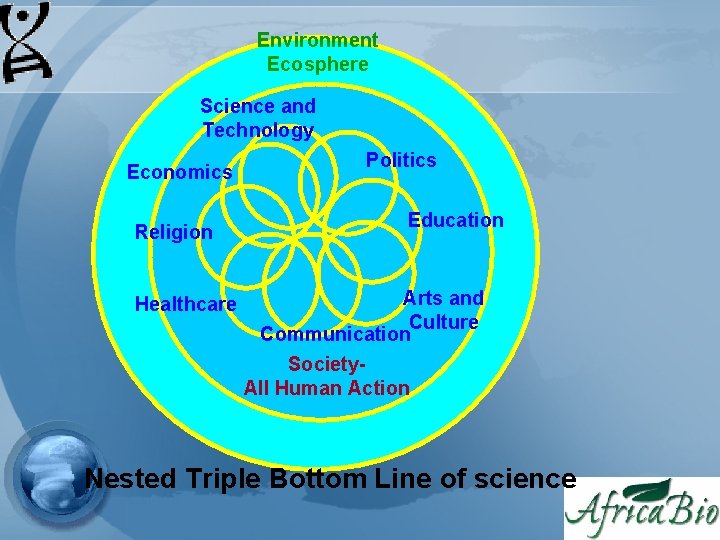
Environment Ecosphere Science and Technology Economics Religion Healthcare Politics Education Arts and Culture Communication Society. All Human Action Nested Triple Bottom Line of science
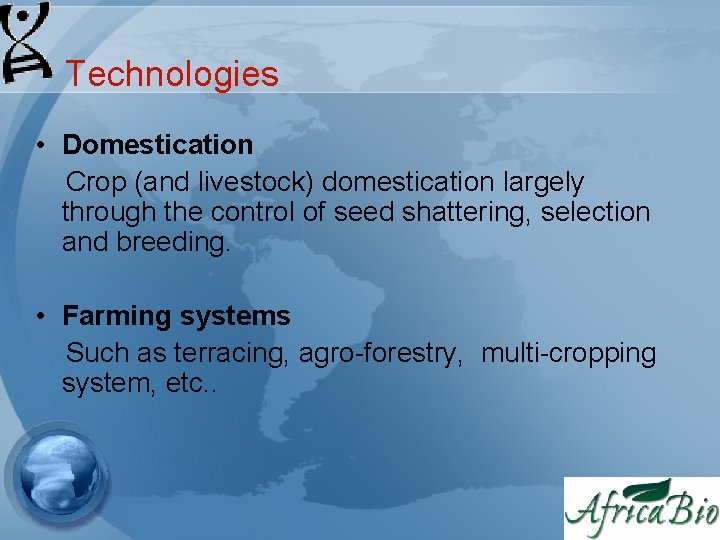
Technologies • Domestication Crop (and livestock) domestication largely through the control of seed shattering, selection and breeding. • Farming systems Such as terracing, agro-forestry, multi-cropping system, etc. .
• Water management Highly-efficient irrigation and water management technologies involving canals, tanks, and terraces, etc. • Water mechanization Chinese invented hydraulic engineering and water wheels that increased yields and allowed the cropping of new land the irrigation of old land.
• New products Plants species and crop cultivars were spread worldly and exploited in multi-functions, such as Chinese medical plant, each period of collection led to massive food production increases.
• New Genetics The rediscovery of Mendel's Laws in 1900 led to an explosion in plant breeding in Europe and North America including the development of hybrid maize. In time these advances also led to the recent biotechnological revolution in agriculture. • External inputs The theories of von Liebig on plant nutrition spun off the use of chemical fertilizers in agriculture. The commercialization of 2, 4 -D in 1945 symbolized a new era of pesticide inputs as the way to control pests. Together these two inputs reinforce the "Man conquers Nature" era of agricultural research.
• Green Revolution The development of dwarf wheat , corn and rice in south-east Asia capable of withstanding lodging even with heavy fertilizer inputs, yield increase in great extent. • What Next? More high-technologies-more commercial ---More energy input ---- natural degradation----Farmer poverty---food security & safety---less sustainability…. .
Ideology: Five points of wrong ‘Agriculture’ Wrong Wrong beginnings goals focus time-frame gender
Wrong beginnings • Green Revolution: there is a general feeling that despite an important increase in the productivity of some important crops, greater yields and other negative effects could have been avoided if the emphasis had been placed upon the development of livelihood system strategies;
Wrong goals • The understandable desire to increase grain yield blinded the system to other needs and led scientists to equate yield with nutrition; short-term gains with long-term stability; and yield improvement over farm improvement.
Wrong focus • Emphasizing plant genetics over almost everything else, dubbing “wild” species incorrectly for food security. The broader picture of livelihood systems, soil management, landscape, biodiversity are lost from the view and undermined from the start.
Wrong time-frame • The specialization strategy focusing on single commodities and identifiable problems encourages "quick fix" technical solutions from agro-sciences for the short term, undermining in many cases the sustainability in the long term.
Wrong gender • Almost everyone else began assuming that "men" and "farmers" were synonymous. For twenty years they have preached to (partially) the wrong gender. Now, recognizing the central role of women in food production, the-male-dominated research system is still slow to adjust its strategy. -----inequality for people inside agroecosystem
学科 Disciplines (majors) in Chinese Agronomy college Crop cultivation Plant genetics and breeding Plant protection( pesticide) Soil sciences Plant nutrition ( agrochemistry, fertilizer) Plant biotechnology(GMO) …. .
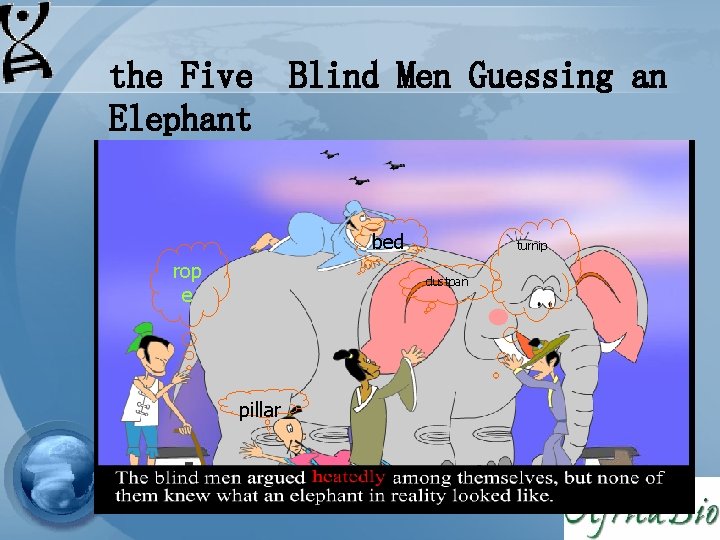
the Five Elephant Blind Men Guessing an bed rop e turnip dustpan pillar
“Farmer have problems and university have departments” (Lieblein & Francis, 2002) Because course are generally designed to cover the information in specific portion of established disciplines p. Each suffers from the same handicap (each in a specific discipline), and each approaches a different part of the ‘Elephant’ (specialization). p “We live in era of specialists”(Riches, 2002), being good at so called “Therapeutic intervention ” , but ‘a tiny error makes a magnitude differences”( Chinese idiom). p. Such teaching and research threatens the realization of Sustainable Agriculture( Mac. Rae et al. , 1989; Ison, 1990)
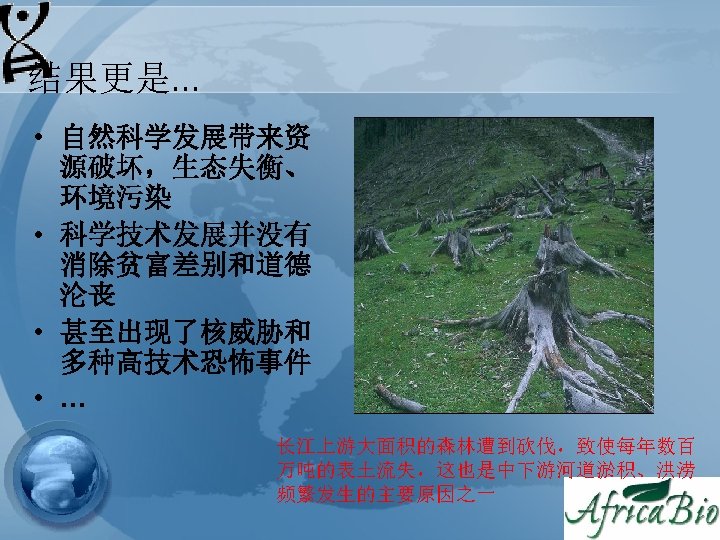
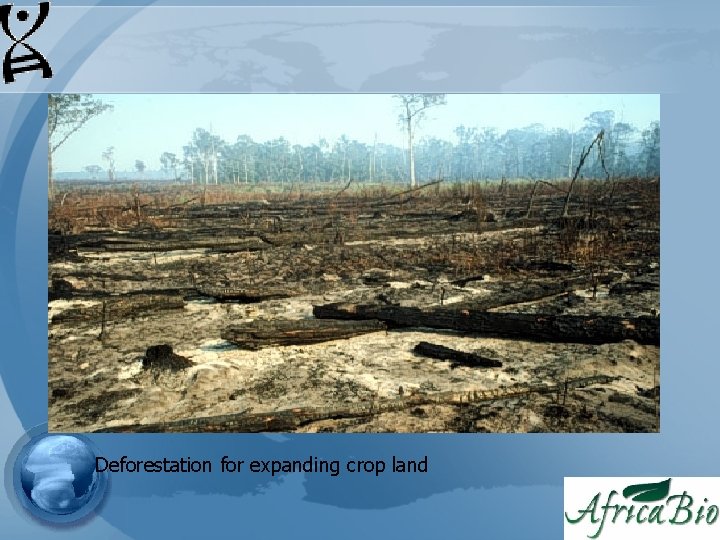
Deforestation for expanding crop land
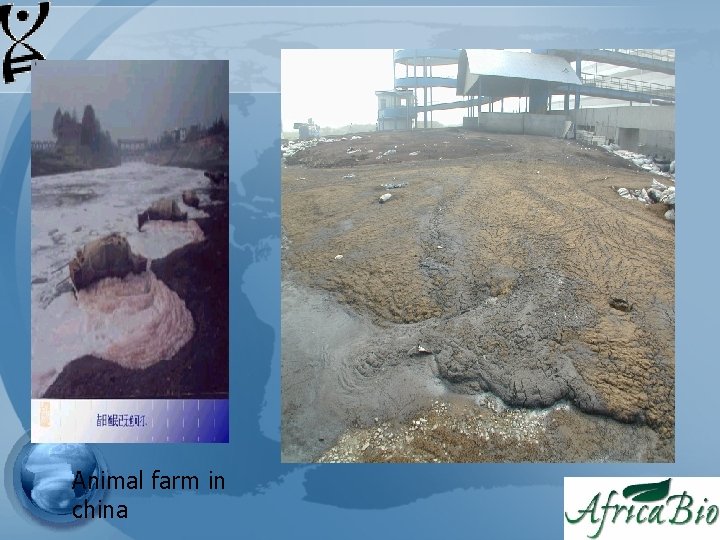
Animal farm in china
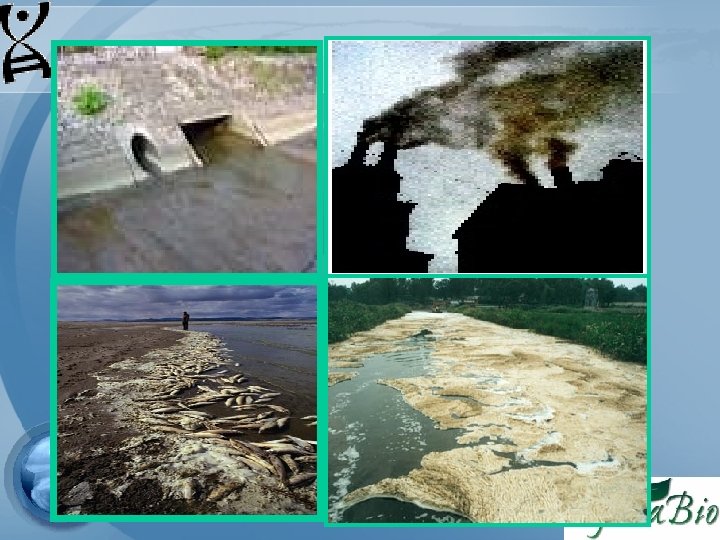
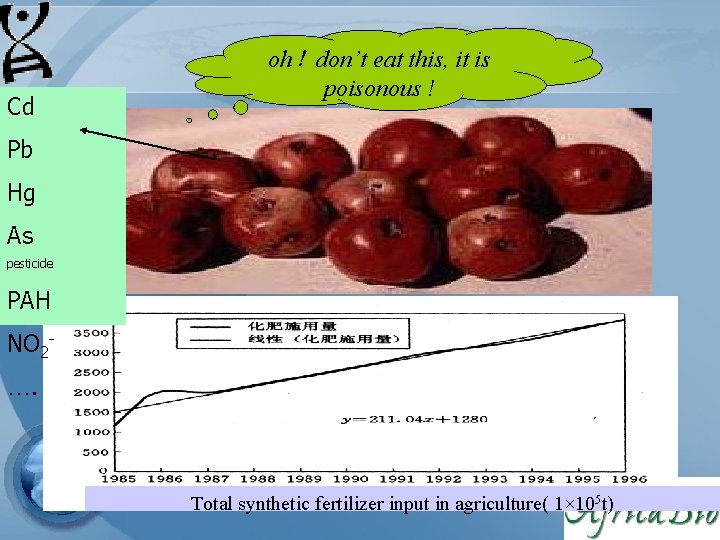
Cd oh!don’t eat this, it is poisonous ! Pb Hg As pesticide PAH NO 2…. Total synthetic fertilizer input in agriculture( 1× 10⁵ t)
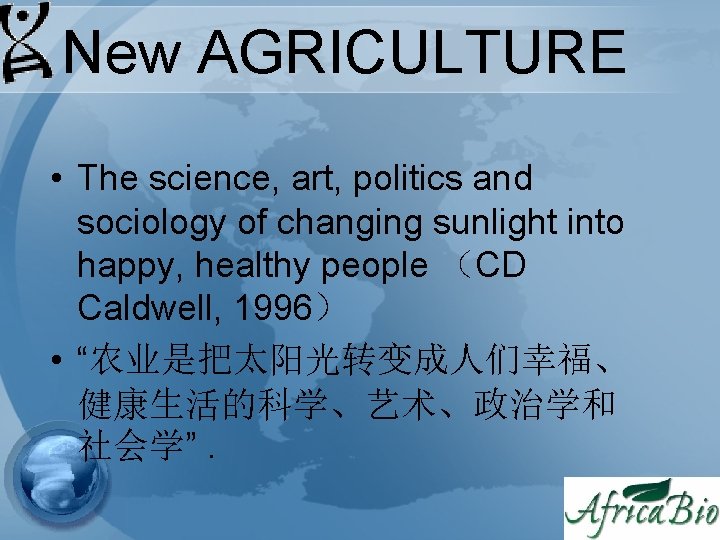
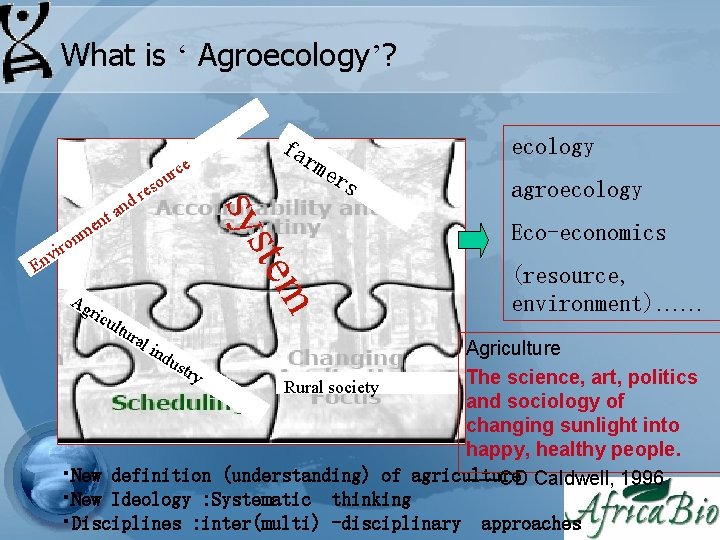
New AGRICULTURE • The science, art, politics and sociology of changing sunlight into happy, healthy people (CD Caldwell, 1996) • “农业是把太阳光转变成人们幸福、 健康生活的科学、艺术、政治学和 社会学”.
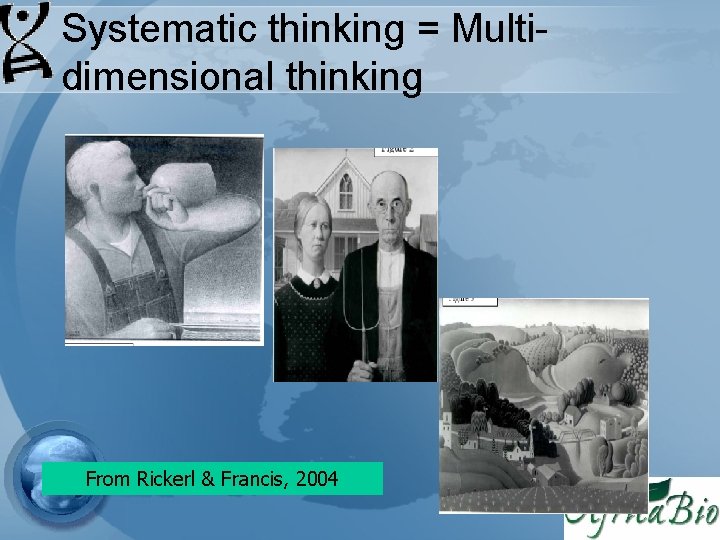
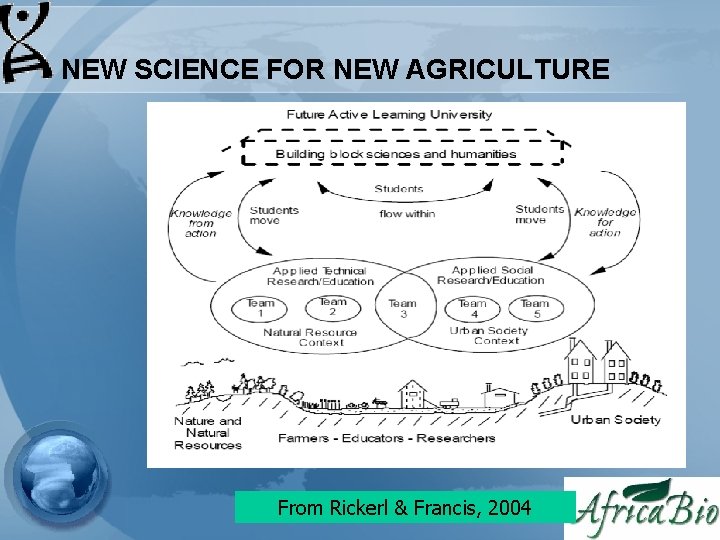
Systematic thinking = Multidimensional thinking From Rickerl & Francis, 2004
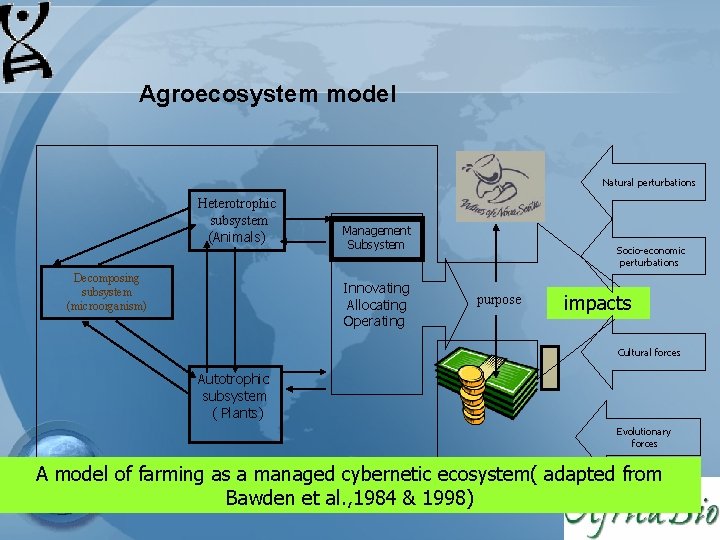
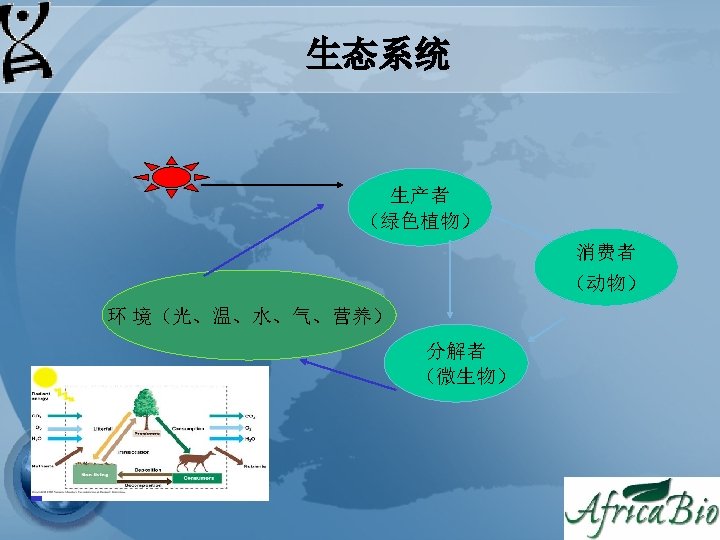
Agroecosystem model Natural perturbations Heterotrophic subsystem (Animals) Decomposing subsystem (microorganism) Management Subsystem Innovating Allocating Operating Socio-economic perturbations purpose impacts Cultural forces Autotrophic subsystem ( Plants) Evolutionary forces A model of farming as a managed cybernetic ecosystem( adapted from Bawden et al. , 1984 & 1998)
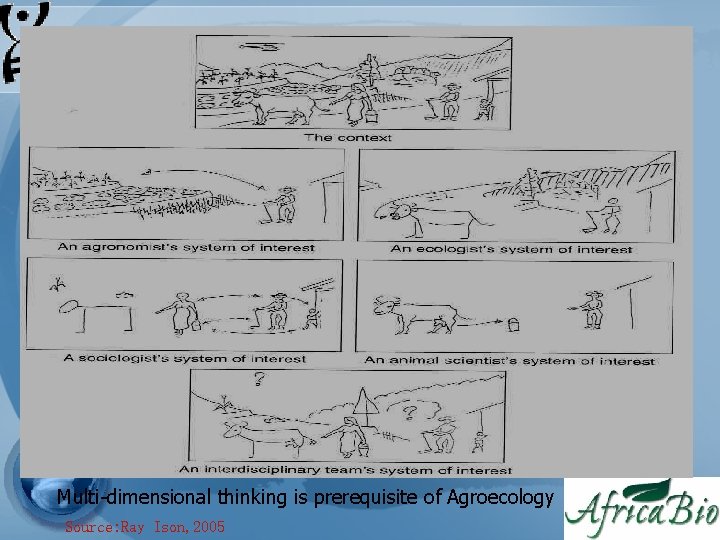
Multi-dimensional thinking is prerequisite of Agroecology Source: Ray Ison, 2005
NEW SCIENCE FOR NEW AGRICULTURE From Rickerl & Francis, 2004
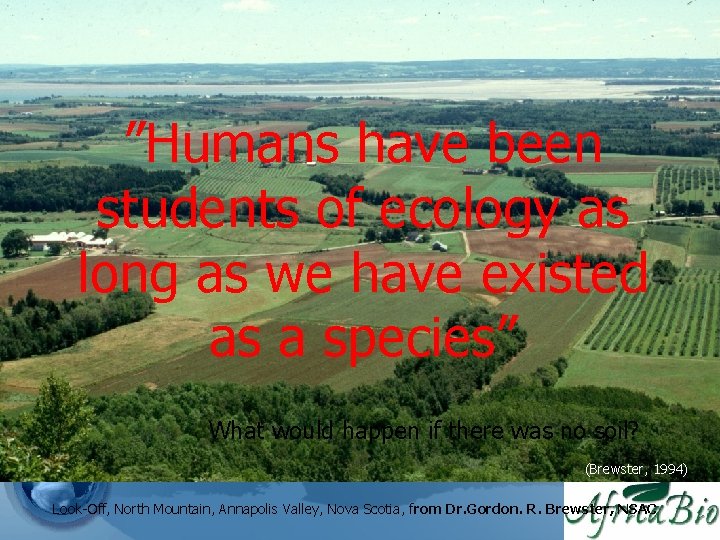
”Humans have been students of ecology as long as we have existed as a species” What would happen if there was no soil? (Brewster, 1994) Look-Off, North Mountain, Annapolis Valley, Nova Scotia, from Dr. Gordon. R. Brewster, NSAC
生态学基础知识 The Elementary Knowledge of Ecology
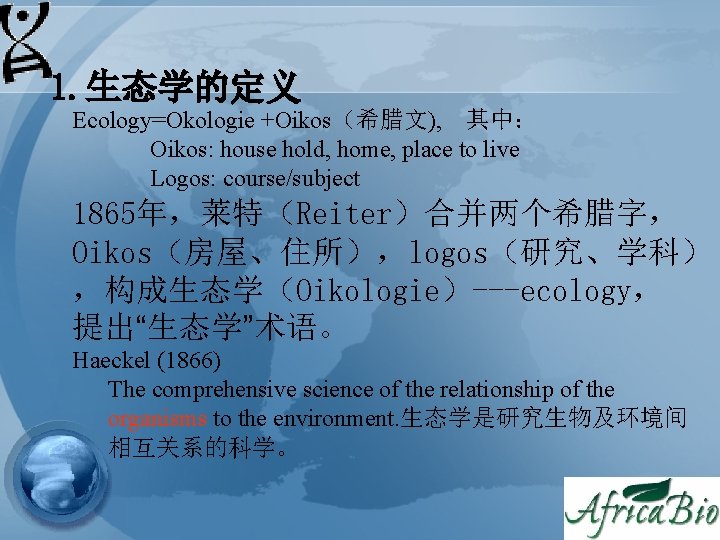
1. 生态学的定义 Ecology=Okologie +Oikos(希腊文), 其中: Oikos: house hold, home, place to live Logos: course/subject 1865年,莱特(Reiter)合并两个希腊字, Oikos(房屋、住所),logos(研究、学科) ,构成生态学(Oikologie)---ecology, 提出“生态学”术语。 Haeckel (1866) The comprehensive science of the relationship of the organisms to the environment. 生态学是研究生物及环境间 相互关系的科学。
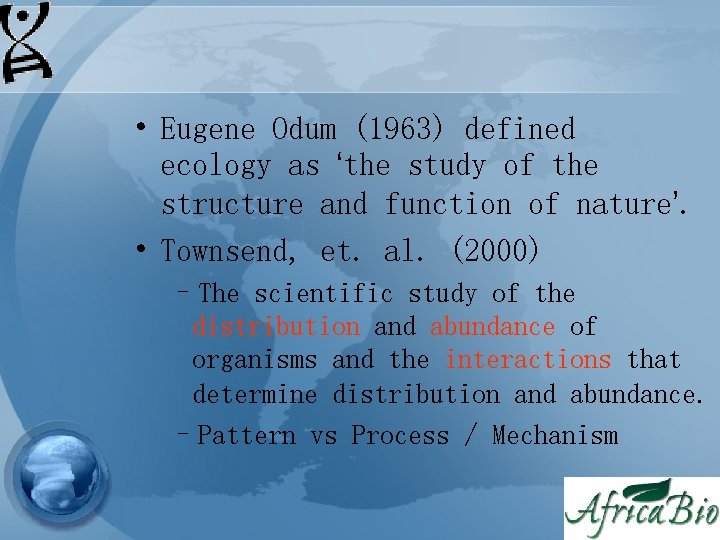
• Eugene Odum (1963) defined ecology as ‘the study of the structure and function of nature’. • Townsend, et. al. (2000) –The scientific study of the distribution and abundance of organisms and the interactions that determine distribution and abundance. –Pattern vs Process / Mechanism
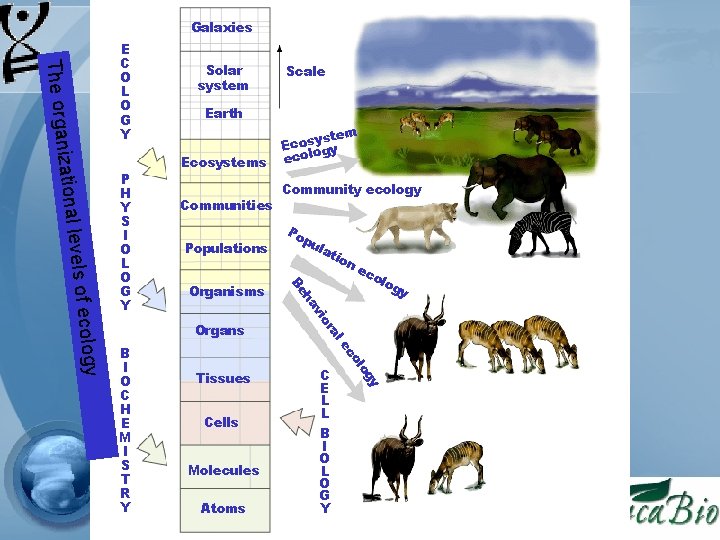
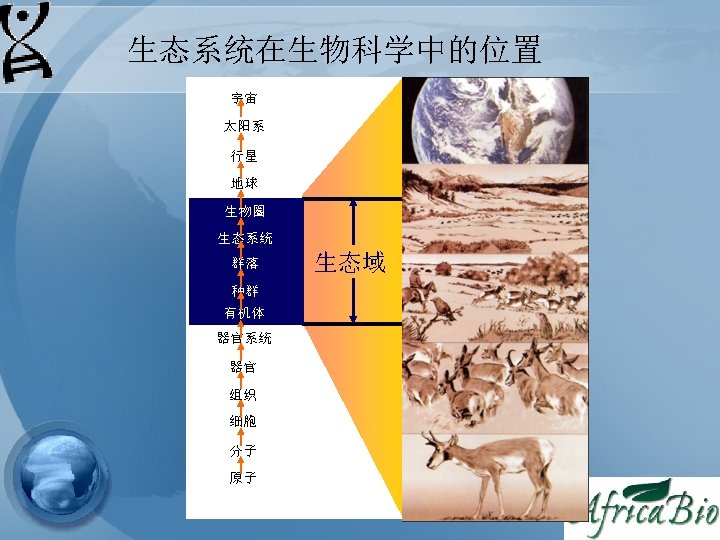
Galaxies Earth Ecosystems Communities Populations Organisms ystem Ecosogy ecol Community ecology Po pu lat ion Tissues C E L L Molecules Atoms olo B I O L O G Y gy lo co Cells ec e al Organs or B I O C H E M I S T R Y Scale vi ha P H Y S I O L O G Y Solar system Be cology evels of e izational l The organ E C O L O G Y gy
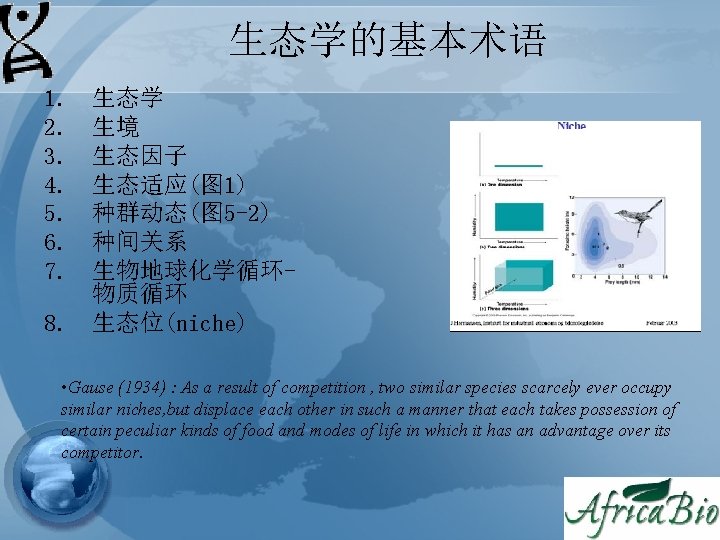
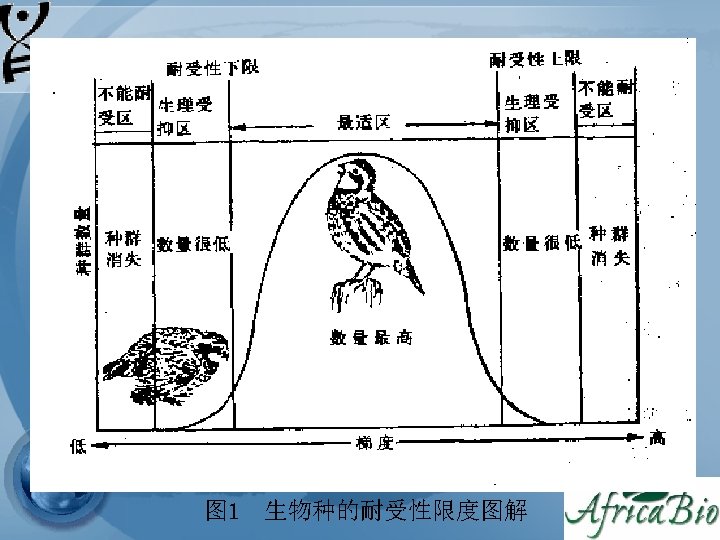
生态学的基本术语 1. 2. 3. 4. 5. 6. 7. 生态学 生境 生态因子 生态适应(图 1) 种群动态(图 5 -2) 种间关系 生物地球化学循环物质循环 8. 生态位(niche) • Gause (1934) : As a result of competition , two similar species scarcely ever occupy similar niches, but displace each other in such a manner that each takes possession of certain peculiar kinds of food and modes of life in which it has an advantage over its competitor.
种间关系 • 互利共生(mutualism) : 。 • 偏利共生(commensalism) • 原始协作 (protocooperation) • 竞争(competition) • 捕食(predation) • 寄生(parasitism) • 偏害(amensalism)
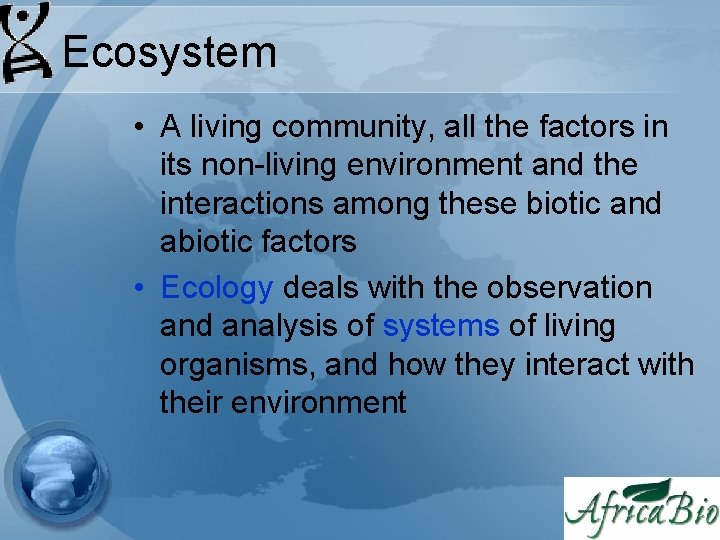
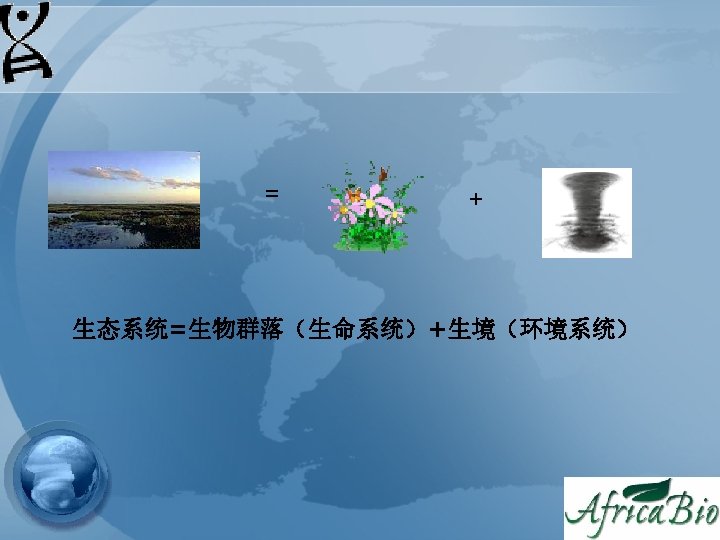
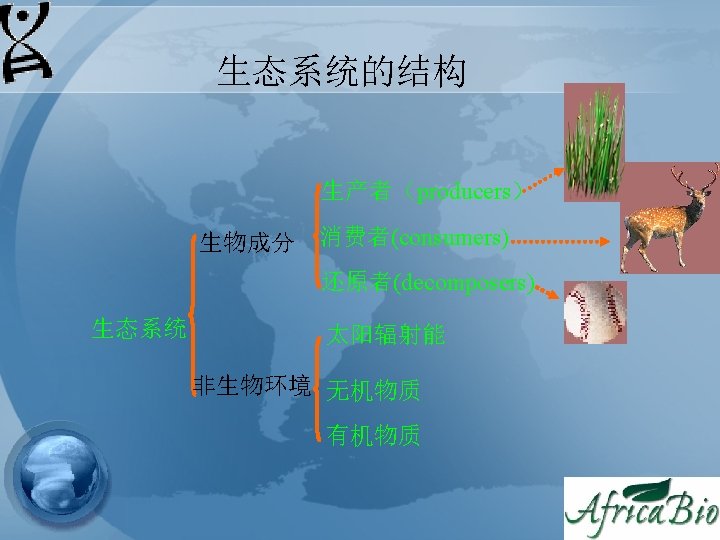
Ecosystem • A living community, all the factors in its non-living environment and the interactions among these biotic and abiotic factors • Ecology deals with the observation and analysis of systems of living organisms, and how they interact with their environment
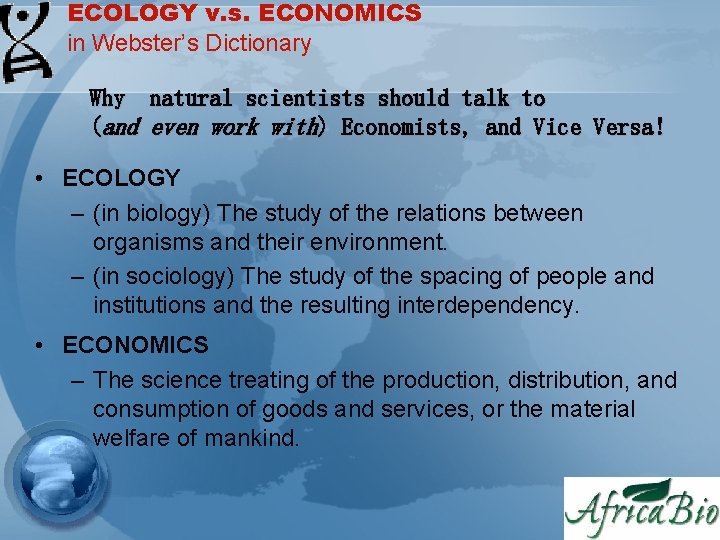
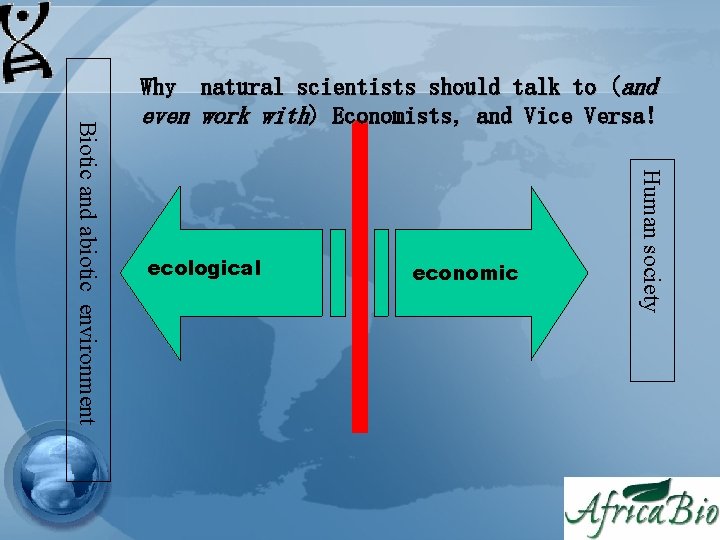
ECOLOGY v. s. ECONOMICS in Webster’s Dictionary Why natural scientists should talk to (and even work with) Economists, and Vice Versa! • ECOLOGY – (in biology) The study of the relations between organisms and their environment. – (in sociology) The study of the spacing of people and institutions and the resulting interdependency. • ECONOMICS – The science treating of the production, distribution, and consumption of goods and services, or the material welfare of mankind.
ecological economic Human society Biotic and abiotic environment Why natural scientists should talk to (and even work with) Economists, and Vice Versa!
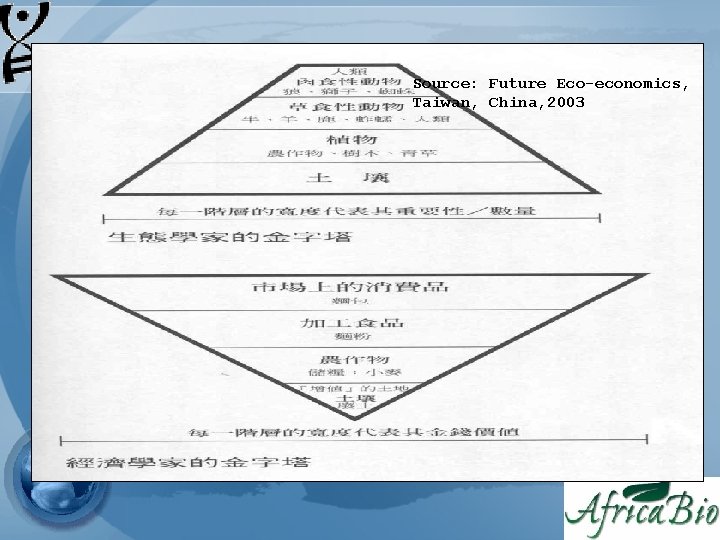
Source: Future Eco-economics, Taiwan, China, 2003
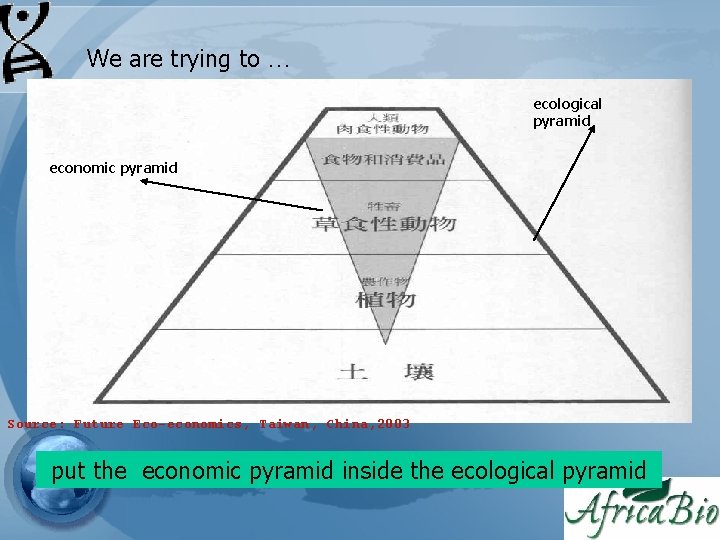
We are trying to … ecological pyramid economic pyramid Source: Future Eco-economics, Taiwan, China, 2003 put the economic pyramid inside the ecological pyramid
What is ‘ Agroecology’? e rc u so an m on r i v tem En Ag rm sys t en e d r fa ric ult ura l in er ecology s agroecology Eco-economics (resource, environment)…… Agriculture y The science, art, politics Rural society and sociology of changing sunlight into happy, healthy people. • New definition (understanding) of agriculture -----CD Caldwell, 1996 • New Ideology : Systematic thinking • Disciplines : inter(multi) -disciplinary approaches du str
What is Agro-ecology? (Section 1 Unit 2)
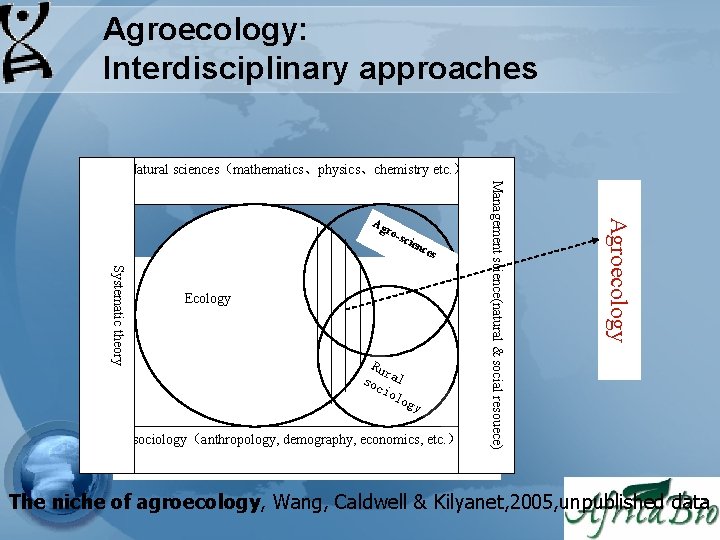
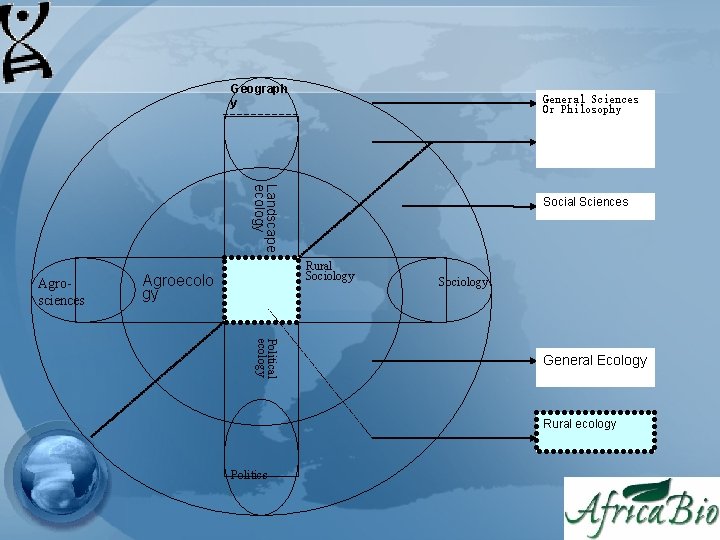
Agroecology: Interdisciplinary approaches Natural sciences(mathematics、physics、chemistry etc. ) enc es Systematic theory Ecology Rur soc al iol ogy sociology(anthropology, demography, economics, etc. ) Agroecology rosci Management science(natural & social resouece) Ag The niche of agroecology, Wang, Caldwell & Kilyanet, 2005, unpublished data
Designing an interdisciplinary agroecology curriculum and major in agricultural university in developing countries
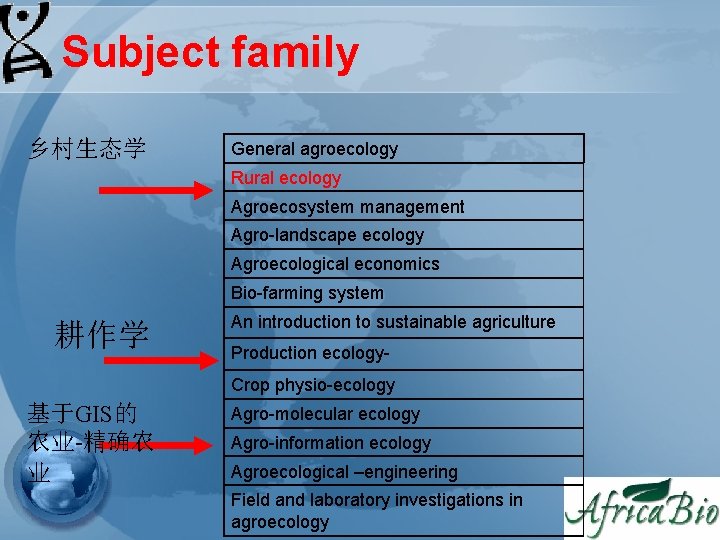
Subject family 乡村生态学 General agroecology Rural ecology Agroecosystem management Agro-landscape ecology Agroecological economics Bio-farming system 耕作学 An introduction to sustainable agriculture Production ecology. Crop physio-ecology 基于GIS的 农业-精确农 业 Agro-molecular ecology Agro-information ecology Agroecological –engineering Field and laboratory investigations in agroecology
Geograph y General Sciences Or Philosophy Natural Sciences Landscape ecology Agrosciences Social Sciences Rural Sociology Agroecolo gy Sociology Political ecology General Ecology Rural ecology Politics
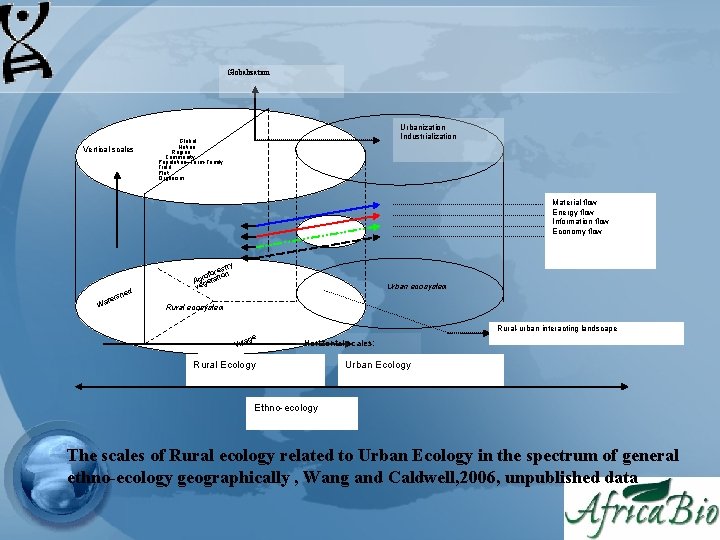
Globalization Vertical scales Urbanization Industrialization Global Nation Region Community Population–Farm-Family Field Plot Organism Material flow Energy flow Information flow Economy flow d he ters Wa try res ofotation r g A ege v Urban ecosystem Rural-urban interacting landscape e illag V Horizontal scales: Rural Ecology Urban Ecology Ethno-ecology The scales of Rural ecology related to Urban Ecology in the spectrum of general ethno-ecology geographically , Wang and Caldwell, 2006, unpublished data
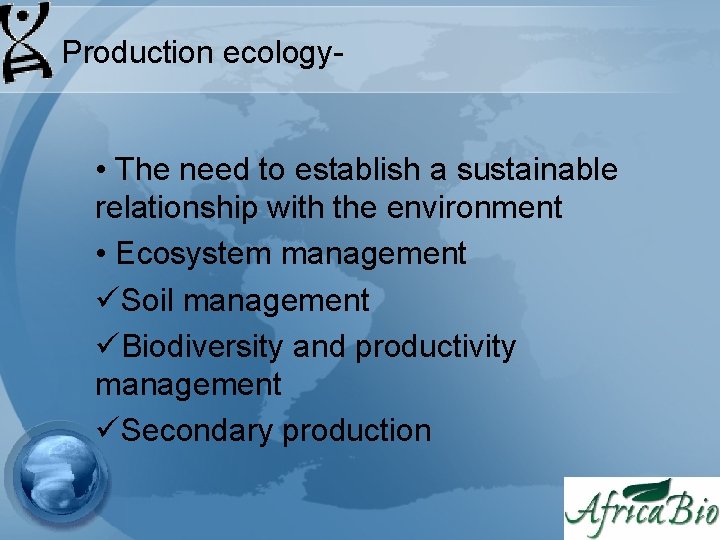
Production ecology- • The need to establish a sustainable relationship with the environment • Ecosystem management üSoil management üBiodiversity and productivity management üSecondary production
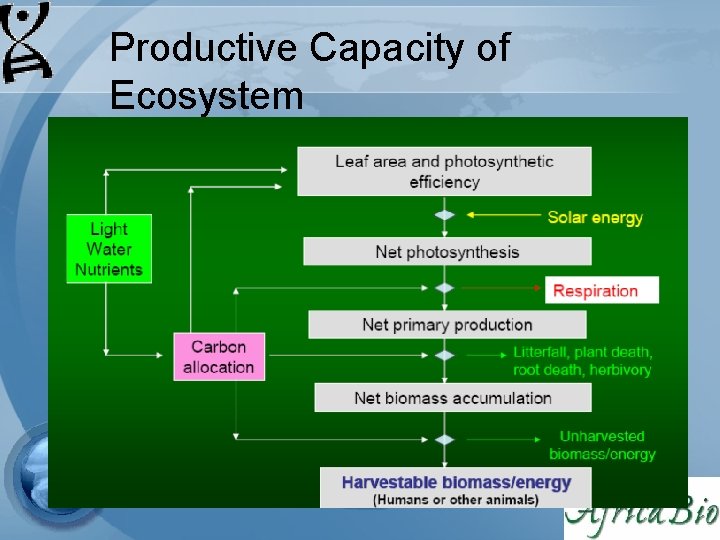
Productive Capacity of Ecosystem
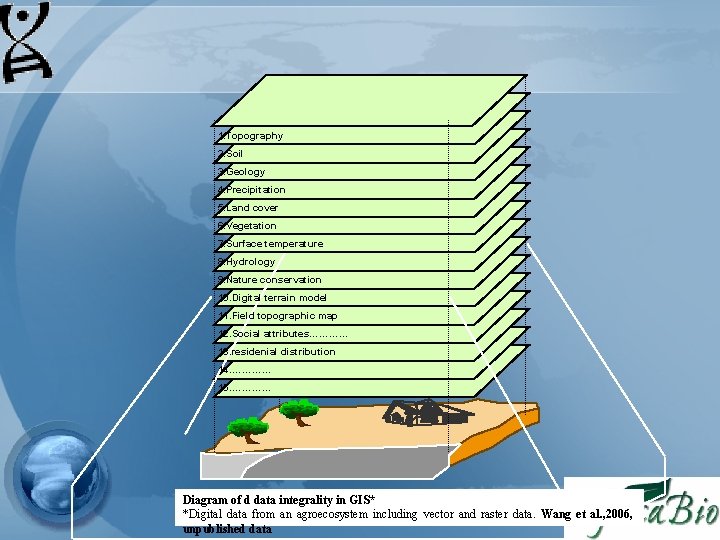
1. Topography 2. Soil 3. Geology 4. Precipitation 5. Land cover 6. Vegetation 7. Surface temperature 8. Hydrology 9. Nature conservation 10. Digital terrain model 11. Field topographic map 12. Social attributes………… 13. residenial distribution 14. ………… 15. ………… Diagram of d data integrality in GIS* *Digital data from an agroecosystem including vector and raster data. Wang et al. , 2006, unpublished data
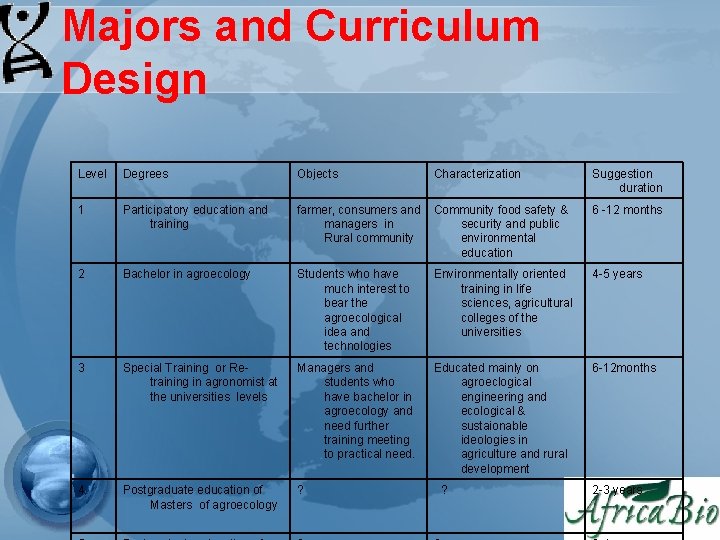
Majors and Curriculum Design Level Degrees Objects Characterization Suggestion duration 1 Participatory education and training farmer, consumers and Community food safety & managers in security and public Rural community environmental education 6 -12 months 2 Bachelor in agroecology Students who have much interest to bear the agroecological idea and technologies Environmentally oriented training in life sciences, agricultural colleges of the universities 4 -5 years 3 Special Training or Retraining in agronomist at the universities levels Managers and students who have bachelor in agroecology and need further training meeting to practical need. Educated mainly on agroeclogical engineering and ecological & sustaionable ideologies in agriculture and rural development 6 -12 months 4 Postgraduate education of Masters of agroecology ? ? 2 -3 years
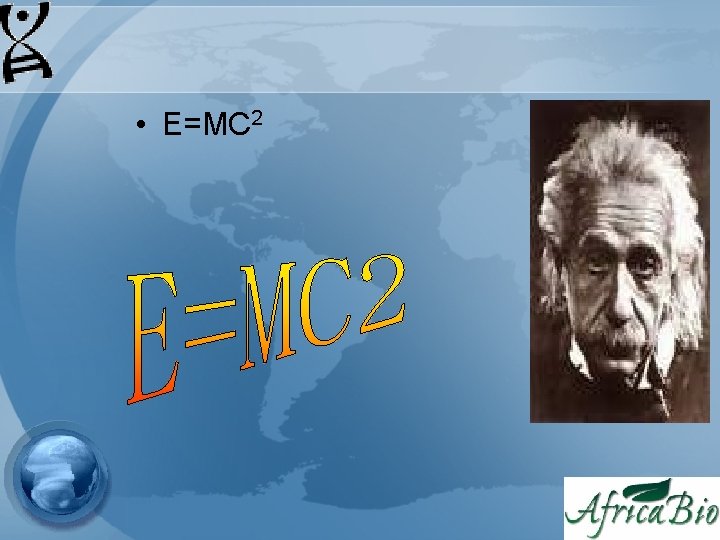
• E=MC 2
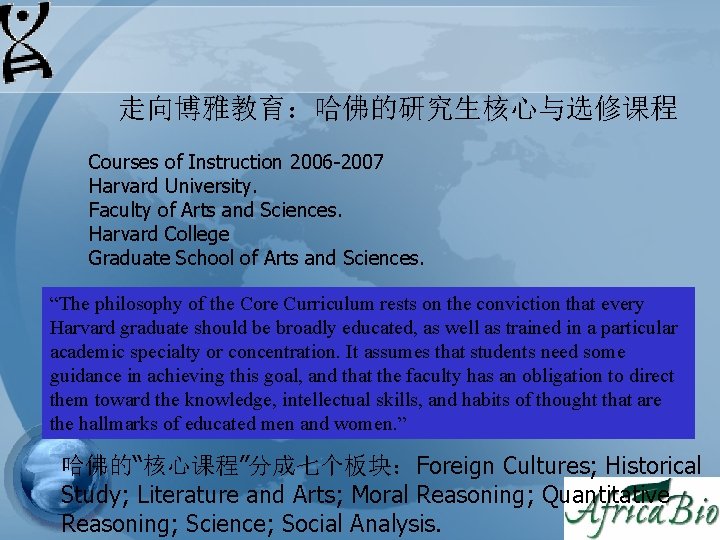
走向博雅教育:哈佛的研究生核心与选修课程 Courses of Instruction 2006 -2007 Harvard University. Faculty of Arts and Sciences. Harvard College Graduate School of Arts and Sciences. “The philosophy of the Core Curriculum rests on the conviction that every Harvard graduate should be broadly educated, as well as trained in a particular academic specialty or concentration. It assumes that students need some guidance in achieving this goal, and that the faculty has an obligation to direct them toward the knowledge, intellectual skills, and habits of thought that are the hallmarks of educated men and women. ” 哈佛的“核心课程”分成七个板块:Foreign Cultures; Historical Study; Literature and Arts; Moral Reasoning; Quantitative Reasoning; Science; Social Analysis.
只有生命的投入, 才能改变生命 ‘Thinking Like a Mountain’ ----By Aldo Leopold, 1949 Who will you Be ? Are You Sure? Are You Ready?