
Writing Publishable Article From TitleAbstract to A Journal

Writing Publishable Article: From Title&Abstract to A Journal Paper Teddy Mantoro Email: teddy@ieee. org
Discussion Pointers 1. 2. 3. 4. 5. Title AI Method Induction Approach Writing Abstract Writing Introduction
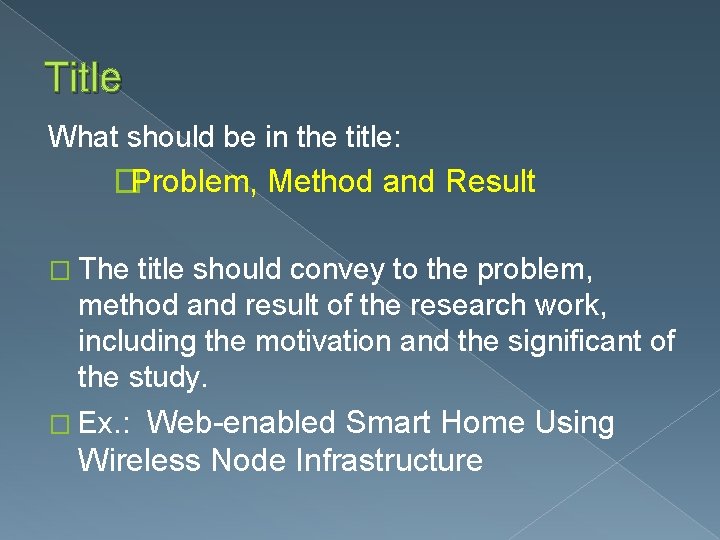
Title What should be in the title: �Problem, Method and Result � The title should convey to the problem, method and result of the research work, including the motivation and the significant of the study. � Ex. : Web-enabled Smart Home Using Wireless Node Infrastructure
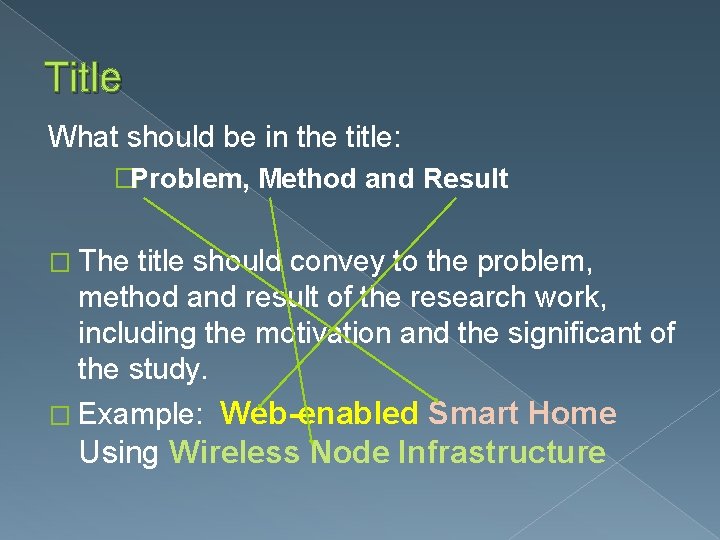
Title What should be in the title: �Problem, Method and Result � The title should convey to the problem, method and result of the research work, including the motivation and the significant of the study. � Example: Web-enabled Smart Home Using Wireless Node Infrastructure
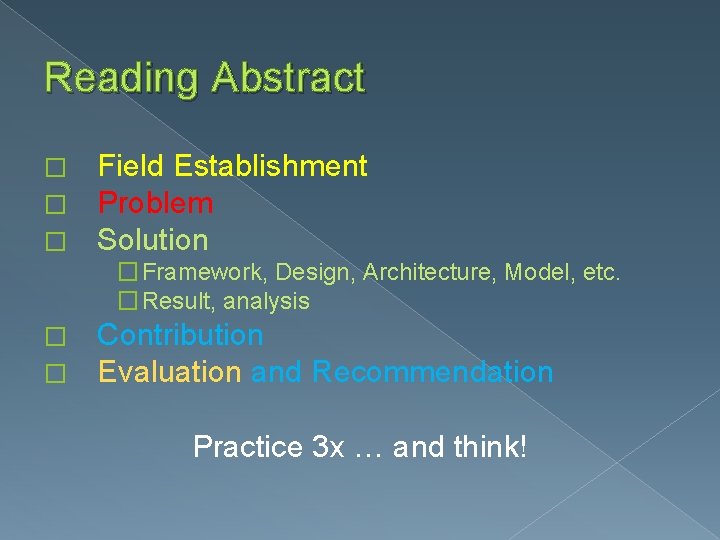
Reading Abstract � � � Field Establishment Problem Solution � Framework, Design, Architecture, Model, etc. � Result, analysis � � Contribution Evaluation and Recommendation Practice 3 x … and think!

Exercises � Evaluate your own abstract
Web-enabled Smart Home Using Wireless Node Infrastructure ABSTRACT This paper presents a framework for a smart home which uses wireless nodes infrastructure. The framework is developed based on the aims to build a smart home that can be implemented easily without the hassle of major alteration to current condition of the house. A prototype which built based on the proposed framework is presented as a proof of concept of its implementation. The prototype which we called Integ’s Smart Home system and also allows its occupant to control the home through the Internet, Wi-Fi and GPRS enabled mobile devices. Simulation results on typical home occupant’s whole day activities during working days and not working days are presented and discussed. The result shows that the occupant spent their time mostly at home, not outside, either during working day (65%) or not working day (93. 75%). This results show that home is a very important place for the occupant. Keywords: smart sensor, smart-home, wireless home network, home monitoring, home automation, pervasive computing.
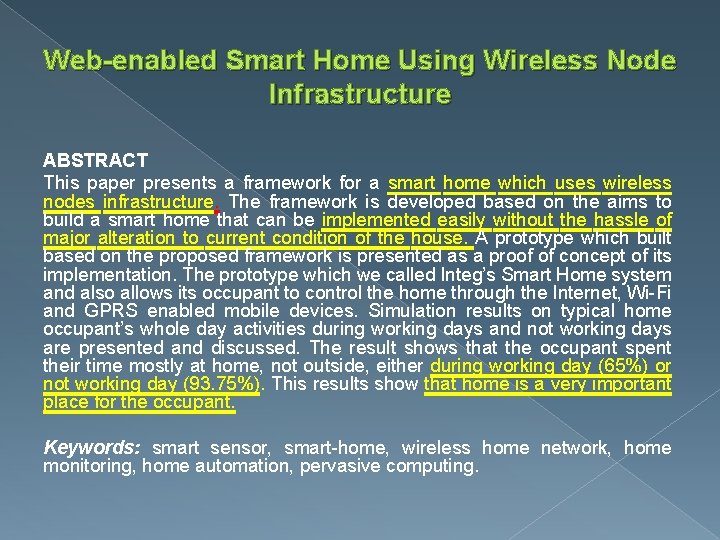
Web-enabled Smart Home Using Wireless Node Infrastructure ABSTRACT This paper presents a framework for a smart home which uses wireless nodes infrastructure. The framework is developed based on the aims to build a smart home that can be implemented easily without the hassle of major alteration to current condition of the house. A prototype which built based on the proposed framework is presented as a proof of concept of its implementation. The prototype which we called Integ’s Smart Home system and also allows its occupant to control the home through the Internet, Wi-Fi and GPRS enabled mobile devices. Simulation results on typical home occupant’s whole day activities during working days and not working days are presented and discussed. The result shows that the occupant spent their time mostly at home, not outside, either during working day (65%) or not working day (93. 75%). This results show that home is a very important place for the occupant. Keywords: smart sensor, smart-home, wireless home network, home monitoring, home automation, pervasive computing.
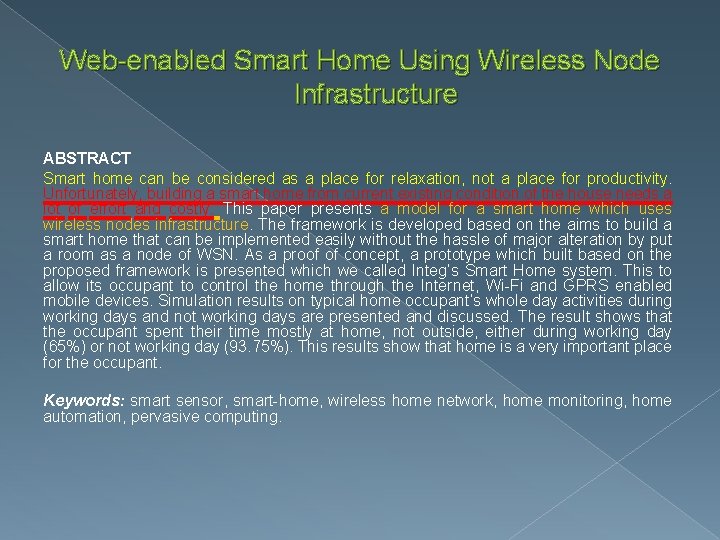
Web-enabled Smart Home Using Wireless Node Infrastructure ABSTRACT Smart home can be considered as a place for relaxation, not a place for productivity. Unfortunately, building a smart home from current existing condition of the house needs a lot of effort and costly. This paper presents a model for a smart home which uses wireless nodes infrastructure. The framework is developed based on the aims to build a smart home that can be implemented easily without the hassle of major alteration by put a room as a node of WSN. As a proof of concept, a prototype which built based on the proposed framework is presented which we called Integ’s Smart Home system. This to allow its occupant to control the home through the Internet, Wi-Fi and GPRS enabled mobile devices. Simulation results on typical home occupant’s whole day activities during working days and not working days are presented and discussed. The result shows that the occupant spent their time mostly at home, not outside, either during working day (65%) or not working day (93. 75%). This results show that home is a very important place for the occupant. Keywords: smart sensor, smart-home, wireless home network, home monitoring, home automation, pervasive computing.
Edge Features and Geometrical Properties based Approach for Vehicle License Plate Detection and Localization ABSTRACT Frequently, there is a need to identify vehicle license plates (VLP) for security. The extracted information from VLP is used for enforcement, access-control, and flow management, e. g. to keep a time record for automatic payment calculations or to fight against crime. That’s make license plate detection crucial and inevitable in the VLP recognition system. This paper presents a robust method to detect and localize license plates in images. Especially we focus on the Moroccan’s VLP. The proposed approach is based on edge features and characteristics of license plate characters. Various images including Moroccan’s VLP were used to evaluate the proposed method. The experimental results show that our system can efficiently detect and localize the Moroccan’s VLP in the images. Indeed, the recall/precision curve proves that 95% precision rate is obtained for recall rate value equals to 81%. In addition, the standard measure of quality is equal to 87. 44 %. Keywords: License plate, Vehicle License Plate detection, image text detection, Vehicle License plate localization, Component analysis, Plate region extraction, Image processing.
Edge Features and Geometrical Properties based Approach for Vehicle License Plate Detection and Localization ABSTRACT Frequently, there is a need to identify vehicle license plates (VLP) for security. The extracted information from VLP is not an easy task in enforcement, access-control, and flow management, in regard to keep a time record for automatic payment calculations or to fight against crime. That’s make license plate detection crucial and inevitable in the VLP recognition system. This paper presents a robust method to detect and localize license plates in images. Especially we focus on the Moroccan’s VLP. The proposed approach is based on edge features and characteristics of license plate characters. Various images including Moroccan’s VLP were used to evaluate the proposed method. The experimental results show that our system can efficiently detect and localize the Moroccan’s VLP in the images. Indeed, the recall/precision curve proves that 95% precision rate is obtained for recall rate value equals to 81%. In addition, the standard measure of quality is equal to 87. 44 %. Keywords: License plate, Vehicle License Plate detection, image text detection, Vehicle License plate localization, Component analysis, Plate region extraction, Image processing.
Application Development of Mobile Phone Busway Digital Route Map (Case Study: Jakarta Indonesia) ABSTRACT The transportation pathway is the major problem for big cities like Jakarta. The increasing number of vehicles passing by each time both cars, motorcycles and public transportations have an impact on the density of streets in the capital resulting in congestion. Therefore the Province Government of DKI Jakarta provides an alternative to build a ground freight transportation system (Transjakarta busway). Lack of media for passengers to know the busway route, only the information provided in each bulletin board, it is often confusing. Therefore it needs information services that can provide information busway route with multimedia and mobile technology. Researchers used Suyanto method which is extended from Arc Luther method to development this multimedia application. The application can provide information busway lane route to public especially the Transjakarta busway users and mobile phonebased applications that can provide easy access. Keywords: Development, Mobile phone, Digital map, busway, Transjakarta
Application Development of Mobile Phone Busway Digital Route Map (Case Study: Jakarta Indonesia) ABSTRACT The transportation pathway is the major problem for big cities like Jakarta. The increasing number of vehicles passing by each time both cars, motorcycles and public transportations have an impact on the density of streets in the capital resulting in congestion. Therefore the Province Government of DKI Jakarta provides an alternative to build a ground freight transportation system (Transjakarta busway). Lack of media for passengers to know the busway route, only the information provided in each bulletin board, it is often confusing. Therefore it needs information services that can provide information busway route with multimedia and mobile technology. Researchers used Suyanto method which is extended from Arc Luther method to development this multimedia application. The application can provide information busway lane route to public especially the Transjakarta busway users and mobile phonebased applications that can provide easy access. Keywords: Development, Mobile phone, Digital map, busway, Transjakarta
Example of a good abstract Video on Demand (Vo. D) via the internet had been introduced in Asia around 1990, in Indonesia it began in 2011, one of them was Groovia TV. Unfortunately, development of the Vo. D has not been used optimally in the field of education, especially for distance learning. This is caused by the video quality is not good enough, especially on mobile devices. This thesis, proposes a solution by providing a good video quality based the calculation Quality of Service (Qo. S). The aim of this study is to provide the acceptable Vo. D quality, especially for users on mobile devices based on Android. This research used Pyramid Broadcasting algorithm to earn good quality implemented on the clientserver network. In the experimental set-up, a proxy server is used to manage the broadcast server by utilize a load balance technique in order to balance the video distribution in the server maintained. This researchcontributed in providing a deliveryservice of distance learning via the internet, especially with Vo. D using Pyramid Broadcasting algorithm to make the video pictures acceptable for the userson mobile Android. Keywords: pyramid broadcasting, video on demand, quality of service, client-server, proxy server, broadcast server
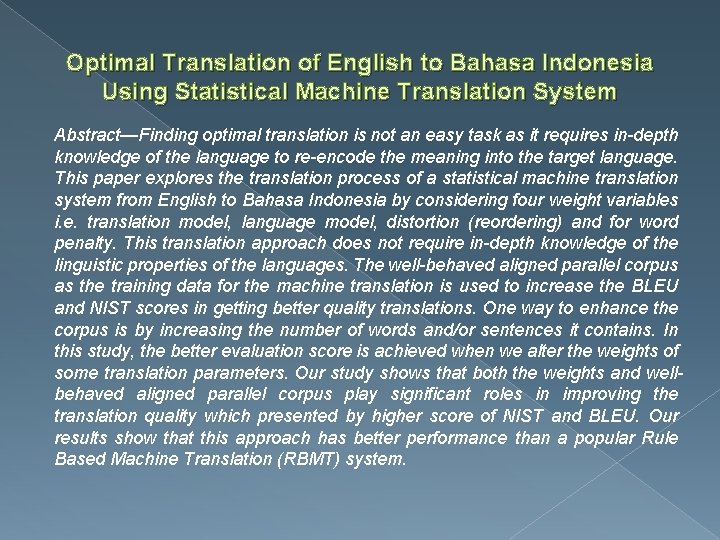
Optimal Translation of English to Bahasa Indonesia Using Statistical Machine Translation System Abstract—Finding optimal translation is not an easy task as it requires in-depth knowledge of the language to re-encode the meaning into the target language. This paper explores the translation process of a statistical machine translation system from English to Bahasa Indonesia by considering four weight variables i. e. translation model, language model, distortion (reordering) and for word penalty. This translation approach does not require in-depth knowledge of the linguistic properties of the languages. The well-behaved aligned parallel corpus as the training data for the machine translation is used to increase the BLEU and NIST scores in getting better quality translations. One way to enhance the corpus is by increasing the number of words and/or sentences it contains. In this study, the better evaluation score is achieved when we alter the weights of some translation parameters. Our study shows that both the weights and wellbehaved aligned parallel corpus play significant roles in improving the translation quality which presented by higher score of NIST and BLEU. Our results show that this approach has better performance than a popular Rule Based Machine Translation (RBMT) system.

Hands on Writing Abstract
Exercises � Rewrite your abstract If needed … � Please everyone try to write using this approach and use your highlighter
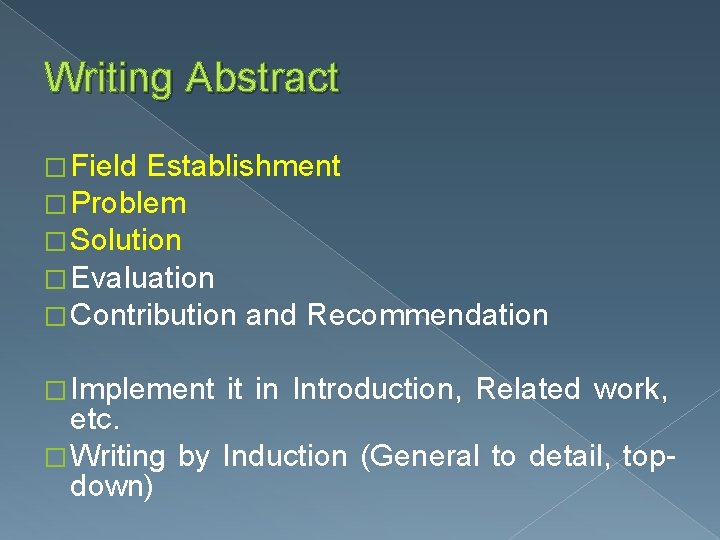
Writing Abstract � Field Establishment � Problem � Solution � Evaluation � Contribution and Recommendation � Implement it in Introduction, Related work, etc. � Writing by Induction (General to detail, topdown)
Hands on Writing Introduction
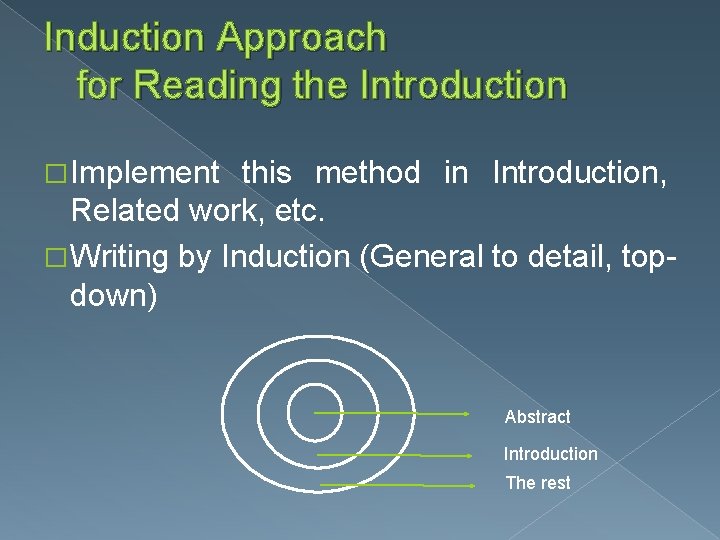
Induction Approach for Reading the Introduction � Implement this method in Introduction, Related work, etc. � Writing by Induction (General to detail, topdown) Abstract Introduction The rest
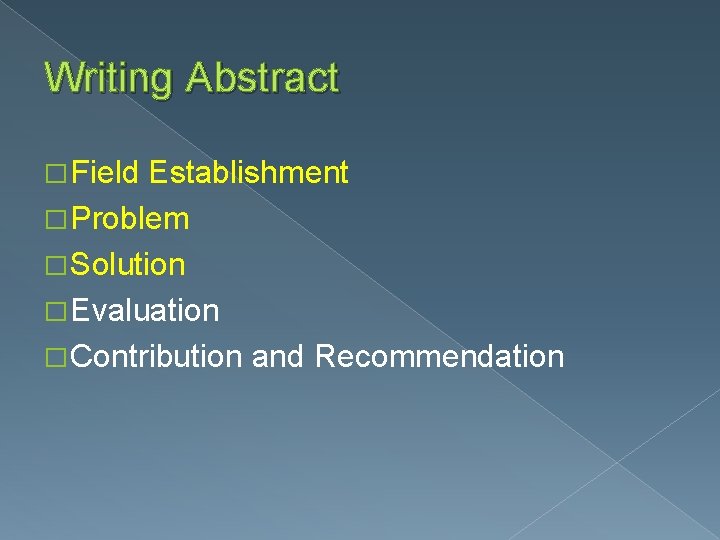
Writing Abstract � Field Establishment � Problem � Solution � Evaluation � Contribution and Recommendation
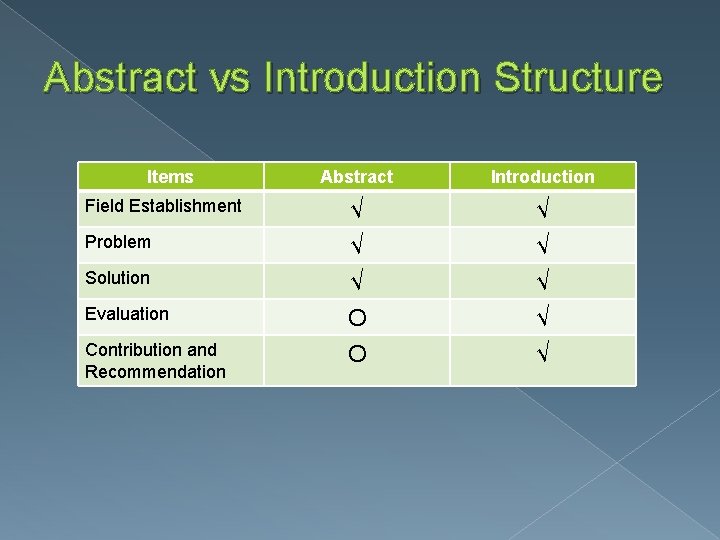
Abstract vs Introduction Structure Items Field Establishment Problem Solution Evaluation Contribution and Recommendation Abstract Introduction √ √ √ О О √ √ √
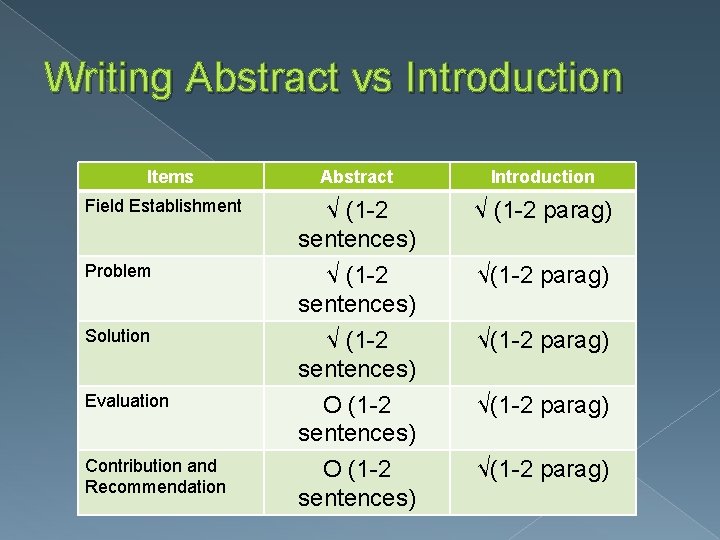
Writing Abstract vs Introduction Items Abstract Introduction Field Establishment √ (1 -2 sentences) √ (1 -2 parag) Problem √ (1 -2 sentences) √(1 -2 parag) Solution √ (1 -2 sentences) О (1 -2 sentences) √(1 -2 parag) Evaluation Contribution and Recommendation √(1 -2 parag)
Exercises � Evaluate your own introduction uses your highlighters
Writing Critical Reports ONE page of critical review report: 1. 2. 3. 4. 5. 6. Field Establishment Problem Solution Evaluation Contribution and Recommendation Critical review
Writing Critical Reports Magic numbers: � › › › � � 7, 7, 14 (42) 14, 14, 14 (56) STOP after two months. Start to do Mind Mapping from early beginning of your understanding Create a positioning table or the structure of your research work
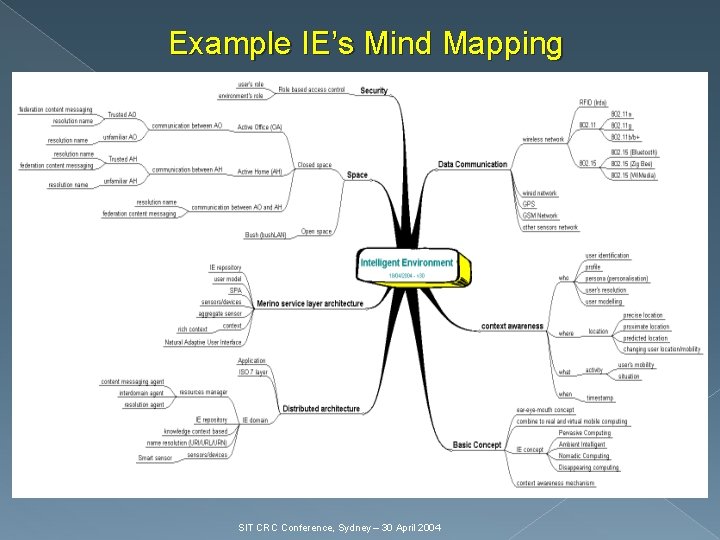
Example IE’s Mind Mapping SIT CRC Conference, Sydney – 30 April 2004
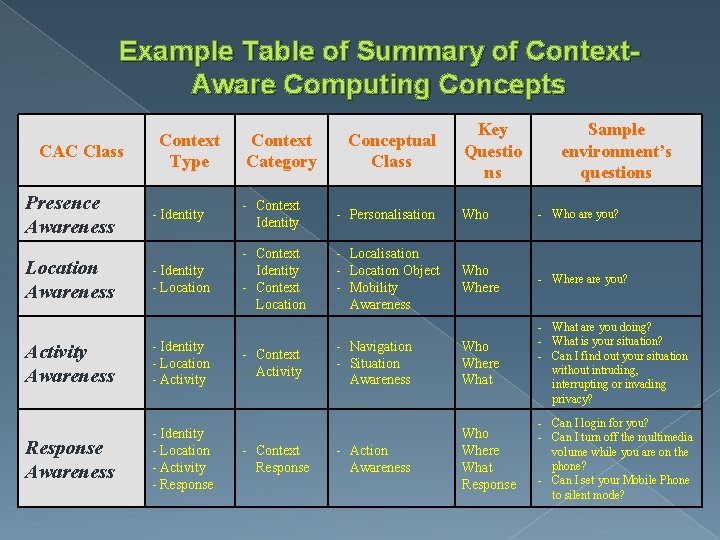
Example Table of Summary of Context. Aware Computing Concepts CAC Class Presence Awareness Location Awareness Context Type Context Category Conceptual Class Key Questio ns Sample environment’s questions - Identity - Context Identity - Personalisation Who - Who are you? - Identity - Location - Context Identity - Context Location - Localisation - Location Object - Mobility Awareness Who Where - Where are you? - Navigation - Situation Awareness Who Where What - What are you doing? - What is your situation? - Can I find out your situation without intruding, interrupting or invading privacy? - Action Awareness Who Where What Response - Can I login for you? - Can I turn off the multimedia volume while you are on the phone? - Can I set your Mobile Phone to silent mode? Activity Awareness - Identity - Location - Activity Response Awareness - Identity - Location - Activity - Response - Context Activity - Context Response
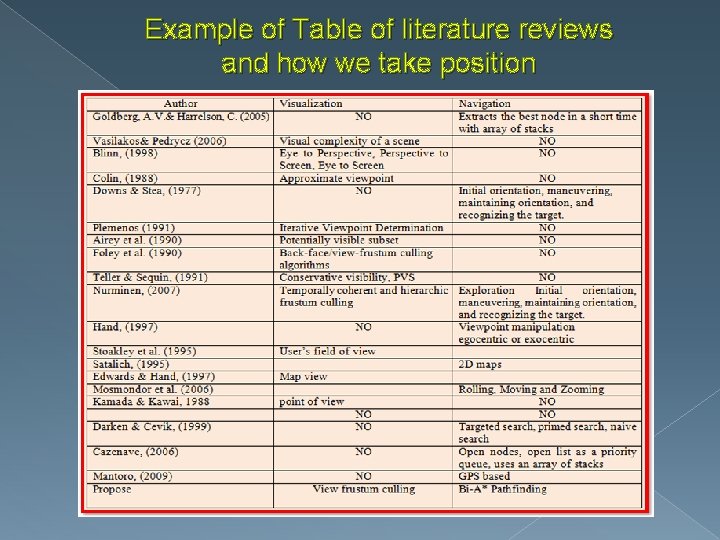
Example of Table of literature reviews and how we take position
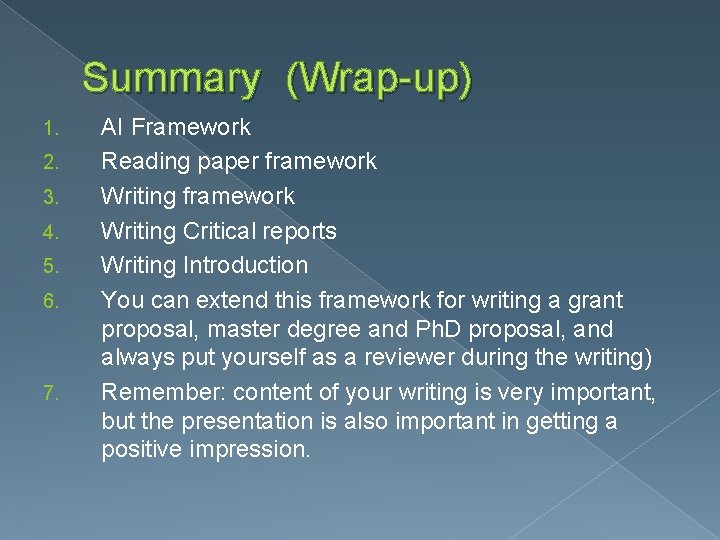
Summary (Wrap-up) 1. 2. 3. 4. 5. 6. 7. AI Framework Reading paper framework Writing Critical reports Writing Introduction You can extend this framework for writing a grant proposal, master degree and Ph. D proposal, and always put yourself as a reviewer during the writing) Remember: content of your writing is very important, but the presentation is also important in getting a positive impression.

Please submit your work to: penulisan. jurnal. ilmiah@gmail. com teddy@ieee. org

- Slides: 32