
Wide band speech introduction into Vo IP solutions
Wide band speech introduction into Vo. IP solutions 9 th June 2004 Gilbert DERVAL, Yannick MAHIEUX, D. DELEAM France Télécom - R&D Division Le présent document contient des informations qui sont la propriété de France Télécom. L'acceptation de ce document par son destinataire implique, de la part de ce dernier, la reconnaissance du caractère confidentiel de son contenu et l'engagement de n'en faire aucune reproduction, aucune transmission à des tiers, aucune divulgation et aucune utilisation commerciale sans l'accord préalable écrit de France Télécom R&D D 1 - 25/09/2020
Vo. IP : an opportunity for Wide band s Packets switching networks offer bit rate versatility s Wide bandwith links are available, even in access networks s IP services integration enables heterogeneous solutions s IP terminals become more and more intelligent QEmbedded codecs and signal processing France Télécom R&D La communication de ce document est soumise à autorisation de France Télécom R&D D 2 - 25/09/2020
What are the success conditions? s Limited impact on installed infrastructure QNetwork QServices platforms QTerminals s Interoperability with existing solutions s Short term availability s Clear IPR situation QSimplicity QLow cost France Télécom R&D La communication de ce document est soumise à autorisation de France Télécom R&D D 3 - 25/09/2020
Limited impact on network infastructure s Low bit rate increase s No need of additionnal signalling channels s Adaptability to traffic conditions s Versatility when faced with different access networks France Télécom R&D La communication de ce document est soumise à autorisation de France Télécom R&D D 4 - 25/09/2020
Low impact on service platforms Wide band / narrow band interoperability s No additionnal function in the call control equipment : Vo. IP protocols implement codec negotiation s No additionnal transcoder in gateways s Wide band messages on voice mail equally available from a wide band or a narrow band terminal France Télécom R&D La communication de ce document est soumise à autorisation de France Télécom R&D D 5 - 25/09/2020
Limited impact on terminals (1) s The simplest case : reuse of POTS QTransducers (earpiece, open listening speaker) weak bandwith frequency compensation for low frequencies (<300 Hz) and high frequencies (>3400 Hz) QNeed of an external box such as a Home Gateway including the software (codec, Vo. IP protocols, RTP/UDP/IP stack, …) s Softphones in PC : no problem QMultimedia equipment provides wide bandwith QPowerfull processors allow software implementation of complex algorithms (codecs, echo cancellation, …) France Télécom R&D La communication de ce document est soumise à autorisation de France Télécom R&D D 6 - 25/09/2020
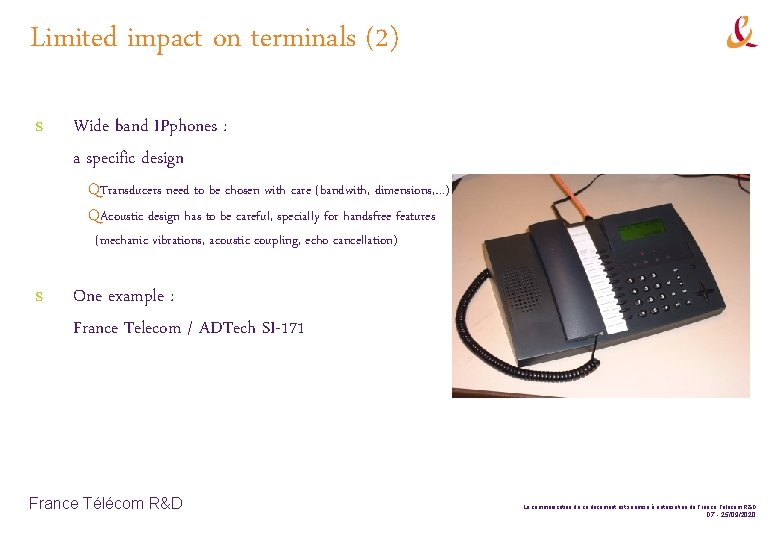
Limited impact on terminals (2) s Wide band IPphones : a specific design QTransducers need to be chosen with care (bandwith, dimensions, …) QAcoustic design has to be careful, specially for handsfree features (mechanic vibrations, acoustic coupling, echo cancellation) s One example : France Telecom / ADTech SI-171 France Télécom R&D La communication de ce document est soumise à autorisation de France Télécom R&D D 7 - 25/09/2020
Limited impact on terminals (3) s Wireless terminals QThe same issues as the IPphones (tranducers, acoustics, …), – but made more difficult by the small terminal size QAdditionnal issues due to the wireless link bitrate s s – Wi. Fi : OK, no bandwith problem – Bluetooth : still under investigation (no defined codec) – DECT : not impossible but difficult (no R&D investment) Mobile phones QWide band available in UMTS Release 5 in packet mode as in circuit mode QFirst wide band mobile phones available Q 4 2004 / Q 1 2005 QSame bit rate as nowadays mobile phones : 12. 65 kbps CPU issues QSingle processor architecture QEmbedded applications (video, data) QWide band must have memory and CPU reasonable requirements France Télécom R&D La communication de ce document est soumise à autorisation de France Télécom R&D D 8 - 25/09/2020
IPR : keep it simple and low cost s Short time to market Qsimple IPR licensing – if possible, a single negotiating partner Qno long and costly negotiations s Cost reduction Qas few additionnal licences as possible QIf possible, pay only the extra charge due to the changeover from narrow band to wide band France Télécom R&D La communication de ce document est soumise à autorisation de France Télécom R&D D 9 - 25/09/2020
A structuring component : the codec s The codec choice impacts the whole of the above issues QBit rate in the network QVersatility when faced with different access networks QVersatility in case of network traffic problems QWide band / narrow band interoperability QTranscoder need on Vo. IP services platform (Gateway, voice mail server, …) QTerminals (memory, CPU) QIPR QAudio quality France Télécom R&D La communication de ce document est soumise à autorisation de France Télécom R&D D 10 - 25/09/2020
One solution : a scalable codec s s s Two parts in the bitstream : QA narrow band core compliant to G. 729 QA wide band additionnal part A wide bit rate range QByte level granularity for packets filling optimization QWide band minimum bit rate at least from 14 kbps QSame audio quality as G. 722 for higher bit rates Dynamic bit rate variation without additionnal signalling A standardized narrow band core G. 729 codec QLower cost and simplified IPR situation QWide band G. 729 extension An ITU-T action is currently under discussion France Télécom R&D La communication de ce document est soumise à autorisation de France Télécom R&D D 11 - 25/09/2020
Conclusion : let's do it ASAP s Vo. IP is currently in a phase of fast expansion s Wide band can increase Vo. IP attactiveness s Once the deployed terminal base too large, it will be more difficult to integrate evolutions s So, it's necessary to be fast France Télécom R&D La communication de ce document est soumise à autorisation de France Télécom R&D D 12 - 25/09/2020
- Slides: 12