
STUDY ON THE PROBLEMS OF RURAL ELDERLY IN

STUDY ON THE PROBLEMS OF RURAL ELDERLY IN RI-BHOI, EAST KHASI HILLS & WEST KHASI HILLS IN MEGHALAYA Nilav J. Gohain Grameen Sahara Sajer, Nongpoh, Ri-Bhoi Meghalaya
ABOUT US. . GRAMEEN SAHARA is a development facilitating organization initiated ‘in support of sustainable livelihood’ in the year 2002. The organization is a not-for-profit organization under the Societies Registration Act XXI of 1860. Sinception, it endeavors towards bringing significant changes in the livelihoods of the poor and underprivileged through its different livelihood programs with prime focus areas viz. Sustainable Livelihood, Natural Resource Management, Institution Building, Education & Financial Inclusion.
INTRODUCTION Meghalaya is a hilly state in northeastern India. The name means "the abode of clouds" in Sanskrit. Bounded on the North and East by Assam and on the South and West by Bangladesh, the State of Meghalaya (Meghalaya) is spread over an area of 22, 429 square kilometres with total population of 3. 536 Million. The State enjoys a temperate climate. The principal languages in Meghalaya are Khasi, Pnar and Garo with English as the official language of the State. Meghalaya comprises of the 3 Divisions and 11 Districts. Meghalaya can mesmerize anyone with its hills, valleys, lakes, caves and waterfalls which when combined with the beautiful clouds, give it a very serene, beautiful look.
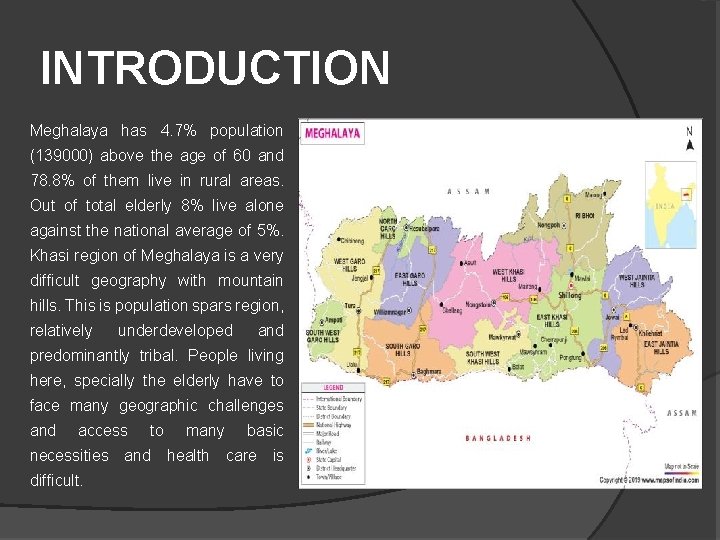
INTRODUCTION Meghalaya has 4. 7% population (139000) above the age of 60 and 78. 8% of them live in rural areas. Out of total elderly 8% live alone against the national average of 5%. Khasi region of Meghalaya is a very difficult geography with mountain hills. This is population spars region, relatively underdeveloped and predominantly tribal. People living here, specially the elderly have to face many geographic challenges and access to many basic necessities and health care is difficult.
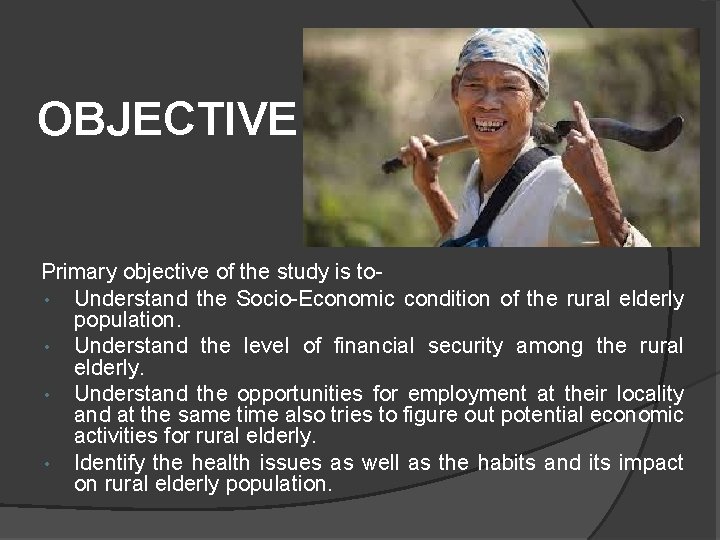
OBJECTIVE Primary objective of the study is to • Understand the Socio-Economic condition of the rural elderly population. • Understand the level of financial security among the rural elderly. • Understand the opportunities for employment at their locality and at the same time also tries to figure out potential economic activities for rural elderly. • Identify the health issues as well as the habits and its impact on rural elderly population.
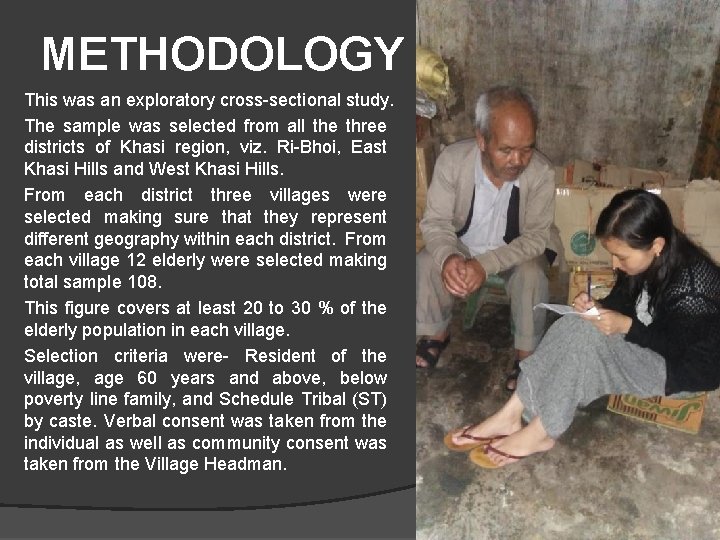
METHODOLOGY This was an exploratory cross-sectional study. The sample was selected from all the three districts of Khasi region, viz. Ri-Bhoi, East Khasi Hills and West Khasi Hills. From each district three villages were selected making sure that they represent different geography within each district. From each village 12 elderly were selected making total sample 108. This figure covers at least 20 to 30 % of the elderly population in each village. Selection criteria were- Resident of the village, age 60 years and above, below poverty line family, and Schedule Tribal (ST) by caste. Verbal consent was taken from the individual as well as community consent was taken from the Village Headman.
RESULTS � � � Data consisted of 108 Elderly (35 men and 73 women) Mean age was 67. 6 years: Education Level: � 77 were illiterate; � 22 completed primary; and � 9 could complete secondary schooling. � � Average reported HH income: INR 3160 per month. Out of 108 participants: � 77 have agri-land with average land holding of 2. 58 bighas. � 93 have bank accounts, 14 have ATM cards, � 23 have Aadhar card, 7 have PAN, � 44 have mobile phones, � 1 has life insurance, 68 have Health Insurance (Govt. scheme), 29 have pension (Govt. scheme). � None have PF or PPF, � Regarding awareness of the Govt. schemes for elderly, only 18 people know about the special clinic for elderly in PHC/ CHC; only one knew bank related schemes; none knew about the travel concession and age assistive devices schemes.
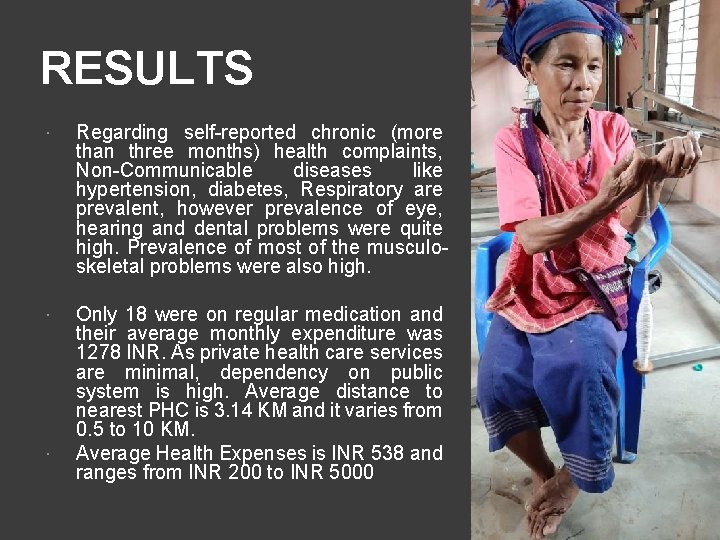
RESULTS Regarding self-reported chronic (more than three months) health complaints, Non-Communicable diseases like hypertension, diabetes, Respiratory are prevalent, however prevalence of eye, hearing and dental problems were quite high. Prevalence of most of the musculoskeletal problems were also high. Only 18 were on regular medication and their average monthly expenditure was 1278 INR. As private health care services are minimal, dependency on public system is high. Average distance to nearest PHC is 3. 14 KM and it varies from 0. 5 to 10 KM. Average Health Expenses is INR 538 and ranges from INR 200 to INR 5000
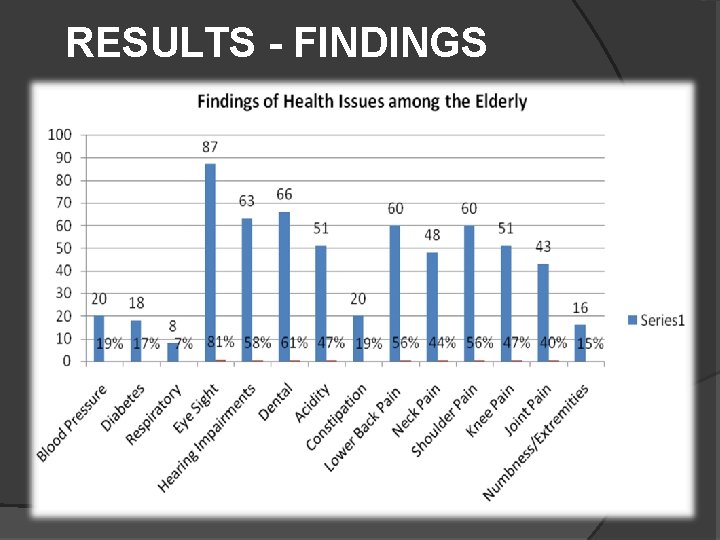
RESULTS - FINDINGS
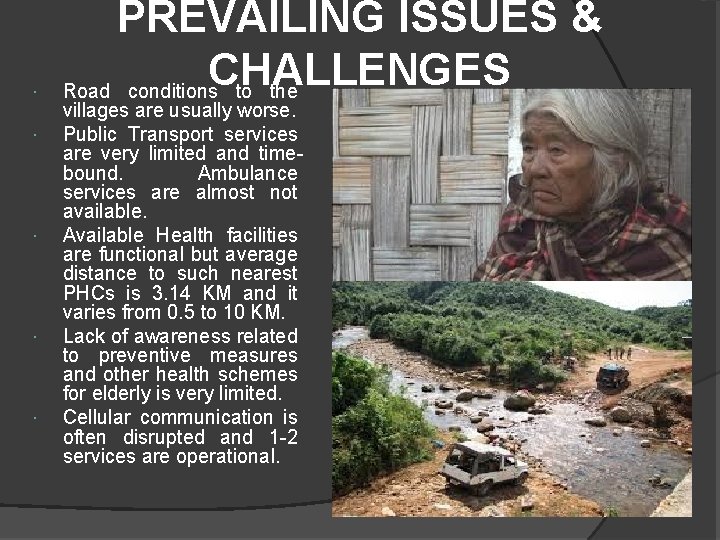
PREVAILING ISSUES & CHALLENGES Road conditions to the villages are usually worse. Public Transport services are very limited and timebound. Ambulance services are almost not available. Available Health facilities are functional but average distance to such nearest PHCs is 3. 14 KM and it varies from 0. 5 to 10 KM. Lack of awareness related to preventive measures and other health schemes for elderly is very limited. Cellular communication is often disrupted and 1 -2 services are operational.
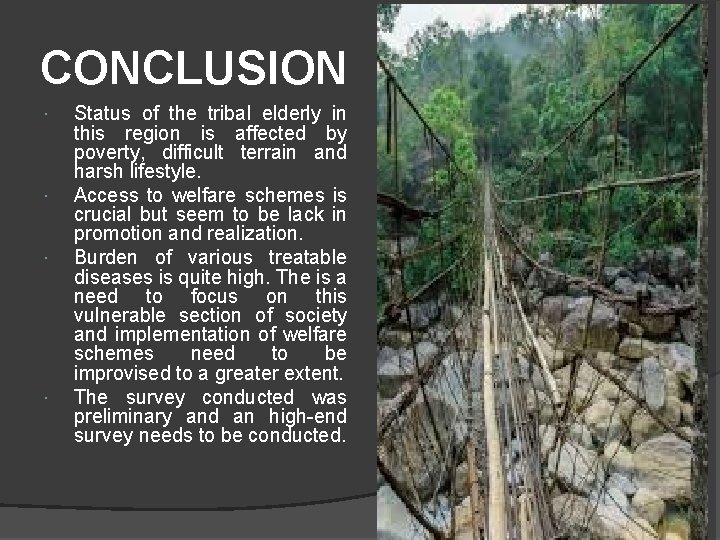
CONCLUSION Status of the tribal elderly in this region is affected by poverty, difficult terrain and harsh lifestyle. Access to welfare schemes is crucial but seem to be lack in promotion and realization. Burden of various treatable diseases is quite high. The is a need to focus on this vulnerable section of society and implementation of welfare schemes need to be improvised to a greater extent. The survey conducted was preliminary and an high-end survey needs to be conducted.
THANK YOU
- Slides: 12