Welcome to The 21 st Financial Management Learning

- Slides: 30
Welcome to The 21 st Financial Management Learning Forum On “Cambodian Taxation and Law” 27 March 2018, 8: 00 -5: 00 pm, Diakonia Center Vision: Sustainable development for Cambodia.
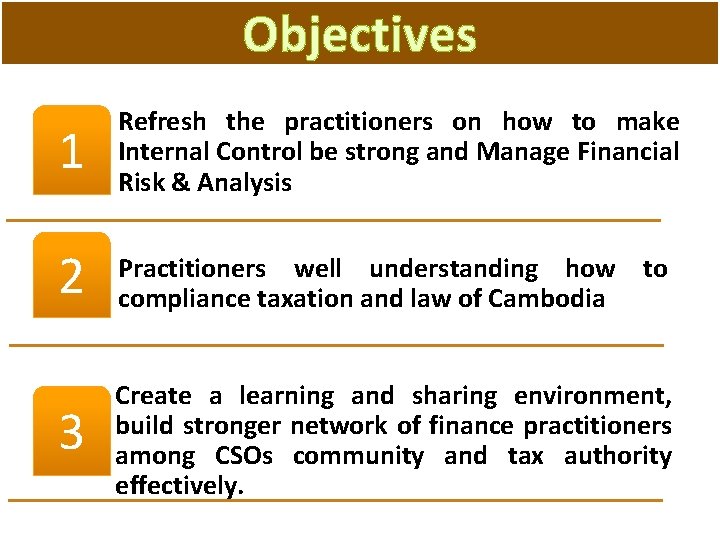
Objectives 1 Refresh the practitioners on how to make Internal Control be strong and Manage Financial Risk & Analysis 2 Practitioners well understanding how to compliance taxation and law of Cambodia 3 Create a learning and sharing environment, build stronger network of finance practitioners among CSOs community and tax authority effectively.
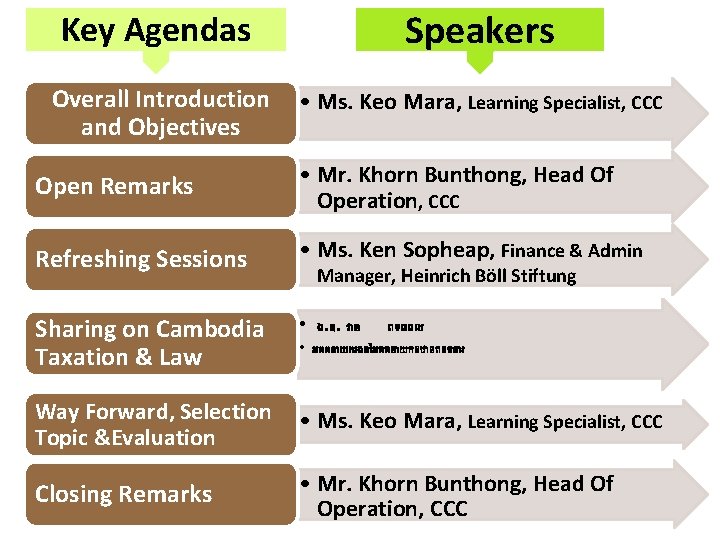
Key Agendas Speakers Overall Introduction and Objectives • Ms. Keo Mara, Learning Specialist, CCC Open Remarks • Mr. Khorn Bunthong, Head Of Operation, CCC Refreshing Sessions • Ms. Ken Sopheap, Finance & Admin Sharing on Cambodia Taxation & Law • ឯ. ឧ. វ ន Way Forward, Selection Topic &Evaluation • Ms. Keo Mara, Learning Specialist, CCC Closing Remarks • Mr. Khorn Bunthong, Head Of Operation, CCC Manager, Heinrich Böll Stiftung ពទធពល • អគគន យករងន អគគន យកដឋ នពនធដ រ
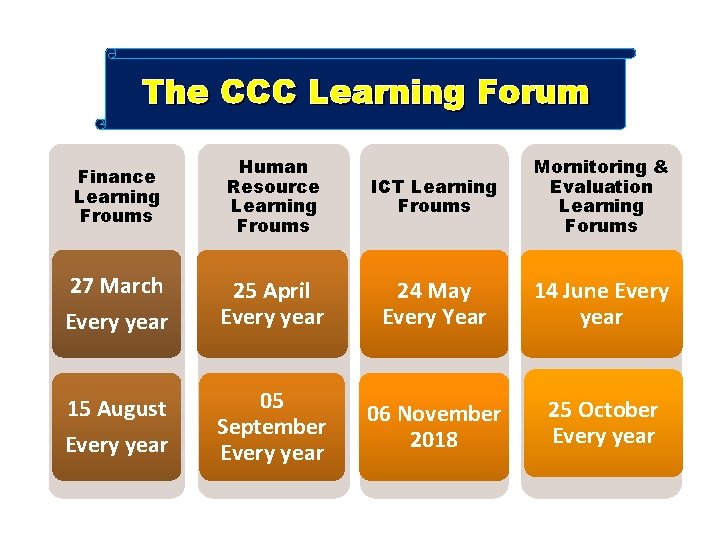
The CCC Learning Forum Finance Learning Froums Human Resource Learning Froums ICT Learning Froums Mornitoring & Evaluation Learning Forums 27 March Every year 25 April Every year 24 May Every Year 14 June Every year 15 August Every year 05 September Every year 06 November 2018 25 October Every year
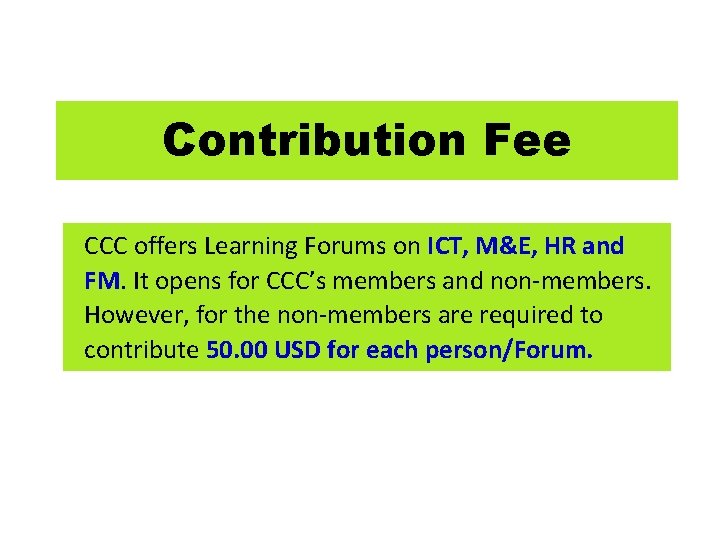
Contribution Fee CCC offers Learning Forums on ICT, M&E, HR and FM. It opens for CCC’s members and non-members. However, for the non-members are required to contribute 50. 00 USD for each person/Forum.
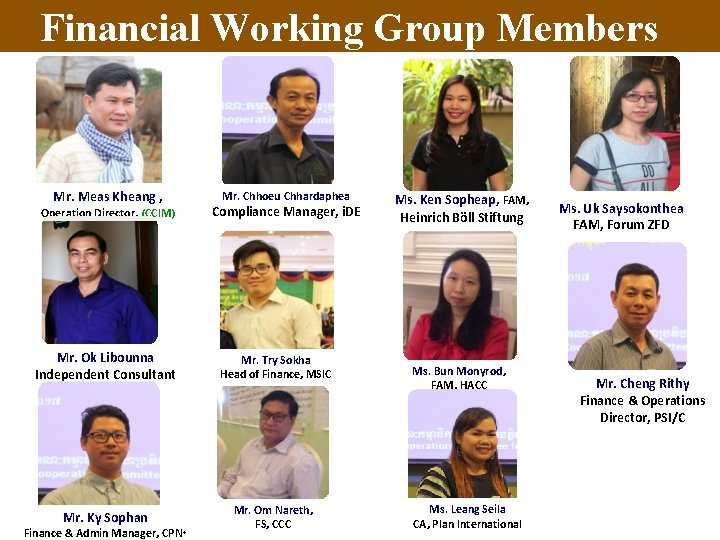
Financial Working Group Members Mr. Meas Kheang , Operation Director, (CCIM) Mr. Chhoeu Chhardaphea Compliance Manager, i. DE Mr. Ok Libounna Independent Consultant Mr. Try Sokha Head of Finance, MSIC Mr. Ky Sophan Mr. Om Nareth, FS, CCC Finance & Admin Manager, CPN + Ms. Ken Sopheap, FAM, Heinrich Böll Stiftung Ms. Bun Monyrod, FAM, HACC Ms. Leang Seila CA, Plan International Ms. Uk Saysokonthea FAM, Forum ZFD Mr. Cheng Rithy Finance & Operations Director, PSI/C
HR WG Members M&E WG Members ICT WG Members
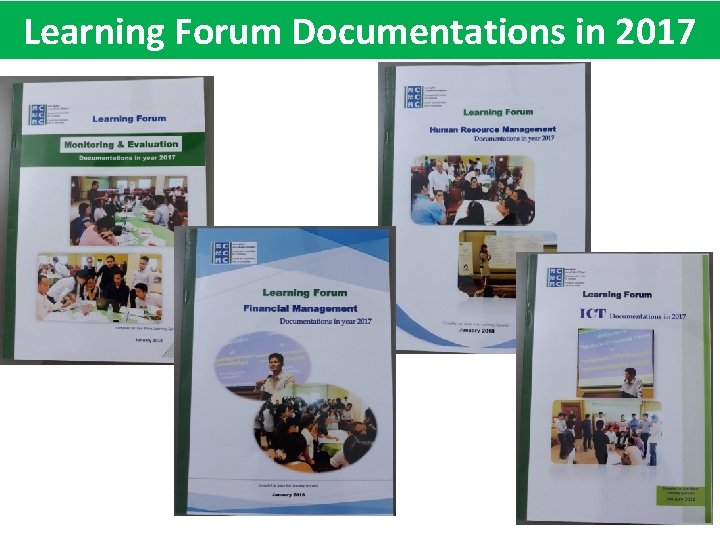
Learning Forum Documentations in 2017
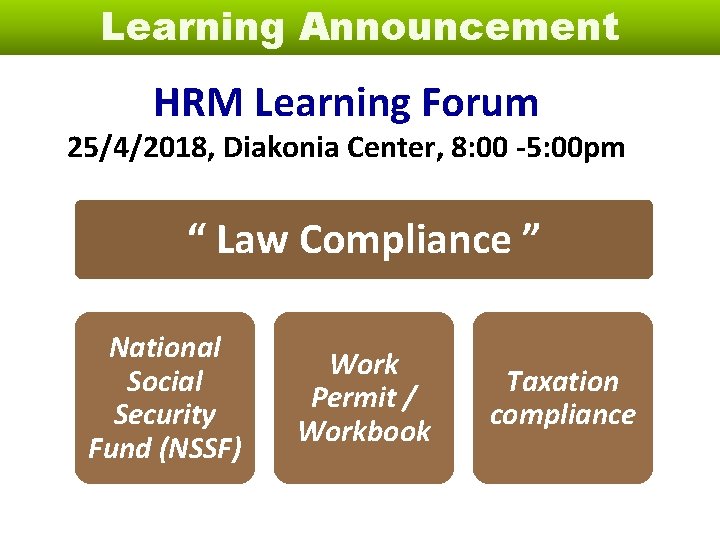
Learning Announcement HRM Learning Forum 25/4/2018, Diakonia Center, 8: 00 -5: 00 pm “ Law Compliance ” National Social Security Fund (NSSF) Work Permit / Workbook Taxation compliance
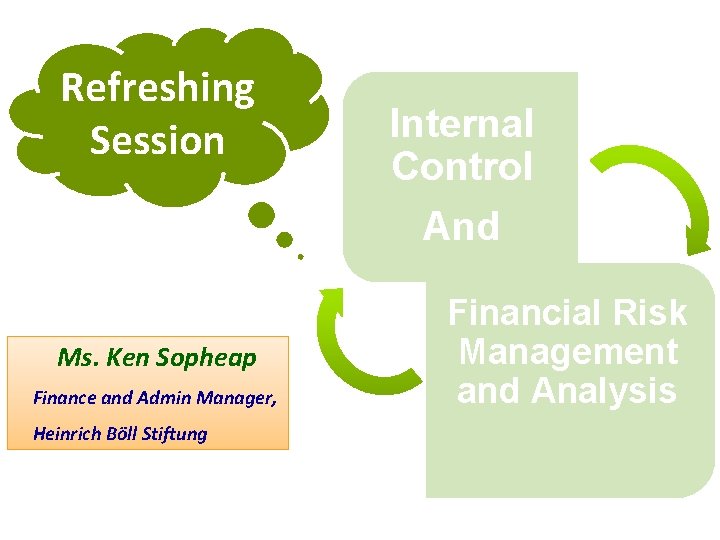
Refreshing Session Ms. Ken Sopheap Finance and Admin Manager, Heinrich Böll Stiftung Internal Control And Financial Risk Management and Analysis
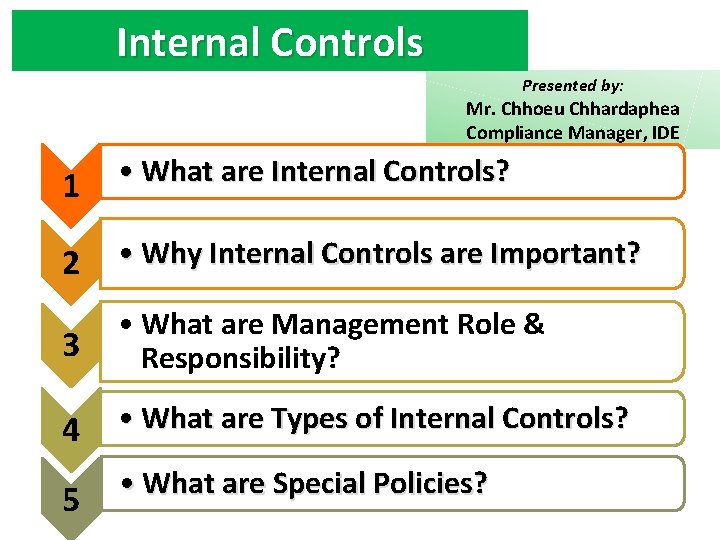
Internal Controls Presented by: Mr. Chhoeu Chhardaphea Compliance Manager, IDE 1 • What are Internal Controls? 2 • Why Internal Controls are Important? 3 • What are Management Role & Responsibility? 4 • What are Types of Internal Controls? 5 • What are Special Policies?
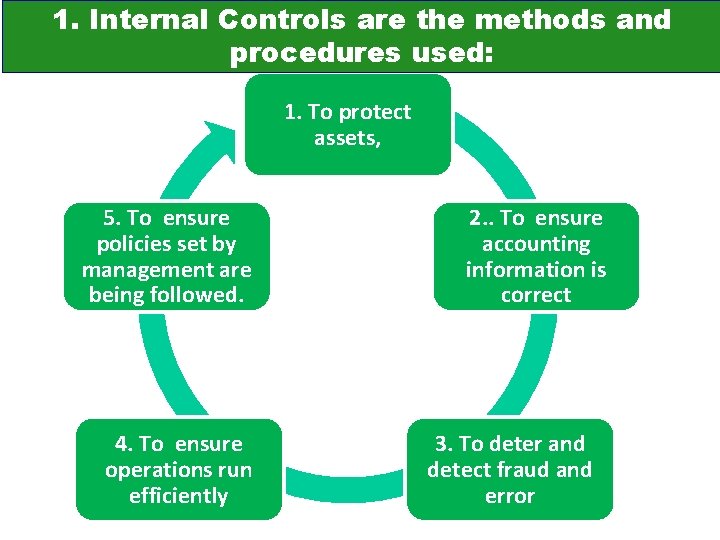
1. Internal Controls are the methods and procedures used: 1. To protect assets, 5. To ensure policies set by management are being followed. 4. To ensure operations run efficiently 2. . To ensure accounting information is correct 3. To deter and detect fraud and error
2. Why Internal Controls are needed? 1. Internal controls reduce the temptation to steal because of the likelihood of detection. 2. Strong internal controls help the staff to do the commitments. 3. Internal controls and systems help the staff and the organization to be more accountable for the funds given.
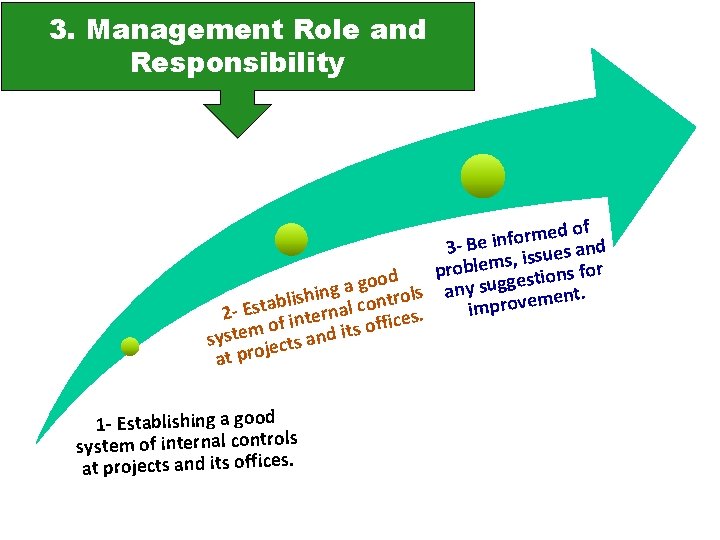
3. Management Role and Responsibility ed of m r o f n i 3 - Be s and e u s s i , s oblem tions for r p d goo s any sugges a g n i l nt. h o e s r i m t l e n b v o a o r t imp 2 - Es f internal c fices. o of s m t i e t d s n sy ts a c e j o r at p 1 - Establishing a good system of internal controls at projects and its offices.
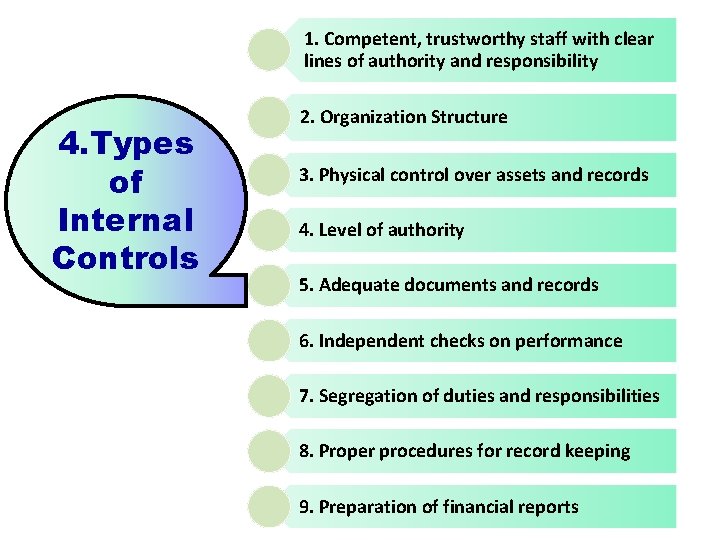
1. Competent, trustworthy staff with clear lines of authority and responsibility 4. Types of Internal Controls 2. Organization Structure 3. Physical control over assets and records 4. Level of authority 5. Adequate documents and records 6. Independent checks on performance 7. Segregation of duties and responsibilities 8. Proper procedures for record keeping 9. Preparation of financial reports
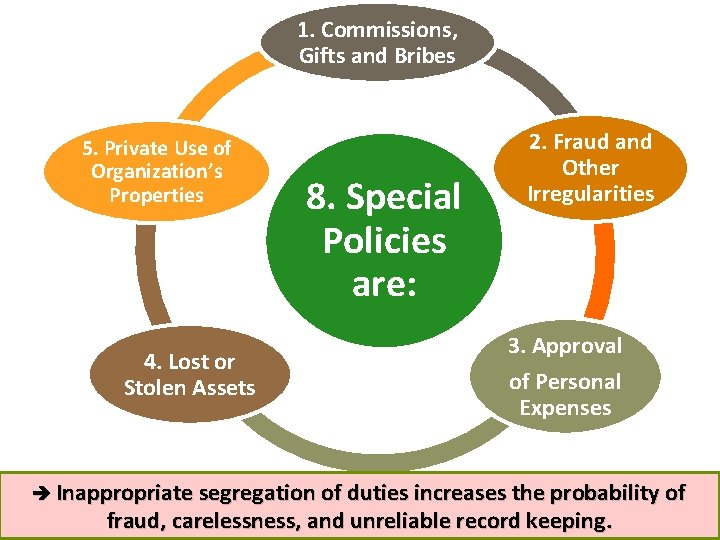
1. Commissions, Gifts and Bribes 5. Private Use of Organization’s Properties 4. Lost or Stolen Assets 8. Special Policies are: 2. Fraud and Other Irregularities 3. Approval of Personal Expenses Inappropriate segregation of duties increases the probability of fraud, carelessness, and unreliable record keeping.
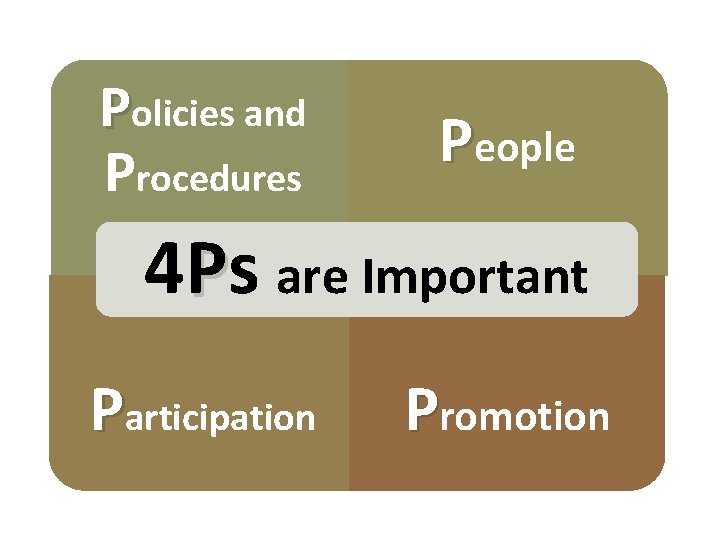
Policies and Procedures People 4 Ps are Important Participation Promotion
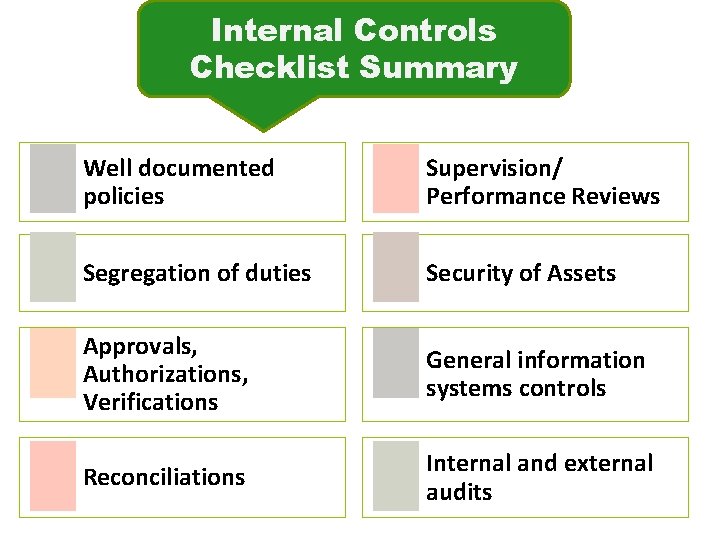
Internal Controls Checklist Summary Well documented policies Supervision/ Performance Reviews Segregation of duties Security of Assets Approvals, Authorizations, Verifications General information systems controls Reconciliations Internal and external audits
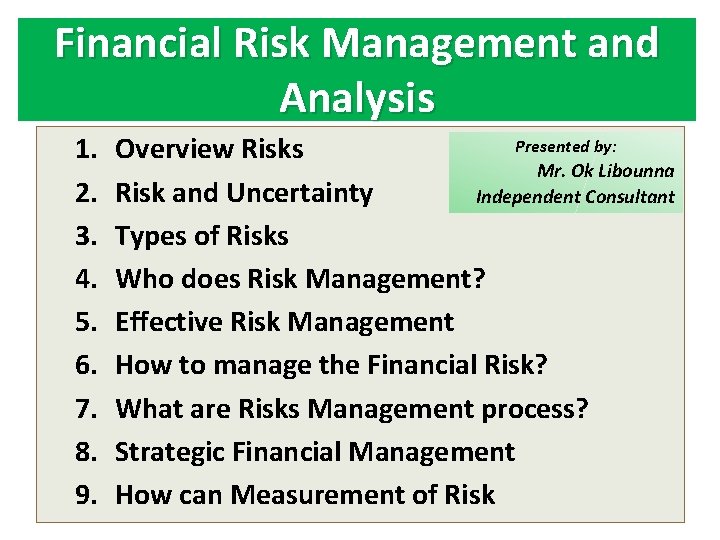
Financial Risk Management and Analysis 1. 2. 3. 4. 5. 6. 7. 8. 9. Presented by: Overview Risks Mr. Ok Libounna Risk and Uncertainty Independent Consultant Types of Risks Who does Risk Management? Effective Risk Management How to manage the Financial Risk? What are Risks Management process? Strategic Financial Management How can Measurement of Risk
1. Overview Risks It is important for all NGOs, large or small, to assess and then manage financial risks facing the organization. Significant financial risks that are not actively managed could threaten the NGO’s operations and financial security (Mango). What is a Risk? § We deal with risks every day. Risks are a part of life, and in fact very much part of any organizations activities. § To define risk on a technical level, a risk is “the effect of uncertainty of an object”. Think of it as cause and effect… an event happens (the cause) and the risk is the effect (good or bad) and how likely it will happen. § A risk can be internal (within your control) or external (outside your control). Risk management then, is managing the possibility that something will happen.
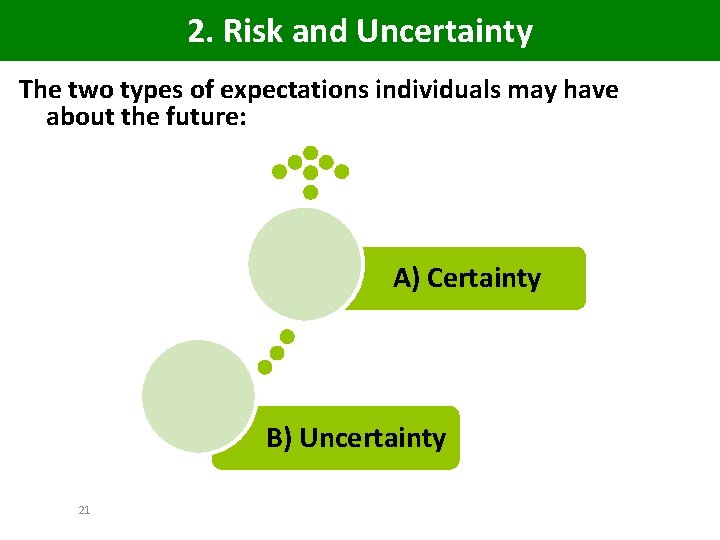
2. Risk and Uncertainty The two types of expectations individuals may have about the future: A) Certainty B) Uncertainty 21
3. Types of Risks A_ Systematic Risk 1. 2. 3. 4. Interest Rate Risk Market Risk &Economy Purchasing Power Risk Exchange Rate Risk 22 B_ Unsystematic Risk 1. Business Risk a) b) 2. Internal Business Risk External Business Risk Financial Risk
4. Who does Risk Management? § § § The treasurer (Board members) is responsible for ensuring that a risk assessment takes place regularly. It is often best done by a group of people including board members and management, say once a year. This will ensure ownership of the results and a greater awareness in the team of the potential threats. External auditor may also be able to help or advise.
5. Effective Risk Management 1. can contribute to strategic and business planning and the general running (operational activities) of an organization. 2. it creates confidence organization can deliver the desired outcomes, manage threats to an acceptable degree, and make informed decisions about opportunities. 3. improves the quality of decision-making (appropriate, fast, accurate, and effective) 4. improves stakeholder relationships and stakeholders’ confidence in the organization through enhanced accountability and reporting processes. 5. contributes to the development of a positive organizational culture of improved governance, as well as helps establish clear purpose, roles and accountabilities for all staff 6. optimizes performance through efficiencies in service delivery, major change and quality assurance initiatives.
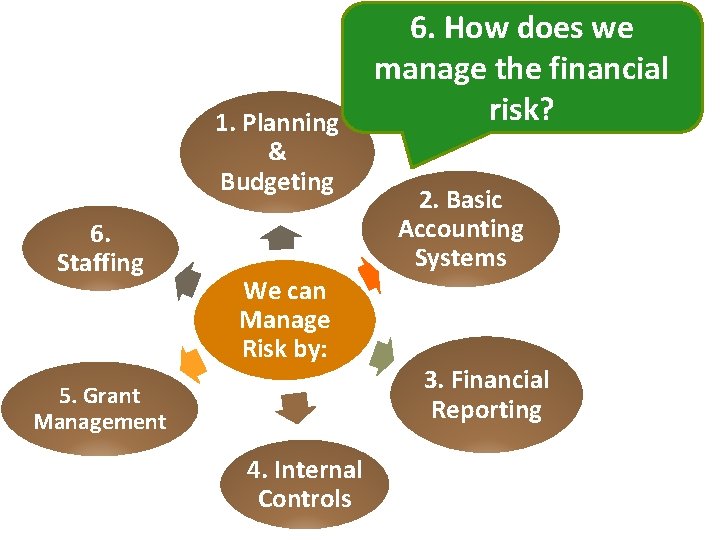
1. Planning & Budgeting 6. Staffing We can Manage Risk by: 5. Grant Management 4. Internal Controls 6. How does we manage the financial risk? 2. Basic Accounting Systems 3. Financial Reporting
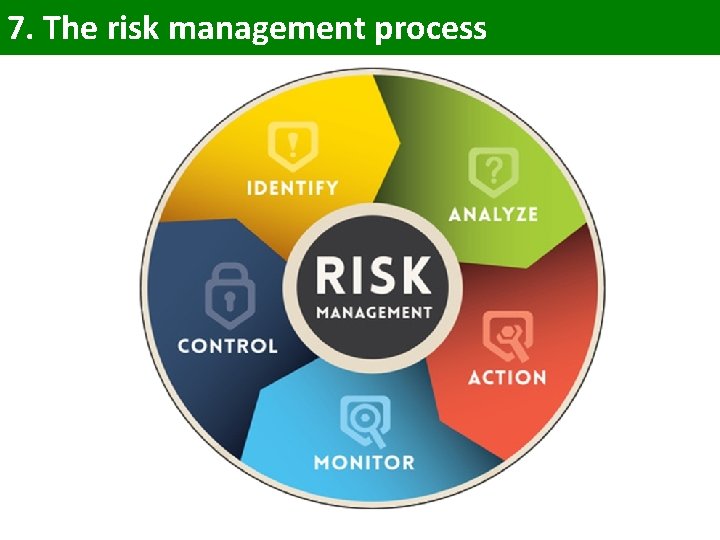
7. The risk management process
5. Strategic Financial management § An approach to management that applies financial techniques to strategic decision making. § Definition: “the application of financial techniques to strategic decisions in order to help achieve the decision-maker's objectives”. § Strategy: a carefully devised plan of action to achieve a goal, or the art of developing or carrying out such a plan. § Strategic Financial Management refers to both, financial implications or aspects of various business strategies, and strategic management of finances.
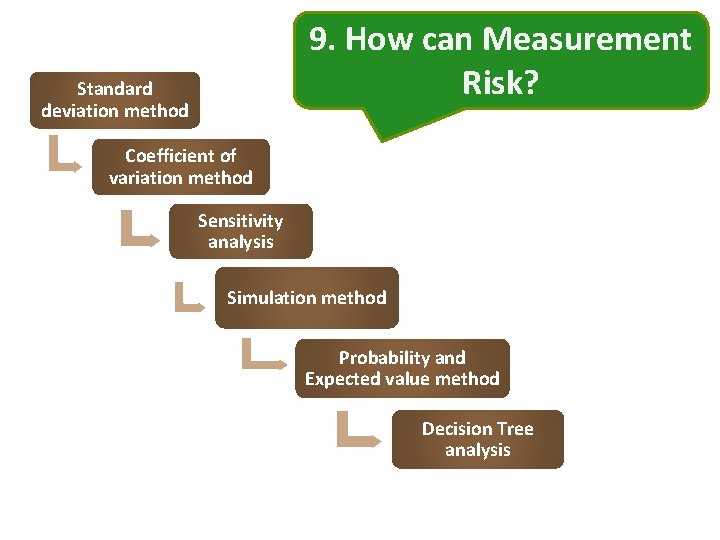
9. How can Measurement Risk? Standard deviation method Coefficient of variation method Sensitivity analysis Simulation method Probability and Expected value method Decision Tree analysis
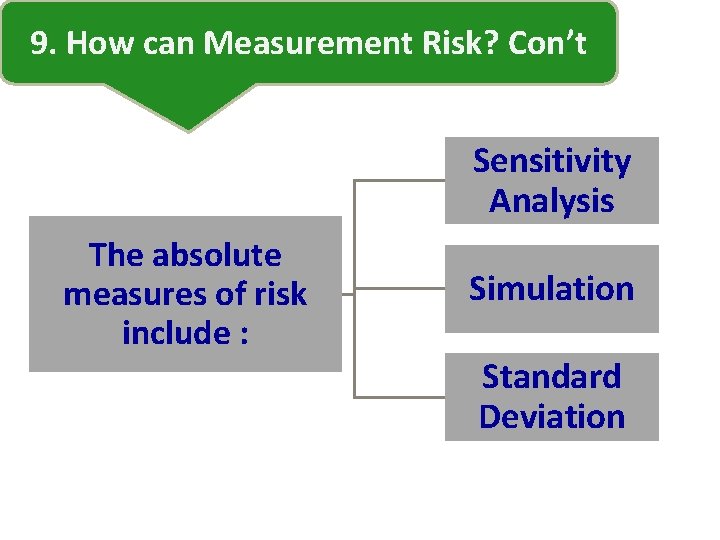
9. How can Measurement Risk? Con’t Sensitivity Analysis The absolute measures of risk include : Simulation Standard Deviation
Thank you for attention !