Transition 101 Jim Martin Mindy Lingo University of
- Slides: 95
Transition 101 Jim Martin & Mindy Lingo University of Oklahoma Zarrow Center Email: jemartin@ou. edu
Quiz Time
Critical Question n What is the purpose of special education as defined by IDEA 2004? 3
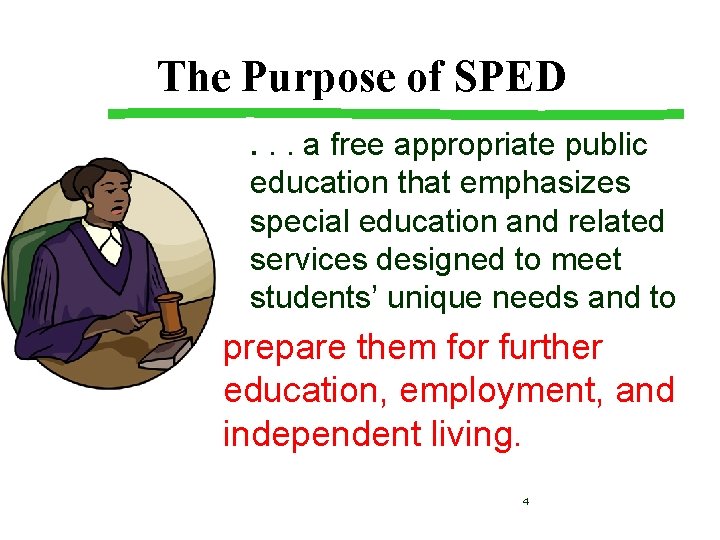
The Purpose of SPED. . . a free appropriate public education that emphasizes special education and related services designed to meet students’ unique needs and to prepare them for further education, employment, and independent living. 4
Agenda
Agenda 1. 2. 3. Transition Defined Legally Transition Defined Programmatically Eight Transition Big Ideas
Transition Legally
IDEA 2004 INDICATOR 13
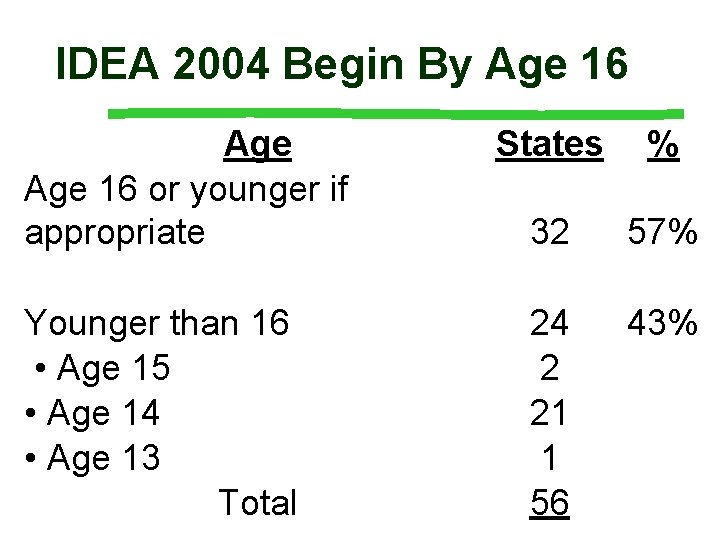
IDEA 2004 Begin By Age 16 or younger if appropriate Younger than 16 • Age 15 • Age 14 • Age 13 Total States % 32 57% 24 2 21 1 56 43%
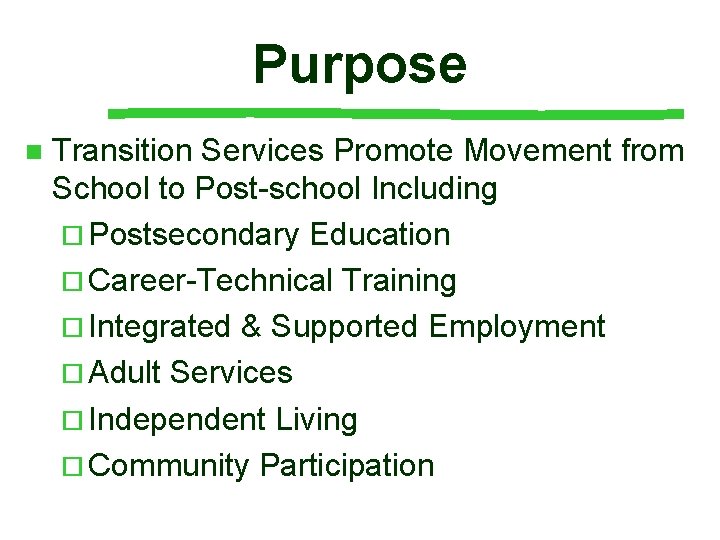
Purpose n Transition Services Promote Movement from School to Post-school Including ¨ Postsecondary Education ¨ Career-Technical Training ¨ Integrated & Supported Employment ¨ Adult Services ¨ Independent Living ¨ Community Participation
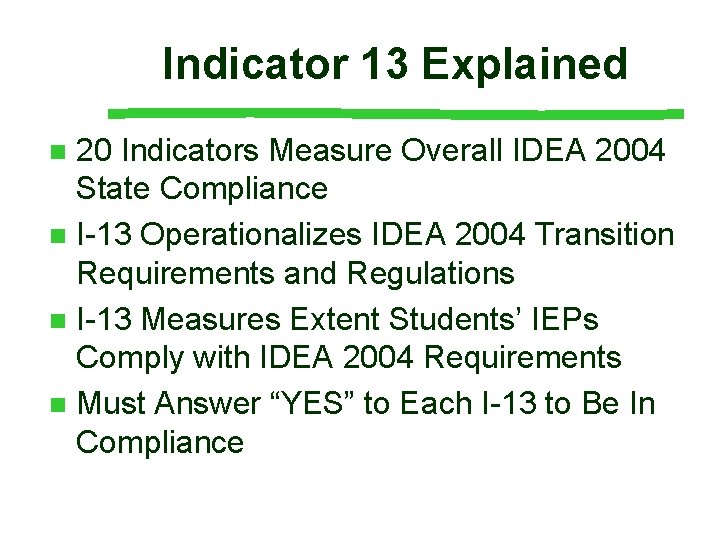
Indicator 13 Explained 20 Indicators Measure Overall IDEA 2004 State Compliance n I-13 Operationalizes IDEA 2004 Transition Requirements and Regulations n I-13 Measures Extent Students’ IEPs Comply with IDEA 2004 Requirements n Must Answer “YES” to Each I-13 to Be In Compliance n
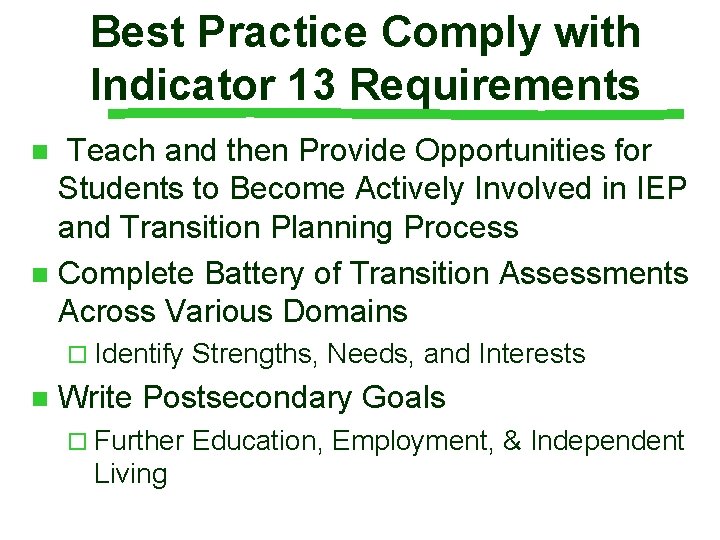
Best Practice Comply with Indicator 13 Requirements Teach and then Provide Opportunities for Students to Become Actively Involved in IEP and Transition Planning Process n Complete Battery of Transition Assessments Across Various Domains n ¨ Identify Strengths, Needs, and Interests n Write Postsecondary Goals ¨ Further Education, Employment, & Independent Living
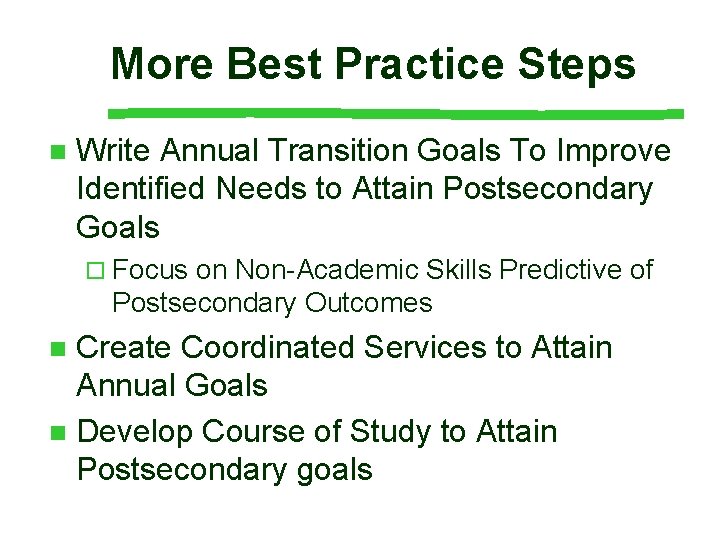
More Best Practice Steps n Write Annual Transition Goals To Improve Identified Needs to Attain Postsecondary Goals ¨ Focus on Non-Academic Skills Predictive of Postsecondary Outcomes Create Coordinated Services to Attain Annual Goals n Develop Course of Study to Attain Postsecondary goals n
Workforce Innovation and Opportunity Act WIOA
PETS Pre-Employment Transition Services
More on PETS Rehab must set aside at least 15% of budget for PETS n PETS must be available to all students with disabilities statewide n Typically transition-aged (age varies by states) n PETS implemented in conjunction with schools n
Required PETS n Job Exploration Counseling n Work-Based Learning Experiences n Counseling Regarding Post- Secondary Programs n Workplace Readiness ¨ Including Social and Independent Living Skills n Instruction in Self-Advocacy
IDEA vs ADA
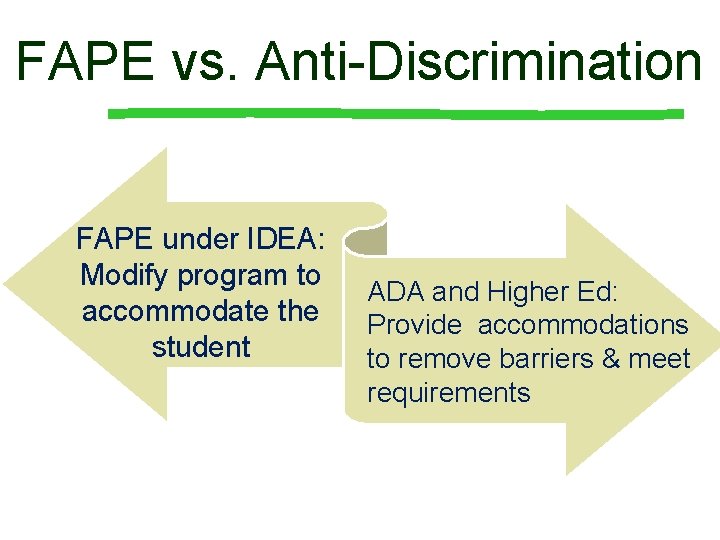
FAPE vs. Anti-Discrimination FAPE under IDEA: Modify program to accommodate the student ADA and Higher Ed: Provide accommodations to remove barriers & meet requirements
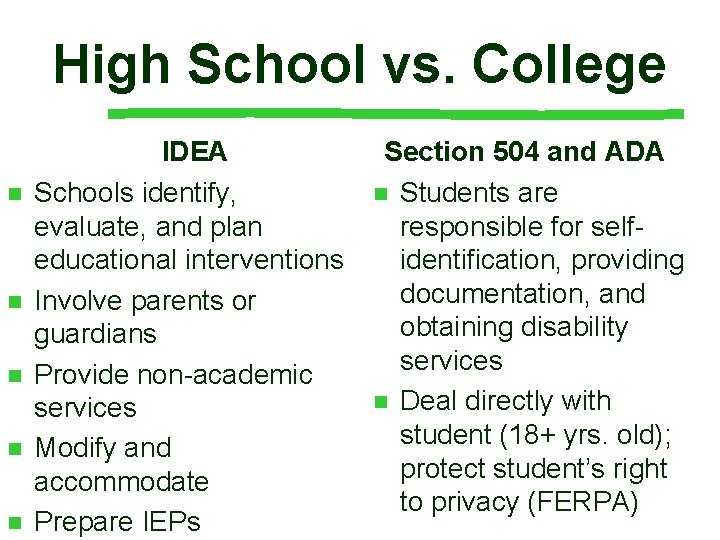
High School vs. College n n n IDEA Schools identify, evaluate, and plan educational interventions Involve parents or guardians Provide non-academic services Modify and accommodate Prepare IEPs Section 504 and ADA n Students are responsible for selfidentification, providing documentation, and obtaining disability services n Deal directly with student (18+ yrs. old); protect student’s right to privacy (FERPA)
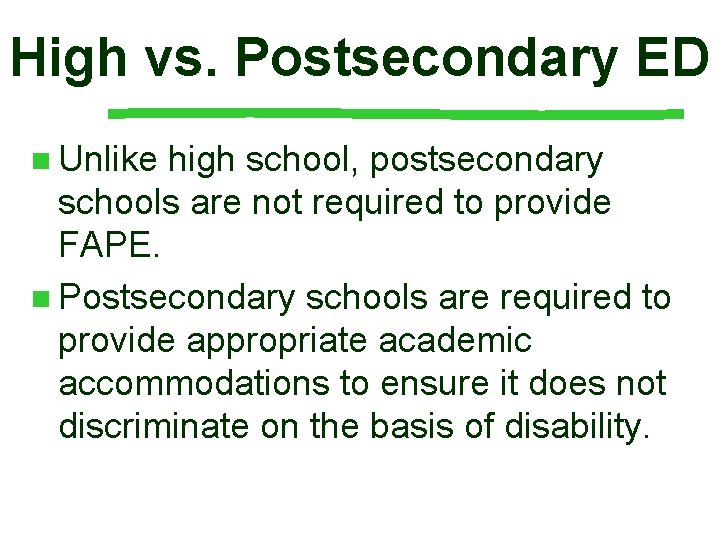
High vs. Postsecondary ED n Unlike high school, postsecondary schools are not required to provide FAPE. n Postsecondary schools are required to provide appropriate academic accommodations to ensure it does not discriminate on the basis of disability.
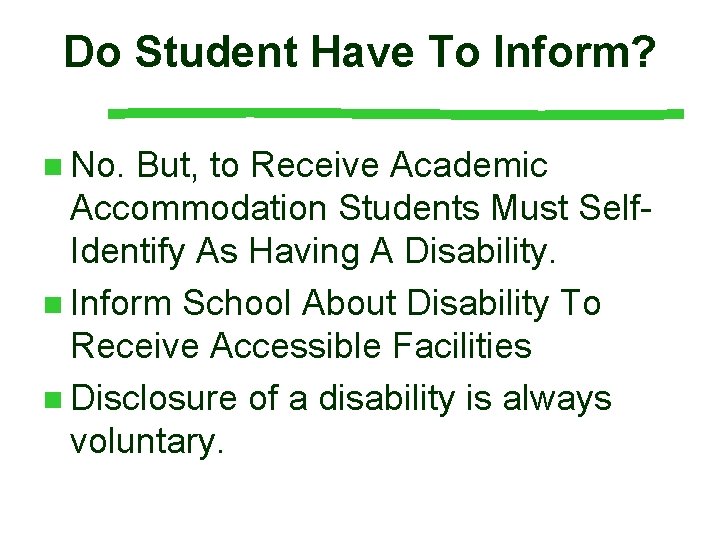
Do Student Have To Inform? n No. But, to Receive Academic Accommodation Students Must Self- Identify As Having A Disability. n Inform School About Disability To Receive Accessible Facilities n Disclosure of a disability is always voluntary.
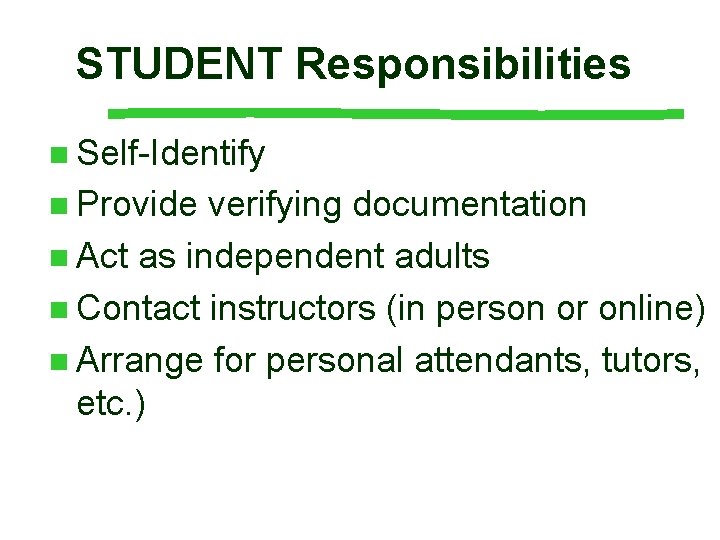
STUDENT Responsibilities n Self-Identify n Provide verifying documentation n Act as independent adults n Contact instructors (in person or online) n Arrange for personal attendants, tutors, etc. )
Disability Services Varies n Quality and depth of services can vary greatly from school to school n Each program must apply services equally for students with disabilities in that school based on identified needs
Transition Programmatically
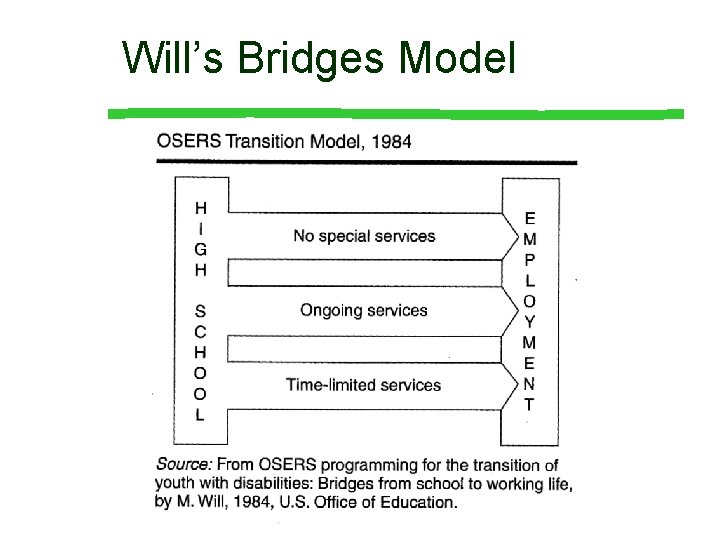
Will’s Bridges Model
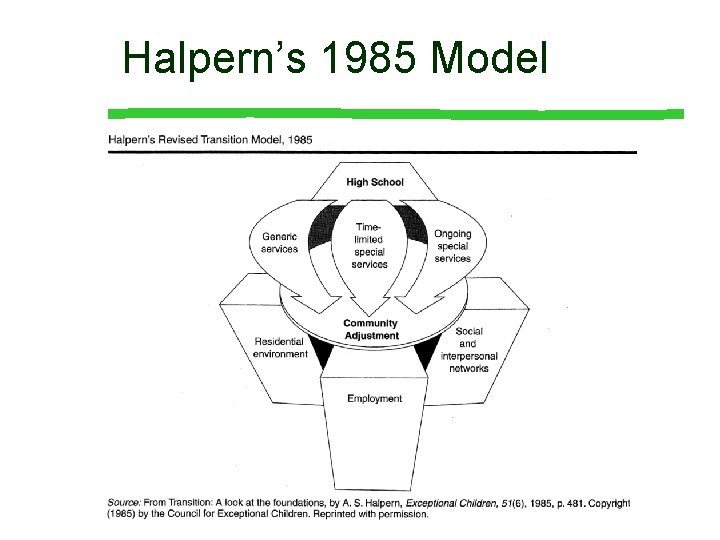
Halpern’s 1985 Model
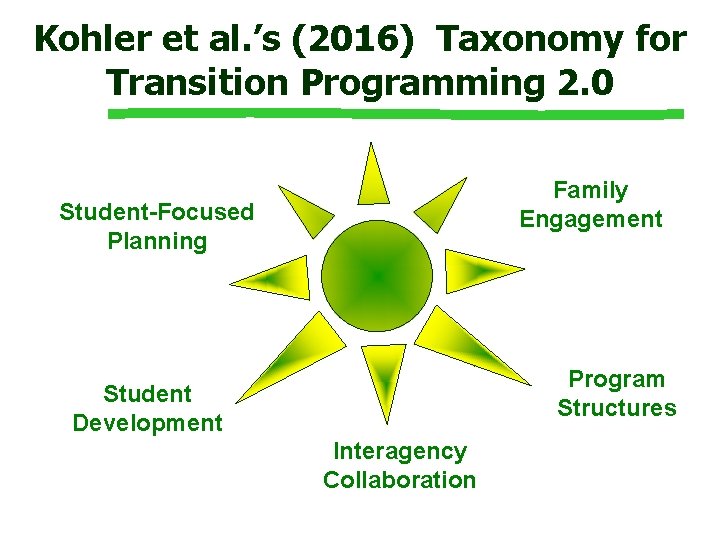
Kohler et al. ’s (2016) Taxonomy for Transition Programming 2. 0 Family Engagement Student-Focused Planning Program Structures Student Development Interagency Collaboration
Eight Transition Big IDEAS
Big IDEA #1
Using Transition Assessment n IEPs must include postsecondary and annual transition goals ¨ based upon age-appropriate transition assessments ¨ related to training, education, employment, and independent living (when needed)
Transition Assessment & The Courts n Prince, Plotner, & Yell (2014) examined district court findings and found. . . ¨ Use multiple assessments across transition domains ¨ DO not solely use informal assessments n At Least One NEEDS To Be A FORMAL ASSESSMENT ¨ Maximize student participation in the transition planning process
Example TA With Ample Validity Evidence n Self-Determination Assessments ¨ AIR, ARC, Choice. Maker n Adaptive Behavior Scales ¨ Vineland n Interest Inventory ¨ O-Net, Self-Directed Search n Skill Assessment ¨ Transition Assessment & Goal Generator
Case Law Decision Case involved not conducting adequate transition assessments. Decision: n Told school to focus on meaningful non-academic goals to prepare students for post-school life. Massachusetts Bureau Of Special Education Appeals And Currently Under Appeal In Federal Court, Dracut Public Schools, BSEA #08 -5330, 15 MSER 78 (2009).
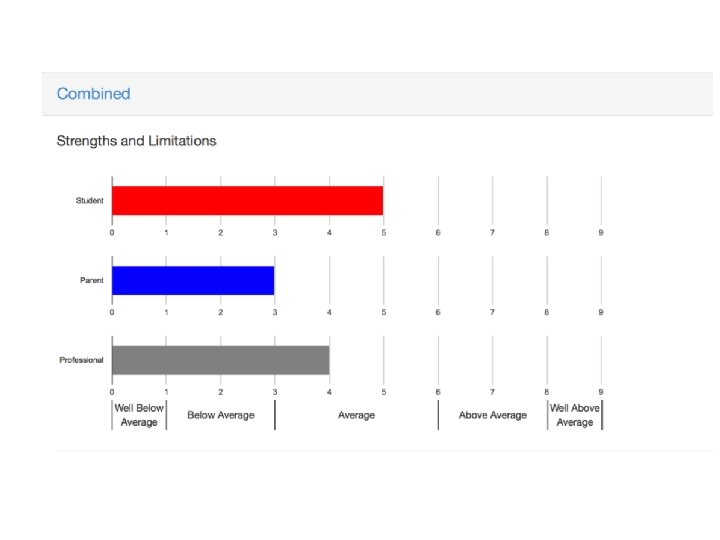
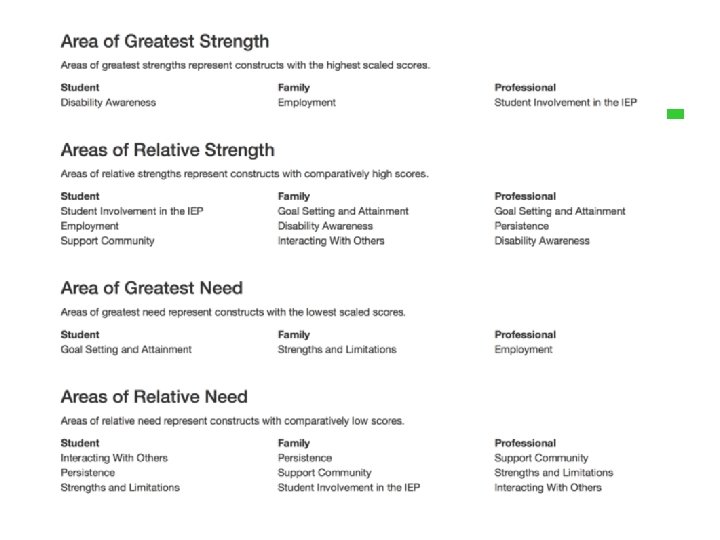
Transition Assessment and Goal Generator An easy-to-use transition assessment based upon behaviors and experiences research has identified as associated with post-school employment and further education n TAGG assessment yields priority ranked annual transition goals and an overall strengths and needs profile. n $3. 00 per use n
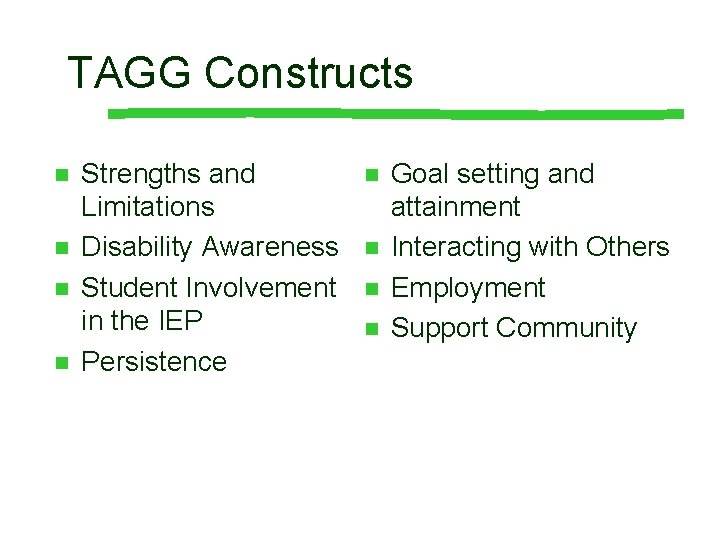
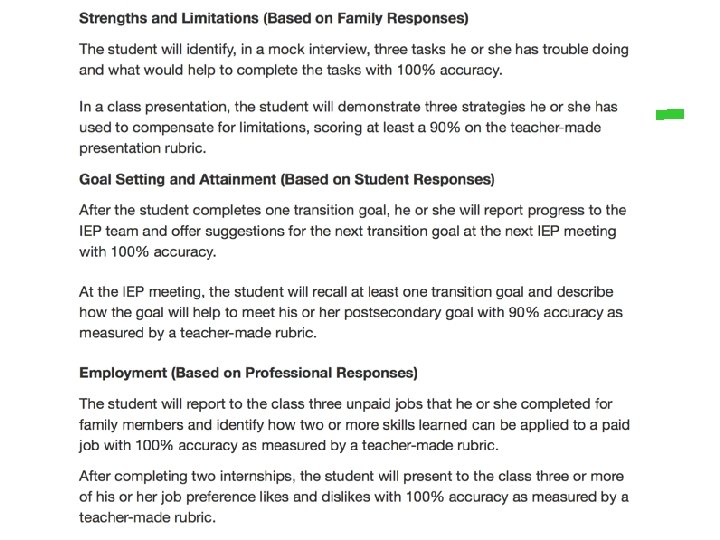
TAGG Constructs n n Strengths and Limitations Disability Awareness Student Involvement in the IEP Persistence n n Goal setting and attainment Interacting with Others Employment Support Community
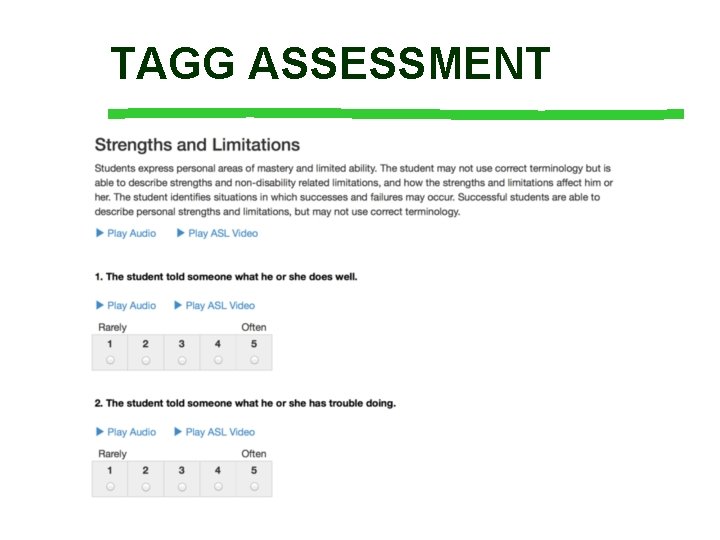
TAGG ASSESSMENT
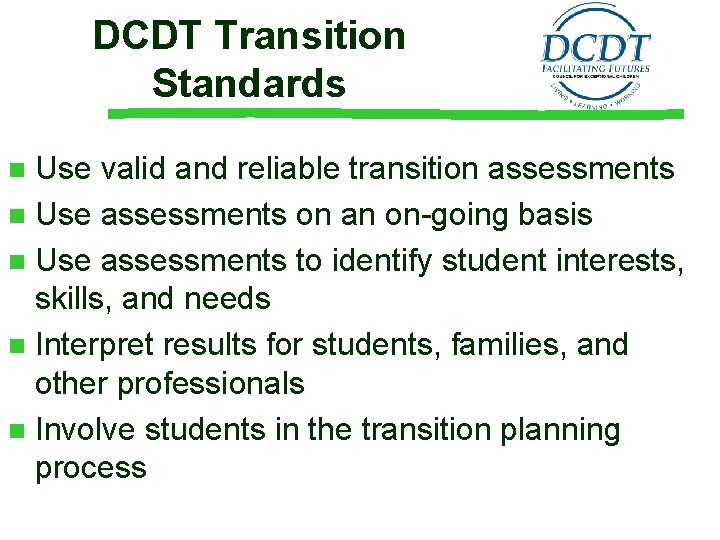
DCDT Transition Standards Use valid and reliable transition assessments n Use assessments on an on-going basis n Use assessments to identify student interests, skills, and needs n Interpret results for students, families, and other professionals n Involve students in the transition planning process n
Details How Assessments Need to be Developed n Details needed validity evidence to support use of assessment results n
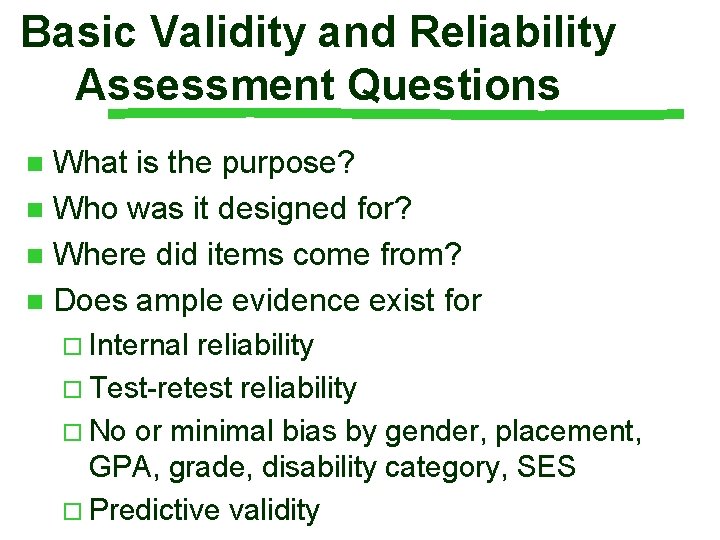
Basic Validity and Reliability Assessment Questions What is the purpose? n Who was it designed for? n Where did items come from? n Does ample evidence exist for n ¨ Internal reliability ¨ Test-retest reliability ¨ No or minimal bias by gender, placement, GPA, grade, disability category, SES ¨ Predictive validity
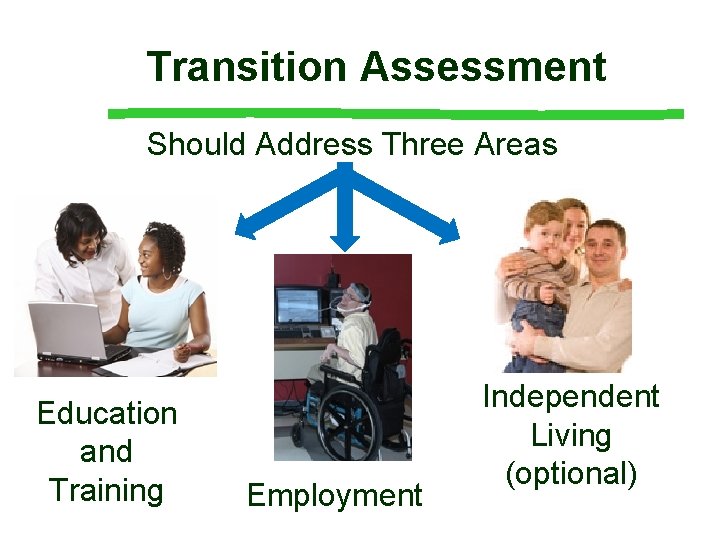
Transition Assessment Should Address Three Areas Education and Training Employment Independent Living (optional)
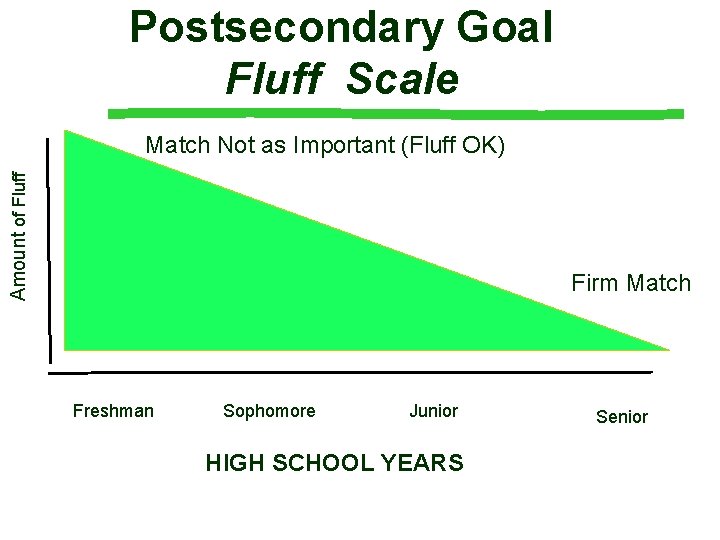
Postsecondary Goal Fluff Scale Amount of Fluff Match Not as Important (Fluff OK) Firm Match Freshman Sophomore Junior HIGH SCHOOL YEARS Senior
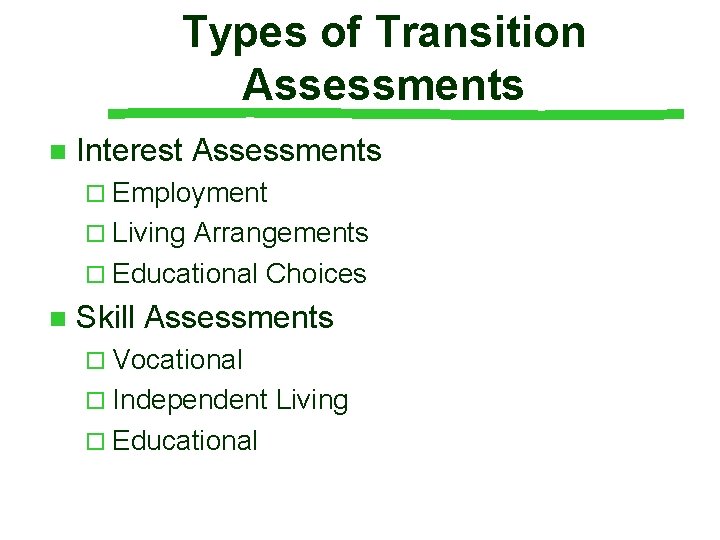
Types of Transition Assessments n Interest Assessments ¨ Employment ¨ Living Arrangements ¨ Educational Choices n Skill Assessments ¨ Vocational ¨ Independent Living ¨ Educational
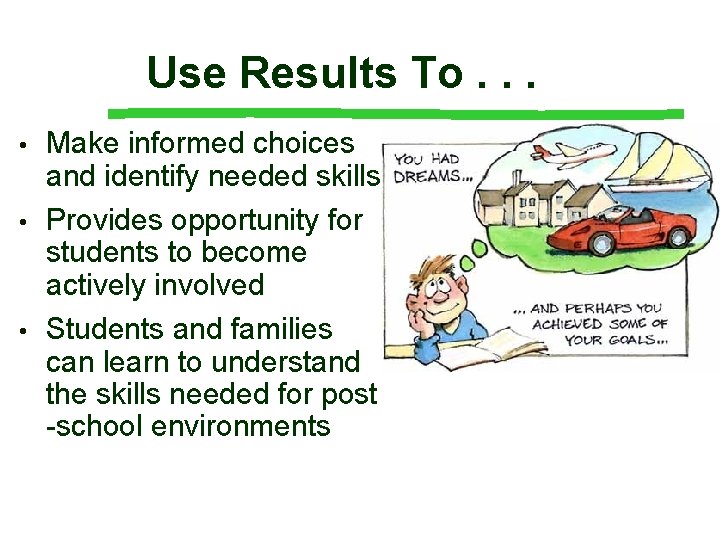
Use Results To. . . • • • Make informed choices and identify needed skills Provides opportunity for students to become actively involved Students and families can learn to understand the skills needed for post -school environments Picture of boy daydreaming about a mansion, plane, sailboat, and Ferrari
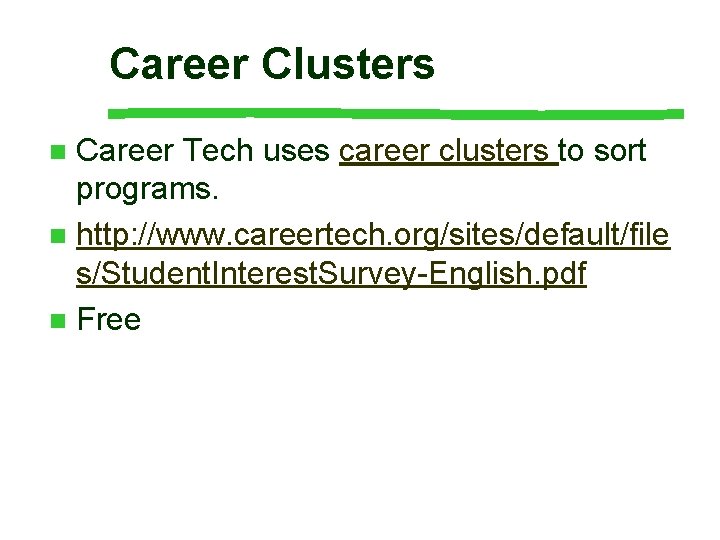
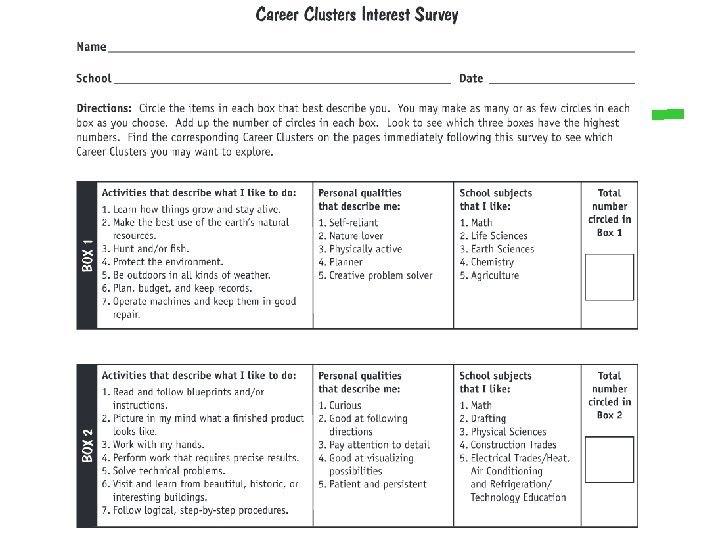
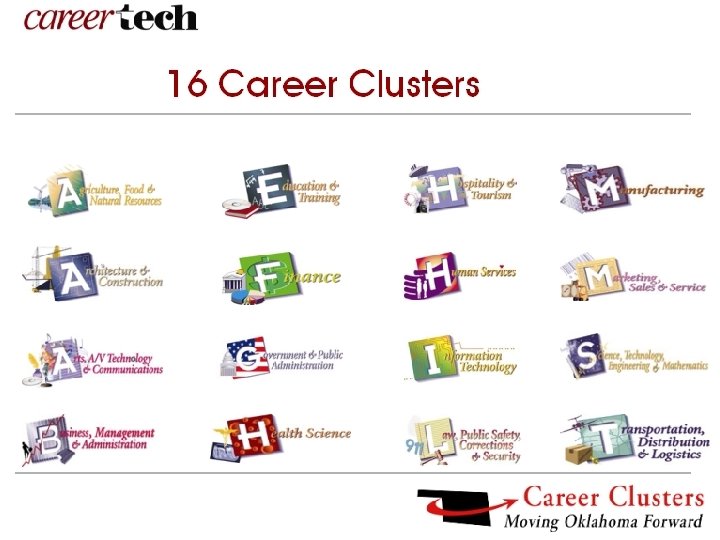
Career Clusters Career Tech uses career clusters to sort programs. n http: //www. careertech. org/sites/default/file s/Student. Interest. Survey-English. pdf n Free n
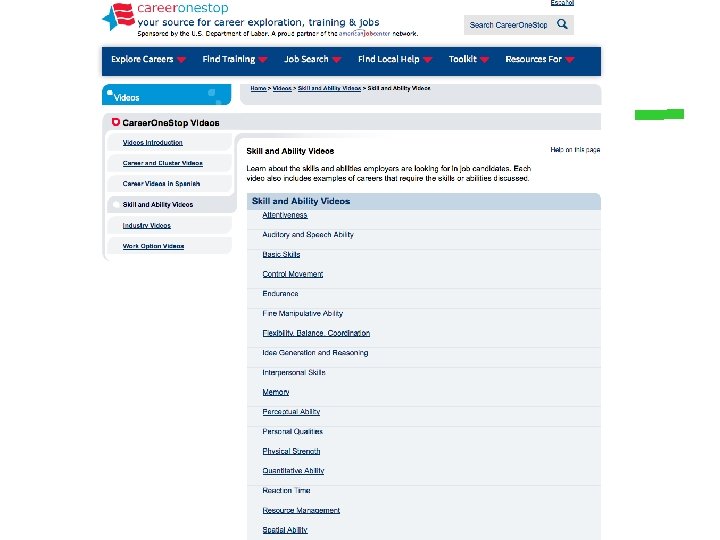
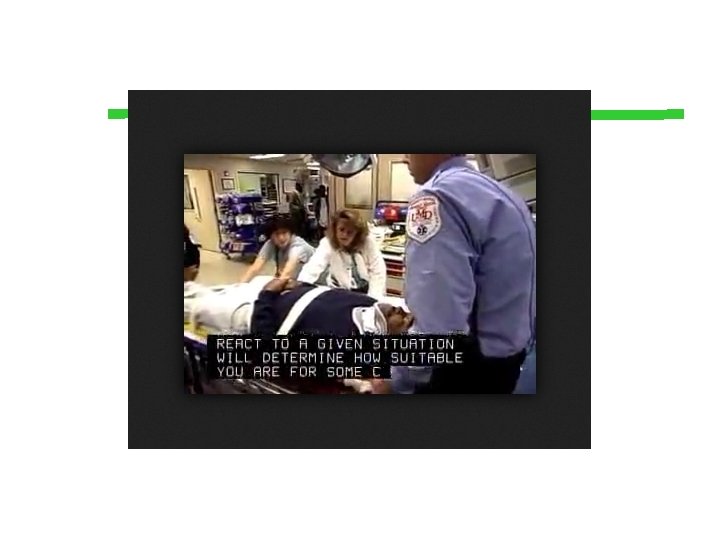
Career One Stop Skill and Ability Videos http: //www. careeronestop. org/Videos/Skill and. Ability. Videos/skill-and-abilityvideos. aspx n Free n
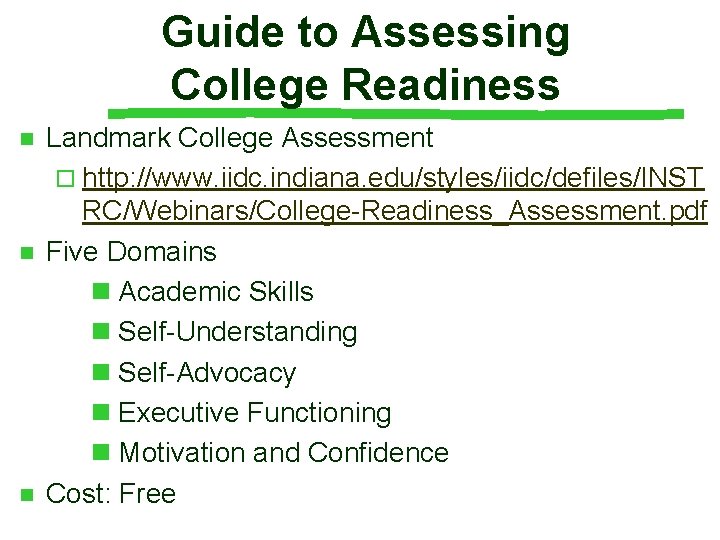
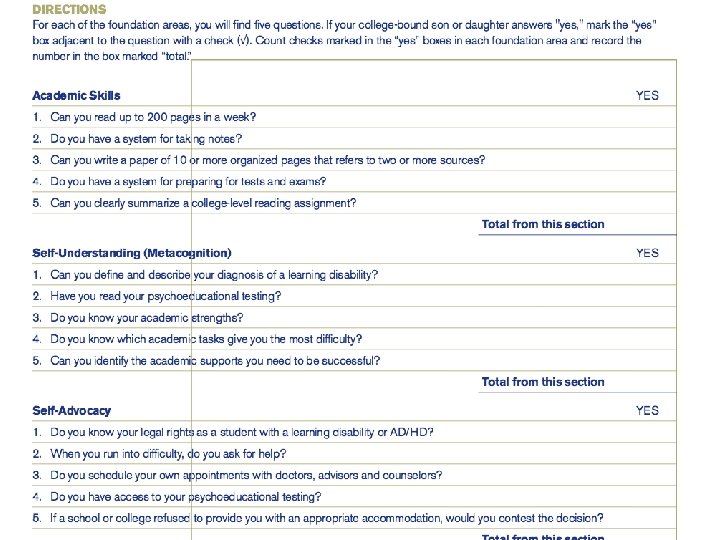
Guide to Assessing College Readiness n n n Landmark College Assessment ¨ http: //www. iidc. indiana. edu/styles/iidc/defiles/INST RC/Webinars/College-Readiness_Assessment. pdf Five Domains n Academic Skills n Self-Understanding n Self-Advocacy n Executive Functioning n Motivation and Confidence Cost: Free
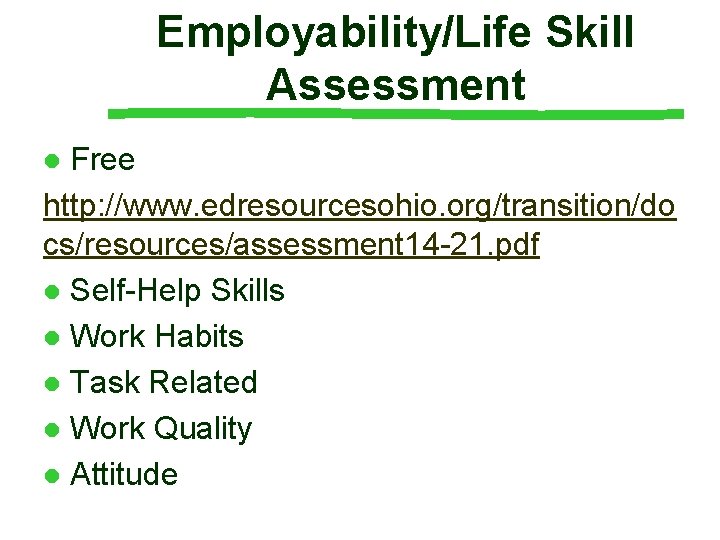
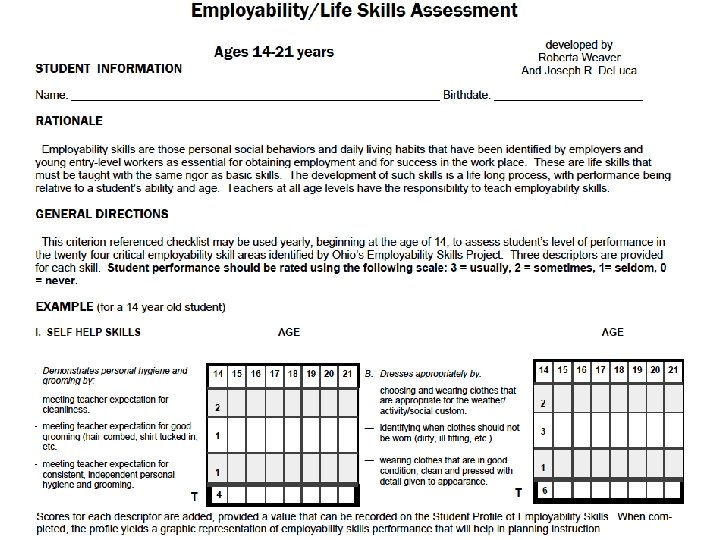
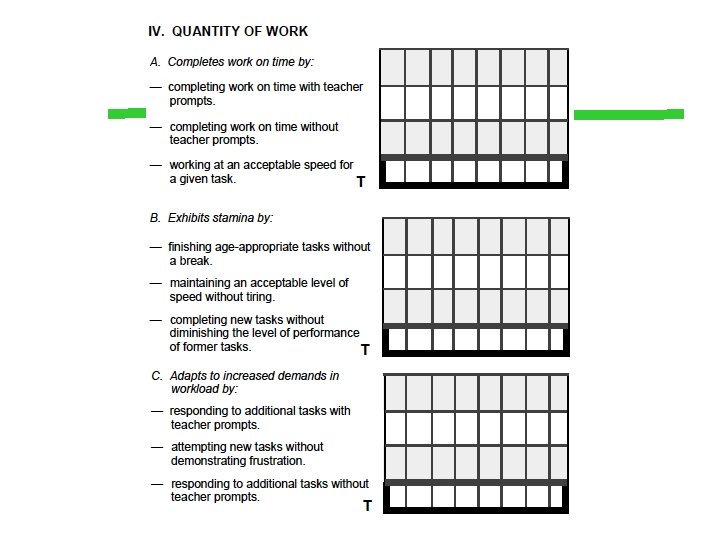
Employability/Life Skill Assessment Free http: //www. edresourcesohio. org/transition/do cs/resources/assessment 14 -21. pdf l Self-Help Skills l Work Habits l Task Related l Work Quality l Attitude l
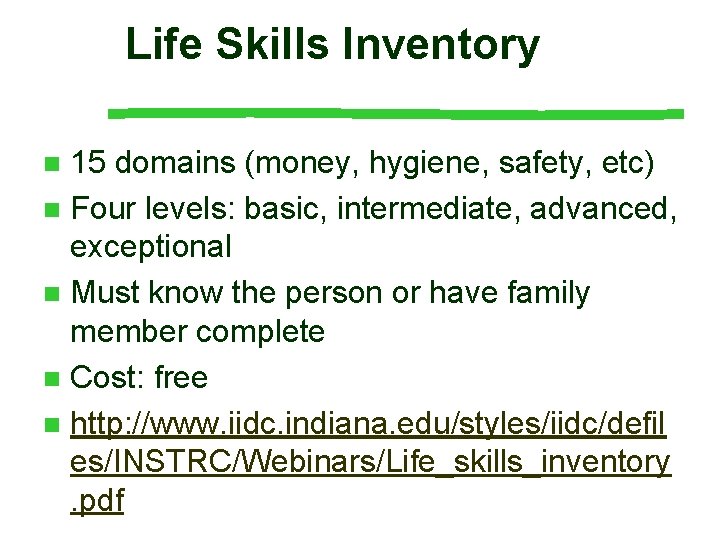
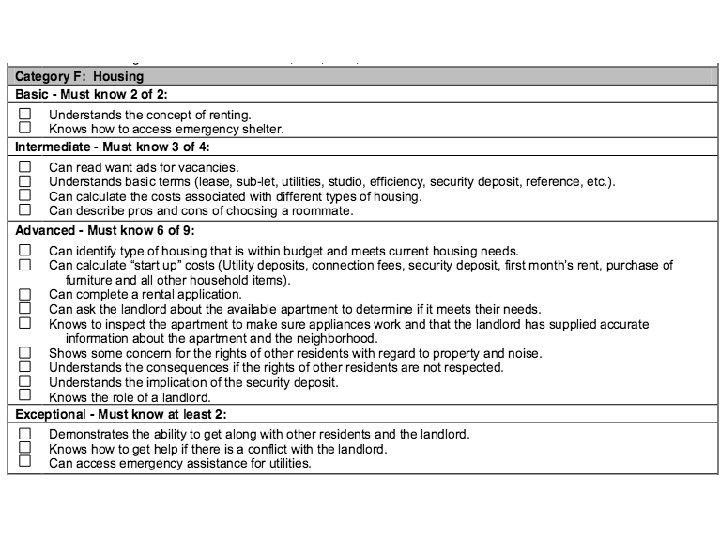
Life Skills Inventory 15 domains (money, hygiene, safety, etc) n Four levels: basic, intermediate, advanced, exceptional n Must know the person or have family member complete n Cost: free n http: //www. iidc. indiana. edu/styles/iidc/defil es/INSTRC/Webinars/Life_skills_inventory. pdf n
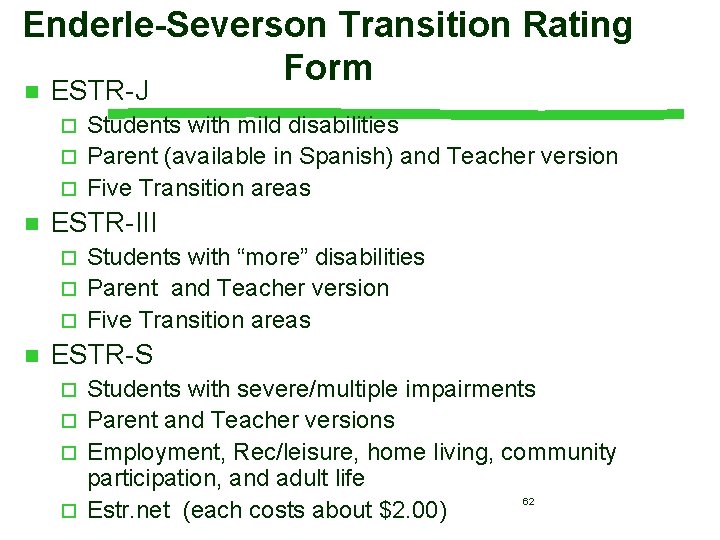
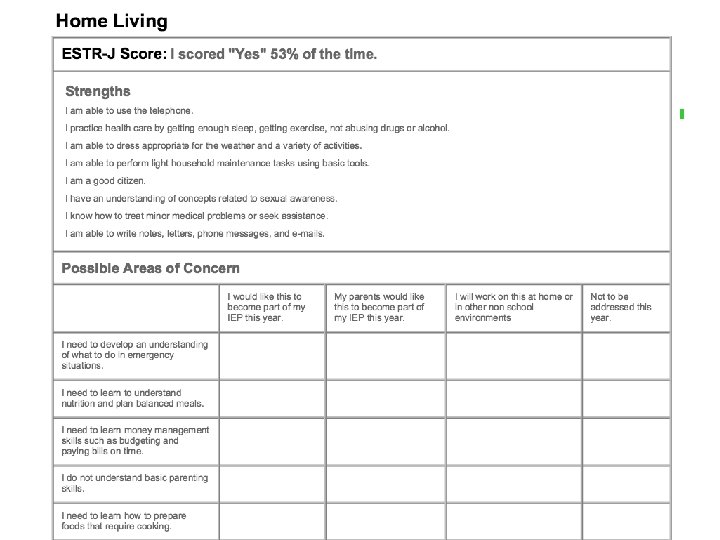
Enderle-Severson Transition Rating Form n ESTR-J Students with mild disabilities ¨ Parent (available in Spanish) and Teacher version ¨ Five Transition areas ¨ n ESTR-III Students with “more” disabilities ¨ Parent and Teacher version ¨ Five Transition areas ¨ n ESTR-S Students with severe/multiple impairments ¨ Parent and Teacher versions ¨ Employment, Rec/leisure, home living, community participation, and adult life 62 ¨ Estr. net (each costs about $2. 00) ¨
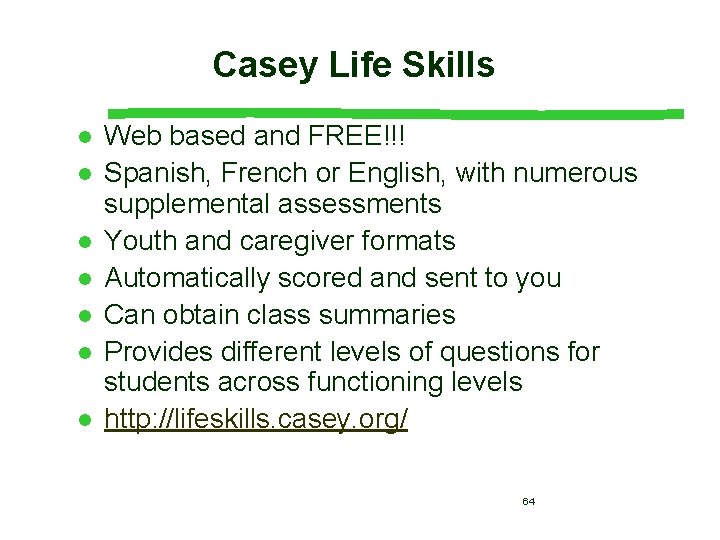
Casey Life Skills l l l l Web based and FREE!!! Spanish, French or English, with numerous supplemental assessments Youth and caregiver formats Automatically scored and sent to you Can obtain class summaries Provides different levels of questions for students across functioning levels http: //lifeskills. casey. org/ 64
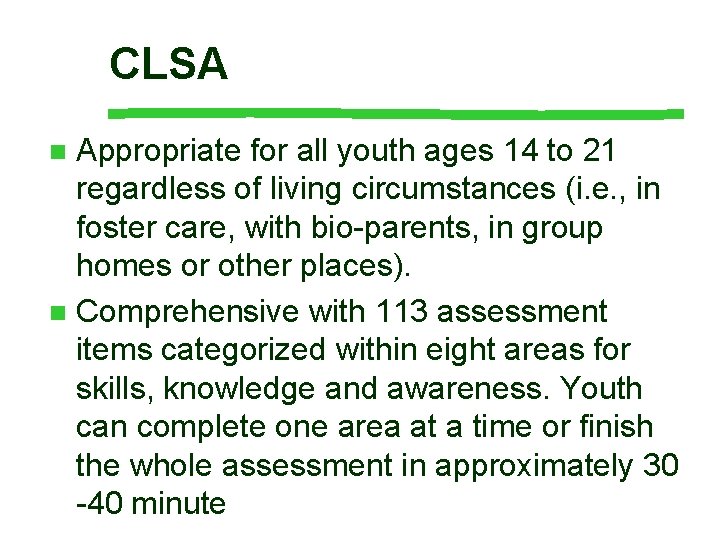
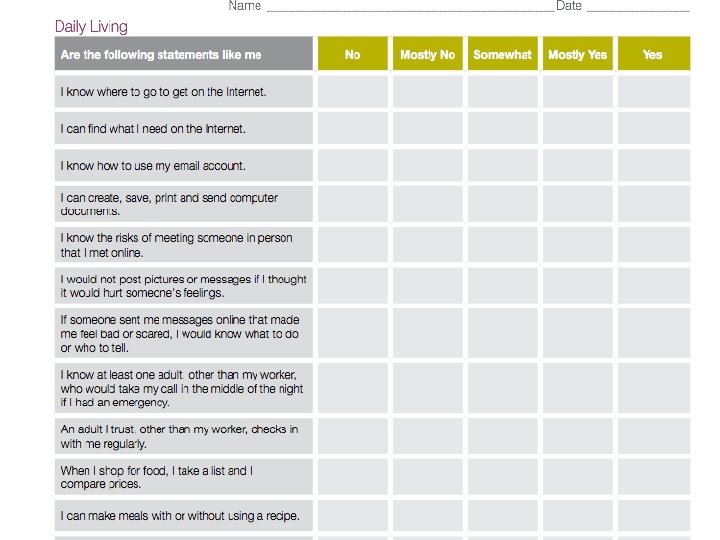
CLSA Appropriate for all youth ages 14 to 21 regardless of living circumstances (i. e. , in foster care, with bio-parents, in group homes or other places). n Comprehensive with 113 assessment items categorized within eight areas for skills, knowledge and awareness. Youth can complete one area at a time or finish the whole assessment in approximately 30 -40 minute n
66
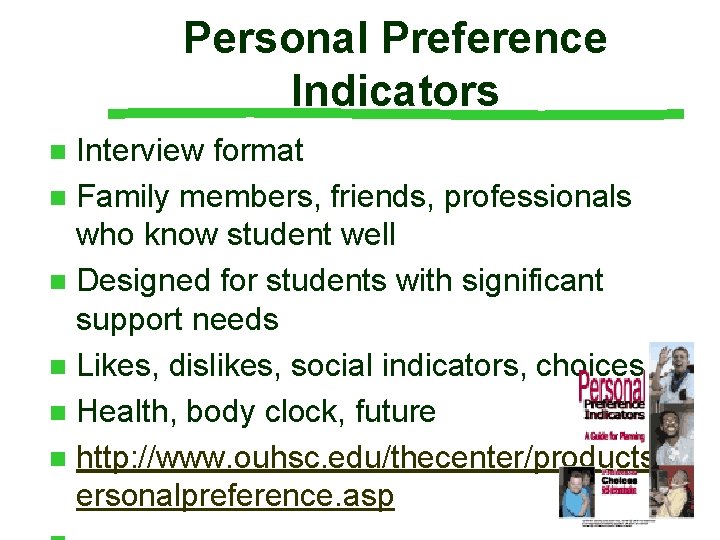
Personal Preference Indicators Interview format n Family members, friends, professionals who know student well n Designed for students with significant support needs n Likes, dislikes, social indicators, choices n Health, body clock, future n http: //www. ouhsc. edu/thecenter/products/p ersonalpreference. asp n
Big IDEA #2
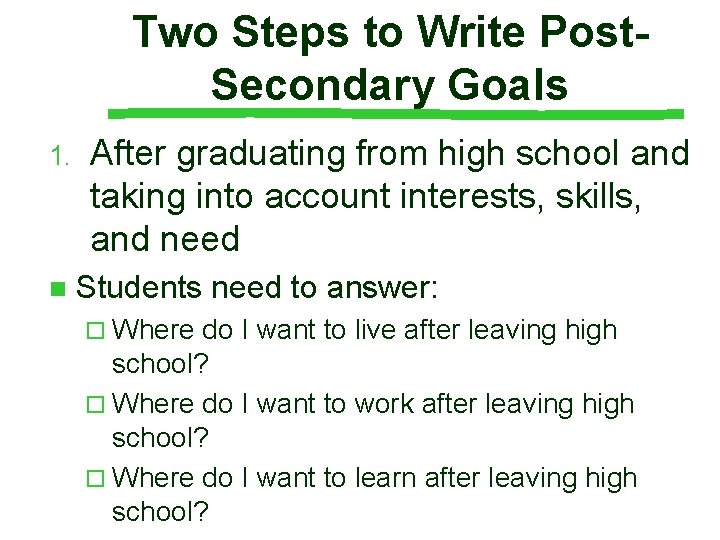
Two Steps to Write Post. Secondary Goals 1. n After graduating from high school and taking into account interests, skills, and need Students need to answer: ¨ Where do I want to live after leaving high school? ¨ Where do I want to work after leaving high school? ¨ Where do I want to learn after leaving high school?
Big IDEA #3
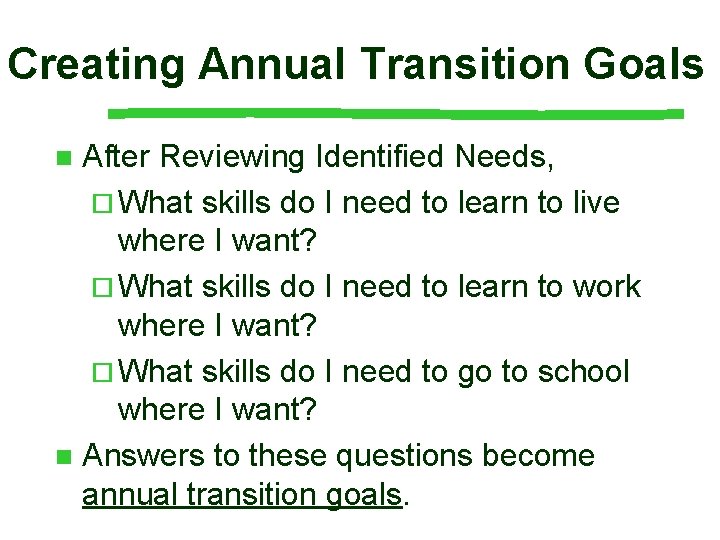
Creating Annual Transition Goals After Reviewing Identified Needs, ¨ What skills do I need to learn to live where I want? ¨ What skills do I need to learn to work where I want? ¨ What skills do I need to go to school where I want? n Answers to these questions become annual transition goals. n
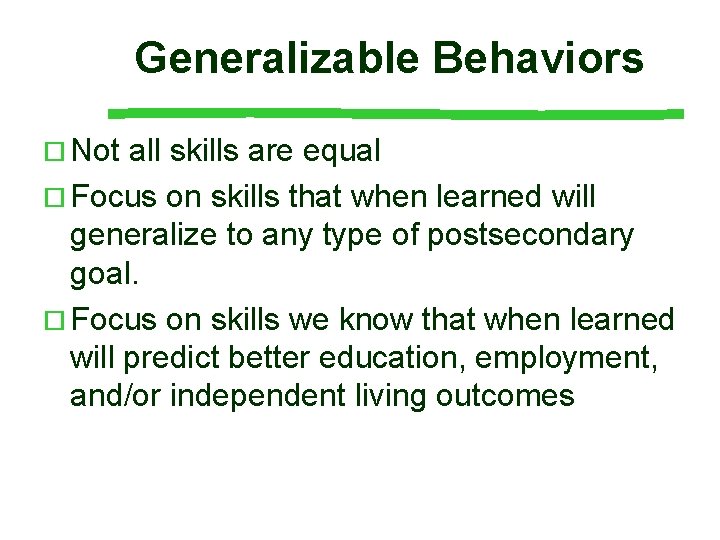
Generalizable Behaviors ¨ Not all skills are equal ¨ Focus on skills that when learned will generalize to any type of postsecondary goal. ¨ Focus on skills we know that when learned will predict better education, employment, and/or independent living outcomes
Big IDEA #4
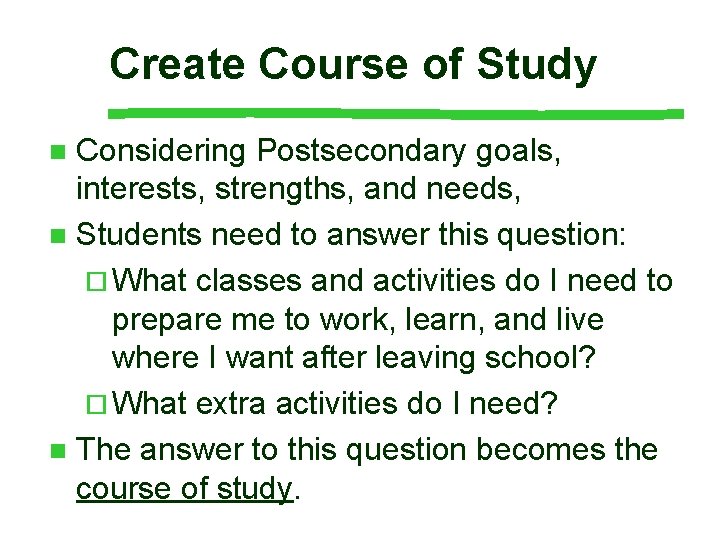
Create Course of Study Considering Postsecondary goals, interests, strengths, and needs, n Students need to answer this question: ¨ What classes and activities do I need to prepare me to work, learn, and live where I want after leaving school? ¨ What extra activities do I need? n The answer to this question becomes the course of study. n
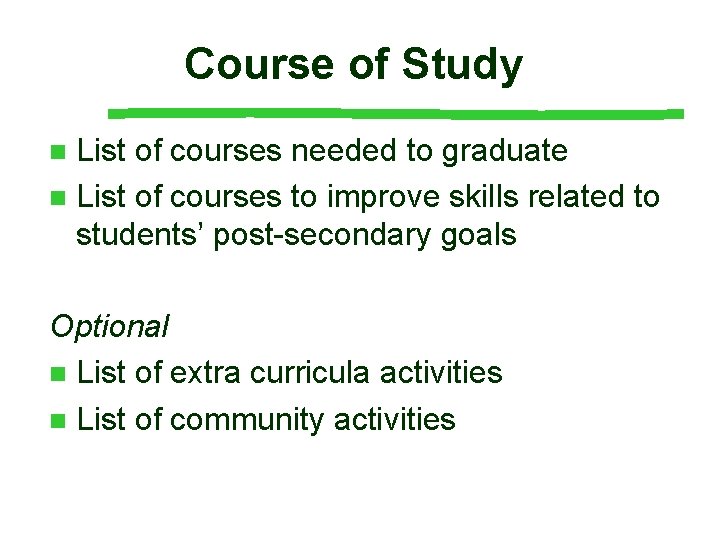
Course of Study List of courses needed to graduate n List of courses to improve skills related to students’ post-secondary goals n Optional n List of extra curricula activities n List of community activities
Big IDEA #5
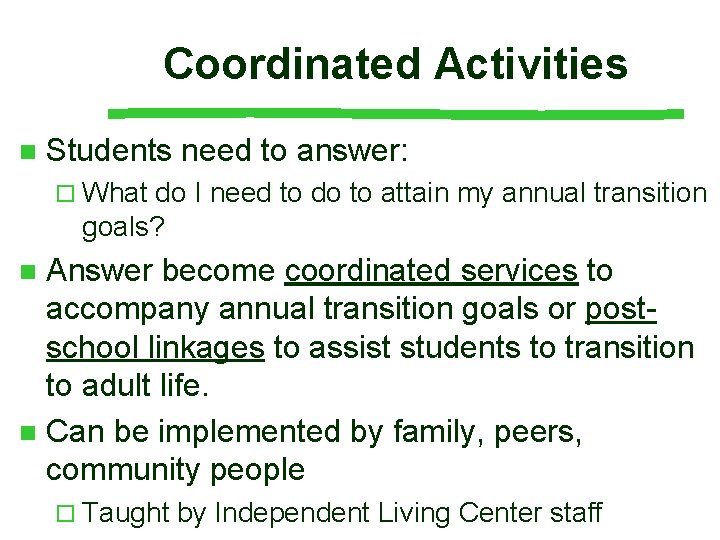
Coordinated Activities n Students need to answer: ¨ What do I need to do to attain my annual transition goals? Answer become coordinated services to accompany annual transition goals or postschool linkages to assist students to transition to adult life. n Can be implemented by family, peers, community people n ¨ Taught by Independent Living Center staff
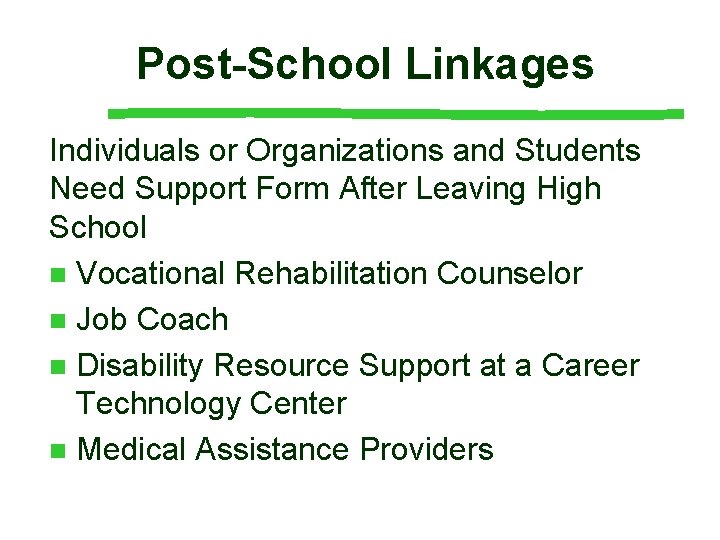
Post-School Linkages Individuals or Organizations and Students Need Support Form After Leaving High School n Vocational Rehabilitation Counselor n Job Coach n Disability Resource Support at a Career Technology Center n Medical Assistance Providers
Big IDEA #6 Student Engagement in IEP and Transition Planning Process
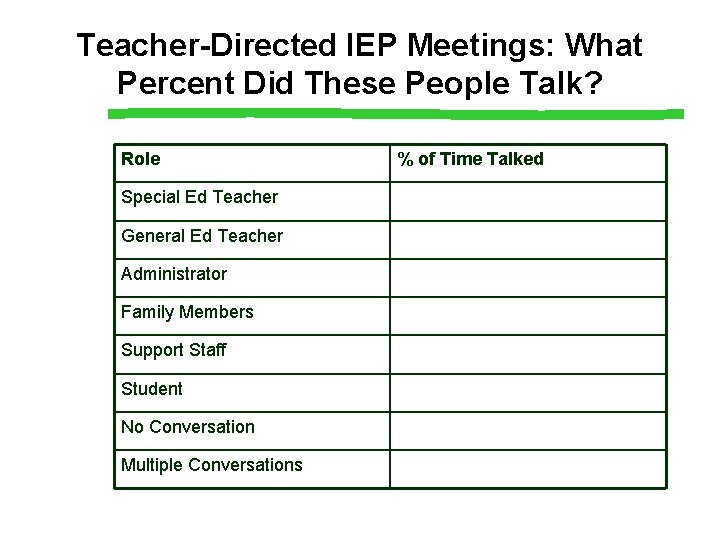
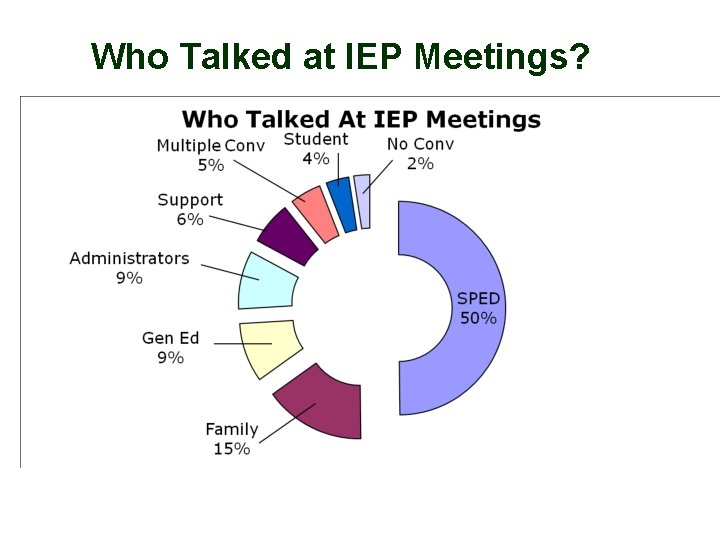
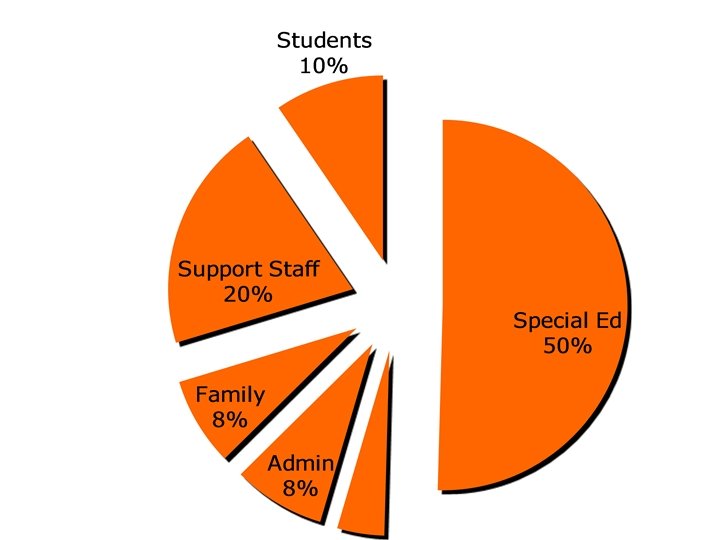
Teacher-Directed IEP Meetings: What Percent Did These People Talk? Role Special Ed Teacher General Ed Teacher Administrator Family Members Support Staff Student No Conversation Multiple Conversations % of Time Talked
Who Talked at IEP Meetings?
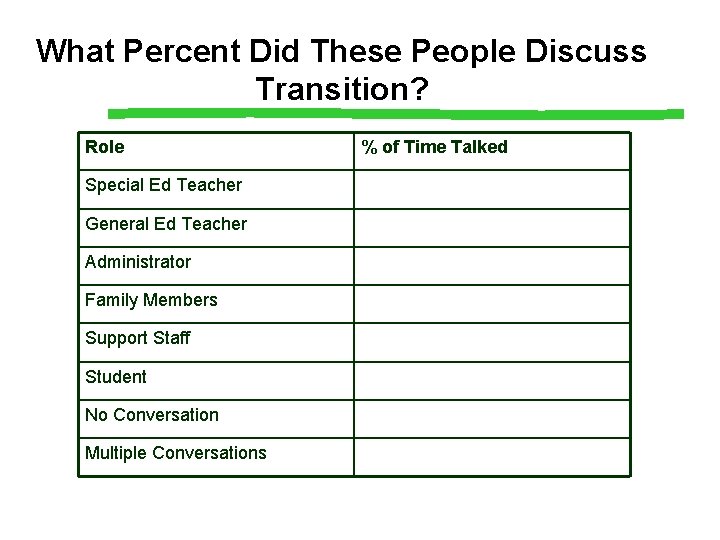
What Percent Did These People Discuss Transition? Role Special Ed Teacher General Ed Teacher Administrator Family Members Support Staff Student No Conversation Multiple Conversations % of Time Talked
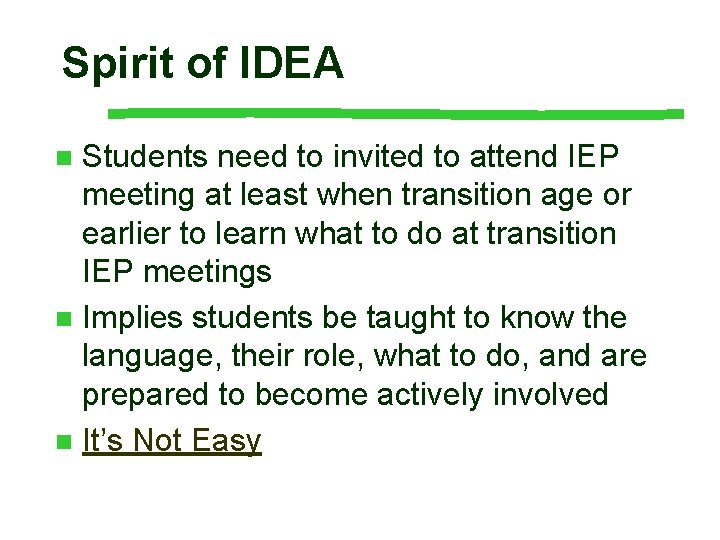
Spirit of IDEA Students need to invited to attend IEP meeting at least when transition age or earlier to learn what to do at transition IEP meetings n Implies students be taught to know the language, their role, what to do, and are prepared to become actively involved n It’s Not Easy n
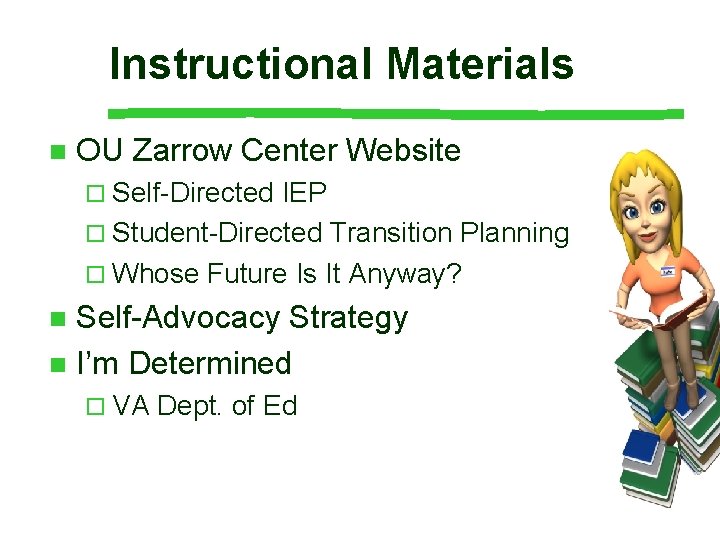
Instructional Materials n OU Zarrow Center Website ¨ Self-Directed IEP ¨ Student-Directed Transition Planning ¨ Whose Future Is It Anyway? Self-Advocacy Strategy n I’m Determined n ¨ VA Dept. of Ed
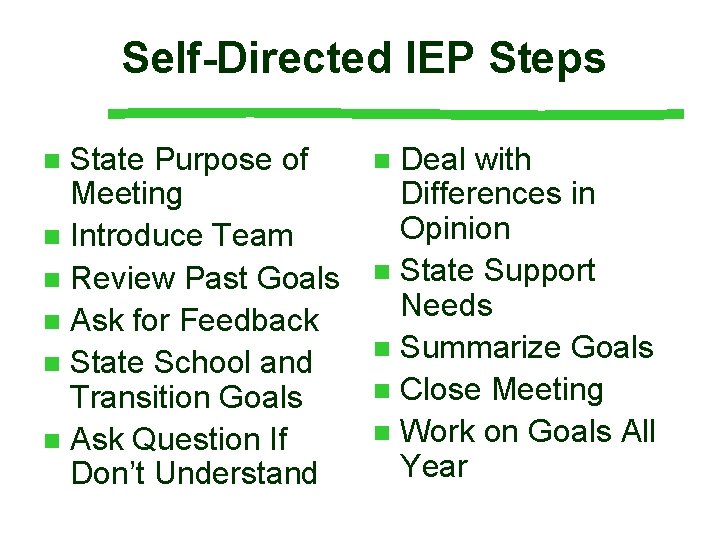
Self-Directed IEP Steps State Purpose of Meeting n Introduce Team n Review Past Goals n Ask for Feedback n State School and Transition Goals n Ask Question If Don’t Understand n Deal with Differences in Opinion n State Support Needs n Summarize Goals n Close Meeting n Work on Goals All Year n
Big IDEA #7
Teach Other Self. Determination Skills Me! Lesson to Teach Disability Awareness and Self-Advocacy n Choice. Maker Lesson Packages n Student-Directed Transition Planning Lessons n SDLMI n Whose Future Is It Anyway n
Big IDEA #8
Paid Employment n Paid Employment While In High School Predicts Employment After Graduation ¨Work Study ¨Summer Jobs ¨Part-Time Job ¨Community-Based Supported Employment
ZC Resources
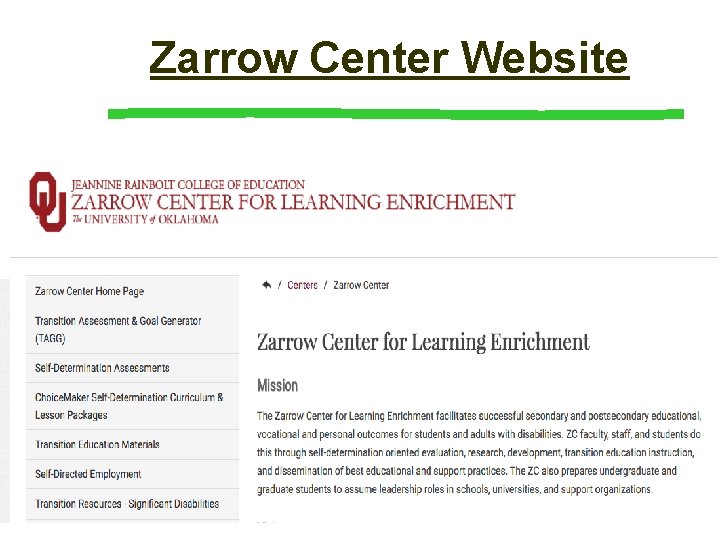
Zarrow Center Website
Questions? 94
Contact Information Jim Martin, Ph. D. Email: jemartin@ou. edu Phone: (405) 325 -8951 Website: https: //zarrowcenter. ou. edu