
THE NEW JIM CROW CHAPTER 1 THE REBIRTH

THE NEW JIM CROW CHAPTER 1: THE REBIRTH OF CASTE MICHELLE ALEXANDER
FOUNDATION FOR DISCUSSION This chapter in The New Jim Crow does much more than provide a history of the discrimination of African Americans in the United States. As Alexander outlines the historical story of racism, she exposes the foundation for the division in our country between political parties, geographic regions, religious affiliations and, most importantly, between the privileged and disenfranchised. I realize that this video is long (even if I do break it into sections), but I implore you to look at the Alexander chapter in its broader context of the debates, discussions and divisions of the present. When you couple this insight with the two articles dealing with the Conservative Republican ideas. I believe you have both the context for this class and a better understanding of where we are as a county.
RACISM IS HIGHLY ADAPTABLE “Preservation thru transformation” is the process through which white privilege is maintained, though the rules and rhetoric change. (Alexander, p. 21) While this is easier to see in retrospect, where the pattern to the cycle is more visible, it is still the case that…. . “The most ardent proponents of racial hierarchy have consistently succeeded in implementing new racial caste systems by triggering a collapse of resistance across the political spectrum. This feat has been achieved largely by appealing to the racism and vulnerability of lower-class whites, a group of people who are understandably eager to ensure that they never find themselves trapped at the bottom of the American hierarchy. ” (Alexander, p 22)
THE BIRTH OF SLAVERY “It is impossible to overstate the significance of race in defining the basic structure of American society. ” (p. 25) • Indentured servitude – early colonized America • Land essential – taken from Indians • Bacon’s Rebellion – unified white and black bond laborers • Introduction of African slaves • Racial Bribe – co-opted poor whites
CREATION OF OUR UNION Formation of our union was only possible when the structures we created allowed the preservation of the racial caste system and maintained rights (privilege) to whites, especially propertied whites. • Protect “property rights” in all documents • Weak federal government • Strong state’s rights • “Federalism – the division of power between the states and the federal government – was the device employed to protect the institution of slavery and the political power of slaveholding states. ” (p. 26) Slaves 3/5 of a man – and that was “man” by the way. • Entire structure of American democracy standing on this fiction –original constitution.
DEATH OF SLAVERY – EMANCIPATION • The Civil War and loss of life resulted in the Emancipation Proclamation • “The history of racial caste in the United States would end with the Civil War if the idea of race and racial difference had died when the institution of slavery was put to rest. But during the four centuries in which slavery flourished the idea of race flourished as well. Indeed, the notion of racial difference – specifically the notion of white supremacy – proved far more durable than the institution that gave birth to it. ” • White supremacy became the concept that engrained itself in the American psyche. • If you think about this idea, than all of the actions that follow (and the ones we are seeing today) become much clearer and understandable. The changes were not to eradicate slavery or racism or discrimination. It has never really been the goal. The goal has always remained how to secure the supremacy of the white race – and in today’s perspective – the propertied.
DEATH OF SLAVERY – EMANCIPATION • Just to give you a little idea about the white supremacy debate – here are some articles that might give you a perspective (if you are so inclined). I tried to give you a variety. • Why Donald Trump is considered a racist. • Talking about “Black Privilege. ” • White people vs white privilege • When my white friend asked my black opinion on white privilege • The Myth of White Privilege (The National Review)
DEATH OF SLAVERY – RECONSTRUCTION • Blacks walked away from the plantations and began acting like free people • Reconstruction was successfully enabling blacks to gain initial access to power: • 1867 – no black held public office • 1870 – 15% of southern officials were black • Even after voting rights act it was only 8% • 13 th, 14 th and 15 th amendments (Abolish slavery, Equal Protection Under the Law and right to vote) and the Civil Rights Act
DEATH OF SLAVERY TO THE SOUTHERN WHITE • “Racial division was a consequence, not a precondition of slavery, but once it was instituted it became detached from its initial function and acquired a social potency of its own. ” (Wacquant in Alexander) • Southern whites (poor and rich alike) were outraged by the emancipation • Economic impact on the plantation – infrastructure of South in shambles • 4 million newly freed slaves • Racial order of slavery no longer present (based on relationship – however unequal) • “The Negro must be controlled in some way…. ” (28) Black men aggressive.
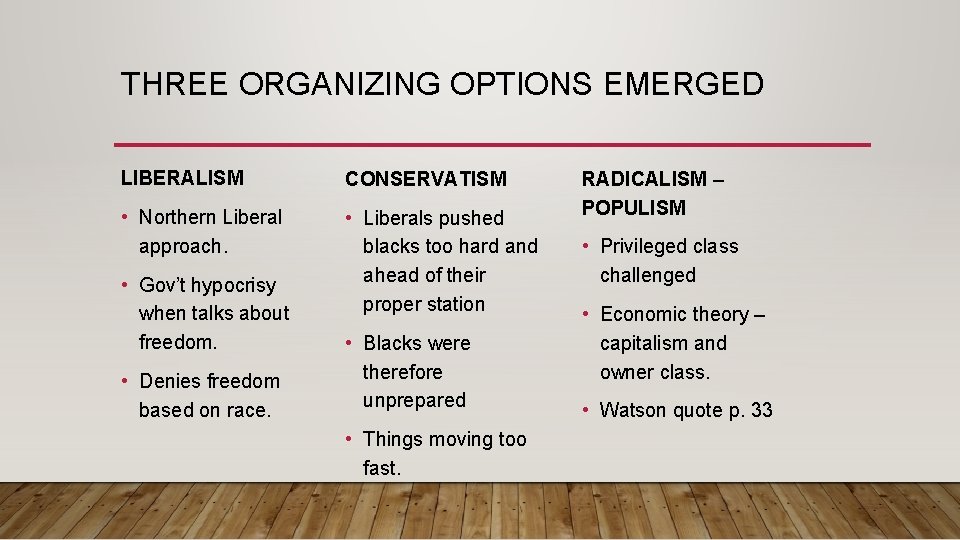
THREE ORGANIZING OPTIONS EMERGED LIBERALISM CONSERVATISM • Northern Liberal approach. • Liberals pushed blacks too hard and ahead of their proper station • Gov’t hypocrisy when talks about freedom. • Denies freedom based on race. • Blacks were therefore unprepared • Things moving too fast. RADICALISM – POPULISM • Privileged class challenged • Economic theory – capitalism and owner class. • Watson quote p. 33
POPULIST (RADICAL) MOVEMENT GAINED MOMENTUM • The populist approach initially was successful. • “it is altogether probably that during the brief Populist upheaval in the nineties Negros and native whites achieved a greater comity of mind and harmony of political purpose than ever before or since in the South. ” (33) • Conservatives returned to cry of white supremacy and utilized their previously successful tactics. While the poor whites were directing their animus to African Americans, the white privileged were spared their anger. • Everyone else deserted (p. 34)
REDEMPTION AND NEO-SLAVERY • Reconstruction was starting to look successful and the populist movement was challenging the owner class. • Southern conservatives vowed to reverse reconstruction and everything that is “designed to secure negro supremacy. ” • Political climate decimates a multiracial alliance of poor people • Planter elite maintains the separation of the races • South formalized racial division is specific laws to disenfranchise blacks.
THE BIRTH OF JIM CROW • Vagrancy laws – mischief charges • KKK terrorist campaign • Intimidation, bribery, fraud, and terror drove a wedge between poor whites and African Americans. • The final settlement, return to sanity, permanent system – Jim Crow was born.
THE DEATH OF JIM CROW This is the part of this history lesson that is most commonly referenced in our country. Most identify Brown v Board of Education as the end of Jim Crow, but there was a progression before that. • 1944/45 – Migration to the north increase and leads to an increase in the power of African Americans. • 1945 – WW II and the contrast between what we say and what we do • 1944 – Smith v Allwright – ended all white primary elections • 1946 – Segregation on Interstate buses illegal
THE DEATH OF JIM CROW This is the part of this history lesson that is most commonly referenced in our country. Most identify Brown v Board of Education as the end of Jim Crow, but there was a progression before that. • 1948 – Voided real estate agreements that racially discriminated • 1949 – Texas segregated law school for blacks inherely unequal and inferior • 1950 – Mc. Lauren v Oklahoma – law school segregated
THE BIRTH OF MASS INCARCERATION THE INITIAL STRATEGY It is important to remember, as Alexander discusses, that while there were many changes and opportunities for blacks in this country, the underlying divisions between the races remained a part of our culture. And there were times when various political strategies attempted to exploit that division. Goldwater in 1964 exploited riots and fears in his presidential campaign. Protests were frequently referred to as crime in the streets and stopping them became anticrime.
THE BIRTH OF MASS INCARCERATION THE SOUTHERN STRATEGY • From 1932 through 1960 there was a New Deal Coalition that consisted of ethnic groups in the north and white south democrats. • Kevin Phillips (Republican Strategist) saw the chance for a new political realignment • “Full racial polarization is essential ingredient of Phillip’s political pragmatism. He wants to see a black Democratic party, particularly in the South, because this will drive into the Republican party precisely the kind of anti-Negro whites who will help constitute the emerging majority. This even leads him to support some civil rights efforts. ”
THE BIRTH OF MASS INCARCERATION THE SOUTHERN STRATEGY • The beginning of the deserving and non-deserving designation • 1968 – law and order was called into question – and the cause was blacks and communists • 1970 s – Moynihan’s report on the black family – blamed for their own poverty • Liberals thought social reforms from the War on Poverty and civil rights legislation would get to “root causes. ” • Nixon dedicated 17 speeches to law and order
THE BIRTH OF MASS INCARCERATION THE REAGAN ERA • 1980 s – Reagan smoother in presenting the case • Reagan mastered the “excision of the language of race from conservative public discourse” • Welfare queens, predators, states rights, • Reagan coupled welfare and crime. The food stamp program was used to buy T-Bone steaks • Whites and blacks at the low end of the income distribution were again pitted against each other. Just like the populist defeat. And it worked.
THE BIRTH OF MASS INCARCERATION REAGAN ERA • Democrats defected – succumbed to the well executed PR campaign. • “Reagan’s racially coded rhetoric and strategy proved extraordinarily effective, as 22 percent of all Democrats defected from the party to vote for Reagan. The defenction rate shot up to 34 percent among those democrats who believed civil rights leaders were pushing too fast. “ (p. 49) • Reagan began building the war on crime.
THE BIRTH OF MASS INCARCERATION WAR ON CRIME • Democrats defected – succumbed to the well executed PR campaign. • “Reagan’s racially coded rhetoric and strategy proved extraordinarily effective, as 22 percent of all Democrats defected from the party to vote for Reagan. The defenction rate shot up to 34 percent among those democrats who believed civil rights leaders were pushing too fast. “ (p. 49) • Reagan began building the war on crime.
THE BIRTH OF MASS INCARCERATION WAR ON CRIME • Resources from the federal government were diverted from white collar criminals to “street crime, ” especially drug enforcement. • At that time less than 2% of the American public viewed druss as important problem • Early 1980 s inner cities struggling, declining in legitimate employment opportunities • Incentives to sell drugs high. And crack cocaine terrible scourge on inner cities. • Our response was not treatment – not prevention – but punishment • Scourge of crack exaggerated in order to maintain agenda: “Crack was a godsend to the Right…it could not have appeared at a more politically opportune moment. ” (p. 53)
THE BIRTH OF MASS INCARCERATION WAR ON CRIME • High correlation between racial attitudes and the support for getting “tough on crime. ” • H. W. Bush continued the message • 1989 64% agreed drugs most important issue • Shift to the attitude of toughness – mobilizing white resentment • Early 1990 s resistance to this new system of racialized social control collapsed across all political spectrum. • This was a repeat of the populists collapse
THE BIRTH OF MASS INCARCERATION CLINTON ERA • Determined he would not be “less tough” on crime than the Republicans • Largest increase in federal and state prison inmates of any president in American History. • PRWORA turned AFDC to block grants. • Back to states rights
THE BIRTH OF MASS INCARCERATION CLINTON ERA • Any drug offence made you permanently unable to receive benefits. • Dramatic shift toward punitiveness resulted in a massive reallocation of public resources • Enables discrimination in public housing policy • Proving how tough he was on “them. ” • No serious alternative existed. • 2 million behind bars at turn of century • NEW JIM CROW WAS BORN
MASS INCARCERATION THE TRUMP ERA • Here are some indications of what we might be looking at in a Trump administration. • Criminal justice reformers will look elsewhere • Fighting mass incarceration under Trump • Why Trump can’t doom the criminal reform movement • Ava Du. Verney on Trump and Mass Incarceration – related to movie assigned later in class
- Slides: 26