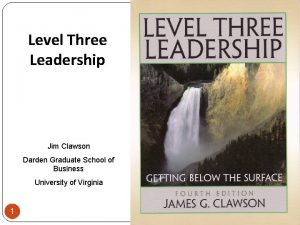
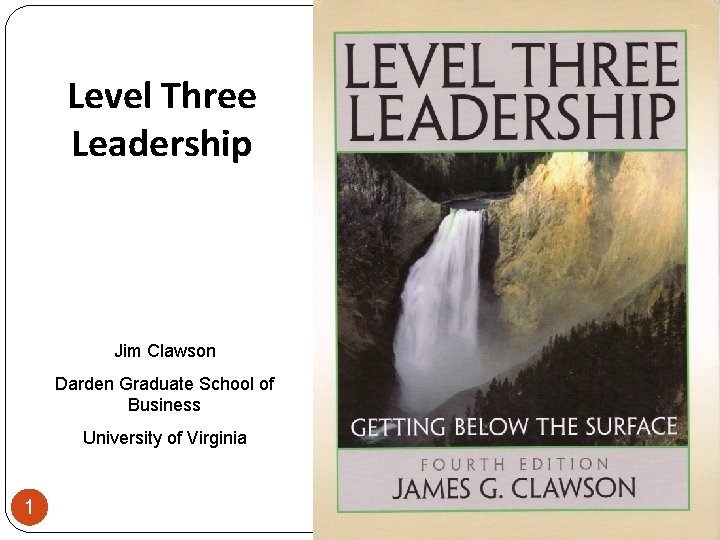
Level Three Leadership Jim Clawson Darden Graduate School


- Slides: 109
Level Three Leadership Jim Clawson Darden Graduate School of Business University of Virginia 1
What are the biggest challenges you face today? 2 © James G. Clawson
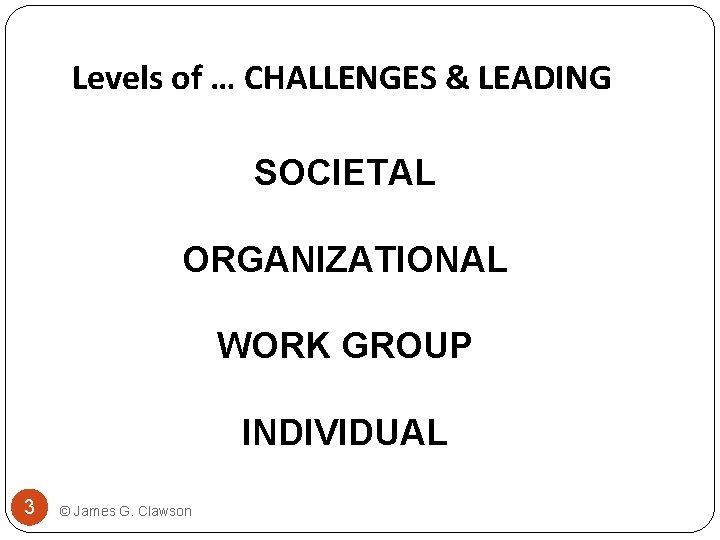
Levels of … CHALLENGES & LEADING SOCIETAL ORGANIZATIONAL WORK GROUP INDIVIDUAL 3 © James G. Clawson
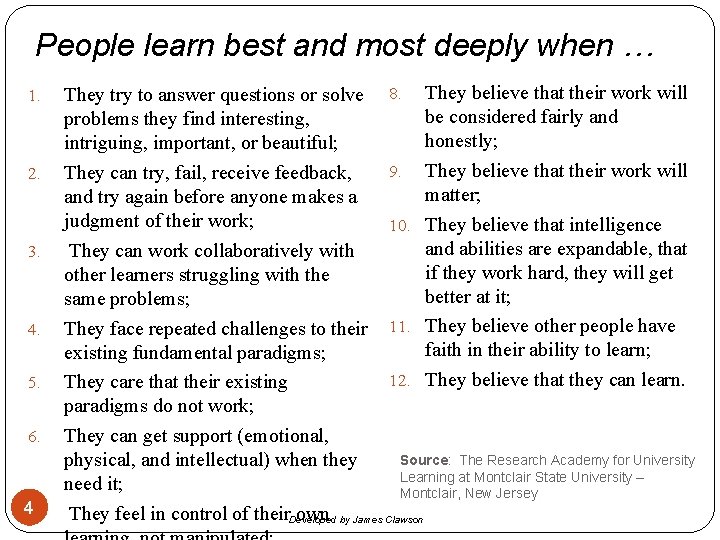
People learn best and most deeply when … 1. 2. 3. 4. 5. 6. 47. They try to answer questions or solve 8. They believe that their work will be considered fairly and problems they find interesting, honestly; intriguing, important, or beautiful; 9. They believe that their work will They can try, fail, receive feedback, matter; and try again before anyone makes a judgment of their work; 10. They believe that intelligence and abilities are expandable, that They can work collaboratively with if they work hard, they will get other learners struggling with the better at it; same problems; They face repeated challenges to their 11. They believe other people have faith in their ability to learn; existing fundamental paradigms; 12. They believe that they can learn. They care that their existing paradigms do not work; They can get support (emotional, Source: The Research Academy for University physical, and intellectual) when they Learning at Montclair State University – need it; Montclair, New Jersey They feel in control of their. Developed own by James Clawson
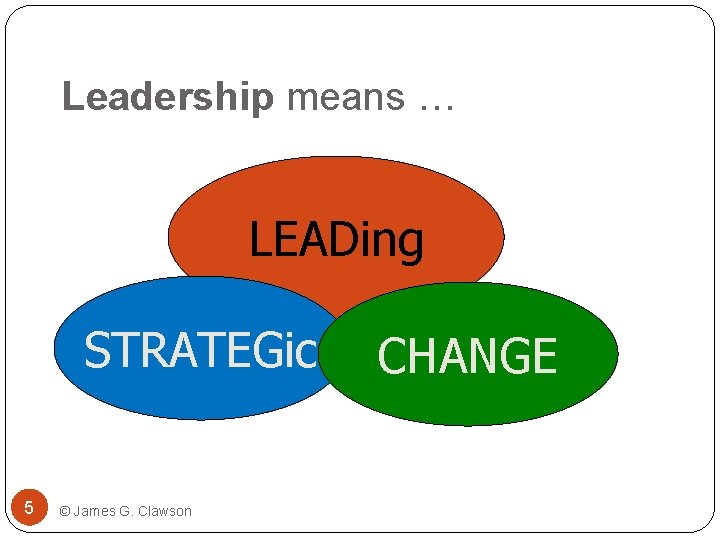
Leadership means … LEADing STRATEGic 5 © James G. Clawson CHANGE
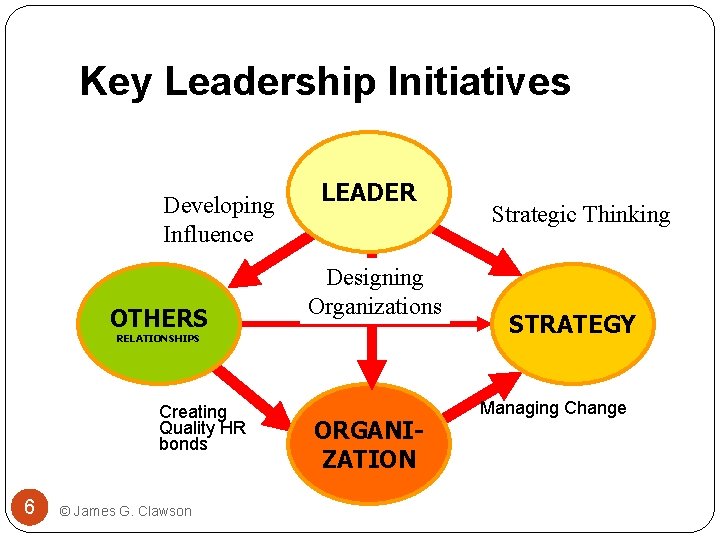
Key Leadership Initiatives Developing Influence OTHERS LEADER Designing Organizations RELATIONSHIPS Creating Quality HR bonds 6 © James G. Clawson ORGANIZATION Strategic Thinking STRATEGY Managing Change
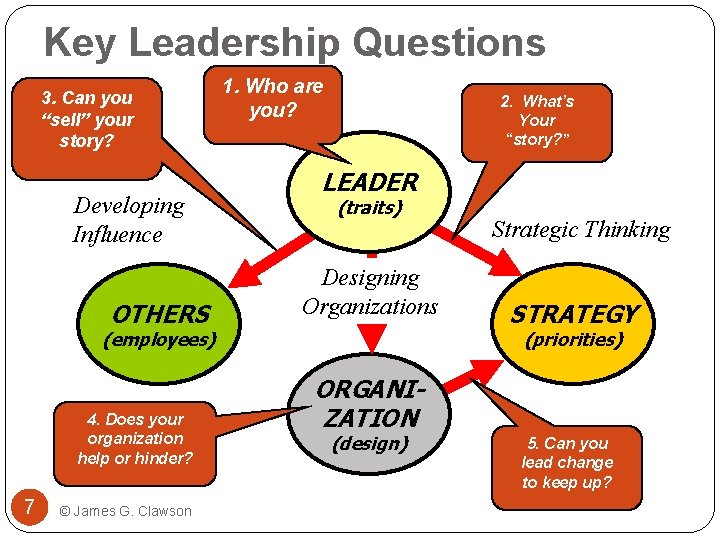
Key Leadership Questions 3. Can you “sell” your story? Developing Influence OTHERS 1. Who are you? 2. What’s Your “story? ” LEADER (traits) Designing Organizations (employees) 4. Does your organization help or hinder? 7 © James G. Clawson Strategic Thinking STRATEGY (priorities) ORGANIZATION (design) 5. Can you lead change to keep up?
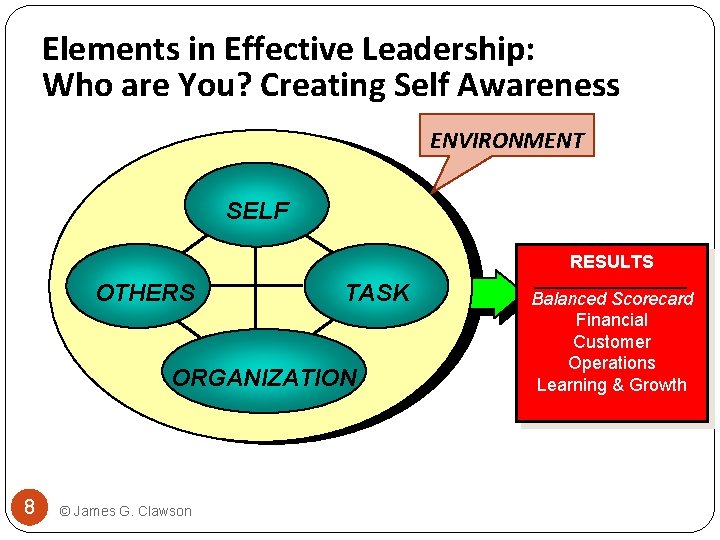
Elements in Effective Leadership: Who are You? Creating Self Awareness ENVIRONMENT SELF RESULTS OTHERS TASK ORGANIZATION 8 © James G. Clawson Balanced Scorecard Financial Customer Operations Learning & Growth
Does experience lead to wisdom? “Most people do not accumulate a body of experience. Most people go through life under-going a series of happenings which pass through their systems undigested. Happenings become experiences when they are digested, when they are reflected on, related to general patterns, and synthesized. ” Saul Alinsky, Rules for Radicals, quoted by Henry Mintzberg in “The 9 Five Minds of a Manager” HBR 11/03
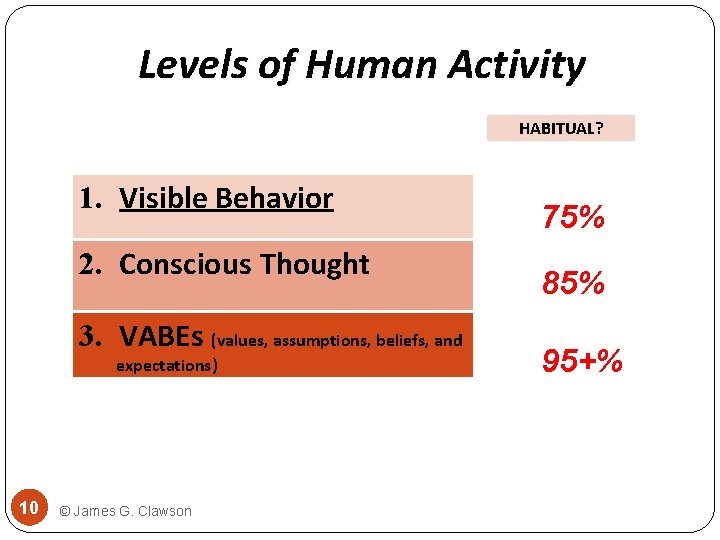
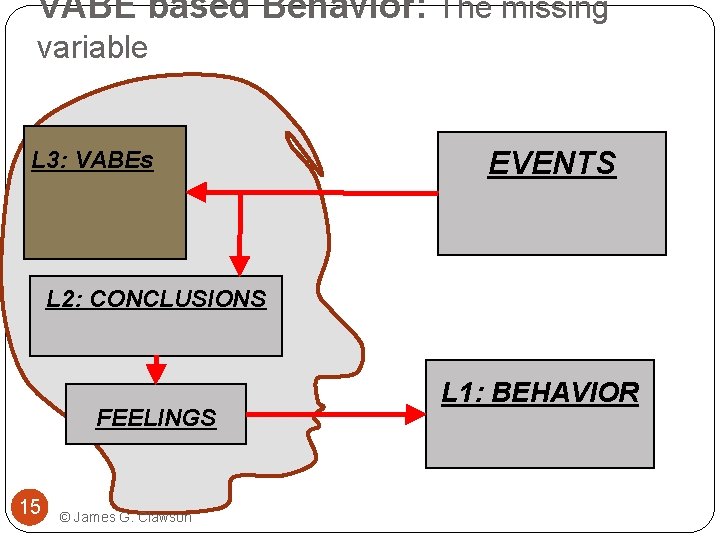
Levels of Human Activity HABITUAL? 1. Visible Behavior 2. Conscious Thought 3. VABEs (values, assumptions, beliefs, and expectations) 10 © James G. Clawson 75% 85% 95+%
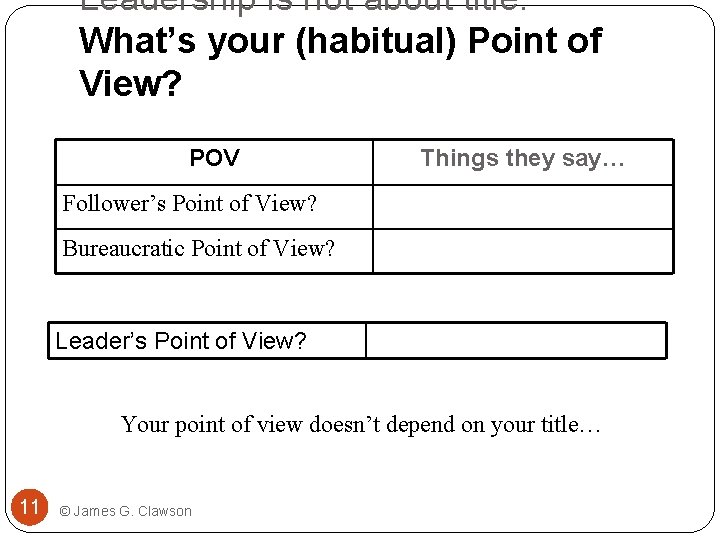
Leadership is not about title. What’s your (habitual) Point of View? POV Things they say… Follower’s Point of View? Bureaucratic Point of View? Leader’s Point of View? Your point of view doesn’t depend on your title… 11 © James G. Clawson
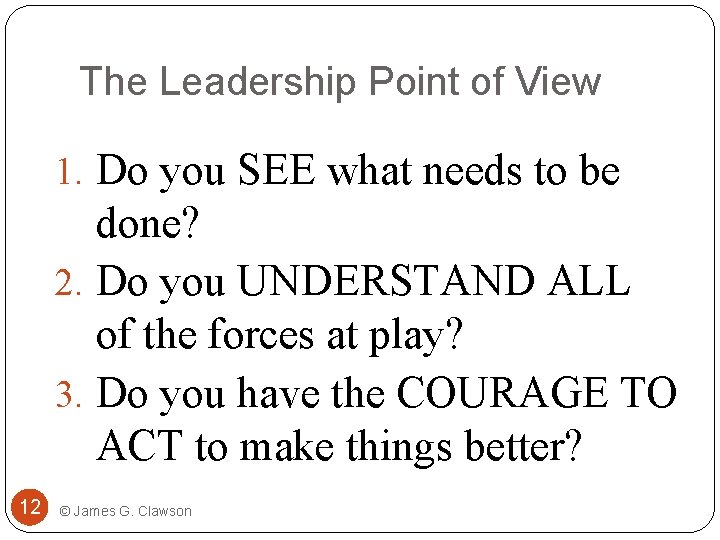
The Leadership Point of View 1. Do you SEE what needs to be done? 2. Do you UNDERSTAND ALL of the forces at play? 3. Do you have the COURAGE TO ACT to make things better? 12 © James G. Clawson
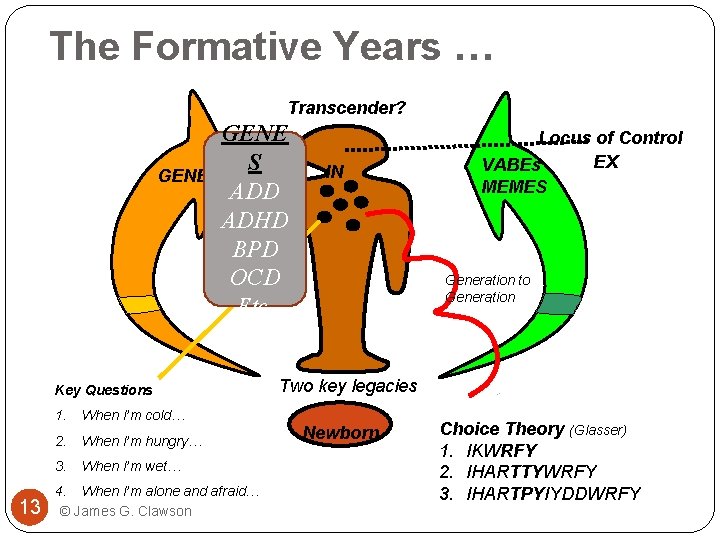
The Formative Years … Transcender? GENE S GENES ADD ADHD BPD OCD Etc. Key Questions 13 1. When I’m cold… 2. When I’m hungry… 3. When I’m wet… 4. When I’m alone and afraid… © James G. Clawson K, L, A IN Locus of Control EX VABEs MEMES Generation to Generation Two key legacies Newborn Choice Theory (Glasser) 1. IKWRFY 2. IHARTTYWRFY 3. IHARTPYIYDDWRFY
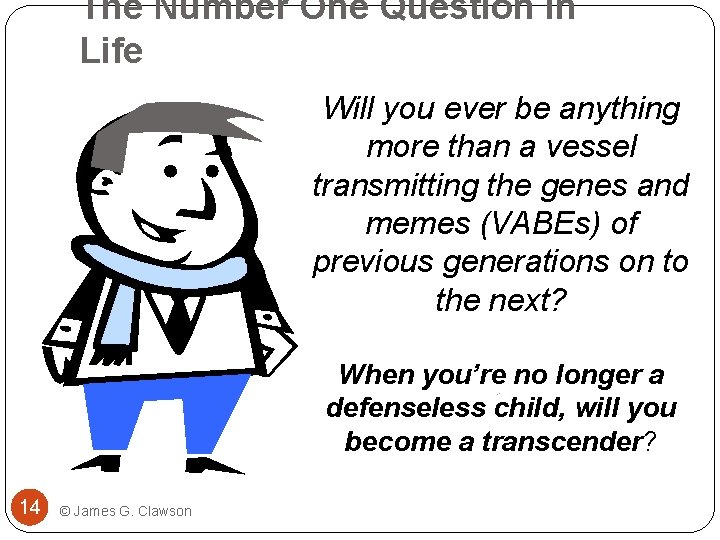
The Number One Question in Life Will you ever be anything more than a vessel transmitting the genes and memes (VABEs) of previous generations on to the next? When you’re no longer a defenseless child, will you become a transcender? 14 © James G. Clawson
VABE based Behavior: The missing variable L 3: VABEs EVENTS L 2: CONCLUSIONS FEELINGS 15 © James G. Clawson L 1: BEHAVIOR
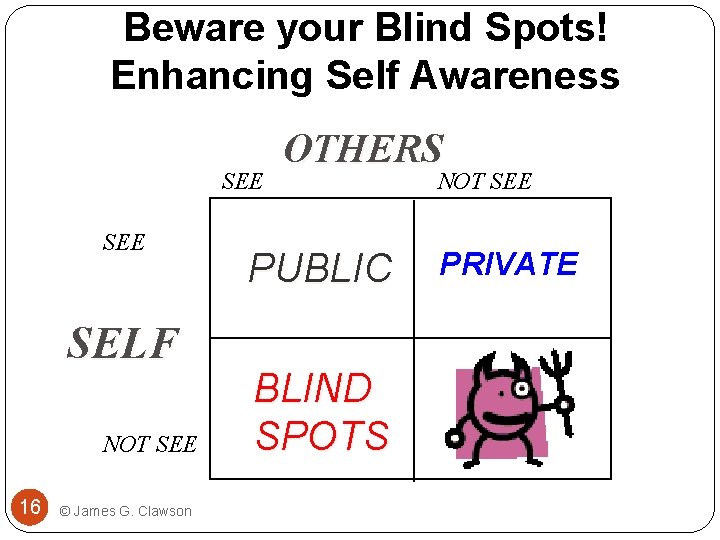
Beware your Blind Spots! Enhancing Self Awareness SEE SELF NOT SEE 16 © James G. Clawson OTHERS PUBLIC BLIND SPOTS NOT SEE PRIVATE
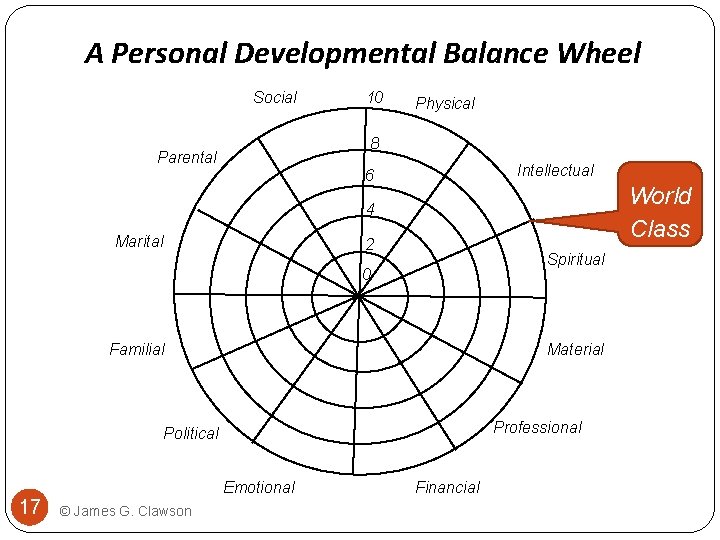
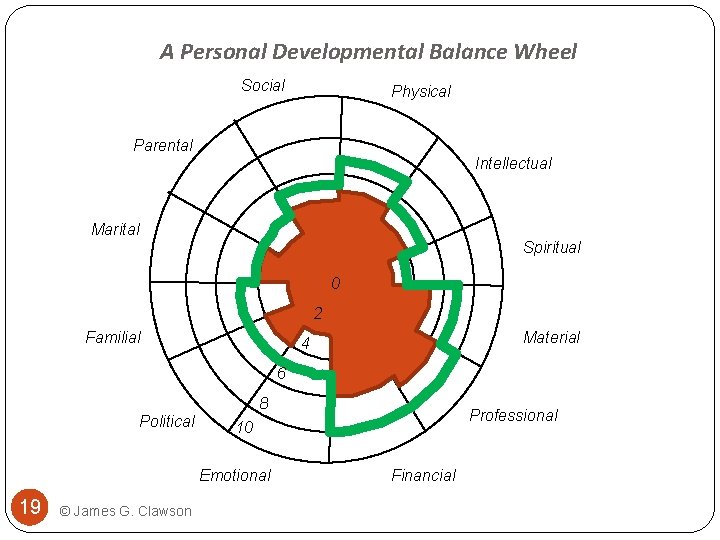
A Personal Developmental Balance Wheel Social 10 Physical 8 Parental Intellectual 6 World Class 4 Marital 2 Spiritual 0 Familial Material Professional Political 17 Emotional © James G. Clawson Financial
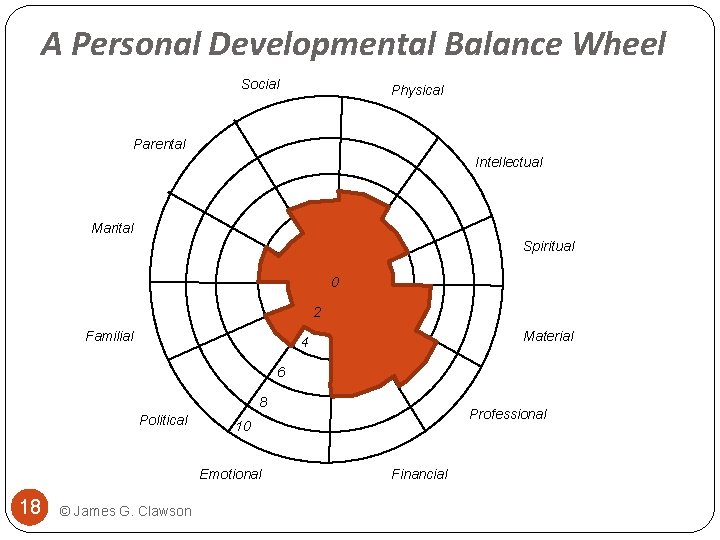
A Personal Developmental Balance Wheel Social Physical Parental Intellectual Marital Spiritual 0 2 Familial Material 4 6 8 Political Emotional 18 © James G. Clawson Professional 10 Financial
A Personal Developmental Balance Wheel Social Physical Parental Intellectual Marital Spiritual 0 2 Familial Material 4 6 8 Political Emotional 19 © James G. Clawson Professional 10 Financial
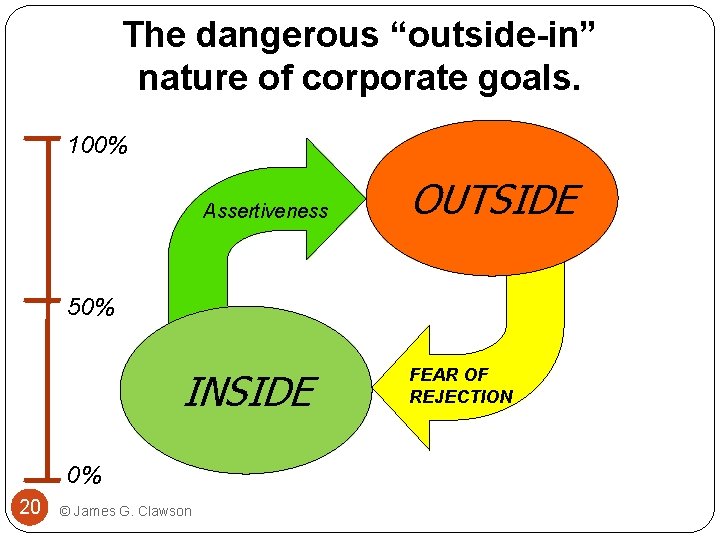
The dangerous “outside-in” nature of corporate goals. 100% Assertiveness OUTSIDE 50% INSIDE 0% 20 © James G. Clawson FEAR OF REJECTION
Are you leading your own life or living outside-in? 21 21 Summer 2009 © James G. Clawson
Is leading self about managing time? 22 © James G. Clawson
Leadership is about managing energy, first in yourself and then in others. 23 © James G. Clawson
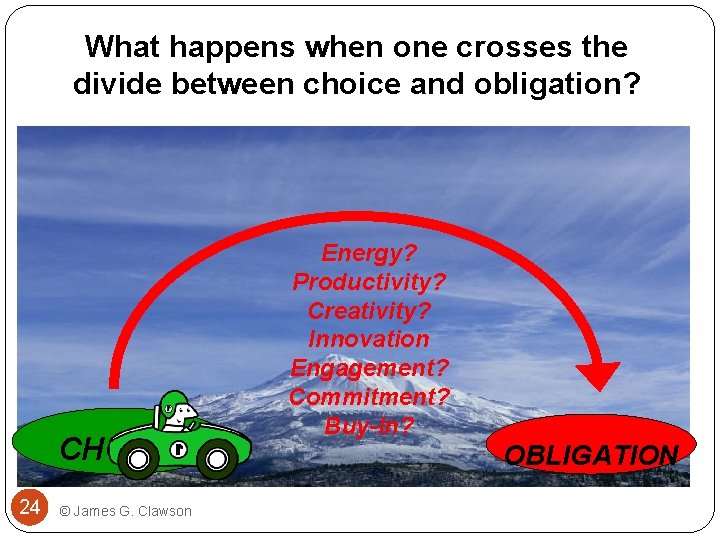
What happens when one crosses the divide between choice and obligation? CHOICE 24 © James G. Clawson Energy? Productivity? Creativity? Innovation Engagement? Commitment? Buy-In? OBLIGATION
The obligatory commute … 25 © James G. Clawson
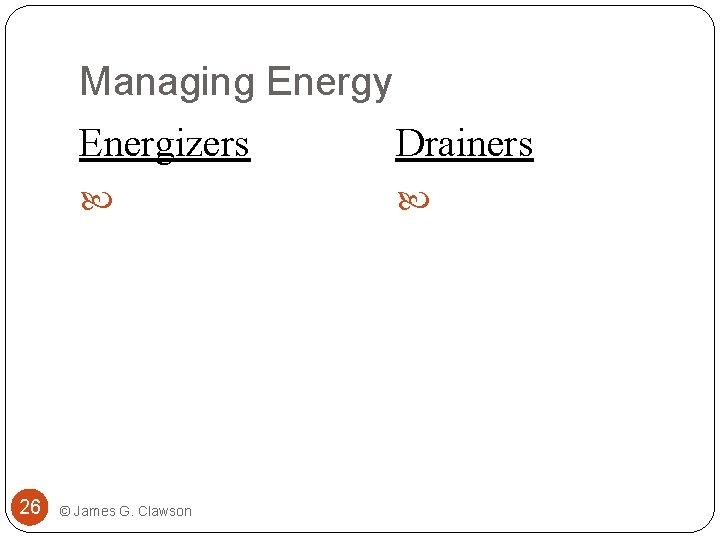
Managing Energy 26 Energizers Drainers © James G. Clawson
How do you want to feel? 27 © James G. Clawson
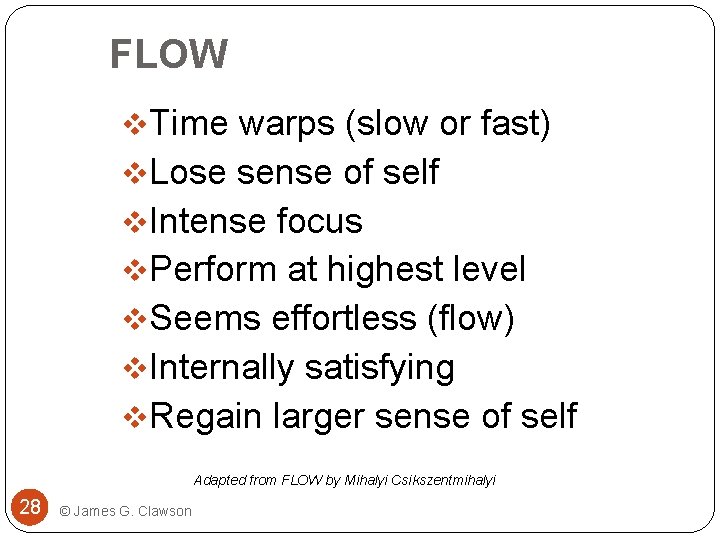
FLOW v. Time warps (slow or fast) v. Lose sense of self v. Intense focus v. Perform at highest level v. Seems effortless (flow) v. Internally satisfying v. Regain larger sense of self Adapted from FLOW by Mihalyi Csikszentmihalyi 28 © James G. Clawson
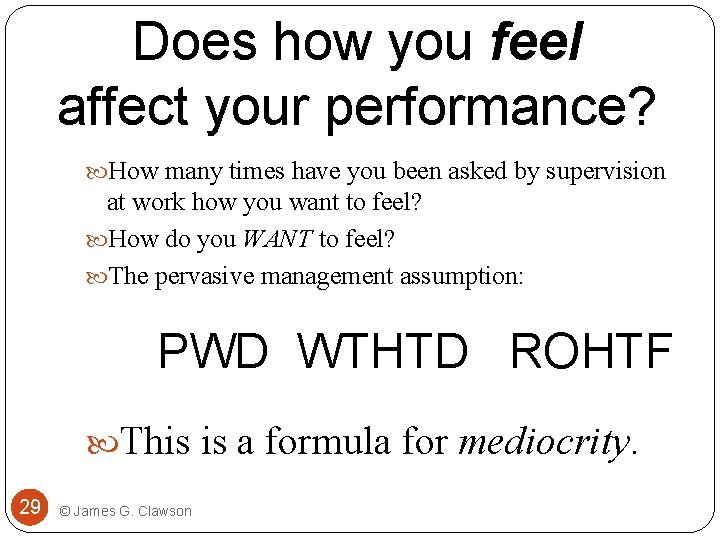
Does how you feel affect your performance? How many times have you been asked by supervision at work how you want to feel? How do you WANT to feel? The pervasive management assumption: PWD WTHTD ROHTF This is a formula for mediocrity. 29 © James G. Clawson
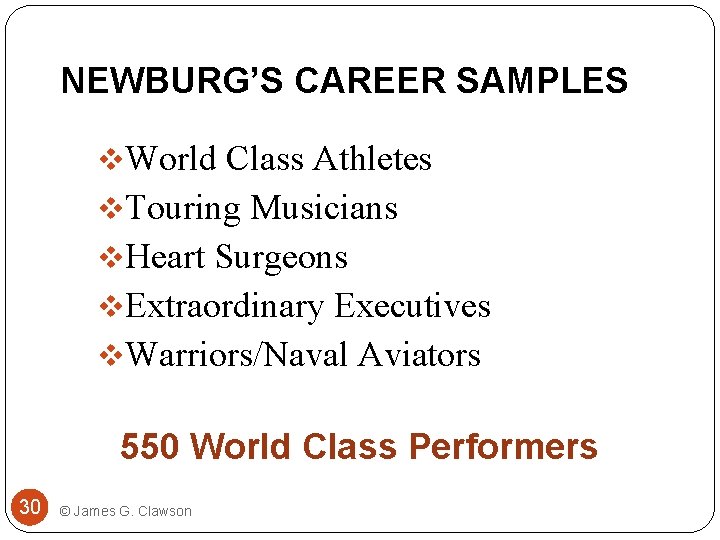
NEWBURG’S CAREER SAMPLES v. World Class Athletes v. Touring Musicians v. Heart Surgeons v. Extraordinary Executives v. Warriors/Naval Aviators 550 World Class Performers 30 © James G. Clawson
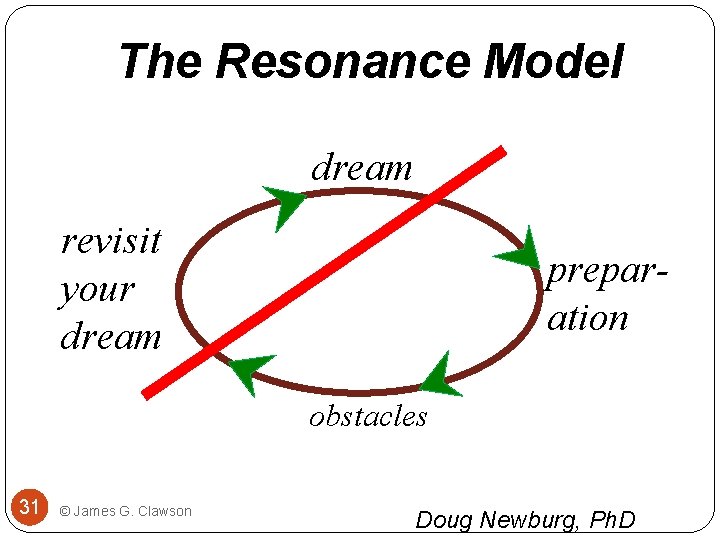
The Resonance Model dream revisit your dream preparation obstacles 31 © James G. Clawson Doug Newburg, Ph. D
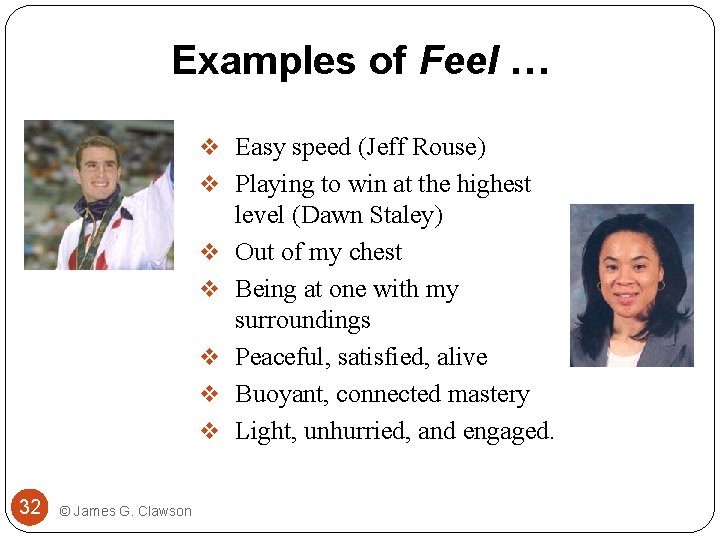
Examples of Feel … v Easy speed (Jeff Rouse) v Playing to win at the highest v v v 32 © James G. Clawson level (Dawn Staley) Out of my chest Being at one with my surroundings Peaceful, satisfied, alive Buoyant, connected mastery Light, unhurried, and engaged.
Focusing on Feel to Perform Dave Scott 49, Six-time Ironman Hawaii Champion “During a race, I never wear a wristwatch, and my bike doesn’t have a speedometer. They’re distractions. All I work on is finding a rhythm that feels strong and sticking to it. ” 33 © James G. Clawson Outside, 9/03, p. 122
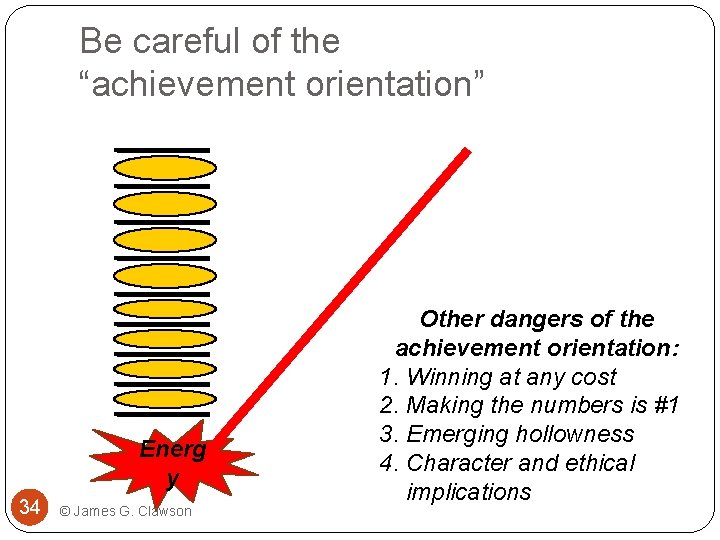
Be careful of the “achievement orientation” Energ y 34 © James G. Clawson Other dangers of the achievement orientation: 1. Winning at any cost 2. Making the numbers is #1 3. Emerging hollowness 4. Character and ethical implications
What’s the difference between “work” and a “job? ” “I stopped loving golf at exactly the time I decided to turn pro. ” - Tom Weiskopf , Golf, July 2004, p. 133 People pay me a lot of money to go away from my family, stay in cheap motels, ride on the bus all night, and eat rubber chicken. But when the curtain goes up and the light on the camera goes on, THAT I do for free. - Grammy winning musician 35 © James G. Clawson
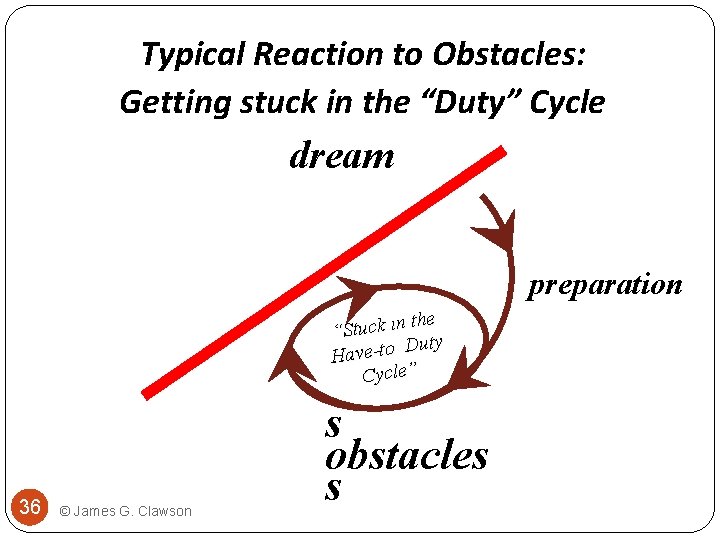
Typical Reaction to Obstacles: Getting stuck in the “Duty” Cycle dream preparation the “Stuck in y Dut Have-to Cycle” 36 © James G. Clawson s obstacles s
What is “success? ” Money? Fame? Power? “afterward, you want to do it again. ” 37 © James G. Clawson
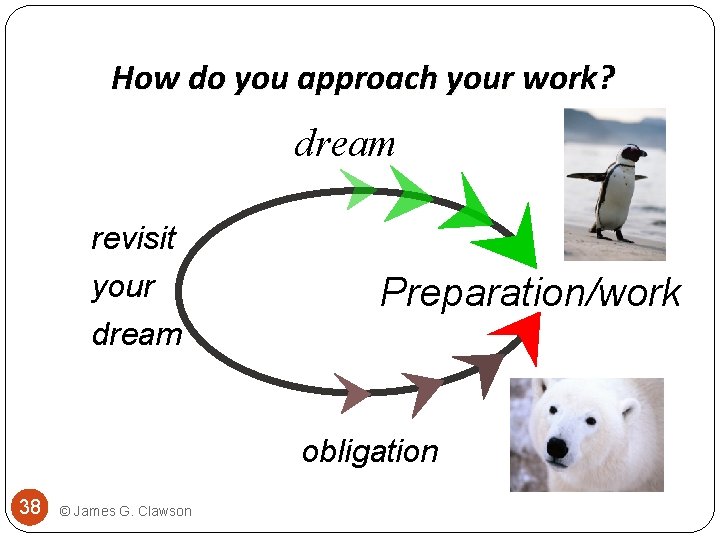
How do you approach your work? dream revisit your Preparation/work dream obligation 38 © James G. Clawson
Resonance is a question of harmony between inside and outside “I think that we’re seeking is an experience of being alive, so that our life experiences on the purely physical plane will have resonance with our innermost being and reality, so that we actually feel the rapture of being alive. ” - Joseph Campbell, The Power of Myth, 1988 39 © James G. Clawson
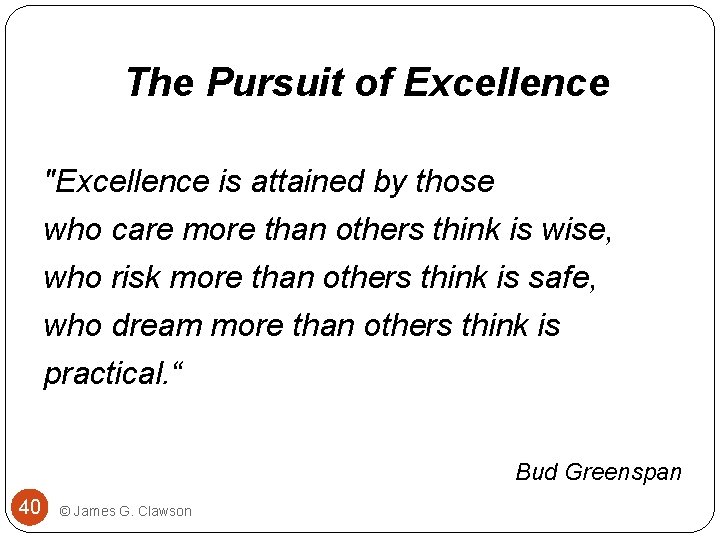
The Pursuit of Excellence "Excellence is attained by those who care more than others think is wise, who risk more than others think is safe, who dream more than others think is practical. “ Bud Greenspan 40 © James G. Clawson
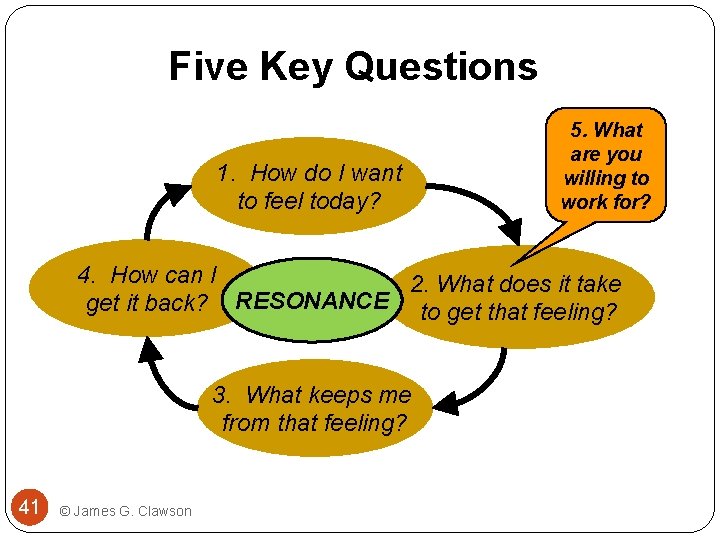
Five Key Questions 1. How do I want to feel today? 5. What are you willing to work for? 4. How can I 2. What does it take get it back? RESONANCE to get that feeling? 3. What keeps me from that feeling? 41 © James G. Clawson
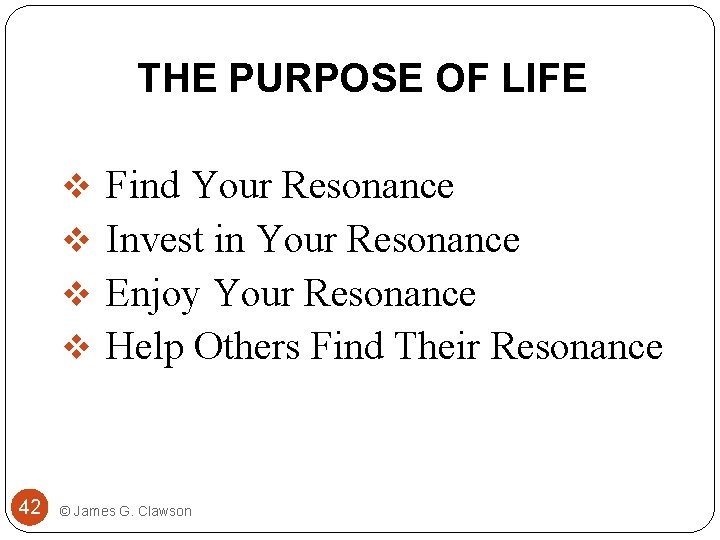
THE PURPOSE OF LIFE v Find Your Resonance v Invest in Your Resonance v Enjoy Your Resonance v Help Others Find Their Resonance 42 © James G. Clawson
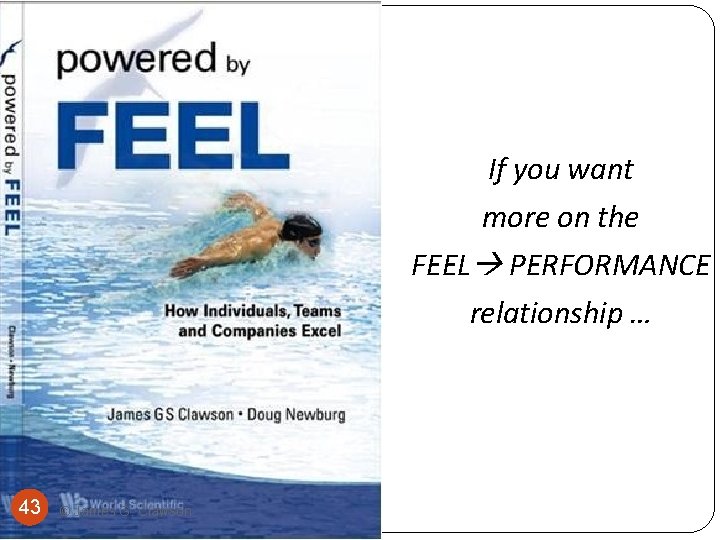
If you want more on the FEEL PERFORMANCE relationship … 43 © James G. Clawson
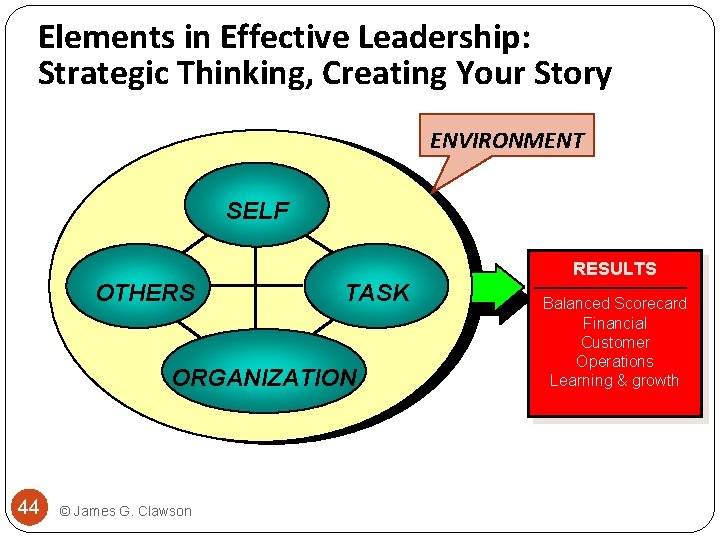
Elements in Effective Leadership: Strategic Thinking, Creating Your Story ENVIRONMENT SELF RESULTS OTHERS TASK ORGANIZATION 44 © James G. Clawson Balanced Scorecard Financial Customer Operations Learning & growth
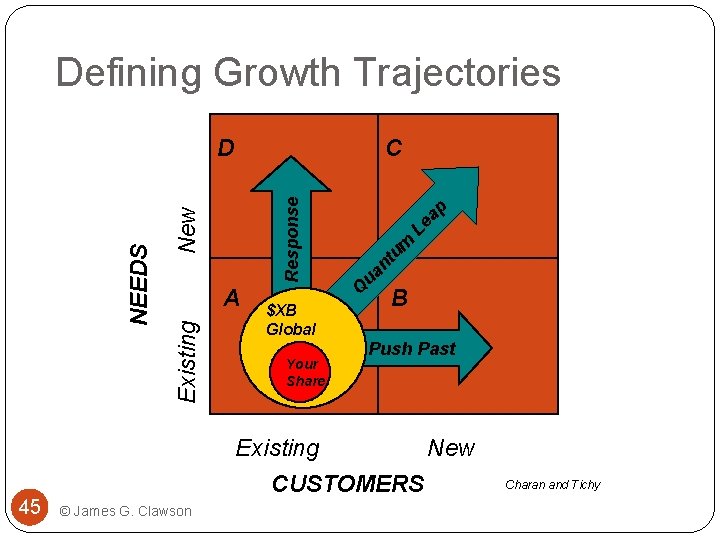
Defining Growth Trajectories 45 $XB Global Your Share ap Le um Q ua nt New Response C A Existing NEEDS D B Push Past Existing New CUSTOMERS © James G. Clawson Charan and Tichy
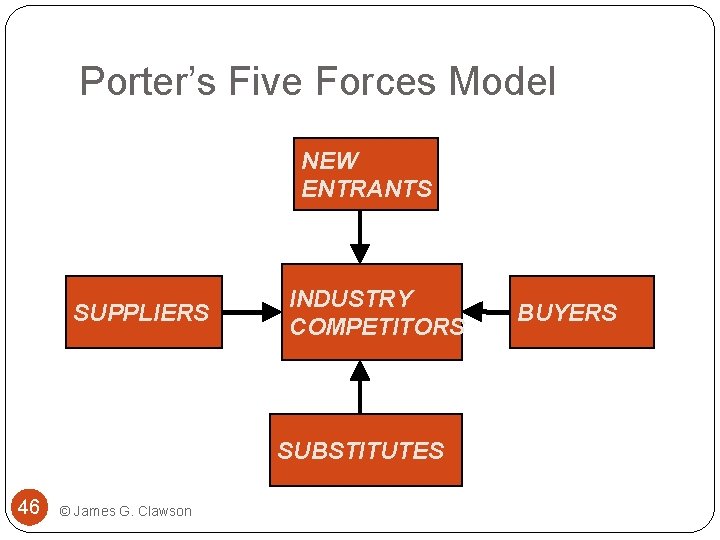
Porter’s Five Forces Model NEW ENTRANTS SUPPLIERS INDUSTRY COMPETITORS SUBSTITUTES 46 © James G. Clawson BUYERS
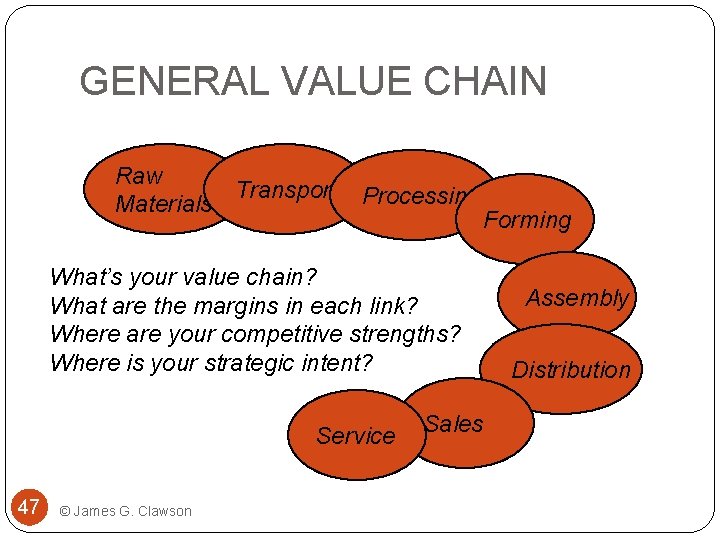
GENERAL VALUE CHAIN Raw Transport Materials Processing What’s your value chain? What are the margins in each link? Where are your competitive strengths? Where is your strategic intent? Forming Service 47 © James G. Clawson Sales Assembly Distribution
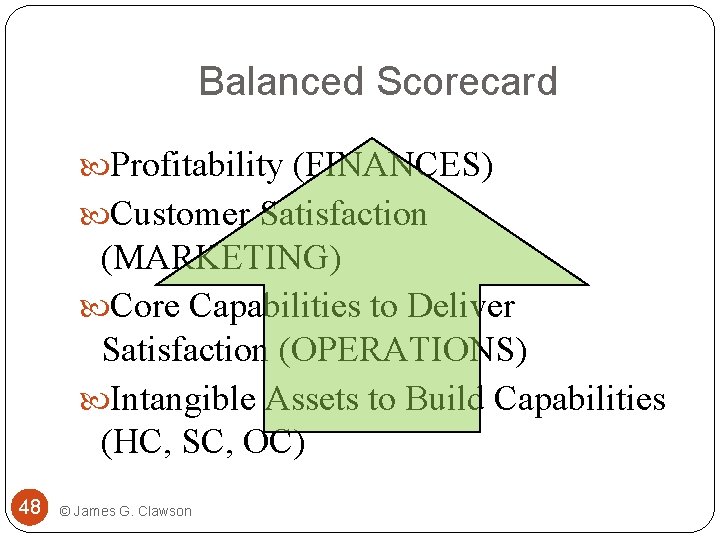
Balanced Scorecard Profitability (FINANCES) Customer Satisfaction (MARKETING) Core Capabilities to Deliver Satisfaction (OPERATIONS) Intangible Assets to Build Capabilities (HC, SC, OC) 48 © James G. Clawson
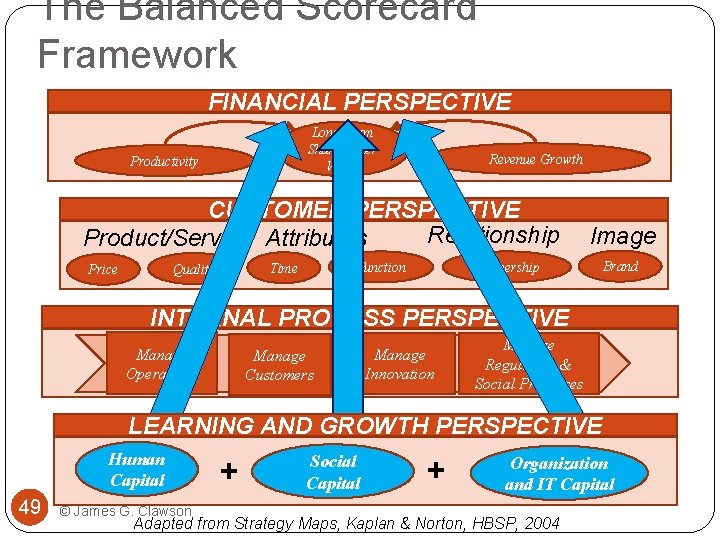
The Balanced Scorecard Framework FINANCIAL PERSPECTIVE Long Term Shareholder Value Productivity Revenue Growth CUSTOMER PERSPECTIVE Relationship Product/Service Attributes Function Time Quality Price Image Partnership Brand INTERNAL PROCESS PERSPECTIVE Manage Operations Manage Customers Manage Innovation Manage Regulatory & Social Processes LEARNING AND GROWTH PERSPECTIVE Human Capital 49 © James G. Clawson + Social Capital + Organization and IT Capital Adapted from Strategy Maps, Kaplan & Norton, HBSP, 2004
Problems: The Source of Change “…the starting point of any effective change effort is a clearly defined business problem. ” Beer, Eisenstadt, Spector—Why change programs don’t produce change. HBR What problems do you SEE? What kind of problem is strong enough to motivate you to initiate change? 50 © James G. Clawson
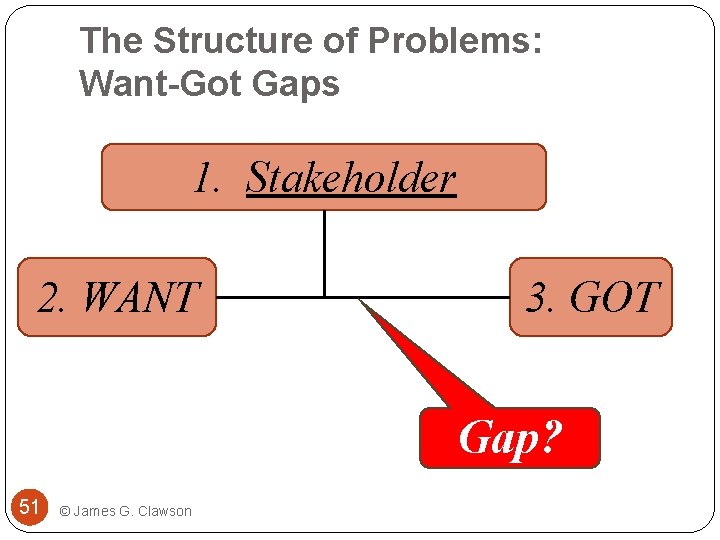
The Structure of Problems: Want-Got Gaps 1. Stakeholder 2. WANT 3. GOT Gap? 51 © James G. Clawson
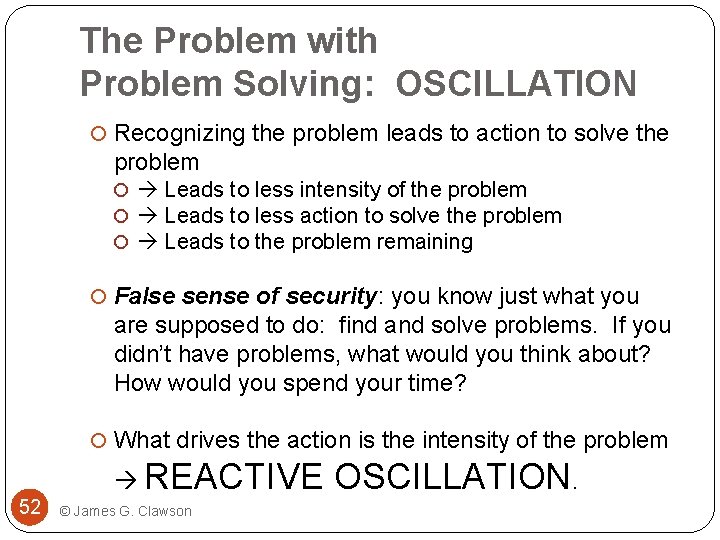
The Problem with Problem Solving: OSCILLATION Recognizing the problem leads to action to solve the problem Leads to less intensity of the problem Leads to less action to solve the problem Leads to the problem remaining False sense of security: you know just what you are supposed to do: find and solve problems. If you didn’t have problems, what would you think about? How would you spend your time? What drives the action is the intensity of the problem REACTIVE OSCILLATION. 52 © James G. Clawson
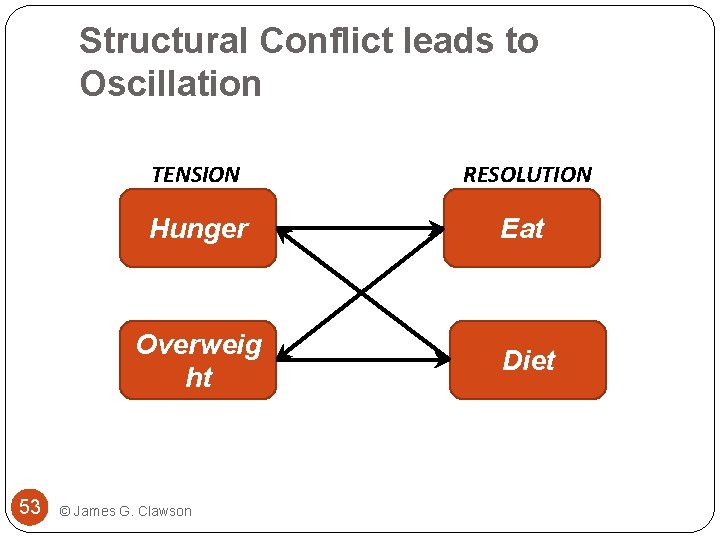
Structural Conflict leads to Oscillation 53 TENSION RESOLUTION Hunger Eat Overweig ht Diet © James G. Clawson
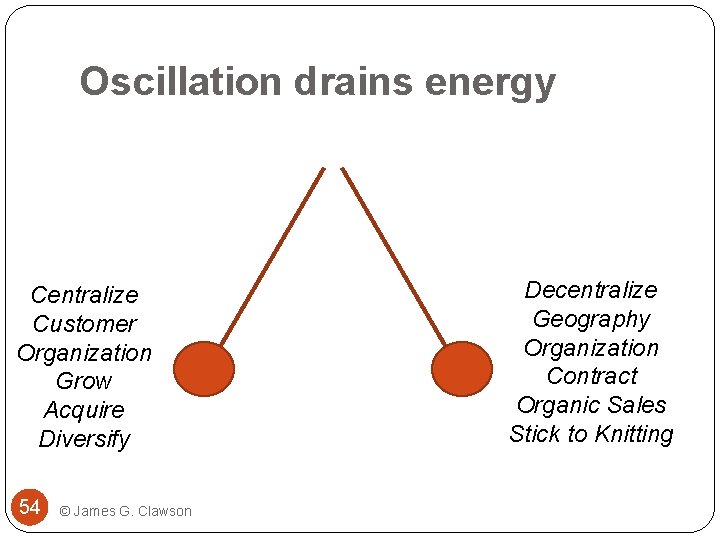
Oscillation drains energy Centralize Customer Organization Grow Acquire Diversify 54 © James G. Clawson Decentralize Geography Organization Contract Organic Sales Stick to Knitting
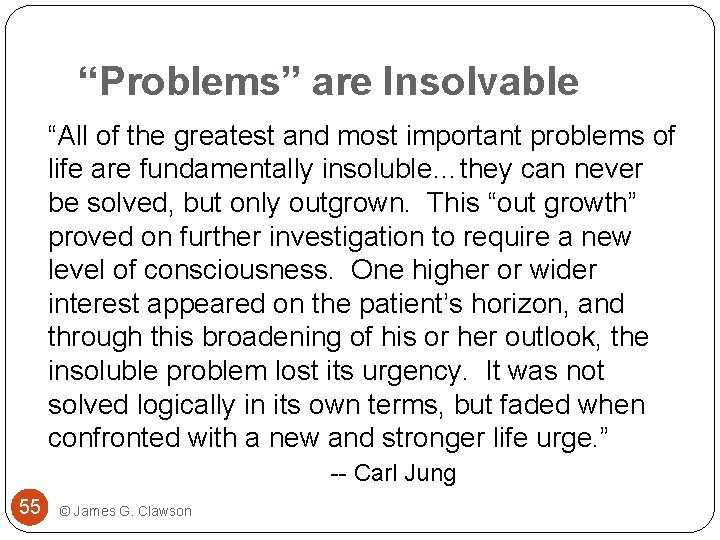
“Problems” are Insolvable “All of the greatest and most important problems of life are fundamentally insoluble…they can never be solved, but only outgrown. This “out growth” proved on further investigation to require a new level of consciousness. One higher or wider interest appeared on the patient’s horizon, and through this broadening of his or her outlook, the insoluble problem lost its urgency. It was not solved logically in its own terms, but faded when confronted with a new and stronger life urge. ” -- Carl Jung 55 © James G. Clawson
The Path of Least Resistance Robert Fritz 1984, 1989 Random House 56 © James G. Clawson
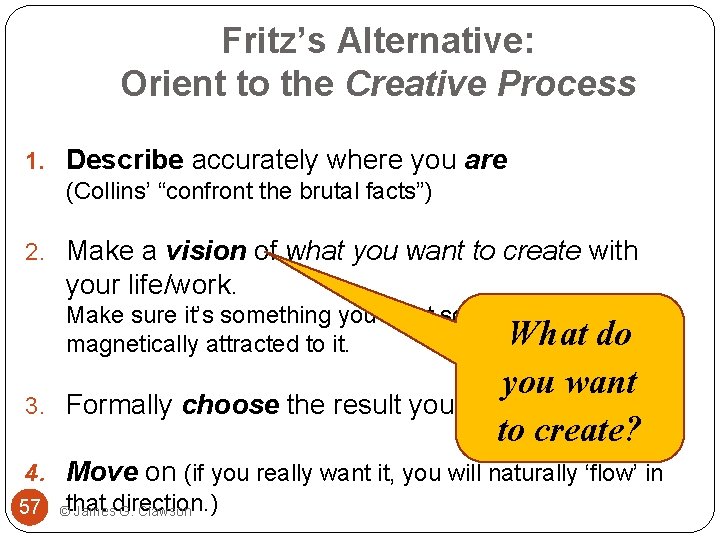
Fritz’s Alternative: Orient to the Creative Process 1. Describe accurately where you are (Collins’ “confront the brutal facts”) 2. Make a vision of what you want to create with your life/work. Make sure it’s something you want so bad, you are What do magnetically attracted to it. 3. you want Formally choose the result you want. to create? 4. Move on (if you really want it, you will naturally ‘flow’ in that direction. ) 57 © James G. Clawson
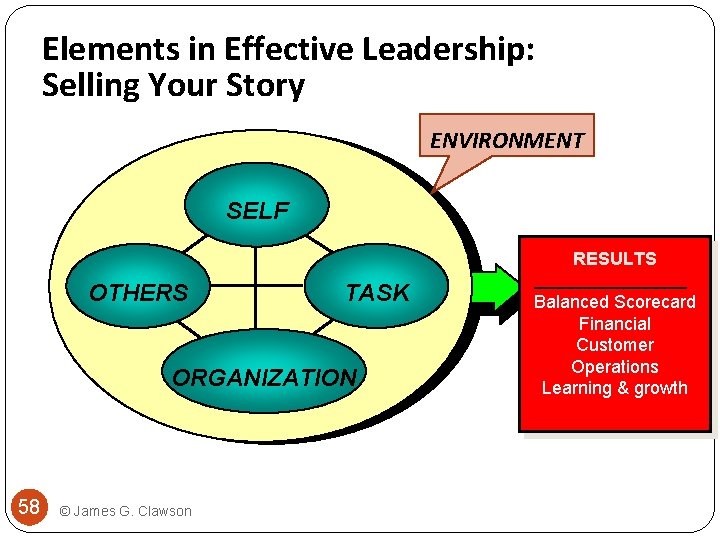
Elements in Effective Leadership: Selling Your Story ENVIRONMENT SELF RESULTS OTHERS TASK ORGANIZATION 58 © James G. Clawson Balanced Scorecard Financial Customer Operations Learning & growth
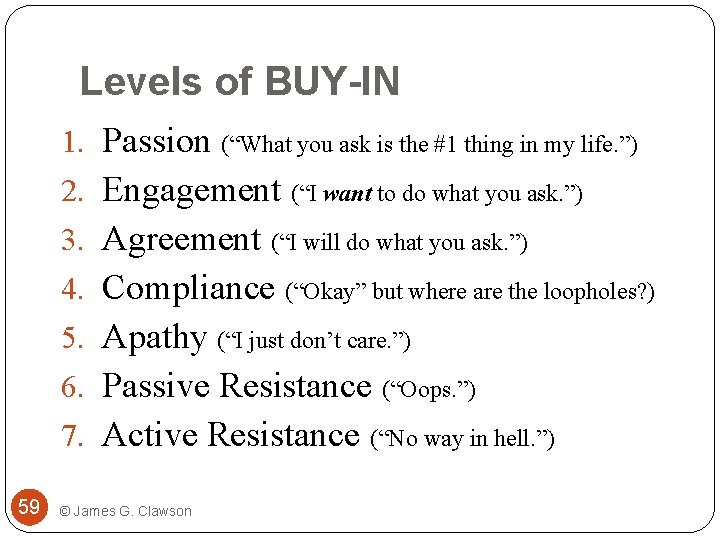
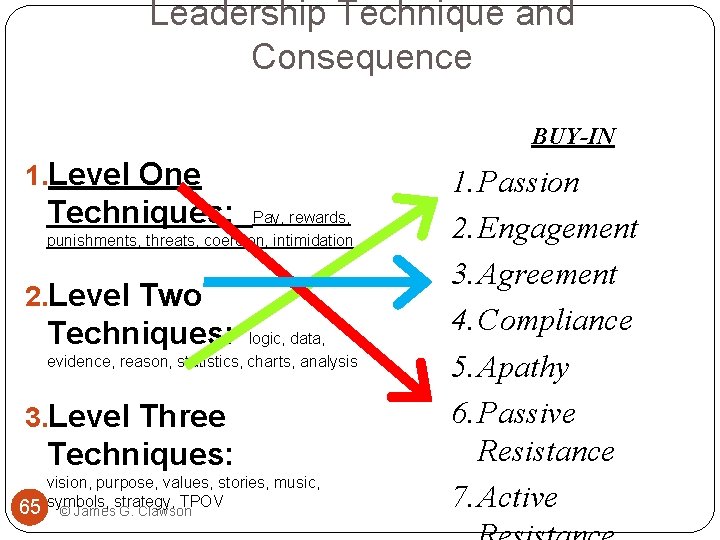
Levels of BUY-IN 1. Passion (“What you ask is the #1 thing in my life. ”) 2. Engagement (“I want to do what you ask. ”) 3. Agreement (“I will do what you ask. ”) 4. Compliance (“Okay” but where are the loopholes? ) 5. Apathy (“I just don’t care. ”) 6. Passive Resistance 7. Active Resistance 59 © James G. Clawson (“Oops. ”) (“No way in hell. ”)
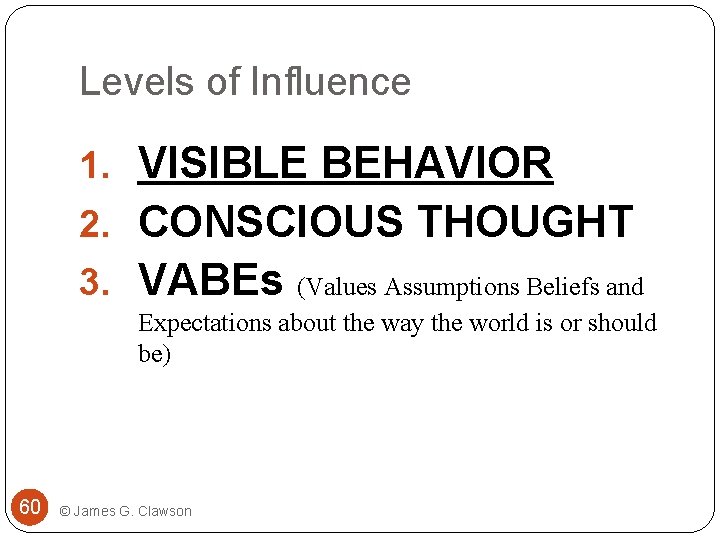
Levels of Influence 1. VISIBLE BEHAVIOR 2. CONSCIOUS THOUGHT 3. VABEs (Values Assumptions Beliefs and Expectations about the way the world is or should be) 60 © James G. Clawson
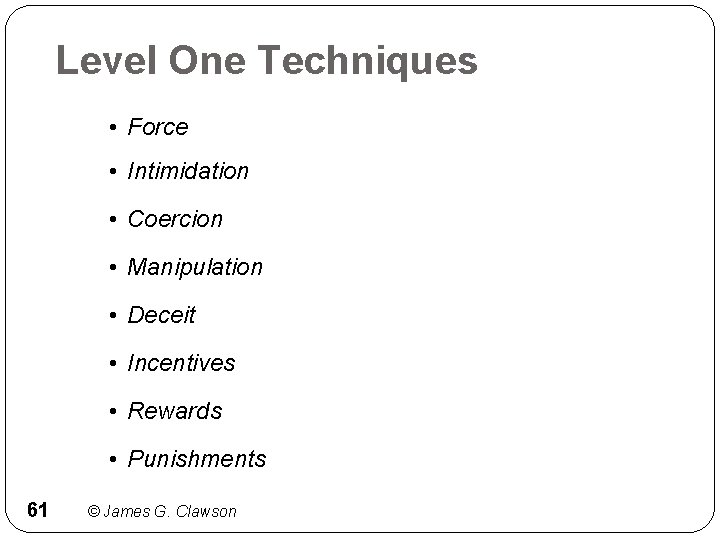
Level One Techniques • Force • Intimidation • Coercion • Manipulation • Deceit • Incentives • Rewards • Punishments 61 © James G. Clawson
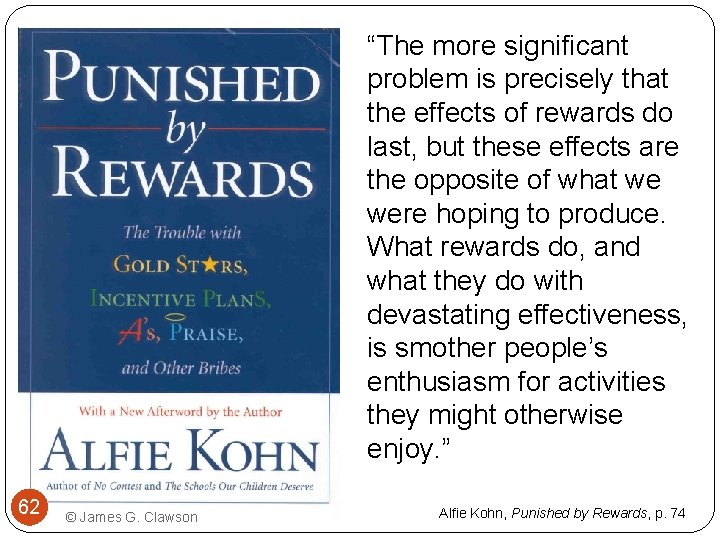
“The more significant problem is precisely that the effects of rewards do last, but these effects are the opposite of what we were hoping to produce. What rewards do, and what they do with devastating effectiveness, is smother people’s enthusiasm for activities they might otherwise enjoy. ” 62 © James G. Clawson Alfie Kohn, Punished by Rewards, p. 74
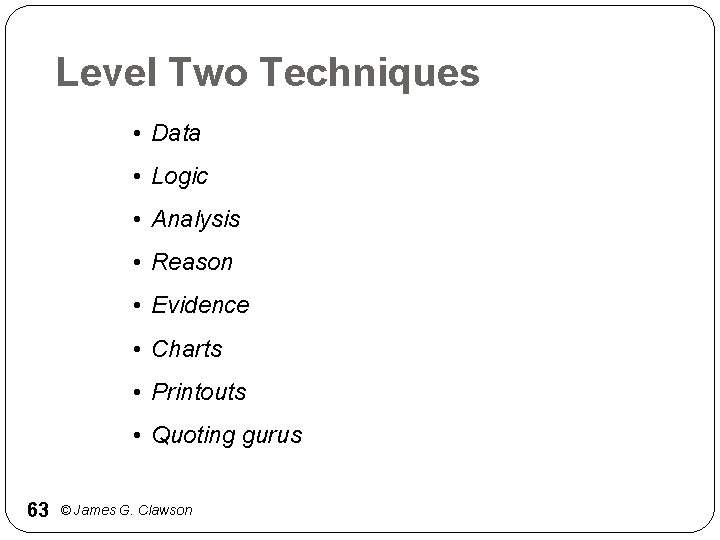
Level Two Techniques • Data • Logic • Analysis • Reason • Evidence • Charts • Printouts • Quoting gurus 63 © James G. Clawson
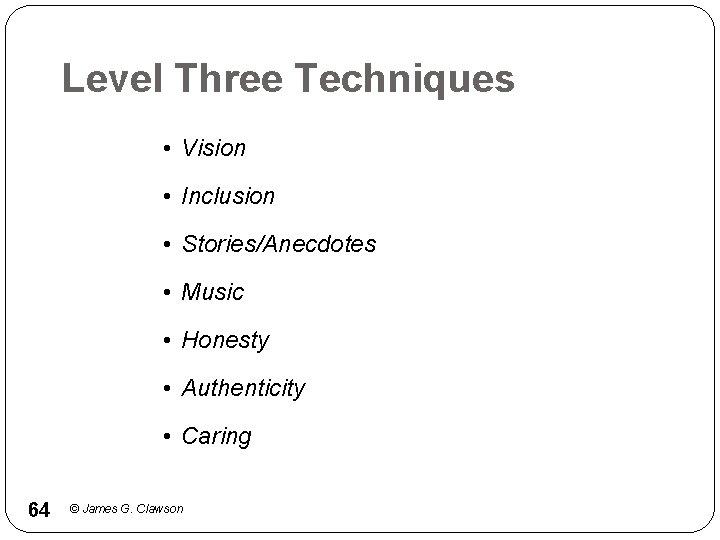
Level Three Techniques • Vision • Inclusion • Stories/Anecdotes • Music • Honesty • Authenticity • Caring 64 © James G. Clawson
Leadership Technique and Consequence BUY-IN 1. Level One Techniques: Pay, rewards, punishments, threats, coercion, intimidation 2. Level Two Techniques: logic, data, evidence, reason, statistics, charts, analysis 3. Level Three Techniques: 65 vision, purpose, values, stories, music, symbols, strategy, TPOV © James G. Clawson 1. Passion 2. Engagement 3. Agreement 4. Compliance 5. Apathy 6. Passive Resistance 7. Active
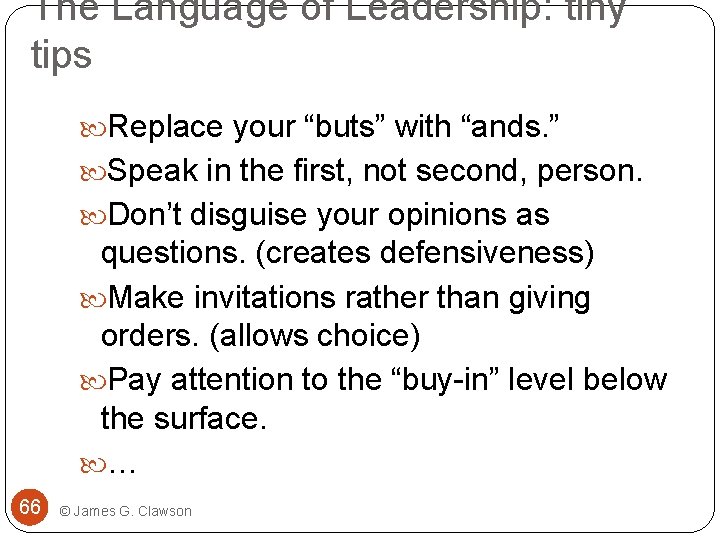
The Language of Leadership: tiny tips Replace your “buts” with “ands. ” Speak in the first, not second, person. Don’t disguise your opinions as questions. (creates defensiveness) Make invitations rather than giving orders. (allows choice) Pay attention to the “buy-in” level below the surface. … 66 © James G. Clawson
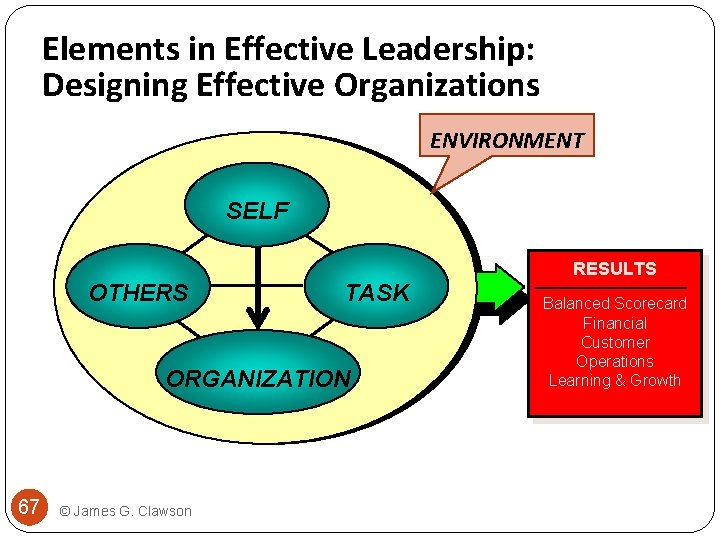
Elements in Effective Leadership: Designing Effective Organizations ENVIRONMENT SELF RESULTS OTHERS TASK ORGANIZATION 67 © James G. Clawson Balanced Scorecard Financial Customer Operations Learning & Growth
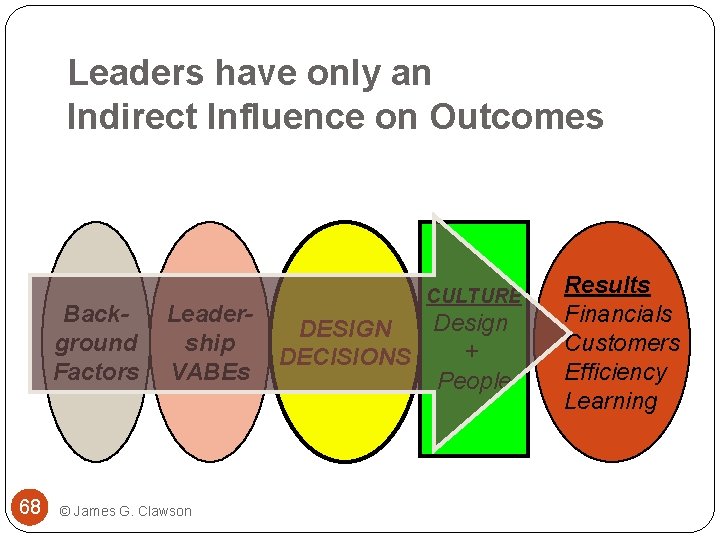
Leaders have only an Indirect Influence on Outcomes Background Factors 68 Leadership VABEs © James G. Clawson CULTURE Design DESIGN + DECISIONS People Results Financials Customers Efficiency Learning
CULTURE EATS STRATEGY FOR BREAKFAST! 69 © James G. Clawson
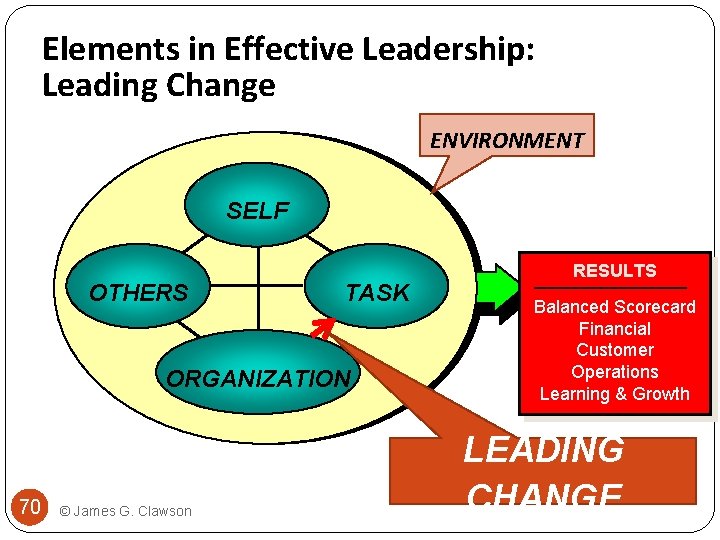
Elements in Effective Leadership: Leading Change ENVIRONMENT SELF OTHERS TASK ORGANIZATION 70 © James G. Clawson RESULTS Balanced Scorecard Financial Customer Operations Learning & Growth LEADING CHANGE
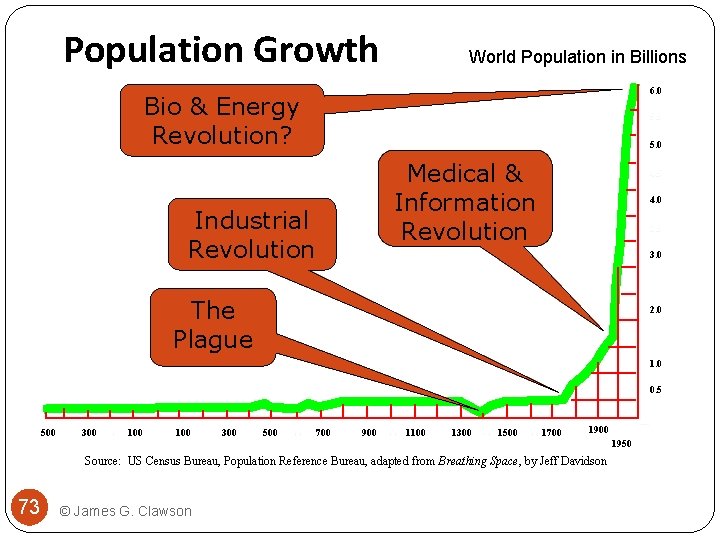
We live in a world of dramatic and on-going change… 71 © James G. Clawson
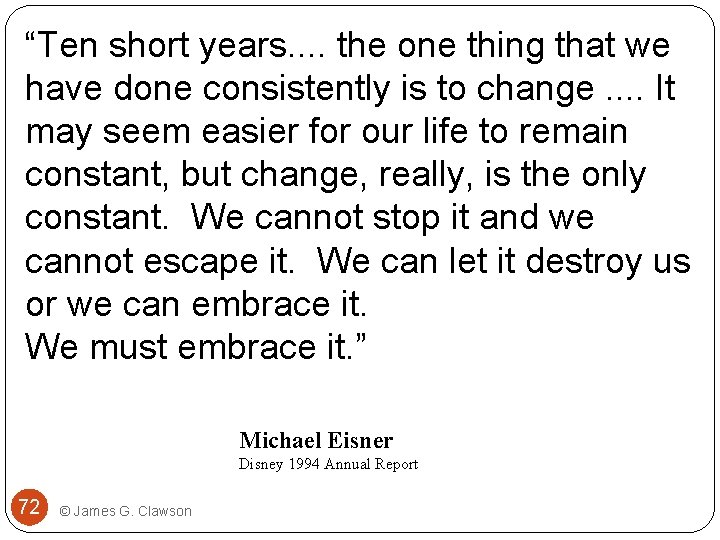
“Ten short years. . the one thing that we have done consistently is to change. . It may seem easier for our life to remain constant, but change, really, is the only constant. We cannot stop it and we cannot escape it. We can let it destroy us or we can embrace it. We must embrace it. ” Michael Eisner Disney 1994 Annual Report 72 © James G. Clawson
Population Growth World Population in Billions 6. 0 Bio & Energy Revolution? 5. 5 5. 0 Medical & Information Revolution Industrial Revolution 4. 5 4. 0 3. 5 3. 0 2. 5 The Plague 2. 0 1. 5 1. 0 0. 5 500 400 300 200 100 A. D. 100 200 300 400 500 600 700 800 900 1000 1100 1200 1300 1400 1500 1600 1700 1800 2000 1950 Source: US Census Bureau, Population Reference Bureau, adapted from Breathing Space, by Jeff Davidson 73 © James G. Clawson
What will it take to deal with / lead in turbulent times like these? 74 © James G. Clawson
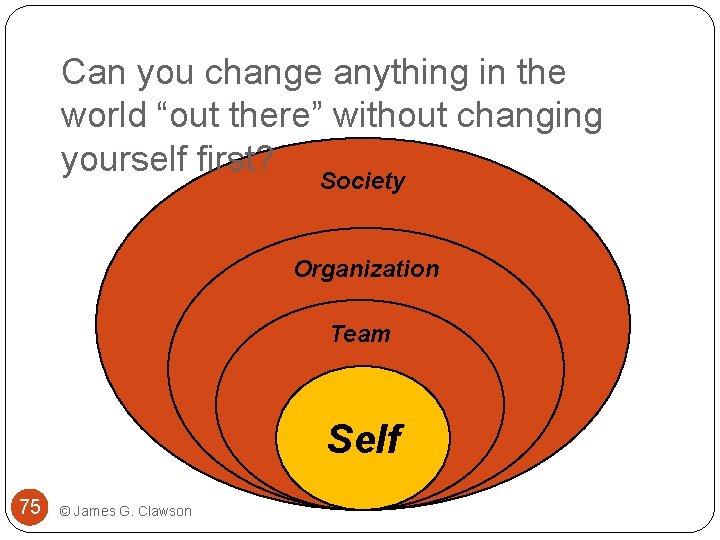
Can you change anything in the world “out there” without changing yourself first? Society Organization Team Self 75 © James G. Clawson
Change and Learning In a world of change, learners will inherit the earth, while the learned shall find themselves perfectly suited for a world that no longer exists. Eric Hoffer, Ordeal of Change 76 © James G. Clawson
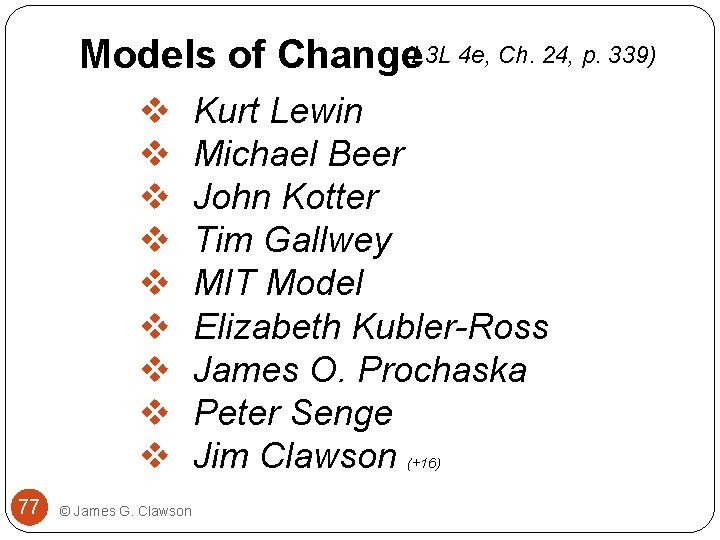
(L 3 L 4 e, Ch. 24, p. 339) Models of Change v v v v v 77 © James G. Clawson Kurt Lewin Michael Beer John Kotter Tim Gallwey MIT Model Elizabeth Kubler-Ross James O. Prochaska Peter Senge Jim Clawson (+16)
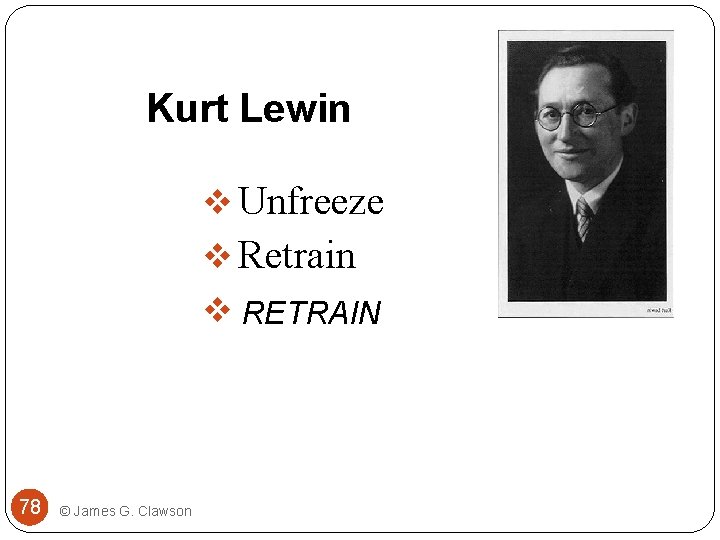
Kurt Lewin v Unfreeze v Retrain v Refreeze RETRAIN 78 © James G. Clawson
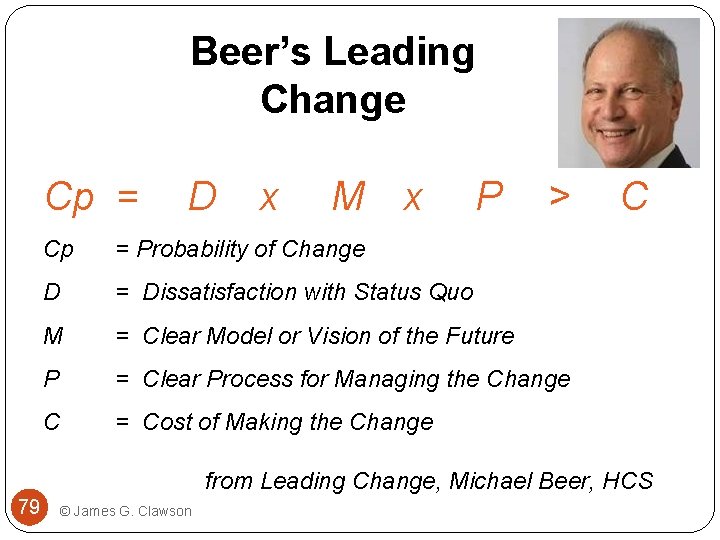
Beer’s Leading Change Cp = D x M x P > Cp = Probability of Change D = Dissatisfaction with Status Quo M = Clear Model or Vision of the Future P = Clear Process for Managing the Change C = Cost of Making the Change C from Leading Change, Michael Beer, HCS 79 © James G. Clawson
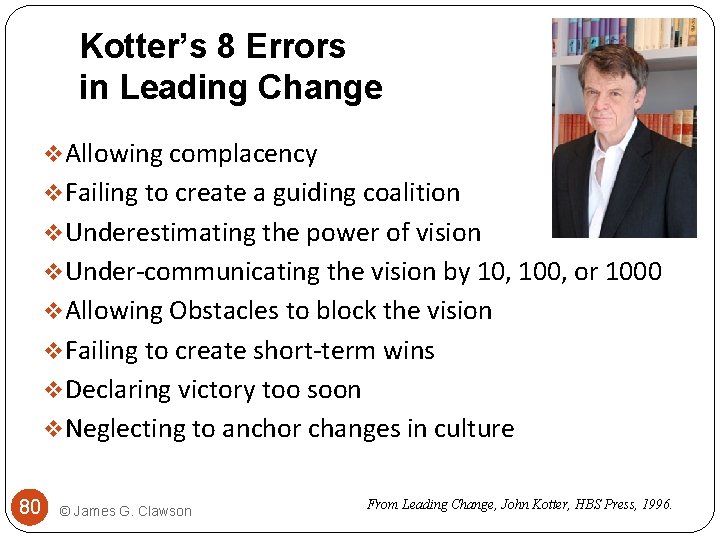
Kotter’s 8 Errors in Leading Change v. Allowing complacency v. Failing to create a guiding coalition v. Underestimating the power of vision v. Under-communicating the vision by 10, 100, or 1000 v. Allowing Obstacles to block the vision v. Failing to create short-term wins v. Declaring victory too soon v. Neglecting to anchor changes in culture 80 © James G. Clawson From Leading Change, John Kotter, HBS Press, 1996.
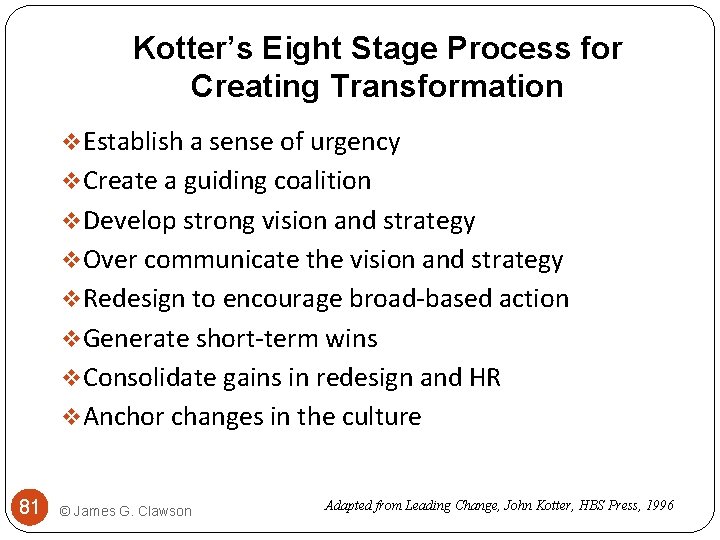
Kotter’s Eight Stage Process for Creating Transformation v. Establish a sense of urgency v. Create a guiding coalition v. Develop strong vision and strategy v. Over communicate the vision and strategy v. Redesign to encourage broad-based action v. Generate short-term wins v. Consolidate gains in redesign and HR v. Anchor changes in the culture 81 © James G. Clawson Adapted from Leading Change, John Kotter, HBS Press, 1996
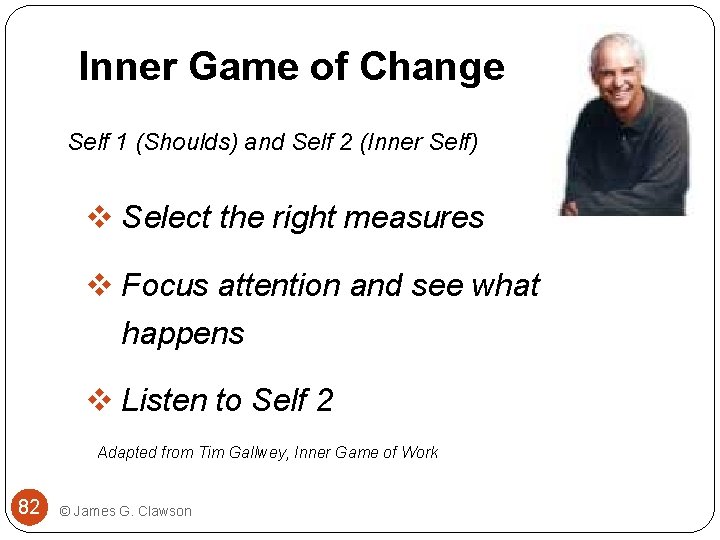
Inner Game of Change Self 1 (Shoulds) and Self 2 (Inner Self) v Select the right measures v Focus attention and see what happens v Listen to Self 2 Adapted from Tim Gallwey, Inner Game of Work 82 © James G. Clawson
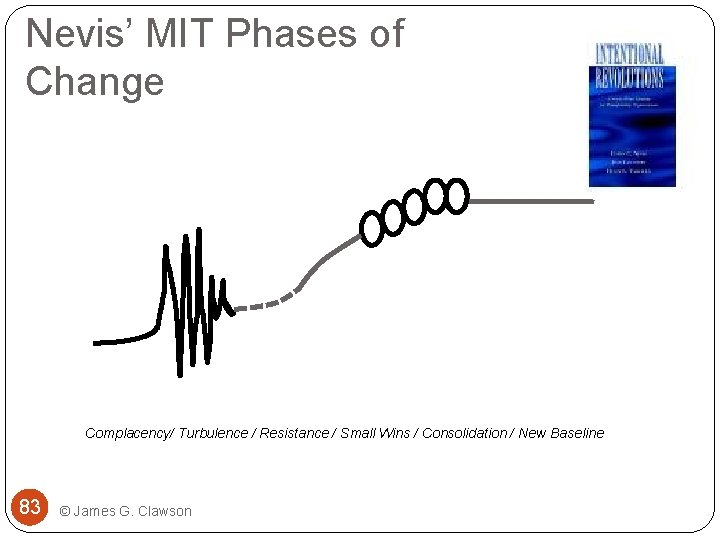
Nevis’ MIT Phases of Change Complacency/ Turbulence / Resistance / Small Wins / Consolidation / New Baseline 83 © James G. Clawson
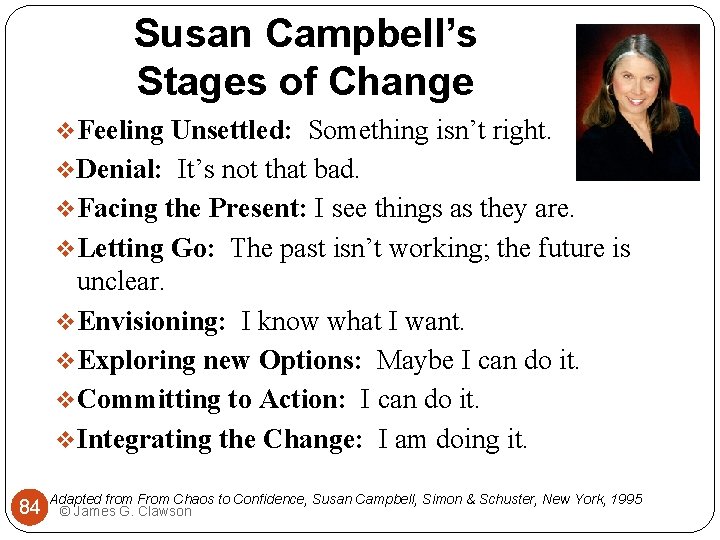
Susan Campbell’s Stages of Change v. Feeling Unsettled: Something isn’t right. v. Denial: It’s not that bad. v. Facing the Present: I see things as they are. v. Letting Go: The past isn’t working; the future is unclear. v. Envisioning: I know what I want. v. Exploring new Options: Maybe I can do it. v. Committing to Action: I can do it. v. Integrating the Change: I am doing it. 84 Adapted from From Chaos to Confidence, Susan Campbell, Simon & Schuster, New York, 1995 © James G. Clawson
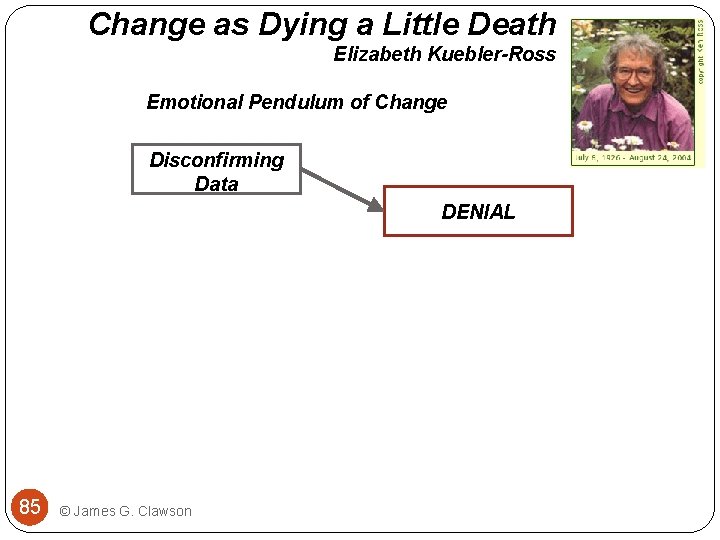
Change as Dying a Little Death Elizabeth Kuebler-Ross Emotional Pendulum of Change Disconfirming Data DENIAL 85 © James G. Clawson
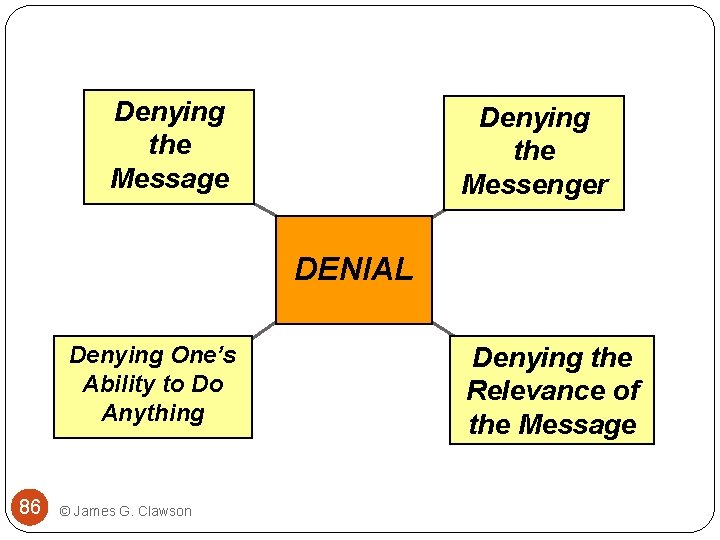
Denying the Message Denying the Messenger DENIAL Denying One’s Ability to Do Anything 86 © James G. Clawson Denying the Relevance of the Message
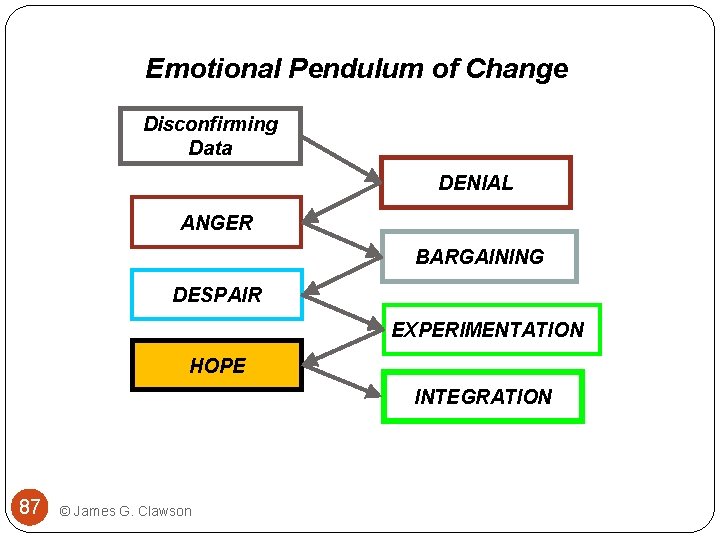
Emotional Pendulum of Change Disconfirming Data DENIAL ANGER BARGAINING DESPAIR EXPERIMENTATION HOPE INTEGRATION 87 © James G. Clawson
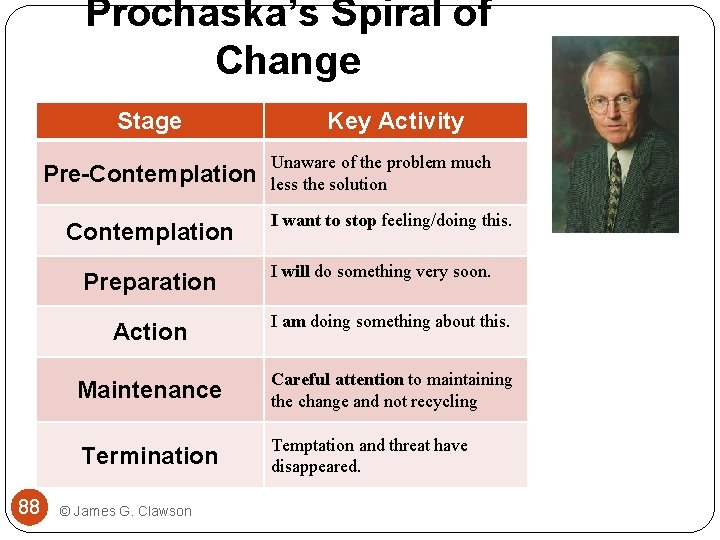
Prochaska’s Spiral of Change Stage Pre-Contemplation Preparation 88 Key Activity Unaware of the problem much less the solution I want to stop feeling/doing this. I will do something very soon. Action I am doing something about this. Maintenance Careful attention to maintaining the change and not recycling Termination Temptation and threat have disappeared. © James G. Clawson
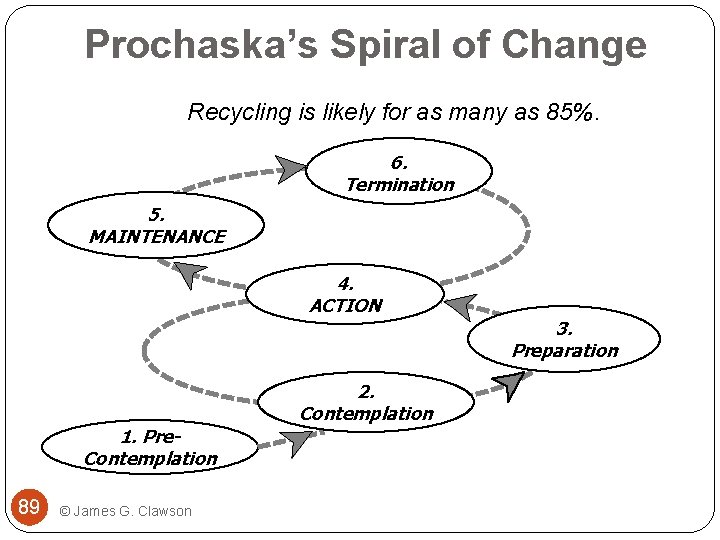
Prochaska’s Spiral of Change Recycling is likely for as many as 85%. 6. Termination 5. MAINTENANCE 4. ACTION 3. Preparation 2. Contemplation 1. Pre. Contemplation 89 © James G. Clawson
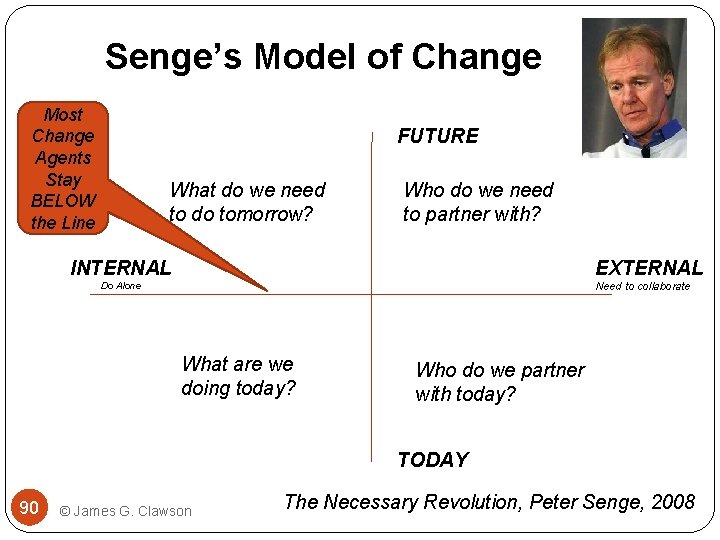
Senge’s Model of Change Most Change Agents Stay BELOW the Line FUTURE What do we need to do tomorrow? Who do we need to partner with? EXTERNAL INTERNAL Do Alone Need to collaborate What are we doing today? Who do we partner with today? TODAY 90 © James G. Clawson The Necessary Revolution, Peter Senge, 2008
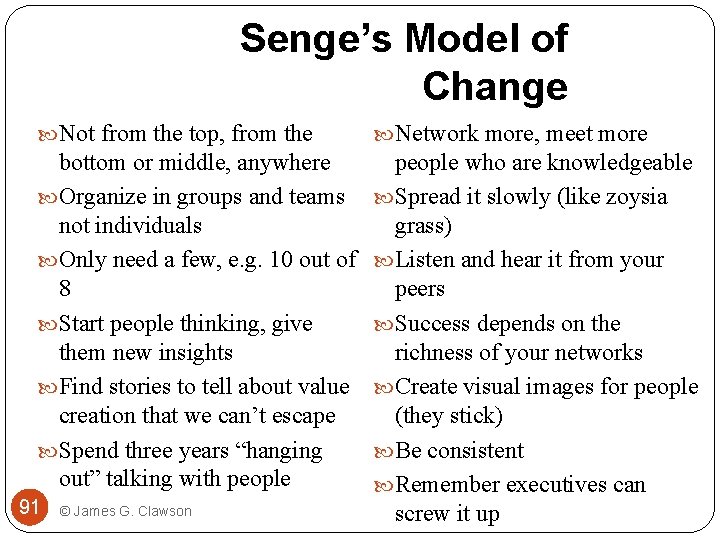
Senge’s Model of Change Not from the top, from the Network more, meet more bottom or middle, anywhere Organize in groups and teams not individuals Only need a few, e. g. 10 out of 8 Start people thinking, give them new insights Find stories to tell about value creation that we can’t escape Spend three years “hanging out” talking with people who are knowledgeable Spread it slowly (like zoysia grass) Listen and hear it from your peers Success depends on the richness of your networks Create visual images for people (they stick) Be consistent Remember executives can screw it up 91 © James G. Clawson
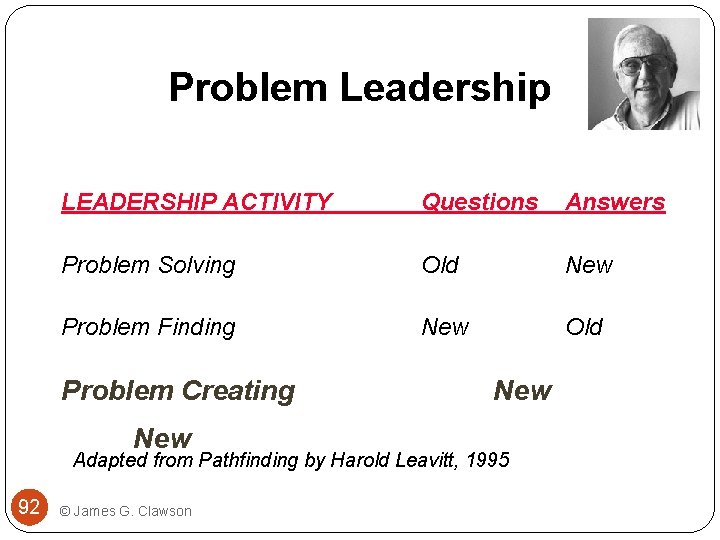
Problem Leadership LEADERSHIP ACTIVITY Questions Answers Problem Solving Old New Problem Finding New Old Problem Creating New Adapted from Pathfinding by Harold Leavitt, 1995 92 © James G. Clawson
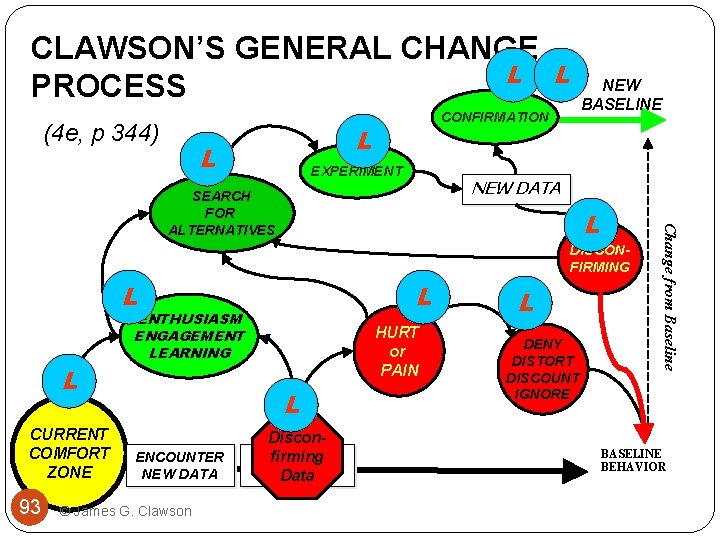
CLAWSON’S GENERAL CHANGE L PROCESS (4 e, p 344) NEW BASELINE CONFIRMATION L L L EXPERIMENT NEW DATA L DISCONFIRMING L L CURRENT COMFORT ZONE 93 L ENTHUSIASM ENGAGEMENT LEARNING HURT or PAIN L ENCOUNTER NEW DATA © James G. Clawson Discon. CONFIRMING firming DATA Data L DENY DISTORT DISCOUNT IGNORE Change from Baseline SEARCH FOR ALTERNATIVES BASELINE BEHAVIOR
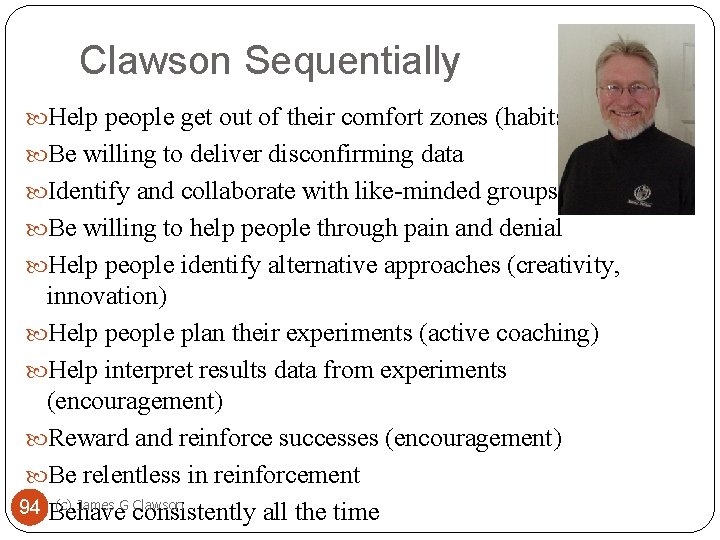
Clawson Sequentially Help people get out of their comfort zones (habits) Be willing to deliver disconfirming data Identify and collaborate with like-minded groups Be willing to help people through pain and denial Help people identify alternative approaches (creativity, innovation) Help people plan their experiments (active coaching) Help interpret results data from experiments (encouragement) Reward and reinforce successes (encouragement) Be relentless in reinforcement (c) James G Clawson 94 Behave consistently all the time
Is it ETHICAL to muck around at Level Three? 95 © James G. Clawson
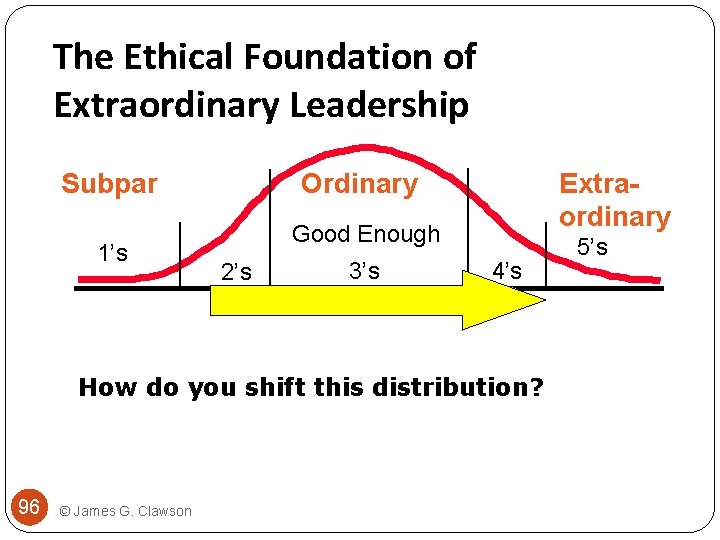
The Ethical Foundation of Extraordinary Leadership Subpar 1’s Ordinary Extraordinary Good Enough 2’s 3’s 4’s How do you shift this distribution? 96 © James G. Clawson 5’s
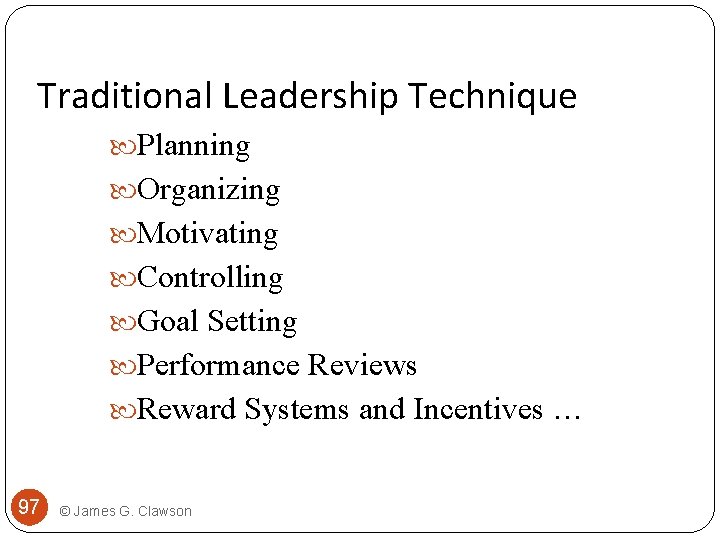
Traditional Leadership Technique Planning Organizing Motivating Controlling Goal Setting Performance Reviews Reward Systems and Incentives … 97 © James G. Clawson
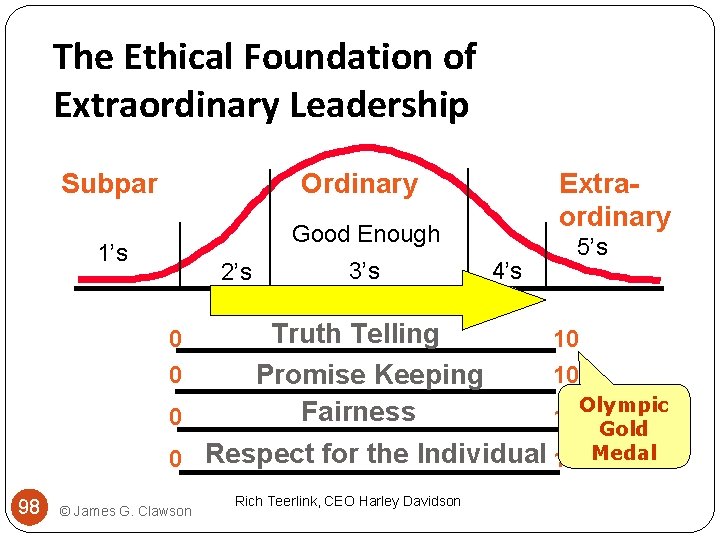
The Ethical Foundation of Extraordinary Leadership Subpar Ordinary Extraordinary Good Enough 1’s 2’s 3’s 4’s 5’s Truth Telling 10 10 Promise Keeping Olympic Fairness 0 10 Gold 0 Respect for the Individual 10 Medal 0 0 98 © James G. Clawson Rich Teerlink, CEO Harley Davidson
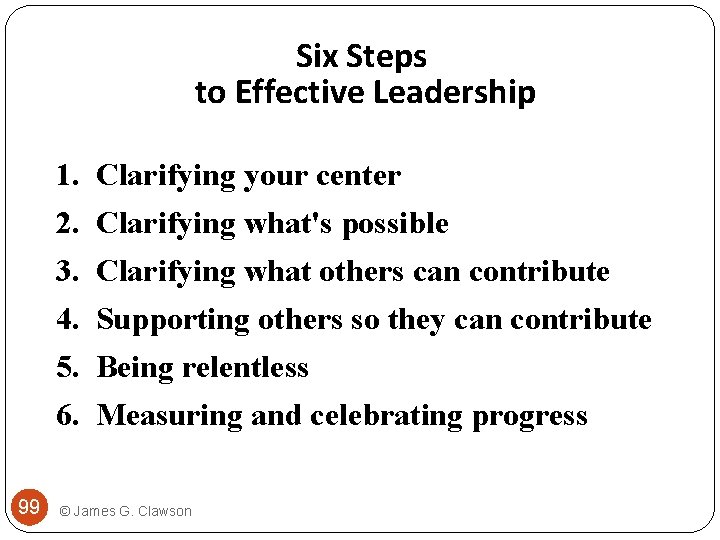
Six Steps to Effective Leadership 1. Clarifying your center 2. Clarifying what's possible 3. 4. 5. 6. 99 Clarifying what others can contribute Supporting others so they can contribute Being relentless Measuring and celebrating progress © James G. Clawson
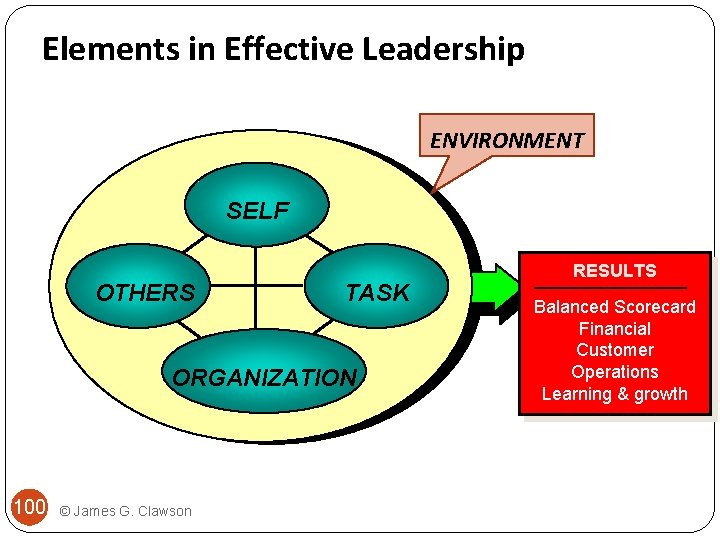
Elements in Effective Leadership ENVIRONMENT SELF OTHERS TASK ORGANIZATION 100 © James G. Clawson RESULTS Balanced Scorecard Financial Customer Operations Learning & growth
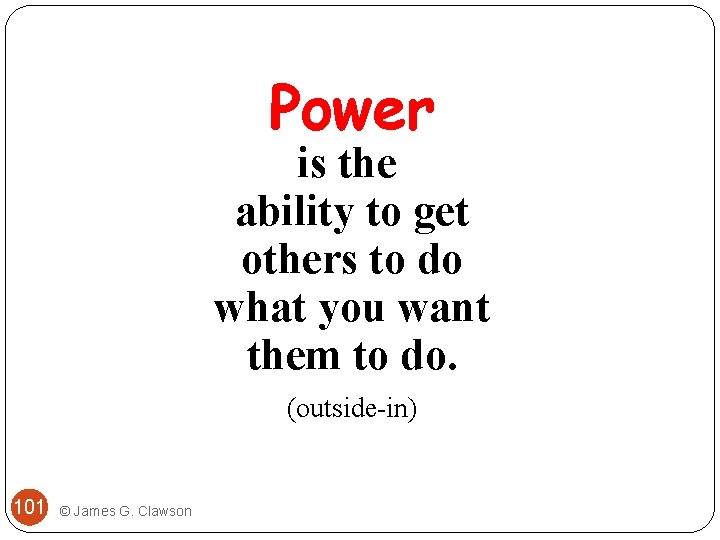
Power is the ability to get others to do what you want them to do. (outside-in) 101 © James G. Clawson
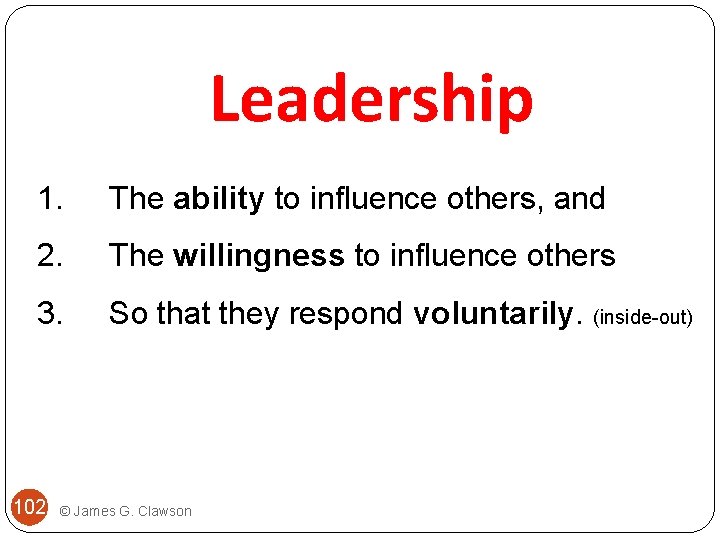
Leadership 1. The ability to influence others, and 2. The willingness to influence others 3. So that they respond voluntarily. (inside-out) 102 © James G. Clawson
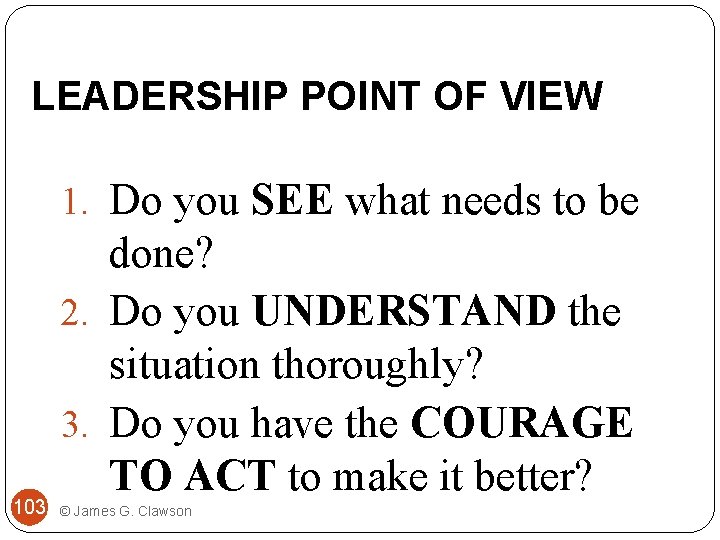
LEADERSHIP POINT OF VIEW 1. Do you SEE what needs to be 103 done? 2. Do you UNDERSTAND the situation thoroughly? 3. Do you have the COURAGE TO ACT to make it better? © James G. Clawson
Leadership is, as you know, not a position but a job. It’s hard and exciting and good work. It’s also a serious meddling in other people’s lives. One examines leadership beginning not with techniques but rather with premises, not with tools but with beliefs, and not with systems but with understandings. This I truly believe. Max De. Pree, Leadership Jazz, p. 7 104 © James G. Clawson
You are always teaching. Every encounter between a superior and a subordinate involves learning of some kind for the subordinate. (It should involve learning for the superior, too, but that is another matter. ) When the boss gives an order, asks for a job to be done, reprimands, praises, conducts an appraisal interview, deals with a mistake, holds a staff meeting, works with his subordinates in solving a problem, gives a salary increase, discusses a possible promotion, or takes any other action with subordinates, he is teaching them something. The attitudes, the habits, the expectations of the subordinate will be either reinforced or modified to some degree as a result of every encounter with the boss. . . The day‑by‑day experience of the job is so much more powerful that it 105 © James G. Clawson tends to overshadow what the individual may learn in
Will you (not can you) change? Will you ever become anything more than a vessel transmitting the memes and genes of previous generations on to the next? Will you rise above (transcend) your legacies and lead others to do the same? If not, … 106 © James G. Clawson
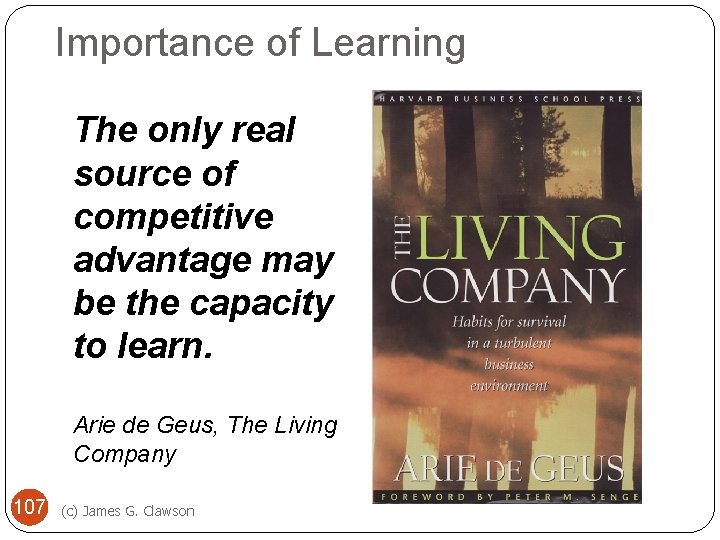
Importance of Learning The only real source of competitive advantage may be the capacity to learn. Arie de Geus, The Living Company 107 (c) James G. Clawson
AN INVITATION / CHALLENGE 108 © James G. Clawson
109 © James Clawson, 2009