
Graduate Institute of Electronics Engineering NTU Why Systolic
- Slides: 21
Graduate Institute of Electronics Engineering, NTU Why Systolic Architecture ? VLSI Signal Processing 台灣大學電機系 吳安宇 ACCESS IC LAB
ACCESS IC LAB Graduate Institute of Electronics Engineering, NTU Motivation & Introduction • We need a high-performance , special-purpose computer system to meet specific application. • I/O and computation imbalance is a notable problem. • The concept of Systolic architecture can map high-level computation into hardware structures. • Systolic system works like an automobile assembly line. • Systolic system is easy to implement because of its regularity and easy to reconfigure. • Systolic architecture can result in cost-effective , highperformance special-purpose systems for a wide range of problems. 2
ACCESS IC LAB Graduate Institute of Electronics Engineering, NTU Key architectural issues in designing special-purpose systems • Simple and regular design Simple, regular design yields cost-effective special systems. • Concurrency and communication Design algorithm to support high concurrency and meantime to employ only simple. • Balancing computation with I/O A special-purpose system should be match a variety of I/O bandwidth. 3
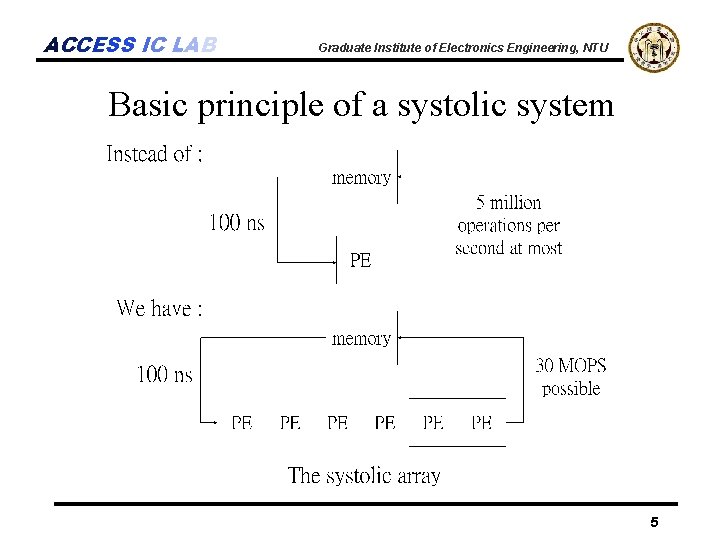
ACCESS IC LAB Graduate Institute of Electronics Engineering, NTU Basic principle of systolic architecture • Systolic system consists of a set interconnected cells , each capable of performing some simple operation. • Systolic approach can speed up a compute-bound computation in a relatively simple and inexpensive manner. • A systolic array in particular , is illustrated in next page. (we achieve higher computation throughput without increasing memory bandwidth) 4
ACCESS IC LAB Graduate Institute of Electronics Engineering, NTU Basic principle of a systolic system 5
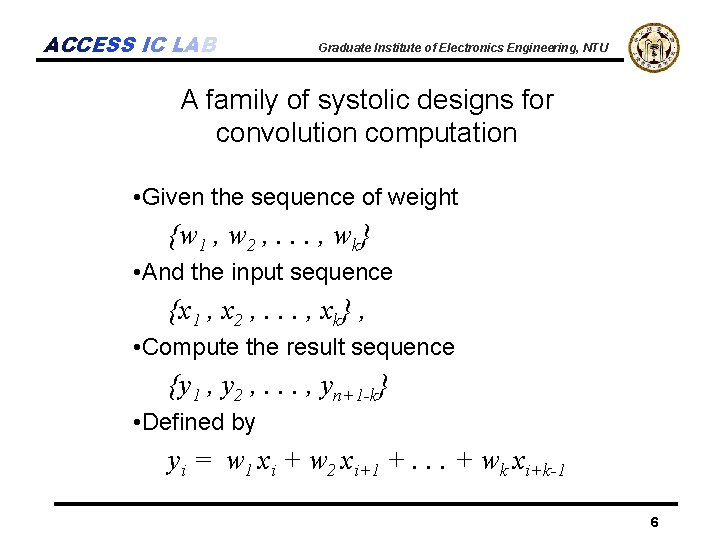
ACCESS IC LAB Graduate Institute of Electronics Engineering, NTU A family of systolic designs for convolution computation • Given the sequence of weight {w 1 , w 2 , . . . , wk} • And the input sequence {x 1 , x 2 , . . . , xk} , • Compute the result sequence {y 1 , y 2 , . . . , yn+1 -k} • Defined by yi = w 1 xi + w 2 xi+1 +. . . + wk xi+k-1 6
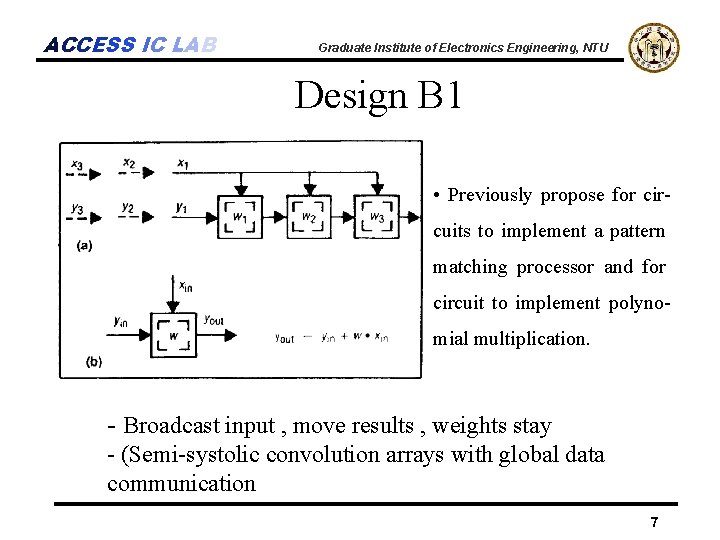
ACCESS IC LAB Graduate Institute of Electronics Engineering, NTU Design B 1 • Previously propose for circuits to implement a pattern matching processor and for circuit to implement polynomial multiplication. - Broadcast input , move results , weights stay - (Semi-systolic convolution arrays with global data communication 7
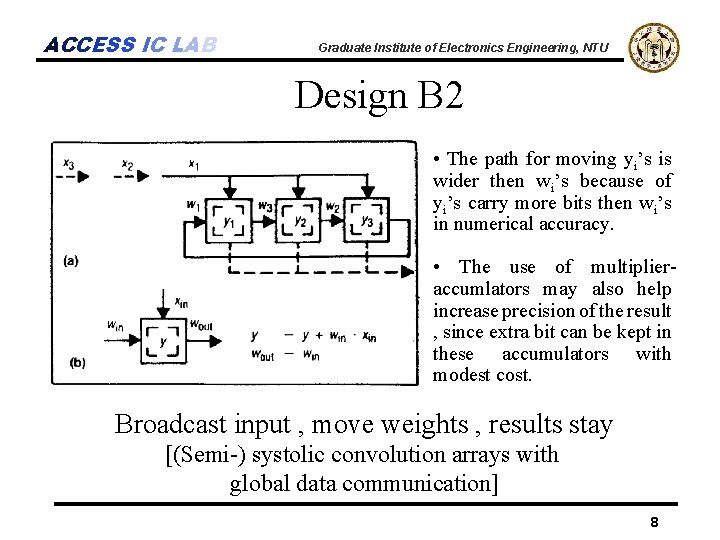
ACCESS IC LAB Graduate Institute of Electronics Engineering, NTU Design B 2 • The path for moving yi’s is wider then wi’s because of yi’s carry more bits then wi’s in numerical accuracy. • The use of multiplieraccumlators may also help increase precision of the result , since extra bit can be kept in these accumulators with modest cost. Broadcast input , move weights , results stay [(Semi-) systolic convolution arrays with global data communication] 8
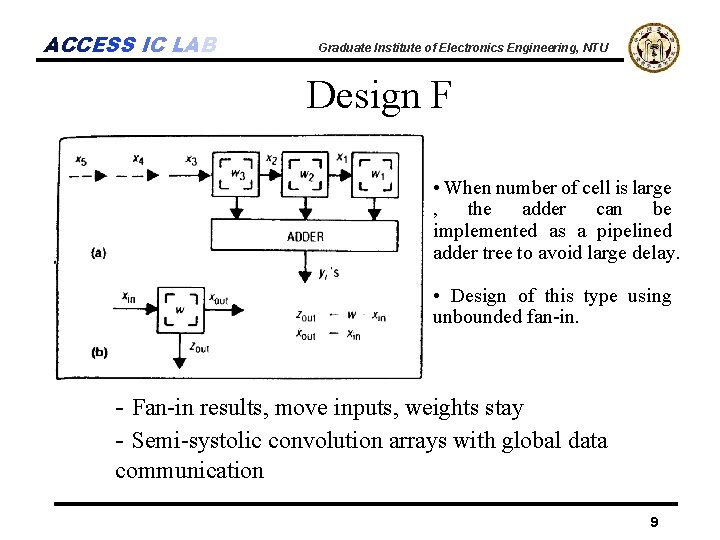
ACCESS IC LAB Graduate Institute of Electronics Engineering, NTU Design F • When number of cell is large , the adder can be implemented as a pipelined adder tree to avoid large delay. • Design of this type using unbounded fan-in. - Fan-in results, move inputs, weights stay - Semi-systolic convolution arrays with global data communication 9
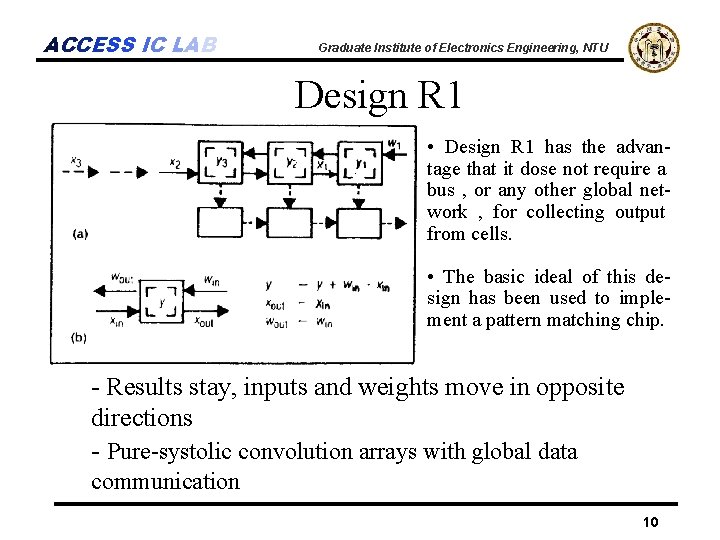
ACCESS IC LAB Graduate Institute of Electronics Engineering, NTU Design R 1 • Design R 1 has the advantage that it dose not require a bus , or any other global network , for collecting output from cells. • The basic ideal of this design has been used to implement a pattern matching chip. - Results stay, inputs and weights move in opposite directions - Pure-systolic convolution arrays with global data communication 10
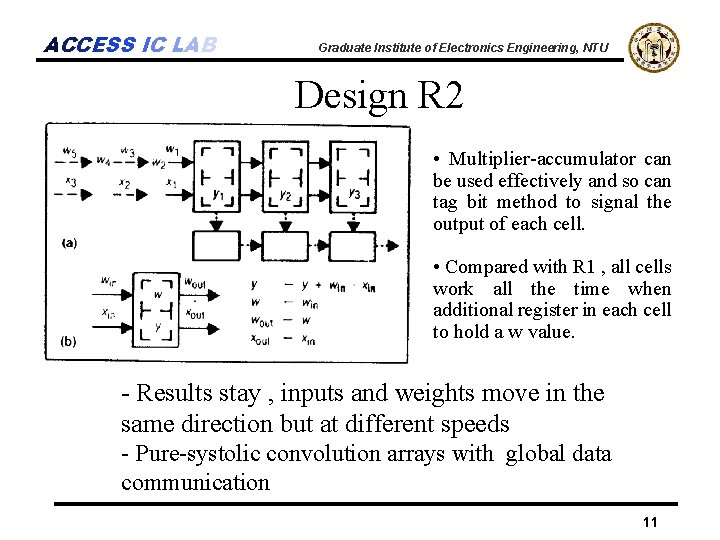
ACCESS IC LAB Graduate Institute of Electronics Engineering, NTU Design R 2 • Multiplier-accumulator can be used effectively and so can tag bit method to signal the output of each cell. • Compared with R 1 , all cells work all the time when additional register in each cell to hold a w value. - Results stay , inputs and weights move in the same direction but at different speeds - Pure-systolic convolution arrays with global data communication 11
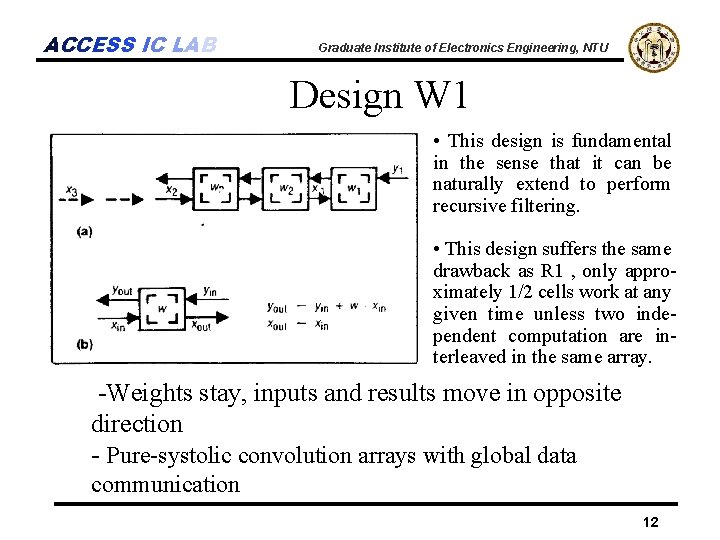
ACCESS IC LAB Graduate Institute of Electronics Engineering, NTU Design W 1 • This design is fundamental in the sense that it can be naturally extend to perform recursive filtering. • This design suffers the same drawback as R 1 , only approximately 1/2 cells work at any given time unless two independent computation are interleaved in the same array. -Weights stay, inputs and results move in opposite direction - Pure-systolic convolution arrays with global data communication 12
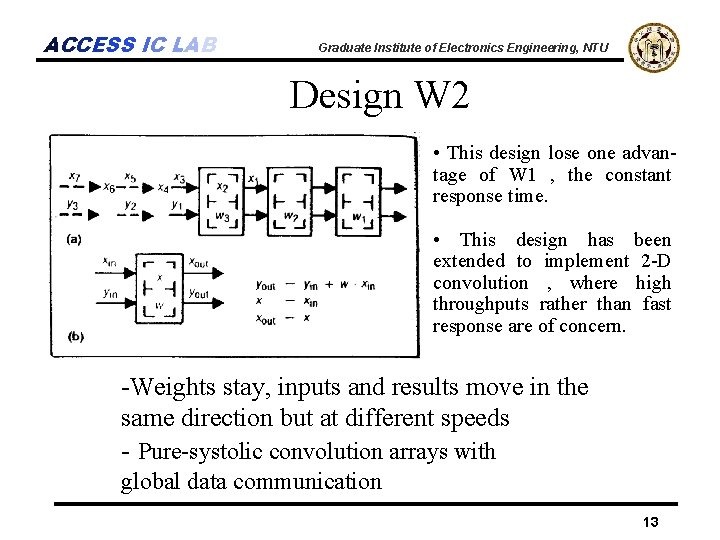
ACCESS IC LAB Graduate Institute of Electronics Engineering, NTU Design W 2 • This design lose one advantage of W 1 , the constant response time. • This design has been extended to implement 2 -D convolution , where high throughputs rather than fast response are of concern. -Weights stay, inputs and results move in the same direction but at different speeds - Pure-systolic convolution arrays with global data communication 13
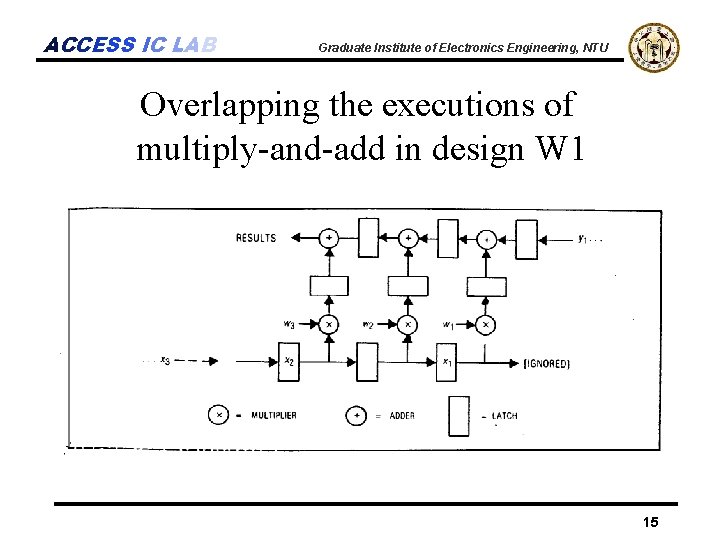
ACCESS IC LAB Graduate Institute of Electronics Engineering, NTU Remarks • Above designs are all possible systolic designs for the convolution problem. • Using a systolic control path , weight can be selected onthe-fly to implement interpolation or adaptive filtering. • We need to understand precisely the strengths and drawbacks of each design so that an appropriate design can be selected for a given environment. • For improving throughput, it may be worthwhile to implement multiplier and adder separately to allow overlapping of their execution. (Such as next page show) • When chip pin is considered , pure-systolic requires four; semi-systolic requires three I/O ports. 14
ACCESS IC LAB Graduate Institute of Electronics Engineering, NTU Overlapping the executions of multiply-and-add in design W 1 15
ACCESS IC LAB Graduate Institute of Electronics Engineering, NTU Criteria and advantages • The design makes multiple use of each input data item Because of this property , systolic systems can achieve high throughputs with modest I/O bandwidths for outside communication. • The design uses extensive concurrency Concurrency can be obtained by pipelining the stages involved in the computation of each single result , by multiprocessing many results in parallel, or by both. 16
ACCESS IC LAB Graduate Institute of Electronics Engineering, NTU Criteria and advantages • There are only a few types of simple cells To achieve performance goals, a systolic system is likely to use a large number of cells which must be simple and of only a few types to curtail design and implementation cost. • Data and control flow are simple and regular Pure systolic system totally avoid long-distance or irregular wires for data communication. 17
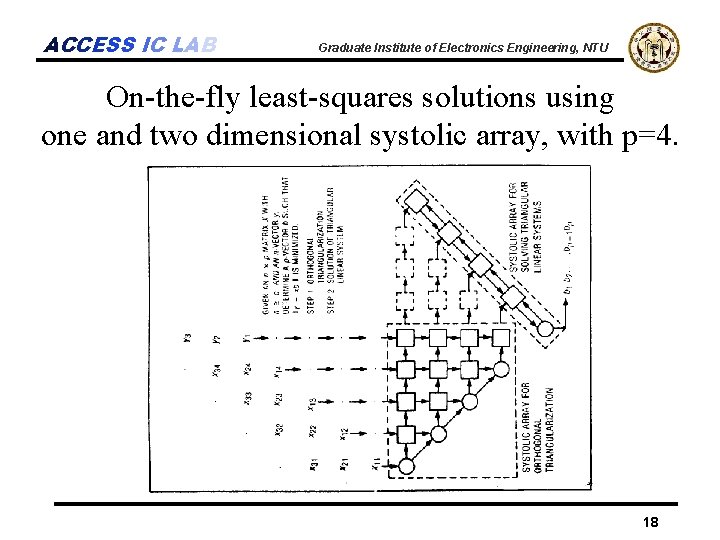
ACCESS IC LAB Graduate Institute of Electronics Engineering, NTU On-the-fly least-squares solutions using one and two dimensional systolic array, with p=4. 18
ACCESS IC LAB Graduate Institute of Electronics Engineering, NTU Applications of Systolic Array - Signal and image processing: • FTR , IIR filtering , and 1 -D convolution. • 2 -D convolution and correlation. • Discrete Furier transform • Interpolation • 1 -D and 2 -D median filtering • Geometric warping 19
ACCESS IC LAB Graduate Institute of Electronics Engineering, NTU Applications of Systolic Array - Matrix arithmetic: • Matrix-vector multiplication • Matrix-matrix multiplication • Matrix triangularization (solution of linear systems , matrix inversion) • QR decomposition (eigenvalue , least-square computation) • Solution of triangular linear systems 20
ACCESS IC LAB Graduate Institute of Electronics Engineering, NTU Applications of Systolic Array - Non-numeric applications: • Data structure • Graph algorithm • Language recognition • Dynamic programming • Encoder (polynomial division) • Relational data-base operations 21