
SchoolBased GrowOut Stations Jim Egenrieder Virginia Tech Math
School-Based Grow-Out Stations Jim Egenrieder Virginia Tech Math and Science Education October, 2007 Jim Egenrieder, Virginia Tech
Overview • • Introductions Potomac Watershed Partnership Cacapon Institute – Oh Deer! Forum Growing Native overview Inquiry and project-based learning Grow Out Station planning and design American Chestnut programs October, 2007 Jim Egenrieder, Virginia Tech
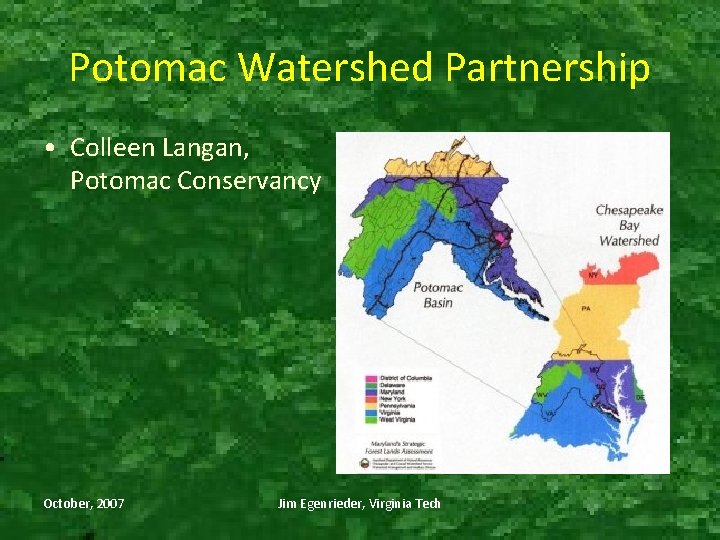
Potomac Watershed Partnership • Colleen Langan, Potomac Conservancy October, 2007 Jim Egenrieder, Virginia Tech
Cacapon Institute • Oh Deer! Environmental Forum • Deer Fencing experiment October, 2007 Jim Egenrieder, Virginia Tech
Growing Native Overview • Colleen Langan, Potomac Conservancy October, 2007 Jim Egenrieder, Virginia Tech
Project-based learning, inquiry, and integrative STEM • Project-based learning has been part of the school curriculum for nearly a century • teacher strategies have changed significantly • now an integral part of the curriculum, rather than a supplement • breaks the traditional classroom routines characterized by control, reiteration and duplication, and standardization. October, 2007 Jim Egenrieder, Virginia Tech
Goal for the STEM educator • to develop and maintain students’ connections to STEM tools and practices that foster lifelong learning and appreciation for STEM disciplines Even when such students do not pursue STEM careers, their appreciation for STEM connections in the world around them benefits everyone. October, 2007 Jim Egenrieder, Virginia Tech
Pedagogy of Project-Based Learning • involves students in project design, • problem-solving investigations or • experiences that give students extended periods of time to work autonomously. • resulting products or presentations demonstrate understanding, application and often, synthesis. October, 2007 Jim Egenrieder, Virginia Tech
Other components of PBL: • • • authentic content and assessment, a reduced role for the teacher as instructor, increased role as a facilitator cooperative learning reflective self-assessment constructivism development of adult skills community involvement cognitive use of technology-based tools October, 2007 Jim Egenrieder, Virginia Tech
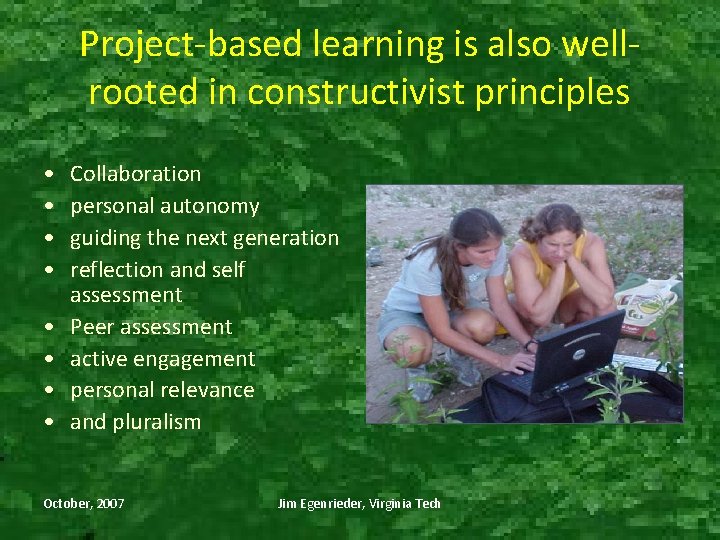
Project-based learning is also wellrooted in constructivist principles • • Collaboration personal autonomy guiding the next generation reflection and self assessment Peer assessment active engagement personal relevance and pluralism October, 2007 Jim Egenrieder, Virginia Tech
Project-based learning as inquiry • Project-based learning is an informal type of inquiry learning. • provides relevance, depth, application and understanding to the formal transfer of knowledge • inquiry, whether formal or informal, does not entirely replace the efficiency and effectiveness of lectures and classroom discussion. October, 2007 Jim Egenrieder, Virginia Tech
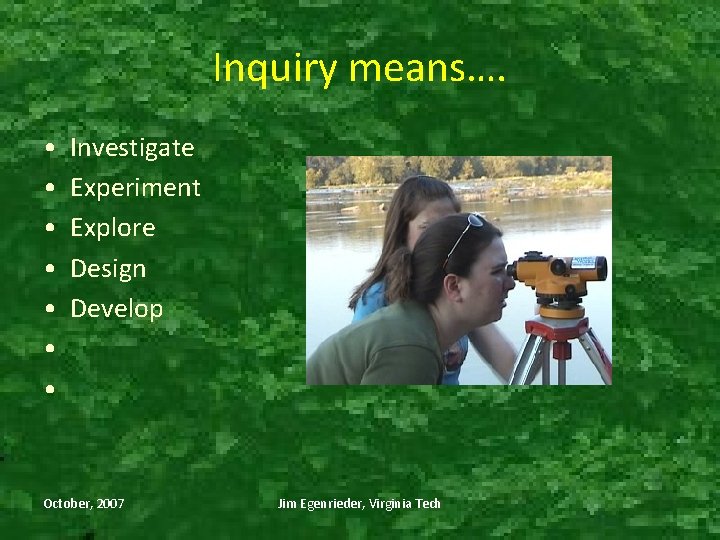
Inquiry means…. • • Investigate Experiment Explore Design Develop October, 2007 Jim Egenrieder, Virginia Tech
5 -E Approach to Inquiry IDENTIFY THE SCIENTIFIC CONCEPT FOR THE LESSON • Engage - real-world or practical applications • Explore - opportunities for students to observe, collect and record information • Explain – driven by research questions • Elaborate (Extend) – deepen students’ understanding • Evaluate – throughout; and then revise October, 2007 Jim Egenrieder, Virginia Tech
Inquiry and Established Curricula • NSES promote an emphasis on guiding students in active and extended inquiry • NSES also promote teachers’ recognizing and responding to students’ individual interests, strengths, experiences and needs • AAAS promotes inquiry through investigation as the tool for scientific literacy October, 2007 Jim Egenrieder, Virginia Tech
In Virginia • Beginning with the third grade, all Virginia Science Standards of Learning except chemistry begin with, “The student will plan and conduct investigations in which…” followed by a grade-specific or subjectspecific list of metrics that typically include observations, background research, and the construction of a scientific viewpoint (Virginia Department of Education, 2007). • Standards for the younger grades and chemistry include investigations but not planning. October, 2007 Jim Egenrieder, Virginia Tech
Project-based learning parallels the most familiar scientific methods: a. ) a problem or question is identified; b. ) background information is developed to identify possible solutions (and predictions and hypotheses); c. ) procedures to evaluate the solution are performed; d. ) inferences are made; e. ) the solution is evaluated in consideration of other knowledge; f. ) the results are presented to others; and g. ) the outcomes are discussed and further inquiry is considered October, 2007 Jim Egenrieder, Virginia Tech
The Nature of Science: • demand for empirical evidence • multiple approaches to defining problems and conducting research • the creative aspects of research • the role of technologies • recognition of inherent subjectivity, and • the cultural and social influences on science October, 2007 Jim Egenrieder, Virginia Tech
Planning • School year • Science fairs • Phenology October, 2007 Jim Egenrieder, Virginia Tech
The Grow-Out Cycle • • Choosing species Species’ requirements Finding seeds Choosing seeds Designs Growing Planting October, 2007 Jim Egenrieder, Virginia Tech
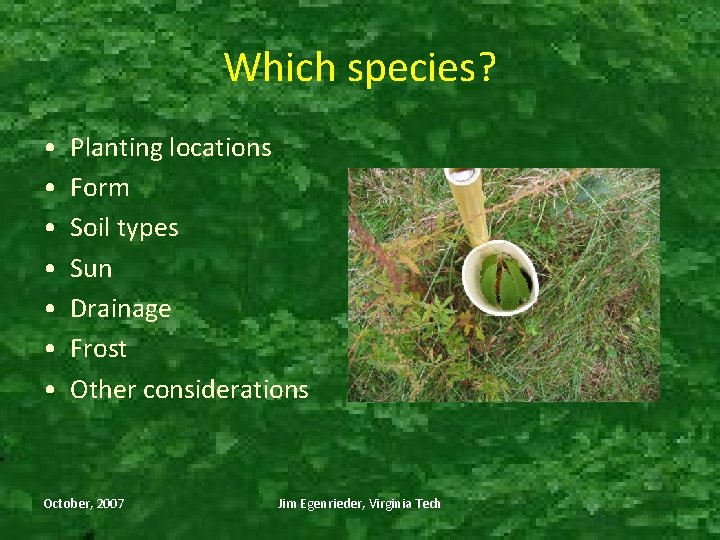
Which species? • • Planting locations Form Soil types Sun Drainage Frost Other considerations October, 2007 Jim Egenrieder, Virginia Tech
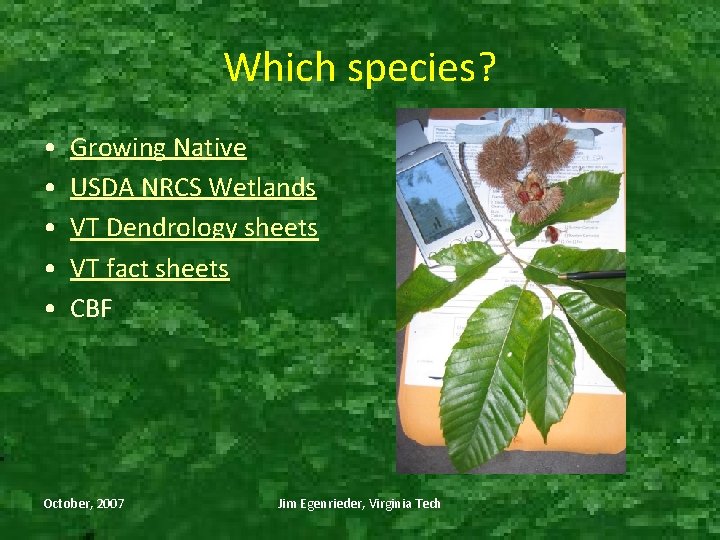
Which species? • • • Growing Native USDA NRCS Wetlands VT Dendrology sheets VT fact sheets CBF October, 2007 Jim Egenrieder, Virginia Tech
Species recommended by CBF • • • Green ash (Fraxinus pennsylvanica) – dendro, site River birch (Betula nigra) – dendro, site Black gum ( Nyssa sylvatica) – dendro, site Sweet gum (Liquidambar styraciflua) – dendro, site Red maple (Acer rubrum) – dendro, site Sycamore (Platanus occidentalis) – dendro, site October, 2007 Jim Egenrieder, Virginia Tech
Species recommended by CBF • • • Hackberry (Celtis occidentalis) – dendro, site Sweetbay magnolia (Magnolis virginiana) – dendro, site Loblolly pine (Pinus taeda) – dendro, site Black willow (Salix nigra) – dendro, site Pin oak (Quercus palustris) – dendro, site Willow oak (Quercus phellos) – dendro, site October, 2007 Jim Egenrieder, Virginia Tech
Species recommended by CBF • • • Southern arrowood (Viburnum dentatum) – dendro, site Winterberry (Ilex verticillata) – dendro, site Spicebush (Lindera benzoin) – dendro, site Buttonbush (Cephalantus occidentalis) – dendro, site Red Chokeberry (Aronia arbutifolia) – dendro, site Serviceberry (Amelanchier canadensis) – dendro, site October, 2007 Jim Egenrieder, Virginia Tech
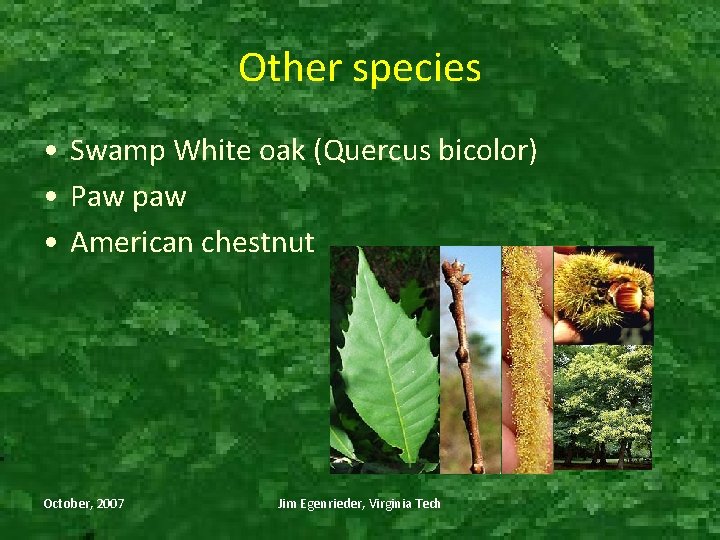
Other species • Swamp White oak (Quercus bicolor) • Paw paw • American chestnut October, 2007 Jim Egenrieder, Virginia Tech
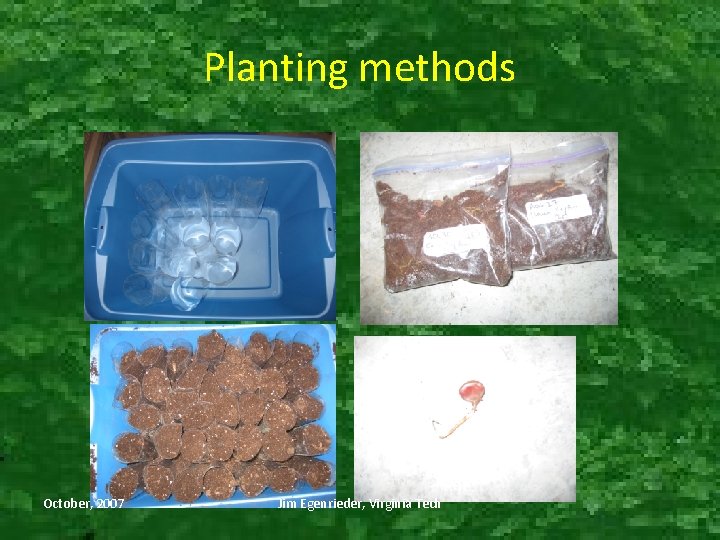
Planting methods October, 2007 Jim Egenrieder, Virginia Tech
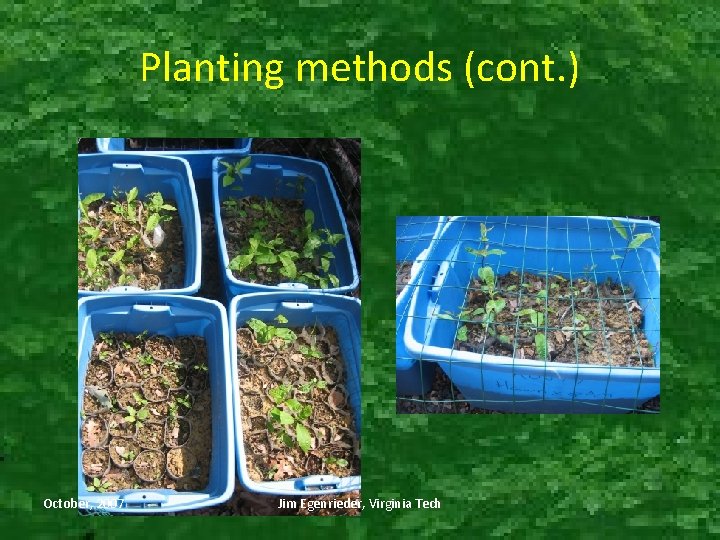
Planting methods (cont. ) October, 2007 Jim Egenrieder, Virginia Tech
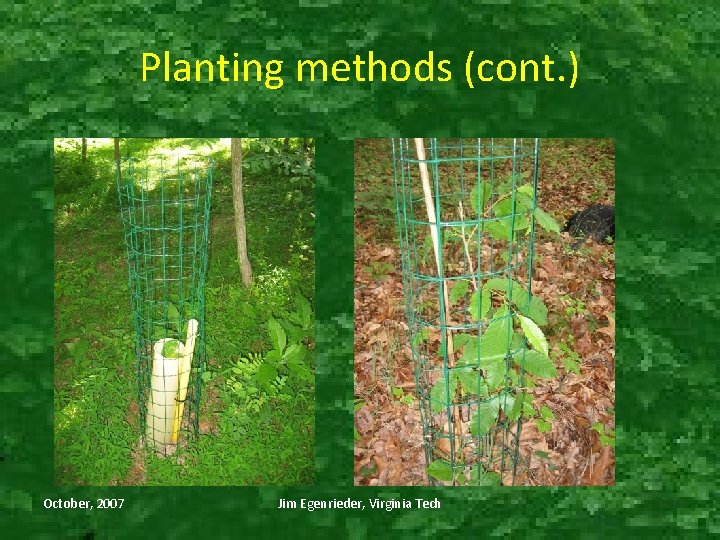
Planting methods (cont. ) October, 2007 Jim Egenrieder, Virginia Tech
Other Resources There are other resources available that may help one in establishing an orchard and for further growing: – The TACF handbook to Growing American Chestnuts – Other TACF growers – http: //chestnut. cas. psu. edu/breeding. html – The Northern Nut Growers Association • Many knowledgeable growers, particularly for growing chestnuts for nut production • http: //www. nutgrowing. org October, 2007 Jim Egenrieder, Virginia Tech

October, 2007 Jim Egenrieder, Virginia Tech
Species requirements • • • Soil type Drainage p. H Light Deer damage October, 2007 Jim Egenrieder, Virginia Tech
Trees that don’t need much help • • Silver maple Redbud Cedar Black locust October, 2007 Jim Egenrieder, Virginia Tech
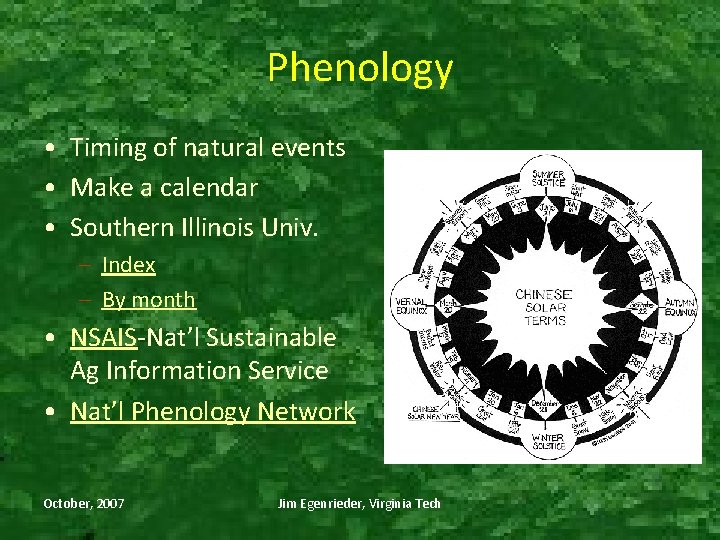
Phenology • Timing of natural events • Make a calendar • Southern Illinois Univ. – Index – By month • NSAIS-Nat’l Sustainable Ag Information Service • Nat’l Phenology Network October, 2007 Jim Egenrieder, Virginia Tech
Seed Handling • • Natural germination Dormancy Germination indoors Container-in-container methods October, 2007 Jim Egenrieder, Virginia Tech
Resources Links • • • Growing Native CBF Grow-Out stations - Marcy Damon: (443) 482 -2156 Virginia Tech’s Dr. Dendro More VT dendrology links Cooperative Extension: MD, VA, WV Science Content Standards: MD, VA, WV October, 2007 Jim Egenrieder, Virginia Tech
Contact me. Jim Egenrieder Wood House Research Farm HC 86 Box 404 Green Spring, WV 26722 Jim. E@vt. edu or jim@woodhouseresearch. org 304 -492 -4292 703 -599 -3643 (cell) www. woodhouseresearch. org or http: //www. nvc. vt. edu/education/mathscience/ October, 2007 Jim Egenrieder, Virginia Tech
- Slides: 36