CIMH FFT Statewide Conference April 23 24 2009





- Slides: 17
CIMH FFT Statewide Conference April 23 & 24, 2009 Sacramento, CA FFT National / International New Data And Implementation Trends (And Lessons Learned) James F. Alexander, Ph. D. Material based on presentations and data bases provided by (in alphabetical order) Jim Alexander, Malinda Freidag, Amy Hollimon, Helen Midouhas, Andrea Neeb, Charles Turner
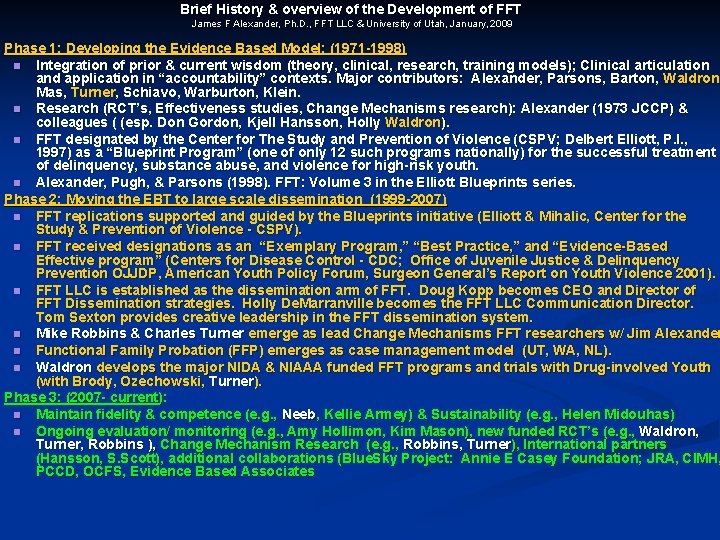
Brief History & overview of the Development of FFT James F Alexander, Ph. D. , FFT LLC & University of Utah, January, 2009 Phase 1: Developing the Evidence Based Model: (1971 -1998) n Integration of prior & current wisdom (theory, clinical, research, training models); Clinical articulation and application in “accountability” contexts. Major contributors: Alexander, Parsons, Barton, Waldron Mas, Turner, Schiavo, Warburton, Klein. n Research (RCT’s, Effectiveness studies, Change Mechanisms research): Alexander (1973 JCCP) & colleagues ( (esp. Don Gordon, Kjell Hansson, Holly Waldron). n FFT designated by the Center for The Study and Prevention of Violence (CSPV; Delbert Elliott, P. I. , 1997) as a “Blueprint Program” (one of only 12 such programs nationally) for the successful treatment of delinquency, substance abuse, and violence for high-risk youth. n Alexander, Pugh, & Parsons (1998). FFT: Volume 3 in the Elliott Blueprints series. Phase 2: Moving the EBT to large scale dissemination (1999 -2007) n FFT replications supported and guided by the Blueprints initiative (Elliott & Mihalic, Center for the Study & Prevention of Violence - CSPV). n FFT received designations as an “Exemplary Program, ” “Best Practice, ” and “Evidence-Based Effective program” (Centers for Disease Control - CDC; Office of Juvenile Justice & Delinquency Prevention OJJDP, American Youth Policy Forum, Surgeon General’s Report on Youth Violence 2001). n FFT LLC is established as the dissemination arm of FFT. Doug Kopp becomes CEO and Director of FFT Dissemination strategies. Holly De. Marranville becomes the FFT LLC Communication Director. Tom Sexton provides creative leadership in the FFT dissemination system. n Mike Robbins & Charles Turner emerge as lead Change Mechanisms FFT researchers w/ Jim Alexander n Functional Family Probation (FFP) emerges as case management model (UT, WA, NL). n Waldron develops the major NIDA & NIAAA funded FFT programs and trials with Drug-involved Youth (with Brody, Ozechowski, Turner). Phase 3: (2007 - current): n Maintain fidelity & competence (e. g. , Neeb, Kellie Armey) & Sustainability (e. g. , Helen Midouhas) n Ongoing evaluation/ monitoring (e. g. , Amy Hollimon, Kim Mason), new funded RCT’s (e. g. , Waldron, Turner, Robbins ), Change Mechanism Research (e. g. , Robbins, Turner), International partners (Hansson, S. Scott), additional collaborations (Blue. Sky Project: Annie E Casey Foundation; JRA, CIMH, PCCD, OCFS, Evidence Based Associates
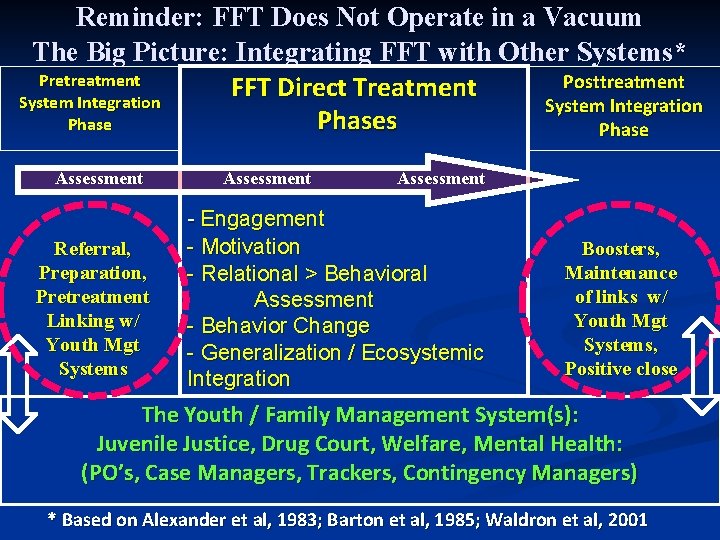
Reminder: FFT Does Not Operate in a Vacuum The Big Picture: Integrating FFT with Other Systems* Pretreatment Posttreatment FFT Direct Treatment System Integration Phases Phase Assessment - Engagement Referral, Preparation, Pretreatment Linking w/ Youth Mgt Systems - Motivation - Relational > Behavioral Assessment - Behavior Change - Generalization / Ecosystemic Integration Boosters, Maintenance of links w/ Youth Mgt Systems, Positive close The Youth / Family Management System(s): Juvenile Justice, Drug Court, Welfare, Mental Health: (PO’s, Case Managers, Trackers, Contingency Managers) * Based on Alexander et al, 1983; Barton et al, 1985; Waldron et al, 2001
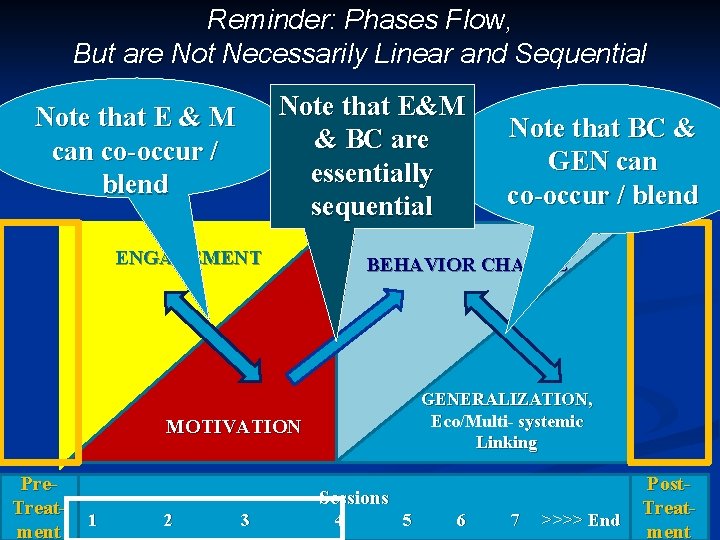
Reminder: Phases Flow, But are Not Necessarily Linear and Sequential Note that E&M & BC are essentially sequential Note that E & M can co-occur / blend ENGAGEMENT BEHAVIOR CHANGE GENERALIZATION, Eco/Multi- systemic Linking MOTIVATION Pre. Treatment Note that BC & GEN can co-occur / blend Sessions 1 2 3 4 5 6 7 >>>> End Post. Treatment
Does Adherence Still Count? Supervisor Ratings and Outcomes in Functional Family Therapy Charles W. Turner, Ph. D. 1, Andrea A. Neeb, M. S. 2, James F. Alexander, Ph. D. 3 Oregon Research Institute, 2 Functional Family Therapy, Fort Worth, FL, 3 University of Utah, Functional Family Therapy, Salt Lake City 1 Presented at the Annual Convention of the American Psychological Association, Boston, MA, August 14, 2008. The research was supported in part by funding from the National Institute on Drug Abuse (NIDA)
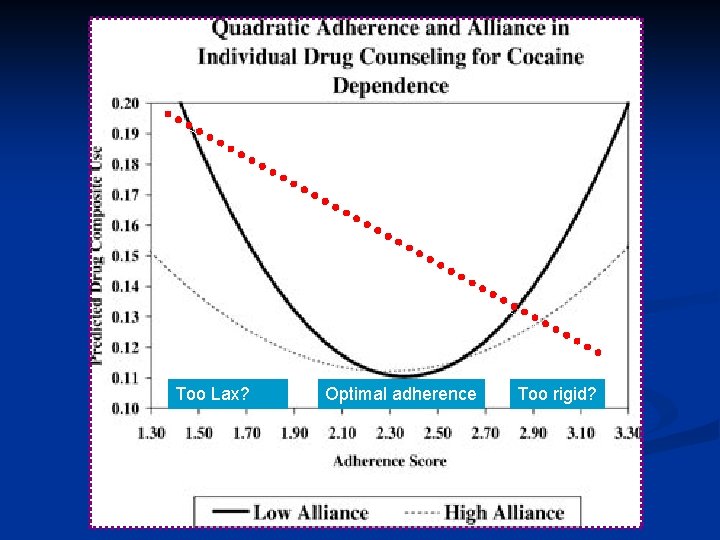
Too Lax? Optimal adherence Too rigid?
Relationship of Adherence to FFT and Dropout Rates by Phase of Treatment Note: The association of Adherence level to dropout status yielded a c 2 (6) = 36. 48, p <. 001
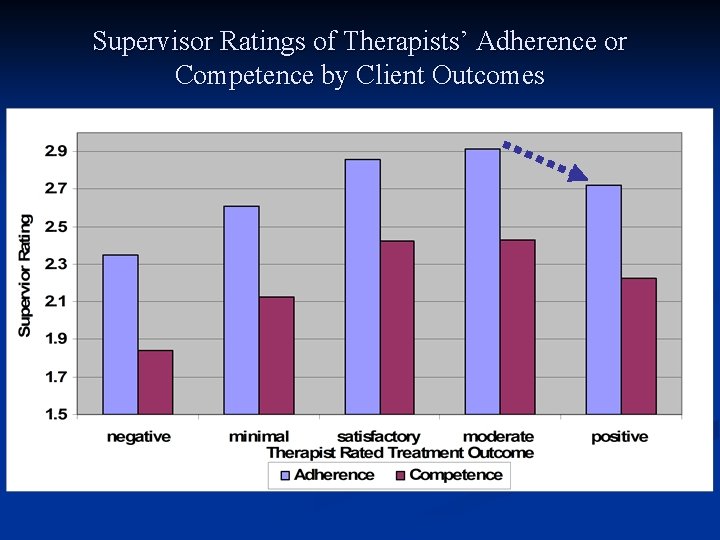
Supervisor Ratings of Therapists’ Adherence or Competence by Client Outcomes
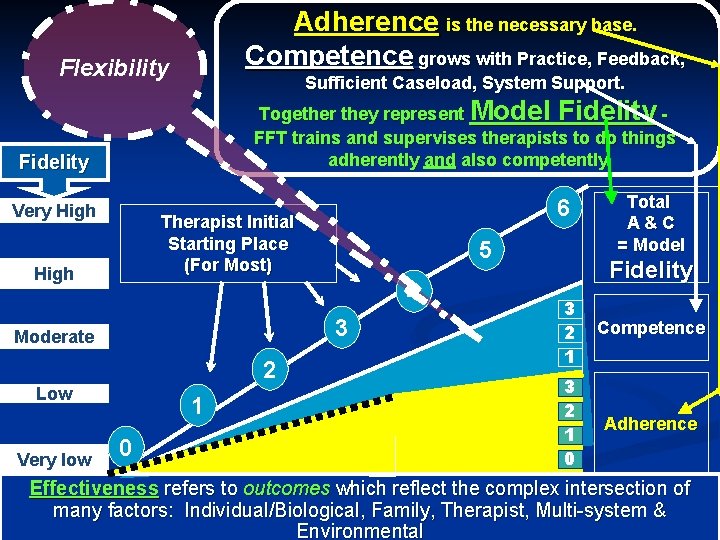
Adherence is the necessary base. Competence grows with Practice, Feedback, Flexibility Sufficient Caseload, System Support. Together they represent Model Fidelity FFT trains and supervises therapists to do things adherently and also competently Fidelity Very High Therapist Initial Starting Place (For Most) High 5 4 3 Moderate 2 Low Very low 6 1 0 Total A&C = Model Fidelity 3 2 1 Competence 3 2 1 0 Adherence Effectiveness refers to outcomes which reflect the complex intersection of many factors: Individual/Biological, Family, Therapist, Multi-system & Environmental
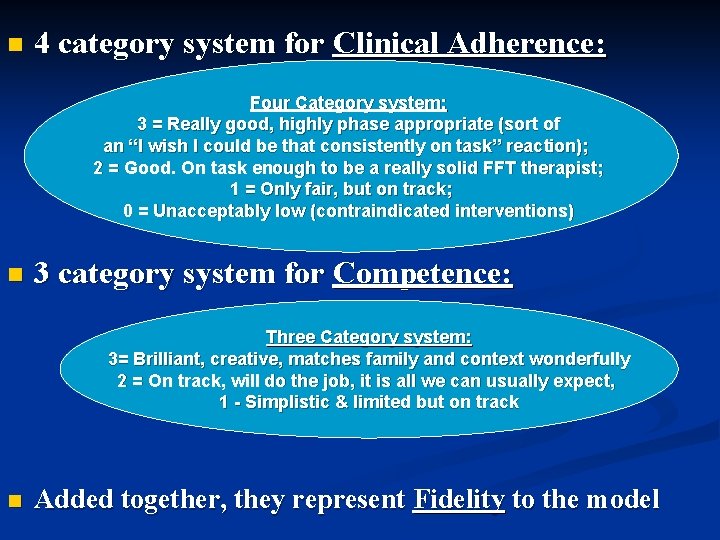
n 4 category system for Clinical Adherence: Four Category system: 3 = Really good, highly phase appropriate (sort of an “I wish I could be that consistently on task” reaction); 2 = Good. On task enough to be a really solid FFT therapist; 1 = Only fair, but on track; 0 = Unacceptably low (contraindicated interventions) n 3 category system for Competence: Three Category system: 3= Brilliant, creative, matches family and context wonderfully 2 = On track, will do the job, it is all we can usually expect, 1 - Simplistic & limited but on track n Added together, they represent Fidelity to the model
Within Family Alliance in FFT Across Segments 1 & 2 of Sessions 1 & 2 Positive Change Shows Up (or Not) Early
Therapist Rated Outcomes by Ethnic Origin for Male Participants Note: Values for each bar represent the percent of the males in each ethnic group that was rated by therapist as having the indicated outcome.
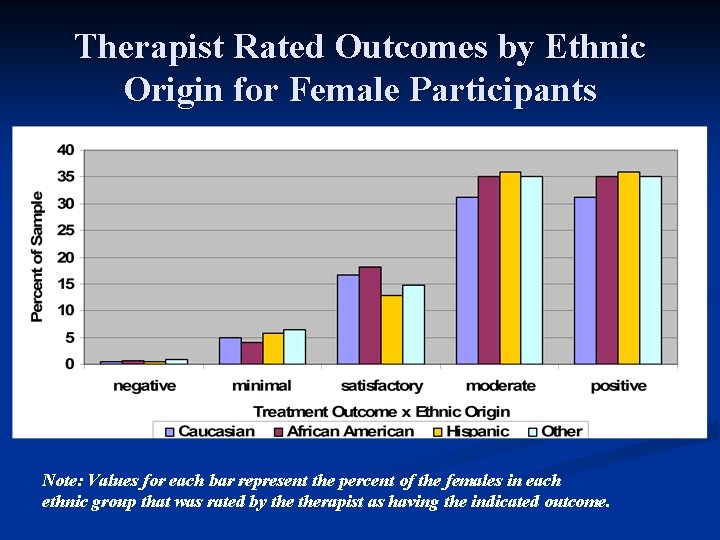
Therapist Rated Outcomes by Ethnic Origin for Female Participants Note: Values for each bar represent the percent of the females in each ethnic group that was rated by therapist as having the indicated outcome.
Retention Status at the End of Each Treatment Phase Treatment by Adolescent Gender Note: Cell entries are the percent of each gender entering treatment who remain at the end of each phase of treatment. c 2 (3) = 7. 607, p <. 06.
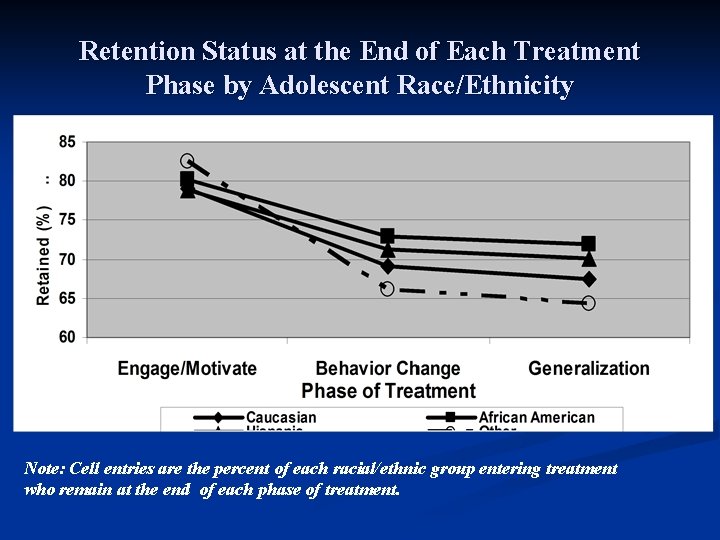
Retention Status at the End of Each Treatment Phase by Adolescent Race/Ethnicity Note: Cell entries are the percent of each racial/ethnic group entering treatment who remain at the end of each phase of treatment.
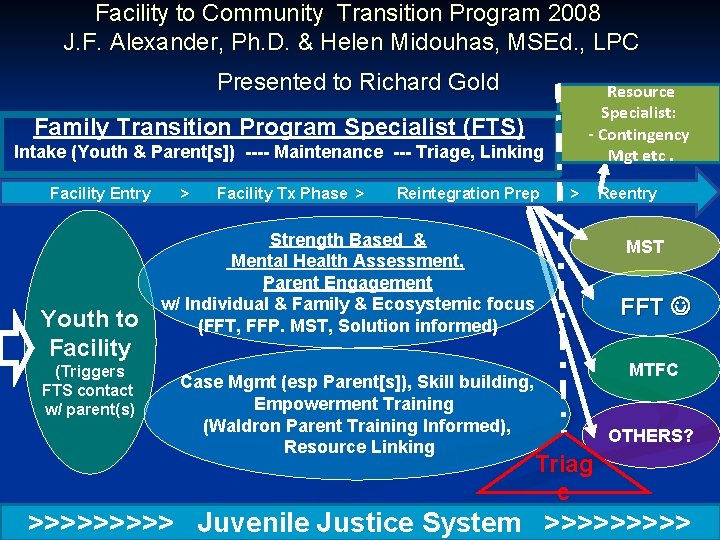
Facility to Community Transition Program 2008 J. F. Alexander, Ph. D. & Helen Midouhas, MSEd. , LPC Presented to Richard Gold Resource Specialist: - Contingency Mgt etc. Family Transition Program Specialist (FTS) Intake (Youth & Parent[s]) ---- Maintenance --- Triage, Linking Facility Entry Youth to Facility (Triggers FTS contact w/ parent(s) > Facility Tx Phase > Reintegration Prep > Strength Based & Mental Health Assessment, Parent Engagement w/ Individual & Family & Ecosystemic focus (FFT, FFP. MST, Solution informed) Case Mgmt (esp Parent[s]), Skill building, Empowerment Training (Waldron Parent Training Informed), Resource Linking Reentry MST FFT MTFC OTHERS? Triag e >>>>> Juvenile Justice System >>>>>
Points of Contact of Ideal Reentry Program: The Integrated FTS >>> Community Based FFT Model (Gold, PA) Reentry Coordinator (e. g. , FTS Specialist) initiates A link with a Reentry Coordinator Community Based FFT provider (e. g. , FTS Specialist) (or other EBT while youth is makes a conjoint family still in facility and/or home visits) initial relationship to begin family based (FFT) to establish Engagement & Motivation with a future perspective and youth and parent(s) balanced alliance FFT or alternative efficacious & effective family Based Intervention maintain communication, esp with parents Entry Into System In Facility: FTS Transition FTS Natural Environment FFT