THE SHORT STORY 1 2 3 Identify and

- Slides: 37
THE SHORT STORY 1. 2. 3. Identify and interpret various literary elements used in the short story Analyze the effects the elements have upon the reader Analyze the emotions felt during the reading
Shaping the Short Story “Human life itself may be almost pure chaos, but the work of the artist is to take these handfuls of confusion and put them together in a frame to give them some kind of shape and meaning. ” - Katherine Anne Porter American Short Story Writer
Plot and Setting o o o When, Where, and How Setting: The time and place in which the events of a literary work occur. Physical surroundings and ideas, customs, and values of a particular time and place. Atmosphere: The dominant emotional feeling of a literary work. Created through setting, such as time, place and weather. n Setting can be used to create mood
Let’s Practice! n Now, balanced easily and firmly, he stood on the ledge outside in the slight, chill, breeze, eleven stories above the street, staring into his own lighted apartment, odd and different-seeming now. - Jack Finney
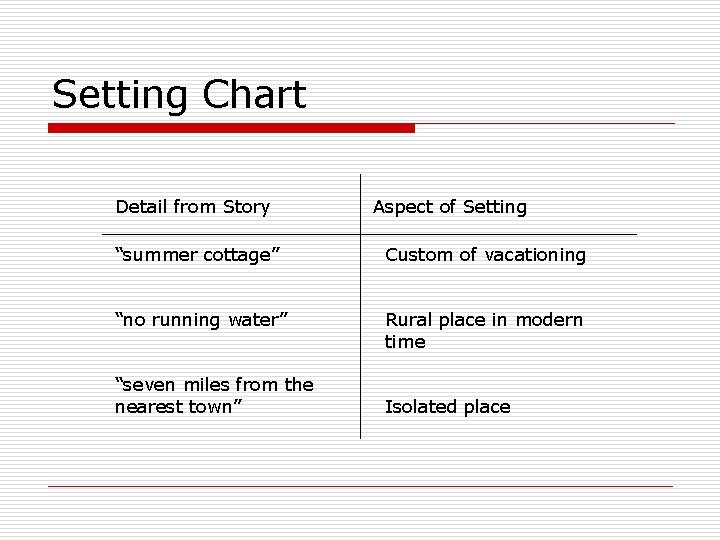
Creating Events and Places o The Allisons’ country cottage, seven miles from the nearest town, was set prettily on a hill; from three sides it looked down on soft trees and grass that seldom, even at mid-summer, lay still and dry. On the fourth side was the lake, which touched against the wooden pier the Allisons had to keep repairing, and which looked equally well from the Allisons’ front porch, their side porch or any other spot leading to the water. Although the Allisons loved their summer cottage, looked forward to arriving in early summer and hated to leave in the fall, they had not troubled themselves to put in any improvement. The cottage had no heat, no running water, and no electricity. – Shirley Jackson
Setting Chart Detail from Story Aspect of Setting “summer cottage” Custom of vacationing “no running water” Rural place in modern time “seven miles from the nearest town” Isolated place
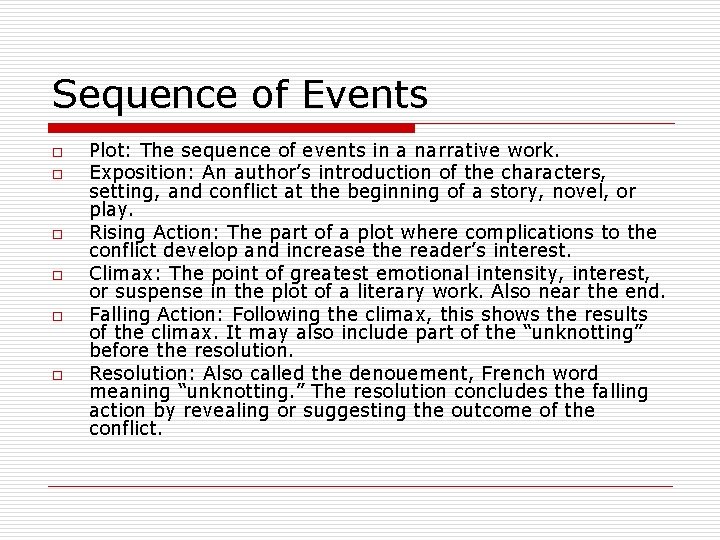
Sequence of Events o o o Plot: The sequence of events in a narrative work. Exposition: An author’s introduction of the characters, setting, and conflict at the beginning of a story, novel, or play. Rising Action: The part of a plot where complications to the conflict develop and increase the reader’s interest. Climax: The point of greatest emotional intensity, interest, or suspense in the plot of a literary work. Also near the end. Falling Action: Following the climax, this shows the results of the climax. It may also include part of the “unknotting” before the resolution. Resolution: Also called the denouement, French word meaning “unknotting. ” The resolution concludes the falling action by revealing or suggesting the outcome of the conflict.
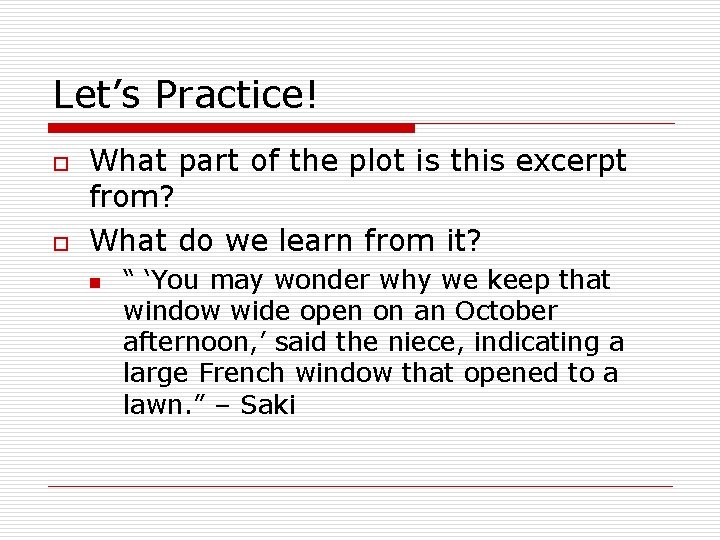
Let’s Practice! o o What part of the plot is this excerpt from? What do we learn from it? n “ ‘You may wonder why we keep that window wide open on an October afternoon, ’ said the niece, indicating a large French window that opened to a lawn. ” – Saki
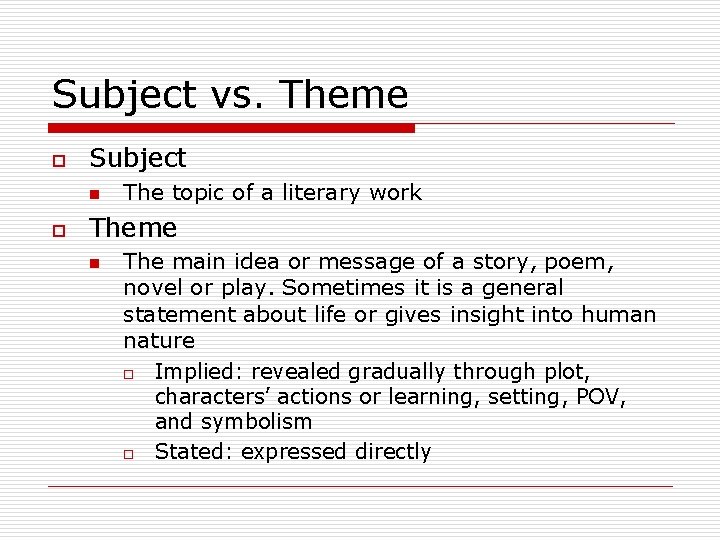
Subject vs. Theme o Subject n o The topic of a literary work Theme n The main idea or message of a story, poem, novel or play. Sometimes it is a general statement about life or gives insight into human nature o Implied: revealed gradually through plot, characters’ actions or learning, setting, POV, and symbolism o Stated: expressed directly
Let’s Practice! o o Is theme implied or stated? What is theme? n “Luis thought that maybe if they ate together once in a while things might get better between them, but he always had something to do around dinnertime and ended up at a hamburger joint. Tonight was the first time in months they had sat down at the table together. ” – Judith Ortiz Cofer
Character o Protagonist vs. Antagonist n The central character who faces the main conflict. Readers are supposed to sympathize with him or her. n A person or a force in society or nature that opposes the central character.
Conflict o Conflict: The struggle between opposing forces that advance a story or drama. n External: a character struggles against some outside force such as a person, nature, society or fate n Internal: a struggle that takes place in the mind of a character – torn between two opposing feelings or goals
Let’s Practice! o o o Who is the protagonist? Why? Who/what is the antagonist? What is the conflict? Who is it against? n “Thirty-five years ago I was out prospecting on the Stanislaus, tramping all day long with pick and pan and horn, and washing a hatful of dirt here and there, always expecting to make a rich strike, and never doing it. ” – Mark Twain
Let’s Practice! o o o Who is the protagonist? Why? Who/what is the antagonist? What is the conflict? Who is it against? n “Luis thought that maybe if they ate together once in a while things might get better between them, but he always had something to do around dinnertime and ended up at a hamburger joint. Tonight was the first time in months they had sat down at the table together. ” – Judith Ortiz Cofer
Narrator o Narrator: The person who tells a story – may be a character in the story. n n Unreliable: Intentionally mislead readers/don’t understand the true meaning of events they describe – usually in 1 st person Reliable: Truthful/can trust
Point of View o POV: The perspective from which a story is told. n n n 1 st Person: narrator is a character in the story/referred to as “I”/readers see everything through their eyes 3 rd Person Omniscient: (all knowing) narrator is not a character but standing outside looking in and commenting on the action/may reveal details characters could not 3 rd Person Limited: narrator reveals thoughts, feelings and observations of characters/refers to them as “he” or “she”
Let’s Practice! o What point of view is this excerpt? n “The young man was daring and brave, eager to go up to the mountaintop. He had been brought up by good, honest people who were wise in the ancient ways and who prayed for him. ” –Lame Deer
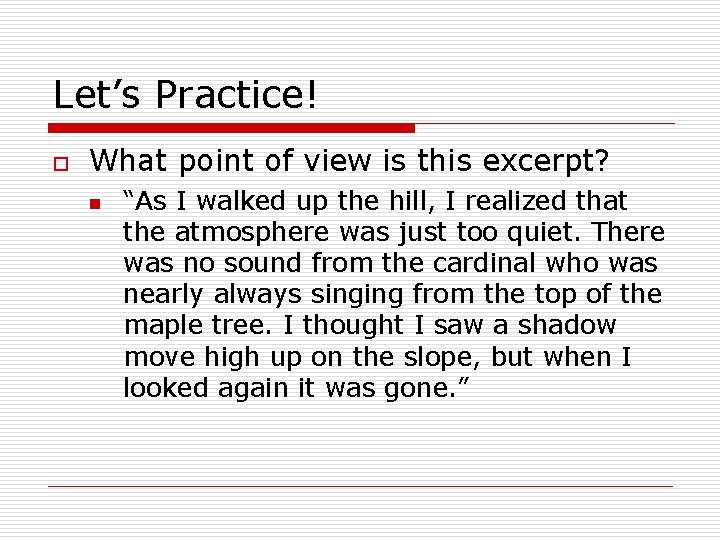
Let’s Practice! o What point of view is this excerpt? n “As I walked up the hill, I realized that the atmosphere was just too quiet. There was no sound from the cardinal who was nearly always singing from the top of the maple tree. I thought I saw a shadow move high up on the slope, but when I looked again it was gone. ”
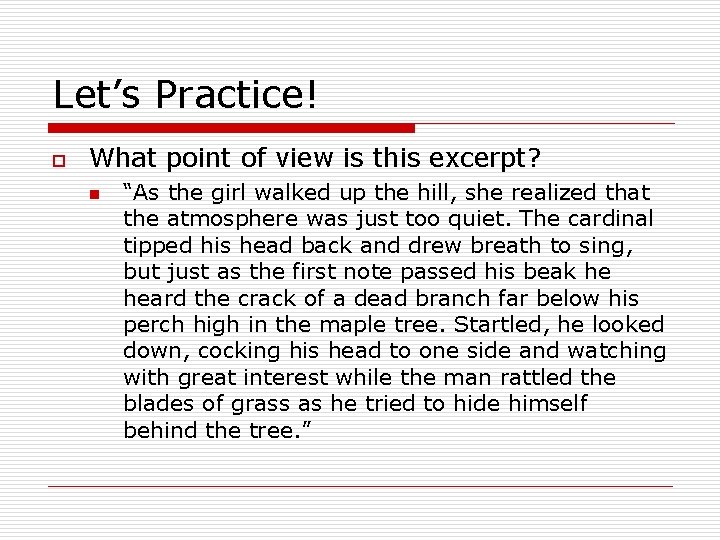
Let’s Practice! o What point of view is this excerpt? n “As the girl walked up the hill, she realized that the atmosphere was just too quiet. The cardinal tipped his head back and drew breath to sing, but just as the first note passed his beak he heard the crack of a dead branch far below his perch high in the maple tree. Startled, he looked down, cocking his head to one side and watching with great interest while the man rattled the blades of grass as he tried to hide himself behind the tree. ”
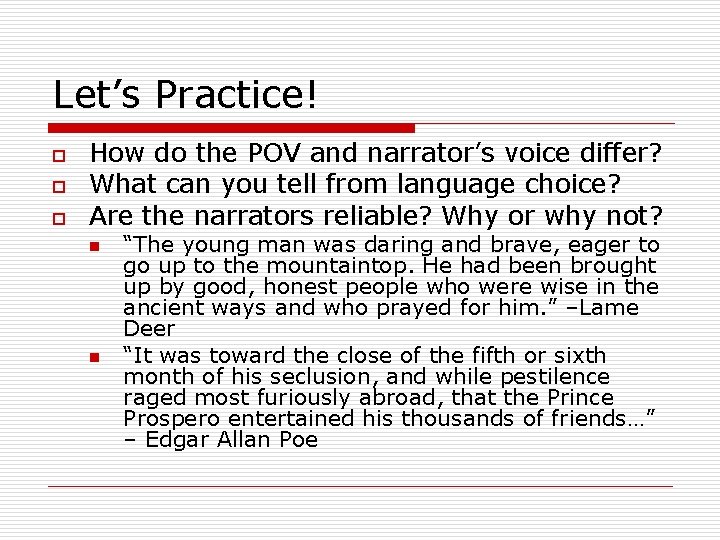
Let’s Practice! o o o How do the POV and narrator’s voice differ? What can you tell from language choice? Are the narrators reliable? Why or why not? n n “The young man was daring and brave, eager to go up to the mountaintop. He had been brought up by good, honest people who were wise in the ancient ways and who prayed for him. ” –Lame Deer “It was toward the close of the fifth or sixth month of his seclusion, and while pestilence raged most furiously abroad, that the Prince Prospero entertained his thousands of friends…” – Edgar Allan Poe
Title o The name given to a literary work. Can help explain setting, theme, or describe action taking place.
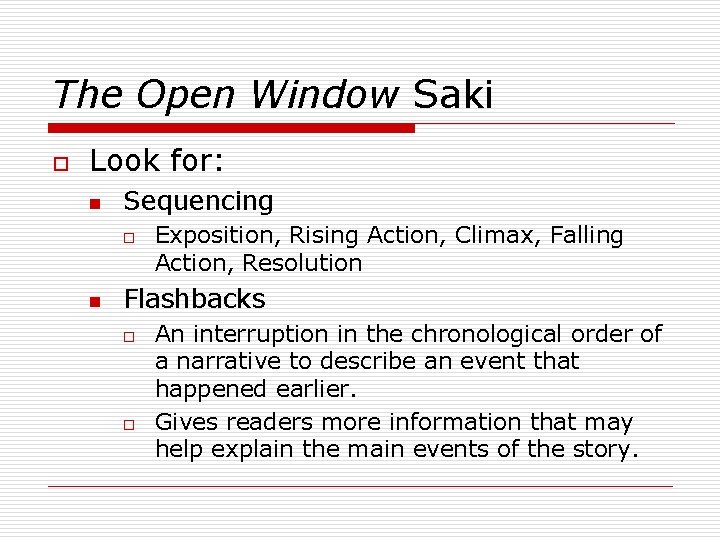
The Open Window Saki o Look for: n Sequencing o n Exposition, Rising Action, Climax, Falling Action, Resolution Flashbacks o o An interruption in the chronological order of a narrative to describe an event that happened earlier. Gives readers more information that may help explain the main events of the story.
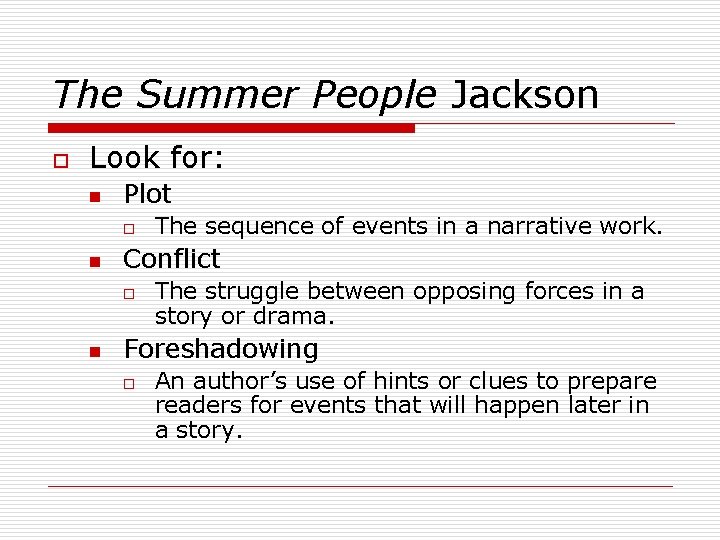
The Summer People Jackson o Look for: n Plot o n Conflict o n The sequence of events in a narrative work. The struggle between opposing forces in a story or drama. Foreshadowing o An author’s use of hints or clues to prepare readers for events that will happen later in a story.
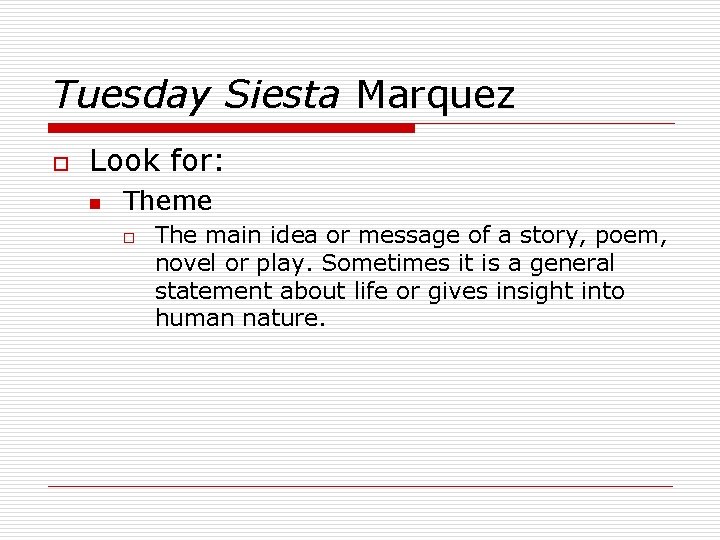
Tuesday Siesta Marquez o Look for: n Theme o The main idea or message of a story, poem, novel or play. Sometimes it is a general statement about life or gives insight into human nature.
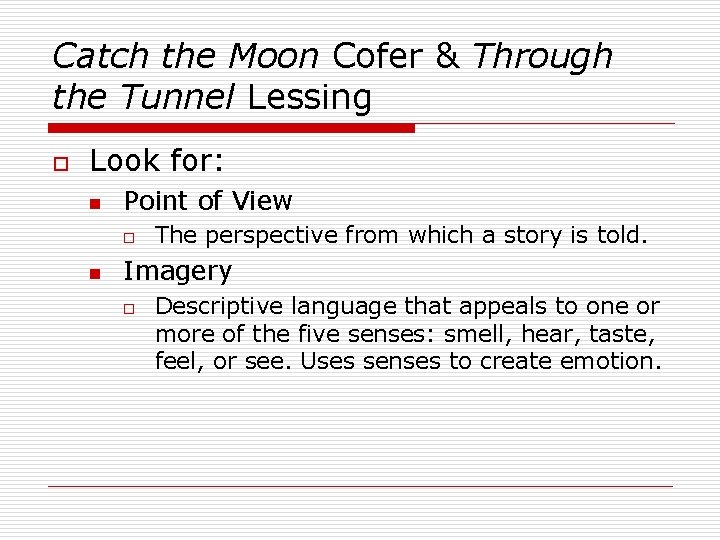
Catch the Moon Cofer & Through the Tunnel Lessing o Look for: n Point of View o n The perspective from which a story is told. Imagery o Descriptive language that appeals to one or more of the five senses: smell, hear, taste, feel, or see. Uses senses to create emotion.
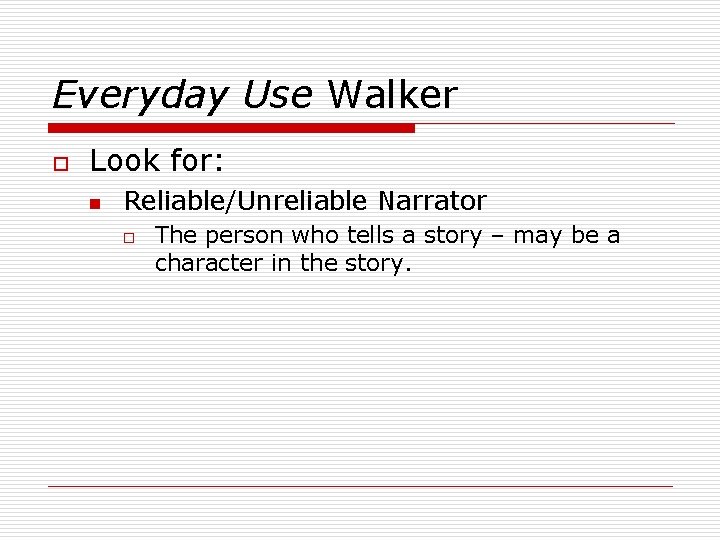
Everyday Use Walker o Look for: n Reliable/Unreliable Narrator o The person who tells a story – may be a character in the story.
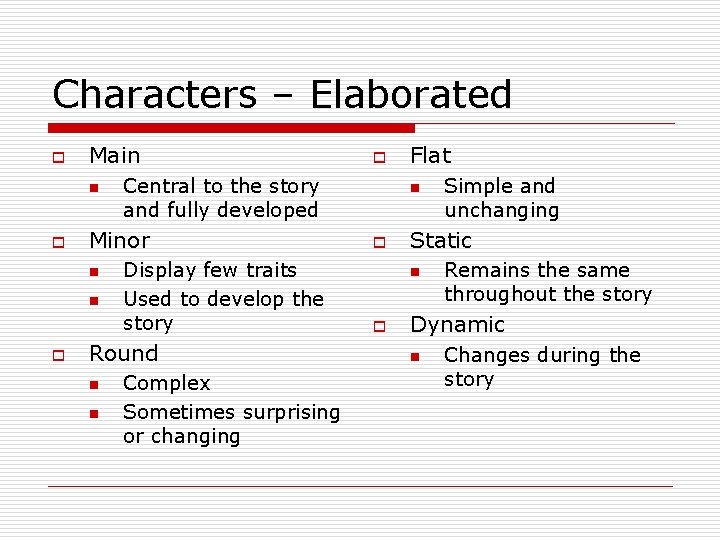
Characters – Elaborated o Main n o Central to the story and fully developed Minor n Display few traits Used to develop the story Round n n o Complex Sometimes surprising or changing Flat n o Static n o Simple and unchanging Remains the same throughout the story Dynamic n Changes during the story
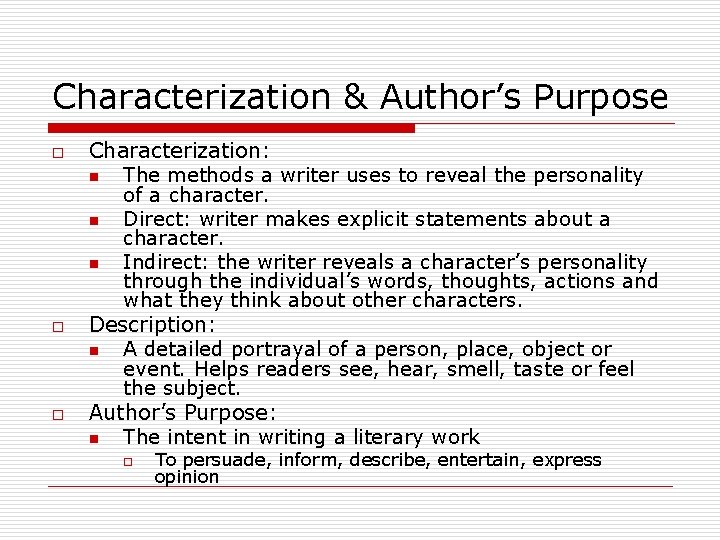
Characterization & Author’s Purpose o o o Characterization: n The methods a writer uses to reveal the personality of a character. n Direct: writer makes explicit statements about a character. n Indirect: the writer reveals a character’s personality through the individual’s words, thoughts, actions and what they think about other characters. Description: n A detailed portrayal of a person, place, object or event. Helps readers see, hear, smell, taste or feel the subject. Author’s Purpose: n The intent in writing a literary work o To persuade, inform, describe, entertain, express opinion
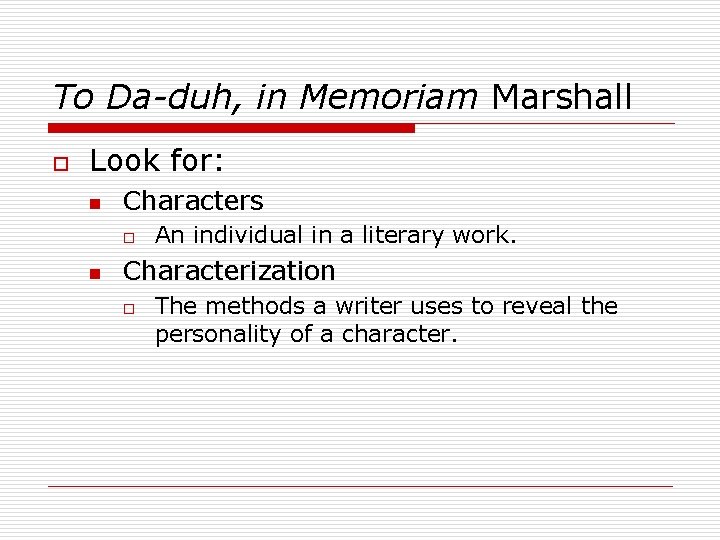
To Da-duh, in Memoriam Marshall o Look for: n Characters o n An individual in a literary work. Characterization o The methods a writer uses to reveal the personality of a character.
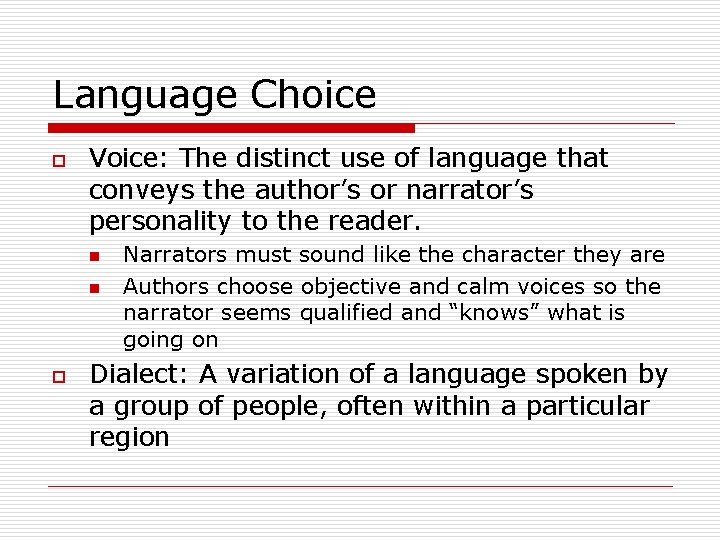
Language Choice o Voice: The distinct use of language that conveys the author’s or narrator’s personality to the reader. n n o Narrators must sound like the character they are Authors choose objective and calm voices so the narrator seems qualified and “knows” what is going on Dialect: A variation of a language spoken by a group of people, often within a particular region
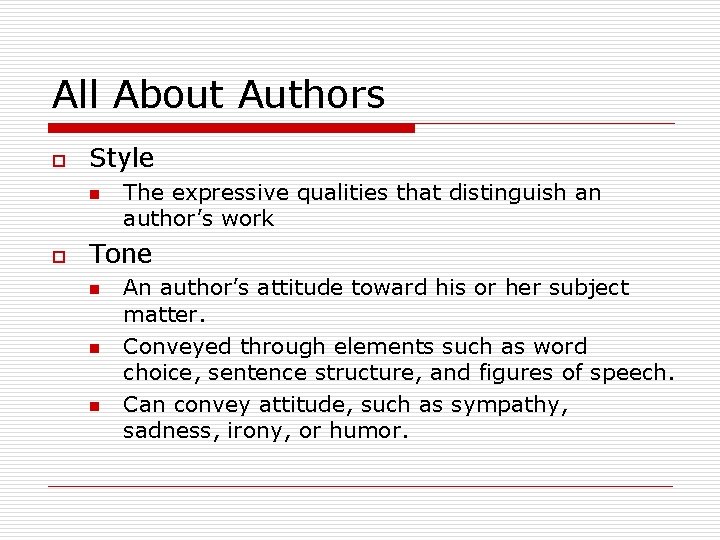
All About Authors o Style n o The expressive qualities that distinguish an author’s work Tone n n n An author’s attitude toward his or her subject matter. Conveyed through elements such as word choice, sentence structure, and figures of speech. Can convey attitude, such as sympathy, sadness, irony, or humor.
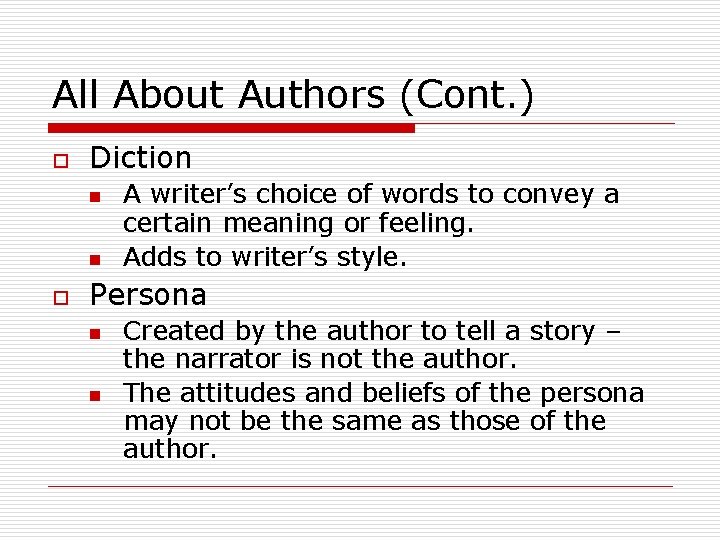
All About Authors (Cont. ) o Diction n n o A writer’s choice of words to convey a certain meaning or feeling. Adds to writer’s style. Persona n n Created by the author to tell a story – the narrator is not the author. The attitudes and beliefs of the persona may not be the same as those of the author.
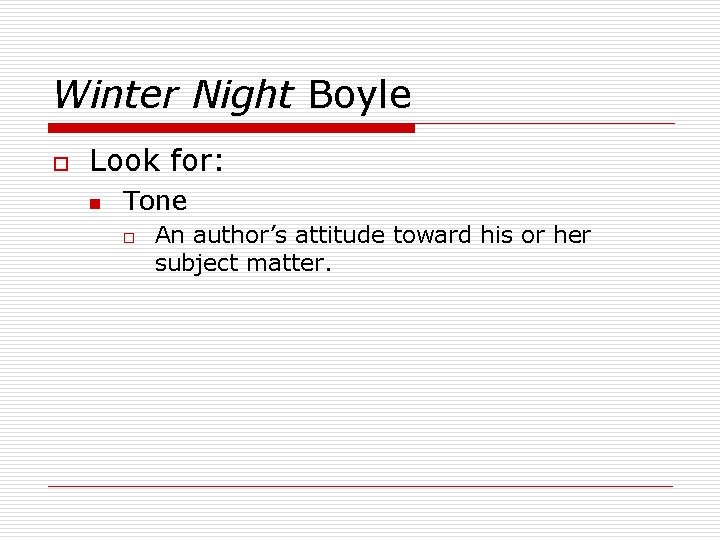
Winter Night Boyle o Look for: n Tone o An author’s attitude toward his or her subject matter.
Additional Literary Elements o Symbolism n o Mood n o Any person, animal, place, object, or event that exists on a literal level within a work but also represents something on a figurative level. The emotional quality of literary work. Irony n A contrast between expectation and reality, or between what is expected and what actually happens
The Masque of the Red Death Poe o Look for: n Mood o The emotional quality of literary work
Contents of a Dead Man’s Pockets Finney o Look for: n Symbolism o Any person, animal, place, object, or event that exists on a literal level within a work but also represents something on a figurative level.
The Book of the Dead Danticat o Look for: n Irony o A contrast between expectation and reality, or between what is expected and what actually happens