Elements of a Short Story Elements of a



- Slides: 15
Elements of a Short Story
Elements of a Short Story Objectives • Identify elements of a short story • Define elements of a short story • Demonstrate mastery of short story elements
Plot Character (and Point of View) Conflict Theme Settings
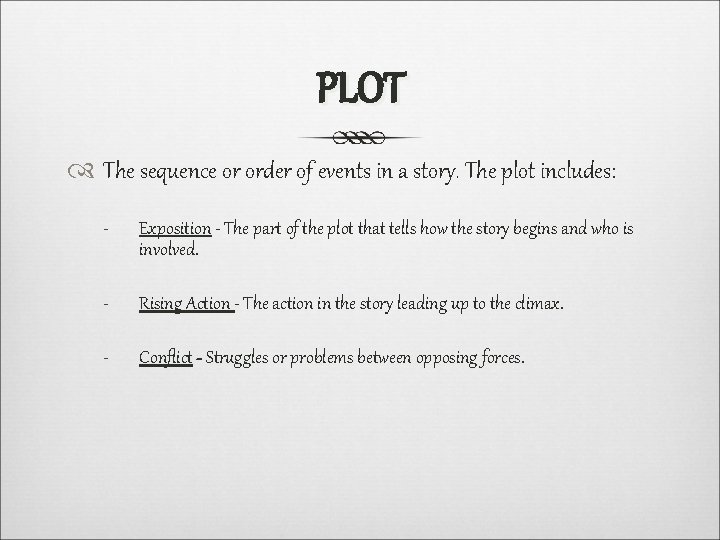
PLOT The sequence or order of events in a story. The plot includes: - Exposition - The part of the plot that tells how the story begins and who is involved. - Rising Action - The action in the story leading up to the climax. - Conflict - Struggles or problems between opposing forces.
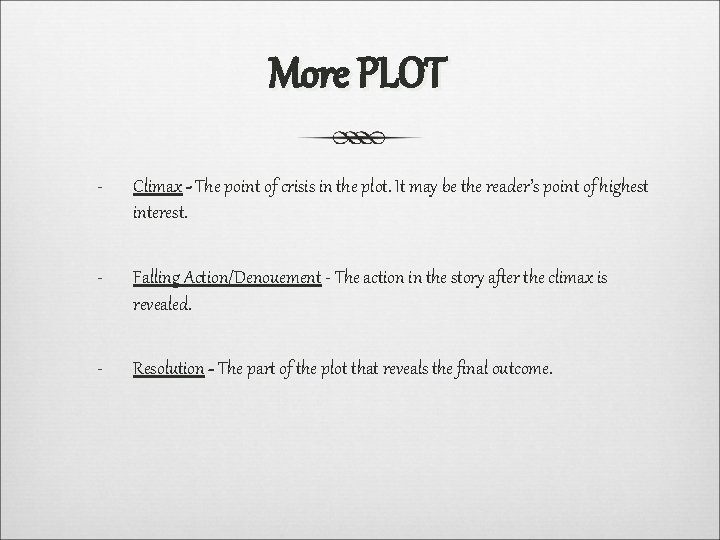
More PLOT - Climax - The point of crisis in the plot. It may be the reader’s point of highest interest. - Falling Action/Denouement - The action in the story after the climax is revealed. - Resolution - The part of the plot that reveals the final outcome.
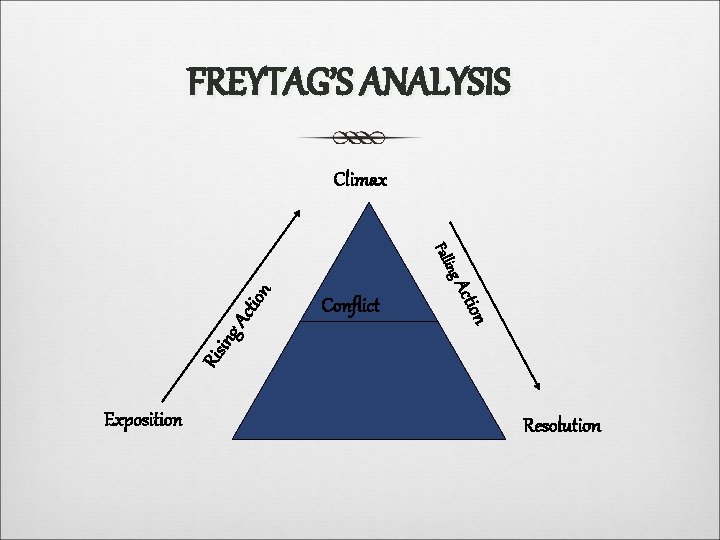
FREYTAG’S ANALYSIS Climax g. A Ris in n o Acti ctio n ing Fall Conflict Exposition Resolution
CHARACTERS The people within the story. CHARACTERIZATION The description of the personalities of the characters in the story and the way in which an author reveals their personalities.
Point of View The angle from which the story is being told (the Narrator). Types of P. O. V. First person: Often told by main character (or protagonist) of the story. Uses “I” to describe events and feelings
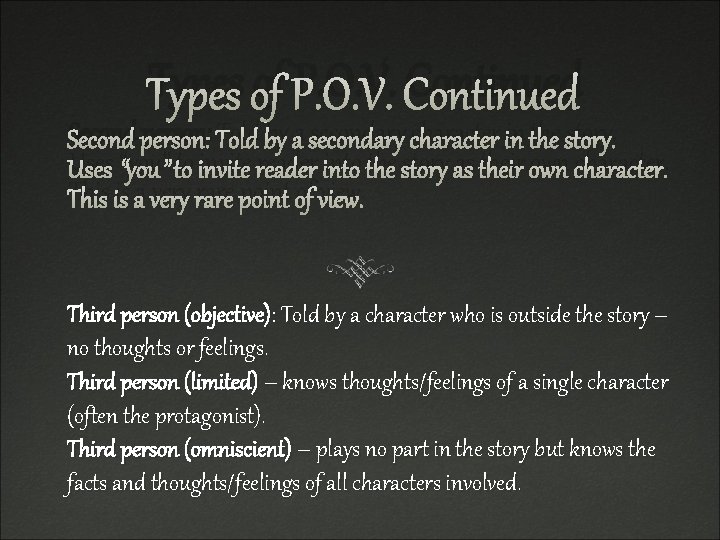
Types of P. O. V. Continued Second person: Told by a secondary character in the story. Uses “you” to invite reader into the story as their own character. This is a very rare point of view. Third person (objective): Told by a character who is outside the story – no thoughts or feelings. Third person (limited) – knows thoughts/feelings of a single character (often the protagonist). Third person (omniscient) – plays no part in the story but knows the facts and thoughts/feelings of all characters involved.
CONFLICT Conflict is essential to plot. Conflict is not merely limited to open arguments, rather it is any form of opposition that faces the main character. There are 2 types and 5 kinds of Conflict which we will look at more fully later.
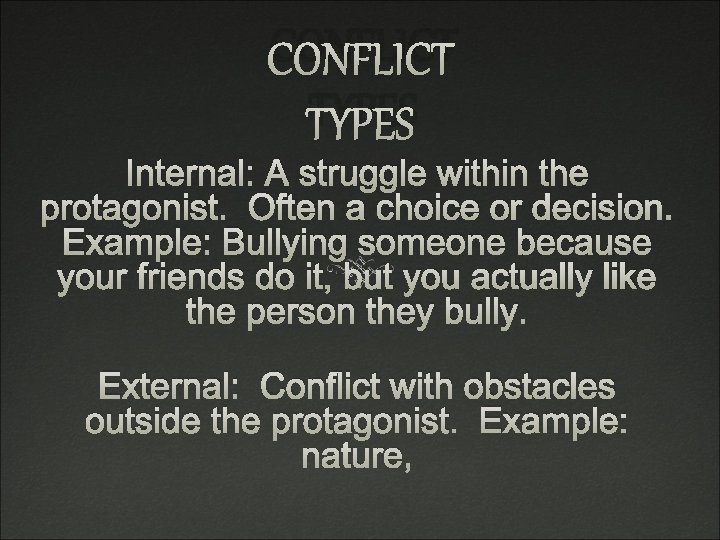
CONFLICT TYPES Internal: A struggle within the protagonist. Often a choice or decision. Example: Bullying someone because your friends do it, but you actually like the person they bully. External: Conflict with obstacles outside the protagonist. Example: nature,
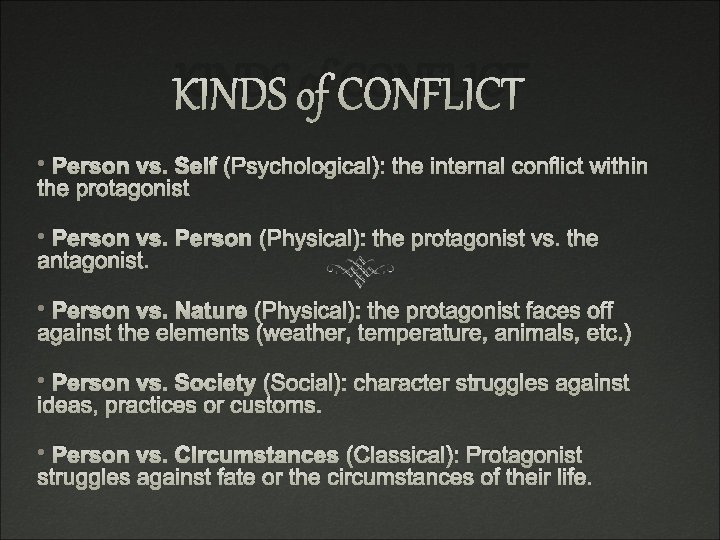
KINDS of CONFLICT • Person vs. Self (Psychological): the internal conflict within the protagonist • Person vs. Person (Physical): the protagonist vs. the antagonist. • Person vs. Nature (Physical): the protagonist faces off against the elements (weather, temperature, animals, etc. ) • Person vs. Society (Social): character struggles against ideas, practices or customs. • Person vs. Circumstances (Classical): Protagonist struggles against fate or the circumstances of their life.
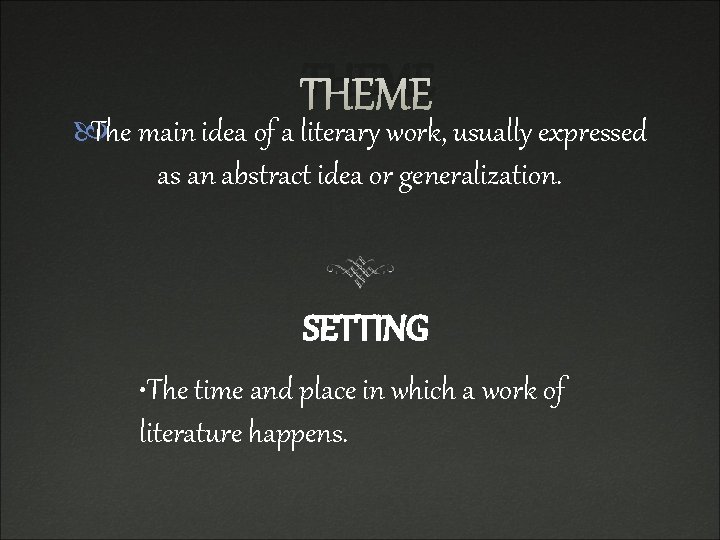
THEME The main idea of a literary work, usually expressed as an abstract idea or generalization. SETTING • The time and place in which a work of literature happens.
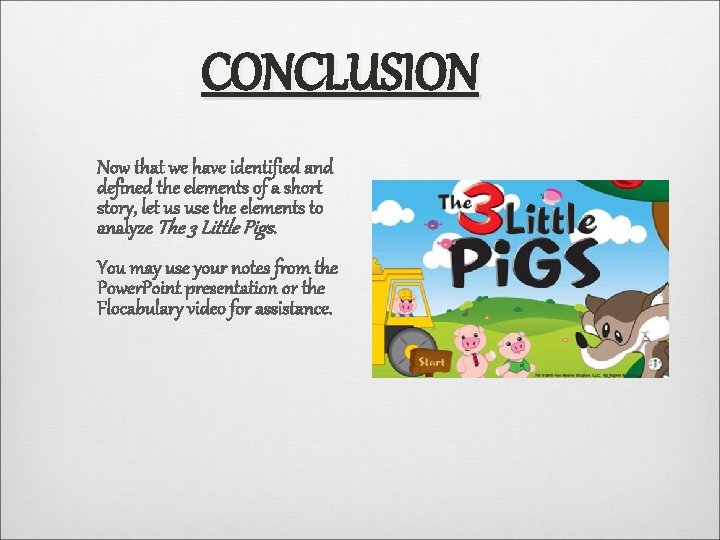
CONCLUSION Now that we have identified and defined the elements of a short story, let us use the elements to analyze The 3 Little Pigs. You may use your notes from the Power. Point presentation or the Flocabulary video for assistance.
Bibliography Dinneen, K. Elements of the Short Story. Retrieved Jun. 19, 2003, from Yale-New Haven Teachers Institute: http: //www. yale. edu/ynhti/curriculum/units/1983/3/83. 09. x. html Five Elements of a Story. Retrieved Jun. 19, 2003, http: //www. teachervision. com/lesson-plans/lesson-2277. html Guevin, D. Short Story Elements. Retrieved Jun. 19, 2003, http: //www. uvm. edu/~dguevin/Elements. html